
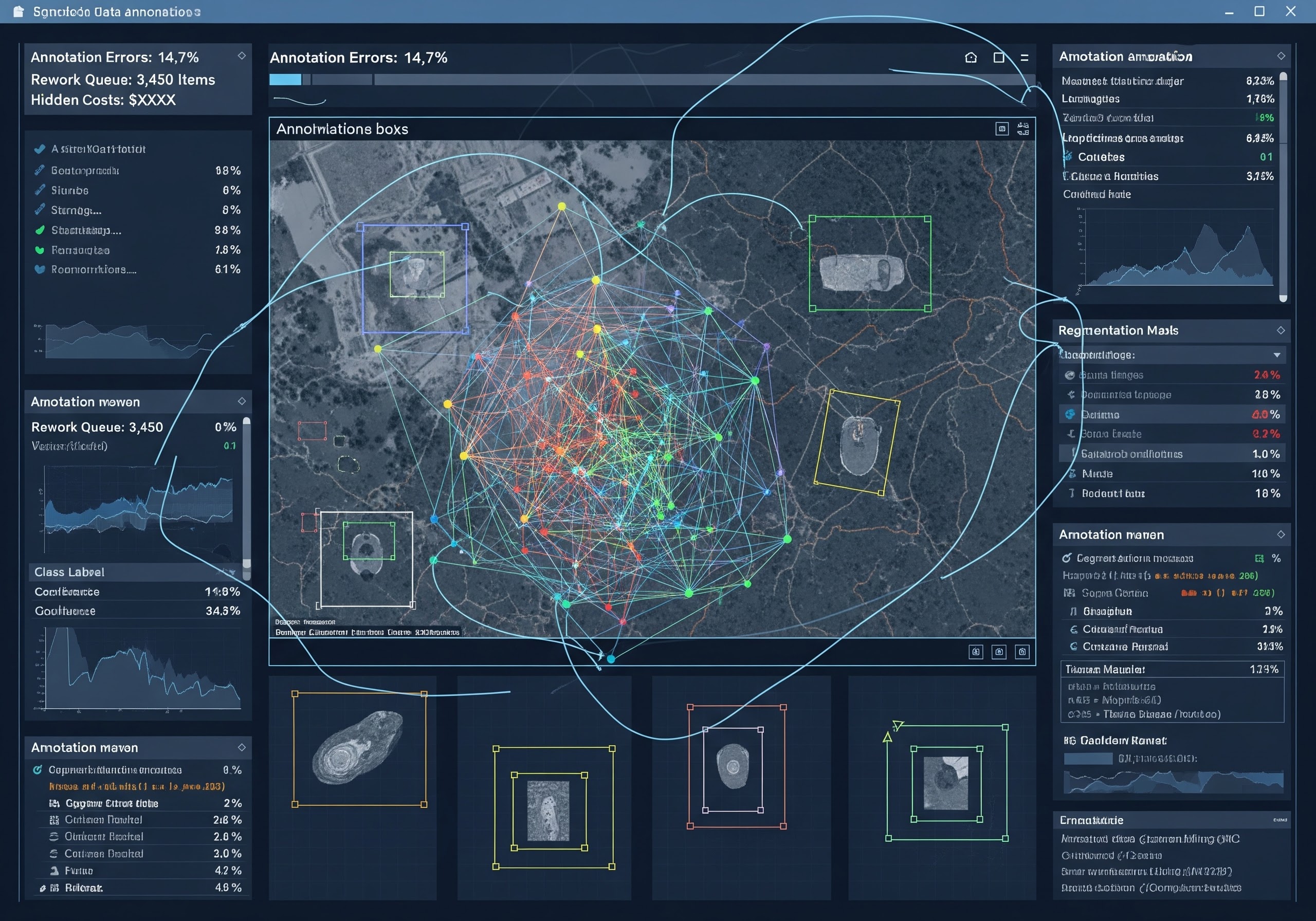
Enterprise image labeling services cost significantly more than crowd-sourced platforms advertise, once rework cycles, QA overhead, and downstream model failures are included in the calculation. Crowd-sourced image annotation services quote attractive per-label rates, but those rates rarely account for the correction cycles that consume engineering time and delay model readiness.
Teams that optimize for price-per-label without modeling their full rework rate consistently underestimate total annotation program spend by 30–60%. Managed annotation services with structured QA pipelines reduce those rework loops and deliver lower total cost of ownership at production scale. Understanding the challenges in large-scale data annotation is the starting point for building a labeling program whose costs are actually predictable.
Key Takeaways
- Crowd-sourced image annotation platforms quote labor only. QA review, rework cycles, and engineering management typically add 30–60% to the true program cost.
- A 5% defect rate on 200,000 images means 10,000 corrections, and if the root cause isn’t fixed, the same errors recur in every subsequent batch.
- Annotation errors get more expensive the later you find them. A bad label caught during QA costs a fraction of what it costs to diagnose after it has influenced model training and evaluation.
- Managed annotation services often have lower total cost, not just higher quality. The higher per-label rate is typically offset by fewer rework cycles and faster model readiness, making the overall program spend lower.
- Crowd-only pipelines struggle with high spatial precision requirements, ambiguous taxonomy, compliance-grade QA needs, and iterative active learning workflows, exactly the conditions common in large enterprise AI programs.
What is an Enterprise Image Labeling Service?
Image labeling services, also referred to as image annotation services, are the structured workflows that produce the ground-truth datasets computer vision models learn from. At the enterprise level, this means labeling large volumes of images with precisely defined metadata; bounding boxes for object detection, semantic or instance segmentation masks, keypoint skeletons for pose estimation, polygon contours for irregular shapes, and classification labels for scene understanding. The annotation type, task complexity, and inter-annotator agreement requirements all vary by model objective.
Enterprise image annotation programs differ from ad-hoc labeling in several ways. They operate at volumes of hundreds of thousands to millions of images. They require domain-specific annotator expertise, for example, a pedestrian detection program for ADAS needs annotators who understand sensor perspective and occlusion edge cases, not generalist crowd workers. And they require quality measurement infrastructure, including inter-annotator agreement (IAA) scoring, golden-set validation, consensus protocols, and auditable QA logs that support model governance requirements.
The term “image labeling” is sometimes used interchangeably with “image tagging” in lower-complexity contexts, but at the enterprise level, the distinction matters. Tagging assigns coarse classification labels; labeling produces the precise spatial and semantic annotations that train production perception models. Conflating the two leads to scope and cost misalignments early in program planning.
Why Is Enterprise Image Labeling More Expensive Than Crowd-Sourced Platforms Suggest?
Crowd-sourced annotation platforms display a price-per-label that reflects labor input only, the cost of a worker completing a single annotation task. What that price does not include is any of the structural overhead required to make those labels reliable enough for model training. The gap between the advertised rate and the true program cost is where most enterprise teams get surprised.
Several costs are routinely omitted from platform pricing:
- QA and review overhead: Crowd-sourced work typically requires 15–30% of task volume to be re-reviewed or adjudicated, adding labor and tooling costs that are not in the base rate.
- Rework cycles: When a batch fails quality thresholds, the entire batch must be re-annotated. Depending on the error rate and the quality bar, this can trigger multiple rework rounds.
- Engineering time: Someone on your team must manage the data pipeline, write quality rejection logic, triage ambiguous labels, and communicate corrections back to the labeling pool.
- Downstream model cost: Labels that pass QA but contain systematic errors, for example, consistent boundary drift, class confusion, etc. only surface during model evaluation. At that point, the remediation cost includes re-annotation, retraining, and re-evaluation time.
A production-level analysis of what 99.5% annotation accuracy actually means shows that even modest error rates, when compounded across large datasets and multiple training iterations, generate significant correction overhead. The per-label price point on a crowd platform does not reflect that compounding effect.
How Do Rework Loops Multiply the True Cost of Image Annotation?
Rework loops are the primary driver of annotation cost overruns. A rework loop occurs when labeled data fails quality thresholds, either during QA review or during model evaluation, and must be corrected before training can proceed. Each loop adds direct labor cost, delays the model development timeline, and often requires additional coordination overhead to communicate error patterns back to annotators. This rework has a compounding impact on the overall cost
Consider a dataset of 200,000 images with a 5% defect rate after initial labeling. That is 10,000 images requiring correction. If the correction round itself has a 5% error rate, you have another 500 images to fix. Meanwhile, the underlying taxonomy ambiguities or guideline gaps that caused the original errors may not have been addressed, meaning the same error types will recur in the next batch. As unreliable annotation pipelines tend to generate, rework loops are rarely one-time events; they repeat until the root cause in the labeling process is identified and resolved.
The model-training multiplier makes this worse. When systematic annotation errors reach training, the model learns incorrect decision boundaries. Identifying that the model problem originates in label quality, rather than architecture, hyperparameters, or data distribution, takes several evaluation cycles. Each cycle consumes GPU compute, ML engineer time, and calendar time. The annotation error that costs $0.08 to produce can cost orders of magnitude more to diagnose and remediate downstream.
What Does a Rework-Inclusive Cost Model Actually Look Like?
A rework-inclusive cost model starts by separating four cost categories that crowd-platform pricing collapses into one:
- Direct annotation cost: Price per label × volume. This is the number most programs budget for.
- QA and review cost: Time to audit, adjudicate, and track quality metrics across the annotated batch, typically 15–25% of direct annotation cost for crowd-sourced work.
- Rework cost: Re-annotation cost for failed batches, multiplied by the number of rework cycles. This is the most variable and often most underestimated category.
- Downstream remediation cost: Engineering, computing, and re-evaluation time spent addressing model problems that originate in label quality. Often invisible in annotation budgets but real in overall AI program spend.
When you model these four categories together, the total cost of a crowd-only program at moderate quality (95% accuracy) versus a managed-service program at higher quality (99.5%+ accuracy) often inverts. The managed service charges more per label, sometimes 2 – 3 times more, but the reduction in rework cycles and downstream remediation typically produces a lower total program cost.
Crowd-Only vs. Managed Annotation: Where the Unit Economics Diverge
Crowd-only annotation platforms provide maximum throughput flexibility. They work well for tasks with clear visual boundaries, low taxonomy complexity, and high tolerance for label variability, mainly basic classification, coarse bounding boxes for well-defined object classes, and simple tagging at scale. In those contexts, the crowd model is both efficient and cost-effective.
The model breaks down in several situations that are common in enterprise AI programs:
- High spatial precision requirements: Semantic segmentation masks for ADAS, polygon annotation for medical imaging, and keypoint annotations for robotics require consistency that crowd workers with high turnover cannot reliably deliver.
- Complex or ambiguous taxonomy: When the difference between two label classes requires domain judgment, for example, distinguishing a cyclist from a pedestrian in a partly-occluded frame, crowd workers without structured training produce high disagreement rates.
- Regulatory or compliance requirements: Programs subject to functional safety standards or AI governance frameworks need auditable QA logs, annotator qualification records, and traceable correction workflows that crowd platforms do not provide by default.
- Iterative active learning pipelines: Programs that continuously retrain on new data need annotation workflows that can prioritize high-uncertainty samples, update guidelines rapidly, and maintain consistency across annotation rounds, all of which require managed workflow infrastructure.
Human-in-the-loop approach to computer vision annotation for safety-critical systems provides the control layer that crowd-only pipelines lack: structured review, expert escalation paths, and feedback loops between annotators and quality managers. The economics of that structure pay off most clearly in programs where annotation errors are expensive to detect and expensive to fix.
The operational architecture of building AI-ready datasets at scale ultimately determines whether a program’s quality costs are controlled or compounding. Programs built on crowd-only models tend to discover their quality costs late — during model evaluation or production failure analysis. Programs built on managed annotation services surface quality issues earlier, where they are cheaper to fix.
How Digital Divide Data Can Help
DDD operates managed image annotation services with a QA infrastructure designed specifically to reduce rework loops at scale. Our annotation workflows include annotation-level IAA measurement, structured consensus protocols for ambiguous cases, golden-set validation batches, and annotator feedback loops that address taxonomy gaps before they propagate across a dataset. We track defect rates by error type and by annotator cohort, which means quality problems can be identified and corrected at the source rather than during model evaluation.
We also offer data collection and curation services that address upstream data quality before labeling begins, because poor source data quality is one of the most consistent drivers of downstream annotation rework. For programs with active learning requirements, our workflows support uncertainty-prioritized sample selection, rapid guideline iteration, and annotation consistency tracking across training rounds. The result is a labeling program whose cost structure is visible and controllable, rather than opaque and variable.
Whether you are evaluating crowd-sourced platforms against managed services or trying to reduce rework in an existing annotation program, quantifying your full rework-inclusive cost is the right starting point. Stop paying for rework loops. Talk to an Expert!
Conclusion
Enterprise image labeling programs that plan only from price-per-label consistently underestimate their true annotation program cost. The difference between what a crowd platform charges and what the managed program actually costs lies in rework cycles, QA overhead, and downstream model remediation, costs that are real but rarely itemized in initial budget models. Organizations that account for rework-inclusive costs from the start build programs that scale predictably. Those that optimize for the lowest per-label rate often spend more in aggregate as quality problems compound through training and evaluation cycles.
The organizations that consistently close the gap between annotation budget and annotation reality are those that treat labeling not as a commodity purchase but as a quality-critical production process. That shift in framing changes the vendor selection criteria, the QA investment, and ultimately the total program cost.
References
Northcutt, C. G., Athalye, A., Mueller, J. (2021). Pervasive label errors in test sets destabilize machine learning benchmarks. Proceedings of the 35th Conference on Neural Information Processing Systems (NeurIPS 2021 Track on Datasets and Benchmarks). https://arxiv.org/abs/2103.14749
Sambasivan, N., Kapania, S., Highfill, H., Akrong, D., Paritosh, P., Aroyo, L. M. (2021). “Everyone wants to do the model work, not the data work”: Data Cascades in High-Stakes AI. Proceedings of CHI 2021.https://dl.acm.org/doi/10.1145/3411764.3445518
Frequently Asked Questions
Why is enterprise image labeling more expensive than crowd-sourced platforms suggest?
Crowd platforms price the labor of completing an annotation task, but they don’t include QA review, rework cycles, or the engineering time needed to manage the pipeline. When you add those costs, plus the downstream model cost of catching bad labels during training, the total program cost is typically 30–60% higher than the per-label price implies.
What is a rework loop in data annotation, and why does it matter?
A rework loop happens when a batch of labeled data fails quality thresholds and has to be corrected and re-reviewed before it can be used for training. Rework loops matter because they add direct labor cost, slow down model development timelines, and if the root cause isn’t fixed, usually tend to repeat across multiple annotation batches.
When does it make economic sense to use a managed annotation service over a crowd platform?
Managed annotation services tend to have better total economics when annotation tasks require spatial precision, domain-specific expertise, or auditable QA workflows. In those situations, the higher per-label rate of a managed service is offset by significantly lower rework rates and faster model readiness, making the total program cost lower even if the label cost is higher.

Asit Dubey is a global operations leader with almost 30 years of experience across digitization, publishing, AI/ML, and LegalTech, currently serving as Executive Vice President at Digital Divide Data. He has led large-scale operations (3,500+ workforce) across APAC, EMEA, and North America, driving AI-led transformation and process excellence. A Six Sigma Black Belt, he specializes in automation, solutioning, and cost optimization, delivering productivity gains of over 300% and significant margin improvements. He has successfully scaled revenues from $750K to $3M+ monthly while turning around underperforming units. His expertise spans global delivery setup, GTM strategy, and client engagement. He is known for building resilient, multi-geo delivery models and enabling organizations to transition to AI-powered services.