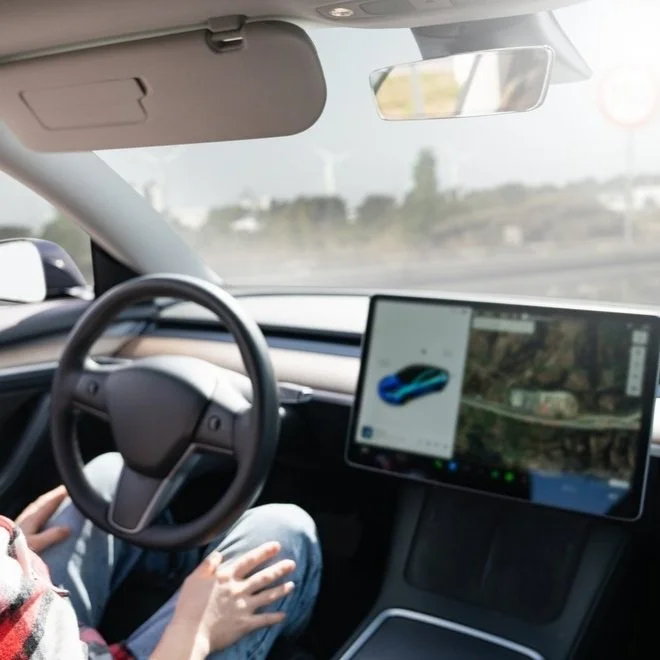

In-Cabin AI: Why Driver Condition & Behavior Annotation Matters
As vehicles move toward higher levels of automation, monitoring the human behind the wheel becomes just as important as monitoring traffic. When control shifts between machine and driver, even briefly, the system must know whether the person in the seat is alert, distracted, fatigued, or simply not paying attention.
Driver Monitoring Systems and Cabin Monitoring Systems are no longer optional features available only on premium trims. They are becoming regulatory expectations and safety differentiators. The conversation has shifted from convenience to accountability.
Here is the uncomfortable truth: in-cabin AI is only as reliable as the quality of the data used to train it. And that makes driver condition and behavior annotation mission-critical.
In this guide, we will explore what in-cabin AI actually does, why understanding human state is far more complex, how annotation defines system performance, and what a practical labeling taxonomy looks like.
What In-Cabin AI Actually Does
At a practical level, In-Cabin AI observes, measures, and interprets what is happening inside the vehicle in real time. Most commonly, that means tracking the driver’s face, eyes, posture, and interaction with controls to determine whether they are attentive and capable of driving safely.
A typical system starts with cameras positioned on the dashboard or steering column. These cameras capture facial landmarks, eye movement, and head orientation. From there, computer vision models estimate gaze direction, blink duration, and head pose. If a driver’s eyes remain off the road for longer than a defined threshold, the system may classify that as a distraction. If eye closure persists beyond a certain duration or blink frequency increases noticeably, it may indicate drowsiness. These are not guesses in the human sense. They are statistical inferences built on labeled behavioral patterns.
What makes this especially complex is that the system is continuously evaluating capability. In partially automated vehicles, the car may handle steering and speed for extended periods. Still, it must be ready to hand control back to the human. In that moment, the AI needs to assess whether the driver is alert enough to respond. Is their gaze forward? Are their hands positioned to take control? Have they been disengaged for the past thirty seconds? The system is effectively asking, several times per second, “Can this person safely drive right now?”
Understanding Human State Is Hard
Detecting a pedestrian is difficult, but at least it is visible. A pedestrian has edges, motion, shape, and a defined spatial boundary. Human internal state is different. Monitoring a driver involves subtle behavioral signals. A slight head tilt, a prolonged blink, a gaze that drifts for a fraction too long.
Interpretation depends on context. Looking left could mean checking a mirror. It could mean looking at a roadside billboard. The model must decide. And the data is inherently privacy sensitive. Faces, eyes, expressions, interior scenes. Annotation teams must handle such data carefully and ethically.
A model does not learn fatigue directly. It learns patterns mapped from labeled behavioral signals. If the annotation defines prolonged eye closure as greater than a specific duration, the model internalizes that threshold. If distraction is labeled only when gaze is off the road for more than two seconds, that becomes the operational definition.
Annotation is the bridge between pixels and interpretation. Without clear labels, models guess. With inconsistent labels, models drift. With carefully defined labels, models can approach reliability.
Why Driver Condition and Behavior Annotation Is Foundational
In many AI domains, annotation is treated as a preprocessing step. Something to complete before the real work begins. In-cabin AI challenges that assumption.
Defining What Distraction Actually Means
Consider a simple scenario. A driver glances at the infotainment screen for one second to change a song. Is that a distraction? What about two seconds? What about three? Now, imagine the driver checks the side mirror for a lane change. Their gaze leaves the forward road scene. Is that a distraction?
Without structured annotation guidelines, annotators will make inconsistent decisions. One annotator may label any gaze off-road as a distraction. Another may exclude mirror checks. A third may factor in steering input. Annotation defines thresholds, temporal windows, class boundaries, and edge case rules.
- How long must the gaze deviate from the road to count as a distraction?
- Does cognitive distraction require observable physical cues?
- How do we treat brief glances at navigation screens?
These decisions shape system behavior. Clarity creates consistency, and consistency supports defensibility. When safety ratings and regulatory scrutiny enter the picture, being able to explain how distraction was defined and measured is not optional. Annotation transforms subjective human behavior into measurable system performance.
Temporal Complexity: Behavior Is Not a Single Frame
A micro sleep may last between one and three seconds. A single frame of closed eyes does not prove drowsiness. Cognitive distraction may occur while gaze remains forward because the driver is mentally preoccupied. Yawning might signal fatigue, or it might not. If annotation is limited to frame-by-frame labeling, nuance disappears.
Instead, annotation must capture sequences. It must define start and end timestamps. It must mark transitions between states and sometimes escalation patterns. A driver who repeatedly glances at a phone may shift from momentary distraction to sustained inattention. This requires video-level annotation, event segmentation, and state continuity logic.
Annotators need guidance. When does an event begin? When does it end? What if signals overlap? A driver may be fatigued and distracted simultaneously.
The more I examine these systems, the clearer it becomes that temporal labeling is one of the hardest challenges. Static images are simpler. Human behavior unfolds over time.
Handling Edge Cases
Drivers wear sunglasses. They wear face masks. They rest a hand on their chin. The cabin lighting shifts from bright sunlight to tunnel darkness. Reflections appear on glasses. Steering wheels partially occlude faces. If these conditions are not deliberately represented and annotated, models overfit to ideal conditions. They perform well in controlled tests and degrade in real traffic.
High-quality annotation anticipates these realities. It includes occlusion flags, records environmental metadata such as lighting conditions, and captures sensor quality variations. It may even assign confidence scores when visibility is compromised. Ignoring edge cases is tempting during early development. It is also costly in deployment.
Building a Practical Annotation Taxonomy for In-Cabin AI
Taxonomy design often receives less attention than model architecture. A well-structured labeling framework determines how consistently human behavior is represented across datasets.
Core Label Categories
A practical taxonomy typically spans multiple dimensions. Some organizations prefer binary labels. Others choose graded scales. For example, distraction might be labeled as mild, moderate, or severe based on duration and context.
The choice affects model output. Binary systems are simpler but less nuanced. Graded systems provide richer information but require more training data and clearer definitions.
It is also worth acknowledging that certain states, especially emotional inference, may be contentious. Inferring stress or aggression from facial cues is not straightforward. Annotation teams must approach such labels with caution and clear criteria.
Multi-Modal Annotation Layers
Systems often integrate RGB cameras, infrared cameras for low light performance, depth sensors, steering input, and vehicle telemetry. Annotation may need to align visual signals with CAN bus signals, audio events, and sometimes biometric data if available. This introduces synchronization challenges.
Cross-stream alignment becomes essential. A blink detected in the video must correspond to a timestamp in vehicle telemetry. If steering correction occurs simultaneously with gaze deviation, that context matters. Unified timestamping and structured metadata alignment are foundational.
In practice, annotation platforms must support multimodal views. Annotators may need to inspect video, telemetry graphs, and event logs simultaneously to label behavior accurately. Without alignment, signals become isolated fragments. With alignment, they form a coherent behavioral narrative.
Evaluation and Safety: Annotation Drives Metrics
Performance measurement depends on labeled ground truth. If labels are flawed, metrics become misleading.
Key Evaluation Metrics
True positive rate measures how often the system correctly detects fatigue or distraction. False positive rate measures over-alerting. A system that identifies drowsiness five seconds too late may not prevent an incident.
Missed critical events represent the most severe failures. Robustness under occlusion tests performance when visibility is impaired. Each metric traces back to an annotation. If the ground truth for drowsiness is inconsistently defined, true positive rates lose meaning. Teams sometimes focus heavily on model tuning while overlooking annotation quality audits. That imbalance can create a false sense of progress.
The Cost of Poor Annotation
Alert fatigue occurs when drivers receive excessive warnings. They learn to ignore the system. Unnecessary disengagement of automation frustrates users and reduces adoption. Legal exposure increases if systems cannot demonstrate consistent behavior under defined conditions. Consumer trust declines quickly after visible failures.
Regulatory penalties are not hypothetical. Compliance increasingly requires clear evidence of system performance. Annotation quality directly impacts safety certification readiness, market adoption, and OEM partnerships. In many cases, annotation investment may appear expensive upfront. Yet the downstream cost of unreliable behavior is higher.
Why Annotation Is the Competitive Advantage
Competitive advantage is more likely to emerge from structured driver state definitions, comprehensive edge case coverage, temporal accuracy, bias-resilient datasets, and high-fidelity behavioral labeling. Companies that invest early in deep taxonomy design, disciplined annotation workflows, and safety-aligned validation pipelines position themselves differently.
They can explain their system decisions. They can demonstrate performance across diverse populations. They can adapt definitions as regulations evolve. In a field where accountability is rising, clarity becomes currency.
How DDD Can Help
Developing high-quality driver condition and behavior datasets requires more than labeling tools. It requires domain understanding, structured workflows, and scalable quality control.
Digital Divide Data supports automotive and AI companies with specialized in-cabin and driver monitoring data annotation solutions. This includes:
- Detailed driver condition labeling across distraction, drowsiness, and engagement categories
- Temporal event segmentation with precise timestamping
- Occlusion handling and environmental condition tagging
- Multi-modal data alignment across video and vehicle telemetry
- Tiered quality assurance processes for consistency and compliance
Driver monitoring data is sensitive and complex. DDD applies structured protocols to ensure privacy protection, bias awareness, and high inter-annotator agreement. Instead of treating annotation as a transactional service, DDD approaches it as a long-term partnership focused on safety outcomes.
Partner with DDD to build safer in-cabin AI systems grounded in precise, scalable driver behavior annotation.
Conclusion
Autonomous driving systems have become remarkably good at interpreting the external world. They can detect lane markings in heavy rain, identify pedestrians at night, and calculate safe following distances in milliseconds. Yet the human inside the vehicle remains far less predictable.
If in-cabin AI is meant to bridge the gap between automation and human control, it has to be grounded in something more deliberate than assumptions. It has to be trained on clearly defined, carefully labeled human behavior.
Driver condition and behavior annotation may not be the most visible part of the AI stack, but it quietly shapes everything above it. The thresholds we define, the edge cases we capture, and the temporal patterns we label ultimately determine how a system responds in critical moments. Treating annotation as a strategic investment rather than a background task is likely to separate dependable systems from unreliable ones. As vehicles continue to share responsibility with drivers, the quality of that shared intelligence will depend, first and foremost, on the quality of the data beneath it.
FAQs
How much data is typically required to train an effective driver monitoring system?
The volume varies depending on the number of behavioral states and environmental conditions covered. Systems that account for multiple lighting scenarios, demographics, and edge cases often require thousands of hours of annotated driving footage to achieve stable performance.
Can synthetic data replace real-world driver monitoring datasets?
Synthetic data can help simulate rare events or challenging lighting conditions. However, human behavior is complex and context-dependent. Real-world data remains essential to capture authentic variability.
How do companies address bias in driver monitoring systems?
Bias mitigation begins with diverse data collection and balanced annotation across demographics. Ongoing validation across population groups is critical to ensure consistent performance.
What privacy safeguards are necessary for in-cabin data annotation?
Best practices include anonymization protocols, secure data handling environments, restricted access controls, and compliance with regional data protection regulations.
How often should annotation guidelines be updated?
Guidelines should evolve alongside regulatory expectations, new sensor configurations, and insights from field deployments. Periodic audits help ensure definitions remain aligned with real-world behavior.
References
Deans, A., Guy, I., Gupta, B., Jamal, O., Seidl, M., & Hynd, D. (2025, June). Status of driver state monitoring technologies and validation methods (Report No. PPR2068). TRL Limited. https://doi.org/10.58446/laik8967
https://www.trl.co.uk/uploads/trl/documents/PPR2068-Driver-Fatigue-and-Attention-Monitoring_1.pdf
U.S. Government Accountability Office. (2024). Driver assistance technologies: NHTSA should take action to enhance consumer understanding of capabilities and limitations (GAO-24-106255). https://www.gao.gov/assets/d24106255.pdf
Cañas, P. N., Diez, A., Galvañ, D., Nieto, M., & Rodríguez, I. (2025). Occlusion-aware driver monitoring system using the driver monitoring dataset (arXiv:2504.20677). arXiv.
https://arxiv.org/abs/2504.20677

Umang architects and drives full-funnel content marketing strategies for AI training data solutions, spanning computer vision, data annotation, data labelling, and Physical and Generative AI services. He works closely with senior leadership to shape DDD’s market positioning, translating complex technical capabilities into compelling narratives that resonate with global AI innovators.
In-Cabin AI: Why Driver Condition & Behavior Annotation Matters Read Post »