Celebrating 25 years of DDD's Excellence and Social Impact.
Physical AI ML model development VLA Model Analysis Services

Vision-Language-Action (VLA) Model Analysis Services

Empower your autonomous systems with VLA models that understand, reason, and act with real-world precision.

Our VLA Model Analysis Solutions

Comprehensive Vision-Language-Action (VLA) Model Analysis to evaluate, benchmark, and enhance multimodal systems.

Multimodal Scenario Evaluation

Our workflows measure robustness, safety, bias, and edge-case handling using curated datasets and structured human feedback. This ensures models behave reliably across unpredictable, domain-specific environments such as ADAS, robotics, and healthcare.

Planning Validation

Through controlled task sequences, failure-case mining, and environment simulation reviews, we ensure the model’s decision pathways meet accuracy, safety, and compliance requirements. This improves consistency in manipulation, driving, motion planning, and multi-step task execution across autonomous systems.

Edge Case Analysis

Our teams analyze edge cases such as low-light conditions, occlusions, rare object interactions, motion anomalies, or ambiguous instructions.
Insights are translated into targeted dataset improvements, optimized prompts, and retraining pipelines to strengthen real-world reliability and reduce operational risk.

VLA Benchmarking & Performance Scoring

Our scoring integrates both automated evaluation and structured human-in-the-loop reviews.
This creates a complete model performance profile designed to support regulatory readiness, fleet-level deployment, and scalable productization.

Continuous Model Improvement Pipeline

We manage structured evaluations, iterative tuning cycles, dataset updates, and regression testing. This ensures every new model version demonstrates measurable improvement in accuracy, precision, safety, and interpretability.

Human-in-the-Loop Review & Safety Validation

Experts review grounding accuracy, content alignment, response safety, hallucinations, and model reliability under high-risk conditions. This ensures VLA models meet enterprise-grade safety, ethical, and compliance standards before real-world deployment.

Grounded, Reliable, Deployment-Ready VLA Models

At DDD, we provide specialized Vision-Language-Action model evaluation and improvement solutions. Our teams combine multimodal expertise with structured human-in-the-loop validation to analyze performance, safety, grounding, and action reliability. By pairing curated datasets with robust scoring frameworks, we ensure your VLA models deliver real-world accuracy, reliability, and operational safety at scale.
ISO-27001 1
AICPA-SOC
GDPR
HIPAA Compliant
Tisax-Certificate

Industries We Serve

Real-World Applications of Our VLA Model Analysis Solutions

ADAS

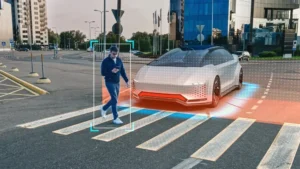
DDD validates VLA-driven perception and reasoning for safer lane-keeping, obstacle detection, and decision-making across diverse real-world conditions.

Autonomous Driving

We assess multimodal driving models for scene understanding, planning accuracy, and action reliability across urban, highway, and complex environments.

Robotics

DDD evaluates VLA models for mobile and industrial robots, ensuring accurate grounding, reliable task execution, and safe operation in dynamic settings.

Healthcare

We validate multimodal healthcare models for imaging interpretation, clinical reasoning, and safe decision-support aligned with medical standards.

Agriculture Technology

We test VLA models for crop monitoring, anomaly detection, and autonomous field tasks, ensuring accuracy despite variations in weather, lighting, and growth conditions.

Humanoids

We assess multimodal reasoning, embodied actions, and instruction following to ensure humanoid robots perform safely and effectively in human environments.

What Our Clients Say

DDD’s VLA evaluations helped us uncover hidden failure cases in our L3 ADAS stack and improve safety significantly.

– Principal Perception Engineer, Automotive OEM

Their multimodal testing accelerated our humanoid robot’s action-planning performance in real-world tasks

– Robotics Lead, Robotics Startup

We rely on DDD to validate our agricultural vision-language models for crop detection and autonomous operations.

– CTO, AgTech Company

Their benchmarks gave us a clear understanding of where our VLA agent struggled and how to fix it.

– Senior Applied Scientist, AI Lab

Read Our Latest Blogs

Explore the latest techniques and thought leadership shaping the future of VLA Model Analysis.

Smarter VLA Models.
Safer Real-World Autonomy.

Frequently Asked Questions

What is VLA Model Analysis?
VLA Model Analysis evaluates multimodal Vision-Language-Action models across perception, reasoning, and action execution. It measures grounding accuracy, planning reliability, safety, robustness, and domain-specific performance for real-world deployment in autonomous systems.
Why do autonomous driving and robotics companies need VLA evaluation?
VLA models operate in dynamic environments. Evaluating their reasoning and actions ensures safety, reduces risk, prevents edge-case failures, and accelerates deployment readiness.
How does DDD evaluate action reliability?
We use scenario-based testing, structured human review, and controlled task assessment to measure planning quality, execution safety, and multi-step task consistency.
Does DDD work with proprietary or sensitive data?
Yes. DDD follows strict data-security protocols, confidentiality controls, and compliance standards to handle proprietary sensor, video, and clinical datasets.
Can DDD customize evaluation pipelines?
Absolutely. We tailor evaluation workflows to your model architecture, application domain, risk profile, and product milestones.
Scroll to Top