

Celebrating 25 years of DDD's Excellence and Social Impact.
Physical AI ML model development ML Data Annotations

Human-in-the-Loop ML Data Annotation Services

Human-in-the-loop AI data annotation services for the sensor data that powers robots, autonomous vehicles, drones, and smart machines.

Why Annotation Is Different for Physical AI

Physical AI systems don’t just classify pixels or tokens; they operate in 3D space, in real time, around people and infrastructure. That means their training data must reflect:

Multi-sensor inputs (multi-camera rigs, LiDAR, radar, GPS/IMU)

Complex, dynamic scenes (traffic, factories, warehouses, farms)

Safety-critical edge cases (near-misses, occlusions, rare events)

DDD’s AI data annotation services are designed for Physical AI, combining specialized workflows, domain-trained teams, and rigorous QA to deliver trustworthy labels for perception, mapping, navigation, manipulation, and human–robot interaction.

What We Annotate for Physical AI

Layer 4

Perception Data (Vision, LiDAR, Multimodal)

Use for: object detection, tracking, collision avoidance, perception, and scene understanding.
Read More
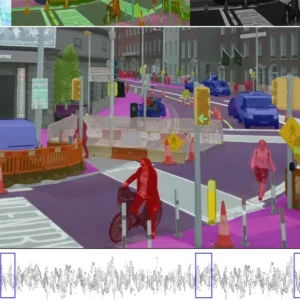
  • 2D Vision: Bounding boxes, polygons, and masks; instance & semantic segmentation; multi-frame tracking.
  • LiDAR / 3D: Cuboids for agents and static objects; drivable vs. non-drivable space; infrastructure (poles, rails, docks, racks).
  • Sensor Fusion: Consistent labels across camera–LiDAR projections and BEV views.

Supports AV/ADAS, mobile robots, drones, and inspection robots.

Layer 5

Mapping & Localization Annotations

Use for: HD mapping, SLAM, localization, route planning, and environment modeling.
Read More
  • Road & Outdoor: Lanes, crosswalks, stop lines, traffic lights, signs, and barriers.
  • Indoor: Aisles, docking zones, shelves/racks, markers, waypoints, and no-go zones.
  • Structures: Walls, doors, stairs, loading bays, mezzanines, and SLAM landmarks.
Built from drive logs, drone flights, robot runs, and fixed cameras into your GIS/mapping stack.
Layer 6

Manipulation & Task-Level Labels

Use for: grasping, pick-and-place, assembly, task learning, and cobots.
Read More
  • Manipulation Annotations: Grasp points, affordances, contact surfaces, and keypoints on tools and parts.
  • Task Phases: Approach, grasp, move, place, and verify, with success/failure states and error tags.
Feeds RL, imitation learning, and control policies for arms and mobile manipulators in warehouses, factories, labs, and field robotics.
Layer 7

Human–Robot Interaction & Safety Labels

Use for: HRI, collaborative robots, safety compliance, social navigation.
Read More
  • Human Pose & Safety: Human pose/keypoints, proximity zones, and dynamic safety envelopes.
  • Gestures & Intent: Hand signals and direction of movement.
  • Scenario Tags: Near-collision, obstruction, queueing, handover, and co-manipulation.
Safety data goes through enhanced QA and SME review aligned to your risk profile.
Layer 8

Telemetry, Logs & Event Annotation

Use for: reinforcement learning, diagnostics, and post-deployment analysis
Read More
  • Robot State & Control Logs: Operating modes, control commands, and error states.
  • Sensor Health & Diagnostics: Sensor status, faults, and diagnostic events.
  • Environment Events: Door states, machine statuses, and alarms.
  • Time-Aligned Episodes: Structured episodes for RL training, evaluation, and edge-case mining.
We work directly in your log formats and internal tools to create synchronized perception + control datasets for Physical AI.

Industries We Serve

ADAS

High-precision annotations for lanes, signs, and obstacles to improve ADAS perception and safety.

Autonomous Driving

Multi-sensor annotations enabling accurate perception and decision-making from L2+ assistance to full autonomy.

Robotics

Reliable labeling for navigation, obstacle detection, and manipulation tasks across industrial and service robots.

Healthcare

Clinical-grade annotations for medical imaging, diagnostics, and patient monitoring to enhance healthcare AI accuracy.

Agriculture Technology

Precise drone and field-image labeling supporting crop analysis, yield prediction, and autonomous farming systems.

Humanoids

Annotations for pose, gesture, and environment understanding to enable human-like perception and interaction.

What Our Clients Say

DDD delivered extremely consistent 3D annotations across LiDAR frames, something even our internal teams struggled to achieve.

– Computer Vision Lead, Autonomous Vehicle Company

Their agriculture image labeling drastically reduced our model drift and improved yield estimation accuracy across multiple crop cycles.

– AI Program Manager, AgTech Company

DDD transformed our raw vehicle sensor streams into production-ready annotations that accelerated our L2+ perception stack.

– Senior AI Engineer, Automotive OEM

Their QA workflows and domain expertise made our robotics navigation model far more reliable in edge environments.

– Head of Robotics Research, IAC

Why Choose DDD?

Layer 10
Domain-Trained Physical AI Teams

Annotators and leads are trained on robotics and autonomy concepts (ODD, sensor stacks, coordinate frames, safety envelopes) so they understand why labels matter, not just where to click.

Layer 4
Multi-Sensor & 3D Native

We’re comfortable in 3D tooling, bird’s-eye views, and multi-camera rigs, not just single 2D images, crucial for AV, drones, and warehouse robots.

Layer 1 5
Human-in-the-Loop at Scale

You get production-grade teams and QA that can grow from pilot spans of a few sequences to full-fleet, continuous annotation, without sacrificing quality.

Layer 1 3
Tool & Platform Agnostic

We integrate with your existing Physical AI toolchain: commercial 3D/AV labeling platforms, in-house data tools, or GIS environments, no forced platform migration.

Layer
Quality, Safety & Governance

Our quality and safety are strengthened through maker–checker workflows, gold tasks, targeted quality metrics, and clear escalation paths.
Read Our Latest Blogs

Explore the latest techniques and thought leadership shaping the future of ML data annotations.

Customer Success Stories

See how DDD accelerates physical AI innovation through data-driven success stories.

Accelerating ADAS Model Development through 2D and 3D Annotations

A leading autonomous vehicle manufacturer sought to enhance the safety and accuracy of its Advanced Driver Assistance Systems (ADAS).


Read more →

LLM

Object detection in LIDAR with 98% quality consistency

Although one of the more straightforward LiDAR data processing tasks, object boxing is still challenging. For applications like ADAS, the task requires extreme precision.


Explore solutions →
AI

Ready to Train Physical AI That Works in the Real World?

Frequently Asked Questions

What is ML data annotation, and why is it important?
ML data annotation is the process of labeling images, videos, LiDAR, text, or audio so AI models can learn patterns. Accurate annotations directly improve model precision, safety, and real-world reliability.
How does DDD ensure annotation accuracy?
Through multi-layer QA workflows, expert-led reviews, domain-specific training, performance auditing, and real-time quality dashboards.
Can DDD scale for millions of annotations?
Yes. Our global workforce and productionized workflows are built for enterprise-scale annotation across complex datasets.
Does DDD support secure and compliant data handling?
Absolutely. DDD maintains strict data governance with secure access controls, compliance with industry standards, and dedicated secure annotation environments.
Scroll to Top