Celebrating 25 years of DDD's Excellence and Social Impact.
Physical AI In-Cabin AI & UX Data Solutions Driver Condition & Behavior Annotation

Driver Condition & Behavior Annotation for In-Cabin AI

Enable safer, more intelligent driving behavior analysis with precise datasets engineered for real-world complexity.

Driver Condition & Behavior Annotation for ADAS

Our teams are trained to interpret human behavior inside cabins where millisecond-level changes can determine safety. From long-haul fatigue to tactical decision-making in defense vehicles, we help your models understand what human readiness looks like in the real world.

ISO-27001 1
AICPA-SOC
GDPR
HIPAA Compliant
Tisax-Certificate

Our Use Cases for Driver Condition & Behavior Annotation

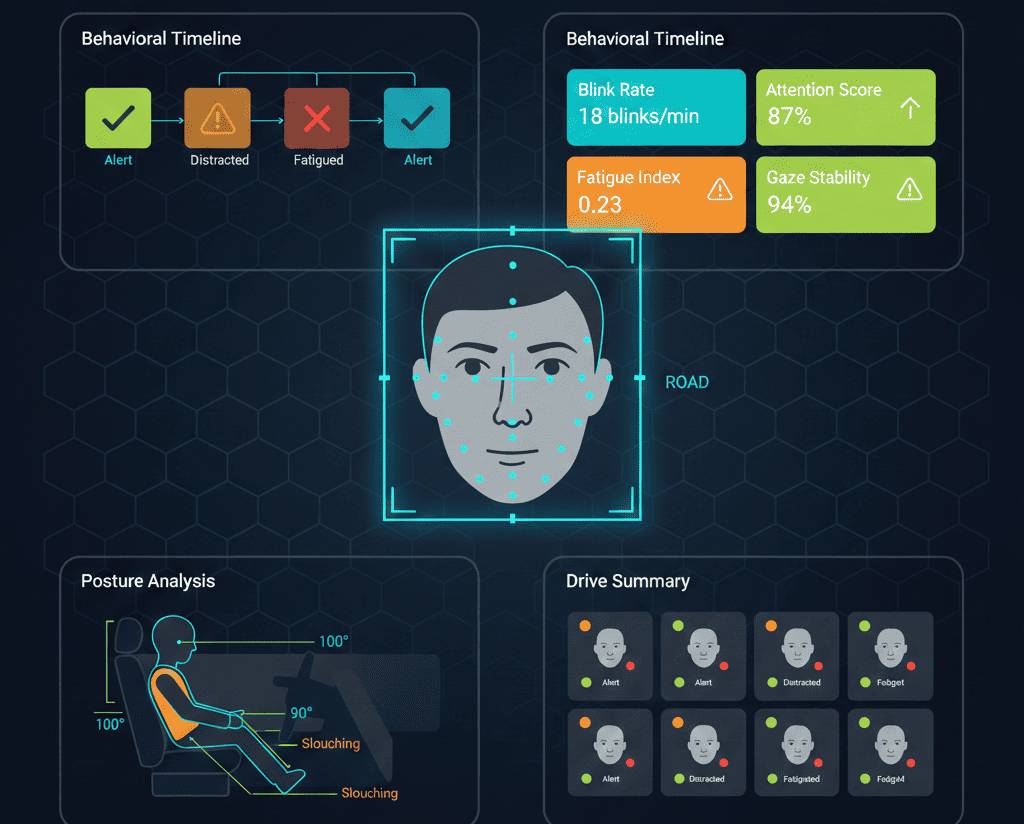
Driver State Classification

Build models that recognize drowsiness, attention decay, emotional distress, or high alertness, essential for autonomous readiness.

Distraction Intelligence Mapping

Identify phone interactions, passenger conversations, off-road glances, or prolonged screen focus across durations and intensities.

Autonomous Handover Preparedness

Train systems to detect whether a driver is cognitively aware and physically prepared to take back control.

Human and Machine Interaction Validation

Evaluate how drivers respond to warnings, notifications, and UI elements, enabling more intuitive HMI design.

Regulation-Driven Behavior Modeling

Support datasets aligned with global safety requirements.

Use Case Image 1 e1770906523189

Industries We Support

Autonomous Driving

Driver behavior datasets that improve safety, control transitions, and intervention accuracy.

Defensetech

Operator vigilance, threat response cues, and tactical attention mapping for armored vehicle operations.

Robotics

Human-state insights for tele-operated robots requiring driver readiness, awareness, and responsive control.

Rail/Aviation/Marine

Fatigue and distraction pattern analysis for long-duration operators in high-stakes transport environments.

Fully Managed Driver Behavior Annotation

Group 1 7
Discovery & Scoping

Define behavioral taxonomies, sensor types, driver states, complexity levels, and quality requirements.

Group 1 1
Ontology & Scenario Design

Design structured driver behavior schemas, including gaze zones, fatigue signals, task load, and distraction types.

Group 1 2
Specialist Training

Equip annotators with domain-specific behavioral guidelines for safety-critical driver state interpretation.

Group 1 3
Annotation & Monitoring

Execute high-precision labeling across gaze tracking, micro-actions, hand positions, interactions, and contextual cues.

Group 1 4
Quality Review & Enrichment

Apply multi-step QA, calibrations, and targeted audits; enrich ambiguous or subtle driver behaviors.

Group 1 5
Delivery & Iteration

Provide datasets in your preferred formats and refine taxonomies as your model evolves.
What Our Clients Say

DDD helped us capture subtle fatigue indicators we didn’t even realize our model was missing.

— Lead ML Scientist, Autonomous Trucking Company

DDD’s consistency across millions of frames, across sensors, lighting conditions, and driver profiles, was exceptional.

— AI Program Manager, Commercial Fleet Technology Firm

DDD’s interpreters of ambiguous driver behavior were game-changing for our validation process.

— Product Owner, Defense Vehicle AI Systems

Their precision in annotating gaze and micro-behavior signals dramatically improved our DMS model accuracy.

— Director of Autonomy, Global Automotive OEM

Blogs

Read expert articles, insights, and industry benchmarks across physical AI.

Make Your In-Cabin AI Smarter, Safer, and More Human-Aware

Frequently Asked Questions

What is Driver Condition & Behavior Annotation?

It involves labeling driver states such as gaze direction, fatigue signals, distraction events, and hand movements so AI models can accurately assess driver awareness, readiness, and safety in real time.

What types of driver behaviors can DDD annotate?

We capture a wide range of behaviors, including gaze shifts, eye closure, phone use, head pose, hands-on/off-wheel actions, emotional cues, and cognitive load indicators, across diverse drivers, lighting conditions, and cabin environments.

How do you ensure accuracy for subtle or ambiguous behaviors?

Our annotators undergo specialized behavior training and use multi-step QA workflows, expert reviews, and calibrated ontologies to ensure consistent interpretation of complex human-state cues.

Can DDD annotate challenging or low-visibility scenarios?

Yes. We handle low light, glare, shadows, PPE-based occlusions, rapid movements, and off-road or high-vibration environments with high annotation consistency.

How does DDD keep driver video data secure?

We operate under ISO 27001, SOC 2 Type 2, GDPR, HIPAA, and TISAX-aligned controls, ensuring strict protection for sensitive driver footage through encrypted environments and access restrictions.

Scroll to Top