
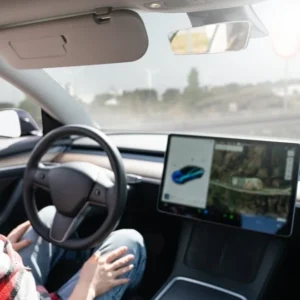
This blog explores in-cabin monitoring solutions for autonomous vehicles and highlights the key functions, critical technologies driving their development.
Read MoreIn-Cabin Occupant Detection & Behavior Insight Services
Train your in-cabin monitoring system to understand every occupant, every gesture, every seat, and every scenario inside the vehicle.
Complete Cabin Environment Monitoring Insights for AV and ADAS
DDD delivers occupant-level insights for OMS systems, including posture, gestures, belt status, movement patterns, emotional cues, and CPD (Child Presence Detection). Our data insights help your models interpret these behaviors accurately and inclusively.
Industries We Support
Defensetech
Monitor crew actions, readiness, and multi-operator interactions under mission constraints.
Robotics
Enable humanoids and tele-operated systems to understand human body language inside controlled spaces.
Rail/Aviation/Marine
Enhance crew and passenger monitoring for operational safety and compliance.
What Our Clients Say
DDD’s occupant labeling accuracy was outstanding, especially in multi-seat cabins where other vendors struggled.
Their team quickly understood complex posture and gesture requirements and delivered consistent results across millions of frames.
DDD helped us accelerate our Child Presence Detection development with extremely reliable annotations of high-risk scenarios.
Their attention to detail in annotating emotional cues and subtle passenger behaviors significantly improved our UX prediction models.
Fully Managed Occupant Behavior Annotation
Define target occupants (adult, child, pet), postures, gestures, seat interactions, safety markers, and multi-cabin layouts.
We build taxonomies covering posture transitions, seat usage, seatbelt states, gesture sets, control interactions, personal objects, emotional cues, and multi-occupant dynamics.
Teams learn to recognize cabin-specific behaviors across cultures, ages, lighting conditions, attire, and body types.
Annotate per-frame occupant presence, identity, position, limb orientation, occlusions, seatbelt status, child seats, objects, and risk indicators.
Review complex cases such as overlapping limbs, partial occlusions, multiple children, reflections, and low-light environments.
Integrate with your OMS workflows and enrich datasets as new scenarios emerge.
Why Choose DDD?
Our dedicated delivery groups stay with your project for its entire lifecycle, ensuring consistency across millions of frames and multi-year development cycles.
We operate under ISO 27001, SOC 2 Type 2, GDPR, HIPAA, and TISAX-aligned standards, ensuring strict protection for in-cabin video and biometric-like human-state data.
Our multilayer QA framework is engineered for behavior-rich annotation, ensuring that critical states of occupant behavior are captured with extreme accuracy.
We work seamlessly inside your tools, workflows, ontologies, and multi-sensor pipelines, no forced platforms, no proprietary lock-in.
Blog
Read expert articles, insights, and industry benchmarks across key AI industries.
Enhancing In-Cabin Monitoring Systems for Autonomous Vehicles with Data Annotation
In this blog, we will learn how driver monitoring systems work, what type of data is collected, and discuss...
Read MoreAnnouncing the Launch of Autonomous Fleet Ops

Digital Divide Data (DDD) continues to expand its end-to-end data capabilities for Autonomous Systems across land, air, sea, and...
Read MoreHigh-Fidelity Occupant Data for Intelligent Mobility

Frequently Asked Questions
It involves labeling who is in the cabin, adults, children, pets, along with their posture, movements, gestures, emotional cues, seatbelt status, object interactions, and overall behavior, so OMS models can understand and respond to human activity inside the vehicle.
We annotate posture transitions, gestures, seat occupancy, seatbelt usage, emotional indicators, reaching movements, sleeping states, interactions with controls or devices, and CPD-related scenarios such as unattended children or child seats.
Absolutely. Our teams are trained to identify high-risk events, including child presence, improper seating, unrestrained passengers, medical distress, and hazardous movements that affect safety.
We train annotators on varied body types, clothing, lighting, occlusions, cultural expressions, and environmental conditions. Multi-layer QA ensures consistent labeling of even subtle or ambiguous behaviors.
Yes. All in-cabin imagery, including minors, is protected under ISO 27001, SOC 2 Type 2, GDPR, HIPAA, and TISAX-aligned controls with strict access restrictions and secure processing environments.
Yes. We work closely with your perception team to design labeling schemas tailored to your OMS goals, regulatory requirements, and interaction model needs.