

In this blog, we will explore how digital twins are transforming the testing and validation of autonomous systems, examine...
Read MoreRare Event & Edge-Case Scenario Annotation
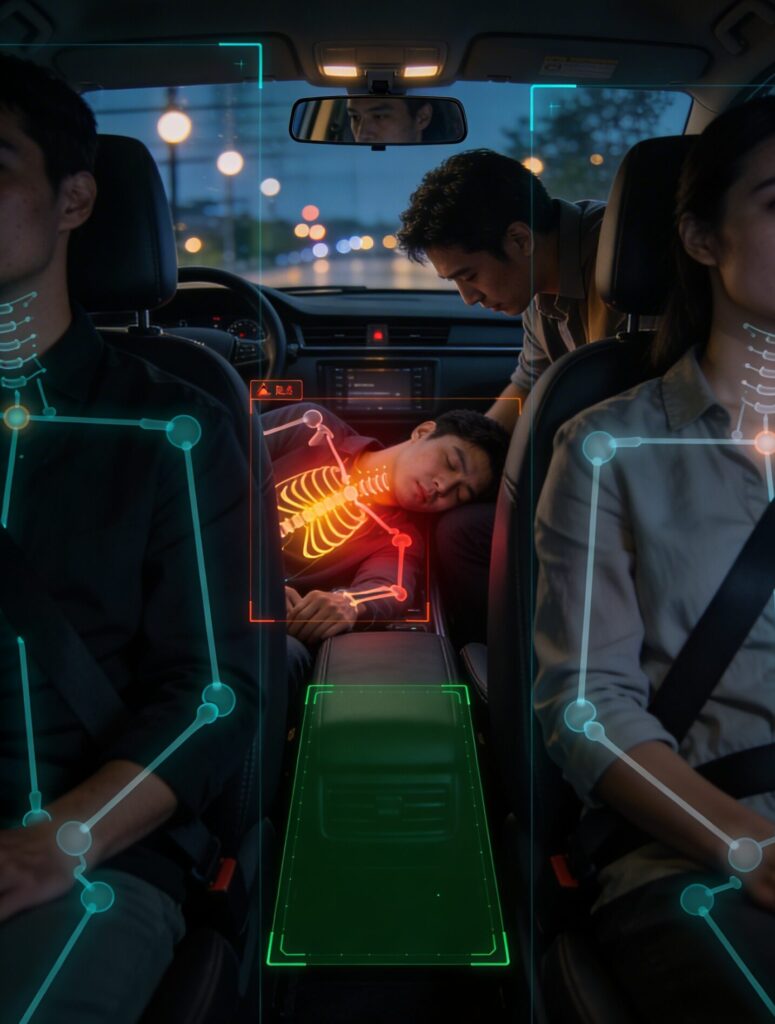
Prepare your models for the unexpected by capturing the behaviors, events, and anomalies that rarely occur, but truly matter.
Strengthening In-Cabin AI with Rare Event & Edge-Case Scenario Annotation
Strengthening AI Safety with Rare Event & Edge-Case Scenario Annotation
Our Use Cases
Emergency Passenger Behavior Detection
Capture rare medical emergencies, panic reactions, and falls to ensure in-cabin AI responds accurately during life-critical moments.
Fatigue & Incapacitation Monitoring
Label subtle, low-frequency fatigue and incapacitation patterns that are often missed but essential for proactive safety interventions.
Multi-Occupant Edge Cases in Shared Cabins
Annotate complex interactions, occlusions, and unpredictable passenger behavior in shared mobility and robotaxi environments.
Ambiguous Human Intent for Robotics
Train robots to interpret unusual gestures, atypical postures, and hesitation states for safer human-robot interaction.
Environmental & Sensor Disruption Scenarios
Label rare lighting changes, obstructions, turbulence, and interference that challenge real-world perception systems.
Safety Validation & Regulatory Readiness
Build high-risk edge-case datasets that demonstrate model robustness for safety audits, certifications, and commercial rollout.
Industries We Support
Defensetech
Monitor crew actions, readiness, and multi-operator interactions under mission constraints.
Robotics
Enable humanoids and tele-operated systems to understand human body language inside controlled spaces.
Rail/Aviation/Marine
Enhance crew and passenger monitoring for operational safety and compliance.
Edge-Case Annotation Workflow
Map the high-risk events that your AI may encounter, such as falls, seizures, collisions, occlusions, PPE disruptions, turbulence, or equipment interference.
Define anomaly classes, severity levels, temporal sequences, multi-person interactions, and sensor properties.
Train experts to identify unusual human responses, atypical body mechanics, rare gestures, and ambiguous states.
Frame-by-frame and sequence-based labeling of rare or safety-critical events with contextual notes and metadata.
Multiple specialists review each anomaly, ensuring accuracy in high-risk edge cases.
Continuously enrich datasets with new anomaly classes sourced from your real-world deployments.
What Our Clients Say
DDD uncovered edge cases we didn’t even know existed in our deployment data. Their annotations immediately improved model stability.
Their rare-event labeling helped reduce critical false negatives in our safety systems, an essential improvement for commercial rollout
Our defense cabin AI required high-risk scenario coverage, and DDD delivered exceptional accuracy in extremely challenging conditions
Their ability to identify anomalies across multi-sensor video streams transformed our anomaly-detection roadmap.
Why Choose DDD?
Every rare event undergoes multi-layer auditing and expert review to guarantee accuracy in scenarios where misinterpretation leads to real-world safety risks.
Our dedicated delivery groups stay with your project for its entire lifecycle, ensuring consistency across multi-year development cycles.
We operate under ISO 27001, SOC 2 Type 2, GDPR, HIPAA, and TISAX-aligned standards, ensuring strict protection for rare event & edge-case scenario annotation.
We work seamlessly inside your tools, workflows, ontologies, and multi-sensor pipelines, no forced platforms, no proprietary lock-in.
Blog
Explore the latest techniques and thought leadership shaping the future of Physical AI
In-Cabin Monitoring Solutions for Autonomous Vehicles
This blog explores in-cabin monitoring solutions for autonomous vehicles and highlights the key functions, critical technologies driving their development.
Read MoreEnhancing In-Cabin Monitoring Systems for Autonomous Vehicles with Data Annotation
In this blog, we will learn how driver monitoring systems work, what type of data is collected, and discuss...
Read MoreEdge-Case Intelligence for Real-World Readiness

Frequently Asked Questions
It involves labeling low-frequency, high-impact behaviors and anomalies, such as emergency responses, equipment interference, unusual movements, extreme lighting, and unpredictable interactions, so AI models can perform reliably in real-world, high-risk situations.
We capture emergencies, panic reactions, medical distress, falls, sudden posture changes, PPE-related occlusions, rapid movements, object interference, seatbelt misuse, environmental disruptions, and surprising multi-occupant interactions.
Most AI failures occur during rare events, not during normal behavior. Training models on these long-tail scenarios dramatically improves safety, reduces false positives and false negatives, and ensures readiness for real-world deployment.
Yes. We co-design detailed classification frameworks for emergency behaviors, environmental extremes, unexpected human actions, and anomaly severity levels tailored to your model architecture.