
Celebrating 25 years of DDD's Excellence and Social Impact.

Author name: umang dayal

Umang architects and drives full-funnel content marketing strategies for AI training data solutions, spanning computer vision, data annotation, data labelling, and Physical and Generative AI services. He works closely with senior leadership to shape DDD's market positioning, translating complex technical capabilities into compelling narratives that resonate with global AI innovators.

Avatar of umang dayal
Geospatial AI

Geospatial Intelligence and AI: Defense and Government Applications

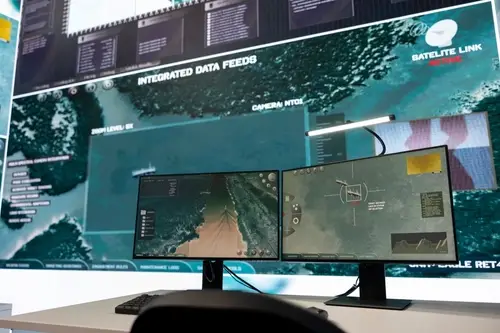
The National Geospatial-Intelligence Agency describes geospatial AI as the integration of AI into GEOINT to automate imagery exploitation, detect change, classify objects, and extract patterns from spatial data at a scale that manual analysis cannot approach. For defense and government customers, this capability shift has operational consequences: the time between satellite collection and actionable intelligence can compress from days to minutes, and the coverage that was once limited by analyst capacity can expand to encompass entire theaters of operation continuously.

This blog examines where AI is being applied across defense and government geospatial use cases, what the annotation and data quality requirements are for each application, and where the critical gaps between current capability and mission-reliable performance remain. HD map annotation services and 3D LiDAR data annotation are the two annotation capabilities most directly relevant to government geospatial AI programs.

Key Takeaways

  • The core data challenge in defense geospatial AI is not sensor capability, which has advanced dramatically, but annotation quality: models trained on poorly labeled satellite imagery produce false positives and missed detections that undermine the operational decisions they are meant to support.
  • SAR imagery annotation requires domain expertise in radar physics that generic computer vision annotators do not possess, making specialist annotation capability a limiting factor for many defense programs.
  • Change detection, the identification of differences between imagery of the same location at different times, requires temporally consistent annotation across multi-date datasets that standard single-image annotation workflows do not support.
  • Government geospatial AI programs increasingly combine optical satellite imagery, SAR, LiDAR, and signals data; models trained on single-modality data fail at the fusion boundaries where most operationally interesting events occur.
  • Humanitarian and emergency response applications of government geospatial AI share the same annotation requirements as defense intelligence programs, but operate under tighter time constraints and with less tolerance for model errors that affect aid distribution.

The Geospatial AI Landscape in Defense and Government

From Imagery Collection to Intelligence Production

The traditional geospatial intelligence workflow moves from satellite or aerial collection through manual imagery analysis to intelligence production. The bottleneck has always been the analysis step: a skilled imagery analyst can examine a limited number of images per day, and the volume of collected imagery has long exceeded what any analyst population can process. AI changes the economics of this step by automating the detection and classification tasks that consume most analyst time, allowing human analysts to focus on the complex interpretive judgments that remain beyond current model capability.

The operational shift this enables is significant. Rather than analyzing imagery of priority locations on a tasked collection schedule, AI-assisted GEOINT programs can monitor entire geographic areas continuously, flagging any change or anomaly for human review. The lessons from geospatial intelligence use in the Russia-Ukraine conflict have accelerated government investment in this capability: the conflict demonstrated that commercial satellite imagery combined with AI analysis can provide operationally relevant intelligence within hours of collection, compressing decision cycles in ways that traditional classified collection pipelines cannot match.

Government Use Cases Beyond Defense

Geospatial AI applications extend across the full scope of government operations beyond military intelligence. Border surveillance programs use AI to detect crossings and movement patterns across large perimeters that no physical patrol force could continuously monitor. Customs and trade enforcement use satellite imagery analysis to verify declared shipping activity against actual vessel movements. 

Disaster response agencies use AI-processed imagery to assess damage and direct resources hours after an event. Critical infrastructure protection programs use change detection to identify construction or activity near sensitive installations. Each of these applications has distinct annotation requirements determined by the specific objects, events, and changes the model needs to detect.

Optical Satellite Imagery: Object Detection and Classification

What AI Needs to Detect in Satellite Imagery

Object detection in satellite imagery involves identifying specific targets within images that may cover hundreds of square kilometres. Target categories in defense applications include military vehicles, aircraft, vessels, weapons systems, and infrastructure. Target categories in government applications include buildings, road networks, agricultural land use, and economic activity indicators. The fundamental challenge in both contexts is that targets in satellite imagery are small relative to the image extent, may be partially obscured by shadows or clouds, and may be visually similar to background clutter that the model must not classify as a target.

Annotation for satellite object detection requires bounding boxes or polygon masks placed with spatial precision that accounts for the overhead viewing geometry. Unlike ground-level photography, where objects face a camera and present a familiar visual profile, satellite imagery shows objects from directly or near-directly above, where the visible surface may be a roof, a vehicle top, or a shadow rather than the identifying features an analyst would use in a ground-level view. 

Annotators working on satellite imagery need specific training in overhead recognition that generic computer vision annotation experience does not provide. Why high-quality data annotation defines computer vision model performance examines how annotation precision requirements scale with the operational consequences of model errors, which in defense contexts are direct.

Resolution and Scale Dependencies

Satellite imagery is collected at varying spatial resolutions, from sub-meter commercial imagery capable of identifying individual vehicles to ten-meter government archives suited for land cover classification. A model trained on sub-meter imagery cannot be applied to ten-meter imagery without retraining, and vice versa. 

This resolution dependency means that annotation programs must be designed around the specific imagery resolution that the deployed model will operate on, with separate annotation investments for each resolution band if the program needs to exploit multiple imagery sources. Recent research on AI in remote sensing confirms that deep learning models trained on one spatial resolution show significant accuracy degradation when applied to imagery at a different resolution, even when the same object categories are present.

SAR Imagery: The Specialist Annotation Challenge

Why SAR Is Operationally Critical and Annotation-Difficult

Synthetic Aperture Radar operates by emitting microwave pulses and measuring how they reflect from the Earth’s surface, producing imagery that is independent of daylight, cloud cover, and most weather conditions. This all-weather, day-and-night capability makes SAR indispensable for military and government programs that cannot wait for clear optical conditions before collection. Flood extent mapping, maritime vessel detection, ground deformation measurement, and damage assessment in obscured areas all rely on SAR data precisely because optical imagery is unavailable when these events occur.

The annotation challenge is that SAR imagery does not look like optical imagery. Objects appear as characteristic backscatter patterns that reflect the radar properties of their surfaces rather than their visual appearance. A metallic vehicle produces a bright, specular reflection. Water appears dark, absorbing radar energy. Vegetation creates a diffuse, textured return. Annotators who understand radar physics can reliably interpret these signatures; annotators with only optical imagery experience cannot. This domain expertise gap is one of the most significant bottlenecks in defense geospatial AI programs, particularly as SAR becomes more central to operational workflows. The role of multisensor fusion data in Physical AI describes how radar and optical modalities are combined at the data level to leverage the complementary strengths of each.

The Scarcity of Labeled SAR Data

Labeled SAR datasets for defense applications are scarce relative to optical imagery datasets. Collection restrictions on military vehicle imagery, the sensitivity of SAR signatures as intelligence sources, and the specialist expertise required for annotation have all limited the size and accessibility of SAR training datasets. Programs building SAR-based AI capabilities typically find that their annotation investment needs to be substantially higher per labeled example than for optical imagery, because each labeled example requires more time from a specialist annotator working with more complex data. The scarcity of existing labeled data also means that transfer learning from publicly available models is less effective for SAR than for optical imagery, where large pretrained models provide a useful starting point.

Change Detection: The Temporal Annotation Problem

What Change Detection Requires and Why It Is Difficult

Change detection identifies differences between satellite or aerial imagery of the same location captured at different times, flagging construction, demolition, movement of equipment, changes in land use, or any other modification of the physical environment. It is among the most operationally valuable geospatial AI capabilities because it automatically directs analyst attention to locations where something has changed, rather than requiring analysts to review entire areas for possible changes.

The annotation challenge is temporal consistency. A change detection model needs training examples that show the same scene at two or more time points, with the areas of genuine change labeled separately from the areas of apparent change caused by differences in illumination angle, cloud shadow, seasonal vegetation, or sensor calibration differences between collection dates. An annotator labeling a pair of images without understanding these sources of apparent change will produce training data that teaches the model to flag imaging artifacts as meaningful events. Building temporally consistent annotation protocols and training annotators to apply them consistently across multi-date image pairs requires a workflow design that single-image annotation programs do not address.

Multi-Temporal Annotation at Scale

Government programs that monitor large geographic areas for change need annotation datasets that cover the range of change types and magnitudes the model will be asked to detect, across the range of seasonal and atmospheric conditions in which collection occurs. A change detection model trained only on summer imagery will produce unreliable results on winter imagery, where vegetation state, snow cover, and shadow geometry all differ. 

The European Union’s Copernicus programme, which provides open satellite imagery for environmental and humanitarian monitoring, has generated extensive multi-temporal datasets that demonstrate both the operational value and the annotation complexity of change detection at a continental scale: ensuring consistent labeling across imagery captured under different conditions by different sensors requires annotation infrastructure that treats temporal consistency as a first-class quality requirement.

Maritime Domain Awareness and Vessel Tracking

The AI Monitoring Problem at Sea

Maritime domain awareness requires tracking vessel movements across ocean areas too vast for any physical surveillance presence to cover. AI applied to satellite imagery, including both optical and SAR data, can detect vessels, classify them by type and size, and compare their positions against Automatic Identification System transmissions to identify vessels that are operating without broadcasting their location. This dark vessel detection capability is directly relevant to counter-piracy, counter-smuggling, sanctions enforcement, and illegal fishing interdiction programs across multiple government agencies.

Training a maritime AI system requires annotation of vessel detection across a wide range of sea states, vessel sizes, and imaging conditions. Small fishing vessels in high sea states present very different SAR signatures than large tankers in calm water, and a model trained predominantly on large vessel examples will have poor detection rates for the smaller vessels that often represent the highest-priority targets for enforcement programs. Integrating AI with geospatial data for autonomous defense systems examines the multi-sensor approach that combines satellite detection with signals intelligence to maintain vessel tracks through coverage gaps.

Port and Infrastructure Monitoring

Government programs monitoring port activity, airfield operations, and logistics infrastructure use AI to identify changes in vessel loading patterns, aircraft movements, and vehicle concentrations that indicate changes in operational status or activity levels. These applications require annotation of activity patterns rather than just object presence: the model needs to learn what normal port activity looks like to flag deviations that indicate something operationally significant. This behavioral pattern annotation is more demanding than static object detection because the training data needs to represent the full range of normal activity, not just the specific events to be detected.

Humanitarian and Disaster Response Applications

Where GEOINT Meets Crisis Response

Geospatial AI serves government programs beyond defense intelligence. Humanitarian organizations and government emergency management agencies use AI-processed satellite imagery to assess damage after earthquakes, floods, and conflicts, directing aid and response resources to the areas of greatest need. These applications face the same annotation requirements as defense programs, the same need for specialist annotators who understand overhead imagery, the same challenges with SAR data in adverse weather conditions, but with the additional constraint of time: damage assessments for humanitarian response must be produced within hours of an event to be operationally useful.

Building damage assessment models need to be trained on imagery from multiple geographic regions and multiple disaster types, because the visual signature of earthquake damage in a concrete-construction urban environment differs substantially from flood damage in a wooden-construction agricultural area. A model trained only on one disaster type or one geographic context will produce unreliable assessments when deployed for a different disaster, and humanitarian programs need to deploy quickly to novel events rather than having time to retrain on locally relevant data. 

This geographic and disaster-type generalization requirement is one of the strongest arguments for pre-building annotation-rich training datasets across diverse contexts before operational need arises. Data collection and curation services that build geographically diverse geospatial training datasets across disaster types enable rapid deployment of damage assessment models to novel events without a retraining cycle.

Dual-Use Geospatial Data and Its Governance Implications

Geospatial imagery of civilian infrastructure, population movement, and land use patterns serves both legitimate government purposes and potential misuse. Government programs handling this data operate under legal frameworks including privacy law, data sovereignty requirements, and, in some contexts, international humanitarian law. The annotation programs that label this imagery need to manage data access controls, annotator vetting, and documentation of data provenance to satisfy the governance requirements of the programs they serve. These governance requirements are more demanding than those for commercial computer vision programs, and annotation service providers working on government geospatial programs need to demonstrate compliance with the relevant security and governance frameworks.

The Fusion Challenge: Building Models That Combine Data Sources

Why Single-Modality Models Fall Short

The most operationally interesting events in defense and government geospatial contexts rarely manifest clearly in any single data source. A military movement may be visible in optical imagery under clear conditions and in SAR imagery under cloud, but neither alone provides the full picture. A vessel conducting illegal activity may appear in satellite imagery, but can only be identified as suspicious by comparing its position against AIS data showing where it claimed to be. Infrastructure under construction may be detectable through building footprint change in optical imagery and through ground deformation in SAR, with the combination providing higher confidence than either alone.

Training fusion models requires annotation that is consistent across modalities: an object labeled in the optical channel must be co-registered with the corresponding annotation in the SAR or LiDAR channel, so that the model learns to associate corresponding features across data types. This cross-modal annotation consistency is technically demanding and requires annotation workflows that handle the co-registration of data from different sensors and collection times. Multisensor fusion data services address the cross-modal consistency requirement that single-modality annotation programs do not support.

LiDAR Integration for Terrain and Structure Analysis

LiDAR data provides precise three-dimensional terrain models and building height information that satellite imagery cannot supply. Government programs use LiDAR for terrain analysis, urban structure mapping, vegetation height mapping, and infrastructure assessment. Annotating LiDAR point clouds for government geospatial applications requires the same specialist skills and three-dimensional annotation precision as defense-oriented LiDAR annotation programs. 3D LiDAR data annotation at the precision levels that terrain analysis and structure assessment require uses the same annotation discipline that enables reliable perception in autonomous driving, applied to geospatial rather than road scene contexts.

Data Governance, Security, and Annotation in Classified Contexts

The Security Requirements That Shape Annotation Programs

Defense and intelligence geospatial AI programs operate under security requirements that fundamentally shape how annotation can be conducted. Classified imagery cannot be annotated on standard commercial annotation platforms. Annotators may require security clearances at specific levels depending on the classification of the imagery they are labeling. Annotation results may themselves be classified if they reveal sensitive analytical methods, target identities, or collection capabilities. These constraints mean that annotation programs for classified geospatial AI cannot simply engage commercial annotation services without first establishing the data handling infrastructure and personnel clearance frameworks that classified work requires.

Unclassified geospatial AI programs, including those using commercial satellite imagery for civilian government applications, still face data governance requirements related to data sovereignty, privacy, and the acceptable use of imagery that may capture civilian populations. Government programs in European Union jurisdictions face GDPR requirements when geospatial imagery captures identifiable individuals, and the EU AI Act’s provisions for high-risk AI systems apply to government AI used in consequential decisions about individuals.

The Shift Toward Commercial Data and Open-Source Intelligence

A significant development in defense geospatial AI is the increasing use of commercial satellite imagery and open-source intelligence alongside classified government collection. Commercial providers now offer sub-meter resolution imagery with daily revisit rates that rival or exceed classified systems for many applications. This commercial imagery can be annotated and used to train models on unclassified infrastructure, with the trained models then applied to classified imagery in classified environments. 

This approach reduces the annotation burden on classified programs by allowing training data development to proceed on unclassified commercial imagery before deployment against classified collection. The National Geospatial-Intelligence Agency’s GEOINT AI program reflects this direction, emphasizing the integration of commercial capabilities and open-source data into government intelligence workflows.

How Digital Divide Data Can Help

Digital Divide Data provides geospatial annotation services tailored to the specialist requirements of defense and government applications, from optical satellite imagery annotation and SAR interpretation to multi-temporal change-detection labeling and LiDAR point-cloud annotation.

The image annotation services capability for geospatial programs covers overhead object detection with the spatial precision and overhead-geometry expertise that satellite imagery requires, building and infrastructure segmentation for government mapping applications, and vehicle and vessel classification across the resolution ranges and imaging conditions that operational programs encounter. Annotation workflows are designed to preserve geospatial coordinate metadata through the annotation process, producing labeled datasets that are directly usable in geospatial AI training pipelines.

For multi-temporal programs, data collection and curation services build temporally consistent annotation protocols that distinguish genuine change from imaging artifacts, covering the range of seasonal and atmospheric conditions that change detection models need to handle reliably. Multisensor fusion data services support cross-modal annotation consistency for programs combining optical, SAR, and LiDAR data sources.

For programs building toward mission deployment, model evaluation services provide geographically stratified performance assessment across the imaging conditions, target categories, and resolution ranges the deployed model will encounter. HD map annotation services and 3D LiDAR annotation extend these capabilities to terrain modeling and precision mapping applications across government programs.

Build geospatial AI training data that meets the precision and domain expertise requirements of defense and government applications. Talk to an expert!

Conclusion

The AI transformation of defense and government geospatial intelligence is well underway. What remains the binding constraint in most programs is not sensor capability, which has advanced to the point where continuous global monitoring is technically achievable, but training data quality. Models trained on poorly annotated satellite imagery, on SAR data labeled by annotators without radar domain expertise, on single-date datasets that cannot support change detection, or on single-modality data that cannot be fused with complementary sensors will fail to deliver the operational reliability that mission-critical applications demand. The annotation investment required to close these gaps is substantial, specialized, and ongoing.

Government programs that invest in annotation quality as a primary capability, rather than as a data preparation step before the interesting AI work begins, build systems with materially better operational performance and greater reliability under the changing conditions that deployed systems encounter. Image annotation, LiDAR annotation, and multisensor fusion annotation built to the domain expertise standards that geospatial AI requires are the foundation that separates programs that perform in deployment from those that perform only in demonstration.

References

Kazanskiy, N., Khabibullin, R., Nikonorov, A., & Khonina, S. (2025). A comprehensive review of remote sensing and artificial intelligence integration: Advances, applications, and challenges. Sensors, 25(19), 5965. https://doi.org/10.3390/s25195965

National Geospatial-Intelligence Agency. (2024). GEOINT artificial intelligence. NGA. https://www.nga.mil/news/GEOINT_Artificial_Intelligence_.html

United States Geospatial Intelligence Foundation. (2024). GEOINT lessons being learned from the Russian-Ukrainian war. USGIF. https://usgif.org/geoint-lessons-being-learned-from-the-russian-ukrainian-war/

Frequently Asked Questions

Q1. Why does SAR imagery annotation require specialist expertise that optical imagery annotation does not?

SAR imagery captures radar backscatter rather than visual appearance. Objects appear as characteristic reflectance patterns determined by their material properties and surface geometry rather than their colour or shape. Annotators need training in radar physics to reliably interpret these signatures, which are not legible to annotators with only optical imagery experience.

Q2. What is change detection in geospatial AI, and why is annotation for it challenging?

Change detection identifies genuine physical changes between satellite images of the same location at different times. Annotation is challenging because images captured at different times differ due to illumination angle, seasonal vegetation state, cloud shadow, and sensor calibration variation, all of which can appear as a change but are not operationally significant. Annotation protocols must be specifically designed to distinguish genuine change from these imaging artifacts.

Q3. How do government geospatial AI programs handle security constraints on annotation?

Classified imagery cannot be annotated on standard commercial platforms and may require annotators with appropriate security clearances. Many programs address this by developing training data on unclassified commercial imagery and then applying trained models in classified environments, separating the annotation workflow from the most sensitive collection.

Q4. Why do geospatial AI models trained on single-modality data fail at sensor fusion applications?

Single-modality models learn features specific to one sensor type. When applied to fused data, they cannot associate corresponding features across modalities, and the cross-modal relationships that provide the most operationally useful intelligence are not represented in their training data. Fusion model training requires cross-modal annotation where the same objects are consistently labeled across all data sources.

Q5. What annotation requirements are specific to humanitarian and disaster response geospatial AI?

Humanitarian damage assessment models need annotation datasets that cover multiple geographic regions, construction types, and disaster types to generalize reliably to novel events. They also need to be trained and ready for rapid deployment, which requires pre-built, diverse training datasets rather than post-event annotation when response time is critical.

Geospatial Intelligence and AI: Defense and Government Applications Read Post »

computer vision retail

Retail Computer Vision: What the Models Actually Need to See

What is consistently underestimated in retail computer vision programs is the annotation burden those applications create. A shelf monitoring system trained on images captured under one store’s lighting conditions will fail in stores with different lighting. A product recognition model trained on clean studio images of product packaging will underperform on the cluttered, partially occluded, angled views that real shelves produce. 

A loss prevention system trained on footage from a low-footfall period will not reliably detect the behavioral patterns that appear in high-footfall conditions. In every case, the gap between a working demonstration and a reliable production deployment is a training data gap.

This blog examines what retail computer vision models actually need from their training data, from the annotation types each application requires to the specific challenges of product variability, environmental conditions, and continuous catalogue change that make retail annotation programs more demanding than most. Image annotation services and video annotation services are the two annotation capabilities that determine whether retail computer vision systems perform reliably in production.

Key Takeaways

  • Retail computer vision models require annotation that reflects actual in-store conditions, including variable lighting, partial occlusion, cluttered shelves, and diverse viewing angles, not studio or controlled-environment images.
  • Product catalogue change is the defining annotation challenge in retail: new SKUs, packaging redesigns, and seasonal items require continuous retraining cycles that standard annotation workflows are not designed to sustain efficiently.
  • Loss prevention video annotation requires behavioral labeling across long, continuous footage sequences with consistent event tagging, a fundamentally different task from product-level image annotation.
  • Frictionless checkout systems require fine-grained product recognition at close range and from arbitrary angles, with annotation precision requirements significantly higher than shelf-level inventory monitoring.
  • Active learning approaches that concentrate annotation effort on the images the model is most uncertain about can reduce annotation volume while maintaining equivalent model performance, making continuous retraining economically viable.

The Product Recognition Challenge

Why Retail Products Are Harder to Recognize Than They Appear

Product recognition at the SKU level is among the most demanding fine-grained recognition problems in applied computer vision. A single product category may contain hundreds of SKUs with visually similar packaging that differ only in flavor text, weight descriptor, or color accent. The model must distinguish a 500ml bottle of a product from the 750ml version of the same product, or a low-sodium variant from the regular variant, based on packaging details that are easy for a human to read at close range and nearly impossible to distinguish reliably from a shelf-distance camera angle with variable lighting. The visual similarity between related SKUs means that annotation must be both granular, assigning correct SKU-level labels, and consistent, applying the same label to the same product across all its appearances in the training set.

Packaging Variation Within a Single SKU

A single product SKU may appear in multiple packaging variants that are all legitimately the same product: regional packaging editions, promotional packaging, seasonal limited editions, and retailer-exclusive variants may all carry different visual appearances while representing the same product in the inventory system. A model trained only on standard packaging images will misidentify promotional variants, creating phantom out-of-stock detections for products that are present but packaged differently. Annotation programs need to account for packaging variation within SKUs, either by grouping variants under a shared label or by labeling each variant explicitly and mapping variant labels to canonical SKU identifiers in the annotation ontology.

The Continuous Catalogue Change Problem

The most distinctive challenge in retail computer vision annotation is catalogue change. New products are introduced continuously. Existing products are reformulated with new packaging. Seasonal items appear and disappear. Brand refreshes change the visual identity of entire product lines. Each of these changes requires updating the model’s knowledge of the product catalogue, which in a production deployment means retraining on new annotation data. Data collection and curation services that integrate active learning into the annotation workflow make continuous catalogue updates economically sustainable rather than a periodic annotation project that falls behind the rate of catalogue change.

Annotation Requirements for Shelf Monitoring

Bounding Box Annotation for Product Detection

Product detection in shelf images requires bounding box annotations that precisely enclose each product face visible in the image. In dense shelf layouts with products positioned side by side, the boundaries between adjacent products must be annotated accurately: bounding boxes that overlap into adjacent products will teach the model incorrect spatial relationships between products, degrading both detection accuracy and planogram compliance assessment. Annotators working on dense shelf images must make consistent decisions about how to handle partially visible products at the edges of the image, products occluded by price tags or promotional materials, and products where the facing is ambiguous because of the viewing angle.

Planogram Compliance Labeling

Beyond product detection, planogram compliance annotation requires that detected products are labeled with their placement status relative to the reference planogram: correctly placed, incorrectly positioned within the correct shelf row, on the wrong shelf row, or out of stock. This label set requires annotators to have access to the reference planogram for each store format, to understand the compliance rules being enforced, and to apply consistent judgment when product placement is ambiguous. Annotators without adequate training in planogram compliance rules will produce inconsistent compliance labels that teach the model incorrect decision boundaries between compliant and non-compliant placement.

Lighting and Environment Variation in Training Data

Shelf images collected under consistent controlled lighting conditions produce models that fail when deployed in stores with different lighting setups. Fluorescent lighting, natural light from store windows, spotlighting on promotional displays, and low-light conditions in refrigerated sections all create different visual characteristics in the same product packaging. 

Training data needs to cover the range of lighting conditions the deployed system will encounter, which typically requires deliberate data collection from multiple store environments rather than relying on a single-location dataset. AI data preparation services that audit training data for environmental coverage gaps, including lighting variation, viewing angle distribution, and store format diversity, identify the specific collection and annotation investments needed before a model can be reliably deployed across a retail network.

Annotation Requirements for Loss Prevention

Behavioral Event Annotation in Long Video Sequences

Loss prevention annotation is fundamentally a video annotation task, not an image annotation task. Annotators must label behavioral events, including product pickup, product concealment, self-checkout bypass actions, and extended dwell at high-value displays, within continuous video footage that may contain hours of unremarkable background activity for every minute of annotatable event. The annotation challenge is to identify event boundaries precisely, to assign consistent event labels across annotators, and to maintain the temporal context that distinguishes genuine suspicious behavior from normal customer behavior that superficially resembles it.

Video annotation for behavioral applications requires annotation workflows that are specifically designed for temporal consistency: annotators need to label the start and end of each behavioral event, maintain consistent individual tracking identifiers across camera cuts, and apply behavioral category labels that are defined with enough specificity to be applied consistently across annotators. Video annotation services for physical AI describe the temporal consistency requirements that differentiate video annotation quality from frame-level image annotation quality.

Class Imbalance in Loss Prevention Training Data

Loss prevention training datasets face a severe class imbalance problem. Genuine theft events are rare relative to the total volume of customer interactions captured by store cameras. A model trained on data where theft events represent a tiny fraction of total examples will learn to classify almost everything as non-theft, achieving high overall accuracy while being useless as a loss prevention tool. Addressing this imbalance requires deliberate data curation strategies: oversampling of theft events, synthetic augmentation of event footage, and training strategies that weight the minority class appropriately. The annotation program needs to produce a class-balanced dataset through curation rather than assuming that passive data collection from store cameras will produce a usable class distribution.

Privacy Requirements for Loss Prevention Data

Loss prevention computer vision operates on footage of real customers in a physical retail environment. The data governance requirements differ from product recognition: annotators are working with footage that may identify individuals, and the annotation process itself creates a record of individual customer behavior. Retention limits on identifiable footage, anonymization requirements for training data that will be shared across retail locations, and access controls on annotation systems processing this data are all governance requirements that need to be built into the annotation workflow design rather than added as compliance checks after the data has been collected and annotated. Trust and safety solutions applied to retail AI annotation programs include the data governance and anonymization infrastructure that satisfies GDPR and equivalent privacy regulations in the jurisdictions where the retail system is deployed.

Frictionless Checkout: The Highest Precision Bar

Why Checkout Recognition Requires Finer Annotation Than Shelf Monitoring

In shelf monitoring, a product misidentification produces an incorrect inventory record or a missed out-of-stock alert. In frictionless checkout, a product misidentification produces a billing error: a customer is charged for the wrong product, or a product is not charged at all. The business and reputational consequences are qualitatively different, and the annotation precision requirement reflects this. 

Bounding boxes on product images for checkout recognition must be tighter than for shelf monitoring. The product category taxonomy must be more granular, distinguishing SKUs at the level of size, flavor, and variant that affect price. And the training data must include the close-range, hand-occluded, arbitrary-angle views that checkout cameras capture when customers pick up and put down products.

Multi-Angle and Occlusion Coverage

A product picked up by a customer in a frictionless checkout environment will be visible in the camera feed from multiple angles as the customer handles it. The model needs training examples that cover the full range of orientations in which any product can appear at close range: front, back, side, top, bottom, and partially occluded by the customer’s hand at each orientation. Collecting and annotating training data that covers this multi-angle requirement for every product in a large assortment is a substantial annotation investment, but it is the investment that determines whether the system charges customers correctly rather than producing billing disputes that undermine the frictionless experience the system was built to create.

Handling New Products at Checkout

Frictionless checkout systems encounter products the model has never seen before, either because they are new to the assortment or because they are products brought in by customers from other retailers. The system needs a defined behavior for unrecognized products: queuing them for human review, routing them to a fallback manual scan option, or flagging them as unresolved in the transaction. The annotation program needs to include training examples for this unrecognized product handling behavior, not just for the canonical recognized assortment. Human-in-the-loop computer vision for safety-critical systems describes how human review integration into automated vision systems handles the ambiguous cases that model confidence alone cannot reliably resolve.

Managing the Annotation Lifecycle in Retail

The Retraining Cycle and Its Annotation Economics

Unlike many computer vision applications, where the object set is relatively stable, retail computer vision programs operate in an environment of continuous change. A grocery retailer introduces hundreds of new SKUs annually. A fashion retailer’s entire product catalogue changes seasonally. A convenience store network conducts quarterly planogram resets that change the product mix and layout across all locations. Each of these changes creates a gap between what the deployed model knows and what the real-world retail environment looks like, and closing that gap requires annotation of new training data on a timeline that matches the rate of change.

Active Learning as the Structural Solution

Active learning addresses the annotation economics problem by directing annotator effort toward the images that will most improve model performance rather than uniformly annotating every new product image. For catalogue updates, this means annotating the product images where the model’s confidence is lowest, rather than annotating all available images of new products. Data collection and curation services that integrate active learning into the retail annotation workflow make the continuous retraining cycle sustainable at the pace that catalogue change requires.

Annotation Ontology Management Across a Retail Network

Retail annotation programs that operate across a large network of store formats, regional markets, and product ranges face ontology management challenges that single-location programs do not. The product taxonomy needs to be consistent across all annotation work so that a product annotated in one store format is labeled identically to the same product annotated in a different format. 

Label hierarchies need to accommodate both store-level granularity for planogram compliance and network-level granularity for cross-store analytics. And the taxonomy needs to be maintained as a living document that is updated when products are added, removed, or relabeled, with change propagation to the annotation teams working across all active annotation projects.

How Digital Divide Data Can Help

Digital Divide Data provides image and video annotation services designed for the specific requirements of retail computer vision programs, from product recognition and shelf monitoring to loss prevention and checkout behavior, with annotation workflows built around the continuous catalogue change and multi-environment deployment that retail programs demand.

The image annotation services capability covers SKU-level product recognition with bounding box, polygon, and segmentation annotation types, planogram compliance labeling, and multi-angle product coverage across the viewing conditions and packaging variations that retail deployments encounter. Annotation ontology management ensures label consistency across assortments, store formats, and regional markets.

For loss prevention and behavioral analytics programs, video annotation services provide behavioral event labeling in continuous footage, temporal consistency across frames and camera transitions, and anonymization workflows that satisfy the privacy requirements of in-store footage. Class imbalance in loss prevention datasets is addressed through deliberate curation and augmentation strategies rather than accepting the imbalance that passive collection produces.

Active learning integration into the retail annotation workflow is available through data collection and curation services that direct annotation effort toward the catalogue items where model performance gaps are largest, making continuous retraining sustainable at the pace retail catalogue change requires. Model evaluation services close the loop between annotation investment and production model performance, measuring accuracy stratified by product category, lighting condition, and store format to identify where additional annotation coverage is needed.

Build retail computer vision training data that performs across the full range of conditions your stores actually present. Talk to an expert!

Conclusion

The computer vision applications transforming retail, from shelf monitoring and loss prevention to frictionless checkout and customer analytics, share a common dependency: they perform reliably in production only when their training data reflects the actual conditions of the environments they are deployed in. 

The gap between a working demonstration and a reliable deployment is almost always a training-data gap, not a model-architecture gap. Meeting that gap in retail requires annotation programs that cover the full diversity of product appearances, lighting environments, viewing angles, and behavioral scenarios the deployed system will encounter, and that sustain the continuous annotation investment that catalogue change requires.

The annotation investment that makes retail computer vision programs reliable is front-loaded but compounds over time. A model trained on annotation that genuinely covers production conditions requires fewer correction cycles, performs equitably across the store network rather than only in the flagship locations where pilot data was collected, and handles catalogue changes without the systematic accuracy degradation that programs which treat annotation as a one-time exercise consistently experience.

Image annotation and video annotation built to the quality and coverage standards that retail computer vision demands are the foundation that separates programs that scale from those that remain unreliable pilots.

References

Griffioen, N., Rankovic, N., Zamberlan, F., & Punith, M. (2024). Efficient annotation reduction with active learning for computer vision-based retail product recognition. Journal of Computational Social Science, 7(1), 1039-1070. https://doi.org/10.1007/s42001-024-00266-7

Ou, T.-Y., Ponce, A., Lee, C., & Wu, A. (2025). Real-time retail planogram compliance application using computer vision and virtual shelves. Scientific Reports, 15, 43898. https://doi.org/10.1038/s41598-025-27773-5

Grand View Research. (2024). Computer vision AI in retail market size, share and trends analysis report, 2033. Grand View Research. https://www.grandviewresearch.com/industry-analysis/computer-vision-ai-retail-market-report

National Retail Federation & Capital One. (2024). Retail shrink report: Global shrink projections 2024. NRF.

Frequently Asked Questions

Q1. Why do retail computer vision models trained on studio product images perform poorly in stores?

Studio images capture products under ideal controlled conditions that differ from in-store reality in lighting, viewing angle, partial occlusion, and surrounding clutter. Models trained only on studio imagery learn a visual distribution that does not match the production environment, producing systematic errors in the conditions that stores actually present.

Q2. How does product catalogue change affect retail computer vision programs?

New SKU introductions, packaging redesigns, and seasonal items continuously create gaps between what the deployed model recognizes and the current product assortment. Each change requires retraining on new annotated data, making annotation a recurring operational cost rather than a one-time development investment.

Q3. What annotation type does a loss prevention computer vision system require?

Loss prevention requires behavioral event annotation in continuous video footage: labeling the start and end of theft-related behaviors within long sequences that contain predominantly unremarkable background activity, with consistent temporal identifiers maintained across camera transitions.

Q4. How does active learning reduce annotation cost in retail computer vision programs?

Active learning concentrates annotation effort on the product images where the model’s confidence is lowest, rather than uniformly annotating all new product imagery. Research on retail product recognition demonstrates this approach can achieve 95 percent of full-dataset model performance with 20 to 25 percent of the annotation volume.

Retail Computer Vision: What the Models Actually Need to See Read Post »

Financial Services

AI in Financial Services: How Data Quality Shapes Model Risk

Model risk in financial services has a precise regulatory meaning. It is the risk of adverse outcomes from decisions based on incorrect or misused model outputs. Regulators, including the Federal Reserve, the OCC, the FCA, and, under the EU AI Act, the European Banking Authority, treat AI systems used in credit scoring, fraud detection, and risk assessment as high-risk applications requiring enhanced governance, explainability, and audit trails. 

In this regulatory environment, data quality is not an upstream technical consideration that can be treated separately from model governance. It is a model risk variable with direct compliance, fairness, and financial stability implications.

This blog examines how data quality determines model risk in financial services AI, covering credit scoring, fraud detection, AML compliance, and the explainability requirements that regulators are increasingly demanding. Financial data services for AI and model evaluation services are the two capabilities where data quality connects directly to regulatory compliance in financial AI.

Key Takeaways

  • Model risk in financial services AI is disproportionately driven by data quality failures, biased training data, incomplete feature coverage, and poor lineage documentation, rather than by model architecture choices.
  • Credit scoring models trained on historically biased data perpetuate discriminatory lending patterns, creating both legal liability under fair lending regulations and material financial exclusion for underserved populations.
  • Fraud detection systems trained on imbalanced or stale datasets produce false positive rates that impose measurable cost on legitimate customers and false negative rates that allow fraud to pass undetected.
  • Explainability is not separable from data quality in financial AI: a model that cannot be explained to a regulator cannot demonstrate that its training data was appropriate, complete, and free from prohibited bias sources.

Why Data Quality Is a Model Risk Variable in Financial AI

The Regulatory Definition of Model Risk and Where Data Fits

Model risk management in banking traces to guidance from the Federal Reserve and OCC, which requires banks to validate models before use, monitor their ongoing performance, and maintain documentation of their development and assumptions. AI systems operating in consequential decision areas, including loan approval, fraud flags, and customer risk scoring, fall within model risk management scope regardless of whether they are labelled as AI or as traditional analytical models. 

The data used to build and calibrate a model is a primary component of model risk: a model built on data that does not represent the population it is applied to, that contains systematic measurement errors, or that encodes historical discrimination will produce outputs that are biased in ways that neither the model architecture nor the validation process will correct.

Deloitte’s 2024 Banking and Capital Markets Data and Analytics survey found that more than 90 percent of data users at banks reported that the data they need for AI development is often unavailable or technically inaccessible. This data infrastructure gap is not primarily a technology problem. It is a consequence of financial institutions building AI ambitions on data architectures that were designed for regulatory reporting and transactional processing rather than for machine learning. The scaling of finance and accounting with intelligent data pipelines examines the pipeline architecture that makes financial data AI-ready rather than reporting-ready.

The Three Data Quality Failures That Drive Financial AI Risk

Three categories of data quality failure account for the largest share of financial AI model risk. The first is representational bias, where the training dataset does not accurately represent the population the model will be applied to, either because certain groups are under-represented, because the data reflects historical discriminatory practices, or because the label definitions embedded in the training data encode human biases. 

The second is temporal staleness, where a model trained on data from one economic period is applied in a materially different economic environment without retraining, producing systematic miscalibration. The third is lineage opacity, where the provenance and transformation history of training data cannot be documented in sufficient detail to satisfy regulatory audit requirements or to diagnose performance failures when they occur.

Credit Scoring: When Training Data Encodes Historical Discrimination

How Biased Historical Data Produces Discriminatory Models

Credit scoring AI learns patterns from historical lending data: who received credit, on what terms, and whether they repaid. This historical data reflects the lending decisions of human underwriters who operated under legal frameworks, institutional practices, and social conditions that produced systematic disadvantage for certain demographic groups. A model trained on this data learns to replicate those patterns. 

It may achieve high predictive accuracy on the held-out test set drawn from the same historical population, while systematically underscoring applicants from groups that historical lending practices disadvantaged. The model’s accuracy on the benchmark does not reveal the discrimination it is perpetuating; only fairness-specific evaluation reveals that.

Research on AI-powered credit scoring consistently identifies this as the central data challenge: training data that encodes past lending discrimination produces models that deny credit to qualified applicants from historically excluded populations at rates that exceed what their actual risk profile would justify. 

Alternative Data and Its Own Quality Risks

The use of alternative data sources in credit scoring, including transaction history, utility and rental payment records, and behavioral signals from digital interactions, offers the potential to assess creditworthiness for individuals with thin or no traditional credit file. This is a genuine financial inclusion opportunity. It also introduces new data quality risks. Alternative data sources may have collection biases that disadvantage certain populations, may be incomplete in ways that correlate with protected characteristics, or may encode proxies for demographic variables that are prohibited as direct inputs to credit decisions. 

The quality governance required for alternative credit data is more complex than for traditional credit bureau data, not less, because the relationship between the data and protected characteristics is less understood and less consistently regulated.

Class Imbalance and Default Prediction

Credit default prediction faces a fundamental class imbalance challenge. Loan defaults are rare events relative to the total loan population in most portfolios, which means training datasets contain many more non-default examples than default examples. A model trained on imbalanced data without appropriate correction learns to predict the majority class with high frequency, producing a model that appears accurate by overall accuracy metrics while performing poorly at identifying the minority class of actual defaults that it was built to detect. Techniques including resampling, synthetic minority oversampling, and cost-sensitive learning address this, but they require deliberate data preparation choices that need to be documented and justified as part of model risk management.

Fraud Detection: The Cost of Stale and Imbalanced Training Data

Why Fraud Detection Models Degrade Faster Than Most Financial AI

Fraud detection is an adversarial domain. The fraudster population actively adapts its behavior in response to detection systems, meaning that the distribution of fraudulent transactions at any point in time diverges from the distribution that existed when the model was trained. A fraud detection model trained on data from twelve months ago has been trained on a fraud population that has since changed its tactics. 

This model drift is more severe and more rapid in fraud detection than in most other financial AI applications because the adversarial adaptation of fraudsters is systematically faster than the retraining cycles of the institutions attempting to detect them.

The False Positive Problem and Its Data Source

Fraud detection models that are too sensitive produce high false positive rates: legitimate transactions flagged as suspicious. This imposes real costs on customers whose transactions are declined or delayed, and creates an operational burden for fraud investigation teams. The false positive rate is substantially determined by the quality of the negative class in the training data: the examples labeled as legitimate. 

If the legitimate transaction examples in training data are unrepresentative of the true population of legitimate transactions, the model will learn a decision boundary that misclassifies legitimate transactions as suspicious at a rate that is higher than the training distribution would suggest. Data quality problems on the negative class are as consequential for fraud model performance as problems on the positive class, but they receive less attention because they are less visible in model evaluation metrics focused on fraud recall.

AML and the Label Quality Challenge

Anti-money laundering models face a particularly difficult label quality problem. The ground truth labels for AML training data come from historical suspicious activity reports, regulatory findings, and confirmed money laundering convictions. These labels are sparse, inconsistent, and subject to reporting biases: suspicious activity reports represent the judgments of human compliance analysts who operate under reporting incentives and thresholds that differ across institutions and jurisdictions. 

A model trained on this labeled data learns the biases of the historical reporting process as well as the genuine patterns of money laundering behavior. Reducing the false positive rate in AML without increasing the false negative rate requires training data with more consistent, comprehensive, and carefully reviewed labels than historical SAR data typically provides.

Explainability as a Data Quality Requirement

Why Regulators Demand Explainable AI in Financial Services

Explainability requirements for financial AI are not primarily about technical transparency. They are about the ability to demonstrate to a regulator, a customer, or a court that an AI decision was made for legally permissible reasons based on appropriate data. Under the US Equal Credit Opportunity Act, a lender must be able to provide specific reasons for adverse credit actions. 

Under GDPR and the EU AI Act, individuals have the right to meaningful information about automated decisions that significantly affect them. Meeting these requirements demands that the model can produce feature-level explanations of its decisions, which in turn requires that the features used in those decisions are documented, interpretable, and demonstrably connected to legitimate risk assessment criteria rather than prohibited characteristics.

Research on explainable AI for credit risk consistently demonstrates that the transparency requirement reaches back into the training data: a model that can explain which features drove a specific decision can only satisfy the regulatory requirement if those features are documented, their measurement is consistent, and their relationship to protected characteristics has been assessed. A model trained on undocumented or poorly governed data cannot produce explanations that satisfy regulators, even if the explanation technique itself is sophisticated. The data quality and governance standards required for explainable financial AI are therefore as much a data preparation requirement as a model architecture requirement.

The Black Box Problem in Credit and Risk Decisions

Deep learning models and complex ensemble methods frequently achieve higher predictive accuracy than interpretable models on credit and risk tasks, but their complexity makes feature-level explanation difficult. This creates a direct tension between accuracy optimization and regulatory compliance. 

Financial institutions deploying high-accuracy opaque models in consequential decision contexts face model risk governance challenges that less accurate but more interpretable models do not. The resolution, increasingly adopted by leading institutions, is to use interpretable surrogate models or post-hoc explanation frameworks such as SHAP and LIME to generate feature attributions for opaque model decisions, while maintaining documentation that demonstrates the surrogate explanation is a faithful representation of the opaque model’s decision logic.

Data Governance Practices That Reduce Financial AI Model Risk

Bias Auditing as a Data Preparation Step

Bias auditing should be treated as a data preparation step, not as a post-model evaluation. Before training data is used to build a financial AI model, the dataset should be assessed for demographic representation across protected characteristics relevant to the use case, for label consistency across demographic groups, and for proxies for protected characteristics that appear as features. 

If these audits reveal imbalances or biases, corrections should be applied at the data level before training rather than attempted through post-hoc model adjustments. Data-level corrections, including resampling, reweighting, and label review, address bias at its source rather than attempting to compensate for biased training data with model-level interventions that are less reliable and harder to document.

Temporal Validation and Economic Regime Testing

Financial AI models need to be validated not only on held-out samples from the training period but on data from different economic periods, market regimes, and stress scenarios. A credit model trained during a period of low defaults may systematically underestimate default risk in a recessionary environment. A fraud detection model trained before a specific fraud typology emerged will be blind to it. 

Temporal validation frameworks that test model performance across different historical periods, combined with synthetic stress scenario testing for economic conditions that did not occur in the training period, provide the robustness evidence that regulators increasingly require. Model evaluation services for financial AI include temporal validation and stress testing against out-of-distribution scenarios as standard components of the evaluation framework.

Continuous Monitoring and Retraining Triggers

Production financial AI systems need continuous monitoring of both input data distributions and model output distributions, with defined retraining triggers when drift is detected beyond acceptable thresholds. 

Data drift monitoring in financial AI requires particular attention to protected characteristic proxies: if the demographic composition of model inputs changes, the fairness properties of the model may change even if the overall performance metrics remain stable. Monitoring frameworks need to track fairness metrics alongside accuracy metrics, and retraining protocols need to address fairness implications as well as performance implications when drift triggers a model update.

How Digital Divide Data Can Help

Digital Divide Data provides financial data services for AI designed around the governance, lineage documentation, and bias management requirements that financial services AI operates under, from training data sourcing through ongoing model validation support.

The financial data services for AI capability cover structured financial data preparation with explicit demographic coverage auditing, bias assessment at the data preparation stage, data lineage documentation that supports EU AI Act and US model risk management requirements, and temporal coverage analysis that identifies gaps in economic regime representation in the training dataset.

For model evaluation, model evaluation services provide fairness-stratified performance assessment across demographic dimensions, temporal validation against different economic periods, and stress scenario testing. Evaluation frameworks are designed to produce the documentation that regulators require rather than only the model performance metrics that development teams track internally.

For programs building explainability requirements into their AI systems, data collection and curation services structure training data with the feature documentation and provenance metadata that explainability frameworks require. Text annotation and AI data preparation services support the structured labeling of financial text data for NLP-based compliance, AML, and customer risk applications, where annotation quality directly determines regulatory defensibility.

Build financial AI on data that satisfies both model performance requirements and regulatory governance standards. Get started!

Conclusion

The model risk that regulators and financial institutions are focused on in AI is not primarily a consequence of model complexity or algorithmic opacity, though both contribute. It is a consequence of data quality failures that are embedded in the training data before the model is built, and that no amount of post-hoc model validation can reliably detect or correct. Biased historical lending data produces discriminatory credit models. 

Stale fraud training data produces detection systems that fail against evolved fraud tactics. Undocumented data pipelines produce AI systems that cannot satisfy explainability requirements, regardless of the explanation technique applied. In each case, the root cause is upstream of the model in the data.

Financial institutions that invest in data governance, bias auditing, temporal validation, and lineage documentation as primary components of their AI programs, rather than as compliance additions after model development is complete, build systems with materially lower regulatory risk exposure and more durable performance over the operational lifetime of the deployment. The financial data services infrastructure that makes this possible is not a supporting function of the AI program. 

In the regulatory environment that financial services AI now operates in, it is the foundation that determines whether the program is compliant and reliable or exposed and fragile.

References

Nallakaruppan, M. K., Chaturvedi, H., Grover, V., Balusamy, B., Jaraut, P., Bahadur, J., Meena, V. P., & Hameed, I. A. (2024). Credit risk assessment and financial decision support using explainable artificial intelligence. Risks, 12(10), 164. https://doi.org/10.3390/risks12100164

Financial Stability Board. (2024). The financial stability implications of artificial intelligence. FSB. https://www.fsb.org/2024/11/the-financial-stability-implications-of-artificial-intelligence/

European Parliament and the Council of the European Union. (2024). Regulation (EU) 2024/1689 laying down harmonised rules on artificial intelligence (AI Act). Official Journal of the European Union. https://eur-lex.europa.eu/legal-content/EN/TXT/?uri=CELEX:32024R1689

U.S. Government Accountability Office. (2025). Artificial intelligence: Use and oversight in financial services (GAO-25-107197). GAO. https://www.gao.gov/assets/gao-25-107197.pdf

Frequently Asked Questions

Q1. How does data quality create model risk in financial AI systems?

Data quality failures, including representational bias, temporal staleness, and lineage opacity, produce models that systematically fail on the populations or conditions they were not adequately trained to handle. These failures cannot be reliably detected or corrected through model-level validation alone, making data quality a primary model risk variable.

Q2. Why are credit-scoring AI systems particularly vulnerable to training data bias?

Credit scoring models learn from historical lending data that reflects past discriminatory practices. A model trained on this data learns to replicate those patterns, systematically underscoring applicants from historically disadvantaged groups even when their actual risk profile does not justify it.

Q3. What does the EU AI Act require for training data in financial services AI?

The EU AI Act requires that high-risk AI systems, which include credit scoring, fraud detection, and insurance pricing applications, maintain documentation of training data sources, collection methods, demographic coverage, quality checks applied, and known limitations, all in sufficient detail to support a regulatory audit.

Q4. Why do fraud detection models degrade more rapidly than other financial AI applications?

Fraud detection is adversarial: fraudsters actively adapt their behavior in response to detection systems, making the fraud pattern distribution at any given time different from what existed when the model was trained. This adversarial drift requires more frequent retraining on recent data than most other financial AI applications.

AI in Financial Services: How Data Quality Shapes Model Risk Read Post »

AI Pilots

Why AI Pilots Fail to Reach Production

What is striking about the failure pattern in production is how consistently it is misdiagnosed. Organizations that experience pilot failure tend to attribute it to model quality, to the immaturity of AI technology, or to the difficulty of the specific use case they attempted. The research tells a different story. The model is rarely the problem. The failures cluster around data readiness, integration architecture, change management, and the fundamental mismatch between what a pilot environment tests and what production actually demands.

This blog examines the specific reasons AI pilots stall before production, the organizational and technical patterns that distinguish programs that scale from those that do not, and what data and infrastructure investment is required to close the pilot-to-production gap. Data collection and curation services and data engineering for AI address the two infrastructure gaps that account for the largest share of pilot failures.

Key Takeaways

  • Research consistently finds that 80 to 95 percent of AI pilots fail to reach production, with data readiness, integration gaps, and organizational misalignment cited as the primary causes rather than model quality.
  • Pilot environments are designed to demonstrate feasibility under favorable conditions; production environments expose every assumption the pilot made about data quality, infrastructure reliability, and user behavior.
  • Data quality problems that are invisible in a curated pilot dataset become systematic model failures when the system is exposed to the full, messy range of production inputs.
  • AI programs that redesign workflows before selecting models are significantly more likely to reach production and generate measurable business value than those that start with model selection.
  • The pilot-to-production gap is primarily an organizational capability challenge, not a technology challenge; programs that treat it as a technology problem consistently fail to close it.

The Pilot Environment Is Not the Production Environment

What Pilots Are Designed to Test and What They Miss

An AI pilot is a controlled experiment. It runs on a curated dataset, operated by a dedicated team, in a sandboxed environment with minimal integration requirements and favorable conditions for success. These conditions are not accidental. They reflect the legitimate goal of a pilot, which is to demonstrate that a model can perform the intended task when everything is set up correctly. The problem is that demonstrating feasibility under favorable conditions tells you very little about whether the system will perform reliably when exposed to the full range of conditions that production brings.

Production environments surface every assumption the pilot made. The curated pilot dataset assumed data quality that production data does not have. The sandboxed environment assumes integration simplicity that enterprise systems do not provide. The dedicated pilot team assumed expertise availability that business-as-usual staffing does not guarantee. The favorable conditions assumed user behavior that actual users do not consistently exhibit. Each of these assumptions holds in the pilot and fails in production, and the cumulative effect is a system that appeared ready and then stalled when the conditions changed.

The Sandbox-to-Enterprise Integration Gap

Moving an AI system from a sandbox environment to enterprise production requires integration with existing systems that were not designed with AI in mind. Enterprise data lives in legacy systems with inconsistent schemas, access controls, and update frequencies. APIs that work reliably in a pilot at low request volume fail under production load. Authentication and authorization requirements that did not apply in the pilot become mandatory gatekeepers in production. 

Security and compliance reviews that were waived to accelerate the pilot timeline have become blocking steps that can take months. These integration requirements are not surprising, but they are systematically underestimated in pilot planning because the pilot was explicitly designed to avoid them. Data orchestration for AI at scale covers the pipeline architecture that makes enterprise integration reliable rather than a source of production failures.

Data Readiness: The Root Cause That Is Consistently Underestimated

Why Curated Pilot Data Does Not Predict Production Performance

The most consistent finding across research into AI pilot failures is that data readiness, not model quality, is the primary limiting factor. Organizations that build pilots on curated, carefully prepared datasets discover at production scale that the enterprise data does not match the assumptions the model was trained on. Schemas differ between source systems. Data quality varies by geographic region, business unit, or time period in ways the pilot dataset did not capture. Fields that were consistently populated in the pilot are frequently missing or malformed in production. The model that performed well on curated data produces unreliable outputs on the real enterprise data it was supposed to operate on.

The Hidden Cost of Poor Training Data Quality

A model trained on data that does not represent the production input distribution will fail systematically on production inputs that fall outside what it was trained on. These failures are often not obvious during pilot evaluation because the pilot evaluation dataset was drawn from the same curated source as the training data. The failure only becomes visible when the model is exposed to the full range of production inputs that the curated pilot data excluded. Why high-quality data annotation defines model performance examines this dynamic in detail: annotation quality that appears adequate on a held-out test set drawn from the same data source can mask systematic model failures that only emerge when the model encounters a distribution shift in production.

The Workflow Mistake: Models Without Process Redesign

Starting With the Model Instead of the Problem

A consistent pattern among failed AI pilots is that they begin with model selection rather than business process analysis. Teams identify a model capability that seems relevant, demonstrate it in a controlled environment, and then attempt to insert it into an existing workflow without redesigning the workflow to make effective use of what the model can do. The model performs tasks that the existing workflow was not designed to incorporate. Users do not change their behavior to engage with the model’s outputs. The model generates results that nobody acts on, and the pilot concludes that the technology did not deliver value, when the actual finding is that the workflow integration was not designed.

The Augmentation-Automation Distinction

Pilots who attempt full automation of a human task from the outset face a higher production failure rate than pilots who begin with AI-augmented human decision-making and move toward automation progressively as model confidence is validated. Full automation requires the model to handle the complete distribution of inputs it will encounter in production, including edge cases, ambiguous inputs, and the tail of unusual scenarios that the pilot dataset did not adequately represent. Augmentation allows human judgment to handle the cases where the model is uncertain, catch the model failures that would be costly in a fully automated system, and produce feedback data that can improve the model over time. Building generative AI datasets with human-in-the-loop workflows describes the feedback architecture that makes augmentation a compounding improvement mechanism rather than a permanent compromise.

Organizational Failures: What the Technology Cannot Fix

The Absence of Executive Ownership

AI pilots that lack genuine executive ownership, where a senior leader has taken accountability for both the technical delivery and the business outcome, consistently fail to convert to production. The pilot-to-production transition requires decisions that cross organizational boundaries: budget commitments from finance, infrastructure investment from IT, process changes from operations, compliance sign-off from legal, and risk. Without executive authority to make these decisions or to escalate them to someone who can, the transition stalls at each boundary. AI programs often have executive sponsors who approve the pilot budget but do not take ownership of the production decision. Sponsorship without ownership is insufficient.

Disconnected Tribes and Misaligned Metrics

Enterprise AI programs typically involve data science teams building models, IT infrastructure teams managing deployment environments, legal and compliance teams reviewing risk, and business unit teams who are the intended users. These groups frequently operate with different success metrics, different time horizons, and no shared definition of what production readiness means. Data science teams measure model accuracy. IT teams measure infrastructure stability. Legal teams measure risk exposure. Business teams measure workflow disruption. When these metrics are not aligned into a shared production readiness standard, each group declares the system ready by its own definition, while the other groups continue to identify blockers. The system never actually reaches production because there is no agreed-upon production standard.

Change Management as a Technical Requirement

AI programs that underinvest in change management consistently discover that technically successful deployments fail to generate business value because users do not adopt the system. A model that generates accurate outputs that users do not trust, do not understand, or do not incorporate into their workflow produces no business outcome. 

User trust in AI outputs is not a given; it is earned through transparency about what the system does and does not do, through demonstrated reliability on the tasks users actually care about, and through training that builds the judgment to know when to act on the model’s output and when to override it. These are not soft program elements that can be scheduled after technical delivery. They determine whether technical delivery translates into business impact. Trust and safety solutions that make model behavior interpretable and auditable to business users are a prerequisite for the user adoption that production value depends on.

The Compliance and Security Trap

Why Compliance Is Discovered Late and Costs So Much

A common pattern in failed AI pilots is that security review, data governance compliance, and regulatory assessment are treated as post-pilot steps rather than design-time constraints. The pilot is built in a sandboxed environment where data privacy requirements, access controls, and audit trail obligations do not apply. 

When the system moves toward production, the compliance requirements that were absent from the sandbox become mandatory. The system was not designed to satisfy them. Retrofitting compliance into an architecture that did not account for it is expensive, time-consuming, and frequently requires rebuilding components that were considered complete.

Organizations operating in regulated industries, including financial services, healthcare, and any sector subject to the EU AI Act’s high-risk AI provisions, face compliance requirements that are non-negotiable at production. These requirements need to be built into the system architecture from the start, which means the pilot design needs to reflect production compliance constraints rather than optimizing for speed of demonstration by bypassing them. Programs that treat compliance as a pre-production checklist rather than a design constraint consistently experience compliance-driven delays that prevent production deployment.

Data Privacy and Training Data Provenance

AI systems trained on data that was not properly licensed, consented, or documented for AI training use create legal exposure at production that did not exist during the pilot. The pilot may have used data that was convenient and accessible without examining whether it was permissible for training. 

Moving to production with a model trained on impermissible data requires retraining, which can require sourcing permissible training data from scratch. This is a production delay that organizations could not have anticipated if provenance had not been examined during pilot design. Data collection and curation services that include provenance documentation and licensing verification as standard components of the data pipeline prevent this category of production blocker from arising at the end of the pilot rather than being addressed at the start.

Evaluation Failure: Measuring the Wrong Things

The Gap Between Pilot Metrics and Production Value

Pilot evaluations typically measure model performance metrics: accuracy, precision, recall, F1 score, or task-specific equivalents. These metrics are appropriate for assessing whether the model performs the technical task it was designed for. They are poor predictors of whether the deployed system will generate the business outcome it was intended to support. A model that achieves high accuracy on a held-out test set may still fail to produce actionable outputs for the specific user population it serves, may generate outputs that are technically correct but not trusted by users, or may handle the average case well while failing on the high-stakes edge cases that matter most for business outcomes.

The evaluation framework for a pilot needs to include both model performance metrics and leading indicators of operational value: user adoption rate, decision change rate, error rate on consequential cases, and time-to-decision measurements that reflect whether the system is actually changing how work gets done. Model evaluation services that connect technical performance measurement to business outcome indicators give programs the evaluation framework they need to make reliable production decisions.

Overfitting to the Pilot Dataset

Pilot models that are tuned extensively on the pilot dataset, including through repeated rounds of evaluation and adjustment against the same held-out test set, become overfit to that specific dataset rather than generalizing to the production input distribution. This overfitting is often invisible until the model encounters production data and its performance drops substantially. 

Evaluation on a genuinely held-out dataset drawn from the production distribution, distinct from the pilot evaluation set, is the only reliable test of whether a pilot model will generalize to production. Programs that do not maintain this separation between tuning data and production-representative evaluation data cannot reliably distinguish a model that generalizes from a model that has memorized the pilot evaluation conditions. Human preference optimization and fine-tuning programs that use production-representative evaluation data from the start produce models that generalize more reliably than those tuned against curated pilot datasets.

Infrastructure and MLOps: The Operational Layer That Gets Skipped

Why Pilots Skip MLOps and Why This Kills Production Conversion

Pilots are built to demonstrate capability quickly, and the infrastructure required to demonstrate capability is much lighter than the infrastructure required to operate a system reliably in production. Pilots run on notebook environments, use manual model deployment steps, have no monitoring or alerting, do not handle model versioning, and have no retraining pipeline. None of these limitations matters for demonstrating feasibility. All of them become critical deficiencies when the system needs to operate reliably, handle production load, degrade gracefully under failure conditions, and improve over time as the model drifts from the distribution it was trained on.

Building the MLOps infrastructure to production standard after the pilot has demonstrated feasibility requires as much or more engineering work than building the model itself. Programs that do not budget for this work, or that treat it as an implementation detail to be addressed after the pilot succeeds, discover that the production deployment timeline is dominated by infrastructure work they did not plan for. The gap between a working pilot and a production-grade system is not a modelling gap. It is an operational engineering gap that requires dedicated investment.

Model Monitoring and Drift Management

Production AI systems degrade over time as the data distribution they operate on changes relative to the training distribution. A model that performed well at deployment may produce systematically worse outputs six months later, not because the model changed but because the world changed. Without a monitoring infrastructure that tracks model output quality over time and triggers retraining when drift is detected, this degradation is invisible until users or business metrics reveal a problem. By that point, the degradation may have been accumulating for months. Data engineering for AI infrastructure that includes continuous data quality monitoring and distribution shift detection is a prerequisite for production AI systems that remain reliable over the operational lifetime of the deployment.

How Digital Divide Data Can Help

Digital Divide Data addresses the data and annotation gaps that account for the largest share of AI pilot failures, providing the data infrastructure, training data quality, and evaluation capabilities required for production conversion.

For programs where data readiness is the blocking issue, AI data preparation services and data collection and curation services provide the data quality validation, schema standardization, and production-representative corpus development that pilot datasets do not supply. Data provenance documentation is included as standard, preventing the training data licensing issues that create compliance blockers at production.

For programs where evaluation methodology is the issue, model evaluation services provide production-representative evaluation frameworks that connect model performance metrics to business outcome indicators, giving programs the evidence base to make reliable production go or no-go decisions rather than basing them on pilot dataset performance alone.

For programs building generative AI systems, human preference optimization and fine-tuning support using production-representative evaluation data ensures that model quality is assessed against the actual distribution the system will encounter, not against a curated pilot proxy. Data annotation solutions across all data types provide the training data quality that separates pilot-scale performance from production-scale reliability.

Close the pilot-to-production gap with data infrastructure built for deployment. Talk to an expert!

Conclusion

The AI pilot failure rate is not a technology problem. The research is consistent on this: data readiness, workflow design, organizational alignment, compliance architecture, and evaluation methodology account for the overwhelming majority of failures, while model quality accounts for a small fraction. This means that organizations approaching their next AI pilot with a better model will not meaningfully change their production conversion rate. What will change it is approaching the pilot with the same engineering discipline for data infrastructure and production integration that they would apply to any other enterprise system that needs to run reliably at scale.

The programs that consistently convert pilots to production treat data preparation as the most important investment in the program, not as a preliminary step before the interesting work begins. They design workflows before models. They build compliance into the architecture rather than retrofitting it. They measure success in business outcome terms from the start. And they build or partner for the specialized data and evaluation capabilities that determine whether a technically functional pilot translates into a deployed system that generates the value it was built to deliver. AI data preparation and model evaluation are not supporting functions in the AI program. They are the determinants of production conversion.

References

International Data Corporation. (2025). AI POC to production conversion research [Partnership study with Lenovo]. IDC. Referenced in CIO, March 2025. https://www.cio.com/article/3850763/88-of-ai-pilots-fail-to-reach-production-but-thats-not-all-on-it.html

S&P Global Market Intelligence. (2025). AI adoption and abandonment survey [Survey of 1,000+ enterprises, North America and Europe]. S&P Global.

Gartner. (2024, July 29). Gartner predicts 30% of generative AI projects will be abandoned after proof-of-concept by end of 2025 [Press release]. https://www.gartner.com/en/newsroom/press-releases/2024-07-29-gartner-predicts-30-percent-of-generative-ai-projects-will-be-abandoned-after-proof-of-concept-by-end-of-2025

MIT NANDA Initiative. (2025). The GenAI divide: State of AI in business 2025 [Research report based on 52 executive interviews, 153 leader surveys, 300 public AI deployments]. Massachusetts Institute of Technology.

Frequently Asked Questions

Q1. What is the most common reason AI pilots fail to reach production?

Research consistently identifies data readiness as the primary cause, specifically that production data does not match the quality, schema consistency, and distribution coverage of the curated pilot dataset on which the model was trained and evaluated.

Q2. How is a pilot environment different from a production environment for AI?

A pilot runs on curated data, in a sandboxed environment with minimal integration requirements, operated by a dedicated team under favorable conditions. Production exposes every assumption the pilot made, including data quality, integration complexity, security and compliance requirements, and real user behavior.

Q3. Why do large enterprises have lower pilot-to-production conversion rates than mid-market companies?

Large enterprises face more organizational boundary crossings, more complex compliance and approval chains, and more legacy system integration requirements than mid-market companies, all of which slow or block the decisions and investments needed to convert a pilot to production.

Q4. What evaluation metrics should an AI pilot use beyond model accuracy?

Pilots should measure leading indicators of operational value alongside model performance, including user adoption rate, decision change rate, error rate on high-stakes cases, and time-to-decision improvements that reflect whether the system is actually changing how work gets done.

Why AI Pilots Fail to Reach Production Read Post »

audio annotation

Audio Annotation for Speech AI: What Production Models Actually Need

Audio annotation for speech AI covers a wider territory than most programs initially plan for. Transcription is the obvious starting point, but production speech systems increasingly need annotation that goes well beyond faithful word-for-word text. 

Speaker diarization, emotion and sentiment labeling, phonetic and prosodic marking, intent and entity annotation, and quality metadata such as background noise levels and speaker characteristics are all annotation types that determine what a speech AI system can and cannot do in deployment. Programs that treat audio annotation as a transcription task and add the other dimensions later, under pressure from production failures, pay a higher cost than those that design the full annotation requirement from the start.

This blog examines what production speech AI models actually need from audio annotation, covering the full range of annotation types, the quality standards each requires, the specific challenges of accent and language diversity, and how annotation design connects to model performance at deployment. Audio annotation and low-resource language services are the two capabilities where speech model quality is most directly shaped by annotation investment.

Key Takeaways

  • Transcription alone is insufficient for most production speech AI use cases; speaker diarization, emotion labeling, intent annotation, and quality metadata are each distinct annotation types with their own precision requirements.
  • Annotation team demographic and linguistic diversity directly determines whether speech models perform equitably across the full user population; models trained predominantly on data from narrow speaker demographics systematically underperform for others.
  • Paralinguistic annotation, covering emotion, stress, prosody, and speaking style, requires human annotators with specific expertise and structured inter-annotator agreement measurement, as these dimensions involve genuine subjectivity.
  • Low-resource languages face an acute annotation data gap that compounds at every level of the speech AI pipeline, from transcription through diarization to emotion recognition.

The Gap Between Benchmark Accuracy and Production Performance

Domain-Specific Vocabulary and Model Failure Modes

Domain-specific terminology is one of the most consistent sources of ASR failure in production deployments. A general-purpose speech model that handles everyday conversation well may produce high error rates on medical terms, legal language, financial product names, technical abbreviations, or industry-specific acronyms that appear infrequently in general-purpose training data. 

Each of these failure modes requires targeted annotation investment: transcription data drawn from or simulating the target domain, with domain vocabulary represented at the density at which it will appear in production. Data collection and curation services designed for domain-specific speech applications source and annotate audio from the relevant domain context rather than relying on general-purpose corpora that systematically under-represent the vocabulary the deployed model needs to handle.

Transcription Annotation: The Foundation and Its Constraints

What High-Quality Transcription Actually Requires

Transcription annotation converts spoken audio into written text, providing the core training signal for automatic speech recognition. The quality requirements for production-grade transcription go well beyond phonetic accuracy. Transcripts need to capture disfluencies, self-corrections, filled pauses, and overlapping speech in a way that is consistent across annotators. 

They need to handle domain-specific vocabulary and proper nouns correctly. They need to apply a consistent normalization convention for numbers, dates, abbreviations, and punctuation. And they need to distinguish between what was actually said and what the annotator assumes was meant, a distinction that becomes consequential when speakers produce grammatically non-standard or heavily accented speech.

Verbatim transcription, which captures what was actually said, including disfluencies, and clean transcription, which normalizes speech to standard written form, produce different training signals and are appropriate for different applications. Speech recognition systems trained on verbatim transcripts are better equipped to handle naturalistic speech. Systems trained on clean transcripts may perform better on formal speech contexts but underperform on conversational audio. The choice is a design decision with downstream model behavior implications, not an annotation default.

Timestamps and Alignment

Word-level and segment-level timestamps, which record when each word or phrase begins and ends in the audio, are required for applications including meeting transcription, subtitle generation, speaker diarization training, and any downstream task that needs to align text with audio at fine time resolution. Forced alignment, which uses an ASR model to assign timestamps to a given transcript, can automate this process for clean audio. 

For noisy audio, overlapping speech, or audio where the automatic alignment is unreliable, human annotators must produce or verify timestamps manually. Building generative AI datasets with human-in-the-loop workflows is directly applicable here: the combination of automated pre-annotation with targeted human review and correction of alignment errors is the most efficient approach for timestamp annotation at scale.

Speaker Diarization: Who Said What and When

Why Diarization Is a Distinct Annotation Task

Speaker diarization assigns segments of an audio recording to specific speakers, answering the question of who is speaking at each moment. It is a prerequisite for any speech AI application that needs to attribute statements to individuals: meeting summarization, customer service call analysis, clinical conversation annotation, legal transcription, and multi-party dialogue systems all depend on accurate diarization. The annotation task requires annotators to identify speaker change points, handle overlapping speech where multiple speakers talk simultaneously, and maintain consistent speaker identities across a recording, even when a speaker is silent for extended periods and then resumes.

Diarization annotation difficulty scales with the number of speakers, the frequency of turn-taking, the amount of overlapping speech, and the acoustic similarity of speaker voices. In a two-speaker interview with clean audio and infrequent interruption, automated diarization performs well, and human annotation mainly serves as a quality check. In a multi-party meeting with frequent interruptions, background noise, and acoustically similar speakers, human annotation remains the only reliable method for producing accurate speaker attribution.

Diarization Annotation Quality Standards

Diarization error rate, which measures the proportion of audio incorrectly attributed to the wrong speaker, is the standard quality metric for diarization annotation. The acceptable threshold depends on the application: a meeting summarization tool may tolerate higher diarization error than a legal transcription service where speaker attribution has evidentiary consequences. 

Annotation guidelines for diarization need to specify how to handle overlapping speech, what to do when speaker identity is ambiguous, and how to manage the consistent speaker label assignment across long recordings with interruptions and re-entries. Healthcare AI solutions that depend on accurate clinical conversation annotation, including distinguishing clinician speech from patient speech, require diarization annotation standards calibrated to the clinical documentation context rather than general meeting transcription.

Emotion and Sentiment Annotation: The Subjectivity Challenge

Why Emotional Annotation Requires Structured Human Judgment

Emotion recognition from speech requires training data where audio segments are labeled with the emotional state of the speaker: anger, frustration, satisfaction, sadness, excitement, or more fine-grained states, depending on the application. The annotation challenge is that emotion is inherently subjective and that different annotators will categorize the same audio segment differently, not because one is wrong but because the perception of emotional expression carries genuine ambiguity. A speaker who sounds mildly frustrated to one annotator may sound neutral or slightly impatient to another. This inter-annotator disagreement is not noise to be eliminated through adjudication; it is information about the inherent uncertainty of the annotation task.

Annotation guidelines for emotion recognition need to define the emotion taxonomy clearly, provide worked examples for each category, including boundary cases, and specify how disagreement should be handled. Some programs use majority-vote labels where the most common annotation across a panel becomes the ground truth. Others preserve the full distribution of annotator labels and use soft labels in training. Each approach encodes a different assumption about how emotional perception works, and the choice has implications for how the trained model handles ambiguous audio at inference time.

Dimensional vs. Categorical Emotion Annotation

Emotion annotation can be categorical, assigning audio segments to discrete emotion classes, or dimensional, rating audio on continuous scales such as valence from negative to positive and arousal from low to high energy. Categorical annotation is more intuitive for annotators and more straightforwardly usable in classification training, but it forces a discrete boundary where the underlying phenomenon is continuous. Dimensional annotation captures the continuous nature of emotional expression more accurately, but is harder to produce reliably and harder to use directly in classification tasks. The choice between approaches should be made based on the downstream model requirements, not on which is easier to annotate.

Sentiment vs. Emotion: Different Tasks, Different Signals

Sentiment annotation, which labels speech as positive, negative, or neutral in overall orientation, is related to but distinct from emotion annotation. Sentiment is easier to annotate consistently because the three-way distinction is less ambiguous than multi-class emotion categories. For applications like customer service quality monitoring, where the business question is whether a customer is satisfied or dissatisfied, sentiment annotation is the appropriate task. 

For applications that need to distinguish between specific emotional states, such as detecting customer frustration versus customer confusion to route to different intervention types, emotion annotation is required. Human preference optimization data collection for speech-capable AI systems needs to capture sentiment dimensions alongside response quality dimensions, as the emotional valence of a model’s response is as important as its factual accuracy in conversational contexts.

Paralinguistic Annotation: Beyond the Words

What Paralinguistic Features Are and Why They Matter

Paralinguistic features are properties of speech that carry meaning independently of the words spoken: speaking rate, pitch variation, voice quality, stress patterns, pausing behavior, and non-verbal vocalizations such as laughter, sighs, and hesitation sounds. These features convey emphasis, uncertainty, emotional state, and pragmatic intent in ways that transcription cannot capture. A speech AI system trained only on transcription data will be blind to these dimensions, producing models that cannot reliably identify when a speaker is being sarcastic, emphasizing a particular point, or signaling uncertainty through vocal hesitation.

Paralinguistic annotation is technically demanding because the features it captures are not visible in the audio waveform without domain expertise. Annotators need either acoustic training or sufficient familiarity with the target language and speaker population to reliably identify paralinguistic cues. Inter-annotator agreement on paralinguistic labels is typically lower than for transcription or sentiment, which means that the quality assurance process needs to specifically measure agreement on paralinguistic dimensions and investigate disagreements rather than treating them as simple annotation errors.

Non-Verbal Vocalizations

Non-verbal vocalizations, including laughter, crying, coughing, breathing artifacts, and filled pauses such as hesitation sounds, are annotation categories that matter for building conversational AI systems that can respond appropriately to human speech in its full natural form. Standard transcription conventions either ignore these vocalizations or represent them inconsistently. Speech models trained on data where non-verbal vocalizations are absent or inconsistently labeled will produce models that mishandle the segments of audio they appear in. The low-resource languages in the AI context compound this problem: the non-verbal vocalization conventions that are common in one language or culture may differ significantly from another, and annotation guidelines developed for one language community do not transfer without adaptation.

Intent and Entity Annotation for Conversational AI

From Transcription to Understanding

Spoken language understanding, the task of extracting meaning from transcribed speech, requires annotation beyond transcription. Intent annotation identifies the goal of an utterance: is the speaker requesting information, issuing a command, expressing a complaint, or performing some other speech act? 

Entity annotation identifies the specific items the utterance refers to: the dates, names, products, locations, and domain-specific terms that carry the semantic content of the request. Together, intent and entity annotation provide the training signal for the dialogue systems, voice assistants, and customer service automation tools that form the large commercial segment of speech AI.

Intent and entity annotation is a natural language understanding task applied to transcribed speech, with the additional complication that the transcription may contain errors, disfluencies, and incomplete sentences that make the annotation task harder than it would be for clean written text. Annotation guidelines need to specify how to handle transcription errors when they affect intent or entity identification, and whether to annotate based on what was said or what was clearly meant.

Custom Taxonomies for Domain-Specific Applications

Domain-specific conversational AI systems require intent and entity taxonomies tailored to the application context. A healthcare voice assistant needs intent categories and entity types specific to clinical workflows. A financial services voice system needs entity types that capture financial products, account actions, and regulatory classifications. 

Applying a generic intent taxonomy to a domain-specific application produces models that classify correctly within the generic categories while missing the distinctions that matter for the specific deployment context. Text annotation expertise in domain-specific semantic labeling transfers directly to spoken language understanding annotation, as the linguistic analysis required is equivalent once the transcription layer has been handled.

Speaker Diversity and the Representation Problem

How Annotation Demographics Shape Model Performance

Speech AI models learn from the audio they are trained on, and their performance reflects the speaker population that population represents. A model trained predominantly on audio from native English speakers in North American accents will perform well for that population and systematically worse for speakers with different accents, different dialects, or different native language backgrounds. This is not a modelling limitation that can be overcome with a better architecture. It is a training data problem that can only be addressed by ensuring that the annotation corpus represents the speaker population the model will serve.

The bias compounds across annotation stages. If the transcription annotators predominantly speak one dialect, their transcription conventions will encode that dialect’s phonological expectations. If the emotion annotators come from a narrow demographic background, their emotion labels will reflect that background’s emotional expression norms. Annotation team composition is a data quality variable with direct model performance implications, not a separate diversity consideration.

Accent and Dialect Coverage

Accent and dialect coverage in audio annotation corpora requires intentional design rather than emergent diversity from large-scale data collection. A large corpus of English audio collected from widely available sources will over-represent certain regional varieties and under-represent others, producing models that perform inequitably across the English-speaking world. 

Designing accent coverage into the data collection protocol, recruiting speakers from targeted geographic and demographic backgrounds, and annotating accent and dialect metadata explicitly are all practices that produce more equitable model performance. Low-resource language services address the most acute version of this problem, where entire language communities are absent from or severely underrepresented in standard speech AI training corpora.

Children’s Speech and Elderly Speech

Speech models trained predominantly on adult speech from a narrow age range perform systematically worse on children’s speech and elderly speech, both of which have acoustic characteristics that differ from typical adult speech in ways that standard training corpora do not cover adequately. 

Children speak with higher fundamental frequencies, less consistent articulation, and age-specific vocabulary. Elderly speakers may exhibit slower speaking rates, increased disfluency, and voice quality changes associated with aging. Applications targeting these populations, including educational technology for children and assistive technology for older adults, require annotation corpora that specifically cover the acoustic characteristics of the target age group.

Audio Quality Metadata: The Often Overlooked Annotation Layer

Why Quality Metadata Improves Model Robustness

Audio annotation programs that capture metadata about recording conditions alongside the primary annotation labels produce training datasets with information that enables more sophisticated model training strategies. Signal-to-noise ratio estimates, background noise type labels, recording environment classifications, and microphone quality indicators allow training pipelines to weight examples differently, sample more heavily from underrepresented acoustic conditions, and train models that are more explicitly robust to the acoustic degradation patterns they will encounter in production.

Trust and safety evaluation for speech AI applications also benefits from quality metadata annotation. Models deployed in conditions where audio quality is consistently poor may produce transcriptions with higher error rates in ways that interact with content safety filtering, producing either false positives or false negatives in safety classification that a quality-aware model could avoid. Recording quality metadata provides the context that allows safety-aware speech models to calibrate their confidence appropriately to the audio conditions they are operating in.

Recording Environment and Background Noise Classification

Background noise classification, which labels audio segments by the type and level of environmental interference, produces a training signal that helps models learn to be robust to specific noise categories. A customer service speech model that is trained on audio labeled by noise type, including telephone channel noise, call center background chatter, and mobile network artifacts, learns representations that are more specific to the noise conditions it will encounter than a model trained on undifferentiated noisy audio. This specificity pays dividends in production, where the model is more likely to encounter the specific noise patterns it was trained to be robust to.

How Digital Divide Data Can Help

Digital Divide Data provides audio annotation services across the full range of annotation types that production speech AI programs require, from transcription through diarization, emotion and sentiment labeling, paralinguistic annotation, intent and entity extraction, and audio quality metadata.

The audio annotation capability covers verbatim and clean transcription with domain-specific vocabulary handling, word-level and segment-level timestamp alignment, speaker diarization including overlapping speech annotation, and non-verbal vocalization labeling. Annotation guidelines are developed for each project context, not applied from a generic template, ensuring that the annotation reflects the specific acoustic conditions and vocabulary distribution of the target deployment.

For speaker diversity requirements, data collection and curation services source audio from speaker populations that match the intended deployment demographics, with explicit accent, dialect, age, and gender coverage targets built into the collection protocol. Annotation team composition is managed to match the speaker diversity requirements of the corpus, ensuring that transcription conventions and emotion labels reflect the linguistic and cultural norms of the target population.

For programs requiring paralinguistic annotation, emotion labeling, or sentiment classification, structured annotation workflows include inter-annotator agreement measurement on subjective dimensions, disagreement analysis, and guideline refinement cycles that converge on the annotation consistency that model training requires. Model evaluation services provide independent evaluation of trained speech models against production-representative audio, linking annotation quality investment to deployed model performance.

Build speech AI training data that closes the gap between benchmark performance and production reliability. Talk to an expert!

Conclusion

The gap between speech AI benchmark performance and production reliability is primarily an annotation problem. Models that excel on clean, curated test sets fail in production when the training data did not cover the acoustic conditions, speaker demographics, vocabulary distributions, and non-transcription annotation dimensions that the deployed system actually encounters. Closing that gap requires audio annotation programs that go well beyond transcription to cover the full range of signal dimensions that speech AI systems need to interpret: speaker identity, emotional state, paralinguistic cues, intent, entity content, and the acoustic quality metadata that allows models to calibrate their behavior to the conditions they are operating in.

The investment in comprehensive audio annotation is front-loaded, but the returns compound throughout the model lifecycle. A speech model trained on annotations that cover the full production distribution requires fewer retraining cycles, performs more equitably across the user population, and handles production edge cases without the systematic failure modes that narrow annotation programs produce. Audio annotation designed around the specific requirements of the deployment context, rather than the convenience of the annotation process, is the foundation of reliable production speech AI.

References

Kuhn, K., Kersken, V., Reuter, B., Egger, N., & Zimmermann, G. (2024). Measuring the accuracy of automatic speech recognition solutions. ACM Transactions on Accessible Computing, 17(1), 25. https://doi.org/10.1145/3636513

Park, T. J., Kanda, N., Dimitriadis, D., Han, K. J., Watanabe, S., & Narayanan, S. (2022). A review of speaker diarization: Recent advances with deep learning. Computer Speech and Language, 72, 101317. https://doi.org/10.1016/j.csl.2021.101317

Frequently Asked Questions

Q1. Why does speech AI performance drop significantly between benchmarks and production?

Standard benchmarks use clean, professionally recorded audio from narrow speaker demographics, while production audio includes background noise, diverse accents, domain-specific vocabulary, and naturalistic speech conditions that models have not been trained to handle if the annotation corpus did not cover them.

Q2. What annotation types are needed beyond transcription for production speech AI?

Production speech AI typically requires speaker diarization for multi-speaker attribution, emotion and sentiment labeling for conversational context, paralinguistic annotation for prosody and non-verbal cues, intent and entity annotation for spoken language understanding, and audio quality metadata for noise robustness training.

Q3. How does annotation team diversity affect speech model performance?

Annotation team demographics influence transcription conventions, emotion label distributions, and implicit quality standards in ways that encode the team’s linguistic and cultural norms into the training data, producing models that perform more reliably for speaker populations that resemble the annotation team.

Q4. What is the difference between verbatim and clean transcription, and when should each be used?

Verbatim transcription captures speech exactly as produced, including disfluencies, self-corrections, and filled pauses, producing models better suited to naturalistic conversation. Clean transcription normalizes speech to standard written form, producing models better suited to formal speech contexts but less robust to conversational input.

Audio Annotation for Speech AI: What Production Models Actually Need Read Post »

3D LiDAR Data Annotation

3D LiDAR Data Annotation: What Precision Actually Demands

The consequences of getting LiDAR annotation wrong propagate directly into perception model failures. A bounding box that is too loose teaches the model an inflated estimate of object size. A box placed two frames late on a decelerating vehicle teaches the model incorrect velocity dynamics.

A pedestrian annotated as fully absent because occlusion made it difficult to label leaves the model with no training signal for one of the most safety-critical object categories. These are not edge cases in production LiDAR annotation programs. They are systematic failure modes that require specific annotation discipline and quality assurance infrastructure to prevent.

This blog examines what 3D LiDAR annotation precision actually demands, from the annotation task types and their quality requirements to the specific challenges of occlusion, sparsity, weather degradation, and temporal consistency. 3D LiDAR data annotation and multisensor fusion data services are the two annotation capabilities where Physical AI perception quality is most directly determined.

Key Takeaways

  • 3D LiDAR annotation requires spatial precision in all three dimensions simultaneously; positional errors that are acceptable in 2D bounding boxes produce systematic model failures when placed on point cloud data.
  • Temporal consistency across frames is a distinct annotation requirement for LiDAR: frame-to-frame box size fluctuations and incorrect object tracking IDs teach models incorrect velocity and motion dynamics.
  • Occluded and partially visible objects must be annotated with predicted geometry based on contextual inference, not simply omitted; omission produces models that miss objects whenever occlusion occurs.
  • Weather conditions, including rain, fog, and snow, degrade point cloud quality and introduce false returns, requiring annotators with the expertise to distinguish genuine objects from environmental artifacts.
  • Camera-LiDAR fusion annotation requires cross-modal consistency that single-modality QA does not check; an object correctly labeled in one modality but incorrectly in the other produces a conflicting training signal.

What LiDAR Produces and Why It Requires Different Annotation Skills

Point Clouds: Structure, Density, and the Annotator’s Challenge

A LiDAR sensor emits laser pulses and measures the time each takes to return from a surface, building a three-dimensional map of the surrounding environment expressed as a set of x, y, z coordinates. Each point carries a position and typically a reflectance intensity value. The resulting point cloud has no inherent pixel grid, no colour information, and no fixed spatial resolution. Object density in the cloud varies with distance from the sensor: objects close to the vehicle may be represented by thousands of points, while an object at 80 metres may be represented by only a handful.

Annotators working with point clouds must navigate a three-dimensional space using software tools that allow rotation and zoom through the data, typically combining top-down, front-facing, and side-facing views simultaneously. Identifying an object’s boundaries requires understanding its three-dimensional geometry, not its visual appearance. The skills required are closer to spatial reasoning under geometric constraints than to the visual pattern recognition that image annotation demands, and the onboarding time for LiDAR annotation teams reflects this difference.

Why Point Cloud Data Is Not Just Another Image Format

Image annotation tools and workflows are not transferable to point cloud annotation without significant modification. The quality dimensions that matter are different: in image annotation, boundary placement accuracy is measured in pixels. In LiDAR annotation, it is measured in centimetres across three spatial axes simultaneously, and errors in any axis affect the model’s learned representation of object size, position, and orientation. 

The model architectures trained on LiDAR data, including voxel-based, pillar-based, and point-based processing networks, are sensitive to annotation precision in ways that differ from convolutional image models. The relationship between annotation quality and computer vision model performance is more direct and more spatially specific in LiDAR contexts than in standard image annotation.

Annotation Task Types and Their Precision Requirements

3D Bounding Boxes: The Core Task and Its Constraints

Three-dimensional bounding boxes, also called cuboids or 3D boxes, are the primary annotation type for object detection in LiDAR point clouds. A well-placed 3D bounding box encloses all points belonging to the object while excluding points from the surrounding environment, with the box oriented to match the object’s heading direction. The precision requirements are demanding: box dimensions should reflect the actual physical size of the object, not the extent of visible points, which means annotators must infer full geometry for partially visible or occluded objects. 

Orientation accuracy matters because the model uses heading direction for trajectory prediction and path planning. ADAS data services for safety-critical functions require 3D bounding box annotation at the precision standard set by the safety requirements of the specific perception function being trained, not a generic commercial annotation standard.

Semantic Segmentation: Classifying Every Point

LiDAR semantic segmentation assigns a class label to every point in the cloud, distinguishing road surface from sidewalk, building from vegetation, and vehicle from pedestrian at the point level. The precision requirement is higher than for bounding box annotation because every point contributes to the model’s learned class boundaries. Boundary regions between classes, where a road surface meets a kerb or where a vehicle body meets its shadow on the ground, are the areas where annotator judgment is most consequential and where inter-annotator disagreement is most likely. Annotation guidelines for semantic segmentation need to be specific about boundary point treatment, not just about object class definitions.

Instance Segmentation and Object Tracking

Instance segmentation distinguishes between individual objects of the same class, assigning unique instance identifiers to each car, each pedestrian, and each cyclist in a scene. It is the annotation type required for multi-object tracking, where the model must maintain the identity of each object across successive frames as the vehicle moves. Tracking annotation requires that each object receive the same identifier across every frame in which it appears, and that the identifier is consistent even when the object is temporarily occluded and reappears. 

Maintaining this consistency across large annotation datasets requires systematic quality assurance that checks identifier continuity, not just frame-level box accuracy. Sensor data annotation at the quality level required for tracking-capable perception models requires this cross-frame consistency checking as a structural component of the QA workflow.

The Occlusion Problem: Annotating What Cannot Be Seen

Why Occlusion Cannot Simply Be Ignored

Occlusion is the most common source of annotation difficulty in LiDAR data. A pedestrian partially hidden behind a parked car, a cyclist whose lower body is obscured by road furniture, a truck whose rear is out of the sensor’s direct line of sight: these are not rare scenarios. They are the normal condition in dense urban traffic. Annotators who respond to occlusion by omitting the occluded object or reducing the bounding box to cover only visible points produce training data that teaches the model to be uncertain about or to miss objects whenever occlusion occurs. In a deployed autonomous driving system, this produces exactly the failure mode in dense traffic that is most dangerous.

Predictive Annotation for Occluded Objects

The correct annotation approach for occluded objects requires annotators to infer the full geometry of the object based on contextual information: the visible portion of the object, knowledge of typical object dimensions for that class, the object’s trajectory in preceding frames, and contextual cues from other sensors. A pedestrian whose body is 60 percent visible allows a trained annotator to infer full height, approximate width, and likely heading with reasonable accuracy.

Annotation guidelines must specify this inference requirement explicitly, with worked examples and decision rules for different occlusion levels. Annotators who are not trained in this inference discipline will default to visible-point-only annotation, which is faster but produces systematically degraded training data for occluded scenarios.

Occlusion State Labeling

Beyond annotating the geometry of occluded objects, many LiDAR annotation programs require that annotators record the occlusion state of each annotation explicitly, classifying objects as fully visible, partially occluded, or heavily occluded. This metadata allows model training pipelines to weight examples differently based on annotation confidence, to analyze model performance separately for different occlusion levels, and to identify where the training dataset is under-represented in high-occlusion scenarios. Edge case curation services specifically address the under-representation of high-occlusion scenarios in standard LiDAR training datasets, ensuring that the scenarios where annotation is most demanding and model failures are most consequential receive adequate coverage in the training corpus.

Temporal Consistency in LiDAR

Why Frame-Level Accuracy Is Not Enough

LiDAR data for autonomous driving is collected as continuous sequences of frames, typically at 10 to 20 Hz, capturing the dynamic scene as the vehicle moves. A model trained on this data learns not only to detect objects in individual frames but to understand their motion, velocity, and trajectory across frames. This means annotation errors that are consistent across a sequence are less damaging than inconsistencies between frames, because a consistent error teaches a consistent but wrong pattern, while frame-to-frame inconsistency teaches no coherent pattern at all.

The most common temporal consistency failure is bounding box size fluctuation: annotators placing boxes of slightly different dimensions around the same object in successive frames because the point density and viewing angle change as the vehicle moves. A vehicle that appears to change physical size between consecutive frames is producing a training signal that will undermine the model’s size estimation accuracy. Annotation guidelines need to specify size consistency requirements across frames, and QA processes need to measure frame-to-frame size variance as an explicit quality metric.

Object Identity Consistency Across Long Sequences

Maintaining consistent object identifiers across long annotation sequences is particularly challenging when objects temporarily leave the sensor’s field of view and re-enter, when two objects of the same class pass close to each other, and their point clouds briefly merge, or when an object is first obscured and then reappears from behind cover. 

Annotation teams without systematic identity management protocols will produce sequences with identifier reassignment errors that teach the tracking model incorrect trajectory continuities. Video annotation discipline for temporal consistency in conventional video annotation carries over to LiDAR sequence annotation, but the three-dimensional nature of the data and the absence of visual cues make LiDAR identity management a harder problem requiring more structured annotator training.

Weather, Distance, and Sensor Challenges in LiDAR

How Adverse Weather Degrades Point Cloud Quality

Rain, fog, snow, and dust all degrade LiDAR point cloud quality in ways that create annotation challenges with no equivalent in camera data. Water droplets and snowflakes reflect laser pulses and produce false returns in the point cloud, appearing as clusters of points that do not correspond to any physical object. These false returns can superficially resemble real objects of similar reflectance, and distinguishing them from genuine objects requires annotators who understand both the physics of the degradation and the characteristic patterns it produces in the point cloud.

Annotation guidelines for adverse weather conditions need to specify how annotators should handle ambiguous clusters that may be environmental artifacts, what contextual evidence is required before annotating a possible object, and how to record uncertainty levels when annotation confidence is reduced. Programs that apply the same annotation guidelines to clear-weather and adverse-weather data without differentiation will produce an inconsistent training signal for exactly the conditions where perception reliability matters most.

Sparsity at Range and Its Annotation Implications

Point density decreases with distance from the sensor as laser beams diverge and fewer pulses return from any given object. An object at 10 metres may be represented by hundreds of points; the same object class at 80 metres may be represented by only a dozen. The annotation challenge at long range is that sparse representations make it harder to determine object boundaries accurately, to distinguish one object class from another of similar geometry, and to identify the orientation of an object with limited point coverage. 

The ODD analysis for autonomous systems framework is relevant here: the distance ranges that fall within the system’s operational design domain determine the annotation precision requirements that the training data must satisfy, and ODD-aware annotation programs specify different quality thresholds for different distance bands.

Sensor Fusion Annotation

Why LiDAR-Camera Fusion Annotation Is Not Two Separate Tasks

Autonomous driving perception systems increasingly fuse LiDAR point clouds with camera images to combine the spatial precision of LiDAR with the semantic richness of cameras. Training these fusion models requires annotation that is consistent across both modalities: an object labeled in the camera image must correspond exactly to the same object labeled in the point cloud, with matching identifiers, matching spatial extent, and temporally synchronized labels. 

Inconsistency between modalities, where a pedestrian is correctly labeled in the camera frame but slightly offset in the point cloud or vice versa, produces conflicting training signal that degrades fusion model performance. The role of multisensor fusion data in Physical AI covers the full scope of this cross-modal consistency requirement and its implications for annotation program design.

Calibration and Coordinate Alignment

Camera-LiDAR fusion annotation requires that the sensor calibration parameters are correct and that both annotation streams are operating in a consistent coordinate system. If the extrinsic calibration between the LiDAR and camera has drifted or was not precisely determined, points in the LiDAR coordinate frame will not project accurately onto the camera image plane. 

Annotators working on both streams simultaneously may compensate for calibration errors by adjusting their annotations in ways that introduce systematic inconsistencies. Annotation programs that treat calibration validation as a prerequisite for annotation, rather than as a separate engineering concern, produce more consistent fusion training data.

4D LiDAR and the Emerging Annotation Requirement

Newer LiDAR systems operating on frequency-modulated continuous wave principles add instantaneous velocity as a fourth dimension to each point, providing direct measurement of object radial velocity rather than requiring it to be inferred from position change across frames. Annotating 4D LiDAR data requires that velocity attributes are verified for consistency with observed object motion, adding a new quality dimension to the annotation task. As 4D LiDAR adoption increases in production autonomous driving programs, annotation services that can handle velocity attribute validation alongside spatial annotation will become a differentiating capability. Autonomous driving data services designed for next-generation sensor configurations need to accommodate this expanded annotation schema before 4D LiDAR becomes the production standard in new vehicle programs.

Quality Assurance for 3D LiDAR Annotation

Why Standard QA Metrics Are Insufficient

Annotation accuracy metrics for 2D image annotation, including bounding box IoU and per-class label accuracy, do not translate directly to LiDAR annotation quality assessment. A 3D bounding box that achieves an acceptable 2D IoU when projected onto a ground plane may still be incorrectly oriented or sized in the vertical dimension. Metrics that measure accuracy in the bird’s-eye view projection alone miss annotation errors in the height dimension that are consequential for object classification and for applications requiring accurate height estimation. Full 3D IoU measurement, orientation angle error, and explicit heading accuracy metrics are the quality dimensions that LiDAR QA frameworks should measure.

Gold Standard Design for LiDAR Annotation

Gold standard examples for LiDAR annotation QA present specific challenges that image annotation gold standards do not. A gold standard LiDAR scene needs to cover the full range of difficulty conditions: varying object distances, different occlusion levels, adverse weather representations, and the object classes that are most frequently annotated incorrectly. 

Designing gold standard scenes that adequately represent the tail of the difficulty distribution, rather than the average of the annotation task, is what distinguishes gold standard sets that actually surface annotator quality gaps from those that measure performance on the easy cases. Human-in-the-loop computer vision for safety-critical systems describes the quality assurance architecture where human expert review is systematically applied to the most safety-consequential annotation categories.

Inter-Annotator Agreement in 3D Space

Inter-annotator agreement for 3D bounding boxes is harder to measure than for 2D annotations because agreement must be assessed across position, dimensions, and orientation simultaneously. Two annotators may agree perfectly on an object’s position and dimensions but disagree on its heading by 15 degrees, which produces a meaningful difference in the model’s learned orientation representation. Agreement measurement frameworks for LiDAR annotation need to decompose agreement into these separate spatial components, identify which components show the highest disagreement across annotator pairs, and target guideline refinements at the specific spatial dimensions where annotator interpretation diverges.

Applications Beyond Autonomous Driving

Robotics and Industrial Automation

LiDAR annotation requirements for robotics and industrial automation differ from automotive perception in ways that affect annotation standards. Industrial manipulation robots need highly precise 3D object pose annotation, including not just position and orientation but specific grasp point locations on object surfaces. Warehouse autonomous mobile robots need accurate annotation of dynamic obstacles at close range in environments with dense, reflective infrastructure. 

The annotation standards developed for automotive LiDAR, which are optimized for road scene objects at driving speeds and distances, may not transfer directly to these contexts without domain-specific adaptation. Robotics data services address the specific annotation requirements of manipulation and mobile robot perception, including the close-range precision and object pose annotation that automotive-focused LiDAR annotation workflows do not typically prioritise.

Infrastructure, Mapping, and Geospatial Applications

LiDAR annotation for infrastructure inspection, corridor mapping, and smart city applications involves different object categories, different precision standards, and different temporal requirements from automotive perception annotation. Infrastructure LiDAR data needs annotation of linear features such as power lines and road markings, structural elements of varying scale, and vegetation that changes between survey passes. 

The annotation challenge in these contexts is less about temporal consistency at high frame rates and more about spatial precision and category consistency across long survey corridors. Annotation teams calibrated for automotive LiDAR need specific domain training before working on infrastructure annotation tasks.

How Digital Divide Data Can Help

Digital Divide Data provides 3D LiDAR annotation services designed around the precision standards, temporal consistency requirements, and cross-modal fusion demands that production Physical AI programs require.

The 3D LiDAR data annotation capability covers all primary annotation types, including 3D bounding boxes with full orientation and dimension accuracy, semantic segmentation at the point level, instance segmentation with cross-frame identity consistency, and object tracking across long sequences. Annotation teams are trained to handle occluded objects with predictive geometry inference, not visible-point-only annotation, and occlusion state metadata is captured as a standard annotation attribute.

For programs requiring camera-LiDAR fusion training data, multisensor fusion data services provide cross-modal consistency checking as a structural component of the QA workflow, not a post-hoc audit. Calibration validation is treated as a prerequisite for annotation, and cross-modal annotation agreement is measured alongside single-modality accuracy metrics.

QA frameworks include full 3D IoU measurement, orientation angle error tracking, frame-to-frame size consistency metrics, and gold standard sampling stratified across distance bands, occlusion levels, and adverse weather conditions. Performance evaluation services connect annotation quality to downstream model performance, closing the loop between data quality investment and perception system reliability in the deployment environment.

Build LiDAR training datasets that meet the precision standards and production perception demands. Talk to an expert!

Conclusion

3D LiDAR annotation is technically demanding in ways that standard image annotation experience does not prepare teams for. The spatial precision requirements, the temporal consistency obligations across dynamic sequences, the occlusion handling discipline, the weather artifact identification skills, and the cross-modal consistency demands of fusion annotation are all distinct competencies that require specific training, specific tooling, and specific quality assurance frameworks. 

Programs that approach LiDAR annotation as a harder version of image annotation, and apply image annotation standards and QA methodologies to point cloud data, will produce training datasets with systematic error patterns that surface in production as perception failures in exactly the conditions that matter most: dense traffic, occlusion, adverse weather, and long range.

The investment required to build annotation programs that meet the precision standards LiDAR perception models need is substantially higher than for image annotation, and it is justified by the role that LiDAR plays in the perception stack of safety-critical Physical AI systems. A perception model trained on precisely annotated LiDAR data is more reliable across the full operational envelope of the system. A model trained on imprecisely annotated data will fail in the scenarios where annotation difficulty was highest, which are also the scenarios where perception reliability matters most.

References

Valverde, M., Moutinho, A., & Zacchi, J.-V. (2025). A survey of deep learning-based 3D object detection methods for autonomous driving across different sensor modalities. Sensors, 25(17), 5264. https://doi.org/10.3390/s25175264

Zhang, X., Wang, H., & Dong, H. (2025). A survey of deep learning-driven 3D object detection: Sensor modalities, technical architectures, and applications. Sensors, 25(12), 3668. https://doi.org/10.3390/s25123668

Jiang, H., Elmasry, H., Lim, S., & El-Basyouny, K. (2025). Utilizing deep learning models and LiDAR data for automated semantic segmentation of infrastructure on multilane rural highways. Canadian Journal of Civil Engineering, 52(8), 1523-1543. https://doi.org/10.1139/cjce-2024-0312

Frequently Asked Questions

Q1. What is the difference between 3D bounding box annotation and semantic segmentation for LiDAR data?

3D bounding boxes place a cuboid around individual objects to define their position, dimensions, and orientation. Semantic segmentation assigns a class label to every individual point in the cloud, producing a complete spatial classification of the scene without object-level instance boundaries.

Q2. How should annotators handle occluded objects in LiDAR point clouds?

Occluded objects should be annotated with their full inferred geometry based on visible portions, object class size priors, and trajectory context from adjacent frames — not reduced to cover only visible points or omitted, as either approach produces models that miss or underestimate objects under occlusion.

Q3. Why is frame-to-frame bounding box consistency important for LiDAR training data?

Models trained on LiDAR sequences learn velocity and motion dynamics across frames. Box size fluctuations between frames for the same object produce conflicting signals about object dimensions and produce models with inaccurate size estimation and trajectory prediction capabilities.

Q4. What annotation challenges does adverse weather introduce for LiDAR data?

Rain, fog, and snow create false returns in the point cloud that can resemble real objects, requiring annotators with domain expertise to distinguish environmental artifacts from genuine objects and to record appropriate confidence levels when scan quality is degraded.

3D LiDAR Data Annotation: What Precision Actually Demands Read Post »

Data Engineering

Why Data Engineering Is Becoming a Core AI Competency

Data engineering for AI is not the same discipline as data engineering for analytics. Analytics pipelines are optimized for query performance and reporting latency. AI pipelines need to optimize for training data quality, feature consistency between training and serving, continuous retraining triggers, model performance monitoring, and governance traceability across the full data lineage. 

These are different engineering problems requiring different skills, different tooling choices, and different quality standards. Organizations that treat their analytics pipeline as a ready-made foundation for AI deployment consistently discover the gap between the two when their first production model begins to degrade.

This blog examines why data engineering is now a core AI competency, what AI-specific pipeline requirements look like, and where most programs fall short. Data engineering for AI and AI data preparation services is the infrastructure layer that determines whether AI programs deliver in production.

Key Takeaways

  • Data engineering for AI requires different design priorities than analytics pipelines: training data quality, feature consistency, continuous retraining, and governance traceability are all distinct requirements.
  • Training-serving skew, where features are computed differently at training time versus inference time, is one of the most common and costly production failures in AI systems.
  • Data quality problems upstream of model training are invisible at the model level and typically surface only after production deployment reveals systematic behavioral gaps.
  • MLOps pipelines that automate retraining, validation, gating, and deployment require data engineering infrastructure that most organizations have not yet built to the required standard.

What Makes AI Data Engineering Different

The Difference Between Analytics and AI Pipeline Requirements

Analytics pipelines serve human analysts who interpret outputs and apply judgment before acting. AI pipelines serve models that act directly on their inputs. The tolerance for inconsistency, latency, and data quality gaps is fundamentally different. An analyst can recognize a suspicious data point and discount it. A model will train on it or run inference against it without any equivalent check, and the error propagates downstream until it surfaces as a model behavior problem.

AI pipelines also need to handle data across two distinct runtime contexts: training and serving. A feature computed one way during training and a slightly different way during serving produces a distribution shift that degrades model performance in ways that are difficult to diagnose. Getting this consistency right is a data engineering problem, not a modeling problem, and it requires explicit engineering investment in feature stores, schema versioning, and pipeline monitoring.

The Full Data Lifecycle an AI Pipeline Must Support

A production AI data pipeline covers raw data ingestion from multiple source systems with different schemas, latencies, and reliability characteristics; cleaning and validation to detect quality problems before they reach training; feature engineering and transformation applied consistently across training and serving; versioned dataset management so that any model can be reproduced from the exact training data that produced it; continuous data monitoring to detect distribution shift in incoming data; and retraining triggers that initiate new model training when monitoring signals indicate degradation. Data orchestration for AI at scale covers the architectural patterns that connect these stages into a coherent pipeline that can operate at the volume and reliability that production AI programs require.

Why Most Existing Data Infrastructure Is Not Ready

The typical enterprise data infrastructure was built to serve business intelligence and reporting workloads. It was designed for batch processing, human-readable schema conventions, and query-optimized storage formats. AI workloads require column-consistent, numerically normalized, schema-stable data served at high throughput for training jobs and at low latency for real-time inference. The transformation from a reporting-optimized infrastructure to an AI-ready one is not a configuration change. It is a substantive re-engineering effort that takes longer and costs more than most AI programs budget for at inception.

Training-Serving Skew: The Most Expensive Pipeline Failure

What Training-Serving Skew Is and Why It Is Systematic

Training-serving skew occurs when the data transformation logic applied to features during model training differs from the logic applied to the same features at inference time. The differences may be small, a different handling of null values, a slightly different normalization formula, a timestamp rounding convention that diverges by milliseconds, but their effect on model behavior can be significant. The model learned a relationship between features and outputs as computed at training time. At inference, it receives features as computed by a different code path, and the relationship it learned no longer holds precisely.

Training-serving skew is systematic rather than random because the two code paths are typically maintained by different teams, using different tools, under different operational pressures. The training pipeline runs in a batch compute environment managed by a data science team. The inference pipeline runs in a production serving system managed by an engineering team. When these teams do not share feature computation code and do not test for consistency across the boundary, skew accumulates silently until a model performance audit reveals the gap.

Feature Stores as the Engineering Solution

Feature stores address training-serving skew by centralizing feature computation logic in a single location that serves both training jobs and inference endpoints. When a feature is defined once and computed from the same code path regardless of whether it is being served to a training job or a live inference request, the skew disappears by construction. Feature stores also provide point-in-time correct feature lookup for training, ensuring that the feature values used to train a model on a historical example reflect what those features would have looked like at the time of the example, not their current values. This prevents data leakage from future information contaminating training labels. AI data preparation services include feature consistency auditing as part of the pipeline validation process, identifying training-serving skew before it reaches production.

Data Quality in AI Pipelines: A Different Standard

Why AI Pipelines Need Automated Quality Gating

Data quality problems that would produce a visible anomaly in a reporting dashboard and be caught before publication can pass through to an AI training job without triggering any alert. The model simply trains on the degraded data. If the quality problem is systematic, such as a sensor malfunction producing systematically biased readings for a week, the model learns the bias. If the quality problem is subtle, such as a schema change in a source system that shifts the distribution of a feature, the model learns the shifted distribution. 

In both cases, the quality problem only becomes visible after the trained model encounters data that does not match its training distribution in production. Automated data quality gating, where pipeline stages validate incoming data against defined statistical expectations before allowing it to proceed to training, is the engineering control that prevents these failures. Data collection and curation services that include automated quality validation checkpoints treat data quality as a pipeline engineering concern, not a post-hoc annotation review.

Schema Evolution and Backward Compatibility

Source systems change. A database column gets renamed, a categorical variable gains a new level, and a numeric field changes its unit of measurement. In an analytics pipeline, these changes produce visible query errors that prompt immediate investigation. In an AI training pipeline, they often produce silent degradation: the pipeline continues to run, the data continues to flow, and the trained model’s performance erodes because the semantic meaning of a feature has changed without the pipeline detecting it. Schema validation at ingestion, automated backward-compatibility testing, and versioned schema management are the engineering practices that prevent schema evolution from silently undermining model quality.

Data Lineage for Debugging and Compliance

When a model fails in production, diagnosing the cause requires tracing the failure back through the pipeline to its source. Without data lineage, this investigation is time-consuming and often inconclusive. With lineage, every piece of data in the training set can be traced to its source system, its transformation history, and every pipeline stage it passed through. Lineage is also a regulatory requirement in an increasing number of jurisdictions. The EU AI Act’s documentation requirements for high-risk AI systems effectively mandate that organizations can demonstrate the provenance and processing history of their training data. Financial data services for AI operate under the strictest data lineage requirements of any sector, and the pipeline engineering practices developed for financial AI provide a useful template for any program where regulatory traceability is a deployment requirement.

MLOps: Where Data Engineering and Model Operations Meet

The Data Engineering Foundation That MLOps Requires

MLOps, the discipline of operating machine learning systems reliably in production, is often described primarily as a model management concern: experiment tracking, model versioning, deployment automation, and performance monitoring. All of these capabilities rest on a data engineering foundation. Experiment tracking is only reproducible if the training data for each experiment is versioned and retrievable. Automated retraining requires a pipeline that can deliver a new, validated training dataset on a defined schedule or trigger. Performance monitoring requires continuous data quality monitoring that can distinguish model drift from data distribution shift. Without the underlying data engineering, MLOps tooling adds ceremony without delivering reliability.

Continuous Training and Its Data Requirements

Continuous training, the practice of periodically retraining models on new data to keep them aligned with the current data distribution, is the operational pattern that prevents model performance from degrading as the world changes. It requires a data pipeline that can deliver a fresh, validated, properly formatted training dataset on a defined schedule without manual intervention. Most organizations that attempt continuous training discover that their data infrastructure was not designed for unattended operation at the required reliability level. Failures in upstream source systems, unexpected schema changes, and data quality degradation all interrupt the training cycle in ways that require engineering attention to resolve.

Monitoring Data Drift vs. Model Drift

Production AI systems experience two distinct categories of performance degradation. Model drift occurs when the relationship between input features and the target variable changes, meaning the model’s learned function is no longer accurate even for inputs that match the training distribution. Data drift occurs when the distribution of incoming data changes so that inputs no longer resemble the training distribution, even if the underlying relationship has not changed. Distinguishing between these two failure modes requires monitoring infrastructure that tracks both input data statistics and model output statistics continuously. RAG systems face an additional variant of this problem where the knowledge base that retrieval components draw from becomes stale as the world changes, requiring separate monitoring of retrieval quality alongside model output quality.

Getting the Architecture Right for the Use Case

Batch Pipelines and When They Suffice

Batch data pipelines process data in scheduled runs, computing features and updating training datasets on a defined cadence. For use cases where the data does not change faster than the batch frequency and where inference does not require sub-second feature freshness, batch pipelines are simpler, cheaper, and more reliable than streaming alternatives. Most model training workloads are appropriately served by batch pipelines. The problem arises when organizations with batch pipelines deploy models to inference use cases that require real-time feature freshness and attempt to bridge the gap with stale precomputed features.

Streaming Pipelines for Real-Time AI Applications

Real-time AI applications, including fraud detection, dynamic pricing, content recommendation, and agentic AI systems that act on live data, require streaming data pipelines that compute features continuously and deliver them at inference latency. The engineering complexity of streaming pipelines is substantially higher than batch: event ordering, late-arriving data, exactly-once processing semantics, and backpressure handling are all engineering problems with no equivalent in batch processing. 

Organizations that attempt to build streaming pipelines without the requisite engineering expertise consistently underestimate the development and operational costs. Agentic AI deployments that operate on live data streams are among the most demanding data engineering contexts, as they require streaming pipelines that deliver consistent, low-latency features to inference endpoints while maintaining the quality standards that model performance depends on.

Hybrid Architectures and the Lambda Pattern

Many production AI systems require a hybrid approach: batch pipelines for model training and for features that can tolerate higher latency, combined with streaming pipelines for features that require real-time freshness. The lambda architecture pattern, which maintains separate batch and streaming processing paths that are reconciled into a unified serving layer, is one established approach to this problem. Its complexity is real: maintaining two code paths for the same logical computation introduces the same kind of skew risk that motivates feature stores, and organizations implementing lambda architectures need explicit engineering controls to ensure consistency across the batch and streaming paths.

Building Data Engineering Capability for AI

The Skills Gap Between Analytics and AI Data Engineering

Data engineers with strong analytics backgrounds are well-positioned to develop the additional competencies that AI data engineering requires, but the transition is not automatic. Feature engineering for machine learning, understanding of training-serving consistency requirements, experience with model performance monitoring, and familiarity with MLOps tooling are all skills that analytics-focused data engineers typically need to develop deliberately. Organizations that recognize this skills gap and invest in structured upskilling consistently close it faster than those that assume existing analytics engineering capability transfers directly to AI contexts.

The Organisational Location of Data Engineering for AI

Where data engineering for AI sits organisationally has practical implications for how effectively it supports AI programs. Data engineering embedded within ML teams has strong contextual knowledge of model requirements but may lack the operational and infrastructure expertise of a dedicated data platform team. Centralized data platform teams have broader infrastructure expertise but may lack the AI-specific context needed to prioritize AI pipeline requirements appropriately. The most effective organizational arrangements typically involve dedicated collaboration structures between ML teams and data platform teams, with shared ownership of the AI data pipeline and explicit interfaces between the two.

Making the Business Case for Data Engineering Investment

Data engineering investment is often underfunded because its value is difficult to quantify before a data quality failure reveals its absence. The most effective approach to making the business case is to connect data engineering infrastructure directly to the outcomes that senior stakeholders care about: time to deploy a new AI model, cost of model retraining cycles, time to diagnose and resolve a production model failure, and regulatory risk exposure from inadequate data documentation. Each of these outcomes has a measurable improvement trajectory from investment in AI data engineering that can be estimated from program history or industry benchmarks. Data engineering for AI is not overhead on the model development program. It is the infrastructure that determines whether model development investment reaches production.

How Digital Divide Data Can Help

Digital Divide Data provides data engineering and AI data preparation services designed around the specific requirements of production AI programs, from pipeline architecture through data quality validation, feature consistency management, and compliance documentation.

The data engineering for AI services covers pipeline design and implementation for both batch and streaming AI workloads, with automated quality gating, schema validation, and data lineage documentation built into the pipeline architecture rather than added as optional audits.

The AI data preparation services address the upstream data quality and feature engineering requirements that determine training dataset quality, including distribution coverage analysis, feature consistency validation, and training-serving skew detection.

For programs with regulatory documentation requirements, the data collection and curation services include provenance tracking and transformation documentation. Financial data services for AI apply financial-grade lineage and access control standards to AI training pipelines for programs operating under the most demanding regulatory frameworks.

Build the data engineering foundation that makes AI programs deliver in production. Talk to an expert!

Conclusion

Data engineering has shifted from a support function to a core determinant of AI program success. The organizations that deploy reliable, production-grade AI systems at scale are not those with the most sophisticated models. They are those who have built the data infrastructure to supply those models with consistent, high-quality, well-documented data across training and serving contexts. The shift requires deliberate investment in skills, tooling, and organizational structures that most programs are still in the early stages of making. The programs that make that investment now will compound the returns as they deploy more models, retrain more frequently, and face increasing regulatory scrutiny of their data practices.

The practical starting point is an honest audit of where the current data infrastructure diverges from AI pipeline requirements, specifically on training-serving consistency, automated quality gating, data lineage documentation, and continuous monitoring. Each gap has a known engineering solution. 

The cost of addressing those gaps before the first production deployment is a fraction of the cost of addressing them after a model failure reveals their existence. AI data preparation built to production standards from the start is the investment that makes every subsequent model faster to deploy and more reliable in operation.

References

Pancini, M., Camilli, M., Quattrocchi, G., & Tamburri, D. A. (2025). Engineering MLOps pipelines with data quality: A case study on tabular datasets in Kaggle. Journal of Software: Evolution and Process, 37(9), e70044. https://doi.org/10.1002/smr.70044

Minh, T. Q., Lan, N. T., Phuong, L. T., Cuong, N. C., & Tam, D. C. (2025). Building scalable MLOps pipelines with DevOps principles and open-source tools for AI deployment. American Journal of Artificial Intelligence, 9(2), 297-309. https://doi.org/10.11648/j.ajai.20250902.29

European Parliament and the Council of the European Union. (2024). Regulation (EU) 2024/1689 laying down harmonised rules on artificial intelligence (AI Act). Official Journal of the European Union. https://eur-lex.europa.eu/legal-content/EN/TXT/?uri=CELEX:32024R1689

Kreuzberger, D., Kuhl, N., & Hirschl, S. (2023). Machine learning operations (MLOps): Overview, definition, and architecture. IEEE Access, 11, 31866-31879. https://doi.org/10.1109/ACCESS.2023.3262138

Frequently Asked Questions

Q1. What is the difference between data engineering for analytics and data engineering for AI?

Analytics pipelines optimize for query performance and reporting latency, serving human analysts who apply judgment to outputs. AI pipelines must additionally ensure feature consistency between training and serving environments, support continuous retraining, and produce data lineage documentation that analytics pipelines do not require.

Q2. What is training-serving skew, and why does it degrade model performance?

Training-serving skew occurs when the feature-computation logic differs between training and inference, causing models to receive inputs at inference that differ statistically from those on which they were trained, degrading prediction accuracy in ways that are difficult to diagnose without explicit consistency monitoring.

Q3. Why is data quality gating important in AI pipelines?

Data quality problems upstream of model training are invisible at the model level and do not trigger pipeline errors, so models silently learn from degraded data. Automated quality gating blocks problematic data from proceeding to training, preventing the problem from propagating into model behavior.

Q5. When does an AI application require a streaming data pipeline rather than a batch?

Streaming pipelines are required when the application depends on features that must reflect the current state of the world at inference time, such as fraud detection on live transactions, real-time recommendation systems, or agentic AI systems acting on live data streams.

Why Data Engineering Is Becoming a Core AI Competency Read Post »

Human-in-the-Loop

When to Use Human-in-the-Loop vs. Full Automation for Gen AI

The framing of human-in-the-loop versus full automation is itself slightly misleading, because the decision is rarely binary. Most production GenAI systems operate on a spectrum, applying automated processing to high-confidence, low-risk outputs and routing uncertain, high-stakes, or policy-sensitive outputs to human review. The design question is where on that spectrum each output category belongs, which thresholds trigger human review, and what the human reviewer is actually empowered to do when they enter the loop.

This blog examines how to make that decision systematically for generative AI programs, covering the dimensions that distinguish tasks suited to automation from those requiring human judgment, and how human involvement applies differently across the GenAI development lifecycle versus the inference pipeline. Human preference optimization and trust and safety solutions are the two GenAI capabilities where human oversight most directly determines whether a deployed system is trustworthy.

Key Takeaways

  • Human-in-the-loop (HITL) and full automation are not binary opposites; most production GenAI systems use a spectrum based on output risk, confidence, and regulatory context.
  • HITL is essential at three lifecycle stages: preference data collection for RLHF, model evaluation for subjective quality dimensions, and safety boundary review at inference.
  • Confidence-based routing, directing low-confidence outputs to human review, only works if the model’s stated confidence is empirically validated to correlate with its actual accuracy.
  • Active learning concentrates human annotation effort on the outputs that most improve model performance, making HITL economically viable at scale.

The Fundamental Decision Framework

Four Questions That Determine Where Humans Belong

Before assigning any GenAI task to full automation or to an HITL workflow, four questions need to be answered. 

First: what is the cost of a wrong output? If errors are low-stakes, easily correctable, and reversible, the calculus favors automation. If errors are consequential, hard to detect downstream, or irreversible, the calculus favors human review. 

Second: how well-defined is correctness for this task? Tasks with verifiable correct answers, like code that either passes tests or does not, can be automated more reliably than tasks where quality requires contextual judgment.

Third: how consistent is the model’s performance across the full distribution of inputs the task will produce? A model that performs well on average but fails unpredictably on specific input types needs human oversight targeted at those types, not uniform automation across the board. 

Fourth: Does a regulatory or compliance framework impose human accountability requirements for this decision type? In regulated domains, the answer to this question can override the purely technical assessment of whether automation is capable enough.

The Spectrum Between Full Automation and Full Human Review

Most production systems implement neither extreme. Each point on this spectrum makes a different trade-off between throughput, cost, consistency, and the risk of undetected errors. The right point differs by task category, even within a single deployment. Treating the decision as binary and applying the same oversight level to every output type wastes reviewer capacity on low-risk outputs while under-protecting high-risk ones.

Distinguishing Human-in-the-Loop from Human-on-the-Loop

In a HITL design, the human actively participates in processing: reviewing, correcting, or approving outputs before they are acted on. In a human-on-the-loop design, automated processing runs continuously, and humans set policies and intervene when aggregate metrics signal a problem. Human-on-the-loop is appropriate for lower-stakes automation where real-time individual review is impractical. Human-in-the-loop is appropriate where individual output quality matters enough to justify the latency and cost of per-item review. Agentic AI systems that take real-world actions, covered in depth in building trustworthy agentic AI with human oversight, require careful consideration of which action categories trigger each pattern.

Human Involvement Across the GenAI Development Lifecycle

Data Collection and Annotation

In the data development phase, humans collect, curate, and annotate the examples that teach the model what good behavior looks like. Automation can assist at each stage, but for subjective quality dimensions, the human signal sets the ceiling of what the model can learn. Building generative AI datasets with human-in-the-loop workflows covers how annotation workflows direct human effort to the examples that most improve model quality rather than applying uniform review across the full corpus.

Preference Data and Alignment

Reinforcement learning from human feedback is the primary mechanism for aligning generative models with quality, safety, and helpfulness standards. The quality of this preference data depends critically on the representativeness of the annotator population, the specificity of evaluation criteria, and the consistency of annotation guidelines across reviewers. Poor preference data produces aligned-seeming models that optimize for superficial quality signals rather than genuine quality. Human preference optimization at the required quality level is itself a discipline requiring structured workflows, calibrated annotators, and systematic inter-annotator agreement measurement.

Human Judgment as the Evaluation Standard

Automated metrics capture some quality dimensions and miss others. For output dimensions that require contextual judgment, human evaluation is the primary signal. Model evaluation services for production GenAI programs combine automated metrics for the dimensions they can measure reliably with structured human evaluation for the dimensions they cannot, producing an evaluation framework that actually predicts production performance.

Criteria for Choosing Automation in the Inference Pipeline

When Automation Is the Right Default

Common GenAI tasks suited to automation include content classification, where model confidence is high, structured data extraction from documents with a well-defined schema, code completion suggestions where tests verify correctness, and first-pass moderation of clearly violating content where the violation is unambiguous. These tasks share the property that outputs are either verifiably correct or easily triaged by downstream processes.

Confidence Thresholds as the Routing Mechanism

The threshold calibration determines the economics of the system: too high and the review queue contains many outputs that would have been correct, wasting reviewer capacity; too low and errors pass through at a rate that undermines the purpose of automation. A miscalibrated model that confidently produces incorrect outputs, while routing correct outputs to human review as uncertain, is worse than either full automation or full human review. Calibration validation is a prerequisite for deploying confidence-based routing in any context where error consequences are significant.

Criteria for Requiring Human Oversight in the Inference Pipeline

High-Stakes, Irreversible, or Legally Consequential Outputs

Medical triage that directs patient care, legal documents filed on behalf of clients, loan decisions that affect credit history, and communications sent to vulnerable users under stress are all outputs where the cost of model error in specific cases exceeds the efficiency benefit of automating those cases. The model’s average accuracy across the distribution does not determine the acceptability of errors in the highest-stakes subset.

Ambiguous, Novel, or Out-of-Distribution Inputs

A well-designed inference pipeline identifies signals of novelty or ambiguity, low model confidence, unusual input structure, topic categories underrepresented in training, or user signals of sensitive context, and routes those inputs to human review. Trust and safety solutions that monitor the output stream for these signals continuously route potentially harmful or policy-violating outputs to human review before they are served.

Safety, Policy, and Ethical Judgment Calls

A model that has learned patterns for identifying policy violations will exhibit systematic blind spots at the policy boundary, and those blind spots are exactly where human judgment is most needed. Automating the obvious cases while routing boundary cases to human review is not a limitation of the automation. It is the correct architecture for any deployment where policy enforcement has real consequences.

Changing the Economics of Human Annotation

Why Uniform Human Review Is Inefficient

In a system where every output is reviewed by a human, the cost of human oversight scales linearly with volume. Most reviews confirm what was already reliable, diluting the human signal with cases that need no correction and burying it in reviewer fatigue. The improvements to model performance come from the small fraction of uncertain or ambiguous outputs that most annotation programs review at the same rate as everything else.

Active Learning as the Solution

For preference data collection in RLHF, active learning selects the comparison pairs where the model’s behavior is most uncertain or most in conflict with human preferences, focusing annotator effort on the feedback that will most change model behavior. The result is a faster model improvement per annotation hour than uniform sampling produces. Data collection and curation services that integrate active learning into annotation workflow design deliver better model improvement per annotation dollar than uniform-sampling approaches.

The Feedback Loop Between Deployment and Training

This flywheel only operates if the human review workflow is designed to capture corrections in a format usable for training, and if the pipeline connects production corrections back to the training data process. Systems that treat human review as a separate customer service function, disconnected from the engineering organization, rarely close this loop and miss the model improvement opportunity that deployment-time human feedback provides.

How Digital Divide Data Can Help

Digital Divide Data provides human-in-the-loop services across the GenAI development lifecycle and the inference pipeline, with workflows designed to direct human effort to the tasks and output categories where it produces the greatest improvement in model quality and safety.

For development-phase human oversight, human preference optimization services provide structured preference annotation with calibrated reviewers, explicit inter-annotator agreement measurement, and protocols designed to produce the consistent preference signal that RLHF and DPO training requires. Active learning integration concentrates reviewer effort on the comparison pairs that most inform model behavior.

For deployment-phase oversight, trust and safety solutions provide output monitoring, safety boundary routing, and human review workflows that keep GenAI systems aligned with policy and regulatory requirements as output volume scales. Review interfaces are designed to minimize automation bias and support substantive reviewer judgment rather than nominal confirmation.

For programs navigating regulatory requirements, model evaluation services provide the independent human evaluation of model outputs that regulators require as evidence of meaningful oversight, documented with the audit trails that compliance frameworks mandate. Generative AI solutions across the full lifecycle are structured around the principle that human oversight is most valuable when systematically targeted rather than uniformly applied.

Design human-in-the-loop workflows that actually improve model quality where it matters. Talk to an expert.

Conclusion

The choice between human-in-the-loop and full automation for a GenAI system is not a one-time architectural decision. It is an ongoing calibration that should shift as model performance improves, as the production input distribution evolves, and as the program’s understanding of where the model fails becomes more precise. The programs that get this calibration right treat HITL design as a discipline, with explicit criteria for routing decisions, measured assessment of where human judgment adds value versus where it adds only variability, and active feedback loops that connect production corrections back to training data pipelines.

As GenAI systems take on more consequential tasks and as regulators impose more specific oversight requirements, the quality of HITL design becomes a direct determinant of whether programs can scale responsibly. A system where human oversight is nominal, where reviewers are overwhelmed, and corrections are inconsistent, provides neither the safety benefits that justify its cost nor the regulatory compliance it is designed to demonstrate. 

Investing in the workflow design, reviewer calibration, and active learning infrastructure that makes human oversight substantive is what separates programs that scale safely from those that scale their error rates alongside their output volume.

References

European Parliament and the Council of the European Union. (2024). Regulation (EU) 2024/1689 laying down harmonised rules on artificial intelligence (AI Act). Official Journal of the European Union. https://eur-lex.europa.eu/legal-content/EN/TXT/?uri=CELEX:32024R1689

National Institute of Standards and Technology. (2023). AI Risk Management Framework (AI RMF 1.0). NIST. https://doi.org/10.6028/NIST.AI.100-1

Frequently Asked Questions

Q1. What is the difference between human-in-the-loop and human-on-the-loop AI?

Human-in-the-loop places a human as a checkpoint within the pipeline, reviewing or approving individual outputs before they are used. Human-on-the-loop runs automation continuously while humans monitor aggregate system behavior and intervene at the policy level rather than on individual outputs.

Q2. How do you decide which outputs to route to human review in a high-volume GenAI system?

The most practical mechanism is confidence-based routing — directing outputs below a calibrated threshold to human review — but this requires empirical validation that the model’s stated confidence actually correlates with its accuracy before it is used as a routing signal.

Q3. What is automation bias, and why does it undermine human-in-the-loop oversight?

Automation bias is the tendency for reviewers to defer to automated outputs without meaningful assessment, particularly under high volume and time pressure, resulting in nominal oversight where the errors HITL was designed to catch pass through undetected.

Q4. Does active learning reduce the cost of human-in-the-loop annotation for GenAI?

Yes. By identifying which examples would be most informative to annotate, active learning concentrates human effort on the outputs that most improve model performance, producing faster capability gains per annotation hour than uniform sampling of the output stream.

When to Use Human-in-the-Loop vs. Full Automation for Gen AI Read Post »

Data Annotation

What 99.5% Data Annotation Accuracy Actually Means in Production

The gap between a stated accuracy figure and production data quality is not primarily a matter of vendor misrepresentation. It is a matter of measurement. Accuracy as reported in annotation contracts is typically calculated across the full dataset, on all annotation tasks, including the straightforward cases that every annotator handles correctly. 

The cases that fail models are not the straightforward ones. They are the edge cases, the ambiguous inputs, the rare categories, and the boundary conditions that annotation quality assurance processes systematically underweight because they are a small fraction of the total volume.

This blog examines what data annotation accuracy actually means in production, and what QA practices produce accuracy that predicts production performance. 

The Distribution of Errors Is the Real Quality Signal

Aggregate accuracy figures obscure the distribution of errors across the annotation task space. The quality metric that actually predicts model performance is category-level accuracy, measured separately for each object class, scenario type, or label category in the dataset. 

A dataset that achieves 99.8% accuracy on the common categories and 85% accuracy on the rare ones has a misleadingly high headline figure. The right QA framework measures accuracy at the level of granularity that matches the model’s training objectives. Why high-quality annotation defines computer vision model performance covers the specific ways annotation errors compound in model training, particularly when those errors concentrate in the tail of the data distribution.

Task Complexity and What Accuracy Actually Measures

Object Detection vs. Semantic Segmentation vs. Attribute Classification

Annotation accuracy means different things for different task types, and a 99.5% accuracy figure for one type is not equivalent to 99.5% for another. Bounding box object detection tolerates some positional imprecision without significantly affecting model training. Semantic segmentation requires pixel-level precision; an accuracy figure that averages across all pixels will look high because background pixels are easy to label correctly, while the boundary region between objects, which is where the model needs the most precision, contributes a small fraction of total pixels. 

Attribute classification of object states, whether a traffic light is green or red, whether a pedestrian is looking at the road or away from it, has direct safety implications in ADAS training data, where a single category of attribute error can produce systematic model failures in specific driving scenarios.

The Subjectivity Problem in Complex Annotation Tasks

Many production annotation tasks require judgment calls that reasonable annotators make differently. Sentiment classification of ambiguous text. Severity grading of partially occluded road hazards. Boundary placement on objects with indistinct edges. For these tasks, inter-annotator agreement, not individual accuracy against a gold standard, is the more meaningful quality metric. Two annotators who independently produce slightly different but equally valid segmentation boundaries are not making errors; they are expressing legitimate variation in the task.

When inter-annotator agreement is low, and a gold standard is imposed by adjudication, the agreed label is often not more accurate than either annotator’s judgment. It is just more consistent. Consistency matters for model training because conflicting labels on similar examples teach the model that the decision boundary is arbitrary. Agreement measurement, calibration exercises, and adjudication workflows are the practical tools for managing this in annotation programs, and they matter more than a stated accuracy figure for subjective task types.

Temporal and Spatial Precision in Video and 3D Annotation

3D LiDAR annotation and video annotation introduce precision requirements that aggregate accuracy metrics do not capture well. A bounding box placed two frames late on an object that is decelerating teaches the model a different relationship between visual features and motion dynamics than the correctly timed annotation. 

A 3D bounding box that is correctly classified but slightly undersized systematically underestimates object dimensions, producing models that misjudge proximity calculations in autonomous driving. For 3D LiDAR annotation in safety-critical applications, the precision specification of the annotation, not just its categorical accuracy, is the quality dimension that determines whether the model is trained to the standard the application requires.

Error Taxonomy in Production Data

Systematic vs. Random Errors

Random annotation errors are distributed across the dataset without a pattern. A model trained on data with random errors learns through them, because the correct pattern is consistently signaled by the majority of examples, and the errors are uncorrelated with any specific feature of the input. Systematic errors are the opposite: they are correlated with specific input features and consistently teach the model a wrong pattern for those features.

A systematic error might be: annotators consistently misclassifying motorcycles as bicycles in distant shots because the training guidelines were ambiguous about the size threshold. Or consistently under-labeling partially occluded pedestrians because the adjudication rule was interpreted to require full body visibility. Or applying inconsistent severity thresholds to road defects, depending on which annotator batch processed the examples. Systematic errors are invisible in aggregate accuracy figures and visible in production as model performance gaps on exactly the input types the errors affected.

Edge Cases and the Tail of the Distribution

Edge cases are scenarios that occur rarely in the training distribution but have an outsized impact on model performance. A pedestrian in a wheelchair. A partially obscured stop sign. A cyclist at night. These scenarios represent a small fraction of total training examples, so their annotation error rate has a negligible effect on aggregate accuracy figures. They are exactly the scenarios where models fail in deployment if the training data for those scenarios is incorrectly labeled. Human-in-the-loop computer vision for safety-critical systems specifically addresses the quality assurance approach that applies expert oversight to the rare, high-stakes scenarios that standard annotation workflows underweight.

Error Types in Automotive Perception Annotation

A multi-organisation study involving European and UK automotive supply chain partners identified 18 recurring annotation error types in AI-enabled perception system development, organized across three dimensions: completeness errors such as attribute omission, missing edge cases, and selection bias; accuracy errors such as mislabeling, bounding box inaccuracies, and granularity mismatches; and consistency errors such as inter-annotator disagreement and ambiguous instruction interpretation. 

The finding that these error types recur systematically across supply chain tiers, and that they propagate from annotated data through model training to system-level decisions, demonstrates that annotation quality is a lifecycle concern rather than a data preparation concern. The errors that emerge in multisensor fusion annotation, where the same object must be consistently labeled across camera, radar, and LiDAR inputs, span all three dimensions simultaneously and are among the most consequential for model reliability.

Domain-Specific Accuracy Requirements

Autonomous Driving: When Annotation Error Is a Safety Issue

In autonomous driving perception, annotation error is not a model quality issue in the abstract. It is a safety issue with direct consequences for system behavior at inference time. A missed pedestrian annotation in training data produces a model that is statistically less likely to detect pedestrians in similar scenarios in deployment. 

The standard for annotation accuracy in safety-critical autonomous driving components is not set by what is achievable in general annotation workflows. It is set by the safety requirements that the system must meet. ADAS data services require annotation accuracy standards that are tied to the ASIL classification of the function being trained, with the highest-integrity functions requiring the most rigorous QA processes and the most demanding error distribution requirements.

Healthcare AI: Accuracy Against Clinical Ground Truth

In medical imaging and clinical NLP, annotation accuracy is measured against clinical ground truth established by domain experts, not against a labeling team’s majority vote. A model trained on annotations where non-expert annotators applied clinical labels consistently but incorrectly has not learned the clinical concept. 

It has learned a proxy concept that correlates with the clinical label in the training distribution and diverges from it in the deployment distribution. Healthcare AI solutions require annotation workflows that incorporate clinical expert review at the quality assurance stage, not just at the guideline development stage, because the domain knowledge required to identify labeling errors is not accessible to non-clinical annotators reviewing annotations against guidelines alone.

NLP Tasks: When Subjectivity Is a Quality Dimension, Not a Defect

For natural language annotation tasks, the distinction between annotation error and legitimate annotator disagreement is a design choice rather than a factual determination. Sentiment classification, toxicity grading, and relevance assessment all contain a genuine subjective component where multiple labels are defensible for the same input. Programs that force consensus through adjudication and report the adjudicated label as ground truth may be reporting misleadingly high accuracy figures. 

The underlying variation in annotator judgments is a real property of the task, and models that treat it as noise to be eliminated will be systematically miscalibrated for inputs that humans consistently disagree about. Text annotation workflows that explicitly measure and preserve inter-annotator agreement distributions, rather than collapsing them to a single adjudicated label, produce training data that more accurately represents the ambiguity inherent in the task.

QA Frameworks That Produce Accuracy

Stratified QA Sampling Across Input Categories

The most consequential change to a standard QA process for production annotation programs is stratified sampling: drawing the QA review sample proportionally, not from the overall dataset but from each category separately, with over-representation of rare and high-stakes categories. A flat 5% QA sample across a dataset where one critical category represents 1% of examples produces approximately zero QA samples from that category. A stratified sample that ensures a minimum review rate of 10% for each category, regardless of its prevalence, surfaces error patterns in rare categories that flat sampling misses entirely.

Gold Standards, Calibration, and Ongoing Monitoring

Gold standard datasets, pre-labeled examples with verified correct labels drawn from the full difficulty distribution of the annotation task, serve two quality assurance functions. At onboarding, they assess the annotator’s capability before any annotator touches production data. During ongoing annotation, they are seeded into the production stream as a continuous calibration check: annotators and automated QA systems encounter gold standard examples without knowing they are being monitored, and performance on those examples signals the current state of label quality. This approach catches quality degradation before it accumulates across large annotation batches. Performance evaluation services that apply the same systematic quality monitoring logic to annotation output as to model output are providing a quality assurance architecture that reflects the production stakes of the annotation task.

Inter-Annotator Agreement as a Leading Indicator

Inter-annotator agreement measurement is a leading indicator of annotation quality problems, not a lagging one. When agreement on a specific category or scenario type drops below the calibrated threshold, it signals that the annotation guideline is insufficient for that category, that annotator calibration has drifted on that dimension, or that the category itself is inherently ambiguous and requires a policy decision about how to handle it. None of these problems is visible in aggregate accuracy figures until a model trained on the affected data shows the performance gap in production.

Running agreement measurement as a continuous process, not as a periodic audit, is what transforms it from a diagnostic tool into a preventive one. Agreement tracking identifies where quality problems are emerging before they contaminate large annotation batches, and it provides the specific category-level signal needed to target corrective annotation guidelines and retraining at the right examples.

Accuracy Specifications That Actually Match Production Requirements

Writing Accuracy Requirements That Reflect Task Structure

Accuracy specifications that simply state a percentage without defining the measurement methodology, the sampling approach, the task categories covered, and the handling of edge cases produce a number that vendors can meet without delivering the quality the program requires. A well-formed accuracy specification defines the error metric separately for each major category in the dataset, specifies a minimum QA sample rate for each category, defines the gold standard against which accuracy is measured, specifies inter-annotator agreement thresholds for subjective task dimensions, and defines acceptable error distributions rather than just aggregate rates.

Tiered Accuracy Standards Based on Safety Implications

Not all annotation tasks in a training dataset have the same safety or quality implications, and applying a uniform accuracy standard across all of them is both over-specifying for some tasks and under-specifying for others. A tiered accuracy framework assigns the most demanding QA requirements to the annotation categories with the highest safety or model quality implications, applies standard QA to routine categories, and explicitly identifies which categories are high-stakes before annotation begins. 

This approach concentrates quality investment where it has the most impact on production model behavior. ODD analysis for autonomous systems provides the framework for identifying which scenario categories are highest-stakes in autonomous driving deployment, which in turn determines which annotation categories require the most demanding accuracy specifications.

The Role of AI-Assisted Annotation in Quality Management

Pre-labeling as a Quality Baseline, Not a Quality Guarantee

AI-assisted pre-labeling, where a model provides an initial annotation that human annotators review and correct, is increasingly standard in annotation workflows. It improves throughput significantly and, for common categories in familiar distributions, it also tends to improve accuracy by catching obvious errors that manual annotation introduces through fatigue and inattention. It does not improve accuracy for the categories where the pre-labeling model itself performs poorly, which are typically the edge cases and rare categories that are most important for production model performance.

For AI-assisted annotation to actually improve quality rather than simply speed, the QA process needs to specifically measure accuracy on the categories where the pre-labeling model is most likely to err, and apply heightened human review to those categories rather than accepting pre-labels at the same review rate as familiar categories. The risk is that annotation programs using AI assistance report higher aggregate accuracy because the common cases are handled well, while the rare cases, where the pre-labeling model has not been validated, and human reviewers are not applying additional scrutiny, are labeled at lower quality than a purely manual process would produce. Data collection and curation services that combine AI-assisted pre-labeling with category-stratified human review apply the efficiency benefits of AI assistance to the right tasks while directing human expertise to the categories where it is most needed.

How Digital Divide Data Can Help

Digital Divide Data provides annotation services designed around the quality standards that production AI programs actually require, treating accuracy as a multidimensional property measured at the category level, not as a single aggregate figure.

Across image annotation, video annotation, audio annotation, text annotation, 3D LiDAR annotation, and multisensor fusion annotation, QA processes apply stratified sampling across input categories, gold standard monitoring, and inter-annotator agreement measurement as continuous quality signals rather than periodic audits.

For safety-critical programs in autonomous driving and healthcare, annotation accuracy specifications are built around the safety and regulatory requirements of the specific function being trained, not around generic industry accuracy benchmarks. ADAS data services and healthcare AI solutions apply domain-expert review at the QA stage for the high-stakes categories where clinical or safety knowledge is required to identify labeling errors that domain-naive reviewers cannot catch.

The model evaluation services provide the downstream validation that connects annotation quality to model performance, identifying whether the error distribution in the training data is producing the model behavior gaps that category-level accuracy metrics predicted.

Talk to an expert and build annotation programs where the accuracy figure matches what matters in production. 

Conclusion

A 99.5% annotation accuracy figure is not a guarantee of production model quality. It is an average that tells you almost nothing about where the errors are concentrated or what those errors will teach the model about the cases that matter most in deployment. The programs that build reliable production models are those that specify annotation quality in terms of the distribution of errors across categories, not just the aggregate rate; that measure quality with QA sampling strategies designed to catch the rare, high-stakes errors rather than the common, low-stakes ones; and that treat inter-annotator agreement measurement as a leading indicator of quality degradation rather than a periodic audit.

The sophistication of the accuracy specification is ultimately more important than the accuracy figure itself. Vendors who can only report aggregate accuracy and cannot provide category-level error distributions are not providing the visibility into data quality that production programs require. 

Investing in annotation workflows with the measurement infrastructure to produce that visibility from the start, rather than discovering the gaps when model failures surface the error patterns in production, is the difference between annotation quality that predicts model performance and annotation quality that merely reports it.

References

Saeeda, H., Johansson, T., Mohamad, M., & Knauss, E. (2025). Data annotation quality problems in AI-enabled perception system development. arXiv. https://arxiv.org/abs/2511.16410

Karim, M. M., Khan, S., Van, D. H., Liu, X., Wang, C., & Qu, Q. (2025). Transforming data annotation with AI agents: A review of architectures, reasoning, applications, and impact. Future Internet, 17(8), 353. https://doi.org/10.3390/fi17080353

Saeeda, H., Johansson, T., Mohamad, M., & Knauss, E. (2025). RE for AI in practice: Managing data annotation requirements for AI autonomous driving systems. arXiv. https://arxiv.org/abs/2511.15859

Northcutt, C., Athalye, A., & Mueller, J. (2024). Pervasive label errors in test sets destabilize machine learning benchmarks. Proceedings of the 35th NeurIPS Track on Datasets and Benchmarks. https://arxiv.org/abs/2103.14749

Frequently Asked Questions

Q1. Why does a 99.5% annotation accuracy rate not guarantee good model performance?

Aggregate accuracy averages across all examples, including easy ones that any annotator labels correctly. Errors are often concentrated in rare categories and edge cases that have the highest impact on model failure in production, yet contribute minimally to the aggregate figure.

Q2. What is the difference between random and systematic annotation errors?

Random errors are uncorrelated with input features and are effectively averaged away during model training. Systematic errors are correlated with specific input categories and consistently teach the model a wrong pattern for those inputs, producing predictable model failures in deployment.

Q3. How should accuracy requirements be specified for safety-critical annotation tasks?

Safety-critical annotation specifications should define accuracy requirements separately for each task category, establish minimum QA sample rates for rare and high-stakes categories, specify the gold standard used for measurement, and define acceptable error distributions rather than only aggregate rates.

Q4. When is inter-annotator agreement more meaningful than accuracy against a gold standard?

For tasks with inherent subjectivity such as sentiment classification, toxicity grading, or boundary placement on ambiguous objects, inter-annotator agreement is a more appropriate quality metric because multiple labels can be defensible and forcing consensus through adjudication may not produce a more accurate label.

What 99.5% Data Annotation Accuracy Actually Means in Production Read Post »

Scroll to Top