
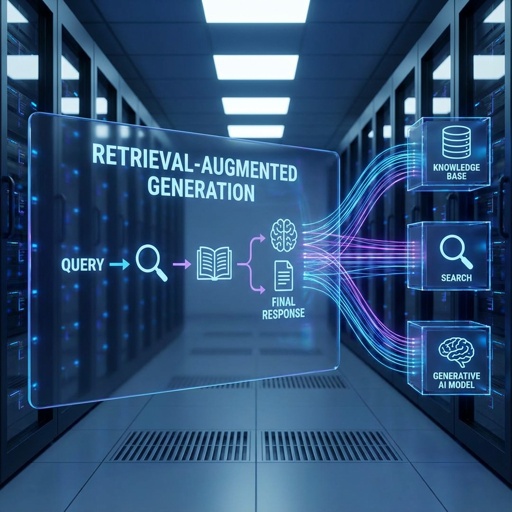
Retrieval Augmented Generation (RAG) is often presented as a simple architectural upgrade: connect a language model to a knowledge base, retrieve relevant documents, and generate grounded answers. In practice, however, most RAG systems fail not because the idea is flawed, but because they are treated as lightweight retrieval pipelines rather than full-fledged information systems.
When answers go wrong, teams frequently adjust prompts, swap models, or tweak temperature settings. Yet in enterprise environments, the real issue usually lies upstream. Incomplete repositories, outdated policies, inconsistent formatting, duplicated files, noisy OCR outputs, and poorly defined access controls quietly shape what the model is allowed to “know.” The model can only reason over the context it receives. If that context is fragmented, stale, or irrelevant, even the most advanced LLM will produce unreliable results.
In this article, let’s explore how Retrieval Augmented Generation or RAG should be treated not as a retrieval pipeline, but as a data system, an evaluation system, and a governance system.
Data Quality: The Foundation Of RAG Performance
There is a common instinct to blame the model when RAG answers go wrong. Maybe the prompt was weak. Maybe the model was too small. Maybe the temperature was set incorrectly. In many enterprise cases, however, the failure is upstream. The language model is responding to what it sees. If what it sees is incomplete, outdated, fragmented, or irrelevant, the answer will reflect that.
RAG systems fail more often due to poor data engineering than poor language models. When teams inherit decades of documents, they also inherit formatting inconsistencies, duplicates, version sprawl, and embedded noise. Simply embedding everything and indexing it does not transform it into knowledge. It transforms it into searchable clutter. Before discussing chunking or embeddings, it helps to define what data quality means in the RAG context.
Data Quality Dimensions in RAG
Data quality in RAG is not abstract. It can be measured and managed.
Completeness
Are all relevant documents present? If your knowledge base excludes certain product manuals or internal policies, retrieval will never surface them. Completeness also includes coverage of edge cases. For example, do you have archived FAQs for discontinued products that customers still ask about?
Freshness
Are outdated documents removed or clearly versioned? A single outdated HR policy in the index can generate incorrect advice. Freshness becomes more complex when departments update documents independently. Without active lifecycle management, stale content lingers.
Consistency
Are formats standardized? Mixed encodings, inconsistent headings, and different naming conventions may not matter to humans browsing folders. They matter to embedding models and search filters.
Relevance Density
Does each chunk contain coherent semantic information? A chunk that combines a privacy disclaimer, a table of contents, and a partial paragraph on pricing is technically valid. It is not useful.
Noise Ratio
How much irrelevant content exists in the index? Repeated headers, boilerplate footers, duplicated disclaimers, and template text inflate the search space and dilute retrieval quality.
If you think of RAG as a question answering system, these dimensions determine what the model is allowed to know. Weak data quality constrains even the best models.
Document Ingestion: Cleaning Before Indexing
Many RAG projects begin by pointing a crawler at a document repository and calling it ingestion. The documents are embedded. A vector database is populated. A demo is built. Weeks later, subtle issues appear.
Handling Real World Enterprise Data
Enterprise data is rarely clean. PDFs contain tables that do not parse correctly. Scanned documents require optical character recognition and may include recognition errors. Headers and footers repeat across every page. Multiple versions of the same file exist with names like “Policy_Final_v3_revised2.”
In multilingual organizations, documents may switch languages mid-file. A support guide may embed screenshots with critical instructions inside images. Legal documents may include annexes appended in different formats.
Even seemingly small issues can create disproportionate impact. For example, repeated footer text such as “Confidential – Internal Use Only” embedded across every page becomes semantically dominant in embeddings. Retrieval may match on that boilerplate instead of meaningful content.
Duplicate versions are another silent problem. If three versions of the same policy are indexed, retrieval may surface the wrong one. Without clear version tagging, the model cannot distinguish between active and archived content. These challenges are not edge cases. They are the norm.
Pre-Processing Best Practices
Pre-processing should be treated as a controlled pipeline, not an ad hoc script.
OCR normalization should standardize extracted text. Character encoding issues need resolution. Tables require structure-aware parsing so that rows and columns remain logically grouped rather than flattened into confusing strings. Metadata extraction is critical. Every document should carry attributes such as source repository, timestamp, department, author, version, and access level. This metadata is not decorative. It becomes the backbone of filtering and governance later.
Duplicate detection algorithms can identify near-identical documents based on hash comparisons or semantic similarity thresholds. When duplicates are found, one version should be marked authoritative, and others archived or excluded. Version control tagging ensures that outdated documents are clearly labeled and can be excluded from retrieval when necessary.
Chunking Strategies
Chunking may appear to be a technical parameter choice. In practice, it is one of the most influential design decisions in a RAG system.
Why Chunking Is Not a Trivial Step
If chunks are too small, context becomes fragmented. The model may retrieve one paragraph without the surrounding explanation. Answers then feel incomplete or overly narrow. If chunks are too large, tokens are wasted. Irrelevant information crowds the context window. The model may struggle to identify which part of the chunk is relevant.
Misaligned boundaries introduce semantic confusion. Splitting a policy in the middle of a conditional statement may lead to the retrieval of a clause without its qualification. That can distort the meaning entirely. I have seen teams experiment with chunk sizes ranging from 200 tokens to 1500 tokens without fully understanding why performance changed. The differences were not random. They reflected how well chunks aligned with the semantic structure.
Chunking Techniques
Several approaches exist, each with tradeoffs. Fixed-length chunking splits documents into equal-sized segments. It is simple but ignores structure. It may work for uniform documents, but it often performs poorly on complex policies. Recursive semantic chunking attempts to break documents along natural boundaries such as headings and paragraphs. It requires more preprocessing logic but typically yields higher coherence.
Section-aware chunking respects document structure. For example, an entire “Refund Policy” section may become a chunk, preserving logical completeness. Hierarchical chunking allows both coarse and fine-grained retrieval. A top-level section can be retrieved first, followed by more granular sub-sections if needed.
Table-aware chunking ensures that rows and related cells remain grouped. This is particularly important for pricing matrices or compliance checklists. No single technique fits every corpus. The right approach depends on document structure and query patterns.
Chunk Metadata as a Quality Multiplier
Metadata at the chunk level can significantly enhance retrieval. Each chunk should include document ID, version number, access classification, semantic tags, and potentially embedding confidence scores. When a user from the finance department asks about budget approvals, metadata filtering can prioritize finance-related documents. If a document is marked confidential, it can be excluded from users without proper clearance.
Embedding confidence or quality indicators can flag chunks generated from low-quality OCR or incomplete parsing. Those chunks can be deprioritized or reviewed. Metadata also improves auditability. If an answer is challenged, teams can trace exactly which chunk was used, from which document, and at what version. Without metadata, the index is flat and opaque. With metadata, it becomes navigable and controllable.
Embeddings and Index Design
Embeddings translate text into numerical representations. The choice of embedding model and index architecture influences retrieval quality and system performance.
Embedding Model Selection Criteria
A general-purpose embedding model may struggle with highly technical terminology in medical, legal, or engineering documents. Multilingual support becomes important in global organizations. If queries are submitted in one language but documents exist in another, cross-lingual alignment must be reliable. Latency constraints also influence model selection. Higher-dimensional embeddings may improve semantic resolution but increase storage and search costs.
Dimensionality tradeoffs should be evaluated in context. Larger vectors may capture nuance but can slow retrieval. Smaller vectors may improve speed but reduce semantic discrimination. Embedding evaluation should be empirical rather than assumed. Test retrieval performance across representative queries.
Index Architecture Choices
Vector databases provide efficient similarity search. Hybrid search combines dense embeddings with sparse keyword-based retrieval. In many enterprise settings, hybrid approaches improve performance, especially when exact terms matter.
Re-ranking layers can refine top results. A first stage retrieves candidates. A second stage re ranks based on deeper semantic comparison or domain-specific rules. Filtering by metadata allows role-based retrieval and contextual narrowing. For example, limiting the search to a particular product line or region. Index architecture decisions shape how retrieval behaves under real workloads. A simplistic setup may work in a prototype but degrade as corpus size and user complexity grow.
Retrieval Failure Modes
Semantic drift occurs when embeddings cluster content that is conceptually related but not contextually relevant. For example, “data retention policy” and “retention bonus policy” may appear semantically similar but serve entirely different intents. Keyword mismatch can cause dense retrieval to miss exact terminology that sparse search would capture.
Over-broad matches retrieve large numbers of loosely related chunks, overwhelming the generation stage. Context dilution happens when too many marginally relevant chunks are included, reducing answer clarity.
To make retrieval measurable, organizations can define a Retrieval Quality Score. RQS can be conceptualized as a weighted function of precision, recall, and contextual relevance. By tracking RQS over time, teams gain visibility into whether retrieval performance is improving or degrading.
Evaluation: Making RAG Measurable
Standard text generation metrics such as BLEU or ROUGE were designed for machine translation and summarization tasks. They compare the generated text to a reference answer. RAG systems are different. The key question is not whether the wording matches a reference, but whether the answer is faithful to the retrieved content.
Traditional metrics do not evaluate retrieval correctness. They do not assess whether the answer cites the appropriate document. They cannot detect hallucinations that sound plausible. RAG requires multi-layer evaluation. Retrieval must be evaluated separately from generation. Then the entire system must be assessed holistically.
Retrieval Level Evaluation
Retrieval evaluation focuses on whether relevant documents are surfaced. Metrics include Precision at K, Recall at K, Mean Reciprocal Rank, context relevance scoring, and latency. Precision at K measures how many of the top K retrieved chunks are truly relevant. Recall at K measures whether the correct document appears in the retrieved set.
Gold document sets can be curated by subject matter experts. For example, for 200 representative queries, experts identify the authoritative documents. Retrieval results are then compared against this set. Synthetic query generation can expand test coverage. Variations of the same intent help stress test retrieval robustness.
Adversarial queries probe edge cases. Slightly ambiguous or intentionally misleading queries test whether retrieval resists drift. Latency is also part of retrieval quality. Even perfectly relevant results are less useful if retrieval takes several seconds.
Generation Level Evaluation
Generation evaluation examines whether the model uses the retrieved context accurately. Metrics include faithfulness to context, answer relevance, hallucination rate, citation correctness, and completeness. Faithfulness measures whether claims in the answer are directly supported by retrieved content. Answer relevance checks whether the response addresses the user’s question.
Hallucination rate can be estimated by comparing answer claims against the source text. Citation correctness ensures references point to the right documents and sections. LLM as a judge approach may assist in automated scoring, but human evaluation loops remain important. Subject matter experts can assess subtle errors that automated systems miss. Edge case testing is critical. Rare queries, multi-step reasoning questions, and ambiguous prompts often expose weaknesses.
System Level Evaluation
System-level evaluation considers the end-to-end experience. Does the answer satisfy the user? Is domain-specific correctness high? What is the cost per query? How does throughput behave under load? User satisfaction surveys and feedback loops provide qualitative insight. Logs can reveal patterns of dissatisfaction, such as repeated rephrasing of queries.
Cost per query matters in production environments. High embedding costs or excessive context windows may strain budgets. Throughput under load indicates scalability. A system that performs well in testing may struggle during peak usage.
A Composite RAG Quality Index can aggregate retrieval, generation, and system metrics into a single dashboard score. While simplistic, such an index helps executives track progress without diving into granular details.
Building an Evaluation Pipeline
Evaluation should not be a one-time exercise.
Offline Evaluation
Offline evaluation uses benchmark datasets and regression testing before deployment. Whenever chunking logic, embedding models, or retrieval parameters change, retrieval and generation metrics should be re-evaluated. Automated scoring pipelines allow rapid iteration. Changes that degrade performance can be caught early.
Online Evaluation
Online evaluation includes A B testing retrieval strategies, shadow deployments that compare outputs without affecting users, and canary testing for gradual rollouts. Real user queries provide more diverse coverage than synthetic tests.
Continuous Monitoring
After deployment, monitoring should track drift in embedding distributions, drops in retrieval precision, spikes in hallucination rates, and latency increases. A Quality Gate Framework for CI CD can formalize deployment controls. Each new release must pass defined thresholds:
- Retrieval threshold
- Faithfulness threshold
- Governance compliance check
Why RAG Governance Is Unique
Unlike standalone language models, RAG systems store and retrieve enterprise knowledge. They dynamically expose internal documents. They combine user input with sensitive data. Governance must therefore span data governance, model governance, and access governance.
If governance is an afterthought, the system may inadvertently expose confidential information. Even if the model is secure, retrieval bypass can surface restricted documents.
Data Classification
Documents should be classified as Public, Internal, Confidential, or Restricted. Classification integrates directly into index filtering and access controls. When a user submits a query, retrieval must consider their clearance level. Classification also supports retrieval constraints. For example, external customer-facing systems should never access internal strategy documents.
Access Control in Retrieval
Role-based access control assigns permissions based on job roles. Attribute-based access control incorporates contextual attributes such as department, region, or project assignment. Document-level filtering ensures that unauthorized documents are never retrieved. Query time authorization verifies access rights dynamically. Retrieval bypass is a serious risk. Even if the generation model does not explicitly expose confidential information, the act of retrieving restricted documents into context may constitute a policy violation.
Data Lineage and Provenance
Every answer should be traceable. Track document source, version history, embedding timestamp, and index update logs. Audit trails support compliance and incident investigation. If a user disputes an answer, teams should be able to identify exactly which document version informed it. Without lineage, accountability becomes difficult. In regulated industries, that may be unacceptable.
Conclusion
RAG works best when you stop treating it like a clever retrieval add-on and start treating it like a knowledge infrastructure that has to behave predictably under pressure. The uncomfortable truth is that most “RAG problems” are not model problems. They are data problems that show up as retrieval mistakes, and evaluation problems that go unnoticed because no one is measuring the right things.
Once you enforce basic hygiene in ingestion, chunking, metadata, and indexing, the system usually becomes calmer. Answers get more stable, the model relies less on guesswork, and teams spend less time chasing weird edge cases that were baked into the corpus from day one.
Governance is what turns that calmer system into something people can actually trust. Access control needs to happen at retrieval time, provenance needs to be traceable, and quality checks need to be part of releases, not a reaction to incidents.
None of this is glamorous work, and it may feel slower than shipping a demo. Still, it is the difference between a tool that employees cautiously ignore and a system that becomes part of daily operations. If you build around data quality, continuous evaluation, and clear governance controls, RAG stops being a prompt experiment and starts looking like a dependable way to deliver the right information to the right person at the right time.
How Digital Divide Data Can Help
Digital Divide Data brings domain-aware expertise into every stage of the RAG data pipeline, from structured data preparation to ongoing human-in-the-loop evaluation. Teams trained in subject matter nuance help ensure that retrieval systems surface contextually correct and relevant information, reducing the kind of hallucinated or misleading responses that erode user trust.
This approach is especially valuable in high-stakes environments like healthcare and legal research, where specialized terminology and subtle semantic differences matter more than textbook examples. For teams looking to move RAG from experimentation to trusted production use, DDD offers both the technical discipline and the people-centric approach that make that transition practical and sustainable.
Partner with DDD to build RAG systems that are accurate, measurable, and governance-ready from day one.
References
National Institute of Standards and Technology. (2024). Artificial Intelligence Risk Management Framework: Generative AI Profile. https://www.nist.gov/publications/artificial-intelligence-risk-management-framework-generative-artificial-intelligence
European Union. (2024). Regulation (EU) 2024/1689 laying down harmonised rules on artificial intelligence. https://eur-lex.europa.eu/eli/reg/2024/1689/oj
European Data Protection Supervisor. (2024). TechSonar: Retrieval Augmented Generation. https://www.edps.europa.eu/data-protection/technology-monitoring/techsonar/retrieval-augmented-generation-rag_en
Microsoft Azure Architecture Center. (2025). Retrieval augmented generation guidance. https://learn.microsoft.com/en-us/azure/architecture/ai-ml/guide/rag
Amazon Web Services. (2025). Building secure retrieval augmented generation applications. https://aws.amazon.com/blogs/machine-learning
FAQs
- How often should a RAG index be refreshed?
It depends on how frequently underlying documents change. In fast-moving environments such as policy or pricing updates, weekly or even daily refresh cycles may be appropriate. Static archives may require less frequent updates. - Can RAG eliminate hallucination?
Not entirely. RAG reduces hallucination risk by grounding responses in retrieved documents. However, generation errors can still occur if context is misinterpreted or incomplete. - Is hybrid search always better than pure vector search?
Not necessarily. Hybrid search often improves performance in terminology-heavy domains, but it adds complexity. Empirical testing with representative queries should guide the choice. - What is the highest hidden cost in RAG systems?
Data cleaning and maintenance. Ongoing ingestion, version control, and evaluation pipelines often require sustained operational investment. - How do you measure user trust in a RAG system?
User feedback rates, query repetition patterns, citation click-through behavior, and survey responses can provide signals of trust and perceived reliability.

Umang architects and drives full-funnel content marketing strategies for AI training data solutions, spanning computer vision, data annotation, data labelling, and Physical and Generative AI services. He works closely with senior leadership to shape DDD’s market positioning, translating complex technical capabilities into compelling narratives that resonate with global AI innovators.