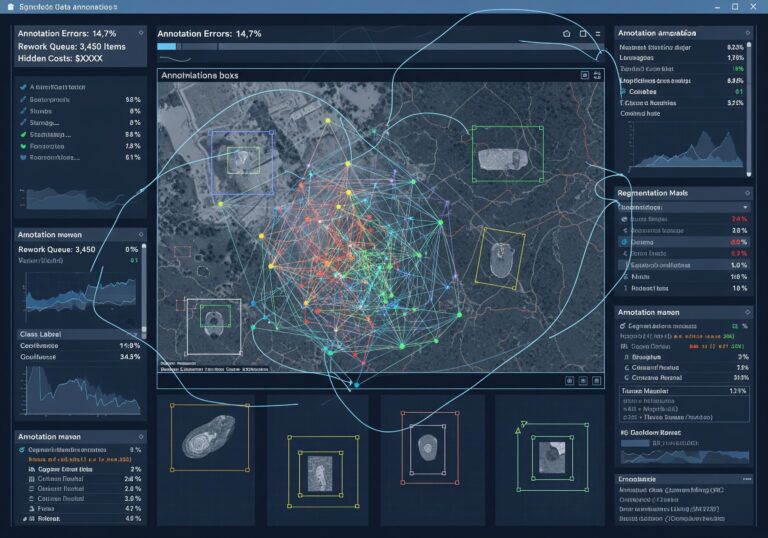
Teams often invest months comparing backbones, tuning hyperparameters, and experimenting with fine-tuning strategies. Meanwhile, labeling guidelines sit in a shared document that has not been updated in six months. Bounding box standards vary slightly between annotators. Edge cases are discussed informally but never codified. The model trains anyway. Metrics look decent. Then deployment begins, and subtle inconsistencies surface as performance gaps.
Despite progress in noise handling and model regularization, high-quality annotation still fundamentally determines model accuracy, generalization, fairness, and safety. Models can tolerate some noise. They cannot transcend the limits of flawed ground truth.
In this article, we will explore how data annotation shapes model behavior at a foundational level, what practical systems teams can put in place to ensure their computer vision models are built on data they can genuinely trust.
What “High-Quality Annotation” Actually Means
Technical Dimensions of Annotation Quality
Label accuracy is the most visible dimension. For classification, that means the correct class. Object detection, it includes both the correct class and precise bounding box placement. For segmentation, it extends to pixel-level masks. For keypoint detection, it means spatially correct joint or landmark positioning. But accuracy alone does not guarantee reliability.
Consistency matters just as much. If one annotator labels partially occluded bicycles as bicycles and another labels them as “unknown object,” the model receives conflicting signals. Even if both decisions are defensible, inconsistency introduces ambiguity that the model must resolve without context.
Granularity defines how detailed annotations should be. A bounding box around a pedestrian might suffice for a traffic density model. The same box is inadequate for training a pose estimation model. Polygon masks may be required. If granularity is misaligned with downstream objectives, performance plateaus quickly.
Completeness is frequently overlooked. Missing objects, unlabeled background elements, or untagged attributes silently bias the dataset. Consider retail shelf detection. If smaller items are systematically ignored during annotation, the model will underperform on precisely those objects in production.
Context sensitivity requires annotators to interpret ambiguous scenarios correctly. A construction worker holding a stop sign in a roadside setup should not be labeled as a traffic sign. Context changes meaning, and guidelines must account for it.
Then there is bias control. Balanced representation across demographics, lighting conditions, geographies, weather patterns, and device types is not simply a fairness issue. It affects generalization. A vehicle detection model trained primarily on clear daytime imagery will struggle at dusk. Annotation coverage defines exposure.
Task-Specific Quality Requirements
Different computer vision tasks demand different annotation standards.
In image classification, the precision of class labels and class boundary definitions is paramount. Misclassifying “husky” as “wolf” might not matter in a casual photo app, but it matters in wildlife monitoring.
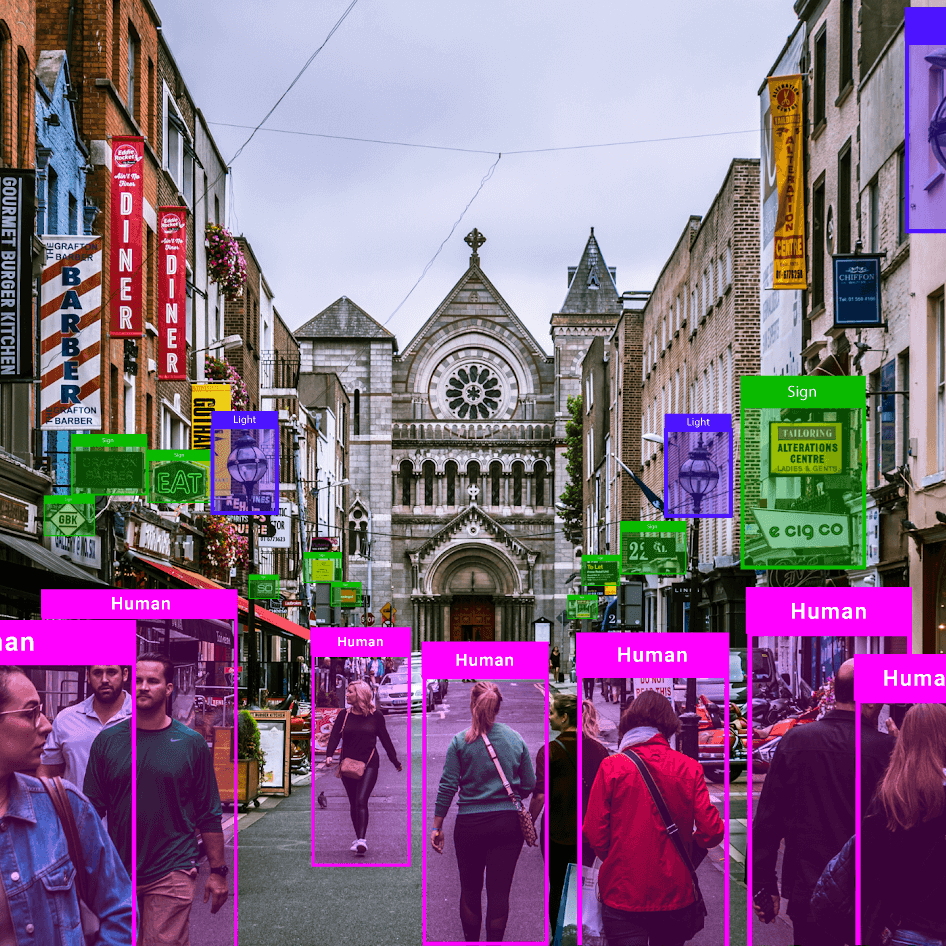
In object detection, bounding box tightness significantly impacts performance. Boxes that consistently include excessive background introduce noise into feature learning. Loose boxes teach the model to associate irrelevant pixels with the object.
In semantic segmentation, pixel-level precision becomes critical. A few misaligned pixels along object boundaries may seem negligible. In aggregate, they distort edge representations and degrade fine-grained predictions.
In keypoint detection, spatial alignment errors can cascade. A misplaced elbow joint shifts the entire pose representation. For applications like ergonomic assessment or sports analytics, such deviations are not trivial.
In autonomous systems, annotation requirements intensify. Edge-case labeling, temporal coherence across frames, occlusion handling, and rare event representation are central. A mislabeled traffic cone in one frame can alter trajectory planning.
Annotation quality is not binary. It is a spectrum shaped by task demands, downstream objectives, and risk tolerance.
The Direct Link Between Annotation Quality and Model Performance
Annotation quality affects learning in ways that are both subtle and structural. It influences gradients, representations, decision boundaries, and generalization behavior.
Label Noise as a Performance Ceiling
Noisy labels introduce incorrect gradients during training. When a cat is labeled as a dog, the model updates its parameters in the wrong direction. With sufficient data, random noise may average out. Systematic noise does not.
Systematic noise shifts learned decision boundaries. If a subset of small SUVs is consistently labeled as sedans due to annotation ambiguity, the model learns distorted class boundaries. It becomes less sensitive to shape differences that matter. Random noise slows convergence. The model must navigate conflicting signals. Training requires more epochs. Validation curves fluctuate. Performance may stabilize below potential.
Structured noise creates class confusion. Consider a dataset where pedestrians are partially occluded and inconsistently labeled. The model may struggle specifically with occlusion scenarios, even if overall accuracy appears acceptable. It may seem that a small percentage of mislabeled data would not matter. Yet even a few percentage points of systematic mislabeling can measurably degrade object detection precision. In detection tasks, bounding box misalignment compounds this effect. Slightly mispositioned boxes reduce Intersection over Union scores, skew training signals, and impact localization accuracy.
Segmentation tasks are even more sensitive. Boundary errors introduce pixel-level inaccuracies that propagate through convolutional layers. Edge representations become blurred. Fine-grained distinctions suffer. At some point, annotation noise establishes a performance ceiling. Architectural improvements yield diminishing returns because the model is constrained by flawed supervision.
Representation Contamination
Poor annotations do more than reduce metrics. They distort learned representations. Models internalize semantic associations based on labeled examples. If background context frequently co-occurs with a class label due to loose bounding boxes, the model learns to associate irrelevant background features with the object. It may appear accurate in controlled environments, but it fails when the context changes.
This is representation contamination. The model encodes incorrect or incomplete features. Downstream tasks inherit these weaknesses. Fine-tuning cannot fully undo foundational distortions if the base representations are misaligned. Imagine training a warehouse detection model where forklifts are often partially labeled, excluding forks. The model learns an incomplete representation of forklifts. In production, when a forklift is seen from a new angle, detection may fail.
What Drives Annotation Quality at Scale
Annotation quality is not an individual annotator problem. It is a system design problem.
Annotation Design Before Annotation Begins
Quality starts before the first image is labeled. A clear taxonomy definition prevents overlapping categories. If “van” and “minibus” are ambiguously separated, confusion is inevitable. Detailed edge-case documentation clarifies scenarios such as partial occlusion, reflections, or atypical camera angles.
Hierarchical labeling schemas provide structure. Instead of flat categories, parent-child relationships allow controlled granularity. For example, “vehicle” may branch into “car,” “truck,” and “motorcycle,” each with subtypes.
Version-controlled guidelines matter. Annotation instructions evolve as edge cases emerge. Without versioning, teams cannot trace performance shifts to guideline changes. I have seen projects where annotation guides existed only in chat threads.
Multi-Annotator Frameworks
Single-pass annotation invites inconsistency. Consensus labeling approaches reduce variance. Multiple annotators label the same subset of data. Disagreements are analyzed. Inter-annotator agreement is quantified.
Disagreement audits are particularly revealing. When annotators diverge systematically, it often signals unclear definitions rather than individual error. Tiered review systems add another layer. Junior annotators label data. Senior reviewers validate complex or ambiguous samples. This mirrors peer review in research environments. The goal is not perfection. It is a controlled, measurable agreement.
QA Mechanisms
Quality assurance mechanisms formalize oversight. Gold-standard test sets contain carefully validated samples. Annotator performance is periodically evaluated against these references. Random audits detect drift. If annotators become fatigued or interpret guidelines loosely, audits reveal deviations.
Automated anomaly detection can flag unusual patterns. For example, if bounding boxes suddenly shrink in size across a batch, the system alerts reviewers. Boundary quality metrics help in segmentation and detection tasks. Monitoring mask overlap consistency or bounding box IoU variance across annotators provides quantitative signals.
Human and AI Collaboration
Automation plays a role. Pre-labeling with models accelerates workflows. Annotators refine predictions rather than starting from scratch. Human correction loops are critical. Blindly accepting pre-labels risks reinforcing model biases. Active learning can prioritize ambiguous or high-uncertainty samples for human review.
When designed carefully, human and AI collaboration increases efficiency without sacrificing oversight. Annotation quality at scale emerges from structured processes, not from isolated individuals working in isolation.
Measuring Data Annotation Quality
If you cannot measure it, you cannot improve it.
Core Metrics
Inter-Annotator Agreement quantifies consistency. Cohen’s Kappa and Fleiss’ Kappa adjust for chance agreement. These metrics reveal whether consensus reflects shared understanding or random coincidence. Bounding box IoU variance measures localization consistency. High variance signals unclear guidelines. Pixel-level mask overlap quantifies segmentation precision across annotators. Class confusion audits examine where disagreements cluster. Are certain classes repeatedly confused? That insight informs taxonomy refinement.
Dataset Health Metrics
Class imbalance ratios affect learning stability. Severe imbalance may require targeted enrichment. Edge-case coverage tracks representation of rare but critical scenarios. Geographic and environmental diversity metrics ensure balanced exposure across lighting conditions, device types, and contexts. Error distribution clustering identifies systematic labeling weaknesses.
Linking Dataset Metrics to Model Metrics
Annotation disagreement often correlates with model uncertainty. Samples with low inter-annotator agreement frequently yield lower confidence predictions. High-variance labels predict failure clusters. If segmentation masks vary widely for a class, expect lower IoU during validation. Curated subsets with high annotation agreement often improve generalization when used for fine-tuning. Connecting dataset metrics with model performance closes the loop. It transforms annotation from a cost center into a measurable performance driver.
How Digital Divide Data Can Help
Sustaining high annotation quality at scale requires structured workflows, experienced annotators, and measurable quality governance. Digital Divide Data supports organizations by designing end-to-end annotation pipelines that integrate clear taxonomy development, multi-layer review systems, and continuous quality monitoring.
DDD combines domain-trained annotation teams with structured QA frameworks. Projects benefit from consensus-based labeling approaches, targeted edge-case enrichment, and detailed performance reporting tied directly to model metrics. Rather than treating annotation as a transactional service, DDD positions it as a strategic component of AI development.
From object detection and segmentation to complex multimodal annotation, DDD helps enterprises operationalize quality while maintaining scalability and cost discipline.
Conclusion
High-quality annotation defines the ceiling of model performance. It shapes learned representations. It influences how well systems generalize beyond controlled test sets. It affects fairness across demographic groups and reliability in edge conditions. When annotation is inconsistent or incomplete, the model inherits those weaknesses. When annotation is precise and thoughtfully governed, the model stands on stable ground.
For organizations building computer vision systems in production environments, the implication is straightforward. Treat annotation as part of core engineering, not as an afterthought. Invest in clear schemas, reviewer frameworks, and dataset metrics that connect directly to model outcomes. Revisit your data with the same rigor you apply to code.
In the end, architecture determines potential. Annotation determines reality.
Talk to our expert to build computer vision systems on data you can trust with Digital Divide Data’s quality-driven data annotation solutions.
References
Ganguly, D., Kumar, S., Balappanawar, I., Chen, W., Kambhatla, S., Iyengar, S., Kalyanaraman, S., Kumaraguru, P., & Chaudhary, V. (2025). LABELING COPILOT: A deep research agent for automated data curation in computer vision (arXiv:2509.22631). arXiv. https://arxiv.org/abs/2509.22631
Rädsch, T., Reinke, A., Weru, V., Tizabi, M. D., Heller, N., Isensee, F., Kopp-Schneider, A., & Maier-Hein, L. (2024). Quality assured: Rethinking annotation strategies in imaging AI. In Proceedings of the European Conference on Computer Vision (ECCV 2024). https://www.ecva.net/papers/eccv_2024/papers_ECCV/papers/09997.pdf
Bhardwaj, E., Gujral, H., Wu, S., Zogheib, C., Maharaj, T., & Becker, C. (2024). The state of data curation at NeurIPS: An assessment of dataset development practices in the Datasets and Benchmarks Track. In Proceedings of the 38th Conference on Neural Information Processing Systems (NeurIPS 2024), Datasets and Benchmarks Track. https://papers.neurips.cc/paper_files/paper/2024/file/605bbd006beee7e0589a51d6a50dcae1-Paper-Datasets_and_Benchmarks_Track.pdf
Freire, A., de S. Silva, L. H., de Andrade, J. V. R., Azevedo, G. O. A., & Fernandes, B. J. T. (2024). Beyond clean data: Exploring the effects of label noise on object detection performance. Knowledge-Based Systems, 304, 112544. https://doi.org/10.1016/j.knosys.2024.112544
FAQs
How much annotation noise is acceptable in a production dataset?
There is no universal threshold. Acceptable noise depends on task sensitivity and risk tolerance. Safety-critical applications demand far lower tolerance than consumer photo tagging systems.
Is synthetic data a replacement for manual annotation?
Synthetic data can reduce manual effort, but it still requires careful labeling, validation, and scenario design. Poorly controlled synthetic labels propagate systematic bias.
Should startups invest heavily in annotation quality early on?
Yes, within reason. Early investment in clear taxonomies and QA processes prevents expensive rework as datasets scale.
Can active learning eliminate the need for large annotation teams?
Active learning improves efficiency but does not eliminate the need for human judgment. It reallocates effort rather than removing it.
How often should annotation guidelines be updated?
Guidelines should evolve whenever new edge cases emerge or when model errors reveal ambiguity. Regular quarterly reviews are common in mature teams.

Umang architects and drives full-funnel content marketing strategies for AI training data solutions, spanning computer vision, data annotation, data labelling, and Physical and Generative AI services. He works closely with senior leadership to shape DDD’s market positioning, translating complex technical capabilities into compelling narratives that resonate with global AI innovators.