
Celebrating 25 years of DDD's Excellence and Social Impact.

Data Labeling

Use Cases 1 1 scaled e1770977330117

Human-in-the-Loop Computer Vision for Safety-Critical Systems

The promise of automation has always been efficiency. Fewer delays, faster decisions, reduced human error. And yet, as these systems become more autonomous, something interesting happens: risk does not disappear; it migrates.

Instead of a distracted operator missing a signal, we may now face a model that misinterprets glare on a wet road. Instead of a fatigued technician overlooking a defect, we might have a neural network misclassifying an unusual pattern it never encountered in training data for AV.

There’s also a persistent illusion in the market: the idea of “fully autonomous” systems. The marketing language often suggests a clean break from human dependency. But in practice, what emerges is layered oversight, remote support teams, escalation protocols, human review panels, and more. 

Enterprises must document who intervenes, how decisions are recorded, and what safeguards are in place when models behave unpredictably. Boards ask uncomfortable questions about liability. Insurers scrutinize safety architecture. All of these points toward a conclusion that might feel less glamorous but far more grounded:

In safety-critical environments, Human-in-the-Loop (HITL) computer vision is not a fallback mechanism; it is a structural requirement for resilience, accountability, and trust. In this detailed guide, we will explore Human-in-the-Loop (HITL) computer vision for safety-critical systems, develop effective architectures, and establish robust workflows.

What Is Human-in-the-Loop in Computer Vision?

“Human-in-the-Loop” can mean different things depending on who you ask. For some, it’s about annotation, humans labeling bounding boxes and segmentation masks. For others, it’s about a remote operator taking control of a vehicle during edge cases. In reality, HITL spans the entire lifecycle of a vision system.

Human involvement can be embedded within:

Data labeling and validation – Annotators refining datasets, resolving ambiguous cases, and identifying mislabeled samples.

Model training and retraining – Subject matter experts reviewing outputs, flagging systematic errors, guiding retraining cycles.

Real-time inference oversight – Operators reviewing low-confidence predictions or intervening when anomalies occur.

Post-deployment monitoring – Analysts auditing performance logs, reviewing incidents, and adjusting thresholds.

Why Vision Systems Require Special Attention

Vision systems operate in messy environments. Unlike structured databases, the visual world is unpredictable. Perception errors are often high-dimensional. A small shadow may alter classification confidence. A slightly altered angle can change bounding box accuracy. A sticker on a stop sign might confuse detection.

Edge cases are not theoretical; they’re daily occurrences. Consider:

  • A construction worker wearing reflective gear that obscures their silhouette.
  • A pedestrian pushing a bicycle across a road at dusk.
  • Medical imagery containing artifacts from older equipment models.

Visual ambiguity complicates matters further. Is that a fallen branch on the highway or just a dark patch? Is a cluster of pixels noise or an early-stage anomaly in a scan?

Human judgment, imperfect as it is, excels at contextual interpretation. Vision models excel at pattern recognition at scale. In safety-critical systems, one without the other appears incomplete.

Why Safety-Critical Systems Cannot Rely on Full Autonomy

The Nature of Safety-Critical Environments

In a content moderation system, a false positive may frustrate a user. In a surgical assistance system, a false positive could mislead a clinician. The difference is not incremental; it’s structural. When failure consequences are severe, explainability becomes essential. Stakeholders will ask: What happened? Why did the system decide this? Could it have been prevented?

Without a human oversight layer, answers may be limited to probability distributions and confidence scores, insufficient for legal or operational review.

The Automation Paradox

There’s an uncomfortable phenomenon sometimes described as the automation paradox. As systems become more automated, human operators intervene less frequently. Then, when something goes wrong, often something rare and unusual, the human is suddenly required to take control under pressure.

Imagine a remote vehicle support operator overseeing dozens of vehicles. Most of the time, the dashboard remains calm. Suddenly, a complex intersection scenario triggers an escalation. The operator has seconds to assess camera feeds, sensor overlays, and context.

The irony? The more reliable the system appears, the less prepared the human may be for intervention. That tension suggests full autonomy may not simply be a technical challenge; it’s a human systems design challenge.

Trust, Liability, and Accountability

Who is responsible when perception fails?

In regulated markets, accountability frameworks increasingly require verifiable oversight layers. Enterprises must demonstrate not just that a system performs well in benchmarks, but that safeguards exist when it does not. Human oversight becomes both a technical mechanism and a legal one. It provides a checkpoint. A record. A place where responsibility can be meaningfully assigned. Without it, organizations may find themselves exposed, not only technically, but also reputationally and legally.

Where Humans Fit in the Vision Pipeline

Data-Centric HITL

Data is where many safety issues originate. A vision model trained predominantly on sunny weather may struggle in fog. A dataset lacking diversity may introduce bias in detection.

Human-in-the-loop at the data stage includes:

  • Annotation quality control
  • Edge-case identification
  • Active learning loops
  • Bias detection and correction
  • Continuous dataset refinement

For example, annotators might notice that nighttime pedestrian images are underrepresented. Or that certain industrial defect types appear inconsistently labeled. Those observations feed directly into model improvement. Active learning systems can flag uncertain predictions and route them to expert reviewers. Over time, the dataset evolves, ideally reducing blind spots. Data-centric HITL may not feel dramatic, but it’s foundational.

Model Development HITL

An engineering team might notice that a system confuses scaffolding structures with human silhouettes. Instead of treating all errors equally, they categorize them. Confidence thresholds are particularly interesting. Set them too low, and the system rarely escalates, risking missed edge cases. Set them too high, and operators drown in alerts. Finding that balance often requires iterative human evaluation, not just statistical optimization.

Real-Time Operational HITL

In live environments, human escalation mechanisms become visible. Confidence-based routing may direct low-certainty detections to a monitoring center. An operator reviews video snippets and confirms or overrides decisions. Override mechanisms must be clear and accessible. If an industrial robot’s vision system detects a human in proximity, a supervisor should have immediate authority to pause operations. Designing these workflows requires clarity about response times, accountability, and documentation.

Post-Deployment HITL

No system remains static after deployment. Incident review boards analyze edge cases. Drift detection workflows flag performance degradation as environments change. Retraining cycles incorporate newly observed patterns. Safety audits and compliance documentation often rely on human interpretation of logs and events. In this sense, HITL extends far beyond the moment of decision; it becomes an ongoing governance process.

HITL Architectures for Safety-Critical Computer Vision

Confidence-Gated Architectures

In confidence-gated systems, the model outputs a probability score. Predictions below a defined threshold are escalated to human review. Dynamic thresholding may adjust based on context. For instance, in a low-risk warehouse zone, a slightly lower confidence threshold might be acceptable. Near hazardous materials, stricter thresholds apply. This approach appears straightforward but requires careful calibration. Over-escalation can overwhelm operators, and under-escalation can introduce risk.

Dual-Channel Systems

Dual-channel systems combine automated decision-making with parallel human validation streams. For example, an automated rail inspection system flags potential track anomalies. A human analyst reviews flagged images before maintenance crews are dispatched. Redundancy increases reliability, though it also increases operational cost. Enterprises must weigh efficiency against safety margins.

Supervisory Control Models

Here, humans monitor dashboards and intervene only under specific triggers. Visualization tools become critical. Operators need clear summaries, not dense technical overlays. Risk scoring, anomaly heatmaps, and simplified indicators help maintain situational awareness. A poorly designed interface may undermine even the most accurate model.

Designing Effective Human-in-the-Loop Workflows

Avoiding Cognitive Overload

Operators in control rooms already face information saturation. Introducing AI-generated alerts can amplify that burden. Interface clarity matters. Alerts should be prioritized. Context, timestamp, camera angle, and environmental conditions should be visible at a glance. Alarm fatigue is real. If too many low-risk alerts trigger, operators may begin ignoring them. Ironically, the system designed to enhance safety could erode it.

Operator Training & Skill Retention

Skill retention may require deliberate effort. Continuous simulation environments can expose operators to rare scenarios, black ice on roads, unexpected pedestrian behavior, and unusual equipment failures. Scenario-based drills keep intervention skills sharp. Otherwise, human oversight becomes nominal rather than functional.

Latency vs. Safety Tradeoffs

How fast must a human respond?  Designing for controlled degradation, where a system transitions safely into a low-risk mode while awaiting human input, can mitigate time pressure. Full automation may still be justified in tightly constrained environments. The key is recognizing where that boundary lies.

How Digital Divide Data (DDD) Can Help

Building and maintaining Human-in-the-Loop computer vision systems isn’t just a technical challenge; it’s an operational one. It demands disciplined data workflows, rigorous quality control, and scalable human oversight. Digital Divide Data (DDD) helps enterprises structure this foundation. From high-precision, domain-specific annotation with multi-layer QA to edge-case identification and bias detection, DDD designs processes that surface ambiguity early and reduce downstream risk.

As systems evolve, DDD supports active learning loops, retraining workflows, and compliance-ready documentation that meets regulatory expectations. For real-time escalation models, DDD can also manage trained review teams aligned to defined intervention protocols. In effect, DDD doesn’t just supply labeled data; it builds the structured human oversight that safety-critical AI systems depend on.

Conclusion

The real question isn’t whether AI can operate autonomously. In many environments, it already does. The better question is where autonomy should pause, and how humans are positioned when it does. Human-in-the-Loop systems acknowledge something simple but important: uncertainty is inevitable. Rather than pretending it can be eliminated, they design for it. They create checkpoints, escalation paths, audit trails, and shared responsibility between machines and people.

For enterprises operating in regulated, high-risk industries, this approach is increasingly non-negotiable. Compliance expectations are tightening. Liability frameworks are evolving. Stakeholders want proof that safeguards exist, not just performance metrics.

The future of safety-critical AI will not be defined by removing humans from the loop. It will be defined by placing them intelligently within it, where judgment, context, and responsibility still matter most.

Talk to our experts to build safer vision systems with structured human oversight.

References

European Parliament & Council of the European Union. (2024). Regulation laying down harmonised rules on artificial intelligence (Artificial Intelligence Act). Official Journal of the European Union.

Waymo Research. (2024). Advancements in end-to-end multimodal models for autonomous driving systems. Waymo LLC.

NVIDIA Corporation. (2024). Designing human-in-the-loop AI systems for real-time decision environments. NVIDIA Developer Blog.

European Commission. (2024). High-risk AI systems and human oversight requirements under the EU digital strategy. Publications Office of the European Union.

FAQs

Is Human-in-the-Loop always required for safety-critical computer vision systems?
In most regulated or high-risk environments, some form of human oversight is typically expected, though its depth varies by use case.

Does adding humans to the loop significantly reduce efficiency?
When properly calibrated, HITL usually targets only high-uncertainty cases, limiting impact on overall efficiency.

How do organizations decide which decisions should be escalated to humans?
Escalation thresholds are generally defined based on risk severity, confidence scores, and regulatory exposure.

What are the highest hidden costs of Human-in-the-Loop systems?
Ongoing training, interface optimization, quality control management, and compliance documentation often represent the highest hidden costs.

Human-in-the-Loop Computer Vision for Safety-Critical Systems Read Post »

Mapping Localization for SLAM

Why High-Quality Data Annotation Still Defines Computer Vision Model Performance

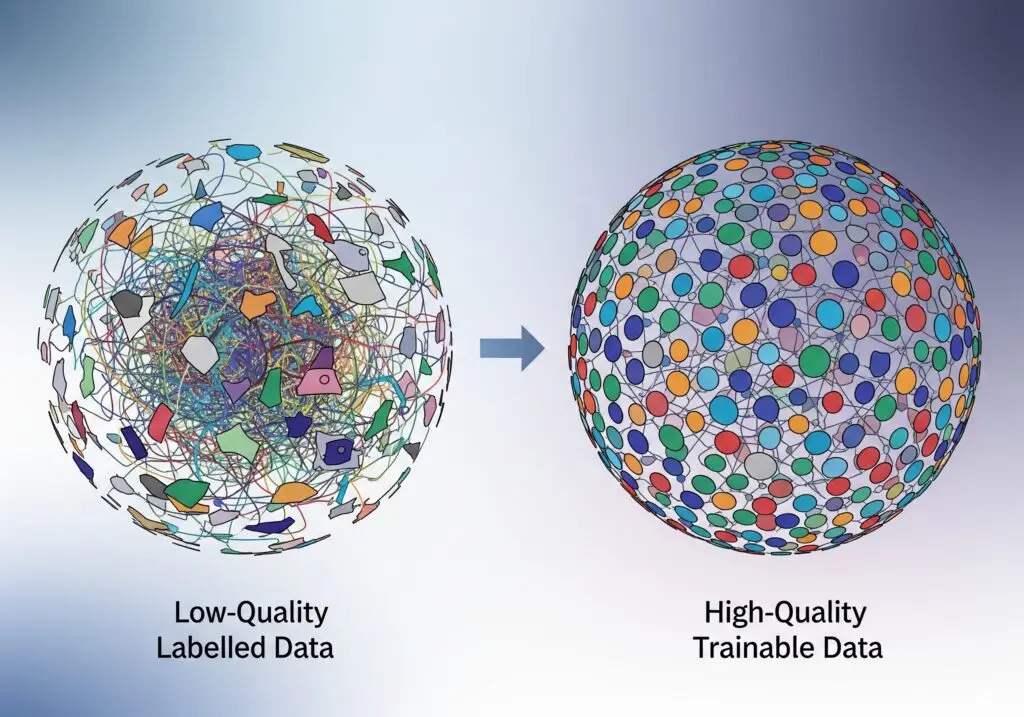
Teams often invest months comparing backbones, tuning hyperparameters, and experimenting with fine-tuning strategies. Meanwhile, labeling guidelines sit in a shared document that has not been updated in six months. Bounding box standards vary slightly between annotators. Edge cases are discussed informally but never codified. The model trains anyway. Metrics look decent. Then deployment begins, and subtle inconsistencies surface as performance gaps.

Despite progress in noise handling and model regularization, high-quality annotation still fundamentally determines model accuracy, generalization, fairness, and safety. Models can tolerate some noise. They cannot transcend the limits of flawed ground truth.

In this article, we will explore how data annotation shapes model behavior at a foundational level, what practical systems teams can put in place to ensure their computer vision models are built on data they can genuinely trust.

What “High-Quality Annotation” Actually Means

Technical Dimensions of Annotation Quality

Label accuracy is the most visible dimension. For classification, that means the correct class. Object detection, it includes both the correct class and precise bounding box placement. For segmentation, it extends to pixel-level masks. For keypoint detection, it means spatially correct joint or landmark positioning. But accuracy alone does not guarantee reliability.

Consistency matters just as much. If one annotator labels partially occluded bicycles as bicycles and another labels them as “unknown object,” the model receives conflicting signals. Even if both decisions are defensible, inconsistency introduces ambiguity that the model must resolve without context.

Granularity defines how detailed annotations should be. A bounding box around a pedestrian might suffice for a traffic density model. The same box is inadequate for training a pose estimation model. Polygon masks may be required. If granularity is misaligned with downstream objectives, performance plateaus quickly.

Completeness is frequently overlooked. Missing objects, unlabeled background elements, or untagged attributes silently bias the dataset. Consider retail shelf detection. If smaller items are systematically ignored during annotation, the model will underperform on precisely those objects in production.

Context sensitivity requires annotators to interpret ambiguous scenarios correctly. A construction worker holding a stop sign in a roadside setup should not be labeled as a traffic sign. Context changes meaning, and guidelines must account for it.

Then there is bias control. Balanced representation across demographics, lighting conditions, geographies, weather patterns, and device types is not simply a fairness issue. It affects generalization. A vehicle detection model trained primarily on clear daytime imagery will struggle at dusk. Annotation coverage defines exposure.

Task-Specific Quality Requirements

Different computer vision tasks demand different annotation standards.

In image classification, the precision of class labels and class boundary definitions is paramount. Misclassifying “husky” as “wolf” might not matter in a casual photo app, but it matters in wildlife monitoring.

In object detection, bounding box tightness significantly impacts performance. Boxes that consistently include excessive background introduce noise into feature learning. Loose boxes teach the model to associate irrelevant pixels with the object.

In semantic segmentation, pixel-level precision becomes critical. A few misaligned pixels along object boundaries may seem negligible. In aggregate, they distort edge representations and degrade fine-grained predictions.

In keypoint detection, spatial alignment errors can cascade. A misplaced elbow joint shifts the entire pose representation. For applications like ergonomic assessment or sports analytics, such deviations are not trivial.

In autonomous systems, annotation requirements intensify. Edge-case labeling, temporal coherence across frames, occlusion handling, and rare event representation are central. A mislabeled traffic cone in one frame can alter trajectory planning.

Annotation quality is not binary. It is a spectrum shaped by task demands, downstream objectives, and risk tolerance.

The Direct Link Between Annotation Quality and Model Performance

Annotation quality affects learning in ways that are both subtle and structural. It influences gradients, representations, decision boundaries, and generalization behavior.

Label Noise as a Performance Ceiling

Noisy labels introduce incorrect gradients during training. When a cat is labeled as a dog, the model updates its parameters in the wrong direction. With sufficient data, random noise may average out. Systematic noise does not.

Systematic noise shifts learned decision boundaries. If a subset of small SUVs is consistently labeled as sedans due to annotation ambiguity, the model learns distorted class boundaries. It becomes less sensitive to shape differences that matter. Random noise slows convergence. The model must navigate conflicting signals. Training requires more epochs. Validation curves fluctuate. Performance may stabilize below potential.

Structured noise creates class confusion. Consider a dataset where pedestrians are partially occluded and inconsistently labeled. The model may struggle specifically with occlusion scenarios, even if overall accuracy appears acceptable. It may seem that a small percentage of mislabeled data would not matter. Yet even a few percentage points of systematic mislabeling can measurably degrade object detection precision. In detection tasks, bounding box misalignment compounds this effect. Slightly mispositioned boxes reduce Intersection over Union scores, skew training signals, and impact localization accuracy.

Segmentation tasks are even more sensitive. Boundary errors introduce pixel-level inaccuracies that propagate through convolutional layers. Edge representations become blurred. Fine-grained distinctions suffer. At some point, annotation noise establishes a performance ceiling. Architectural improvements yield diminishing returns because the model is constrained by flawed supervision.

Representation Contamination

Poor annotations do more than reduce metrics. They distort learned representations. Models internalize semantic associations based on labeled examples. If background context frequently co-occurs with a class label due to loose bounding boxes, the model learns to associate irrelevant background features with the object. It may appear accurate in controlled environments, but it fails when the context changes.

This is representation contamination. The model encodes incorrect or incomplete features. Downstream tasks inherit these weaknesses. Fine-tuning cannot fully undo foundational distortions if the base representations are misaligned. Imagine training a warehouse detection model where forklifts are often partially labeled, excluding forks. The model learns an incomplete representation of forklifts. In production, when a forklift is seen from a new angle, detection may fail.

What Drives Annotation Quality at Scale

Annotation quality is not an individual annotator problem. It is a system design problem.

Annotation Design Before Annotation Begins

Quality starts before the first image is labeled. A clear taxonomy definition prevents overlapping categories. If “van” and “minibus” are ambiguously separated, confusion is inevitable. Detailed edge-case documentation clarifies scenarios such as partial occlusion, reflections, or atypical camera angles.

Hierarchical labeling schemas provide structure. Instead of flat categories, parent-child relationships allow controlled granularity. For example, “vehicle” may branch into “car,” “truck,” and “motorcycle,” each with subtypes.

Version-controlled guidelines matter. Annotation instructions evolve as edge cases emerge. Without versioning, teams cannot trace performance shifts to guideline changes. I have seen projects where annotation guides existed only in chat threads.

Multi-Annotator Frameworks

Single-pass annotation invites inconsistency. Consensus labeling approaches reduce variance. Multiple annotators label the same subset of data. Disagreements are analyzed. Inter-annotator agreement is quantified.

Disagreement audits are particularly revealing. When annotators diverge systematically, it often signals unclear definitions rather than individual error. Tiered review systems add another layer. Junior annotators label data. Senior reviewers validate complex or ambiguous samples. This mirrors peer review in research environments. The goal is not perfection. It is a controlled, measurable agreement.

QA Mechanisms

Quality assurance mechanisms formalize oversight. Gold-standard test sets contain carefully validated samples. Annotator performance is periodically evaluated against these references. Random audits detect drift. If annotators become fatigued or interpret guidelines loosely, audits reveal deviations.

Automated anomaly detection can flag unusual patterns. For example, if bounding boxes suddenly shrink in size across a batch, the system alerts reviewers. Boundary quality metrics help in segmentation and detection tasks. Monitoring mask overlap consistency or bounding box IoU variance across annotators provides quantitative signals.

Human and AI Collaboration

Automation plays a role. Pre-labeling with models accelerates workflows. Annotators refine predictions rather than starting from scratch. Human correction loops are critical. Blindly accepting pre-labels risks reinforcing model biases. Active learning can prioritize ambiguous or high-uncertainty samples for human review.

When designed carefully, human and AI collaboration increases efficiency without sacrificing oversight. Annotation quality at scale emerges from structured processes, not from isolated individuals working in isolation.

Measuring Data Annotation Quality

If you cannot measure it, you cannot improve it.

Core Metrics

Inter-Annotator Agreement quantifies consistency. Cohen’s Kappa and Fleiss’ Kappa adjust for chance agreement. These metrics reveal whether consensus reflects shared understanding or random coincidence. Bounding box IoU variance measures localization consistency. High variance signals unclear guidelines. Pixel-level mask overlap quantifies segmentation precision across annotators. Class confusion audits examine where disagreements cluster. Are certain classes repeatedly confused? That insight informs taxonomy refinement.

Dataset Health Metrics

Class imbalance ratios affect learning stability. Severe imbalance may require targeted enrichment. Edge-case coverage tracks representation of rare but critical scenarios. Geographic and environmental diversity metrics ensure balanced exposure across lighting conditions, device types, and contexts. Error distribution clustering identifies systematic labeling weaknesses.

Linking Dataset Metrics to Model Metrics

Annotation disagreement often correlates with model uncertainty. Samples with low inter-annotator agreement frequently yield lower confidence predictions. High-variance labels predict failure clusters. If segmentation masks vary widely for a class, expect lower IoU during validation. Curated subsets with high annotation agreement often improve generalization when used for fine-tuning. Connecting dataset metrics with model performance closes the loop. It transforms annotation from a cost center into a measurable performance driver.

How Digital Divide Data Can Help

Sustaining high annotation quality at scale requires structured workflows, experienced annotators, and measurable quality governance. Digital Divide Data supports organizations by designing end-to-end annotation pipelines that integrate clear taxonomy development, multi-layer review systems, and continuous quality monitoring.

DDD combines domain-trained annotation teams with structured QA frameworks. Projects benefit from consensus-based labeling approaches, targeted edge-case enrichment, and detailed performance reporting tied directly to model metrics. Rather than treating annotation as a transactional service, DDD positions it as a strategic component of AI development.

From object detection and segmentation to complex multimodal annotation, DDD helps enterprises operationalize quality while maintaining scalability and cost discipline.

Conclusion

High-quality annotation defines the ceiling of model performance. It shapes learned representations. It influences how well systems generalize beyond controlled test sets. It affects fairness across demographic groups and reliability in edge conditions. When annotation is inconsistent or incomplete, the model inherits those weaknesses. When annotation is precise and thoughtfully governed, the model stands on stable ground.

For organizations building computer vision systems in production environments, the implication is straightforward. Treat annotation as part of core engineering, not as an afterthought. Invest in clear schemas, reviewer frameworks, and dataset metrics that connect directly to model outcomes. Revisit your data with the same rigor you apply to code.

In the end, architecture determines potential. Annotation determines reality.

Talk to our expert to build computer vision systems on data you can trust with Digital Divide Data’s quality-driven data annotation solutions.

References

Ganguly, D., Kumar, S., Balappanawar, I., Chen, W., Kambhatla, S., Iyengar, S., Kalyanaraman, S., Kumaraguru, P., & Chaudhary, V. (2025). LABELING COPILOT: A deep research agent for automated data curation in computer vision (arXiv:2509.22631). arXiv. https://arxiv.org/abs/2509.22631

Rädsch, T., Reinke, A., Weru, V., Tizabi, M. D., Heller, N., Isensee, F., Kopp-Schneider, A., & Maier-Hein, L. (2024). Quality assured: Rethinking annotation strategies in imaging AI. In Proceedings of the European Conference on Computer Vision (ECCV 2024). https://www.ecva.net/papers/eccv_2024/papers_ECCV/papers/09997.pdf

Bhardwaj, E., Gujral, H., Wu, S., Zogheib, C., Maharaj, T., & Becker, C. (2024). The state of data curation at NeurIPS: An assessment of dataset development practices in the Datasets and Benchmarks Track. In Proceedings of the 38th Conference on Neural Information Processing Systems (NeurIPS 2024), Datasets and Benchmarks Track. https://papers.neurips.cc/paper_files/paper/2024/file/605bbd006beee7e0589a51d6a50dcae1-Paper-Datasets_and_Benchmarks_Track.pdf

Freire, A., de S. Silva, L. H., de Andrade, J. V. R., Azevedo, G. O. A., & Fernandes, B. J. T. (2024). Beyond clean data: Exploring the effects of label noise on object detection performance. Knowledge-Based Systems, 304, 112544. https://doi.org/10.1016/j.knosys.2024.112544

FAQs

How much annotation noise is acceptable in a production dataset?
There is no universal threshold. Acceptable noise depends on task sensitivity and risk tolerance. Safety-critical applications demand far lower tolerance than consumer photo tagging systems.

Is synthetic data a replacement for manual annotation?
Synthetic data can reduce manual effort, but it still requires careful labeling, validation, and scenario design. Poorly controlled synthetic labels propagate systematic bias.

Should startups invest heavily in annotation quality early on?
Yes, within reason. Early investment in clear taxonomies and QA processes prevents expensive rework as datasets scale.

Can active learning eliminate the need for large annotation teams?
Active learning improves efficiency but does not eliminate the need for human judgment. It reallocates effort rather than removing it.

How often should annotation guidelines be updated?
Guidelines should evolve whenever new edge cases emerge or when model errors reveal ambiguity. Regular quarterly reviews are common in mature teams.

Why High-Quality Data Annotation Still Defines Computer Vision Model Performance Read Post »

Computer Vision Services

Computer Vision Services: Major Challenges and Solutions

Not long ago, progress in computer vision felt tightly coupled to model architecture. Each year brought a new backbone, a clever loss function, or a training trick that nudged benchmarks forward. That phase has not disappeared, but it has clearly slowed. Today, many teams are working with similar model families, similar pretraining strategies, and similar tooling. The real difference in outcomes often shows up elsewhere.

What appears to matter more now is the data. Not just how much of it exists, but how it is collected, curated, labeled, monitored, and refreshed over time. In practice, computer vision systems that perform well outside controlled test environments tend to share a common trait: they are built on data pipelines that receive as much attention as the models themselves.

This shift has exposed a new bottleneck. Teams are discovering that scaling a computer vision system into production is less about training another version of the model and more about managing the entire lifecycle of visual data. This is where computer vision data services have started to play a critical role.

This blog explores the most common data challenges across computer vision services and the practical solutions that organizations should adopt.

What Are Computer Vision Data Services?

Computer vision data services refer to end-to-end support functions that manage visual data throughout its lifecycle. They extend well beyond basic labeling tasks and typically cover several interconnected areas. Data collection is often the first step. This includes sourcing images or video from diverse environments, devices, and scenarios that reflect real-world conditions. In many cases, this also involves filtering, organizing, and validating raw inputs before they ever reach a model.

Data curation follows closely. Rather than treating data as a flat repository, curation focuses on structure and intent. It asks whether the dataset represents the full range of conditions the system will encounter and whether certain patterns or gaps are already emerging. Data annotation and quality assurance form the most visible layer of data services. This includes defining labeling guidelines, training annotators, managing workflows, and validating outputs. The goal is not just labeled data, but labels that are consistent, interpretable, and aligned with the task definition.

Dataset optimization and enrichment come into play once initial models are trained. Teams may refine labels, rebalance classes, add metadata, or remove redundant samples. Over time, datasets evolve to better reflect the operational environment. Finally, continuous dataset maintenance ensures that data pipelines remain active after deployment. This includes monitoring incoming data, identifying drift, refreshing labels, and feeding new insights back into the training loop.

Where CV Data Services Fit in the ML Lifecycle

Computer vision data services are not confined to a single phase of development. They appear at nearly every stage of the machine learning lifecycle.

During pre-training, data services help define what should be collected and why. Decisions made here influence everything downstream, from model capacity to evaluation strategy. Poor dataset design at this stage often leads to expensive corrections later. In training and validation, annotation quality and dataset balance become central concerns. Data services ensure that labels reflect consistent definitions and that validation sets actually test meaningful scenarios.

Once models are deployed, the role of data services expands rather than shrinks. Monitoring pipeline tracks changes in incoming data and surfaces early signs of degradation. Refresh cycles are planned instead of reactive. Iterative improvement closes the loop. Insights from production inform new data collection, targeted annotation, and selective retraining. Over time, the system improves not because the model changed dramatically, but because the data became more representative.

Core Challenges in Computer Vision

Data Collection at Scale

Collecting visual data at scale sounds straightforward until teams attempt it in practice. Real-world environments are diverse in ways that are easy to underestimate. Lighting conditions vary by time of day and geography. Camera hardware introduces subtle distortions. User behavior adds another layer of unpredictability.

Rare events pose an even greater challenge. In autonomous systems, for example, edge cases often matter more than common scenarios. These events are difficult to capture deliberately and may appear only after long periods of deployment. Legal and privacy constraints further complicate collection efforts. Regulations around personal data, surveillance, and consent limit what can be captured and how it can be stored. In some regions, entire classes of imagery are restricted or require anonymization.

The result is a familiar pattern. Models trained on carefully collected datasets perform well in lab settings but struggle once exposed to real-world variability. The gap between test performance and production behavior becomes difficult to ignore.

Dataset Imbalance and Poor Coverage

Even when data volume is high, coverage is often uneven. Common classes dominate because they are easier to collect. Rare but critical scenarios remain underrepresented.

Convenience sampling tends to reinforce these imbalances. Data is collected where it is easiest, not where it is most informative. Over time, datasets reflect operational bias rather than operational reality. Hidden biases add another layer of complexity. Geographic differences, weather patterns, and camera placement can subtly shape model behavior. A system trained primarily on daytime imagery may struggle at dusk. One trained in urban settings may fail in rural environments.

These issues reduce generalization. Models appear accurate during evaluation but behave unpredictably in new contexts. Debugging such failures can be frustrating because the root cause lies in data rather than code.

Annotation Complexity and Cost

As computer vision tasks grow more sophisticated, annotation becomes more demanding. Simple bounding boxes are no longer sufficient for many applications.

Semantic and instance segmentation require pixel-level precision. Multi-label classification introduces ambiguity when objects overlap or categories are loosely defined. Video object tracking demands temporal consistency. Three-dimensional perception adds spatial reasoning into the mix. Expert-level labeling is expensive and slow. 

Training annotators takes time, and retaining them requires ongoing investment. Even with clear guidelines, interpretation varies. Two annotators may label the same scene differently without either being objectively wrong. These factors drive up costs and timelines. They also increase the risk of noisy labels, which can quietly degrade model performance.

Quality Assurance and Label Consistency

Quality assurance is often treated as a final checkpoint rather than an integrated process. This approach tends to miss subtle errors that accumulate over time. Annotation standards may drift between batches or teams. Guidelines evolve, but older labels remain unchanged. Without measurable benchmarks, it becomes difficult to assess consistency across large datasets.

Detecting errors at scale is particularly challenging. Visual inspection does not scale, and automated checks can only catch certain types of mistakes. The impact shows up during training. Models fail to converge cleanly or exhibit unstable behavior. Debugging efforts focus on hyperparameters when the underlying issue lies in label inconsistency.

Data Drift and Model Degradation in Production

Once deployed, computer vision systems encounter change. Environments evolve. Sensors age or are replaced. User behavior shifts in subtle ways. New scenarios emerge that were not present during training. Construction changes traffic patterns. Seasonal effects alter visual appearance. Software updates affect image preprocessing.

Without visibility into these changes, performance degradation goes unnoticed until failures become obvious. By then, tracing the cause is difficult. Silent failures are particularly risky in safety-critical applications. Models appear to function normally but make increasingly unreliable predictions.

Data Scarcity, Privacy, and Security Constraints

Some domains face chronic data scarcity. Healthcare imaging, defense, and surveillance systems often operate under strict access controls. Data cannot be freely shared or centralized. Privacy concerns limit the use of real-world imagery. Sensitive attributes must be protected, and anonymization techniques are not always sufficient.

Security risks add another layer. Visual data may reveal operational details that cannot be exposed. Managing access and storage becomes as important as model accuracy. These constraints slow development and limit experimentation. Teams may hesitate to expand datasets, even when they know gaps exist.

How CV Data Services Address These Challenges

Intelligent Data Collection and Curation

Effective data services begin before the first image is collected. Clear data strategies define what scenarios matter most and why. Redundant or low-value images are filtered early. Instead of maximizing volume, teams focus on diversity. Metadata becomes a powerful tool, enabling sampling across conditions like time, location, or sensor type. Curation ensures that datasets remain purposeful. Rather than growing indefinitely, they evolve in response to observed gaps and failures.

Structured Annotation Frameworks

Annotation improves when structure replaces ad hoc decisions. Task-specific guidelines define not only what to label, but how to handle ambiguity. Clear edge case definitions reduce inconsistency. Annotators know when to escalate uncertain cases rather than guessing.

Tiered workflows combine generalist annotators with domain experts. Complex labels receive additional review, while simpler tasks scale efficiently. Human-in-the-loop validation balances automation with judgment. Models assist annotators, but humans retain control over final decisions.

Built-In Quality Assurance Mechanisms

Quality assurance works best when it is continuous. Multi-pass reviews catch errors that single checks miss. Consensus labeling highlights disagreement and reveals unclear guidelines. Statistical measures track consistency across annotators and batches.

Golden datasets serve as reference points. Annotator performance is measured against known outcomes, providing objective feedback. Over time, these mechanisms create a feedback loop that improves both data quality and team performance.

Cost Reduction Through Label Efficiency

Not all data points contribute equally. Data services increasingly focus on prioritization. High-impact samples are identified based on model uncertainty or error patterns. Annotation efforts concentrate where they matter most. Re-labeling replaces wholesale annotation. Existing datasets are refined rather than discarded. Pruning removes redundancy. Large datasets shrink without sacrificing coverage, reducing storage and processing costs. This incremental approach aligns better with real-world development cycles.

Synthetic Data and Data Augmentation

Synthetic data offers a partial solution to scarcity and risk. Rare or dangerous scenarios can be simulated without exposure. Underrepresented classes are balanced. Sensitive attributes are protected through abstraction. The most effective strategies combine synthetic and real-world data. Synthetic samples expand coverage, while real data anchors the model in reality. Controlled validation ensures that synthetic inputs improve performance rather than distort it.

Continuous Monitoring and Dataset Refresh

Monitoring does not stop at model metrics. Incoming data is analyzed for shifts in distribution and content. Failure patterns are traced to specific conditions. Insights feed back into data collection and annotation strategies. Dataset refresh cycles become routine. Labels are updated, new scenarios added, and outdated samples removed. Over time, this creates a living data system that adapts alongside the environment.

Designing an End-to-End CV Data Service Strategy

From One-Off Projects to Data Pipelines

Static datasets are associated with an earlier phase of machine learning. Modern systems require continuous care. Data pipelines treat datasets as evolving assets. Refresh cycles align with product milestones rather than crises. This mindset reduces surprises and spreads effort more evenly over time.

Metrics That Matter for CV Data

Meaningful metrics extend beyond model accuracy. Coverage and diversity indicators reveal gaps. Label consistency measures highlight drift. Dataset freshness tracks relevance. Cost-to-performance analysis enables teams to make informed trade-offs.

Collaboration Between Teams

Data services succeed when teams align. Engineers, data specialists, and product owners share definitions of success. Feedback flows across roles. Data insights inform modeling decisions, and model behavior guides data priorities. This collaboration reduces friction and accelerates improvement.

How Digital Divide Data Can Help

Digital Divide Data supports computer vision teams across the full data lifecycle. Our approach emphasizes structure, quality, and continuity rather than one-off delivery. We help organizations design data strategies before collection begins, ensuring that datasets reflect real operational needs. Our annotation workflows are built around clear guidelines, tiered expertise, and measurable quality controls.

Beyond labeling, we support dataset optimization, enrichment, and refresh cycles. Our teams work closely with clients to identify failure patterns, prioritize high-impact samples, and maintain data relevance over time. By combining technical rigor with human oversight, we help teams scale computer vision systems that perform reliably in the real world.

Conclusion

Visual data is messy, contextual, and constantly changing. It reflects the environments, people, and devices that produce it. Treating that data as a static input may feel efficient in the short term, but it tends to break down once systems move beyond controlled settings. Performance gaps, unexplained failures, and slow iteration often trace back to decisions made early in the data pipeline.

Computer vision services exist to address this reality. They bring structure to collection, discipline to annotation, and continuity to dataset maintenance. More importantly, they create feedback loops that allow systems to improve as conditions change rather than drift quietly into irrelevance.

Organizations that invest in these capabilities are not just improving model accuracy. They are building resilience into their computer vision systems. Over time, that resilience becomes a competitive advantage. Teams iterate faster, respond to failures with clarity, and deploy models with greater confidence.

As computer vision continues to move into high-stakes, real-world applications, the question is no longer whether data matters. It is whether organizations are prepared to manage it with the same care they give to models, infrastructure, and product design.

Build computer vision systems designed for scale, quality, and long-term impact. Talk to our expert.

References

Rädsch, T., Reinke, A., Weru, V., Tizabi, M. D., Heller, N., Isensee, F., Kopp-Schneider, A., & Maier-Hein, L. (2024). Quality assured: Rethinking annotation strategies in imaging AI (pp. x–x). In Proceedings of the 18th European Conference on Computer Vision (ECCV 2024). Springer. https://doi.org/10.1007/978-3-031-73229-4_4

Bhardwaj, E., Gujral, H., Wu, S., Zogheib, C., Maharaj, T., & Becker, C. (2024). The state of data curation at NeurIPS: An assessment of dataset development practices in the Datasets and Benchmarks track. In NeurIPS 2024 Datasets & Benchmarks Track. https://papers.neurips.cc/paper_files/paper/2024/file/605bbd006beee7e0589a51d6a50dcae1-Paper-Datasets_and_Benchmarks_Track.pdf

Mumuni, A., Mumuni, F., & Gerrar, N. K. (2024). A survey of synthetic data augmentation methods in computer vision. arXiv. https://arxiv.org/abs/2403.10075

Jiu, M., Song, X., Sahbi, H., Li, S., Chen, Y., Guo, W., Guo, L., & Xu, M. (2024). Image classification with deep reinforcement active learning. arXiv. https://doi.org/10.48550/arXiv.2412.19877

FAQs

How long does it typically take to stand up a production-ready CV data pipeline?
Timelines vary widely, but most teams underestimate the setup phase. Beyond tooling, time is spent defining data standards, annotation rules, QA processes, and review loops. A basic pipeline may come together in a few weeks, while mature, production-ready pipelines often take several months to stabilize.

Should data services be handled internally or outsourced?
There is no single right answer. Internal teams offer deeper product context, while external data service providers bring scale, specialized expertise, and established quality controls. Many organizations settle on a hybrid approach, keeping strategic decisions in-house while outsourcing execution-heavy tasks.

How do you evaluate the quality of a data service provider before committing?
Early pilot projects are often more revealing than sales materials. Clear annotation guidelines, transparent QA processes, measurable quality metrics, and the ability to explain tradeoffs are usually stronger signals than raw throughput claims.

How do computer vision data services scale across multiple use cases or products?
Scalability comes from shared standards rather than shared datasets. Common ontologies, QA frameworks, and tooling allow teams to support multiple models and applications without duplicating effort, even when the visual tasks differ.

How do data services support regulatory audits or compliance reviews?
Well-designed data services maintain documentation, versioning, and traceability. This makes it easier to explain how data was collected, labeled, and updated over time, which is often a requirement in regulated industries.

Is it possible to measure return on investment for CV data services?
ROI is rarely captured by a single metric. It often appears indirectly through reduced retraining cycles, fewer production failures, faster iteration, and lower long-term labeling costs. Over time, these gains tend to outweigh the upfront investment.

How do CV data services adapt as models improve?
As models become more capable, data services shift focus. Routine annotation may decrease, while targeted data collection, edge case analysis, and monitoring become more important. The service evolves alongside the model rather than becoming obsolete.

Computer Vision Services: Major Challenges and Solutions Read Post »

Data2Blabeling2BAutonomy

How Data Labeling and Real‑World Testing Build Autonomous Vehicle Intelligence

DDD Solutions Engineering Team

11 Aug, 2025

While breakthroughs in deep learning architectures and simulation environments often capture the spotlight, the practical intelligence of Autonomous Vehicles stems from more foundational elements: the quality of data they are trained on and the scenarios they are tested in.

High-quality data labeling and thorough real-world testing are not just supporting functions; they are essential building blocks that determine whether an AV can make safe, informed decisions in dynamic environments.

This blog outlines how data labeling and real-world testing complement each other in the AV development lifecycle.

The Role of Data Labeling in Autonomous Vehicle Development

Why Data Labeling Matters

At the core of every autonomous vehicle is a perception system trained to interpret its surroundings through sensor data. For that system to make accurate decisions, such as identifying pedestrians, navigating intersections, or merging in traffic, it must be trained on massive volumes of precisely labeled data. These annotations are far more than a technical formality; they form the ground truth that neural networks learn from. Without them, the vehicle’s ability to distinguish a cyclist from a signpost, or a curb from a shadow, becomes unreliable.

Data labeling in the AV domain typically involves multimodal inputs: high-resolution images, LiDAR point clouds, radar streams, and even audio signals in some edge cases. Each modality requires a different labeling strategy, but all share a common goal: to reflect reality with high fidelity and semantic richness. This labeled data powers key perception tasks such as object detection, semantic segmentation, lane detection, and Simultaneous Localization and Mapping (SLAM). The accuracy of these models in real-world deployments directly correlates with the quality and diversity of the labels they are trained on.

Types of Labeling

Different machine learning tasks require different annotation formats. For object detection, 2D bounding boxes are commonly used to enclose vehicles, pedestrians, traffic signs, and other roadway actors. For a more detailed understanding, 3D cuboids provide spatial awareness, enabling the vehicle to estimate depth, orientation, and velocity. Semantic and instance segmentation break down every pixel or point in an image or LiDAR scan, giving a precise class label, crucial for understanding drivable space, road markings, or occlusions.

Point cloud annotation is particularly critical for AVs, as it adds a third spatial dimension to perception. These annotations help train models that operate on LiDAR data, allowing the vehicle to perceive its environment in 3D and adapt to complex traffic geometries. Lane and path markings are another category, often manually annotated due to their variability across regions and road types. Each annotation type plays a distinct role in making perception systems more accurate, robust, and adaptable to real-world variability.

Real-World Testing for Autonomous Vehicles

What Real-World Testing Entails

No matter how well-trained an autonomous vehicle is in simulation or with labeled datasets, it must ultimately perform safely and reliably in the real world. Real-world testing provides the operational grounding that simulations and synthetic datasets cannot fully replicate. It involves deploying AVs on public roads or closed test tracks, collecting sensor logs during actual driving, and exposing the vehicle to unpredictable conditions, human behavior, and edge-case scenarios that occur organically.

During these deployments, the vehicle captures massive volumes of multimodal data, camera footage, LiDAR sweeps, radar signals, GPS and IMU readings, as well as system logs and actuator commands. These recordings are not just used for performance benchmarking; they form the raw inputs for future data labeling, scenario mining, and model refinement. Human interventions, driver overrides, and unexpected behaviors encountered on the road help identify system weaknesses and reveal where additional training or re-annotation is required.

Real-world testing also involves behavioral observations. AV systems must learn how to interpret ambiguous situations like pedestrians hesitating at crosswalks, cyclists merging unexpectedly, or aggressive drivers deviating from norms. Infrastructure factors, poor signage, lane closures, and weather conditions further test the robustness of perception and control. Unlike controlled simulation environments, real-world testing surfaces the nuances and exceptions that no pre-scripted scenario can fully anticipate.

Goals and Metrics

The primary goal of real-world testing is to validate the AV system’s ability to operate safely and reliably under a wide range of conditions. This includes compliance with industry safety standards such as ISO 26262 for functional safety and emerging frameworks from the United Nations Economic Commission for Europe (UNECE). Engineers use real-world tests to measure system robustness across varying lighting conditions, weather events, road surfaces, and traffic densities.

Key metrics tracked during real-world testing include disengagement frequency (driver takeovers), intervention triggers, perception accuracy, and system latency. More sophisticated evaluations assess performance in specific risk domains, such as obstacle avoidance in urban intersections or lane-keeping under degraded visibility. Failures and anomalies are logged, triaged, and often transformed into re-test scenarios in simulation or labeled datasets to close the learning loop.

Functional validation also includes testing of fallback strategies, what the vehicle does when a subsystem fails, when the road becomes undrivable, or when the AV cannot confidently interpret its surroundings. These behaviors must not only be safe but also align with regulatory expectations and public trust.

Labeling and Testing Feedback Cycle for AV

The Training-Testing Feedback Loop

The development of autonomous vehicles is not a linear process; it operates as a feedback loop. Real-world testing generates data that reveals how the vehicle performs under actual conditions, including failure points, unexpected behaviors, and edge-case encounters. These instances often highlight gaps in the training data or expose situations that were underrepresented or poorly annotated. That feedback is then routed back into the data labeling pipeline, where new annotations are created, and models are retrained to better handle those scenarios.

This cyclical workflow is central to improving model robustness and generalization. For example, if a vehicle struggles to detect pedestrians partially occluded by parked vehicles, engineers can isolate that failure, extract relevant sequences from the real-world logs, and annotate them with fine-grained labels. Once retrained on this enriched dataset, the model is redeployed for further testing. If performance improves, the cycle continues. If not, it signals deeper model or sensor limitations. Over time, this iterative loop tightens the alignment between what the AV system sees and how it acts.

Modern AV pipelines automate portions of this loop. Tools ingest driving logs, flag anomalies, and even pre-label data based on model predictions. This semi-automated system accelerates the identification of edge cases and reduces the time between observing a failure and addressing it in training. The result is not just a more intelligent vehicle, but one that is continuously learning from its own deployment history.

Recommendations for Data Labeling in Autonomous Driving

Building intelligence in autonomous vehicles is not simply a matter of applying the latest deep learning techniques; it requires designing processes that tightly couple data quality, real-world validation, and continuous improvement.

Invest in Hybrid Labeling Pipelines with Quality Assurance Feedback

Manual annotation remains essential for complex and ambiguous scenes, but it cannot scale alone. Practitioners should implement hybrid pipelines that combine human-in-the-loop labeling with automated model-assisted annotation.

Equally important is the incorporation of feedback loops in the annotation workflow. Labels should not be treated as static ground truth; they should evolve based on downstream model performance. Establishing QA mechanisms that flag and correct inconsistent or low-confidence annotations will directly improve model outcomes and reduce the risk of silent failures during deployment.

Prioritize Edge-Case Collection from Real-World Tests

Real-world driving data contains a wealth of rare but high-impact scenarios that simulations alone cannot generate. Instead of focusing solely on high-volume logging, AV teams should develop tools that automatically identify and extract unusual or unsafe situations. These edge cases are the most valuable training assets, often revealing systemic weaknesses in perception or control.

Practitioners should also categorize edge cases systematically, by behavior type, location, and environmental condition, to ensure targeted model refinement and validation.

Use Domain Adaptation Techniques to Bridge Simulation and Reality

While simulation environments offer control and scalability, they often fail to capture the visual and behavioral diversity of the real world. Bridging this gap requires applying domain adaptation techniques such as style transfer, distribution alignment, or mixed-modality training. These methods allow models trained in simulation to generalize more effectively to real-world deployments.

Teams should also consider mixing synthetic and real data within training batches, especially for rare classes or sensor occlusions. The key is to ensure that models not only learn from clean and idealized conditions but also from the messy, ambiguous, and imperfect inputs found on real roads.

Track Metrics Across the Data–Model–Validation Lifecycle

Developing an AV system is a lifecycle process, not a series of discrete tasks. Practitioners must track performance across the full development chain, from data acquisition and labeling to model training and real-world deployment. Metrics should include annotation accuracy, label diversity, edge-case recall, simulation coverage, deployment disengagements, and regulatory compliance.

Establishing these metrics enables informed decision-making and accountability. It also supports more efficient iteration, as teams can pinpoint whether performance regressions are due to data issues, model limitations, or environmental mismatches. Ultimately, mature metric tracking is what separates experimental AV programs from production-ready platforms.

How DDD can help

Digital Divide Data (DDD) supports autonomous vehicle developers by delivering high-quality, scalable data labeling services essential for training and validating perception systems. With deep expertise in annotating complex sensor data, including 2D/3D imagery, LiDAR point clouds, and semantic scenes.

DDD enables AV teams to improve model accuracy and accelerate feedback cycles between real-world testing and retraining. Its hybrid labeling approach, combining expert human annotators with model-assisted workflows and rigorous QA, ensures consistency and precision even in edge-case scenarios.

By integrating seamlessly into testing-informed annotation pipelines and operating with global SMEs, DDD helps AV innovators build safer, smarter systems with high-integrity data at the core.

Conclusion

While advanced algorithms and simulation environments receive much of the attention, they can only function effectively when grounded in accurate, diverse, and well-structured data. Labeled inputs teach the vehicle what to see, and real-world exposure teaches it how to respond. Acknowledge that autonomy is not simply a function of model complexity, but of how well the system can learn from both curated data and lived experience. In the race toward autonomy, data and road miles aren’t just fuel; they’re the map and compass. Mastering both is what will distinguish truly intelligent vehicles from those that are merely functional.

Partner with Digital Divide Data to power your autonomous vehicle systems with precise, scalable, and ethically sourced data labeling solutions.


References:

NVIDIA. (2023, March 21). Developing an end-to-end auto labeling pipeline for autonomous vehicle perception. NVIDIA Developer Blog. https://developer.nvidia.com/blog/developing-an-end-to-end-auto-labeling-pipeline-for-autonomous-vehicle-perception/

Connected Automated Driving. (2024, September). Recommendations for a European framework for testing on public roads: Regulatory roadmap for automated driving (FAME project). https://www.connectedautomateddriving.eu/blog/recommendations-for-a-european-framework-for-testing-on-public-roads-regulatory-roadmap-for-automated-driving/

Frequently Asked Questions (FAQs)

1. How is data privacy handled in AV data collection and labeling?

Autonomous vehicles capture vast amounts of sensor data, which can include identifiable information such as faces, license plates, or locations. To comply with privacy regulations like GDPR in Europe and CCPA in the U.S., AV companies typically anonymize data before storing or labeling it. Techniques include blurring faces or plates, removing GPS metadata, and encrypting raw data during transmission. Labeling vendors are also required to follow strict access controls and audit policies to ensure data security.

2. What is the role of simulation in complementing real-world testing?

Simulations play a critical role in AV development by enabling the testing of thousands of scenarios quickly and safely. They are particularly useful for rare or dangerous events, like a child running into the road or a vehicle making an illegal turn, that may never occur during physical testing. While real-world testing validates real behavior, simulation helps stress-test systems across edge cases, sensor failures, and adversarial conditions without putting people or property at risk.

3. How do AV companies determine when a model is “good enough” for deployment?

There is no single threshold for model readiness. Companies use a combination of quantitative metrics (e.g., precision/recall, intervention rates, disengagement frequency) and qualitative reviews (e.g., behavior in edge cases, robustness under sensor occlusion). Before deployment, models are typically validated against a suite of simulation scenarios, benchmark datasets, and real-world replay testing.

4. Can crowdsourcing be used for AV data labeling?

While crowdsourcing is widely used in general computer vision tasks, its role in AV labeling is limited due to the complexity and safety-critical nature of the domain. Annotators must understand 3D space, temporal dynamics, and detailed labeling schemas that require expert training. However, some platforms use curated and trained crowdsourcing teams to handle simpler tasks or validate automated labels under strict QA protocols.

How Data Labeling and Real‑World Testing Build Autonomous Vehicle Intelligence Read Post »

Ground Truth Data Testing

A Guide To Choosing The Best Data Labeling and Annotation Company

By Umang Dayal

December 3, 2024

Discussions about artificial intelligence and machine learning often revolve around two topics: data and algorithms. To stay on top of the rapidly advancing technology, it’s crucial to understand both.

To explain it briefly, AI models use algorithms to learn from training data and apply that knowledge to achieve specific objectives. For this article, we’ll focus on data. We will explore associated challenges when choosing a data labeling and annotation company for your ML projects and everything else you need to know before outsourcing your projects.

What is Data Labeling and Annotation?

data+labeling+and+annotation+company?format=original

Data annotation is a process for categorizing and labeling data to successfully deploy AI applications. Building an AI or ML model that offers a human-like user interface or functionality, requires large volumes of high-quality data to be trained upon. This training data is accurately categorized and annotated for specific use cases to build precise ML models that generate highly accurate results.

This data is trained on huge data sets such as videos, images, texts, graphics, and more for specific use cases, and in the case of ADAS like self-driving cars various types of annotation techniques are used after acquiring data from multiple sensors such as LiDAR, radar, ultrasonic and cameras.

You can read more about it in this blog: Multi-Sensor Data Fusion in Autonomous Vehicles — Challenges and Solutions

AI models are constantly fed enormous amounts of data to train AI models so they can generate accurate results and be used for specific tasks such as speech recognition, chatbot, automation, and more. Data annotation and labeling can be applied to numerous use cases like natural language processing (NLP), computer vision, generative AI, and more.

Data Labeling and Annotation Challenges

The process of data labeling and annotation comes with its unique challenges, let’s discuss a few of them below.

Accuracy of Data Annotation

A study by Gartner revealed that poorly trained data can cost companies up to 15% of their revenue. Human error is quite common in the data annotation process, which can lead AI to generate inaccurate results or, worse, biased results.

Cost of Data Annotation

Data annotation is performed manually or automatically. Manual annotation requires considerable time, effort, and resources which can increase costs for annotation projects. Maintaining the accuracy and quality of these annotations can also lead to increased costs.

Scalability of data annotation projects

ML models are trained on a huge number of data sets and the volume of data increases over time, this leads to more complex annotations and time consumption. Many data labeling and annotation companies face the challenge of maintaining the accuracy and quality of trained data when the project needs to be scaled.

Data Privacy and Security

Data usually contains sensitive information such as medical records, financial data, personal information, etc, which raises concerns about security and privacy. A labeling company must ensure that they comply with relevant data protection rules and regulations and also follow ethical guidelines to avoid legal or reputational risks.

Training Diverse Data Types

Data comes in all shapes and sizes especially when it comes to autonomous systems which require ML models to be trained on various data types from diverse sensors and fused to see their surroundings. These data types require expert SMEs and experience in sensor fusion for autonomous vehicles.

Solutions to Overcome Data Labeling Challenges 

The challenges in data annotation get more complicated as the project expands or more data is needed to train ML models. Here are a few proven solutions to overcome these data labeling and annotation challenges.

Using Sophisticated Algorithms 

When dealing with intricate data sophisticated algorithms can be used for the annotation process. Deep learning methods like Convolutional Neural Networks (CNN) for image classification, can help labelers automate labeling tasks with better accuracy as it learn characteristics and patterns from the data itself. This is critical in managing diverse data sets and the intricacy of data.

Crowdsourcing

Crowdsourcing is a smart way to address scalability problems as it allows collaboration among numerous annotators, which enhances data quality, redundancy checks, and consensus-based data labeling to ensure the highest accuracy.

Active Learning Techniques 

Data annotation companies utilize active learning processes to choose the most informative instances for annotation. It enhances efficiency using iterative training on a subset of data and choosing uncertain samples for manual annotation while maintaining highest accuracy. This reduces the overall burden of labeling huge data sets and helps overcome scalability issues.

Annotation Training and Guidelines

To combat bias, subjectivity, and ambiguity in ML models, labelers need to set up clear guidelines for annotation projects. Data annotation companies must ensure annotators receive thorough training, constant feedback, and calibration sessions for establishing precision and accuracy. Furthermore, establishing a deep understanding of the project enhances the context of ML models, and increases the quality of labeled data.

Methods You Can Use for Data Training

Here are some methods that you can use to label your data.

Internal Labeling

Using an in-house data labeling team can simplify tasks and provide greater accuracy and quality of trained data. However, this approach requires more time and effort which gets in the way of focusing on the primary objectives of the project.

Synthetic Labeling

This approach generates new data for the project from pre-existing data sets, which reduces the time in collecting data from organic sources. However, the accuracy of the quality of generated results in ML models can be compromised as the training data was generated synthetically.

Programmatic Labeling

Allows companies to use an automated data labeling process instead of human annotators, which helps reduce the cost of training data. However, this approach can encounter technical problems and lead to biased or inaccurate results as they are not verified with SMEs. This challenge can be tackled using a humans-in-the-loop approach where manual verification and validation are done to cross-check labeled data sets and verify generated results.

Outsourcing

You can outsource your data training projects to data labeling companies, which reduces the overall burden and allows you to focus on your primary objectives. Annotation companies have a pre-trained staff for specific industries, subject matter experts, relevant hardware resources, and pre-built labeling tools, that allow convenient ways to train your data with the highest accuracy.

Why Choose Us as Your Data Labeling and Annotation Services Provider?

At Digital Divide Data (DDD), we are committed to providing you with the precise and reliable data needed to power your ML projects. Here’s why you should choose us as your data labeling partner:

Expertise Across Multiple Domains

Our team consists of industry-specific subject matter experts (SMEs) who understand the intricacies of various data types, such as autonomous driving, finance, government, AgTech, and more. We ensure that your data is accurately labeled with the expertise required to meet the specific needs of your AI application in your relevant industry.

Human-Driven Accuracy and Precision

While automation can help scale the data labeling process, we believe in a human-in-the-loop approach to ensure accuracy, context, and relevance. Our team manually annotates data using contextual clues, ensuring that even the most complex and varied data, is labeled correctly. This reduces the risk of errors and biases that are often introduced by automated systems.

Scalability Without Compromise

We use a combination of advanced algorithms, crowdsourcing, and active learning techniques to efficiently handle large-scale annotation projects. Our ability to quickly adapt to your growing data demands means you can focus on building and deploying your ML models without worrying about scalability.

Data Privacy and Security

We recognize the importance of confidentiality and data protection when working with sensitive information such as financial records, healthcare data, personal details, etc. We ensure secure infrastructure and commitment to ethical data practices to protect your information throughout the labeling and annotation process.

Final Thoughts

Choosing the right data labeling and annotation company is a crucial decision for the success of your AI and ML projects. The quality of training data directly impacts the performance of machine learning models, making it essential to work with a partner who not only understands your industry’s unique needs but also employs best practices for ensuring data accuracy, security, and scalability.

Focus on driving innovation with data, labeled for precision, context, and deployment. Talk to our experts and learn how our autonomous vehicle solutions can help you reach the full potential of your ML models.

A Guide To Choosing The Best Data Labeling and Annotation Company Read Post »

DDD StreetAnnotated 2

How Data Labeling and Annotation Are Fueling Autonomous Driving’s Global Movement

DDD StreetAnnotated 2

By Abhilash Malluru
Feb 1, 2023

Autonomous driving is becoming more prevalent worldwide, garnering increased interest in optimizing technology through data labeling and annotation from investors and developers alike. With that growing interest comes an emerging need for experienced developers who can develop the tools and processes necessary for driver behavior monitoring, self-parking, motion planning, and traffic mapping.

Growing acceptance of autonomous driving has led to several approaches to advancing data labeling, annotation, and other machine learning processes. As these become standardized and more widely accepted in the industry, it’s crucial to understand the difficulties and obstacles which might arise in deploying them to any autonomous driving development platform.

Data Labeling and Annotation Strategies for Autonomous Vehicle Applications

The standard methods regarding the implementation of data labeling and annotation are as follows:

  • Bounding Boxes

  • Semantic segmentation

  • Polylines

  • Video Frame Annotation

  • Keypoints

  • Polygons

Bounding Boxes – Crucial for Robotaxis

2D bounding box annotation uses video or image annotation to identify and spatially place objects. It first maps items to develop datasets, then machine learning models use those datasets to localize objects. Depending on the method deployed, it can support various tags or text extraction for things like street signs.

This annotation technique is vital for an autonomous vehicle or robotaxi’s navigation. It relies heavily upon complex logic systems and requires additional inputs to differentiate for decision-making, meaning it requires significantly large quantities of data and human input for the vehicle to operate effectively and safely.

Partnering with firms that have extensive experience in this method like any reputable managed service model (MSM) can help you implement and deploy a technique like bounding boxes. A managed service provider (MSP) has both a data annotation workforce and expert consultants who can help guide your needs and pinpoint any difficulties or obstacles that might arise.

Semantic Segmentation to Identify Humans from Objects

Semantic segmentation is a technique that relies on a computer’s optical input to divide images into different components and label them by each pixel. This process is crucial to identify different types of objects so that a system can make a decision. For example, semantic segmentation helps a system identify people in a crosswalk. It may not know how many, but the point that people are crossing is enough to influence the decision-making process.

However, the most significant hurdle is that semantic segmentation is incredibly time-consuming. And this is where a dedicated team of SMEs from a third-party platform becomes invaluable. MSMs enable any organization seeking to implement semantic segmentation toolchains for this absolutely crucial process.

Since DDD’s workforce is trained in standard models and data annotation methods, they can help establish efficient and steady workflows while minimizing operational costs. These experts can handle such laborious tasks as semantic segmentation so you can place your focus elsewhere, ensuring you can complete other project needs before deliverables are due.

Polylines – Crucial for Overall Road System

This image annotation method enables the visualization and identification of lanes, including bicycle lanes, lane directions, diverging lanes, and oncoming traffic. Polylines require extensive data sets to be successfully labeled and deployed.

Polylines are crucial for autonomous driving as a means of lane detection. Accurate and consistent modeling allows for navigation and the avoidance of obstacles. Plus, models can be trained further so they better adhere to relevant traffic laws by detecting road markings and signs. MSMs can help offload some of the enormous overhead which goes into developing the toolchains necessary for polylines.

Video Frame Annotation – Necessary for Object Detection

Autonomous vehicles can use video annotation to identify, classify, and recognize objects and lanes. It can work in conjunction with techniques like semantic segmentation and polylines. Video frame annotation is necessary for more accurate object detection and works in conjunction with other annotation methods to provide accurate results.

Video annotation is time-consuming as it relies upon analyzing and data labeling thousands of video frames. Whether your platform is leveraging video and image annotation for autonomous vehicles or robotaxis, partnering with a third-party service can drastically reduce the time needed to implement this form of data annotation.

Keypoints – Giving Robotaxis Adaptability

Data drives both autonomous vehicles and the development of the systems which guide them. Keypoints provide a frame of reference for objects that might change shape by leveraging multiple consecutive points.

As with most of the techniques related to autonomous vehicles or robotaxis, this form of data annotation is a very consuming and costly process. While much of the modeling that goes into what serves a self-driving vehicle needs elements of artificial intelligence or machine learning, a human component must still input the points on the sets processed for data labeling.

Nothing encountered on the road will remain static, doubly so for those using autonomous vehicles in metropolitan areas. With this type of data labeling, leveraging an organization with actionable domain experience like MSMs can help develop streamlined methods and toolchains. Cost is dictated per hour or unit, and DDD’s staff brings much experience in standardized data labeling and annotation methods.

Polygons – Greater Precision for Visual Processing

Polygons operate like bounding boxes for visual data annotation. Irregular objects and accurate object detection greatly benefit from the implementation of polygonal data annotation. Polygonal annotation can have far greater precision than the bounding box method. When properly implemented, it helps detect things like obstructions, sidewalks, and the sides of the roads.

Polygonal annotation is a vital step in the autonomous driving model. Objects are very rarely uniform, and as such this method of annotation has a crucial function in making effective and safe models for the sake of detection and recognition. Its integration into your workflow comes from it being a time-consuming process. Compared to methods like bounding box annotation, it requires even more resources and time to correctly integrate. Engaging an MSM to help provide a platform can significantly reduce the time needed to implement this into your autonomous driving toolchain. Leveraging a third-party resource with actionable and proven experience can easily lead to greater precision in your detection model.

Get Started With a Data Labeling Service

The past few years have made it abundantly clear that autonomous driving is here to stay, and leveraging another organization’s expertise into your workflow frees up valuable resources and manpower which could be better spent on other aspects of project development. Plus, we can’t ignore the time it takes to invest and develop these annotation methods.

So if you’re developing the technologies and models that power autonomous driving, it’s worth considering outsourcing at least some of the workflows to a third-party vendor. MSMs like Digital Divide Data (DDD) provide a platform to help you and your staff overcome some of the pitfalls of developing systems for autonomous driving.

Data labeling and data annotation alike are diverse and complicated fields of work. You can discuss your project needs and requirements with the DDD staff today. By partnering with us, you gain access to a developed platform that delivers exceptional results for your digital labeling and annotation needs. Let’s discuss your project requirements today.

How Data Labeling and Annotation Are Fueling Autonomous Driving’s Global Movement Read Post »

FiveCriteriaImage

Five Key Criteria to Consider When Evaluating a Data Labeling Partner

FiveCriteriaImage

By Aaron Bianchi
Jul 14, 2021

Machine learning (ML) and AI have dramatically changed the way many businesses across the globe work. As ML and AI continue to evolve, one of the biggest challenges is to ensure the quality of the data utilized by your systems.

For machine learning to work, your system needs properly labeled data. Without it, your ML model may not recognize patterns, which it needs to make decisions or perform its functions.

This is one reason data scientists and corporations worldwide work with data labeling partners or invest in data labeling tools.

Are you currently looking for a data labeling partner? Before getting started on your search, you must first understand what data labeling is.

What is Data Labeling?

Data labeling is an essential part of ML, particularly Supervised Learning, a common type of ML used today.

Data labeling identifies raw data such as text files, images, and videos and adds context to them. Once data have been labeled, it will be the learning foundation of your ML model for all data processing activities.

As your ML model relies heavily on data labeling, make sure you’re working with a data labeling partner that isn’t just reliable; your partner should also have sufficient data labeling experience in your industry.

How to Choose a Data Labeling Partner

There are many ways to find professionals to perform data labeling for you. The most popular is working with a data labeling company or contractor.

Essentially, these service providers become an extension of your team. They manage all your data and would often charge by their output volume.

Why should you work with a data labeling company? One of its benefits is that it’s more cost-effective than investing in data labeling tools and spending on human resources. Secondly, working with a data labeling service provider ensures the work is done right. When your team doesn’t have enough knowledge and experience with data labeling, you’ll need to give them time to learn it. Additionally, you’ll have to provide more time for them to finish the work, which isn’t an efficient use of your company’s resources.

When choosing a data labeling partner, don’t forget to take the following steps. These will help you find the best provider and make your search more efficient.

  1. Define Your Goals
    Setting goals and expectations is crucial, especially when working with professionals outside of your organization. Remember, they will be working on your data. Therefore, they should have a clear understanding of what you expect from them and the service required of them.

    It would help to have the following information from the beginning:
    • Project overview
    • Timeline
    • Data volume
    • Data quality guidelines or overview

  2. Set a Budget
    Once you’ve prepared all the information, the next step is to decide on a budget.

    Every service provider is different, and all of them would have different rates. Having a budget would make it easier to create a shortlist of candidates, mainly when most of your chosen candidates provide similar proposals or offers.

  3. Create a List of Candidates

    Now that you have your budget and project details on hand, the actual search begins!

    Don’t be in a rush to find the “one” for your company. Instead, take your time evaluating multiple service providers. Do your background research, look for customer reviews, and find out their overall standing in the industry.

  4. Ask for Proof of Concept

    Provide a sample task that is quite similar to your project and evaluate how each candidate would deliver the output. This is an easy way to identify a service provider’s skills, experience, and reliability. Additionally, a proof of concept could help you determine any possible roadblocks you may encounter once your project starts.

Criteria for Evaluating a Data Labeling Partner

With thousands of companies offering data labeling services, it could be challenging to assess everyone on your list.

The best way to evaluate your candidates is to set some criteria. Here are five you may use when choosing a partner.

Data Quality
Keep in mind that your ML or AI model would only be as good as the quality of data you provide. Because of this, checking for data quality is of utmost importance when looking for a data labeling service provider.

Tip: Don’t forget to talk to your candidates about their quality control measures.

Technology
Another benefit of outsourcing data labeling is that you can access tools and technology that your company may not otherwise afford.

Ask your vendors which tools and technology they would use for your project. Their tools should help you maximize your time, resources, and efficiency — all while providing quality data.

Workforce
Sure, a service provider may already work with multiple clients… but that doesn’t mean they’re suitable for your project. Make sure their staff knows how to handle the type and volume of data you have. This would help get things going smoothly and with minimal supervision from your end.

Security
Confidentiality and data security are crucial when it comes to outsourcing this type of work. You wouldn’t want to worry about data leaks and hacks, would you? Inquire about the company’s security protocols and process of handling sensitive data.

Social proof
When possible, ask for a list of (past or present) clients. Then, get in touch with them to ask for their feedback on the provider. You may also consider looking into case studies that they’ve done, which would give you a good idea of the quality of their work and processes.

Finding the right data labeling partner for your company doesn’t always have to be complicated. With this guide, you could get started on your search and make sound decisions.

Do you want to learn more about data labeling and how Digital Divide Data could help? Fill out our contact form, and we’d be happy to learn more about your needs and walk you through our process.

Five Key Criteria to Consider When Evaluating a Data Labeling Partner Read Post »

Scroll to Top