How Construction Zone Data Gaps Cause Autonomous Vehicle Failures
Construction zones are among the most demanding scenarios for autonomous vehicle perception systems. The environment changes faster than any other road context: lane markings are removed, covered, or relocated. Temporary barriers replace permanent road furniture. Traffic control workers and flaggers direct vehicles with gestures that the model has rarely encountered. Signs appear with configurations and placements that deviate from the standardized layouts the model was trained on.
A vehicle navigating a construction zone cannot rely on the road geometry it learned during training. It needs to interpret a scene that was not designed with machine perception in mind, where the usual cues for lane position, speed limit, and right-of-way are absent, contradictory, or actively misleading. Most production AV datasets are heavily skewed toward normal driving conditions. Construction zone coverage is sparse.
This blog examines where construction zone data gaps originate, what they cause in deployed perception systems, and what annotation programs need to address them. ADAS data services, image annotation services, and sensor data annotation are the capabilities most directly involved in closing these gaps.
Key Takeaways
- Construction zones create perception challenges that do not appear in standard driving datasets: absent or temporary lane markings, non-standard signage, construction equipment not present in training data, and traffic control workers whose gestures direct vehicle behavior.
- The dynamic nature of construction zones makes static annotation insufficient. A zone that was annotated last week may have a completely different geometry, barrier placement, and lane configuration this week. Annotation programs need to account for this temporal variability.
- Construction equipment is a distinct object category from standard road vehicles. It has different proportions, movement patterns, and operational behaviors that models trained only on standard vehicle categories will not reliably detect or classify.
- Traffic control workers and flaggers pose a unique annotation challenge: their gestures convey directional authority that standard pedestrian annotations do not capture. Models need to be trained on gesture semantics, not just worker presence.
- Multisensor coverage is essential in construction zones because camera performance degrades in the dust, debris, and variable lighting that characterize active construction environments. LiDAR and radar provide light-independent detection that cameras cannot deliver reliably in these conditions.
What Construction Zones Do to Perception Systems
The Lane Geometry Problem
Most AV perception systems depend heavily on lane markings for lateral positioning. In standard driving, lane markings are consistent, well-maintained, and positioned as the model expects. In a construction zone, the original lane markings may still be visible but covered by temporary paint or barriers that establish different lanes. The model can detect both the original and temporary markings, producing conflicting lane position estimates that degrade lateral control.
When lane markings are absent entirely, a model trained primarily on marked-road environments has no reliable fallback for establishing lateral position. It must infer the correct driving path from barrier placement, traffic patterns, and contextual cues that are less standardized and less consistently represented in training data than lane markings. This is precisely the situation where data coverage gaps have the most direct impact on safety-critical behavior.
Non-Standard Signage and Temporary Traffic Control Devices
Construction zones introduce signage configurations that deviate systematically from the standardized placements the model learned during training. Warning signs appear at non-standard heights mounted on temporary stands. Speed limit signs display reduced limits not encountered in the model’s standard road experience. Multiple signs appear in proximity with potentially conflicting information. Temporary traffic signals are mounted in positions that differ from permanent signal installations.
Each of these deviations represents a scenario where the model’s learned associations between sign position, type, and meaning may produce incorrect interpretations. Image annotation services that treat construction zone signage as a distinct annotation category, with specific label taxonomies for temporary versus permanent traffic control devices, produce training data that teaches the model to recognize and correctly interpret the non-standard configurations that construction zones introduce.
The Sensor Performance Degradation Problem
Active construction environments introduce conditions that degrade sensor performance beyond what standard road driving produces. Dust and debris from active excavation and paving operations reduce camera image clarity and can accumulate on sensor surfaces. Uneven lighting from construction equipment and work lighting creates high-contrast zones that stress the camera’s dynamic range. Ground vibration from heavy equipment introduces sensor jitter that affects LiDAR point cloud quality.
These degraded sensor conditions coincide with the highest-complexity perception task the system faces in construction zones: navigating a dynamically changing environment with non-standard geometry, unfamiliar objects, and novel control situations. The sensor degradation happens exactly when the system needs the most reliable perception. Annotation programs that collect construction zone data only under favorable sensor conditions will produce models that perform well in clean construction zone imagery but degrade when sensor conditions match the actual operational environment.
Construction Equipment: A Distinct Object Category
Why Standard Vehicle Training Data Does Not Transfer
Construction equipment, excavators, graders, rollers, concrete trucks, and paving machines share the road with conventional vehicles but have fundamentally different visual characteristics, proportions, and movement patterns. An excavator’s articulated arm extends into space that no standard vehicle occupies. A road roller has no cab visible from the front in the same way a car does. A concrete mixer has a rotating drum whose motion does not correspond to any object behavior in standard vehicle training data.
Models trained primarily on standard vehicle categories will attempt to classify construction equipment using the closest matching category in their taxonomy. This produces misclassifications that affect the safety planner’s understanding of the scene: an excavator arm classified as a pedestrian creates a false obstacle. A road grader classified as an oversized car is assigned movement predictions based on car dynamics that do not apply to grader behavior. Building construction equipment as an explicit object category in the annotation taxonomy, with specific subcategories for different equipment types, is the prerequisite for producing models that handle these objects reliably. Sensor data annotation programs that include construction equipment as a labeled category across both camera and LiDAR modalities produce the cross-modal coverage that reliable detection requires.
Movement Pattern Annotation for Construction Equipment
Construction equipment has operational movement patterns that differ qualitatively from those of standard road vehicles. An excavator swings its arm through arcs that extend beyond its chassis footprint. A road grader moves at very low speeds while making lateral blade adjustments. A concrete truck may stop in a travel lane while its drum rotates. These movement patterns need to be annotated not just at the object level but at the behavioral level, with trajectory annotations that capture the operational dynamics rather than just the instantaneous position.
Trajectory annotation for construction equipment requires annotators to have enough domain knowledge to distinguish between different phases of equipment operation: transit mode, when equipment is moving between positions, and operational mode, when it is performing its function. The spatial footprint and movement predictions appropriate for each mode are different, and a model that does not learn this distinction will generate inappropriate motion predictions for equipment in operational mode.
Traffic Control Workers: Beyond Standard Pedestrian Annotation
Why Flagger Annotation Requires a Different Approach
Traffic control workers and flaggers in construction zones are pedestrians in the pedestrian detection sense. But they are also active traffic controllers whose gestures carry directional authority over vehicle behavior. A flagger holding a stop sign paddle means the vehicle must stop. A flagger holding a slow sign and waving means the vehicle may proceed at reduced speed. A flagger using hand signals without equipment conveys the same information through gesture alone.
Standard pedestrian annotation captures the worker’s presence and position but not the semantic content of their traffic control actions. A model trained on standard pedestrian annotation will detect the flagger but will not learn that the flagger’s pose and gesture should override the model’s default right-of-way logic. This is a gap between presence detection and behavioral interpretation that standard annotation frameworks are not designed to address.
Gesture and Pose Annotation for Traffic Control
Annotating traffic control worker behavior requires a taxonomy that distinguishes between the directional states a flagger can communicate: stop, proceed, slow, and directional guidance. Each state corresponds to specific pose and gesture configurations that need to be labeled at the annotation level, not inferred by the model from general pedestrian pose data. Keypoint annotation for flagger pose, combined with semantic labels for the traffic control state being communicated, produces the training signal that teaches the model to correctly interpret flagger authority rather than treating the flagger as an uncontrolled pedestrian in the travel lane. Image annotation services and video annotation services that include flagger state annotation as a distinct workflow, with annotators trained on traffic control semantics, produce the behavioral training data that standard pedestrian annotation does not.
The Temporal Variability Problem
Why Construction Zone Data Goes Stale
A construction zone is not a static environment. The geometry changes as work progresses: barriers are repositioned, lanes are opened or closed, working areas expand or contract, and temporary pavement markings are added or covered as the construction sequence advances. A dataset collected at one phase of a construction project may be completely unrepresentative of the same zone at a later phase.
This temporal variability means that construction zone annotation programs cannot treat data collection as a one-time activity. A model trained on data from the early phases of a project will encounter a fundamentally different scene geometry during later phases. Programs that build annotation pipelines capable of capturing and labeling construction zone data continuously across the project lifecycle, rather than at a single point in time, produce training data that reflects the actual range of configurations the model will encounter.
Geographic and Regulatory Variability
Construction zone standards vary by jurisdiction. The temporary traffic control device standards that govern sign placement, barrier types, and worker positioning differ between countries, states, and municipalities. A model trained primarily on construction zone data from one jurisdiction will encounter configuration differences when deployed in another. Annotation programs that collect data across multiple geographies and explicitly label regulatory context as part of the annotation metadata produce models with broader geographic generalization. ADAS data services designed around geographic coverage requirements treat regulatory variability as a data scope decision rather than discovering it as a performance gap during deployment validation.
Multisensor Coverage for Construction Zone Robustness
LiDAR in Active Construction Environments
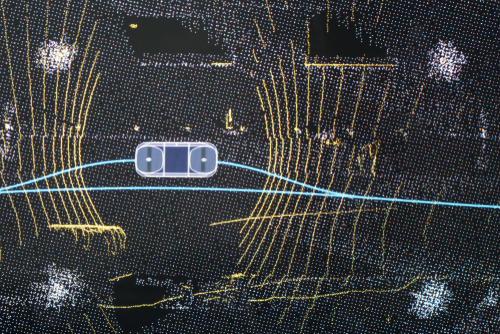
LiDAR provides structural information about the construction zone scene that is independent of lighting and less affected by dust and debris than camera imaging. Barrier positions, equipment locations, and zone boundaries that are ambiguous in camera imagery can often be resolved with LiDAR point clouds that capture the three-dimensional structure of the scene directly. Annotating LiDAR data in construction zones requires a taxonomy that covers temporary barriers, construction equipment, and ground surface changes at the resolution that LiDAR provides.
Ground surface annotation in construction zones is a specific LiDAR annotation challenge: zones with active paving or excavation have surface characteristics, edges, drop-offs, and material transitions that need to be labeled for the vehicle’s path planning system to navigate safely. 3D LiDAR data annotation programs that include construction zone surface annotation as part of their label taxonomy produce the ground truth that path planning in active work zones requires.
Radar for Dust and Low-Visibility Conditions
Active construction environments produce dust levels that can substantially reduce camera range and clarity. Radar is unaffected by dust and provides reliable detection of large objects, barriers, and equipment in conditions where camera performance is degraded. For fusion architectures operating in construction zones, radar serves as a reliability backstop for exactly the conditions where camera performance is most challenged. Cross-modal annotation consistency between radar and camera modalities in construction zone data is essential for producing fusion models that correctly integrate the two sensor streams when their reliability levels differ. Multisensor fusion data services that maintain cross-modal label consistency in construction zone data treat sensor reliability weighting as part of the annotation specification rather than leaving it to be inferred by the model.
How Digital Divide Data Can Help
Digital Divide Data supports ADAS and autonomous driving programs, building construction zone training data across all relevant sensor modalities and annotation requirements.
For programs building camera-based construction zone datasets, image annotation services and video annotation services include specific annotation taxonomies for temporary traffic control devices, construction equipment categories, flagger state annotation, and non-standard lane geometry, with annotators trained on construction zone domain knowledge.
For programs building LiDAR construction zone datasets, 3D LiDAR data annotation covers barrier annotation, construction equipment labeling, and ground surface annotation for active work zone environments.
For programs building fusion datasets that maintain cross-modal consistency in construction zone scenarios, multisensor fusion data services enforce label consistency across camera, LiDAR, and radar modalities, accounting for the differential sensor reliability that active construction environments produce.
Build construction zone training data that matches what your perception system will actually encounter in production. Talk to an expert.
Conclusion
Construction zones expose the coverage gaps in standard autonomous driving datasets more directly than almost any other road scenario. The scene geometry is non-standard, the object categories include equipment not present in normal driving, the control authority is exercised by humans whose gestures carry specific traffic semantics, and the environment changes continuously as work progresses. A model trained on standard road data will encounter all of these as novel inputs in a safety-critical context.
Addressing construction zone data gaps requires annotation programs that treat the construction environment as a distinct domain with its own taxonomy, sensor coverage requirements, and temporal collection strategy. Programs that build this coverage deliberately, rather than hoping that general road training data will generalize to construction zones, produce perception systems with the robustness that work zone navigation requires. Physical AI programs that include construction zone data as a first-class component of their training data strategy are the ones that close this gap before it becomes a deployment failure.
References
Wullrich, S., Steinke, N., & Goehring, D. (2026). Deep neural network-based roadwork detection for autonomous driving. arXiv. https://arxiv.org/abs/2604.02282
Ahammed, A. S., Hossain, M. S., & Obermaisser, R. (2025). A computer vision approach for autonomous cars to drive safe at construction zone. In the 6th IEEE International Conference on Image Processing, Applications and Systems (IPAS 2025). IEEE.
Goudarzi, A., Reza Khosravi, M., Farmanbar, M., & Naeem, W. (2026). Multi-sensor fusion and deep learning for road scene understanding: A comprehensive survey. Artificial Intelligence Review. https://doi.org/10.1007/s10462-026-11542-5
Frequently Asked Questions
Q1. Why do construction zones create such significant challenges for autonomous vehicle perception?
Because they systematically violate the assumptions that perception models build during training on standard road data. Lane markings are absent or contradictory. Signage is non-standard. The scene contains object categories, construction equipment, and flaggers that are rare or absent in normal driving datasets. The environment changes continuously as work progresses. Each of these factors individually degrades perception reliability. Together, they create a compound challenge that sparse construction zone coverage in training data cannot adequately prepare a model to handle.
Q2. How should construction equipment be handled in annotation taxonomies?
As a distinct top-level category with specific subcategories for different equipment types: excavators, graders, rollers, concrete trucks, paving equipment, and others. Each subcategory has specific visual characteristics, proportions, and movement patterns that differ qualitatively from standard vehicle categories. Attempting to force-fit construction equipment into existing vehicle subcategories produces systematic misclassifications that affect both detection and behavioral prediction. The annotation taxonomy needs to reflect the actual object diversity the model will encounter in production.
Q3. What makes the flagger and traffic control worker annotation different from standard pedestrian annotation?
Standard pedestrian annotation captures presence and position. Flagger annotation needs to capture the traffic control state being communicated: stop, proceed, slow, or directional guidance. Each state corresponds to specific pose and gesture configurations that need to be labeled at the annotation level. A model trained only on pedestrian presence annotation will detect the flagger but will not learn that the flagger’s gesture should override standard right-of-way logic. Keypoint annotation combined with semantic traffic control state labels produces the training signal that teaches this behavioral interpretation.
Q4. Why is construction zone annotation an ongoing rather than a one-time requirement?
Because the construction environment changes continuously as work progresses. Barrier positions shift. Lanes open and close. Working areas expand and contract. Temporary markings are added and covered. Data collected at one phase of a project may be unrepresentative of the same zone at a later phase. Models trained only on early-phase construction zone data will encounter substantially different scene geometry in later phases without having been trained on it. Annotation pipelines need to support continuous data collection across the project lifecycle to produce coverage of the full range of construction configurations.

How Construction Zone Data Gaps Cause Autonomous Vehicle Failures Read Post »