
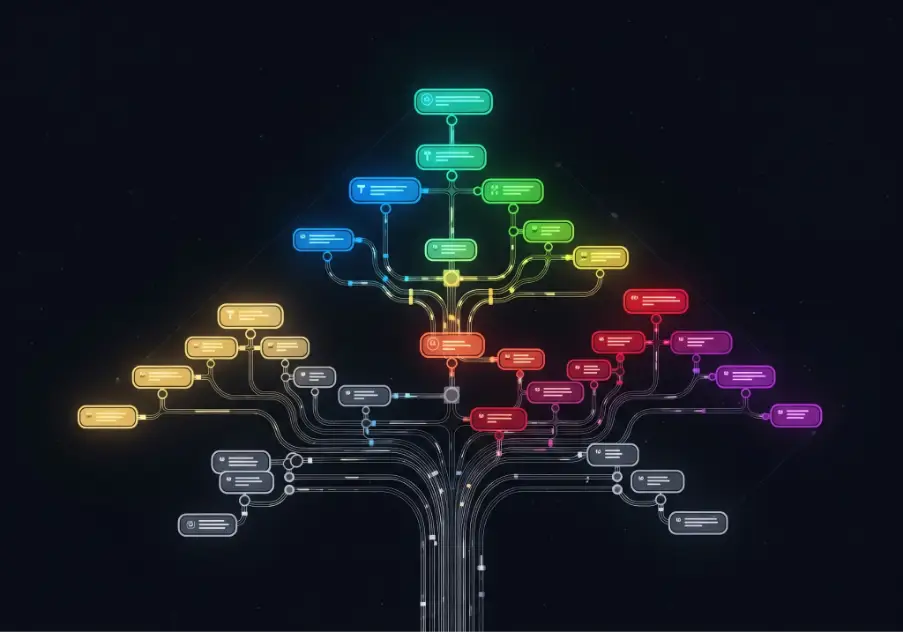
Sentiment Annotation Services: The Taxonomy Decisions for NLP Accuracy
Sentiment annotation is the process of labeling text with polarity, emotion, or opinion signals to train NLP classifiers. At scale, NLP accuracy depends less on model architecture and more on three upstream decisions: the taxonomy tier chosen (binary, fine-grained, or aspect-based), the inter-annotator agreement targets set before labeling begins, and the production QA controls applied throughout the pipeline. Getting any one of these wrong compounds downstream.
The cost of correcting those errors at the relabeling stage is high. Text annotation services for NLP need to be treated as an engineering discipline, with the same rigor applied to schema design as to model training.
Key Takeaways
- Sentiment annotation assigns structured polarity or opinion labels to text so NLP models can learn to recognize emotional signals. The taxonomy tier you choose, viz., binary, fine-grained, or aspect-based, sets the ceiling on what your sentiment model can ever learn, regardless of how much data you annotate.
- Binary sentiment schemas (positive/negative/neutral) are fast and produce high annotator agreement, but collapse mixed-signal text into a single label and lose the component-level detail most production NLP applications need.
- Fine-grained and aspect-based schemas deliver richer signals, but only when annotation guidelines define clear decision rules for hedged, ironic, and mixed-polarity sentences.
- Inter-annotator agreement targets differ by tier: binary programs should aim for Cohen’s kappa ≥ 0.80; aspect-based programs should target κ ≥ 0.70 for category assignment and κ ≥ 0.75 for polarity. Scores below these are a guideline problem.
- Majority voting on disagreement cases systematically suppresses the minority label, which is often the correct one on ambiguous inputs. Expert adjudication is a more reliable option here.
- Label drift is invisible in aggregate accuracy metrics. IAA scores should be monitored at the batch level throughout a campaign, not just measured once at the start, with recalibration triggered every 500 – 1,000 labeled items.
What Is Sentiment Annotation and How Is It Done at Scale?
Sentiment annotation, also called opinion labeling or polarity annotation, is the process of assigning structured sentiment signals to spans of text so that machine learning classifiers can learn to detect those signals in unseen data. At its simplest, a sentiment label might be positive, negative, or neutral. At its most granular, it might encode the target entity, the specific attribute being evaluated, the intensity of the expressed opinion, and the annotator’s confidence. The label schema chosen at project inception is the taxonomy, and that taxonomy determines the ceiling on what the downstream model can ever learn.
Doing this at scale introduces structural problems. When thousands of annotators work across shifts, time zones, and languages, label consistency depends on two things: the precision of the annotation guidelines and the rigor applied to calibration before and during production. Challenges in text annotation for chatbots and LLMs illustrate how quickly semantic drift accumulates across a distributed workforce when guidelines leave polarity boundaries underspecified.
A production sentiment annotation program typically involves four sequential stages: 1. taxonomy design and guideline development, 2. annotator calibration and certification, 3. active labeling with real-time IAA monitoring, and 4. QA adjudication by senior reviewers. Each stage gates the next. Errors introduced in stage one propagate through all subsequent stages and are difficult to detect without explicit quality controls.
How Does Taxonomy Tier Selection Determine NLP Accuracy?
The taxonomy tier is the structural choice that shapes every downstream decision. Choosing a tier that is too coarse for the use case produces a model that cannot surface the signal the product actually needs. Choosing a tier that is too fine-grained without the budget or annotator expertise is often worse than the coarser alternative. Annotation taxonomy design remains one of the most overlooked steps in AI programs, yet teams that skip this phase often underestimate the level of label ambiguity they will encounter in production.
Taxonomy selection should be driven by three inputs: the downstream inference task, the annotator profile available, and the volume and domain of the source data. A brand monitoring use case for social media posts has different requirements than a voice-of-customer pipeline processing long-form support transcripts. The former might be well-served by a three-class polarity schema; the latter almost certainly requires aspect decomposition to be useful.
Binary vs. Fine-Grained vs. Aspect-Based Sentiment Annotation: Which Is Right?
Binary Sentiment Annotation
Binary annotation assigns each text unit one of two labels: typically positive or negative. Optionally adds a neutral class to create a three-class schema. It is the lowest-cost tier, produces the highest inter-annotator agreement, and is appropriate when the downstream task is triage-level, routing, flagging, or macro-level sentiment trending. The principal limitation is that binary labels collapse meaningful signals. A review that reads “The hardware is excellent, but the onboarding is painful” receives a single label, losing the component-level signal that a product team needs to act upon.
Fine-Grained Sentiment Annotation
Fine-grained schemas expand the label space along one or more dimensions; like intensity (very positive, positive, neutral, negative, very negative), emotion type (anger, joy, frustration, surprise), or confidence. This tier is appropriate when the downstream task depends on gradation. For example, scoring customer satisfaction on a continuous scale or training an emotion-aware dialogue model. The cost is higher annotator cognitive load and, consistently, lower inter-annotator agreement on boundary cases. Annotators reliably distinguish strongly positive from strongly negative, but diverge significantly on whether a mildly hedged statement is neutral or weakly negative.
Aspect-Based Sentiment Annotation (ABSA)
Aspect-based sentiment analysis (ABSA) is the most structurally demanding tier. Each annotation identifies the target aspect or entity within the text, such as “battery life,” “customer service,” or “pricing”, and assigns a polarity or intensity label to that specific aspect rather than the overall text. A 2026 systematic review of aspect-based sentiment analysis in NLP describes ABSA as providing fine-grained insights by identifying sentiment toward specific attributes of an entity. ABSA is the correct choice when the end application requires attribute-level feedback: product development teams, CX analytics, financial opinion mining on earnings calls, and multi-domain NLP applications where a single document evaluates multiple entities.
The annotator workload for ABSA is substantially higher than for binary or fine-grained schemas. Annotators must identify span boundaries, assign aspect categories from a predefined taxonomy, determine polarity for each aspect, and handle implicit aspects. Implicit aspects are particularly problematic for inter-annotator agreement. NLP applications across enterprise use cases that rely on ABSA consistently show that annotator precision on implicit aspect spans is the primary quality bottleneck in production pipelines.
What Inter-Annotator Agreement Targets Should Sentiment Programs Target?
Inter-annotator agreement (IAA) is the quantitative measure of label consistency across annotators on the same data. For sentiment annotation, the standard metrics are Cohen’s kappa (κ) for pairwise agreement and Krippendorff’s alpha (α) for multi-annotator settings. Both metrics are correct for chance agreement, which makes them more reliable than raw percent agreement for evaluating annotation programs.
Practical IAA targets vary by taxonomy tier. For binary sentiment, well-run programs routinely achieve κ ≥ 0.80, which falls in the “substantial agreement” band on the Landis-Koch scale. A 2025 mixed-methods study of sentiment annotation instruction design found that detailed annotation instructions alone do not guarantee higher agreement. Sentences with hedging language, irony, or mixed polarity consistently produce lower IAA regardless of instruction quality, which means that taxonomy design must explicitly address these edge cases with decision rules.
For fine-grained and ABSA schemas, acceptable IAA thresholds shift downward. Production programs typically target κ ≥ 0.70 for aspect category assignment and κ ≥ 0.75 for aspect-level polarity. Scores below these thresholds suggest that the guidelines are underspecified at the boundary cases most relevant to model learning.
99.5% data annotation accuracy in production often hides the gap between reported accuracy metrics and the real-world errors that impact model performance. This gap becomes especially significant in sentiment annotation, where disagreements usually occur around ambiguous examples.
IAA monitoring should be continuous, not a one-time baseline check. Agreement scores drift as annotators develop individual labeling habits, particularly in long-running campaigns. The practical control mechanism is regular recalibration sessions; typically every 500–1,000 labeled items. Annotators whose scores diverge from the standard by more than one standard deviation should be flagged for retraining before their labels enter the training set.
How Does Production QA Prevent Label Drift in Sentiment Pipelines?
Label drift, systematic shifts in how annotators apply labels over time, is the quality failure mode most commonly missed by teams that rely on aggregate accuracy metrics alone. An annotator pool that starts a campaign at κ = 0.82 can drift to κ = 0.68 over six weeks without any single annotation being obviously wrong. The individual labels look plausible; the drift is only visible in the distribution of boundary-case decisions across time.
Production QA for sentiment annotation programs requires four controls working in parallel. First, a statistically representative holdout set (typically 5–10% of all batches) is relabeled by a senior QA tier and compared against the primary annotator labels. Second, automatic consistency checks flag annotators who are assigning labels at unusual rates relative to the rest of the pool. Third, adjudication workflows route disagreement cases, where two or more annotators assigned different labels to a specialist reviewer rather than resolving them by majority vote. Fourth, clear and practical annotation guidelines are essential. Without well-defined rules for handling edge cases, even QA reviewers may disagree, weakening the effectiveness of the entire adjudication process.
The challenge of annotator disagreement in NLP is increasingly understood as informative rather than purely erroneous.
A 2026 analysis of inter-annotator agreement for NLP notes that disagreement can reveal genuine task ambiguity or underspecified guidelines rather than annotator error, and recommends retaining label distributions for cases where reasonable annotators consistently diverge.
For sentiment models deployed in high-stakes applications, soft labels provide more honest training signals than forcing a single hard label on genuinely ambiguous inputs.
Human-in-the-loop quality control workflows for generative AI further strengthen this process by adding expert adjudication layers that prevent valid minority interpretations from being ignored in production sentiment pipelines.
How Digital Divide Data Can Help
Digital Divide Data operates sentiment annotation programs across all three taxonomy tiers; viz. binary, fine-grained, and aspect-based, with dedicated QA infrastructure at each stage of the pipeline. The work begins at the schema level; DDD’s annotation architects review the downstream inference task, define label boundaries, and produce taxonomy documentation with explicit decision trees for edge cases before any labeling begins.
DDD’s text annotation services cover the full range of NLP annotation modalities, including sentiment, intent, emotion, and aspect extraction across multiple domains and languages.
For ABSA programs, DDD maintains annotator certification tracks that require demonstrated proficiency in implicit aspect identification before annotators work on live data. IAA is monitored at the batch level using Krippendorff’s alpha, with recalibration triggered automatically when scores fall below tier-specific thresholds. Multilingual data annotation training is a particular strength, and DDD supports sentiment annotation in more than 40 languages, with native-speaker annotators trained on culturally-aware polarity guidelines.
Adjudication on disagreement cases is handled by a senior QA tier with domain expertise, not by majority vote. This is particularly relevant for fine-grained emotion labels and implicit aspect spans, where the minority label often carries a higher signal value than the majority.
Build sentiment annotation programs that actually deliver production-grade NLP accuracy. Talk to an Expert!
Conclusion
Sentiment annotation is one of the few AI data tasks where the taxonomy decision made on day one determines the quality ceiling of the entire program. Binary schemas deliver speed and high agreement but sacrifice the signal granularity that most production NLP applications require. Fine-grained and aspect-based schemas deliver richer signals but only when annotation guidelines are precise, annotators are certified, and QA controls are running continuously throughout the campaign.
Organizations that invest in taxonomy design, IAA monitoring, and adjudication infrastructure consistently build more reliable sentiment classifiers and spend less time relabeling. Those who skip these steps discover the cost later, usually when the model fails on exactly the ambiguous cases that the annotation program was too coarse to capture.
References
Äyräväinen, L. E. M., Hinds, J., Davidson, B. I. (2025). Disambiguating sentiment annotation: A mixed methods investigation of annotator experience and impact of instructions on annotator agreement. PLOS ONE. https://journals.plos.org/plosone/article?id=10.1371/journal.pone.0336269
James, J. (2026). Counting on consensus: Selecting the right inter-annotator agreement metric for NLP annotation and evaluation. arXiv preprint. https://arxiv.org/abs/2603.06865
Shukla, P., Kumar, R., Dwivedi, V. K., Singh, A. K., (2026). Aspect based sentiment analysis: A systematic review, taxonomy, applications, and future research directions. Information Fusion. https://www.sciencedirect.com/science/article/abs/pii/S157401372600033X
Frequently Asked Questions
What is the difference between binary and aspect-based sentiment annotation?
Binary annotation assigns a single positive, negative, or neutral label to a full text unit. Whereas, Aspect-based sentiment annotation (ABSA) identifies specific entities or attributes within the text and assigns a polarity to each one independently.
What inter-annotator agreement score is acceptable for sentiment annotation?
For binary sentiment schemas, well-designed programs typically target Cohen’s kappa of 0.80 or higher. For fine-grained or aspect-based schemas, targets of 0.70–0.75 are more realistic given the higher label ambiguity. Scores below 0.70 on any sentiment tier usually indicate that the annotation guidelines need to be revised.
Does annotation team size actually drive sentiment accuracy, or is something else responsible?
Team size matters less than taxonomy precision. A smaller, well-calibrated team working from a precise schema consistently outperforms a large team applying vague guidelines, because errors cluster on boundary cases that the guidelines failed to define.
How do I know when my annotators are drifting, and when should I intervene?
Run a gold-standard check every 500 – 1,000 items. If an annotator’s agreement with the gold set drops more than one standard deviation below the pool average, that’s your intervention point.

Udit Khanna leads the delivery of scalable AI and data solutions at Digital Divide Data, with a deep specialization in Physical AI. With a background in presales, solutioning, and customer success, he brings a mix of technical depth and business fluency, helping global enterprises move their AI projects from prototype to real-world deployment without losing momentum.
Sentiment Annotation Services: The Taxonomy Decisions for NLP Accuracy Read Post »