
Celebrating 25 years of DDD's Excellence and Social Impact.

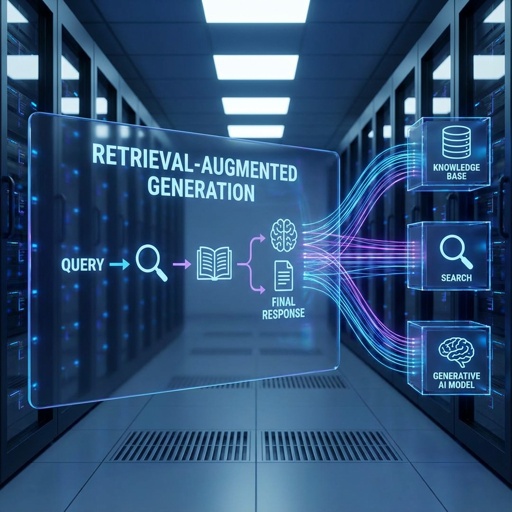
RAG

Retrieval-augmented,Generation,(rag)

RAG Detailed Guide: Data Quality, Evaluation, and Governance

Retrieval Augmented Generation (RAG) is often presented as a simple architectural upgrade: connect a language model to a knowledge base, retrieve relevant documents, and generate grounded answers. In practice, however, most RAG systems fail not because the idea is flawed, but because they are treated as lightweight retrieval pipelines rather than full-fledged information systems.

When answers go wrong, teams frequently adjust prompts, swap models, or tweak temperature settings. Yet in enterprise environments, the real issue usually lies upstream. Incomplete repositories, outdated policies, inconsistent formatting, duplicated files, noisy OCR outputs, and poorly defined access controls quietly shape what the model is allowed to “know.” The model can only reason over the context it receives. If that context is fragmented, stale, or irrelevant, even the most advanced LLM will produce unreliable results.

In this article, let’s explore how Retrieval Augmented Generation or RAG should be treated not as a retrieval pipeline, but as a data system, an evaluation system, and a governance system.

Data Quality: The Foundation Of RAG Performance

There is a common instinct to blame the model when RAG answers go wrong. Maybe the prompt was weak. Maybe the model was too small. Maybe the temperature was set incorrectly. In many enterprise cases, however, the failure is upstream. The language model is responding to what it sees. If what it sees is incomplete, outdated, fragmented, or irrelevant, the answer will reflect that.

RAG systems fail more often due to poor data engineering than poor language models. When teams inherit decades of documents, they also inherit formatting inconsistencies, duplicates, version sprawl, and embedded noise. Simply embedding everything and indexing it does not transform it into knowledge. It transforms it into searchable clutter. Before discussing chunking or embeddings, it helps to define what data quality means in the RAG context.

Data Quality Dimensions in RAG

Data quality in RAG is not abstract. It can be measured and managed.

Completeness
Are all relevant documents present? If your knowledge base excludes certain product manuals or internal policies, retrieval will never surface them. Completeness also includes coverage of edge cases. For example, do you have archived FAQs for discontinued products that customers still ask about?

Freshness
Are outdated documents removed or clearly versioned? A single outdated HR policy in the index can generate incorrect advice. Freshness becomes more complex when departments update documents independently. Without active lifecycle management, stale content lingers.

Consistency
Are formats standardized? Mixed encodings, inconsistent headings, and different naming conventions may not matter to humans browsing folders. They matter to embedding models and search filters.

Relevance Density
Does each chunk contain coherent semantic information? A chunk that combines a privacy disclaimer, a table of contents, and a partial paragraph on pricing is technically valid. It is not useful.

Noise Ratio
How much irrelevant content exists in the index? Repeated headers, boilerplate footers, duplicated disclaimers, and template text inflate the search space and dilute retrieval quality.

If you think of RAG as a question answering system, these dimensions determine what the model is allowed to know. Weak data quality constrains even the best models.

Document Ingestion: Cleaning Before Indexing

Many RAG projects begin by pointing a crawler at a document repository and calling it ingestion. The documents are embedded. A vector database is populated. A demo is built. Weeks later, subtle issues appear.

Handling Real World Enterprise Data

Enterprise data is rarely clean. PDFs contain tables that do not parse correctly. Scanned documents require optical character recognition and may include recognition errors. Headers and footers repeat across every page. Multiple versions of the same file exist with names like “Policy_Final_v3_revised2.”

In multilingual organizations, documents may switch languages mid-file. A support guide may embed screenshots with critical instructions inside images. Legal documents may include annexes appended in different formats.

Even seemingly small issues can create disproportionate impact. For example, repeated footer text such as “Confidential – Internal Use Only” embedded across every page becomes semantically dominant in embeddings. Retrieval may match on that boilerplate instead of meaningful content.

Duplicate versions are another silent problem. If three versions of the same policy are indexed, retrieval may surface the wrong one. Without clear version tagging, the model cannot distinguish between active and archived content. These challenges are not edge cases. They are the norm.

Pre-Processing Best Practices

Pre-processing should be treated as a controlled pipeline, not an ad hoc script.

OCR normalization should standardize extracted text. Character encoding issues need resolution. Tables require structure-aware parsing so that rows and columns remain logically grouped rather than flattened into confusing strings. Metadata extraction is critical. Every document should carry attributes such as source repository, timestamp, department, author, version, and access level. This metadata is not decorative. It becomes the backbone of filtering and governance later.

Duplicate detection algorithms can identify near-identical documents based on hash comparisons or semantic similarity thresholds. When duplicates are found, one version should be marked authoritative, and others archived or excluded. Version control tagging ensures that outdated documents are clearly labeled and can be excluded from retrieval when necessary.

Chunking Strategies

Chunking may appear to be a technical parameter choice. In practice, it is one of the most influential design decisions in a RAG system.

Why Chunking Is Not a Trivial Step

If chunks are too small, context becomes fragmented. The model may retrieve one paragraph without the surrounding explanation. Answers then feel incomplete or overly narrow. If chunks are too large, tokens are wasted. Irrelevant information crowds the context window. The model may struggle to identify which part of the chunk is relevant.

Misaligned boundaries introduce semantic confusion. Splitting a policy in the middle of a conditional statement may lead to the retrieval of a clause without its qualification. That can distort the meaning entirely. I have seen teams experiment with chunk sizes ranging from 200 tokens to 1500 tokens without fully understanding why performance changed. The differences were not random. They reflected how well chunks aligned with the semantic structure.

Chunking Techniques

Several approaches exist, each with tradeoffs. Fixed-length chunking splits documents into equal-sized segments. It is simple but ignores structure. It may work for uniform documents, but it often performs poorly on complex policies. Recursive semantic chunking attempts to break documents along natural boundaries such as headings and paragraphs. It requires more preprocessing logic but typically yields higher coherence.

Section-aware chunking respects document structure. For example, an entire “Refund Policy” section may become a chunk, preserving logical completeness. Hierarchical chunking allows both coarse and fine-grained retrieval. A top-level section can be retrieved first, followed by more granular sub-sections if needed.

Table-aware chunking ensures that rows and related cells remain grouped. This is particularly important for pricing matrices or compliance checklists. No single technique fits every corpus. The right approach depends on document structure and query patterns.

Chunk Metadata as a Quality Multiplier

Metadata at the chunk level can significantly enhance retrieval. Each chunk should include document ID, version number, access classification, semantic tags, and potentially embedding confidence scores. When a user from the finance department asks about budget approvals, metadata filtering can prioritize finance-related documents. If a document is marked confidential, it can be excluded from users without proper clearance.

Embedding confidence or quality indicators can flag chunks generated from low-quality OCR or incomplete parsing. Those chunks can be deprioritized or reviewed. Metadata also improves auditability. If an answer is challenged, teams can trace exactly which chunk was used, from which document, and at what version. Without metadata, the index is flat and opaque. With metadata, it becomes navigable and controllable.

Embeddings and Index Design

Embeddings translate text into numerical representations. The choice of embedding model and index architecture influences retrieval quality and system performance.

Embedding Model Selection Criteria

A general-purpose embedding model may struggle with highly technical terminology in medical, legal, or engineering documents. Multilingual support becomes important in global organizations. If queries are submitted in one language but documents exist in another, cross-lingual alignment must be reliable. Latency constraints also influence model selection. Higher-dimensional embeddings may improve semantic resolution but increase storage and search costs.

Dimensionality tradeoffs should be evaluated in context. Larger vectors may capture nuance but can slow retrieval. Smaller vectors may improve speed but reduce semantic discrimination. Embedding evaluation should be empirical rather than assumed. Test retrieval performance across representative queries.

Index Architecture Choices

Vector databases provide efficient similarity search. Hybrid search combines dense embeddings with sparse keyword-based retrieval. In many enterprise settings, hybrid approaches improve performance, especially when exact terms matter.

Re-ranking layers can refine top results. A first stage retrieves candidates. A second stage re ranks based on deeper semantic comparison or domain-specific rules. Filtering by metadata allows role-based retrieval and contextual narrowing. For example, limiting the search to a particular product line or region. Index architecture decisions shape how retrieval behaves under real workloads. A simplistic setup may work in a prototype but degrade as corpus size and user complexity grow.

Retrieval Failure Modes

Semantic drift occurs when embeddings cluster content that is conceptually related but not contextually relevant. For example, “data retention policy” and “retention bonus policy” may appear semantically similar but serve entirely different intents. Keyword mismatch can cause dense retrieval to miss exact terminology that sparse search would capture.

Over-broad matches retrieve large numbers of loosely related chunks, overwhelming the generation stage. Context dilution happens when too many marginally relevant chunks are included, reducing answer clarity.

To make retrieval measurable, organizations can define a Retrieval Quality Score. RQS can be conceptualized as a weighted function of precision, recall, and contextual relevance. By tracking RQS over time, teams gain visibility into whether retrieval performance is improving or degrading.

Evaluation: Making RAG Measurable

Standard text generation metrics such as BLEU or ROUGE were designed for machine translation and summarization tasks. They compare the generated text to a reference answer. RAG systems are different. The key question is not whether the wording matches a reference, but whether the answer is faithful to the retrieved content.

Traditional metrics do not evaluate retrieval correctness. They do not assess whether the answer cites the appropriate document. They cannot detect hallucinations that sound plausible. RAG requires multi-layer evaluation. Retrieval must be evaluated separately from generation. Then the entire system must be assessed holistically.

Retrieval Level Evaluation

Retrieval evaluation focuses on whether relevant documents are surfaced. Metrics include Precision at K, Recall at K, Mean Reciprocal Rank, context relevance scoring, and latency. Precision at K measures how many of the top K retrieved chunks are truly relevant. Recall at K measures whether the correct document appears in the retrieved set.

Gold document sets can be curated by subject matter experts. For example, for 200 representative queries, experts identify the authoritative documents. Retrieval results are then compared against this set. Synthetic query generation can expand test coverage. Variations of the same intent help stress test retrieval robustness.

Adversarial queries probe edge cases. Slightly ambiguous or intentionally misleading queries test whether retrieval resists drift. Latency is also part of retrieval quality. Even perfectly relevant results are less useful if retrieval takes several seconds.

Generation Level Evaluation

Generation evaluation examines whether the model uses the retrieved context accurately. Metrics include faithfulness to context, answer relevance, hallucination rate, citation correctness, and completeness. Faithfulness measures whether claims in the answer are directly supported by retrieved content. Answer relevance checks whether the response addresses the user’s question.

Hallucination rate can be estimated by comparing answer claims against the source text. Citation correctness ensures references point to the right documents and sections. LLM as a judge approach may assist in automated scoring, but human evaluation loops remain important. Subject matter experts can assess subtle errors that automated systems miss. Edge case testing is critical. Rare queries, multi-step reasoning questions, and ambiguous prompts often expose weaknesses.

System Level Evaluation

System-level evaluation considers the end-to-end experience. Does the answer satisfy the user? Is domain-specific correctness high? What is the cost per query? How does throughput behave under load? User satisfaction surveys and feedback loops provide qualitative insight. Logs can reveal patterns of dissatisfaction, such as repeated rephrasing of queries.

Cost per query matters in production environments. High embedding costs or excessive context windows may strain budgets. Throughput under load indicates scalability. A system that performs well in testing may struggle during peak usage.

A Composite RAG Quality Index can aggregate retrieval, generation, and system metrics into a single dashboard score. While simplistic, such an index helps executives track progress without diving into granular details.

Building an Evaluation Pipeline

Evaluation should not be a one-time exercise.

Offline Evaluation

Offline evaluation uses benchmark datasets and regression testing before deployment. Whenever chunking logic, embedding models, or retrieval parameters change, retrieval and generation metrics should be re-evaluated. Automated scoring pipelines allow rapid iteration. Changes that degrade performance can be caught early.

Online Evaluation

Online evaluation includes A B testing retrieval strategies, shadow deployments that compare outputs without affecting users, and canary testing for gradual rollouts. Real user queries provide more diverse coverage than synthetic tests.

Continuous Monitoring

After deployment, monitoring should track drift in embedding distributions, drops in retrieval precision, spikes in hallucination rates, and latency increases. A Quality Gate Framework for CI CD can formalize deployment controls. Each new release must pass defined thresholds:

  • Retrieval threshold
  • Faithfulness threshold
  • Governance compliance check

Why RAG Governance Is Unique

Unlike standalone language models, RAG systems store and retrieve enterprise knowledge. They dynamically expose internal documents. They combine user input with sensitive data. Governance must therefore span data governance, model governance, and access governance.

If governance is an afterthought, the system may inadvertently expose confidential information. Even if the model is secure, retrieval bypass can surface restricted documents.

Data Classification

Documents should be classified as Public, Internal, Confidential, or Restricted. Classification integrates directly into index filtering and access controls. When a user submits a query, retrieval must consider their clearance level. Classification also supports retrieval constraints. For example, external customer-facing systems should never access internal strategy documents.

Access Control in Retrieval

Role-based access control assigns permissions based on job roles. Attribute-based access control incorporates contextual attributes such as department, region, or project assignment. Document-level filtering ensures that unauthorized documents are never retrieved. Query time authorization verifies access rights dynamically. Retrieval bypass is a serious risk. Even if the generation model does not explicitly expose confidential information, the act of retrieving restricted documents into context may constitute a policy violation.

Data Lineage and Provenance

Every answer should be traceable. Track document source, version history, embedding timestamp, and index update logs. Audit trails support compliance and incident investigation. If a user disputes an answer, teams should be able to identify exactly which document version informed it. Without lineage, accountability becomes difficult. In regulated industries, that may be unacceptable.

Conclusion

RAG works best when you stop treating it like a clever retrieval add-on and start treating it like a knowledge infrastructure that has to behave predictably under pressure. The uncomfortable truth is that most “RAG problems” are not model problems. They are data problems that show up as retrieval mistakes, and evaluation problems that go unnoticed because no one is measuring the right things. 

Once you enforce basic hygiene in ingestion, chunking, metadata, and indexing, the system usually becomes calmer. Answers get more stable, the model relies less on guesswork, and teams spend less time chasing weird edge cases that were baked into the corpus from day one.

Governance is what turns that calmer system into something people can actually trust. Access control needs to happen at retrieval time, provenance needs to be traceable, and quality checks need to be part of releases, not a reaction to incidents. 

None of this is glamorous work, and it may feel slower than shipping a demo. Still, it is the difference between a tool that employees cautiously ignore and a system that becomes part of daily operations. If you build around data quality, continuous evaluation, and clear governance controls, RAG stops being a prompt experiment and starts looking like a dependable way to deliver the right information to the right person at the right time.

How Digital Divide Data Can Help

Digital Divide Data brings domain-aware expertise into every stage of the RAG data pipeline, from structured data preparation to ongoing human-in-the-loop evaluation. Teams trained in subject matter nuance help ensure that retrieval systems surface contextually correct and relevant information, reducing the kind of hallucinated or misleading responses that erode user trust.

This approach is especially valuable in high-stakes environments like healthcare and legal research, where specialized terminology and subtle semantic differences matter more than textbook examples. For teams looking to move RAG from experimentation to trusted production use, DDD offers both the technical discipline and the people-centric approach that make that transition practical and sustainable. 

Partner with DDD to build RAG systems that are accurate, measurable, and governance-ready from day one.

References

National Institute of Standards and Technology. (2024). Artificial Intelligence Risk Management Framework: Generative AI Profile. https://www.nist.gov/publications/artificial-intelligence-risk-management-framework-generative-artificial-intelligence

European Union. (2024). Regulation (EU) 2024/1689 laying down harmonised rules on artificial intelligence. https://eur-lex.europa.eu/eli/reg/2024/1689/oj

European Data Protection Supervisor. (2024). TechSonar: Retrieval Augmented Generation. https://www.edps.europa.eu/data-protection/technology-monitoring/techsonar/retrieval-augmented-generation-rag_en

Microsoft Azure Architecture Center. (2025). Retrieval augmented generation guidance. https://learn.microsoft.com/en-us/azure/architecture/ai-ml/guide/rag

Amazon Web Services. (2025). Building secure retrieval augmented generation applications. https://aws.amazon.com/blogs/machine-learning

FAQs

  1. How often should a RAG index be refreshed?
    It depends on how frequently underlying documents change. In fast-moving environments such as policy or pricing updates, weekly or even daily refresh cycles may be appropriate. Static archives may require less frequent updates.
  2. Can RAG eliminate hallucination?
    Not entirely. RAG reduces hallucination risk by grounding responses in retrieved documents. However, generation errors can still occur if context is misinterpreted or incomplete.
  3. Is hybrid search always better than pure vector search?
    Not necessarily. Hybrid search often improves performance in terminology-heavy domains, but it adds complexity. Empirical testing with representative queries should guide the choice.
  4. What is the highest hidden cost in RAG systems?
    Data cleaning and maintenance. Ongoing ingestion, version control, and evaluation pipelines often require sustained operational investment.
  5. How do you measure user trust in a RAG system?
    User feedback rates, query repetition patterns, citation click-through behavior, and survey responses can provide signals of trust and perceived reliability.


RAG Detailed Guide: Data Quality, Evaluation, and Governance Read Post »

RAG2Buse2Bcases2Bin2BGen2BAI

Real-World Use Cases of Retrieval-Augmented Generation (RAG) in Gen AI

By Umang Dayal

June 16, 2025

Generative AI has captured the attention of industries worldwide, offering the ability to generate human-like text, code, visuals, and more with unprecedented fluency. Large Language Models (LLMs), in particular, have become powerful tools for tasks like summarization, translation, and content creation.

However, they come with inherent limitations. LLMs often produce hallucinated or outdated information, lack domain-specific grounding, and cannot natively access proprietary or real-time data. These constraints can significantly reduce the reliability and trustworthiness of their outputs, especially in enterprise or high-stakes contexts.

This is where Retrieval-Augmented Generation (RAG) becomes critical. RAG introduces a mechanism to enhance LLMs by augmenting their responses with relevant, retrieved information from external sources such as internal knowledge bases, documentation repositories, or structured databases.

This blog explores the real-world use cases of RAG in GenAI, illustrating how Retrieval-Augmented Generation is being applied across industries to solve the limitations of traditional language models by delivering context-aware, accurate, and enterprise-ready AI solutions.

Understanding Retrieval-Augmented Generation (RAG)

Retrieval-Augmented Generation (RAG) is a hybrid approach that enhances the capabilities of generative models by combining them with a retrieval mechanism. Traditional large language models generate responses based solely on the knowledge encoded during training. While this works well for general-purpose tasks, it often fails when the model is asked to reference specific, up-to-date, or proprietary information. RAG addresses this limitation by injecting relevant external knowledge into the generation process, on demand.

The architecture of a RAG system can be broadly divided into two components: the retriever and the generator.

The retriever is responsible for searching and extracting relevant content from external sources such as enterprise documents, FAQs, knowledge bases, or research publications. This component typically uses dense retrieval methods, embedding documents into a vector space using language models like OpenAI’s embeddings, Cohere, or open-source alternatives. These embeddings are indexed in a vector database such as FAISS, Weaviate, or Pinecone, enabling fast and accurate semantic search.

Once relevant documents are retrieved, the generator takes over. This is typically a large language model, such as GPT-4, Claude, LLaMA, or Mixtral, which uses the retrieved content as additional context to generate grounded and context-aware responses. The retrieval step is invisible to the user, but it significantly boosts the model’s ability to deliver reliable, source-based answers.

Real World Use Cases of RAG in GenAI

Retrieval-Augmented Generation has evolved from a technical enhancement into a strategic enabler for real-world applications. Below are some of the most impactful use cases where RAG is transforming workflows and decision-making.

Enterprise Knowledge Management

In large organizations, employees often spend significant time searching for relevant information scattered across disparate systems, ranging from HR portals and legal repositories to product documentation and SOPs. This inefficiency not only slows down decision-making but also creates friction in day-to-day workflows. Retrieval-Augmented Generation (RAG) enables the creation of intelligent enterprise assistants that dynamically search across internal knowledge sources and provide immediate, context-rich answers. This eliminates the need for navigating multiple databases or submitting IT tickets, empowering employees to self-serve and resolve queries efficiently.

By combining the retriever’s ability to pinpoint precise documents with a generator that synthesizes those inputs into conversational responses, RAG-based systems enhance knowledge accessibility across departments. Whether it’s retrieving onboarding procedures, policy clarifications, or security protocols, these systems improve organizational agility. Unlike traditional search engines, which often return long lists of documents, RAG delivers directly actionable answers grounded in the source material, improving both speed and accuracy of internal knowledge consumption.

Customer Support Automation

Customer service functions are frequently challenged by high ticket volumes and the need for consistent, fast responses across various product lines or service queries. RAG transforms customer support by enabling AI agents to deliver responses grounded in real-time data such as user manuals, product catalogs, historical tickets, and troubleshooting logs. This allows support teams to handle a larger volume of customer interactions while ensuring that answers remain accurate, up-to-date, and relevant to the customer’s specific context.

Moreover, RAG reduces reliance on static decision trees and scripted responses, which are often too rigid to handle complex or evolving customer needs. Instead, it provides flexibility by generating customized responses based on what the customer is asking and what the underlying documentation supports. This adaptive capability significantly improves customer satisfaction, reduces escalations, and shortens issue resolution time. Additionally, it enables organizations to scale their customer support operations without a linear increase in staffing.

Legal and Compliance

The legal domain demands absolute precision, traceability, and adherence to strict regulatory standards. In this context, hallucinated responses or ambiguous interpretations can have serious consequences. RAG addresses this challenge by retrieving authoritative documents such as statutes, case law, compliance protocols, and contract templates, and using them to produce grounded responses. This makes it possible to automate and augment tasks such as legal research, document review, and contract analysis while maintaining high accuracy.

For compliance professionals, RAG also proves invaluable in navigating complex regulatory environments. By aggregating and contextualizing rules from various jurisdictions or regulatory bodies, RAG can help identify risks, highlight non-compliant language in documents, and summarize applicable legal frameworks. Unlike traditional search tools, which require users to interpret raw legal text, RAG systems present actionable insights while maintaining the traceability of their sources, which is crucial for legal defensibility and audit trails.

Healthcare and Medical Research

In healthcare settings, decisions often depend on the synthesis of diverse information sources, clinical notes, diagnostic images, treatment guidelines, and published research. RAG empowers medical professionals by integrating these sources into a unified retrieval-augmented workflow. It retrieves contextually relevant information from patient records, clinical databases, and peer-reviewed journals, which is then used to generate detailed, evidence-backed responses that support diagnosis, treatment planning, or documentation.

Beyond direct patient care, RAG can also be used in research and administrative settings. It can assist researchers in identifying emerging clinical evidence or trial data relevant to specific conditions, saving time and enhancing research quality. It enables healthcare institutions to build tools that bridge the gap between raw data and informed medical decisions, without the risks of misinformation. The model’s ability to stay current with newly published findings also addresses the issue of medical knowledge decay in fast-evolving fields.

Scientific Literature Search and Summarization

Researchers across disciplines are inundated with a growing volume of literature, much of which is fragmented across journals, preprints, and conference proceedings. Traditional keyword-based search often falls short in retrieving semantically relevant studies, especially for interdisciplinary queries. RAG changes this dynamic by semantically retrieving related research articles, abstracts, or data based on conceptual similarity rather than surface-level matching. This significantly enhances literature discovery and supports comprehensive reviews.

Additionally, RAG systems can summarize retrieved research into digestible formats tailored to the researcher’s question. This is particularly useful for early-stage exploratory research, hypothesis validation, or comparative analysis. Instead of reading dozens of full papers, users can get curated overviews that capture the core contributions, methods, and findings. This reduces cognitive load and accelerates innovation by helping researchers focus more on synthesis and interpretation rather than manual document retrieval.

Education and Tutoring Systems

Educational tools powered by RAG offer personalized and context-aware support for students and teachers alike. Unlike generic AI tutors, RAG-based systems can retrieve explanations, worked-out solutions, and contextual examples directly from textbooks, lecture notes, or curricular databases. This allows students to receive help that is not only accurate but also aligned with the learning materials and terminology they are already familiar with.

For educators, RAG can streamline curriculum design, question generation, and grading assistance. It can surface supplementary content tailored to specific learning objectives or help in identifying gaps in students’ understanding by reviewing questions and past responses. This approach supports differentiated instruction and fosters independent learning, where students are empowered to explore concepts deeply with the guidance of AI that respects and reflects their educational context.

Content Generation with Source Attribution

In professional writing, marketing, technical documentation, and academic publishing, it’s crucial to generate content that is not only fluent and informative but also factually verifiable. RAG supports this by retrieving relevant data points, quotes, or references from trusted sources before generating text. This process ensures that the AI’s outputs are grounded in identifiable documents, adding transparency and credibility to the generated content.

This capability is especially valuable in environments where content must be produced rapidly but must still adhere to editorial standards or regulatory compliance. Writers can create informed narratives with minimal manual research, while still being able to trace and cite every key statement. It also aids in reducing the spread of misinformation, a growing concern in content-heavy industries, by making source verification an integral part of the generation process.

Finance and Investment Insights

In financial services, decision-making is driven by data streams that are both vast and volatile. Analysts need to synthesize quarterly earnings, investor calls, economic indicators, regulatory filings, and third-party analysis to create accurate and timely assessments. RAG systems can retrieve and contextualize this data from various repositories, enabling users to generate grounded market insights that are responsive to real-time developments.

Furthermore, by integrating structured data (like earnings figures) with unstructured content (such as CEO commentary), RAG helps create comprehensive narratives that are both quantitative and qualitative. This aids in investment research, risk management, and portfolio strategy by surfacing insights that a human might overlook or be too slow to assemble. By anchoring its outputs in trusted financial documentation, RAG allows financial professionals to maintain a high level of confidence and accountability in automated insights.

Read more: Scaling Generative AI Projects: How Model Size Affects Performance & Cost 

How We Can Help

As organizations seek to operationalize Retrieval-Augmented Generation (RAG) in real-world applications, the need for high-quality, domain-specific data pipelines becomes a foundational requirement. This is where Digital Divide Data (DDD) brings a distinct value proposition. With years of experience in curating, annotating, and managing structured and unstructured datasets, DDD provides the essential groundwork that makes RAG systems effective, scalable, and reliable.

Our solutions are tailored to industry-specific use cases and are backed by a trained global workforce that ensures accuracy, security, and scalability. Below are some of the key RAG-enabling solutions we offer:

Enterprise Knowledge Assistants
We help build internal assistants that retrieve information from company wikis, policy documents, SOPs, reports, and HR/legal repositories. These systems empower employees to find answers quickly without combing through siloed platforms or requesting help from internal support teams.

Customer Support Automation
DDD structures and annotates support documents, troubleshooting guides, FAQs, and chat logs to feed RAG-powered virtual agents. These agents consistently resolve customer queries with grounded, accurate information, reducing escalations and improving resolution speed.

Healthcare & Clinical Decision Support
We support the ingestion and curation of medical literature, treatment protocols, and electronic medical records (EMRs), enabling RAG models to assist clinicians with timely, evidence-backed recommendations and insights that improve patient outcomes.

Legal & Compliance Research
Our legal data services include summarizing statutes, organizing case law, tagging contracts, and structuring compliance documentation. These datasets form the backbone of RAG tools that deliver fast, relevant, and reliable legal intelligence.

Education & Research Tools
DDD helps academic and edtech organizations by indexing textbooks, lecture materials, and scholarly articles. These data assets fuel personalized learning systems and research assistants capable of delivering context-aware answers and content summaries.

E-commerce & Product Assistants
We structure product specifications, customer reviews, compatibility information, and user guides to help RAG systems provide precise product comparisons, shopping assistance, and post-sales support.

Developer Support & Documentation
DDD also powers RAG systems for developers by managing code libraries, technical documentation, and API guides. This enables intelligent developer assistants that retrieve and explain relevant code snippets, patterns, or functions in real-time.

By partnering with DDD, organizations not only gain access to a reliable data infrastructure for RAG but also a scalable team with the expertise to align AI workflows with business objectives.

Read more: Bias in Generative AI: How Can We Make AI Models Truly Unbiased?

Conclusion

Retrieval-Augmented Generation (RAG) has rapidly transitioned from an experimental concept to a cornerstone of real-world Generative AI systems. As the limitations of traditional large language models become more apparent, especially in areas like factual grounding, domain specificity, and explainability, RAG presents a powerful and practical solution. Its architecture empowers organizations to bridge the gap between static, pre-trained models and the dynamic, evolving nature of real-world knowledge.

With the growing number of RAG deployments across industries, from internal knowledge assistants looking ahead, RAG is poised to play a foundational role in enterprise GenAI strategy. It’s not just about enhancing LLMs, it’s about making them useful, trustworthy, and truly aligned with human workflows. For businesses seeking scalable, grounded, and future-proof AI solutions, Retrieval-Augmented Generation isn’t optional; it’s necessary.

Ready to build trustworthy, gen AI solutions using RAG? Contact our experts

Real-World Use Cases of Retrieval-Augmented Generation (RAG) in Gen AI Read Post »

RAG

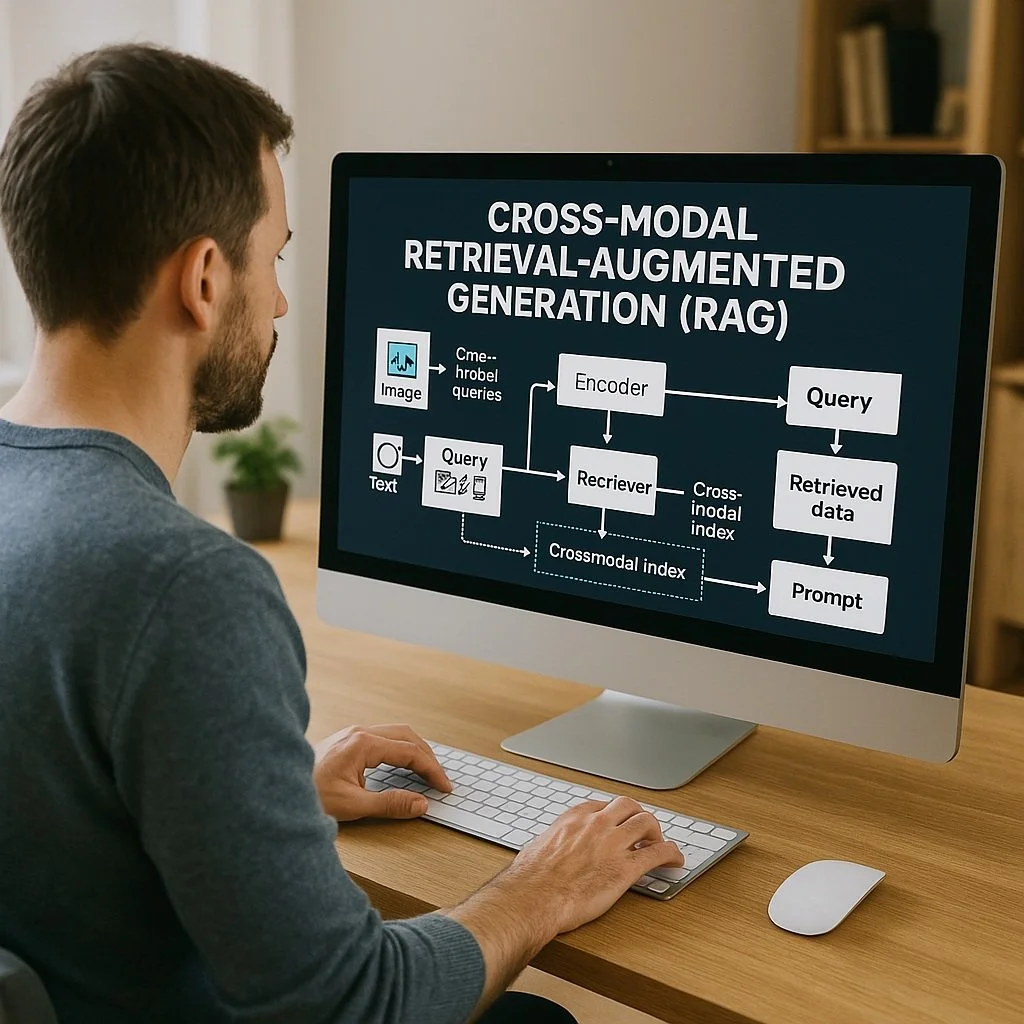
Cross-Modal Retrieval-Augmented Generation (RAG): Enhancing LLMs with Vision & Speech

By Umang Dayal

3 April, 2025

AI has come a long way in natural language processing, but traditional Large Language Models (LLMs) still face some significant challenges. They often hallucinate, struggle with limited context, and can’t process images or speech effectively.

Retrieval-Augmented Generation (RAG) has helped improve things by letting LLMs pull in external knowledge before responding. But here’s the catch: most RAG models are still text-based. That means they fall short in scenarios that require a mix of text, images, and speech to fully understand and respond to queries.

That’s where Cross-Modal Retrieval-Augmented Generation (Cross-Modal RAG) comes in. By incorporating vision, speech, and text into AI retrieval models, we can boost comprehension, reduce hallucinations, and expand AI’s capabilities across fields like visual question answering (VQA), multimodal search, and assistive AI.

In this blog, we’ll break down what Cross-Modal RAG is, how it works, its real-world applications, and the challenges that still need solving.

Understanding Cross-Modal Retrieval-Augmented Generation (RAG)

What is Cross-Modal RAG?

Cross-Modal RAG is an advanced AI technique that lets LLMs retrieve and generate responses using multiple types of data: text, images, and audio. Unlike traditional RAG models that only fetch text-based information, Cross-Modal RAG allows AI to retrieve images for a text query, analyze speech for deeper context, and combine multiple data sources to craft better, more informed responses.

Why is Cross-Modal RAG important?

  • More Accurate Responses: RAG helps by grounding their answers in real data, and with multimodal retrieval, AI gets even better at pulling fact-based, relevant information.

  • Richer Context Understanding: Many queries involve images or audio, not just text. Imagine asking about a car part, it’s much easier if the AI retrieves a labeled diagram rather than just trying to describe it.

  • More Dynamic AI Interactions: AI assistants, chatbots, and search engines get a serious upgrade when they can use text, images, and audio together. This makes conversations more intuitive and useful.

  • Smarter Decision-Making: In fields like healthcare, autonomous driving, and security, AI needs to process multimodal data to make the best decisions. Cross-Modal RAG helps make that happen.

How Cross-Modal RAG Works

Cross-Modal RAG follows a structured process to find and generate information from multiple sources. Here’s how it works:

Encoding & Retrieving Data

Multimodal Data Embeddings: Different types of content (text, images, audio) are encoded into a shared embedding space using models like CLIP (for text-image matching), Whisper (for speech-to-text conversion), and multimodal transformers like Flamingo and BLIP.

AI searches vector databases (like FAISS, Milvus, or Weaviate) to find the most relevant content. This means the model can retrieve an image for a text query or pull a transcript from audio. AI keeps track of timestamps, sources, and confidence scores to ensure retrieved information stays relevant and reliable.

Knowledge Augmentation

Once relevant multimodal data is retrieved, it’s integrated into the LLM’s prompt before generating a response. AI uses image-caption alignment and cross-attention mechanisms to make sure it understands an image’s context or an audio snippet’s meaning before responding. This allows prioritizing different data types depending on context. For example, when answering a question about music theory, it might focus more on text and audio rather than images.

Response Generation

Now, AI generates a cohesive, human-like response by pulling together all the retrieved text, images, and audio insights. For this to work well, the model must fuse multimodal data in a way that makes sense. Cross-attention mechanisms help the AI focus on the most relevant parts of retrieved images or transcripts, ensuring that responses are both accurate and insightful.

To keep responses engaging and accessible, AI also uses dynamic prompt engineering. This means AI formats answer differently depending on the type of query. If answering a medical question, it might provide a structured response with step-by-step explanations. If responding to a retail inquiry, it might generate a quick product comparison with images.

Here are a few examples of use cases:

  • A visual question-answering system retrieves and analyzes an image before responding.

  • A multimodal chatbot pulls audio snippets, images, and documents to craft insightful replies.

  • A medical AI system retrieves X-ray images and reports to assist doctors in diagnosis.

Real-World Applications of Cross-Modal RAG

Smarter Multimodal Search

Imagine searching for something without having to describe it in words. Cross-modal retrieval allows AI to fetch images, videos, and even audio clips based on text-based queries. This capability is transforming how people interact with search engines and databases, making information access more intuitive and efficient.

In retail and e-commerce, shoppers no longer need to struggle to find the right keywords to describe a product. Instead, they can simply upload a photo, and AI will match it with visually similar items, streamlining the shopping experience. This is particularly useful for fashion, furniture, and rare collectibles, where descriptions can be subjective or difficult to communicate.

Visual Question Answering (VQA)

AI is now capable of analyzing images and answering questions about them, opening up new possibilities for education, research, and everyday convenience.

In education, students can upload diagrams, maps, or complex visuals and ask AI to explain them. Whether it’s breaking down a biology chart, interpreting a historical map, or explaining a complex physics experiment, VQA makes learning more interactive and accessible. This technology also enhances academic research by enabling better analysis of scientific images and infographics.

Assistive AI for Accessibility

For people with disabilities, cross-modal AI can bridge communication gaps in powerful ways. AI-powered tools can convert text into speech, describe images, and generate captions for videos, making digital content more accessible.

Real-time speech-to-text transcription is a game-changer for individuals with hearing impairments, enabling them to follow live conversations, lectures, and broadcasts effortlessly. Similarly, visually impaired users can benefit from AI that provides spoken descriptions of images, documents, and surroundings, significantly improving their ability to navigate the digital and physical world.

Cross-Lingual Multimodal Retrieval

Language should never be a barrier to accessing information. AI-driven cross-lingual retrieval allows users to find relevant images and videos using text queries in different languages.

This is particularly impactful in journalism and media, where AI can translate and retrieve multimodal content across languages, making global news and cultural insights more accessible. Whether it’s searching for international footage, multilingual infographics, or foreign-language articles, this technology helps break down linguistic silos and connect people across borders.

Key Challenges & What’s Next?

One of the biggest hurdles in cross-modal retrieval is aligning text, images, and audio effectively. Since different data types exist in distinct formats- text as words, images as pixels, and audio as waveforms- AI needs to map them into a common vector space where they can be meaningfully compared.

Achieving this requires sophisticated deep learning models trained on vast multimodal datasets, but even then, discrepancies in meaning and context can arise. A photo of a “jaguar” might refer to the animal or the car, and without proper alignment, the AI could misinterpret the query.

Another major concern is computational cost. Multimodal retrieval demands significantly more processing power than traditional text-only searches. Every query involves analyzing and comparing high-dimensional embeddings across multiple modalities, often requiring large-scale GPUs or TPUs to process in real time. This makes deployment expensive, and for companies working with limited resources, scalability becomes a serious challenge. Optimizing these models for efficiency while maintaining accuracy is a crucial area of research.

Biases and ethical issues also pose significant risks. If the AI is trained on biased datasets- whether in images, text, or audio, it can inherit and amplify those biases. For example, if a model is trained mostly on Western-centric images, it might struggle to accurately retrieve or categorize content from other cultures. Similarly, voice-based AI systems might perform better for certain accents while failing to recognize others. Addressing these biases requires careful dataset curation, fairness-aware training techniques, and continuous monitoring of model outputs.

While multimodal AI has made impressive strides, achieving seamless, instant retrieval across text, images, and audio is still challenging. Current systems often introduce delays, especially when dealing with large-scale databases or high-resolution media files. Advances in model compression, edge computing, and distributed processing could help mitigate these issues, but for now, real-time multimodal AI remains an ambitious goal rather than a fully realized capability.

As research continues, overcoming these challenges will be key to unlocking the full potential of cross-modal retrieval. Future developments in more efficient architectures, better alignment techniques, and responsible AI practices will shape the next generation of smarter, fairer, and faster multimodal AI systems.

Read more: The Role of Human Oversight in Ensuring Safe Deployment of Large Language Models (LLMs)

Conclusion

Cross-Modal Retrieval-Augmented Generation (RAG) is changing the game by combining vision, speech, and text into retrieval-based AI models. This approach boosts accuracy, deepens contextual understanding, and unlocks new AI applications from visual search to accessibility solutions.

As AI continues to evolve, Cross-Modal RAG will become a key tool for developers, businesses, and researchers.

If you’re looking to build smarter AI applications, now’s the time to explore multimodal RAG! Talk to our experts at DDD and learn how we can help you.

Cross-Modal Retrieval-Augmented Generation (RAG): Enhancing LLMs with Vision & Speech Read Post »

Scroll to Top