
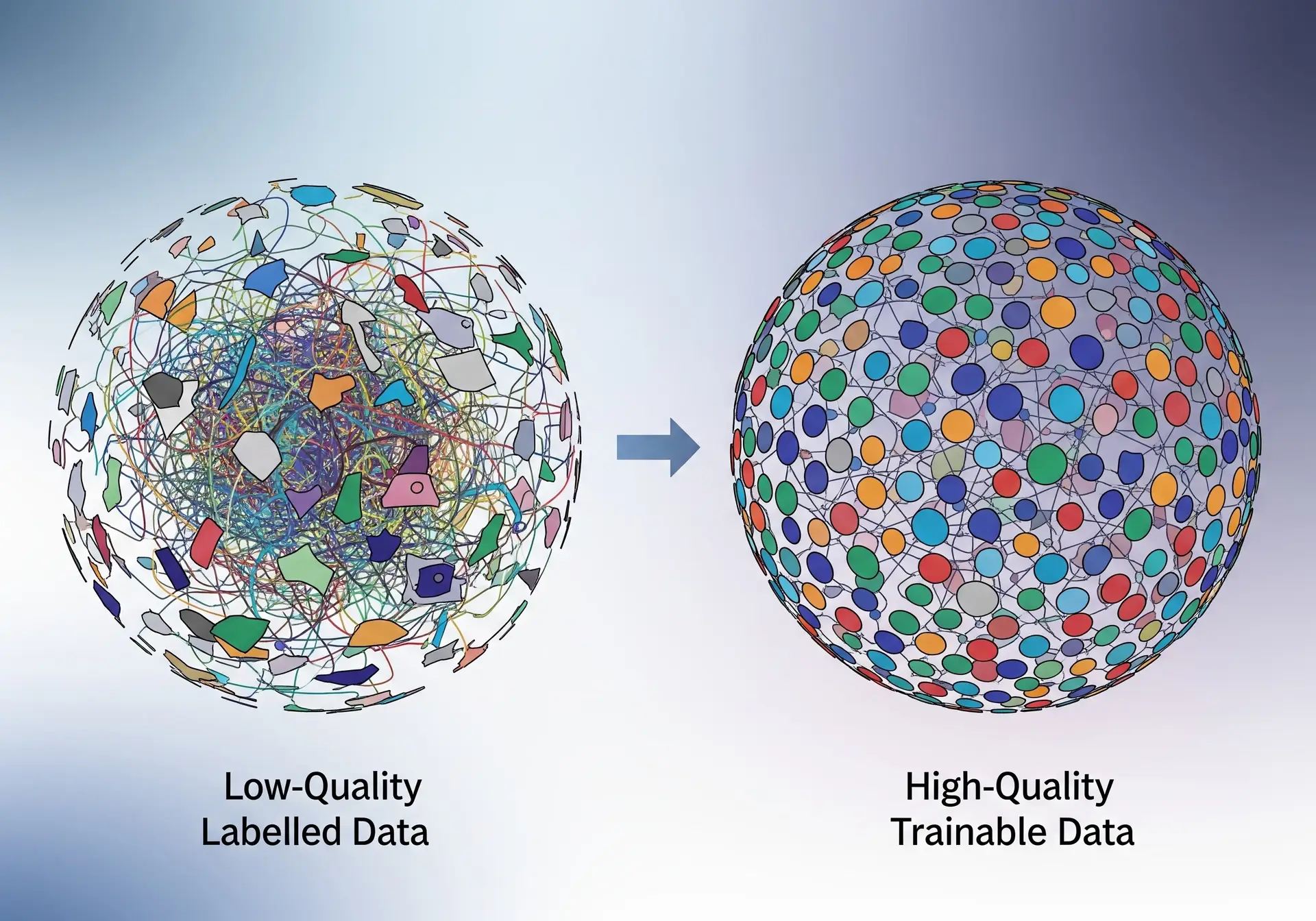
Labeled data is not automatically trainable data. The gap between the two is defined by three important factors: label consistency across annotators, class coverage across the distribution your model will face in production, and whether your downstream evaluation metrics actually expose annotation failures before they reach deployment. Most machine learning data labeling services close the first factor. Very few consistently address all three.
Data quality is the most cited reason AI projects underperform in production, and yet most teams don’t catch the problem until they’ve already trained on it. Understanding what makes labeled data actually useful for AI models starts with separating the act of annotation from the standard of annotation. Programs that invest in quality of data collection and curation process programs label quality upstream spend far less time debugging model failures downstream.
Key Takeaways
- Labeled data and trainable data are two different attributes. A 100% labeled dataset can still fail to produce a model that generalizes if consistency, coverage, or schema quality is missing.
- Low inter-annotator agreement (IAA) means your model is learning a weighted average of conflicting annotator interpretations, not actual ground truth.
- Coverage gaps are invisible during standard evaluation because test sets are usually drawn from the same flawed collection as training data.
- Overall accuracy many times hides annotation failures. Per-class recall, confusion matrix analysis, and slice-level performance are the metrics that actually expose them.
- Annotation quality problems found during model debugging cost far more to fix than annotation quality standards enforced at the start of the labeling pipeline.
What is the Difference Between Labeled Data and Trainable Data?
Machine learning data labeling services produce labeled dataset files, where each sample carries an annotation, but “labeled” is a binary state. While “Trainable” is a quality threshold. A dataset can be 100% labeled and still fail to produce a model that generalizes.
Trainable data meet three conditions simultaneously. First, labels are consistent; two annotators working independently on the same sample reach the same conclusion, as measured by inter-annotator agreement (IAA) scores. Second, the dataset has sufficient class coverage; every category the model will encounter in production appears with enough examples to learn a reliable decision boundary. Third, the label schema maps correctly to the task, the taxonomy used during annotation is specific enough to be useful, but not so granular that annotators make arbitrary distinctions.
When any of these conditions fail, the model trains on noise instead of signal, producing plausible-looking accuracy numbers on a held-out set while underperforming on the specific cases that matter in deployment. This is why data annotation challenges at scale are not primarily about throughput; they’re about maintaining quality standards as volume increases.
Why Does Label Consistency Determine Whether a Dataset Is Trainable?
Label consistency is the single most predictive indicator of whether a supervised learning dataset will produce a model that transfers to production. Low inter-annotator agreement is not a minor inconvenience; it means your model is learning a weighted average of conflicting interpretations rather than a coherent concept.
When annotators disagree on boundary conditions like edge cases between adjacent categories, ambiguous instances, or samples that require domain knowledge to classify, the training signal on those samples is contradictory. The model receives conflicting gradient updates. Over a large enough dataset, systematic disagreements encode annotator bias rather than ground truth. The 99.5% annotation accuracy in production matters precisely because even small error rates compound across millions of training samples.
There are three primary sources of label inconsistency that teams consistently underestimate:
Ambiguous labeling guidelines: Guidelines written at the category level without worked examples leave annotators to resolve edge cases independently. Each annotator develops their own rules. IAA looks acceptable in aggregate but hides systematic splits on specific subclasses.
Annotator fatigue in long sessions: Accuracy on complex annotation tasks degrades after 90–120 minutes. Without session controls, later batches in a work session carry more noise than earlier batches.
Insufficient domain expertise for specialized tasks: Tasks that require domain knowledge, like medical imaging, legal document classification, or sensor data from autonomous systems, produce very low IAA when assigned to general annotators. The resulting labels represent best guesses, not ground truth.
Fixing this after labeling is expensive. Relabeling at scale means discovering the problem late, often after a failed training run. The more reliable approach is to run IAA audits on a stratified sample before full production begins, and to build adjudication workflows, where disagreements trigger a review by a senior annotator or domain expert, into the pipeline itself. Fixing unreliable data annotation becomes costly after failed training and requires a lot of hidden costs.
How Do Coverage Gaps Expose Your Model to Silent Failure?
Label consistency is a within-dataset property. Coverage is about the relationship between your dataset and the real-world distribution your model must handle. A dataset can have near-perfect IAA scores and still catastrophically fail in production if it systematically underrepresents the cases that matter.
Coverage gaps tend to be invisible during evaluation because most held-out test sets are drawn from the same collection as training data. If the collection process missed night-time driving scenarios, both training and test sets missed them. The model looks competent until it encounters night-time conditions in deployment. The same pattern appears in medical imaging when datasets are collected from a single hospital, in NLP when training data skews toward one dialect or register, and in robotics when physical training environments don’t replicate the range of object orientations found in real warehouses.
Three coverage problems appear most often:
Class imbalance: Rare but important categories like edge cases, failure modes, and minority demographic groups are underrepresented because they’re genuinely rare in uncurated data collection. The model learns to ignore them because ignoring them carries a minimal penalty on the training objective.
Distribution shift: Data is collected under conditions that differ from deployment conditions. This includes temporal shifts (training on last year’s data for this year’s problem), geographic shifts, and hardware shifts (different camera models, different sensor calibrations).
Missing negative examples: Classifiers trained without sufficient hard negatives, examples that resemble the positive class but should be labeled negative, develop wide decision boundaries and produce too many false positives in production.
The only reliable defense against coverage gaps is active curation. This means analyzing collection data for distributional completeness before annotation begins, augmenting underrepresented slices, and running slice-level evaluation to confirm that model performance is acceptable across each subgroup, not just in aggregate. Building AI-ready datasets at scale requires a pipeline design that treats coverage as a first-order constraint.
Which Downstream Metrics Actually Expose Annotation Problems?
Overall accuracy is never the right metric for detecting annotation quality failures. It aggregates across the entire dataset and is dominated by the majority class. Problems with rare categories, coverage gaps, and labeling inconsistencies on hard examples all hide inside an acceptable accuracy number.
The metrics that consistently surface annotation problems are those that force per-slice analysis. These include:
Per-class precision and recall: A class with very low recall relative to others is often one where annotators disagree frequently or where coverage is insufficient. High false negative rates on specific classes trace directly to annotation failures.
Confusion matrix analysis: Systematic confusions between adjacent classes, for example, where the model consistently predicts Class A when the ground truth is Class B, often indicate that the boundary between those classes was annotated inconsistently. The model learned the wrong boundary because annotators didn’t agree on where it was.
Calibration error: A model that is overconfident in its errors has typically been trained on noisy labels. Expected Calibration Error (ECE) tends to be higher for datasets with low IAA, because the model has been trained to express high confidence in examples where the “ground truth” was actually contested.
Slice-level performance on known hard subgroups: If you can define subgroups expected to be harder, rare classes, out-of-distribution conditions, or demographic subgroups, performance gaps between those slices and the overall population are a proxy for coverage and consistency failures.
If the taxonomy is wrong, and task framing doesn’t match what the model needs to do in production, high IAA and good coverage will produce a highly consistent but wrong model. Taxonomy validation, which involves domain experts reviewing the label schema against production use cases before annotation begins, is not optional for high-stakes programs.
How Digital Divide Data Can Help
DDD’s approach to machine learning data labeling services is built around the distinction between labeled and trainable data. Every annotation program that DDD operates includes IAA measurement as a standard process step, not an optional audit. Annotator teams work against guidelines that are developed with worked examples for edge cases, and adjudication workflows are embedded directly in the pipeline so that disagreements trigger expert review rather than accumulating as noise in the final dataset.
On the coverage side, DDD’s data collection and curation services include collection strategy design, distributional analysis, and active slice augmentation for underrepresented categories. For programs in Physical AI and ADAS where coverage gaps carry safety implications, DDD runs scenario-level coverage audits that map the collected dataset against the target Operational Design Domain (ODD) before labeling begins. This ensures that annotation effort is not wasted on a distribution that will produce a model with known coverage failures.
Downstream, DDD’s model evaluation services are designed to surface annotation-level failures. Evaluation pipelines include per-class analysis, confusion matrix review, and slice-level scoring against defined hard subgroups. Where evaluation reveals category-level failures that trace back to annotation inconsistency, DDD’s teams can run targeted relabeling on the affected slice without restarting the full dataset pipeline.
Label programs that actually close performance gaps require more than throughput. They require quality architecture. Talk to an Expert!
Conclusion
The gap between labeled data and trainable data is not closed by scale. Larger volumes of low-consistency, low-coverage labeled data produce larger models with the same failure modes, at greater cost. The programs that consistently produce deployable models treat annotation quality as an upstream investment. IAA measurement, coverage analysis, and taxonomy validation should be discussed before annotation begins, not as remediation steps after a failed training run.
Teams that operate this way are better positioned to identify failures before they reach production and to iterate faster when distribution shifts require dataset updates. Teams that don’t will continue to discover annotation failures through model debugging, which is the most expensive place to find them.
References
Zha, D., Bhat, Z. P., Lai, K.-H., Yang, F., Jiang, Z., Zhong, S., & Hu, X. (2023). Data-centric AI: A survey. arXiv preprint. https://arxiv.org/abs/2303.10158
Nushi, B., Kamar, E., & Horvitz, E. (2018). Towards accountable AI: Hybrid human-machine analyses for characterizing system failure. Proceedings of AAAI HCOMP. https://arxiv.org/abs/1809.07424
Frequently Asked Questions
What makes labeled data actually useful for machine learning models?
Labeled data becomes useful when it meets three conditions at once: annotators are consistent with each other (measured by inter-annotator agreement), the dataset covers the distribution the model will face in production, and the label schema maps correctly to the actual task. Missing any one of these produces a dataset that can train a model, but won’t produce reliable performance in deployment.
How do you measure label quality before training starts?
The primary measure is inter-annotator agreement (IAA), calculated on a stratified sample where multiple annotators label the same examples. Cohen’s kappa is the standard metric for categorical labels. IAA should be measured at the category level, not just in aggregate, because high overall agreement can hide systematic disagreements on specific subclasses that matter most.
Why does a model sometimes perform well on test data but fail in production?
This usually means the test set was drawn from the same distribution as the training data, so coverage gaps and annotation errors are shared across both sets. If a class or condition was systematically underrepresented or mislabeled during collection, both training and test sets carry the same blind spot. Slice-level evaluation; testing specifically on known hard subgroups is more likely to surface these gaps than overall held-out accuracy.
How does annotator disagreement affect model training?
When annotators disagree on the same sample, the training set contains conflicting labels for similar inputs. The model receives contradictory gradient updates on those samples and tends to learn an unstable boundary around the contested region. This often shows up as high calibration error, and the model becomes overconfident in the types of examples where annotators disagreed most.

Udit Khanna leads the delivery of scalable AI and data solutions at Digital Divide Data, with a deep specialization in Physical AI. With a background in presales, solutioning, and customer success, he brings a mix of technical depth and business fluency, helping global enterprises move their AI projects from prototype to real-world deployment without losing momentum.