
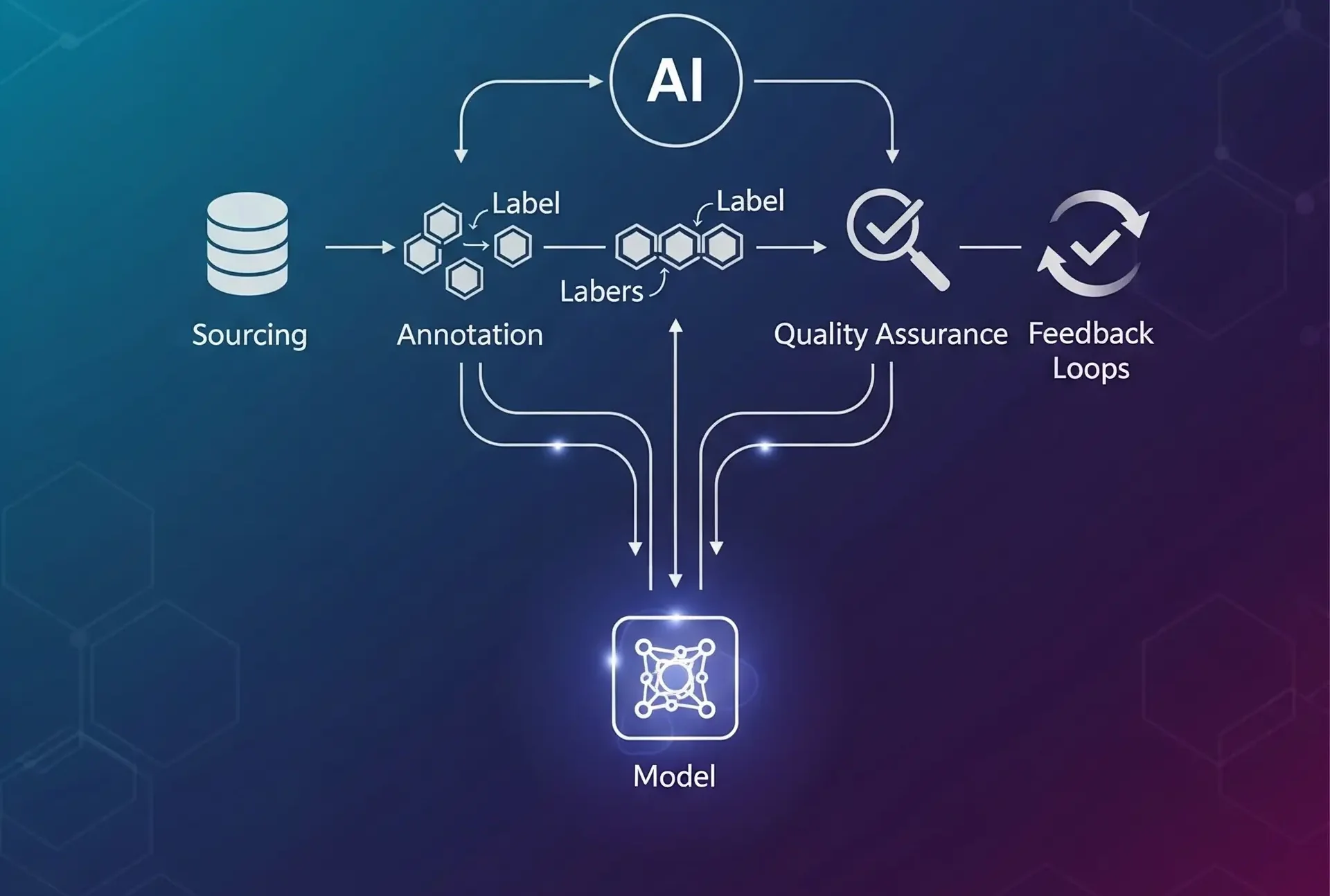
Building an AI data operations services function means standing up a repeatable system that moves training and evaluation data from sourcing through annotation, quality assurance, and back into the model, continuously and at scale. The implementation sequence is consistent; assign a single accountable owner, define the three operating layers (acquisition, annotation, quality and feedback), select tooling around dataset versioning and lineage, automate the annotation pipeline where automation is reliable, and track KPIs that tie data work to model behavior. Most programs fail not because of weak models but because this actual operating structure is missing.
The pressure to formalize this function is measurable. A 2025 S&P Global survey of more than 1,000 enterprises found that 42% of companies abandoned most of their AI initiatives that year, up from 17% the prior year, and the organizations that succeeded were the ones that redesigned their end-to-end workflows rather than swapping models. A standing AI data operations function is what that redesign looks like in practice. It is the difference between a one-time labeled dataset and a persistent data supply chain. Strong data collection and curation services feed the front of that chain, while reliable AI data pipeline infrastructure carries data through it without manual rework at every handoff.
Key Takeaways
- AI data operations is the system that keeps the right data flowing to your models continuously, not just once at the start of a project.
- Start by putting one person clearly in charge, someone who can look at a model failure and trace it back to a data problem they’re allowed to fix.
- Set up the work in three clear stages; getting the data, labeling it, and checking quality while feeding lessons back into the process.
- Automate the easy, repetitive parts, but keep people involved in the tricky or high-stakes cases instead of automating everything.
- Track whether your data work is actually improving the model, not just how fast you’re labeling things.
- The companies that succeed, treat data as an ongoing supply they manage, while the ones that fail keep reacting to problems after they appear.
What is an AI data operations function and why does it need its own structure?
AI data operations, often shortened to AI DataOps, is the operating model, team structure, tooling conventions, and governance that manage the continuous flow of training and evaluation data through an AI program. It borrows the discipline of DevOps, automation, version control, testing, and continuous delivery, and applies it to data work rather than code. The function spans the full lifecycle, so continuous model evaluation sits at one end and human preference optimization workflows feed back into it. The goal is simple to state and hard to sustain; deliver the right dataset, with known quality, to every training and evaluation run.
It needs its own structure because annotation alone does not scale into reliable model behavior. Annotation is one layer of the system. Around it sits sourcing, quality measurement, dataset versioning, and the feedback path that turns evaluation findings into specific data fixes. When those surrounding parts are informal, scale amplifies whatever inconsistency already exists. A small team with vague guidelines produces a manageable amount of noise, while a large one produces noise faster than anyone can correct it.
The distinction matters for planning. A proof-of-concept can run on a single curated dataset and an informal labeling group. A production program that requires continuous fine-tuning, preference optimization, and safety evaluation needs a persistent data supply chain instead. For a stronger understanding of the conceptual fundamentals behind this AI data operating model, it is important to first look at the core layers, ownership structure, and accountability questions that define AI data operations.
How do I set up an AI data operations function step by step?
Setting up the function is a sequence, not a single hire or a tool purchase. The order matters because each step depends on the one before it. Standing up tooling before assigning an owner, for example, produces a stack that nobody is accountable for. The following sequence works for teams moving from pilot to production.
- Assign a single accountable owner: Name one person, usually the AI program lead or a Head of AI Data, who can trace a model failure to a specific data problem and authorize the work to fix it. This accountability role must sit inside the organization even when execution is outsourced.
- Define the three operating layers: Separate acquisition and sourcing, annotation and labeling, and quality assurance with feedback integration. Each layer has its own inputs, outputs, and quality checks, so treating them as one blurred process is where most early programs lose traceability.
- Establish a sourcing strategy before labeling: Decide what data you need, where it comes from, and how representativeness is verified. A deliberate data collection strategy for AI training prevents the common failure of labeling large volumes of data that do not reflect the target distribution.
- Select tooling around versioning and lineage: Pick orchestration, annotation, and observability tools that can track which dataset version fed which training run. Lineage is the feature that makes everything downstream debuggable.
- Automate the annotation pipeline where automation is reliable: Use model-assisted pre-labeling and automated checks for the predictable cases, and route ambiguous or safety-critical cases to human review.
- Close the feedback loop with evaluation: Wire evaluation findings back into data remediation so that a regression triggers a targeted dataset fix rather than a vague request for more labels.
This ordering reflects a finding that holds across the research. McKinsey’s 2025 State of AI survey reports that organizations seeing real bottom-line impact are far more likely to have fundamentally redesigned their workflows rather than bolting AI onto existing processes. An AI data operations function is workflow redesign applied to the data layer specifically.
What roles belong on an AI data operations team?
The team is cross-functional, but a few roles carry the function. The most underrated of them is the accountable owner described above, because without it the team stays reactive. The remaining roles divide cleanly between building the pipeline and producing the data that flows through it. Data engineering has become central enough that successful AI enterprises treat data engineering as a core AI competency rather than a supporting function.
- AI data operations lead (accountable owner): Translates model failures into data remediation actions and owns the build-versus-buy decision.
- Data / DataOps engineer: Builds and maintains pipeline infrastructure, automation, lineage tracking, and the templates other contributors follow.
- Annotation lead and quality lead: Own annotation guidelines, taxonomy decisions, and inter-annotator agreement targets.
- Annotation workforce (internal or partner): Produces the labels, ideally with continuous rather than burst capacity.
- Evaluation consumer: The model training and evaluation team that uses the data and feeds findings back into it.
Two organizational patterns are common, and choosing between them early avoids rework. In a central platform model, one team builds shared tooling and standards while domain teams own their pipelines on that foundation. In an embedded model, data operations specialists sit inside each domain and keep consistency through shared practice. Teradata’s analysis of DataOps team structures describes both patterns and the tradeoff between centralized control and domain proximity.
What tools support an AI data operations function?
Tooling should be selected by capability category, not by brand. The function needs four categories working together, and the connective tissue across all of them is dataset versioning and lineage. Without lineage, a quality problem becomes a guessing exercise instead of a lookup.
- Orchestration: Schedules jobs, manages dependencies between pipeline steps, retries failures, and triggers downstream work automatically.
- Annotation and labeling platforms: Support the data modalities you work in, model-assisted pre-labeling, and reviewer workflows.
- Observability and quality monitoring: Track pipeline health, schema changes, and label quality, and surface anomalies before they reach a training run.
- Versioning and lineage: Record which dataset version, sourced how and labeled by whom, fed each fine-tuning or evaluation job.
For multimodal programs spanning text, image, video, and audio, the annotation platform decision is heavier because each modality carries its own tooling and quality conventions. The broader AI data pipeline layer is where orchestration and lineage are operationalized as delivered infrastructure rather than a stack you assemble alone.
How do I automate AI data and annotation pipelines?
Automation in AI data operations is not the same as full automation. The aim is zero-touch operation for the standard, predictable cases and fast, informed human intervention for the exceptions. Applied to annotation specifically, that means automating the parts that are reliable and reserving human judgment for the parts that are not. The strength of a multi-layered annotation pipeline lies in how well it combines automated stages with human judgment while maintaining quality, consistency, and control.
A practical automation sequence looks like this. First, automate ingestion and validation so that incoming data is checked against schema and quality rules at the door, which prevents broken pipelines downstream. Second, apply model-assisted pre-labeling so annotators correct machine output rather than starting from scratch, which raises throughput without raising error rates if review is enforced. Third, automate quality testing so that label distributions, agreement scores, and edge-case coverage are monitored continuously instead of audited occasionally.
The boundary of automation is the point worth getting right. Predictable, high-volume cases are good automation candidates, while ambiguous, rare, or safety-critical cases should route to human reviewers by design. Automating those amplifies error instead of removing it, which is why the strongest pipelines treat human-in-the-loop review as a permanent design feature, not a temporary crutch to be removed once volume grows.
How should quality governance and vendor integration work?
Quality governance is what keeps the function honest as it scales. Three practices separate mature programs from those stuck in pilot mode, and none of them are complicated in principle. Every dataset delivered to a training run is versioned with clear lineage from source through annotation. When a model regresses, the team can isolate which dataset version and which annotation cohort were involved without losing time. And evaluation findings drive data remediation as a standing practice rather than an occasional cleanup.
Quality targets need to be concrete rather than aspirational. Inter-annotator agreement, edge-case coverage, and a defined accuracy threshold give the function something to measure against. However, a headline number like 99.5% accuracy can be misleading without the right context. In production, data annotation accuracy, depends on the denominator being measured, the types of errors being counted, and how those errors affect downstream model performance.
Vendor integration is partly a governance decision. The build-versus-buy-versus-partner question is really about which capabilities the internal accountability structure must own and where external execution capacity makes more sense. The accountable owner stays internal in every pattern. Execution work such as sourcing, labeling, and quality assurance can be partnered, provided the partner plugs into the same lineage and quality standards rather than running a parallel, opaque process. The integration pattern that works treats a partner as an extension of the pipeline, with shared versioning, shared quality definitions, and shared visibility into agreement metrics.
What KPIs should I track for AI data operations?
KPIs for AI data operations should connect data work to model behavior, not just measure labeling speed. Throughput matters, but a fast pipeline producing inconsistent labels is a faster route to a failed model. Track a small, balanced set across quality, flow, and impact.
- Inter-annotator agreement: The consistency of labels across annotators, the leading indicator of dataset reliability.
- Annotation accuracy against gold standard: Measured on a held-out, expert-labeled set with a clear error definition.
- Edge-case and distribution coverage: How well the dataset represents the target distribution, including rare but important cases.
- Dataset lineage completeness: The share of training datasets with full, traceable provenance from source to training run.
- Cycle time and rework rate: How long data takes to move through the pipeline and how often it must be redone.
- Evaluation-to-remediation time: How quickly an evaluation finding becomes a shipped data fix, the clearest signal that the feedback loop is closed.
The last metric is the one that distinguishes a real operating function from a labeling vendor relationship. A program that can measure how fast a model failure turns into a corrected dataset has the feedback loop working. A program that cannot is still treating data as a one-time input rather than a continuously managed supply.
How Digital Divide Data Can Help
Digital Divide Data operates the execution layers of AI data operations as managed services, which lets the internal accountability owner stay focused on tracing model failures to data fixes. On the sourcing side, DDD’s data collection and curation services build representative, AI-ready datasets rather than large volumes of poorly targeted data. For labeling across text, image, video, and audio, DDD’s multimodal data annotation services bring inter-annotator agreement discipline and reviewer workflows to each modality’s specific conventions.
On the feedback side, DDD’s model evaluation services produce the findings that drive targeted data remediation, closing the loop between how a model behaves and what data work happens next. Preference data work, including RLHF and DPO optimization, is run with the same versioning and quality standards as the rest of the pipeline, so a partner becomes an extension of your operating model rather than a parallel process you have to reconcile.
The integration pattern is deliberate. DDD plugs into shared dataset lineage and shared quality definitions, so visibility into agreement metrics and dataset provenance stays with your team. That is what makes the build-versus-buy-versus-partner decision a question of capacity rather than control.
Stand up an AI data operations function that actually closes the gap between pilots and production. Talk to an Expert!
Conclusion
An AI data operations function is the operating system for a production AI program. The implementation sequence is consistent and unglamorous: name an accountable owner, separate the three layers, source deliberately, version everything, automate the reliable parts, and route the hard cases to people. The organizations that treat data as a continuously managed supply chain are the ones moving models from pilot to production, while the organizations still labeling in bursts and reacting to regressions are well represented in the share of AI initiatives quietly abandoned each year.
The gap between those two groups is not model sophistication. It is whether a model failure can be traced to a dataset version and fixed on purpose, or whether it triggers another round of guessing. Building the function correctly is what makes that traceability routine.
References
S&P Global Market Intelligence. (2025). AI experiences rapid adoption, but with mixed outcomes: Highlights from VotE: AI & Machine Learning. https://www.spglobal.com/market-intelligence/en/news-insights/research/ai-experiences-rapid-adoption-but-with-mixed-outcomes-highlights-from-vote-ai-machine-learning
McKinsey & Company, QuantumBlack. (2025). The state of AI: Global Survey 2025. https://www.mckinsey.com/capabilities/quantumblack/our-insights/the-state-of-ai
Frequently Asked Questions
How do I set up an AI data operations function?
Start by naming one accountable owner who can trace a model failure to a specific data problem and authorize the fix. Then separate the three layers, sourcing, annotation, and quality with feedback, set up tooling around dataset versioning and lineage, and automate only the parts that are reliable. The order matters because each step depends on the one before it.
What roles are in an AI data operations team?
The core roles are an accountable data operations lead, a data or DataOps engineer who builds the pipeline, an annotation and quality lead who owns guidelines and agreement targets, the annotation workforce, and the evaluation team that consumes the data and feeds findings back. The accountable owner is the role most often missing, and it should stay internal even when labeling is outsourced.
What tools support AI data operations?
You need four tool categories working together: orchestration, annotation and labeling platforms, observability and quality monitoring, and versioning with lineage. Lineage is the connective feature, because it lets you trace which dataset version fed which training run when something goes wrong.
What KPIs should I track for AI data operations?
Track a balanced set across quality, flow, and impact including inter-annotator agreement, annotation accuracy against a gold standard, edge-case and distribution coverage, dataset lineage completeness, cycle time and rework rate, and evaluation-to-remediation time. The last one matters most, because it shows whether your feedback loop from model behavior back to data work is actually closed.

Udit Khanna leads the delivery of scalable AI and data solutions at Digital Divide Data, with a deep specialization in Physical AI. With a background in presales, solutioning, and customer success, he brings a mix of technical depth and business fluency, helping global enterprises move their AI projects from prototype to real-world deployment without losing momentum.