
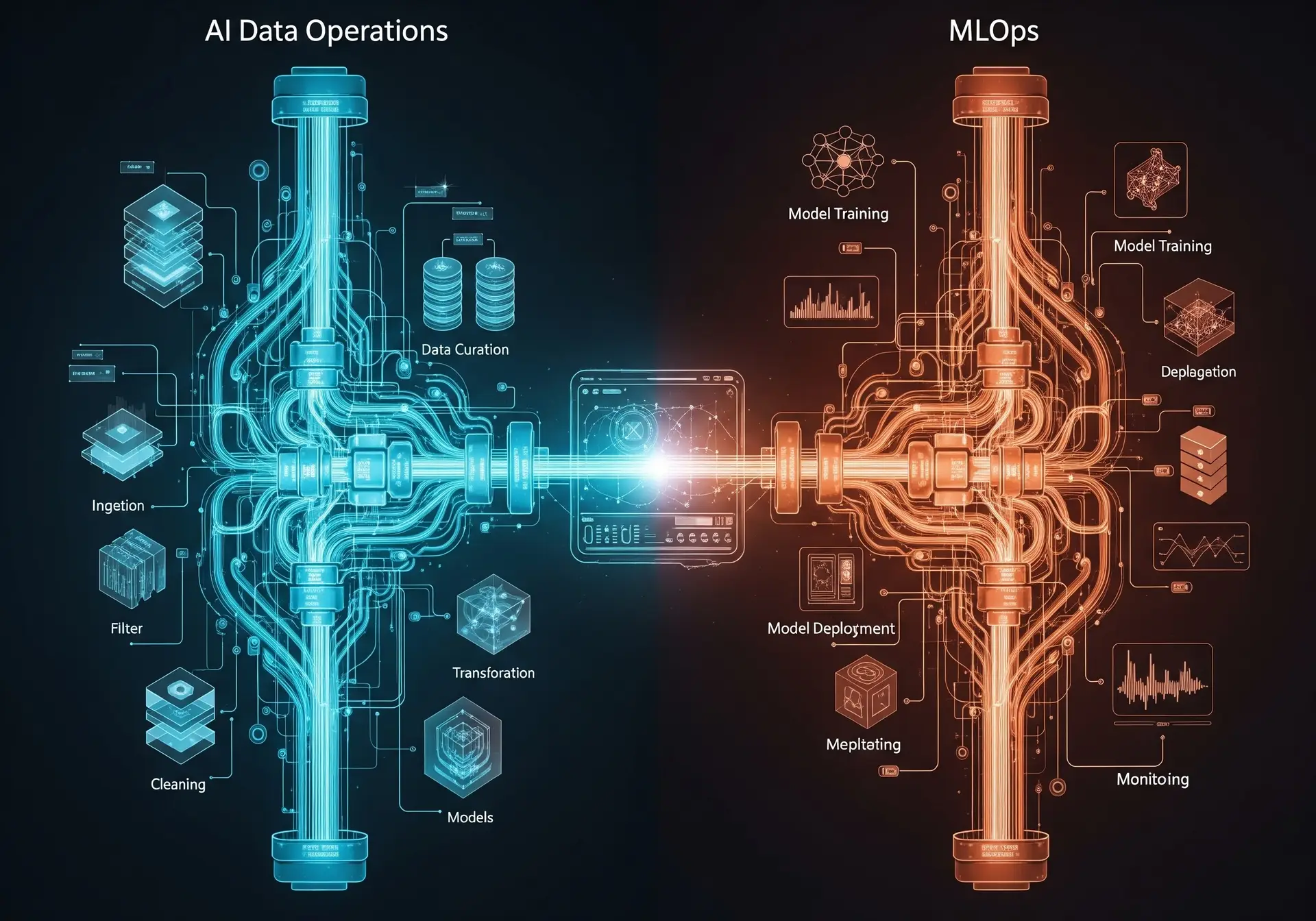
AI Data Operations is the discipline that produces and maintains the data an AI system learns from; collection, annotation, curation, human feedback, and the evaluation sets used to test it. MLOps is the discipline that trains, deploys, monitors, and retrains the models that consume that data. The two share roots in DevOps and meet at the pipeline, yet they own different assets and fail in different ways. A production AI program needs both, because a well-engineered model sitting on unreliable data still fails once it is live.
Teams usually learn the difference the hard way, when a model that passed every offline benchmark starts making strange calls in production. The cause is rarely the model code. It is almost always something upstream; a label definition that drifted, a data collection and curation process that quietly changed, or a data pipeline that started dropping a field with no warning. Treating these two functions as one job, or assuming one team owns both, is where many production AI programs lose months.
Key Takeaways
- AI Data Operations is the work of building and maintaining the data a model learns from, while MLOps is the work of training, launching, and watching over the model itself.
- The two are easy to confuse because they grew from the same playbook, but they look after different things and break in different ways.
- A model can pass every test and still fail in real use if the data feeding it was messy or out of date.
- The most common breakdowns happen at the handoff between the two teams, which is why a clear agreement on what “good data” means is so important.
- If you have to choose where to fix things first, look at what fails more often: shaky data or shaky deployment.
- Companies that treat data work as its own real job tend to ship more dependable AI than those who leave it as an afterthought.
What is AI Data Operations, and how is it different from classic DataOps?
AI Data Operations, sometimes called AI DataOps, is the operational discipline that turns raw signals into AI-ready datasets and keeps them reliable over time. It covers data collection, annotation, curation, human preference optimization, and the evaluation sets used to test models before and after release. Classic DataOps grew up in analytics and business intelligence, where the output is a dashboard or a report. AI Data Operations targets a different output: training and evaluation data whose quality directly changes how a model behaves.
A useful way to frame the scope comes from data-centric AI research, which organizes the work into three goals; training data development, inference data development, and data maintenance. Those goals map almost exactly onto what an AI data operations team does day to day. Building labeled training sets is training data development. Preparing prompts and retrieval context is inference data development. Re-labeling, auditing, and refreshing datasets as the world changes is data maintenance.
The hardest part of this discipline is rarely the labeling itself. It is the definition work of AI data operations that sits behind the labels. Two reasonable annotators will disagree on the same example whenever the guideline is vague, and that disagreement becomes noise the model learns as if it were signal. Measuring inter-annotator agreement, then tightening guidelines until agreement is high, is the unglamorous core of a serious data operation. Skip it, and every downstream metric inherits the ambiguity.
For most of the last decade, this work was treated as a side task for whoever happened to be free. That assumption no longer holds at production scale. Data engineering is becoming a core AI competency as models commoditize, and the data operation becomes the part of the stack that teams can actually differentiate on. Naming it as a discipline, with its own owners and standards, is the first step toward running it well.
What does MLOps actually own in the model lifecycle?
MLOps, short for machine learning operations, is the engineering discipline that moves models from a notebook into reliable production service. It borrows continuous integration, version control, and monitoring from DevOps and applies them to the model lifecycle. That lifecycle runs from experiment and training through validation, deployment, monitoring, and retraining. The asset MLOps protects is the model and its behavior in production.
MLOps assumes the training data already exists and is fit for purpose. It versions that data, tracks which dataset produced which model, and watches for drift once the model is live. What it does not do is produce the labels, resolve disagreement between annotators, or decide what a correct answer looks like. Those decisions sit upstream, in the data operation, and MLOps inherits whatever they produce.
This blind spot is well documented. A foundational paper offering a data quality-driven view of MLOps argued that most MLOps tooling concentrates on engineering concerns such as orchestration, reproducibility, and versioning, while doing little to monitor or version the datasets themselves. The gap is structural. When data quality is treated as someone else’s problem, it tends to surface later as a model incident that is expensive to trace.
Reproducibility is the other thing MLOps exists to guarantee. A model is only trustworthy in production if you can recreate exactly how it was built, roll back to a known-good version, and audit what changed between releases. That demands strict versioning of code, configuration, and the dataset reference, plus a registry that ties each deployed model to the run that produced it. None of this fixes a bad dataset. It only makes the consequences of one traceable, which is necessary but not sufficient on its own.
Where do AI Data Operations and MLOps overlap, and where do they diverge?
Both disciplines descend from DevOps, so they share a lot of mechanics. Both use version control, automated testing, continuous delivery, and monitoring. Both organize work into repeatable cycles instead of one-off projects. The overlap is real, and it is a large part of why the two are so often confused.
The divergence shows up in what each one owns and measures. AI Data Operations is judged on data quality distributed across inter-annotator agreement, label accuracy, coverage of edge cases, and freshness. MLOps is judged on model and system quality based on accuracy in production, latency, drift, and rollback safety. The table below maps the split across the dimensions that matter most when you decide who owns what.
| Dimension | AI Data Operations | MLOps |
| Primary asset | Training, annotation, and evaluation data | Models and their behavior in production |
| Lifecycle | Collect, annotate, curate, validate, maintain | Experiment, train, validate, deploy, monitor, retrain |
| Core metrics | Inter-annotator agreement, label accuracy, edge-case coverage, freshness | Production accuracy, latency, drift, rollback safety |
| Typical owners | Data ops leads, annotation managers, domain experts, QA | ML engineers, platform and infrastructure teams, SREs |
| Example tooling | Labeling platforms, consensus and QA tooling, dataset version control, curation pipelines | Feature stores, model registries, CI/CD for models, serving and monitoring |
| Main failure mode | Inconsistent labels, stale data, hidden bias | Training and serving skew, undetected drift, fragile deployment |
The shared vocabulary hides a subtle trap. Continuous integration means something different in each discipline. In MLOps, a pipeline run retrains and revalidates a model against a fixed dataset. In AI Data Operations, a pipeline run ingests new examples, routes them through annotation and QA, and publishes an updated dataset. Both are automated and both are tested, but a passing data pipeline and a passing model pipeline answer different questions. Confusing the two leads teams to trust a green build that never checked the thing that actually broke.
MLOps cannot hit its metrics if the data operation misses its own. A model registry with perfect lineage offers little comfort when the labels it points to were defined inconsistently across three annotation vendors.
Does MLOps include data operations?
This is the most common question, and the honest answer is partly. MLOps includes data handling; versioning datasets, building feature pipelines, and validating schemas at training time. It treats data as an input to be managed. It does not include the human and editorial work of producing that data, which means writing annotation guidelines, training annotators, adjudicating disagreement, and curating for coverage.
AI Data Operations and MLOps share the pipeline where data is prepared and fed to training. Upstream of that handoff, the data operation runs work that MLOps tooling was never designed to do. Downstream, MLOps runs work that no labeling platform handles. Calling one a subset of the other hides the seam where most production failures actually happen.
How does AI Data Operations feed the MLOps pipeline?
The connection point between the two is a handoff, and handoffs are where things break. The data operation produces a dataset, and MLOps consumes it for training and serving. When that boundary is informal, small upstream changes cause large downstream failures. A clear data contract, meaning an agreed schema, label taxonomy, and quality threshold, is what keeps the handoff stable.
Two failure patterns dominate this seam. The first is training and serving skew, where the transformation applied during training differs from the one applied at inference, so the model meets data it was never trained on. The second is silent schema drift, where a column changes type or a field stops arriving and nothing flags it. Data pipelines are important for AI as disciplined pipeline design prevents both, by making every transformation explicit and testable.
A data contract is what turns this from a hope into a guarantee. In practice it specifies the exact fields a dataset will contain, the label taxonomy and its allowed values, the minimum agreement and accuracy thresholds, and how changes are versioned and announced. With that contract in place, the data team can evolve its work and the model team can depend on a stable interface. Without it, every relabeling effort or new data source becomes a surprise that the MLOps team discovers through a failing model.
The feedback loop also runs the other way. Once a model is live, MLOps monitoring detects drift, which is a drop in accuracy as real-world inputs shift away from the training distribution and AI model performance degrades over time. That signal is only useful if the data operation can respond by sourcing and labeling fresh examples.
What tools are used in AI data operations, and who owns them?
AI Data Operations runs on a different stack than MLOps. The core tools are labeling and annotation platforms, consensus and QA tooling for measuring agreement, dataset version control, and curation pipelines that filter and balance data. A 2024 survey of data quality tools for machine learning reviewed seventeen such tools and found the field still fragmented, with no single platform covering quality end to end. That fragmentation is why process and standards matter more than any one tool.
MLOps runs on feature stores, model registries, CI/CD systems built for models, and serving and monitoring platforms. The ownership split follows the tooling. Annotation managers, domain experts, and QA leads own the data operation. ML engineers, platform teams, and SREs own MLOps. Problems start when one group is held accountable for outcomes that the other group controls. A separate question is whether to run the data operation in-house at all, which the build vs. buy vs. partner decision for AI data operations works through for teams weighing their options.
Deciding where to invest first depends on what breaks more often:
- If models pass offline tests but behave unpredictably in production, the bottleneck is usually data quality, and AI Data Operations needs attention first.
- If models are sound but slow, fragile, or hard to deploy and roll back, the bottleneck is MLOps maturity.
- If incidents cluster at the handoff, with schema mismatches, skew, and stale labels, the fix is a formal contract between the two, not more spending on either alone.
How Digital Divide Data Can Help
Digital Divide Data operates the data side of this split as a managed service. Our data collection and curation teams build training and evaluation datasets to an agreed taxonomy, with inter-annotator agreement tracked as a first-class metric rather than an afterthought. Domain experts and trained annotators handle the editorial decisions, including guideline design, disagreement adjudication, and edge-case coverage, that MLOps tooling cannot.
The work connects directly to the MLOps pipeline through disciplined delivery. Our model evaluation services produce the held-out and adversarial sets your team needs to validate models before release and to catch regressions after. When production monitoring flags drift, the same teams source and label fresh examples, which closes the loop between detection and response. This is the handoff that most programs leave informal, run instead as a contract with defined schemas and quality thresholds.
For programs that need the infrastructure as well as the labels, DDD builds and runs the data pipelines that move data from source to training-ready state, with quality checks at each stage. The result is an AI data operation that feeds MLOps cleanly, in place of a series of manual handoffs that fail quietly.
Build a data operation your MLOps pipeline can actually rely on. Talk to an operation and pipeline expert today.
Conclusion
AI Data Operations and MLOps are two halves of one production system. One keeps the data trustworthy, and the other keeps the model reliable. They share DevOps roots and meet at the pipeline, but they own different assets, use different tools, and fail in different ways. Treating them as a single job is how programs end up debugging model code to fix what was always a data problem.
The organizations that ship dependable AI treat the data operation as a named discipline with its own owners, metrics, and contract to the MLOps pipeline. The ones that struggle keep data work invisible, then absorb the cost downstream as drift, skew, and incidents no one can trace. As models commoditize, the gap between these two groups will widen, and it will be decided upstream, in the data operation, long before a model reaches production.
References
Zha, D., Bhat, Z. P., Lai, K.-H., Yang, F., Jiang, Z., Zhong, S., & Hu, X. (2025). Data-centric Artificial Intelligence: A Survey. ACM Computing Surveys, 57(5), 1–42. https://arxiv.org/abs/2303.10158
Zhou, Y., Tu, F., Sha, K., Ding, J., & Chen, H. (2024). A Survey on Data Quality Dimensions and Tools for Machine Learning. arXiv preprint arXiv:2406.19614. https://arxiv.org/abs/2406.19614
Renggli, C., Rimanic, L., Gürel, N. M., Karlaš, B., Wu, W., & Zhang, C. (2021). A Data Quality-Driven View of MLOps. IEEE Data Engineering Bulletin, 44(1), 11–23. https://arxiv.org/abs/2102.07750
Frequently Asked Questions
What is the difference between AI DataOps and MLOps?
AI Data Operations produces and maintains the data a model learns from, including collection, annotation, curation, and evaluation sets. MLOps trains, deploys, and monitors the model that uses that data. They overlap at the pipeline but own different assets.
Does MLOps include data operations?
Only partly. MLOps handles data as an input by versioning datasets, building feature pipelines, and validating schemas. It does not produce the labels or write the annotation guidelines, since that editorial work sits upstream in the data operation.
What tools are used in AI data operations?
Mainly labeling and annotation platforms, consensus and QA tooling for measuring agreement, dataset version control, and curation pipelines. The field is fragmented, so no single tool covers quality end to end, which is why standards and process matter as much as the tools.
Should we invest in AI Data Operations or MLOps first?
It depends on what breaks more often. If models pass offline tests but act up in production, fix data quality first. If models are sound but slow or fragile to deploy, invest in MLOps. If failures cluster at the handoff, formalize the contract between the two.

Udit Khanna leads the delivery of scalable AI and data solutions at Digital Divide Data, with a deep specialization in Physical AI. With a background in presales, solutioning, and customer success, he brings a mix of technical depth and business fluency, helping global enterprises move their AI projects from prototype to real-world deployment without losing momentum.