
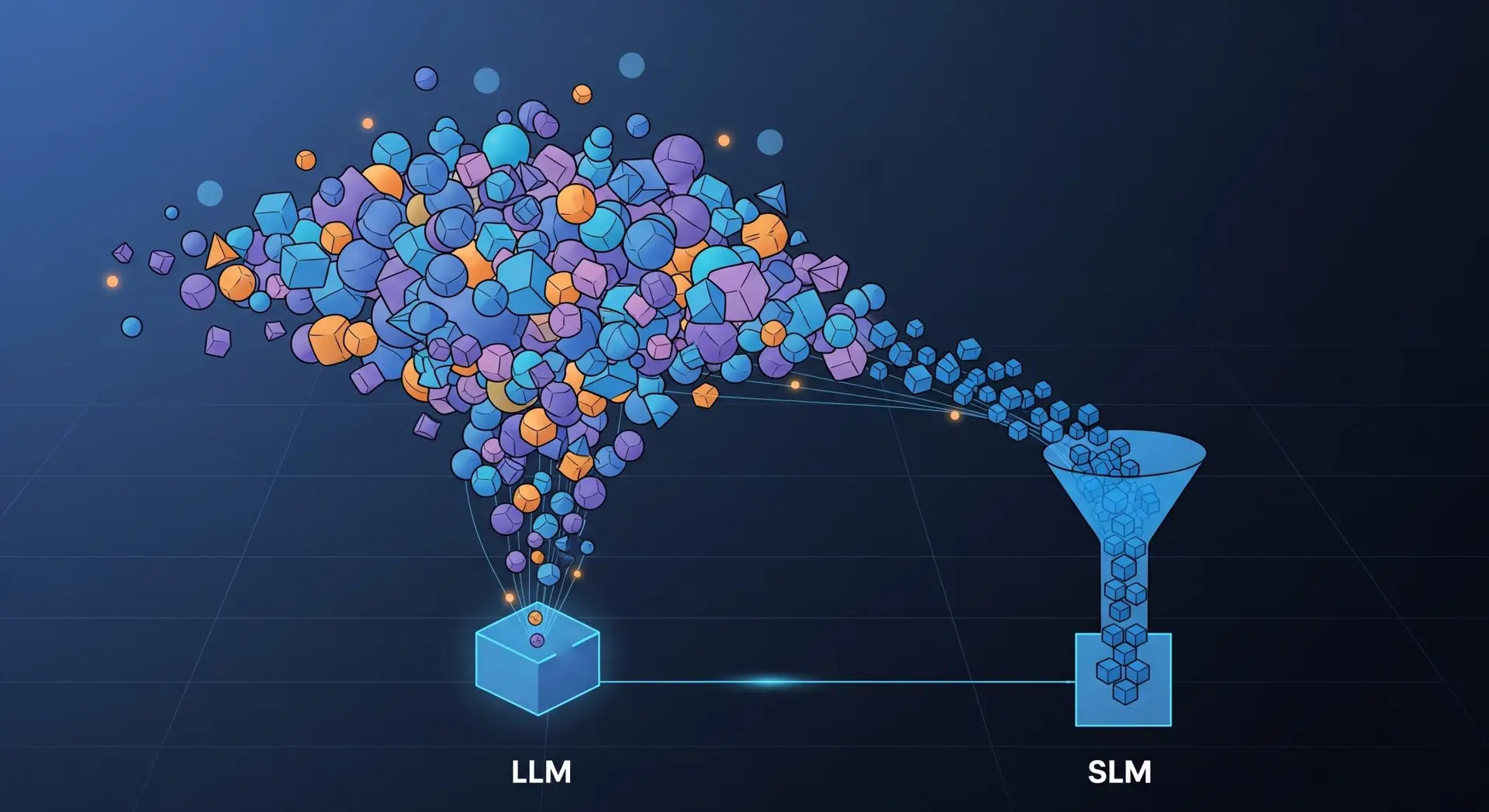
Vertical small language models (SLMs) and frontier large language models (LLMs) are built for fundamentally different jobs, and their training data requirements reflect that difference. Frontier LLMs benefit from scale, breadth, and diversity, while Vertical SLMs need tight domain purity, carefully bounded vocabulary, and task-specific negative examples. Treating these two model classes as interchangeable at the data level is one of the most reliable ways to produce a fine-tuned model that underperforms both a general-purpose LLM and the specialized model your program needs.
The practical distinction between frontier models and efficient model classes matters most clearly in data strategy. Language Model fine-tuning services that work well for general-purpose adaptation frequently produce mediocre results when applied to vertical SLMs, because the data pipelines were designed for a different scale objective.
Key Takeaways
- Vertical SLMs are built for one specific job, so their training data must match that job precisely, scale and variety work against them.
- A small model exposed to data from outside its target domain gets confused by competing word meanings, and that confusion shows up as unreliable outputs in production.
- Generic benchmarks used to test large AI models tell you almost nothing useful about how a vertical SLM is actually performing.
- The evaluation set should be built before training starts, not assembled from leftover examples afterward.
- Showing the model what a wrong-but-plausible answer looks like requires people who know the domain well enough to construct realistic mistakes.
- Teams that treat vertical SLM data as its own discipline, with its own standards and sourcing strategy, consistently get better models faster than those borrowing general-purpose pipelines.
What is a Vertical SLM and How Does It Differ from a Frontier LLM?
A vertical small language model (SLM) is a compact language model, typically under 10 billion parameters, trained or fine-tuned to perform well on a narrow domain of tasks. Examples include a radiology report parser, a contract clause classifier, or a parts-identification assistant for industrial equipment. The model is not trying to answer general knowledge questions or write poetry. It is trying to be highly reliable on a defined set of inputs within a specific operational context. Data collection and curation for this category of model look very different from what goes into pre-training a frontier model.
Frontier LLMs, such as GPT-4 class models or Claude Opus, are trained on massive corpora spanning hundreds of domains. Their value proposition is breadth; they handle novel inputs, transfer across tasks, and generalize well without task-specific fine-tuning. An SLM’s value proposition is depth and efficiency i.e. maximum performance on a targeted task, at a fraction of the inference cost.
On the architectural side, Frontier LLMs use hundreds of billions of parameters to build rich cross-domain representations. SLMs use far fewer parameters and compensate through targeted fine-tuning on high-quality, in-domain data. This is why the data strategy for custom LLM training diverges sharply depending on which model class is the target.
What Training Data Do Small Language Models Need Compared to Large Language Models?
SLMs need less data overall but more precise data. A frontier LLM improves with more tokens, more domains, and more linguistic variation. A vertical SLM degrades when exposed to out-of-domain content that dilutes the signal the model is trying to learn. The training objective is different, so the data design must be different.
For frontier LLMs, the training corpus typically aims for breadth across Common Crawl snapshots, books, code repositories, scientific papers, and multilingual content. Quality filtering matters, but diversity is a design goal. The model learns generalizable representations precisely because it has seen so many domains.
A vertical SLM does not benefit from that breadth. Introducing clinical text into a legal contract model, or general-purpose Q&A data into a medical coding assistant, tends to produce a model that hedges on in-domain queries rather than confidently applying domain-specific reasoning. Research on domain-adaptive pretraining consistently finds that models fine-tuned on clean, in-domain corpora outperform models fine-tuned on mixed corpora of the same token count. The quality-versus-quantity tradeoff resolves firmly in favor of quality at the SLM scale.
This has direct implications for how datasets built for LLM fine-tuning should be structured when the target is a vertical SLM. The pipeline needs domain-specific sourcing, not general-web crawling. It needs annotators with subject matter expertise, not general annotation talent. And it needs tighter filtering criteria than a frontier pre-training pipeline would apply.
Why Domain Purity Matters More Than Dataset Scale for Custom LLM Training in Vertical SLMs
Domain purity refers to the degree to which training examples fall within the target operational domain, use the correct vocabulary and ontology, and reflect real distributions of the inputs the deployed model will see. It is not the same as simply filtering for quality. A high-quality general-purpose document can still contaminate a vertical SLM training set if it introduces terminology ambiguity or shifts the model’s prior away from domain norms.
Consider a financial services SLM trained to extract covenant violations from loan agreements. If the training set includes general legal text, contracts from unrelated industries, or financial journalism alongside actual loan documents, the model will see multiple competing uses of terms like ‘default’, ‘material adverse change’, or ‘cure period’. That ambiguity does not hurt a frontier LLM, which has enough capacity to hold context-dependent representations of each usage.
Practical domain purity requires three things:
- Source selection: data must be sourced from the operational domain itself, not adjacent or related domains. Proxies are often insufficient.
- Vocabulary alignment: the terminology, abbreviations, and entity types in the training data must match those in production inputs.
- Distribution matching: the ratio of document types, query types, and difficulty levels must reflect what the deployed model will actually encounter.
This level of curation is substantially more demanding than what most general-purpose fine-tuning pipelines are built to deliver. Most enterprise LLM fine-tuning projects underdeliver, traces directly to this gap. Teams apply general-purpose data pipelines to domain-specific problems and then attribute the failure to the model architecture rather than the training data.
How Should Eval Sets Be Designed Differently for Vertical SLMs?
Standard benchmarks like MMLU, HellaSwag, or TruthfulQA are designed to probe general reasoning and knowledge breadth. They are appropriate eval instruments for frontier LLMs. They are nearly useless for evaluating vertical SLMs. An enterprise LLM training program for a vertical SLM needs a custom eval set built specifically for the target domain and task distribution.
A well-designed vertical SLM eval set has several distinct characteristics. It is tight: only examples that fall within the operational domain are included. It is adversarial in a domain-specific way: it probes failure modes that are plausible in production, not failures that are only interesting in a general reasoning context. And it is stratified: it includes examples across the full difficulty spectrum, from easy canonical cases to edge cases that require fine-grained discrimination within the domain.
One structural error teams make is treating the eval set as an afterthought, assembled from whatever labeled examples were not used in training. A vertical SLM eval set should be purpose-built before fine-tuning begins. Model evaluation services designed for this purpose treat the eval set as an independent artifact with its own sourcing, annotation, and quality assurance process. The inter-annotator agreement standards for eval data should be higher than those applied to training data, because errors in the eval set produce misleading signals about model performance at every subsequent iteration.
Why Negative Example Curation is a Structural Requirement for Vertical SLM Training
Frontier LLMs encounter enough diversity in pre-training that they develop reasonable priors about what constitutes an incorrect or unhelpful output. Vertical SLMs do not have that breadth of exposure. They need to be explicitly taught what wrong looks like in the target domain, through carefully curated negative examples.
Negative examples for vertical SLMs serve a different purpose than they do in general RLHF pipelines for frontier models. In a frontier model alignment context, rejected responses typically demonstrate generic failure modes: refusal when helpful, helpfulness when harmful, poor formatting, or factual hallucination on general knowledge. For a vertical SLM, the failure modes are domain-specific. A medical coding assistant might confidently assign a plausible but incorrect ICD code. A contract extraction model might correctly identify a clause type but miss a material qualifier. These errors do not appear in generic negative example datasets.
Curating useful negative examples for a vertical SLM requires subject matter expertise in the target domain. The annotator needs to know what a plausible wrong answer looks like, which requires understanding the domain well enough to construct near-miss errors. Fine-tuning techniques for domain-specific language models consistently identify this as one of the harder components of vertical SLM data pipeline design, precisely because general annotation talent cannot reliably produce domain-plausible negatives.
The difference between labeled and trainable data is not just annotation quality, it is whether the examples, positive and negative alike, are representative enough of the production distribution to produce a model that generalizes within the target domain.
How Digital Divide Data Can Help
Digital Divide Data builds domain-specific training datasets for vertical SLMs that prioritize purity over scale. The process starts with source analysis: understanding the operational domain’s vocabulary, document types, and query distributions before any data collection begins. Data collection and curation services are designed to produce training corpora that match the target domain precisely, with sourcing strategies adapted to the specific industry, use case, and model architecture in scope.
DDD’s annotation teams are organized around domain specialization. For vertical SLMs in sectors such as legal, financial services, healthcare, or industrial operations, annotators are recruited and trained for subject matter competency, not just annotation speed. This matters most when building negative example sets, where domain-plausible near-miss errors require annotators who understand the domain well enough to construct them. LLM fine-tuning services at DDD include this negative example curation step as a standard component, not an optional add-on.
Eval set design is treated as a separate, independent workstream. DDD builds custom evaluation sets for vertical SLMs before fine-tuning begins, with higher inter-annotator agreement thresholds than applied to training data and explicit coverage of domain-specific failure modes. The model evaluation services team works with ML engineers to define what correct, acceptable, and incorrect mean in the target domain, then builds an eval set that actually measures those distinctions.
Build a vertical SLM training program on data that was designed for it from the beginning. Talk to an Expert!
Conclusion
The data requirements for vertical SLMs and frontier LLMs diverge at every layer of the pipeline, namely; sourcing, filtering, annotation expertise, eval design, and negative example curation. Treating them as the same problem produces models that are neither as capable as a frontier LLM nor as precise as a well-built SLM should be. The organizations that get this right approach vertical SLM data as its own discipline, with its own quality standards and its own tooling decisions.
Enterprise AI teams that build domain-pure training sets, purpose-built eval corpora, and subject-matter-grounded negative examples consistently outperform teams that apply general-purpose fine-tuning pipelines to vertical SLM programs. The gap tends to compound over iteration cycles: better data produces better eval signals, which produces better fine-tuning decisions, which produces a better model faster.
References
Gururangan, S., Marasovic, A., Swayamdipta, S., Lo, K., Beltagy, I., Downey, D., & Smith, N. A. (2020). Don’t stop pretraining: Adapt language models to domains and tasks. Proceedings of ACL 2020. https://aclanthology.org/2020.acl-main.740
Sachdeva, N., Coleman, B., Kang, W.-C., Ni, J., Hong, L., Chi, E. H., Caverlee, J., McAuley, J., & Cheng, D. Z. (2024). How to train data-efficient LLMs. arXiv preprint. https://arxiv.org/abs/2402.09668
Kumar, A., Amin, E. M., Lee, X. Y., Vidyaratne, L., Farahat, A. K., Ghosh, D. D., Koreeda, Y., & Gupta, C. (2025). Building domain-specific small language models via guided data generation. arXiv preprint. https://arxiv.org/abs/2511.21748
Frequently Asked Questions
What training data do small language models need compared to large language models?
Small language models need less data overall but far more precise data. Where frontier LLMs benefit from broad, diverse corpora spanning many domains, vertical SLMs perform better when trained on clean, in-domain data that closely matches their target task. Adding out-of-domain data to an SLM training set tends to dilute the model’s in-domain signal rather than improving its generalization, because SLMs do not have the parameter capacity to hold context-dependent representations of the same term across multiple domains.
Why does domain purity matter more for SLMs than for frontier LLMs?
Frontier LLMs have enough parameters to learn context-dependent representations of ambiguous terms across domains. If the training set introduces competing uses of domain-critical vocabulary, the SLM tends to hedge at inference time rather than apply confident domain-specific reasoning. Domain purity ensures the model’s learned representations map cleanly onto the operational domain it will encounter in production.
How should I build an eval set for a vertical SLM?
Build the eval set before fine-tuning begins, as an independent artifact. It should cover the full difficulty spectrum within the target domain, include examples that probe domain-specific failure modes, and be held to higher annotation quality standards than the training data. Generic benchmarks like MMLU are not useful for evaluating vertical SLMs because they measure general reasoning, not performance within the operational domain.
Why are negative examples harder to curate for vertical SLMs?
For a vertical SLM, useful negative examples are domain-plausible near-misses: outputs that look correct to a non-expert but are wrong in ways that matter in the target domain. Constructing those examples requires annotators who understand the domain well enough to know what a plausible wrong answer looks like. General annotation talent can produce random incorrect outputs, but those do not teach the model to avoid the specific failure modes it will encounter in production.

Udit Khanna leads the delivery of scalable AI and data solutions at Digital Divide Data, with a deep specialization in Physical AI. With a background in presales, solutioning, and customer success, he brings a mix of technical depth and business fluency, helping global enterprises move their AI projects from prototype to real-world deployment without losing momentum.