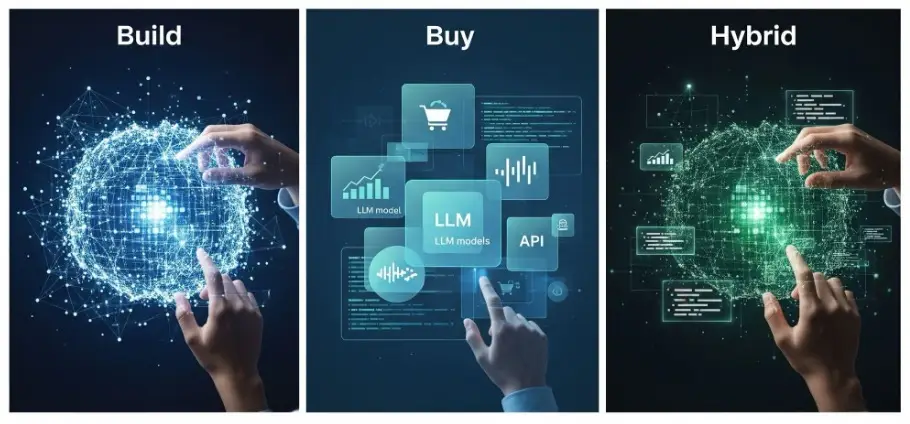
The question of whether to build, buy, or partner for LLM training comes up in almost every enterprise AI planning conversation right now. It sounds like a procurement decision, but it is really a data operations question. Each path has a different data burden, and the path that fails most often is the one chosen without a clear-eyed view of what that burden actually requires. Generative AI training and fine-tuning services span the full spectrum from foundational corpus preparation to alignment, and the choice of path determines which parts of that spectrum you own internally and which you can delegate.
Fine-tuning an open-weight foundation model on proprietary domain data delivers production-grade performance at a fraction of the cost, provided the training data is built correctly. For teams without the data engineering capacity to do that well, a managed data partner that handles collection, curation, annotation, and alignment is often the fastest path to a model that actually works in production.
Key Takeaways
- Fine-tuning an open-weight model on domain-specific data is the most practical path for most enterprises in 2026. It costs 1,000 to 10,000 times less than training from scratch and can reach production in two to six months.
- The build vs. buy vs. partner decision is really a data operations decision; each path shifts the burden of corpus curation, annotation, and alignment to a different place, but does not eliminate it.
- Training from scratch is only justified for frontier AI labs, national AI programs, or organizations that require complete provenance over every training token for regulatory compliance.
- The most common failure mode in enterprise fine-tuning is launching training before annotation guidelines, edge case coverage, and alignment data requirements have been properly designed.
- A hybrid approach, managed partner model for general tasks, and fine-tuned open-weight model for domain-specific workflows, is increasingly how enterprises in 2026 balance speed with control.
What Do Enterprise LLM Training Services Actually Cover?
Enterprise LLM training services refer to the full set of capabilities required to take a language model from a raw or pre-trained state to a production-ready system aligned to a specific domain, task, or organizational standard. The category includes data collection and curation, supervised fine-tuning (SFT), instruction tuning, alignment via reinforcement learning from human feedback (RLHF) or direct preference optimization (DPO), red teaming, and model evaluation.
The distinction matters because enterprises frequently underestimate scope. For example, a team that plans to “fine-tune Llama” on its internal documents often discovers that the dataset is inconsistently formatted, the annotation guidelines are ambiguous, the coverage of edge cases is thin, and the alignment data does not reflect the tone or safety requirements the business actually needs. Building datasets for LLM fine-tuning is a discipline in its own right, and skipping the design phase is where most programs lose time.
Why Does the Build vs. Buy vs. Partner Decision Start with Data?
The three paths: train from scratch, fine-tune open-weights, and use a managed model partner, are often presented as a cost or speed trade-off. They are more accurately described as different distributions of data responsibility. Training from scratch requires a pretraining corpus at a scale that almost no enterprise can source, clean, and govern internally. Fine-tuning requires a smaller but precisely curated domain dataset with consistent labeling standards. A managed partner absorbs most of the data burden, but the enterprise must still define what the model needs to do and evaluate whether it is doing it.
A 2025 position paper from arXiv on the true cost of LLM training data estimated that producing the training datasets for 64 LLMs released between 2016 and 2024 would cost 10 to 1,000 times more than the compute required to train the models themselves, even under conservative wage assumptions.
Whichever path an enterprise chooses, the data operations problem does not disappear. It just moves to a different part of the organization or to a partner.
Training from Scratch
Training a large language model from scratch means assembling a pretraining corpus; typically hundreds of billions to trillions of tokens, cleaning and deduplicating it, running multi-stage training on significant GPU clusters, and then running instruction tuning and alignment passes on top. The compute cost for a frontier-scale model runs between $10 million and $100 million or more. Engineering and infrastructure overhead adds substantially to that figure.
This path is justified in a narrow set of cases: national AI programs building sovereign models for low-resource languages or classified domains; large frontier labs pursuing capability research; and enterprises in regulated industries that require complete provenance over every training token for compliance or audit purposes. For almost everyone else, the compute and data burden is not proportionate to the performance gain over a well-tuned open-weight model. The Stanford AI Index Report 2025 documented that training costs for frontier models have continued rising, even as fine-tuning costs have fallen dramatically, widening the gap between the two paths for budget-constrained programs.
Fine-Tuning Open-Weight Models: Most Common Enterprise LLM Training Path
Fine-tuning an open-weight foundation model, Llama, Mistral, Falcon, or a domain-specific base model, etc., is the path most enterprises usually take in 2026. The economics are compelling; practical guidelines on LLM fine-tuning for enterprise document LoRA-based fine-tuning, completing on a single GPU in hours, at a cost 1,000 to 10,000 times lower than training from scratch. The model starts with broad language capability, and fine-tuning adapts its behavior to a target domain, task, or safety requirement.
The data ops burden for this path is high, even if compute costs are low. The training dataset must be carefully designed. Instruction-response pairs need to be task-diverse, edge cases and refusal scenarios must be included, and annotation guidelines must produce labeling that is consistent across annotators rather than merely individually correct. The data difference between instruction tuning and domain fine-tuning is significant, and each stage demands a different curation approach; conflating them produces datasets that underperform in both directions.
After supervised fine-tuning, most production deployments require an alignment pass, RLHF or DPO, usually to bring the model’s outputs in line with the enterprise’s tone, safety standards, and regulatory requirements. The quality of this preference data tends to be the variable that separates models that work reliably in production from those that behave well on benchmarks but fail on real user inputs. AI data training services for generative AI programs that skip or shortcut this stage consistently find alignment failures in production that are expensive to remediate after deployment.
Managed Partner
A managed partner model, using a hosted API like GPT-4o, Claude, or Gemini with system prompt customization, eliminates most of the data operations burden internally. The enterprise defines behavior through prompts and retrieval layers, and the partner handles pretraining, fine-tuning, and alignment. Deployment timelines compress from months to weeks. This path suits teams that need to move quickly, are not working in a domain where proprietary data is the competitive moat, or do not have the ML engineering capacity to manage a fine-tuning pipeline.
The enterprise does not own the model weights, the training data decisions that shaped the model’s behavior are not visible, and costs scale with usage rather than being fixed. For regulated industries like healthcare, financial services, and legal, this dependency on a third-party model provider creates compliance complexity that often pushes teams toward the fine-tune path, even when the managed partner path is faster.
A hybrid approach is increasingly commonly suggested; using a managed model for general-purpose tasks while fine-tuning a smaller open-weight model for the domain-specific workflows where proprietary data and output consistency matter most. This split-path strategy allows enterprises to manage data operations burden selectively, applying the most intensive curation effort where it has the highest return.
How Does the Choice of Path Change the Model Evaluation Requirements?
Evaluation is not the same problem across the three paths. A model trained from scratch requires evaluation that covers general capability, domain performance, safety, and benchmark generalization. A fine-tuned model needs evaluation focused on the delta: does the fine-tuned model outperform the base model on the target tasks, and does it do so without degrading on capabilities the base model handled correctly? A managed partner model primarily requires behavioral evaluation; does the system, given your prompts and retrieval layer, produce outputs that meet your quality and safety standards?
In each case, automated evaluation is not sufficient on its own. Evaluating generative AI models for accuracy, safety, and fairness requires human evaluation at the quality gates, where automated metrics fail to capture what users actually experience. This is particularly true for alignment evaluation, where the question is not whether the model produces a grammatically correct answer but whether it produces an answer a domain expert would endorse. Human evaluation panels calibrated to the target deployment context produce more reliable pass/fail decisions than benchmark-only evaluation programs.
Decision Framework: Three Paths at a Glance
| Dimension | Train from Scratch | Fine-Tune Open-Weights | Managed Partner |
| Compute cost | $10M–$100M+ | $5K–$500K | API / usage-based |
| Data ops burden | Extremely high, full pre-training corpus | High, curated domain dataset required | Low internal, partner absorbs most burden |
| IP / data control | Full | Full (on-prem possible) | Shared / contractual |
| Time to first output | 12–24+ months | 2–6 months | 4–12 weeks |
| Best for | Frontier AI labs, national programs | Regulated industries, proprietary domains | Rapid deployment, capacity-constrained teams |
How Digital Divide Data Can Help
Digital Divide Data works with enterprise AI programs across all three paths, providing the data operations capabilities that determine whether each path succeeds. For teams on the fine-tune path, DDD’s LLM fine-tuning services cover the full data pipeline: domain corpus curation, instruction-response dataset construction, annotation guideline development, inter-annotator agreement measurement, and alignment data production for RLHF and DPO workflows. Domain-trained subject matter experts annotate and validate training data so that the labels reflect genuine domain knowledge, not generalist judgment applied to specialized content.
For alignment specifically, DDD’s human preference optimization services provide structured preference data collection against rubrics calibrated to the enterprise’s safety, tone, and regulatory requirements. The human feedback training data services guide describes the methodology DDD applies: annotator calibration protocols designed for domain-sensitive use cases, adversarial preference collection to close safety gaps that standard preference datasets miss, and RLAIF workflows with human validation at quality-critical checkpoints.
Build better enterprise LLM programs by starting with the data operations question, not the model selection question. Talk to an Expert!
Conclusion
The build vs. buy vs. partner decision for enterprise LLM training is, at its core, a decision about where to carry the data operations burden. Training from scratch places the full weight of pretraining corpus construction, cleaning, and governance on the enterprise, which is a burden that only a small set of organizations can carry without it becoming the bottleneck that blocks everything else. Fine-tuning open-weight models reduces compute costs dramatically but preserves most of the data quality and annotation work as an internal responsibility. A managed partner or hybrid model shifts the burden externally but requires rigorous evaluation to know whether what was shifted is performing correctly.
Organizations that treat data operations as a planning input, designing annotation guidelines, curation standards, and evaluation criteria before training begins, consistently outperform those that treat it as an execution detail. The gap between these two approaches widens as deployment scales.
References
Kandpal, N., Raffel, C., (2025). Position: The most expensive part of an LLM should be its training data. arXiv preprint arXiv:2504.12427. https://arxiv.org/abs/2504.12427
Raj, M. J., Kushala, V. M., Warrier, H., Gupta, Y. (2024). Fine tuning LLM for enterprise: Practical guidelines and recommendations. arXiv preprint arXiv:2404.10779. https://arxiv.org/abs/2404.10779
Chan, Y.-C., Pu, G., Shanker, A., Suresh, P., Jenks, P., Heyer, J., Denton, S. (2024). Balancing cost and effectiveness of synthetic data generation strategies for LLMs. NeurIPS 2024 Fine-Tuning in Machine Learning Workshop. arXiv:2409.19759. https://arxiv.org/abs/2409.19759
Stanford Human-Centered AI. (2026). Stanford AI Index Report 2026. Stanford University. https://hai.stanford.edu/ai-index/2026-ai-index-report
Frequently Asked Questions
Should enterprises train their LLM from scratch or fine-tune an existing model in 2026?
For almost all enterprises, fine-tuning an open-weight foundation model is the right starting point. Training from scratch costs tens of millions of dollars in compute alone, requires a pretraining corpus that most organizations cannot source or govern, and takes 12 months or more before you see a usable output.
What data operations work is required to fine-tune an open-weight LLM?
Fine-tuning requires a curated dataset of instruction-response pairs that covers the target tasks, edge cases, and refusal scenarios the model will encounter in production. Annotation guidelines must be specific enough to produce consistent labeling across annotators. Models learn from the pattern across examples, so inconsistency in the data translates directly into inconsistency in model behavior.
What is the difference between a managed partner LLM and fine-tuning your own model?
A managed partner model, such as a hosted API, gives you fast deployment with minimal internal data work, but you do not own the model weights, and the behavior of the underlying model is shaped by training decisions you did not make. Fine-tuning your own model takes more time and data effort, but gives you full control over training data provenance, model behavior, and deployment infrastructure.
How does the choice of LLM training path affect model evaluation?
A fine-tuned model needs evaluation focused on whether it outperforms the base model on target tasks without degrading on capabilities the base model handled correctly. A managed partner model primarily requires behavioral evaluations, such as: does the system, given your prompts and retrieval layer, produce outputs that meet your quality and safety standards. In both cases, automated evaluation is not sufficient on its own; human evaluation panels calibrated to the deployment context are needed at the quality gates where benchmark metrics miss real user experience.

Kevin Sahotsky leads strategic partnerships and go-to-market strategy at Digital Divide Data, with deep experience in AI data services and annotation for physical AI, autonomy programs, and Generative AI use cases. He works with enterprise teams navigating the operational complexity of production AI, helping them connect the right data strategy to real model performance. At DDD, Kevin focuses on bridging what organizations need from their AI data operations with the delivery capability, domain expertise, and quality infrastructure to make it happen.