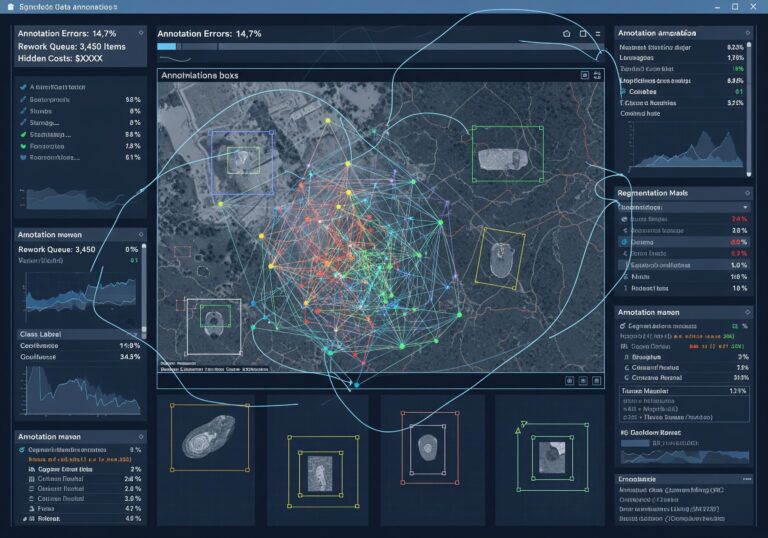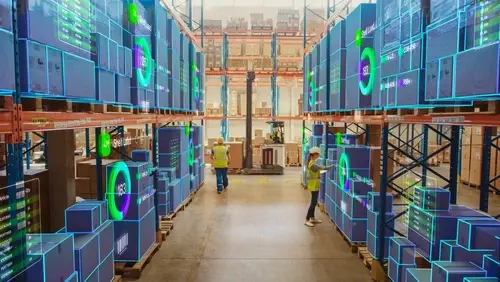

Bounding box annotation cost scales with object density, class complexity, required IoU thresholds, and QA depth. Loose boxes with 0.5 IoU are often sufficient for classification-heavy tasks, but safety-critical detection like pedestrians in ADAS, small objects in aerial imagery, dense scenes in robotics, etc., consistently degrades when annotation tolerance is too wide. The annotation QA signals that predict downstream model failure are measurable before training begins.
The decision about how precisely to draw a bounding box is rarely made explicitly. Most programs set an IoU threshold in their labeling guidelines and move on. However, many underestimate how annotation precision changes based on object type, scene complexity, and the AI model being trained. This often leads to costly re-labeling later. AI and computer vision programs that define the right Image Annotation accuracy from the start usually achieve better model performance at a lower total cost. Since every industry has different needs, the balance between annotation cost and computer vision solutions quality also varies across ADAS, robotics, retail, and aerial imaging.
Key Takeaways
- Bounding box annotation precision directly affects object detection model performance, especially for AI systems that rely on accurate localization such as ADAS, robotics, and aerial imaging.
- Annotation costs depend on object density, complexity, IoU requirements, and QA processes, so low-cost labeling often leads to higher rework expenses later.
- Loose boxes work for classification support and early-stage prototyping, while pixel-tight boxes are essential for small objects, dense scenes, and safety-critical applications.
- Metrics like per-class IoU, inter-annotator agreement, and missing annotation rates are stronger indicators of future model success than basic defect rate alone.
- Investing in the right annotation strategy from the start reduces total dataset costs, improves AI accuracy, and speeds up deployment readiness.
What Is Bounding Box Annotation and Why Does Precision Level Matter?
Bounding box annotation, also called 2D rectangular localization labeling or object detection labeling, is the process of drawing axis-aligned rectangular boxes around objects of interest in an image or video frame, assigning each box a class label, and optionally adding attributes such as occlusion level, truncation state, or object ID for tracking. The output is ground truth used to train object detectors like YOLO, Faster R-CNN, DETR, and their variants.
Precision level refers to how tightly the box boundary is required to align with the actual object boundary. Precision level is typically measured as Intersection over Union (IoU) between annotator-drawn boxes and a reference standard.
The gap in IoU matters on a requirement basis, because quality of data annotation defines computer vision model performance. A 2023 analysis of universal noise annotation effects on object detection found that localization noise (imprecise bounding box coordinates) degrades detector Average Precision (AP) differently than classification noise, and that the impact is architecture-dependent. Transformer-based models tend to be more robust to moderate box imprecision than anchor-based models, which has direct implications for calibrating annotation tolerance to the target architecture.
How Much Does Bounding Box Annotation Cost and What Affects the Price?
Bounding box annotation pricing varies on several factors. Understanding what drives cost is more useful than benchmarking against a single number.
The primary cost drivers are:
- Object density per frame: Annotating 40 objects in a dense street scene takes significantly longer per frame than annotating 3 vehicles on an empty road. Per-frame pricing often masks per-instance cost differences.
- Required IoU threshold: Tight boxes (0.85+ IoU) require annotators to zoom in, trace edges carefully, and handle partial occlusion explicitly. That review cycle adds 30–60% to per-instance time compared to 0.5 IoU work.
- Class complexity and ambiguity: Simple classes like “car” or “truck” are faster than “construction vehicle partially occluded by barrier” or “cyclist with trailer.” Classes requiring judgment about inclusion boundaries add annotator decision time.
- Attribute requirements: Adding occlusion level, truncation flag, object state, or tracking ID to each box multiplies annotation time roughly linearly with the number of required attributes.
- QA depth and Inter-Annotator Agreement (IAA) requirements: Programs requiring multi-pass review, blind re-annotation for IAA measurement, or adjudication of disputed boxes cost 20–50% more than single-pass work but deliver significantly more consistent ground truth.
- Annotator specialization: Medical imaging, aerial imagery, or safety-critical ADAS annotation requires domain-trained annotators who command higher rates than general-purpose labeling workforce.
The tendency to optimize for the lowest per-box price frequently results in higher total program cost. Re-labeling a 200,000-frame dataset because box tightness was insufficient for a small-object detection task costs far more than investing in proper QA from the start. Data annotation techniques for voice, text, image, and video all share this pattern. Annotation quality decisions made early in the program determine whether the dataset is usable at the end of it.
When Loose Bounding Boxes Are Acceptable
Loose boxes (IoU thresholds in the 0.5 – 0.65 range) are sufficient when the downstream model task does not require precise spatial localization as its primary output. The use cases of object detection that genuinely tolerate looser annotation share a common characteristic.
Loose annotation is typically acceptable in these scenarios:
- Image-level classification assistance: When bounding boxes are used to crop regions for a downstream classifier, and crop boundary tolerance is wide enough that 0.5 IoU rarely affects classification accuracy.
- Large, well-separated objects: Annotating full-frame vehicles on a highway, aircraft on a runway, or large infrastructure objects where the object-to-frame ratio is high. At these scales, a 10–15 pixel boundary error is proportionally small and does not affect detector training meaningfully.
- Rapid prototyping and feasibility testing: Early-stage model experiments to validate whether an object class is learnable from available data. Precision annotation is wasted if the experiment is designed to discard the dataset after concept validation.
- Classes where human judgment about exact boundaries varies naturally: Amorphous objects like smoke, liquid spills, or crowds do not have well-defined physical edges. Demanding 0.9 IoU for these classes creates false precision and inter-annotator disagreement without model benefit.
When Pixel-Tight Bounding Boxes Are Necessary?
Tight annotation (IoU thresholds at 0.75 or above, sometimes up to 0.9 for specific object classes) is a functional requirement in programs where the detector’s spatial output drives downstream safety decisions or feeds into a second model stage that relies on accurate region proposals. ADAS and autonomous driving annotation are the clearest cases for Pixel-Tight bounding boxes.
Tight annotation is functionally required when:
- Small object detection: Pedestrians at a distance, cyclists, road debris, and traffic signs occupy small pixel areas. A loose box that adds 15% margin on each side can double the included background area relative to the object area, degrading the signal-to-background ratio in the training crop.
- Dense scenes with adjacent objects: Parking lots, pedestrian crossings, and warehouse robotics scenes involve objects close enough that a loose box on one object overlaps a neighboring object. This creates ambiguous positive proposals during training and suppression errors at inference.
- Two-stage detector pipelines: Region proposal networks (RPNs) in architectures like Faster R-CNN use ground truth boxes to learn anchor offsets. Imprecise ground truth boxes teach the RPN to generate proposals that are systematically offset from the true object center, a bias that does not self-correct during training.
- Tracking applications: Object tracking across video frames — for traffic analysis, in-cabin monitoring, or robotics — uses box geometry as the primary input to matching algorithms. Box imprecision at frame t introduces matching errors at frame t+1 that compound across the sequence.
- Safety-critical deployment with regulatory review: Programs subject to functional safety standards (ISO 26262, SOTIF) or regulatory submission need ground truth that can be audited for precision. Loose boxes in these programs create documentation and validation gaps.
Which Annotation QA Signals Predict Model Impact?
Most annotation programs measure defect rate as the percentage of boxes rejected during QA review. Defect rate is a necessary but insufficient quality signal. It captures errors that reviewers can see; it does not capture systematic bias, class-specific precision drift, or annotator-level IoU variance that pass per-box review but degrade model performance at the dataset level. Human-in-the-loop for safety-critical systems addresses how structured review workflows catch systemic errors that per-instance review misses.
The QA signals with the strongest predictive relationship to the downstream model AP are:
- Per-class IoU distribution: A dataset with a mean IoU of 0.78 might have a pedestrian sub-class with a median IoU of 0.61 if annotators are inconsistent on partially occluded instances. Class-level IoU analysis, not aggregate metrics, predicts which detection classes will underperform.
- Inter-annotator agreement (IAA) by class and scene type: Low IAA on a specific class is a leading indicator of model instability on that class. An IAA below 0.70 on any class in a safety-relevant program warrants guideline revision before full-scale annotation begins.
- Annotator-level IoU variance: When two annotators working the same task produce systematically different IoU profiles, one consistently tighter, and one consistently looser, the batch-level variance degrades detector calibration. This is invisible in the aggregate defect rate but visible in annotator-level IoU tracking.
- Missing annotation rate by scene complexity: Missed objects (false negatives in ground truth) have a larger model impact than slightly imprecise boxes. Programs that measure missing annotation rate separately from box precision consistently identify the highest-impact QA problems first.
- Box attribute consistency: For programs using occlusion or truncation attributes, the attribute agreement rate is often lower than the IoU agreement rate. A detector trained on inconsistently attributed occlusion levels will produce unreliable confidence scores in occluded scenarios, exactly the edge cases where reliable detection matters most.
Research on automated bounding box label quality assessment using vision-language models shows that model-assisted QA approaches can identify spatial precision errors at scale, which makes pre-training dataset audits feasible even on large volumes. These tools complement human review; they do not replace the judgment calls that require domain context.
How Digital Divide Data Can Help
DDD’s image annotation services are built around annotation tier design, the practice of defining precision requirements, QA thresholds, and annotator qualification criteria per class and per scene type before a single frame is labeled. For programs in ADAS, robotics, and physical AI, this means annotators working on pedestrian detection at range are held to different IoU standards than annotators working on large-vehicle classes in the same dataset.
For autonomous driving and ADAS annotation programs, DDD operates metric-based SLAs where IoU thresholds, IAA targets, and missing annotation rates are contractually defined per class, not as global dataset averages. Program managers with AD/ADAS subject matter expertise oversee QA pipelines that track annotator-level IoU variance in real time. The signal that most reliably predicts systematic ground truth bias before it affects training. DDD has set up over 50 ADAS labeling workflows, which means the edge cases, like partially occluded pedestrians, low-visibility cyclists, sensor-fusion alignment for 3D boxes, etc. are not new problems at program start.
Define annotation precision that matches your actual model requirements. Talk to an Expert!
Conclusion
Bounding box annotation precision is a model design decision, not a vendor specification. Programs that use one IoU standard for every object class often create uneven datasets, where the most important classes get the least accuracy. Those that set precision rules by class and scene type, measure annotator agreement separately, and track consistency get better-performing datasets. Those that measure only defect rate and accept a single IoU threshold find out the cost of that decision during model evaluation, after the annotation budget has been spent.
The upstream investment in annotation QA design is almost always less expensive than downstream re-labeling. For teams planning or scaling bounding box annotation programs, the practical starting point is a per-class IoU audit of existing data before committing to full-scale annotation.
References
Lu, H., Bian, Y., & Shah, R. C. (2025). ClipGrader: Leveraging vision-language models for robust label quality assessment in object detection. Intel Labs. https://arxiv.org/pdf/2503.02897
Li, J., Xiong, C., Socher, R., & Hoi, S. (2020). Towards noise-resistant object detection with noisy annotations. Salesforce Research. https://arxiv.org/pdf/2003.01285
Ryoo, K., Jo, Y., Lee, S., Kim, M., Jo, A., Kim, S. H., Kim, S., & Lee, S. (2023). Universal Noise Annotation: Unveiling the impact of noisy annotation on object detection. arXiv. https://arxiv.org/pdf/2312.13822
Frequently Asked Questions
How much does bounding box annotation cost per image?
Bounding box annotation cost is typically measured per annotated instance rather than per image, and depending on object complexity, required IoU threshold, attribute count, and QA depth. A frame with 40 densely packed objects costs far more to annotate correctly than a frame with 3 large, well-separated vehicles, even if both count as “one image”.
What IoU threshold should I require for bounding box annotation?
It depends on your downstream task and model architecture. For large, well-separated objects in classification-support tasks, 0.5 IoU is often sufficient. For small object detection, dense scenes, or safety-critical systems like ADAS pedestrian detection, 0.75 to 0.9 IoU is functionally required. Transformer-based models tend to tolerate moderate box imprecision better than anchor-based architectures like Faster R-CNN.
What annotation QA metrics actually predict model performance?
Aggregate defect rate is the least predictive quality signal. The metrics that consistently predict downstream model AP problems are per-class IoU distribution (not just mean), inter-annotator agreement segmented by class and scene type, annotator-level IoU variance, and missing annotation rate in dense scenes. Programs that track these signals before training begins catch the most expensive quality problems early.
When should I use pixel-tight boxes versus looser annotation?
Use tight boxes (0.75 IoU or above) when objects are small relative to frame size, when scenes are dense with adjacent objects, when you are using a two-stage detector like Faster R-CNN, or when annotation feeds into a tracking pipeline or safety-critical deployment. Loose boxes are acceptable for large, well-separated objects, rapid prototyping, or tasks where the bounding box is only used to generate image crops for a downstream classifier.

Asit Dubey is a global operations leader with almost 30 years of experience across digitization, publishing, AI/ML, and LegalTech, currently serving as Executive Vice President at Digital Divide Data. He has led large-scale operations (3,500+ workforce) across APAC, EMEA, and North America, driving AI-led transformation and process excellence. A Six Sigma Black Belt, he specializes in automation, solutioning, and cost optimization, delivering productivity gains of over 300% and significant margin improvements. He has successfully scaled revenues from $750K to $3M+ monthly while turning around underperforming units. His expertise spans global delivery setup, GTM strategy, and client engagement. He is known for building resilient, multi-geo delivery models and enabling organizations to transition to AI-powered services.