Warehouse robot camera LiDAR annotation works best, when the buyer settles three things before labeling starts. Those are a warehouse-specific taxonomy, written rules for occlusion and partial objects, and a QA plan built on calibration and sync checks. Any supplier offering sensor data annotation for warehouse robots should prove those rules on your own sequences in a stratified pilot.
Warehouse perception sits in an awkward middle ground. The sensors and file formats resemble autonomous driving, while the objects, distances, and failure modes belong to a very different world. Teams that scope robotics data services for autonomous forklifts with driving assumptions tend to pay for rework once stretch-wrapped pallets reach the labeling queue.
Key Takeaways
- Warehouses are very different from public roads, so labeling rules written for self-driving cars need to be reworked for pallets, racks, and people working close to the robot.
- Every label should connect to a real decision the robot makes, such as where it can safely drive or how to pick up a pallet.
- Clear written rules for hidden or partly visible objects keep every labeler working the same way on the hardest scenes.
- The choice between buying a labeling tool and hiring a full-service team depends mostly on who will keep the rules updated as your needs change.
- A supplier’s self-driving car experience shows they have strong processes, while their warehouse know-how still has to be proven on your own data.
- Share real sample data and sensor setup details up front, then test suppliers with a small trial that covers every warehouse condition and is checked against answers your team already trusts.
What Does Warehouse Robot Camera LiDAR Annotation Involve, and How Is It Different From Driving Data?
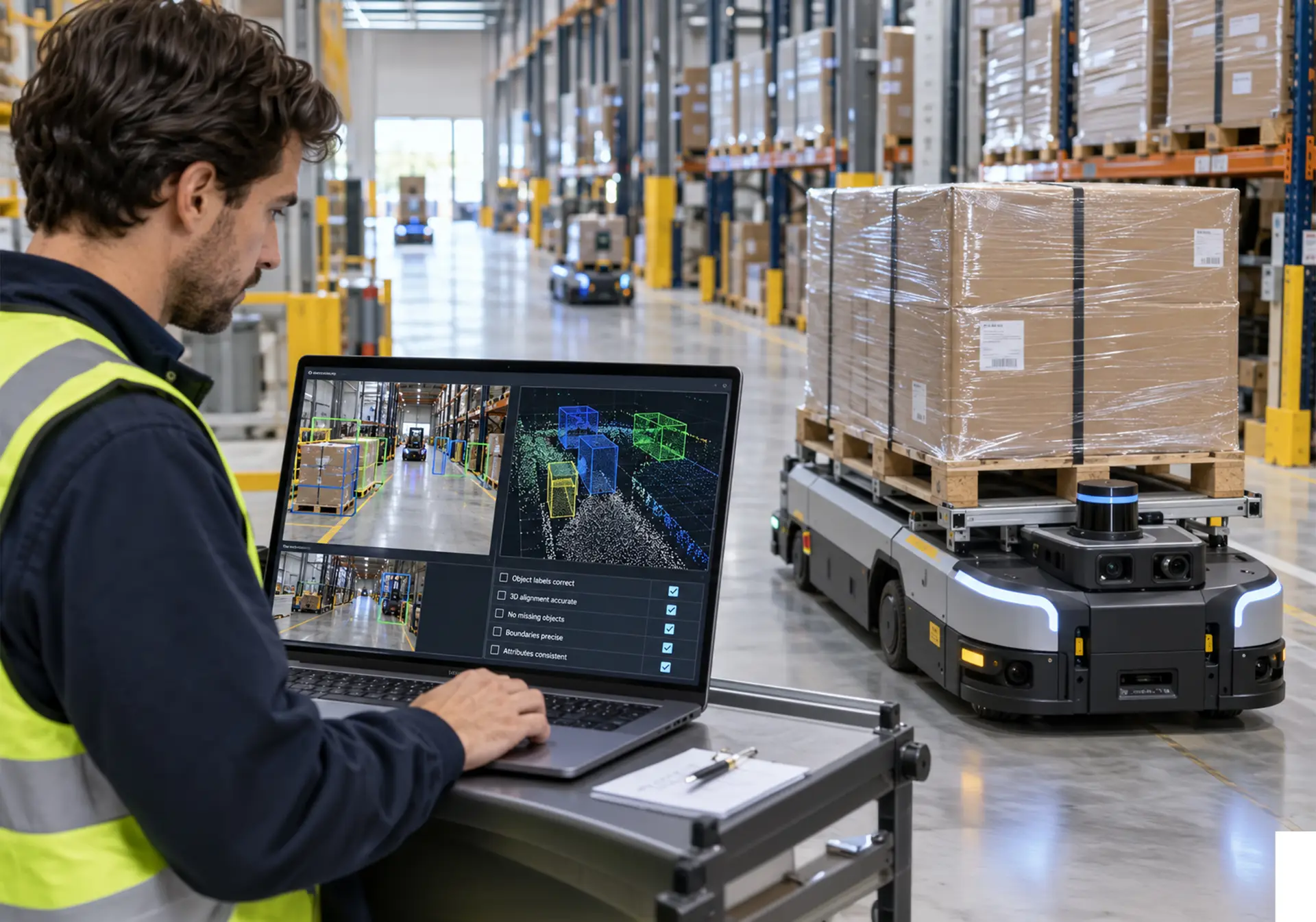
Warehouse robot camera LiDAR annotation is the labeling of synchronized RGB images and 3D point clouds captured by autonomous mobile robots (AMRs), automated guided vehicles (AGVs), and autonomous forklifts. It usually pairs 2D boxes or masks on camera frames with 3D cuboids or point-level segmentation on LiDAR, linked by shared object IDs. When both views of the same object must agree, the work becomes multisensor fusion annotation, which depends on calibration and timestamp alignment as much as on labeling skill. Some programs also add depth-camera data for close-range tasks such as fork alignment.
The domain differs from road driving in ways that change the labeling rules. KIT researchers building an automated annotation framework for industrial LiDAR data note that most public datasets, such as KITTI and Waymo, focus on roads. They also point to a shortage of freely available labeled LiDAR from warehouses and industrial halls. Most programs therefore build their own ground truth, which puts more weight on the buyer’s scope decisions. The main differences show up in five areas:
- Range: Most relevant objects sit close to the robot, so small position and yaw errors carry more weight than at road distances.
- Dual-role objects: A pallet is an obstacle to avoid and a target to engage, so it needs both detection and pose labels.
- Surfaces: Stretch wrap, metal racking, and dock plates cause reflections, ghost points, and missing returns.
- Lighting: Brightness swings between dock doors and trailer interiors within a single task.
- People: Workers on foot move close to the robot and often appear half-hidden by racks or loads.
What Labels Should a Warehouse Camera and LiDAR Project Include?
Start from the robot’s decisions and work back to the classes. A navigation stack needs to know where it can drive and what might move. A pallet-handling stack needs pallet pose and fork-pocket geometry. Labels that no downstream model consumes add cost without adding capability, so each class should map to a specific model output. Most warehouse taxonomies cover five groups:
- Dynamic agents: People, manual forklifts, pallet jacks, tuggers, and other robots, with 3D cuboids, 2D boxes, and track IDs that persist across frames and sensors.
- Load carriers: Pallets by type and material, loaded or empty, wrapped or unwrapped, with yaw and fork-pocket locations.
- Static infrastructure: Rack uprights and beams, shelving bays, walls, columns, dock doors, and dock plates, often as segmentation or cuboids.
- Floor and free space: Drivable area, floor markings, and hazards such as spilled liquid, debris, strapping, and wrap scraps.
- Attributes: Occlusion level, truncation, a reflective-surface flag, lighting condition, and high-visibility clothing on people.
Fork pockets deserve their own class and their own QA threshold. A 2025 study of pallet and pallet-hole detection for forklifts reported up to 95% pallet detection accuracy, against 72% for pallet holes. The authors traced the gap to holes resembling shadows and gaps at a distance, and annotators face the same ambiguity. In multi-sensor data labeling framework, cross-modal consistency rules help resolve these cases by checking whether camera annotations align with corresponding LiDAR geometry rather than relying on a single modality alone.
How Should a Supplier Handle Partial Pallets, Racks, and Occlusions?
Occlusion is constant in a warehouse, so the guideline has to settle it before annotators do. Pallets sit behind other pallets, people step out from between racks, and loads overhang their bases. Without written rules, each annotator invents a policy. Inter-annotator agreement then falls apart on the frames the robot finds hardest. A usable occlusion policy covers six points:
- Extent convention: Decide whether cuboids cover the full estimated object or only the observed points, and apply the same choice in both modalities.
- Minimum evidence: Define how many LiDAR points or what visible fraction justifies a label, and when an object moves to an ignore region.
- Partial pallets: Label the pallet base and its load separately, and record when the base is hidden but the load is visible.
- Racks: Where the robot localizes reliably, label static racking once in an aggregated, registered map and project those labels into each scan. This keeps rack geometry consistent and avoids redrawing the same uprights in every frame.
- Reflective surfaces: Flag stretch-wrapped loads and shiny surfaces, and state how to treat ghost points and missing returns.
- Track continuity: Keep the same ID when an object leaves view briefly, and define how many frames count as briefly.
Moving objects need a timing rule as well. A WACV 2026 study of systematic errors in 3D box annotations found boxes in public driving datasets misplaced by up to 2.5 m. Highly dynamic objects were the most affected, because a rotating LiDAR observes each object at a slightly different time. Forklifts move slower than cars but operate much closer to the robot, so small offsets still matter. Ask each supplier how its tooling handles per-point timestamps and motion compensation.
How Do You Compare an Annotation Platform With a Managed Annotation Service?
An annotation platform sells software, and your team runs the work. A managed service sells labeled output against a specification, while the supplier runs the workforce, guidelines, and QA. Many programs settle on a hybrid, pairing the buyer’s platform with the supplier’s trained annotators. The right choice depends on who will own guideline changes when the taxonomy shifts, as robotics taxonomies usually do.
| Factor | Annotation platform | Managed annotation service |
| QA ownership | Your team builds review queues and audits | Supplier runs layered review against agreed metrics |
| Guideline changes | You write and update every rule | Supplier drafts edge-case rules for your approval |
| Fusion tooling | Must load your formats and project 3D boxes into every camera | Supplier’s tooling, which you should test on your data |
| Scaling limit | Your annotation operations staff | Supplier’s pool of trained annotators |
| Best fit | Stable taxonomy and an in-house annotation ops lead | Shifting taxonomy, volume swings, or a thin ops team |
Whichever route you choose, test the tool on your own synchronized data before signing. Check that it loads your log format, projects 3D boxes correctly into every camera, and keeps track IDs across modalities. Ask who pays for rework when guidelines change after labeling starts. The wider build vs buy vs partner decision applies here, with sensor-specific tooling as an added constraint.
Can a Driving Multisensor Case Study Prove Warehouse Robotics Experience?
It proves part of what you need. A driving fusion project shows process capability: calibration validation, timestamp alignment, 3D cuboids, cross-modal ID persistence, and QA at volume. Those skills transfer directly and are hard to fake. The MultiCorrupt benchmark of LiDAR-camera fusion tested five detectors against ten corruption types, including spatial and temporal misalignment. Robustness varied by corruption type and fusion strategy, which is why sync and calibration discipline matter in any fused dataset.
A driving case does not prove warehouse judgment. Road guidelines say nothing about fork pockets, wrapped loads, rack beams at head height, or people half-hidden behind a pallet stack. Ask the supplier which of its driving rules it would change for your site. Then ask for a draft warehouse guideline before the pilot starts. A clear, specific answer is stronger evidence than a longer list of logos.
What Files Should Go Into the Initial Warehouse Annotation Brief?
A supplier can only quote and plan accurately from real inputs. Thin briefs produce optimistic quotes, followed by change orders once the edge cases appear. Send these files before the pilot is priced:
- Sample sequences: Raw logs, such as rosbag or MCAP files or per-frame point clouds and images, from every site and condition in scope.
- Calibration files: Camera intrinsics and LiDAR-to-camera extrinsics, versioned by robot and date, with notes on how they were validated.
- Sync documentation: Clock source, sensor rates, hardware or software triggering, and any known timing offsets.
- Rig and frame conventions: Sensor mounting heights, fields of view, coordinate frames, axis order, and yaw definition.
- Draft taxonomy and guideline: Classes, attributes, and edge-case rules, with visual examples of correct and incorrect labels.
- Gold set and acceptance criteria: Reference labels your team trusts, plus the metric thresholds the pilot must meet.
- Output specification: A sample label file in your target schema, with units, ID rules, and coordinate frame.
- Site notes: Pallet types, racking styles, dock and trailer work, lighting conditions, and shift patterns.
- Privacy and security terms: Treatment of faces, badges, and shipping labels, plus data residency and access controls.
Calibration and sync records belong in the brief because annotators cannot fix them. A 3D box that projects off the object in the image may be a labeling error or a calibration error. Only versioned calibration and sync records let the supplier tell which, and trace any drift back to its source.
How Should a Warehouse Annotation Pilot Be Sampled and Scored?
Sample the pilot by operating condition so every stratum the robot will meet appears several times. A random draw from fleet logs over-represents empty aisles and under-represents the frames that cause failures. Build the strata first, then fill each one with a few sequences:
- Zones: Aisles, staging lanes, docks, trailer interiors, and charging areas.
- Lighting: Bright dock doors, dim trailers, and night shifts.
- Loads: Wood and plastic pallets, wrapped and unwrapped loads, and partial or damaged pallets.
- Traffic: People and forklifts at close range, crossing paths, or hidden by racks.
- Rigs: Each robot model or sensor configuration in the fleet.
Include continuous sequences as well as single frames, since track ID switches only show up over time. Label a gold subset internally and insert it blind into the supplier’s batch. Then score the pilot per stratum on agreed metrics:
- Class accuracy: Precision and recall against the gold set.
- 3D geometry: Center error, yaw error, or 3D IoU for pallets, people, and vehicles.
- Cross-modal consistency: The share of projected 3D boxes that match their 2D labels.
- Tracking: ID switches per sequence.
- Process signals: Guideline questions raised, turnaround time, and pre-label correction rates.
Run a second, larger batch before committing to full volume, because quality often slips when a supplier expands the annotator pool. If the workflow uses model-generated pre-labels, monitor the correction rate closely; a rate that is unusually close to zero may indicate that annotators are accepting pre-labels without sufficient review. This is where many AI pilots fail to scale because early results may look strong, but performance often changes once the workflow expands across more annotators, higher volumes, and stricter production requirements.
How Digital Divide Data Can Help
Digital Divide Data supports warehouse perception programs with camera labeling, 3D LiDAR point cloud annotation, and fused annotation run as one workflow. Engagements start with scoping: sensor modalities, robot tasks, known failure points, and the taxonomy those imply. DDD teams then ingest and synchronize raw streams, apply AI-assisted pre-labeling with human review, and run domain expert validation against scenario-specific criteria. Multi-layer QA includes inter-annotator agreement checks and audit trails, so every delivered label is traceable.
DDD’s multisensor fusion case study for an autonomous vehicle developer shows the process side in practice. That program covered calibration and timestamp validation, 2D boxes and segmentation on images, 3D cuboids on LiDAR, and persistent object IDs across modalities. It also added scenario tagging for occlusion-heavy scenes and night-time driving. As this guide argues, a driving case proves process capability, so DDD demonstrates warehouse-specific judgment on your own data through a stratified pilot scored against your gold set.
Warehouse footage often shows workers’ faces, badges, and shipping labels. DDD handles sensor data under SOC 2 Type 2 and ISO 27001 controls, with GDPR-compliant handling of personal data. Pilots can then scale into continuous annotation pipelines as fleets and sites grow.
Build warehouse perception datasets your robots can rely on from the first batch. Talk to an Expert.
Conclusion
Warehouse perception data fails quietly when scope is vague. The taxonomy drifts, occlusion rules vary by annotator, and calibration errors surface as labeling errors months later. Buyers who fix the label set, edge-case rules, brief, and pilot design up front get a dataset they can audit and extend.
That gap widens as fleets spread across more sites and pallet types. Teams with versioned guidelines, stratified gold sets, and measurable acceptance criteria can add a new warehouse with a short pilot.
References
Abdelhalim, G., Simon, K., Bensch, R., Parimi, S., & Qureshi, Bilal A. (2024). Automated AI-based annotation framework for 3D object detection from LiDAR data in industrial areas (SAE Technical Paper 2024-01-2999). SAE International. https://publikationen.bibliothek.kit.edu/1000172646
Beemelmanns, T., Zhang, Q., Geller, C., & Eckstein, L. (2024). MultiCorrupt: A multi-modal robustness dataset and benchmark of LiDAR-camera fusion for 3D object detection. https://arxiv.org/abs/2402.11677
Miro, A. J., af Klinteberg, L., Timus, B., Asefaw, A., Khoche, A., Gustafsson, T., Mansouri, S. S., & Daneshtalab, M. (2026). Correcting and quantifying systematic errors in 3D box annotations for autonomous driving. https://openaccess.thecvf.com/content/WACV2026/html/Miro_Correcting_and_Quantifying_Systematic_Errors_in_3D_Box_Annotations_for_WACV_2026_paper.html
Sutar, V., Maheshwari, M., & Mittal, A. (2025). Learning-based vision systems for semi-autonomous forklift operation in industrial warehouse environments. arXiv preprint arXiv:2511.06295. https://arxiv.org/abs/2511.06295
Frequently Asked Questions
Do warehouse robots need 3D cuboids, or are 2D boxes enough?
Most warehouse programs use both, linked by shared object IDs. Cuboids on LiDAR carry the position, size, and yaw that navigation and pallet handling depend on, and 2D labels on camera frames add the visual detail.
Should racks be labeled in every LiDAR frame?
Not always. Where the robot localizes reliably, teams can label static racking once in an aggregated map and project those labels into each scan. That keeps rack geometry consistent and avoids redrawing the same uprights in every frame.
How do I know an annotation supplier’s quality will hold at full volume?
Run a second, larger batch after the pilot and score it against the same blind gold set. Quality often slips when a supplier adds annotators, and a pre-label correction rate near zero can mean people are accepting model output without checking it.
Why should calibration files be part of an annotation brief?
Annotators cannot fix calibration, but they see its effects. A 3D box that projects off the object in the camera image could be a labeling error or a calibration error, and only versioned calibration and sync records show which.

Udit Khanna leads the delivery of scalable AI and data solutions at Digital Divide Data, with a deep specialization in Physical AI. With a background in presales, solutioning, and customer success, he brings a mix of technical depth and business fluency, helping global enterprises move their AI projects from prototype to real-world deployment without losing momentum.