A custom egocentric data collection partner records first-person human demonstrations of your tasks, in your environments, to your specification, and delivers them as training-ready episodes. The right partner can show a written capture protocol, measured hand-tracking quality, a documented review process, and a consent record for every participant. Suppliers of egocentric data collection differ most in how much of that evidence they can produce before a contract is signed.
Enterprise robotics teams usually reach this decision once public datasets stop matching their tasks, objects, or facilities. Proposals then arrive with different hour counts, different meanings of hand tracking, and different assumptions about permissions, which makes them hard to compare. Teams that buy robotics data for Physical AI need a brief that fixes those definitions before the first proposal arrives.
Key Takeaways
- Judge a data collection partner by real world proof, and ask for examples of past work before you sign, then run a small paid trial with pass-or-fail rules agreed in advance.
- Write a brief that spells out the tasks, movement data, quality checks, and permissions you need, so every supplier answers the same questions.
- Compare suppliers on hours of usable footage and the variety of places, objects, and people recorded, because the raw hours on a quote can mislead.
- Ask early whether the supplier can record inside your own sites with your own cameras, and how your footage will be kept secure.
- Check the hand-movement data yourself on sample recordings, since suppliers use the same words for very different levels of accuracy.
- Agree in writing who collects permission from the people being recorded and from anyone nearby, as missing permission cannot be fixed later.
What Is a Custom Egocentric Data Collection Partner, and When Do You Need One?
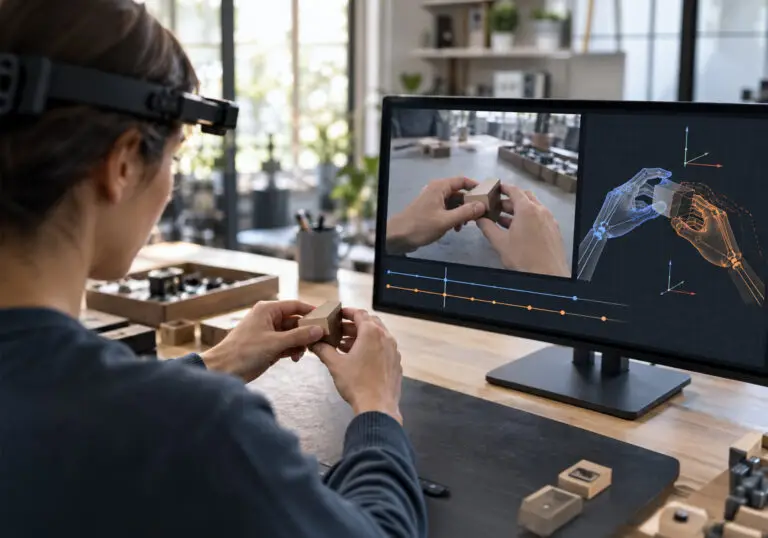
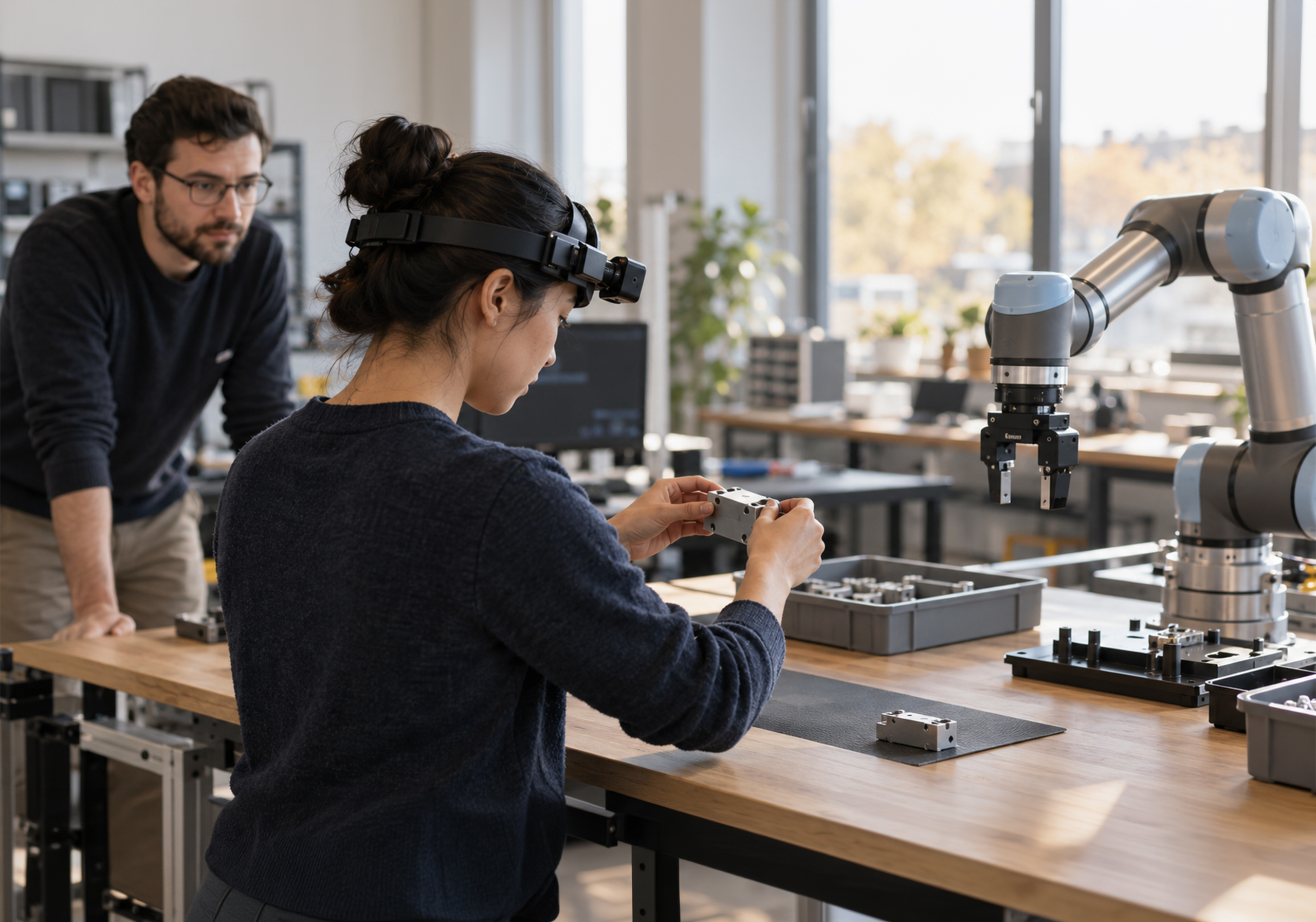
Egocentric data is sensor data recorded from the viewpoint of the person performing a task, usually through a head-mounted camera, smart glasses, or a headset. It is also called first-person, point-of-view (POV), or wearable-camera data, and one recorded task attempt is an egocentric demonstration or episode. A custom egocentric data collection partner is a supplier that designs and runs that recording program to a buyer’s specification. The work sits within managed data collection services, with added requirements for wearable hardware, pose capture, and participant permissions.
Demand for this data has grown because human demonstrations scale faster than robot teleoperation. The EgoScale study from NVIDIA and university collaborators trained a vision-language-action model on 20,854 hours of egocentric human video. It found a log-linear relationship between data volume and validation loss, and the final policy improved average success rate by 54% over a baseline without human pretraining. Results like these explain why enterprise teams now budget for human demonstration data alongside robot data.
Public datasets rarely close the gap for a commercial program. They cover general household or tabletop activity, while an enterprise robot needs demonstrations with specific parts, tools, and workstations. License terms are a second limit. Ego4D is released under its own license agreement, and the EgoDex dataset is distributed under a non-commercial license, so commercial use needs legal review first.
Which types of suppliers offer custom egocentric data collection?
Suppliers in this market fall into four groups. Each answers a brief differently, and each can be the right choice for a particular program. The brief and the pilot reveal which model a supplier actually runs:
- Managed data service providers design the protocol, recruit and train demonstrators, operate the hardware, and run review and annotation under one contract.
- Contributor marketplaces and crowd networks route recording tasks to large pools of contributors, who record on their own or shipped devices.
- Dataset licensors sell existing first-person footage and sometimes commission new collections to fill gaps.
- Annotation-first vendors label footage that the buyer supplies, and may subcontract the capture itself.
When is egocentric human data the wrong purchase?
Human egocentric video has limits that a brief should respect. It does not contain robot joint commands, force, torque, or tactile signals. Programs that need those signals still need teleoperation or other robot-native data, and the EgoScale authors report that human demonstrations amplify robot data without replacing it. A capable supplier will say this plainly when the task requires it.
What Should a Procurement Brief for Egocentric Demonstrations Include?
A comparable brief defines every term a supplier could interpret in its own favor. Four requirements carrying most of the risk including task coverage, hand tracking, quality review, and participant permissions. Capture sites, hardware, and delivery format complete the picture. Specify whether the data will support perception, hand-trajectory prediction or a vision-language-action model, commonly called a VLA model. Each use requires different observations and labels.
Ask every supplier to return the same evidence package before comparing prices. A proposal should distinguish supported capabilities, pilot commitments and dependencies on your team. The following procurement brief makes those distinctions inspectable.
| Brief requirement | What to specify | Evidence to request |
|---|---|---|
| Task coverage | Task list with success criteria; variations per task (objects, tools, lighting, clutter); environments; demonstrator mix (skill level, handedness, hand size); failure and recovery cases; episodes per cell. | A coverage matrix filled in during the pilot, showing accepted episodes per cell. |
| Capture and tracking | Pose source (device-native, instrumented, or estimated from video); skeleton and joint count; coordinate frame; sample rate; confidence output. | Raw pose files with per-joint confidence, plus reprojection overlays on sample episodes. |
| Quality review | Automated checks; human review sampling rate; acceptance criteria per episode; rejection codes; retake policy. | Rejection log by reason, reviewer agreement figures, and yield from raw to accepted hours. |
| Participant permissions | Consent scope (AI training, commercial use, transfer, retention); withdrawal process; bystander handling; de-identification standard. | Blank consent form, per-episode consent linkage, and a de-identification QA record. |
| Sites and hardware | Supplier sites, buyer facilities, or both; who supplies and maintains the rigs; calibration routine. | Site plan, device list, and per-session calibration records. |
| Delivery format | Episode schema; timestamps; metadata fields; file format; versioning. | A sample release that loads in the buyer’s training pipeline. |
Suppliers that receive this brief must answer in the same units, which is what makes proposals comparable. The brief also exposes gaps early. A supplier that cannot say where its hand pose comes from, or who signs the consent forms, has answered the question by omission.
What Evidence Should a Custom Egocentric Collection Partner Provide?
Request a task matrix that describes the behavior your robot must learn. For warehouse picking, relevant variables could include object size, packaging, shelf height, clutter, handedness and required protective gloves. Specify which combinations are mandatory, which are exploratory and how many accepted episodes each needs. Review these distributions after rejection, because unusable recordings can leave gaps in otherwise complete capture totals.
An egocentric data collection protocol for robotics programs turns this matrix into repeatable operator instructions. Ask for episode boundaries, permitted variations, task outcomes, and rules for recording recovery attempts. Keep successful demonstrations, recoverable failures and technical recording failures distinguishable in the metadata. This prevents footage of a failed task from being mislabeled as successful supervision.
Ask for the following before the pilot is scoped, with client details removed:
- A written capture protocol from a previous program, covering hardware configuration, task scripts, environment setup, and failure handling.
- Sample episodes with raw streams: video, pose, IMU where captured, and metadata, in the original file format.
- A rejection log showing how many recorded hours were rejected, and for which reasons.
- Measured synchronization error between video and pose streams, with the method used to measure it.
- Demonstrator training material and the qualification test demonstrators must pass before recording.
- A blank consent form and a description of the de-identification workflow, including who reviews its output.
- A dataset card or manifest that records versions, protocol changes, and known limitations.
Two questions help separate collection operators from vendors that mainly label footage. Ask who physically operates and maintains the capture devices, and ask for the last three collection programs described in operational detail. Suppliers with field experience tend to answer with device counts, session lengths, and yield figures. Suppliers without it tend to answer with annotation case studies.
The delivery model matters as much as the evidence. Crowd-based collection offers reach across homes and geographies, with more variation in device setup and instruction compliance. Managed collection with trained demonstrators gives tighter control over scripted tasks, custom rigs, and multi-session recording. Enterprise programs that depend on precise task scripts tend to need the managed model for at least part of the dataset.
How Do You Compare Vendors When Their Proposed Hours Differ?
Hours are the least comparable number in an egocentric proposal. One supplier may quote raw recorded hours, another accepted hours after review, and a third hours of active manipulation with idle time removed. The same budget can therefore buy very different amounts of usable training signals. Comparison starts by converting every proposal to accepted hours and accepted episodes per task.
Coverage deserves more weight than volume once that conversion is done. A study of data scaling laws in imitation learning for robotic manipulation found that environment and object diversity mattered far more than the absolute number of demonstrations. Once demonstrations per environment or object passed a threshold, additional ones had minimal effect. A proposal with fewer hours across more environments, objects, and demonstrators can therefore be the stronger offer.
Price comparison should wait until proposals share the same measures. Ask each supplier to restate its offer on the points below. A supplier that declines has also told you something:
- Accepted volume: Accepted hours and accepted episodes, with the expected yield from raw recording.
- Coverage: Episodes per task and per variation, mapped to the coverage matrix in the brief.
- Diversity: Number of distinct environments, object instances, and demonstrators.
- Active time: Share of recorded time that contains active manipulation.
- Inclusions: Whether the price covers de-identification, annotation, retakes, and format conversion.
- Unit cost: Cost per accepted hour and cost per accepted episode.
A simple illustration shows why the conversion matters. Suppose Vendor A proposes 500 raw hours with an expected 60% acceptance rate, and Vendor B proposes 350 accepted hours. Vendor A’s offer converts to about 300 accepted hours, so the smaller headline number is the larger delivery. If Vendor B also records across twice as many workstations, the gap in training value widens further.
Ask each supplier to commit to a yield figure and to explain what happens when it is missed. A supplier that absorbs the cost of rejected hours has an incentive to train demonstrators well and catch errors during recording. A supplier that bills for raw hours has a weaker incentive to do either. Contracts that pay on accepted episodes tend to align both sides.
Can the Supplier Record in Your Own Facilities and on Your Hardware?
Many suppliers can, and the question is worth asking early because on-site capability varies widely. Recording in the buyer’s facility puts the real parts, fixtures, lighting, and clutter into the data, which is hard to reproduce in a staged environment. Recording on buyer-specified hardware keeps the camera viewpoint and intrinsics close to what the robot will see. Both choices reduce the distance between collection conditions and deployment conditions.
Research practice supports the hardware point. In EgoScale’s aligned human-robot dataset, the human demonstrations used for mid-training were recorded with the same camera configuration as the robot, with matched viewpoints and calibrated intrinsics. That aligned set was small, at roughly 50 hours of human data and 4 hours of robot data. It still grounded the much larger pretraining corpus in the robot’s sensing and control. A supplier that can operate the buyer’s rig makes this kind of aligned collection practical.
On-site work raises operational questions that suppliers answer very differently. Some bring trained demonstrators and their own device fleet, while others expect the buyer to provide both. The brief should ask each supplier to address the following points:
- Site access: Safety induction, escorts, restricted zones, and recording hours that fit production shifts.
- Demonstrators: Whether the supplier brings trained demonstrators or trains the buyer’s skilled operators to record.
- Hardware custody: Who owns, stores, charges, and calibrates the devices, and how many spares stay on site.
- Device control: Locked firmware and recording settings, with a calibration and sync check in every session.
- Protective equipment: Gloves, sleeves, and safety glasses that can degrade hand tracking or interfere with headsets.
- Data handling: Where footage is stored on site, how it leaves the building, and when local copies are deleted.
Facility footage is also proprietary, as it shows processes, layouts, part designs, screens, and paperwork that a buyer would not publish. The agreement should therefore cover confidentiality, access control, storage location, retention period, and verified deletion, alongside privacy terms. Suppliers that record mainly in contributors’ homes may have no standard answer for these terms.
How Do You Verify Hand Tracking Rather Than Relying on a Modality Claim?
Request raw tracking outputs alongside the corresponding video and an explanation of how each field was produced. Distinguish device-generated tracking, additional motion-capture measurements and pose inferred later from RGB video. Specify whether your model needs wrist trajectories, articulated finger joints or both. A wrist trajectory cannot describe individual finger articulation.
The EgoDex study of dexterous manipulation pairs egocentric video with hand and finger tracking captured during recording. That distinction is useful when specifying deliverables, although a supplier still needs to validate its own capture system. Ask for the following fields and measurements in the pilot package.
- Pose definition: joint names, units, coordinate frames, handedness and transforms between camera, hand and world coordinates.
- Tracking provenance: device and software versions, processing method, confidence fields and records of manual corrections.
- Timing evidence: timestamp definitions, synchronization method, measured offset, drift and dropped-frame handling.
- Failure reporting: missing joints, tracking loss, occlusion flags and behavior when hands leave the field of view.
- Geometric validation: an independent reference and error measurement where accuracy claims require one, with uncertainty documented.
Inspect tracking overlays during grasping, contact, hand crossings and fast movement. Overlays can expose obvious errors, but they cannot establish metric 3D accuracy by themselves. Confidence scores also need interpretation because model confidence and independently measured error are different quantities. Set tolerances against your model’s requirements and validate the measurement method before using those tolerances as acceptance gates.
The evaluation of egocentric video and pose data should cover synchronization, coordinate consistency and usable task intervals together. Review results separately by task, device, site and operator so aggregate scores cannot hide a weak collection segment. Require rejection reasons and examples from each segment. This makes corrective action specific enough to improve the next batch.
Who Is Responsible for Participant and Bystander Permissions?
Responsibility is shared, and the contract should state the split in writing. The supplier usually runs the consent process, because it recruits participants and is present at recording. The buyer remains accountable for how the data is used in training and products, and should confirm the legal roles with counsel in each jurisdiction. A supplier’s assurance that data is consented does not transfer that accountability.
Ego4D remains a useful reference for a rigorous standard. Its privacy and ethics standards for egocentric data collection required informed consent from camera wearers, who could withdraw at any time and review and redact their own video. Partners also had to respect the rights of others in private spaces, avoid sensitive areas, and de-identify personal information. A commercial supplier should be able to describe its equivalent of each point.
Bystanders are the harder case, because they did not sign anything. Head-mounted cameras capture co-workers, visitors, screens, documents, badges, and reflections without anyone intending it. Common controls include posted notices, defined recording zones, sessions scheduled away from busy periods, muted audio, and blurring of faces and other identifiers. The brief should say which controls the supplier performs and which the buyer performs as site owner.
Recording the buyer’s own employees needs particular care. An employee asked by an employer to wear a camera may not feel free to decline, which weakens the value of a signature. Programs usually address this with voluntary opt-in, an equivalent assignment for those who decline, and early involvement of worker representatives where they exist. These steps remain the buyer’s responsibility even when the supplier handles the paperwork.
De-identification is a cost line that proposals often leave out. One Ego4D collection site reported roughly 780 hours of manual labor to de-identify 500 hours of video. The same paper notes that footage captured outdoors could take ten times the video length to redact. Controlled indoor workstations with a single demonstrator tend to need far less, but the effort is rarely zero. Ask whether the quoted price includes automated redaction, human review of the output, and a record of what was checked.
Permissions should be verifiable at the level of the individual episode. Each episode should link to a consent record whose scope covers AI model training, commercial use, transfer to the buyer, and the agreed retention period. The supplier should also explain how a withdrawal request reaches the dataset and what gets deleted. Absent consent cannot be repaired after collection, so this check belongs in the pilot.
What Should Cause a Supplier to Fail the First Pilot?
A supplier should fail the pilot when it cannot satisfy mandatory acceptance gates or provide evidence supporting its claims. Choose a sample spanning routine tasks and difficult conditions, including occlusion, varied lighting and representative operators. Agree on the sample composition, evaluation method and permitted rework before recording begins. This prevents acceptance criteria from changing after delivery. Treat the following findings as reasons to withhold acceptance until resolved.
- Missing task coverage: Accepted recordings omit required task–object–environment combinations or contain undocumented substitutions.
- Unusable observations: Critical hand–object interactions are repeatedly outside the view or fail the agreed visibility requirements.
- Unverifiable tracking: Required pose fields, calibration, timing measurements or accuracy evidence are missing or fail agreed tolerances.
- Unresolved permissions: The supplier cannot trace accepted episodes to the approvals required for the intended use.
- Unreliable review: Quality reports cannot be reproduced, rejected clips reappear without resolution, or annotation disagreements lack adjudication.
- Failed delivery: Files cannot be loaded, required metadata is missing, or recordings and annotations cannot be matched reliably.
Run the delivered sample through your actual data loader. Check identifiers, timestamps, units, schema versions, checksums and links between media, annotations and metadata. Inspect duplicate handling and the agreed train-evaluation split, especially where the same operator, environment or session appears repeatedly. Preserve raw and processed assets according to the agreed delivery scope so transformations remain traceable.
Separate repairable defects from failures requiring recollection or a supplier change. A schema mismatch may be fixable; a missing camera view generally requires another recording. Put correction ownership, reshoot charges, review deadlines and termination conditions in the pilot agreement. If a mandatory gate remains unresolved after the agreed correction cycle, do not expand the collection program.
Passing collection acceptance does not establish downstream robot performance. If policy improvement is a purchasing requirement, define a separate learning experiment with a baseline and held-out evaluation tasks. Keep that result distinct from the supplier’s capture and annotation scorecard. This distinction helps locate whether a later problem comes from data quality, model design or transfer to the target robot.
Before production, ask for an accepted-volume forecast tied to trained operators, available hardware, site access and reviewer capacity. Require version records for devices, calibration, software and annotation guidelines so changes at scale remain traceable. Agree on when a change requires another sample review. A successful pilot provides a baseline for this operating plan.
How Digital Divide Data Can Help
Digital Divide Data (DDD) provides custom egocentric data collection for robotics and Physical AI programs, covering protocol design, demonstrator training, capture, review, and annotation in one engagement. Protocol work happens before recording begins, including diversity planning, sync events, per-session calibration steps, and metadata standards for coordinate conventions. Collection can run on-site or through integrated capture setups, with real-time progress tracking. Consent and privacy workflow design is part of the same scope.
Quality review follows the checks described in this article. DDD’s teams combine automated checks, reviewer validation, and temporal consistency audits across synchronized video, IMU, and pose streams. For humanoid and manipulation programs, DDD’s robotics training data and annotation services extend the work to joint pose labeling, task phase segmentation, and cross-sensor QA. Stable, non-rotating teams keep guideline interpretation consistent as volume grows.
DDD recommends starting with a scoped pilot against the buyer’s own brief, with acceptance gates agreed before recording. The pilot reports yield, rejection reasons, and coverage by task and environment, so the scale-up decision rests on measured results. Teams still drafting the brief can use the pilot design phase to settle hand-tracking source, delivery format, and permission scope.
Scope a custom egocentric collection pilot against your own brief. Talk to an Expert!
Conclusion
Choosing a custom egocentric data collection partner comes down to evidence that can be checked. Task coverage, hand tracking, quality review, and participant permissions each have a measurable form, and a good brief asks for that form by name. Suppliers then compete on accepted episodes, verified pose quality, and documented consent, which are the properties a training pipeline depends on.
Organizations that buy on headline hours tend to discover the gaps during training, when re-collection is the only fix. Organizations that fix definitions in the brief and enforce them in a pilot tend to scale collection with predictable yield.
References
Grauman, K., Westbury, A., Byrne, E., Chavis, Z., Furnari, A., Girdhar, R., Hamburger, J., Jiang, H., Liu, M., Liu, X., Martin, M., Nagarajan, T., Radosavovic, I., Ramakrishnan, S. K., Ryan, F., Sharma, J., Wray, M., Xu, M., Xu, E. Z., Zhao, C., Bansal, S., Batra, D., Cartillier, V., Crane, S., Do, T., Doulaty, M., Erapalli, A., Feichtenhofer, C., Fragomeni, A., Fu, Q., Gebreselasie, A., Gonzalez, C., Hillis, J., Huang, X., Huang, Y., Jia, W., Khoo, W., Kolar, J., Kottur, S., Kumar, A., Landini, F., Li, C., Li, Y., Li, Z., Mangalam, K., Modhugu, R., Munro, J., Murrell, T., Nishiyasu, T., Price, W., Puentes, P. R., Ramazanova, M., Sari, L., Somasundaram, K., Southerland, A., Sugano, Y., Tao, R., Vo, M., Wang, Y., Wu, X., Yagi, T., Zhao, Z., Zhu, Y., Arbelaez, P., Crandall, D., Damen, D., Farinella, G. M., Fuegen, C., Ghanem, B., Ithapu, V. K., Jawahar, C. V., Joo, H., Kitani, K., Li, H., Newcombe, R., Oliva, A., Park, H. S., Rehg, J. M., Sato, Y., Shi, J., Shou, M. Z., Torralba, A., Torresani, L., Yan, M., & Malik, J. (2022). Ego4D: Around the world in 3,000 hours of egocentric video. https://arxiv.org/abs/2110.07058
Hoque, R., Huang, P., Yoon, D. J., Sivapurapu, M., & Zhang, J. (2025). EgoDex: Learning dexterous manipulation from large-scale egocentric video. https://arxiv.org/abs/2505.11709
Hu, Y., Lin, F., Sheng, P., Wen, C., You, J., & Gao, Y. (2024). Data scaling laws in imitation learning for robotic manipulation. https://arxiv.org/abs/2410.18647
Zheng, R., Niu, D., Xie, Y., Wang, J., Xu, M., Jiang, Y., Castañeda, F., Hu, F., Tan, Y. L., Fu, L., Darrell, T., Huang, F., Zhu, Y., Xu, D., & Fan, L. (2026). EgoScale: Scaling dexterous manipulation with diverse egocentric human data. arXiv preprint arXiv:2602.16710. https://arxiv.org/abs/2602.16710
Frequently Asked Questions
Who offers custom egocentric data collection for enterprise robotics?
Four types of suppliers offer it, including managed data service providers, contributor marketplaces, dataset licensors that also commission new collections, and annotation-first vendors. Digital Divide Data is a managed provider that covers protocol design, capture, review, and annotation in one engagement. A clear brief and a pilot show which model a supplier actually runs.
How do I compare egocentric data vendors when their proposed hours differ?
Convert every proposal to accepted hours and accepted episodes per task, then compare coverage across environments, objects, and demonstrators. Check what the price includes, such as de-identification and annotation, and work out the cost per accepted hour.
Can I use public egocentric datasets like Ego4D or EgoDex to train a commercial robot?
Check the license first, because public datasets carry their own terms, and EgoDex is distributed under a non-commercial license. Public datasets also cover general activity, so most enterprise programs still need custom demonstrations with their own parts, tools, and workstations.
What should make me fail a supplier after the first pilot?
Fail the pilot if the critical action is not visible, hand tracking misses the agreed level, consent records are missing, or the delivery does not load in your pipeline. Hidden rejections and an undisclosed change in pose source are disqualifying, because they reflect how the supplier operates.

Udit Khanna leads the delivery of scalable AI and data solutions at Digital Divide Data, with a deep specialization in Physical AI. With a background in presales, solutioning, and customer success, he brings a mix of technical depth and business fluency, helping global enterprises move their AI projects from prototype to real-world deployment without losing momentum.