Celebrating 25 years of DDD's Excellence and Social Impact. ✖

Physical AI

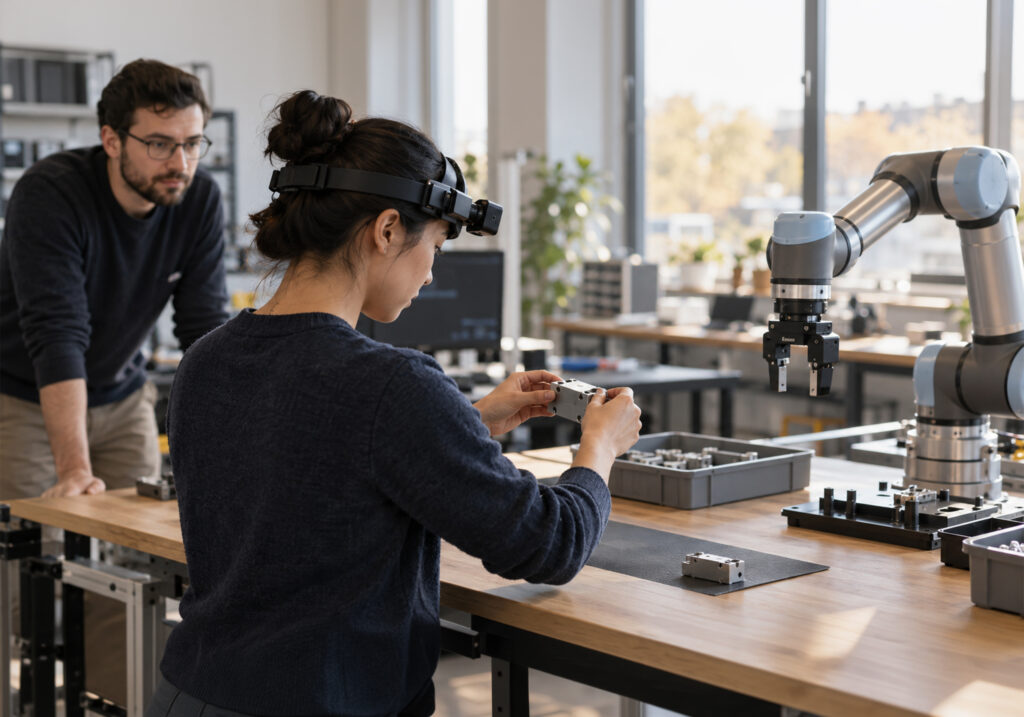
Person wearing head-mounted camera equipment performing a manipulation task beside a robotic arm

How to Choose a Custom Egocentric Data Collection Partner for Enterprise Robotics

A custom egocentric data collection partner records first-person human demonstrations of your tasks, in your environments, to your specification, and delivers them as training-ready episodes. The right partner can show a written capture protocol, measured hand-tracking quality, a documented review process, and a consent record for every participant. Suppliers of egocentric data collection differ most in how much of that evidence they can produce before a contract is signed.

Enterprise robotics teams usually reach this decision once public datasets stop matching their tasks, objects, or facilities. Proposals then arrive with different hour counts, different meanings of hand tracking, and different assumptions about permissions, which makes them hard to compare. Teams that buy robotics data for Physical AI need a brief that fixes those definitions before the first proposal arrives.

Key Takeaways

  • Judge a data collection partner by real world proof, and ask for examples of past work before you sign, then run a small paid trial with pass-or-fail rules agreed in advance.
  • Write a brief that spells out the tasks, movement data, quality checks, and permissions you need, so every supplier answers the same questions.
  • Compare suppliers on hours of usable footage and the variety of places, objects, and people recorded, because the raw hours on a quote can mislead.
  • Ask early whether the supplier can record inside your own sites with your own cameras, and how your footage will be kept secure.
  • Check the hand-movement data yourself on sample recordings, since suppliers use the same words for very different levels of accuracy.
  • Agree in writing who collects permission from the people being recorded and from anyone nearby, as missing permission cannot be fixed later.

What Is a Custom Egocentric Data Collection Partner, and When Do You Need One?

Egocentric data is sensor data recorded from the viewpoint of the person performing a task, usually through a head-mounted camera, smart glasses, or a headset. It is also called first-person, point-of-view (POV), or wearable-camera data, and one recorded task attempt is an egocentric demonstration or episode. A custom egocentric data collection partner is a supplier that designs and runs that recording program to a buyer’s specification. The work sits within managed data collection services, with added requirements for wearable hardware, pose capture, and participant permissions.

Demand for this data has grown because human demonstrations scale faster than robot teleoperation. The EgoScale study from NVIDIA and university collaborators trained a vision-language-action model on 20,854 hours of egocentric human video. It found a log-linear relationship between data volume and validation loss, and the final policy improved average success rate by 54% over a baseline without human pretraining. Results like these explain why enterprise teams now budget for human demonstration data alongside robot data.

Public datasets rarely close the gap for a commercial program. They cover general household or tabletop activity, while an enterprise robot needs demonstrations with specific parts, tools, and workstations. License terms are a second limit. Ego4D is released under its own license agreement, and the EgoDex dataset is distributed under a non-commercial license, so commercial use needs legal review first.

Which types of suppliers offer custom egocentric data collection?

Suppliers in this market fall into four groups. Each answers a brief differently, and each can be the right choice for a particular program. The brief and the pilot reveal which model a supplier actually runs:

  • Managed data service providers design the protocol, recruit and train demonstrators, operate the hardware, and run review and annotation under one contract.
  • Contributor marketplaces and crowd networks route recording tasks to large pools of contributors, who record on their own or shipped devices.
  • Dataset licensors sell existing first-person footage and sometimes commission new collections to fill gaps.
  • Annotation-first vendors label footage that the buyer supplies, and may subcontract the capture itself.

When is egocentric human data the wrong purchase?

Human egocentric video has limits that a brief should respect. It does not contain robot joint commands, force, torque, or tactile signals. Programs that need those signals still need teleoperation or other robot-native data, and the EgoScale authors report that human demonstrations amplify robot data without replacing it. A capable supplier will say this plainly when the task requires it.

What Should a Procurement Brief for Egocentric Demonstrations Include?

A comparable brief defines every term a supplier could interpret in its own favor. Four requirements carrying most of the risk including task coverage, hand tracking, quality review, and participant permissions. Capture sites, hardware, and delivery format complete the picture. Specify whether the data will support perception, hand-trajectory prediction or a vision-language-action model, commonly called a VLA model. Each use requires different observations and labels.

Ask every supplier to return the same evidence package before comparing prices. A proposal should distinguish supported capabilities, pilot commitments and dependencies on your team. The following procurement brief makes those distinctions inspectable.

Brief requirement What to specify Evidence to request
Task coverage Task list with success criteria; variations per task (objects, tools, lighting, clutter); environments; demonstrator mix (skill level, handedness, hand size); failure and recovery cases; episodes per cell. A coverage matrix filled in during the pilot, showing accepted episodes per cell.
Capture and tracking Pose source (device-native, instrumented, or estimated from video); skeleton and joint count; coordinate frame; sample rate; confidence output. Raw pose files with per-joint confidence, plus reprojection overlays on sample episodes.
Quality review Automated checks; human review sampling rate; acceptance criteria per episode; rejection codes; retake policy. Rejection log by reason, reviewer agreement figures, and yield from raw to accepted hours.
Participant permissions Consent scope (AI training, commercial use, transfer, retention); withdrawal process; bystander handling; de-identification standard. Blank consent form, per-episode consent linkage, and a de-identification QA record.
Sites and hardware Supplier sites, buyer facilities, or both; who supplies and maintains the rigs; calibration routine. Site plan, device list, and per-session calibration records.
Delivery format Episode schema; timestamps; metadata fields; file format; versioning. A sample release that loads in the buyer’s training pipeline.

 Suppliers that receive this brief must answer in the same units, which is what makes proposals comparable. The brief also exposes gaps early. A supplier that cannot say where its hand pose comes from, or who signs the consent forms, has answered the question by omission.

What Evidence Should a Custom Egocentric Collection Partner Provide?

Request a task matrix that describes the behavior your robot must learn. For warehouse picking, relevant variables could include object size, packaging, shelf height, clutter, handedness and required protective gloves. Specify which combinations are mandatory, which are exploratory and how many accepted episodes each needs. Review these distributions after rejection, because unusable recordings can leave gaps in otherwise complete capture totals.

An egocentric data collection protocol for robotics programs turns this matrix into repeatable operator instructions. Ask for episode boundaries, permitted variations, task outcomes, and rules for recording recovery attempts. Keep successful demonstrations, recoverable failures and technical recording failures distinguishable in the metadata. This prevents footage of a failed task from being mislabeled as successful supervision.

Ask for the following before the pilot is scoped, with client details removed:

  1. A written capture protocol from a previous program, covering hardware configuration, task scripts, environment setup, and failure handling.
  2. Sample episodes with raw streams: video, pose, IMU where captured, and metadata, in the original file format.
  3. A rejection log showing how many recorded hours were rejected, and for which reasons.
  4. Measured synchronization error between video and pose streams, with the method used to measure it.
  5. Demonstrator training material and the qualification test demonstrators must pass before recording.
  6. A blank consent form and a description of the de-identification workflow, including who reviews its output.
  7. A dataset card or manifest that records versions, protocol changes, and known limitations.

Two questions help separate collection operators from vendors that mainly label footage. Ask who physically operates and maintains the capture devices, and ask for the last three collection programs described in operational detail. Suppliers with field experience tend to answer with device counts, session lengths, and yield figures. Suppliers without it tend to answer with annotation case studies.

The delivery model matters as much as the evidence. Crowd-based collection offers reach across homes and geographies, with more variation in device setup and instruction compliance. Managed collection with trained demonstrators gives tighter control over scripted tasks, custom rigs, and multi-session recording. Enterprise programs that depend on precise task scripts tend to need the managed model for at least part of the dataset.

How Do You Compare Vendors When Their Proposed Hours Differ?

Hours are the least comparable number in an egocentric proposal. One supplier may quote raw recorded hours, another accepted hours after review, and a third hours of active manipulation with idle time removed. The same budget can therefore buy very different amounts of usable training signals. Comparison starts by converting every proposal to accepted hours and accepted episodes per task.

Coverage deserves more weight than volume once that conversion is done. A study of data scaling laws in imitation learning for robotic manipulation found that environment and object diversity mattered far more than the absolute number of demonstrations. Once demonstrations per environment or object passed a threshold, additional ones had minimal effect. A proposal with fewer hours across more environments, objects, and demonstrators can therefore be the stronger offer.

Price comparison should wait until proposals share the same measures. Ask each supplier to restate its offer on the points below. A supplier that declines has also told you something:

  • Accepted volume: Accepted hours and accepted episodes, with the expected yield from raw recording.
  • Coverage: Episodes per task and per variation, mapped to the coverage matrix in the brief.
  • Diversity: Number of distinct environments, object instances, and demonstrators.
  • Active time: Share of recorded time that contains active manipulation.
  • Inclusions: Whether the price covers de-identification, annotation, retakes, and format conversion.
  • Unit cost: Cost per accepted hour and cost per accepted episode.

A simple illustration shows why the conversion matters. Suppose Vendor A proposes 500 raw hours with an expected 60% acceptance rate, and Vendor B proposes 350 accepted hours. Vendor A’s offer converts to about 300 accepted hours, so the smaller headline number is the larger delivery. If Vendor B also records across twice as many workstations, the gap in training value widens further.

Ask each supplier to commit to a yield figure and to explain what happens when it is missed. A supplier that absorbs the cost of rejected hours has an incentive to train demonstrators well and catch errors during recording. A supplier that bills for raw hours has a weaker incentive to do either. Contracts that pay on accepted episodes tend to align both sides.

Can the Supplier Record in Your Own Facilities and on Your Hardware?

Many suppliers can, and the question is worth asking early because on-site capability varies widely. Recording in the buyer’s facility puts the real parts, fixtures, lighting, and clutter into the data, which is hard to reproduce in a staged environment. Recording on buyer-specified hardware keeps the camera viewpoint and intrinsics close to what the robot will see. Both choices reduce the distance between collection conditions and deployment conditions.

Research practice supports the hardware point. In EgoScale’s aligned human-robot dataset, the human demonstrations used for mid-training were recorded with the same camera configuration as the robot, with matched viewpoints and calibrated intrinsics. That aligned set was small, at roughly 50 hours of human data and 4 hours of robot data. It still grounded the much larger pretraining corpus in the robot’s sensing and control. A supplier that can operate the buyer’s rig makes this kind of aligned collection practical.

On-site work raises operational questions that suppliers answer very differently. Some bring trained demonstrators and their own device fleet, while others expect the buyer to provide both. The brief should ask each supplier to address the following points:

  • Site access: Safety induction, escorts, restricted zones, and recording hours that fit production shifts.
  • Demonstrators: Whether the supplier brings trained demonstrators or trains the buyer’s skilled operators to record.
  • Hardware custody: Who owns, stores, charges, and calibrates the devices, and how many spares stay on site.
  • Device control: Locked firmware and recording settings, with a calibration and sync check in every session.
  • Protective equipment: Gloves, sleeves, and safety glasses that can degrade hand tracking or interfere with headsets.
  • Data handling: Where footage is stored on site, how it leaves the building, and when local copies are deleted.

Facility footage is also proprietary, as it shows processes, layouts, part designs, screens, and paperwork that a buyer would not publish. The agreement should therefore cover confidentiality, access control, storage location, retention period, and verified deletion, alongside privacy terms. Suppliers that record mainly in contributors’ homes may have no standard answer for these terms.

How Do You Verify Hand Tracking Rather Than Relying on a Modality Claim?

Request raw tracking outputs alongside the corresponding video and an explanation of how each field was produced. Distinguish device-generated tracking, additional motion-capture measurements and pose inferred later from RGB video. Specify whether your model needs wrist trajectories, articulated finger joints or both. A wrist trajectory cannot describe individual finger articulation.

The EgoDex study of dexterous manipulation pairs egocentric video with hand and finger tracking captured during recording. That distinction is useful when specifying deliverables, although a supplier still needs to validate its own capture system. Ask for the following fields and measurements in the pilot package.

  • Pose definition: joint names, units, coordinate frames, handedness and transforms between camera, hand and world coordinates.
  • Tracking provenance: device and software versions, processing method, confidence fields and records of manual corrections.
  • Timing evidence: timestamp definitions, synchronization method, measured offset, drift and dropped-frame handling.
  • Failure reporting: missing joints, tracking loss, occlusion flags and behavior when hands leave the field of view.
  • Geometric validation: an independent reference and error measurement where accuracy claims require one, with uncertainty documented.

Inspect tracking overlays during grasping, contact, hand crossings and fast movement. Overlays can expose obvious errors, but they cannot establish metric 3D accuracy by themselves. Confidence scores also need interpretation because model confidence and independently measured error are different quantities. Set tolerances against your model’s requirements and validate the measurement method before using those tolerances as acceptance gates.

The evaluation of egocentric video and pose data should cover synchronization, coordinate consistency and usable task intervals together. Review results separately by task, device, site and operator so aggregate scores cannot hide a weak collection segment. Require rejection reasons and examples from each segment. This makes corrective action specific enough to improve the next batch.

Who Is Responsible for Participant and Bystander Permissions?

Responsibility is shared, and the contract should state the split in writing. The supplier usually runs the consent process, because it recruits participants and is present at recording. The buyer remains accountable for how the data is used in training and products, and should confirm the legal roles with counsel in each jurisdiction. A supplier’s assurance that data is consented does not transfer that accountability.

Ego4D remains a useful reference for a rigorous standard. Its privacy and ethics standards for egocentric data collection required informed consent from camera wearers, who could withdraw at any time and review and redact their own video. Partners also had to respect the rights of others in private spaces, avoid sensitive areas, and de-identify personal information. A commercial supplier should be able to describe its equivalent of each point.

Bystanders are the harder case, because they did not sign anything. Head-mounted cameras capture co-workers, visitors, screens, documents, badges, and reflections without anyone intending it. Common controls include posted notices, defined recording zones, sessions scheduled away from busy periods, muted audio, and blurring of faces and other identifiers. The brief should say which controls the supplier performs and which the buyer performs as site owner.

Recording the buyer’s own employees needs particular care. An employee asked by an employer to wear a camera may not feel free to decline, which weakens the value of a signature. Programs usually address this with voluntary opt-in, an equivalent assignment for those who decline, and early involvement of worker representatives where they exist. These steps remain the buyer’s responsibility even when the supplier handles the paperwork.

De-identification is a cost line that proposals often leave out. One Ego4D collection site reported roughly 780 hours of manual labor to de-identify 500 hours of video. The same paper notes that footage captured outdoors could take ten times the video length to redact. Controlled indoor workstations with a single demonstrator tend to need far less, but the effort is rarely zero. Ask whether the quoted price includes automated redaction, human review of the output, and a record of what was checked.

Permissions should be verifiable at the level of the individual episode. Each episode should link to a consent record whose scope covers AI model training, commercial use, transfer to the buyer, and the agreed retention period. The supplier should also explain how a withdrawal request reaches the dataset and what gets deleted. Absent consent cannot be repaired after collection, so this check belongs in the pilot.

What Should Cause a Supplier to Fail the First Pilot?

A supplier should fail the pilot when it cannot satisfy mandatory acceptance gates or provide evidence supporting its claims. Choose a sample spanning routine tasks and difficult conditions, including occlusion, varied lighting and representative operators. Agree on the sample composition, evaluation method and permitted rework before recording begins. This prevents acceptance criteria from changing after delivery. Treat the following findings as reasons to withhold acceptance until resolved.

  1. Missing task coverage: Accepted recordings omit required task–object–environment combinations or contain undocumented substitutions.
  2. Unusable observations: Critical hand–object interactions are repeatedly outside the view or fail the agreed visibility requirements.
  3. Unverifiable tracking: Required pose fields, calibration, timing measurements or accuracy evidence are missing or fail agreed tolerances.
  4. Unresolved permissions: The supplier cannot trace accepted episodes to the approvals required for the intended use.
  5. Unreliable review: Quality reports cannot be reproduced, rejected clips reappear without resolution, or annotation disagreements lack adjudication.
  6. Failed delivery: Files cannot be loaded, required metadata is missing, or recordings and annotations cannot be matched reliably.

Run the delivered sample through your actual data loader. Check identifiers, timestamps, units, schema versions, checksums and links between media, annotations and metadata. Inspect duplicate handling and the agreed train-evaluation split, especially where the same operator, environment or session appears repeatedly. Preserve raw and processed assets according to the agreed delivery scope so transformations remain traceable.

Separate repairable defects from failures requiring recollection or a supplier change. A schema mismatch may be fixable; a missing camera view generally requires another recording. Put correction ownership, reshoot charges, review deadlines and termination conditions in the pilot agreement. If a mandatory gate remains unresolved after the agreed correction cycle, do not expand the collection program.

Passing collection acceptance does not establish downstream robot performance. If policy improvement is a purchasing requirement, define a separate learning experiment with a baseline and held-out evaluation tasks. Keep that result distinct from the supplier’s capture and annotation scorecard. This distinction helps locate whether a later problem comes from data quality, model design or transfer to the target robot.

Before production, ask for an accepted-volume forecast tied to trained operators, available hardware, site access and reviewer capacity. Require version records for devices, calibration, software and annotation guidelines so changes at scale remain traceable. Agree on when a change requires another sample review. A successful pilot provides a baseline for this operating plan.

How Digital Divide Data Can Help

Digital Divide Data (DDD) provides custom egocentric data collection for robotics and Physical AI programs, covering protocol design, demonstrator training, capture, review, and annotation in one engagement. Protocol work happens before recording begins, including diversity planning, sync events, per-session calibration steps, and metadata standards for coordinate conventions. Collection can run on-site or through integrated capture setups, with real-time progress tracking. Consent and privacy workflow design is part of the same scope.

Quality review follows the checks described in this article. DDD’s teams combine automated checks, reviewer validation, and temporal consistency audits across synchronized video, IMU, and pose streams. For humanoid and manipulation programs, DDD’s robotics training data and annotation services extend the work to joint pose labeling, task phase segmentation, and cross-sensor QA. Stable, non-rotating teams keep guideline interpretation consistent as volume grows.

DDD recommends starting with a scoped pilot against the buyer’s own brief, with acceptance gates agreed before recording. The pilot reports yield, rejection reasons, and coverage by task and environment, so the scale-up decision rests on measured results. Teams still drafting the brief can use the pilot design phase to settle hand-tracking source, delivery format, and permission scope.

Scope a custom egocentric collection pilot against your own brief. Talk to an Expert!

Conclusion

Choosing a custom egocentric data collection partner comes down to evidence that can be checked. Task coverage, hand tracking, quality review, and participant permissions each have a measurable form, and a good brief asks for that form by name. Suppliers then compete on accepted episodes, verified pose quality, and documented consent, which are the properties a training pipeline depends on.

Organizations that buy on headline hours tend to discover the gaps during training, when re-collection is the only fix. Organizations that fix definitions in the brief and enforce them in a pilot tend to scale collection with predictable yield. 

References

Grauman, K., Westbury, A., Byrne, E., Chavis, Z., Furnari, A., Girdhar, R., Hamburger, J., Jiang, H., Liu, M., Liu, X., Martin, M., Nagarajan, T., Radosavovic, I., Ramakrishnan, S. K., Ryan, F., Sharma, J., Wray, M., Xu, M., Xu, E. Z., Zhao, C., Bansal, S., Batra, D., Cartillier, V., Crane, S., Do, T., Doulaty, M., Erapalli, A., Feichtenhofer, C., Fragomeni, A., Fu, Q., Gebreselasie, A., Gonzalez, C., Hillis, J., Huang, X., Huang, Y., Jia, W., Khoo, W., Kolar, J., Kottur, S., Kumar, A., Landini, F., Li, C., Li, Y., Li, Z., Mangalam, K., Modhugu, R., Munro, J., Murrell, T., Nishiyasu, T., Price, W., Puentes, P. R., Ramazanova, M., Sari, L., Somasundaram, K., Southerland, A., Sugano, Y., Tao, R., Vo, M., Wang, Y., Wu, X., Yagi, T., Zhao, Z., Zhu, Y., Arbelaez, P., Crandall, D., Damen, D., Farinella, G. M., Fuegen, C., Ghanem, B., Ithapu, V. K., Jawahar, C. V., Joo, H., Kitani, K., Li, H., Newcombe, R., Oliva, A., Park, H. S., Rehg, J. M., Sato, Y., Shi, J., Shou, M. Z., Torralba, A., Torresani, L., Yan, M., & Malik, J. (2022). Ego4D: Around the world in 3,000 hours of egocentric video. https://arxiv.org/abs/2110.07058

Hoque, R., Huang, P., Yoon, D. J., Sivapurapu, M., & Zhang, J. (2025). EgoDex: Learning dexterous manipulation from large-scale egocentric video. https://arxiv.org/abs/2505.11709

Hu, Y., Lin, F., Sheng, P., Wen, C., You, J., & Gao, Y. (2024). Data scaling laws in imitation learning for robotic manipulation. https://arxiv.org/abs/2410.18647

Zheng, R., Niu, D., Xie, Y., Wang, J., Xu, M., Jiang, Y., Castañeda, F., Hu, F., Tan, Y. L., Fu, L., Darrell, T., Huang, F., Zhu, Y., Xu, D., & Fan, L. (2026). EgoScale: Scaling dexterous manipulation with diverse egocentric human data. arXiv preprint arXiv:2602.16710. https://arxiv.org/abs/2602.16710

Frequently Asked Questions

Who offers custom egocentric data collection for enterprise robotics?

Four types of suppliers offer it, including managed data service providers, contributor marketplaces, dataset licensors that also commission new collections, and annotation-first vendors. Digital Divide Data is a managed provider that covers protocol design, capture, review, and annotation in one engagement. A clear brief and a pilot show which model a supplier actually runs.

How do I compare egocentric data vendors when their proposed hours differ?

Convert every proposal to accepted hours and accepted episodes per task, then compare coverage across environments, objects, and demonstrators. Check what the price includes, such as de-identification and annotation, and work out the cost per accepted hour.

Can I use public egocentric datasets like Ego4D or EgoDex to train a commercial robot?

Check the license first, because public datasets carry their own terms, and EgoDex is distributed under a non-commercial license. Public datasets also cover general activity, so most enterprise programs still need custom demonstrations with their own parts, tools, and workstations.

What should make me fail a supplier after the first pilot?

Fail the pilot if the critical action is not visible, hand tracking misses the agreed level, consent records are missing, or the delivery does not load in your pipeline. Hidden rejections and an undisclosed change in pose source are disqualifying, because they reflect how the supplier operates.

How to Choose a Custom Egocentric Data Collection Partner for Enterprise Robotics Read Post »
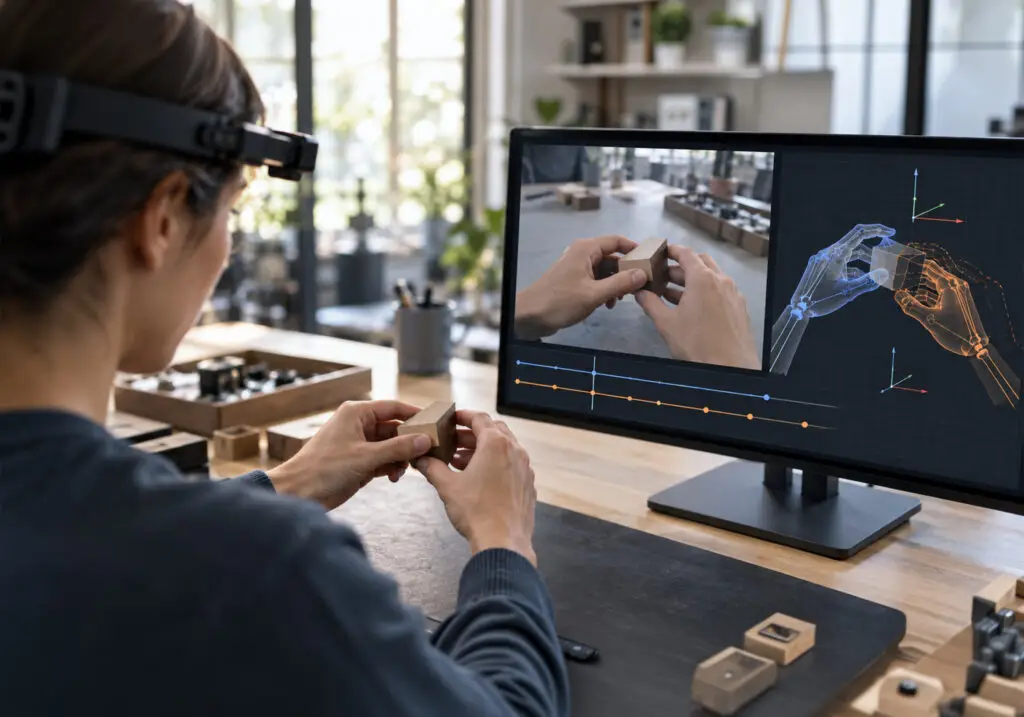
Person evaluating egocentric video and hand pose alignment on a monitor

How to Evaluate Egocentric Video and Pose Data Usability When Timing and Coordinates Don’t Match

Egocentric video and pose data with inconsistent timing and coordinate systems is often recoverable, and a structured audit tells you how much of it is. The audit documents every clock and coordinate frame, measures time offset and drift per session, and checks spatial alignment through reprojection error. Each session then lands in one of four outcomes: use as-is, repair, route to weaker supervision, or discard. 

Most teams reach this question with a pilot batch already in hand. The videos play, the pose files parse, and the schema validates. The trouble surfaces later, when projected hand keypoints trail the real hand during fast motion or a grasp label fires before the fingers close.

These errors are costly because they are silent. A 30-millisecond offset or a flipped axis passes every format check, yet it teaches a model the wrong link between what the camera sees and what the body does. Whether a team runs its own egocentric data collection program or sources egocentric datasets from a reputed vendor, the usability question is best settled before scaling collection or labeling.

Key Takeaways

  • Mismatched timing and positions rarely cause visible errors, so a structured check is the most reliable way to learn whether the data can still be used.
  • Check timing before any labeling starts by confirming that the video and body-movement data line up at the start, middle, and end of every recording session.
  • Check positions by writing down how each data source defines direction, scale, and starting point, then overlay the body data on the video to confirm it matches.
  • Some body positions are guessed by software because the camera couldn’t see them clearly, so flag those and check that all movements look physically realistic.
  • Sort each recording into one of four groups: use as is, fix and use, use for less demanding training, or discard.
  • Test a small, varied sample before scaling up, and use what you find to improve how future data is collected.

What Is Egocentric Video and Pose Data, and Why Does Alignment Matter?

Egocentric video is the footage recorded from the viewpoint of the person performing a task, usually through smart glasses, a headset, or a head-mounted camera. Pose data describes where the body is in space over time. In robotics programs, it typically includes a six-degree-of-freedom (6-DoF) head or camera trajectory, 3D hand keypoints, and sometimes full-body joints from an IMU suit or motion capture. Programs that apply video annotation services to this footage are working with streams recorded by different sensors that were never guaranteed to agree. As egocentric datasets become the new standard for training robotics models, that agreement becomes a core data quality question.

Two separate properties decide whether the streams agree. Temporal alignment, also called synchronization, means every video frame and every pose sample refer to the same physical instant. Spatial alignment means every pose is expressed in a documented coordinate frame with a known transform to the camera. A dataset can pass one test and fail the other, so each one needs its own evaluation.

A few terms come up repeatedly in any usability audit. Using them consistently across capture, annotation, and training teams prevents avoidable errors.

Time offset

The constant difference between two clocks at a given moment, usually measured in milliseconds.

Clock drift

The rate at which that offset changes across a session.

Coordinate frame

The origin, axis directions, and handedness that give a position or rotation its meaning.

Extrinsic calibration

The rigid transform between two sensors, such as the headset tracking frame and the RGB camera.

Intrinsic calibration

The camera’s internal model, including focal length, principal point, and lens distortion.

Why Do Timing and Coordinate Systems Drift Apart in Egocentric Captures?

Inconsistency is the default state of multi-device egocentric capture. A typical rig combines a headset, wrist or body trackers, and sometimes external motion capture, each with its own clock and reference frame. Sensor synchronization for egocentric robotics data is harder than in vehicle-mounted rigs, because the sensors sit on a moving human head. There is no fixed mounting to calibrate against, and head motion is fast and unpredictable.

Where does timing break down?

Timing errors tend to come from a small set of repeatable sources. The team behind the EMHI multimodal egocentric motion dataset, for example, had to reconcile a host PC clock and a separate headset clock offline. Common sources include:

  • Independent device clocks that start at different epochs and drift apart over long sessions.
  • Timestamps assigned on arrival at the host PC, which can lag the true sensor capture time.
  • Camera exposure delay and rolling shutter, which shift the actual capture instant by a few milliseconds.
  • Variable frame rates and dropped frames, which break the assumption that frame N sits at N divided by the frame rate.
  • Tracker disconnections that leave gaps in the pose stream while video keeps recording.

Where do coordinate systems break down?

Spatial inconsistencies tend to be convention mismatches. Human motion formats, game engines, and robotics simulators disagree on which axis points up, and some use left-handed frames. Others come from tracking itself, such as SLAM drift that builds up over long, fast, or poorly lit sequences. Typical mismatches include:

  • Up-axis differences, such as Y-up body model outputs loaded into a Z-up simulator.
  • Quaternion ordering, where one tool writes w-x-y-z and another expects x-y-z-w.
  • The unit mismatches between millimeters and meters, which scale every trajectory by a factor of 1,000.
  • Camera conventions, where OpenCV and OpenGL point the y and z axes in opposite directions.
  • World origin resets when a headset re-localizes, which shift the entire trajectory mid-session.

How Do You Measure Temporal Alignment Between Video and Pose Streams?

Temporal evaluation starts with the timestamps themselves. Check that every stream is monotonic, with no duplicate or out-of-order samples. Plot the interval between consecutive samples to expose dropped frames and variable frame rates. Record which clock stamped each stream, because that determines which corrections are possible.

The next step is to estimate the offset between video and pose directly from the data. Motion correlation, which compares angular velocity from two independent sources, is more reliable than manual alignment. EMHI synchronized its headset and motion capture streams this way, correlating headset IMU angular velocity against the tracked rigid body on the headset. For video without an IMU, visual odometry or optical flow can supply the second signal. Cross-correlating the two signals gives the lag at which they match best.

A single offset estimate is not sufficient on its own. Estimate the offset in windows at the start, middle, and end of each session. A stable offset can be corrected with one shift, while a steadily growing one indicates clock drift that needs a linear correction. A sudden jump usually marks a tracker reconnection or re-localization, and the session should be split at that point.

Tolerance should come from the downstream task, because timing error turns into spatial error during motion. A hand moving at one meter per second with a 20-millisecond offset is misplaced by about two centimeters. That may be acceptable for activity recognition and unacceptable for grasp retargeting. The EMHI authors noted that at 30 Hz, residual synchronization error can reach 16.5 milliseconds, so they interpolated annotations onto the headset timestamps.

How Do You Validate Coordinate Frames and Spatial Calibration?

Spatial validation begins with a written pose contract for every data source. The contract states the up-axis, handedness, units, rotation representation, quaternion order, world origin, and the frame each pose is expressed in. If a supplier or internal team cannot produce this document, that gap is itself a finding.

Simple physical sanity checks catch most convention errors early. The following checks work on almost any egocentric pose dataset:

  • Gravity check: The accelerometer’s mean direction at rest should point along the declared down-axis.
  • Scale check: Bone lengths, such as wrist-to-knuckle distances, should match human proportions and stay constant across a session.
  • Rotation check: Every rotation matrix should have a determinant of +1, and every quaternion should have unit norm.
  • Floor check: Foot or floor height should sit near the declared ground plane.

Reprojection error is the most direct test of spatial calibration. Project 3D keypoints into the image using the camera intrinsics and extrinsics, then measure the pixel distance to where the joint actually appears. The EgoXtreme egocentric pose benchmark validated its ground truth this way, sampling 200 frames per scenario where keypoints were clearly visible. It reported mean reprojection errors under one percent of the 1408-pixel image width and a trajectory alignment error of 4.3 mm and 1.5 degrees.

Two details often decide whether reprojection results can be trusted. Egocentric cameras frequently use fisheye lenses, so projecting with a pinhole model inflates error near the image edges. Exposure timing also matters, and the EgoXtreme team corrected a few milliseconds of offset caused by camera exposure delay before final interpolation. Checking reprojection during fast motion therefore tests timing and calibration together.

Which Pose Quality Checks Matter Beyond Synchronization?

A perfectly synchronized and calibrated stream can still contain unusable poses. Hand tracking degrades under occlusion, motion blur, and low light, and many pipelines fill the gaps with learned pose priors. The key question for each joint is whether it was measured, inferred, or generated. Datasets that do not record this distinction force every downstream user to guess.

Useful plausibility checks include:

  • Temporal smoothness: Velocity and acceleration spikes beyond human limits signal tracking jumps.
  • Bone-length stability: Joint distances that stretch from frame to frame indicate fitting errors.
  • Joint limits: Finger and wrist angles outside anatomical ranges point to failed estimates.
  • Identity consistency: Left and right hands should not swap labels mid-sequence.
  • Coverage: The share of frames with valid hand poses during manipulation phases, where they matter most.

Recent large-scale pipelines turn these checks into per-sample confidence. The JoyAI-RA 0.5 data curation pipeline scores recovered hand trajectories on visibility, reprojection, and temporal consistency. It also screens episodes for timestamp alignment, schema completeness, and agreement between video and reconstructed hand states.

Pose quality also interacts directly with annotation quality. Labels for contact onset, grasp type, and task phase are only as accurate as the timestamps to which they are attached. When teams annotate egocentric video for robot manipulation, synchronization verification should be completed before labeling begins. Misaligned pose overlays force annotators to compensate visually, which can hide the underlying timing error and propagate it into the labels, reducing the reliability of the final dataset.

How Do You Decide Whether Egocentric Pose Data Is Usable?

Usability is a routing decision made per session, against the requirements of the downstream task. Binary accept-or-reject rules waste data, because many failures are deterministic and fixable. A tiered outcome keeps more of the collection while protecting the training signal.

Tier Typical condition Action
Use as-is Offset and reprojection error within task tolerance; conventions documented Train directly and keep the audit report with the data
Repair Constant offset, linear drift, or a known convention mismatch Apply the correction, then rerun every check
Weak supervision Video and task labels are sound, but poses are unreliable Use for representation or latent-action pretraining; exclude from action targets
Discard or recapture Unknown clocks, missing calibration, or large unexplained jumps Remove and feed the failure back into the capture protocol

The third tier is where many teams leave value on the table. JoyAI-RA retains clips with valid video and language but unreliable hand poses, and uses them for latent-action world-model pretraining. Those clips never feed explicit action learning, so noisy trajectories cannot corrupt the policy.

Run the audit on a stratified pilot sample before scaling. Cover every device type, firmware version, operator, and environment, since timing and calibration faults tend to cluster by setup. Report usable hours per recorded hour for each group to estimate realistic yield. Record provenance for every session, including device, calibration file, and consent record, because data without it cannot be audited later.

The audit is also the fastest way to improve collection. Findings usually point to a few protocol changes, such as hardware triggering or a shared clock. A visible sync event like a clap at session start and end, per-session calibration, and logged conventions also help. Each change moves future sessions from the repair tier into the use-as-is tier.

How Digital Divide Data Can Help

Digital Divide Data works with Physical AI teams at the point where egocentric captures meet training pipelines. DDD’s sensor data annotation services combine automated checks, reviewer validation, and temporal consistency audits across synchronized video, IMU, and pose streams. Timing lag, convention errors, and implausible joints are flagged before labels are applied. Each session receives a documented outcome, so engineering teams know which data is ready, which needs correction, and which should be routed elsewhere.

When the audit shows that problems start at capture, DDD’s egocentric data collection services support protocol design, including sync events, per-session calibration steps, and metadata standards for coordinate conventions. For humanoid and manipulation programs, the same teams extend this work to joint pose labeling, task phase segmentation, and cross-sensor QA. DDD is platform agnostic and works within a client’s existing tools and formats.

Turn inconsistent egocentric captures into training data your models can trust. Talk to an Expert.

Conclusion

Inconsistent timing and coordinate systems rarely make egocentric data worthless by themselves. The real risk is uncertainty about how large the errors are and whether anyone has measured them. A short audit of clocks, frames, reprojection, and pose plausibility converts that uncertainty into numbers a team can act on.

Teams that audit early tend to scale collection with predictable yield and fewer retraining cycles. Teams that skip the audit usually discover misalignment through unexplained policy failures, long after the data has been labeled. 

References

Fan, Z., Dai, P., Su, Z., Gao, X., Lv, Z., Zhang, J., Du, T., Wang, G., & Zhang, Y. (2024). EMHI: A multimodal egocentric human motion dataset with HMD and body-worn IMUs. https://arxiv.org/pdf/2408.17168

Yoon, T., Han, Y., Ji, S., Park, J., Kim, S., Kwon, T., & Kim, H.-S. (2026). EgoXtreme: A dataset for robust object pose estimation in egocentric views under extreme conditions. https://arxiv.org/html/2603.25135

JoyAI-RA Team, Joy Future Academy, JD. (2026). JoyAI-RA 0.5: Scaling robot manipulation learning via dual action alignment. arXiv preprint arXiv:2608.05674. https://arxiv.org/pdf/2608.05674

Frequently Asked Questions

How much time offset between egocentric video and pose data is acceptable?

It depends on the task and how fast the hands move. A 20-millisecond offset at one meter per second misplaces a hand by about two centimeters. That may be fine for activity recognition and too much for grasp retargeting.

How to sync egocentric video and pose data recorded on different clocks?

Estimate the offset from the data itself using motion correlation, which compares angular velocity from the headset IMU or visual odometry with angular velocity from the pose stream. Measure it at the start, middle, and end of each session to catch drift or sudden jumps.

What is the quickest way to tell if my coordinate systems are wrong?

Run a few physical sanity checks first, including gravity direction at rest, stable bone lengths, valid rotations, and a floor at the declared height. Then project 3D keypoints onto video frames and measure reprojection error, because misaligned frames show up as keypoints that miss the hands.

Should we throw away egocentric clips that have bad pose data?

Often you can keep them. If the video and task labels are sound, those clips can still support representation or latent-action pretraining, as long as they are excluded from action targets. Discard only sessions with unknown clocks, missing calibration, or large unexplained jumps.

How to Evaluate Egocentric Video and Pose Data Usability When Timing and Coordinates Don’t Match Read Post »

Egocentric Data Collection

How to Design an Egocentric Data Collection Protocol for Robotics Programs

Udit Khanna

Egocentric data collection has a property that most robotics teams discover too late: protocol errors are permanent. An annotation mistake can be corrected in a second pass. A model architecture decision can be revisited at the next training run. But footage collected without synchronization signals cannot be synchronized afterward; scenes that were never sampled cannot be recovered from those that were; and consent that was not obtained at capture time cannot be applied retroactively without discarding the data. The collection protocol is the one component of an egocentric data program where the cost of getting it wrong is re-collection, not revision.

This blog covers the design of an egocentric collection protocol for robotics programs: hardware selection and its downstream consequences, diversity planning, task decomposition, demonstrator training, metadata that must be captured at collection time, privacy architecture, and the pilot collection run that validates the protocol before it scales.

Key Takeaways

  • Protocol errors are permanent in a way that annotation and modeling errors are not. Missing synchronization signals, unsampled scene types, and absent consent cannot be fixed after collection. The protocol deserves the same design rigor as the model architecture.
  • Hardware selection is a dataset design decision, not a procurement decision. The capture device determines which annotation types are possible downstream: gaze labels require eye tracking, finger-level manipulation labels require joint tracking, and scalable multi-site collection requires hardware that demonstrators can operate without specialist supervision.
  • Diversity must be planned as quotas before collection, not assessed as statistics after it. EgoVerse’s consortium study found that effective scaling depends on alignment between human data and robot learning objectives, and that domain-aligned diversity, not raw volume, drives transfer.
  • Metadata captured at collection time is the cheapest data in the program. Scene identifiers, hardware calibration records, demonstrator identifiers, task labels, and synchronization markers cost seconds to capture during recording and are expensive or impossible to reconstruct afterward.
  • A pilot collection run of a small fraction of the target volume, taken all the way through annotation and a probe training run, is the single highest-return step in protocol design. It surfaces protocol defects while they are still cheap to fix.

Why Protocol Design Determines Dataset Value

A useful way to evaluate an egocentric collection protocol is to ask what fraction of the collected hours will survive to become training data. In a well-designed protocol, that fraction is high: episodes are complete, streams are synchronized, metadata is attached, consent is documented, and the scene and task distribution matches what the training pipeline needs. In a weakly designed protocol, the collected volume looks impressive and the surviving fraction is low: episodes are discarded for missing calibration records, entire sessions are unusable because a firmware update changed the timestamp format mid-collection, and the scene distribution is discovered, after the fact, to be concentrated in whichever environments were most convenient to access.

In our experience reviewing collection programs, the difference between these two outcomes is rarely the collection team’s diligence. It is whether the protocol specified, in advance and in writing, what a valid episode consists of: which streams, at which rates, with which metadata, under which scene and task conditions, verified by which checks before the demonstrator moves to the next episode. A protocol that leaves these questions to session-time judgment produces a dataset whose quality varies with who was in the room.

Hardware Selection: The Decision That Constrains Everything Downstream

What Each Hardware Class Provides

Smart glasses with eye tracking, such as the Meta Project Aria glasses used in EgoMimic, provide RGB video (standard color camera footage), inertial measurement unit (IMU) motion data, and calibrated eye gaze, which makes gaze target annotation possible downstream. Headset-class devices such as Apple Vision Pro, used in EgoDex, add on-device hand tracking: SE(3) poses (positions and orientations in full 3D space) for 25 joints of both hands at 30 Hz, captured via the device’s own simultaneous localization and mapping (SLAM) system. This is what makes finger-level dexterous manipulation annotation feasible at scale without a motion capture studio. Custom head-mounted camera rigs, the approach behind Build AI’s Egocentric-1M, trade sensor richness for cost and durability, which is what made it possible to equip factory workers at the scale required to reach one million hours. Wrist-mounted cameras provide the closest view of hand-object contact but lose head-level gaze and wide scene context.

Selecting Against the Annotation Plan, Not the Spec Sheet

The correct selection procedure runs backward from the annotation schema. If the training pipeline requires gaze target labels, the hardware must capture calibrated eye tracking, and no post-processing can substitute for it. If the pipeline requires finger-joint ground truth, the hardware must track joints at capture time, because manual joint annotation of ordinary video is prohibitively expensive at production volume and markedly less accurate. If the program requires thousands of demonstrators across many sites, the hardware must be operable by a trained demonstrator without an engineer present, which rules out rigs that require per-session calibration by a specialist.

A practical consequence, visible in the EgoVerse design, is that large diverse programs often standardize on more than one hardware class: a rich-sensor device for the subset of tasks that need gaze and joint tracking, and a simpler, cheaper device for the volume and diversity of collection. The protocol must then specify how episodes from each hardware class are marked, because the downstream pipeline will treat them differently.

Diversity Planning: Quotas Before Volume

What the Evidence Says About Diversity Versus Scale

The EgoVerse consortium study, replicated across multiple labs, tasks, and robot embodiments, found that policy performance generally improves with more human data, but that effective scaling depends on alignment between the human data and the robot learning objectives. Volume collected in the wrong distribution does not convert to policy performance. The precedent for planned diversity goes back to Ego4D, which deliberately collected its more than 3,000 hours across 74 locations in 9 countries precisely because earlier egocentric datasets had been narrow in geography and demography, and that narrowness limited what models trained on them could generalize to.

Building the Coverage Matrix

Diversity planning operationalizes as a coverage matrix defined before collection: scene types crossed with task types crossed with object variations, with a target episode count in each cell. The matrix should be derived from the deployment target, not from convenience of collection. A program training household manipulation policies needs kitchens, bathrooms, and living spaces in realistic states of clutter, across multiple lighting conditions, with object instances that vary in size, material, and wear. A program training industrial policies needs the equivalent coverage of workstations, fixtures, and part variations.

An illustrative slice of such a matrix, for a household manipulation program, shows how deployment targets become collection quotas:

Scene type Grasp and place Open and close Pour and transfer
Kitchen, cluttered counter 30 episodes × 5 object variants 20 episodes × 4 container types 25 episodes × 4 vessel pairs
Kitchen, clear counter 20 episodes × 5 object variants 15 episodes × 4 container types 15 episodes × 4 vessel pairs
Bathroom shelf 20 episodes × 4 object variants 20 episodes × 3 cabinet types 10 episodes × 2 vessel pairs
Living space, low light 15 episodes × 4 object variants 10 episodes × 3 furniture types 10 episodes × 2 vessel pairs

Each cell is further split across demonstrators under the per-demonstrator caps described below, and the real matrix extends across every scene, lighting, and task condition in the deployment target.

Demonstrator diversity belongs in the matrix as well. Different demonstrators perform the same task with different hand sizes, motion styles, speeds, and strategies, and a policy trained on a single demonstrator’s style inherits that style’s idiosyncrasies as if they were task requirements. In our experience, programs that assign per-demonstrator episode caps per task, forcing the same task to be captured by many hands, produce measurably more robust policies than programs that let their fastest demonstrators dominate the collection.

Task Decomposition and Language at Capture Time

The task list is not a logistics artifact. It defines the supervision the dataset can provide. Tasks should be decomposed to the granularity the training pipeline will use: if policies will be trained on atomic skills such as grasp, place, open, and pour, the collection should capture clean episodes at that granularity, with defined start and end states, rather than long unsegmented activity streams that annotation must later cut apart. If the program targets long-horizon policies, the protocol should capture both the composed sequences and their atomic components, because both supervision levels will be needed.

Natural language task descriptions should be recorded at capture time, by the demonstrator or the session operator, in the phrasing that end users would actually use. Language-conditioned policies ground instructions in these descriptions, and descriptions written months later by annotators who did not perform the task are systematically flatter and less varied than descriptions captured in the moment. This is among the cheapest high-value data in the protocol: a spoken sentence per episode, recorded while the context is live.

Demonstrator Recruitment and Training

Demonstrators require training, and the training has a specific and somewhat counterintuitive goal: natural motion, not performative motion. Untrained demonstrators tend to perform for the camera, slowing down, exaggerating grasps, holding objects in view longer than natural task execution would. Policies trained on performative demonstrations learn performative behavior, which then looks hesitant and inefficient on the robot. Demonstrator training should therefore emphasize executing the task as if no camera were present, with the protocol’s quality checks catching the drift back toward performance.

The onboarding session should cover three things: device handling and calibration verification; the definition of a valid episode, including start state, end state, and what to do when a task attempt fails; and a supervised set of practice episodes reviewed against the protocol before the demonstrator’s data enters the production dataset.

Failed attempts deserve explicit protocol treatment: they should be captured and marked as failures rather than deleted, because failure episodes are among the most valuable and scarce training data in manipulation learning.

Metadata and Synchronization: Capture-Time or Never

Certain data can only be captured at collection time, and the protocol must enumerate it explicitly. Synchronization markers are what make multi-stream temporal alignment verifiable downstream: a clap, a flash, or a device-generated sync event at every episode start. Without them, alignment becomes an estimation problem with no ground truth. 

Calibration records determine whether spatial annotation downstream is trustworthy: camera intrinsics and extrinsics, device firmware versions, and eye tracking calibration results. Scene and session metadata rounds out the record: location identifier, lighting condition, object inventory, demonstrator identifier, and task label. Capturing these is seconds of effort during recording. Reconstructing them afterward is a project.

The protocol should treat metadata capture as a gating requirement: an episode without its metadata record is an invalid episode, checked at session end rather than discovered at annotation time. In our experience, the single most common source of discarded egocentric footage is not sensor failure. It is metadata that was deferred to later and never created.

Privacy and Consent Architecture

Egocentric capture records everything the demonstrator looks at, which includes bystanders, screens, documents, and identifying details of private spaces. Consent must be obtained from demonstrators and, where applicable, from the owners of collection environments, before recording, with the scope of use, including model training and potential dataset publication, stated explicitly.

Bystander handling must be designed into the protocol. Collection windows and locations should be chosen to minimize incidental capture, and a redaction stage (face and screen blurring at minimum) should sit in the pipeline before footage becomes broadly accessible to annotation teams.

Programs that defer privacy handling to a post-collection review consistently lose data to it, because footage with unconsented identifiable individuals in critical frames often cannot be salvaged by redaction without destroying the annotation value of those frames. Privacy architecture designed before collection is a yield decision as much as a compliance one.

The Pilot Collection Run: Validate Before You Scale

Before scaling to production volume, the protocol should be validated end to end with a pilot collection: a small fraction of the target volume, in our experience typically one to three percent, taken through the entire pipeline. That means collecting under the written protocol, running the full annotation schema on the pilot data, and training a probe model to confirm that the collected data actually supports the intended supervision. Each stage surfaces a different class of protocol defect: collection surfaces hardware and session-flow problems, annotation surfaces missing metadata and ambiguous episode boundaries, and the probe training run surfaces distribution and label-quality problems that neither of the first two stages can see.

The pilot ends with a protocol revision, and the revision should be treated as the expected outcome rather than a failure. Every large program’s published methodology reflects lessons that were cheap at pilot scale and would have been expensive at production scale. The discipline is refusing to scale until the pilot data has survived the full pipeline.

How Digital Divide Data Can Help

The principles above are straightforward to state and demanding to execute, which is where a specialist partner earns its place.

Digital Divide Data designs and operates egocentric collection programs where the protocol work is done before the first minute of footage is recorded, so that the collected hours survive to become training data instead of becoming an expensive archive.

That work runs upstream to downstream, from hardware and collection design through execution at scale. Physical AI data services cover this protocol and collection design layer, and data collection and curation operate the collection itself at production scale.

If a previous collection produced less usable data than its volume suggested, the audit almost always traces to one of the protocol elements above, and the fix belongs in the protocol, not in heroic post-processing. Talk to an expert.

Conclusion

Protocol errors are permanent in a way that annotation and modeling errors are not, which is why the five practices above earn the same design rigor as the model architecture itself.

The published datasets that robotics teams now benchmark against, EgoVerse, EgoDex, EgoMimic, and their successors, are protocol documents as much as they are data releases: every one of those practices is visible in how they were built. The question for a program planning its own collection is whether its protocol would survive the same scrutiny. For every hour it plans to collect, does the protocol specify what makes that hour usable?

References

Punamiya, R., Kareer, S., Liu, Z., Citron, J., Qiu, R.-Z., Cai, X., Gavryushin, A., Chen, J., Liconti, D., Zhu, L. Y., et al. (2026). EgoVerse: An egocentric human dataset for robot learning from around the world. arXiv. https://arxiv.org/abs/2604.07607

Hoque, R., Huang, P., Yoon, D. J., Sivapurapu, M., & Zhang, J. (2025). EgoDex: Learning dexterous manipulation from large-scale egocentric video. arXiv. https://arxiv.org/abs/2505.11709

Kareer, S., Patel, D., Punamiya, R., Mathur, P., Cheng, S., Wang, C., Hoffman, J., & Xu, D. (2024). EgoMimic: Scaling imitation learning via egocentric video. In Conference on Robot Learning (CoRL). https://arxiv.org/abs/2410.24221

Grauman, K., Westbury, A., Byrne, E., Chavis, Z., Furnari, A., Girdhar, R., Hamburger, J., Jiang, H., Liu, M., Liu, X., et al. (2022). Ego4D: Around the world in 3,000 hours of egocentric video. In Proceedings of the IEEE/CVF Conference on Computer Vision and Pattern Recognition (CVPR). https://arxiv.org/abs/2110.07058

Frequently Asked Questions

Q1. We have a limited budget and cannot afford Vision Pro or Aria units at scale. Does that rule out a serious egocentric program?

No, but it changes the design. The Egocentric-1M program reached one million hours on custom low-cost head-mounted cameras precisely because sensor richness was traded for scale and durability. The decision procedure is the same regardless of budget: run backward from the annotation schema. If the training pipeline does not require gaze targets or finger-joint ground truth, low-cost RGB head rigs with disciplined synchronization markers and metadata capture support a fully credible program. If a subset of tasks does require rich sensing, the mixed-fleet approach used by EgoVerse, a small number of rich-sensor devices for those tasks and inexpensive hardware for volume and diversity, delivers most of the capability at a fraction of the fleet cost.

Q2. How many hours should we plan to collect?

The honest answer is that the coverage matrix, not an hours target, is the right planning unit. The published evidence, including the EgoVerse consortium finding that scaling gains depend on alignment between the human data and the robot learning objectives, indicates that hours in the wrong distribution convert poorly to policy performance. The practical sequence is to define the coverage matrix from the deployment target, estimate episodes per cell from the task complexity, and let the hours total fall out of that calculation. Then validate with the pilot run: if the probe model trained on pilot data shows the expected learning signal, the matrix and the derived volume are credible; if it does not, more hours of the same distribution will not fix it.

Q3. Should we run collection in-house with our own team or distribute it across many demonstrators and sites?

The tradeoff is control versus diversity, and the deployment target should decide it. A small in-house team gives tight protocol control, fast iteration, and easy hardware management, at the cost of demonstrator and environment diversity, which the evidence consistently identifies as a driver of policy robustness. Distributed collection across many demonstrators and sites delivers the diversity but demands a protocol strong enough to survive operation by non-specialists: hardware that self-calibrates or verifies calibration automatically, session checklists that gate episode validity, and remote quality review with fast feedback to collectors. Most production programs converge on a hybrid: in-house collection to develop and stabilize the protocol, then distributed collection to scale diversity once the protocol has survived the pilot.

Q4. What synchronization approach should the protocol specify when devices cannot share a hardware clock?

The protocol should layer three mechanisms. First, a physical sync event at every episode start, a clap or a light flash visible or audible across streams, which creates a ground-truth alignment point that survives any clock behavior. Second, periodic timestamp logging against a common reference such as a network time source, which bounds drift within long sessions. Third, cross-correlation verification during the pilot run, confirming that streams which should show correlated signals at the same physical event actually do after alignment. The critical protocol rule is that the sync event is a gating requirement: an episode recorded without it is invalid at session end, not a problem deferred to the annotation team.

Q5. How do we know the protocol is ready to scale beyond the pilot?

Three checks, in order. First, yield: the fraction of pilot episodes that passed metadata, synchronization, and completeness gates should be high and the failure causes should be understood and fixed in the revised protocol, not explained away. Second, annotation viability: the full annotation schema should have run on the pilot data without discovering missing information that the protocol failed to capture, because any such gap will replicate across the entire production collection. Third, learning signal: a probe model trained on the annotated pilot data should show the expected supervision behavior on its target skills. When all three hold on the revised protocol, scaling is justified. When any one fails, scaling multiplies the defect by the size of the production run, which is the most expensive way to discover it.

How to Design an Egocentric Data Collection Protocol for Robotics Programs Read Post »

Sensor Synchronization for Egocentric Robotics Data: IMU, RGB, Depth, and Gaze Alignment

Sensor Synchronization for Egocentric Robotics Data: IMU, RGB, Depth, and Gaze Alignment

Udit Khanna

Every modern egocentric capture device is a federation of sensors running on their own schedules. Meta’s Project Aria research glasses combine RGB cameras (standard color video), monochrome scene cameras, inertial measurement units (IMUs, which measure acceleration and rotation), eye tracking cameras, microphones, and positioning sensors in a single wearable, each stream sampling at its own rate. Apple Vision Pro, the capture platform behind EgoDex, adds hand joint tracking at 30 Hz derived from its on-device simultaneous localization and mapping (SLAM) system. A typical egocentric robotics rig therefore produces four to eight concurrent time series whose scientific value depends entirely on a property none of them can guarantee alone: that a timestamp in one stream refers to the same physical instant as the identical timestamp in every other stream.

When that property fails, it fails silently. A dataset with a 40 millisecond offset between the gaze stream and the video stream contains no corrupted files, no missing frames, and no error messages. Every individual stream looks perfect. What it contains is a systematic lie about which object the demonstrator was looking at during every fast head movement in the collection, and the policy trained on it learns attention patterns that are consistently, confidently wrong. Synchronization errors are the only data quality failure that gets worse the better the rest of the pipeline is, because clean annotation applied to misaligned streams produces precise labels for events that did not co-occur.

This blog covers the mechanics: where desynchronization comes from, the hardware and software methods for preventing it, the verification techniques that prove alignment rather than assume it, and the capture-time logging that makes all of it auditable. It goes a level deeper than protocol design, into the specific failure modes and checks that apply per stream pair. Sensor data annotation and physical AI data services are the two capabilities most directly involved in operating this discipline at production scale.

Key Takeaways

  • Desynchronization is silent and systematic. Misaligned streams produce no errors and no corrupted files, only labels that are precisely wrong about which events co-occurred. It is the one data quality failure that clean annotation makes worse rather than better.
  • The error budget is stream-pair specific. Gaze-to-video alignment during fast head motion demands tighter tolerance than depth-to-video alignment in a slow scene. Setting one global tolerance either over-engineers cheap pairs or under-protects critical ones.
  • Clock architecture is a design decision, not a default. Shared hardware clocks, hardware trigger lines, network time protocols, and physical sync events form a hierarchy of guarantees, and the right choice depends on which streams share silicon and which cross device boundaries.
  • Verification means measurement, not inspection. Cross-correlation of physically coupled signals produces an empirical offset estimate with confidence bounds. Watching playback does not.
  • Drift makes synchronization a per-session property, not a per-device one. Independent clocks diverge over minutes to hours, so long recording sessions require drift measurement across the session, not a single alignment check at the start.

Where Desynchronization Actually Comes From

Clock Domains and Drift

Every sensor with its own oscillator keeps its own time, and consumer-grade oscillators drift relative to each other at rates that are trivial per second and material per session. Two independent clocks diverging at 20 parts per million accumulate 72 milliseconds of relative offset per hour, which at a 1000 Hz force sensor is 72 samples and at 30 Hz video is more than two frames. Devices that share a clock domain, sensors on the same board reading one oscillator, do not drift relative to each other; streams that cross a device boundary, an external tactile glove alongside head-mounted glasses, always do. Mapping which streams share clock domains is the first task of synchronization design, because it separates the pairs that are aligned by construction from the pairs that must be aligned by method.

Pipeline Latency and Timestamp Semantics

The second source is subtler: even with perfect clocks, a timestamp means different things in different streams. Some drivers stamp at exposure start, some at exposure end, some at readout, and some at software arrival after buffering, and the differences span tens of milliseconds. Gaze estimates carry processing latency between the eye image and the computed gaze vector. Compressed video streams buffer before writing. A synchronization design that treats all timestamps as equivalent inherits these semantic offsets as fixed biases, which is why documented timestamp semantics per stream (what event, in whose clock, stamped where in the pipeline) belong in every capture specification.

The useful property of pipeline latency is that it is a known bias. Once the per-stream latency is characterized and documented, it is subtracted analytically as a fixed correction before any verification runs, so that measurement only has to recover what remains. That yields a clean two-axis model for the whole problem: latency is the known bias you correct by arithmetic, and drift is the unknown, time-varying bias you must measure. A pipeline that conflates the two spends its measurement budget rediscovering constants it already logged.

Sampling Rate Mismatch

Streams at 30, 60, 100, and 1000 Hz never sample the same instant except by coincidence. This is not an error, but it forces an explicit decision that many pipelines make implicitly and inconsistently: how a label defined on one stream maps to the nearest samples of another, by nearest-neighbor assignment, by interpolation, or by windowed association. In our experience, the most common downstream defect in multi-rate egocentric datasets is not clock error at all, but inconsistent resampling conventions applied by different annotation tools on the same corpus.

The Synchronization Method Hierarchy

Level 1: Shared Hardware Clock

The strongest guarantee is sensors reading one clock. Integrated devices provide this within their own sensor suite, which is a genuine and underappreciated argument for integrated capture hardware over assembled rigs: the hardest synchronization problems are solved in silicon before collection begins. The limit is the device boundary; the moment a program adds an external sensor, it leaves Level 1 for that pair.

Level 2: Hardware Trigger and Timestamping

Where streams cross devices but the hardware supports it, a shared electrical trigger line or a common timestamping unit provides near-hardware alignment: a pulse that either drives simultaneous capture or is recorded by both devices as a common reference. This is standard practice in robot-mounted rigs where cameras and force-torque sensors expose trigger inputs, and it converts an unbounded drift problem into a bounded interpolation problem between trigger events.

Level 3: Network Time Protocols

Devices that share only a network can discipline their clocks to a common reference: Network Time Protocol (NTP) at millisecond-scale accuracy, or Precision Time Protocol (PTP) at sub-millisecond scale on supported hardware. Two numbers characterize what a protocol actually delivers, and they should not be conflated. Accuracy is the mean offset: how far the disciplined clock sits from the reference on average. Jitter is the variance of that offset from timestamp to timestamp. For label alignment, jitter is frequently the binding constraint, because a stable bias is a constant that one correction removes, while jitter scatters individual timestamps unpredictably and no per-session correction can undo it. 

This is also the honest form of the argument for hardware triggering over network discipline: triggers win less on mean accuracy than on jitter, because an electrical pulse does not wobble with network conditions. Protocol discipline bounds drift continuously, but both its accuracy and its jitter depend on network conditions and must be measured rather than assumed, which returns to the verification requirement below.

Level 4: Physical Sync Events

The universal fallback, and the mandatory floor for any protocol: a physical event visible or audible across streams at every episode start. The standard forms are a clap (which appears in audio, in video, and as an IMU spike) or a light flash visible to every camera. A physical sync event provides ground truth alignment that survives any clock behavior, firmware update, or driver quirk, and it costs two seconds per episode. Its absence is unrecoverable, which is why episode validity gates on its presence. The event also anchors post-hoc verification: it is the known co-occurrence against which computed alignments are checked.

Verification: Proving Alignment Instead of Assuming It

Cross-Correlation of Physically Coupled Signals

Streams that observe the same physics provide free verification signal. Head rotation appears simultaneously in the IMU gyroscope and as global optical flow in the video; a hand strike appears in audio, video, IMU, and any force sensor at the same physical instant; gaze saccades correlate with the head movements that accompany them. Computing the cross-correlation between such signal pairs across a recording yields the empirical time offset at which they align best. After the documented per-stream latency corrections have been applied, this measurement only has to recover the residual, which keeps the search window small and the estimate stable. Run per session and per stream pair, this converts synchronization from an assumption into a measurement, and its output (offset and confidence per pair per session) is the artifact a dataset can actually audit.

Three implementation details make the measurement operational rather than gestural. First, commensurability: an IMU gyroscope trace and video optical flow live in different units and rates, so the practical pairing correlates angular-rate magnitude against global flow magnitude, after resampling both to a common rate and band-pass filtering each to the shared band of natural head motion, which suppresses sensor noise below the band and rolling-shutter and compression artifacts above it. 

Second, sub-sample estimation: the true offset rarely lands on a sample boundary, so the standard cheap refinement is a parabolic fit through the correlation peak and its two neighbors, which recovers the offset at a fraction of a sample interval. Third, quantitative confidence: peak sharpness should be reported as a number, either the peak-to-sidelobe ratio or the correlation coefficient at the peak, with a minimum threshold below which the session’s alignment is treated as unverified rather than approximately fine.

Drift Measurement Across the Session

A single offset estimate at session start says nothing about session end. Repeating the correlation estimate in windows across the recording, or comparing physical sync events at episode boundaries, measures drift directly: a stable offset indicates a fixed bias that one correction removes, while a growing offset quantifies drift that requires time-varying correction. In our experience, a practical session gate is that residual misalignment after correction stays below half of the tightest sampling interval among the critical stream pairs, a threshold that keeps nearest-sample label assignment unambiguous; programs should calibrate the exact figure to their own error budget rather than adopt it as a standard.

The Per-Pair Error Budget

Not all misalignment is equally expensive, and the tolerance should follow the physics of the labels. Gaze-to-video alignment is the most demanding pair in most egocentric programs, because saccades complete in tens of milliseconds and a modest offset relocates the gaze target across object boundaries during exactly the head movements that matter. Contact labels shared between video and force or tactile streams are next, since contact transitions complete within a few high-rate samples. Depth-to-video and IMU-to-video tolerances can often be looser in slow-motion segments. Writing the budget down per pair, with the label types each pair supports, is what turns synchronization requirements from folklore into specification.

What to Log at Capture Time

Verification and correction are only as good as the records they run on. The capture specification should mandate, per session: device and firmware versions for every sensor, since firmware updates change timestamp behavior; both device timestamps and host arrival timestamps for every stream, preserving the raw material for offset analysis; the timestamp semantics declaration per stream; the measured per-stream pipeline latencies that will be applied as fixed corrections; the physical sync events with their per-stream detections; and the clock discipline configuration in effect. None of this is reconstructible afterward, and all of it is seconds of engineering per session. Sessions missing these records should fail intake before annotation, for the same reason unsynchronized episodes should: annotation effort spent on unverifiable alignment is annotation effort at risk.

If your annotation pipeline has ever adjudicated a disagreement about what the demonstrator was looking at, and the answer turned out to depend on which tool loaded the streams, the underlying issue is almost certainly synchronization, and it is measurable this week. Talk to an expert.

How Digital Divide Data Can Help

Digital Divide Data operates synchronization as a gate, not a hope: alignment is measured, corrected, and documented before a single label is applied.

For multi-modal egocentric programs, sensor data annotation begins with cross-correlation verification per stream pair per session, producing the offset and drift record that makes every downstream label auditable, and applies consistent resampling conventions so multi-rate labels mean the same thing across the entire corpus.

Upstream of that, physical AI data services build the synchronization architecture into the collection protocol itself: clock domain mapping, sync event design, timestamp semantics specification, and the capture-time logging that verification depends on.

And where the aligned streams feed video labels, video annotation teams work against the verified timeline, so gaze targets, contact events, and phase boundaries land on the frames where the physics actually happened.

If your program can state its per-pair error budget and produce last week’s drift measurements, this discipline is already in place. If it cannot, that is the gap. Talk to an expert.

Conclusion

Synchronization is the least visible layer of an egocentric data program and the one every other layer silently depends on. The discipline is not conceptually difficult: map the clock domains, choose the strongest feasible alignment method per stream pair, mandate physical sync events as the universal floor, correct the documented latencies analytically, verify the residual by measurement rather than inspection, track drift across sessions, and log the capture-time records that make all of it auditable. Each element is cheap at collection time and unrecoverable afterward.

The test of the discipline is not whether the streams look aligned in playback. It is whether the program can produce, for any session in the corpus, the measured offset, the residual after correction, and the drift profile, per stream pair. A dataset that can answer that question has synchronized data. A dataset that cannot has synchronized-looking data, and the difference is invisible until a policy trained on it meets the physical world.

References

Engel, J., Somasundaram, K., Goesele, M., Sun, A., Gamino, A., Turner, A., et al. (2023). Project Aria: A new tool for egocentric multi-modal AI research. arXiv. https://arxiv.org/abs/2308.13561

Hoque, R., Huang, P., Yoon, D. J., Sivapurapu, M., & Zhang, J. (2025). EgoDex: Learning dexterous manipulation from large-scale egocentric video. arXiv. https://arxiv.org/abs/2505.11709

Kareer, S., Patel, D., Punamiya, R., Mathur, P., Cheng, S., Wang, C., Hoffman, J., & Xu, D. (2024). EgoMimic: Scaling imitation learning via egocentric video. In Conference on Robot Learning (CoRL). https://arxiv.org/abs/2410.24221

Grauman, K., Westbury, A., Byrne, E., Chavis, Z., Furnari, A., Girdhar, R., Hamburger, J., Jiang, H., Liu, M., Liu, X., et al. (2022). Ego4D: Around the world in 3,000 hours of egocentric video. In Proceedings of the IEEE/CVF Conference on Computer Vision and Pattern Recognition (CVPR). https://arxiv.org/abs/2110.07058

Frequently Asked Questions

Q1. Our capture device is an integrated headset. Doesn’t the manufacturer handle synchronization for us?

Within the device, largely yes: sensors sharing the device’s clock domain are aligned by construction, which is a real advantage of integrated hardware. The guarantee ends at the device boundary. The moment a program records anything alongside the headset (a robot’s joint states, an external force sensor, a second camera, a tactile glove), that pair crosses clock domains and requires explicit alignment. Programs should also verify rather than assume the intra-device guarantee across firmware updates, since timestamp behavior is firmware-dependent, and confirm the timestamp semantics the device exposes, because exposure-time versus arrival-time stamping differs across streams even on integrated hardware.

Q2. We already recorded a large corpus without sync events. Is it unusable?

Not necessarily, but its alignment must now be estimated rather than anchored. Cross-correlation of physically coupled signals, such as IMU motion against optical flow or audio impacts against visual events, can recover offset estimates for many sessions, with confidence that varies by how much correlated activity each recording contains: sessions with vigorous motion align well, static sessions may not align at all. The honest workflow is triage: run correlation-based estimation across the corpus, retain sessions where the offset estimate is sharp and the residual meets the error budget, flag low-confidence sessions for restricted use, and add sync events to the protocol before the next collection run. Recovery is real but partial, which is exactly why the sync event is protocol-mandatory going forward.

Q3. What tolerance should we set for gaze-to-video alignment?

Derive it from the labels rather than adopting a universal number. The bounding physics: saccades complete in roughly 20 to 80 milliseconds, and during a fast head turn the gaze point can cross an object boundary in a similar window, so the tolerance question is how far a gaze target label can shift in time before it lands on the wrong object in your actual scenes. A defensible procedure is empirical: take representative episodes, artificially shift the gaze stream by candidate offsets, and measure at what shift the gaze-target annotation begins to change. In our experience that experiment typically motivates single-frame tolerance at 30 Hz for manipulation scenes with adjacent objects, but the point of the procedure is that your scenes, not a blog post, set your number.

Q4. Is Precision Time Protocol worth the hardware investment over NTP for a collection rig?

It depends on which stream pairs cross the network and what their error budget is. The comparison has two dimensions, and the second is the one that usually decides it. On accuracy, NTP typically disciplines clocks to within a few milliseconds under good conditions while PTP reaches sub-millisecond on supported hardware. On jitter, the timestamp-to-timestamp wobble of that offset, the gap between the approaches is wider, and jitter is what label alignment actually experiences, because a stable bias is removable by one correction while jitter is not removable at all. The decision procedure is the error budget: list the cross-network stream pairs, take the tightest tolerance among them, and compare it against measured NTP performance on your actual network, measuring both the mean offset and its variance rather than nominal figures. Many rigs land on a hybrid, hardware triggering for the high-rate pairs and NTP for the rest, which buys the guarantee where it matters without re-cabling the whole rig.

Q5. Who should own synchronization, the collection team or the annotation team?

Collection owns creating it; annotation owns refusing to work without proof of it. The mechanisms that make alignment possible, clock architecture, sync events, timestamp logging, exist only at capture time and belong in the collection protocol with episode validity gated on them. The verification artifact, measured offsets and drift per session, is the handoff document: annotation intake checks for it the way it checks for consent records, and sessions without it bounce back rather than entering the labeling queue. Programs that instead discover synchronization problems inside annotation tools resolve them tool by tool and annotator by annotator, which is how one corpus quietly acquires several incompatible alignments.

Sensor Synchronization for Egocentric Robotics Data: IMU, RGB, Depth, and Gaze Alignment Read Post »

Annotate Egocentric Video

How to Annotate Egocentric Video for Robot Manipulation

Udit Khanna

Collecting egocentric video for robot manipulation is now a largely solved problem. Consumer hardware, established capture protocols, and a fast-growing ecosystem of open datasets have made first-person footage the most accessible demonstration data source in robotics. Annotating it correctly is not solved, and that is where most programs lose the advantage they were trying to build. 

The reason annotation matters so much is that egocentric footage contains information that standard video annotation pipelines were not designed to extract. Hand-object contact state, gaze direction at the moment of action, precise 3D joint positions, and task phase transitions are all present in the data. They are available only as training signals if the annotation pipeline is configured to capture them. A standard object detection and action labeling pipeline applied to egocentric footage will produce correct labels that miss everything that makes the egocentric perspective valuable.

This blog covers the complete annotation stack for egocentric robot manipulation video: what labels are required at each level, what annotation quality standards apply, and what quality control processes distinguish annotation programs that produce a reliable policy-training signal from those that produce correctly formatted but misleading supervision. 

Key Takeaways

  • Egocentric video requires annotation at four levels: episode, segment, frame, and sensor stream. Annotation at one level cannot substitute for annotation at another, and missing any level produces a training set with systematic gaps.
  • Hand-object contact annotation is the most consequential label in manipulation video and the one most commonly done wrong. Contact onset and offset must be identified at the frame level, not the second level, and contact quality must be assessed, not just contact presence.
  • Gaze annotation is only meaningful when it identifies the fixation target, not just the gaze direction. A gaze direction vector that points at a cluttered scene tells the policy very little. A gaze target label that identifies the specific object or region the demonstrator was fixating on is what makes gaze information useful for policy learning.
  • Sensor stream synchronization must be verified before annotation begins. A contact label applied to a frame that is 50 milliseconds offset from the corresponding tactile or force reading produces a training signal that is systematically wrong at the most critical moments of a manipulation task.
  • Cross-embodiment annotation requires robot-agnostic task descriptions alongside robot-specific action data. EgoDex uses SE(3) annotations (poses in the special Euclidean group, capturing full 3D position and orientation) for 25 joints of both hands per frame as its joint-level ground truth; programs building datasets for cross-embodiment training should understand what their target format requires before annotation begins.

The Four Annotation Levels for Egocentric Manipulation Video

Level 1: Episode-Level Annotation

Episode-level annotation assigns labels to the entire recorded demonstration as a unit. The minimum required fields are task identity, task success or failure, a natural language task description, and collection metadata covering the hardware used, the scene configuration, and the demonstrator identifier. For programs training instruction-conditioned or language-conditioned policies, natural language task descriptions are a first-class annotation modality rather than optional metadata, and their quality, specifically whether they describe what the task accomplishes in the language that users will actually use, determines how well the policy learns language grounding.

Episode-level annotation also supports dataset balancing. Coverage metadata across scene type, object category, and task type is what enables the training pipeline to identify and address coverage gaps systematically rather than training on whatever distribution the collection produced by default.

Level 2: Segment-Level Annotation

Segment-level annotation divides an episode into labeled temporal segments corresponding to meaningful task phases. For manipulation tasks, the standard phase decomposition is approach, pre-grasp, grasp, transport, pre-place, place, and release. Each phase has different action requirements and different error modes, and a training pipeline that applies equal supervision weight to all phases will underweight the contact-rich phases where precision matters most.

Segment boundaries should be defined by the physical state of the task, specifically by changes in the contact state between the hand and the objects in the scene, rather than by visual heuristics such as hand speed or proximity. A segment boundary defined by contact state change is consistent across demonstrators and object types. A boundary defined by visual heuristics is demonstrator-specific and object-specific in ways that produce inconsistent training signal.

Level 3: Frame-Level Annotation

Frame-level annotation assigns labels to individual video frames, typically at the full capture rate or at a defined subsampling rate, depending on the task dynamics. The four label types required for manipulation policy training are: object state, tracking the position and manipulation status of each task-relevant object; end-effector state, recording gripper aperture and spatial relationship to the target; contact state, identifying whether contact is occurring and characterizing its quality; and task phase label at each frame, enabling phase-weighted training loss. EgoDex sets the current precision benchmark for this level of annotation: SE(3) poses for 25 joints of both hands at every frame, captured at 30 Hz via on-device simultaneous localization and mapping (SLAM) using multiple calibrated Apple Vision Pro cameras. Programs that need joint-level annotation at this precision for dexterous manipulation tasks should treat EgoDex’s annotation schema as the reference format.

Level 4: Sensor Stream Annotation

Modern egocentric capture rigs produce data streams beyond video: inertial measurement unit (IMU) data, eye gaze tracking, depth video, and, in precision setups, joint tracking. Sensor stream annotation assigns labels to these streams that synchronize with and extend the video annotation. The critical requirement is that synchronization is verified before annotation begins. A gaze target label applied to a gaze vector offset by 50 milliseconds from the corresponding video frame yields incorrect information about what the demonstrator was attending to at the moment of a critical manipulation event. At 30 Hz, 50 milliseconds is 1.5 frames. At 60 Hz, it is 3 frames. 

These offsets are small enough to be invisible in individual annotation reviews and large enough to corrupt the training signal for contact-rich tasks systematically. Synchronization verification therefore belongs at the start of the pipeline as a pre-annotation gate, confirming temporal alignment across all streams before any labeling begins, rather than as a correction applied after errors are discovered.

Hand-Object Contact Annotation: The Most Critical Label

Why Contact State Is Different From Contact Presence

Contact presence is a binary label: the hand is or is not touching an object. Contact state is a richer annotation that includes contact onset and offset at the frame level, the spatial location of contact on the object surface, the character of the contact (fingertip pinch, palmar wrap, or lateral pinch, for instance), and a quality assessment of whether the contact configuration is mechanically stable under the forces the subsequent task phase will apply.

The quality assessment is what most annotation programs skip and what causes the most policy failures. A grasp that passes the contact presence check but is rated as mechanically marginal because the object is held at the fingertip edge rather than centered will produce a training example that teaches the policy a grasp pattern that fails under any perturbation. In our experience running contact quality review at production scale, even a dataset where roughly one in ten grasps is mechanically marginal but labeled successful is enough to teach the policy to accept and reproduce that margin. The proportion is illustrative; the mechanism is not.

Annotation Protocol for Contact Quality

Contact quality assessment requires annotators with physical intuition about manipulation mechanics, not general-purpose video labelers. The annotation guidelines must specify, with examples, what a stable contact looks like for the specific object types in the dataset, what a marginal contact looks like, and what an unstable contact looks like. Calibration on a set of twenty to thirty representative examples before the main annotation pass establishes consistent application of these criteria across the annotation team. Inter-annotator agreement on contact quality for the calibration set, measured before production annotation begins, is the quality gate that determines whether the annotation process is ready to scale. 

In our experience, agreement below roughly 80 percent on contact quality labels for the calibration set is a signal that the guidelines need revision, not that the annotators need more practice. This threshold is a working heuristic drawn from production annotation programs rather than a published standard, and teams should calibrate it to the stakes of their specific task.

Gaze Annotation: Making the Target Explicit

Gaze direction data from a head-mounted eye tracker gives the angular direction of the demonstrator’s gaze at each frame. In a cluttered scene with multiple objects, this direction vector intersects with a region of the scene but does not identify which specific element within that region the demonstrator was fixating on. Annotating gaze direction without annotating gaze target produces data that tells the policy the demonstrator was looking somewhere in the vicinity of the action, which is far less informative than knowing they were specifically fixating on the handle of the mug rather than the mug body.

Gaze target annotation identifies the specific object, object part, or scene region that the demonstrator was attending to at each keyframe. This label is what enables gaze-conditioned policy learning, where the policy learns to attend to the same targets the demonstrator attended to at the same task phases. The most efficient annotation approach is to label gaze targets at keyframes corresponding to task phase transitions rather than at every video frame, and to propagate the label forward until the next keyframe where the gaze target changes. Without this target-level grounding, eye tracking data remains decorative sensor output rather than usable supervision.

Cross-Embodiment Annotation Requirements

Programs building egocentric datasets for cross-embodiment training face an additional annotation requirement that single-robot programs do not: the action representation must be robot-agnostic at the task description level while preserving robot-specific data at the control level. This two-level structure is what allows trajectories from human demonstrators wearing Apple Vision Pro to be co-trained with robot teleoperation data without requiring the training pipeline to reconcile incompatible action spaces.

The robot-agnostic layer consists of the natural language task description, the 3D spatial trajectory of the hand or end-effector in a world coordinate frame, and the contact state sequence. These are expressible in a coordinate system that is independent of the specific robot kinematics. The robot-specific layer consists of the joint angles and gripper commands that translate the spatial trajectory into commands for a specific robot embodiment. Annotating only the robot-specific layer locks the dataset to a single embodiment; adding the robot-agnostic layer is what opens it to co-training with egocentric human demonstration data.

How Digital Divide Data Can Help

Digital Divide Data builds egocentric annotation pipelines that extract the full training signal from first-person manipulation footage, not just correctly formatted labels.

Our annotation teams are trained specifically on egocentric manipulation video, with quality control designed to catch the failures that matter: mechanically marginal grasps labeled as successful, and gaze-direction labels that miss the actual fixation target. That covers the frame-level stack in full: contact state, gaze target, object state, and task phase, at production scale.

For multi-modal rigs, we handle synchronization verification and label integration across video, IMU, gaze, and joint-tracking streams, with temporal alignment confirmed as a pre-annotation gate rather than discovered after the dataset is built. And for programs starting from scratch, we work upstream of annotation itself: protocol design, hardware selection, and schema design that keeps collection and annotation aligned before either begins.

If your pipeline produces contact presence but not contact quality, gaze direction but not gaze target, or robot-specific action data without robot-agnostic task descriptions, the footage you have collected is worth more than the signal you are pulling from it. Talk to an expert.

Conclusion

The annotation stack for egocentric robot manipulation video is substantially more demanding than for standard manipulation video, and for good reason: the information that makes egocentric data valuable is precisely the information that standard annotation pipelines were not designed to capture. Contact quality, gaze target, sensor synchronization, and robot-agnostic task description are the labels that determine whether egocentric footage produces a policy that generalizes or one that merely passes the training loss.

Programs that collect egocentric video without building the annotation pipeline to match it are leaving the most important part of the data value on the table. What does your current egocentric annotation pipeline produce at the contact quality, gaze target, and sensor synchronization levels, and is that the complete annotation stack your training pipeline actually needs?

References

Kareer, S., Patel, D., Punamiya, R., Mathur, P., Cheng, S., Wang, C., Hoffman, J., & Xu, D. (2024). EgoMimic: Scaling imitation learning via egocentric video. In Conference on Robot Learning (CoRL). https://arxiv.org/abs/2410.24221

Hoque, R., Huang, P., Yoon, D. J., Sivapurapu, M., & Zhang, J. (2025). EgoDex: Learning dexterous manipulation from large-scale egocentric video. arXiv. https://arxiv.org/abs/2505.11709

Punamiya, R., Kareer, S., Liu, Z., Citron, J., Qiu, R., Cai, X., Gavryushin, A., Chen, J., Liconti, D., Zhu, L. Y., et al. (2026). EgoVerse: An egocentric human dataset for robot learning from around the world. arXiv. https://arxiv.org/abs/2604.07607

Frequently Asked Questions

Q1. Why does gaze annotation matter for robot manipulation policy training?

Gaze annotation tells the policy what the demonstrator was attending to at each moment of the task, which is information that the video frames alone do not reliably convey in cluttered scenes. At task phase transitions, where the demonstrator shifts from fixating on the approach target to fixating on the grasp point to fixating on the placement target, the gaze label captures the intended focus of attention that determines what the next action should be. Policies trained with gaze target labels learn to attend to the same task-relevant features at the same task phases as the demonstrator. Policies trained without gaze information must infer the relevant features from the action sequence alone, which produces weaker generalization to new object arrangements.

Q2. What frame rate should egocentric video be annotated at for manipulation tasks?

The annotation rate depends on the task dynamics. For slow, deliberate manipulation tasks like assembly or placement, annotating every fifth frame at 30 Hz, roughly six frames per second, captures phase transitions and contact events with adequate resolution. For fast, dynamic tasks like catching or rapid sequencing, full frame-rate annotation or at least every other frame is required to capture contact onset and offset accurately. The contact quality assessment should always be performed at the frame where contact is first established and at the frame where it ends, regardless of the general annotation rate, because these are the frames with the highest policy training value and the highest annotation error cost.

Q3. How do you handle occlusion in egocentric manipulation annotation?

Occlusion, where the demonstrator’s own hand or arm blocks the camera’s view of the object being manipulated, is the most frequent annotation challenge in egocentric footage. The standard approaches are: maintaining the last observed object state label until contact state changes, using depth video to infer 3D position when the color camera (RGB) view is occluded, and marking occluded frames with an occlusion flag that allows the training pipeline to apply reduced loss weight to those frames. Frames with complete occlusion of the primary task object during contact should be flagged rather than guessed, because a guessed label during contact is worse than a missing label.

Q4. How do you build an annotation calibration set for contact quality?

Select twenty to thirty episodes representing the full range of contact quality the dataset contains: clear examples of stable grasps across the object types in the collection, clear examples of mechanically marginal grasps at different stages of marginality, and clear examples of unstable contact that would fail under load. Have every annotator on the team label the calibration set independently, then measure inter-annotator agreement on the contact quality dimension specifically. The calibration review session should examine every disagreement on contact quality cases to determine whether the disagreement stems from guideline ambiguity, which requires guideline revision, or from annotator interpretation differences, which requires calibration discussion. The calibration set should be retained as a reference benchmark for ongoing quality monitoring throughout the annotation program.

Q5. What action representation format is required for cross-embodiment training with egocentric human data?

Cross-embodiment training requires a two-layer action representation. The robot-agnostic layer captures the 3D spatial trajectory of the hand or end-effector in a world coordinate frame, the contact state sequence, and the natural language task description. This layer can be aligned across human demonstrations and robot data from different embodiments. The robot-specific layer captures the joint angles and gripper commands that map the spatial trajectory to the specific robot. The Open X-Embodiment dataset established a widely adopted schema for the robot-specific layer. For the hand-level data from egocentric human demonstrations, EgoDex uses SE(3) annotations for 25 joints of both hands as the ground truth format. Programs building datasets intended for cross-embodiment training should decide on both layers before collection and annotation begin, because converting action representations after the fact is significantly more expensive than designing the annotation schema correctly upfront.

How to Annotate Egocentric Video for Robot Manipulation Read Post »

Egocentric Datasets

Why Egocentric Datasets are Becoming the New Standard for Training Robotics Models

Udit Khanna

Robot training data has a perspective problem. Most demonstration datasets are collected from fixed external cameras, ceiling rigs, or third-person views that watch the robot execute a task from outside. These perspectives are convenient to set up, but they produce a fundamental mismatch at deployment: the robot’s onboard camera is not mounted on the ceiling. It sees the world from the agent’s own position. 

A policy trained primarily on external perspectives must close a viewpoint gap at inference time that the training data did not address. Research on manipulation tasks has shown that adding an egocentric wrist-mounted view improves task success by more than 50 percent over third-person baselines on tasks requiring fine-grained spatial alignment. The field has absorbed this finding and is now moving fast.

Egocentric datasets, data collected from the point of view of the acting agent, are no longer a niche research track. A wave of large-scale releases in 2025 and 2026 has pushed egocentric human demonstration data into the mainstream of robot learning. The reason is both practical and principled: human egocentric video is far cheaper to collect than robot teleoperation data, covers a vastly larger range of tasks and environments, and when aligned correctly, transfers meaningfully to robot policy performance.

This blog covers the current state of egocentric datasets for robotics, what makes them effective, what alignment and annotation work they require, and what the data programs behind them actually look like in practice. Physical AI data services and video annotation services are the two capabilities most directly involved in building egocentric data programs that produce robot policies capable of generalizing beyond controlled collection environments.

Key Takeaways

  • Egocentric data captures the world from the perspective of the acting agent. This preserves the spatial, contact, and gaze signals that external cameras lose, and it matches the inference-time viewpoint of the deployed robot.
  • The performance evidence is now substantial. EgoMimic demonstrated 34 to 228 percent relative improvement in task score over state-of-the-art imitation learning baselines. EgoVerse showed up to 30 percent relative gains from co-training across multiple robots and tasks. EgoScale achieved a 54 percent improvement in average success rate over a no-pretraining baseline using over 20,854 hours of egocentric video.
  • Human egocentric demonstrations are cheaper to collect and faster to scale than robot teleoperation. A person wearing smart glasses can capture diverse manipulation tasks across real environments at a fraction of the cost and setup time required for a teleoperation rig.
  • Raw egocentric footage is not training-ready. Hand-object contact labels, gaze target annotation, task phase segmentation, and cross-embodiment action alignment are what convert first-person video into a usable supervision signal for a robot policy.
  • Dataset diversity drives generalization more than volume alone. The best-performing egocentric programs sample across environments, objects, lighting conditions, and demonstrators systematically rather than collecting large volumes in a narrow setting.

What Egocentric Data Is and Why It Matters for Robotics

The Viewpoint Mismatch Problem

A robot policy trained on external camera footage must solve two problems simultaneously at deployment: it must execute the task, and it must compensate for the viewpoint difference between the training data it learned from and the sensor stream it is actually receiving. This compensation is rarely explicit. It shows up as brittleness when the camera angle changes, when object positions shift relative to the robot’s own position, or when the spatial precision required by the task exceeds what the external viewpoint could reliably convey.

Egocentric data eliminates this mismatch by design. When the training data is collected from the same perspective the robot’s camera occupies at deployment, the policy learns spatial relationships, distances, and contact geometries in the coordinate frame it will actually use. This is not a marginal improvement in the conditions that matter most for contact-rich manipulation, precise insertion, delicate placement, and dexterous grasping. It is often the difference between a policy that generalizes and one that does not.

What Egocentric Data Captures That External Cameras Cannot

The information advantage of egocentric data goes beyond viewpoint alignment. Hand-object contact is clearer from the agent’s perspective because the hands are closer to the camera and less likely to be occluded by the robot’s own body. Gaze direction, where the demonstrator is looking at each moment, is only accessible from a head-mounted or wrist-mounted camera. Relative depth and proximity between the end-effector and a target object are more accurately represented from the robot’s own viewpoint than from a ceiling camera that may be meters away from the action.

These signals matter because they are what contact-rich manipulation tasks depend on. A policy that cannot accurately represent the spatial relationship between its gripper and a target during the approach phase will fail at grasp. A policy that cannot detect contact state from its own viewpoint will fail at placement. Video annotation services that are built specifically for egocentric footage, extracting hand-object contact, gaze, and proximity labels frame by frame, produce the supervision signals that make these capabilities learnable from human demonstration data.

The Current Landscape of Egocentric Datasets for Robotics

The Scale That Has Emerged in the Past 18 Months

The quantity and quality of publicly available egocentric datasets for robotics has changed dramatically since late 2024. EgoScale (Grauman et al., 2026) trained a VLA model on over 20,854 hours of action-labeled egocentric human video and demonstrated a log-linear scaling law between human data scale and validation loss, with that loss strongly correlating to downstream robot performance. This is the first published evidence of a scaling law connecting egocentric human data volume directly to robot policy quality.

EgoVerse, released in April 2026 by a consortium spanning Georgia Tech, Stanford, UC San Diego, ETH Zurich, MIT, and Meta Reality Labs, provides 1,362 hours of egocentric demonstrations across 1,965 tasks, 240 scenes, and 2,087 demonstrators from multiple countries. The dataset was designed explicitly for robot learning and validated through a multi-robot co-training study across multiple labs, with consistent gains of up to 30 percent relative improvement across different robot embodiments.

Apple’s EgoDex (Hoque et al., 2025) adds a precision layer that most large-scale datasets lack: 829 hours of egocentric video paired with 3D tracking of every joint of each finger at 30 Hz, captured via Apple Vision Pro across 194 tabletop manipulation tasks. The fine-grained hand pose annotation in EgoDex addresses the finger-level precision gap that earlier large-scale datasets did not cover.

What Makes Egocentric Data Work: Alignment and Annotation

The Embodiment Gap and How Data Programs Address It

Human hands and robot grippers do not move the same way. A human grasps an egg with compliant fingers that distribute force naturally. A robot gripper applies force through two rigid surfaces at fixed positions. An egocentric dataset that records human hand demonstrations without addressing this kinematic difference will produce a training signal that teaches the robot to imitate human hand shapes it cannot replicate.

Alignment techniques address this by mapping human hand trajectories to robot-executable action representations. This can be done through retargeting, which converts human hand poses to robot joint configurations, or through observation-space alignment, which finds shared representations between human and robot visual inputs. The specific approach depends on the robot hardware and task structure, but all of them require the annotation infrastructure to capture precise 3D hand pose data at the frame level before any alignment can be performed.

What Annotation Egocentric Data Requires

Frame-level annotation for egocentric robotics data is more demanding than for standard video datasets. At minimum, a training-ready egocentric episode requires: contact state labels identifying when and where the hand is making contact with an object; hand pose annotations capturing 3D joint positions across all fingers; task phase segmentation dividing the episode into approach, grasp, transport, place, and release phases; object state labels tracking what each manipulated object is doing at each timestep; and natural language task descriptions that connect the visual demonstration to instruction-conditioned policy architectures. 

Physical AI data services that are designed for egocentric collection rather than adapted from standard annotation pipelines produce this full annotation stack as a coordinated output rather than requiring separate annotation passes for each label type.

Sensor Synchronization Across Modalities

Modern egocentric capture rigs produce multiple simultaneous data streams: RGB video, IMU data, eye gaze tracking, depth, and, in precision setups like Apple Vision Pro, millimeter-accurate hand joint tracking. These streams run at different sampling rates and accumulate timing offsets that must be resolved before annotation begins. A contact label applied to a gaze sample that is 50 milliseconds offset from the corresponding visual frame produces a training signal that is systematically wrong about what the policy was attending to at the moment of contact. Sensor data annotation programs that include synchronization verification as a pre-annotation step, not a post-annotation correction, prevent this class of systematic error from propagating through the full dataset.

Collection Protocol Design for Egocentric Robotics Data

Why Diversity Planning Matters More Than Volume

The EgoScale finding of a log-linear scaling law between data volume and validation loss might suggest that collecting more data is always the right investment. What the same paper also demonstrates is that the diversity of the collection, across environments, objects, and demonstrators, determines how much of that scaling benefit transfers to robot deployment. A dataset of 20,000 hours collected in three environments by ten demonstrators will produce a policy with a much narrower generalization range than a dataset of the same size collected across hundreds of environments by thousands of demonstrators.

EgoVerse’s design reflects this. Its 1,362 hours span 240 distinct scenes and 2,087 demonstrators from multiple countries, not because those numbers were an arbitrary target but because the researchers found that domain-aligned data is crucial for effective scaling. A smaller, more diverse dataset consistently outperforms a larger, narrower one when the evaluation includes out-of-distribution tasks and environments. Data collection and curation services that build scene diversity, object diversity, and demonstrator diversity into the collection protocol from the start, rather than treating coverage as something to assess after the collection is complete, produce egocentric datasets with the generalization properties that deployment requires.

Hardware Selection and Its Impact on Data Quality

The hardware used for egocentric capture directly determines what information is available for annotation and what alignment techniques are applicable. Head-mounted cameras like Meta Project Aria provide eye gaze tracking alongside RGB video, making gaze-based annotation possible. Apple Vision Pro provides the most precise finger-joint tracking currently available in a consumer device, making fine-grained dexterous manipulation annotation feasible at scale. Wrist-mounted cameras provide a closer view of hand-object contact but lose head-level gaze information.

The choice is not purely a quality decision. It is also a scalability decision. Devices that require professional setup and controlled environments limit how many demonstrators can be recruited and how varied the collection environments can be. Consumer devices that a trained demonstrator can set up independently scale to orders of magnitude more collection capacity. The EgoVerse framework explicitly addressed this by supporting multiple hardware options so that the diversity of demonstrators and environments would not be constrained by hardware availability.

Privacy and Consent Built Into the Collection Process

Egocentric data, by definition, captures bystanders, workspaces, and environmental details that were not the intended focus of the collection. Programs that treat privacy review as a post-collection step consistently discover that a portion of their data is unusable because identifiable individuals or sensitive locations appear in footage that cannot be retroactively anonymized without destroying the annotation value. Consent protocols and bystander redaction need to be designed into the collection workflow before a single recording is made.

How Digital Divide Data Can Help

Digital Divide Data supports robotics teams building egocentric data programs at production scale, from collection protocol design through the full annotation stack. For programs designing egocentric collection protocols, physical AI data services cover hardware selection, diversity planning across scenes and demonstrators, consent and privacy workflow design, and the structured collection protocols that produce annotatable footage rather than raw video that requires substantial rework. 

For programs annotating collected egocentric episodes with the frame-level labels that robot policy training requires, video annotation services provide annotation teams trained specifically on egocentric manipulation footage, producing hand-object contact, gaze target, task phase, and object state labels at the quality and consistency that policy training demands. For programs handling the IMU, depth, and joint-tracking streams that modern egocentric rigs produce alongside video, sensor data annotation covers the multi-modal synchronization and labeling that makes the full sensor stack usable.

If your robotics data program is collecting third-person demonstrations and wondering why generalization to deployment environments is limited, the viewpoint gap is a likely contributor. Talk to an expert.

Conclusion

Egocentric datasets are becoming the standard input for serious robotics training programs because the evidence for their effectiveness has become too strong to ignore. A 54 percent improvement in success rate from large-scale egocentric pretraining, up to 30 percent relative gains from co-training with human demonstrations, and viewpoint alignment that closes the gap between training and deployment all point in the same direction: the agent’s own perspective is the right perspective to train from.

The data programs behind these results share a common structure. They plan for scene and demonstrator diversity before collection begins, build annotation pipelines specifically for egocentric footage rather than adapting general-purpose ones, and treat sensor synchronization as a prerequisite rather than an afterthought. If your team is collecting robot training data today, the question worth asking is whether your collection viewpoint matches the viewpoint your deployed policy will actually operate from.

References

Kareer, S., Patel, D., Punamiya, R., Mathur, P., Cheng, S., Wang, C., Hoffman, J., & Xu, D. (2024). EgoMimic: Scaling imitation learning via egocentric video. In Conference on Robot Learning (CoRL). https://arxiv.org/abs/2410.24221

Punamiya, R., Kareer, S., Liu, Z., Citron, J., Qiu, R., Cai, X., Gavryushin, A., Chen, J., Liconti, D., Zhu, L. Y., et al. (2026). EgoVerse: An egocentric human dataset for robot learning from around the world. arXiv. https://arxiv.org/abs/2604.07607

Hoque, R., Huang, P., Yoon, D. J., Sivapurapu, M., & Zhang, J. (2025). EgoDex: Learning dexterous manipulation from large-scale egocentric video. arXiv. https://arxiv.org/abs/2505.11709

Grauman, K., Westbury, A., Byrne, E., Chavis, Z., Furnari, A., Girdhar, R., Hamburger, J., Jiang, H., Liu, M., Liu, X., et al. (2022). Ego4D: Around the world in 3,000 hours of egocentric video. In Proceedings of the IEEE/CVF Conference on Computer Vision and Pattern Recognition (CVPR). https://arxiv.org/abs/2110.07058

Frequently Asked Questions

Q1. We already collect data from robot-mounted wrist cameras. Is that the same as egocentric data?

In viewpoint terms, yes: a wrist-mounted camera is egocentric because it captures the scene from the robot’s own perspective. Whether it functions as egocentric data in the sense that benefits policy training depends entirely on the annotation pipeline. Most wrist-camera programs apply standard object detection and success labeling without extracting hand-object contact state, gaze, or task phase labels specific to the egocentric perspective. Having first-person footage and having a pipeline that extracts what first-person footage uniquely provides are two different things. The question is not what camera you have. It is what your annotation pipeline does with it.

Q2. What is the embodiment gap and how do egocentric human datasets address it?

The embodiment gap is the kinematic and morphological difference between a human hand and a robot gripper. A human demonstration recorded from an egocentric perspective shows hand movements that a rigid-fingered robot cannot directly replicate. Egocentric datasets address this through alignment techniques that either retarget human hand poses to robot joint configurations or learn shared observation-space representations between human and robot visual inputs. The EgoMimic framework, for instance, uses cross-domain data alignment to co-train on human and robot data simultaneously so the policy learns to use the information in the human demonstrations without being constrained to replicate the exact hand shape.

Q3. How does a team decide between collecting egocentric human data and more robot teleoperation data?

The decision depends on what the data program needs. Robot teleoperation data is collected from the actual robot hardware, which means the action representation is directly usable and the embodiment gap is zero. It is also expensive, slow to scale, and limited to environments where the robot can be deployed for data collection. Egocentric human data is cheaper, faster to collect, and can cover environments and tasks that teleoperation cannot reach at reasonable cost. EgoScale’s finding that one additional hour of egocentric human data improves policy quality more than one additional hour of robot data, at scale, suggests the two are complementary rather than substitutable. The practical answer for most programs is to use egocentric human data to bootstrap new tasks and cover environmental diversity, and teleoperation to calibrate the final policy to the specific robot hardware.

Q4. What hardware is needed to collect egocentric robotics training data?

The options range from consumer devices to research-grade rigs, and the choice involves tradeoffs between data quality, scalability, and annotation capability. Meta Project Aria glasses provide eye gaze tracking alongside RGB video and were used in EgoMimic. Apple Vision Pro provides millimeter-accurate finger-joint tracking across 25 joints per hand, used in EgoDex and the Qwen-RobotManip training pipeline. Custom head-mounted rigs with action-labeled video, used in EgoScale, offer the most flexibility but the highest setup cost per demonstrator. Consumer wrist cameras and modified action cameras are the lowest barrier to entry and scale most easily to large numbers of demonstrators and environments. The EgoVerse framework supports multiple hardware types simultaneously specifically to avoid letting hardware availability constrain collection diversity.

Q5. What annotation is specifically required for egocentric data that standard video annotation does not provide?

Standard video annotation typically produces object detection boxes, action labels, and scene classification at the clip or episode level. Egocentric robotics annotation requires substantially more: frame-level hand-object contact state identifying when and where contact occurs; 3D hand poses tracking at the joint level, not just bounding box detection; task phase segmentation dividing the episode into manipulation-relevant stages; object state tracking recording what each manipulated object is doing at each frame; and natural language task descriptions tied to the specific episode content rather than generic action labels. Additionally, synchronization verification across multiple sensor streams, RGB video, IMU, depth, and gaze, must be confirmed before annotation begins to prevent systematic label offset errors.

Why Egocentric Datasets are Becoming the New Standard for Training Robotics Models Read Post »

Training Datasets for Robotic

How to Build Training Datasets for Robotic Manipulation: Demonstration Data, Annotation, and Quality Control

Robotic manipulation is one of the hardest data collection problems in machine learning. A language model trains on text that already exists in abundance on the internet. A vision model trains on images that can be scraped, filtered, and labeled at scale. A manipulation policy is trained on demonstration trajectories that must be collected physically, one episode at a time, in real environments or in carefully constructed simulations. The data does not exist until someone generates it, and generating it well requires decisions about hardware, collection protocol, scene diversity, and annotation standards that determine whether the resulting model generalizes or merely overfits to the collection setup.

The field is moving fast. Cross-embodiment datasets pooling trajectories across dozens of robot platforms and hundreds of task types have demonstrated that scale and diversity drive generalization in manipulation learning. The annotation standards and quality control processes that turn raw demonstration data into training-ready episodes, however, receive less attention than the collection infrastructure and the model architectures trained on the resulting data.

This blog covers what a production-grade manipulation dataset actually requires: how demonstration data is collected, what annotations need to be captured, and how quality control prevents the failures that only surface at deployment. Physical AI data services and video annotation services are the two capabilities most directly involved in building manipulation datasets that produce policies capable of generalizing beyond the collection environment.

Key Takeaways

  • Demonstration data for robotic manipulation must be collected physically or in high-fidelity simulation. The annotation and quality control standards applied to that data determine whether the resulting policy generalizes to deployment environments.
  • Episode-level annotation captures what a trajectory is trying to accomplish. Frame-level annotation captures the precise state of the robot and environment at each timestep. Both are required for manipulation policy training.
  • Task success is not a binary label in manipulation. Policies trained on coarse success labels learn behaviors that pass the label criteria but fail on the physical variation that deployment introduces.
  • Scene diversity and object diversity are as important as demonstration volume. A dataset of ten thousand demonstrations from five object types in one scene will produce a more brittle policy than a smaller dataset with genuine scene and object coverage.
  • Human-in-the-loop quality control is not optional for manipulating data. Annotators who cannot recognize whether a grasp is stable or a placement is physically viable will pass failures into the training set that automated filters cannot catch.

What Demonstration Data for Manipulation Requires

The Collection Problem

Demonstration data is collected by recording a robot or a human operator performing a manipulation task: picking an object, placing it in a target location, assembling components, or executing a multi-step task sequence. Each recorded episode captures the sequence of observations and actions that produced a successful or unsuccessful task execution. The policy trained on this data learns to reproduce the demonstrated behavior in new environments.

The quality of the resulting policy is directly determined by the quality and diversity of the demonstrations. Demonstrations collected in a single lab environment with a fixed set of objects produce policies that generalize poorly to new environments, new objects, and new lighting conditions. Demonstrations collected at scale across varied environments, object sets, and task configurations produce policies with the coverage required for deployment.

Teleoperation vs. Autonomous Collection

Most high-quality manipulation demonstration data is collected through teleoperation: a human operator controls the robot in real time to execute tasks, and the operator’s control inputs and the resulting robot states are recorded as the training data. Teleoperation produces high-quality demonstrations because a skilled operator can navigate the physical contingencies that arise in real environments, recover from near-failures, and complete tasks in ways that purely autonomous collection cannot replicate.

The annotation burden for teleoperated demonstrations differs from autonomous collection. Teleoperated episodes need annotation that captures the operator’s intent at each stage of the task, the task completion status at the episode level, and the quality of the physical execution at the frame level. Data collection and curation services that include structured teleoperation protocols alongside the annotation pipeline produce demonstration datasets where the collection and annotation stages are designed together rather than sequenced independently.

Episode-Level and Frame-Level Annotation

What Episode-Level Annotation Captures

Episode-level annotation assigns labels to each recorded demonstration as a complete unit. The minimum required fields are task identity, task success or failure, and a brief description of what the episode was attempting to accomplish. For manipulation policies trained on language-conditioned or instruction-following architectures, natural language task descriptions are a required component of every episode annotation, not an optional enrichment.

Episode-level annotation also captures metadata about the collection context: the scene configuration, the object set used, the robot platform, and any environmental conditions that vary across the collection. This metadata is what allows the training pipeline to balance the dataset across scene types, object categories, and task types rather than training on whatever distribution the collection produced by default.

What Frame-Level Annotation Captures

Frame-level annotation assigns labels to individual timesteps within an episode. For manipulation tasks, the critical frame-level labels are object state, end-effector state, contact state, and task phase. Object state captures whether an object is grasped, in motion, or at rest, and in what configuration. End-effector state captures gripper aperture, contact forces where available, and the spatial relationship between the end-effector and the target object or surface.

A frame-level annotation record for a single timestep typically looks something like this in practice:

{“timestep”: 142, “object_state”: {“id”: “mug_03”, “status”: “grasped”, “pose”: [x, y, z, qx, qy, qz, qw]}, “end_effector_state”: {“gripper_aperture”: 0.018, “contact_force”: [0.4, 0.1, 2.3], “distance_to_target”: 0.002}, “contact_state”: “stable_contact”, “task_phase”: “transport”}

Each field maps to a specific training signal. The object_state.status field, which moves from approaching to grasped to released across an episode, is what lets a model learn the discrete state transitions a task moves through. The contact_force vector inside end_effector_state is what distinguishes a firm, centered grasp from one that is barely holding the object, a distinction that a binary success label cannot make. The task_phase field is the value that drives the phase-weighted loss described below: a training pipeline can assign higher loss weight to frames labeled grasp or place than to frames labeled transport, because errors during contact-rich phases are more consequential than errors during free-space movement.

Task phase annotation divides an episode into labeled stages: approach, grasp, transport, place, and release. Phase labels are what allow the training pipeline to apply different loss weighting to different stages of the task, which matters because the failure modes associated with the approach are different from those associated with grasp, and a model that weights all phases equally will underfit the phases where precision is highest.

Fine-grained frame-level annotation requires annotators who understand the physical mechanics of the manipulation task being annotated. An annotator who cannot distinguish a stable grasp from a marginal one will label marginal grasps as successful, introducing systematic failures into the training set at exactly the points where the policy needs the most reliable supervision signal. Video annotation services that include domain expertise in robotic manipulation mechanics produce frame-level annotations that reflect the physical realities of the task rather than surface-level pattern matching on the visual appearance of the episode.

Quality Control for Manipulation Datasets

Why Automated Filters Are Not Enough

Automated quality control for manipulating data can filter obvious failures: episodes with missing sensor modalities, episodes that end before the task window closes, and episodes with out-of-range sensor readings. What automated filters cannot catch is the physically marginal case: a grasp that looks successful in the video but is held with a contact configuration that would drop the object under any perturbation, a placement that appears to reach the target but is not mechanically stable, a task completion that passes the binary label criteria but executes in a way that will not generalize to slightly different object weights or surface textures.

These marginal cases are the ones that cause policies to fail at deployment. A policy trained on a dataset where ten percent of ‘successful’ demonstrations are physically marginal will learn a behavior that reproduces that margin. In deployment, where the physical environment is not a controlled collection setup, the marginal behavior fails consistently.

Human-in-the-Loop Review for Physical Validity

Human quality review for manipulating data requires annotators with physical intuition about the tasks being reviewed. The reviewer needs to be able to watch a manipulation episode and identify whether the grasp is stable, whether the object placement is physically viable, whether the robot’s approach trajectory would generalize to a slightly different object position, and whether the task completion would survive the perturbations the deployment environment will introduce.

This is a fundamentally different skill requirement from text annotation or image classification. It requires annotators who have either direct experience with robotic manipulation or strong physical intuition developed through adjacent domains. Review teams staffed with general-purpose annotators produce quality control that catches visual anomalies but passes physical failures.

Dataset Balance and Coverage Auditing

A manipulation dataset can pass individual episode quality checks while still being unbalanced in ways that produce brittle policies. If ninety percent of demonstrations use objects of similar weight, size, and texture, the policy learns a manipulation behavior calibrated to that distribution. Object diversity at the dataset level requires deliberate coverage auditing: checking that the final dataset includes adequate representation across object categories, size ranges, texture types, and scene configurations before training begins. Data collection and curation services that include dataset-level coverage auditing as a standard component of the curation process produce training datasets with the balance that generalizable manipulation policies require.

How Digital Divide Data Can Help

Digital Divide Data supports robotics teams building manipulation training datasets across the full data pipeline, from collection protocol design through annotation and quality control. For programs collecting teleoperation demonstration data, physical AI data services cover collection protocol design, scene and object diversity planning, and the structured teleoperation workflows that produce demonstrations with consistent annotation coverage across task phases. 

For programs annotating collected manipulation episodes, video annotation services provide domain-aware annotation teams capable of applying frame-level labels for object state, end-effector state, contact state, and task phase, with quality control processes designed to catch physically marginal demonstrations rather than only visual failures. For programs evaluating whether collected datasets produce the policy generalization their deployment requires, model evaluation services design evaluation frameworks built around the deployment environment rather than the collection environment.

If your manipulation dataset collection program does not have annotation standards and quality control processes designed for physical validity, the policy failures at deployment will trace back to the dataset. Talk to an expert.

Conclusion

Manipulation of the dataset quality is determined at collection and annotation, not at training. The diversity decisions made during collection, the annotation standards applied to each episode and frame, and the quality control processes that distinguish physically valid demonstrations from marginal ones are what separate training datasets that produce generalizable policies from those that produce policies that work in the lab and fail in deployment.

The field has demonstrated that scale and diversity drive generalization in manipulation learning. Building datasets with the scale and diversity that generalization requires means treating collection, annotation, and quality control as an integrated program rather than three sequential steps.

Before your next collection run, it is worth checking your pipeline against four specific questions: 

  1. Does every episode carry frame-level labels for object state, end-effector state, contact state, and task phase, or only episode-level success and failure? 
  2. Has anyone audited your dataset’s scene and object distribution against your actual deployment targets, or only against what was convenient to collect? 
  3. Are your human reviewers screening for physically marginal grasps and placements, or only for visually obvious failures? 
  4. And if you are building toward cross-embodiment training, is your action schema aligned to a shared standard now, before conversion becomes the expensive afterthought it always becomes later? 

A pipeline that cannot answer all four with a clear yes has a specific, fixable gap rather than a vague data quality problem.

References

Khazatsky, A., Pertsch, K., Nair, S., Balakrishna, A., Dasari, S., Karamcheti, S., Nasiriany, S., Srirama, M. K., Chen, L. Y., Ellis, K., et al. (2024). DROID: A large-scale in-the-wild robot manipulation dataset. arXiv:2403.12945. https://arxiv.org/abs/2403.12945

O’Neill, A., Rehman, A., Maddukuri, A., Gupta, A., Padalkar, A., Lee, A., Pooley, A., Gupta, A., Mandlekar, A., Jain, A., et al. (2024). Open X-Embodiment: Robotic learning datasets and RT-X models. In the IEEE International Conference on Robotics and Automation. https://arxiv.org/abs/2310.08864

Belkhale, S., Cui, Y., & Sadigh, D. (2023). Data quality in imitation learning. In Advances in Neural Information Processing Systems, 36. https://arxiv.org/abs/2306.02437

Black, K., Brown, N., Driess, D., Esmail, A., Equi, M., Finn, C., Fusai, N., Groom, L., Hausman, K., Ichter, B., et al. (2024). π0: A vision-language-action flow model for general robot control. arXiv:2410.24164. https://arxiv.org/abs/2410.24164

Frequently Asked Questions

Q1. How many demonstration episodes does a manipulation policy need to generalize reliably?

There is no universal number because the required volume depends on task complexity, scene diversity, and object diversity. A policy trained on a narrow task with limited object variation can generalize adequately with hundreds of demonstrations. A policy intended to generalize across many object types, scene configurations, and task variations needs thousands of diverse demonstrations. Cross-embodiment datasets have shown that diversity drives generalization more reliably than raw volume. A smaller dataset with genuine coverage across scene types and object categories will typically produce a more capable policy than a larger dataset with narrow coverage.

Q2. What is the difference between episode-level and frame-level annotation, and when is each required?

Episode-level annotation labels the demonstration as a whole: task identity, success or failure, natural language task description, and collection metadata. Frame-level annotation labels individual timesteps: object state, end-effector state, contact state, and task phase. Episode-level annotation is required for all manipulation datasets. Frame-level annotation is required for policies trained with dense supervision signals, such as those using imitation learning with phase-weighted loss, or for policies trained on instruction-following architectures where the relationship between natural language commands and physical states needs to be captured at a fine-grained level.

Q3. How do you identify physically marginal demonstrations during quality control?

Physically marginal demonstrations require reviewers with physical intuition about the manipulation task. The indicators include grasps where the object is held at the edge of the gripper contact surface rather than centered, placements where the object is technically at the target but in a mechanically unstable configuration, approach trajectories that would require unusually precise alignment to replicate, and task completions that depend on specific surface friction properties. Automated filters that check for sensor completeness and episode duration will not catch these. Human review by annotators familiar with manipulation mechanics is the only reliable method.

Q4. How should object and scene diversity be planned before collection begins?

Define the object categories, size ranges, texture types, and weight classes that the policy needs to handle in deployment. Design the collection protocol to sample deliberately across those dimensions rather than collecting whatever is convenient. For scene diversity, identify the surface types, lighting conditions, and environmental configurations that the deployment context will include and ensure each is represented in the collection. Audit the dataset against these coverage specifications before training begins, not after. Discovering coverage gaps after training requires collecting more data, which is expensive. Discovering them before training allows the collection protocol to be adjusted.

Q5. What annotation format is required for cross-embodiment training?

Cross-embodiment training requires annotation that captures robot-agnostic task descriptions alongside robot-specific action and state data. The task description must be in natural language and describe what the episode accomplishes rather than how the specific robot executed it. The action and state data must be formatted in a standard schema that allows trajectories from different robot platforms to be combined in the same training batch.

How to Build Training Datasets for Robotic Manipulation: Demonstration Data, Annotation, and Quality Control Read Post »

Evaluate VLA Model

How to Evaluate VLA Model for Real-World Deployment: Grounding, Planning, and Action Fidelity

Kevin Sahotsky

Here’s a question I get from robotics and physical AI teams more often than I used to: we have a VLA model that looks impressive in the demo, how do we know if it will actually hold up once it leaves the lab? It’s a fair question, and the honest answer is that most teams do not have a good way to answer it yet. The benchmarks the model was trained and reported against often measure something narrower than what deployment actually requires.

Vision-Language-Action models are being evaluated in the way earlier generations of computer vision models were evaluated: a held-out test set, a success rate, and a leaderboard position. That approach tells you how the model performs on a distribution similar to its training data. It tells you very little about whether the model will ground a spoken instruction correctly in a cluttered warehouse, plan a multi-step task when the first attempt fails, or execute an action with the physical fidelity that a real task requires. This is particularly relevant for robotics program leads, physical AI product teams, and operations leaders evaluating whether a VLA model is ready to move from a controlled pilot into a live deployment.

This blog walks through the three capabilities that actually determine whether a VLA model is deployment-ready: grounding, planning, and action fidelity, and what evaluating each of them looks like in practice. Model evaluation services and video annotation services are the two capabilities most directly involved in building VLA evaluation programs that predict real-world performance rather than benchmark performance.

Key Takeaways

  • Standard VLA benchmarks measure performance on a distribution similar to the training data. They do not reliably predict performance in a specific deployment environment with its own object sets, lighting, and task variations.
  • Grounding, planning, and action fidelity are three distinct capabilities that fail independently. A model can ground language well and still fail at multi-step planning, or plan well and still execute with poor physical fidelity.
  • Out-of-distribution evaluation, testing on object placements, lighting, and task variations the model has not seen, is a better predictor of deployment performance than in-distribution benchmark scores.
  • Action fidelity cannot be assessed from success rate alone. Two policies with the same success rate can have very different margins for error, and that margin is what determines reliability at scale.
  • A model evaluation program built around your specific deployment task taxonomy will catch failure modes that a general VLA leaderboard never surfaces.

Why Standard Benchmarks Undersell the Real Question

What Leaderboard Scores Actually Measure

Most published VLA benchmarks evaluate models on tasks and environments that are either simulated or closely matched to the training distribution. A model can score well on these benchmarks because the test conditions are similar enough to what it has already seen. That is a legitimate measure of in-distribution capability. It is not a measure of whether the model will work in your warehouse, your kitchen, or your assembly line, where the objects, the lighting, and the task variations will not match the benchmark distribution.

This gap matters more for physical AI than it did for earlier generations of language or vision models, because the cost of a wrong answer is physical. A chatbot that gives an unhelpful response is an inconvenience. A robot that misjudges a grasp or executes the wrong action in a live environment is a safety and operational problem.

Out-of-Distribution Performance Is the Real Signal

Recent benchmarking work in the field has made a point that matters here: models trained primarily on action data can transfer reasonably well to environments that resemble their training distribution, but performance drops sharply when visual conditions or task mechanics shift outside that distribution. That is the gap that matters for deployment. If your environment, your object set, or your task structure differs meaningfully from what the model was trained on, the benchmark score tells you very little about what will happen in production.

The practical implication is that evaluation needs to be built around your specific deployment context, not borrowed wholesale from a published leaderboard. A model that ranks well on a general benchmark may still fail consistently on the specific variations your environment introduces.

Grounding: Does the Model Understand What You Are Asking?

What Grounding Failures Look Like

Grounding is the model’s ability to connect a language instruction to the correct object, location, or action in its visual field. A grounding failure looks like the model picking up the wrong object when two similar items are present, or misinterpreting a spatial reference like “the one on the left” when the scene has shifted from how it appeared in training.

Grounding failures are often invisible in simple test environments because there is only one plausible object or location for the model to act on. They become visible the moment you add visual clutter, similar-looking objects, or ambiguous spatial language, which is exactly what real environments contain in abundance.

The business cost of a grounding failure shows up as rework and damaged trust rather than a single dramatic incident. A model that picks up the wrong part on an assembly line creates a defect that gets caught downstream, at a higher cost than catching it at the source. A model that misreads a spatial instruction in a fulfillment center sends the wrong item, which becomes a customer-facing SLA breach and a return to process. Multiply a small grounding error rate by daily production volume, and the cost stops looking small.

Evaluating Grounding Under Realistic Ambiguity

A grounding evaluation needs deliberately ambiguous scenes: multiple objects of similar type, instructions that require spatial or relational reasoning, and language phrasings that vary from the canonical form the model may have been trained on. Video annotation services that label ground-truth object references and spatial relationships in evaluation footage give you the basis for scoring whether the model’s grounding matches what a human would understand the instruction to mean, rather than just whether the model picked up some object.

Planning: Does the Model Handle Multi-Step Tasks and Recover From Failure?

Single-Step Success Hides Planning Weakness

Many real tasks require a sequence of actions, and a model can execute each action competently while still failing at the task because it does not sequence them correctly, does not recognize when an earlier step failed, or cannot adapt the plan when the environment does not match its expectation. A model evaluated only on isolated single-step actions will look far more capable than it will behave in a multi-step task.

Hierarchical approaches that separate high-level planning from low-level execution have shown that grounding ambiguous instructions and adapting plans dynamically remains one of the harder open problems in the field. That should inform how much weight you put on a model’s single-step benchmark score relative to its actual planning behavior.

Planning failures are typically what cause unplanned downtime, not a single bad action. A robot that cannot recognize a failed step will either stall and wait for human intervention, which stops the line, or continue executing a plan built on a false assumption, which can damage product or equipment before anyone notices. Both outcomes carry a direct cost in lost throughput, and the second carries an added repair or scrap cost on top of it.

Designing an Evaluation for Recovery Behavior

Planning evaluation should deliberately introduce failure points: an object that is not where the model expects it, a step that cannot be completed on the first attempt, or a change in the environment mid-task. The question is not whether the model can execute a clean multi-step task when everything goes as expected. It is whether the model notices when something has gone wrong and adapts rather than continuing to execute a plan based on a stale assumption.

Action Fidelity: How Precisely Does the Model Execute?

Why Success Rate Alone Is Not Enough

Two policies can report the same success rate on a benchmark while having very different margins for error. One policy might complete a grasp with a wide, stable margin every time. Another might complete the same grasp at the edge of what is mechanically possible, succeeding in the test conditions but failing the moment an object’s weight, texture, or position shifts slightly. Success rate does not distinguish between these two cases, and that distinction is exactly what determines whether a model is reliable at production scale.

Action fidelity evaluation requires looking past the binary success label to the quality of the execution itself: trajectory smoothness, contact stability, and how close the action came to the failure boundary, even when it technically succeeded.

A narrow action fidelity margin is the kind of risk that does not show up until volume increases or conditions drift slightly, and then it shows up as a safety incident or an equipment damage claim rather than a quality metric. A grasp that succeeds at the edge of mechanical stability in a pilot of fifty units can fail consistently at a production volume of five thousand, once object weight or surface friction varies even slightly from the pilot batch. That is the gap between a model that looked ready in evaluation and one that was not.

Building Action Fidelity Into the Evaluation Protocol

This requires frame-level review of execution quality, not just episode-level success labels. Model evaluation services that score action fidelity on dimensions like grasp stability margin and trajectory precision, not just task completion, surface the difference between a model that succeeds reliably and one that succeeds narrowly.

Building an Evaluation Program Around Your Deployment, Not the Leaderboard

The most useful thing you can do before deploying a VLA model is to define your own task taxonomy: the specific objects, environments, instruction phrasings, and failure scenarios your deployment will actually involve. Then evaluate the model against that taxonomy directly, rather than relying on how it ranks on a general benchmark.

This is not a one-time gate before launch. Models get updated, deployment environments evolve, and new task variations show up that your original evaluation set did not anticipate. Data collection and curation services that continuously sample new deployment scenarios into your evaluation set keep the evaluation program honest as the deployment context changes.

Signs Your Current Evaluation Is Not Enough, and Whether to Build or Buy

Not every team is at the same starting point, and it is worth being honest about where you actually are before investing further. A few signs your current evaluation program is not enough: your only performance number comes from a published benchmark or the model provider’s own reported metrics; you have never tested the model against object types, lighting, or instruction phrasings specific to your facility; your evaluation set has not changed since the pilot, even though your deployment environment has; or you are relying on field incident reports, rather than a structured evaluation process, to tell you when something is wrong.

If two or more of these are true, the question becomes whether to build this evaluation capability in-house or bring in a partner to run it. Building in-house makes sense if you already have ML engineers who understand evaluation design, your deployment environment is stable enough that a one-time investment in tooling will keep paying off, and you have the headcount to maintain the evaluation set as conditions change. Buying makes sense if your team’s strength is in the application and the robotics integration rather than in evaluation methodology, if your deployment environment is still evolving and the evaluation set will need frequent updates, or if you need this running before your next deployment milestone and do not have the lead time to build the capability from scratch. Most teams that choose to buy are not outsourcing judgment; they are outsourcing the ongoing labor of keeping an evaluation set current, which is the part that erodes fastest when left to a part-time internal owner.

How Digital Divide Data Can Help

Digital Divide Data supports robotics and physical AI teams building VLA evaluation programs that are grounded in the specific environments and tasks those models will face. For programs designing grounding and action fidelity evaluations, model evaluation services build evaluation frameworks around your deployment task taxonomy, with scoring dimensions that go beyond binary success rate to capture execution quality and failure margins. 

For programs that need labeled ground truth for grounding and planning evaluation, video annotation services provide annotation of object references, spatial relationships, and task phase structure in evaluation footage. For programs that need to keep their evaluation sets current as deployment environments evolve, data collection and curation services continuously source new evaluation scenarios from the field rather than relying on a static benchmark.

If your VLA evaluation program is built around a published benchmark rather than your actual deployment task taxonomy, you will not see the failure modes that matter until they show up in production. Talk to an expert.

Conclusion

A VLA model that looks strong on a published benchmark can still fail in your specific deployment, because the benchmark was never designed to predict performance in your environment. Grounding, planning, and action fidelity are three distinct capabilities that each fail in their own way, and a benchmark score that averages across all three will hide exactly the failure you need to catch before deployment.

The teams that get this right build their own evaluation taxonomy around the objects, environments, and task variations their deployment will actually involve, and they keep updating it as conditions change. What does your current VLA evaluation actually tell you about how the model will behave in your specific environment, not a benchmark’s?

References

Guruprasad, P., Wang, Y., et al. (2025). Benchmarking the generality of vision-language-action models. https://arxiv.org/abs/2512.11315

Li, X., Hsu, K., Gu, J., Pertsch, K., Mees, O., Walke, H. R., Fu, C., Lunawat, I., Sieh, I., Kirmani, S., et al. (2024). Evaluating real-world robot manipulation policies in simulation. arXiv. https://arxiv.org/abs/2405.05941

Zhou, J., Ye, K., Liu, J., Ma, T., Wang, Z., Qiu, R., Lin, K., Zhao, Z., & Liang, J. (2025). Exploring the limits of vision-language-action manipulations in cross-task generalization. arXiv. https://arxiv.org/abs/2505.15660

Frequently Asked Questions

Q1. How is evaluating a VLA model different from evaluating a standard computer vision model?

A vision model is typically evaluated on a single capability, like classification or detection accuracy, against a static test set. A VLA model has to be evaluated across three interacting capabilities at once: whether it understands the instruction, whether it plans the right sequence of actions, and whether it executes those actions with enough physical precision to succeed. A model can be strong in one of these and weak in another, and a single aggregate success rate will not tell you which one is the problem.

Q2. What does an out-of-distribution evaluation set actually look like for a VLA model?

It is a test set built deliberately to differ from the model’s likely training distribution: object types it has not seen paired with familiar ones, lighting and background conditions different from the training environment, and instruction phrasings that vary from the canonical form. The goal is not to make the test unfairly hard. It is to find the boundary of where the model’s competence actually stops, which a test set drawn from the same distribution as the training will not reveal.

Q3. How do you evaluate a model’s ability to recover from a failed step in a multi-step task?

Build evaluation scenarios that deliberately introduce a failure partway through a task: move an object slightly, interrupt the action, or change the environment mid-sequence. Then assess whether the model recognizes that the expected state did not occur and adapts, or whether it continues executing a plan based on its original assumption. This requires reviewing the full episode, not just the outcome, because a model can recover successfully through an inefficient path or fail silently while still producing a result that looks plausible at a glance.

Q4. What is a reasonable success rate to expect from a VLA model before deployment?

There is no single universal threshold, because the right number depends on the cost of failure in your specific task, but rough industry ranges give you a starting anchor. Low-stakes sorting or bin-picking tasks with cheap recovery from a miss are often deployed in the 90 to 95 percent success range, with a human or a simple fallback catching the rest. Tasks involving variable or fragile objects, such as warehouse pick-and-pack with mixed SKUs, generally need to clear 95 to 98 percent before the rework cost stops eating the labor savings. Tasks operating near people, expensive equipment, or in safety-relevant contexts, such as collaborative assembly or surgical-adjacent applications, are typically held to 99 percent or higher, often paired with a hard mechanical or software safety layer rather than relying on the model’s success rate alone. These are starting anchors, not certifications. What matters more than clearing a number is understanding the failure modes behind whatever rate you observe: whether failures are concentrated in specific object types, specific instruction phrasings, or specific task phases. That breakdown tells you whether the gap is fixable with more targeted data or whether it reflects a more fundamental limitation.

How to Evaluate VLA Model for Real-World Deployment: Grounding, Planning, and Action Fidelity Read Post »

Construction Zone Data

How Construction Zone Data Gaps Cause Autonomous Vehicle Failures

Construction zones are among the most demanding scenarios for autonomous vehicle perception systems. The environment changes faster than any other road context: lane markings are removed, covered, or relocated. Temporary barriers replace permanent road furniture. Traffic control workers and flaggers direct vehicles with gestures that the model has rarely encountered. Signs appear with configurations and placements that deviate from the standardized layouts the model was trained on.

A vehicle navigating a construction zone cannot rely on the road geometry it learned during training. It needs to interpret a scene that was not designed with machine perception in mind, where the usual cues for lane position, speed limit, and right-of-way are absent, contradictory, or actively misleading. Most production AV datasets are heavily skewed toward normal driving conditions. Construction zone coverage is sparse.

This blog examines where construction zone data gaps originate, what they cause in deployed perception systems, and what annotation programs need to address them. ADAS data services, image annotation services, and sensor data annotation are the capabilities most directly involved in closing these gaps.

Key Takeaways

  • Construction zones create perception challenges that do not appear in standard driving datasets: absent or temporary lane markings, non-standard signage, construction equipment not present in training data, and traffic control workers whose gestures direct vehicle behavior.
  • The dynamic nature of construction zones makes static annotation insufficient. A zone that was annotated last week may have a completely different geometry, barrier placement, and lane configuration this week. Annotation programs need to account for this temporal variability.
  • Construction equipment is a distinct object category from standard road vehicles. It has different proportions, movement patterns, and operational behaviors that models trained only on standard vehicle categories will not reliably detect or classify.
  • Traffic control workers and flaggers pose a unique annotation challenge: their gestures convey directional authority that standard pedestrian annotations do not capture. Models need to be trained on gesture semantics, not just worker presence.
  • Multisensor coverage is essential in construction zones because camera performance degrades in the dust, debris, and variable lighting that characterize active construction environments. LiDAR and radar provide light-independent detection that cameras cannot deliver reliably in these conditions.

What Construction Zones Do to Perception Systems

The Lane Geometry Problem

Most AV perception systems depend heavily on lane markings for lateral positioning. In standard driving, lane markings are consistent, well-maintained, and positioned as the model expects. In a construction zone, the original lane markings may still be visible but covered by temporary paint or barriers that establish different lanes. The model can detect both the original and temporary markings, producing conflicting lane position estimates that degrade lateral control.

When lane markings are absent entirely, a model trained primarily on marked-road environments has no reliable fallback for establishing lateral position. It must infer the correct driving path from barrier placement, traffic patterns, and contextual cues that are less standardized and less consistently represented in training data than lane markings. This is precisely the situation where data coverage gaps have the most direct impact on safety-critical behavior.

Non-Standard Signage and Temporary Traffic Control Devices

Construction zones introduce signage configurations that deviate systematically from the standardized placements the model learned during training. Warning signs appear at non-standard heights mounted on temporary stands. Speed limit signs display reduced limits not encountered in the model’s standard road experience. Multiple signs appear in proximity with potentially conflicting information. Temporary traffic signals are mounted in positions that differ from permanent signal installations. 

Each of these deviations represents a scenario where the model’s learned associations between sign position, type, and meaning may produce incorrect interpretations. Image annotation services that treat construction zone signage as a distinct annotation category, with specific label taxonomies for temporary versus permanent traffic control devices, produce training data that teaches the model to recognize and correctly interpret the non-standard configurations that construction zones introduce.

The Sensor Performance Degradation Problem

Active construction environments introduce conditions that degrade sensor performance beyond what standard road driving produces. Dust and debris from active excavation and paving operations reduce camera image clarity and can accumulate on sensor surfaces. Uneven lighting from construction equipment and work lighting creates high-contrast zones that stress the camera’s dynamic range. Ground vibration from heavy equipment introduces sensor jitter that affects LiDAR point cloud quality.

These degraded sensor conditions coincide with the highest-complexity perception task the system faces in construction zones: navigating a dynamically changing environment with non-standard geometry, unfamiliar objects, and novel control situations. The sensor degradation happens exactly when the system needs the most reliable perception. Annotation programs that collect construction zone data only under favorable sensor conditions will produce models that perform well in clean construction zone imagery but degrade when sensor conditions match the actual operational environment.

Construction Equipment: A Distinct Object Category

Why Standard Vehicle Training Data Does Not Transfer

Construction equipment, excavators, graders, rollers, concrete trucks, and paving machines share the road with conventional vehicles but have fundamentally different visual characteristics, proportions, and movement patterns. An excavator’s articulated arm extends into space that no standard vehicle occupies. A road roller has no cab visible from the front in the same way a car does. A concrete mixer has a rotating drum whose motion does not correspond to any object behavior in standard vehicle training data.

Models trained primarily on standard vehicle categories will attempt to classify construction equipment using the closest matching category in their taxonomy. This produces misclassifications that affect the safety planner’s understanding of the scene: an excavator arm classified as a pedestrian creates a false obstacle. A road grader classified as an oversized car is assigned movement predictions based on car dynamics that do not apply to grader behavior. Building construction equipment as an explicit object category in the annotation taxonomy, with specific subcategories for different equipment types, is the prerequisite for producing models that handle these objects reliably. Sensor data annotation programs that include construction equipment as a labeled category across both camera and LiDAR modalities produce the cross-modal coverage that reliable detection requires.

Movement Pattern Annotation for Construction Equipment

Construction equipment has operational movement patterns that differ qualitatively from those of standard road vehicles. An excavator swings its arm through arcs that extend beyond its chassis footprint. A road grader moves at very low speeds while making lateral blade adjustments. A concrete truck may stop in a travel lane while its drum rotates. These movement patterns need to be annotated not just at the object level but at the behavioral level, with trajectory annotations that capture the operational dynamics rather than just the instantaneous position.

Trajectory annotation for construction equipment requires annotators to have enough domain knowledge to distinguish between different phases of equipment operation: transit mode, when equipment is moving between positions, and operational mode, when it is performing its function. The spatial footprint and movement predictions appropriate for each mode are different, and a model that does not learn this distinction will generate inappropriate motion predictions for equipment in operational mode.

Traffic Control Workers: Beyond Standard Pedestrian Annotation

Why Flagger Annotation Requires a Different Approach

Traffic control workers and flaggers in construction zones are pedestrians in the pedestrian detection sense. But they are also active traffic controllers whose gestures carry directional authority over vehicle behavior. A flagger holding a stop sign paddle means the vehicle must stop. A flagger holding a slow sign and waving means the vehicle may proceed at reduced speed. A flagger using hand signals without equipment conveys the same information through gesture alone.

Standard pedestrian annotation captures the worker’s presence and position but not the semantic content of their traffic control actions. A model trained on standard pedestrian annotation will detect the flagger but will not learn that the flagger’s pose and gesture should override the model’s default right-of-way logic. This is a gap between presence detection and behavioral interpretation that standard annotation frameworks are not designed to address.

Gesture and Pose Annotation for Traffic Control

Annotating traffic control worker behavior requires a taxonomy that distinguishes between the directional states a flagger can communicate: stop, proceed, slow, and directional guidance. Each state corresponds to specific pose and gesture configurations that need to be labeled at the annotation level, not inferred by the model from general pedestrian pose data. Keypoint annotation for flagger pose, combined with semantic labels for the traffic control state being communicated, produces the training signal that teaches the model to correctly interpret flagger authority rather than treating the flagger as an uncontrolled pedestrian in the travel lane. Image annotation services and video annotation services that include flagger state annotation as a distinct workflow, with annotators trained on traffic control semantics, produce the behavioral training data that standard pedestrian annotation does not.

The Temporal Variability Problem

Why Construction Zone Data Goes Stale

A construction zone is not a static environment. The geometry changes as work progresses: barriers are repositioned, lanes are opened or closed, working areas expand or contract, and temporary pavement markings are added or covered as the construction sequence advances. A dataset collected at one phase of a construction project may be completely unrepresentative of the same zone at a later phase.

This temporal variability means that construction zone annotation programs cannot treat data collection as a one-time activity. A model trained on data from the early phases of a project will encounter a fundamentally different scene geometry during later phases. Programs that build annotation pipelines capable of capturing and labeling construction zone data continuously across the project lifecycle, rather than at a single point in time, produce training data that reflects the actual range of configurations the model will encounter.

Geographic and Regulatory Variability

Construction zone standards vary by jurisdiction. The temporary traffic control device standards that govern sign placement, barrier types, and worker positioning differ between countries, states, and municipalities. A model trained primarily on construction zone data from one jurisdiction will encounter configuration differences when deployed in another. Annotation programs that collect data across multiple geographies and explicitly label regulatory context as part of the annotation metadata produce models with broader geographic generalization. ADAS data services designed around geographic coverage requirements treat regulatory variability as a data scope decision rather than discovering it as a performance gap during deployment validation.

Multisensor Coverage for Construction Zone Robustness

LiDAR in Active Construction Environments

LiDAR provides structural information about the construction zone scene that is independent of lighting and less affected by dust and debris than camera imaging. Barrier positions, equipment locations, and zone boundaries that are ambiguous in camera imagery can often be resolved with LiDAR point clouds that capture the three-dimensional structure of the scene directly. Annotating LiDAR data in construction zones requires a taxonomy that covers temporary barriers, construction equipment, and ground surface changes at the resolution that LiDAR provides.

Ground surface annotation in construction zones is a specific LiDAR annotation challenge: zones with active paving or excavation have surface characteristics, edges, drop-offs, and material transitions that need to be labeled for the vehicle’s path planning system to navigate safely. 3D LiDAR data annotation programs that include construction zone surface annotation as part of their label taxonomy produce the ground truth that path planning in active work zones requires.

Radar for Dust and Low-Visibility Conditions

Active construction environments produce dust levels that can substantially reduce camera range and clarity. Radar is unaffected by dust and provides reliable detection of large objects, barriers, and equipment in conditions where camera performance is degraded. For fusion architectures operating in construction zones, radar serves as a reliability backstop for exactly the conditions where camera performance is most challenged. Cross-modal annotation consistency between radar and camera modalities in construction zone data is essential for producing fusion models that correctly integrate the two sensor streams when their reliability levels differ. Multisensor fusion data services that maintain cross-modal label consistency in construction zone data treat sensor reliability weighting as part of the annotation specification rather than leaving it to be inferred by the model.

How Digital Divide Data Can Help

Digital Divide Data supports ADAS and autonomous driving programs, building construction zone training data across all relevant sensor modalities and annotation requirements.

For programs building camera-based construction zone datasets, image annotation services and video annotation services include specific annotation taxonomies for temporary traffic control devices, construction equipment categories, flagger state annotation, and non-standard lane geometry, with annotators trained on construction zone domain knowledge.

For programs building LiDAR construction zone datasets, 3D LiDAR data annotation covers barrier annotation, construction equipment labeling, and ground surface annotation for active work zone environments.

For programs building fusion datasets that maintain cross-modal consistency in construction zone scenarios, multisensor fusion data services enforce label consistency across camera, LiDAR, and radar modalities, accounting for the differential sensor reliability that active construction environments produce.

Build construction zone training data that matches what your perception system will actually encounter in production. Talk to an expert.

Conclusion

Construction zones expose the coverage gaps in standard autonomous driving datasets more directly than almost any other road scenario. The scene geometry is non-standard, the object categories include equipment not present in normal driving, the control authority is exercised by humans whose gestures carry specific traffic semantics, and the environment changes continuously as work progresses. A model trained on standard road data will encounter all of these as novel inputs in a safety-critical context.

Addressing construction zone data gaps requires annotation programs that treat the construction environment as a distinct domain with its own taxonomy, sensor coverage requirements, and temporal collection strategy. Programs that build this coverage deliberately, rather than hoping that general road training data will generalize to construction zones, produce perception systems with the robustness that work zone navigation requires. Physical AI programs that include construction zone data as a first-class component of their training data strategy are the ones that close this gap before it becomes a deployment failure.

References

Wullrich, S., Steinke, N., & Goehring, D. (2026). Deep neural network-based roadwork detection for autonomous driving. arXiv. https://arxiv.org/abs/2604.02282

Ahammed, A. S., Hossain, M. S., & Obermaisser, R. (2025). A computer vision approach for autonomous cars to drive safe at construction zone. In the 6th IEEE International Conference on Image Processing, Applications and Systems (IPAS 2025). IEEE.

Goudarzi, A., Reza Khosravi, M., Farmanbar, M., & Naeem, W. (2026). Multi-sensor fusion and deep learning for road scene understanding: A comprehensive survey. Artificial Intelligence Review. https://doi.org/10.1007/s10462-026-11542-5

Frequently Asked Questions

Q1. Why do construction zones create such significant challenges for autonomous vehicle perception?

Because they systematically violate the assumptions that perception models build during training on standard road data. Lane markings are absent or contradictory. Signage is non-standard. The scene contains object categories, construction equipment, and flaggers that are rare or absent in normal driving datasets. The environment changes continuously as work progresses. Each of these factors individually degrades perception reliability. Together, they create a compound challenge that sparse construction zone coverage in training data cannot adequately prepare a model to handle.

Q2. How should construction equipment be handled in annotation taxonomies?

As a distinct top-level category with specific subcategories for different equipment types: excavators, graders, rollers, concrete trucks, paving equipment, and others. Each subcategory has specific visual characteristics, proportions, and movement patterns that differ qualitatively from standard vehicle categories. Attempting to force-fit construction equipment into existing vehicle subcategories produces systematic misclassifications that affect both detection and behavioral prediction. The annotation taxonomy needs to reflect the actual object diversity the model will encounter in production.

Q3. What makes the flagger and traffic control worker annotation different from standard pedestrian annotation?

Standard pedestrian annotation captures presence and position. Flagger annotation needs to capture the traffic control state being communicated: stop, proceed, slow, or directional guidance. Each state corresponds to specific pose and gesture configurations that need to be labeled at the annotation level. A model trained only on pedestrian presence annotation will detect the flagger but will not learn that the flagger’s gesture should override standard right-of-way logic. Keypoint annotation combined with semantic traffic control state labels produces the training signal that teaches this behavioral interpretation.

Q4. Why is construction zone annotation an ongoing rather than a one-time requirement?

Because the construction environment changes continuously as work progresses. Barrier positions shift. Lanes open and close. Working areas expand and contract. Temporary markings are added and covered. Data collected at one phase of a project may be unrepresentative of the same zone at a later phase. Models trained only on early-phase construction zone data will encounter substantially different scene geometry in later phases without having been trained on it. Annotation pipelines need to support continuous data collection across the project lifecycle to produce coverage of the full range of construction configurations.

How Construction Zone Data Gaps Cause Autonomous Vehicle Failures Read Post »

Scroll to Top