Celebrating 25 years of DDD's Excellence and Social Impact. ✖

Physical AI

AutonomousDriving 1

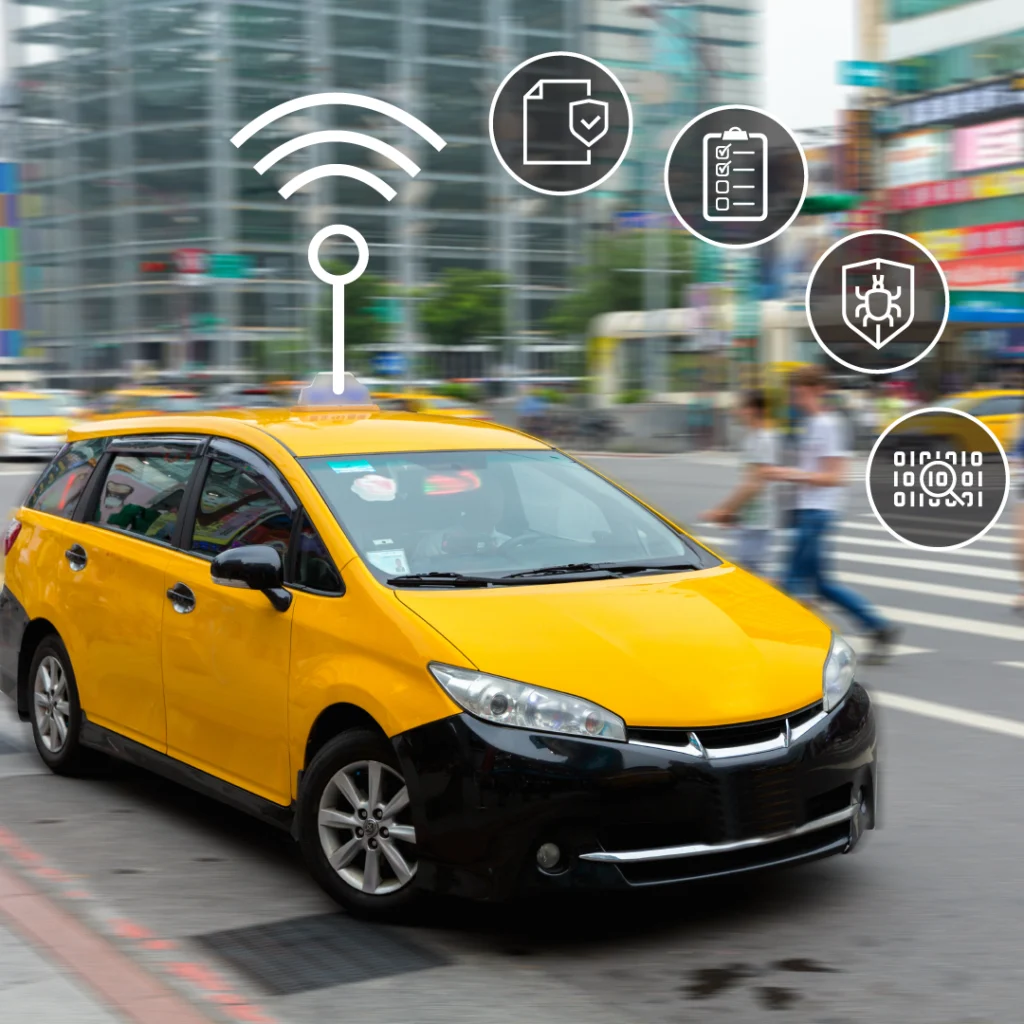
4 Major Regulatory Hurdles in the Autonomous Driving Space

Autonomous driving as a field is booming. As many automotive manufacturers integrate autonomous technologies in their vehicles, fully autonomous cars are becoming a mere stone’s toss away. In fact, the competition has only intensified; Waymo now runs public robotaxi services across several U.S. cities, while Tesla and challengers like Wayve race to prove their full self-driving stacks. Yet for all this progress, some of the biggest challenges in autonomous driving today are less about the technology itself than the regulatory hurdles surrounding it.

Regulations for autonomous driving typically focus on two key areas: safety and performance. This article is mostly focused on the regulatory and legislative hurdles regarding the safety of automated driving and autonomous vehicles. Those regulatory challenges rarely stand alone. The key challenges in developing software for autonomous vehicles, from perception and edge-case handling to validation and testing, feed directly into the safety questions regulators are trying to answer. Below, we break down four major regulatory challenges for autonomous vehicles, and how your enterprise can stay ahead of them.

1. Liability and Autonomous Vehicles

No means of transportation is without its hiccups. And unfortunately, autonomous driving has had numerous fatal accidents, with eleven recorded in 2022 alone. Currently, all autonomous auto manufacturers are required to report accidents to the National Highway Traffic Safety Administration. Those figures have only climbed as deployments scale; under NHTSA’s Standing General Order, manufacturers and operators have reported well over 800 crashes involving automated and driver-assist systems since mandatory reporting began in 2021, and the order was tightened again in 2025.

The points of failure in an autonomous vehicle are a little more nebulous, and concerns have surfaced about who is liable in an accident. Since the cars are not fully autonomous, the accident could be from driver carelessness. Or they could be a result of software malfunctions or mechanical failures. As the technology improves and cars become more autonomous, the accident liability will shift toward the manufacturers and developers. There is no clear-cut solution yet, as the issue has yet to mature.

A Problem of Interwoven Pieces

Autonomous vehicles are complex. There’s a lot of interconnectivity between the various pieces that power and control them. Some speculate that as liability shifts to developers and manufacturers, it will pose some severe hurdles to overcome per incident.

Those making the AVs must analyze every component of the vehicle and perhaps even divulge the proprietary software suites that power the car while assisting law enforcement.

2. Federal and State Regulations

The first road safety initiatives began years before computer chips ever graced automobiles. Much has changed in automotive technology since, but the regulatory bodies are slower to catch up. Currently, there isn’t a wide-sweeping federal regulation governing fully autonomous vehicles. That may finally be shifting. In early 2026, lawmakers reintroduced the SELF DRIVE Act, which would be the first federal statute dedicated to autonomous-vehicle safety, and in mid-2026, NHTSA proposed amending its light-vehicle brake standard (FMVSS No. 135) to accommodate vehicles built without a human driver. Both moves signal that a clearer federal framework, a long-standing gap behind many regulatory challenges for autonomous vehicles, is inching closer.

The NHTSA has made some provisions regarding autonomous vehicles and specific safety feature requirements. This is a positive sign since the safety features that auto manufacturers must include are congruent with autonomous vehicle technologies.

State Laws

Only 43 states out of 50 have legislation regarding automated vehicles. Some are restrictive, while others depend on each vehicle’s SAE automation level. Liability insurance factors into most of these laws since every state save Hawaii and Virginia requires it. This patchwork keeps shifting in 2025, and states including Arizona, Louisiana, Montana, and Nevada plus Washington, D.C. enacted or updated autonomous-vehicle laws, and the NCSL legislation tracker remains the most reliable live count. For operators, this uneven map is one of the defining regulatory hurdles, and it grows more complex the moment you look at autonomous trucks crossing state lines or compare the regulatory hurdles for autonomous trucks in Europe and the US.

The other seven states haven’t enacted laws regarding autonomous vehicles, and there is no indication of when legislation might be drafted. Multiple states also require licensure for mandated drivers, adding another logistics drain onto larger fleet deployments.

Federal Laws

The only federal-level agency providing some oversight over autonomous driving is the previously mentioned NHTSA. Federal regulation currently stipulates safety features, not the deployment of large commercial autonomous vehicle fleets. This isn’t necessarily bad, but a lack of an overarching baseline may cause future headaches for manufacturers.

Limited federal regulations also mean manufacturers must consider various state laws when developing and deploying autonomous vehicles.

3. Cybersecurity of Autonomous Vehicles

Tech magnates worldwide have bolstered their cybersecurity after hard-learned lessons, including cyber attacks, extreme platform compromises, and significant money lost due to offline systems. Yet the nascent autonomous driving space hasn’t fully accounted for their lack of protected systems. And if a server goes down and a vehicle is compromised, the effects would not only be money and time lost but potentially lives.

Despite the technological marvels surrounding AVs, there isn’t much cybersecurity support. These vehicles have diverse means of connectivity, leaving many open attack vectors. For example, the Internet of Things (IoT) has long been a highly vulnerable method of communication. Many AVs communicate with smart devices in the home, and security measures haven’t yet been fully developed to address potential attacks.

Much could be done to bolster and harden the systems around autonomous vehicles. Encrypted digital transmission has been present in IoT for quite some time. Hardened entry points requiring user authentication could mitigate possible actions and deter bad actors.

A clear and effective incident response to a systems breach is now a necessity, as it provides a blueprint for how to respond to a compromised vehicle.

4. Data Usage and Privacy Concerns

Along with the lack of security, there is the question of what data auto manufacturers collect and how they use it.

We can expect manufacturers to collect performance metrics, but gathering personalized data presents grave privacy concerns. Regulatory bodies have already addressed the data collected in the medical, financial, and educational sectors. So perhaps it’s a matter of time before additional regulations develop regarding manufacturers’ collection and safeguarding of personal data.

Other concerns arise regarding what the companies do with the data collected from their autonomous vehicles. Location data gives a glimpse at the patterns and lifestyle of the operator of any autonomous vehicle, and it would be a simple step to leverage that data into marketing materials and betray the trust of a potential customer.

Current American legislative regulations regarding data collection could be adapted to provide some degree of security for user data. New legislation and regulations could further impact how manufacturers use the data gathered by AVs.

How to Position Your Enterprise at the Forefront of AD Policies

With all these concerns, how would you move forward?

Here are some steps that you can take to move forward and position your enterprise at the forefront of these policies and regulations.

  1. Liability: Your organization can handle self-reporting, which helps maintain paper trails for all incidents and prepares your staff to respond appropriately to any incidents.
  2. Federal and State Regulations: Maintaining liaisons with regulatory bodies nationwide could benefit your enterprise. It’s also best to adhere to good practices and industry-standard software stacks when approaching the development of these platforms.
  3. Cybersecurity: Cybersecurity has many glaring issues, but you could strengthen your organization by adopting some of the principles AI and ML companies use.
  4. Data: Software stacks could and should adhere to ISO standards regarding intelligent transport systems, like ISO 22737:2021. Data usage should be self-regulated, as there aren’t provisions for the safest practices concerning the protection of customer data.

Frequently Asked Questions

What regulatory challenges do full self-driving technologies face?

Full self-driving technologies face four intertwined regulatory challenges: unresolved liability when no human is truly in control, a patchwork of state laws layered over limited federal rules, thin cybersecurity requirements, and unsettled data-privacy standards. Until a wide-sweeping federal framework matures, deployment decisions still hinge largely on where a vehicle operates and which SAE automation level it uses.

What are the key challenges in developing software for autonomous vehicles?

Beyond regulation, the key challenges in developing software for autonomous vehicles include reliable perception in poor weather and low light, handling the long tail of edge cases the system was never explicitly trained on, fusing data across cameras, radar, and LiDAR, and validating that the driving stack behaves safely across millions of real-world scenarios. These engineering hurdles are also regulatory ones, because manufacturers increasingly have to document a safety case that proves the software performs as intended.

What are the regulatory hurdles for autonomous trucks in Europe and the US?

Autonomous trucks face the same core issues as passenger AVs, amplified by size, weight, and cross-border operation. In the US, trucks must navigate the same state-by-state patchwork, including commercial licensing and insurance rules, while a single long haul can cross several jurisdictions. In Europe, operators contend with EU-level type-approval and safety frameworks alongside individual national rules, so a truck cleared in one member state may still face extra requirements in another.

What are the main challenges in autonomous driving today?

The main challenges in autonomous driving fall into two buckets. Technically, autonomous vehicle challenges center on perception, edge cases, and safety validation. On the policy side, the regulatory challenges for autonomous vehicles- liability, fragmented federal and state regulations, cybersecurity, and data privacy- are what most often slow real-world deployment, even once the technology is ready.


Are you looking to integrate standard software solutions for your autonomous driving firm? Digital Divide Data provides data annotation services with SOC 2 Type 2 and ISO 27001 certification.

4 Major Regulatory Hurdles in the Autonomous Driving Space Read Post »

Car Aerial Annotated 01 1

Determining The New Gold Standard of Autonomous Driving

Autonomous driving is on the cusp of widespread adoption. As more manufacturers across the globe begin implementing AD systems in their vehicles, it is only a matter of time before it becomes a regular feature in future automobiles. And with the rise in popularity of AD systems comes a need for standardization.

Emerging standards are beginning to regulate how manufacturers approach navigation, safety, and AD modeling quality. These standards also influence policy creation, technology use, and the general framework for AD systems. Creating standard systems for these AD models will lead to a more uniform approach toward autonomous driving models.

An Overview of the Tech Behind Autonomous Driving

While the idea of autonomous driving dates back centuries with Leonardo da Vinci’s inventions, most of the tech has been developed in the last few decades. After Navlab5’s self-steering vehicle made headlines in the ’90s, autonomous driving really took off.

The first AD production vehicle started with Tesla’s Autopilot, an SAE 1 implementation that offered parking assistance and automated driver-assistive processes. Tesla doesn’t provide a fully autonomous platform for their production vehicles, but the Autopilot helped gauge interest in the general public.

Other manufacturers are also spearheading their own development of AD vehicles. For example, Volvo’s recent acquisition of Zenseact, a leading software and hardware developer for autonomous driving, shows the company’s commitment to producing a fully autonomous vehicle. Volvo has also started implementing more sophisticated technologies like LiDAR for its AD driving platforms.

LiDAR and other data annotation methods – like bounding boxes, polygons, and key points – have become ubiquitous in the autonomous driving space. These annotation methods rely on trained AI models with massive data sets that provide accurate information to the vehicle in real time so it can adapt and adjust to conditions on the road.

It’s extremely time-consuming to develop models, so there are still limitations, like a reliance on the driver to make crucial driving decisions. Still, this progress is leaps and bounds from where the earlier assistive processes were just a few years ago.

State governments in the United States have already convened and passed legislation regarding autonomous vehicles on public roadways. The most noteworthy is California, which has the most comprehensive regulations for autonomous vehicles. No federal legislature permits the deployment of fully autonomous vehicles yet. It operates more on a state-by-state basis.

The Standards Fueling AD’s Mass Adoption

Common methods and standards have grown around the autonomous driving industry. Some of these are just general classifications, and others go down to how the vehicles actually function. As the market around AD grows, it only makes sense that there are more robust systems taking hold to define how these vehicles should safely and effectively operate.

SAE and IEEE

SAE and IEEE have convened and already passed their own guidelines defining what autonomous vehicles are and how to classify them. IEEE has more exhaustive standards regarding safety on public roadways and connectivity between other cars. These aren’t necessarily driving the actual development behind Autonomous Driving. But they show that AD has reached a somewhat wide-scale acceptance among the various bodies developing the hardware and software that fuels it.

Simulations

Simulation is a vital method for developing and testing autonomous driving technology, enabling engineers and researchers to create a virtual environment that mirrors real-world conditions without putting people or property at risk. Simulation offers several benefits to developers, including cost-effectiveness, replicability, safety, scalability, and flexibility.

The cost of building and testing a physical vehicle can be high, but simulation can reduce expenses significantly. Simulating various driving scenarios in a virtual environment can help developers identify potential problems and make necessary adjustments without requiring physical testing, saving both time and money.

Simulations are highly replicable, meaning that a particular scenario can be repeated many times to test different algorithms, sensor configurations, or other variables. This enables developers to gather large amounts of data and draw reliable conclusions from their experiments, providing the necessary information to create efficient autonomous driving systems.

Simulation offers safety benefits as well. As autonomous driving technology is still in its early stages, testing in the real world can be risky. Simulating scenarios allows developers to test their technology in a safe environment, reducing the risk of accidents or injury.

Scalability is another benefit of simulation, as it can handle large amounts of data, allowing developers to test various algorithms and scenarios at the same time, while flexibility enables quick modification of variables and testing of different scenarios, reducing the time it takes to identify and address potential issues.

Vision Performance Standards

Much like the human driver behind the wheel, an autonomous vehicle needs a constant feed of visual data to interpret its environs. Visual performance is a crucial component behind autonomous driving and enables the car to recognize objects and react appropriately to them on the roadways. There are a few emerging standards empowering this innovation. For example, Intersection over Union (IoU), Average Precision (AP), and Mean Average Precision provide guidelines for visual processing implementation.

AP and IoU function similarly, dictating the visual detection system’s accuracy in predicting the movement of detected objects. Mean Average Precision can work like AP, but it looks at numerous data sets to effectively process visual detection.

System Implementation Standards

LiDAR is one of the many standard systems emerging behind autonomous vehicles. Beyond just bare visual processing and prediction, LiDAR helps accurately map a car’s surrounding environment. It isn’t intended for the predictive positioning of objects necessarily but provides a quicker and more accurate image using light. Think of it as a more refined and advanced take on the role radar has served in assistive technologies.

Radar in vehicles has been a cornerstone for autonomous driving for a few years. It has helped inform collision detection, lane keeping, and blind spot awareness. Plus, radar works with robust visual imaging suites and LiDAR for complete awareness of everything around the vehicle.

NHTSA

The National Highway Traffic Safety Administration is making real headway toward providing guidelines about what AD needs to be truly ready for America’s roads. The NHTSA has done quite a bit in standardizing automobile safety features over the past few years and made 2016-2025 safety feature stipulations for auto manufacturers. These recent additions are partially automated and very much in line with the aims and goals of autonomous driving. They also include items like lane-keeping assists, adaptive cruise control, and traffic jam assists. NHTSA has a stated goal for all new automobiles manufactured in the United States to have fully automated safety features from 2025 onward. With the headways made in the aforementioned systems, they very well may be on their way to ushering in autonomous driving across a wide swathe of vehicles.

Moving Forward With Autonomous Driving

Autonomous driving has progressed significantly toward providing standardized systems and guidelines for developing autonomous vehicles. As these vehicles – and their technology – mature, there will only be more robust frameworks and guidelines to bolster them.

Are you looking to integrate actionable experience towards developing your own autonomous driving systems? Digital Divide Data has the means and experience to develop robust systems adhering to the guidelines mentioned in this article. We offer support for a wide variety of visual imaging, object classification, and semantic segmentation. If you’re looking to bolster your AD platform, choose DDD to supply industry know-how for your data annotation.

Determining The New Gold Standard of Autonomous Driving Read Post »

DDD WorldAgriTech 2023

World Agri-Tech Innovation Summit 2023

San francisco, ca
MARCH 14-15

MEET WITH DDD IN SAN FRANCISCO

DDD is helping leading Agricultural Technology companies that are innovating in modern farming. We will be in World Agri-Tech to meet leading farmers, growers, leaders, scientists, and more.

Interested in speaking/meeting with us? Setup a time here.

World Agri-Tech Innovation Summit 2023 Read Post »

DDD CVPR 2023

CVPR 2023

Vancouver, Canada
june 18-22

Silver Sponsors!

We are Silver Sponsors at the 2023 CVPR Conference. This year’s conference will take place at the Vancouver Convention Center and gathers thousands of professionals, students, and leading organizations for a week of discovery, learning, networking, and more.

Visit our booth and see how we’re helping deliver successful Computer Vision programs. Or schedule a time to talk to us about your project by clicking the button below.

CVPR 2023 Read Post »

DDD AutonomousVehicles 2023

Autonomous Vehicles USA 2023

Anaheim, CALIFORNIA
APRIL 17-18

Gold Sponsors!

We are excited to announce our Gold sponsorship for the 2023 Autonomous Vehicles forum! The event will take place April 17-18 in Los Angeles and will connect leaders in automated vehicle technologies from around the world. Schedule a time to come by our booth and see what’s new!

Autonomous Vehicles USA 2023 Read Post »

DDD StreetAnnotated 2

How Data Labeling and Annotation Are Fueling Autonomous Driving’s Global Movement

By Abhilash Malluru
Feb 1, 2023

Autonomous driving is becoming more prevalent worldwide, garnering increased interest in optimizing technology through data labeling and annotation from investors and developers alike. With that growing interest comes an emerging need for experienced developers who can develop the tools and processes necessary for driver behavior monitoring, self-parking, motion planning, and traffic mapping. At the heart of this progress is data labeling for autonomous vehicles; the work of turning raw camera, LiDAR, and sensor feeds into the structured training data that self-driving systems learn from.

Growing acceptance of autonomous driving has led to several approaches to advancing data labeling, annotation, and other machine learning processes. As these become standardized and more widely accepted in the industry, it’s crucial to understand the difficulties and obstacles that might arise in deploying them to any autonomous driving development platform.

Data Labeling and Annotation Strategies for Autonomous Vehicle Applications

Choosing the right mix of data annotation for autonomous vehicles depends on your sensor stack, operating environment, and the level of autonomy you are building toward. The standard methods regarding the implementation of data labeling and annotation are as follows:

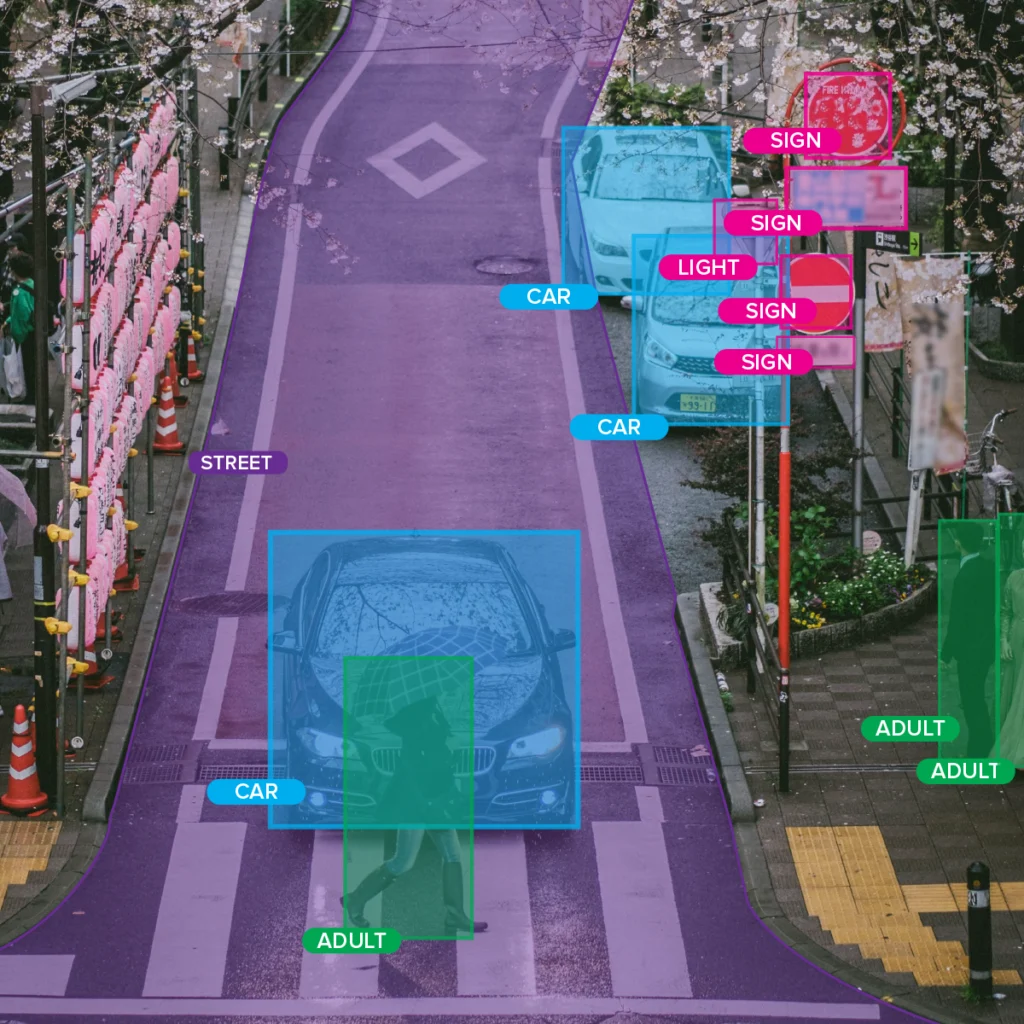
  • Bounding Boxes

  • Semantic segmentation

  • Polylines

  • Video Frame Annotation

  • Keypoints

  • Polygons

What Objects Should Be Labeled in a Traffic-Safety Dataset?

Before choosing an annotation method, teams need to agree on what to annotate. In a standard traffic-safety dataset for autonomous driving, the objects that should be labeled typically include other vehicles (cars, trucks, buses, and motorcycles), pedestrians and cyclists, traffic lights and their current state, traffic signs, lane markings, road boundaries, drivable surfaces and sidewalks, and temporary obstacles such as construction cones or debris. 

Labeling these classes consistently across image, video, and LiDAR data is what allows a model to perceive a scene the way a cautious human driver would. The annotation techniques below each play a role in capturing these objects with the precision autonomous systems require.

Bounding Boxes – Crucial for Robotaxis

2D bounding box annotation uses video or image annotation to identify and spatially place objects. It first maps items to develop datasets, then machine learning models use those datasets to localize objects. Depending on the method deployed, it can support various tags or text extraction for things like street signs.

This annotation technique is vital for an autonomous vehicle or robotaxi’s navigation. It relies heavily upon complex logic systems and requires additional inputs to differentiate for decision-making, meaning it requires significantly large quantities of data and human input for the vehicle to operate effectively and safely.

Partnering with firms that have extensive experience in this method, like any reputable managed service model (MSM), can help you implement and deploy a technique like bounding boxes. A managed service provider (MSP) has both a data annotation workforce and expert consultants who can help guide your needs and pinpoint any difficulties or obstacles that might arise.

Semantic Segmentation to Identify Humans from Objects

Semantic segmentation is a technique that relies on a computer’s optical input to divide images into different components and label them by each pixel. This process is crucial to identify different types of objects so that a system can make a decision. For example, semantic segmentation helps a system identify people in a crosswalk. It may not know how many, but the point that people are crossing is enough to influence the decision-making process.

However, the most significant hurdle is that semantic segmentation is incredibly time-consuming. And this is where a dedicated team of SMEs from a third-party platform becomes invaluable. MSMs enable any organization seeking to implement semantic segmentation toolchains for this absolutely crucial process.

Since DDD’s workforce is trained in standard models and data annotation methods, they can help establish efficient and steady workflows while minimizing operational costs. These experts can handle such laborious tasks as semantic segmentation so you can place your focus elsewhere, ensuring you can complete other project needs before deliverables are due.

Polylines – Crucial for Overall Road System

This image annotation method enables the visualization and identification of lanes, including bicycle lanes, lane directions, diverging lanes, and oncoming traffic. Polylines require extensive data sets to be successfully labeled and deployed.

Polylines are crucial for autonomous driving as a means of lane detection. Accurate and consistent modeling allows for navigation and the avoidance of obstacles. Plus, models can be trained further so they better adhere to relevant traffic laws by detecting road markings and signs. MSMs can help offload some of the enormous overhead that goes into developing the toolchains necessary for polylines.

Video Frame Annotation – Necessary for Object Detection

Autonomous vehicles can use video annotation to identify, classify, and recognize objects and lanes. It can work in conjunction with techniques like semantic segmentation and polylines. Video frame annotation is necessary for more accurate object detection and works in conjunction with other annotation methods to provide accurate results.

Video annotation is time-consuming as it relies upon analyzing and data labeling thousands of video frames. Whether your platform is leveraging video and image annotation for autonomous vehicles or robotaxis, partnering with a third-party service can drastically reduce the time needed to implement this form of data annotation.

Keypoints – Giving Robotaxis Adaptability

Data drives both autonomous vehicles and the development of the systems which guide them. Keypoints provide a frame of reference for objects that might change shape by leveraging multiple consecutive points.

As with most of the techniques related to autonomous vehicles or robotaxis, this form of data annotation is a very consuming and costly process. While much of the modeling that goes into what serves a self-driving vehicle needs elements of artificial intelligence or machine learning, a human component must still input the points on the sets processed for data labeling.

Nothing encountered on the road will remain static, doubly so for those using autonomous vehicles in metropolitan areas. With this type of data labeling, leveraging an organization with actionable domain experience like MSMs can help develop streamlined methods and toolchains. Cost is dictated per hour or unit, and DDD’s staff brings much experience in standardized data labeling and annotation methods.

Polygons – Greater Precision for Visual Processing

Polygons operate like bounding boxes for visual data annotation. Irregular objects and accurate object detection greatly benefit from the implementation of polygonal data annotation. Polygonal annotation can have far greater precision than the bounding box method. When properly implemented, it helps detect things like obstructions, sidewalks, and the sides of the roads.

Polygonal annotation is a vital step in the autonomous driving model. Objects are very rarely uniform, and as such this method of annotation has a crucial function in making effective and safe models for the sake of detection and recognition. Its integration into your workflow comes from it being a time-consuming process. Compared to methods like bounding box annotation, it requires even more resources and time to correctly integrate. Engaging an MSM to help provide a platform can significantly reduce the time needed to implement this into your autonomous driving toolchain. Leveraging a third-party resource with actionable and proven experience can easily lead to greater precision in your detection model.

Get Started With a Data Labeling Service

The past few years have made it abundantly clear that autonomous driving is here to stay, and leveraging another organization’s expertise in your workflow frees up valuable resources and manpower that could be better spent on other aspects of project development. Plus, we can’t ignore the time it takes to invest and develop these annotation methods.

So if you’re developing the technologies and models that power autonomous driving, it’s worth considering outsourcing at least some of the workflows to a third-party vendor. MSMs like Digital Divide Data (DDD) provide a platform to help you and your staff overcome some of the pitfalls of developing systems for autonomous driving. From image annotation for autonomous vehicles to full LiDAR and video pipelines, an experienced data labeling partner can scale these workflows up or down as your autonomous driving program matures.

Data labeling and data annotation alike are diverse and complicated fields of work. You can discuss your project needs and requirements with the DDD staff today. By partnering with us, you gain access to a developed platform that delivers exceptional results for your digital labeling and annotation needs. Let’s discuss your project requirements today.

Frequently Asked Questions

What is data labeling for autonomous vehicles?

Data labeling for autonomous vehicles is the process of tagging objects and features in camera, video, LiDAR, and sensor data so a self-driving system can learn to recognize them. Accurate labels for elements like vehicles, pedestrians, lanes, and signs are what turn raw driving footage into usable training data for perception and decision-making models.

Which data annotation methods are used for autonomous driving?

The most common data annotation methods for autonomous driving are 2D bounding boxes, semantic segmentation, polylines, video frame annotation, keypoints, and polygons. Most programs combine several of these, since each method captures a different aspect of a scene, from lane geometry to irregular object shapes.

What objects should be labeled in a traffic-safety dataset?

A standard traffic-safety dataset should label other vehicles, pedestrians and cyclists, traffic lights and their state, traffic signs, lane markings and road boundaries, drivable surfaces and sidewalks, and temporary obstacles such as cones or debris. Labeling these classes consistently across sensors lets the model interpret a scene the way a cautious human driver would.

What is the difference between 2D bounding box and polygon annotation?

A 2D bounding box draws a simple rectangle around an object, which is fast and works well for regularly shaped items like cars or street signs. Polygon annotation traces an object’s actual outline, offering far greater precision for irregular shapes such as sidewalks, obstructions, and road edges, at the cost of more time and resources.

Should you outsource autonomous vehicle data labeling and annotation?

For most teams, yes, at least partially. Annotation methods like semantic segmentation and polygons are labor-intensive to build and maintain, so partnering with a managed service model (MSM) such as DDD frees your engineers to focus on model development while a trained annotation workforce scales the labeling pipeline up or down as needed.

How Data Labeling and Annotation Are Fueling Autonomous Driving’s Global Movement Read Post »

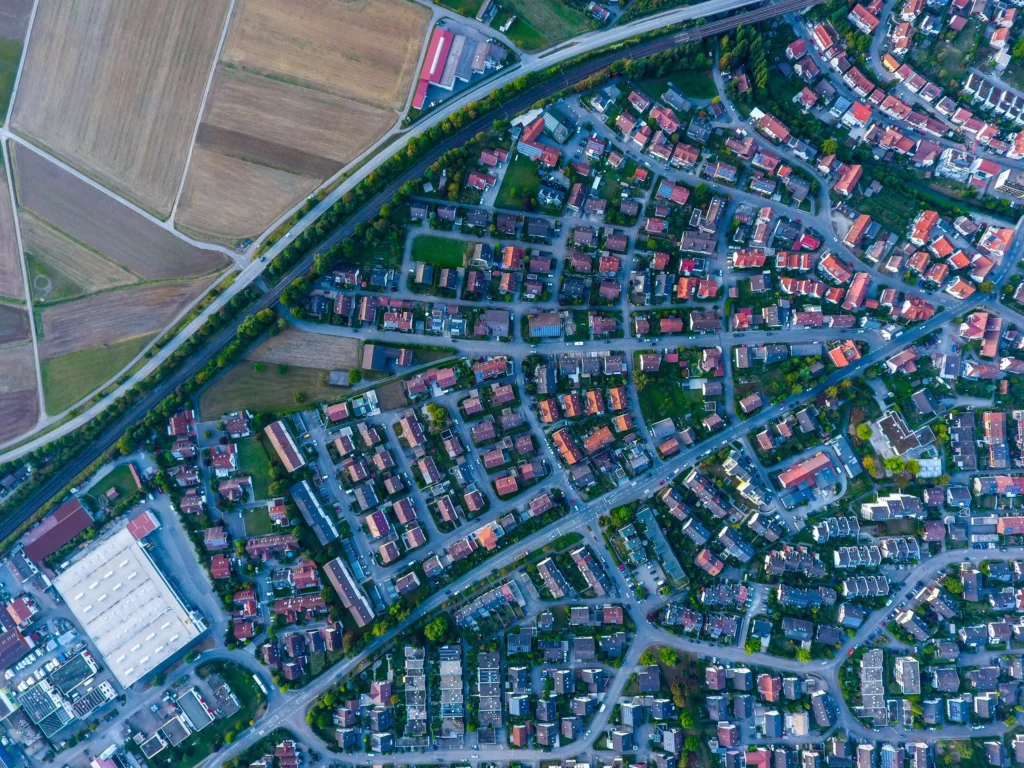
Aerial imagery of residential buildings and roads used for geospatial machine learning training data

Using Aerial Imagery as Training Data

Numerous industries use satellite and aerial imagery to apply machine learning to business and social problem sets. This is a particular strength for DDD given our experience in geospatial and aerial use cases in insurance, transportation, meteorology, environmental protection, agriculture, law enforcement, national security, remote delivery, and traffic management.

This experience has taught us a great deal about the challenges and pitfalls associated with aerial image segmentation. We aired a webinar on this subject, and you can view the recording on-demand. Our goal is to deliver a hands-on guide to overcoming these challenges.

Price of failure

Consider the cost of inadequately or incorrectly training an algorithm to evaluate geospatial or aerial images. Say the project is agricultural. Can you imagine the impact of incorrectly identifying crop disease or inadequate irrigation? Or say the project is military. What are the potential costs of misidentifying an elementary school as an army barracks? You need to include the expected cost of this kind of failure into your DIY vs outsource equation.

Workforce

Aerial and geospatial images are often very large and very detailed, meaning that a large workforce of labelers is required to generate sufficient volumes of training data in a timely fashion. In our experience, most data science teams don’t have access to an in-house workforce big enough to meet their training data demands. This lack of a workforce is one of the principal drivers of seeking a training data partner.

Data volumes

Keep in mind that you may be able to support in-house data preparation for an initial, simple use case, but in your quest for greater levels of model confidence, you will have to train your algorithm on additional use cases, and eventually edge cases. You may be able to generate enough data in-house to train an algorithm to land a delivery drone on a simple graphical market, but what does it take to distinguish between a leaf on the marker and a three-year-old child? Each additional use case requires at least as much training data as the first one, and rarely-occurring edge cases may require significantly more data. This dramatically compounds your workforce requirements, a discovery that many data science teams make late in their projects when budgets are dwindling and deadlines are imminent.

Process and tools

Extremely high-resolution images are far too large to assign to a single labeler. But breaking up images, assigning them to multiple labelers, and then reassembling everything coherently introduces issues around worker consistency and process management. Do you have the wherewithal to train consistency into your own workforce? Do you have the technology and process required to track changes to very high numbers of image fragments? Most data science teams don’t.

Specialization

Are you confident that you can define the most efficient tasks required to label your training data? We had a client who wanted us to label every individual tree in enormous hi-res forest images. As it happened, they weren’t interested in tree density; rather, they were trying to detect illegal land clearing. Because we have been preparing training data for decades, we were able to show them a different approach to labeling their images that appropriately trained their algorithm, but at a fraction of the time and cost of their approach.

Focus

Preparing training data for aerial and geospatial systems involves the application of human judgment to nuanced, and sometimes hard to decipher, images. Our own data shows that the longer individuals spend on a particular kind of interpretation the faster and more accurate they do the work. Data science teams that crowdsource their aerial segmentation work do not capture these workforce efficiencies. DDD assigns you a team that stays with you throughout the span of your project, meaning that you capture all the benefits of growing worker efficiency and your effective cost per transaction steadily declines.

Using Aerial Imagery as Training Data Read Post »

fleet operations

Announcing the Launch of Autonomous Fleet Ops

Detroit, MI, USA: Digital Divide Data (DDD) continues to expand its end-to-end data capabilities for Autonomous Systems across land, air, sea, and space. Our latest solution set is targeted towards supporting Autonomous Fleet Operations including Human in the Loop (HiTL) data solutions for:

(A) Remote Teleoperations to enable full Autonomy

(B) Operational Data Intelligence to gather ODD exposure and mission intel insights

(C) Fleet Management functions surrounding the capabilities of mission command and control

(D) In-Cabin Monitoring to drive forward the safety of ADAS systems

“Remote Teleoperations as a Service” is growing rapidly across the globe to augment the core Autonomous premise of any system, and to unlock L3+ and L4 SAE levels of Autonomy. Similarly, using Operational Data Intelligence is an essential part of the fleet operations and is aimed at most effectively deploying assets across multiple sites; be it for testing, or data collection. Cabin Monitoring serves a critical role to directly support any Autonomy company’s CONOPS for safer and reliable operations.

DDD’s in-house expertise on these workflows and ability to stand-up US (onshore) or offshore operations in a lightning quick span of 10 days[1] is a (critical) market differentiating USP necessary to advance the autonomy tech.

“DDD’s Fleet Operation solutions coupled with data operations support services gives our clients the ability to deliver accelerated fleet deployment and management with controlled, scaleable, and cost effective outcomes”, says Sameer Raina, DDD CEO and President.

DDD is actively in pursuit of value-added technology partners to make its Fleet Operations ecosystem robust, scalable and diverse. DDD’s acquisition of Liberty Source PBC in 2024 has supplemented the workforce to have a direct on the ground US presence, vital to unlock low latency – high data security workflows. DDD’s social impact mission, operational excellence of a global workforce (US, Africa, Asia), deep subject matter expertise in Autonomy and toolchain partnerships uniquely positions the team to be an industry leader in providing such end-to-end Autonomy HiTL data solutions.

[1] 10 business days is the average time to set-up a pilot project for an Autonomy focused workflow. Not specific to the Fleet Operations capability.

Announcing the Launch of Autonomous Fleet Ops Read Post »

Scroll to Top