
Multimodal dataset creation fails at the seams between modalities more often than inside them. Labels can be individually correct in image, text, audio, and LiDAR while the correspondence linking them is wrong, and that correspondence is the signal a multimodal model actually learns. Teams buying AI dataset preparation services should rank temporal synchronization, spatial calibration, and semantic correspondence above per-modality label accuracy when they set acceptance criteria.
A vision-language model trains cleanly, clears every per-modality quality gate, and then grounds the wrong object to the referring phrase at inference. Annotation programs that run each stream as a separate labeling project produce this outcome consistently. Programs that hold up define inter-modal relationships before the first frame is labeled, which is what multimodal data annotation workflows are built to enforce, and they carry those relationships through ingestion and normalization as first-class objects rather than as metadata.
Key Takeaways
- The value of a multimodal dataset sits in the connections between its parts, so the link between a picture and its description matters as much as either one on its own.
- Most problems come from those connections being wrong, usually because the sensors ran on slightly different clocks or shifted out of position during collection.
- Image-and-text pairs pulled from the web are frequently mismatched, and a large share has to be discarded or rewritten before it can be used.
- Labeling several data types together is slower and more demanding than labeling one, partly because most tools only show one at a time.
- Checking each data type separately can look perfectly clean even when the connections between them are broken, so those connections need checks of their own.
- Providers who split the work into separate teams by data type and combine the results at the end are the ones most likely to deliver these hidden problems.
What is a multimodal training dataset, and how does it differ from single-modality data?
A multimodal training dataset pairs two or more data types into records where the relationship between the types carries the supervision signal. The types include image, video, text, audio, LiDAR point clouds, radar returns, IMU traces, and vehicle telemetry. Building these records is the domain of multi-sensor fusion data services, which handle calibration and correspondence alongside labeling. The distinction from single-modality data is structural: a unimodal label describes a sample, while a multimodal label describes a sample plus its correspondence to every other stream in the record.
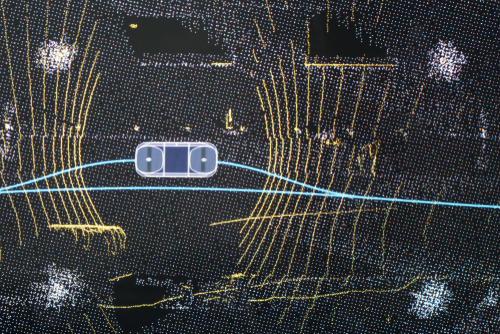
Four configurations account for most enterprise programs today; Image-text datasets support captioning, visual question answering, and referring-expression grounding. Video-audio datasets support audiovisual speech recognition and event detection. Sensor-language datasets support vision-language-action (VLA) models and instruction-following robots. Multi-sensor perception datasets combine camera, LiDAR, and radar for autonomy and ADAS stacks.
The terminology is worth fixing early, because vendors use it loosely. Cross-modal alignment (also called modality alignment or inter-modal correspondence) is the assertion that a specific element in one modality refers to a specific element in another. Temporal synchronization is alignment along the time axis. Spatial calibration is alignment in a shared coordinate frame. Together, these properties help models connect information accurately across modalities and are essential for reliable multimodal training and evaluation.
Why is cross-modal alignment the hardest part of multimodal dataset creation?
Alignment is hard because it is the one property no single annotator owns and no single tool validates. A LiDAR specialist places a cuboid correctly. A vision annotator draws a correct 2D box. Neither is positioned to notice that the two describe different objects, because neither is looking at both. The error is invisible at the point of production and expensive at the point of training.
The organizational root cause is consistent across programs. Work is split by modality because that is how annotation capacity is staffed and priced, and the outputs are merged at the end of the pipeline. The merge step assumes a correspondence that nobody was assigned to produce. What comes out is a dataset where every label is defensible in isolation and the joins between them are unverified, which is the specific condition that degrades grounding, retrieval, and fusion performance without showing up in any per-modality report.
What does temporal synchronization actually require?
Sensors run on independent clocks at different rates, and the offsets between them are not constant. A camera at 30 Hz, a LiDAR at 10 Hz, and a radar at 20 Hz produce three timestamp grids that never natively coincide. Closing this requires a shared time base, meaning PTP or GPS-disciplined clocks, plus hardware triggering where the sensor supports it and an explicit interpolation policy where it does not.
The tolerance is tighter than most teams assume. A vehicle at 60 km/h covers roughly 16.7 mm per millisecond. A 50 ms synchronization error displaces a tracked object by more than 80 cm, which is enough to move a pedestrian from the curb into the lane in the training label. Rolling-shutter cameras add a further per-row offset that a single frame timestamp does not capture. The operational discipline behind synchronized multi-sensor data labeling is mostly clock management, and only secondarily annotation.
What breaks spatial alignment between sensors?
Thermal cycling, road vibration, and minor collisions shift sensor mounting over a collection campaign, and a calibration validated in week one is often stale by week six or eight. Datasets built without a re-calibration cadence accumulate projection error that looks like annotator noise on a QA dashboard.
The practical controls are straightforward and frequently skipped:
- Re-validate extrinsics on a fixed schedule and after any physical disturbance to the rig.
- Store calibration parameters as versioned artifacts attached to each collection segment, not as a single global file.
- Compute reprojection residuals per segment and quarantine segments that exceed a stated pixel threshold.
- Treat calibration drift as a data quality metric with its own acceptance band.
How do you align image and text data for multimodal AI training?
Image-text alignment has a different failure mode; the pairing is usually inherited rather than created. Web-scraped alt-text and surrounding captions are weak supervision, and a large fraction of pairs are semantically unrelated. Work on the DataComp benchmark for multimodal dataset design established that filtering strategy, rather than pool size, drives downstream model quality. Its curated one-billion-pair subset outperformed a comparable OpenAI CLIP baseline under identical training compute.
The economics are severe. Research on improving multimodal datasets with image captioning notes that standard alignment filters discard between 60% and 90% of collected pairs, often removing usable images because the accompanying text is poor. Three approaches raise alignment quality:
Embedding-score filtering: Rank pairs by image-text similarity and cut below a threshold. Cheap, and biased against images containing rendered text.
Caption regeneration: Replace weak alt-text with model-generated descriptions, then human-verify a sample. Recovers otherwise discarded images.
Region-phrase grounding annotation: Have annotators link noun phrases to image regions explicitly. Expensive, and the only method that produces fine-grained correspondence rather than document-level association.
A survey introducing vision-language modeling methods groups these into heuristic pruning, model-based ranking, and diversity balancing, and consistently finds that pruning is a required stage rather than an optimization.
What makes multimodal data annotation harder than standard annotation?
Five factors compound, and they are structural rather than a matter of annotator skill.
Cognitive load per unit of work: An annotator holding a point cloud, two camera views, and a transcript in working memory produces fewer correct judgments per hour than one drawing boxes. Throughput assumptions carried over from single-modality projects will be wrong.
Tooling that shows one modality at a time: Most annotation platforms render modalities in separate panes without a linked cursor or shared timeline. Annotators cannot see the correspondence they are being asked to certify.
Schema design becomes a dependency graph: Guidelines must state that every 3D cuboid has a matching 2D box in the linked camera frame, that every dialogue turn has a speaker-attributed audio segment, and what to do when the rule cannot be satisfied.
No single agreement metric applies: Inter-annotator agreement is well defined within a modality. Across modalities there is no standard equivalent, so teams either invent one or measure nothing.
Modalities go missing: Sensors fail, audio channels drop, captions are absent. A survey of deep multimodal learning with missing modality documents how commonly this occurs and how much model robustness depends on it. Whether incomplete records are dropped, imputed, or flagged is a dataset design decision that belongs in the annotation spec.
How do you run modality-specific quality checks without losing cross-modal consistency?
Quality assurance for multimodal datasets needs two layers, and most programs build only the first. Layer one measures per-modality correctness with the metrics each modality already has; bounding-box IoU, transcription word error rate, segmentation boundary accuracy, entity-level F1. Layer one is necessary and tells you almost nothing about alignment.
Layer two measures correspondence directly. Useful checks include the distribution of timestamp deltas between paired samples, reprojection residual between 3D annotations and their 2D counterparts, dual-annotator agreement on link assignment specifically, and retrieval sanity, meaning you sample records and confirm that each modality retrieves its true partner above a chosen rank. These are the metrics that catch the failures your model will exhibit.
Layer two depends on the pipeline carrying the right structure. Correspondence has to persist as an explicit, queryable relationship through ingestion, storage, and export, which is why this belongs in data engineering for AI rather than in the annotation tool. Datasets that encode links only in filenames or directory conventions lose them at the first schema migration. Our breakdown of what 99.5% annotation accuracy actually means in production applies with more force here, because a headline accuracy figure computed per modality can sit above 99% while a meaningful share of cross-modal links are wrong.
What should you look for in AI dataset creation services for multimodal programs?
Vendor capability gaps in this space are specific and testable. Most providers built their operations around single-modality throughput, then added modalities as separate queues. The organizational structure shows up in the data. Evaluating AI training data providers for multimodal work means probing the seams rather than the per-modality capability claims.
Questions that separate capable vendors from optimistic ones:
- How do you establish and monitor a shared time base across sensors, and what is your synchronization tolerance?
- What is your re-calibration cadence, and how are calibration parameters versioned against collection segments?
- Show me your inter-annotator agreement methodology for cross-modal links, as distinct from within-modality agreement.
- Does one annotator see all modalities simultaneously, or do separate teams label separate streams?
- How does your export format represent correspondence, and does it survive a schema change?
- What is your handling policy for records with a missing modality?
A vendor that answers the first four convincingly is running a genuine multimodal operation. A vendor that answers only in terms of per-modality accuracy rates is running parallel single-modality projects.
How do you create a multimodal AI dataset that survives production?
The sequence matters more than any individual step. Define the correspondence schema first, stating for each modality pair which elements must link and what constitutes a valid link. Instrument collection for synchronization before any data is gathered, since retrofitting a time base onto collected data is rarely possible. Annotate in a single pass with all modalities visible, accepting the lower throughput. Audit alignment separately from labels, using layer-two metrics. Then version the dataset with its calibration and synchronization metadata attached, so that a downstream failure can be traced to a collection segment rather than guessed at.
One control is worth building before scale-up. Run a small pilot, hold out a set of records where correspondence is known independently, and measure how many links your pipeline reproduces correctly. A pilot of a few thousand records will surface clock drift, calibration error, and schema ambiguity at a cost that a full campaign will not. Teams that skip this tend to discover the same defects six months later, distributed across a corpus large enough that re-annotation is no longer economic.
How Digital Divide Data Can Help
DDD builds multimodal datasets as single linked workflows rather than parallel labeling queues. Our multimodal data annotation services put annotators in front of every modality in a record at once, with correspondence assertions captured as explicit objects and reviewed under their own agreement protocol. For programs combining camera, LiDAR, radar, and telemetry, our computer vision solutions teams handle projection validation and calibration-drift monitoring as standing quality controls rather than one-time setup tasks.
The operational difference sits in the quality model. We report per-modality accuracy and cross-modal alignment metrics separately, because a combined figure hides the failure mode that matters. Synchronization tolerances, reprojection residual bands, and missing-modality handling rules are agreed before collection begins and audited per delivery batch. Teams working across low-resource languages, specialized sensor configurations, or domain-specific taxonomies get annotation cohorts assembled for that context rather than generalists working from a translated guideline.
Build multimodal datasets where the links between modalities are as reliable as the labels within them. Talk to an Expert.
Conclusion
The organizations that get multimodal dataset creation right treat correspondence as the primary deliverable and per-modality labels as its supporting detail. They instrument synchronization before collection, version calibration alongside data, and measure alignment with metrics built for the purpose. The organizations that get it wrong ship datasets with excellent per-modality accuracy scores and models that fail on grounding, and they spend months attributing the failure to architecture.
The difference between these outcomes is determined during procurement, collection planning, and schema design, well before annotation begins. Decisions made at this stage, such as sensor selection, timestamp precision, calibration procedures, sampling rates, and correspondence rules, ultimately determine whether reliable multimodal alignment can be achieved downstream.
References
Gadre, S. Y., Ilharco, G., Fang, A., Hayase, J., Smyrnis, G., Nguyen, T., Marten, R., Wortsman, M., Ghosh, D., Zhang, J., Orgad, E., Entezari, R., Daras, G., Pratt, S., Ramanujan, V., Bitton, Y., Marathe, K., Mussmann, S., Vencu, R., Cherti, M., Krishna, R., Koh, P. W., Saukh, O., Ratner, A., Song, S., Hajishirzi, H., Farhadi, A., Beaumont, R., Oh, S., Dimakis, A., Jitsev, J., Carmon, Y., Shankar, V., & Schmidt, L. (2023). DataComp: In search of the next generation of multimodal datasets. Advances in Neural Information Processing Systems (NeurIPS), Datasets and Benchmarks Track. https://arxiv.org/abs/2304.14108
Nguyen, T., Gadre, S. Y., Ilharco, G., Oh, S., & Schmidt, L. (2023). Improving multimodal datasets with image captioning. Advances in Neural Information Processing Systems (NeurIPS), Datasets and Benchmarks Track. https://papers.neurips.cc/paper_files/paper/2023/file/45e604a3e33d10fba508e755faa72345-Paper-Datasets_and_Benchmarks.pdf
Bordes, F., Pang, R. Y., Ajay, A., Li, A. C., Bardes, A., Petryk, S., Mañas, O., Lin, Z., Mahmoud, A., Jayaraman, B., Ibrahim, M., Hall, M., Xiong, Y., Lebensold, J., Ross, C., Jayakumar, S., Guo, C., Bouchacourt, D., Al-Tahan, H., Padthe, K., Sharma, V., Xu, H., Tan, X. E., Richards, M., Lavoie, S., Astolfi, P., Askari Hemmat, R., Chen, J., Tirumala, K., Assouel, R., Moayeri, M., Talattof, A., Chaudhuri, K., Liu, Z., Chen, X., Garrido, Q., Ullrich, K., Agrawal, A., Saenko, K., Celikyilmaz, A., & Chandra, V. (2024). An introduction to vision-language modeling. arXiv preprint arXiv:2405.17247. https://arxiv.org/abs/2405.17247
Wu, R., Wang, H., Chen, H.-T., & Carneiro, G. (2024). Deep multimodal learning with missing modality: A survey. arXiv preprint arXiv:2409.07825. https://arxiv.org/abs/2409.07825
Frequently Asked Questions
What is a multimodal training dataset?
It is a dataset that pairs two or more data types, such as images with text or video with audio and LiDAR, into records where the relationship between the types carries meaning. The label describes both the sample and how it corresponds to the other streams in the record.
What makes multimodal data annotation harder than standard annotation?
Annotators have to hold several modalities in mind at once, which cuts throughput, and most annotation tools show only one modality at a time. There is also no standard agreement metric for cross-modal links, so teams often measure per-modality accuracy and never measure alignment at all.
How do I align image and text data for multimodal AI training?
Three methods are common: filtering pairs by embedding similarity, regenerating weak captions with a model and verifying a sample, and having annotators link noun phrases to image regions directly. Only the third produces fine-grained correspondence, and it is also the most expensive.
What should I ask vendors offering multimodal dataset creation services?
Ask how they maintain a shared clock across sensors, how often they re-validate calibration, and how they measure agreement on cross-modal links specifically. A vendor that answers only with per-modality accuracy rates is likely running separate single-modality projects and merging the outputs.

Udit Khanna leads the delivery of scalable AI and data solutions at Digital Divide Data, with a deep specialization in Physical AI. With a background in presales, solutioning, and customer success, he brings a mix of technical depth and business fluency, helping global enterprises move their AI projects from prototype to real-world deployment without losing momentum.