
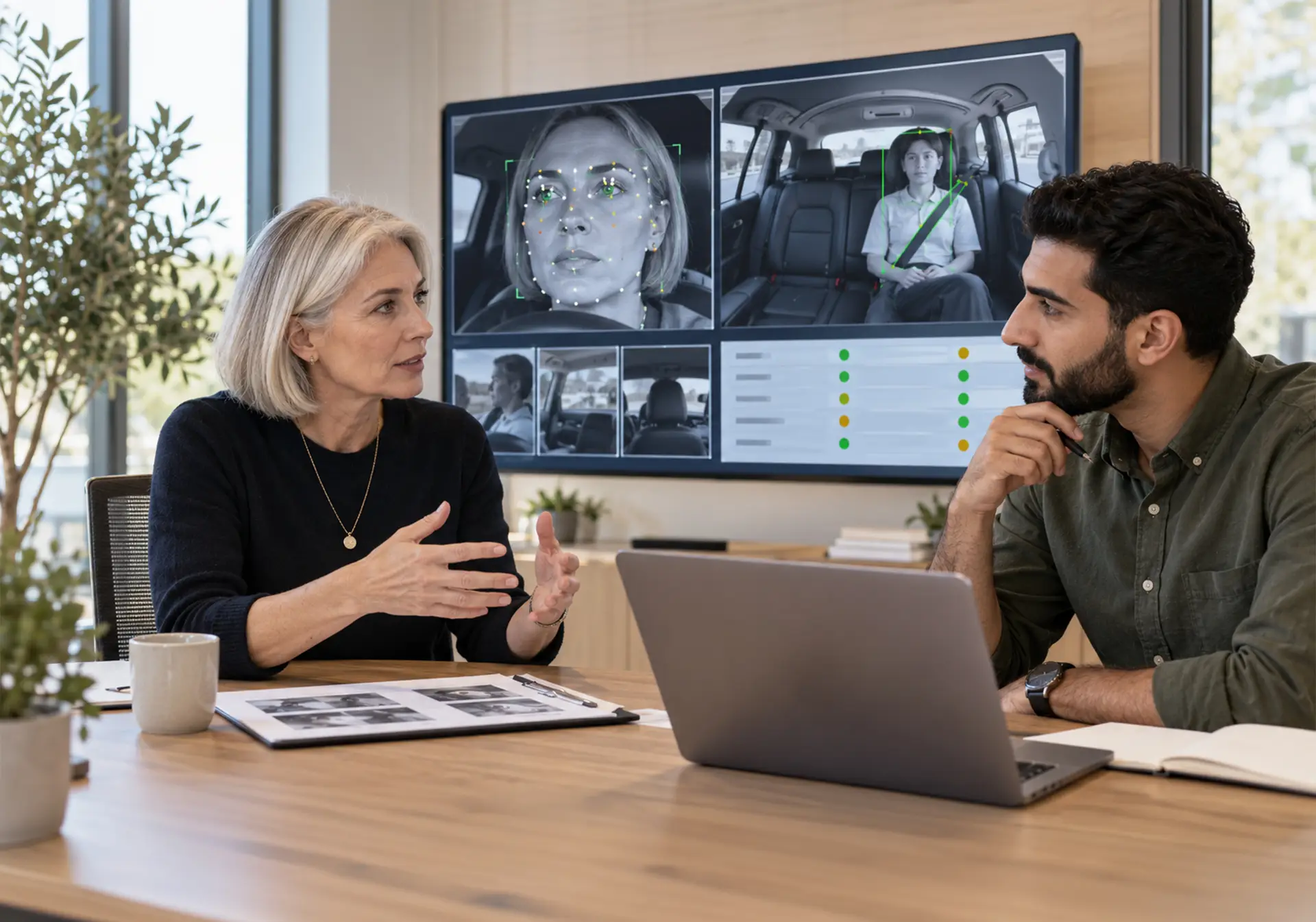
An in-cabin annotation case study helps evaluate a driver monitoring (DMS) or occupant monitoring (OMS) supplier only if it matches your driver states, sensors, population, and evaluation method. Score relevance and verifiability separately for each supplier, and ask for true positive rates and false alerts per hour measured on a frozen evaluation set. Treat related work, such as household robotics, as supporting evidence. When case studies offer different levels of detail, compare suppliers through the same pilot using your own ground truth.
Buyers often start by looking for a supplier case study on driver and occupant monitoring. Finding one is easy; knowing whether the work fits your cabin, cameras and rating targets is harder. Driver condition and behavior annotation and occupant detection and behavior insight each carry distinct taxonomies, edge cases and failure modes. Digital Divide Data (DDD) has published one such case. The scorecard below evaluates it against the same criteria used for other suppliers.
Key Takeaways
- A supplier’s case study is only useful if it matches your project, meaning the same driver and passenger behaviors, camera types and range of people.
- Experience from related fields, such as home robots, shows sound processes but doesn’t prove a supplier can handle in-car monitoring.
- Any claim that better labels improved a model should show clear before-and-after results, measured the same way safety rating bodies measure them.
- Case studies with the client’s name hidden are normal in the car industry, but treat them as unproven until references, sample work or privacy safeguards back them up.
- To compare suppliers fairly, score them all on the same checklist and give them the same trial task using your own data.
What Is In-Cabin Annotation, and What Should a Case Study Prove?
In-cabin annotation is the labeling of camera and sensor data captured inside a vehicle, so models can recognize driver and passenger states and behavior. A Driver Monitoring System (DMS), which Euro NCAP calls Driver State Monitoring (DSM), tracks gaze, head pose, eye closure and distraction. An Occupant Monitoring System (OMS) tracks seat occupancy, posture, seatbelt use and child presence across the cabin. Programs that combine both are often called in-cabin monitoring systems (ICMS), and in-cabin and driver monitoring data annotation spans all three.
Regulatory and safety-rating requirements make this evidence more important. Under Euro NCAP’s 2026 Driver Engagement protocol, driver monitoring is worth 25 of the 30 points in the driver engagement assessment. The EU’s Advanced Driver Distraction Warning (ADDW) regulation applies to new vehicle types from July 2024 and to all new cars, vans, trucks and buses from July 2026. Both frameworks assess performance on defined driver states, so buyers need strong evidence from their data suppliers.
A case study summarizes one supplier project with the angle of the problem, the work performed and the results. For a DMS or OMS buyer, it should prove three things about that program. First, the supplier labeled your kind of data; second, its quality system held at production volume; third, the labels contributed to a measurable improvement in model performance. Most published cases prove the first point well, the second partially and the third only in directional terms.
What Makes an In-Cabin Annotation Case Study Relevant to a DMS Purchase?
Relevance is the degree of match between the program a case describes and the program you are about to run. Euro NCAP’s protocol is a practical template for judging that match, because it defines driver states, movement types and the population a robust system must cover. Cases that map cleanly onto those definitions are the most useful, whatever their length. Focus on five dimensions:
- Driver-state and Occupant-state Match: The case should cover the states you will be scored on, such as long distraction, short distraction, phone use, drowsiness, microsleep and sleep. OMS buyers should look for seat occupancy, seatbelt status, posture and child presence.
- Sensor and Modality Match: Near-infrared (NIR) imagery behaves differently from RGB, especially for eyes behind sunglasses or in a dark cabin. Camera position, resolution and frame rate also change what annotators can see and label consistently.
- Taxonomy and Timing Match: Euro NCAP separates owl movements, led by head rotation, from lizard movements, where the eyes move and the head stays forward. It defines a long distraction as a single 3 to 4 second glance away, and short distraction as 10 cumulative seconds off-road within 30 seconds. Frame-level labels alone cannot support those definitions, so event boundaries and durations matter.
- Population and Occlusion Coverage: The protocol expects coverage of drivers aged roughly 16 to 80 and statures from the 5th percentile female to the 95th percentile male. It also covers Fitzpatrick skin types 1 to 6, eyelid apertures from 6 to 12 mm, lighting from 1 to 100,000 lux, sunglasses, facial hair, face masks and hats. Occlusion flags and lighting metadata recorded per clip make stratified evaluation possible later.
- Scale and Continuity: A pilot of a few thousand frames provides less evidence than a multi-year program spanning sensor generations. Look for evidence of volume, duration and taxonomy changes absorbed mid-program without a drop in quality.
Coverage matters because public data rarely provides it. The comparison table in the manD 1.0 driver monitoring benchmark published in Scientific Data shows that most frequently cited DMS datasets target narrow factors such as drowsiness. Several of those datasets involve fewer than 30 participants. A supplier case that documents broad demographic and occlusion coverage provides evidence your team may struggle to find elsewhere.
Is a Household Robotics Case Sufficient Evidence for Driver Monitoring?
On its own, a household robotics case is insufficient evidence for a DMS purchase. The question comes up when a search for driver monitoring evidence surfaces a supplier’s robotics or egocentric work instead. Those programs label people, hands, objects and actions in video, so the overlap with in-cabin work looks larger than it is. The key is knowing which skills transfer and which still need testing in a vehicle.
What transfers from household robotics work?
- Human body and hand keypoint labeling, including hand-object interaction.
- Temporal segmentation of actions in continuous video.
- Privacy-controlled handling of footage that shows people’s faces and homes.
- Annotator calibration, multi-stage review and audit workflows.
What needs fresh in-domain evidence?
- Eye-state and eyelid labeling on NIR imagery, including eyes behind sunglasses.
- Gaze zones defined against vehicle geometry, such as mirrors, the instrument cluster and the infotainment display.
- Glance-duration timing tied to protocol thresholds.
- Cabin occlusions from the steering wheel, seatbelt webbing, sun visors and hands.
- OMS edge cases such as rear-facing child seats and children partly hidden by adults.
Give related case studies credit for established processes, but little weight for DMS-specific experience. Then require a short in-domain pilot before treating the supplier as qualified for DMS work. The criteria for choosing an egocentric data collection partner for robotics overlap with this list, which is one reason the two buying decisions are easy to confuse.
What Evidence Does the Published DDD In-Cabin Case Provide?
DDD’s published in-cabin case study, Powering Safer In-Cabin AI with Human-Centric Data, describes work for a global automotive technology provider building both DMS and OMS models. The client needed to detect distraction, drowsiness, gaze direction, gesture intent, occupant posture and seatbelt use. Those behaviors had to be recognized across varied lighting, RGB and IR cameras, and diverse demographics. The program also carried automotive-grade safety, compliance and bias-mitigation requirements.
DDD built structured datasets for gaze tracking, fatigue indicators, head pose estimation, seat occupancy, posture recognition, 2D and 3D gesture keypoints, distraction detection and cabin context. The case names multi-tier quality assurance, domain-trained annotators and bias audits as the main controls. It also names the edge cases of those controls targeted, including occlusions, low light and dynamic interactions inside the vehicle. Reported outcomes include higher distraction detection accuracy, fewer false-positive fatigue alerts, more reliable gesture recognition in difficult lighting, and faster validation timelines.
The case compares well against the relevance criteria above. It covers DMS and OMS together, names both sensor types, and lists the driver and occupant states most programs are rated on. However, it reports improvements without exact figures, as is common in anonymized automotive case studies. The public summary does not state effect sizes, baselines, evaluation set composition, labeling volumes, program duration or inter-annotator agreement. A buyer should request the following under NDA, within the limits of client confidentiality:
- Before-and-after true positive rate and false alerts per hour for each affected driver state.
- The share of improvement attributable to data changes, with the model architecture held constant.
- Demographic and occlusion breakdowns of both the labeled data and the evaluation set.
- Labeling volumes, program duration and taxonomy versions.
- Measured agreement per class and the audit sampling rate.
None of these gaps is unusual for a public case summary. These are the questions to cover during due diligence. How clearly a supplier answers them, within confidentiality limits, also matters. Apply the same questions to every shortlisted supplier, including DDD.
What Metrics Should a Supplier Provide for Claimed Model Improvement?
Ask for the same metrics used in safety-rating evidence. Euro NCAP’s Driver Monitoring Dossier Guidance, 2025 asks manufacturers to report true positive rate (TPR) per driver state and false alerts per hour. TPR comes from scripted recordings of the target behaviors. False alerts come from naturalistic drives with no scripted behavior, with indicative totals of 1,800 to 6,000 minutes each for daytime and nighttime driving.
The bulletin’s prefilled values are indicative and are explicitly not pass criteria. For transient states such as long distraction and phone use, it suggests about 0.05 false alerts per hour and TPRs of 60 to 80 percent. For drowsiness, the indicative values are 0.5 false alerts per hour and a 40 percent TPR. A supplier claiming its labels improved your DMS should express the gain in these units, supported by six elements:
- Baseline and post-change TPR and false alerts per hour, per driver state, on the same frozen evaluation set.
- Evaluation set composition, covering subjects, hours, the day and night split, and the noise variables included.
- Stratified results by eyewear, lighting band, skin type and age band, so averages cannot hide weak strata.
- Variance across subjects or confidence intervals, since a few subjects can swing a small evaluation set.
- An ablation that holds the model architecture and training recipe constant, isolating the effect of the data.
- Label quality evidence, including agreement per class, temporal agreement on event boundaries, and keypoint error for landmarks.
Label quality metrics deserve the same scrutiny as model metrics. Inconsistent ground truth for drowsiness or gaze zones makes any reported TPR unreliable. Ask how agreement was measured, on which classes, and how disagreements were adjudicated. Well-designed inter-annotator agreement protocols make this process measurable and help ensure that label quality is reliable enough to support meaningful model evaluation.
How Should Anonymized Client Evidence Be Assessed?
Anonymization is normal in automotive work. OEMs and Tier-1 suppliers protect sensor choices, launch timing and supplier relationships, so most credible cases describe the client by type. The more important the purchase decision, the more thoroughly you should verify an anonymized case. Treat it as a starting point for questions, and give it full weight only once it is corroborated.
A case that names behaviors, sensor types, label classes and edge cases is easier to check than one that only names outcomes. Next, test consistency between the case, the supplier’s service descriptions and what its engineers say in technical calls. Contradictions on taxonomy or sensor details deserve more concern than missing numbers.
Evidence you can often request under NDA includes:
- A reference call with the client’s program owner, or with a comparable program if the original client declines.
- Redacted guideline excerpts showing how states such as microsleep or seatbelt misrouting are defined.
- Redacted QA reports showing audit rates, error categories and trends over time.
- Security evidence such as ISO 27001 certificates, SOC 2 Type 2 reports and TISAX assessment results, checked against the issuing bodies.
- Sample labels produced on your own data during evaluation.
Privacy handling deserves its own check, because in-cabin footage contains faces, sometimes children, and biometric-like signals. The ADDW regulation includes a dedicated privacy and data protection section, which shows how seriously regulators treat this data. Ask where footage is stored and processed, who can access it, and how deletion is confirmed at contract end. Treat anonymized results as unverified until you have at least one supporting item.
How Can Suppliers Be Compared When Public Case Detail Is Uneven?
Different levels of detail in public case studies can make comparisons difficult. Suppliers with polished, number-heavy marketing look stronger, even when the numbers come from another domain or an undefined evaluation set. Score relevance and verifiability separately, then use the same evidence request and pilot for every supplier. Score each criterion from 0 to 3, based on the strongest evidence available:
- 0, no evidence: nothing public or private addresses the criterion.
- 1, publicly claimed: stated in a case study, service page or brochure.
- 2, documented under NDA: supported by references, redacted reports or guideline excerpts.
- 3, demonstrated: shown on your own data during a scored pilot.
| Criterion | Weight | Strong evidence looks like |
| Driver-state and occupant-state coverage | 20% | Taxonomy mapped to Euro NCAP driver states and your OMS functions |
| Sensor and modality fit | 15% | Prior NIR and RGB work at a comparable camera position |
| Population and occlusion coverage | 15% | Labeled data stratified by age, stature, skin type, eyewear and lighting |
| Temporal event labeling | 10% | Event boundaries and glance durations consistent with protocol timing |
| Label quality system | 15% | Per-class agreement, audit rates and adjudication records |
| Outcome evidence | 10% | Before-and-after TPR and false alerts per hour on a frozen set |
| Security and privacy | 10% | Verified certifications, access controls and deletion terms |
| Scale and continuity | 5% | Volume, duration and taxonomy changes absorbed without quality loss |
Multiply each score by its weight and sum the results for a total out of 3. Weights should reflect your program. A team buying OMS labels for child presence detection might raise the occupant-state and privacy weights. A team closing a phone-use gap in its rating evidence might raise temporal labeling and outcome evidence instead. Agree on the weights before any supplier presentation, so a polished presentation does not influence the criteria.
A common pilot gives you a fair comparison. Give every shortlisted supplier the same guideline, the same stratified clip set and the same deadline. Deliberately include the most difficult conditions, such as low-transmittance sunglasses, partial face occlusion and short lizard glances toward the instrument cluster. Score outputs against a golden set your own team labeled and adjudicated, and ask how quality and turnaround would hold at five to ten times the volume. Ask who will perform the production work, and whether any of it is subcontracted.
How Digital Divide Data Can Help
DDD supports DMS and OMS programs through its In-Cabin AI and UX data solutions, covering driver condition, occupant behavior and cabin context labeling. Teams work inside the client’s tools, workflows and ontologies, with label categories aligned to the states used to evaluate the program. Those can include owl and lizard movements, short and long distraction, phone use, eye closure, seatbelt status and child presence scenarios. Annotators are trained on cabin-specific behavior across ages, body types, attire and lighting conditions.
Rare or difficult situations are covered through rare-event and edge-case scenario annotation. DDD’s in-cabin teams work with low-light footage, glare, protective equipment and occlusion from multiple occupants. Quality checks combine multi-layer human-in-the-loop review, calibration and targeted audits, and the published in-cabin program added bias audits. DDD operates under ISO 27001, SOC 2 Type 2 and GDPR controls, with TISAX-aligned handling for in-cabin video. Buyers who want to go beyond the public case can request a deeper evidence review under NDA, within client confidentiality limits, or a scored pilot on their own data.
Need DMS and OMS annotation that meets your evaluation criteria? Speak with a ICMS specialist.
Conclusion
An in-cabin annotation case study earns its place in a purchase decision when it matches your driver states, sensors and population, and when its outcome claims can be checked. Relevance and verifiability are separate questions, and the scorecard keeps them apart. Euro NCAP and the ADDW regulation place measurable performance at the center of driver monitoring. Supplier evidence should be expressed in the same units.
Teams that rely only on case-study claims may discover coverage gaps during rating preparation, when changes are costly. A scored pilot can identify those gaps earlier, while there is still time to address them.
References
Euro NCAP. (2026). Safe Driving – Driver Engagement Protocol (Version 1.2; implementation January 2026). European New Car Assessment Programme. https://cdn.euroncap.com/cars/assets/Euro_NCAP_Protocol_Safe_Driving_Driver_Engagement_v1_2_ebce03a443.pdf
Euro NCAP. (2025). Driver Monitoring Dossier Guidance, Technical Bulletin SD 201 (Version 1.1). European New Car Assessment Programme. https://cdn.euroncap.com/cars/assets/sd_201_driver_monitoring_dossier_guidance_v11_4fbc6a9531.pdf
European Commission. (2023, and amended thereof). Commission Delegated Regulation (EU) 2023/2590 of 13 July 2023 supplementing Regulation (EU) 2019/2144 as regards the specific test procedures and technical requirements for the type-approval of certain motor vehicles with regard to their advanced driver distraction warning systems. Official Journal of the European Union, L 2023/2590. https://eur-lex.europa.eu/eli/reg_del/2023/2590/oj/eng
Dargahi Nobari, K., & Bertram, T. (2024). manD 1.0: A multimodal driver monitoring benchmark dataset for driver modeling in assisted driving automation. Scientific Data, 11, 327. https://doi.org/10.1038/s41597-024-03137-y
Frequently Asked Questions
Does DDD have a case study on driver and occupant monitoring?
DDD’s case, Powering Safer In-Cabin AI with Human-Centric Data, covers DMS and OMS work for a global automotive technology provider using RGB and IR cameras. It reports improvements without exact figures, so buyers should request supporting metrics and evaluation details under NDA.
Is a household robotics case study enough to trust a vendor with DMS annotation?
On its own, no. It can show transferable skills such as human keypoints, video segmentation and privacy handling. DMS work adds NIR eye-state labeling, vehicle-specific gaze zones and timing tied to protocol thresholds, which only an in-domain pilot can confirm.
What metrics should I ask a DMS data annotation vendor for?
Ask for true positive rate per driver state and false alerts per hour, measured before and after on the same frozen evaluation set, which mirrors Euro NCAP dossier reporting. Add results stratified by lighting, eyewear and skin type, plus per-class label agreement.
How do I compare annotation vendors when their case studies have different levels of detail?
Score relevance and verifiability separately, using evidence levels from public claims to results demonstrated in a pilot. Then send every vendor the same evidence request and run the same pilot, scored against a golden set your own team labeled.

Kevin Sahotsky leads strategic partnerships and go-to-market strategy at Digital Divide Data, with deep experience in AI data services and annotation for physical AI, autonomy programs, and Generative AI use cases. He works with enterprise teams navigating the operational complexity of production AI, helping them connect the right data strategy to real model performance. At DDD, Kevin focuses on bridging what organizations need from their AI data operations with the delivery capability, domain expertise, and quality infrastructure to make it happen.