By Abhilash Malluru
Feb 1, 2023
Autonomous driving is becoming more prevalent worldwide, garnering increased interest in optimizing technology through data labeling and annotation from investors and developers alike. With that growing interest comes an emerging need for experienced developers who can develop the tools and processes necessary for driver behavior monitoring, self-parking, motion planning, and traffic mapping. At the heart of this progress is data labeling for autonomous vehicles; the work of turning raw camera, LiDAR, and sensor feeds into the structured training data that self-driving systems learn from.
Growing acceptance of autonomous driving has led to several approaches to advancing data labeling, annotation, and other machine learning processes. As these become standardized and more widely accepted in the industry, it’s crucial to understand the difficulties and obstacles that might arise in deploying them to any autonomous driving development platform.
Data Labeling and Annotation Strategies for Autonomous Vehicle Applications
Choosing the right mix of data annotation for autonomous vehicles depends on your sensor stack, operating environment, and the level of autonomy you are building toward. The standard methods regarding the implementation of data labeling and annotation are as follows:
-
Bounding Boxes
-
Semantic segmentation
-
Polylines
-
Video Frame Annotation
-
Keypoints
-
Polygons
What Objects Should Be Labeled in a Traffic-Safety Dataset?
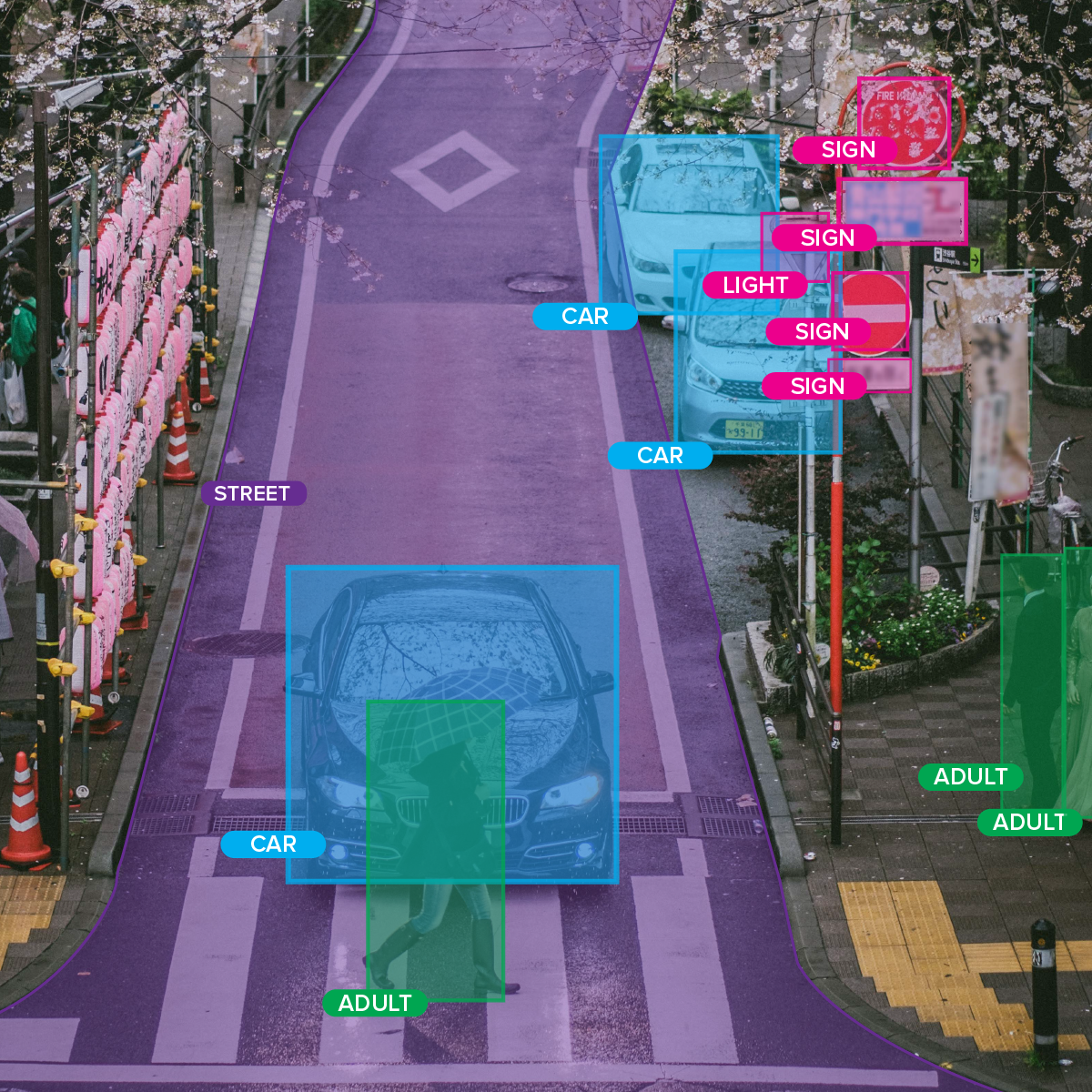
Before choosing an annotation method, teams need to agree on what to annotate. In a standard traffic-safety dataset for autonomous driving, the objects that should be labeled typically include other vehicles (cars, trucks, buses, and motorcycles), pedestrians and cyclists, traffic lights and their current state, traffic signs, lane markings, road boundaries, drivable surfaces and sidewalks, and temporary obstacles such as construction cones or debris.
Labeling these classes consistently across image, video, and LiDAR data is what allows a model to perceive a scene the way a cautious human driver would. The annotation techniques below each play a role in capturing these objects with the precision autonomous systems require.
Bounding Boxes – Crucial for Robotaxis
2D bounding box annotation uses video or image annotation to identify and spatially place objects. It first maps items to develop datasets, then machine learning models use those datasets to localize objects. Depending on the method deployed, it can support various tags or text extraction for things like street signs.
This annotation technique is vital for an autonomous vehicle or robotaxi’s navigation. It relies heavily upon complex logic systems and requires additional inputs to differentiate for decision-making, meaning it requires significantly large quantities of data and human input for the vehicle to operate effectively and safely.
Partnering with firms that have extensive experience in this method, like any reputable managed service model (MSM), can help you implement and deploy a technique like bounding boxes. A managed service provider (MSP) has both a data annotation workforce and expert consultants who can help guide your needs and pinpoint any difficulties or obstacles that might arise.
Semantic Segmentation to Identify Humans from Objects
Semantic segmentation is a technique that relies on a computer’s optical input to divide images into different components and label them by each pixel. This process is crucial to identify different types of objects so that a system can make a decision. For example, semantic segmentation helps a system identify people in a crosswalk. It may not know how many, but the point that people are crossing is enough to influence the decision-making process.
However, the most significant hurdle is that semantic segmentation is incredibly time-consuming. And this is where a dedicated team of SMEs from a third-party platform becomes invaluable. MSMs enable any organization seeking to implement semantic segmentation toolchains for this absolutely crucial process.
Since DDD’s workforce is trained in standard models and data annotation methods, they can help establish efficient and steady workflows while minimizing operational costs. These experts can handle such laborious tasks as semantic segmentation so you can place your focus elsewhere, ensuring you can complete other project needs before deliverables are due.
Polylines – Crucial for Overall Road System
This image annotation method enables the visualization and identification of lanes, including bicycle lanes, lane directions, diverging lanes, and oncoming traffic. Polylines require extensive data sets to be successfully labeled and deployed.
Polylines are crucial for autonomous driving as a means of lane detection. Accurate and consistent modeling allows for navigation and the avoidance of obstacles. Plus, models can be trained further so they better adhere to relevant traffic laws by detecting road markings and signs. MSMs can help offload some of the enormous overhead that goes into developing the toolchains necessary for polylines.
Video Frame Annotation – Necessary for Object Detection
Autonomous vehicles can use video annotation to identify, classify, and recognize objects and lanes. It can work in conjunction with techniques like semantic segmentation and polylines. Video frame annotation is necessary for more accurate object detection and works in conjunction with other annotation methods to provide accurate results.
Video annotation is time-consuming as it relies upon analyzing and data labeling thousands of video frames. Whether your platform is leveraging video and image annotation for autonomous vehicles or robotaxis, partnering with a third-party service can drastically reduce the time needed to implement this form of data annotation.
Keypoints – Giving Robotaxis Adaptability
Data drives both autonomous vehicles and the development of the systems which guide them. Keypoints provide a frame of reference for objects that might change shape by leveraging multiple consecutive points.
As with most of the techniques related to autonomous vehicles or robotaxis, this form of data annotation is a very consuming and costly process. While much of the modeling that goes into what serves a self-driving vehicle needs elements of artificial intelligence or machine learning, a human component must still input the points on the sets processed for data labeling.
Nothing encountered on the road will remain static, doubly so for those using autonomous vehicles in metropolitan areas. With this type of data labeling, leveraging an organization with actionable domain experience like MSMs can help develop streamlined methods and toolchains. Cost is dictated per hour or unit, and DDD’s staff brings much experience in standardized data labeling and annotation methods.
Polygons – Greater Precision for Visual Processing
Polygons operate like bounding boxes for visual data annotation. Irregular objects and accurate object detection greatly benefit from the implementation of polygonal data annotation. Polygonal annotation can have far greater precision than the bounding box method. When properly implemented, it helps detect things like obstructions, sidewalks, and the sides of the roads.
Polygonal annotation is a vital step in the autonomous driving model. Objects are very rarely uniform, and as such this method of annotation has a crucial function in making effective and safe models for the sake of detection and recognition. Its integration into your workflow comes from it being a time-consuming process. Compared to methods like bounding box annotation, it requires even more resources and time to correctly integrate. Engaging an MSM to help provide a platform can significantly reduce the time needed to implement this into your autonomous driving toolchain. Leveraging a third-party resource with actionable and proven experience can easily lead to greater precision in your detection model.
Get Started With a Data Labeling Service
The past few years have made it abundantly clear that autonomous driving is here to stay, and leveraging another organization’s expertise in your workflow frees up valuable resources and manpower that could be better spent on other aspects of project development. Plus, we can’t ignore the time it takes to invest and develop these annotation methods.
So if you’re developing the technologies and models that power autonomous driving, it’s worth considering outsourcing at least some of the workflows to a third-party vendor. MSMs like Digital Divide Data (DDD) provide a platform to help you and your staff overcome some of the pitfalls of developing systems for autonomous driving. From image annotation for autonomous vehicles to full LiDAR and video pipelines, an experienced data labeling partner can scale these workflows up or down as your autonomous driving program matures.
Data labeling and data annotation alike are diverse and complicated fields of work. You can discuss your project needs and requirements with the DDD staff today. By partnering with us, you gain access to a developed platform that delivers exceptional results for your digital labeling and annotation needs. Let’s discuss your project requirements today.
Frequently Asked Questions
What is data labeling for autonomous vehicles?
Data labeling for autonomous vehicles is the process of tagging objects and features in camera, video, LiDAR, and sensor data so a self-driving system can learn to recognize them. Accurate labels for elements like vehicles, pedestrians, lanes, and signs are what turn raw driving footage into usable training data for perception and decision-making models.
Which data annotation methods are used for autonomous driving?
The most common data annotation methods for autonomous driving are 2D bounding boxes, semantic segmentation, polylines, video frame annotation, keypoints, and polygons. Most programs combine several of these, since each method captures a different aspect of a scene, from lane geometry to irregular object shapes.
What objects should be labeled in a traffic-safety dataset?
A standard traffic-safety dataset should label other vehicles, pedestrians and cyclists, traffic lights and their state, traffic signs, lane markings and road boundaries, drivable surfaces and sidewalks, and temporary obstacles such as cones or debris. Labeling these classes consistently across sensors lets the model interpret a scene the way a cautious human driver would.
What is the difference between 2D bounding box and polygon annotation?
A 2D bounding box draws a simple rectangle around an object, which is fast and works well for regularly shaped items like cars or street signs. Polygon annotation traces an object’s actual outline, offering far greater precision for irregular shapes such as sidewalks, obstructions, and road edges, at the cost of more time and resources.
Should you outsource autonomous vehicle data labeling and annotation?
For most teams, yes, at least partially. Annotation methods like semantic segmentation and polygons are labor-intensive to build and maintain, so partnering with a managed service model (MSM) such as DDD frees your engineers to focus on model development while a trained annotation workforce scales the labeling pipeline up or down as needed.