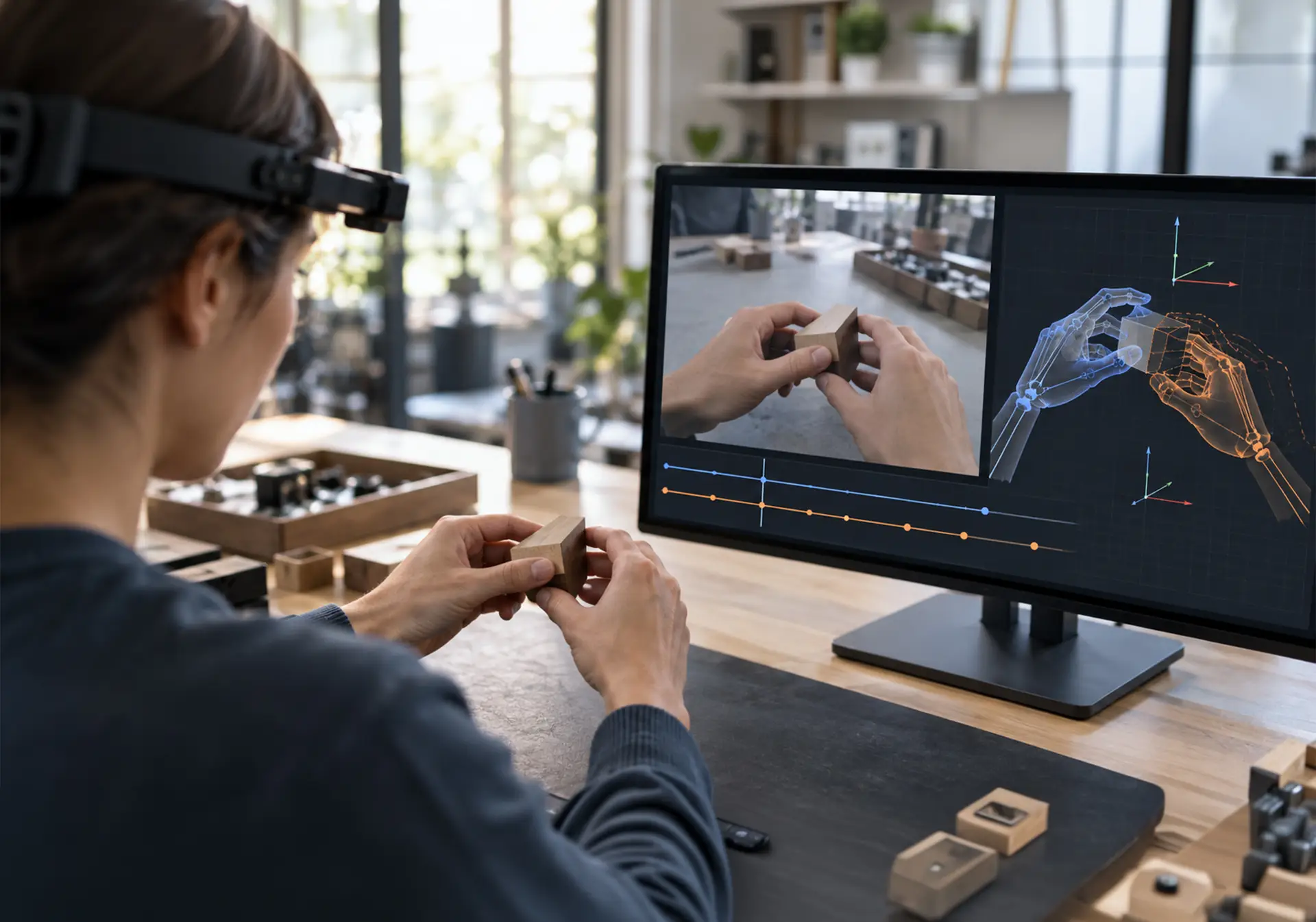
Egocentric video and pose data with inconsistent timing and coordinate systems is often recoverable, and a structured audit tells you how much of it is. The audit documents every clock and coordinate frame, measures time offset and drift per session, and checks spatial alignment through reprojection error. Each session then lands in one of four outcomes: use as-is, repair, route to weaker supervision, or discard.
Most teams reach this question with a pilot batch already in hand. The videos play, the pose files parse, and the schema validates. The trouble surfaces later, when projected hand keypoints trail the real hand during fast motion or a grasp label fires before the fingers close.
These errors are costly because they are silent. A 30-millisecond offset or a flipped axis passes every format check, yet it teaches a model the wrong link between what the camera sees and what the body does. Whether a team runs its own egocentric data collection program or sources egocentric datasets from a reputed vendor, the usability question is best settled before scaling collection or labeling.
Key Takeaways
- Mismatched timing and positions rarely cause visible errors, so a structured check is the most reliable way to learn whether the data can still be used.
- Check timing before any labeling starts by confirming that the video and body-movement data line up at the start, middle, and end of every recording session.
- Check positions by writing down how each data source defines direction, scale, and starting point, then overlay the body data on the video to confirm it matches.
- Some body positions are guessed by software because the camera couldn’t see them clearly, so flag those and check that all movements look physically realistic.
- Sort each recording into one of four groups: use as is, fix and use, use for less demanding training, or discard.
- Test a small, varied sample before scaling up, and use what you find to improve how future data is collected.
What Is Egocentric Video and Pose Data, and Why Does Alignment Matter?
Egocentric video is the footage recorded from the viewpoint of the person performing a task, usually through smart glasses, a headset, or a head-mounted camera. Pose data describes where the body is in space over time. In robotics programs, it typically includes a six-degree-of-freedom (6-DoF) head or camera trajectory, 3D hand keypoints, and sometimes full-body joints from an IMU suit or motion capture. Programs that apply video annotation services to this footage are working with streams recorded by different sensors that were never guaranteed to agree. As egocentric datasets become the new standard for training robotics models, that agreement becomes a core data quality question.
Two separate properties decide whether the streams agree. Temporal alignment, also called synchronization, means every video frame and every pose sample refer to the same physical instant. Spatial alignment means every pose is expressed in a documented coordinate frame with a known transform to the camera. A dataset can pass one test and fail the other, so each one needs its own evaluation.
A few terms come up repeatedly in any usability audit. Using them consistently across capture, annotation, and training teams prevents avoidable errors.
Time offset
The constant difference between two clocks at a given moment, usually measured in milliseconds.
Clock drift
The rate at which that offset changes across a session.
Coordinate frame
The origin, axis directions, and handedness that give a position or rotation its meaning.
Extrinsic calibration
The rigid transform between two sensors, such as the headset tracking frame and the RGB camera.
Intrinsic calibration
The camera’s internal model, including focal length, principal point, and lens distortion.
Why Do Timing and Coordinate Systems Drift Apart in Egocentric Captures?
Inconsistency is the default state of multi-device egocentric capture. A typical rig combines a headset, wrist or body trackers, and sometimes external motion capture, each with its own clock and reference frame. Sensor synchronization for egocentric robotics data is harder than in vehicle-mounted rigs, because the sensors sit on a moving human head. There is no fixed mounting to calibrate against, and head motion is fast and unpredictable.
Where does timing break down?
Timing errors tend to come from a small set of repeatable sources. The team behind the EMHI multimodal egocentric motion dataset, for example, had to reconcile a host PC clock and a separate headset clock offline. Common sources include:
- Independent device clocks that start at different epochs and drift apart over long sessions.
- Timestamps assigned on arrival at the host PC, which can lag the true sensor capture time.
- Camera exposure delay and rolling shutter, which shift the actual capture instant by a few milliseconds.
- Variable frame rates and dropped frames, which break the assumption that frame N sits at N divided by the frame rate.
- Tracker disconnections that leave gaps in the pose stream while video keeps recording.
Where do coordinate systems break down?
Spatial inconsistencies tend to be convention mismatches. Human motion formats, game engines, and robotics simulators disagree on which axis points up, and some use left-handed frames. Others come from tracking itself, such as SLAM drift that builds up over long, fast, or poorly lit sequences. Typical mismatches include:
- Up-axis differences, such as Y-up body model outputs loaded into a Z-up simulator.
- Quaternion ordering, where one tool writes w-x-y-z and another expects x-y-z-w.
- The unit mismatches between millimeters and meters, which scale every trajectory by a factor of 1,000.
- Camera conventions, where OpenCV and OpenGL point the y and z axes in opposite directions.
- World origin resets when a headset re-localizes, which shift the entire trajectory mid-session.
How Do You Measure Temporal Alignment Between Video and Pose Streams?
Temporal evaluation starts with the timestamps themselves. Check that every stream is monotonic, with no duplicate or out-of-order samples. Plot the interval between consecutive samples to expose dropped frames and variable frame rates. Record which clock stamped each stream, because that determines which corrections are possible.
The next step is to estimate the offset between video and pose directly from the data. Motion correlation, which compares angular velocity from two independent sources, is more reliable than manual alignment. EMHI synchronized its headset and motion capture streams this way, correlating headset IMU angular velocity against the tracked rigid body on the headset. For video without an IMU, visual odometry or optical flow can supply the second signal. Cross-correlating the two signals gives the lag at which they match best.
A single offset estimate is not sufficient on its own. Estimate the offset in windows at the start, middle, and end of each session. A stable offset can be corrected with one shift, while a steadily growing one indicates clock drift that needs a linear correction. A sudden jump usually marks a tracker reconnection or re-localization, and the session should be split at that point.
Tolerance should come from the downstream task, because timing error turns into spatial error during motion. A hand moving at one meter per second with a 20-millisecond offset is misplaced by about two centimeters. That may be acceptable for activity recognition and unacceptable for grasp retargeting. The EMHI authors noted that at 30 Hz, residual synchronization error can reach 16.5 milliseconds, so they interpolated annotations onto the headset timestamps.
How Do You Validate Coordinate Frames and Spatial Calibration?
Spatial validation begins with a written pose contract for every data source. The contract states the up-axis, handedness, units, rotation representation, quaternion order, world origin, and the frame each pose is expressed in. If a supplier or internal team cannot produce this document, that gap is itself a finding.
Simple physical sanity checks catch most convention errors early. The following checks work on almost any egocentric pose dataset:
- Gravity check: The accelerometer’s mean direction at rest should point along the declared down-axis.
- Scale check: Bone lengths, such as wrist-to-knuckle distances, should match human proportions and stay constant across a session.
- Rotation check: Every rotation matrix should have a determinant of +1, and every quaternion should have unit norm.
- Floor check: Foot or floor height should sit near the declared ground plane.
Reprojection error is the most direct test of spatial calibration. Project 3D keypoints into the image using the camera intrinsics and extrinsics, then measure the pixel distance to where the joint actually appears. The EgoXtreme egocentric pose benchmark validated its ground truth this way, sampling 200 frames per scenario where keypoints were clearly visible. It reported mean reprojection errors under one percent of the 1408-pixel image width and a trajectory alignment error of 4.3 mm and 1.5 degrees.
Two details often decide whether reprojection results can be trusted. Egocentric cameras frequently use fisheye lenses, so projecting with a pinhole model inflates error near the image edges. Exposure timing also matters, and the EgoXtreme team corrected a few milliseconds of offset caused by camera exposure delay before final interpolation. Checking reprojection during fast motion therefore tests timing and calibration together.
Which Pose Quality Checks Matter Beyond Synchronization?
A perfectly synchronized and calibrated stream can still contain unusable poses. Hand tracking degrades under occlusion, motion blur, and low light, and many pipelines fill the gaps with learned pose priors. The key question for each joint is whether it was measured, inferred, or generated. Datasets that do not record this distinction force every downstream user to guess.
Useful plausibility checks include:
- Temporal smoothness: Velocity and acceleration spikes beyond human limits signal tracking jumps.
- Bone-length stability: Joint distances that stretch from frame to frame indicate fitting errors.
- Joint limits: Finger and wrist angles outside anatomical ranges point to failed estimates.
- Identity consistency: Left and right hands should not swap labels mid-sequence.
- Coverage: The share of frames with valid hand poses during manipulation phases, where they matter most.
Recent large-scale pipelines turn these checks into per-sample confidence. The JoyAI-RA 0.5 data curation pipeline scores recovered hand trajectories on visibility, reprojection, and temporal consistency. It also screens episodes for timestamp alignment, schema completeness, and agreement between video and reconstructed hand states.
Pose quality also interacts directly with annotation quality. Labels for contact onset, grasp type, and task phase are only as accurate as the timestamps to which they are attached. When teams annotate egocentric video for robot manipulation, synchronization verification should be completed before labeling begins. Misaligned pose overlays force annotators to compensate visually, which can hide the underlying timing error and propagate it into the labels, reducing the reliability of the final dataset.
How Do You Decide Whether Egocentric Pose Data Is Usable?
Usability is a routing decision made per session, against the requirements of the downstream task. Binary accept-or-reject rules waste data, because many failures are deterministic and fixable. A tiered outcome keeps more of the collection while protecting the training signal.
| Tier | Typical condition | Action |
|---|---|---|
| Use as-is | Offset and reprojection error within task tolerance; conventions documented | Train directly and keep the audit report with the data |
| Repair | Constant offset, linear drift, or a known convention mismatch | Apply the correction, then rerun every check |
| Weak supervision | Video and task labels are sound, but poses are unreliable | Use for representation or latent-action pretraining; exclude from action targets |
| Discard or recapture | Unknown clocks, missing calibration, or large unexplained jumps | Remove and feed the failure back into the capture protocol |
The third tier is where many teams leave value on the table. JoyAI-RA retains clips with valid video and language but unreliable hand poses, and uses them for latent-action world-model pretraining. Those clips never feed explicit action learning, so noisy trajectories cannot corrupt the policy.
Run the audit on a stratified pilot sample before scaling. Cover every device type, firmware version, operator, and environment, since timing and calibration faults tend to cluster by setup. Report usable hours per recorded hour for each group to estimate realistic yield. Record provenance for every session, including device, calibration file, and consent record, because data without it cannot be audited later.
The audit is also the fastest way to improve collection. Findings usually point to a few protocol changes, such as hardware triggering or a shared clock. A visible sync event like a clap at session start and end, per-session calibration, and logged conventions also help. Each change moves future sessions from the repair tier into the use-as-is tier.
How Digital Divide Data Can Help
Digital Divide Data works with Physical AI teams at the point where egocentric captures meet training pipelines. DDD’s sensor data annotation services combine automated checks, reviewer validation, and temporal consistency audits across synchronized video, IMU, and pose streams. Timing lag, convention errors, and implausible joints are flagged before labels are applied. Each session receives a documented outcome, so engineering teams know which data is ready, which needs correction, and which should be routed elsewhere.
When the audit shows that problems start at capture, DDD’s egocentric data collection services support protocol design, including sync events, per-session calibration steps, and metadata standards for coordinate conventions. For humanoid and manipulation programs, the same teams extend this work to joint pose labeling, task phase segmentation, and cross-sensor QA. DDD is platform agnostic and works within a client’s existing tools and formats.
Turn inconsistent egocentric captures into training data your models can trust. Talk to an Expert.
Conclusion
Inconsistent timing and coordinate systems rarely make egocentric data worthless by themselves. The real risk is uncertainty about how large the errors are and whether anyone has measured them. A short audit of clocks, frames, reprojection, and pose plausibility converts that uncertainty into numbers a team can act on.
Teams that audit early tend to scale collection with predictable yield and fewer retraining cycles. Teams that skip the audit usually discover misalignment through unexplained policy failures, long after the data has been labeled.
References
Fan, Z., Dai, P., Su, Z., Gao, X., Lv, Z., Zhang, J., Du, T., Wang, G., & Zhang, Y. (2024). EMHI: A multimodal egocentric human motion dataset with HMD and body-worn IMUs. https://arxiv.org/pdf/2408.17168
Yoon, T., Han, Y., Ji, S., Park, J., Kim, S., Kwon, T., & Kim, H.-S. (2026). EgoXtreme: A dataset for robust object pose estimation in egocentric views under extreme conditions. https://arxiv.org/html/2603.25135
JoyAI-RA Team, Joy Future Academy, JD. (2026). JoyAI-RA 0.5: Scaling robot manipulation learning via dual action alignment. arXiv preprint arXiv:2608.05674. https://arxiv.org/pdf/2608.05674
Frequently Asked Questions
How much time offset between egocentric video and pose data is acceptable?
It depends on the task and how fast the hands move. A 20-millisecond offset at one meter per second misplaces a hand by about two centimeters. That may be fine for activity recognition and too much for grasp retargeting.
How to sync egocentric video and pose data recorded on different clocks?
Estimate the offset from the data itself using motion correlation, which compares angular velocity from the headset IMU or visual odometry with angular velocity from the pose stream. Measure it at the start, middle, and end of each session to catch drift or sudden jumps.
What is the quickest way to tell if my coordinate systems are wrong?
Run a few physical sanity checks first, including gravity direction at rest, stable bone lengths, valid rotations, and a floor at the declared height. Then project 3D keypoints onto video frames and measure reprojection error, because misaligned frames show up as keypoints that miss the hands.
Should we throw away egocentric clips that have bad pose data?
Often you can keep them. If the video and task labels are sound, those clips can still support representation or latent-action pretraining, as long as they are excluded from action targets. Discard only sessions with unknown clocks, missing calibration, or large unexplained jumps.

Udit Khanna leads the delivery of scalable AI and data solutions at Digital Divide Data, with a deep specialization in Physical AI. With a background in presales, solutioning, and customer success, he brings a mix of technical depth and business fluency, helping global enterprises move their AI projects from prototype to real-world deployment without losing momentum.