Egocentric data collection has a property that most robotics teams discover too late: protocol errors are permanent. An annotation mistake can be corrected in a second pass. A model architecture decision can be revisited at the next training run. But footage collected without synchronization signals cannot be synchronized afterward; scenes that were never sampled cannot be recovered from those that were; and consent that was not obtained at capture time cannot be applied retroactively without discarding the data. The collection protocol is the one component of an egocentric data program where the cost of getting it wrong is re-collection, not revision.
This blog covers the design of an egocentric collection protocol for robotics programs: hardware selection and its downstream consequences, diversity planning, task decomposition, demonstrator training, metadata that must be captured at collection time, privacy architecture, and the pilot collection run that validates the protocol before it scales.
Key Takeaways
- Protocol errors are permanent in a way that annotation and modeling errors are not. Missing synchronization signals, unsampled scene types, and absent consent cannot be fixed after collection. The protocol deserves the same design rigor as the model architecture.
- Hardware selection is a dataset design decision, not a procurement decision. The capture device determines which annotation types are possible downstream: gaze labels require eye tracking, finger-level manipulation labels require joint tracking, and scalable multi-site collection requires hardware that demonstrators can operate without specialist supervision.
- Diversity must be planned as quotas before collection, not assessed as statistics after it. EgoVerse’s consortium study found that effective scaling depends on alignment between human data and robot learning objectives, and that domain-aligned diversity, not raw volume, drives transfer.
- Metadata captured at collection time is the cheapest data in the program. Scene identifiers, hardware calibration records, demonstrator identifiers, task labels, and synchronization markers cost seconds to capture during recording and are expensive or impossible to reconstruct afterward.
- A pilot collection run of a small fraction of the target volume, taken all the way through annotation and a probe training run, is the single highest-return step in protocol design. It surfaces protocol defects while they are still cheap to fix.
Why Protocol Design Determines Dataset Value
A useful way to evaluate an egocentric collection protocol is to ask what fraction of the collected hours will survive to become training data. In a well-designed protocol, that fraction is high: episodes are complete, streams are synchronized, metadata is attached, consent is documented, and the scene and task distribution matches what the training pipeline needs. In a weakly designed protocol, the collected volume looks impressive and the surviving fraction is low: episodes are discarded for missing calibration records, entire sessions are unusable because a firmware update changed the timestamp format mid-collection, and the scene distribution is discovered, after the fact, to be concentrated in whichever environments were most convenient to access.
In our experience reviewing collection programs, the difference between these two outcomes is rarely the collection team’s diligence. It is whether the protocol specified, in advance and in writing, what a valid episode consists of: which streams, at which rates, with which metadata, under which scene and task conditions, verified by which checks before the demonstrator moves to the next episode. A protocol that leaves these questions to session-time judgment produces a dataset whose quality varies with who was in the room.
Hardware Selection: The Decision That Constrains Everything Downstream
What Each Hardware Class Provides
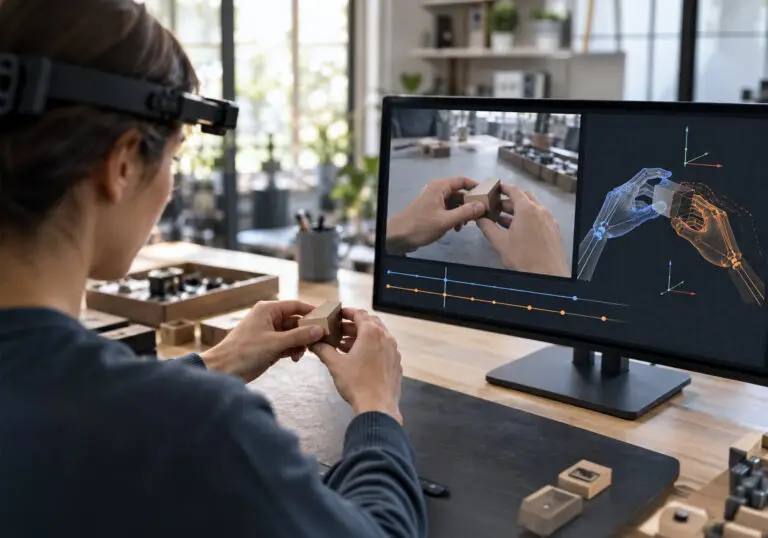
Smart glasses with eye tracking, such as the Meta Project Aria glasses used in EgoMimic, provide RGB video (standard color camera footage), inertial measurement unit (IMU) motion data, and calibrated eye gaze, which makes gaze target annotation possible downstream. Headset-class devices such as Apple Vision Pro, used in EgoDex, add on-device hand tracking: SE(3) poses (positions and orientations in full 3D space) for 25 joints of both hands at 30 Hz, captured via the device’s own simultaneous localization and mapping (SLAM) system. This is what makes finger-level dexterous manipulation annotation feasible at scale without a motion capture studio. Custom head-mounted camera rigs, the approach behind Build AI’s Egocentric-1M, trade sensor richness for cost and durability, which is what made it possible to equip factory workers at the scale required to reach one million hours. Wrist-mounted cameras provide the closest view of hand-object contact but lose head-level gaze and wide scene context.
Selecting Against the Annotation Plan, Not the Spec Sheet
The correct selection procedure runs backward from the annotation schema. If the training pipeline requires gaze target labels, the hardware must capture calibrated eye tracking, and no post-processing can substitute for it. If the pipeline requires finger-joint ground truth, the hardware must track joints at capture time, because manual joint annotation of ordinary video is prohibitively expensive at production volume and markedly less accurate. If the program requires thousands of demonstrators across many sites, the hardware must be operable by a trained demonstrator without an engineer present, which rules out rigs that require per-session calibration by a specialist.
A practical consequence, visible in the EgoVerse design, is that large diverse programs often standardize on more than one hardware class: a rich-sensor device for the subset of tasks that need gaze and joint tracking, and a simpler, cheaper device for the volume and diversity of collection. The protocol must then specify how episodes from each hardware class are marked, because the downstream pipeline will treat them differently.
Diversity Planning: Quotas Before Volume
What the Evidence Says About Diversity Versus Scale
The EgoVerse consortium study, replicated across multiple labs, tasks, and robot embodiments, found that policy performance generally improves with more human data, but that effective scaling depends on alignment between the human data and the robot learning objectives. Volume collected in the wrong distribution does not convert to policy performance. The precedent for planned diversity goes back to Ego4D, which deliberately collected its more than 3,000 hours across 74 locations in 9 countries precisely because earlier egocentric datasets had been narrow in geography and demography, and that narrowness limited what models trained on them could generalize to.
Building the Coverage Matrix
Diversity planning operationalizes as a coverage matrix defined before collection: scene types crossed with task types crossed with object variations, with a target episode count in each cell. The matrix should be derived from the deployment target, not from convenience of collection. A program training household manipulation policies needs kitchens, bathrooms, and living spaces in realistic states of clutter, across multiple lighting conditions, with object instances that vary in size, material, and wear. A program training industrial policies needs the equivalent coverage of workstations, fixtures, and part variations.
An illustrative slice of such a matrix, for a household manipulation program, shows how deployment targets become collection quotas:
| Scene type | Grasp and place | Open and close | Pour and transfer |
|---|---|---|---|
| Kitchen, cluttered counter | 30 episodes × 5 object variants | 20 episodes × 4 container types | 25 episodes × 4 vessel pairs |
| Kitchen, clear counter | 20 episodes × 5 object variants | 15 episodes × 4 container types | 15 episodes × 4 vessel pairs |
| Bathroom shelf | 20 episodes × 4 object variants | 20 episodes × 3 cabinet types | 10 episodes × 2 vessel pairs |
| Living space, low light | 15 episodes × 4 object variants | 10 episodes × 3 furniture types | 10 episodes × 2 vessel pairs |
Each cell is further split across demonstrators under the per-demonstrator caps described below, and the real matrix extends across every scene, lighting, and task condition in the deployment target.
Demonstrator diversity belongs in the matrix as well. Different demonstrators perform the same task with different hand sizes, motion styles, speeds, and strategies, and a policy trained on a single demonstrator’s style inherits that style’s idiosyncrasies as if they were task requirements. In our experience, programs that assign per-demonstrator episode caps per task, forcing the same task to be captured by many hands, produce measurably more robust policies than programs that let their fastest demonstrators dominate the collection.
Task Decomposition and Language at Capture Time
The task list is not a logistics artifact. It defines the supervision the dataset can provide. Tasks should be decomposed to the granularity the training pipeline will use: if policies will be trained on atomic skills such as grasp, place, open, and pour, the collection should capture clean episodes at that granularity, with defined start and end states, rather than long unsegmented activity streams that annotation must later cut apart. If the program targets long-horizon policies, the protocol should capture both the composed sequences and their atomic components, because both supervision levels will be needed.
Natural language task descriptions should be recorded at capture time, by the demonstrator or the session operator, in the phrasing that end users would actually use. Language-conditioned policies ground instructions in these descriptions, and descriptions written months later by annotators who did not perform the task are systematically flatter and less varied than descriptions captured in the moment. This is among the cheapest high-value data in the protocol: a spoken sentence per episode, recorded while the context is live.
Demonstrator Recruitment and Training
Demonstrators require training, and the training has a specific and somewhat counterintuitive goal: natural motion, not performative motion. Untrained demonstrators tend to perform for the camera, slowing down, exaggerating grasps, holding objects in view longer than natural task execution would. Policies trained on performative demonstrations learn performative behavior, which then looks hesitant and inefficient on the robot. Demonstrator training should therefore emphasize executing the task as if no camera were present, with the protocol’s quality checks catching the drift back toward performance.
The onboarding session should cover three things: device handling and calibration verification; the definition of a valid episode, including start state, end state, and what to do when a task attempt fails; and a supervised set of practice episodes reviewed against the protocol before the demonstrator’s data enters the production dataset.
Failed attempts deserve explicit protocol treatment: they should be captured and marked as failures rather than deleted, because failure episodes are among the most valuable and scarce training data in manipulation learning.
Metadata and Synchronization: Capture-Time or Never
Certain data can only be captured at collection time, and the protocol must enumerate it explicitly. Synchronization markers are what make multi-stream temporal alignment verifiable downstream: a clap, a flash, or a device-generated sync event at every episode start. Without them, alignment becomes an estimation problem with no ground truth.
Calibration records determine whether spatial annotation downstream is trustworthy: camera intrinsics and extrinsics, device firmware versions, and eye tracking calibration results. Scene and session metadata rounds out the record: location identifier, lighting condition, object inventory, demonstrator identifier, and task label. Capturing these is seconds of effort during recording. Reconstructing them afterward is a project.
The protocol should treat metadata capture as a gating requirement: an episode without its metadata record is an invalid episode, checked at session end rather than discovered at annotation time. In our experience, the single most common source of discarded egocentric footage is not sensor failure. It is metadata that was deferred to later and never created.
Privacy and Consent Architecture
Egocentric capture records everything the demonstrator looks at, which includes bystanders, screens, documents, and identifying details of private spaces. Consent must be obtained from demonstrators and, where applicable, from the owners of collection environments, before recording, with the scope of use, including model training and potential dataset publication, stated explicitly.
Bystander handling must be designed into the protocol. Collection windows and locations should be chosen to minimize incidental capture, and a redaction stage (face and screen blurring at minimum) should sit in the pipeline before footage becomes broadly accessible to annotation teams.
Programs that defer privacy handling to a post-collection review consistently lose data to it, because footage with unconsented identifiable individuals in critical frames often cannot be salvaged by redaction without destroying the annotation value of those frames. Privacy architecture designed before collection is a yield decision as much as a compliance one.
The Pilot Collection Run: Validate Before You Scale
Before scaling to production volume, the protocol should be validated end to end with a pilot collection: a small fraction of the target volume, in our experience typically one to three percent, taken through the entire pipeline. That means collecting under the written protocol, running the full annotation schema on the pilot data, and training a probe model to confirm that the collected data actually supports the intended supervision. Each stage surfaces a different class of protocol defect: collection surfaces hardware and session-flow problems, annotation surfaces missing metadata and ambiguous episode boundaries, and the probe training run surfaces distribution and label-quality problems that neither of the first two stages can see.
The pilot ends with a protocol revision, and the revision should be treated as the expected outcome rather than a failure. Every large program’s published methodology reflects lessons that were cheap at pilot scale and would have been expensive at production scale. The discipline is refusing to scale until the pilot data has survived the full pipeline.
How Digital Divide Data Can Help
The principles above are straightforward to state and demanding to execute, which is where a specialist partner earns its place.
Digital Divide Data designs and operates egocentric collection programs where the protocol work is done before the first minute of footage is recorded, so that the collected hours survive to become training data instead of becoming an expensive archive.
That work runs upstream to downstream, from hardware and collection design through execution at scale. Physical AI data services cover this protocol and collection design layer, and data collection and curation operate the collection itself at production scale.
If a previous collection produced less usable data than its volume suggested, the audit almost always traces to one of the protocol elements above, and the fix belongs in the protocol, not in heroic post-processing. Talk to an expert.
Conclusion
Protocol errors are permanent in a way that annotation and modeling errors are not, which is why the five practices above earn the same design rigor as the model architecture itself.
The published datasets that robotics teams now benchmark against, EgoVerse, EgoDex, EgoMimic, and their successors, are protocol documents as much as they are data releases: every one of those practices is visible in how they were built. The question for a program planning its own collection is whether its protocol would survive the same scrutiny. For every hour it plans to collect, does the protocol specify what makes that hour usable?
References
Punamiya, R., Kareer, S., Liu, Z., Citron, J., Qiu, R.-Z., Cai, X., Gavryushin, A., Chen, J., Liconti, D., Zhu, L. Y., et al. (2026). EgoVerse: An egocentric human dataset for robot learning from around the world. arXiv. https://arxiv.org/abs/2604.07607
Hoque, R., Huang, P., Yoon, D. J., Sivapurapu, M., & Zhang, J. (2025). EgoDex: Learning dexterous manipulation from large-scale egocentric video. arXiv. https://arxiv.org/abs/2505.11709
Kareer, S., Patel, D., Punamiya, R., Mathur, P., Cheng, S., Wang, C., Hoffman, J., & Xu, D. (2024). EgoMimic: Scaling imitation learning via egocentric video. In Conference on Robot Learning (CoRL). https://arxiv.org/abs/2410.24221
Grauman, K., Westbury, A., Byrne, E., Chavis, Z., Furnari, A., Girdhar, R., Hamburger, J., Jiang, H., Liu, M., Liu, X., et al. (2022). Ego4D: Around the world in 3,000 hours of egocentric video. In Proceedings of the IEEE/CVF Conference on Computer Vision and Pattern Recognition (CVPR). https://arxiv.org/abs/2110.07058
Frequently Asked Questions
Q1. We have a limited budget and cannot afford Vision Pro or Aria units at scale. Does that rule out a serious egocentric program?
No, but it changes the design. The Egocentric-1M program reached one million hours on custom low-cost head-mounted cameras precisely because sensor richness was traded for scale and durability. The decision procedure is the same regardless of budget: run backward from the annotation schema. If the training pipeline does not require gaze targets or finger-joint ground truth, low-cost RGB head rigs with disciplined synchronization markers and metadata capture support a fully credible program. If a subset of tasks does require rich sensing, the mixed-fleet approach used by EgoVerse, a small number of rich-sensor devices for those tasks and inexpensive hardware for volume and diversity, delivers most of the capability at a fraction of the fleet cost.
Q2. How many hours should we plan to collect?
The honest answer is that the coverage matrix, not an hours target, is the right planning unit. The published evidence, including the EgoVerse consortium finding that scaling gains depend on alignment between the human data and the robot learning objectives, indicates that hours in the wrong distribution convert poorly to policy performance. The practical sequence is to define the coverage matrix from the deployment target, estimate episodes per cell from the task complexity, and let the hours total fall out of that calculation. Then validate with the pilot run: if the probe model trained on pilot data shows the expected learning signal, the matrix and the derived volume are credible; if it does not, more hours of the same distribution will not fix it.
Q3. Should we run collection in-house with our own team or distribute it across many demonstrators and sites?
The tradeoff is control versus diversity, and the deployment target should decide it. A small in-house team gives tight protocol control, fast iteration, and easy hardware management, at the cost of demonstrator and environment diversity, which the evidence consistently identifies as a driver of policy robustness. Distributed collection across many demonstrators and sites delivers the diversity but demands a protocol strong enough to survive operation by non-specialists: hardware that self-calibrates or verifies calibration automatically, session checklists that gate episode validity, and remote quality review with fast feedback to collectors. Most production programs converge on a hybrid: in-house collection to develop and stabilize the protocol, then distributed collection to scale diversity once the protocol has survived the pilot.
Q4. What synchronization approach should the protocol specify when devices cannot share a hardware clock?
The protocol should layer three mechanisms. First, a physical sync event at every episode start, a clap or a light flash visible or audible across streams, which creates a ground-truth alignment point that survives any clock behavior. Second, periodic timestamp logging against a common reference such as a network time source, which bounds drift within long sessions. Third, cross-correlation verification during the pilot run, confirming that streams which should show correlated signals at the same physical event actually do after alignment. The critical protocol rule is that the sync event is a gating requirement: an episode recorded without it is invalid at session end, not a problem deferred to the annotation team.
Q5. How do we know the protocol is ready to scale beyond the pilot?
Three checks, in order. First, yield: the fraction of pilot episodes that passed metadata, synchronization, and completeness gates should be high and the failure causes should be understood and fixed in the revised protocol, not explained away. Second, annotation viability: the full annotation schema should have run on the pilot data without discovering missing information that the protocol failed to capture, because any such gap will replicate across the entire production collection. Third, learning signal: a probe model trained on the annotated pilot data should show the expected supervision behavior on its target skills. When all three hold on the revised protocol, scaling is justified. When any one fails, scaling multiplies the defect by the size of the production run, which is the most expensive way to discover it.

Udit Khanna leads the delivery of scalable AI and data solutions at Digital Divide Data, with a deep specialization in Physical AI. With a background in presales, solutioning, and customer success, he brings a mix of technical depth and business fluency, helping global enterprises move their AI projects from prototype to real-world deployment without losing momentum.