
Celebrating 25 years of DDD's Excellence and Social Impact.

Data Quality

Transcription Services

The Role of Transcription Services in AI

What is striking is not just how much audio exists, but how little of it is directly usable by AI systems in its raw form. Despite recent advances, most AI systems still reason, learn, and make decisions primarily through text. Language models consume text. Search engines index text. Analytics platforms extract patterns from text. Governance and compliance systems audit text. Speech, on its own, remains largely opaque to these tools.

This is where transcription services come in; they operate as a translation layer between the physical world of spoken language and the symbolic world where AI actually functions. Without transcription, audio stays locked away. With transcription, it becomes searchable, analyzable, comparable, and reusable across systems.

This blog explores how transcription services function in AI systems, shaping how speech data is captured, interpreted, trusted, and ultimately used to train, evaluate, and operate AI at scale.

Where Transcription Fits in the AI Stack

Transcription does not sit at the edge of AI systems. It sits near the center. Understanding its role requires looking at how modern AI pipelines actually work.

Speech Capture and Pre-Processing

Before transcription even begins, speech must be captured and segmented. This includes identifying when someone starts and stops speaking, separating speakers, aligning timestamps, and attaching metadata. Without proper segmentation, even accurate word recognition becomes hard to use. A paragraph of text with no indication of who said what or when it was said loses much of its meaning.

Metadata such as language, channel, or recording context often determines how the transcript can be used later. When these steps are rushed or skipped, problems appear downstream. AI systems are very literal. They do not infer missing structure unless explicitly trained to do so.

Transcription as the Text Interface for AI

Once speech becomes text, it enters the part of the stack where most AI tools operate. Large language models summarize transcripts, extract key points, answer questions, and generate follow-ups. Search systems index transcripts so that users can retrieve moments from hours of audio with a short query. Monitoring tools scan conversations for compliance risks, customer sentiment, or policy violations.

This handoff from audio to text is fragile. A poorly structured transcript can break downstream tasks in subtle ways. If speaker turns are unclear, summaries may attribute statements to the wrong person. If punctuation is inconsistent, sentence boundaries blur, and extraction models struggle. If timestamps drift, verification becomes difficult.

What often gets overlooked is that transcription is not just about words. It is about making spoken language legible to machines that were trained on written language. Spoken language is messy. People repeat themselves, interrupt, hedge, and change direction mid-thought. Transcription services that recognize and normalize this messiness tend to produce text that AI systems can work with. Raw speech-to-text output, left unrefined, often does not.

Transcription as Training Data

Beyond operational use, transcripts also serve as training data. Speech recognition models are trained on paired audio and text. Language models learn from vast corpora that include transcribed conversations. Multimodal systems rely on aligned speech and text to learn cross-modal relationships.

Small transcription errors may appear harmless in isolation. At scale, they compound. Misheard numbers in financial conversations. Incorrect names in legal testimony. Slight shifts in phrasing that change intent. When such errors repeat across thousands or millions of examples, models internalize them as patterns.

Evaluation also depends on transcription. Benchmarks compare predicted outputs against reference transcripts. If the references are flawed, model performance appears better or worse than it actually is. Decisions about deployment, risk, and investment can hinge on these evaluations. In this sense, transcription services influence not only how AI behaves today, but how it evolves tomorrow.

Transcription Services in AI

The availability of strong automated speech recognition has led some teams to question whether transcription services are still necessary. The answer depends on what one means by “necessary.” For low-risk, informal use, raw output may be sufficient. For systems that inform decisions, carry legal weight, or shape future models, the gap becomes clear.

Accuracy vs. Usability

Accuracy is often reduced to a single number. Word Error Rate is easy to compute and easy to compare. Yet it says little about whether a transcript is usable. A transcript can have a low error rate and still fail in practice.

Consider a medical dictation where every word is correct except a dosage number. Or a financial call where a decimal point is misplaced. Or a legal deposition where a name is slightly altered. From a numerical standpoint, the transcript looks fine. From a practical standpoint, it is dangerous.

Usability depends on semantic correctness. Did the transcript preserve meaning? Did it capture intent? Did it represent what was actually said, not just what sounded similar? Domain terminology matters here. General models struggle with specialized vocabulary unless guided or corrected. Names, acronyms, and jargon often require contextual awareness that generic systems lack.

Contextual Understanding

Spoken language relies heavily on context. Homophones are resolved by the surrounding meaning. Abbreviations change depending on the domain. A pause can signal uncertainty or emphasis. Sarcasm and emotional tone shape interpretation.

In long or complex dialogues, context accumulates over time. A decision discussed at minute forty depends on assumptions made at minute ten. A speaker may refer back to something said earlier without restating it. Transcription services that account for this continuity produce outputs that feel coherent. Those who treat speech as isolated fragments often miss the thread.

Maintaining speaker intent over long recordings is not trivial. It requires attention to flow, not just phonetics. Automated systems can approximate this. Human review still appears to play a role when the stakes are high.

The Cost of Silent Errors

Some transcription failures are obvious. A hallucinated phrase that was never spoken. A fabricated sentence inserted to fill a perceived gap. A confident-sounding correction that is simply wrong. These errors are particularly risky because they are hard to detect. Downstream AI systems assume the transcript is ground truth. They do not question whether a sentence was actually spoken. In regulated or safety-critical environments, this assumption can have serious consequences.

Transcription errors do not just reduce accuracy. They distort reality for AI systems. Once reality is distorted at the input layer, everything built on top inherits that distortion.

How Human-in-the-Loop Process Improves Transcription

Human involvement in transcription is sometimes framed as a temporary crutch. The expectation is that models will eventually eliminate the need. The evidence suggests a more nuanced picture.

Why Fully Automated Transcription Still Falls Short

Low-resource languages and dialects are underrepresented in training data. Emotional speech changes cadence and pronunciation. Overlapping voices confuse segmentation. Background noise introduces ambiguity.

There are also ethical and legal consequences to consider. In some contexts, transcripts become records. They may be used in court, in audits, or in medical decision-making. An incorrect transcript can misrepresent a person’s words or intentions. Responsibility does not disappear simply because a machine produced the output.

Human Review as AI Quality Control

Human reviewers do more than correct mistakes. They validate meaning and resolve ambiguities. They enrich transcripts with information that models struggle to infer reliably.

This enrichment can include labeling sentiment, identifying entities, tagging events, or marking intent. These layers add value far beyond verbatim text. They turn transcripts into structured data that downstream systems can reason over more effectively. Seen this way, human review functions as quality control for AI. It is not an admission of failure. It is a design choice that prioritizes reliability.

Feedback Loops That Improve AI Models

Corrected transcripts do not have to end their journey as static artifacts. When fed back into training pipelines, they help models improve. Errors are not just fixed. They are learned from.

Over time, this creates a feedback loop. Automated systems handle the bulk of transcription, Humans focus on difficult cases, and corrections refine future outputs. This cycle only works if transcription services are integrated into the AI lifecycle, not treated as an external add-on.

How Transcription Impacts AI Trust

Detecting and Preventing Hallucinations

When transcription systems introduce text that was never spoken, the consequences ripple outward. Summaries include fabricated points. Analytics detect trends that do not exist. Decisions are made based on false premises. Standard accuracy metrics often fail to catch this. They focus on mismatches between words, not on the presence of invented content. Detecting hallucinations requires careful validation and, in many cases, human oversight.

Auditability and Traceability

Trust also depends on the ability to verify. Can a transcript be traced back to the original audio? Are timestamps accurate? Can speaker identities be confirmed? Has the transcript changed over time? Versioning, timestamps, and speaker labels may sound mundane. In practice, they enable accountability. They allow organizations to answer questions when something goes wrong.

Transcription in Regulated and High-Risk Domains

In healthcare, finance, legal, defense, and public sector contexts, transcription errors can carry legal or ethical weight. Regulations often require demonstrable accuracy and traceability. Human-validated transcription remains common here for a reason. The cost of getting it wrong outweighs the cost of doing it carefully.

How Digital Divide Data Can Help

By combining AI-assisted workflows with trained human teams, Digital Divide Data helps ensure transcripts are accurate, context-aware, and fit for downstream AI use. We provide enrichment, validation, and feedback processes that improve data quality over time while supporting scalable AI initiatives across domains and geographies.

Partner with Digital Divide Data to turn speech into reliable intelligence.

Conclusion

AI systems reason over representations of reality. Transcription determines how speech is represented. When transcripts are accurate, structured, and faithful to what was actually said, AI systems learn from reality. When they are not, AI learns from guesses.

As AI becomes more autonomous and more deeply embedded in decision-making, transcription becomes more important, not less. It remains one of the most overlooked and most consequential layers in the AI stack.

References

Nguyen, M. T. A., & Thach, H. S. (2024). Improving speech recognition with prompt-based contextualized ASR and LLM-based re-predictor. In Proceedings of INTERSPEECH 2024. ISCA Archive. https://www.isca-archive.org/interspeech_2024/manhtienanh24_interspeech.pdf

Atwany, H., Waheed, A., Singh, R., Choudhury, M., & Raj, B. (2025). Lost in transcription, found in distribution shift: Demystifying hallucination in speech foundation models. arXiv. https://arxiv.org/abs/2502.12414

Automatic speech recognition: A survey of deep learning techniques and approaches. (2024). Speech Communication. https://www.sciencedirect.com/science/article/pii/S2666307424000573

Koluguri, N. R., Sekoyan, M., Zelenfroynd, G., Meister, S., Ding, S., Kostandian, S., Huang, H., Karpov, N., Balam, J., Lavrukhin, V., Peng, Y., Papi, S., Gaido, M., Brutti, A., & Ginsburg, B. (2025). Granary: Speech recognition and translation dataset in 25 European languages. arXiv. https://arxiv.org/abs/2505.13404

FAQs

How is transcription different from speech recognition?
Speech recognition converts audio into text. Transcription services focus on producing usable, accurate, and context-aware text that can support analysis, compliance, and AI training.

Can AI-generated transcripts be trusted without human review?
In low-risk settings, they may be acceptable. In regulated or decision-critical environments, human validation remains important to reduce silent errors and hallucinations.

Why does transcription quality matter for AI training?
Models learn patterns from transcripts. Errors and distortions in training data propagate into model behavior, affecting accuracy and fairness.

Is transcription still relevant as multimodal AI improves?
Yes. Even multimodal systems rely heavily on text representations for reasoning, evaluation, and integration with existing tools.

What should organizations prioritize when selecting transcription solutions?
Accuracy in meaning, domain awareness, traceability, and the ability to integrate transcription into broader AI and governance workflows.

The Role of Transcription Services in AI Read Post »

Language Services

Scaling Multilingual AI: How Language Services Power Global NLP Models

Modern AI systems must handle hundreds of languages, but the challenge does not stop there. They must also cope with dialects, regional variants, and informal code-switching that rarely appear in curated datasets. They must perform reasonably well in low-resource and emerging languages where data is sparse, inconsistent, or culturally specific. In practice, this means dealing with messy, uneven, and deeply human language at scale.

In this guide, we’ll discuss how language data services shape what data enters the system, how it is interpreted, how quality is enforced, and how failures are detected. 

What Does It Mean to Scale Multilingual AI?

Scaling is often described in numbers. How many languages does the model support? How many tokens did it see during training? How many parameters does it have? These metrics are easy to communicate and easy to celebrate. They are also incomplete.

Moving beyond language count as a success metric is the first step. A system that technically supports fifty languages but fails consistently in ten of them is not truly multilingual in any meaningful sense. Nor is it a model that performs well only on standardized text while breaking down on real-world input.

A more useful way to think about scale is through several interconnected dimensions. Linguistic coverage matters, but it includes more than just languages. Scripts, orthographic conventions, dialects, and mixed-language usage all shape how text appears in the wild. A model trained primarily on standardized forms may appear competent until it encounters colloquial spelling, regional vocabulary, or blended language patterns.

Data volume is another obvious dimension, yet it is inseparable from data balance. Adding more data in dominant languages often improves aggregate metrics while quietly degrading performance elsewhere. The distribution of training data matters at least as much as its size.

Quality consistency across languages is harder to measure and easier to ignore. Data annotation guidelines that work well in one language may produce ambiguous or misleading labels in another. Translation shortcuts that are acceptable for high-level summaries may introduce subtle semantic shifts that confuse downstream tasks.

Generalization to unseen or sparsely represented languages is often presented as a strength of multilingual models. In practice, this generalization appears uneven. Some languages benefit from shared structure or vocabulary, while others remain isolated despite superficial similarity.

Language Services in the AI Pipeline

Language services are sometimes described narrowly as translation or localization. In the context of AI, that definition is far too limited. Translation, localization, and transcreation form one layer. Translation moves meaning between languages. Localization adapts content to regional norms. Transcreation goes further, reshaping content so that intent and tone survive cultural shifts. Each plays a role when multilingual data must reflect real usage rather than textbook examples.

Multilingual data annotation and labeling represent another critical layer. This includes tasks such as intent classification, sentiment labeling, entity recognition, and content categorization across languages. The complexity increases when labels are subjective or culturally dependent. Linguistic quality assurance, validation, and adjudication sit on top of annotation. These processes resolve disagreements, enforce consistency, and identify systematic errors that automation alone cannot catch.

Finally, language-specific evaluation and benchmarking determine whether the system is actually improving. These evaluations must account for linguistic nuance rather than relying solely on aggregate scores.

Major Challenges in Multilingual Data at Scale

Data Imbalance and Language Dominance

One of the most persistent challenges in multilingual AI is data imbalance. High-resource languages tend to dominate training mixtures simply because data is easier to collect. News articles, web pages, and public datasets are disproportionately available in a small number of languages.

As a result, models learn to optimize for these dominant languages. Performance improves rapidly where data is abundant and stagnates elsewhere. Attempts to compensate by oversampling low-resource languages can introduce new issues, such as overfitting or distorted representations. 

There is also a tradeoff between global consistency and local relevance. A model optimized for global benchmarks may ignore region-specific usage patterns. Conversely, tuning aggressively for local performance can reduce generalization. Balancing these forces requires more than algorithmic adjustments. It requires deliberate curation, informed by linguistic expertise.

Dialects, Variants, and Code-Switching

The idea that one language equals one data distribution does not hold in practice. Even widely spoken languages exhibit enormous variation. Vocabulary, syntax, and tone shift across regions, age groups, and social contexts. Code-switching complicates matters further. Users frequently mix languages within a single sentence or conversation. This behavior is common in multilingual communities but poorly represented in many datasets.

Ignoring these variations leads to brittle systems. Conversational AI may misinterpret user intent. Search systems may fail to retrieve relevant results. Moderation pipelines may overflag benign content or miss harmful speech expressed in regional slang. Addressing these issues requires data that reflects real usage, not idealized forms. Language services play a central role in collecting, annotating, and validating such data.

Quality Decay at Scale

As multilingual datasets grow, quality tends to decay. Annotation inconsistency becomes more likely as teams expand across regions. Guidelines are interpreted differently. Edge cases accumulate. Translation drift introduces another layer of risk. When content is translated multiple times or through automated pipelines without sufficient review, meaning subtly shifts. These shifts may go unnoticed until they affect downstream predictions.

Automation-only pipelines, while efficient, often introduce hidden noise. Models trained on such data may internalize errors and propagate them at scale. Over time, these issues compound. Preventing quality decay requires active oversight and structured QA processes that adapt as scale increases.

How Language Services Enable Effective Multilingual Scaling

Designing Balanced Multilingual Training Data

Effective multilingual scaling begins with intentional data design. Language-aware sampling strategies help ensure that low-resource languages are neither drowned out nor artificially inflated. The goal is not uniform representation but meaningful exposure.

Human-in-the-loop corrections are especially valuable for low-resource languages. Native speakers can identify systematic errors that automated filters miss. These corrections, when fed back into the pipeline, gradually improve data quality.

Controlled augmentation can also help. Instead of indiscriminately expanding datasets, targeted augmentation focuses on underrepresented structures or usage patterns. This approach tends to preserve semantic integrity better than raw expansion.

Human Expertise Where Models Struggle Most

Models struggle most where language intersects with culture. Sarcasm, politeness, humor, and taboo topics often defy straightforward labeling. Linguists and native speakers are uniquely positioned to identify outputs that are technically correct yet culturally inappropriate or misleading.

Native-speaker review also helps preserve intent and tone. A translation may convey literal meaning while completely missing pragmatic intent. Without human review, models learn from these distortions.

Another subtle issue is hallucination amplified by translation layers. When a model generates uncertain content in one language and that content is translated, the uncertainty can be masked. Human reviewers are often the first to notice these patterns.

Language-Specific Quality Assurance

Quality assurance must operate at the language level. Per-language validation criteria acknowledge that what counts as “correct” varies. Some languages allow greater ambiguity. Others rely heavily on context. Adjudication frameworks help resolve subjective disagreements in annotation. Rather than forcing consensus prematurely, they document rationale and refine guidelines over time.

Continuous feedback loops from production systems close the gap between training and real-world use. User feedback, error analysis, and targeted audits inform ongoing improvements.

Multimodal and Multilingual Complexity

Speech, Audio, and Accent Diversity

Speech introduces a new layer of complexity. Accents, intonation, and background noise vary widely across regions. Transcription systems trained on limited accent diversity often struggle in real-world conditions. Errors at the transcription stage propagate downstream. Misrecognized words affect intent detection, sentiment analysis, and response generation. Fixing these issues after the fact is difficult.

Language services that include accent-aware transcription and review help mitigate these risks. They ensure that speech data reflects the diversity of actual users.

Vision-Language and Cross-Modal Semantics

Vision-language systems rely on accurate alignment between visual content and text. Multilingual captions add complexity. A caption that works in one language may misrepresent the image in another due to cultural assumptions. Grounding errors occur when textual descriptions do not match visual reality. These errors can be subtle and language-specific. Cultural context loss is another risk. Visual symbols carry different meanings across cultures. Without linguistic and cultural review, models may misinterpret or mislabel content.

How Digital Divide Data Can Help

Digital Divide Data works at the intersection of language, data, and scale. Our teams support multilingual AI systems across the full data lifecycle, from data collection and annotation to validation and evaluation.

We specialize in multilingual data annotation that reflects real-world language use, including dialects, informal speech, and low-resource languages. Our linguistically trained teams apply consistent guidelines while remaining sensitive to cultural nuance. We use structured adjudication, multi-level review, and continuous feedback to prevent quality decay as datasets grow. Beyond execution, we help organizations design scalable language workflows. This includes advising on sampling strategies, evaluation frameworks, and human-in-the-loop integration.

Our approach combines operational rigor with linguistic expertise, enabling AI teams to scale multilingual systems without sacrificing reliability.

Talk to our expert to build or scale multilingual AI systems. 

References

He, Y., Benhaim, A., Patra, B., Vaddamanu, P., Ahuja, S., Chaudhary, V., Zhao, H., & Song, X. (2025). Scaling laws for multilingual language models. In Findings of the Association for Computational Linguistics: ACL 2025 (pp. 4257–4273). Association for Computational Linguistics. https://aclanthology.org/2025.findings-acl.221.pdf

Chen, W., Tian, J., Peng, Y., Yan, B., Yang, C.-H. H., & Watanabe, S. (2025). OWLS: Scaling laws for multilingual speech recognition and translation models (arXiv:2502.10373). arXiv. https://doi.org/10.48550/arXiv.2502.10373

Google Research. (2026). ATLAS: Practical scaling laws for multilingual models. https://research.google/blog/atlas-practical-scaling-laws-for-multilingual-models/

European Commission. (2024). ALT-EDIC: European Digital Infrastructure Consortium for language technologies. https://language-data-space.ec.europa.eu/related-initiatives/alt-edic_en

Frequently Asked Questions

How is multilingual AI different from simply translating content?
Translation converts text between languages, but multilingual AI must understand intent, context, and variation within each language. This requires deeper linguistic modeling and data preparation.

Can large language models replace human linguists entirely?
They can automate many tasks, but human expertise remains essential for quality control, cultural nuance, and error detection, especially in low-resource settings.

Why do multilingual systems perform worse in production than in testing?
Testing often relies on standardized data and aggregate metrics. Production data is messier and more diverse, revealing weaknesses that benchmarks hide.

Is it better to train separate models per language or one multilingual model?
Both approaches have tradeoffs. Multilingual models offer efficiency and shared learning, but require careful data curation to avoid imbalance.

How early should language services be integrated into an AI project?
Ideally, from the start. Early integration shapes data quality and reduces costly rework later in the lifecycle.

Scaling Multilingual AI: How Language Services Power Global NLP Models Read Post »

Computer Vision Services

Computer Vision Services: Major Challenges and Solutions

Not long ago, progress in computer vision felt tightly coupled to model architecture. Each year brought a new backbone, a clever loss function, or a training trick that nudged benchmarks forward. That phase has not disappeared, but it has clearly slowed. Today, many teams are working with similar model families, similar pretraining strategies, and similar tooling. The real difference in outcomes often shows up elsewhere.

What appears to matter more now is the data. Not just how much of it exists, but how it is collected, curated, labeled, monitored, and refreshed over time. In practice, computer vision systems that perform well outside controlled test environments tend to share a common trait: they are built on data pipelines that receive as much attention as the models themselves.

This shift has exposed a new bottleneck. Teams are discovering that scaling a computer vision system into production is less about training another version of the model and more about managing the entire lifecycle of visual data. This is where computer vision data services have started to play a critical role.

This blog explores the most common data challenges across computer vision services and the practical solutions that organizations should adopt.

What Are Computer Vision Data Services?

Computer vision data services refer to end-to-end support functions that manage visual data throughout its lifecycle. They extend well beyond basic labeling tasks and typically cover several interconnected areas. Data collection is often the first step. This includes sourcing images or video from diverse environments, devices, and scenarios that reflect real-world conditions. In many cases, this also involves filtering, organizing, and validating raw inputs before they ever reach a model.

Data curation follows closely. Rather than treating data as a flat repository, curation focuses on structure and intent. It asks whether the dataset represents the full range of conditions the system will encounter and whether certain patterns or gaps are already emerging. Data annotation and quality assurance form the most visible layer of data services. This includes defining labeling guidelines, training annotators, managing workflows, and validating outputs. The goal is not just labeled data, but labels that are consistent, interpretable, and aligned with the task definition.

Dataset optimization and enrichment come into play once initial models are trained. Teams may refine labels, rebalance classes, add metadata, or remove redundant samples. Over time, datasets evolve to better reflect the operational environment. Finally, continuous dataset maintenance ensures that data pipelines remain active after deployment. This includes monitoring incoming data, identifying drift, refreshing labels, and feeding new insights back into the training loop.

Where CV Data Services Fit in the ML Lifecycle

Computer vision data services are not confined to a single phase of development. They appear at nearly every stage of the machine learning lifecycle.

During pre-training, data services help define what should be collected and why. Decisions made here influence everything downstream, from model capacity to evaluation strategy. Poor dataset design at this stage often leads to expensive corrections later. In training and validation, annotation quality and dataset balance become central concerns. Data services ensure that labels reflect consistent definitions and that validation sets actually test meaningful scenarios.

Once models are deployed, the role of data services expands rather than shrinks. Monitoring pipeline tracks changes in incoming data and surfaces early signs of degradation. Refresh cycles are planned instead of reactive. Iterative improvement closes the loop. Insights from production inform new data collection, targeted annotation, and selective retraining. Over time, the system improves not because the model changed dramatically, but because the data became more representative.

Core Challenges in Computer Vision

Data Collection at Scale

Collecting visual data at scale sounds straightforward until teams attempt it in practice. Real-world environments are diverse in ways that are easy to underestimate. Lighting conditions vary by time of day and geography. Camera hardware introduces subtle distortions. User behavior adds another layer of unpredictability.

Rare events pose an even greater challenge. In autonomous systems, for example, edge cases often matter more than common scenarios. These events are difficult to capture deliberately and may appear only after long periods of deployment. Legal and privacy constraints further complicate collection efforts. Regulations around personal data, surveillance, and consent limit what can be captured and how it can be stored. In some regions, entire classes of imagery are restricted or require anonymization.

The result is a familiar pattern. Models trained on carefully collected datasets perform well in lab settings but struggle once exposed to real-world variability. The gap between test performance and production behavior becomes difficult to ignore.

Dataset Imbalance and Poor Coverage

Even when data volume is high, coverage is often uneven. Common classes dominate because they are easier to collect. Rare but critical scenarios remain underrepresented.

Convenience sampling tends to reinforce these imbalances. Data is collected where it is easiest, not where it is most informative. Over time, datasets reflect operational bias rather than operational reality. Hidden biases add another layer of complexity. Geographic differences, weather patterns, and camera placement can subtly shape model behavior. A system trained primarily on daytime imagery may struggle at dusk. One trained in urban settings may fail in rural environments.

These issues reduce generalization. Models appear accurate during evaluation but behave unpredictably in new contexts. Debugging such failures can be frustrating because the root cause lies in data rather than code.

Annotation Complexity and Cost

As computer vision tasks grow more sophisticated, annotation becomes more demanding. Simple bounding boxes are no longer sufficient for many applications.

Semantic and instance segmentation require pixel-level precision. Multi-label classification introduces ambiguity when objects overlap or categories are loosely defined. Video object tracking demands temporal consistency. Three-dimensional perception adds spatial reasoning into the mix. Expert-level labeling is expensive and slow. 

Training annotators takes time, and retaining them requires ongoing investment. Even with clear guidelines, interpretation varies. Two annotators may label the same scene differently without either being objectively wrong. These factors drive up costs and timelines. They also increase the risk of noisy labels, which can quietly degrade model performance.

Quality Assurance and Label Consistency

Quality assurance is often treated as a final checkpoint rather than an integrated process. This approach tends to miss subtle errors that accumulate over time. Annotation standards may drift between batches or teams. Guidelines evolve, but older labels remain unchanged. Without measurable benchmarks, it becomes difficult to assess consistency across large datasets.

Detecting errors at scale is particularly challenging. Visual inspection does not scale, and automated checks can only catch certain types of mistakes. The impact shows up during training. Models fail to converge cleanly or exhibit unstable behavior. Debugging efforts focus on hyperparameters when the underlying issue lies in label inconsistency.

Data Drift and Model Degradation in Production

Once deployed, computer vision systems encounter change. Environments evolve. Sensors age or are replaced. User behavior shifts in subtle ways. New scenarios emerge that were not present during training. Construction changes traffic patterns. Seasonal effects alter visual appearance. Software updates affect image preprocessing.

Without visibility into these changes, performance degradation goes unnoticed until failures become obvious. By then, tracing the cause is difficult. Silent failures are particularly risky in safety-critical applications. Models appear to function normally but make increasingly unreliable predictions.

Data Scarcity, Privacy, and Security Constraints

Some domains face chronic data scarcity. Healthcare imaging, defense, and surveillance systems often operate under strict access controls. Data cannot be freely shared or centralized. Privacy concerns limit the use of real-world imagery. Sensitive attributes must be protected, and anonymization techniques are not always sufficient.

Security risks add another layer. Visual data may reveal operational details that cannot be exposed. Managing access and storage becomes as important as model accuracy. These constraints slow development and limit experimentation. Teams may hesitate to expand datasets, even when they know gaps exist.

How CV Data Services Address These Challenges

Intelligent Data Collection and Curation

Effective data services begin before the first image is collected. Clear data strategies define what scenarios matter most and why. Redundant or low-value images are filtered early. Instead of maximizing volume, teams focus on diversity. Metadata becomes a powerful tool, enabling sampling across conditions like time, location, or sensor type. Curation ensures that datasets remain purposeful. Rather than growing indefinitely, they evolve in response to observed gaps and failures.

Structured Annotation Frameworks

Annotation improves when structure replaces ad hoc decisions. Task-specific guidelines define not only what to label, but how to handle ambiguity. Clear edge case definitions reduce inconsistency. Annotators know when to escalate uncertain cases rather than guessing.

Tiered workflows combine generalist annotators with domain experts. Complex labels receive additional review, while simpler tasks scale efficiently. Human-in-the-loop validation balances automation with judgment. Models assist annotators, but humans retain control over final decisions.

Built-In Quality Assurance Mechanisms

Quality assurance works best when it is continuous. Multi-pass reviews catch errors that single checks miss. Consensus labeling highlights disagreement and reveals unclear guidelines. Statistical measures track consistency across annotators and batches.

Golden datasets serve as reference points. Annotator performance is measured against known outcomes, providing objective feedback. Over time, these mechanisms create a feedback loop that improves both data quality and team performance.

Cost Reduction Through Label Efficiency

Not all data points contribute equally. Data services increasingly focus on prioritization. High-impact samples are identified based on model uncertainty or error patterns. Annotation efforts concentrate where they matter most. Re-labeling replaces wholesale annotation. Existing datasets are refined rather than discarded. Pruning removes redundancy. Large datasets shrink without sacrificing coverage, reducing storage and processing costs. This incremental approach aligns better with real-world development cycles.

Synthetic Data and Data Augmentation

Synthetic data offers a partial solution to scarcity and risk. Rare or dangerous scenarios can be simulated without exposure. Underrepresented classes are balanced. Sensitive attributes are protected through abstraction. The most effective strategies combine synthetic and real-world data. Synthetic samples expand coverage, while real data anchors the model in reality. Controlled validation ensures that synthetic inputs improve performance rather than distort it.

Continuous Monitoring and Dataset Refresh

Monitoring does not stop at model metrics. Incoming data is analyzed for shifts in distribution and content. Failure patterns are traced to specific conditions. Insights feed back into data collection and annotation strategies. Dataset refresh cycles become routine. Labels are updated, new scenarios added, and outdated samples removed. Over time, this creates a living data system that adapts alongside the environment.

Designing an End-to-End CV Data Service Strategy

From One-Off Projects to Data Pipelines

Static datasets are associated with an earlier phase of machine learning. Modern systems require continuous care. Data pipelines treat datasets as evolving assets. Refresh cycles align with product milestones rather than crises. This mindset reduces surprises and spreads effort more evenly over time.

Metrics That Matter for CV Data

Meaningful metrics extend beyond model accuracy. Coverage and diversity indicators reveal gaps. Label consistency measures highlight drift. Dataset freshness tracks relevance. Cost-to-performance analysis enables teams to make informed trade-offs.

Collaboration Between Teams

Data services succeed when teams align. Engineers, data specialists, and product owners share definitions of success. Feedback flows across roles. Data insights inform modeling decisions, and model behavior guides data priorities. This collaboration reduces friction and accelerates improvement.

How Digital Divide Data Can Help

Digital Divide Data supports computer vision teams across the full data lifecycle. Our approach emphasizes structure, quality, and continuity rather than one-off delivery. We help organizations design data strategies before collection begins, ensuring that datasets reflect real operational needs. Our annotation workflows are built around clear guidelines, tiered expertise, and measurable quality controls.

Beyond labeling, we support dataset optimization, enrichment, and refresh cycles. Our teams work closely with clients to identify failure patterns, prioritize high-impact samples, and maintain data relevance over time. By combining technical rigor with human oversight, we help teams scale computer vision systems that perform reliably in the real world.

Conclusion

Visual data is messy, contextual, and constantly changing. It reflects the environments, people, and devices that produce it. Treating that data as a static input may feel efficient in the short term, but it tends to break down once systems move beyond controlled settings. Performance gaps, unexplained failures, and slow iteration often trace back to decisions made early in the data pipeline.

Computer vision services exist to address this reality. They bring structure to collection, discipline to annotation, and continuity to dataset maintenance. More importantly, they create feedback loops that allow systems to improve as conditions change rather than drift quietly into irrelevance.

Organizations that invest in these capabilities are not just improving model accuracy. They are building resilience into their computer vision systems. Over time, that resilience becomes a competitive advantage. Teams iterate faster, respond to failures with clarity, and deploy models with greater confidence.

As computer vision continues to move into high-stakes, real-world applications, the question is no longer whether data matters. It is whether organizations are prepared to manage it with the same care they give to models, infrastructure, and product design.

Build computer vision systems designed for scale, quality, and long-term impact. Talk to our expert.

References

Rädsch, T., Reinke, A., Weru, V., Tizabi, M. D., Heller, N., Isensee, F., Kopp-Schneider, A., & Maier-Hein, L. (2024). Quality assured: Rethinking annotation strategies in imaging AI (pp. x–x). In Proceedings of the 18th European Conference on Computer Vision (ECCV 2024). Springer. https://doi.org/10.1007/978-3-031-73229-4_4

Bhardwaj, E., Gujral, H., Wu, S., Zogheib, C., Maharaj, T., & Becker, C. (2024). The state of data curation at NeurIPS: An assessment of dataset development practices in the Datasets and Benchmarks track. In NeurIPS 2024 Datasets & Benchmarks Track. https://papers.neurips.cc/paper_files/paper/2024/file/605bbd006beee7e0589a51d6a50dcae1-Paper-Datasets_and_Benchmarks_Track.pdf

Mumuni, A., Mumuni, F., & Gerrar, N. K. (2024). A survey of synthetic data augmentation methods in computer vision. arXiv. https://arxiv.org/abs/2403.10075

Jiu, M., Song, X., Sahbi, H., Li, S., Chen, Y., Guo, W., Guo, L., & Xu, M. (2024). Image classification with deep reinforcement active learning. arXiv. https://doi.org/10.48550/arXiv.2412.19877

FAQs

How long does it typically take to stand up a production-ready CV data pipeline?
Timelines vary widely, but most teams underestimate the setup phase. Beyond tooling, time is spent defining data standards, annotation rules, QA processes, and review loops. A basic pipeline may come together in a few weeks, while mature, production-ready pipelines often take several months to stabilize.

Should data services be handled internally or outsourced?
There is no single right answer. Internal teams offer deeper product context, while external data service providers bring scale, specialized expertise, and established quality controls. Many organizations settle on a hybrid approach, keeping strategic decisions in-house while outsourcing execution-heavy tasks.

How do you evaluate the quality of a data service provider before committing?
Early pilot projects are often more revealing than sales materials. Clear annotation guidelines, transparent QA processes, measurable quality metrics, and the ability to explain tradeoffs are usually stronger signals than raw throughput claims.

How do computer vision data services scale across multiple use cases or products?
Scalability comes from shared standards rather than shared datasets. Common ontologies, QA frameworks, and tooling allow teams to support multiple models and applications without duplicating effort, even when the visual tasks differ.

How do data services support regulatory audits or compliance reviews?
Well-designed data services maintain documentation, versioning, and traceability. This makes it easier to explain how data was collected, labeled, and updated over time, which is often a requirement in regulated industries.

Is it possible to measure return on investment for CV data services?
ROI is rarely captured by a single metric. It often appears indirectly through reduced retraining cycles, fewer production failures, faster iteration, and lower long-term labeling costs. Over time, these gains tend to outweigh the upfront investment.

How do CV data services adapt as models improve?
As models become more capable, data services shift focus. Routine annotation may decrease, while targeted data collection, edge case analysis, and monitoring become more important. The service evolves alongside the model rather than becoming obsolete.

Computer Vision Services: Major Challenges and Solutions Read Post »

DataqualityDDD

Why Data Quality Defines the Success of AI Systems

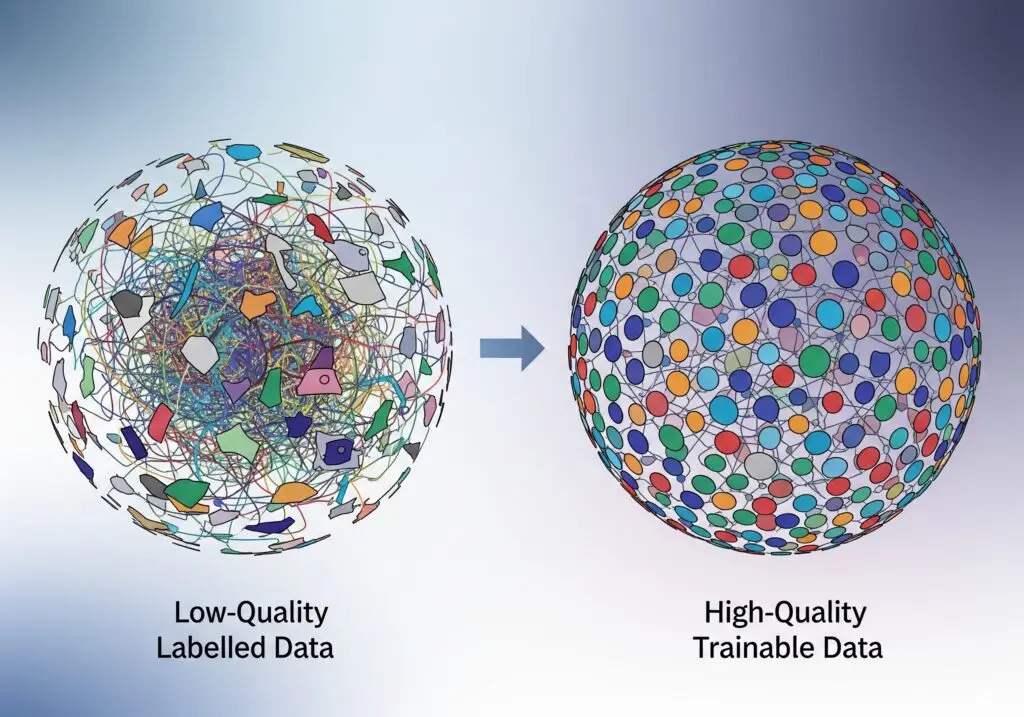
Modern AI systems, from conversational assistants to autonomous vehicles, are often celebrated for their intelligence and precision. But beneath the impressive surface, their success rests on something far less glamorous: data quality. Without reliable, accurate, and well-curated data, even the most advanced neural networks tend to stumble. Improving AI performance may not require new architectures as much as a new discipline in how data is prepared, governed, and maintained over time.

In this blog, we will explore how high-quality data training defines the reliability of AI systems. We’ll look at how data quality shapes everything from model performance and explore practical steps organizations can take to make data quality not just a compliance requirement, but a measurable advantage.

Defining Data Quality in the AI Context

When people talk about “good data,” they often mean something intuitive, clean, accurate, and free of obvious errors. Yet in the context of AI systems, that definition feels incomplete. What counts as quality depends on the purpose of the model, the variability of its environment, and the way data is collected and maintained over time. A dataset that works well for sentiment analysis, for instance, might be deeply flawed if used to train a healthcare triage model. The question isn’t just whether the data is correct, but whether it is fit for its intended use.

Traditional data management frameworks describe quality through dimensions such as completeness, consistency, accuracy, timeliness, and bias. These remain relevant, though they capture only part of the picture. AI introduces new complications: models infer meaning from patterns that humans may not notice, which means subtle irregularities or gaps can ripple through predictions in ways that are difficult to trace. A few mislabeled medical images, or a slightly unbalanced demographic sample, can distort how a model perceives entire categories.

The quality of data doesn’t merely affect whether an AI system works; it determines how it generalizes, what biases it inherits, and whether its predictions can be trusted in unfamiliar contexts. As foundation and generative models become the norm, this bridge grows even more critical. The line between data engineering and ethical AI is, at this point, almost indistinguishable.

Data Quality for Foundation Models

Foundation models thrive on massive and diverse datasets, yet the very scale that makes them powerful also makes their data quality nearly impossible to verify. Unlike smaller, task-specific models, foundation models absorb information from millions of uncurated sources, web pages, documents, code repositories, images, and social feeds, each carrying its own assumptions, biases, and inaccuracies. The result is a blend of brilliance and noise: models that can reason impressively in one domain and hallucinate wildly in another.

Provenance

For many large-scale datasets, it is unclear where the data originated, who authored it, or whether consent was obtained. Web-scraped data often lacks meaningful metadata, making it difficult to trace bias or validate accuracy. This opacity creates downstream risks not only for ethics but also for intellectual property and security. In regulated sectors such as healthcare, defense, and finance, the inability to prove data lineage can render even technically capable models unusable.

Synthetic Data Drift

As companies rely increasingly on generated data to expand or balance datasets, they face the risk of feedback loops, AI systems learning from the outputs of other AIs rather than human-grounded sources.

Federated data-quality enhancement

Where organizations collaborate on model training without sharing raw data. The emerging trend is AI-assisted validation, where machine learning models are trained to detect anomalies, duplication, or labeling inconsistencies in other datasets. It’s a case of using AI to fix AI’s homework, though results still require human oversight.

Building a Data-Quality-First AI Pipeline

Improving data quality isn’t something that happens by accident. It has to be engineered, planned, measured, and continuously maintained. The organizations that treat data quality as a living process, rather than a one-off cleanup exercise, tend to build AI systems that age well and stay explainable long after deployment.

Data auditing and profiling

Before a single model is trained, teams need visibility into what the data actually looks like. Auditing tools can flag duplication, missing values, class imbalance, or labeling conflicts. Some teams now integrate dashboards that track these metrics alongside traditional ML observability indicators. The goal isn’t perfection, but awareness: knowing what you’re working with before deciding how to fix it.

Automated Curation

Methods like DeepMind’s JEST and the SELECT benchmark demonstrate how statistical signals, such as sample difficulty or representativeness, can guide what data to keep or discard. Instead of expanding datasets indiscriminately, these techniques identify the “learnable core” that contributes most to performance. It’s a pragmatic shift: quality selection as a form of optimization.

Human-in-the-loop verification

Machines can identify inconsistencies, but they rarely understand context. Human annotators provide that judgment, whether a sentiment label feels culturally off or a bounding box misses nuance in an edge case. The most effective AI pipelines blend algorithmic precision with human discernment, turning data labeling into a collaborative feedback cycle rather than a static task.

Performance loops

As models encounter new scenarios in production, their errors reveal where the underlying data falls short. Logging, retraining, and continuous validation help close this loop. In mature workflows, model drift is treated not as a failure but as a diagnostic tool: a signpost that the data needs updating.

Governance layer

This means version control for datasets, standardized documentation, and audit trails that align with frameworks like NIST’s AI RMF or the EU AI Act. Governance doesn’t have to be bureaucratic; it can be lightweight, automated, and still transparent enough to answer a regulator or an internal ethics board when questions arise.

The result isn’t just a cleaner dataset, it’s an institutional habit of questioning data before trusting it. That mindset, more than any tool or framework, is what ultimately distinguishes a data-quality-first organization from one still chasing scale at the expense of substance.

Read more: Video Annotation for Generative AI: Challenges, Use Cases, and Recommendations

Strategic Benefits of Prioritizing Data Quality

When teams start to take data quality seriously, the payoff becomes visible across more than just accuracy metrics. It seeps into efficiency, compliance, and even the cultural mindset around how technology decisions are made. The shift isn’t dramatic at first; it’s more like turning down the static on a noisy channel. But over time, the effects are unmistakable.

Performance

High-quality data often reduces overfitting because the patterns it contains are meaningful rather than random. Models trained on carefully selected examples converge faster, require fewer epochs, and maintain stability across updates. Smarter data can yield double-digit improvements in downstream tasks while cutting compute costs. It’s a rare scenario where better ethics and better engineering align naturally.

Compliance and trust

When a model can demonstrate where its training data came from, how it was labeled, and who reviewed it, audits become far less painful. This transparency not only satisfies regulators like NIST or the European Commission, but it also reassures customers, investors, and even internal leadership that AI outputs are defensible. In many ways, data quality is becoming the new form of due diligence: the difference between “we think it works” and “we know why it works.”

Lower long-term costs

Less noise translates into fewer annotation rounds, shorter retraining cycles, and smaller infrastructure footprints. Teams can spend time analyzing results instead of debugging inconsistencies. These efficiencies are particularly valuable for organizations running large-scale systems or maintaining multilingual datasets where rework quickly multiplies.

Sustainability

Training on redundant or poorly curated data wastes energy and contributes to the growing carbon footprint of AI. By trimming unnecessary data and focusing on what matters, organizations align technical performance with environmental responsibility. It’s not just good practice, it’s increasingly good optics in a climate-conscious business landscape.

Read more: How Object Tracking Brings Context to Computer Vision

How We Can Help

For most organizations, improving data quality is less about knowing why it matters and more about figuring out how to get there. The gap between principle and practice often lies in scale; data pipelines are massive, messy, and distributed across teams and vendors. That’s where Digital Divide Data (DDD) has spent years turning data quality management into a repeatable, human-centered process that blends technology, expertise, and accountability.

DDD’s approach starts with human-in-the-loop accuracy; our teams specialize in multilingual, domain-specific data labeling and validation, where context and nuance often determine correctness. Whether the project involves classifying retail product images, annotating text, or segmenting geospatial imagery. Our annotators are trained not only to label but to question, flagging edge cases, ambiguous examples, and potential bias before they make their way into model training sets. This kind of human judgment remains difficult to automate, even with the best tools.

For organizations that see trustworthy AI as more than a slogan, DDD provides the infrastructure, people, and rigor to make it real.

Conclusion

Models are becoming larger, faster, and more capable, yet their reliability often hinges on something far less glamorous: the quality of the data beneath them. A model trained on inconsistent or biased data doesn’t just perform poorly; it becomes untrustworthy in ways that are hard to diagnose after deployment.

What’s changing is the mindset. The AI community is starting to treat data quality as a strategic asset, not an operational nuisance. Clean, representative, and well-documented datasets are beginning to define competitive advantage as much as compute resources once did. Organizations that invest in data auditing, governance, and continuous validation are finding that their models don’t just perform better; they remain interpretable, defensible, and sustainable over time.

Yet this shift is not automatic. It demands infrastructure, discipline, and often cultural change. Teams must get comfortable with slower data collection if it means collecting the right data. They have to view annotation not as a cost center but as part of their intellectual capital. And they need to approach governance not as a compliance hurdle but as a way to future-proof their systems against the inevitable scrutiny that comes with AI maturity.

Every major improvement in performance, fairness, or explainability ultimately traces back to how data is gathered, cleaned, and understood. The sooner organizations internalize that, the more resilient their AI ecosystems will be.

Partner with Digital Divide Data to build AI systems powered by clean, accurate, and ethically sourced data, because quality data isn’t just good practice; it’s the foundation of intelligent, trustworthy technology.


References

DeepMind. (2024). JEST: Data curation via joint example selection. In Proceedings of the 38th Conference on Neural Information Processing Systems (NeurIPS 2024). London, UK: NeurIPS Foundation.

National Institute of Standards and Technology. (2024, July). AI Risk Management Framework: Generative AI Profile (NIST.AI.600-1). U.S. Department of Commerce. Retrieved from https://www.nist.gov/

National Institute of Standards and Technology. (2024). Test, evaluation, verification, and validation (TEVV) program overview. Gaithersburg, MD: U.S. Department of Commerce.

European Committee for Standardization (CEN). (2024). PD CEN/CLC/TR 18115: Data governance and quality for AI systems. Brussels, Belgium: CEN-CENELEC Management Centre.

Financial Times. (2024, August). The risk of model collapse in synthetic AI data. London, UK: Financial Times.

Wired. (2024, September). Synthetic data is a dangerous teacher. New York, NY: Condé Nast Publications.


Frequently Asked Questions (FAQs)

How do I know if my organization’s data quality is “good enough” for AI?
There isn’t a universal benchmark, but indicators include stable model performance across new datasets, low annotation disagreement, and minimal drift over time. If results fluctuate widely when retraining, it may signal uneven or noisy data.

Is there a trade-off between dataset size and quality?
Usually, yes. Larger datasets often introduce redundancy and inconsistency, while smaller, curated ones tend to improve learning efficiency. The key is proportionality: enough data to represent reality, but not so much that the signal gets lost in noise.

What role does bias play in measuring data quality?
Bias isn’t separate from data quality; it’s one of its dimensions. Even perfectly labeled data can be low-quality if it underrepresents certain populations or scenarios. Quality and fairness must be managed together.

How often should data quality be reassessed?
Continuously. As environments, languages, or customer behaviors shift, the relevance of training data decays. Mature AI pipelines include recurring audits and feedback loops to ensure ongoing alignment between data and reality.

Why Data Quality Defines the Success of AI Systems Read Post »

Scroll to Top