
Data Annotation Techniques for Voice, Text, Image, and Video
Data annotation is one of those behind-the-scenes processes that quietly determine whether an AI system succeeds or stumbles. It is the act of labeling raw data, text, images, audio, or video, so that algorithms can make sense of it. Without these labeled examples, a model would have no reference for what it is learning to recognize.
Today’s AI systems depend on more than just one kind of data. Text powers language models and chatbots, audio employer voice assistants and transcription engines, Images and videos train vision systems that navigate streets or monitor industrial processes. Annotating a conversation clip is nothing like segmenting an MRI scan or identifying a moving object across video frames. As machine learning expands into multimodal territories, teams face the challenge of aligning different types of annotations into a single, coherent training pipeline.
In this blog, we will explore how data annotation works across voice, text, image, and video, why quality still matters more than volume, and what methods, manual, semi-automated, and model-assisted, help achieve consistency at scale.
The Strategic Importance of High-Quality Data Annotation
When people talk about AI performance, they often start with model architecture or training data volume. Yet the less glamorous factor, how that data is annotated, quietly decides how well those models perform once they leave the lab. Annotated data forms the ground truth that every supervised or semi-supervised model depends on. It tells the algorithm what “right” looks like, and without it, accuracy becomes guesswork.
What qualifies as high-quality annotation is not as simple as getting labels correct. It is a balance between accuracy, consistency, and coverage. Accuracy measures how closely labels match reality, but even perfect accuracy on a narrow dataset can create brittle models that fail when exposed to new conditions. Consistency matters just as much. Two annotators marking the same image differently introduce noise that the model interprets as a pattern. Coverage, meanwhile, ensures that all meaningful variations in the data, different dialects in speech, lighting conditions in images, or social tones in text, are represented. Miss one of these dimensions and the model’s understanding becomes skewed.
There’s a reason data teams struggle to maintain this balance. Tight budgets and production timelines often push them to cut corners, trading precision for speed. Automated tools may promise efficiency, but they still rely on human validation to handle nuance and ambiguity. Weak supervision, active learning, and model-assisted labeling appear to offer shortcuts, yet each introduces its own fragility. These methods can scale annotation rapidly, but they depend heavily on well-defined heuristics and continuous monitoring to prevent quality drift.
Annotation pipelines, in that sense, are evolving from static workflows into adaptive systems. They now need to handle multimodal data, integrate feedback from deployed models, and align with ethical and regulatory expectations. In industries like healthcare, defense, and finance, annotation quality isn’t just a technical concern; it is a compliance issue. The way data is labeled can affect fairness audits, bias detection, and even legal accountability.
So while machine learning architectures may evolve quickly, the foundations of high-quality annotation remain steady: clarity in design, transparency in process, and discipline in validation. Building AI systems that are accurate, fair, and adaptable begins not with code, but with how we teach machines to see and interpret the world in the first place.
Core Data Annotation Methodologies
Manual Annotation
Manual annotation is where most AI projects begin. It’s the simplest to understand, humans labeling data one instance at a time, but the hardest to execute at scale. The strength of manual labeling lies in precision and contextual understanding. A trained annotator can sense sarcasm in a sentence, recognize cultural nuance in a meme, or identify subtle patterns that automated systems overlook.
Yet even with the best instructions, human annotators bring subjectivity. Two people might interpret the same comment differently depending on language familiarity, mood, or fatigue. For this reason, well-run annotation teams emphasize inter-annotator agreement and guideline iteration. They don’t assume the first rulebook is final; they refine it as ambiguity surfaces.
Manual annotation remains indispensable for domains where small errors carry big consequences, medical imaging, legal documents, and security footage, for example. It’s slower and more expensive, but it builds a reliable baseline against which more automated methods can later be calibrated.
Semi-Automated Annotation
As datasets expand, manual annotation alone becomes impractical. Semi-automated methods step in to share the load between humans and machines. In these workflows, a model pre-labels data, and human annotators review or correct it. Over time, the model learns from these corrections, gradually improving its pre-label accuracy.
This setup, sometimes called human-in-the-loop labeling, offers a middle ground between precision and scalability. The model handles the repetitive or obvious cases, freeing humans to focus on edge conditions and tricky examples. Teams also use confidence-based sampling, where the algorithm flags low-confidence predictions for review, ensuring effort goes where it’s most needed.
Still, semi-automation is not a magic fix. Models can reinforce their own mistakes if feedback loops aren’t carefully monitored. The challenge lies in maintaining vigilance: trusting automation where it performs well, but intervening fast when it begins to drift. When done right, these systems can multiply productivity while keeping quality under control.
Programmatic and Weak Supervision
Programmatic annotation treats labeling as a data engineering problem rather than a manual one. Instead of having people tag every sample, teams define a set of rules, patterns, or heuristics, for example, “mark any headline containing ‘earnings’ or ‘revenue’ as finance-related.” These labeling functions can be combined statistically, often through weak supervision frameworks that weigh each source’s reliability to produce an aggregated label.
The appeal is obvious: speed and scale. You can annotate millions of records in hours instead of months. The trade-off is precision. Rules can’t capture nuance, and noise accumulates quickly when multiple heuristics conflict. Programmatic labeling works best in domains with clear signal boundaries—like detecting spam, categorizing documents, or filtering explicit content, where a few good heuristics go a long way.
As datasets grow, weak supervision often becomes the first stage of annotation, generating rough labels that humans later refine. It’s an efficient approach, though it demands rigorous monitoring to ensure shortcuts don’t become blind spots.
LLM and Foundation Model–Assisted Annotation
The newest player in annotation workflows is the foundation model, a large, pre-trained system that can understand text, images, or audio at near-human levels. These models are increasingly used to pre-label data, summarize annotation guidelines, or even act as “second opinions” to resolve disagreements between annotators.
They bring undeniable advantages: speed, context awareness, and the ability to generalize across languages and modalities. Yet they also introduce new risks. A model that “understands” language is still prone to hallucinations, and without strict oversight, it can produce confident but incorrect labels. More subtly, when a model labels data that will later be used to train another model, the ecosystem risks becoming circular, a feedback loop where AI reinforces its own biases.
To manage this, annotation teams often apply human verification layers and drift tracking systems that monitor how LLM-assisted labels evolve. Governance becomes as important as model performance. The most successful teams treat large models not as replacements for human judgment but as accelerators that extend human capacity, powerful tools that still require a steady human hand on the wheel.
Modality-Specific Data Annotation Techniques
Understanding the unique challenges of each modality helps teams choose the right techniques, tools, and validation strategies before scaling.
Text Annotation
Text annotation forms the backbone of natural language processing systems. It covers a wide range of tasks, classifying documents, tagging named entities, detecting sentiment, identifying intent, or even summarizing content. What seems simple on the surface often hides layers of ambiguity. A single sentence can carry sarcasm, cultural tone, or coded meaning that no keyword-based rule can capture.
Annotators working with text must balance linguistic precision with interpretive restraint. Over-labeling can introduce noise, while under-labeling leaves models starved of context. Good practice often involves ontology design, where teams define a clear, hierarchical structure of labels before annotation begins. Without this structure, inconsistencies spread fast across large datasets.
Another common pain point is domain adaptation. A sentiment model trained on movie reviews may falter on financial reports or customer support chats because emotional cues vary across contexts. Iterative guideline refinement, where annotators and project leads regularly review disagreements, helps bridge such gaps. Text annotation, at its best, becomes a dialogue between human understanding and machine interpretation.
Voice Annotation
Annotating voice data brings its own challenges. Unlike text, where meaning is explicit, audio contains layers of tone, pitch, accent, and rhythm that influence interpretation. Voice annotation is used for tasks such as automatic speech recognition (ASR), speaker diarization, intent detection, and acoustic event tagging.
The process usually begins with segmentation, splitting long recordings into manageable clips, followed by timestamping and transcription. Annotators must handle background noise, overlapping speech, or sudden interruptions, which are common in conversational data. Even something as subtle as laughter or hesitation can alter how a model perceives the dialogue’s intent.
To maintain quality, teams often rely on multi-pass validation, where one set of annotators transcribes and another reviews. Accent diversity adds another layer of complexity. A word pronounced differently across regions might be misinterpreted unless annotators share linguistic familiarity with the dataset. While automated tools can speed up transcription, they rarely capture these fine details. That’s why human input, even in an era of powerful speech models, still grounds the process in real-world understanding.
Image Annotation
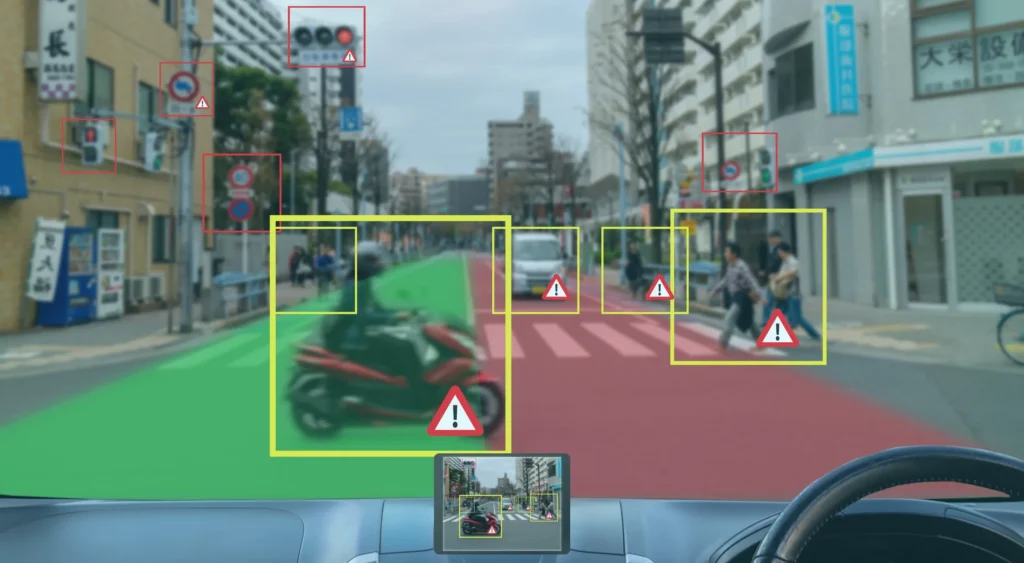
Image annotation sits at the center of computer vision workflows. The goal is to help models identify what’s in a picture and where it appears. Depending on the task, annotations might involve bounding boxes, polygonal masks, semantic segmentation, or keypoint mapping.
What makes this process tricky is not just accuracy but consistency. Two annotators marking the same object’s boundary can draw slightly different edges, creating noise in the dataset. At scale, such variations accumulate and affect model confidence. Teams counter this with clear visual guidelines, periodic calibration sessions, and automated overlap checks.
Automation has made image labeling faster, but it still needs human correction. Pre-labeling models can suggest object boundaries or segment regions automatically, yet these outputs often misinterpret subtle features, say, the edge of a transparent glass or overlapping shadows. Quality assurance here is almost pixel-level, where minor mistakes can mislead downstream models. The most reliable pipelines blend automation for efficiency with human oversight for precision.
Video Annotation
Video annotation takes everything that makes image labeling hard and multiplies it by time. Each frame must not only be labeled accurately but also remain consistent across a sequence. Annotators track moving objects, note interactions, and maintain continuity even as subjects disappear and reappear.
A common technique involves keyframe-based labeling, annotating certain frames, and allowing interpolation algorithms to propagate labels between them. While this saves effort, it can introduce drift if movement or lighting changes unexpectedly. Annotators must review transitions and correct inconsistencies manually, especially in fast-paced footage or scenes with multiple actors.
Temporal awareness adds another challenge. The meaning of an event in a video often depends on what happens before and after. For example, labeling “a person running” requires understanding when the action starts and ends, not just identifying the runner in one frame. Effective video annotation depends on structured workflows, synchronization tools, and strong collaboration between annotators and reviewers.
Despite advances in automation, full autonomy in video labeling remains elusive. Machines can track motion, but they still struggle with context: why someone moved, what triggered an event, or how multiple actions relate. Human annotators remain essential for interpreting those nuances that models have yet to fully grasp.
Building Scalable Data Annotation Pipelines
A scalable annotation pipeline isn’t just a sequence of tasks; it’s a feedback ecosystem that keeps improving as the model learns.
From Raw Data to Model Feedback
A practical workflow often begins with data sourcing, where teams collect or generate inputs aligned with the project’s purpose. Then comes annotation, where humans, models, or both label the data according to predefined rules. After that, quality assurance filters out inconsistencies, feeding the clean data into model training. Once the model is tested, performance feedback reveals where the data was lacking; those cases loop back for re-annotation or refinement.
What seems linear at first is actually circular. The best teams accept this and plan for it, budgeting time and tools for iteration rather than treating annotation as a one-off milestone.
Data Versioning and Traceability
When annotation scales, traceability becomes essential. Every dataset version, every label, correction, or reclassification should be recorded. Without it, models can become black boxes with no reliable way to track why performance changed after retraining.
Data versioning systems create a kind of lineage for annotations. They make it possible to compare two dataset versions, roll back mistakes, or audit label histories when inconsistencies appear. In sectors where accountability matters, public data, healthcare, or defense, this isn’t just operational hygiene; it’s compliance.
Integrating DataOps and MLOps
Annotation doesn’t exist in isolation. As teams move from prototypes to production, DataOps and MLOps practices become central. They bring structure to how data flows, how experiments are tracked, and how retraining occurs. In this context, annotation is treated as a living part of the model lifecycle, not a static dataset frozen in time.
A mature pipeline can automatically flag when new data drifts from what the model was trained on, triggering re-labeling or guideline updates. The integration of DataOps and MLOps effectively turns annotation into an ongoing calibration mechanism, ensuring models remain relevant rather than quietly decaying in production.
Workforce Design and Human Strategy
Even with the best automation, people remain the backbone of annotation work. Scaling isn’t just about hiring more annotators; it’s about designing a workforce strategy that balances in-house expertise and managed crowd solutions. In-house teams bring domain knowledge and quality control. Distributed or crowd-based teams add flexibility and volume.
The most effective setups mix both: experts define standards and review complex cases, while trained external contributors handle repetitive or well-structured tasks. Success depends on communication loops; annotators who understand the “why” behind labels produce more reliable results than those just following checklists.
Evolving Beyond Throughput
Scalability often gets mistaken for speed, but that’s only half of it. True scalability is about maintaining clarity and quality when everything, data volume, team size, and model complexity, expands. A pipeline that can absorb this growth without constant redesign has institutionalized feedback, documentation, and accountability.
How We Can Help
For many organizations, the hardest part of building high-quality training data isn’t knowing what to label; it’s sustaining accuracy and scale as the project matures. That’s where Digital Divide Data (DDD) steps in, after spending years designing annotation operations that combine human expertise with the efficiency of automation, allowing data teams to focus on insight rather than logistics.
DDD approaches annotation as both a technical and human challenge. Its teams handle diverse modalities, voice, text, image, and video, each requiring specialized workflows and domain-aware training. A dataset for conversational AI, for instance, demands linguistic nuance and speaker consistency checks, while a computer vision project needs pixel-level precision and iterative QA cycles. DDD’s experience in balancing these priorities helps clients maintain control over quality without slowing down delivery.
Read more: How Object Tracking Brings Context to Computer Vision
Conclusion
Annotation might not be the most glamorous part of AI, but it’s easily the most defining. The sophistication of today’s models often distracts from a simple truth: they are only as intelligent as the data we use to teach them. Each labeled example, each decision made by an annotator or a model-assisted system, quietly shapes how algorithms perceive the world.
What’s changing now is the mindset around annotation. It’s no longer a static, pre-training activity; it’s becoming a living process that evolves alongside the model itself. High-quality annotation isn’t just about accuracy; it’s about adaptability, accountability, and alignment with human values. The challenge is not only to scale efficiently but to keep that human layer of judgment intact as automation grows stronger.
The future of annotation looks hybrid: humans defining context, machines extending scale, and systems constantly learning from both. Teams that invest early in structured data pipelines, transparent QA frameworks, and ethical labeling practices will find their AI systems learning faster, performing more reliably, and earning greater trust from the people who use them.
High-quality labeled data is more than just training material; it’s the language that helps AI think, reason, and, ultimately, understand.
Partner with Digital Divide Data to build intelligent, high-quality annotation pipelines that power trustworthy AI.
References
CVPR. (2024). Semantic-aware SAM: Towards efficient automated image segmentation. Proceedings of CVPR.
ACL Anthology. (2024). Large Language Models for Data Annotation and Synthesis: A Survey. EMNLP Proceedings.
Springer AI Review. (2025). Recent Advances in Named Entity Recognition: From Learning to Application.
FAQs
How long does it usually take to build a high-quality annotated dataset?
Timelines vary widely depending on complexity. A sentiment dataset might take weeks, while multi-modal video annotations can take months. The key is establishing clear guidelines and iteration loops early; time saved in rework often outweighs time spent on planning.
Can automation fully replace human annotators?
Not yet. Automation handles repetition and scale efficiently, but humans remain essential for tasks that require contextual interpretation, cultural understanding, or ethical judgment. The most effective pipelines combine both.
How often should annotation guidelines be updated?
Whenever data distribution or model objectives shift, static guidelines quickly become outdated, particularly in dynamic domains such as conversation AI or computer vision. Iterative updates maintain alignment with real-world context.
What are common causes of annotation drift?
Changes in annotator interpretation, unclear definitions, or evolving project goals. Regular calibration sessions and consensus reviews help catch drift before it degrades data quality.

Umang architects and drives full-funnel content marketing strategies for AI training data solutions, spanning computer vision, data annotation, data labelling, and Physical and Generative AI services. He works closely with senior leadership to shape DDD’s market positioning, translating complex technical capabilities into compelling narratives that resonate with global AI innovators.
Data Annotation Techniques for Voice, Text, Image, and Video Read Post »