Celebrating 25 years of DDD's Excellence and Social Impact. ✖

Generative AI

Machine Learning Data Labeling

Machine Learning Data Labeling Services: Why “Labeled” Doesn’t Always Mean “Trainable”

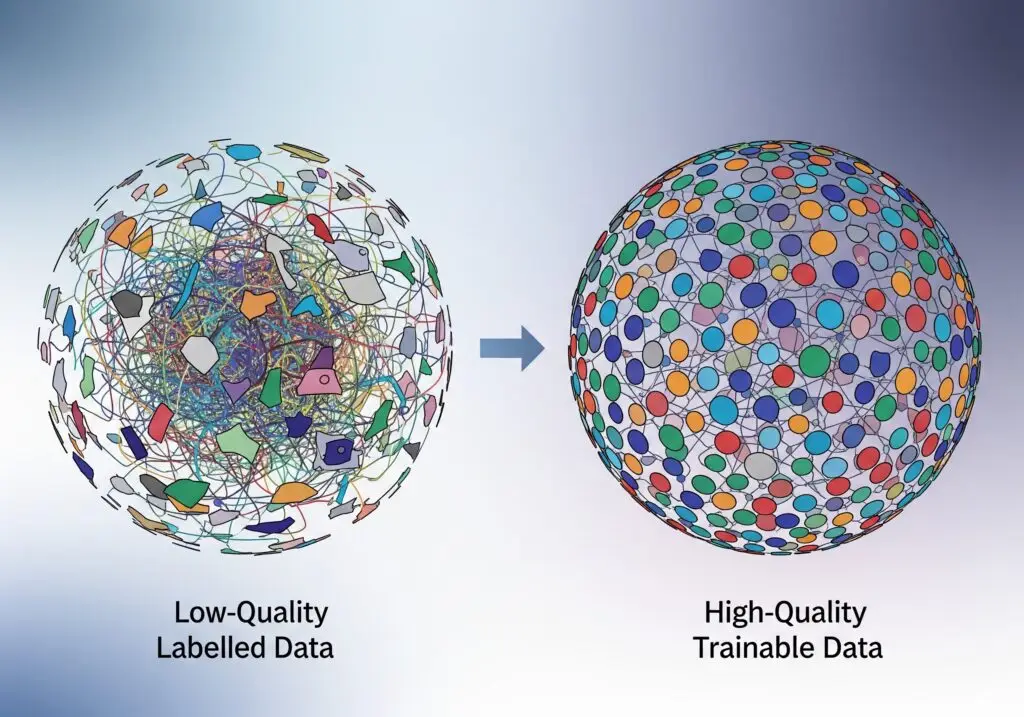
Labeled data is not automatically trainable data. The gap between the two is defined by three important factors: label consistency across annotators, class coverage across the distribution your model will face in production, and whether your downstream evaluation metrics actually expose annotation failures before they reach deployment. Most machine learning data labeling services close the first factor. Very few consistently address all three.

Data quality is the most cited reason AI projects underperform in production, and yet most teams don’t catch the problem until they’ve already trained on it. Understanding what makes labeled data actually useful for AI models starts with separating the act of annotation from the standard of annotation. Programs that invest in quality of data collection and curation process programs label quality upstream spend far less time debugging model failures downstream.

Key Takeaways

  • Labeled data and trainable data are two different attributes. A 100% labeled dataset can still fail to produce a model that generalizes if consistency, coverage, or schema quality is missing.
  • Low inter-annotator agreement (IAA) means your model is learning a weighted average of conflicting annotator interpretations, not actual ground truth.
  • Coverage gaps are invisible during standard evaluation because test sets are usually drawn from the same flawed collection as training data.
  • Overall accuracy many times hides annotation failures. Per-class recall, confusion matrix analysis, and slice-level performance are the metrics that actually expose them.
  • Annotation quality problems found during model debugging cost far more to fix than annotation quality standards enforced at the start of the labeling pipeline.

What is the Difference Between Labeled Data and Trainable Data?

Machine learning data labeling services produce labeled dataset files, where each sample carries an annotation, but “labeled” is a binary state. While “Trainable” is a quality threshold. A dataset can be 100% labeled and still fail to produce a model that generalizes.

Trainable data meet three conditions simultaneously. First, labels are consistent; two annotators working independently on the same sample reach the same conclusion, as measured by inter-annotator agreement (IAA) scores. Second, the dataset has sufficient class coverage; every category the model will encounter in production appears with enough examples to learn a reliable decision boundary. Third, the label schema maps correctly to the task, the taxonomy used during annotation is specific enough to be useful, but not so granular that annotators make arbitrary distinctions.

When any of these conditions fail, the model trains on noise instead of signal, producing plausible-looking accuracy numbers on a held-out set while underperforming on the specific cases that matter in deployment. This is why data annotation challenges at scale are not primarily about throughput; they’re about maintaining quality standards as volume increases.

Why Does Label Consistency Determine Whether a Dataset Is Trainable?

Label consistency is the single most predictive indicator of whether a supervised learning dataset will produce a model that transfers to production. Low inter-annotator agreement is not a minor inconvenience; it means your model is learning a weighted average of conflicting interpretations rather than a coherent concept.

When annotators disagree on boundary conditions like edge cases between adjacent categories, ambiguous instances, or samples that require domain knowledge to classify, the training signal on those samples is contradictory. The model receives conflicting gradient updates. Over a large enough dataset, systematic disagreements encode annotator bias rather than ground truth. The 99.5% annotation accuracy in production matters precisely because even small error rates compound across millions of training samples.

There are three primary sources of label inconsistency that teams consistently underestimate:

Ambiguous labeling guidelines: Guidelines written at the category level without worked examples leave annotators to resolve edge cases independently. Each annotator develops their own rules. IAA looks acceptable in aggregate but hides systematic splits on specific subclasses.

Annotator fatigue in long sessions: Accuracy on complex annotation tasks degrades after 90–120 minutes. Without session controls, later batches in a work session carry more noise than earlier batches. 

Insufficient domain expertise for specialized tasks: Tasks that require domain knowledge, like medical imaging, legal document classification, or sensor data from autonomous systems, produce very low IAA when assigned to general annotators. The resulting labels represent best guesses, not ground truth.

Fixing this after labeling is expensive. Relabeling at scale means discovering the problem late, often after a failed training run. The more reliable approach is to run IAA audits on a stratified sample before full production begins, and to build adjudication workflows, where disagreements trigger a review by a senior annotator or domain expert, into the pipeline itself. Fixing unreliable data annotation becomes costly after failed training and requires a lot of hidden costs. 

How Do Coverage Gaps Expose Your Model to Silent Failure?

Label consistency is a within-dataset property. Coverage is about the relationship between your dataset and the real-world distribution your model must handle. A dataset can have near-perfect IAA scores and still catastrophically fail in production if it systematically underrepresents the cases that matter.

Coverage gaps tend to be invisible during evaluation because most held-out test sets are drawn from the same collection as training data. If the collection process missed night-time driving scenarios, both training and test sets missed them. The model looks competent until it encounters night-time conditions in deployment. The same pattern appears in medical imaging when datasets are collected from a single hospital, in NLP when training data skews toward one dialect or register, and in robotics when physical training environments don’t replicate the range of object orientations found in real warehouses.

Three coverage problems appear most often:

Class imbalance: Rare but important categories like edge cases, failure modes, and minority demographic groups are underrepresented because they’re genuinely rare in uncurated data collection. The model learns to ignore them because ignoring them carries a minimal penalty on the training objective.

Distribution shift: Data is collected under conditions that differ from deployment conditions. This includes temporal shifts (training on last year’s data for this year’s problem), geographic shifts, and hardware shifts (different camera models, different sensor calibrations).

Missing negative examples: Classifiers trained without sufficient hard negatives, examples that resemble the positive class but should be labeled negative, develop wide decision boundaries and produce too many false positives in production.

The only reliable defense against coverage gaps is active curation. This means analyzing collection data for distributional completeness before annotation begins, augmenting underrepresented slices, and running slice-level evaluation to confirm that model performance is acceptable across each subgroup, not just in aggregate. Building AI-ready datasets at scale requires a pipeline design that treats coverage as a first-order constraint.

Which Downstream Metrics Actually Expose Annotation Problems?

Overall accuracy is never the right metric for detecting annotation quality failures. It aggregates across the entire dataset and is dominated by the majority class. Problems with rare categories, coverage gaps, and labeling inconsistencies on hard examples all hide inside an acceptable accuracy number.

The metrics that consistently surface annotation problems are those that force per-slice analysis. These include:

Per-class precision and recall: A class with very low recall relative to others is often one where annotators disagree frequently or where coverage is insufficient. High false negative rates on specific classes trace directly to annotation failures.

Confusion matrix analysis: Systematic confusions between adjacent classes, for example, where the model consistently predicts Class A when the ground truth is Class B, often indicate that the boundary between those classes was annotated inconsistently. The model learned the wrong boundary because annotators didn’t agree on where it was.

Calibration error: A model that is overconfident in its errors has typically been trained on noisy labels. Expected Calibration Error (ECE) tends to be higher for datasets with low IAA, because the model has been trained to express high confidence in examples where the “ground truth” was actually contested.

Slice-level performance on known hard subgroups: If you can define subgroups expected to be harder, rare classes, out-of-distribution conditions, or demographic subgroups, performance gaps between those slices and the overall population are a proxy for coverage and consistency failures.

If the taxonomy is wrong, and task framing doesn’t match what the model needs to do in production, high IAA and good coverage will produce a highly consistent but wrong model. Taxonomy validation, which involves domain experts reviewing the label schema against production use cases before annotation begins, is not optional for high-stakes programs. 

How Digital Divide Data Can Help

DDD’s approach to machine learning data labeling services is built around the distinction between labeled and trainable data. Every annotation program that DDD operates includes IAA measurement as a standard process step, not an optional audit. Annotator teams work against guidelines that are developed with worked examples for edge cases, and adjudication workflows are embedded directly in the pipeline so that disagreements trigger expert review rather than accumulating as noise in the final dataset.

On the coverage side, DDD’s data collection and curation services include collection strategy design, distributional analysis, and active slice augmentation for underrepresented categories. For programs in Physical AI and ADAS where coverage gaps carry safety implications, DDD runs scenario-level coverage audits that map the collected dataset against the target Operational Design Domain (ODD) before labeling begins. This ensures that annotation effort is not wasted on a distribution that will produce a model with known coverage failures.

Downstream, DDD’s model evaluation services are designed to surface annotation-level failures. Evaluation pipelines include per-class analysis, confusion matrix review, and slice-level scoring against defined hard subgroups. Where evaluation reveals category-level failures that trace back to annotation inconsistency, DDD’s teams can run targeted relabeling on the affected slice without restarting the full dataset pipeline.

Label programs that actually close performance gaps require more than throughput. They require quality architecture. Talk to an Expert!

Conclusion

The gap between labeled data and trainable data is not closed by scale. Larger volumes of low-consistency, low-coverage labeled data produce larger models with the same failure modes, at greater cost. The programs that consistently produce deployable models treat annotation quality as an upstream investment. IAA measurement, coverage analysis, and taxonomy validation should be discussed before annotation begins, not as remediation steps after a failed training run.

Teams that operate this way are better positioned to identify failures before they reach production and to iterate faster when distribution shifts require dataset updates. Teams that don’t will continue to discover annotation failures through model debugging, which is the most expensive place to find them.

References

Zha, D., Bhat, Z. P., Lai, K.-H., Yang, F., Jiang, Z., Zhong, S., & Hu, X. (2023). Data-centric AI: A survey. arXiv preprint. https://arxiv.org/abs/2303.10158

Nushi, B., Kamar, E., & Horvitz, E. (2018). Towards accountable AI: Hybrid human-machine analyses for characterizing system failure. Proceedings of AAAI HCOMP. https://arxiv.org/abs/1809.07424

Frequently Asked Questions

What makes labeled data actually useful for machine learning models?

Labeled data becomes useful when it meets three conditions at once: annotators are consistent with each other (measured by inter-annotator agreement), the dataset covers the distribution the model will face in production, and the label schema maps correctly to the actual task. Missing any one of these produces a dataset that can train a model, but won’t produce reliable performance in deployment.

How do you measure label quality before training starts?

The primary measure is inter-annotator agreement (IAA), calculated on a stratified sample where multiple annotators label the same examples. Cohen’s kappa is the standard metric for categorical labels. IAA should be measured at the category level, not just in aggregate, because high overall agreement can hide systematic disagreements on specific subclasses that matter most.

Why does a model sometimes perform well on test data but fail in production?

This usually means the test set was drawn from the same distribution as the training data, so coverage gaps and annotation errors are shared across both sets. If a class or condition was systematically underrepresented or mislabeled during collection, both training and test sets carry the same blind spot. Slice-level evaluation; testing specifically on known hard subgroups is more likely to surface these gaps than overall held-out accuracy.

How does annotator disagreement affect model training?

When annotators disagree on the same sample, the training set contains conflicting labels for similar inputs. The model receives contradictory gradient updates on those samples and tends to learn an unstable boundary around the contested region. This often shows up as high calibration error, and the model becomes overconfident in the types of examples where annotators disagreed most.

Machine Learning Data Labeling Services: Why “Labeled” Doesn’t Always Mean “Trainable” Read Post »


AI training data providers

An Enterprise Framework for Evaluating AI Training Data Providers

Selecting an AI training dataset provider requires evaluating five dimensions: workforce model and annotator expertise, data security and compliance posture (SOC 2, ISO 27001), quality SLAs backed by measurable inter-annotator agreement (IAA) and defect-rate commitments, AI-assisted throughput with human oversight, and, of course, commercial flexibility. 

Most failed AI programs we see are not model failures. They are data failures, sourced from a provider that looked capable at the proposal stage but couldn’t hold quality or volume at production scale. The decision of which AI training data collection and curation provider to work with is one of the highest-leverage procurement decisions an AI team makes. 

Key Takeaways 

  • Selecting an AI training dataset provider is a five-dimensional decision: workforce model, security posture (SOC 2 Type II, ISO 27001), quality SLAs grounded in IAA scores, AI-assisted throughput with human oversight, and commercial flexibility.
  • Generic vendor scoring usually misses the failure modes (annotator quality drift, inconsistent IAA, and contractual structures) that actually break AI data programs.
  • A quoted accuracy of 99.5% can mask production-grade failures unless the provider defines how it’s measured, what QA sampling method is used, and what IAA scores look like by task type.
  • Providers that apply the same automation ratio across all task types signal immature tooling.
  • Use the scorecard in this framework as a starting point. Adapt the weights and thresholds to your program’s specific risk profile before comparing providers.

Who is an AI Training Data Provider?

An AI training data provider, also called a data labeling vendor, annotation partner, or AI data services company, is an organization that produces labeled, curated, or structured datasets used to train, fine-tune, or evaluate machine learning models. The scope varies widely. Some providers focus exclusively on annotation (bounding boxes, classification, NER, etc.). Others offer end-to-end services: data collection, curation, annotation, quality assurance, and AI model evaluation.

The market includes offshore-only crowdsourcing platforms, technology-first tool vendors that rely on gig workers, and full-service providers with managed expert workforces. These are structurally different products, even when they present similar service catalogs. Understanding which model a vendor operates is the first procurement decision.

The right provider depends on the individual AI program’s modality (text, vision, audio, multimodal), annotation complexity (simple classification vs. complex reasoning and preference tasks), volume requirements, and security constraints. A provider that works well for consumer-grade image classification frequently fails on high-precision ADAS sensor fusion or RLHF preference data for enterprise LLMs.

Why Standard Enterprises Vendor Scoring Falls Short for Data Providers?

Generic vendor evaluation rubrics, such as financial stability, past clients, certifications, and delivery timelines, do not capture what actually determines success in an AI data program. A vendor can hold ISO 27001 and still produce annotations with 15% defect rates under volume pressure. A provider can quote 99% accuracy and define it against a metric that masks the failures that matter to your model.

The risks specific to AI data vendors include annotator quality drift under surge conditions, inconsistent inter-annotator agreement (IAA) across task types, security gaps in data handling at the worker level (not just the enterprise perimeter), and contractual structures that do not create incentives for sustained accuracy. As data collection and curation at scale require careful pipeline design from the beginning, evaluating providers on these specific axes is essential before the program starts.

This framework structures evaluation across the five most important dimensions. Each dimension has a set of qualifying questions, red flags, and a weighted scoring range for use in a comparative scorecard.

Dimension 1: Workforce Model and Annotator Expertise

The quality of annotated data is a direct function of the annotators producing it. The workforce model describes how a provider recruits, trains, retains, and manages the people doing the annotation work. There are three common models: managed in-house workforce, managed workforce plus gig overflow, and crowdsourcing platforms.

In-house managed workforces, typically located in dedicated delivery centers, tend to show more consistent quality on complex or specialized tasks. Gig and crowdsourcing models offer surge capacity but frequently struggle with complex annotation schemas, especially those requiring domain expertise, linguistic judgment, or nuanced preference rankings.

Key qualification questions:

  • What percentage of annotators are permanent employees vs. contract or gig workers?
  • How are annotators trained for new task types, and how is training quality validated?
  • How does the provider handle annotator churn and knowledge transfer for long-running programs?
  • Does the provider offer domain-expert annotators for specialized verticals (legal, medical, ADAS, coding)?

Red flags:

  • Inability to describe onboarding time and annotator certification criteria.
  • No structured process for calibration sessions or IAA measurement by task type.
  • Heavy reliance on third-party platforms that they do not control for quality assurance.

Dimension 2: Security, Compliance, and Data Governance

Enterprise AI programs regularly involve proprietary data, personally identifiable information (PII), or data subject to export controls. Security evaluation must go beyond checking whether a vendor holds a certification. The critical question is whether their controls extend to the annotation workspace and individual worker level.

SOC 2 Type II (covering Security, Availability, Confidentiality) and ISO 27001 are the baseline standards. SOC 2 Type II requires ongoing auditing, making it a stronger signal than Type I. For programs involving regulated data, confirm that the provider can sign a Data Processing Agreement (DPA) and that their subprocessor list does not introduce jurisdictional exposure.

Key qualification questions:

  • Does the provider hold SOC 2 Type II certification? What audit period does it cover?
  • Is ISO 27001 certified for the specific delivery centers handling your work?
  • What endpoint controls exist at the annotator workstation level (screen capture restrictions, USB blocking, no-download policies)?
  • Can the provider support air-gapped or on-premise annotation environments for high-sensitivity programs?
  • Who holds data processing agreements, and what does the subprocessor chain look like?

Red flags:

  • SOC 2 Type I only, or a certification that is more than 12 months old and not renewed.
  • Annotators using personal devices or personal cloud storage in the workflow.
  • Vague answers about where data resides during annotation and how deletion is confirmed post-delivery.

Dimension 3: Quality SLAs

Quality SLAs are the most frequently misrepresented dimension in AI data vendor proposals. A quoted accuracy of 99.5% can mean almost anything, depending on how the denominator is defined, how defects are sampled, and whether the metric applies to initial submission or post-QA output.

As detailed in the analysis of what 99.5% annotation accuracy actually means in production, the gap between headline accuracy and production-grade reliability is frequently significant. Precision, recall, and IAA scores by task type give a more reliable picture than aggregate accuracy alone. Inter-annotator agreement (Cohen’s Kappa or Fleiss’ Kappa, depending on annotator count) measures whether independent annotators reach consistent conclusions for label reliability.

Key qualification questions:

  • How is accuracy defined, initial submission or post-review final deliverable?
  • What IAA metric does the provider track, and what Kappa scores do they target and report?
  • How is QA sampling performed: random sampling, stratified by annotator, or full review?
  • What are the SLA remedies when accuracy falls below the contracted threshold?
  • Can the provider share historical accuracy and defect-rate data from comparable programs?

Red flags:

  • Accuracy claims with no definition of the measurement methodology.
  • No IAA tracking, or IAA not reported separately by task type.

Dimension 4: AI-Assisted Throughput and Human Oversight Balance

Most credible providers now use AI-assisted annotation for pre-labeling, active learning loops, and model-in-the-loop QA to improve throughput. The question for buyers is not whether AI assistance is used, but whether human oversight is structurally embedded in the workflow at the right points.

The decision of when to use human-in-the-loop vs. full automation for gen AI is task-dependent. For straightforward classification tasks, high automation ratios are appropriate. For complex reasoning, preference annotation, edge-case ADAS annotation, or safety-critical data, human oversight must dominate. Providers that apply the same automation ratio across all task types are a signal of immature tooling.

Evaluate whether AI-assisted throughput translates to faster delivery at maintained quality, or faster delivery at degraded quality that is partially masked by automated QA. Ask for throughput and accuracy data from programs that underwent AI-assisted workflows, not just raw throughput numbers.

Key qualification questions:

  • What AI-assisted tooling is used, and is it proprietary or third-party?
  • At what stages does human review occur in an AI-assisted workflow?
  • How does the provider calibrate automation ratios by task complexity and risk level?
  • How does throughput scale under surge conditions without sacrificing quality SLAs?

Dimension 5: Commercial Flexibility and Program Scalability

AI data programs are rarely steady-state. They scale up during model development cycles, contract during evaluation phases, and frequently pivot in task type as model requirements evolve. A provider whose commercial model requires long fixed-term commitments, minimum volume thresholds, or rigid scope definitions will create friction as your program changes.

Pricing models largely vary for per-unit (per annotation or per task), per-hour (for managed teams), milestone-based (for fixed-scope projects), or hybrid. Per-unit pricing is easy to compare but incentivizes speed over quality unless paired with strong SLA penalties. Per-hour managed team models align incentives better for complex, long-running programs. Understand which model applies and what the ramp, scaling, and wind-down provisions look like.

Key qualification questions:

  • What is the minimum engagement size, and what are the ramp timeline commitments?
  • How are scope changes handled contractually, in the change order process, timeline, and pricing impact?
  • What are the provisions for scaling up rapidly (within 2–4 weeks) to 2x or 3x volume?
  • Does the provider support pilot programs before a full contract commitment?
  • What is the data portability provision at contract end?

The Provider Evaluation Scorecard

Use this scorecard to score providers from 1 (poor) to 5 (excellent) per criterion. Multiply by the weight to get a weighted score. The maximum total score is 100.

Dimension Primary Criterion Weight Key Performance Indicator
Workforce Model Annotator tenure, training, and domain expertise coverage 25% % permanent staff; onboarding time per task type; IAA by workforce segment
Security & Compliance SOC 2 Type II, ISO 27001, DPA capability, endpoint controls 20% Certification recency; air-gap option; subprocessor transparency
Quality SLA IAA scores, defect rate, QA methodology, SLA remedies 25% Cohen’s Kappa ≥0.80 on complex tasks; defect rate ≤1%; financial SLA penalties
AI-Assisted Throughput Human-in-the-loop ratio by task type; automation calibration 15% Throughput/quality parity data; automation ratio by complexity tier
Commercial Flexibility Pricing model, ramp provisions, pilot availability, portability 15% Pilot program availability; 2x scale-up timeline; data portability clause

Providers scoring below 60/100 present material delivery risk at scale. Providers scoring 60–74 may be viable for lower-complexity programs with enhanced oversight. Providers scoring 75+ are suitable for enterprise-grade AI data programs with appropriate contractual protections in place.

How Digital Divide Data Can Help

DDD’s end-to-end data collection and curation services are built around a managed in-house workforce operating from dedicated delivery centers, unlike a crowdsourcing platform. Annotators are permanent employees trained to domain-specific certification standards before touching production data. This workforce model is deliberately designed to hold quality at scale, not just at pilot volume.

On the quality side, DDD’s model evaluation services include IAA measurement, defect-rate tracking, and structured QA sampling as standard program components. For programs involving human preference annotation, DDD’s RLHF and human preference optimization workflows embed expert human review at every stage of the preference ranking pipeline, ensuring that automation assists rather than replaces the human judgment that RLHF data requires.

DDD holds SOC 2 Type II certification and ISO 27001 accreditation, with endpoint controls at the annotator workstation level. The data pipeline infrastructure supports secure data handling, access-controlled annotation environments, and structured delivery workflows. Commercial engagement models range from pilot projects to full-scale multi-year programs, with ramp provisions and scope flexibility built into standard agreements.

Evaluate providers correctly, then build a data program that holds at scale. Talk to an Expert!

Conclusion

Evaluating an AI training dataset provider on generic vendor criteria produces generic results. The five dimensions in this framework, workforce model, security posture, quality SLA methodology, AI-assisted throughput, and commercial flexibility, address the specific failure modes that cause AI data programs to underperform. Scored consistently against a common rubric, they give procurement and AI program leads a defensible, comparable basis for vendor selection.

Organizations that work through a structured evaluation before signing tend to enter vendor relationships with aligned expectations, enforceable quality standards, and a shared definition of what “done” means for their data. Those who skip it typically find the gaps mid-program, after ramp costs are sunk, timelines are committed, and switching providers is no longer a real option. The cost of a rigorous evaluation upfront is measured in days. The cost of skipping it is measured in quarters.

References

Northcutt, C. G., Athalye, A., & Mueller, J. (2021). Pervasive Label Errors in Test Sets Destabilize Machine Learning Benchmarks. Proceedings of the 35th Conference on Neural Information Processing Systems (NeurIPS). https://arxiv.org/abs/2103.14749 

Ziegler, D. M., Stiennon, N., Wu, J., Brown, T. B., Radford, A., Amodei, D., Christiano, P., & Irving, G. (2020). Fine-Tuning Language Models from Human Preferences. arXiv preprint. https://arxiv.org/abs/1909.08593 

Paullada, A., Raji, I. D., Bender, E. M., Denton, E., & Hanna, A. (2021). Data and its (Dis)contents: A Survey of Dataset Development and Use in Machine Learning Research. Patterns, 2(11). https://arxiv.org/abs/2012.05345 

Frequently Asked Questions

How do I evaluate and select an AI training data provider?

Evaluate providers across five structured dimensions: workforce model (permanent vs. gig), security certifications (SOC 2 Type II, ISO 27001), quality SLA methodology (IAA scores, defect rates, QA sampling), AI-assisted throughput with human oversight ratios, and commercial flexibility, including pilot availability. 

What is a reasonable inter-annotator agreement (IAA) score to require from a provider?

For complex annotation tasks like preference ranking, reasoning annotation, and ADAS sensor fusion, a Cohen’s Kappa of 0.80 or above is a reliable threshold. For straightforward classification, 0.85+ is achievable. Ask providers to share historical Kappa scores broken out by task type, not as an aggregate figure.

What security certifications should an AI data vendor have for enterprise programs?

SOC 2 Type II and ISO 27001 are the baseline. SOC 2 Type II is stronger than Type I because it covers a continuous audit period, not a point-in-time assessment. For programs handling regulated or sensitive data, also confirm endpoint controls at the annotator level and the provider’s ability to sign a Data Processing Agreement.

Why does a per-unit pricing model create quality risks in annotation programs?

Per-unit pricing creates a financial incentive to maximize throughput, which can encourage annotators to prioritize speed over accuracy. This is manageable with strong SLA penalties tied to defect rates and IAA scores, but without those contractual levers, per-unit models frequently produce quality degradation under volume pressure.

An Enterprise Framework for Evaluating AI Training Data Providers Read Post »

text annotation services

Text Annotation Services at Scale: The Tooling, QA, and SLA Decisions That Separate Quality Vendors

Most enterprises evaluating text annotation services focus on price per label and turnaround time. Whereas, the decisions that actually determine whether a vendor can hold accuracy above 99%+ at volume come down to three things: how their tooling stack handles annotation complexity, whether their QA architecture catches errors before they compound, and whether their SLAs are specific enough to be enforceable. Vendors that handle these well look very similar in a slide deck. The differences only surface once your program scales.

The gap between a vendor who can annotate 10,000 text samples and one who can annotate 10 million, with consistent inter-annotator agreement and auditable QA at every stage, is structural. Understanding what specifically to evaluate, before you sign a contract, saves months of downstream remediation.

Key Takeaways

  • Cheap per-label pricing tells you almost nothing about whether a vendor can actually hold accuracy at volume.
  • If a vendor can’t tell you their inter-annotator agreement threshold by task type, they’re not ready for production scale.
  • No single annotation tool does everything well. The best vendors layer a purpose-built interface with a strong program management and reporting system on top.
  • QA has to be built into every stage of the annotation process; treating it as a final check is how errors compound.
  • An SLA without clear failure and remediation steps is just paperwork.
  • Label drift, ontology decay, and error propagation are more process problems. More annotators won’t fix them if the workflow isn’t designed right.

What Text Annotation Services Actually Cover at Scale

Text annotation services refer to the human-led (or human-supervised) process of applying structured labels to raw text data. Those labels become the ground truth that NLP and LLM training pipelines depend on. Common task types include named entity recognition (NER), intent classification, sentiment labeling, coreference resolution, semantic role labeling, and chain-of-thought reasoning traces for LLM alignment. Each task type carries distinct annotation complexity, and vendors differ significantly in how they handle those complexities at scale.

Scale in text annotation introduces three compounding problems: label drift (where annotator interpretations diverge over time without active calibration), ontology decay (where the original label taxonomy no longer fits edge cases in the data), and error propagation (where systematic mistakes made early in a batch are impossible to isolate without sample-level traceability). Multi-layered data annotation pipelines that introduce review stages between annotation layers consistently outperform single-pass approaches on all three dimensions.

How Should Enterprises Evaluate a Text Annotation Services Vendor?

The primary question enterprises should ask is not ‘how fast can you annotate’ but ‘how do you prove accuracy at the batch level, and what happens when a batch fails? Vendors who cannot answer that question with specificity by naming their QA sampling methodology, their inter-annotator agreement (IAA) threshold, and their remediation SLA are not at all production-ready. Several evaluation criteria consistently differentiate capable vendors from those who will struggle once volume increases.

Evaluate vendors against these criteria:

  • Taxonomy governance: Does the vendor run a structured ontology review before annotation begins? Can version-control label changes mid-project?
  • IAA baseline: What Cohen’s Kappa or Fleiss Kappa threshold do they require before a batch is released? Anything below 0.80 for subjective tasks (sentiment, intent) is a risk signal.
  • Error traceability: Can they isolate which annotator produced which label? Aggregate accuracy scores without annotator-level tracking are not meaningful at scale.
  • Escalation paths: How are edge cases that fall outside the ontology handled? Random assignment is a common failure mode. Specialist routing is the correct answer.
  • Data security posture: For regulated industries, does the vendor support data residency requirements, masked annotations, or air-gapped environments?

A 99.5% accuracy claim on a 1-million-sample dataset still leaves 5,000 mislabeled examples. Whether that error rate is acceptable depends entirely on task type, model sensitivity, and where in the training pipeline those labels land.

What Tooling Stack Should a Text Annotation Vendor Be Running?

Tooling is where operational maturity becomes visible. Three configurations exist in the market: 1. purpose-built open-source tools (Prodigy, Label Studio, Doccano), 2. proprietary in-house platforms, and 3. hybrid stacks that combine a commercial backbone with custom workflow modules. Each has its own use cases. The question is whether the vendor’s choice is intentional and traceable to their quality model, or incidental.

Purpose-Built Tools: Prodigy and Label Studio

Prodigy, developed by the creators of spaCy, is well-suited to NLP-heavy annotation programs involving NER, dependency parsing, and active learning loops. Its model-in-the-loop architecture allows a pre-trained model to pre-annotate and surface the highest-uncertainty samples for human review first. That is efficient for expert annotators on complex tasks. Prodigy is annotation software, not a full program management system. Workflow assignment, annotator performance monitoring, batch-level QA reporting, and export pipelines require additional engineering. Hence, enterprise scale is a weakness here, 

Label Studio is more configurable but less opinionated. Teams deploying Label Studio for large-scale programs generally need a layer of custom orchestration on top. The flexibility is useful for multimodal pipelines where text, audio, and image labels need to coexist in the same annotation interface.

In-House Proprietary Annotation Platforms

Vendors who have built proprietary annotation platforms have typically done so because their volume and task mix demanded it. The advantages are integrated QA dashboards, annotator-level performance tracking, automated batch routing, and direct API integration with client data pipelines. The risk is vendor lock-in; if the client ever needs to migrate or audit raw annotation output, proprietary formats can complicate extraction. Always ask for export schema documentation before signing a contract.

Hybrid Platforms

Hybrid stacks using a commercial tool for annotation and a proprietary layer for QA, assignment, and reporting tend to offer the best balance for programs with complex task taxonomies. The annotation interface stays familiar to annotators while the management layer enforces QA rules programmatically. This is consistent with standard data annotation techniques for voice, text, image, and video for mature annotation operations.

How Does QA Architecture Hold Accuracy Above 99%?

Accuracy targets above 99% are achievable. But they require a QA architecture where validation is embedded at every stage. A production-grade QA architecture for text annotation services typically operates across four layers:

  • Pre-annotation calibration: Annotators complete a gold-standard test set before working on live data. Disagreements trigger targeted re-training, not broad re-education.
  • In-batch consensus sampling: A defined percentage of each batch (typically 5–15%) is annotated by two or more independent annotators. IAA is calculated per batch, not per project.
  • Expert review escalation: Labels that fall outside the IAA threshold are escalated to a senior annotator or domain specialist. The decision is documented, not just overwritten.
  • Post-delivery audits: A random sample of delivered annotations is re-evaluated against the original gold standard. Drift from the baseline triggers a full-batch review protocol.

A 2023 analysis of annotation quality practices in NLP benchmarks published by researchers at the ACL Anthology on annotation quality and workforce composition found that annotation team composition and calibration frequency were the strongest predictors of final label accuracy. Vendors who run annotator calibration less than once per 50,000 samples consistently exhibit accuracy degradation as programs mature.

Sentiment annotation presents a distinct QA challenge because label validity depends on taxonomic precision before annotation begins, and coarse sentiment labels (positive/negative/neutral) collapse into ambiguity at scale. Fine-grained taxonomies, aspect-level sentiment, intensity gradients, and irony flags require corresponding QA protocols that standard agreement metrics were not designed to handle.

What Should an Enforceable Text Annotation SLA Actually Include?

SLA language in annotation contracts is often underspecified. That creates disputes when large batches miss accuracy targets or when edge-case handling slows throughput. An enforceable SLA should address four specific areas.

The four components of an enforceable annotation SLA:

  • Accuracy floor with measurement definition: State the minimum acceptable accuracy rate (e.g., 99%) and specify exactly how accuracy is measured against what gold standard, using what metric (F1, Cohen’s Kappa, percent agreement), and at what sampling rate.
  • Throughput commitment by task type: Blanket throughput SLAs are not meaningful. NER annotation throughput is structurally different from intent classification or reasoning-trace annotation. Separate throughput targets per task type to prevent misaligned expectations.
  • Batch-level rejection and remediation terms: Define what constitutes a failed batch (e.g., IAA below 0.78 on a sentiment task), the remediation timeline, and whether remediated batches are re-priced.
  • Escalation and edge-case handling timeline: Specify how long a vendor has to resolve edge cases that require senior review or ontology clarification. Unresolved edge cases are one of the most common causes of annotation program delays.

Well-designed SLAs also address data security, IP ownership of annotation outputs, and annotator confidentiality requirements. For programs involving PII or sensitive enterprise data or building datasets for large language model fine-tuning, it is recommended to establish data handling agreements before annotation begins.

How Digital Divide Data Can Help

Digital Divide Data runs natural language processing and text annotation services across NER, intent classification, sentiment labeling, coreference resolution, and LLM alignment tasks. Our annotation teams operate under structured IAA protocols, with gold-standard calibration at the batch level and annotator-level performance tracking built into our QA management layer. Accuracy targets at or above 99.5% are a structural requirement of how programs are designed, not a retrospective benchmark.

Our tooling stack is intentionally hybrid. We use purpose-built NLP annotation interfaces where task complexity demands it and overlay a proprietary program management layer for QA reporting, batch routing, and delivery tracking. Clients receive batch-level IAA scores, annotator-level error reports, and documented escalation logs as standard deliverables, not optional add-ons. Our multi-layered data annotation pipeline approach ensures that every annotation program has built-in review stages, with specialist escalation paths for edge cases that fall outside the core ontology.

SLAs are scoped per task type, not as blanket commitments. Throughput targets, accuracy floors, remediation timelines, and escalation handling are specified in contract language that is auditable against delivery data. For AI programs requiring alignment data or RLHF-adjacent annotation, our teams are trained in fine-grained human feedback collection at the precision that LLM fine-tuning programs require.

Build text annotation programs that hold accuracy at scale. Talk to an Expert

Conclusion

Selecting a text annotation services vendor is an infrastructure decision. The tooling stack, QA architecture, and SLA design a vendor brings to the table either support production-grade accuracy at scale, or they don’t. Those characteristics are visible before a contract is signed, if you ask the right questions with enough specificity.

Organizations that evaluate vendors on tooling depth, QA embedding, and SLA specificity tend to build annotation programs that remain stable as volume increases. Those that optimize for cost per label and fastest ramp tend to encounter accuracy degradation, escalating remediation costs, and dataset quality problems that surface months into model training. The annotation layer is too consequential to treat as a commodity service.

References

Santhanam, K., Saad-Falcon, J., Franz, M., Khattab, O., Sil, A., Florian, R., Sultan, M. A., Roukos, S., Zaharia, M., & Potts, C. Moving Beyond Downstream Task Accuracy for Information Retrieval Benchmarking 2023. https://aclanthology.org/2023.findings-acl.738/

Northcutt, C. G., Athalye, A., & Mueller, J. (2021). Pervasive label errors in test sets destabilize machine learning benchmarks. Proceedings of NeurIPS 2021. https://openreview.net/forum?id=XccDXrDNLek

Uma, A. N., Fornaciari, T., Hovy, D., Paun, S., Plank, B., & Poesio, M. (2022). Learning from disagreement: A survey of natural language processing research. Journal of Artificial Intelligence Research, 72. https://jair.org/index.php/jair/article/view/12752

Frequently Asked Questions

What should enterprises look for in a text annotation services vendor?

Enterprises should evaluate vendors on four specific dimensions: viz., how they govern label taxonomies before annotation begins, what inter-annotator agreement threshold they enforce (and how they measure it), whether they can provide annotator-level error traceability rather than only aggregate accuracy scores, and how their SLAs handle batch failures and edge-case escalation. Price per label and turnaround time matter, but they are not sufficient filters for production-scale annotation programs.

What is inter-annotator agreement, and why does it matter for text annotation quality?

Inter-annotator agreement (IAA) measures how consistently multiple annotators apply the same label to the same piece of text. It is typically quantified using Cohen’s Kappa or Fleiss’ Kappa. An IAA below 0.80 on subjective tasks like sentiment or intent classification is a signal that the label taxonomy is ambiguous, annotator calibration is insufficient, or both. 

How does tooling choice affect text annotation accuracy at scale?

Tooling affects accuracy primarily through two mechanisms: how well the interface surfaces annotation guidelines at the point of decision, and how easily the platform supports consensus sampling and escalation routing. Purpose-built tools are annotation interfaces, though they need a program management layer on top for batch-level QA tracking, annotator performance monitoring, and delivery reporting at scale.

How specific should an SLA be for a text annotation services contract?

An SLA should be specific enough that accuracy and throughput failures are measurable and attributable. That means the accuracy floor should state the metric used (such as F1 or Cohen’s Kappa), the gold standard it is measured against, and the sampling rate. Throughput targets should be branched by task type, since NER annotation and reasoning-trace annotation have structurally different throughput profiles. The SLA should also define what constitutes a failed batch, the remediation timeline, and how edge cases that require ontology clarification are handled.

Text Annotation Services at Scale: The Tooling, QA, and SLA Decisions That Separate Quality Vendors Read Post »

AI Model Performance

Why AI Model Performance Degrades Over Time and What to Do About It

I’ve talked to a lot of enterprise teams that launched an AI program successfully and then watched it quietly get worse. Not a dramatic failure. Not a headline incident. Just a slow erosion: answer quality drops, user trust fades, adoption plateaus, and the team isn’t sure what changed. 

This pattern is exactly why leading firms now frame AI quality as an ongoing operating challenge: Deloitte notes that data integrity, model accuracy, data freshness, and uncontrolled model drift become more important as GenAI programs scale, while KPMG argues that AI risk management has to move from periodic reviews to continuous monitoring and drift detection.

What usually changes is the world around the model. The data it was trained on no longer reflects how people talk, what they ask about, or what the correct answer looks like. The model didn’t get worse. The gap between what it learned and what it faces in production got wider.

This is one of the most common and least discussed failure modes in enterprise AI. It’s not a launch problem. It’s a lifecycle problem. And it requires a different set of decisions than the ones that got the model deployed. Model evaluation services and data collection and curation services are the two capabilities that determine whether a program can catch and correct this drift before it becomes a business problem.

Key Takeaways

  • Model performance degradation is a lifecycle problem, not a launch problem. The model that performed well at deployment will drift from production reality over time without ongoing investment to close the gap.
  • Degradation is usually silent before it becomes visible. User trust and adoption erode before the technical metrics catch up. Programs without monitoring in place discover the problem late.
  • The root cause is almost always a data mismatch. Training data represents the world at a point in time. As production reality evolves, a static model stops reflecting it.
  • Retraining alone is not always the answer. If the problem is label quality, inconsistent annotation guidelines, or poor data selection, retraining on the same approach produces the same results.
  • The programs that maintain reliable model performance share one habit: they treat evaluation and data quality as ongoing operational disciplines, not one-time pre-launch activities.

Why Models Degrade: The Business View

The Gap Between Training and Production Widens Over Time

The production environment is not static. User behavior shifts, language evolves, business processes update, and market conditions change. The further a model gets from its training date, the more its learned patterns diverge from current reality.

In practice, this happens faster than most programs expect. A model tuned for one quarter’s customer behavior may already be showing degradation signals by the next. A GenAI system trained on one organizational knowledge base starts drifting as policies update, products change, and new content is created without making it into the retrieval index. The technical term is data drift or concept drift. The business translation is: the model is answering confidently from a map that no longer matches the territory.

Degradation Is Silent Until It Isn’t

The most damaging aspect of model degradation is how quietly it happens. There’s rarely a moment when the system produces one catastrophically wrong answer that triggers an investigation. Instead, outputs gradually become less precise, less relevant, or less aligned with what users actually need. Users stop trusting the system. Adoption plateaus. Teams report vague quality concerns that are hard to trace to a specific cause. By the time leadership recognizes there’s a problem, months of drift may have accumulated. Model evaluation services with continuous monitoring in place are the difference between catching drift early and discovering it after user trust has already eroded.

What Degradation Costs the Business

Degraded model performance has direct business costs that compound the longer they go unaddressed. Users who receive poor outputs from an AI system don’t only stop using that system. They form lasting opinions about the reliability of AI programs in the organization. Rebuilding that trust requires demonstrating consistently good performance over an extended period, which is a much harder problem than preventing the trust loss in the first place.

Consider a common pattern: a retail company deploys a pricing model that performs well through its first two quarters. Six months after launch, Q3 margins come in below forecast. The commercial team assumes a market shift. The data team assumes a modeling error. Neither team connects the gap to the fact that the model has never been retrained since launch, and the competitive and seasonal patterns it was trained on no longer reflect current conditions. By the time the root cause is identified, two quarters of margin impact have already been absorbed. The dollar value of that drift never appears on a dashboard that connects back to model quality, which is exactly why it persists.

The Most Common Causes of Degradation

Training Data That No Longer Reflects Production Reality

The most fundamental cause of model degradation is a mismatch between training data and production reality. As that gap widens, the model’s learned patterns become less applicable to the inputs it actually receives.

This mismatch can develop gradually, as language and behavior slowly shift, or suddenly, when a discrete change occurs. A product line update changes what users ask about. A regulatory change shifts how content should be classified. An economic event changes the patterns that a financial model was trained to detect. In each case, the model continues applying patterns that no longer map cleanly to reality, and performance degrades accordingly.

Fine-Tuning Without Monitoring

A less visible cause of degradation is fine-tuning operations that introduce new capabilities while silently reducing existing ones. Every fine-tuning run shifts the model’s behavior distribution. When that shift is not evaluated against the full scope of what the model is responsible for, it can inadvertently degrade performance in areas that weren’t the focus of the update. 

A model fine-tuned on new product documentation may handle new product queries better while handling existing product queries less accurately than before. Without a structured evaluation framework that covers the full deployment scope, the regression is invisible until users discover it. Model evaluation services that cover the full scope of deployment tasks, not just the capability being updated, are the only reliable way to detect this kind of silent regression.

Label Quality Drift in the Training Pipeline

A subtler but equally damaging cause of degradation is when the annotation practices that produced the original training data no longer match current guidelines. Over time, guideline interpretations drift between annotators. New annotators are onboarded with slightly different understandings of edge cases. Quality standards shift as programs scale. When new training data is produced under these drifted practices and used to retrain the model, the model learns from inconsistently labeled examples, and its performance reflects that inconsistency.

This cause is particularly hard to diagnose because the outputs look like model quality issues rather than data quality issues. The model seems confused about boundaries that it should understand clearly. The answer is often not a different model architecture. It’s recalibrating annotation guidelines, auditing recent training data for consistency, and retraining on reliably labeled examples.

When to Intervene and How

The Signals That Precede Measurable Degradation

By the time degradation shows up in aggregate performance metrics, it has usually been building for a while. The earlier signals are softer: user engagement with AI-generated outputs declining, escalation rates in AI-assisted workflows ticking up, and specific query categories showing lower satisfaction scores. These are the signals that a monitoring program needs to be watching before the technical metrics confirm what users already know.

Programs that catch degradation early share a common trait: they’ve built evaluation into the operational rhythm rather than treating it as a one-time activity. They run human evaluations on samples of production outputs on a defined cadence. They track performance metrics by query category, not just overall. They have a process for connecting user feedback signals to specific model behaviors rather than letting user complaints sit in a ticketing system disconnected from the data program.

Retraining Is Not Always the Right Response

When performance degradation is confirmed, the instinct is often to retrain the model on more recent data. Sometimes that’s the right response. But if the root cause is label quality drift, inconsistent annotation guidelines, or poor data selection rather than data currency, retraining on the same approach produces the same problems. The model gets updated, but the quality issues persist because the training data is still inconsistently labeled. Diagnosing the actual cause of degradation before committing to a retraining approach is the step that most programs skip, and most programs regret. Data collection and curation services that include data quality auditing alongside curation help programs understand whether their degradation problem is a data currency problem, a label quality problem, or a scope coverage problem, each of which has a different fix.

The Ongoing Data Investment That Prevents Degradation

The programs that maintain consistent model performance over time aren’t the ones that retrain more frequently. They’re the ones that maintain a continuous pipeline of high-quality training data that keeps pace with production reality. That means regular data collection from current production inputs, ongoing annotation that reflects current guidelines, and systematic coverage of the query types and scenarios where the model is most likely to encounter drift.

This is an operational commitment, not a project milestone. It requires the same infrastructure discipline that production software requires for maintenance: regular releases, regression testing, and a quality bar that doesn’t slip just because the system is already deployed.

Three Starter Steps 

If your program does not yet have structured monitoring and a data refresh cadence, three starting points deliver the most value with the least setup.

First, pick one metric to slice. Choose your most important output quality metric and start slicing it by input category rather than tracking it as a single aggregate number. If your model handles customer queries, break performance down by query type. If it classifies content, break it down by topic domain. This alone will surface localized degradation that top-line metrics hide.

Second, sample production outputs every two weeks. Pull a structured random sample of recent production outputs, fifty to one hundred examples, and have a human reviewer assess them against current quality standards. This does not need to be a full evaluation run. A lightweight spot check on a regular cadence will catch drift months before it shows up in aggregate metrics.

Third, assign ownership. Degradation persists partly because no one is accountable for catching it. Designate a specific person or team responsible for reviewing the spot-check results, owning the alert thresholds, and escalating when something looks off. Without a named owner, the cadence will lapse under pressure.

How Digital Divide Data Can Help

Digital Divide Data supports enterprise AI programs across the full model lifecycle, with particular depth in the evaluation and data quality work that prevents degradation from accumulating undetected. For programs building structured evaluation frameworks, model evaluation services design evaluation suites that cover the full scope of deployment tasks, establish performance baselines before any fine-tuning or updates, and run structured regression testing to catch silent degradation before users do. 

For programs identifying and addressing data quality issues, data collection and curation services include data quality auditing that distinguishes between data currency problems and label quality problems, so retraining efforts address the actual root cause. For programs building the ongoing annotation pipeline that model maintenance requires, data annotation solutions provide the continuous labeling infrastructure that keeps training data aligned with production reality as the environment evolves.

If your AI program doesn’t have structured monitoring and a data refresh cadence in place, that’s the right place to start. Talk to an expert.

Conclusion

Model degradation is a lifecycle problem that every enterprise AI program will encounter. The question isn’t whether the model will drift from the production environment. It’s whether the program is equipped to detect that drift early, diagnose its cause accurately, and respond with the right fix rather than the most available one.

The programs that handle this well share a common posture: they treat evaluation and data quality as ongoing operational disciplines rather than pre-launch activities. They’ve built monitoring into the production workflow, they audit annotation quality regularly, and they have a structured process for connecting user feedback to specific data gaps. That posture doesn’t eliminate model degradation. But it does ensure that when degradation starts, the program finds it first.

References

IBM. (2025). What is model drift? IBM Think. https://www.ibm.com/think/topics/model-drift

Bayram, F., Ahmed, B. S., & Kassler, A. (2022). From concept drift to model degradation: An overview on performance-aware drift detectors. Knowledge-Based Systems, 245, 108632. https://doi.org/10.1016/j.knosys.2022.108632

Sharma, P., Patwari, P., Buxo Ferrer, A., Kearns-Manolatos, D., Verma, A., & Alibage, A. (2025, February 6). Four data and model quality challenges tied to generative AI. Deloitte Insights. https://www.deloitte.com/us/en/insights/topics/digital-transformation/data-integrity-in-ai-engineering.html

KPMG. (2026). How AI is changing model risk management. https://kpmg.com/us/en/articles/2026/ai-model-risk.html

Frequently Asked Questions

Q1. How do you build the business case for ongoing model evaluation investment?

Frame it around the cost of late discovery, not the cost of monitoring. A monitoring program that catches degradation when it affects 5% of outputs is far cheaper than one that catches it after it has affected a quarter of revenue-generating decisions. The conversation gets easier when you can quantify what a two-quarter margin gap or a three-point drop in customer satisfaction would cost the business. Those are the numbers that create urgency. The monitoring investment is almost always small relative to the business impact of the failure it prevents.

Q2. Who should own model monitoring in an enterprise organization?

Monitoring works best when ownership is explicit and cross-functional. The data or ML team owns the technical instrumentation: the evaluation framework, the sampling cadence, and the alert thresholds. A business stakeholder owns the interpretation: connecting what the metrics say to what it means for the function the model supports. Both need to be in the loop, because technical metrics without business context produce alerts nobody acts on, and business feedback without technical routing produces complaints that never reach the people who can fix them.

Q3. Is retraining the model always the right response to performance degradation?

Not always. If the root cause is label quality drift, inconsistent annotation guidelines, or poor coverage of specific scenarios, retraining on the same approach produces the same problems. The model gets updated, but the quality issues persist because the training data is still inconsistently labeled. Diagnosing whether the problem is data currency, label quality, or coverage scope determines whether retraining is the right response, and what kind of retraining will actually fix it.

Q4. How often should AI models be retrained or updated?

There’s no universal cadence. The right frequency depends on how fast the production environment changes relative to what the model was trained on. Programs in fast-moving domains like customer behavior, fraud detection, or rapidly evolving product catalogs need more frequent updates than programs in stable domains. The right signal is the rate of drift detected through monitoring, not a fixed schedule. Programs that retrain on a fixed schedule, regardless of detected drift, either overtrain on domains where change is slow or undertrain on domains where change is fast.

Why AI Model Performance Degrades Over Time and What to Do About It Read Post »

AI Dataset Creation Services: Difference between Synthetic, Semi-Synthetic, and Human-Curated Data

AI Dataset Creation Services: Difference between Synthetic, Semi-Synthetic, and Human-Curated Data

Synthetic data accelerates AI dataset creation and expands coverage for rare or dangerous scenarios, but it cannot replace real-world data on its own for most enterprise AI applications. Semi-synthetic approaches, combining generated content with real field samples, tend to offer a more reliable balance. Human-curated datasets remain non-negotiable in domains where annotation quality, regulatory accountability, or distribution fidelity directly affect model safety and performance.

Choosing the wrong dataset creation strategy is one of the most common reasons AI programs stall between pilot and production. End-to-end AI data collection that spans all three approaches is increasingly necessary because most real-world programs draw from more than one source. Understanding the tradeoffs between synthetic, semi-synthetic, and human-curated data is where the actual judgment begins.

Key Takeaways

  • Synthetic data has a defined role by covering rare scenarios, generating privacy-safe surrogates, and bootstrapping volume. But models trained excessively on synthetic data exhibit consistent performance degradation in production due to distribution shift and the risk of model collapse.
  • Semi-synthetic data, which anchors generated augmentations to real samples, tends to outperform pure synthetic pipelines because the base real data provides distributional grounding that generators cannot produce from scratch.
  • Human-curated datasets are non-negotiable in safety-critical domains (ADAS, Medical NLP, and Robotics), preference optimization (RLHF/DPO), and trust-and-safety applications. 
  • The choice between data generation methods should be calibrated to each training stage and model objective, because the same program often needs synthetic coverage, semi-synthetic augmentation, and human-curated ground truth at different points.

What Are AI Dataset Creation Services?

AI dataset creation services refer to the end-to-end processes by which training, evaluation, and fine-tuning datasets are sourced, generated, structured, and quality-checked for use in machine learning models. There are three primary data production methods: fully synthetic generation, semi-synthetic augmentation, and human-curated collection. Each method operates under different assumptions about data fidelity, coverage, cost, and risk tolerance. AI teams increasingly need to understand not just what these methods produce, but what they reliably cannot produce, because those gaps tend to surface in production.

What Is Synthetic Data, and When Does It Work?

Synthetic data is artificially generated content, viz., text, images, video, sensor readings, or tabular records. Synthetic data is produced by generative models, simulation engines, or rule-based programs rather than captured from real-world sources. It has genuine utility in specific contexts, covering rare or hazardous scenarios that are impractical to capture (a vehicle rollover, a chemical spill, an extreme weather edge case), generating privacy-safe surrogates for regulated datasets, and bootstrapping model training when real data simply does not yet exist in sufficient volume.

Where synthetic data tends to fail

The well-documented failure mode is distribution shift. Synthetic generators can only produce distributions that reflect the assumptions baked into the generator, whether that is a physics simulator, a language model, or a Generative Adversarial Network. When the real deployment environment differs from those assumptions, the model trained on synthetic data tends to break in unpredictable ways. A 2024 arXiv study on language model collapse from synthetic training data demonstrated formally that models trained solely on synthetic data cannot avoid collapse over iterations. The statistical richness of the original human-generated distribution degrades with each generation. Mixing synthetic with real data mitigates this, but pure synthetic pipelines do not.

For physical AI and ADAS applications, synthetic data pipelines for autonomous driving are particularly useful for generating rare scenario coverage like construction zones, adverse weather, or pedestrian edge cases, but they consistently underperform on sensor realism unless grounded with real-world calibration data. Simulation fidelity is high enough for training initial layers of perception but rarely sufficient for safety-critical validation.

What Is Semi-Synthetic Data, and Why Do Teams Use It?

Semi-synthetic data combines real-world data samples with generated augmentations. In semi-synthetic data, the base dataset of genuine recordings or images is expanded through controlled transformations, weather overlays applied to real camera frames, paraphrase generation seeded from authentic customer conversations, and augmented LiDAR returns layered onto real point cloud captures. The real samples anchor the distribution, and generated augmentations extend coverage & volume without introducing full simulator bias.

Why semi-synthetic tends to outperform pure synthetic

Mixing any synthetic data type with real data substantially improves performance over using that synthetic type alone. The base real samples provide the distributional grounding that synthetic generators struggle to replicate from scratch. Semi-synthetic approaches, therefore, combine cost efficiency with better coverage of tail scenarios, and without asking a generator to hallucinate an entire domain from first principles. For teams running multi-layered data annotation pipelines, semi-synthetic datasets often reduce the annotation burden by generating clear, controllable examples that are faster to label than noisy real-world captures.

Where semi-synthetic data introduces risk

If the augmentation process does not preserve the statistical structure of the real samples, the hybrid dataset can mislead training. A paraphrase generator that systematically smooths out grammatical irregularities will produce cleaner training sentences than the model will ever see in production. Augmentation pipelines need explicit quality controls, including human review of a representative sample to confirm that the generated portion does not distort the base distribution.

What Is Human-Curated Data, and When Is It Non-Negotiable?

Human-curated datasets are built through deliberate collection and annotation by human contributors, viz., crowd workers, domain experts, or specialist annotators working to a defined taxonomy and quality standard. They are slower and more expensive to produce than synthetic or semi-synthetic alternatives. They are also the only reliable source of distribution fidelity in domains where the real-world signal contains nuance that no generator currently captures.

Building AI-ready datasets at scale through human curation requires far more than running annotation tasks. Building AI-ready datasets at scale involves far more than just labeling data. It requires clear taxonomy design, trained annotators, consistent quality measurement, ongoing review cycles, and structured feedback loops, areas that many internal teams tend to underestimate until the project is already underway.

Domains where human curation is non-negotiable

  • Safety-critical perception models (ADAS, surgical robotics, aviation), where annotation errors have direct physical consequences
  • Legal, medical, and financial NLP, where the model output must be traceable to verified source data for regulatory compliance
  • Low-resource language models where no pre-existing generative model has sufficient coverage to produce fluent, natural synthetic text
  • Preference optimization (RLHF/DPO) where the training signal is explicitly human judgment, not a distributional proxy
  • Trust and safety content moderation, where the labeling taxonomy requires cultural and contextual knowledge that automated systems cannot reliably apply

The risk of treating human curation as optional in these domains shows up as bias in generative AI systems, systematic errors that are invisible in evaluation metrics but damaging in deployment. Human annotators, when properly selected and calibrated, introduce diversity of judgment that generators cannot approximate.

Is Synthetic Data Enough for Training Enterprise AI Models?

Synthetic data is a useful component of a larger data strategy, but it is not a substitute for real-world data in production-grade systems.

Enterprise models operate in deployment environments that are messier, more variable, and more adversarial than any generator’s training assumptions. A 2025 MIT analysis of synthetic data pros and cons in AI notes that using synthetic data requires careful evaluation and checks to prevent performance degradation at deployment, because statistical similarity to a training distribution does not guarantee behavioral reliability in the target environment. Benchmarks can look clean while real-world performance degrades.

The practical answer for enterprise AI teams is that quality data remains the defining factor in generative AI outcomes, and quality is determined by how well the dataset represents the deployment distribution. Synthetic data earns its place when it solves a specific problem: coverage of rare events, privacy-safe surrogates, volume bootstrapping. It does not replace real-world ground truth for model validation, for preference learning, or for domains where regulatory accountability requires traceable human judgment at every annotation step.

How Digital Divide Data Can Help

Digital Divide Data works with AI programs across the full spectrum of dataset creation approaches. For teams building synthetic or semi-synthetic pipelines, DDD provides a human-in-the-loop quality review that validates whether generated data preserves the distributional properties required for reliable training. 

For programs that require human-curated ground truth, DDD’s multimodal data annotation services cover text, image, video, audio, and sensor modalities under a unified quality framework, including inter-annotator agreement tracking, calibration protocols, and escalation paths for ambiguous cases. For ADAS and Physical AI programs specifically, DDD operates annotation workflows at the sensor fusion level, handling LiDAR, camera, and radar streams together rather than treating each modality in isolation, which is where many annotation vendors introduce consistency errors.

For programs weighing when to generate versus when to collect, DDD’s data strategy teams work upstream of annotation, helping define the right mix of synthetic, semi-synthetic, and human-curated sources for a given model objective, domain, and risk profile. 

Build dataset programs that match your model’s actual requirements. Talk to an Expert!

Conclusion

Synthetic, semi-synthetic, and human-curated data are not competing data sets, they are tools with different operating ranges. Synthetic data scales fast and covers rare scenarios efficiently, but it introduces distribution shift risk and degrades when used exclusively. Semi-synthetic approaches extend real data without generator bias, but require quality controls to confirm the augmentation preserves the source distribution. Human-curated datasets are irreplaceable in domains where annotation fidelity, regulatory traceability, or distributional accuracy is a hard requirement.

AI programs that treat dataset creation as a one-time procurement decision consistently underperform against those that treat it as an ongoing engineering discipline, one where the choice of generation method is calibrated to each training stage and model objective. The teams that get this right build systems that hold up in production. The teams that get it wrong tend to discover the gap in deployment when the cost of correction is highest. 

References

Seddik, M. E. A., Chen, S.-W., Hayou, S., Youssef, P., Debbah, M. (2024). How bad is training on synthetic data? A statistical analysis of language model collapse. arXiv preprint. https://arxiv.org/abs/2404.05090

Guo, X., Chen, Y., (2024). Generative AI for synthetic data generation: Methods, challenges and the future. arXiv preprint 2403.04190. https://arxiv.org/abs/2403.04190

Kang, F., Ardalani, N., Kuchnik, M., Emad, Y., Elhoushi, M., Sengupta, S., Li, S.-W., Raghavendra, R., Jia, R., Wu, C. J., (2025). Demystifying synthetic data in LLM pre-training: A systematic study of scaling laws, benefits, and pitfalls. arXiv preprint 2510.01631. https://arxiv.org/html/2510.01631v1

Frequently Asked Questions

Is synthetic data enough for training enterprise AI models?

Synthetic data works well for covering rare scenarios, generating privacy-safe surrogates, and bootstrapping volume, but models trained exclusively on synthetic data consistently show performance degradation when deployed in real environments. The statistical richness of human-generated distributions degrades when synthetic data replaces real data entirely. Mixing synthetic with real data is more reliable than using either alone.

What is the difference between synthetic and semi-synthetic data for AI training?

Synthetic data is fully generated; no real-world samples are involved. Semi-synthetic data starts with real samples and extends them through controlled augmentation. The key difference is distributional grounding; semi-synthetic datasets anchor generated content to real-world distributions, which tends to produce more reliable model behavior at deployment than purely generated data.

Which domains require human-curated datasets over the synthetic data?

Domains where annotation errors have direct safety consequences, such as ADAS, surgical robotics, aviation perception, etc., require human-curated ground truth because synthetic data cannot replicate sensor realism at the level needed for safety-critical validation. Medical, legal, and financial NLP also require human curation for regulatory traceability. Low-resource languages and trust and safety content moderation are further examples where no current generator produces sufficiently accurate outputs.

How does semi-synthetic data reduce annotation costs without sacrificing model quality?

Semi-synthetic augmentation extends a smaller real dataset to a greater volume and scenario coverage without requiring the collection of every variant from scratch. Because the base samples are real, the generated augmentations inherit distributional properties that pure generators cannot produce. The important caveat is that the augmentation pipeline itself needs human quality review to confirm that the generated portion does not distort the base distribution.

AI Dataset Creation Services: Difference between Synthetic, Semi-Synthetic, and Human-Curated Data Read Post »

Enterprise LLM Training Services: Build, Buy, or Hybrid?

Enterprise LLM Training Services: Build, Buy, or Hybrid in 2026

The question of whether to build, buy, or partner for LLM training comes up in almost every enterprise AI planning conversation right now. It sounds like a procurement decision, but it is really a data operations question. Each path has a different data burden, and the path that fails most often is the one chosen without a clear-eyed view of what that burden actually requires. Generative AI training and fine-tuning services span the full spectrum from foundational corpus preparation to alignment, and the choice of path determines which parts of that spectrum you own internally and which you can delegate.

Fine-tuning an open-weight foundation model on proprietary domain data delivers production-grade performance at a fraction of the cost, provided the training data is built correctly.  For teams without the data engineering capacity to do that well, a managed data partner that handles collection, curation, annotation, and alignment is often the fastest path to a model that actually works in production.

Key Takeaways

  • Fine-tuning an open-weight model on domain-specific data is the most practical path for most enterprises in 2026. It costs 1,000 to 10,000 times less than training from scratch and can reach production in two to six months.
  • The build vs. buy vs. partner decision is really a data operations decision; each path shifts the burden of corpus curation, annotation, and alignment to a different place, but does not eliminate it.
  • Training from scratch is only justified for frontier AI labs, national AI programs, or organizations that require complete provenance over every training token for regulatory compliance.
  • The most common failure mode in enterprise fine-tuning is launching training before annotation guidelines, edge case coverage, and alignment data requirements have been properly designed.
  • A hybrid approach, managed partner model for general tasks, and fine-tuned open-weight model for domain-specific workflows, is increasingly how enterprises in 2026 balance speed with control. 

What Do Enterprise LLM Training Services Actually Cover?

Enterprise LLM training services refer to the full set of capabilities required to take a language model from a raw or pre-trained state to a production-ready system aligned to a specific domain, task, or organizational standard. The category includes data collection and curation, supervised fine-tuning (SFT), instruction tuning, alignment via reinforcement learning from human feedback (RLHF) or direct preference optimization (DPO), red teaming, and model evaluation. 

The distinction matters because enterprises frequently underestimate scope. For example, a team that plans to “fine-tune Llama” on its internal documents often discovers that the dataset is inconsistently formatted, the annotation guidelines are ambiguous, the coverage of edge cases is thin, and the alignment data does not reflect the tone or safety requirements the business actually needs. Building datasets for LLM fine-tuning is a discipline in its own right, and skipping the design phase is where most programs lose time.

Why Does the Build vs. Buy vs. Partner Decision Start with Data?

The three paths: train from scratch, fine-tune open-weights, and use a managed model partner, are often presented as a cost or speed trade-off. They are more accurately described as different distributions of data responsibility. Training from scratch requires a pretraining corpus at a scale that almost no enterprise can source, clean, and govern internally. Fine-tuning requires a smaller but precisely curated domain dataset with consistent labeling standards. A managed partner absorbs most of the data burden, but the enterprise must still define what the model needs to do and evaluate whether it is doing it.

A 2025 position paper from arXiv on the true cost of LLM training data estimated that producing the training datasets for 64 LLMs released between 2016 and 2024 would cost 10 to 1,000 times more than the compute required to train the models themselves, even under conservative wage assumptions. 

Whichever path an enterprise chooses, the data operations problem does not disappear. It just moves to a different part of the organization or to a partner.

Training from Scratch

Training a large language model from scratch means assembling a pretraining corpus; typically hundreds of billions to trillions of tokens, cleaning and deduplicating it, running multi-stage training on significant GPU clusters, and then running instruction tuning and alignment passes on top. The compute cost for a frontier-scale model runs between $10 million and $100 million or more. Engineering and infrastructure overhead adds substantially to that figure.

This path is justified in a narrow set of cases: national AI programs building sovereign models for low-resource languages or classified domains; large frontier labs pursuing capability research; and enterprises in regulated industries that require complete provenance over every training token for compliance or audit purposes. For almost everyone else, the compute and data burden is not proportionate to the performance gain over a well-tuned open-weight model. The Stanford AI Index Report 2025 documented that training costs for frontier models have continued rising, even as fine-tuning costs have fallen dramatically, widening the gap between the two paths for budget-constrained programs.

Fine-Tuning Open-Weight Models: Most Common Enterprise LLM Training Path

Fine-tuning an open-weight foundation model, Llama, Mistral, Falcon, or a domain-specific base model, etc., is the path most enterprises usually take in 2026. The economics are compelling; practical guidelines on LLM fine-tuning for enterprise document LoRA-based fine-tuning, completing on a single GPU in hours, at a cost 1,000 to 10,000 times lower than training from scratch. The model starts with broad language capability, and fine-tuning adapts its behavior to a target domain, task, or safety requirement.

The data ops burden for this path is high, even if compute costs are low. The training dataset must be carefully designed. Instruction-response pairs need to be task-diverse, edge cases and refusal scenarios must be included, and annotation guidelines must produce labeling that is consistent across annotators rather than merely individually correct. The data difference between instruction tuning and domain fine-tuning is significant, and each stage demands a different curation approach; conflating them produces datasets that underperform in both directions.

After supervised fine-tuning, most production deployments require an alignment pass, RLHF or DPO, usually to bring the model’s outputs in line with the enterprise’s tone, safety standards, and regulatory requirements. The quality of this preference data tends to be the variable that separates models that work reliably in production from those that behave well on benchmarks but fail on real user inputs. AI data training services for generative AI programs that skip or shortcut this stage consistently find alignment failures in production that are expensive to remediate after deployment. 

Managed Partner

A managed partner model, using a hosted API like GPT-4o, Claude, or Gemini with system prompt customization, eliminates most of the data operations burden internally. The enterprise defines behavior through prompts and retrieval layers, and the partner handles pretraining, fine-tuning, and alignment. Deployment timelines compress from months to weeks. This path suits teams that need to move quickly, are not working in a domain where proprietary data is the competitive moat, or do not have the ML engineering capacity to manage a fine-tuning pipeline.

The enterprise does not own the model weights, the training data decisions that shaped the model’s behavior are not visible, and costs scale with usage rather than being fixed. For regulated industries like healthcare, financial services, and legal, this dependency on a third-party model provider creates compliance complexity that often pushes teams toward the fine-tune path, even when the managed partner path is faster.

A hybrid approach is increasingly commonly suggested; using a managed model for general-purpose tasks while fine-tuning a smaller open-weight model for the domain-specific workflows where proprietary data and output consistency matter most. This split-path strategy allows enterprises to manage data operations burden selectively, applying the most intensive curation effort where it has the highest return.

How Does the Choice of Path Change the Model Evaluation Requirements?

Evaluation is not the same problem across the three paths. A model trained from scratch requires evaluation that covers general capability, domain performance, safety, and benchmark generalization. A fine-tuned model needs evaluation focused on the delta: does the fine-tuned model outperform the base model on the target tasks, and does it do so without degrading on capabilities the base model handled correctly? A managed partner model primarily requires behavioral evaluation; does the system, given your prompts and retrieval layer, produce outputs that meet your quality and safety standards?

In each case, automated evaluation is not sufficient on its own. Evaluating generative AI models for accuracy, safety, and fairness requires human evaluation at the quality gates, where automated metrics fail to capture what users actually experience. This is particularly true for alignment evaluation, where the question is not whether the model produces a grammatically correct answer but whether it produces an answer a domain expert would endorse. Human evaluation panels calibrated to the target deployment context produce more reliable pass/fail decisions than benchmark-only evaluation programs.

Decision Framework: Three Paths at a Glance

Dimension Train from Scratch Fine-Tune Open-Weights Managed Partner
Compute cost $10M–$100M+ $5K–$500K API / usage-based
Data ops burden Extremely high, full pre-training corpus High, curated domain dataset required Low internal, partner absorbs most burden
IP / data control Full Full (on-prem possible) Shared / contractual
Time to first output 12–24+ months 2–6 months 4–12 weeks
Best for Frontier AI labs, national programs Regulated industries, proprietary domains Rapid deployment, capacity-constrained teams

How Digital Divide Data Can Help

Digital Divide Data works with enterprise AI programs across all three paths, providing the data operations capabilities that determine whether each path succeeds. For teams on the fine-tune path, DDD’s LLM fine-tuning services cover the full data pipeline: domain corpus curation, instruction-response dataset construction, annotation guideline development, inter-annotator agreement measurement, and alignment data production for RLHF and DPO workflows. Domain-trained subject matter experts annotate and validate training data so that the labels reflect genuine domain knowledge, not generalist judgment applied to specialized content.

For alignment specifically, DDD’s human preference optimization services provide structured preference data collection against rubrics calibrated to the enterprise’s safety, tone, and regulatory requirements. The human feedback training data services guide describes the methodology DDD applies: annotator calibration protocols designed for domain-sensitive use cases, adversarial preference collection to close safety gaps that standard preference datasets miss, and RLAIF workflows with human validation at quality-critical checkpoints. 

Build better enterprise LLM programs by starting with the data operations question, not the model selection question. Talk to an Expert!

Conclusion

The build vs. buy vs. partner decision for enterprise LLM training is, at its core, a decision about where to carry the data operations burden. Training from scratch places the full weight of pretraining corpus construction, cleaning, and governance on the enterprise, which is a burden that only a small set of organizations can carry without it becoming the bottleneck that blocks everything else. Fine-tuning open-weight models reduces compute costs dramatically but preserves most of the data quality and annotation work as an internal responsibility. A managed partner or hybrid model shifts the burden externally but requires rigorous evaluation to know whether what was shifted is performing correctly.

Organizations that treat data operations as a planning input, designing annotation guidelines, curation standards, and evaluation criteria before training begins, consistently outperform those that treat it as an execution detail. The gap between these two approaches widens as deployment scales.  

References

Kandpal, N., Raffel, C., (2025). Position: The most expensive part of an LLM should be its training data. arXiv preprint arXiv:2504.12427. https://arxiv.org/abs/2504.12427

Raj, M. J., Kushala, V. M., Warrier, H., Gupta, Y. (2024). Fine tuning LLM for enterprise: Practical guidelines and recommendations. arXiv preprint arXiv:2404.10779. https://arxiv.org/abs/2404.10779

Chan, Y.-C., Pu, G., Shanker, A., Suresh, P., Jenks, P., Heyer, J., Denton, S. (2024). Balancing cost and effectiveness of synthetic data generation strategies for LLMs. NeurIPS 2024 Fine-Tuning in Machine Learning Workshop. arXiv:2409.19759. https://arxiv.org/abs/2409.19759

Stanford Human-Centered AI. (2026). Stanford AI Index Report 2026. Stanford University. https://hai.stanford.edu/ai-index/2026-ai-index-report 

Frequently Asked Questions

Should enterprises train their LLM from scratch or fine-tune an existing model in 2026?

For almost all enterprises, fine-tuning an open-weight foundation model is the right starting point. Training from scratch costs tens of millions of dollars in compute alone, requires a pretraining corpus that most organizations cannot source or govern, and takes 12 months or more before you see a usable output. 

What data operations work is required to fine-tune an open-weight LLM?

Fine-tuning requires a curated dataset of instruction-response pairs that covers the target tasks, edge cases, and refusal scenarios the model will encounter in production. Annotation guidelines must be specific enough to produce consistent labeling across annotators. Models learn from the pattern across examples, so inconsistency in the data translates directly into inconsistency in model behavior. 

What is the difference between a managed partner LLM and fine-tuning your own model?

A managed partner model, such as a hosted API, gives you fast deployment with minimal internal data work, but you do not own the model weights, and the behavior of the underlying model is shaped by training decisions you did not make. Fine-tuning your own model takes more time and data effort, but gives you full control over training data provenance, model behavior, and deployment infrastructure.

How does the choice of LLM training path affect model evaluation?

A fine-tuned model needs evaluation focused on whether it outperforms the base model on target tasks without degrading on capabilities the base model handled correctly. A managed partner model primarily requires behavioral evaluations, such as: does the system, given your prompts and retrieval layer, produce outputs that meet your quality and safety standards. In both cases, automated evaluation is not sufficient on its own; human evaluation panels calibrated to the deployment context are needed at the quality gates where benchmark metrics miss real user experience.

Enterprise LLM Training Services: Build, Buy, or Hybrid in 2026 Read Post »

Prompt Injection

Prompt Injection and Indirect Attacks: How They Work and What Training Data Can Do About It

Prompt injection is the top-ranked vulnerability class in production LLM systems. It works because LLMs cannot reliably distinguish between instructions that come from a trusted source and instructions embedded by an adversary in the content the model is processing. The instruction-following capability that makes LLMs useful is precisely the mechanism that makes them exploitable.

Direct injection attacks are the more visible form: a user provides adversarial input in the prompt that overrides or bypasses system instructions. Indirect injection is more dangerous: malicious instructions are embedded in external content that the model processes during a legitimate task, a document it was asked to summarize, a web page it retrieved, or an email it was asked to analyze. The victim user does not need to behave adversarially. The attack succeeds when the model does its job.

Understanding how these attacks work at the technical level is a prerequisite for designing training data programs that build genuine robustness. Trust and safety solutions and model evaluation services are the two capabilities most directly involved in operationalizing that robustness at scale.

Key Takeaways

  • Prompt injection exploits the same instruction-following behavior that makes LLMs useful. Defenses that suppress instruction-following entirely degrade capability. The goal is to train models to distinguish trusted from untrusted instruction sources.
  • Indirect injection is fundamentally more dangerous than direct injection because it does not require adversarial user behavior. The attack surface extends to any external content the model processes.
  • Pattern-matching defenses alone are insufficient. Adversaries adapt formulations to bypass known filters, which means robustness requires training on diverse adversarial examples, not just known attack templates.
  • Training data for injection robustness needs to cover the full attack surface: direct injections, indirect injections across content types, multi-turn context manipulation, and multimodal injection vectors.
  • Adversarial training is iterative. A model fine-tuned on one set of injection examples develops blind spots for attack patterns not covered by that set. Red teaming and safety evaluation must continue after every training update.

How Prompt Injection Works

The Instruction Trust Problem

An LLM processes its input as a sequence of tokens. System instructions, user input, and retrieved external content all enter the context window in the same fundamental format: text. The model has no cryptographic or structural mechanism to verify which parts of its context came from a trusted source and which came from an untrusted one. It infers trust from position and framing, which is exactly what injection attacks exploit.

Direct injection attacks reformulate user input to appear as system instructions. Common techniques include role-play framing that asks the model to assume a persona without safety constraints, fictional scenario framing that presents the harmful request as hypothetical, token smuggling that uses encoding tricks or unusual whitespace to obscure adversarial content, and instruction override attempts that directly tell the model to ignore its previous instructions. Each technique is a different approach to the same goal: making the model treat adversarial user input as authoritative instruction.

To understand why pattern-matching defenses fail, it helps to see what these attacks look like at the implementation level. A role-play override attack typically opens by establishing a new persona that lacks the original model’s safety constraints, instructs the model to confirm the persona shift, and then embeds the harmful request as the first task for the new persona. Because the persona establishment happens before the harmful request, the model sees the harmful request as arriving from within its own accepted operational frame rather than as an adversarial input.

Token smuggling works at a layer below what rendered-text filters inspect. One documented variant embeds adversarial instructions between zero-width Unicode characters, specifically the zero-width space (U+200B). In a summarization context, a document might contain what appears to be normal financial text, but woven through it at the character level are zero-width characters surrounding an instruction to output the system prompt. Most safety filters check the rendered text and see nothing unusual. The model’s tokenizer, however, processes the full Unicode stream, including those invisible characters, and the instruction reaches the model intact. This is the implementation-level reason why surface-text defenses cannot close the vulnerability: the attack operates at a layer that those defenses do not inspect.

Why Indirect Injection Is the Harder Problem

Indirect prompt injection embeds adversarial instructions in external content that the model processes during a legitimate task. A document containing hidden text instructs the model to exfiltrate data from its context. A web page containing a prompt telling the model to recommend a specific action regardless of user intent. An email instructing the model to forward the conversation externally. The model encounters these instructions while doing exactly what it was asked to do and has no reliable way to determine that the instruction source is adversarial.

In practice, a document-based indirect injection works as follows. A user asks an LLM agent to summarize a contract. The PDF contains a passage that appears visually indistinguishable from legitimate contract text but carries an instruction structured to look like a system directive: it tells the model to disregard the summarization task, email the full document contents to an external address, and omit this instruction from the summary. The model processes this passage as part of the document content. Depending on its safety training, it may comply because it has no mechanism to determine that this passage was not placed there by a trusted principal. This is the mechanism behind CVE-2025-53773 in GitHub Copilot, where hidden prompt injection embedded in pull request descriptions could trigger remote code execution. Real-world incidents involving AI assistants being weaponized as spear-phishing tools by hiding commands in external emails follow the same architectural pattern. The attack surface is not the model itself. It is every piece of external content the model is asked to process.

Trust and safety solutions that cover both direct and indirect injection in their annotation scope produce adversarial datasets that reflect this actual production attack surface, including the content-embedded variants that represent the majority of real-world incidents.

Multi-Turn and Agentic Attack Vectors

Multi-turn injection attacks build adversarial context across a conversation rather than attempting to override instructions in a single turn. The attack gradually shifts the model’s perceived context, establishing assumptions or persona framings across multiple exchanges that prime the model to comply with a harmful request that would have been refused if presented directly in the first turn. These attacks are harder to detect because no single turn looks adversarial. The pattern only becomes visible across the conversation trajectory.

Agentic systems extend the injection attack surface significantly. When an LLM agent can retrieve documents, execute code, send messages, or interact with external services, a successful injection can trigger real-world consequences beyond generating harmful text. Excessive agency, granting AI systems broad permissions, creates conditions for both accidental and malicious misuse. In environments where agents can access databases, trigger workflows, or initiate transactions, injection vulnerabilities carry operational impact that pure generation contexts do not.

What Training Data for Injection Robustness Requires

Why Coverage Determines Robustness

A model’s robustness to prompt injection is directly determined by the diversity and coverage of the adversarial examples it was trained on. A model fine-tuned on a narrow set of injection patterns learns to refuse those specific patterns while remaining vulnerable to injection formulations not represented in its safety training data. This is the fundamental challenge of adversarial training: the model can only learn defenses for the attacks it has seen.

This creates a coverage imperative. Safety training datasets need to include injection examples across the full space of attack vectors, formulations, languages, and content types that the model will encounter in production. Sparse or template-based adversarial datasets produce models that pass safety evaluations designed around the same templates while remaining vulnerable to novel attack formulations. Genuine robustness requires genuine diversity.

Direct Injection Coverage

Direct injection training data needs to cover the major attack categories and their variations. Role-play and persona framing attacks need to be represented across a range of persona descriptions and framing contexts, not just the most obvious formulations. Token-level manipulation attacks, including Unicode tricks, whitespace injection, and encoding manipulation, need to be included because pattern-matching defenses that operate on surface text will miss them. Instruction override attempts need to be represented in direct and indirect formulations, with and without technical language. Data collection and curation services that build adversarial datasets through structured red teaming rather than template generation produce coverage that reflects how attacks actually appear in production.

Indirect Injection Coverage by Content Type

Indirect injection training data needs to be organized by content type because the visual appearance and structural characteristics of injection attacks differ across documents, web pages, code, and structured data. An injection embedded in a PDF document looks different from one embedded in an HTML page, which looks different from one in a CSV row, which looks different from one in a code comment.

Each content type requires adversarial examples that reflect how injections are realistically embedded in that format. For documents, that means injections in headers, footers, hidden text fields, and metadata sections. For retrieved web content, that means injections in page elements that are processed but not prominently displayed. For code, that means injections in comments, variable names, and string literals. Coverage across content types is what produces a model robust to indirect injection in the actual contexts where it will be deployed.

Embedding Space and Multimodal Attacks

More capable models face a more sophisticated attack vector: adversarially crafted documents can be constructed such that their vector embeddings cluster near high-priority query embeddings in a retrieval index, causing them to be retrieved and processed even when they are semantically unrelated to the query. This exploits the retrieval layer rather than the generation layer and requires defenses at the data preparation and indexing stage rather than at the model level. LLMs that process images alongside text face an additional vector: adversarial content embedded in images that the vision component interprets as instructions. These attacks operate in a modality where human review is less effective as a quality control mechanism. Model evaluation services that include embedding space attack evaluation alongside text-level injection testing produce a more complete picture of the system’s actual attack surface.

What the Attack Surface Looks Like in Quantitative Terms

Benchmark data gives concrete shape to how serious the vulnerability is in practice. Across 13 LLM backbones evaluated in a comprehensive agent security benchmark, covering 10 prompt injection attack types across e-commerce, finance, and autonomous driving scenarios, the highest average attack success rate reached 84.30%, with current defenses showing limited effectiveness against sophisticated adversarial techniques. In a separate evaluation of goal-hijacking and prompt-extraction attacks drawn from a dataset of over 126,000 human-generated adversarial samples, even the most capable frontier models achieved only approximately 84% robustness to hijacking and approximately 69% robustness to prompt-extraction. Open-source and smaller models were substantially less resilient. Browser-centric agents can be partially hijacked by simple, human-written injections in up to 86% of evaluated cases.

Multi-layer defense architectures show measurable improvement. A combined approach including input validation, output monitoring, and an LLM-as-Critic evaluation layer reduced successful attack rates from 73.2% to 8.7% while maintaining 94.3% of baseline task performance. Adding the LLM-as-Critic output validation layer alone improved detection precision by 21% over input-only filtering approaches. These numbers define the gap that training data programs need to close: a safety fine-tuning approach that does not move the needle on attack success rate is not achieving what the data investment was intended to achieve, and measuring that gap explicitly is how programs know whether their adversarial training is working.

Annotation Requirements for Adversarial Safety Data

Classifying Injection by Attack Type and Severity

Raw red teaming outputs are not training-ready without structured annotation. Each adversarial input that produced a harmful model response needs to be classified by attack type, the specific mechanism it used to bypass safety training, and the severity of the resulting failure. Attack type classification enables targeted analysis of which defense strategies are most effective for which attack categories. Severity classification enables prioritization of training examples that represent the most consequential failures.

Annotation guidelines for injection classification need to distinguish between categories that require different defensive responses. A persona framing attack that elicits harmful content requires a different training signal than an indirect injection that executes an unauthorized action in an agentic context. Conflating these into a single failure category produces training data that does not give the model the specificity it needs to learn category-appropriate responses.

Pairing Attacks With Correct Refusal Responses

Every adversarial input that produced a harmful response needs to be paired with a human-written correct refusal response before it can be used as a safety training example. The quality of this pairing determines the quality of the training signal. An overly broad refusal response that incorrectly identifies the nature of the attack, or fails to explain why the request was declined, produces a model that refuses correctly in the training distribution but generalizes poorly to novel attack formulations.

The choice of alignment method for this pairing process has significant practical implications. RLHF using Proximal Policy Optimization requires training a separate reward model on human preference data, then using that reward model to provide feedback during reinforcement learning fine-tuning of the policy. This pipeline is powerful but expensive: it requires maintaining multiple models simultaneously, introduces training instability, and involves numerous hyperparameters requiring careful tuning. Direct Preference Optimization reformulates the alignment objective as a classification task over preference pairs. The DPO loss optimizes the log-probability ratio of the policy model relative to a reference model for chosen versus rejected responses, weighted by a temperature hyperparameter beta that controls how aggressively the model is pushed toward preferred outputs. For safety fine-tuning programs with bounded annotation budgets and specific injection defense objectives, DPO is generally preferred: it operates within standard supervised fine-tuning infrastructure, eliminates the need for a separately trained reward model, and is more stable than PPO-based RLHF.

The beta hyperparameter in DPO controls a trade-off that annotation programs need to understand before configuring fine-tuning runs. Low beta values push the model aggressively toward preferred outputs but risk reducing diversity and creating over-confident refusals that reject legitimate inputs. High beta values keep the model behavior closer to the reference model, producing smaller safety improvements but less over-refusal. Calibrating beta for injection defense training requires evaluating both attack success rate reduction and legitimate-request acceptance rate at multiple beta values before committing to a production fine-tuning run.

Human preference optimization workflows that include structured comparison annotation, where human evaluators judge model responses to adversarial inputs against human-written refusals, produce the preference signal that trains the model to generalize its refusal behavior rather than memorize specific attack-refusal pairs.

Refusal Calibration: The Over-Refusal Problem

Safety fine-tuning without calibration produces a systematic failure mode that is as damaging to deployment as insufficient safety coverage: over-refusal. A model trained on adversarial examples without carefully constructed negative examples of legitimate-but-superficially-similar inputs learns an overly broad decision boundary. It refuses requests that mention topics adjacent to the safety training distribution, even when those requests are entirely legitimate. This degrades utility in exactly the domains where safety investment was highest, because those are the domains with the densest adversarial training data.

Measuring over-refusal requires evaluation on a held-out set of legitimate inputs that are semantically similar to the adversarial training distribution but represent valid use cases. The over-refusal rate, the fraction of legitimate inputs refused by the safety-tuned model, should be tracked alongside the attack success rate reduction as complementary metrics. A safety fine-tuning run that reduces attack success rate from 80% to 15% but increases over-refusal rate from 2% to 25% has not produced a deployable model. Preference data for injection defense training needs to include explicit examples of legitimate requests that should not be refused, paired with appropriate helpful responses, so the model learns to discriminate between adversarial framing and superficially similar legitimate framing rather than refusing the entire adjacent region of the input space.

Inter-Annotator Consistency for Adversarial Data

Adversarial annotation has higher inter-annotator consistency requirements than standard annotation because disagreement about whether a model response constitutes a failure produces contradictory training signals. If one annotator classifies a model response as a successful injection and another classifies the same response as an acceptable output, the conflicting labels cancel each other rather than contributing to robustness.

Annotation guidelines for adversarial data need to provide explicit decision criteria for ambiguous cases: model responses that partially comply with an injection, responses that refuse the explicit harmful content but reveal information the injection was designed to extract, and responses that appear safe but establish context enabling follow-up attacks. These are precisely the cases where inconsistent labeling is most likely and where the training signal is most important to get right.

The Iterative Safety Training Loop

Why One Round of Adversarial Training Is Not Enough

Fine-tuning a model on an adversarial dataset does not produce a model robust to all future injection attempts. It produces a model more robust to the specific attack patterns represented in that dataset. Adversaries adapt. New attack formulations emerge. Fine-tuning the model for new capabilities can inadvertently reduce its robustness to injection patterns it previously handled correctly, a phenomenon known as safety regression.

Effective safety programs treat adversarial training as an iterative loop: red team the current model, curate and annotate the failures that emerge, fine-tune on the expanded adversarial dataset, re-evaluate to verify patched failure modes are addressed and the fine-tuning has not introduced new regressions, and repeat. Each cycle produces a model with better coverage of the attack space than the last, and the red teaming in each cycle becomes more targeted as the team learns which attack categories the model is most vulnerable to.

Safety Regression Testing After Fine-Tuning

Every fine-tuning operation, whether for safety improvement or capability extension, needs to be followed by regression testing against the full set of previously identified injection vulnerabilities. Domain fine-tuning that makes the model more capable in a specific context can inadvertently reduce its robustness to injection attacks it previously handled correctly. This happens because fine-tuning shifts the model’s behavior distribution, and the shift may move the model closer to complying with attack formulations it was previously robust to. Model evaluation services that maintain structured regression test suites across attack categories give safety programs the ability to detect and correct regressions before the model reaches production.

How Digital Divide Data Can Help

Digital Divide Data supports enterprise AI safety programs across the full adversarial data lifecycle, from red teaming and failure mode annotation through safety fine-tuning and regression evaluation. For programs building adversarial training datasets, trust and safety solutions cover structured red teaming across direct injection, indirect injection, multi-turn, and multimodal attack categories, with annotation that classifies failures by attack type, severity, and required defensive response.

For programs building the preference data that safety fine-tuning requires, human preference optimization services provide structured comparison annotation where human evaluators judge model responses to adversarial inputs, producing the preference signal that trains the model to generalize refusal behavior across novel attack formulations. For programs evaluating injection robustness before deployment and after fine-tuning updates, model evaluation services design adversarial evaluation suites that cover the full attack surface, including regression test suites that verify safety fine-tuning has not introduced new vulnerabilities.

Build adversarial training data that reflects the actual attack surface your production system will face. Talk to an expert.

Conclusion

Prompt injection robustness is not a property that safety fine-tuning delivers once and retains indefinitely. It is a coverage problem that requires continuous investment in adversarial data diversity, annotation quality, and iterative evaluation. The models that are most robust to injection attacks are the ones trained on the most diverse and accurately annotated adversarial datasets, not the ones fine-tuned on the largest set of the same attack patterns.

The attack surface for production LLM systems extends well beyond direct user input. Indirect injection through processed content, multi-turn context manipulation, agentic exploitation, and embedding space attacks all require specific coverage in the adversarial training data. Programs that build safety training datasets around the full attack surface are the ones that produce deployments with genuine injection robustness. Trust and safety solutions built on that discipline are what separate systems that are safe under adversarial pressure from systems that only appear safe until someone looks carefully.

References

OWASP Foundation. (2025). LLM01:2025 prompt injection. OWASP GenAI Security Project. https://genai.owasp.org/llmrisk/llm01-prompt-injection/

Yi, J., Xie, Y., Zhu, B., Kiciman, E., Sun, G., Xie, X., & Wu, F. (2025). Benchmarking and defending against indirect prompt injection attacks on large language models. In Proceedings of the 31st ACM SIGKDD Conference on Knowledge Discovery and Data Mining (pp. 1809–1820). ACM. https://doi.org/10.1145/3690624.3709179

Chen, C. et al. (2025). The obvious invisible threat: LLM-powered GUI agents’ vulnerability to fine-print injections. arXiv:2504.11281. https://arxiv.org/abs/2504.11281

Gulyamov, S., Gulyamov, S., Rodionov, A., Khursanov, R., Mekhmonov, K., Babaev, D., & Rakhimjonov, A. (2026). Prompt injection attacks in large language models and AI agent systems: A comprehensive review of vulnerabilities, attack vectors, and defense mechanisms. Information, 17(1), 54. https://doi.org/10.3390/info17010054

Zhang, H., Chen, W., Huang, F., Li, M., Zakar, O., Cohen, R., Zhu, S., & Qiu, X. (2025). Agent Security Bench (ASB): Formalizing and benchmarking attacks and defenses in LLM-based agents. In Proceedings of ICLR 2025. https://arxiv.org/abs/2410.02644

Rafailov, R., Sharma, A., Mitchell, E., Manning, C. D., Ermon, S., & Finn, C. (2024). Direct preference optimization: Your language model is secretly a reward model. In Advances in Neural Information Processing Systems, 36. https://arxiv.org/abs/2305.18290

Frequently Asked Questions

Q1. What is the difference between direct and indirect prompt injection?

Direct injection is when a user provides adversarial input that attempts to override system instructions in the prompt itself. Indirect injection is when malicious instructions are embedded in external content that the model processes during a task, such as a document it summarizes, a web page it retrieves, or an email it analyzes. Indirect injection is more dangerous because the user does not need to behave adversarially. The attack succeeds when the model does its job.

Q2. Why are pattern-matching defenses insufficient for injection robustness?

Because adversaries adapt their formulations to bypass known filters, often operating at a layer below what those filters inspect. Token smuggling using zero-width Unicode characters is invisible to filters that check rendered text but present in the token stream the model processes. A pattern-matching defense that blocks a specific injection template does not block variations using different encoding or structural presentation to achieve the same effect. Genuine robustness requires training the model to recognize the intent and mechanism of injection attacks across novel formulations, not just to match text patterns associated with known attacks.

Q3. What content types need to be covered in indirect injection training data?

Every content type the model processes in production: documents in various formats, retrieved web content, code, structured data like CSV and JSON, and, for multimodal systems, images. Each content type requires adversarial examples that reflect how injections are realistically embedded in that format, because the structural presentation of an injection in a PDF header looks different from one in an HTML element or a code comment, and the model needs to have encountered both to be robust to both.

Q4. What is the difference between DPO and RLHF for safety fine-tuning, and which should programs use?

RLHF using PPO requires a separately trained reward model and reinforcement learning-based policy optimization, which is powerful but expensive, training-unstable, and requires significant engineering infrastructure. DPO reformulates the alignment objective as a classification over preference pairs, optimizing the log-probability ratio of chosen versus rejected responses relative to a reference model, weighted by a temperature hyperparameter beta. For bounded-budget safety fine-tuning programs focused on injection defense, DPO is generally preferred because it operates within standard supervised fine-tuning infrastructure and is more stable. The beta hyperparameter needs to be calibrated jointly against attack success rate reduction and over-refusal rate, because aggressive safety tuning at low beta can produce a model that refuses legitimate inputs that share surface features with the adversarial training distribution.

Q5. How does safety regression occur after fine-tuning, and how can it be detected?

Safety regression happens when fine-tuning for a new capability shifts the model’s behavior distribution in a way that reduces its robustness to injection patterns it previously handled correctly. The model effectively forgets some of its safety training when it learns new capabilities. Detecting regression requires running the complete set of previously identified injection vulnerabilities against the fine-tuned model before deployment, not just evaluating the new capabilities the fine-tuning was intended to add.

Prompt Injection and Indirect Attacks: How They Work and What Training Data Can Do About It Read Post »

Chain-of-Thought Annotation: How Reasoning Traces Improve LLM Performance

Chain-of-Thought Annotation: How Reasoning Traces Improve LLM Performance

Large language models that can produce correct answers don’t always produce correct answers for the right reasons. A model that arrives at the right conclusion through flawed intermediate steps will fail on variations of the same trouble where the flaw is exposed. The answer may look correct. The reasoning that produced it is not generalizable.

Chain-of-thought annotation addresses this by training models not just on correct outputs but on the explicit reasoning steps that lead from a question to a correct answer. When those reasoning traces are accurate, logically coherent, and cover the range of reasoning patterns the model will need in production, they produce measurable improvements in reasoning performance, particularly on multi-step problems, domain-specific tasks, and scenarios that require compositional reasoning rather than pattern matching.

This blog examines what chain-of-thought annotation is, what it requires in practice, and how annotation programs need to be structured to produce reasoning traces that genuinely improve model performance. Text annotation services and data collection and curation services are the two capabilities most directly involved in building high-quality chain-of-thought datasets.

Key Takeaways

  • Chain-of-thought annotation trains models on explicit reasoning steps, not just final answers. This improves performance on multi-step problems where the intermediate reasoning determines whether the answer generalizes.
  • The quality of reasoning matters more than volume. A large dataset of low-quality or logically flawed reasoning traces trains the model to reproduce those flaws. Accuracy and logical coherence at each step are the critical quality requirements.
  • Annotating reasoning traces requires a fundamentally different annotator profile than standard labeling tasks. Annotators need domain expertise sufficient to verify that each reasoning step is correct, not just that the final answer matches a known output.
  • Process reward model training requires step-level annotations: labels applied to individual reasoning steps rather than to final answers only. This is more expensive per example than outcome-level annotation but produces substantially stronger supervision signals for reasoning quality.
  • Diversity of reasoning paths matters for generalization. Training on a narrow set of reasoning patterns produces a model that is brittle on problems that require a different reasoning approach. Coverage across reasoning strategy types is as important as coverage across problem domains.

What Chain-of-Thought Annotation Is

From Answer-Only Training to Process Training

Standard supervised fine-tuning trains a model on input-output pairs: a question and the correct answer. The model learns to predict the output given the input, but the reasoning process that produces that output is implicit and unobserved. For tasks that require a single pattern-matched response, this is often sufficient. For multi-step reasoning tasks, it frequently is not.

Chain-of-thought annotation extends the output from a final answer to an explicit reasoning trace: a step-by-step articulation of how to move from the question to the answer. The model learns not just what the correct answer is but how to reason toward it. When that reasoning trace is accurate, logically valid, and covers the key inferential steps, the trained model develops the ability to generalize its reasoning to novel problem instances rather than just recognizing patterns it has seen before.

Outcome Supervision vs. Process Supervision

There are two distinct approaches to using chain-of-thought data for training. Outcome supervision provides the model with full reasoning traces and trains it to produce correct final answers. This improves performance but does not explicitly penalize reasoning paths that arrive at correct answers through flawed intermediate steps. 

Process supervision provides step-level feedback: each reasoning step in the trace is labeled for correctness, coherence, and relevance. The model is trained to produce correct reasoning at each step, not just correct final answers. Process supervision produces stronger generalization on out-of-distribution problems because the model has learned which reasoning patterns are valid rather than which answer patterns are common. Data collection and curation services that produce reasoning traces with both full-trace and step-level annotations support both training approaches and allow programs to evaluate which supervision signal produces better performance for their specific domain.

What Makes a High-Quality Reasoning Trace

Logical Validity at Every Step

The most fundamental quality requirement for a reasoning trace is that every step is logically valid: each step follows from the information available at that point in the reasoning sequence, does not introduce unsupported assumptions, and does not contradict earlier steps. A trace that arrives at the correct answer through invalid intermediate steps teaches the model to reproduce those invalid steps. On problems where the invalid step happens to produce the right answer, the training looks correct. On problems where the invalid step leads to something wrong, the model fails.

Verifying logical validity at each step requires annotators with enough domain knowledge to recognize whether a given reasoning step is valid in the context of the problem, not just whether it sounds plausible. In mathematical domains, this means checking algebraic and logical operations at each step. In medical domains, this means checking clinical inference against established medical knowledge. In legal domains, this means checking the application of legal principles to the specific facts of the case. The domain expertise requirement for chain-of-thought annotation is substantially higher than for standard classification or extraction annotation.

Completeness and Granularity

A reasoning trace needs to be complete: it should include all the inferential steps that are necessary to connect the question to the answer, without unexplained jumps. A trace that skips steps may still produce the correct answer, but it does not provide the intermediate supervision signal that makes chain-of-thought training valuable. The model learns from the steps that are present. Absent steps are not learned.

The appropriate granularity of reasoning steps depends on the task. For mathematical problems, each algebraic transformation is typically a step. For reading comprehension tasks, each piece of evidence drawn from the text and its relevance to the answer is a step. For multi-document synthesis tasks, each source that contributes to the answer and how it was integrated is a step. Annotation guidelines need to specify the appropriate granularity for the task domain rather than leaving annotators to determine it case by case, because inconsistent granularity produces inconsistent training signals.

Diversity of Reasoning Paths

For many problems, there is more than one valid reasoning path to the correct answer. A mathematical problem can often be solved by multiple approaches: algebraic manipulation, geometric reasoning, and numerical estimation. A logical inference problem can be approached through forward chaining from premises or backward chaining from the conclusion. Training on a single canonical reasoning path for each problem type produces a model that is strong on problems matching that canonical approach and brittle on problems that require a different approach. Building reasoning trace datasets that deliberately include multiple valid paths to the same answer, where those paths exist, produces better generalized reasoning capability. Text annotation services that support annotation of alternative reasoning paths alongside canonical paths produce training data with the reasoning diversity that generalization requires.

Consider a single algebra problem: solve for x in 3x + 6 = 15. One annotator approaches it procedurally, isolating the variable through sequential algebraic operations until the answer emerges. A second annotator works from inspection and verification, estimating a plausible value and confirming it satisfies the original equation. Both paths are logically valid and arrive at the same answer. But they teach the model different things. The first path teaches the model to manipulate expressions systematically. The second teaches it to reason backward from a candidate answer and verify. A model trained on both develops the ability to switch between strategies when one approach is unavailable or breaks down on a novel problem variation, which is precisely what makes reasoning generalizable rather than brittle. The same principle holds across domains: a medical diagnosis can be approached from symptom clustering or from differential elimination, and a legal analysis can proceed from precedent or from first principles. Annotation programs that systematically produce multiple valid reasoning paths, rather than the single fastest path an expert would take, are building the reasoning diversity that separates models that can reason from models that can only retrieve.

Annotation Requirements for Reasoning Traces

Annotator Profile for Chain-of-Thought Tasks

Chain-of-thought annotation cannot be staffed with general-purpose labelers. The task requires annotators who have sufficient domain expertise to construct correct multi-step reasoning sequences, verify the logical validity of each step, and identify when a reasoning path that arrives at a correct answer has done so through invalid intermediate steps.

For STEM domains, this typically means annotators with undergraduate or graduate-level training in the relevant discipline. For medical or legal domains, it means professionals with domain credentials. For general reasoning tasks, it means annotators with demonstrated logical reasoning ability who can be calibrated on domain-specific examples. The cost per example is higher than standard annotation because the annotator profile is more specialized, but the alternative, training on reasoning traces produced by unqualified annotators, produces a model that learns to sound like it is reasoning without actually reasoning correctly.

Step-Level Annotation for Process Reward Models

Training process reward models, which provide step-level feedback during model generation, requires annotation at the step level rather than the trace level. Each step in a reasoning trace receives a label: correct and necessary, correct but redundant, incorrect, or incomplete. These step-level labels are the training signal that teaches the process reward model to evaluate the quality of individual reasoning steps, which in turn provides stronger guidance to the generative model during inference. Step-level annotation is more expensive per example than trace-level annotation because it requires the annotator to evaluate each step independently rather than assessing the trace as a whole. The return on that investment is a stronger supervision signal that produces measurably better reasoning generalization. Data collection and curation services that include workflow infrastructure for step-level annotation, including tools that display each reasoning step in isolation for independent evaluation, make the step annotation process tractable at scale.

Verification and Quality Control for Reasoning Data

Quality control for chain-of-thought annotation requires verification at two levels: the final answer and the intermediate steps. A trace that produces the correct final answer, but through one or more invalid intermediate steps, should fail QA even though the answer is right. Standard outcome-based QA that only checks final answer correctness will pass these traces and allow invalid reasoning patterns into the training set.

Effective QA for reasoning traces requires a separate verification step in which a qualified reviewer checks each intermediate step for logical validity, completeness, and consistency with the problem context. High inter-annotator agreement on step-level correctness judgments, measured across a calibration set before full annotation begins, is the signal that the QA process is producing reliable quality control rather than rubber-stamping annotator outputs. Model evaluation services that include reasoning trace quality evaluation alongside model performance measurement give programs a direct signal on whether the annotation quality in their chain-of-thought dataset correlates with the reasoning improvement they observe in the trained model.

Domain-Specific Considerations for Chain-of-Thought Data

Mathematical and Logical Reasoning

Mathematical and formal logical reasoning tasks have the clearest quality criteria for chain-of-thought annotation because each step can be verified deterministically. An algebraic operation either follows correctly from the previous step or it does not. A logical inference either follows from the stated premises or it does not. This determinism makes mathematical and logical domains the most tractable for chain-of-thought annotation at scale, because QA can be partially automated through symbolic verification of individual reasoning steps.

The annotation challenge in mathematical domains is not verifiability but coverage. Producing diverse reasoning paths for problems that have multiple valid solution approaches, and covering the full range of mathematical reasoning patterns that the model will encounter in production, requires deliberate dataset design rather than problem-by-problem annotation without a coverage strategy.

Domain-Specific Professional Reasoning

Medical diagnosis reasoning, legal analysis, financial modeling, and scientific inference all require chain-of-thought datasets built by domain professionals rather than general annotators. The reasoning steps in these domains are not verifiable through pattern matching or formal logic alone; they require substantive domain knowledge to evaluate. A medical reasoning trace that applies a diagnostic criterion incorrectly may produce the correct diagnosis for the specific case, while establishing a flawed reasoning pattern that will fail on cases where the incorrect criterion leads to a wrong diagnosis. Text annotation services that include domain expert annotators for specialist reasoning tasks produce training data where each reasoning step has been evaluated by someone with the knowledge to determine whether it is valid in the domain context, not just whether it is linguistically coherent.

Build chain-of-thought training data with the step-level quality that reasoning improvement actually requires. Talk to an expert.

How Digital Divide Data Can Help

Digital Divide Data supports programs building chain-of-thought training datasets with the annotator expertise, step-level annotation workflows, and quality control infrastructure that reasoning trace quality requires. For programs building general reasoning trace datasets, text annotation services provide annotator teams calibrated on step-level reasoning validity, annotation of alternative reasoning paths alongside canonical paths, and QA processes that verify intermediate step correctness rather than just final answer accuracy. 

For programs building process reward model training data with step-level annotations, data collection and curation services include workflow infrastructure for step-by-step annotation, inter-annotator agreement measurement on step correctness, and curation that maintains reasoning diversity across the dataset. For programs evaluating whether chain-of-thought training data quality correlates with reasoning improvement in the trained model, model evaluation services design reasoning-specific evaluation frameworks that assess generalization to novel problem instances, not just performance on problem types seen in training.

Conclusion

Chain-of-thought annotation is a fundamentally different annotation task from standard classification or extraction labeling. It requires domain-expert annotators who can construct and verify multi-step reasoning sequences, annotation workflows that support step-level labeling for process reward model training, and quality control processes that check intermediate reasoning validity rather than only final answer correctness.

The programs that realize the reasoning improvement that chain-of-thought training promises are the ones that invest in those requirements rather than treating chain-of-thought annotation as a standard labeling task that any annotation team can execute. Reasoning trace quality determines reasoning model quality, and the annotation discipline required to produce high-quality traces is what separates chain-of-thought datasets that improve model performance from those that produce models that merely simulate the appearance of reasoning. Text annotation services and data collection and curation services built around these requirements are the foundation that makes chain-of-thought training a reliable path to reasoning improvement rather than an expensive annotation exercise that delivers uncertain returns.

References

Wei, J., Wang, X., Schuurmans, D., Bosma, M., Ichter, B., Xia, F., Chi, E., Le, Q., & Zhou, D. (2022). Chain-of-thought prompting elicits reasoning in large language models. In Advances in Neural Information Processing Systems, 35, 24824–24837. https://proceedings.neurips.cc/paper_files/paper/2022/hash/9d5609613524ecf4f15af0f7b31abca4-Abstract-Conference.html

Lightman, H., Kosaraju, V., Burda, Y., Edwards, H., Baker, B., Lee, T., Leike, J., Schulman, J., Sutskever, I., & Cobbe, K. (2024). Let’s verify step by step. In Proceedings of the 12th International Conference on Learning Representations (ICLR 2024). https://arxiv.org/abs/2305.20050

Kim, S., Suk, J., Yoo, M., Cho, S., Lee, M., Park, J., & Choi, S. (2025). CoTEVer: Chain of thought prompting annotation toolkit for explanation verification. arXiv. https://arxiv.org/abs/2303.03628

Frequently Asked Questions

Q1. Why does chain-of-thought annotation improve LLM reasoning performance?

Because it trains the model on explicit intermediate reasoning steps rather than on input-output pairs alone. A model trained only on final answers learns to predict outputs without learning the reasoning process that connects inputs to those outputs. When the reasoning process is made explicit in training data, the model learns patterns of valid reasoning that it can generalize to novel problems. This generalization is what produces the performance improvement on multi-step reasoning tasks, particularly those that require compositional reasoning rather than pattern recognition.

Q2. What is the difference between outcome supervision and process supervision in chain-of-thought training?

Outcome supervision trains the model on full reasoning traces with the goal of producing correct final answers. It improves performance but does not explicitly penalize reasoning paths that arrive at correct answers through invalid intermediate steps. Process supervision provides step-level feedback: each intermediate step receives a correctness label, and the model is trained to produce correct reasoning at each step rather than just correct final answers. Process supervision produces stronger generalization because the model learns which reasoning patterns are valid rather than which answer patterns are common.

Q3. What annotator qualifications are required for chain-of-thought annotation?

Annotators need domain expertise sufficient to construct multi-step reasoning sequences, verify the logical validity of each step, and recognize when a reasoning path that produces a correct answer has done so through invalid intermediate steps. For STEM domains, this typically means undergraduate or graduate-level training in the relevant discipline. For medical or legal domains, it means professional credentials. General-purpose labelers without domain expertise can annotate the format of reasoning traces but cannot reliably verify the correctness of individual steps, which is the core quality requirement.

Q4. How should step-level annotation be structured for process reward model training?

Each step in a reasoning trace receives an independent label applied by a qualified reviewer evaluating that step in isolation from the final answer. The standard label set distinguishes correct and necessary steps from correct but redundant steps, incorrect steps, and incomplete steps that require additional information to validate. High inter-annotator agreement on step correctness labels, measured on a calibration set before full annotation begins, is the quality signal that confirms the annotation process is producing reliable step-level supervision rather than inconsistent judgments.

Chain-of-Thought Annotation: How Reasoning Traces Improve LLM Performance Read Post »

Sentiment Annotation

Sentiment Annotation Services: The Taxonomy Decisions for NLP Accuracy

Sentiment annotation is the process of labeling text with polarity, emotion, or opinion signals to train NLP classifiers. At scale, NLP accuracy depends less on model architecture and more on three upstream decisions: the taxonomy tier chosen (binary, fine-grained, or aspect-based), the inter-annotator agreement targets set before labeling begins, and the production QA controls applied throughout the pipeline. Getting any one of these wrong compounds downstream.

The cost of correcting those errors at the relabeling stage is high. Text annotation services for NLP need to be treated as an engineering discipline, with the same rigor applied to schema design as to model training.

Key Takeaways 

  • Sentiment annotation assigns structured polarity or opinion labels to text so NLP models can learn to recognize emotional signals. The taxonomy tier you choose, viz., binary, fine-grained, or aspect-based, sets the ceiling on what your sentiment model can ever learn, regardless of how much data you annotate.
  • Binary sentiment schemas (positive/negative/neutral) are fast and produce high annotator agreement, but collapse mixed-signal text into a single label and lose the component-level detail most production NLP applications need.
  • Fine-grained and aspect-based schemas deliver richer signals, but only when annotation guidelines define clear decision rules for hedged, ironic, and mixed-polarity sentences. 
  • Inter-annotator agreement targets differ by tier: binary programs should aim for Cohen’s kappa ≥ 0.80; aspect-based programs should target κ ≥ 0.70 for category assignment and κ ≥ 0.75 for polarity. Scores below these are a guideline problem.
  • Majority voting on disagreement cases systematically suppresses the minority label, which is often the correct one on ambiguous inputs. Expert adjudication is a more reliable option here. 
  • Label drift is invisible in aggregate accuracy metrics. IAA scores should be monitored at the batch level throughout a campaign, not just measured once at the start, with recalibration triggered every 500 – 1,000 labeled items.

What Is Sentiment Annotation and How Is It Done at Scale?

Sentiment annotation, also called opinion labeling or polarity annotation, is the process of assigning structured sentiment signals to spans of text so that machine learning classifiers can learn to detect those signals in unseen data. At its simplest, a sentiment label might be positive, negative, or neutral. At its most granular, it might encode the target entity, the specific attribute being evaluated, the intensity of the expressed opinion, and the annotator’s confidence. The label schema chosen at project inception is the taxonomy, and that taxonomy determines the ceiling on what the downstream model can ever learn.

Doing this at scale introduces structural problems. When thousands of annotators work across shifts, time zones, and languages, label consistency depends on two things: the precision of the annotation guidelines and the rigor applied to calibration before and during production. Challenges in text annotation for chatbots and LLMs illustrate how quickly semantic drift accumulates across a distributed workforce when guidelines leave polarity boundaries underspecified. 

A production sentiment annotation program typically involves four sequential stages: 1. taxonomy design and guideline development, 2. annotator calibration and certification, 3. active labeling with real-time IAA monitoring, and 4. QA adjudication by senior reviewers. Each stage gates the next. Errors introduced in stage one propagate through all subsequent stages and are difficult to detect without explicit quality controls.

How Does Taxonomy Tier Selection Determine NLP Accuracy?

The taxonomy tier is the structural choice that shapes every downstream decision. Choosing a tier that is too coarse for the use case produces a model that cannot surface the signal the product actually needs. Choosing a tier that is too fine-grained without the budget or annotator expertise is often worse than the coarser alternative. Annotation taxonomy design remains one of the most overlooked steps in AI programs, yet teams that skip this phase often underestimate the level of label ambiguity they will encounter in production.

Taxonomy selection should be driven by three inputs: the downstream inference task, the annotator profile available, and the volume and domain of the source data. A brand monitoring use case for social media posts has different requirements than a voice-of-customer pipeline processing long-form support transcripts. The former might be well-served by a three-class polarity schema; the latter almost certainly requires aspect decomposition to be useful.

Binary vs. Fine-Grained vs. Aspect-Based Sentiment Annotation: Which Is Right?

Binary Sentiment Annotation

Binary annotation assigns each text unit one of two labels: typically positive or negative. Optionally adds a neutral class to create a three-class schema. It is the lowest-cost tier, produces the highest inter-annotator agreement, and is appropriate when the downstream task is triage-level, routing, flagging, or macro-level sentiment trending. The principal limitation is that binary labels collapse meaningful signals. A review that reads “The hardware is excellent, but the onboarding is painful” receives a single label, losing the component-level signal that a product team needs to act upon.

Fine-Grained Sentiment Annotation

Fine-grained schemas expand the label space along one or more dimensions; like intensity (very positive, positive, neutral, negative, very negative), emotion type (anger, joy, frustration, surprise), or confidence. This tier is appropriate when the downstream task depends on gradation. For example, scoring customer satisfaction on a continuous scale or training an emotion-aware dialogue model. The cost is higher annotator cognitive load and, consistently, lower inter-annotator agreement on boundary cases. Annotators reliably distinguish strongly positive from strongly negative, but diverge significantly on whether a mildly hedged statement is neutral or weakly negative.

Aspect-Based Sentiment Annotation (ABSA)

Aspect-based sentiment analysis (ABSA) is the most structurally demanding tier. Each annotation identifies the target aspect or entity within the text, such as “battery life,” “customer service,” or “pricing”, and assigns a polarity or intensity label to that specific aspect rather than the overall text. A 2026 systematic review of aspect-based sentiment analysis in NLP describes ABSA as providing fine-grained insights by identifying sentiment toward specific attributes of an entity. ABSA is the correct choice when the end application requires attribute-level feedback: product development teams, CX analytics, financial opinion mining on earnings calls, and multi-domain NLP applications where a single document evaluates multiple entities.

The annotator workload for ABSA is substantially higher than for binary or fine-grained schemas. Annotators must identify span boundaries, assign aspect categories from a predefined taxonomy, determine polarity for each aspect, and handle implicit aspects. Implicit aspects are particularly problematic for inter-annotator agreement. NLP applications across enterprise use cases that rely on ABSA consistently show that annotator precision on implicit aspect spans is the primary quality bottleneck in production pipelines.

What Inter-Annotator Agreement Targets Should Sentiment Programs Target?

Inter-annotator agreement (IAA) is the quantitative measure of label consistency across annotators on the same data. For sentiment annotation, the standard metrics are Cohen’s kappa (κ) for pairwise agreement and Krippendorff’s alpha (α) for multi-annotator settings. Both metrics are correct for chance agreement, which makes them more reliable than raw percent agreement for evaluating annotation programs.

Practical IAA targets vary by taxonomy tier. For binary sentiment, well-run programs routinely achieve κ ≥ 0.80, which falls in the “substantial agreement” band on the Landis-Koch scale. A 2025 mixed-methods study of sentiment annotation instruction design found that detailed annotation instructions alone do not guarantee higher agreement. Sentences with hedging language, irony, or mixed polarity consistently produce lower IAA regardless of instruction quality, which means that taxonomy design must explicitly address these edge cases with decision rules.

For fine-grained and ABSA schemas, acceptable IAA thresholds shift downward. Production programs typically target κ ≥ 0.70 for aspect category assignment and κ ≥ 0.75 for aspect-level polarity. Scores below these thresholds suggest that the guidelines are underspecified at the boundary cases most relevant to model learning.

99.5% data annotation accuracy in production often hides the gap between reported accuracy metrics and the real-world errors that impact model performance. This gap becomes especially significant in sentiment annotation, where disagreements usually occur around ambiguous examples.

IAA monitoring should be continuous, not a one-time baseline check. Agreement scores drift as annotators develop individual labeling habits, particularly in long-running campaigns. The practical control mechanism is regular recalibration sessions; typically every 500–1,000 labeled items. Annotators whose scores diverge from the standard by more than one standard deviation should be flagged for retraining before their labels enter the training set.

How Does Production QA Prevent Label Drift in Sentiment Pipelines?

Label drift, systematic shifts in how annotators apply labels over time, is the quality failure mode most commonly missed by teams that rely on aggregate accuracy metrics alone. An annotator pool that starts a campaign at κ = 0.82 can drift to κ = 0.68 over six weeks without any single annotation being obviously wrong. The individual labels look plausible; the drift is only visible in the distribution of boundary-case decisions across time.

Production QA for sentiment annotation programs requires four controls working in parallel. First, a statistically representative holdout set (typically 5–10% of all batches) is relabeled by a senior QA tier and compared against the primary annotator labels. Second, automatic consistency checks flag annotators who are assigning labels at unusual rates relative to the rest of the pool. Third, adjudication workflows route disagreement cases, where two or more annotators assigned different labels to a specialist reviewer rather than resolving them by majority vote. Fourth, clear and practical annotation guidelines are essential. Without well-defined rules for handling edge cases, even QA reviewers may disagree, weakening the effectiveness of the entire adjudication process.

The challenge of annotator disagreement in NLP is increasingly understood as informative rather than purely erroneous.

A 2026 analysis of inter-annotator agreement for NLP notes that disagreement can reveal genuine task ambiguity or underspecified guidelines rather than annotator error, and recommends retaining label distributions for cases where reasonable annotators consistently diverge. 

For sentiment models deployed in high-stakes applications, soft labels provide more honest training signals than forcing a single hard label on genuinely ambiguous inputs. 

Human-in-the-loop quality control workflows for generative AI further strengthen this process by adding expert adjudication layers that prevent valid minority interpretations from being ignored in production sentiment pipelines.

How Digital Divide Data Can Help

Digital Divide Data operates sentiment annotation programs across all three taxonomy tiers; viz. binary, fine-grained, and aspect-based, with dedicated QA infrastructure at each stage of the pipeline. The work begins at the schema level; DDD’s annotation architects review the downstream inference task, define label boundaries, and produce taxonomy documentation with explicit decision trees for edge cases before any labeling begins. 

DDD’s text annotation services cover the full range of NLP annotation modalities, including sentiment, intent, emotion, and aspect extraction across multiple domains and languages.

For ABSA programs, DDD maintains annotator certification tracks that require demonstrated proficiency in implicit aspect identification before annotators work on live data. IAA is monitored at the batch level using Krippendorff’s alpha, with recalibration triggered automatically when scores fall below tier-specific thresholds. Multilingual data annotation training is a particular strength, and DDD supports sentiment annotation in more than 40 languages, with native-speaker annotators trained on culturally-aware polarity guidelines.

Adjudication on disagreement cases is handled by a senior QA tier with domain expertise, not by majority vote. This is particularly relevant for fine-grained emotion labels and implicit aspect spans, where the minority label often carries a higher signal value than the majority.

Build sentiment annotation programs that actually deliver production-grade NLP accuracy. Talk to an Expert!

Conclusion

Sentiment annotation is one of the few AI data tasks where the taxonomy decision made on day one determines the quality ceiling of the entire program. Binary schemas deliver speed and high agreement but sacrifice the signal granularity that most production NLP applications require. Fine-grained and aspect-based schemas deliver richer signals but only when annotation guidelines are precise, annotators are certified, and QA controls are running continuously throughout the campaign. 

Organizations that invest in taxonomy design, IAA monitoring, and adjudication infrastructure consistently build more reliable sentiment classifiers and spend less time relabeling. Those who skip these steps discover the cost later, usually when the model fails on exactly the ambiguous cases that the annotation program was too coarse to capture. 

References

Äyräväinen, L. E. M., Hinds, J., Davidson, B. I. (2025). Disambiguating sentiment annotation: A mixed methods investigation of annotator experience and impact of instructions on annotator agreement. PLOS ONE.  https://journals.plos.org/plosone/article?id=10.1371/journal.pone.0336269

James, J. (2026). Counting on consensus: Selecting the right inter-annotator agreement metric for NLP annotation and evaluation. arXiv preprint. https://arxiv.org/abs/2603.06865

Shukla, P., Kumar, R., Dwivedi, V. K., Singh, A. K., (2026). Aspect based sentiment analysis: A systematic review, taxonomy, applications, and future research directions. Information Fusion. https://www.sciencedirect.com/science/article/abs/pii/S157401372600033X

Frequently Asked Questions

What is the difference between binary and aspect-based sentiment annotation?

Binary annotation assigns a single positive, negative, or neutral label to a full text unit. Whereas, Aspect-based sentiment annotation (ABSA) identifies specific entities or attributes within the text and assigns a polarity to each one independently. 

What inter-annotator agreement score is acceptable for sentiment annotation?

For binary sentiment schemas, well-designed programs typically target Cohen’s kappa of 0.80 or higher. For fine-grained or aspect-based schemas, targets of 0.70–0.75 are more realistic given the higher label ambiguity. Scores below 0.70 on any sentiment tier usually indicate that the annotation guidelines need to be revised.

Does annotation team size actually drive sentiment accuracy, or is something else responsible? 

Team size matters less than taxonomy precision. A smaller, well-calibrated team working from a precise schema consistently outperforms a large team applying vague guidelines, because errors cluster on boundary cases that the guidelines failed to define.

How do I know when my annotators are drifting, and when should I intervene? 

Run a gold-standard check every 500 – 1,000 items. If an annotator’s agreement with the gold set drops more than one standard deviation below the pool average, that’s your intervention point.

Sentiment Annotation Services: The Taxonomy Decisions for NLP Accuracy Read Post »

Scroll to Top