Celebrating 25 years of DDD's Excellence and Social Impact. ✖

Physical AI

Fig 2 Autonomy Data Universe APS

Autonomy: Is Data a Big Deal?

Prelude

In the world of cutting-edge technology, from the most simplistic automation to the most advanced Artificial Intelligence (AI) applications – our global corpus of machines emits on average more than 400 million terabytes[1] of data every single day. While it took us ~2.5 million years to harness fire, it merely took us 66 years from the first flight to landing on the moon[2]. This exponential hyper-explosive progress shares its version of success in the area of Autonomy and the impact it has had at a global scale on transportation, manufacturing, defense, and mobility in general. Our evolutionary biology of millions of years from Homo Erectus to Homo Technologies coupled with cognitive adaptation, and muscle memory has helped us learn new skills. Take driving a car for example, a skill that can be easily learned in two days at best! What lies at the heart of this human civilization development is the same micro-unit that trains our machines, robots, and Autonomous Vehicles (AV) – i.e. Data.

The human brain is the most sophisticated neural network. It analyzes patterns within data, aggregates collected experiences, and uses this contextually to make decisions. Autonomous Systems (or Autonomy) do exactly the same – I’m not only talking about the obvious aspect of training neural networks but in fact the entire data value chain necessary to convert a human-supervised application to a fully capable, commercialized, hands-free Autonomous solution. From crafting a smart training data collection strategy, streamlining feedback from the field, and deploying simulation to test at volume (and cheaply so)… every single step in the process radiates niche data that needs to be backward propagated into the product development matrix. A good analogy I can think of is essentially of automotive gear (pun intended), tiny flywheels feeding into bigger flywheels, connected to a driving shaft, and so on. Technology’s time to mature is a direct reflection of this “gearbox efficiency factor” and data plays arguably the most important role as a necessary lubricant.

Let’s double-click on why it is a big deal.

Phase 1: Prove It Works

From “Stanley the robot” winning the 2nd DARPA Grand Challenge[3] in 2005 to Waymo’s consistent market expansion in 2025, our Autonomy index has macro-inflated over the last couple of decades. Productizing research and converting a strong technology conviction into a commercial reality takes a lot of good engineering backed by a strong data signal. In my decade’s worth of first-hand exposure to this evolution, we very rarely see an automotive platform designed specifically for Autonomy in its first iteration. It takes several hits (and misses) to figure out the sensor suite, compute requirements, driving controls, and data format to build a true system that can lift off and generate meaningful results. Not to neglect the complicated supply chain and logistics behind this massive uphill engineering task. The landscape is shifting positively with more purpose-built platforms for autonomous driving that are equipped to provide SAE L2-L3[4] support functions, with an extended scope to integrate L4-L5 automated driving levels further via strategic technology partnerships.

New platform bring-up activities get simpler iteratively as the output data becomes more rich and meaningful to the Autonomy development. Problems start shifting from sensor point cloud density, basic vehicular controls, and task latency to more so of raw driving behavior. Viola! There we have our first prototype, traversing a straight line or a small loop from A to B without any human intervention on the closed course. This all is way simplified of course to keep the length of the article in check – point being, the gritty picture it paints is clear on how packaging and structuring data from the get-go is critically transformative in building prototypes. Bench development of individual components has become more organized with state-of-the-art hardware-software integration (HSI) tools, calibration is more routine than a research process, and it takes much less effort to plug and play ROS output data into a neat visualization application than developing one from scratch, off the shelf data ingest and management solutions are plenty, etc.

General purpose technologies like cloud engineering, data pipelines, web GPUs, and full stack development have solidified to help us solve the real Autonomy problem. Foundational data models and GenAI are taking us multi-step further in real-world behavior interpretation. This is how we keep riding new technology waves. The ecosystem of data experts is stronger than ever, taking us to the next segment – now that you have data at your fingertips, how do you optimize engineering operations to move measurably quicker and build a verifiable, launch-worthy product?

Phase 2: Develop. Fail. Learn and Repeat.

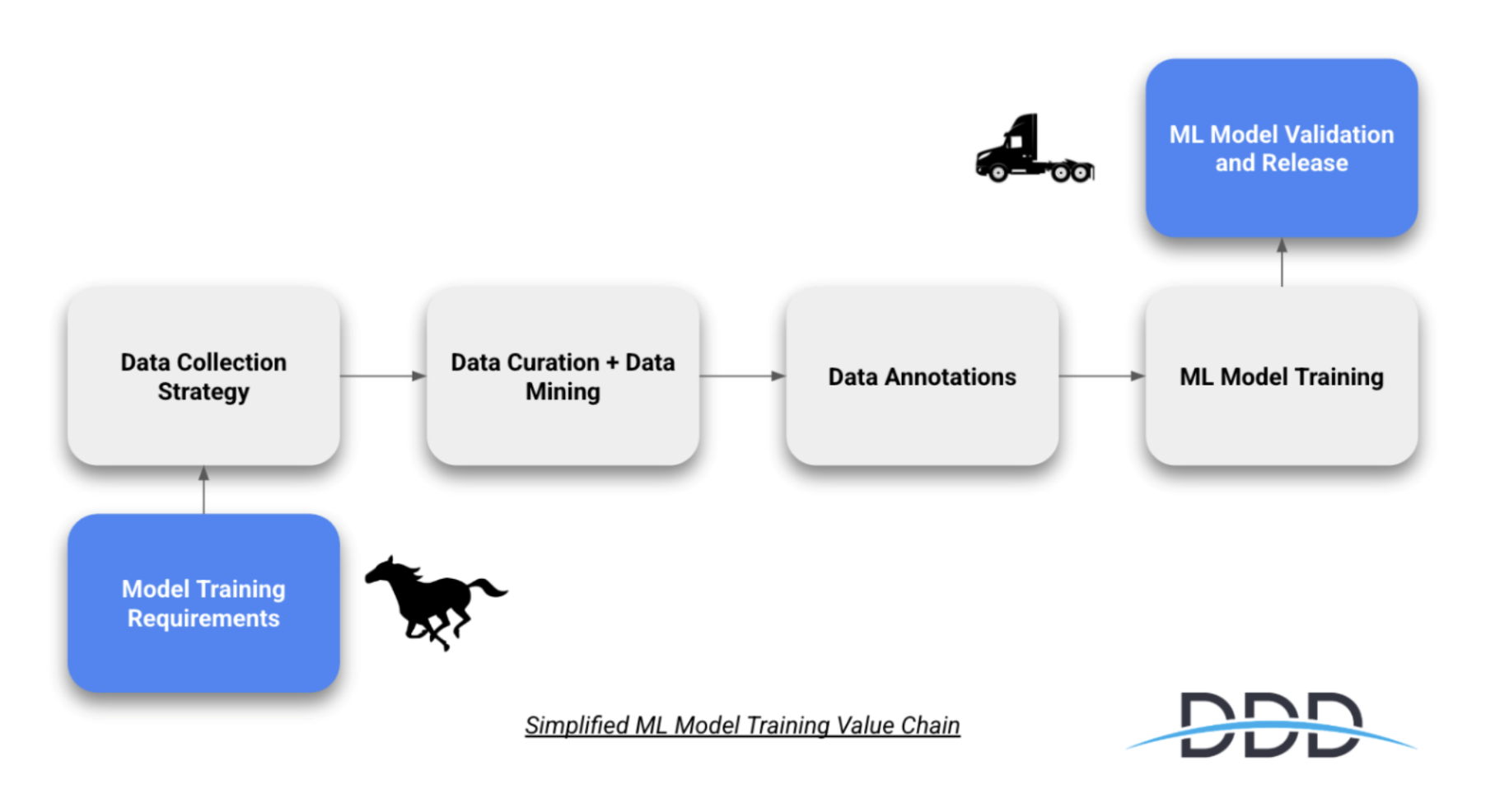
I remember almost a year back, a horse galloping on I-95 made headlines[5] across the US. Now imagine an autonomous truck driving at 70 MPH next to it. Do you think its Perception stack can handle this situation? We or at least the Equus caballus most certainly would hope so! It’s a no-brainer that as humans, we will slow down or lane change and get further away from the stray horse to reduce the probability of conflict. The autonomous truck in our hypothetical example need not have a hyper-specific response to such a situation as long as it can safely, and predictably handle anomalies. These longtail scenarios or edge cases are true gold for data-driven ML Model Development.
Screenshot+2025 02 13+at+8.31.25%E2%80%AFPM

The above-simplified flow chart is true for supervised learning systems where the starting step is to figure out which model attributes need attention. Further, that decision gets multiplexed into a structured data collection >> curation >> annotations strategy. The opportunity (time) cost of this process is invariably high and hence a scientific approach to this data-driven effort-impact problem is a must. Material advancements in the availability of nuanced annotation tooling platforms with technical solutions as offered by companies like DDD have made this process highly predictable, cost: quality efficient, and democratized. Similar to the ML model development proposition, a few other data-centric areas remain critically important to talk about. Let’s take a couple of examples.

Performance Evaluation: Feedback from the field is indispensable for any learned behavior system, especially Autonomy. In a nutshell, performance evaluation refers to: a frequent activity of aggregating output from a range of test modalities (simulation, test track, public roads, HIL benches) into a crystallized set of priorities to improve the product performance. This involves predictive analysis, what-if scenarios, and data-driven failure defect management to remove any delays in improving the system’s performance. I truly believe that for any Autonomy product to succeed, its performance evaluation strategy needs to be spot on, else countless cycles are wasted in figuring out how to measure performance, what problems to fix, by when, and why.

Simulation Operations: Another complementary area or the flywheel we referred to earlier is, Simulation. Refers to: a product for simulating the true physical world representation of any system in a digital environment. Millions and billions of scenarios can be simulated in a shorter period of time, the number being the less important part compared to the time. Companies providing simulation tech as a service or platform have greatly appreciated the product-worthy nature of this vertical. From the primitive synthetic sim to advanced neural sims, the goal all along is to build solid evidence for proving the verifiability of the AI system. Top of the line players have figured out how to – build the sim engine, scale infrastructure, spawn out analysis workstreams, converge back the learnings, and finally, improve the product.

Machine Learning Model Development, Performance Evaluation,and Simulation are the top three continuous learning feedback loops which in my opinion remain fundamental to developing a safer, predictable autonomous product. The job however is not done yet, transferring this tech into the hands of the end user remains a key step and a long(er) pole than some of us had originally anticipated.
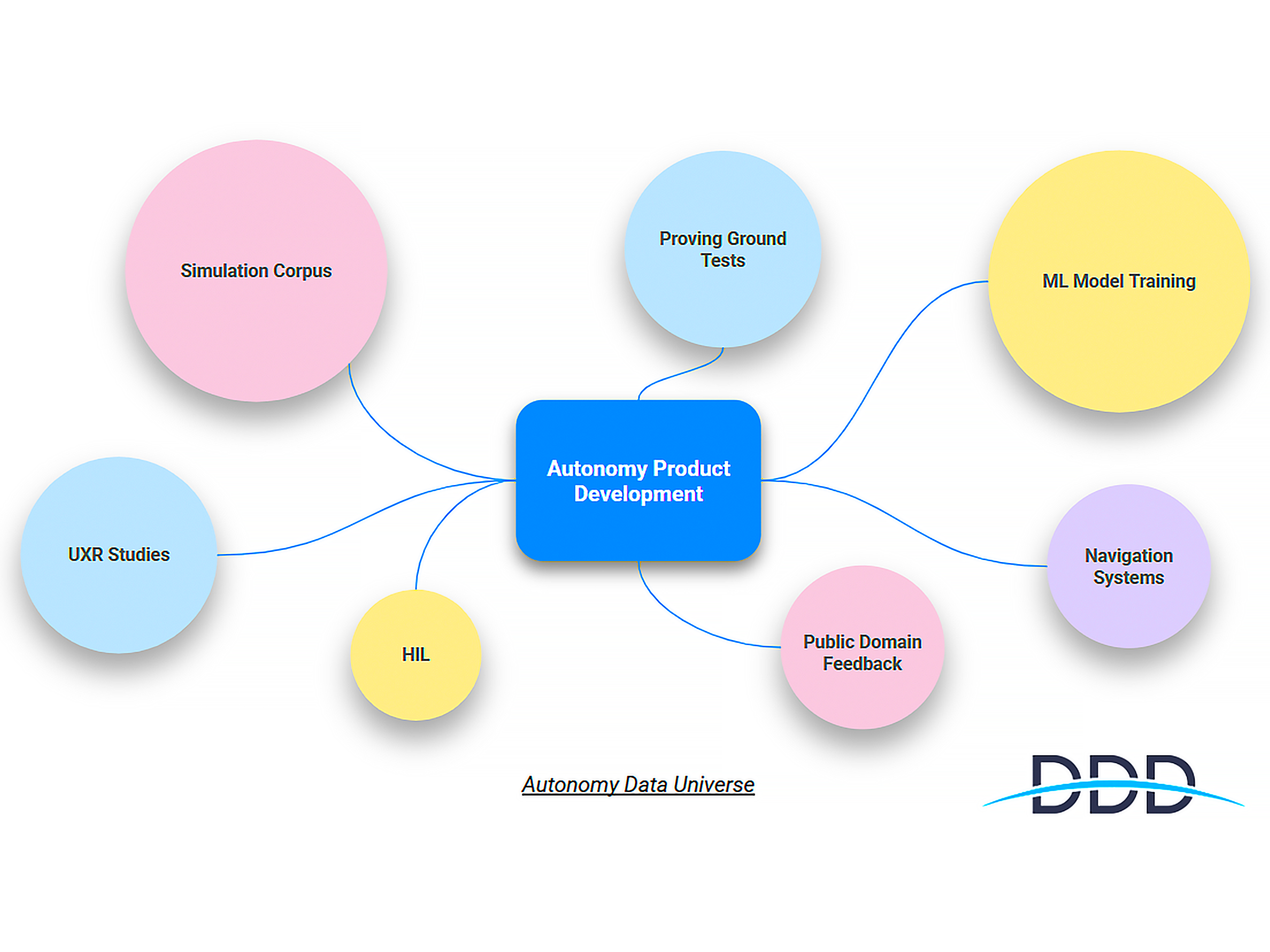
Autonomy Data Universe APS?format=original

Phase 3: The Launch

Operational muscle helps catapult Autonomy’s commercial deployment after the technology is ready for a launch. Locking in the operational recipe serves a very important role when it comes down to a holistic “all systems ready for launch” program status. Taking a step back, in the last 5 years or so, vertical integration of the commercial model has nicely shaped and taken priority frankly compared to the over-emphasized silos of early market entry advantage. This has led OEMs, Tier-1 suppliers, ridesharing platforms, and technology champions to partner together, overall diversifying the deployment risk. Data is at the forefront of planning such joint fleet operations – from command (control) center management, remote assistance, or planning a normalized exposure of your product to the target Operational Design Domain (ODD). I have massive respect for the teams managing CONOPS, and field support services to preserve the business continuity for applications like robotaxis. A substantial variable of this equation is a Human-Robot UXR problem, and data once again is a key catalyst in solving for the unknowns.

From the simplest of fleet management problems to the more involved ODD expansion needs, Autonomy development and its necessary commercialization are backed by data – tools that ingest the data – workforces that transform the data – and engineers who act on the data. We have made great strides in these areas over the past several years, but the job is surely not done yet.

In Conclusion

Data-driven development is more than just an acceptance that data is the key enabler for building Autonomy, it’s the actuality of building necessary infrastructure (tech + people) required to cycle through the data, selectively and with the right judgment to propel the progress.

DDD’s Autonomy Solutions are here to help you accelerate meeting the ends and making a quicker impact. We’re onward to something new that’s more exciting and cutting-edge in the coming days. Get in touch and don’t miss out!

Is data a big deal? Most certainly so.

Reference Links

  1. Amounts of Data Generated Per Day Stats

  2. World Economic Forum: Fast Pace of Tech Transformation

  3. Stanley: The Robot That Won the DARPA Grand Challenge

  4. SAE J3016 Levels of Driving Automation

  5. I-95 horse is back ‘safe’ at Philly stables

Autonomy: Is Data a Big Deal? Read Post »

GenerativeAIinautonomousdriving

Role of Generative AI in Autonomous Driving Innovation

Generative AI is revolutionizing the automotive industry, transforming how vehicles are designed, manufactured, and marketed. The market for generative AI in automotive is projected to soar to USD 3,900.03 million by 2033, growing at a CAGR of 23.3% from 2024 to 2034. This rapid growth highlights Gen AI’s key role in driving efficiency, innovation, and profitability in the Autonomous driving industry.

This blog explores the fundamentals of generative AI in autonomous driving, its impact on AV innovation, the ethical considerations and challenges, and the step-by-step implementation process.

Generative AI in Autonomous Driving: An Overview

Generative AI is offering promising solutions to streamline design, development, and production processes in the AV industry. By leveraging vast datasets and powerful algorithms, generative AI can predict outcomes, analyze patterns, and generate creative solutions, all of which are crucial for autonomous driving technologies.

Gen AI is critical in developing and refining self-driving systems by providing simulations that test how these systems behave under various conditions. Additionally, it is essential to create new materials and energy sources that contribute to more sustainable and efficient vehicles, further driving innovation. The potential applications of generative AI in autonomous driving are vast, offering safer, more efficient, and sustainable mobility solutions.

How Generative AI is Driving Innovation in Autonomous Driving

Let’s explore how generative AI is shaping the future of autonomous vehicles across key areas:

Designing and Optimizing Autonomous Systems

Designing and optimizing self-driving systems is inherently complex, involving decision-making processes such as route planning, motion control, and energy management. Generative AI plays a critical role by simulating a wide range of design options and identifying the most effective solutions.

For example, it can optimize motion planning algorithms, determining how a self-driving vehicle should navigate its environment. By running parallel simulations of multiple routes, generative models can find the safest, most efficient, and most energy-effective routes, ensuring optimal navigation. Similarly, gen AI can simulate various driving behaviors, helping to refine energy management strategies by identifying the best ways to maximize vehicle range and reduce energy consumption during operation.

Enhancing Sensor Data Processing

Autonomous vehicles rely on a combination of sensors, including cameras, LiDAR, radar, and ultrasonic devices, to detect and interpret their environment. These sensors generate enormous amounts of data that must be processed in real-time to make quick, informed driving decisions.

However, gaps in sensor data can occur due to various factors like environmental conditions or technical limitations. Here, generative AI can enhance sensor data processing by filling in missing information and improving the resolution of captured data.

For example, generative models can help improve image quality from cameras or generate additional LiDAR points where coverage is sparse, ensuring that the vehicle’s perception system has a more accurate and complete understanding of its surroundings. This enhanced data processing leads to safer and more reliable decision-making on the road.

Simulating Real-World Driving Environments

Testing autonomous vehicles in real-world conditions can be time-consuming, expensive, and dangerous. Generative AI provides an efficient solution by creating realistic virtual simulations of various driving environments, including different weather patterns, road conditions, and traffic scenarios.

These AI-generated simulations allow developers to test self-driving algorithms extensively, without the need for physical testing in the real world. The ability to mimic rare and hazardous driving situations enables autonomous systems to be trained on edge cases that might be difficult to replicate in real life.

For example, Generative Adversarial Networks (GANs) can produce highly detailed, lifelike simulations of urban environments, populated with pedestrians, moving vehicles, varying lighting, and dynamic traffic conditions. These simulations are crucial for helping autonomous vehicles navigate complex and unpredictable real-world situations.

Refining Object Recognition and Prediction

Accurate object recognition and prediction are essential for autonomous vehicles to avoid collisions and navigate safely. Generative AI contributes significantly to enhancing these capabilities by expanding training datasets with synthetic data, which in turn improves the system’s ability to recognize and predict the behavior of objects in the environment.

For example, GANs can be used to generate images of pedestrians to simulate the future movements of pedestrians, cyclists, or other vehicles by analyzing past behavior, improving the system’s ability to anticipate and react to potential threats on the road. This predictive power enhances the overall safety of autonomous driving systems.

Training and Simulation for Engineers

Generative AI-powered tools, such as VR and AR, can offer immersive training experiences that allow engineers to visualize and interact with autonomous vehicle systems in a virtual environment.

These tools can simulate real-world driving scenarios, providing engineers with a hands-on way to refine their skills and improve their understanding of how autonomous systems operate. By simulating complex situations, such as unexpected road hazards or system failures, engineers can gain valuable insights into how to design more effective and robust autonomous vehicles.

Ethical Considerations and Challenges

Generative AI with its innovation also brings forth a range of ethical considerations and challenges that need to be addressed. Let’s explore them in more detail.

Bias in AI Models and Data

One of the most pressing concerns when using generative AI is the potential for bias in the data used to train models. If the training datasets are unbalanced or unrepresentative of real-world diversity, the AI systems may produce biased outcomes, leading to unsafe or unfair decisions.

In the context of autonomous driving, for example, biased data could cause the vehicle’s AI system to misidentify pedestrians of certain demographics, misinterpret driving conditions, or make flawed decisions in edge cases. These biases can result in accidents or discriminatory behavior that could harm individuals or communities.

Ensuring that training datasets are diverse, inclusive, and representative of various driving scenarios is vital to minimizing bias and improving the overall fairness and safety of AI-powered systems.

AI Hallucinations and Safety Risks

Another major challenge in generative AI for autonomous driving is the risk of “hallucinations” – instances where AI generates inaccurate, irrelevant, or even nonexistent data. For example, an AI system might “hallucinate” an object on the road that doesn’t exist, or it might misinterpret sensor data, creating false positives. These hallucinations can lead to potentially dangerous situations where the vehicle might make a wrong decision, such as braking unnecessarily or swerving in the wrong direction.

Hallucinations can be especially problematic in areas like LiDAR perception, where incorrect sensor data could mislead the vehicle into responding incorrectly to its environment. Minimizing hallucinations requires constant vigilance, robust testing, and the implementation of fail-safe mechanisms to ensure that the vehicle’s AI system can reliably process real-world data without making misleading or unsafe decisions.

Interpretability and Transparency of AI Systems

Generative AI models are often referred to as “black boxes” because their decision-making processes are not always easily understood by humans. This lack of interpretability poses a significant challenge in autonomous driving, as it is essential to understand how the AI arrives at specific decisions.

If a self-driving vehicle encounters an issue or makes an unexpected decision, it is crucial to be able to explain why that decision was made. Without transparency, it becomes difficult to identify and rectify flaws in the system, raising concerns about accountability, liability, and trust.

To address this challenge, there is a growing demand for interpretable AI models that offer greater insight into how decisions are made, helping developers and regulators assess and validate the safety and reliability of autonomous systems.

Data Privacy and Security

Autonomous vehicles generate and process vast amounts of data, including personal information about drivers and passengers, such as location history, driving habits, and even health data. Protecting this data from unauthorized access, misuse, or breaches is a fundamental ethical concern. Additionally, the use of generative AI in analyzing and storing sensitive information raises the question of how to safeguard individuals’ privacy.

Robust encryption techniques, data anonymization practices, and stringent cybersecurity measures must be in place to ensure that the personal data collected by autonomous vehicles is secure and protected from malicious actors. Adhering to privacy regulations, such as the General Data Protection Regulation (GDPR), is also critical to ensuring that individuals’ rights are respected.

Accountability and Liability

When an autonomous vehicle makes a mistake or causes an accident, questions of accountability and liability become complex. If a self-driving car were to crash due to a failure in its AI system, who would be held responsible? Is it the vehicle manufacturer, the software developer, or the owner of the vehicle?

As generative AI systems become more integral to autonomous driving, the legal and ethical frameworks surrounding liability will need to evolve. It is crucial for policymakers, regulators, and industry stakeholders to establish clear guidelines and regulations to determine liability in the case of accidents or failures involving AI systems. This will not only ensure that the rights of individuals are protected but also promote the responsible development and deployment of autonomous vehicles.

Ethical Decision-Making in Critical Situations

Autonomous vehicles may encounter situations where they must make difficult ethical decisions, such as when an accident is unavoidable, and the vehicle must choose between two harmful outcomes. This “trolley problem” scenario raises significant ethical questions about how an AI system should be programmed to make life-and-death decisions. Should the vehicle prioritize the safety of its passengers over pedestrians, or vice versa? What ethical principles should guide these decisions?

While generative AI can help simulate and test these situations, creating a universally accepted framework for autonomous decision-making is challenging. It requires input from ethicists, regulators, and society at large to ensure that these decisions align with human values and societal norms.

Read more: Importance of Human-in-the-Loop for Generative AI: Balancing Ethics and Innovation

Implementing Generative AI in the Automotive Industry

Implementing generative AI within the automotive industry requires a well-thought-out strategy that ensures the technology is integrated effectively into various aspects. Here’s a step-by-step approach to successfully implementing generative AI for autonomous projects:

Define Clear Objectives and Use Cases

The first step in implementing generative AI is to define the specific goals and use cases that the technology will address. Automotive companies should identify the areas where generative AI can deliver the most value, whether it’s enhancing design processes, improving manufacturing efficiency, personalizing customer interactions, or optimizing supply chain management.

For instance, generative AI can be applied in generative design for vehicle components, predictive maintenance for fleets, or even in the development of AI-powered voice assistants for in-car experiences. By clearly defining these goals, organizations can prioritize their AI initiatives and allocate resources effectively.

Data Collection and Preparation

A successful generative AI implementation heavily relies on high-quality, diverse, and relevant data. Automotive companies must gather data that aligns with their use cases. This could include performance data from vehicles, production line data, customer feedback, or data related to supply chain logistics.

Once collected, this data must be cleaned, preprocessed, and formatted to ensure that it is suitable for training generative AI models. Proper data preparation is essential to maximize the accuracy and efficiency of the AI models, as poor-quality data can lead to suboptimal performance and unreliable results.

Select Appropriate Generative AI Models

The next step is to choose the right generative AI models for the intended applications. Different models are suited to different tasks. For example, generative design tasks may use specialized algorithms, while predictive maintenance could benefit from machine learning models trained on historical failure data.

Automotive companies must explore various AI models, such as Generative Adversarial Networks (GANs) or Variational Autoencoders (VAEs), to determine which ones are most effective for their specific use cases. In some cases, companies may choose to customize existing models or build their own, ensuring that they can address the unique challenges of their autonomous projects.

Integration and Development

After selecting the appropriate AI models, the next step is to integrate them into existing systems or build new applications from the ground up. This may require collaboration with AI development firms or the establishment of a dedicated in-house team with expertise in generative AI.

It’s important to ensure that AI models can seamlessly work within the existing ecosystem. Successful integration will help improve workflows, increase efficiency, and drive innovation across various departments.

Test, Validate, and Optimize

Once generative AI models are integrated, thorough testing and validation are essential to ensure their effectiveness and alignment with the set objectives. It’s important to evaluate AI models using both synthetic and real-world data to assess their accuracy and performance. Developers should test AI-generated outcomes against key performance indicators (KPIs) to ensure that the technology is producing reliable results.

If necessary, the models should be refined and optimized to address any shortcomings or limitations. Continuous testing and optimization will also help mitigate any risks associated with the technology, ensuring that the AI-driven systems operate safely and reliably.

Focus on Security and Compliance

Implementing generative AI also requires attention to data security and compliance with industry standards. Automotive companies must prioritize safeguarding sensitive data, including customer information, production data, and vehicle performance data.

Implementing robust security measures, such as encryption, access control, and secure data transfer protocols, is critical to protect this information. Furthermore, ensuring compliance with relevant regulations, such as GDPR or industry-specific standards, is essential to avoid legal issues and maintain consumer trust.

Monitor, Maintain, and Improve

The implementation of generative AI does not end once the models are deployed. Continuous monitoring, maintenance, and improvement of AI systems are necessary to keep them running optimally.

As the automotive industry evolves, so does the needs of the business, requiring gen AI systems to be updated and adapted over time. Regularly monitoring the performance of AI models will allow companies to identify areas for improvement, fine-tune the models, and incorporate new data to further enhance performance. This iterative approach ensures that generative AI continues to deliver value and remains aligned with the company’s long-term goals.

How We Can Help

At Digital Divide Data (DDD), we are committed to supporting the development and deployment of autonomous driving systems with our comprehensive ML data operations support services.

We partner with leading automotive companies in the creation and continuous validation of training datasets, helping them improve the performance of their ADAS and autonomous driving systems. Our expertise spans across critical areas for AV development, including:

  • LIDAR/Multi-Sensor Labeling: Accurately labeling and annotating LIDAR data to improve the precision of sensor fusion algorithms for autonomous vehicles.

  • In-Cabin Monitoring: Helping autonomous systems monitor driver and passenger behavior to ensure safety and compliance.

  • Semantic Mapping: Creating detailed and accurate semantic maps to support localization and navigation in complex environments.

  • Labeling for Critical Events: Annotating critical safety events and edge cases that are essential for testing and validating autonomous driving algorithms.

  • 2D/3D Labeling: Supporting the development of vision-based perception systems with precise 2D and 3D annotations for better object detection and classification.

  • Mapping & Localization: Supporting precise mapping and localization to enhance the vehicle’s navigation capabilities.

  • Digital Twin Validation: Assisting with digital twin creation and validation for real-world testing and development.

By partnering with us, you gain access to a global workforce with a 24/7 capacity to handle large-scale data labeling projects.

Learn more: A Guide To Choosing The Best Data Labeling and Annotation Company

Conclusion

Generative AI is driving innovation across various functions in the automotive industry such as vehicle design, manufacturing, maintenance, and user experience. It enables efficient simulations, predictive maintenance, and personalized in-car functionalities, enhancing mobility and safety. As the technology evolves toward a fully operational self-driving car, Gen AI promises a future of innovation and improved efficiency in the automotive industry.

Learn how we can transform your AV project using Gen AI, talk to our experts and schedule a free consultation.

Role of Generative AI in Autonomous Driving Innovation Read Post »

Red2BTeaming

Red Teaming For Defense Applications and How it Enhances Safety

Cyber threats are evolving unprecedentedly, and the need for robust defense mechanisms has never been more significant. Cyber experts are continually innovating, and crafting advanced solutions and among these developments, Red Teaming is one of the most significant techniques for enhancing safety in defense applications.

Red Teaming is a proactive security assessment process that involves simulating real-world hacking scenarios to identify vulnerabilities in an organization’s systems. By mimicking the tactics, techniques, and procedures of actual attackers, Red Teaming provides organizations an invaluable opportunity to discover and address liabilities before malicious cyber threats can exploit them which is particularly critical for industries where security breaches could have severe consequences.

In this blog, we’ll take a closer look at how Red Teaming for defense enhances safety, its advantages, and the methodology.

Understanding Red Teaming

Red Teaming

Red Teaming is a proactive cybersecurity technique that rigorously tests an organization’s security policies, systems, and assumptions through simulated adversarial attacks. The goal of Red Teaming is to mimic malicious actors and attempt to breach an organization’s systems, exposing vulnerabilities that may otherwise go unnoticed. By simulating realistic attacks, this methodology offers a detailed and reliable analysis of a system’s weaknesses, as well as its resilience against potential exploitation.

Utilizing the red teaming approach organizations gain valuable insights into their security protocols, enabling them to strengthen defenses and improve their response strategies to prevent future threats effectively.

How Does Red Teaming Work to Enhance Defense Applications?

Here’s a detailed breakdown of the key steps that Red Teaming follows to enhance security in defense applications:

1. Information Gathering or Reconnaissance

The process begins with reconnaissance, where the Red Team collects extensive information about the target. This step lays the groundwork for future actions and involves:

  • Collecting employee details such as identities, email addresses, and contact numbers.

  • Identifying open ports, services, hosting providers, and external network IP ranges.

  • Mapping API endpoints, mobile and web-based applications.

  • Accessing previously breached credentials.

  • Locating IoT or embedded systems within the company’s infrastructure.

This stage ensures the team has a comprehensive understanding of the target’s security environment.

2. Planning and Mapping the Attack

After gathering intelligence, the team maps out their attack strategy. This involves determining the type and execution of potential cyberattacks, focusing on:

  • Uncovering hidden subdomains.

  • Identifying misconfigurations in cloud-based infrastructure.

  • Checking for weak or default credentials.

  • Assessing risks in networks and web-based applications.

  • Planning exploitation tactics for identified vulnerabilities.

This meticulous planning ensures the Red Teaming technique can effectively simulate realistic attacks.

3. Execution of the Attack and Penetration Testing

In this step, the team executes the planned attacks using the information and insights gathered. Common methods include:

  • Exploiting previously identified security issues.

  • Compromising development systems to gain access.

  • Using leaked credentials or brute-force methods to access servers.

  • Targeting employees through social engineering tactics.

  • Attacking client-side applications to identify vulnerabilities.

The execution phase simulates real-world attack scenarios, helping organizations understand their current security stance.

4. Reporting and Documentation

The final phase is critical to the success of the Red Teaming process. In this step, a detailed report is prepared, which includes:

  • A description of the attacks conducted and their impact on the system.

  • A list of newly discovered vulnerabilities and security risks.

  • Recommendations for remedial actions to address security gaps and loopholes.

  • An analysis of potential consequences if the identified issues remain unresolved.

This comprehensive read teaming documentation helps organizations strengthen their defenses and prepare for future threats.

Benefits of Red Teaming for Defense

By providing a holistic view of an organization’s security, Red Teaming delivers a range of benefits that are discussed below.

1. Evaluation of Defense Systems

Red Teaming rigorously evaluates an organization’s defense mechanisms by simulating diverse cyberattack scenarios. This testing helps organizations understand the effectiveness of their existing security policies and measures, revealing areas that need improvement.

2. Comprehensive Risk Assessment

The methodology aids in classifying organizational assets based on their risk levels. This classification allows for better resource allocation, ensuring critical assets receive the highest level of protection.

3. Exposure of Vulnerabilities

By mimicking the actions of real-world attackers, Red Teaming identifies and exposes security gaps and loopholes that may otherwise go unnoticed. This proactive approach enables organizations to address vulnerabilities before they can be exploited.

4. Increased Return on Investment (ROI)

Red Teaming maximizes the ROI on cybersecurity investments by assessing how effectively an organization’s security measures perform under attack. It highlights areas where resources are being underutilized and where additional investment may be needed.

5. Regulatory Compliance

Red Teaming helps organizations identify areas of non-compliance with regulatory standards. By addressing these issues promptly, companies can avoid potential penalties and ensure adherence to industry regulations.

6. Prioritization of Security Efforts

Red Teaming provides actionable insights into which vulnerabilities and threats should be addressed first. This prioritization helps organizations efficiently allocate resources for vulnerability remediation, implementation of cybersecurity measures, and planning of security budgets.

How Can We Help?

At Digital Divide Data (DDD), we understand the critical importance of accurate, timely, and secure data in the defense sector. Our expertise in human-in-the-loop processes and advanced AI-integration tools allow us to deliver highly reliable and precise solutions tailored to defense applications.

Red Teaming is a key component of the security landscape, especially in defense, where vulnerabilities can have serious consequences. By mimicking the tactics of real-world attackers, Red Teaming identifies system weaknesses and provides actionable insights to mitigate risks.

Here’s how we support the defense sector through cutting-edge data operation and security solutions:

Enabling Red Teaming for Defense Applications

1. Preparation with Quality Data

We specialize in data preparation services that transform massive volumes of information—such as satellite imagery, sensor data, and video feeds—into actionable insights. This ensures that Red Teaming exercises are conducted with the most accurate and relevant datasets.

2. Advanced Simulations

Our ML engineers and Subject Matter Experts (SMEs) craft strategies for scenario simulations that replicate real-world adversarial attacks. These simulations help defense contractors assess and improve their security systems effectively.

3. Fairness and Compliance Testing

In addition to identifying vulnerabilities, we assist in ensuring regulatory compliance by performing fairness evaluations and adversarial testing.

4. Customized Security Assessments

Whether addressing biases in generative models or identifying weak spots in data operations, our methods are designed to enhance safety and operational readiness using tailored solutions.

Read more: A Guide To Choosing The Best Data Labeling and Annotation Company

Conclusion

In an era where cyber threats are becoming increasingly sophisticated, Red Teaming has emerged as an indispensable strategy for enhancing safety in defense applications. By simulating real-world attack scenarios, it enables organizations to identify vulnerabilities, evaluate their defense mechanisms, and prioritize security efforts effectively.

For more information on how we can help your organization strengthen its defenses through advanced data annotation solutions and Red Teaming, reach out to us today.

Red Teaming For Defense Applications and How it Enhances Safety Read Post »

Digitaltwinforautonomousdriving

Digital Twin For Autonomous Driving: Data Collection and Validation, Major Challenges & Solutions

Digital Twin is enjoying increasing interest in various industrial sectors such as manufacturing, healthcare, urban planning, and autonomous vehicles. It has recently become increasingly popular in Industry 4.0 for AV development, while its usefulness completely depends on the robustness of its corresponding digital twin models. In particular, a digital twin for autonomous vehicles has become a core tool for testing, validating, and de-risking self-driving systems before they ever reach public roads.

In this blog we will discuss digital twin for autonomous driving and autonomous vehicles, leveraging data collection and validation, associated challenges, and their solutions. We will also look at how the same digital twin technology increasingly supports ADAS systems and full autonomous-vehicle stacks.

What is Digital Twin?

In simple terms, a digital twin is a digital representation of a physical object, service, or process. The digital representation or digital twin consists of properties and attributes that characterize the physical entity. A digital twin is a higher-level replication of the physical entity than a traditional simulation model. Using a well-built digital twin model for AV, users can continuously monitor the performance of physical objects and detect anomalies in real time, analyze data, and also suggest solutions. Model validation ensures that the model observed performance of the synthetic model output closely matches the actual system. For autonomous vehicles, this makes an autonomous digital twin a living, data-fed mirror of the vehicle and its operating environment rather than a static, one-off simulation.

Developing a digital twin for autonomous driving involves several steps such as data collection, data validation, data extraction, model development, and digital twin validation. Out of all these processes model validation is the most crucial step that signifies confirmation that the physical model has reached the performance expectation of the simulated one.

Leveraging Data Collection for Digital Twin Validation

The continuous data collection in autonomous driving presents opportunities for advancing digital twin validation as follows.

  • Data Abundance and Generalizability: Large datasets enhance model generalizability and enable tasks like fault detection, where diverse sensor inputs (e.g., audio, thermal, visual) help the model learn fault patterns across various dimensions and situations.
  • Heterogeneous Data: Multimodal data enables comprehensive testing of various model properties, ensuring robustness and versatility.
  • Transfer Learning: Developments in modeling approaches, such as transfer learning, can significantly aid digital twin validation for autonomous driving. By reusing pre-trained models from related domains, transfer learning reduces the need for repetitive training and adapts quickly to new data. This approach is particularly useful in dynamic environments like autonomous driving.

Challenges for Digital Twins in Autonomous Driving

These challenges apply whether the digital twin supports a research autonomous vehicle, a production ADAS system, or a full self-driving stack.

Uncertainty Analysis in Data Integration

Digital twin systems for autonomous driving depend on a network of sensors to collect real-time data from various sources such as images, videos, LiDAR, radar, and more. Performing uncertainty analysis on this data is essential but challenging due to variations in data types, each requiring distinct algorithms for quantification. Poorly optimized algorithms can lead to excessive computational costs, further delaying the validation process.

For uncertainty analysis to be effective it must precede sensitivity analysis, necessitating efficient techniques to handle the large number of parameters involved in monitoring digital twins. Identifying the most impactful parameters using sensitivity analysis can reduce computational complexity, shorten validation time, and improve model performance by clarifying relationships between inputs and outputs. However, traditional sensitivity analysis methods, such as sampling-based approaches, are computationally intensive and unsuitable for the real-time validation demands of digital twin models in autonomous driving

Validating Digital Twins in System-of-Systems (SoS)

Autonomous vehicles often operate within a System-of-Systems (SoS) framework, where the digital twin must represent both the overall system and its individual components. This dual-level representation poses unique challenges for validation.

Here the key question arises: should validation target the entire SoS, or each subsystem individually? This means solely focusing on the overall system risks overlooking deviations in the performance of constituent components, potentially obscuring the root causes of system degradation. A robust approach requires a two-layer validation framework, one at the SoS level and another at the subsystem level. Balancing the complexity, robustness, and timeliness of this validation process is crucial but still remains a challenge.

Integrating Expert Knowledge with Data

In autonomous driving, digital twins must integrate expert knowledge with data to construct accurate simulation models. Expert insights can complement data-driven information, which offers a holistic understanding of the system. Despite notable progress in this area, systematic algorithms to seamlessly combine expert knowledge with data are still lacking. Context-specific approaches are often required, necessitating formalized methods to unify these knowledge sources effectively and enhance model accuracy.

Read More: Top 8 Use Cases of Digital Twin in Autonomous Driving

How We Address Digital Twin Challenges in Autonomous Driving

As a leading data annotation company, Digital Divide Data (DDD) we ensure safety, precision, and efficiency for AI/ML model development for autonomous driving and autonomous vehicles using our expertise in ML operations, computer vision, and human-in-the-loop process, Here’s how we solve Digital Twin challenges:

Digital twins for autonomous driving require robust uncertainty analysis to process diverse, multimodal data efficiently. Our capabilities lie in data annotation, curation, structuring, and streamlining the integration of large datasets from diverse sensors such as LiDAR, cameras, and radar.

We assist in optimizing uncertainty quantification algorithms tailored to specific data types, minimizing computational costs and our HITL process ensures high-quality real-time validation reducing runtime.

We support validation for digital twins representing SoS environments, ensuring robustness at both the system and subsystem levels. We specialize in accurately labeling data from diverse sensors, enabling precise monitoring of constituent systems within an SoS, and helping you identify deviations at the subsystem level.

The combination of expert knowledge and data is critical for creating accurate simulation models in autonomous driving. We utilize a tailored approach for autonomous systems, using SMEs for data integration.

Why Choose Us?

Our data annotation services help clients maximize the potential of ongoing data collection and leverage advancements in AV modeling. We gather, label, and curate large, multimodal datasets such as audio, thermal, and visual sensor inputs, empowering models to generalize across various fault patterns. Our multisensor data annotation ensures robust validation of digital twins, leveraging heterogeneous data to test diverse model properties.

Read More: A Guide To Choosing The Best Data Labeling and Annotation Company

Conclusion

Digital twins are revolutionizing the autonomous driving industry by enabling real-time performance monitoring, anomaly detection, and data-driven decision-making for drivers. However, their effectiveness depends on addressing key challenges such as uncertainty analysis, System-of-Systems validation, and the integration of expert knowledge with data. Overcoming these challenges requires robust solutions that leverage advanced data annotation, efficient algorithms, and domain expertise to build efficient autonomous vehicles. As sensor suites and simulation tools mature, a well-validated digital twin for autonomous vehicles is fast becoming a baseline requirement for teams that need to prove safety at scale.

Whether you’re building next-generation ADAS systems or full autonomy, our autonomous vehicle solutions can help you drive innovation with precision and scalability.

Frequently Asked Questions

What is a digital twin for autonomous vehicles?

A digital twin for autonomous vehicles is a continuously updated virtual replica of a vehicle and its driving environment, fed by live sensor data from cameras, LiDAR, and radar. It lets teams monitor performance, test driving scenarios, and validate self-driving systems in simulation before deploying them on public roads.

How is an autonomous digital twin different from a simulation?

An autonomous digital twin is a higher-level replica than a traditional simulation. It stays synchronized with the physical vehicle through real-time data, detects anomalies as they happen, and evolves as conditions change. A standard simulation is static and one-off, whereas a digital twin is continuous, data-driven, and always current.

How is digital twin technology used in ADAS systems?

In ADAS systems, digital twin technology recreates the vehicle, its sensors, and surrounding traffic in a virtual environment to test features such as lane-keeping and automatic emergency braking. This lets engineers validate rare edge cases safely in simulation, reducing reliance on costly and time-consuming real-world road miles.

What is digital twin validation for autonomous driving?

Digital twin validation confirms that a digital twin’s simulated outputs match the real system’s behavior. For autonomous driving it relies on uncertainty analysis, sensitivity analysis, and System-of-Systems testing across both the full vehicle and its subsystems, ensuring the model is accurate and reliable enough to support safety decisions.

Digital Twin For Autonomous Driving: Data Collection and Validation, Major Challenges & Solutions Read Post »

HD2Bmapping2Bin2Bautonomous2Bdriving

The Role of HD Mapping in Autonomous Driving: Use Cases and Techniques

In the real world, human error remains the most significant factor in car accidents. According to the NHTSA, 94% of vehicle crashes involve human error on the roads. To reduce these accidents and enhance safety on the roads, advanced driver assistance systems are being developed. Leveraging HD mapping in autonomous driving makes driving easier, safer, and more reliable. In this blog, we will explore the importance of HD mapping in autonomous vehicles, and its various capabilities and techniques.

HD Mapping in Autonomous Driving

Autonomous driving technology relies on HD maps and various sensors to verify what the ADAS sees around it. It plays an essential role in autonomous driving by delivering navigation details with sub-centimeter accuracy, meeting the requirements for precision in autonomous driving. It also provides real-time cloud-based navigation services, ensuring vehicles can respond dynamically to changing conditions.

The development of autonomous vehicles demands advanced navigation capabilities, and HD mapping fulfills this requirement by surpassing traditional GPS and navigation systems. With features like highly detailed lane geometry, traffic signage, and real-time updates on dynamic elements such as construction zones or accidents, HD maps empower autonomous systems to navigate safely and effectively. Leveraging technologies like sensor fusion, perception algorithms, and control mechanisms. HD maps ensure vehicles can operate reliably even in complex and dynamic environments.

In addition to enhancing navigation, HD maps effectively prepare vehicles for localization by offering detailed information about the surrounding environment. This includes data on traffic lanes, pedestrian crossings, curb positions and heights, speed limits, and more. By creating a precise “digital twin” of the physical world, HD maps expand a vehicle’s field of view and enable algorithms and AI to process and act on data sets.

Key Components

HD maps are constructed from three essential elements: geometric data, semantic information, and dynamic updates.

Geometric Data provides a precise blueprint of road layouts, including lane boundaries, intersections, and curbs.

Semantic Information captures critical contextual details such as traffic regulations, speed limits, and other road attributes.

Dynamic Updates enrich these maps with real-time data on road conditions, accidents, and construction zones.

Additionally, localized environmental data, such as weather conditions and road surface details, enhances the map’s accuracy, offering a comprehensive understanding of the driving environment. These interconnected components collectively enable autonomous systems to navigate with unparalleled precision and reliability.

HD Mapping Technologies

HD mapping is powered by a convergence of various sensors and technologies, which are described below:

LiDAR captures detailed 3D point cloud data for unparalleled mapping precision.

Cameras provide visual data crucial for object recognition.

Radar complements the system by enabling object detection and speed estimation.

GPS and IMU ensure highly accurate positioning and orientation.

SLAM (Simultaneous Localization and Mapping) and Mobile Mapping Systems enable real-time map updates to reflect dynamic changes in the environment.

High-definition imagery and advanced mobile mapping technologies, such as 360-degree street view capture, are central to creating these detailed maps. Continuous data collection and processing ensure that digital maps remain accurate and up-to-date, allowing ADAS to adapt effectively as road conditions and networks evolve.

HD Mapping Capabilities in Autonomous Driving

When pre-mapped data is seamlessly integrated with real-time sensor inputs, the result is a highly detailed and comprehensive understanding of a vehicle’s surroundings. This powerful combination forms the backbone of map-based ADAS and autonomous vehicle mapping, delivering significant benefits in safety, efficiency, and driving experience. Some of these are discussed below.

Autonomous Cruise Control (ACC)
ACC combines sensor inputs like radar or cameras with map data to maintain safe distances from other vehicles. It adjusts speed proactively based on upcoming curves, speed limits, or road conditions.

Lane Keeping Assistance (LKA)
LKA provides gentle steering adjustments to keep the vehicle centered in its lane-level accuracy due to HD maps. In addition to detecting unintentional drifts, it offers a smoother and safer driving experience by aligning navigation with precise road data.

Real-Time Navigation and Traffic Updates
Integration of real-time traffic data ensures that ADAS and AV systems remain aware of current road conditions, including accidents, construction zones, or other obstacles. This feature enables efficient route planning, minimizing delays and improving overall travel efficiency.

In-Cabin Monitoring
Driving often involves processing an overwhelming amount of information, leading to fatigue and stress for the driver. Map-based ADAS alleviates this burden by automating tasks like maintaining speed, staying in lane, and monitoring the road. Some systems even include fatigue monitoring to alert drivers when they need to rest.

HD Mapping Techniques

With McKinsey projecting that autonomous driving could generate $400 billion in revenue by 2035, OEMs are intensifying their R&D efforts to address key challenges. As they refine and enhance ADAS systems, the ultimate objective remains clear: to improve road safety and revolutionize the consumer mobility experience. The following technologies are facilitating HD mapping and navigation for autonomous driving.

Crowdsourced Mapping:
Companies like Mobileye, Nvidia, and Tesla are leveraging data from millions of connected vehicles to update 3D and HD maps in real time. This approach, combined with advancements in V2X (vehicle-to-everything) communication, ensures continuously evolving and accurate mapping data.

AI and Machine Learning:
These technologies play a critical role in automating map creation, detecting changes from raw sensor inputs, and addressing point cloud misalignments using SLAM (Simultaneous Localization and Mapping) techniques.

4D Mapping:
Incorporating time as a fourth dimension, 4D maps adapt dynamically to real-time changes in road conditions, traffic patterns, and weather challenges, offering unparalleled flexibility and accuracy.

Semantic Labeling:
By embedding contextual understanding into maps, semantic labeling enables vehicles to interpret the function and meaning of objects in their environment, further enhancing decision-making capabilities.

How Can We Help?

As a leading data labeling and annotation company, we specialize in empowering autonomous vehicle companies with the essential tools and expertise for HD mapping and navigation. Our AV solutions help you in data acquisition, processing, and management, and more.

With expertise in HD mapping annotations, triage, verification, and validation, we have supported some of the largest autonomous driving deployments globally. Our capabilities span essential mapping workflows such as base mapping, semantic mapping, and mapping triage, processing over 1 Million miles of HD maps annually using radar, LiDAR, and video-based localization technologies. This ensures the creation of precise and reliable datasets that power advanced autonomous driving systems.

Our teams specialize in annotating and analyzing critical elements such as road hazards (e.g., low visibility, slippery roads), road and lane geometry, landmarks, traffic signs, and stationary objects.

We pride ourselves on delivering tailored solutions for each client, offering custom training and team configurations to suit specific project requirements. Our approach includes European/CET time zone solutions and dedicated customer success teams to ensure seamless communication and efficient project delivery, making us a trusted partner in the autonomous driving industry.

Final Thoughts

Real-time computing and onboard sensors alone can’t handle the complexity of roads and traffic. In such a way, HD maps become critical for guiding autonomous cars. They improve sensor perception in extreme weather conditions or at a very close range and are able to recognize objects and events that might otherwise go unnoticed by intelligent onboard sensors. Such technology ensures that autonomous systems have the reliable and updated visual information necessary for precise localization and safe navigation, even in challenging situations.

Let’s enhance road safety, revolutionize transportation, and shape the future of autonomous driving. Learn how our autonomous vehicle solutions can help your AV project.

The Role of HD Mapping in Autonomous Driving: Use Cases and Techniques Read Post »

Annotated urban road scene showing vehicles, traffic signs, lanes, and road objects for autonomous driving

Mastering Data Annotations Techniques for Autonomous Driving: Key Types & Guidelines

Autonomous driving is a revolutionary change in the field of transportation, offering promising benefits such as road safety, reduced traffic, and shorter travel time. Machine learning algorithms are used by self-driving cars to sense the environment and act on immediate decisions. This ability is based on its underpinning, “data annotation techniques for autonomous driving.” a process of adding labels to data, such as images, video, or sensor output, so that machine learning models gain the power to “see” and comprehend the world around them.

In this blog, we will dig deeper into the various types of data annotation techniques for autonomous vehicles and the best guidelines to follow.

Why Data Annotation is Crucial for Autonomous Vehicles?

Let’s say that you are driving a car on a busy street. You note road signs, predict the paths of pedestrians, and respond to cars that are behind or in front of you, all in the span of seconds. For a self-driving car, mimicking these human instincts involves processing huge quantities of data in real-time. Annotated datasets are essential for training algorithms. Some of these functionalities are provided as follows.

  • Detect Objects such as cars, pedestrians, traffic lights, etc.

  • Interpret Scenarios like rationalizing behavior between objects, like a cyclist running a junction.

  • Determining paths to pursue, and performing maneuvers resulting from detecting obstacles and studying traffic flow.

Machine learning models need to be labeled to understand these tasks, and this is exactly why data annotation is considered critical for autonomous vehicles.

Autonomous Driving Annotation Techniques

Real-world environments are highly variable, and ADAS require various types of annotations. Thus, they are classified into different fields and types. Let’s discuss a few of them below.

2D Bounding Boxes

One of the most common annotation types is bounding boxes. A rectangular box that is drawn around the objects of interest (cars, pedestrians, or animals) to show their location and dimensions in an image. Applicable in annotating car, bike, and pedestrian detection and recognition of traffic lights and signs.

3D Bounding Boxes (Cuboids)

3D bounding boxes extend this to three dimensions, enclosing objects with depth, width, and height. This practice is particularly useful for vehicles’ depth perception, or the relative position of things in a three-dimensional space. Applicable in judging the distance and the size of other vehicles and making accurate spatial maps for navigation.

Polygon Annotation

The annotation takes outlines of things to annotate, outlining the accurate contours of a wide variety of shapes. This is best suited for people, animals, or miscellaneous vegetation (trees or bushes).

Semantic Segmentation

Semantic segmentation refers to the task of assigning a class label to each pixel in an image to segment it into parts that make sense. This level of detail on a pixel level allows autonomous systems to identify a road surface as different from a sidewalk or other object in the field of view. Beneficial for detection of farthest and nearby road boundaries and differentiating between vehicles, pedestrians, and objects.

Instance Segmentation

Instance segmentation unifies semantic segmentation and object-level differentiation, where models can distinguish between individual objects of the same class and label them separately (e.g., two pedestrians or two cars). applicable in the personal identification of road users in complex scenarios and tracking objects over time (i.e., counting)

Line and Spline Annotation

Annotation of lines and splines refers to linear elements such as lanes, road edges, or crosswalks. This is an essential technique for lane-keeping and path-planning systems. Highly beneficial for lane departure warnings automatic lane changes and detection of boundaries on roads in the city/village.

Key point Annotation

Key point annotation indicates the coordinates of particular points of interest on objects, for example, the surrounding landmarks on pedestrians or joints on cyclists. Annotation of this type is crucial for pose estimation. Applicable for predicting behaviors of pedestrians and cyclists and utilizing gesture recognition to interact with road users outside of the vehicle.

LiDAR and Radar Annotation

LiDAR and radar sensors (point cloud sensors) generate their own unique data that needs to be annotated with the objects in the data as well as their spatial properties. The depth of information from point clouds is key in mastering low-visibility surroundings. This annotation technique is highly beneficial in 3D mapping, obstacle avoidance, and navigating in fog, rain, or darkness.

Read more: The Critical Role of Data Annotation in Autonomous Vehicle Safety

Guidelines to Follow for Accurate Data Annotation

  • Create standard protocols for annotation to ensure consistency.

  • Make use of advanced tools for automation & collaboration.

  • Ensure rigorous checks to eliminate errors and maintain quality.

  • Provide appropriate training for annotators; make sure annotators know the specific role key point annotation plays for autonomous driving.

  • Regularly enhance the methodology of annotation in accordance with the outcomes of the models and the provided feedback.

How Can We Help?

We provide comprehensive data annotation services, trusted by Fortune 500 companies and pioneering mobility, ADAS, and autonomous driving innovators worldwide. We ensure that you achieve the highest safety and performance of your AI/ML model training with our human-in-the-loop approach. We specialize in image, video, Lidar labeling and annotation, multi-sensor data fusion, mapping & localization, and digital twin validation.

As a leading data annotation and labeling company we offer end-to-end support, regardless of the scale of your project, and come with a guaranteed level of quality, a global workforce with 24 x 7 x 365 labeling capacity, and best-in-class SOC 2 Type 2 and ISO 27001 data security and confidentiality.

Read more: The Critical Role of Data Annotation in Autonomous Vehicle Safety

Conclusion

From bounding boxes to complex LiDAR point cloud annotations, each has its own purpose, enabling self-driving cars to navigate safely and efficiently through their surroundings. There are certain challenges in undertaking this annotation process, from scaling to quality assurance but adopting annotation best practices, and hiring an experienced data annotation company can help your ADAS models deliver better results and build reliable autonomous systems.

Mastering Data Annotations Techniques for Autonomous Driving: Key Types & Guidelines Read Post »

AdobeStock 595255234

The Crucial Link Between Data Annotation and Autonomous Cruise Control Systems

With the advancement of transportation technology, autonomous driving is slowly starting to seep into our vehicles every year, making them more independent and smarter. This is illustrated by advanced autonomous cruise control systems (ACC) that can receive live data and use predictions to adapt their speed to the traffic flow, making the ride both safe and comfortable.

These systems fuse information from Lidar, radar, ultrasound, video, thermal, and GPS sensors, each one comprehensively labeled to synthesize a “global view.”

Data annotation for autonomous driving is a way of tagging raw data to identify critical situations on the road for the ML models to react and make important decisions. This allows the autonomous vehicles to ‘see’ their environment such as identifying, classifying, and locating objects that are not only nearby but also differentiating between vehicles, pedestrians, and obstructions.

In this blog, we will explore the interlinking of data annotation with autonomous cruise control in autonomous vehicles, its various annotation techniques, and associated challenges.

Understanding Autonomous Cruise Control Systems

Autonomous+Cruise+Control

Autonomous cruise control (ACC) systems are an essential component of ADAS to incorporate features like lane keeping, traffic management, and automated steering. Instead of simple distance-keeping models with alarms, these systems have become automation wonders that use radar to control speed and prevent collision. Today, ACC systems not only improve the safety of the vehicle but drastically reduce congestion and rear-end collisions.

These technologies consist of sensors that detect and warn the driver about any potential threats or collisions when driving. For example; when this situation occurs a red light begins to flash with an alert showing ‘brake now’ appears on the dashboard, along with an audible warning to help the driver slow down the vehicle. The effective use of autonomous cruise control systems will maximize traffic flow due to its spatial awareness.

The Role of Data Annotation in Autonomous Cruise Control Systems

Data annotation is a big step in training data for autonomous cruise control. The process involves extensive and thorough identification and classification of data which considerably improves the training process for these systems. Machine learning algorithms need to be trained in different driving situations and scenarios to make these ACC systems highly accurate and safe in real-world situations.

Reorganizing this labeled data not only aids in its interpretation but subsequently reduces the amount of computational power required and increases the number of sensors that can be efficiently utilized. Whenever there are limited sensors or data available in any scenario, then a pre-annotated dataset can act as a booster for system performance. It enables the vehicle to evaluate different situations from various angles, improving its decision-making process.

Now that we have understood how data annotation helps ACC systems, let’s take a closer look at the different types of data annotation techniques and their use case scenarios.

  • Manual Annotation – As the name suggests, these are primary types of annotations where a human carries out the entire annotation process.

  • Bounding Box Labeling – This method is effective for fast detection, such as detecting cars or pedestrians. This means putting boxes around objects in an image and is a simple, low-effort labeling task.

  • Semantic Segmentation – This technique provides a label to every pixel of an image which specifies the category each object falls into, useful for more granular analysis and understanding of objects in the scene.

  • Instance Segmentation – Similar to semantic segmentation it goes further by distinguishing between different instances of the same type of object within the scene.

  • Lane and Drivable Area Marking – This is an annotation type that is particularly used for autonomous driving, lane marking, and marking the drivable area found by the vehicle.

  • Point Cloud Data Annotation – This technique is applied in 3D modeling, as it is used for labeling the data acquired from LiDAR sensors that are needed for constructing the vehicle’s understanding of its surroundings in three dimensions.

  • Video Motion Prediction – Annotating video data to predict future object motions for anticipatory actions in autonomous driving

  • Contextual or Sensor Data Annotation – This can be a specific set of labels according to context or sensor readings, used for certain scenarios or conditions.

These various data annotation services cater to different needs within autonomous cruise control systems, enhancing their performance and reliability by providing detailed and accurate data for training machine learning algorithms.

Challenges in Data Annotation for Autonomous Cruise Control

Data annotation is very complex when it comes to Autonomous Cruise Control systems. However, the biggest challenge is data collection. The root cause is ingrained in collecting diverse and comprehensive driving data in the most realistic driving scenarios. It is also difficult to obtain consistent data over different driving routes because it is nearly impossible to deliver a clean drive test on the exact same route with a consistent reference driver.

Let’s say that you have acquired high-quality data, the next challenge is to create labeling guidelines that do not too closely adhere to the reference driver behavior. This becomes a daunting task in an urban landscape, which is characterized by non-linear scenarios and variance in human driving styles. The chances are quite high for the ACC system to unknowingly learn poor driving behaviors from the data that mirrors the human driving behavior which may not be desirable.

In addition, modifying the guidelines on what is considered to be newer information or re-assessed behavior of data remains difficult. The process itself is prone to inherent biases, a common problem across machine learning applications but most amplified in traffic-related studies as those bear socio-legal implications. The intrinsic limitations of existing algorithms, combined with the practical constraints on resources for creating large new datasets, make this process unfeasible to execute at scale.

Quality Control

Accurate data annotations are critical, especially since wrong data can actually end up executing incorrect driving decisions and posing serious risks. Standardizing annotation is beneficial to ease the integration of diverse modules into a unified system. However, this standardization comes with its own errors due to discrepancies in the annotating process.

Some strategies to address these error types include a thorough

  • Training of annotators.

  • Multiple annotations by selected experts on the data.

  • Use of simpler ML models (i.e.: models trained only for assisting annotators).

  • Collaborative platforms where annotators can talk about edge cases.

Exploring advanced quality control mechanisms and developing new tools for training data could significantly improve the reliability of datasets used in autonomous driving. While each of these contributes to improved data quality, the variability associated with human judgment presents an ongoing challenge that is addressed through a combination of human factors and machine learning techniques as well as collaborative platforms.

Pathway to Innovation and Future Trends

Data annotation plays a pivotal role in the development of autonomous driving technologies, particularly by refining cruise control systems. Enhancing this process could potentially stem from collaborative efforts among researchers, practitioners, and industry leaders. This includes the integration of machine learning and automation to improve the scalability and efficiency of data annotation. Given the rapid advancements in computer vision and machine learning, they provide significant enhancements to image-based annotation methods which could considerably reduce time of implementation while tremendously increasing system precision.

An interesting direction for autonomous systems is shadow mode neural networks. These networks are trained on the same data inputs as traditional autopilot systems, but their response patterns are monitored based on what they do in real-time driving scenarios. This has the effect of incremental adaptation over time in reliability, whereby learning when exactly the vehicle should brake/be cautious when getting close to something.

Another avenue is with the accessibility of raw GPS data also appears to be heading toward a more unified approach globally. The goal is to create a common standard that would facilitate the sharing of this data and thus reduce the mistakes of navigation systems based on GPS information. An international incentive system using harmonized past trends will encourage more extensive collaboration among stakeholders possessing the data.

Furthermore, as this industry matures, the attention to regulatory and standardization principles is increasing, especially in annotation for data referring to how training of autonomous driving systems happens and what validity shall take place. Regulations governing driver licensing, vehicle safety ratings, and crash tests can also be used as a model for stricter annotation standards that could promote safer practices. Not only would it increase the accountability of driving, but also motivate car manufacturers to build safer cars.

Moving ahead, incorporating LiDAR data to measure Doppler shifts, could provide additional information about how fast other vehicles are moving improving autonomous systems to respond to changing speed environments. This is one step in a process that will involve thousands of experts over the years, all synthesizing many systems and challenging each other to navigate the safe adoption of these technologies into everyday use.

Resolving these aspects will bring us closer to truly reliable, efficient, and safer autonomous automobile solutions opening the path for the widespread acceptance and implementation of such technologies in the near future.

Read more: Ground Truth Data in Autonomous Driving – Challenges and Solutions

Final Thoughts

When it comes to Autonomous Cruise Control (ACC) systems, the importance of making quick decisions is critical when driving in the real world. Data annotation provides essential information that algorithms require to process and connect sensor data with operational systems. A well-trained output from these ADAS models allows these systems to recognize better and respond to hazards in challenging scenarios.

How Can We Help?

As a data labeling and annotation company, we provide comprehensive solutions for data annotation and labeling for autonomous cruise control systems to enhance reliability and safety in real-world situations. Talk to our experts about how DDD can help you with your autonomous driving projects.

The Crucial Link Between Data Annotation and Autonomous Cruise Control Systems Read Post »

Ground2Btruth2Bdata2Bfor2Bautonomous2Bdriving

Ground Truth Data in Autonomous Driving – Challenges and Solutions

We are witnessing exponential growth and innovation in autonomous driving. This growth is powered by vastly trained datasets that allow ADAS to learn and make quick decisions in real-world situations.

The effectiveness of these autonomous systems mostly depends upon the quality of data used during the training and evaluation process. This is where ground truth data for autonomous vehicles comes into the picture. It refers to the accurate real-world data that acts as the solid benchmark for training AV models when assessing their performance.

In this blog, we explore why ground truth data for autonomous driving is critical and discuss various associated challenges and solutions.

What is Ground Truth Data in Autonomous Driving?

Ground truth data is the information gathered from real-world observations used to evaluate and assess AV algorithms or models. Simply put, it’s the reality that you teach your AI models to draw the right conclusions and make the right decisions when

Ground truth data allows AI models to understand the actual situations and scenarios they will encounter on the road, such as traffic signals, road obstacles, and pedestrian movements. This understanding is not just about detecting objects it allows autonomous systems to understand situations similar to human perception, allowing AVs to make informed and safe decisions.

When trained right it allows machines to process data as human beings, for example enabling autonomous vehicles to protect pedestrian safety while operating in the real world. AV models trained using ground truth data can significantly improve their accuracy, and safety, and reduce costs.

According to McKinsey, 75% of AI and machine learning models require updating the solutions regularly with new ground truth data, and 24% require daily refreshed annotated datasets.

Collecting Ground Truth Data

Ground truth data for autonomous driving can be collected from multiple sources such as high-resolution cameras, LiDAR, GPS, Radar, Ultrasonic sensors, and other sensors. This data may consist of images, videos, sound, etc.

In major cases, AV models need labeled or annotated data, which can be used to learn from specific samples and generalize that information to new data.

Image Detection requires images with annotated bounding boxes so AV models can detect them automatically. It is highly effective when annotating data to identify pedestrians, road signs, vehicles, or different objects to ensure safe driving.

Facial recognition systems require data that includes faces with labels for a person’s features, which can be used in autonomous vehicles to identify driver fatigue, concentration, prolonged distraction, anti-theft, and built robust in-cabin monitoring systems.

Challenges in collecting ground truth data for ADAS

There are significant challenges when collecting ground truth data for ADAS and autonomous driving. Let’s discuss the critical ones below.

Diversity in Data

Collecting data for ground truth must source data from the real world that is highly accurate for autonomous driving. The data should be properly balanced so that no part is under or overrepresented, which could lead to poor AV model performance and biased outcomes.

For example, when training AV models for facial recognition it is critical to consider demographic diversity when collecting ground truth data. The data must include diversity in age, gender, ethnicity, education, socio-economic background, and more.

Ethical Considerations in Ground Truth Data

Ethical aspects in ground truth data collection are necessary to ensure that the process respects the rights and privacy of individuals and to enhance trust, fairness, and integrity in AI applications. Here are some key ethical aspects that you should consider:

  • Data privacy: Data collection for ground truth must adhere to privacy laws and regulations such as the General Data Protection Regulation or the California Consumer Privacy Act. For example, data scraped from the internet might include personal information, which might lead to a breach of privacy. To prevent this situation, all sensitive personal information should be anonymized to safeguard people’s identities.

  • Data transparency: Data should be collected from transparent sources to ensure its authenticity and relevancy. It is important to maintain clear documentation that includes information about the origin of the datasets, their characteristics, how they were obtained and selected, and the cleaning methodologies and labeling procedures used.

  • Informed consent: Individuals whose data is being collected for training AV models should be fully informed about the purpose and use of their data and give explicit consent to use it.

  • Copyright compliance: Data collection should comply with all relevant laws governing data usage for the country. For example, data gathered from the internet may contain copyrighted materials that can violate intellectual property rights.

  • Fair representation: Data collection should depict diverse and equitable demographics to avoid biased or prejudiced decisions that could be detrimental to specific groups.

  • Ethical content: Data collection should exclude content that can be ethically problematic, such as hate speech or violent material, to prevent the perpetuation of harmful, abusive, or offensive behavior.

Data Annotation Challenges

When large data is to be annotated companies need to rely on hiring data annotators for analyzing and labeling data accurately. Ensuring quality and consistency in annotated data can pose a significant challenge. Here are a few examples.

When analyzing sentiment different annotators might interpret the sentiment differently based on their cultural background, perspective, or contextual understanding. For example, a particular situation can be interpreted as neutral, positive, or slightly negative by different annotators.

When tagging images in image segmentation different annotations may have different viewpoints on object boundaries, especially when the object is partially obscured or overlapping.

It is important to realize that human annotators can introduce errors that may compromise data quality. These errors can arise due to human fallibility, lack of domain expertise, unclear instructions, cognitive overload, or fatigue. These human-induced errors can pose a significant impact on the reliability and performance of autonomous vehicles.

All annotation projects must begin with clear and detailed guidelines to help you identify systematic errors and inconsistencies. You can even follow these strategies to make your AV models more accurate.

Inter-Annoator Agreement: A measurement criteria on how often annotators agree on their decision for a particular category.

Pearson Correlation Coefficient: Assesses linear relationship between different annotated labels for subjective taste.

Automated Quality Checks: Includes scripts that randomly reassign the same task to the same annotators to make sure they are consistent and attentive.

Manual Spot Check: Where expert annotators randomly review and verify annotated data to identify inconsistencies or erroneous annotations.

How We Can Help?

As a data labeling and annotation company, we focus on combining human intelligence and AI technologies to achieve the highest accuracy when training data for autonomous vehicles. Our expert annotators are highly trained when it comes to labeling workflows managing complex edge cases, and implementing judgment and subjective labeling for ADAS and autonomous driving.

We provide our strategic partners with 24x7x365 labeling capabilities from our highly secure delivery centers that are SOC2 Type 2 and ISO 27001 compliant.

Conclusion

Ground truth data is the backbone of effective autonomous driving model training. Despite the challenges in collecting and maintaining high-quality data, its significance cannot be overstated. It provides a reliable benchmark for measuring the performance of AV models for meaningful comparisons between different algorithms and facilitates informed decision-making. In a broader sense, ground truth data assists in evaluating high-quality data to build safer and reliable autonomous vehicles.

Learn more about how we can help you with ground truth and data labeling & annotation solutions for your autonomous driving project.

Ground Truth Data in Autonomous Driving – Challenges and Solutions Read Post »

video2Bannotation2Bfor2Bautonomous2Bdriving

Video Annotation for Autonomous Driving: Key Techniques and Benefits

DDD Solutions Engineering Team

November 7, 2024

Autonomous vehicles depend on vast amounts of video data to drive effectively and safely. Video feeds are one of the critical sources of this data as they record various conditions such as weather and lighting, pedestrians, and other variables in real-time. Capturing and implementing video annotation for autonomous driving on these datasets is extremely crucial for identifying objects, detecting pedestrians, and taking immediate actions while driving.

Let’s explore important aspects of video annotation for autonomous driving, its various techniques, and how it’s implemented for training ADAS models.

Importance of Video Annotation in Autonomous Driving

Video annotation is a tedious process to execute because the video is saved and labeled after it has been shot which requires meticulous attention to detail and constant verification. The labels applied are essential and these must be made by data labeling experts who are well-versed in identifying each video footage and use appropriate annotation techniques. These annotations improve the validity and usability of the video by providing dimensions, distances, and other spatial characteristics that enhance vehicle performance and safety.

Annotated data are critical for developing an ADAS model with digital and remote sensing. This is especially true in the case of object detection and facial recognition, where massive, annotated datasets can be used to train algorithms to detect and classify different objects into various classes (and within these classes, distinguish different instances of the same object in varying conditions) also known as instance segmentation.

Training datasets for pedestrian detection are traditionally mainly focused on daytime frames, which sometimes do not reflect depending upon different lighting or weather conditions. To reduce these inconsistencies, proximity-based annotation techniques are utilized to improve the quality of this data which in turn makes detection better across diverse scenarios such as dusk/night scene time periods.

The improved algorithms not only improve pedestrian detection but also help minimize false alarms for an overall efficient smart city sensor. As an example, specific video annotations are intended to precisely represent crosswalk trajectories and create detailed object marks during the dark, promoting improved object detection and identifying accuracy.

Understanding Common Video Annotation Techniques and Their Significance

As machine perception systems are developing rapidly in the landscape of autonomous vehicles, video annotation techniques serve as building blocks for helping the vehicles comprehend their surroundings, how to make decisions, and how to plan their way ahead.

Zoom and Freeze

The simplest but most renowned video annotation method is freezing (pausing) the video and zooming in on the details. The method helps annotators to zoom in on small details without the involvement of continuous movement, which makes the objects easier to identify and classify. This is useful in situations where accuracy is very important such as identifying objects that look alike or even something very small that the machine needs to learn.

Annotators, with the help of specific tools, directly interact with the video footage to label relevant areas. The exact position where the video is labeled generally corresponds to the focal point of the user’s gaze, providing an additional layer of data and how machines might be trained to recognize the same patterns in the future.

Markers

Markers help the annotator to tag the object or event within the video and are one of the key annotation tools. These help us in constructing a rich history of an object moving through various frames, which is used when you need an object to be persistent such as while tracking the path of a vehicle or people in a city. Markers can help in tracking annotations across a range of frames, along with behavior/coordinates/movement observed in the video.

Another important use of makers is to assist behavioral analysis, a quantitative method for analyzing video data in which the driver behavior is annotated for duration and intensity. The usefulness of this method involves the behavior of the driver, passengers, or any other dynamic activity important for autonomous driving algorithms to take a proactive approach in case of extreme situations.

Bounding Boxes

In video annotation, bounding boxes play a key role, giving visual help to locate and track objects across different frames. The rectangles drawn around objects in each frame are analyzed to track the movement and appearance changes of the object. Continuous tracking is essential for autonomous driving as systems have to reliably detect and track objects, pedestrians, and obstacles in real time.

Bounding box annotations use different kinds of labels depending on the requirement:

  • Complete: Uses a small database to create a dataset that has many labels for every object visible in the frame.

  • Outside: Some objects are partially visible, but the label is still applied so that all objects can be recognized whenever it is fully visible later.

  • Ignored: This means that an object is present but is ‘ignored’ for training due to the irrelevance of the task (for example falling snowflakes which may confuse the model in tagging it as another object).

Autonomous vehicles then learn how to use these accurate video annotation techniques and develop a detailed understanding of the environment of operation. True understanding is critical to making sure they can traverse a convoluted real-world environment both safely and efficiently; as such, high-quality data annotation services are an absolute requirement for autonomous technology development.

Addressing Challenges in Video Annotation for Autonomous Driving

When talking about autonomous or intelligent vehicles, you might picture something like a self-driving car or a drone. There are many different forms of intelligent mobility — warehouse robots that sort packages, municipal robots that clean the environment, and service robots in hotels, shopping malls, and healthcare facilities. All of these technologies require a common foundation: good navigation and recognition of objects, which you get by processing visual input from cameras (vision) or LiDAR (light detection).

Training the models on a large scale with labeled video data is one of the critical processes needed to make these capabilities reliable. Video annotation is an important but challenging task, especially for complex multi-modal videos involving data from different sensors. It often involves manual labeling of vast numbers of small images or frames, which can be complex and time-consuming.

Addressing Data Variability in Model Training

One of the biggest challenges in training models for self-driving cars is dealing with the variance in the data. Good data labeling provides context and meaning, which is important for machines when it’s in the training stage. Having these models experience diverse scenarios is critical for them to learn and transfer their skills to the open world.

As an example, if a model is designed to detect and track multiple road users, that model must be trained with not just passenger cars, but also trucks, buses, cyclists, motorcyclists, and pedestrians. Depending on the type of the training task, the complexity of the annotation ranges from a per-pixel level for high accuracy such as in object tracking and scene parsing to multiple levels of annotation needed in case of depth prediction.

The variety and quality of these annotations have a direct effect on the image annotation quality for various computer vision tasks such as object detection, facial recognition, scene understanding, and in-cabin monitoring, to name a few. Well-rounded annotations aid these models with the ability to generalize better and respond appropriately in varying circumstances. This technique further solidifies the overall robustness and versatility of the autonomous models to perform effectively in several possible surroundings.

By addressing these challenges and ensuring comprehensive training data, we can enhance the functionality and reliability of autonomous vehicles, leading to safer and more efficient operations.

Read more: Data Annotation Techniques in Training Autonomous Vehicles and Their Impact on AV Development

Final Thoughts 

Video annotation for autonomous driving leads to highly efficient ADAS models that can make quick decisions while driving and in emergency situations, as it is already trained on all the possible outcomes using dedicated video footage. Various video annotation techniques are used to address specific driving scenarios and train autonomous vehicles with Driver Behavior Analysis, parking assistance systems, Traffic Sign Recognition, and more.

How Can We Help?

As a data labeling and annotation company, we utilize humans in the loop process and dedicated AI technologies to provide the highest quality and most accurate data using our video annotation solutions. To learn more, you can book a free consultation with our data operation experts.

Video Annotation for Autonomous Driving: Key Techniques and Benefits Read Post »

Scroll to Top