Celebrating 25 years of DDD's Excellence and Social Impact. ✖

Physical AI

shutterstock 2436155615

Top 10 Use Cases of Gen AI in Defense Tech & National Security

The defense tech and national security are undergoing a profound technological shift, and at the forefront of this transformation is Generative AI. From creating battlefield simulations to generating actionable intelligence summaries, GenAI is beginning to play a critical role in how modern militaries operate and respond.

As global security environments become increasingly complex and multi-domain, from cyberspace to urban warfare, the demand for faster, more adaptive, and more autonomous systems has never been greater. Traditional approaches to decision-making and defense operations often struggle to keep up with the speed and scale of today’s threats. GenAI offers a powerful solution by enabling rapid synthesis of data, predictive analysis, and scenario generation, thereby supporting commanders and analysts in high-pressure environments.

This blog explores the top 10 use cases of Gen Ai in defense tech and national security, and explores real-world applications.

Use Cases of Gen AI in Defense Tech and National Security

Intelligence Summarization and Threat Analysis

Modern military operations generate vast amounts of data from various sources, including satellite imagery, intercepted communications, and open-source intelligence. Processing this data manually is time-consuming and prone to oversight. Generative AI models can automate the summarization of this information, extracting key insights and presenting them in a concise format for analysts.

These AI systems can identify patterns and anomalies that might be indicative of emerging threats. By continuously learning from new data, they adapt to evolving tactics and strategies employed by adversaries. This dynamic analysis enables military intelligence units to stay ahead of potential threats, providing timely warnings and recommendations. However, the integration of AI into intelligence analysis also raises concerns about the reliability and potential biases of AI-generated insights, necessitating human oversight to validate findings.

Mission Planning and Simulation

Mission planning in military operations involves complex decision-making processes that consider numerous variables, including terrain, enemy capabilities, and logistical constraints. Generative AI can assist by rapidly generating multiple courses of action (COAs), simulating potential outcomes, and identifying optimal strategies. For example, the Pentagon’s “Thunderforge” project aims to enhance military planning using AI tools developed in collaboration with tech companies, integrating data from intelligence sources and battlefield sensors to provide commanders with strategic recommendations.

These AI-driven simulations allow for the testing of various scenarios, enabling commanders to anticipate potential challenges and adapt plans accordingly. By incorporating real-time data, generative AI can adjust simulations to reflect changing battlefield conditions, providing dynamic support for decision-making. This capability enhances the agility and responsiveness of military operations, particularly in rapidly evolving conflict zones.

Autonomous Drone Coordination

The deployment of autonomous drones in military operations has transformed surveillance, reconnaissance, and combat strategies. Generative AI enhances the capabilities of these drones by enabling real-time decision-making and coordination without direct human intervention.

These AI systems allow drones to adapt to changing environments, identify targets, and coordinate with other units to execute missions effectively. For instance, in swarm operations, generative AI enables multiple drones to work collaboratively, sharing information and adjusting tactics in response to threats. This level of autonomy enhances operational efficiency and reduces the risk to human personnel in hostile environments.

Electronic Warfare Simulation

Electronic warfare (EW) involves the use of the electromagnetic spectrum to disrupt enemy communications and radar systems. Generative AI can simulate complex EW scenarios, generating synthetic signals and interference patterns to test and improve defense systems. By creating realistic simulations, military units can train for and adapt to various EW threats without the need for live exercises, which can be costly and risky.

These simulations enable the development of countermeasures and the refinement of tactics to protect against electronic attacks. For example, AI-generated decoy signals can be used to confuse enemy sensors, while adaptive jamming techniques can be tested against simulated adversary systems. This proactive approach allows for the continuous improvement of EW capabilities in response to evolving threats.

Personalized Military Training Modules

Traditional military training programs often adopt a one-size-fits-all approach, which may not address the specific needs and learning styles of individual soldiers. Generative AI offers the potential to create personalized training modules that adapt to the performance and progress of each trainee. By analyzing data on a soldier’s strengths and weaknesses, AI can tailor training content to focus on areas requiring improvement, enhancing overall effectiveness.

These AI-driven training systems can simulate a wide range of scenarios, from basic drills to complex combat situations, providing immersive and interactive learning experiences. For instance, virtual reality environments powered by generative AI can replicate battlefield conditions, allowing soldiers to practice decision-making and tactical skills in a controlled setting. This approach not only improves readiness but also reduces the costs and risks associated with live training exercises.

Doctrine and Policy Drafting

Developing military doctrines and policies is a complex process that involves analyzing historical data, current capabilities, and future projections. Generative AI can assist by processing vast amounts of information to identify patterns and generate draft documents that serve as starting points for human review. This capability accelerates the development of strategic guidelines and ensures that policies are informed by comprehensive data analysis.

AI-generated drafts can highlight potential areas of concern, suggest alternative strategies, and provide evidence-based recommendations. By automating the initial stages of policy development, military organizations can allocate more resources to critical evaluation and refinement, enhancing the quality and relevance of the final documents. This approach also allows for more frequent updates to doctrines, ensuring that they remain aligned with evolving threats and technologies.

Conversational Battle Assistants

In high-pressure combat situations, access to timely and accurate information is critical for decision-making. Conversational battle assistants powered by generative AI can provide real-time support to commanders and soldiers by answering queries, offering recommendations, and retrieving relevant data. These AI systems can process natural language inputs, making them accessible and user-friendly in the field.

For example, the U.S. Army has experimented with AI chatbots trained to provide battle advice in war game simulations, demonstrating the potential of such systems to enhance operational planning. By integrating with existing communication and information systems, conversational assistants can serve as valuable tools for situational awareness and tactical support.

Synthetic Target Generation for Training and AI Model Development

Effective training and the development of AI models for target recognition rely on extensive datasets representing various scenarios and conditions. Generative AI can create synthetic images and data that simulate different environments, targets, and situations, providing a rich resource for training purposes. This approach addresses the limitations of collecting real-world data, which can be time-consuming, expensive, and potentially hazardous.

Synthetic data generation enables the creation of diverse and customizable datasets tailored to specific training needs. For instance, AI can generate images of vehicles or personnel in various terrains, weather conditions, and lighting conditions.

Cyber Defense and Threat Hunting

The cyber domain is now a critical battleground in defense, with state-sponsored cyberattacks, espionage, and sabotage becoming increasingly common. Generative AI plays a pivotal role in strengthening cyber defense by analyzing massive volumes of network data to identify vulnerabilities, generate synthetic attack scenarios, and simulate potential intrusions. These capabilities allow defense tech to proactively hunt for threats before they escalate. AI can learn from past breaches, model attacker behavior, and simulate zero-day exploits to test a system’s resilience in a controlled environment.

In addition to reactive capabilities, generative AI supports continuous monitoring of complex digital infrastructures. It can create synthetic phishing emails or malware variants to evaluate the robustness of existing detection systems. This synthetic generation helps in training cybersecurity models to recognize novel threats that have not yet been encountered in the wild. It also aids red teams in stress-testing internal systems, thereby improving preparedness. By continuously generating new threats for simulation, defense units can stay ahead of evolving cyber tactics used by adversaries.

Logistics Optimization and Autonomous Resupply

Efficient logistics are foundational to successful military operations, particularly in austere or contested environments. Generative AI is transforming military logistics by optimizing supply chain routes, forecasting demand, and simulating resupply scenarios. These models can process real-time data on terrain, weather, and enemy movement to generate resupply plans that minimize risk and maximize speed. This has led to significant advancements in automated resupply systems using unmanned vehicles or drones capable of navigating complex environments autonomously.

Generative AI also enhances inventory management by forecasting equipment and ammunition consumption patterns based on mission profiles. It can simulate multiple logistical scenarios under different constraints, enabling planners to assess trade-offs in real time. For example, an AI system could model the impact of delayed fuel delivery on a forward operating base and generate mitigation strategies like route changes or reallocation of resources. These AI-powered logistics systems contribute to more agile and adaptive operations, especially in multi-domain operations (MDO) environments.

A key application area is autonomous convoy planning, where AI helps unmanned ground vehicles chart optimal paths through hazardous zones while dynamically responding to threats. By integrating AI into both strategic and tactical logistics, militaries can reduce the need for human personnel in dangerous supply missions, thereby decreasing casualties.

Real-World Examples of Generative AI Applications in Defense Tech

Project Maven – U.S. Department of Defense

Project Maven is the Pentagon’s flagship AI initiative, designed to process and analyze vast amounts of surveillance data. In May 2024, Palantir Technologies secured a $480 million contract to expand the Maven Smart System.

This system leverages AI to ingest data from multiple sources, such as satellite imagery and geolocation data, and uses it to automatically detect potential targets. The expansion aims to provide this capability to thousands of users across various combatant commands, enhancing decision-making processes across the Department of Defense.

Osiris – CIA’s Open-Source AI Tool

The CIA has developed an AI tool named Osiris to manage the overwhelming influx of data from global surveillance technology. Osiris processes open-source data and assists analysts with summaries and follow-up queries, functioning similarly to ChatGPT.

While the integration of generative AI like Osiris offers significant advantages in processing and analyzing intelligence data, it also raises concerns about reliability and potential biases, necessitating human oversight to validate findings.

Anduril’s Lattice for Mission Autonomy and Autonomous Drones

Anduril Industries has developed Lattice for Mission Autonomy, a software platform that simplifies the management of potentially hundreds of drones and robots. In May 2023, the company unveiled this software, which serves as a central node for threat identification, electronic signature management, maneuvering, and more. Lattice enables a single operator to control multiple uncrewed systems, enhancing operational efficiency and reducing the need for extensive manpower.

DARPA’s Air Combat Evolution (ACE) Program

DARPA’s ACE program aims to increase human trust in autonomous platforms through AI-driven air combat simulations. In April 2024, a series of trials witnessed a manned F-16 face off against a bespoke Fighting Falcon known as the Variable In-flight Simulator Aircraft (VISTA), which was controlled by an AI agent. These trials demonstrated the potential of AI in executing complex air combat maneuvers, marking a significant milestone in the integration of AI into military aviation.

Palantir and the Army Vantage Program

Palantir Technologies has been instrumental in enhancing military logistics and data management through the Army Vantage program. In September 2023, the U.S. Army awarded Palantir a contract worth up to $250 million to research and experiment with artificial intelligence and machine learning. This initiative focuses on integrating and analyzing thousands of disparate data sources to support readiness, supply chain forecasting, and strategic planning, thereby streamlining decision-making processes across various military domains.

How We Can Help

At Digital Divide Data, we offer comprehensive Generative AI solutions designed to streamline processes and empower your AI models in the defense tech and national security. Our human-in-the-loop process and advanced AI-Integration tools enable us to deliver highly reliable and accurate training data solutions for computer vision and LLM applications.

In the defense sector, accurate, timely, and secure data is critical for operations ranging from intelligence gathering to autonomous systems. Our data operation solutions and data preparation services at DDD enable military and defense contractors to efficiently process large volumes of data such as satellite imagery, video feeds, and sensor data into actionable insights.

Conclusion

Generative AI is transforming defense tech and national security, introducing advanced capabilities that enhance strategic decision-making, operational efficiency, and battlefield effectiveness. From intelligence gathering and autonomous systems to cyber defense and logistics optimization, the potential applications of generative AI in defense are vast and increasingly vital for modern military operations.

Adoption of such technologies requires careful consideration of security, ethical, and operational risks. The reliance on AI models to make critical decisions whether in autonomous combat scenarios or logistics optimization requires robust oversight, continuous training, and transparent accountability to ensure safe deployment. As defense agencies and private sector innovators continue to push the boundaries of what generative AI can achieve, it is crucial to remain mindful of the broader implications, including the potential for misuse and unintended consequences.

Talk to our experts to accelerate innovation in defense technology with trusted generative AI.

Top 10 Use Cases of Gen AI in Defense Tech & National Security Read Post »

shutterstock 2338082613

GenAI Model Evaluation in Simulation Environments: Metrics, Benchmarks, and HITL Integration

As generative AI (GenAI) systems become more capable and widely deployed, the demand for rigorous, transparent, and context-aware evaluation methodologies is growing rapidly. These models, ranging from large language models (LLMs) to generative agents in robotics or autonomous vehicles, are no longer confined to research labs. They’re being embedded into interactive systems, exposed to real-world complexity, and expected to perform reliably under unpredictable conditions. In this environment, simulation emerges as a critical tool for assessing GenAI performance before models are released into production.

Simulation environments provide a controlled yet dynamic setting where GenAI models can be tested against repeatable scenarios, rare edge cases, and evolving contexts. For applications like autonomous driving, human-robot interaction, or digital twin systems, simulation offers a practical middle ground: it captures enough real-world complexity to be meaningful while remaining safe, scalable, and cost-effective. However, simply running a GenAI model in a simulated world is not enough. What matters is how we evaluate its performance, what metrics we choose, how we benchmark it, and where we allow human judgment to intervene.

This blog explores the core components of GenAI model evaluation in simulation environments. We’ll look at why simulation is critical, how to select meaningful metrics, what makes a benchmark robust, and how to integrate human input without compromising scalability.

The Role of Simulation Environments in GenAI Evaluation

Simulation environments have become foundational in testing and validating the performance of generative AI systems, particularly in high-stakes domains such as robotics, autonomous vehicles, and interactive agents. These environments replicate complex, real-world scenarios with controllable variables, allowing developers and researchers to expose models to a broad spectrum of conditions, including rare or risky edge cases, without the consequences of real-world failure. For example, a language model embedded in a vehicle control system can be stress-tested in thousands of driving scenarios involving weather variability, pedestrian unpredictability, and dynamic road rules, all without ever putting lives at risk.

In the context of GenAI evaluation, simulations are not just a testing tool, they are a critical infrastructure. They enable scalable, cost-effective experimentation, support safe model deployment pipelines, and form the basis for the next generation of benchmarks. But to fully realize their potential, we must pair them with rigorous metrics, task-relevant benchmarks, and human oversight.

Evaluation Metrics: Quantitative and Qualitative

Effective evaluation of GenAI models in simulation environments hinges on the choice and design of metrics. These metrics serve as proxies for real-world performance, guiding decisions about model readiness, deployment, and iteration. But unlike traditional supervised learning tasks, where accuracy or loss may suffice, evaluating generative models, particularly in interactive or multimodal simulations, requires a more nuanced approach. Metrics must capture not just correctness, but also plausibility, coherence, safety, and human alignment.

Quantitative Metrics

Quantitative metrics provide measurable, repeatable insights into model behavior. In text-based tasks, this includes traditional NLP scores such as BLEU, ROUGE, and METEOR, which compare generated output against reference responses. In vision or multimodal simulations, metrics like Inception Score (IS), Fréchet Inception Distance (FID), and Structural Similarity Index (SSIM) assess visual quality or image fidelity.

For agent-based simulations, like autonomous driving or robotic navigation, metrics become more task-specific: collision rate, lane departure frequency, time to task completion, and trajectory efficiency are common examples.

However, these metrics often fail to capture the full spectrum of desired outcomes in generative contexts. For instance, a driving assistant might technically complete a simulated route without collision but still exhibit erratic or non-humanlike behavior that undermines user trust. Similarly, a conversational agent may generate syntactically perfect responses that are semantically irrelevant or socially inappropriate.

Qualitative Evaluation

Qualitative evaluation incorporates human judgment to assess dimensions such as relevance, fluency, contextual appropriateness, and ethical alignment. This can be executed through Likert-scale surveys, preference-based comparisons (e.g., A/B testing), or open-ended feedback from domain experts. In simulation settings, human annotators may watch replays of model behavior or interact directly with the system, offering evaluations that combine intuition, expertise, and contextual sensitivity. While subjective, this form of evaluation is often the only way to assess higher-order traits like empathy, creativity, or social competence.

The biggest challenge lies in balancing the objectivity and scalability of quantitative metrics with the richness and contextual grounding of qualitative methods. Often, evaluation pipelines combine both: automated scoring systems flag performance thresholds, while human reviewers provide deeper insight into edge cases and system anomalies. Increasingly, researchers are exploring hybrid approaches, where model outputs are first filtered or clustered algorithmically and then selectively reviewed by humans, a necessary step in scaling evaluation while preserving depth.

Ultimately, no single metric can capture the full performance profile of a generative AI model operating in a dynamic, simulated environment. A robust evaluation strategy must be multidimensional, blending task-specific KPIs with general-purpose metrics and layered human oversight.

Benchmarks for Measuring Simulation-Based GenAI

While metrics quantify performance, benchmarks provide the structured contexts in which those metrics are applied. They define the scenarios, tasks, data, and evaluation procedures used to systematically compare generative AI models. For simulation-based GenAI, benchmarks must do more than an accuracy test, they must evaluate generalization, adaptability, alignment with human intent, and resilience under changing conditions. Designing meaningful benchmarks for such models is an active area of research and a cornerstone of responsible model development.

Traditional benchmarks like GLUE, COCO, or ImageNet have played a foundational role in AI progress, but they fall short for generative and interactive models that operate in dynamic environments. To address this, newer benchmarks such as HELM (Holistic Evaluation of Language Models) and BIG-bench have emerged, offering broader, multidimensional evaluations across tasks like reasoning, translation, ethics, and commonsense understanding.

While these are valuable, they are often limited to static input-output pairs and lack the interactivity and environmental context necessary for simulation-based evaluation.

such as CARLA, AI2-THOR, Habitat, and Isaac Sim allow for the construction of repeatable, procedurally generated tasks in autonomous driving, indoor navigation, or robotic manipulation.

Within these environments, benchmark suites define specific objectives, like navigating to an object, avoiding obstacles, or following language-based instructions, along with ground truth success criteria. The ability to customize environment parameters (e.g., lighting, layout, adversarial agents) enables stress-testing under a wide variety of conditions.

What makes a benchmark truly effective is not just the complexity of the task, but the clarity and relevance of its evaluation criteria. For GenAI, benchmarks must address not only can the model complete the task, but also how it does so. For instance, in a driving simulation, success might require not just reaching the destination, but doing so with human-like caution and compliance with implicit social norms. In interactive agents, benchmarks might assess multi-turn coherence, goal alignment, and user satisfaction areas that cannot be captured by pass/fail results alone.

Open, standardized evaluation protocols and public leaderboards help ensure that results are comparable across systems. However, in generative contexts, benchmark validity can erode quickly due to overfitting, prompt optimization, or changes in model behavior across versions. This has led to a growing interest in adaptive or dynamic benchmarks, where tasks evolve in response to model performance, helping identify limits and blind spots that static datasets may miss.

Finally, benchmarks must be aligned with deployment realities. In high-risk fields such as autonomous driving or healthcare, it’s not enough for a model to succeed in simulation; it must be benchmarked under failure-aware, safety-critical conditions that reflect operational constraints. This often includes stress testing, adversarial scenarios, and integration with HITL components for on-the-fly validation or override.

Human-in-the-Loop (HITL) Evaluation Frameworks

While simulation environments and automated benchmarks offer scale and repeatability, they lack one crucial element: human judgment. Generative AI systems, especially those operating in open-ended, interactive, or safety-critical contexts, frequently produce outputs that are difficult to evaluate through static rules or quantitative scores alone. This is where Human-in-the-Loop (HITL) evaluation becomes indispensable. It provides the necessary layer of contextual understanding, ethical oversight, and domain expertise that no fully automated system can replicate.

HITL evaluation refers to the integration of human feedback into the model assessment loop, either during development, fine-tuning, or deployment. In the context of simulation environments, this involves embedding human evaluators within the test process to score, intervene, or analyze a model’s behavior in real time or post-hoc. This allows for assessment of complex qualities like intent alignment, safety, usability, and subjective satisfaction, factors often invisible to automated metrics.

HITL plays a critical role in three stages of model evaluation:

  1. Training and Fine-Tuning
    This includes techniques like Reinforcement Learning from Human Feedback (RLHF), where human evaluators rank model outputs to guide policy optimization. In simulation settings, human preferences can steer agent behavior, helping the model learn not just to accomplish tasks, but to do so in ways that feel intuitive, ethical, or socially acceptable. This is particularly useful for LLM-driven agents or copilots that must interpret vague or underspecified instructions.

  2. Validation and Testing
    Human reviewers are often employed to validate model behavior against real-world expectations. For example, in a driving simulation, a model might technically obey traffic rules but drive in a way that feels unnatural or unsafe to humaannn passengers. Human evaluators can assess these subtleties, flag ambiguous edge cases, and identify failure modes that metrics alone might miss. This type of evaluation is often implemented through structured scoring interfaces or post-simulation reviews.

  3. Deployment Supervision
    In high-risk or regulatory-sensitive domains, HITL is also embedded into production systems to enable real-time intervention. Simulation environments can simulate such HITL workflows, for example, allowing a human operator to override a robotic agent during test runs, or pausing and annotating interactions when suspicious or harmful behavior is detected. These practices ensure not only safety but also provide continuous feedback loops for model improvement.

How We Can Help?

Digital Divide Data’s deep expertise in HiTL practices ensures that evaluation protocols go beyond static benchmarks, incorporating real-time human feedback to assess nuance, intent, and operational alignment. This makes HiTL an essential layer in validating the safety, realism, and market-readiness of GenAI systems, especially where simulation fidelity alone cannot capture the unpredictability of real-world use.

Conclusion

The evaluation of GenAI models in simulation environments is no longer a niche concern, it’s a central challenge for ensuring the reliability, safety, and societal alignment of increasingly autonomous systems. By combining high-fidelity simulation, robust metrics, standardized benchmarks, and structured human oversight, we can move toward a more holistic and responsible model of AI assessment.

The road ahead is complex, but the tools and frameworks outlined above provide a strong foundation for building AI systems that are not only powerful but also trustworthy and fit for the real world.

Reach out to our team to explore how DDD can support your next GenAI project backed with HITL.

GenAI Model Evaluation in Simulation Environments: Metrics, Benchmarks, and HITL Integration Read Post »

shutterstock 2157367457

Guidelines for Closing the Reality Gaps in Synthetic Scenarios for Autonomy

As Autonomy evolves, simulations have become an indispensable part of their development pipeline. From training computer vision models to testing decision-making policies, synthetic scenarios enable rapid iteration, safe experimentation, and cost-efficient scaling.

However, despite their utility, models trained in simulated worlds often stumble when deployed in the real world. This mismatch poses a fundamental challenge in deploying reliable autonomous systems across fields like self-driving, robotics, and aerial navigation. These gaps may be visual, physical, sensory, or behavioral, and even minor mismatches can degrade model performance in safety-critical tasks.

In this blog, we’ll explore key guidelines for generating synthetic scenarios for Autonomy, explore how to measure reality gaps, and learn how we are supporting the autonomous industry to solve these challenges.

Understanding the Reality Gap in Simulations for Autonomy

The reality gap refers to the mismatch between a model’s performance in a synthetic setting versus its behavior in the real world. While simulation is invaluable for accelerating development, offering a controlled, scalable, and safe environment, no simulation can perfectly replicate the complexity and unpredictability of the physical world.

Simulators often use simplified dynamics to reduce computational overhead, but these simplifications can lead to subtle and sometimes critical errors in how an autonomous vehicle or robot perceives motion, friction, or inertia in the real world. For example, a braking maneuver that seems successful in simulation might fail in reality due to overlooked nuances like road texture or tire condition.

Simulated environments may lack the richness and variability of real-world scenes, such as inconsistent lighting, weather effects, motion blur, or environmental clutter. These differences can compromise the performance of computer vision models, which may have learned to recognize objects in overly sanitized, idealized settings. As a result, systems trained in simulation often struggle with domain shifts when exposed to real-world conditions they were not trained on.

Sensors such as cameras, LiDAR, radar, and IMUs behave differently in the physical world than they do in simulation. Real sensors introduce various types of noise, distortions, and latency that are often overlooked or oversimplified in virtual environments. These differences can introduce discrepancies in perception, mapping, and localization, all of which are foundational to reliable autonomy.

Human drivers, pedestrians, cyclists, and other dynamic actors in real environments behave unpredictably and often irrationally. Simulated agents, in contrast, usually follow deterministic rules or bounded stochastic models. This makes it difficult to train autonomous systems that are robust to the subtle, emergent behaviors of real-world participants.

In applications like autonomous driving, aerial drones, or service robotics, a small misalignment between simulation and reality can lead to degraded performance, operational inefficiencies, or even dangerous behavior. Bridging this gap is not just a technical exercise; it is a fundamental requirement for ensuring the safety and real-world viability of autonomous systems.

Guidelines for Closing the Reality Gap in Synthetic Scenarios for Autonomy

The following methodologies represent the current best practices for minimizing this sim-to-real discrepancy.

Domain Randomization

Domain randomization is one of the earliest and most influential strategies for closing the reality gap, especially in vision-based tasks. Instead of trying to make the simulation perfectly realistic, domain randomization deliberately injects extreme variability during training. The logic is straightforward: if a model can succeed across a wide variety of randomly generated environments, it is more likely to succeed in the real world, which becomes just another variation the model has encountered.

In practice, this variability can take many forms, visual parameters like lighting direction, shadows, texture patterns, color palettes, and background complexity are randomized. Physics parameters such as friction, mass, and inertia may also be altered across episodes. By exposing models to a broad distribution of inputs, domain randomization prevents overfitting to specific, clean patterns that are unlikely to occur in reality. A prominent example is OpenAI’s work with the Shadow Hand, where a robotic hand trained entirely in randomized simulations was able to manipulate a cube in the real world without any physical training. This success demonstrated the method’s potential in generalizing across significant sim-to-real gaps.

Domain Adaptation

Domain adaptation directly tackles the mismatch between synthetic and real data. The aim here is to bring the source (simulation) and target (real-world) domains into alignment so that a model trained on the former performs effectively on the latter. There are two common approaches: pixel-level adaptation and feature-level adaptation.

Pixel-level adaptation, often achieved through techniques like CycleGANs, transforms synthetic images into more realistic counterparts without needing paired data. This can help vision models generalize better by training them on synthetic data that visually resembles the real world. On the other hand, feature-level adaptation works within the neural network itself, aligning the internal representations of real and simulated data using adversarial training. This ensures that the network learns to extract domain-invariant features, improving transfer performance.

Domain adaptation is particularly important when models rely on subtle visual cues, like edge detection or texture gradients, that are often rendered imperfectly in simulation. When done correctly, it allows engineers to maintain the efficiency of synthetic data generation while reaping the generalization benefits of real-world compatibility.

Simulator Calibration and Tuning

Discrepancies in vehicle dynamics, sensor noise, and environmental physics can create significant gaps between simulation and real-world conditions. Simulator calibration aims to bridge this gap by refining simulation parameters to better reflect empirical observations.

For instance, if a real vehicle exhibits longer stopping distances than its simulated counterpart, the braking dynamics within the simulator must be adjusted accordingly. Similarly, if a camera in the real world introduces lens distortion or motion blur, these artifacts should be replicated in the simulated camera model. The calibration process typically involves comparing simulation outputs with logged real-world data and iteratively adjusting parameters until alignment is achieved.

This approach has been used in both academic and industrial settings. For example, researchers at MIT have calibrated drone simulators using real sensor data to improve flight stability during autonomous navigation tasks. By anchoring simulation parameters to the real world, the fidelity of training improves, reducing the likelihood of model failure during deployment.

Hybrid Data Training

Synthetic data is valuable for its scalability and ease of annotation, but no simulation can capture every nuance of the real world. This is why hybrid data training, combining synthetic and real-world data, is essential for many autonomy applications. The synthetic data provides broad coverage, including rare or dangerous edge cases, while real-world data ensures the model is grounded in authentic physics, noise patterns, and environmental complexity.

One common approach is pretraining models on synthetic datasets and fine-tuning them on smaller, curated real-world datasets. Another is to interleave synthetic and real samples during training, applying differential weighting or loss functions to balance their influence. Some teams also adopt curriculum learning, where models are first trained on simplified, synthetic tasks and gradually exposed to more realistic and challenging real-world data.

This dual-track strategy is especially common in perception pipelines for autonomous vehicles, where semantic segmentation models trained on synthetic road scenes are fine-tuned with real-world urban datasets like Cityscapes or nuScenes to improve performance in deployment.

Reinforcement Learning with Real-Time Safety Constraints

Reinforcement learning (RL) is a powerful paradigm for training decision-making policies, but its reliance on trial-and-error poses significant risks when applied outside simulation. One emerging solution is the integration of safety constraints directly into the learning process, allowing RL agents to explore while minimizing the chances of harmful behavior.

Techniques include adding supervisory controllers that override unsafe actions, defining reward structures that penalize risk-prone behavior, and using constrained optimization methods to ensure policy updates remain within safety bounds. Another effective strategy is model-based RL, where the agent learns a predictive model of the environment and uses it to evaluate potential outcomes before acting. This reduces the need for dangerous exploration in real-world trials.

These safety-aware approaches are increasingly relevant in autonomous navigation and robotics, where real-world testing carries financial, legal, and ethical consequences. By enabling real-time correction and bounded exploration, they allow RL agents to continue adapting to real-world conditions without exposing systems or the public to unacceptable levels of risk.

Semantic Abstraction and Transfer

Finally, one of the most effective ways to mitigate sim-to-real discrepancies is to abstract away from raw sensor data and focus on semantic-level representations. These abstractions include elements like lane markings, road topology, vehicle trajectories, and object classes. By training decision-making or planning modules to operate on semantic inputs rather than pixel-level data, developers reduce the dependency on exact visual fidelity.

This method is particularly useful in modular autonomy stacks where perception, prediction, and planning are decoupled. For example, a planning module might receive inputs such as “car in adjacent lane is slowing” or “pedestrian detected at crosswalk,” regardless of whether those inputs were derived from real-world sensors or a synthetic environment. This increases transferability and simplifies validation, since the semantic structure remains consistent even if the underlying imagery or sensor inputs vary.

How To Measure Reality Gaps

While many strategies exist to reduce the sim-to-real gap, measuring how much of that gap remains is just as important. Without quantifiable metrics and evaluation protocols, progress becomes speculative and unverifiable. Let’s explore key approaches used to assess how closely performance in simulation aligns with that in the real world.

Defining and Measuring the Gap

The reality gap can be broadly defined as the divergence in system behavior or performance when transitioning from a simulated to a real-world environment. This divergence can manifest in various ways, such as increased error rates, altered decision patterns, latency mismatches, or even complete failure modes. To measure it, developers typically define a set of core tasks or benchmarks and evaluate model performance in both simulated and physical settings.

For autonomous driving, these may include lane-keeping accuracy, time-to-collision under braking scenarios, or object detection precision. In robotics, grasp success rates, trajectory tracking error, and manipulation time are common indicators. The key is consistency, using identical or closely matched tasks, environments, and evaluation criteria to ensure that differences in performance can be attributed to the sim-to-real transition and not to other confounding variables.

Sim-to-Real Transfer Benchmarking

Sim-to-real benchmarks typically feature a fixed set of simulation scenarios and require participants to validate performance on a mirrored physical task using the same model or control policy.

For instance, CARLA’s autonomous driving leaderboard provides a suite of urban driving tasks, ranging from obstacle avoidance to navigation through complex intersections, where algorithms are scored based on safety, efficiency, and compliance with traffic rules. Some versions of the challenge include real-world testbeds to directly compare simulated and physical performance.

These benchmarks are critical for identifying patterns of generalization and failure. They help the community understand which methods offer true transferability and which are brittle, requiring retraining or adaptation.

Real-World Validation

Even well-calibrated simulators can miss the unpredictable nuances of physical environments, such as sensor degradation, electromagnetic interference, subtle mechanical tolerances, or unmodeled human behavior. For this reason, leading autonomy teams allocate dedicated time and infrastructure for systematic real-world testing.

This validation can take several forms; one approach is A/B testing, where multiple versions of an algorithm, trained under different simulation regimes, are deployed in real-world environments and compared.

Another is shadow mode testing, in which a simulated decision-making system runs in parallel with a production vehicle, receiving the same inputs but without controlling the vehicle. This allows for a safe assessment of how the system would behave without risking operational safety.

Importantly, real-world testing must be designed to mimic the same conditions used in simulation. For example, testing an AV’s braking performance in both domains should involve similar initial speeds, weather conditions, and road surfaces. Only then can developers draw meaningful conclusions about transferability and identify the root causes of performance divergence.

Proxy Metrics and Statistical Distance Measures

When direct real-world testing is limited by cost or risk, developers often rely on proxy metrics to estimate the potential for sim-to-real transfer. These include statistical distance measures between simulated and real datasets, such as:

  • Fréchet Inception Distance (FID) or Kernel Inception Distance (KID) for visual similarity

  • Maximum Mean Discrepancy (MMD) for feature distributions

  • Earth Mover’s Distance (EMD) to quantify point cloud alignment (used in LiDAR-based systems)

These metrics provide a quantifiable way to estimate how “realistic” synthetic data appears to a machine learning model. However, they are only approximations; a low FID score, for example, may indicate visual similarity but not guarantee behavioral transfer. Therefore, proxy metrics are best used as screening tools before a more robust real-world evaluation.

Human-in-the-Loop Assessment

In complex or high-risk autonomy systems, such as those used in aviation, advanced robotics, or autonomous driving, human oversight remains a critical part of evaluating sim-to-real performance. Engineers and operators often serve as evaluators of model decisions, identifying behaviors that, while not failing outright, deviate from human intuition or expected safety norms.

Techniques such as manual annotation of failure modes, expert scoring, or guided scenario reviews allow teams to incorporate qualitative insights alongside quantitative metrics. This is particularly important in edge cases where current models may behave in unexpected or counterintuitive ways that are difficult to capture through automated evaluation alone.

How DDD Can Help?

We provide end-to-end simulation solutions specifically designed to accelerate autonomy development and ensure high-fidelity system performance in real-world conditions. By offering tailored services across the simulation lifecycle, from data generation to results analysis, we help organizations systematically reduce the discrepancies between virtual and physical environments.

Here’s an overview of our simulation solutions for Autonomy

Synthetic Sim Creation: Our experts help you accelerate AI development by leveraging synthetic simulation for training, testing, and safety validation.

Log-Based Sim Creation: We specialize in log-based simulations for the AV industry, enabling precise safety and behavior testing.

Log-to-Sim Creation: We excel in log-to-sim conversion, managing the entire lifecycle from data curation to expiration.

Digital Twin Validation: DDD has expertise in planning, executing, and fine-tuning the digital twin validation checks, followed by failure identification and reporting.

Sim Suite Management: We provide end-to-end simulation suite management, ensuring seamless testing and maximum ROI.

Sim Results Analysis & Reporting: DDD’s platform-agnostic team delivers actionable analysis and custom visualizations for simulation results.

Read more: The Case for Smarter Autonomy V&V

Conclusion

The disparity between simulated environments and the complexities of the real world can hinder performance, safety, and reliability. However, by leveraging advanced strategies such as domain randomization, calibration, hybrid training, and continuous real-world validation, developers can make meaningful progress toward bridging this gap.

This process requires more than just sophisticated technology; it demands careful planning, a deep understanding of both the simulation and physical worlds, and a commitment to iterative improvement. From defining the reality gap explicitly at the outset to adopting modular simulation architectures, maintaining parity between simulation and real-world testing, and using a continuous feedback loop for refinement, best practices offer a solid framework for success.

Contact us today to learn how DDD’s end-to-end solutions can accelerate your autonomy development and bridge the gap between simulation and reality.

Guidelines for Closing the Reality Gaps in Synthetic Scenarios for Autonomy Read Post »

shutterstock 2404121267

Enhancing Image Categorization with the Quantized Object Detection Model in Surveillance Systems

As surveillance technologies continue to evolve, their role in maintaining public safety, enforcing law and order, and monitoring critical infrastructure becomes increasingly indispensable. Central to the efficacy of these systems is the ability to process visual information rapidly and accurately. Image categorization is at the core of this capability, classifying visual data into predefined categories such as humans, vehicles, or suspicious objects.

With the rising deployment of surveillance systems across smart cities, airports, borders, and industrial zones, there’s a growing need to make these systems more intelligent and efficient. One promising approach that addresses both performance and resource constraints is the use of quantized object detection models. These models offer a compelling balance between computational speed and categorization accuracy, making them ideal for modern surveillance deployments.

In this blog, we will discuss object detection in surveillance systems and how quantized object detection models are reshaping image categorization. We’ll explore the challenges of categorizing visual data in real-world surveillance environments, define what quantized models are and how they work, and examine the specific advantages they bring to the table.

Image Categorization in Surveillance and Associated Challenges

Image recognition, at its core, involves assigning labels to objects or scenes captured in visual data. In the context of general computer vision, this might seem like a straightforward process. But when you introduce real-world surveillance environments into the equation, the complexity rises dramatically.

Surveillance systems aren’t operating in controlled lab conditions, they’re monitoring busy streets, crowded public transport terminals, remote borders, industrial facilities, and more. These environments are unpredictable, fast-paced, and often noisy, both visually and audibly.

One of the biggest hurdles is the sheer variability in the data. Unlike curated datasets used to train traditional models, surveillance footage often includes obstructions, varying light conditions (nighttime, glare from headlights, heavy shadows), different angles, and partial views of people or objects. An object might be partially hidden by another or captured at a resolution that makes it hard to distinguish. For example, identifying a person wearing a hood in a shadowed alley or detecting a small object on a cluttered sidewalk is far more difficult than recognizing clearly labeled items in a dataset.

Another layer of complexity comes from the real-time performance expectations. Surveillance isn’t just about recording; it’s about actively analyzing and reacting. Whether it’s a city-wide camera network or a drone patrolling a perimeter, the system needs to process data continuously and make decisions.

The volume of data generated by surveillance systems is enormous. A single high-definition camera running 24/7 can produce terabytes of video data per week. Multiply that by dozens, hundreds, or thousands of cameras in a city or facility, and you’re dealing with an overwhelming amount of visual information. It’s not feasible, either technically or financially, to send all this data to the cloud for analysis. The processing has to happen closer to the source, which introduces another challenge: resource constraints.

Edge devices like cameras, drones, or embedded sensors typically don’t have the luxury of high-end GPUs or abundant memory. They’re designed to be lightweight and energy-efficient. Running large, traditional deep learning models on these devices is impractical. These models can be too slow, too power-hungry, and too demanding in terms of memory and thermal management. As a result, there’s a growing demand for models that are compact, efficient, and still capable of handling the nuanced demands of surveillance categorization.

In short, image categorization in surveillance is not just a technical problem, it’s an operational and logistical challenge that sits at the intersection of AI, hardware constraints, and real-world complexity. And this is precisely where innovations like quantized object recognition models come in, offering the potential to bridge the gap between what’s technically possible and what’s practically deployable.

What is a Quantized Object Recognition Model?

In the realm of machine learning, especially deep learning, models are traditionally built using high-precision numbers, specifically, 32-bit floating point (FP32) values. These numbers are used to represent everything from the weights of neural networks to the activation values calculated during inference.

While this level of precision ensures accuracy, it also comes with a significant computational cost. Large models can be slow to run, require a lot of memory, and consume substantial energy, especially problematic when deploying to edge devices like security cameras, drones, or embedded systems in surveillance environments.

This is where quantization enters the picture. Quantization is the process of reducing the precision of a model’s parameters and computations. Instead of using 32-bit floats, quantized models use lower-bit formats such as 16-bit, 8-bit, or even 4-bit integers. This seemingly simple reduction can lead to significant benefits: smaller model sizes, faster inference times, and lower power consumption. It allows developers to compress large neural networks into lightweight versions that can run efficiently on limited hardware, without having to fundamentally redesign the model architecture.

A quantized object recognition model is exactly what it sounds like: an object detection model, such as YOLO (You Only Look Once), SSD (Single Shot Multibox Detector), or MobileNet, that has been quantized to operate more efficiently. These models are trained to detect and classify objects (like people, vehicles, or bags) in an image or video feed, and quantization makes them more suitable for real-time use in edge-based surveillance systems.

There are two main types of quantization methods:

  1. Post-Training Quantization – This is applied after the model is trained. It’s fast and easy but may result in slight drops in accuracy, especially if the original model is sensitive to precision loss.

  2. Quantization-Aware Training (QAT) – In this approach, the model is trained with quantization in mind from the beginning. It simulates lower-precision operations during training, helping the model learn to adapt. This generally results in better performance after quantization, especially in complex tasks like object detection.

How Quantized Object Recognition Model Improves Image Categorization

Quantized models are reshaping how we approach image categorization in surveillance systems, primarily by making intelligent analysis possible on devices that were previously too resource-constrained to run modern deep learning models. Their impact is felt not only in technical efficiency but also in the way they influence operational workflows and real-time decision-making in high-stakes security environments. Let’s discuss how this model improves image categorization:

Real-Time Processing on Edge Devices

With quantized models, the image categorization task can happen locally on the device itself. A security camera equipped with a quantized model can identify vehicles, detect weapons, or differentiate between authorized and unauthorized personnel, right at the source, without the need to send video data to a data center. This dramatically shortens response time and also alleviates bandwidth demands, which is crucial for large-scale deployments where hundreds of devices are simultaneously streaming video.

Scalability and Cost Efficiency

Quantized models enable surveillance systems to scale more cost-effectively. When models require fewer resources, organizations can deploy them across a wider range of hardware: older devices, smaller drones, portable surveillance kits, and low-power embedded processors. This is particularly valuable in large-scale deployments like smart cities or airport security networks, where infrastructure costs can increase rapidly.

The cost savings go beyond just hardware. Quantized models reduce energy consumption, which extends the operational time of battery-powered devices and lowers overall energy costs. In military or remote applications where power sources are limited, this added efficiency means longer missions and fewer interruptions.

Improved Data Privacy and Security

Performing categorization tasks locally with quantized models also enhances privacy and data security. Instead of transmitting raw video footage, which may contain sensitive personal or strategic information, only metadata or categorization results (e.g., “suspicious vehicle detected in zone 3”) need to be sent back to a central system. This approach aligns with modern privacy protocols and regulatory requirements, especially in public surveillance scenarios where personal data protection is a concern.

Maintaining Accuracy in Resource-Limited Conditions

Quantized models can be fine-tuned on surveillance-specific datasets. This domain adaptation helps ensure the model continues to perform well in varied lighting, weather, and background conditions, hallmarks of real-world surveillance environments. In many cases, this tuned performance rivals or even exceeds that of bulkier, full-precision models running in idealized lab settings.

Enables Continuous Operation and Edge Learning

With lower processing demands, quantized models contribute to more stable and sustained system operation. Surveillance devices can remain active longer without overheating or needing to offload tasks. And as adaptive learning technologies mature, it’s becoming possible to retrain or fine-tune quantized models on-device using small amounts of new data, a concept known as edge learning. This allows surveillance systems to improve over time, adapting to new threats, behavioral patterns, or environmental changes without requiring a complete retraining cycle.

Application Scenarios

In border security applications, quantized models deployed on UAVs or thermal cameras help detect unauthorized crossings or movement patterns that deviate from the norm. Their efficiency allows them to process high-definition video feeds on the fly, delivering actionable intelligence directly to security personnel.

Another compelling use case is in public event monitoring. During large gatherings or protests, security forces use surveillance systems to detect anomalies such as sudden crowd dispersals, aggressive behavior, or the presence of weapons. With quantized models, such capabilities can be extended to mobile devices, allowing law enforcement teams to analyze video streams from body-worn cameras or drones in real time.

Learn more: Synthetic Data Generation for Edge Cases in Perception AI

Future Outlook

Looking ahead, the use of quantized models in surveillance is expected to expand significantly. As edge computing becomes more powerful and widespread, we can anticipate a shift toward fully decentralized AI surveillance systems capable of operating autonomously and securely.

The convergence of quantized models with other technologies, such as multi-modal learning, sensor fusion, and federated learning, will open new possibilities. For instance, future systems might combine audio, thermal, and visual data in quantized form to deliver holistic situational awareness. Furthermore, emerging standards around secure AI deployment will make it easier to validate and certify quantized models for use in sensitive applications.

Learn more: How AI-Powered Object Detection is Reshaping Defense

Conclusion

Quantized object recognition models represent a pivotal advancement in the field of AI-powered surveillance. By enabling efficient and accurate image categorization on edge devices, they solve one of the biggest challenges in scaling smart surveillance systems. These models are not just tools of convenience; they are strategic enablers that allow security systems to operate faster, smarter, and more autonomously. As technology continues to evolve, their role will only grow more central in the effort to build safe and resilient public and private spaces.

At DDD, we help organizations deploy and scale AI-powered object detection and categorization in real-world surveillance environments. Have questions about integrating advanced object recognition into your security systems? Talk to our experts today.

References:

NVIDIA. (n.d.). Jetson edge AI benchmark. NVIDIA Developer. https://developer.nvidia.com/embedded/jetson-benchmarks

Intel. (n.d.). OpenVINO™ toolkit overview. Intel Developer Zone. https://www.intel.com/content/www/us/en/developer/tools/openvino-toolkit/overview.html

Papers with Code. (n.d.). Object detection on COCO. https://paperswithcode.com/sota/object-detection-on-coco

Song, H., Wang, X., Bai, X., Wang, C., & Li, X. (2023). Vision-based object detection in autonomous driving: A survey. Expert Systems with Applications, 234, 120103. https://doi.org/10.1016/j.eswa.2023.120103

Enhancing Image Categorization with the Quantized Object Detection Model in Surveillance Systems Read Post »

shutterstock 1936992973

How AI-Powered Object Detection is Reshaping Defense

Artificial Intelligence (AI) is now a central pillar of how nations protect their people, borders, and interests. Among its many applications, object detection stands out for its immediate impact on national security.

By teaching machines to identify people, vehicles, weapons, and other objects in images and videos, governments and defense organizations are enhancing how they monitor threats, respond to crises, and maintain strategic advantages.

From surveillance drones patrolling borders to satellites tracking troop movements across continents, AI-driven systems are increasing speed, accuracy, and operational efficiency in unprecedented ways. This shift is not only making defense systems smarter but also reducing human workloads and error, allowing military personnel and analysts to focus on what truly matters.

In this blog, we explore how object detection is revolutionizing national security by enhancing situational awareness, accelerating decision-making, and reducing risk across every level.

The Rise of AI in National Security

AI-powered object detection systems use algorithms trained on large volumes of annotated data to recognize and classify objects in real time. Whether it’s a drone identifying enemy vehicles in rough terrain or a surveillance camera picking up suspicious behavior in a high-traffic area, the technology allows defense forces to react quickly and precisely.

A key example is Project Maven, which was launched by the U.S. Department of Defense in 2017. This initiative was developed to harness AI for analyzing vast volumes of drone footage and extracting actionable intelligence. Project Maven dramatically reduced the manual workload for military analysts by enabling AI to identify and flag people, vehicles, and other objects of interest in real time. The project improved operational timelines and the overall quality of intelligence gathered from ISR (intelligence, surveillance, and reconnaissance) assets. These enhancements allowed defense teams to accelerate mission planning and improve response times in high-risk environments.

Another example is Shield AI, a San Diego-based defense technology firm that builds AI pilots for autonomous aircraft. Their flagship platform, Hivemind, enables drones to operate in GPS-denied or communication-degraded environments without human input. These AI-powered reconnaissance tools enable real-time object detection and terrain navigation, allowing drones to scout heavily contested or dangerous areas safely.

This advancement significantly improves ISR capabilities as it minimizes the risk of human error, reduces false positives, and increases mission success rates through autonomous situational awareness. This project represents the future of deploying smart, self-directed aerial systems that support critical operations without placing personnel in harm’s way.

Key Applications of Object Detection in National Security

Object detection is transforming nearly every aspect of defense operations by enabling systems to “see” and understand complex visual environments. Below are several of its most critical applications:

Surveillance and Reconnaissance

AI-driven surveillance tools, like drones, satellites, and fixed cameras, are redefining how military and security teams monitor territories. With the ability to detect and track people, vehicles, and movements in real time, these tools dramatically reduce the risk of human oversight and improve response times.

AI models trained on vast datasets can distinguish between ordinary civilian activity and potentially threatening behavior, minimizing false alarms and enabling more informed situational awareness.

Border Security and Counterterrorism

AI-based object detection plays a pivotal role in identifying unauthorized border crossings, spotting concealed weapons, and flagging suspicious actions. These systems are particularly effective in remote or high-traffic areas where human monitoring is difficult.

Integrated with facial recognition and license plate scanning, they support law enforcement and homeland security in preempting potential threats. AI also enables more efficient data fusion from multiple sources, such as ground sensors, surveillance footage, and biometric records.

Battlefield Intelligence and Tactical Advantage

On the front lines, real-time image and video analysis offers soldiers a decisive edge. AI systems ingest drone feeds and satellite imagery to identify enemy positions, detect hidden explosives, and assess terrain risks.

This information, delivered almost instantly, helps commanders make faster, smarter decisions. By reducing the fog of war, AI object detection enhances strategic planning and coordination between units.

Mine and IED Detection

Autonomous ground vehicles and drones equipped with object detection can identify improvised explosive devices (IEDs) or landmines buried underground or hidden in debris. Using visual cues and sensor data, these systems help ensure safe navigation for troops and minimize the risk of casualties. Their ability to continuously learn and adapt makes them more effective with every mission.

Cybersecurity and Decision-Making

Object detection in the digital realm helps monitor network activity for unusual patterns, potentially flagging cyber threats before they escalate. Coupled with other AI capabilities, these systems can correlate physical and digital data, such as identifying suspicious persons near a sensitive facility following a cyberattack.

Predictive Maintenance and Supply Chain Optimization

AI-powered detection systems are also used to monitor military equipment, vehicles, aircraft, and weapons systems, for signs of wear or malfunction. By spotting issues before they become critical, maintenance can be performed proactively, reducing downtime. Similarly, AI helps forecast supply needs and streamline logistics, as demonstrated in the U.S. Navy’s LAI (Logistics AI Integration) initiative.

Humanitarian and Investigative Support

AI object detection supports broader missions as well, such as law enforcement investigations into trafficking and exploitation. By analyzing video footage and online content, these systems can spot patterns of suspicious behavior or identify known criminals. In conflict zones, they help identify humanitarian needs by tracking displaced populations or damaged infrastructure.

Other Areas

AI’s impact extends far beyond traditional defense scenarios. Here are some additional areas where object detection and AI technologies are making a difference:

  • Language Translation & Communication: Real-time translation tools powered by AI help military personnel communicate across linguistic barriers in multinational operations.

  • Predictive Maintenance: AI can detect early signs of equipment failure, reducing downtime and increasing the efficiency of military assets.

  • Supply Chain Optimization: The U.S. Navy’s Logistics AI Integration (LAI) program is a prime example of how AI predicts supply needs and enhances logistics planning.

  • Human Trafficking & Exploitation Prevention: AI monitors online platforms and detects suspicious behavior patterns to assist in preventing human trafficking and exploitation.

Read more: Red Teaming For Defense Applications and How it Enhances Safety

Technical Challenges in Object Detection

Despite its promise, AI object detection faces significant hurdles that developers and defense tech must address to ensure system reliability and resilience. One major concern is vulnerability to adversarial attacks. In such cases, malicious actors intentionally introduce subtle, misleading data that can cause an AI system to misidentify or overlook objects, posing a serious threat in mission-critical environments. For example, researchers have demonstrated that adding noise to images or manipulating pixels can trick AI models into misclassifying vehicles, weapons, or people.

To combat these risks, the AI research community is exploring several techniques. One emerging approach is the use of conditional diffusion models, which are generative methods that help AI systems produce more robust and realistic predictions by modeling uncertainty in data. When trained properly, these models can resist manipulations and better generalize to new or unpredictable scenarios. Additionally, robust training techniques, such as adversarial training, ensemble methods, and data augmentation, are proving effective in hardening AI models against deceptive inputs.

Another foundational challenge lies in ensuring high-quality training data. Inaccurate or inconsistent labels can weaken model performance, especially when AI is tasked with identifying nuanced threats across diverse terrains and contexts. This is where precise data labeling and annotation become mission-critical. It’s not just about quantity but also accuracy, context, and consistency. Continuous fine-tuning and real-world testing are also necessary to adapt models to evolving conditions and threat profiles.

Finally, the importance of data governance and ethical considerations cannot be overstated. Systems that analyze sensitive environments must be developed with transparency and accountability to avoid unintended consequences, such as biased detections or privacy violations.

How Digital Divide Data (DDD) Supports National Security

We provide high-quality data services to enhance the effectiveness of national security technology. Here’s how:

Data Labeling & Annotation – Our experts ensure precise image, video, and sensor data labeling to train reliable detection AI models.

LLM Fine-Tuning & RLHF – We refine large language models and incorporate human feedback to enhance decision-making capabilities.

Red Teaming for AI Systems – Our rigorous testing identifies vulnerabilities and biases, strengthening the reliability of security technologies.

Data Engineering & Analysis – We collect, clean, and structure data to improve real-time threat detection and intelligence gathering.

Impact Sourcing Model – DDD employs skilled professionals from underserved communities, delivering top-tier services while promoting social impact.

By leveraging our expertise, national security organizations can enhance precision, security, and efficiency.

Learn more: Gen AI for Government: Benefits, Risks and Implementation Process

Object detection helps defense teams spot threats faster, make better decisions, and reduce risks. But for these systems to work perfectly, they need high-quality data and thoughtful development behind them.

At Digital Divide Data (DDD), we specialize in ML data services that make AI smarter and more reliable, from labeling images and videos to testing systems for bias and vulnerability.

Let’s talk about how we can support your next AI project.

How AI-Powered Object Detection is Reshaping Defense Read Post »

AutonomyV26V

The Case for Smarter Autonomy V&V

No One-Size-Fits-All Model

Autonomous systems, be they robotaxis, AV trucks, or UAV drones, don’t carry the luxury of a learning curve for full autonomous deployment. When handling expected (and unexpected) scenarios safely and predictably like humans, these systems must demonstrate flawless behavior every single time with no room for guesswork. Can they learn from the environment to perfect their behavior? Of course, yes, but there’s a notional difference between learning to tune up unprotected left turns versus hitting a curb. You get it.

There are often philosophical and technological debates about what constitutes an ideal playbook for validating fully autonomous behavior. The reality is, there is not one, nor should there be. While standards and guidelines help achieve a faster convergence rate and guardrail the problem, they shouldn’t dilute the innovative methods in proving a system is safe(r). Honestly, that recipe varies depending on the product technology, operational design domain (ODD), safety case claims and subclaims, and methods of CONOPS for every company.

What matters at the end are a few specifics:

  • Can you demonstrate qualitatively and quantitatively that your product meets the desired safety case claims (in whichever bounding box you want to draw)?

  • Have you built sufficient evidence from your final product validation to bridge the gap between saying “our product is safe” and “actually proving it”?

  • Have you or can you build public trust on top of the latter two via transparency?

It’s much easier said than done. I can say that first-hand.

Validating AI systems with deep learning and neural networks is a tough problem. It doesn’t follow the traditional automotive or software systems validation approach. You’re no longer working with deterministic inputs and closed-form logic. You’re working with stochastic, black-box behavior, statistical probabilities, and edge cases that rarely repeat. Yet you’re still on the hook to demonstrate functional safety, regulatory compliance, and operational reliability under every possible ODD condition.

Let’s break down the problem further.

Chain of Thought: Starting with Continuous Validation

There’s a reason why continuous validation is replacing end-of-line testing across the autonomy industry. Early-stage issues cost less to fix. They’re also easier to isolate and more informative for engineers. Wait too long, and you may have to deal with system-wide rework, safety case rewrites, or worse — a product recall that makes headlines.

The stakes are even higher when building for Level 3 or Level 4 autonomy. These systems must take complete control in real-world environments. The only way to get there confidently is to validate continually — from unit test to public test, from synthetic sim to closed course to shadow-mode deployment. It’s a regressed approach. If you’re waiting for a completely signed-off system module before you can validate it within your test corpus, it just takes too long, and there’s no guarantee that you won’t find issues to restart the process again.

At DDD, we see this shift up close every day. Teams aren’t validating autonomy as a last step. They’re baking verification and validation (V&V) into every sprint, every milestone, and every release. That’s what it takes to succeed in today’s market. Let’s break the problem down even further.

  1. Define the validation scope – component, sub-system, system, or even an autonomous behavior, per se.

  2. Highlight the constraints – Write down operating conditions to ensure the floor and ceiling of your tests are locked in. This is crucial. Just because you can test for everything doesn’t mean you need to.

  3. Create test campaigns – {insert simulation / HIL / closed course tests}; it’s important not to boil the ocean here for an early signal. If it’s not the final validation, you have a next shot.

  4. Draw the classic requirements traceability matrix (RTM) – Document your findings in the RTM and feed back into the engineering problems.

  5. Rinse and repeat…

Teams often misconstrue validation as a final step pre-release. That is true if you’re doing product validation for a commercial deployment. However, it doesn’t mean you can’t use validation principles to start the cycle early and in a smaller incremental scope. More than likely, what breaks complex distributed systems is the interface – any amount of testing that exposes interface definition problems and detects dependency failures will always benefit the system architecture and end product validation.

V&V is a process. Not a final destination. The goal is to deploy proven technology.

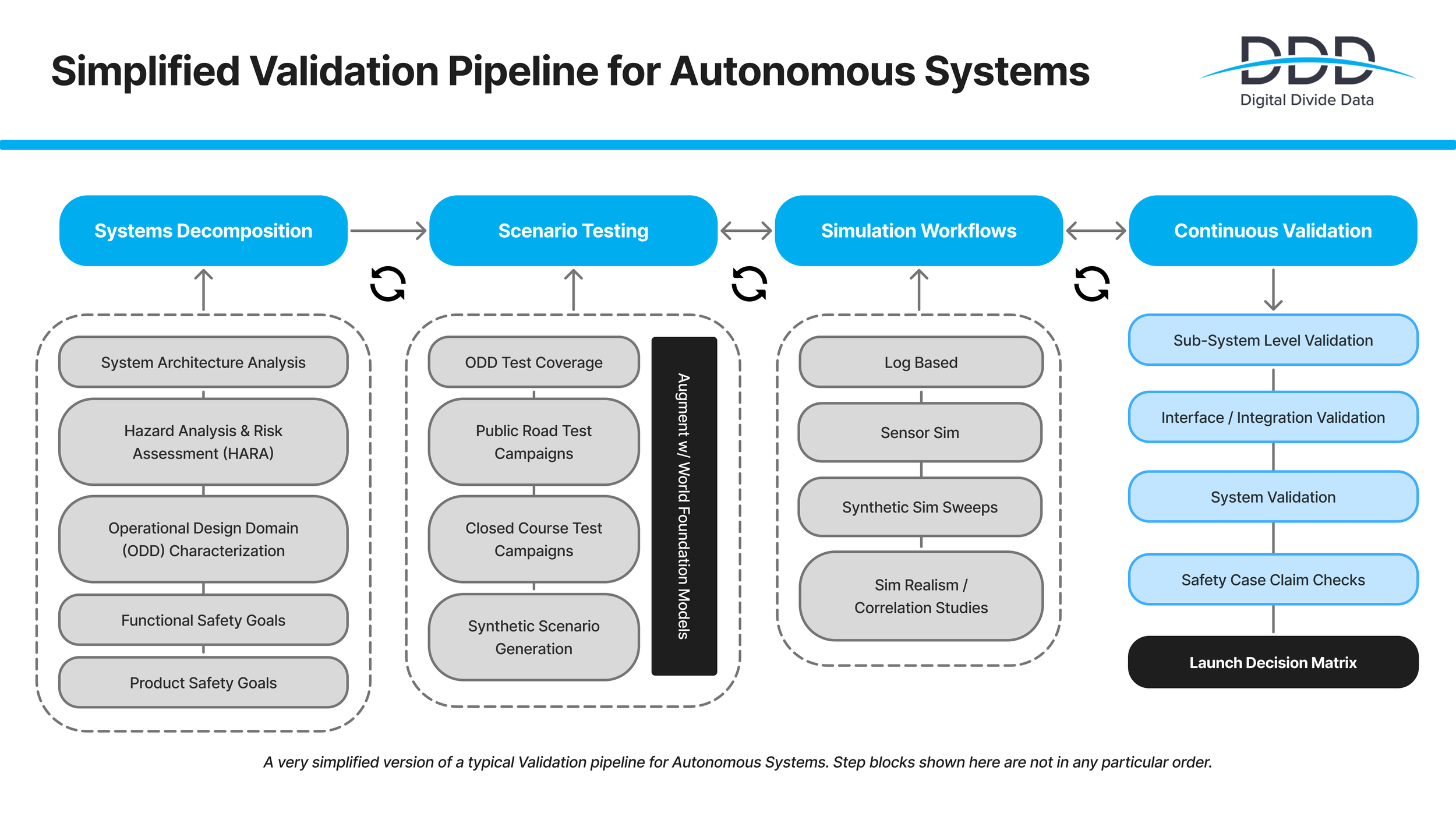
Basic Tenets of a Healthy Validation Pipeline

Autonomy+V%26V+Workflow

Figure 1. Simplified Validation Pipeline for Autonomous Systems

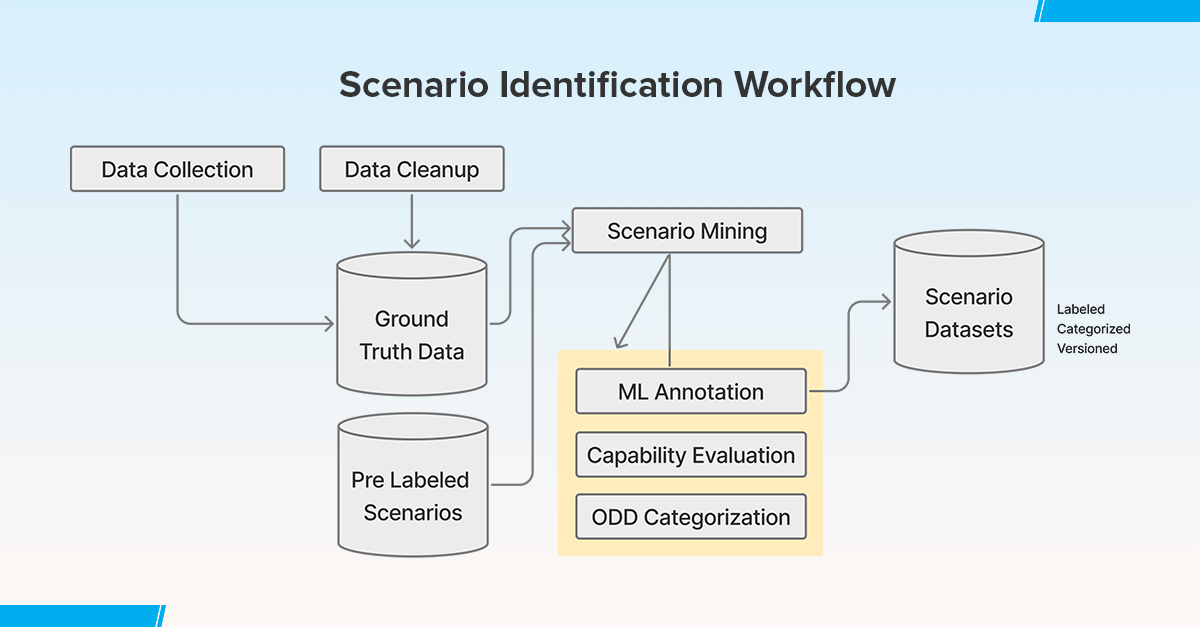
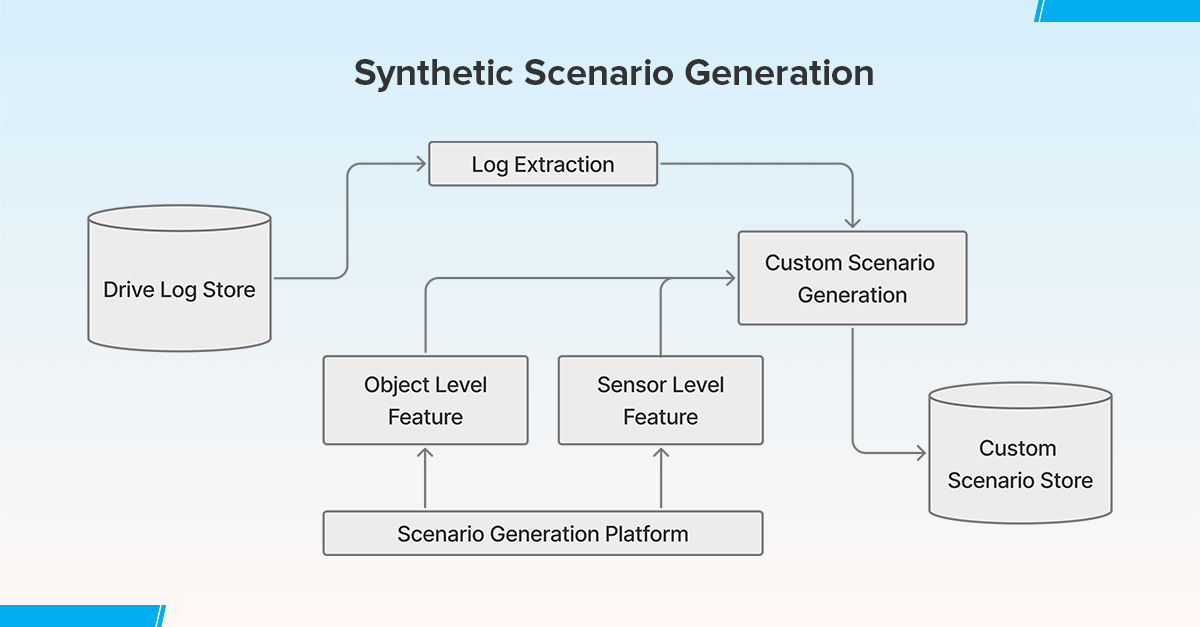
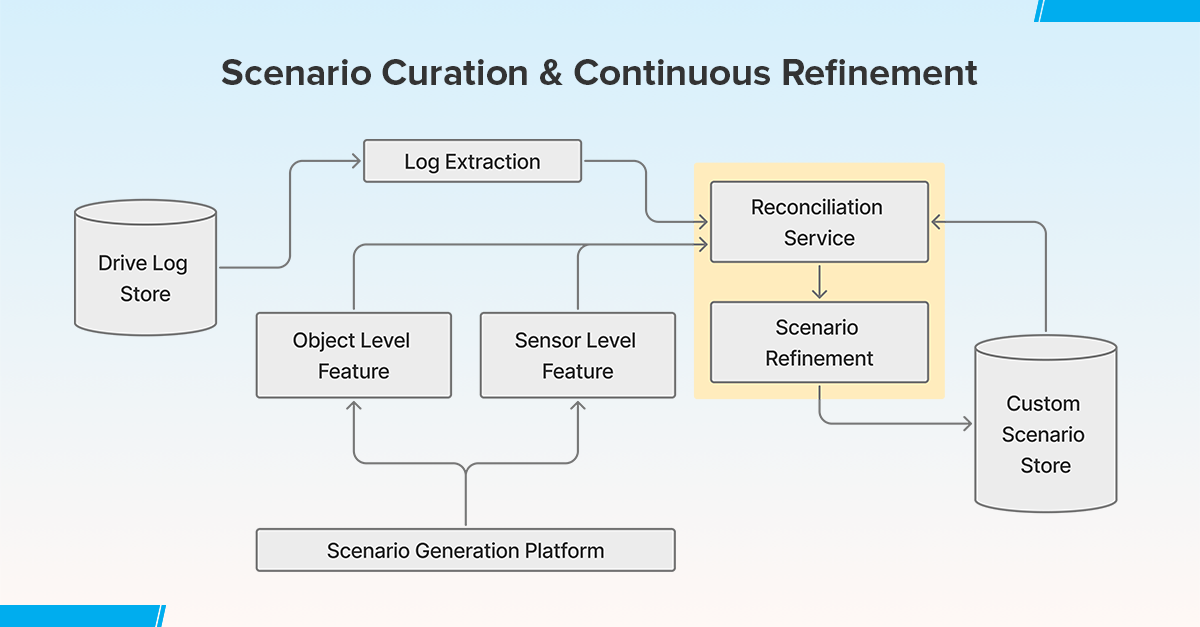
Synthetic Data Generation

You can’t validate what you can’t simulate.

That’s why scenario-based testing has become the gold standard for autonomy V&V. It allows developers to test real-world and edge-case interactions across varied ODDs long before a system hits the road. The amount of progress the industry has achieved in creating world foundation models is insane over the last 12 months. From what was a limiting factor to test all limiting ODD conditions five years ago to creating hyper-realistic, neurally simulated, actor-overlaid scenes is straight out of a fiction book.

What does this mean? Tools exist, but system integrators and end user applications must catch up to make the most of them. This advancement solves the software problem but, interestingly, complicates the systems engineering problem – you need to pick and choose which scenarios matter, why, and how that test builds your confidence in the system under test (SUT). You can now operate for 1,000 hours in Japan and a few hundred hours in the US to drive (nearly) perfectly, let’s say, in the UK. The additive nature of unsupervised learning using synthetic data greatly simplifies the model training problem. But, I digress…

The bottom line is that you should supplement your real-world testing with NVIDIA Cosmos-like tools to turbocharge data curation needs. Then, couple that with scenario ontology and ODD constraint definitions to create a dataset that gives you an unprecedented edge in creating V&V scenario sets.

State of the Art Simulation

Almost every autonomous systems company uses digital twin validation to increase confidence in simulation-based results by creating virtual replicas of physical systems and correlating their behavior against real-world performance. This validation layer assures that simulation outcomes are trustworthy enough to inform safety decisions at scale. There’s plenty of public domain literature on simulation realism and correlation scores. We won’t go into those details. That said:

  • Input information (II): What do you need to build in simulations and why? Is the data sourced from real-world (log-based) sensor models or the output of ODD characterization studies?

  • Input constraints (IC): Which simulation aspect gives you the most realistic behavior and, hence, which part of ODD does it leave open gaps for?

  • Desired outcomes (DO): What is the intent of simulation tests for your SUT, i.e., learning to expect or things to cross off from the known risks SOTIF quadrant?

When you plug II + IC + DO in any tool, it should spit out a spectrum of simulated tests that help you build at volume. If you can crack the simulation-in-the-loop development workflow, with the rest of the tenets in this section, you’re almost guaranteed to succeed quicker than others.

As scenario libraries grow, managing them becomes a discipline in itself. Enter simulation operations (SimOps) — a formal practice that includes scenario lifecycle management, suite health monitoring, and adversarial testing orchestration. SimOps ensures testing is systematic, repeatable, and aligned with your development goals as they evolve.

At DDD, we begin with what’s real: logs from the field, annotated sensor data, and even moments when a safety driver took over. From that foundation, we build what you need — synthetic scenarios with adjustable variables like speed, visibility, or pedestrian intent. We reconstruct real-world incidents in simulation with near pixel-perfect accuracy. We also design adversarial tests meant to push systems to the limits, on purpose, so we can see how they recover under pressure.

Data Driven Development

It’s great to have tools at your disposal that can simulate the real world, traffic behavior, agent reactions, etc., but ultimately, how you use the output data for inference and performance improvements is where things make or break.

A mental model categorizes your autonomy capabilities into standard scenario metrics – with every new software or hardware release, these metrics change against your baseline regression test suites. You can use this data to close the loop with scenario generation, simulation, and public road testing campaigns to improve the release for next time. This cuts more into your systematic verification, but the principles are the same for an overall product validation. Instead of sub-system metrics, you swap with system-level KPIs such as system latency, field assists, safety incidents, etc.

Well-Oiled Data Infrastructure

The validation pipeline can be extremely efficient or severely laggy, depending on the data infrastructure of your setup. Feeding the test systems with your inputs and executing them precisely has to happen quickly. Otherwise, the temporal costs stack on and become a perfect recipe to skip the continuous validation I mentioned earlier.

Data ingestion, cloud uploads, scenario creation or simulation execution time, and automated triage with manual QA checks are all important to optimize for streamlining the data infrastructure.

Predictive Performance Modeling

There are plenty of advancements to build predictive statistical models based on your system’s behavioral attributes, the nature of the change, and expected performance improvement. This largely helps predict the product roadmap forward and ensures that the V&V runway is sufficient to complete the testing, analysis, conclusions, and changes.

Towards More Automation

Simulation generates data. Edge cases generate questions. However, powerful insights come from understanding why something failed and where it can be traced back.

Modern V&V teams need systems that do more than detect anomalies. They need infrastructure for root-cause defect analysis — tools and workflows that isolate what went wrong, why it went wrong, and what to fix.

We’re seeing a fast pivot away from traditional human-led triage, which doesn’t scale. In its place? Automated log analysis, tagged defect taxonomies, and closed-loop workflows that route issues back to development with semantic context. DDD has helped build such taxonomies for leading autonomy customers, and we continue to refine them as systems grow more complex.

Coverage is both Metric and Deployment Decision

Coverage is a word that gets tossed around a lot. In autonomy, it means one thing: Have we tested enough to deploy with confidence? You can’t answer that question with line counts or percentage bars. You need:

  • Complete ODD analysis (day/night, urban/highway, dry/snow/low-visibility).

  • Scenario frequency distribution (not just edge cases but also the right mix of nominal vs. critical interactions).

  • Subsystem validation (perception, prediction, planning, control, fallback logic).

  • Human touchpoints (remote ops, customer support, fail-safes).

Teams preparing for geographic expansion also use region-specific scenarios to simulate local conditions, traffic patterns, and regulatory environments. This targeted approach helps adapt AV behavior to new markets quickly and safely.

The right approach combines simulation, structured closed-course testing, and targeted real-world validation — all mapped back to coverage goals. We help teams define those goals and hit them systematically.

Traceability: The Quiet Power Move in V&V

Most engineers don’t get excited about traceability. But safety auditors, regulatory bodies, and deployment leads do — and with good reason.

Traceability is a provable link from requirement to scenario to test to result. It’s the backbone of ISO 26262 and SOTIF compliance. It’s the reason regulators say yes.

And here’s the reality: The more complex your autonomy stack, the harder it is to trace. At DDD, we help clients build end-to-end traceability frameworks that embed links early and preserve them as systems evolve. That work includes:

  • Mapping requirements to acceptance criteria in simulation and real-world testing.

  • Tagging results with scenario IDs, environment variables, and sensor configurations.

  • Correlating anomalies to architectural layers (sensor, fusion, planning, actuation).

  • Making sure every test result directly reinforces a safety case element.

With traceability in place, teams can know what passed, what matters, and how to prove it to anyone who asks — regulator, insurer, or the public.

Automation isn’t the Goal; Understanding is

It’s easy to think automation is the final destination in V&V. However, the real goal is understanding. Understanding is why human-in-the-loop (HITL) validation remains essential — especially in early-stage autonomy development or when AI systems behave unexpectedly. No matter how advanced the model, there will be edge cases where human judgment is faster, sharper, and more adaptable.

At DDD, we balance automation and human review by:

  • Using AI to flag anomalies in massive data streams.

  • Routing ambiguous or high-impact cases to expert human reviewers.

  • Feeding human-labeled data back into the model for continuous improvement.

  • Creating feedback loops that combine speed with insight.

We also design performance evaluation workflows that integrate feedback from both onboard and offboard sources so that each iteration of the autonomy stack gets evaluated against business goals, technical benchmarks, and safety criteria.

This work is especially powerful for safety-critical edge cases where pedestrian intent, cyclist behavior, or sensor dropouts challenge even the most advanced AV stack. With our HITL workflows, nothing gets missed. No bad decision gets a free pass.

The Bottom Line

Looking ahead, V&V will only grow more dynamic. Engineers will regenerate entire worlds from a single log file and spin off dozens of test variants with synthetic weather, lighting, occlusion, and pedestrian behaviors. Simulations will be stress-tested by agents designed to provoke failure, not avoid it — because that’s where the system shows its true limits.

Think prompt engineering but for autonomy: crafting inputs that reveal how the model reasons under pressure, testing not just behavior but reasoning, not just capability but recoverability. It’s what makes this space exciting. And it’s why companies that invest in smarter V&V now will move faster, scale safer, and lead longer.

Verification and validation is a strategy, not a checkbox. Done right, it’s your moat, your launchpad, your competitive edge.

At DDD, we can help you validate systems, prove system readiness, improve system reliability, and shorten the road to system deployment. From automated performance analysis to HITL review, from scenario curation to traceability infrastructure — it’s the work we do every day.

And we’d love to help you do it smarter.

References

  1. Validation and Verification Processes: Keeping Up with the Driving Advances – David Ip, LinkedIn

  2. Metrics That Matter in AV Development – Applied Intuition

  3. Navigating SOTIF (ISO/PAS 21448) and Ensuring Safety in Autonomous Driving – Automotive IQ

  4. AV Compliance: Still a State-by-State Slog (for Now) – Frost Brown Todd

  5. Traceability Standards and Regulations in the Automotive Industry – SodiusWillert

  6. Continually Verify and Validate ADAS and AV Compliance and Performance – Siemens

  7. Human-in-the-Loop AI – KJR

  8. What Is Edge Case Testing? – TestScenario

  9. AV Development: 4 Triage Considerations – Applied Intuition

  10. Tech-Driven AV Performance Validation – Applied Intuition

The Case for Smarter Autonomy V&V Read Post »

SyntheticDriving

Developing Effective Synthetic Data Pipelines for Autonomous Driving

The development of autonomy heavily relies on vast amounts of high-quality data to train and validate machine learning models. Traditionally, real-world data collection has been the primary approach, but it comes with significant challenges, including high costs, safety concerns, and difficulties in capturing rare edge cases. To overcome these limitations, synthetic data has emerged as a game-changing solution, providing scalable, diverse, and precisely labeled datasets that enhance the performance of self-driving systems.

According to research, the global synthetic data generation market was valued at $469.8 million in 2024 and is projected to reach $3.7 billion by 2030, growing at a CAGR of 41.3% over the forecast period.

In this blog, we will explore how to develop an effective synthetic data pipeline for autonomous driving, breaking down the key components, best practices, and future trends shaping this innovative approach.

Why Synthetic Data is Essential for Autonomous Driving

Autonomous vehicles (AVs) need to be trained on diverse driving scenarios, including various weather conditions, traffic densities, road types, and unpredictable pedestrian behavior. Collecting and annotating real-world data for every possible scenario is impractical and time-consuming. Additionally, edge cases such as a pedestrian suddenly crossing the road in low visibility conditions are rare in real-world datasets, making it difficult for AV models to generalize effectively.

Synthetic data addresses these challenges by generating artificial yet highly realistic driving scenarios in simulated environments. It enables the creation of rare and complex situations that are otherwise difficult to capture in real life. Furthermore, it eliminates privacy concerns related to real-world data collection, as synthetic data does not involve actual human recordings. By combining synthetic and real-world data, companies can develop more robust AI models capable of handling the unpredictable nature of real-world driving.

Key Components of a Synthetic Data Pipeline

A well-structured synthetic data pipeline consists of multiple stages, from scenario design to model validation. Let’s break down the core elements necessary to build an effective pipeline.

1. Scenario Definition & Simulation

The first step in generating synthetic data is defining the driving scenarios that an autonomous vehicle must navigate. These scenarios include various environmental conditions, road layouts, traffic situations, and potential obstacles. Simulation tools such as CARLA, NVIDIA Drive Sim, and LGSVL allow developers to create highly customizable environments where AVs can be tested in controlled conditions.

For example, a developer might design a scenario where a cyclist suddenly crosses an intersection in heavy rain at night. By recreating such scenarios, engineers can expose AV models to complex situations and improve their ability to make safe and accurate driving decisions.

2. High-Fidelity Sensor Simulation

For synthetic data to be effective, it must accurately replicate the inputs received by real-world AV sensors, including cameras, LiDAR, radar, and ultrasonic sensors. High-fidelity simulation ensures that data captured in the virtual environment closely resembles real-world sensor readings.

To achieve this, advanced rendering techniques such as ray tracing are used to simulate how light interacts with surfaces, mimicking real-world lighting conditions. Additionally, noise models are introduced to account for sensor imperfections, ensuring that the synthetic data does not appear unrealistically perfect compared to real-world inputs.

3. Automated Data Labeling and Annotation

One of the key advantages of synthetic data is its ability to generate automatically labeled datasets. In traditional real-world data collection, human annotators spend significant time labeling objects such as pedestrians, vehicles, lane markings, and traffic signs. In contrast, synthetic data pipelines can generate perfect ground-truth annotations instantly, including depth maps, object segmentation masks, and 3D bounding boxes.

This automation drastically reduces the time and cost associated with data labeling while improving accuracy. Furthermore, synthetic annotation can be customized to match specific AV perception algorithms, ensuring seamless integration with machine learning models.

4. Domain Randomization and Variability

To enhance the generalization capabilities of AV models, synthetic data pipelines incorporate domain randomization techniques. This process involves introducing a wide range of variations in environmental conditions, vehicle placements, lighting effects, and object appearances. The goal is to prevent models from overfitting to a specific dataset and instead learn robust features that apply to real-world scenarios.

For instance, an AV model trained on synthetic data might encounter the same street intersection in various lighting conditions; morning fog, bright midday sun, and nighttime with streetlights. By exposing the model to such variations, it learns to handle diverse real-world situations more effectively.

5. Integration with Machine Learning Pipelines

Once synthetic data is generated, it must be seamlessly integrated into the machine learning pipeline. This includes data preprocessing, augmentation, and combining synthetic datasets with real-world data for model training.

Many companies adopt a hybrid approach, using synthetic data for rare edge cases while relying on real-world data for common driving scenarios. Additionally, synthetic datasets can be used to pre-train models before fine-tuning them with real-world data, reducing training time and improving generalization.

Best Practices for Building a Robust Synthetic Data Pipeline

To maximize the effectiveness of synthetic data, several best practices should be followed:

  • Ensuring Domain Realism: While synthetic data is artificial, it should closely resemble real-world driving environments. Techniques such as generative AI and physics-based rendering can help bridge the gap between synthetic and real-world data.

  • Validating Synthetic Data Effectiveness: Continuous validation is necessary to ensure that synthetic data improves model performance. This can be done by testing models trained on synthetic data against real-world benchmarks.

  • Balancing Synthetic and Real Data: A hybrid approach that blends synthetic and real-world datasets yields the best results, leveraging the advantages of both data sources.

  • Automating Pipeline Processes: Automating scenario generation, labeling, and validation helps scale synthetic data pipelines efficiently.

Challenges and Future Trends

While synthetic data has revolutionized AV development, it is not without challenges. The sim-to-real gap the difference between synthetic and real-world data remains a key concern. Despite advances in high-fidelity rendering, AV models may still struggle when transitioning from synthetic training environments to real-world conditions.

To address this, researchers are exploring generative AI models such as diffusion models and GANs (Generative Adversarial Networks) to create ultra-realistic synthetic datasets. Additionally, reinforcement learning in simulation is becoming a powerful tool for testing AV decision-making algorithms under controlled conditions.

As AV technology continues to evolve, synthetic data will play an even greater role in accelerating development cycles, improving safety, and reducing costs. The integration of self-learning simulations, where AV models dynamically interact with synthetic environments to refine their decision-making, represents an exciting future for the industry.

How Digital Divide Data (DDD) Can Help

As the demand for high-quality synthetic data continues to grow, having the right expertise in simulation and AI development is crucial. Digital Divide Data (DDD) provides cutting-edge solutions to accelerate AI and autonomous system development, making it a valuable partner for companies building synthetic data pipelines for autonomous driving.

With a deep understanding of simulation pipelines and AI-driven data solutions, DDD empowers AV companies to develop safer, more intelligent self-driving systems. By integrating synthetic simulation, log-based sim, and advanced sensor modeling, DDD ensures that autonomous technology continues to evolve with greater accuracy, efficiency, and scalability.

Conclusion

Developing effective synthetic data pipelines is essential for advancing autonomous driving technology. By leveraging simulation environments, high-fidelity sensor modeling, automated labeling, and domain randomization, companies can create scalable and diverse datasets that enhance AV performance.

As the industry moves forward, bridging the sim-to-real gap and incorporating AI-driven data generation techniques will be crucial for unlocking the full potential of autonomous vehicles. By adopting best practices and continuously improving synthetic data pipelines, AV developers can accelerate innovation and build safer, more reliable self-driving systems.

Talk to our expert today to discover how DDD can help accelerate your development with cutting-edge simulation solutions.

Developing Effective Synthetic Data Pipelines for Autonomous Driving Read Post »

Scenario Dataset Services Slide 5

Democratizing Scenario Datasets for Autonomy

Developing safer, reliable Autonomy and commercializing Autonomous Vehicles (AVs) necessitates rigorous testing and product validation. While real-world testing is indispensable, it is capital-intensive and limits scalability to encompass the range of potential driving conditions and edge cases in the target Operational Design Domain (ODD). Over the years, AV Companies have adopted a multitude of strategies to boost test coverage without incurring prohibitive costs. A few of these strategies are as follows:

  • Simulation-First Testing – Validates AV software in a scalable, cost-effective, and risk-free virtual environment. Shifting the testing paradigm to the left to discover known, predictable issues provides a cost and time advantage over real-world data.

  • Edge Case & Adversarial Testing – Evaluates AV performance in rare, unpredictable, and high-risk situations mostly in simulated environments (e.g. Pedestrians crossing in front of the AV out of occlusion).

  • Closed-Course Structured Testing – Tests (verifies) AVs in a physical world but with a controlled set of scenarios (test tracks) before the public road deployment.

  • Real-World Testing – Tests (validates) AV performance in an uncontrolled, real-world environment (public roads) for maximizing the Autonomy stack exposure.

In this article, we will explore how a set of services built around Scenario Curation, Analysis, and Management can accelerate the AV product development lifecycle. Let’s dive in!

The Curse of Rarity

Diverse weather conditions (snow storm, rain, low visibility, etc.), dense downtown areas with a high number of pedestrians, unprotected left turns, and occluded motorbikes – all of these are ODD conditions that can lead to an edge case interaction with the AV and real-world physical element. If the Autonomy model is developed and evaluated using scenarios accounting for these edge cases after a thorough ODD analysis, then the risk of a safety-critical incident can be reduced to unknown unknowns. A scenario-based approach for training Autonomy models and performance evaluation provides a safer AV without spending years of effort in real-world testing.

The Cost of Developing a Safer AV

According to a news article published by The Information in 2020, the AV Industry has cumulatively spent a whopping $16 billion to develop AVs. A significant chunk of this capital has been spent on data collection, training, and performance evaluation efforts. All of these problems can be alleviated by using bespoke scenario datasets. All the well-funded large companies (Waymo, Cruise, Uber/Aurora, Baidu, etc.) have developed their infrastructure ground-up to support generating synthetic or hybrid scenarios. These companies plus many others in the space have heavily invested in sim infrastructure and scenario-based operations.

One might think that these large well-funded companies have the first-mover advantage and it is difficult for new entrants to catch up. At the very least, it is difficult to outspend the incumbents. However, with advancements in silicon chip design, computing power, and network speeds: we are at the cusp of a revolution in the usage of Simulation and synthetic scenarios. In the present-future terms, we expect many of these platforms, and data services to be available off-the-shelf and democratize the adoption of scenario-based performance evaluation.

Recent Trends

The last few years have witnessed the launch of multiple foundational physical AI models. These models make it easy to construct scenarios on-demand and run Simulation engines for various performance evaluation use cases. A few prominent examples of technological advances include:

  • NVIDIA has recently launched its Cosmos platform. Along with NVIDIA’s Scenario Editor, developers can now speedily build synthetic scenarios or generate new scenarios from existing ground truth data.

  • Waabi’s UniSim is a neural closed-loop sensor simulator that can generate multiple scenarios from a single recorded log captured by a sensor-equipped vehicle. Provides far better test coverage using such base scenario variations.

  • PD Replica Sim by Parallel Domain allows AV companies to create simulation scenarios from their own captured data.

  • Companies like Nexar are crowdsourcing automotive scenario generation and reconstruction using dash-cams or ADAS cameras on a fleet of millions of production vehicles.

Such platforms have removed the initial barriers of entry and reduced the need for:

  1. Sourcing ground-truth ML data for training Autonomy models, dropping data collection costs significantly

  2. Large-scale infrastructure setup for scenario-based simulated performance evaluation, dropping overhead engineering costs

The current trend conclusively shows that scenario management and simulation-based processes need not be built ground-up anymore compared to ~5 years back. To take full advantage of the ecosystem, there is a need for a system integrator and service provider who can manage the lifecycle of scenario datasets from scenario generation, scenario management, edge case curation, and analysis. At DDD, with deep expertise in AV Safety and Performance Analysis, we are well-equipped to take up this role as an important catalyst in the democratization of AV development and adoption.

Scenario Datasets Services

So far we have delved into a scenario-based approach for AV development; the problems it solves and how the recent technological trajectory makes it easily accessible to a wider set of stakeholders. In this section, we will focus on the services that can be built around Scenario Management and the Applications this will facilitate.

At a high level, the following services are the backbone of the solution suite:

Scenario Identification: The real-world driving situations that the AV must handle are mined. The net collected data is reviewed further for identifying relevant scenarios using the ODD context and for further labeling, performance analysis, or other taxonomic classification. The identified scenarios are then categorized into normal (everyday) and edge-case (rare, high-risk) situations. Factors like weather, traffic density, road conditions, unexpected obstacles, etc. are considered. This library of categorized Scenario Datasets are versioned and kept ready for ML foundational models or analytical product development to build the prioritized Autonomy capability set. This process can be entirely manual or semi-automated, in combination with other parameters such as downstream tech stack requirements.

Scenario Dataset Services Slide 2

Fig 1: Scenario Identification Workflow

Synthetic Scenario Generation: Scenarios are created synthetically and from real-world driving logs. Object-level and sensor-level scenarios are created with GUI tools and parameterized approaches. These synthetic or hybrid scenarios bridge the gap between real-world datasets and rare edge cases an AV may encounter. These scenarios can be labeled and then used to train, validate new autonomy model versions, or evaluate existing models against evolved requirements.

Scenario Dataset Services Slide 3

Fig 2: Synthetic Scenario Generation

Curation & Continuous Refinement: To maintain scenarios relevant to the AV development lifecycle, there is a need to optimize existing scenario datasets to account for real-world events and changes to ground truth. Analyzing and fine-tuning scenarios can be used to isolate systemic defects, perform CAPA analysis, and implement changes for further training, testing, and validation. This is particularly useful for the matured stage of product development.

Scenario Dataset Services Slide 4

Fig 3: Scenario Curation & Continuous Refinement

With the above services, we can develop a library of curated, categorized, and up-to-date Scenario Datasets which can then be utilised for various applications and use cases. We will discuss a few of the applications in the next section.

Key Applications of Scenario Dataset Services

1. Working with Edge Cases – Accelerating AV Development

A diverse curated Scenario Dataset library is particularly useful to address the challenge of data scarcity in edge-case scenarios, such as adverse weather conditions, temporary construction zones, low-visibility environments, etc. This approach enhances the availability of diverse and high-risk driving scenarios, which are often underrepresented in real-world datasets (Dosovitskiy et al., 2017; Sun et al., 2020). By integrating both real-world log data and synthetically generated scenarios, the dataset library enables comprehensive training, validation, and performance evaluation of autonomous vehicle (AV) systems.

Synthetic scenario generation, leveraging simulation platforms such as CARLA or LGSVL, provides scalable and repeatable test cases for rare but critical situations. Additionally, scenario augmentation techniques using generative models and domain adaptation enhance the robustness of AV perception systems (Sadeghi & Levine, 2017).

This methodology significantly accelerates the AV product development lifecycle by reducing the time required for data collection and annotation, thereby expediting training, validation, and performance evaluation cycles. Moreover, by continuously updating the dataset library with newly encountered real-world edge cases, the AV system can iteratively improve its decision-making capabilities.

2. Safety & Compliance in AVs

Scenario datasets play a crucial role in AV development to enhance safety and regulatory compliance, particularly in handling safety-critical incidents. These incidents often involve non-conforming and erratic vehicle behavior, vulnerable road users (VRUs), and unexpected road hazards, which require extensive dataset coverage to ensure robust AV decision-making.

By leveraging readily available high-fidelity scenario datasets, AV developers can systematically improve the detection of potentially harmful situations and develop response mechanisms, particularly for pedestrians, cyclists, emergency vehicles, and other unpredictable entities in urban and highway environments. Furthermore, scenario augmentation techniques using generative models and reinforcement learning facilitate the expansion of dataset variability to improve generalization across diverse ODDs.

From a compliance perspective, readily available scenario datasets increase test coverage and ensure alignment with regulatory frameworks such as ISO 26262 (functional safety), ISO 21448 (safety of the intended functionality, SOTIF), and NCAP assessment protocols. By integrating synthetic and real-world scenarios into safety validation pipelines, AV manufacturers can systematically address regulatory testing requirements, ensuring that AVs can safely operate under complex, high-risk driving conditions.

3. Global Expansion for AVs

The Scenario Dataset Library can be filtered for specific locations to essentially generate a region-specific dataset. This is highly useful for AV developers who want to expand to new locations (cities, regions, countries). Region-specific datasets (hybrid and synthetic) account for different road infrastructures, traffic laws, weather, and pedestrian behaviors. Usage of region-specific datasets drastically reduces the time and effort to fine-tune autonomy models as per specific ODDs relevant to the new location.

4. Collision & Near Collision Analysis:

Retrospective collision and near collision (or near misses) identification is part of the safety critical event performance evaluation, necessary for extracting crucial information on potential system failures. It is a systematic approach to dissect the problem, root cause analysis, and hazard analysis for minimizing the exposure of your autonomous system to similar situations. Existing scenario datasets can be used in addition to logs of safety-critical incidents to analyse and identify root causes. The findings can then be used to reconstruct scenarios for relabeling and re-simulation to actively prevent recurrence. The availability of a library of datasets for safety-critical scenarios provides an accelerated mechanism for handling retrospective analysis for safety issues.

Conclusion

Scenario dataset services play an integral role in Autonomous Vehicle (AV) development including model training, validation, and evaluation. By leveraging a library of high-fidelity datasets, developers can enhance AV performance, ensure regulatory compliance, and improve real-world safety outcomes. As the AV industry advances, the continued evolution of scenario dataset services — coupled with Machine Learning advancements and standardized validation frameworks — will be pivotal in shaping the future of safe and reliable Autonomous Mobility.

DDD’s Scenario Dataset Services can be used for such end-to-end applications and derivative use cases that will help AV developers expedite their product development and take it to market.

References:

  • Riedmaier, S., et al. (2020). “Scenario-Based Testing for Automated Driving.” IEEE Transactions on Intelligent Vehicles

  • Nidhi Kalra, Susan M. Paddock (2016) “Driving to Safety:How Many Miles of Driving Would It Take to Demonstrate Autonomous Vehicle Reliability?”. RAND.

  • Simulated terrible drivers cut the time and cost of AV testing by a factor of one thousand

  • Money Pit: Self-Driving Cars’ $16 Billion Cash Burn

  • Dosovitskiy, A., Ros, G., Codevilla, F., Lopez, A., & Koltun, V. (2017). CARLA: An open urban driving simulator. Conference on Robot Learning (CoRL).

  • Rong, G., Zhao, H., Bian, J., Xia, Y., Zhao, Y., … & Li, K. (2020). LGSVL Simulator: A high-fidelity simulator for autonomous driving. arXiv preprint arXiv:2005.03778

  • Sadeghi, F., & Levine, S. (2017). CAD2RL: Real single-image flight without a single real image. Robotics: Science and Systems (RSS).

  • Bansal, M., Krizhevsky, A., & Ogale, A. (2018). ChauffeurNet: Learning to drive by imitating the best and synthesizing the worst. NeurIPS.

  • Philion, J., Kar, A., Lebedev, V., Kolve, E., Fidler, S., & Urtasun, R. (2020). Learning to evaluate perception models using planner-centric metrics. CVPR.

  • Geiger, A., Lenz, P., Stiller, C., & Urtasun, R. (2013). Vision meets robotics: The KITTI dataset. International Journal of Robotics Research (IJRR).

  • Richter, S. R., Vineet, V., Roth, S., & Koltun, V. (2017). Playing for data: Ground truth from computer games. IEEE Transactions on Pattern Analysis and Machine Intelligence (TPAMI).

  • Winner, H., Hakuli, S., Lotz, F., & Singer, C. (2017). Handbook of Driver Assistance Systems: Basic Information, Components and Systems for Active Safety and Comfort. Springer.

  • Koopman, P., & Wagner, M. (2017). Autonomous vehicle safety: An interdisciplinary challenge. IEEE Intelligent Transportation Systems Magazine.

Democratizing Scenario Datasets for Autonomy Read Post »

Aerial view of an urban intersection with simulated vehicle trajectories for autonomous driving testing

Simulation Operations: Accelerating the Path to the Age of Autonomous Systems

Introduction

The ultimate pursuit of a fully Autonomous System stretching from – Autonomous Vehicles (AVs) and unmanned Aerial Vehicles (UAVs – Drones) to Delivery and Manufacturing Robots, Micro-mobility, etc. has been a longstanding ambition for humanity. Achieving this steep goal necessitates overcoming significant Engineering, Regulatory (Policy), and Safety challenges. While we surely are moving in the right direction and this ambition is achieved by some on the playing field, it remains a very interesting problem for the rest to solve.

Simulation is one of the most effective tools in developing and validating an Autonomous System. All Autonomy applications rely on a strong verification and validation strategy for a commercially viable product, with Simulation as the backbone. Broadly speaking, this encapsulates creating simulated representations of the physical world to build the Autonomy AI. The complexity lies in the levers of simulated realism, scalability as a function of cost and compute, and ease of creating a parameterized space to extract the signal of interest (amongst many others).

In this post, we explore how Human in the Loop Workflows (HiTL) expedites adopting this Simulation tool to build maximum test coverage for safer, reliable Autonomous Systems. We will look back on the history of Simulation, key components of the Sim-eng-ops ecosystem, present-day trends in foundational models, building effective Simulation Operations, and how these aspects connect to speed up meaningful product development.

A Brief History of Computer Simulations in the Automotive Industry

Computer Simulations have played a pivotal role in engineering disciplines since the mid-20th century, initially emerging in safety-critical fields such as Nuclear Physics (defense tech) and Aerospace Engineering. The Automotive industry quickly followed suit and adopted simulation techniques to enhance design and safety testing. Before the introduction of computational methods, crash testing relied solely on physical prototypes, which were costly, time-consuming, and often destructive.

The advent of Finite Element Analysis (FEA) in the 1960s and 1970s revolutionized vehicle safety testing by enabling virtual crash simulations. By leveraging FEA, engineers could model complex material behaviors and simulate crash scenarios, leading to several cost reductions, increased efficiency, and enhanced insight.

It may surprise you to learn that some of the crash simulations required overnight computer runtimes to produce results for a single iteration in the 1980s (Haug et al., 1986). This is impossible to imagine in the current era of unlimited GPU and Quantum Computing power. As computational power exploded, simulation methodologies evolved to include multi-physics modeling, near-real-time processing, and machine learning-enhanced neural modeling. These advancements have minimized barriers to entry for simulation and paved the way for a quicker integration into Autonomy Systems and similar Physical AI development.

Trends in Physical AI Foundational Models

With advancements in silicon chip design, computing power, and network speeds: we are at the cusp of a revolution in the usage of Simulation. This is similar to the inflection point in cloud computing spend, which grew 10x in the last 10 years (Link). Reports from the National Bureau of Economic Research (NBER) indicate that the prices of basic cloud services fell at double-digit annual rates between 2014 and 2016. The rate of decline has reduced but overall prices have continued to have a downward trend due to technological evolution and higher adoption.

Let’s draw an analogy between these two massively adopted technologies: Cloud Computing and Simulations. The Cloud Computing landscape has 3 primary categories:

  • Cloud Service Providers: Led by AWS, Microsoft Azure, and Google Cloud Platform (GCP)

  • Application Layer: B2C (Netflix, Zoom, Ube,r etc.) and B2B (Databricks, Shopify, Workday, etc.) players building applications on Cloud

  • System Integrators: B2C service providers helping corporations adopt cloud computing (Accenture, Capgemini, TC,S etc.) for their internal and external needs.

simulation

Fig 1: Cloud Industry Structure

Similar to Cloud Computing, the landscape of Simulations is becoming clearer due to the development of underlying infrastructure. The last few years have witnessed the launch of multiple foundational models that act as core simulation engines.

To note a few companies championing this:

  • NVIDIA’s Cosmos platform (launched in Jan 2025): The openness of Cosmos’ state-of-the-art models unblocks physical AI developers building robotics and AV technology and enables enterprises of all sizes to more quickly bring their physical AI applications to market. Developers can use Cosmos models directly to generate physics-based synthetic data, or they can harness the NVIDIA NeMo framework to fine-tune the models with their own videos for specific physical AI setups.

  • PD Replica Sim by Parallel Domain: PD Replica Sim allows AV companies to recreate simulations from their own capture data in near-pixel-perfect scene reconstructions and create fully annotated, simulation-ready environments with unparalleled realism and variety.

  • Meta’s Habitat 3.0 (launched in Mar 2024): Habitat 3.0 is a simulation platform for studying collaborative human-robot tasks in indoor and home environments.

These models address critical challenges in physical AI development, such as data scarcity, high computational costs, and safety concerns. The ability of such platforms to generate realistic, physics-based synthetic data and their support for efficient model customization makes them a valuable asset for developers aiming to advance the capabilities of autonomous systems and robotic applications.

It is unclear at this point what the leaderboard for physical AI foundational models will look like in 10 years. We can definitely crystalball a trend where other players will jump on board; and use these models to build platforms and applications making Simulation a modular off-the-shelf capability for verifying Autonomy Systems. The industry structure in the future will shadow the cloud ecosystem with the following players:

  • Foundational AI Model Developers: Companies such as NVIDIA, and Meta will create foundational physical AI models

  • Sim Platforms/Tool Developers: Companies who will create platforms for Sims adoption. Some of the current cloud platforms such as AWS are already creating such services.

  • Sim Apps Developers: Specialised companies who will build applications for specific use cases such as on-demand Sim Generation, Sim Lifecycle Management, etc.

  • Sim Integrators: Companies who will perform the task of last mile adoption by creating an effective and efficient workforce for system integration, running SIM operations and workflows.

Autonomy+simulation

Fig 2: Sim Industry Structure

With the advent of sim-in-the-loop development, we are about to experience breakthrough improvements in the following area

  • Safety & Test Coverage: Simulation allows for testing dangerous scenarios without risking human life or property. It enables developers to identify and address potential safety issues early in the development process.

  • Accelerated Development Cycle: Simulating scenarios is significantly faster and cheaper than real-world testing. It avoids the need for physical prototypes, test tracks, and associated logistical expenses. This accelerates the development cycle.

  • Scalability and Repeatability: Simulations can be easily scaled to run thousands or millions of scenarios concurrently. The same scenarios can be repeated consistently, allowing for rigorous testing and comparison of different algorithms and software versions.

Some of the second-order benefits of simulation adoption include

  • Innovation & Creativity: With reduced cost of adoption, simulation will not be reserved for large megacorps. With the increased democratisation of this technology, we will be witnessing new products, business models, and academic pursuits.

  • Safety as a Core Tenet: By accelerating the physical AI development cycle, Simulations can create a safer future both from existing problems (e.g. car accidents, industrial accidents); and also create a framework of safety for any new product development. This will inherently prioritize safety as a core tenet of any physical product development.

At DDD, we feel that a system integrator/operator will be required to accelerate and democratize the use of Simulation for companies trying to build autonomous products. With our vast experience in Model Training, Safety Review, and Triage Operations serving L4+ AV customers, we are confident to fit into this role seamlessly.

Double Click on HiTL Simulation Operations

Now that we have a good understanding of the Simulation landscape, let us dive a little deeper into Simulation Operations. Simulation Operations refers to the structured orchestration of simulation workflows, tools, and infrastructure to support large-scale, data-driven autonomous system development. Unlike traditional simulation approaches, Simulation Operations emphasizes automation, scalability, and integration across multiple domains. Key components include:

Sim Suite Management

As companies scale their test operations and developer ecosystem, it becomes critically important to manage offline testing modality to provide a maximum ROI and seamless experience. Simulation Suite Management encompasses the application of specialized tools, processes, and practices to organize the simulation macro (input tests, output data, result conclusions) in easy-to-interpret constructs. It includes the following broader areas:

  • Scenario creation, editing, and augmentation overlay

  • Scenario expiration, and its lifecycle management

  • Aggregate sim suite health and status reporting

  • Adversarial Testing – rare but critical failure scenarios, such as GPS outages or sensor malfunctions

  • Centralized data access: Cloud-based platforms for seamless team interactions.

  • Standardized metrics: Common performance benchmarks and reporting structures.

  • Stakeholder engagement: Transparent reporting mechanisms for regulatory bodies and safety auditors.

Sim Creation

Simulation creation is the process of generating virtual environments and scenarios to train, test, and validate the behavior of autonomous systems. It involves creating realistic digital replicas of the real world, including roads, traffic, pedestrians, weather conditions, and other relevant factors. These simulations allow developers to evaluate the performance of autonomous systems in a safe and controlled environment, without the risks and limitations associated with real-world testing.

There are broadly following ways in which Sims are created:

  • Synthetic Sim Creation: This involves creating virtual environments from scratch using foundational models, computer graphics, and 3D modeling techniques. It allows for a high degree of control and customization but can be time-consuming and may not always capture the full complexity of the real world.

  • Log-based Sim Creation: This approach uses real-world data, such as sensor logs from autonomous systems or recordings of human usage behavior, to recreate specific scenarios in a virtual environment. It can be more efficient than synthetic simulation and ensures that the simulated scenarios are realistic, but may be limited by the availability and quality of the data.

Digital Twin Validation

Digital Twin is a virtual replica of a physical object, system, or process that accurately mirrors its real-world counterpart’s behavior, and performance, and even predicts its future behavior. Digital twin validation is the process of making sure that a digital twin accurately reflects the real-world object or system it represents. It’s a correlation analysis that provides a higher degree of confidence in the virtual environment for scaling up any V&V activity. In addition to AV use cases, this process is widely used in robotics, aerospace, defense, and any safety-critical system analysis.

Sim Results Analysis & Reporting

Sim Results Analysis & Reporting is the process of extracting meaningful insights from simulation data and communicating those findings effectively. It’s a critical step in any simulation project, as it allows you to understand the behavior of the system being modeled and make informed decisions based on the results.

The integration of Simulation Operations into Autonomous Systems development accelerates progress by addressing critical industry challenges such as safety and risk mitigation, scalability, and cost-effectiveness. The industry trend indicates that a well-defined end-to-end Simulation Operations expertise will turbocharge the development cycle for autonomous products.

Conclusion

Just as simulation transformed automotive crash testing, Simulation Operations is revolutionizing the development of autonomous systems. By providing a scalable and automated framework for testing and validation, and end-to-end Simulation Operations offering accelerates the deployment of safe and reliable technology. As computational capabilities continue to advance, the integration of AI-driven simulations and real-world validation will further refine AV technology, pushing the boundaries of automation and safety. The future of Simulations is also exciting –  innovations such as Neural Sims, which can generate multiple simulation environments from one solitary log can multiply the effectiveness of simulations. In conclusion, the future seems bright – the age of Physical AI is imminent and Simulations will unlock the doors to that age.

DDD has positioned itself to be at the forefront of this revolution and contribute to ushering in the Age of Autonomy Systems. To learn more talk to our simulation experts.

References

  • Belytschko, T., Liu, W. K., Moran, B., & Elkhodary, K. (2000). Nonlinear Finite Elements for Continua and Structures. Wiley.

  • Haug, E., T. Scharnhorst, P. Du Bois (1986) “FEM-Crash, Berechnung eines Fahrzeugfrontalaufpralls”, VDI Berichte 613, 479–505.

  • Kalra, N., & Paddock, S. M. (2016). Driving to Safety: How Many Miles of Driving Would It Take to Demonstrate Autonomous Vehicle Reliability? RAND Corporation.

  • Koopman, P., & Wagner, M. (2017). “Autonomous Vehicle Safety: An Interdisciplinary Challenge.” IEEE Intelligent Transportation Systems Magazine, 9(1), 90-95.

  • UniSim: A Neural Closed-Loop Sensor Simulator, CVPR 2023 –  Ze Yang,  Yun Chen,  Jingkang Wang,  Siva Manivasagam,  Wei-Chiu Ma,  Anqi Joyce Yang,  Raquel Urtasun

Simulation Operations: Accelerating the Path to the Age of Autonomous Systems Read Post »

Scroll to Top