Celebrating 25 years of DDD's Excellence and Social Impact. ✖

Data Collection & Curation

A Step-by-Step Guide to Building AI DataOps

How to Build an AI Data Operations Function: A Guided Framework

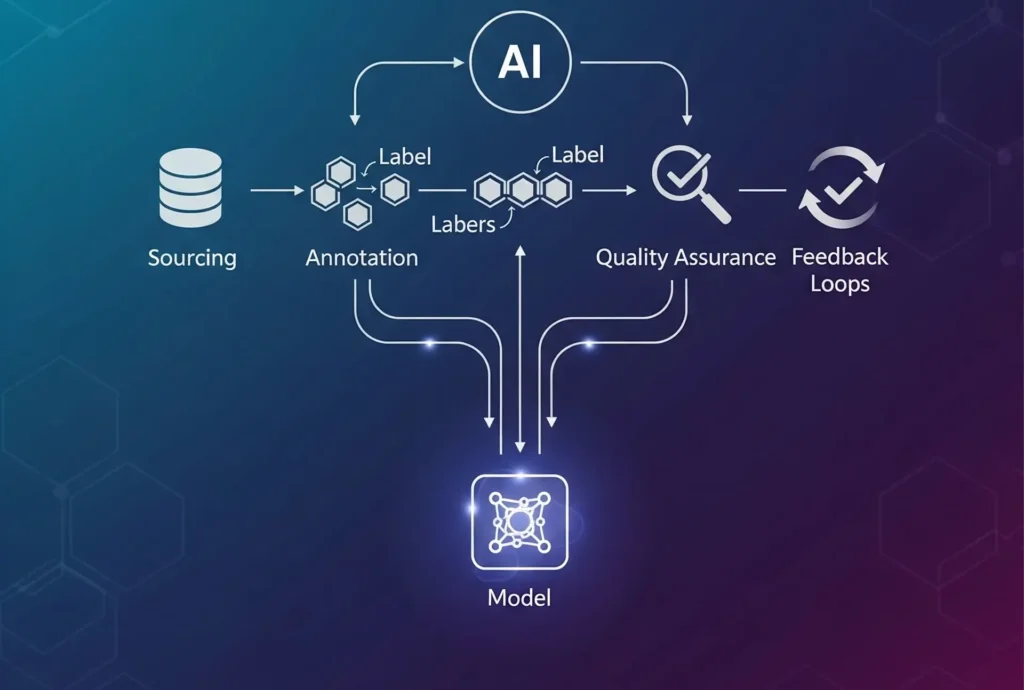
Building an AI data operations services function means standing up a repeatable system that moves training and evaluation data from sourcing through annotation, quality assurance, and back into the model, continuously and at scale. The implementation sequence is consistent; assign a single accountable owner, define the three operating layers (acquisition, annotation, quality and feedback), select tooling around dataset versioning and lineage, automate the annotation pipeline where automation is reliable, and track KPIs that tie data work to model behavior. Most programs fail not because of weak models but because this actual operating structure is missing.

The pressure to formalize this function is measurable. A 2025 S&P Global survey of more than 1,000 enterprises found that 42% of companies abandoned most of their AI initiatives that year, up from 17% the prior year, and the organizations that succeeded were the ones that redesigned their end-to-end workflows rather than swapping models. A standing AI data operations function is what that redesign looks like in practice. It is the difference between a one-time labeled dataset and a persistent data supply chain. Strong data collection and curation services feed the front of that chain, while reliable AI data pipeline infrastructure carries data through it without manual rework at every handoff.

Key Takeaways 

  • AI data operations is the system that keeps the right data flowing to your models continuously, not just once at the start of a project.
  • Start by putting one person clearly in charge, someone who can look at a model failure and trace it back to a data problem they’re allowed to fix.
  • Set up the work in three clear stages; getting the data, labeling it, and checking quality while feeding lessons back into the process.
  • Automate the easy, repetitive parts, but keep people involved in the tricky or high-stakes cases instead of automating everything.
  • Track whether your data work is actually improving the model, not just how fast you’re labeling things.
  • The companies that succeed, treat data as an ongoing supply they manage, while the ones that fail keep reacting to problems after they appear.

What is an AI data operations function and why does it need its own structure?

AI data operations, often shortened to AI DataOps, is the operating model, team structure, tooling conventions, and governance that manage the continuous flow of training and evaluation data through an AI program. It borrows the discipline of DevOps, automation, version control, testing, and continuous delivery, and applies it to data work rather than code. The function spans the full lifecycle, so continuous model evaluation sits at one end and human preference optimization workflows feed back into it. The goal is simple to state and hard to sustain; deliver the right dataset, with known quality, to every training and evaluation run.

It needs its own structure because annotation alone does not scale into reliable model behavior. Annotation is one layer of the system. Around it sits sourcing, quality measurement, dataset versioning, and the feedback path that turns evaluation findings into specific data fixes. When those surrounding parts are informal, scale amplifies whatever inconsistency already exists. A small team with vague guidelines produces a manageable amount of noise, while a large one produces noise faster than anyone can correct it.

The distinction matters for planning. A proof-of-concept can run on a single curated dataset and an informal labeling group. A production program that requires continuous fine-tuning, preference optimization, and safety evaluation needs a persistent data supply chain instead. For a stronger understanding of the conceptual fundamentals behind this AI data operating model, it is important to first look at the core layers, ownership structure, and accountability questions that define AI data operations.

How do I set up an AI data operations function step by step?

Setting up the function is a sequence, not a single hire or a tool purchase. The order matters because each step depends on the one before it. Standing up tooling before assigning an owner, for example, produces a stack that nobody is accountable for. The following sequence works for teams moving from pilot to production.

  • Assign a single accountable owner: Name one person, usually the AI program lead or a Head of AI Data, who can trace a model failure to a specific data problem and authorize the work to fix it. This accountability role must sit inside the organization even when execution is outsourced.
  • Define the three operating layers: Separate acquisition and sourcing, annotation and labeling, and quality assurance with feedback integration. Each layer has its own inputs, outputs, and quality checks, so treating them as one blurred process is where most early programs lose traceability.
  • Establish a sourcing strategy before labeling: Decide what data you need, where it comes from, and how representativeness is verified. A deliberate data collection strategy for AI training prevents the common failure of labeling large volumes of data that do not reflect the target distribution.
  • Select tooling around versioning and lineage: Pick orchestration, annotation, and observability tools that can track which dataset version fed which training run. Lineage is the feature that makes everything downstream debuggable.
  • Automate the annotation pipeline where automation is reliable: Use model-assisted pre-labeling and automated checks for the predictable cases, and route ambiguous or safety-critical cases to human review.
  • Close the feedback loop with evaluation: Wire evaluation findings back into data remediation so that a regression triggers a targeted dataset fix rather than a vague request for more labels.

This ordering reflects a finding that holds across the research. McKinsey’s 2025 State of AI survey reports that organizations seeing real bottom-line impact are far more likely to have fundamentally redesigned their workflows rather than bolting AI onto existing processes. An AI data operations function is workflow redesign applied to the data layer specifically.

What roles belong on an AI data operations team?

The team is cross-functional, but a few roles carry the function. The most underrated of them is the accountable owner described above, because without it the team stays reactive. The remaining roles divide cleanly between building the pipeline and producing the data that flows through it. Data engineering has become central enough that successful AI enterprises treat data engineering as a core AI competency rather than a supporting function.

  • AI data operations lead (accountable owner): Translates model failures into data remediation actions and owns the build-versus-buy decision.
  • Data / DataOps engineer: Builds and maintains pipeline infrastructure, automation, lineage tracking, and the templates other contributors follow.
  • Annotation lead and quality lead: Own annotation guidelines, taxonomy decisions, and inter-annotator agreement targets.
  • Annotation workforce (internal or partner): Produces the labels, ideally with continuous rather than burst capacity.
  • Evaluation consumer: The model training and evaluation team that uses the data and feeds findings back into it.

Two organizational patterns are common, and choosing between them early avoids rework. In a central platform model, one team builds shared tooling and standards while domain teams own their pipelines on that foundation. In an embedded model, data operations specialists sit inside each domain and keep consistency through shared practice. Teradata’s analysis of DataOps team structures describes both patterns and the tradeoff between centralized control and domain proximity.

What tools support an AI data operations function?

Tooling should be selected by capability category, not by brand. The function needs four categories working together, and the connective tissue across all of them is dataset versioning and lineage. Without lineage, a quality problem becomes a guessing exercise instead of a lookup.

  • Orchestration: Schedules jobs, manages dependencies between pipeline steps, retries failures, and triggers downstream work automatically.
  • Annotation and labeling platforms: Support the data modalities you work in, model-assisted pre-labeling, and reviewer workflows.
  • Observability and quality monitoring: Track pipeline health, schema changes, and label quality, and surface anomalies before they reach a training run.
  • Versioning and lineage: Record which dataset version, sourced how and labeled by whom, fed each fine-tuning or evaluation job.

For multimodal programs spanning text, image, video, and audio, the annotation platform decision is heavier because each modality carries its own tooling and quality conventions. The broader AI data pipeline layer is where orchestration and lineage are operationalized as delivered infrastructure rather than a stack you assemble alone.

How do I automate AI data and annotation pipelines?

Automation in AI data operations is not the same as full automation. The aim is zero-touch operation for the standard, predictable cases and fast, informed human intervention for the exceptions. Applied to annotation specifically, that means automating the parts that are reliable and reserving human judgment for the parts that are not. The strength of a multi-layered annotation pipeline lies in how well it combines automated stages with human judgment while maintaining quality, consistency, and control.

A practical automation sequence looks like this. First, automate ingestion and validation so that incoming data is checked against schema and quality rules at the door, which prevents broken pipelines downstream. Second, apply model-assisted pre-labeling so annotators correct machine output rather than starting from scratch, which raises throughput without raising error rates if review is enforced. Third, automate quality testing so that label distributions, agreement scores, and edge-case coverage are monitored continuously instead of audited occasionally.

The boundary of automation is the point worth getting right. Predictable, high-volume cases are good automation candidates, while ambiguous, rare, or safety-critical cases should route to human reviewers by design. Automating those amplifies error instead of removing it, which is why the strongest pipelines treat human-in-the-loop review as a permanent design feature, not a temporary crutch to be removed once volume grows.

How should quality governance and vendor integration work?

Quality governance is what keeps the function honest as it scales. Three practices separate mature programs from those stuck in pilot mode, and none of them are complicated in principle. Every dataset delivered to a training run is versioned with clear lineage from source through annotation. When a model regresses, the team can isolate which dataset version and which annotation cohort were involved without losing time. And evaluation findings drive data remediation as a standing practice rather than an occasional cleanup.

Quality targets need to be concrete rather than aspirational. Inter-annotator agreement, edge-case coverage, and a defined accuracy threshold give the function something to measure against. However, a headline number like 99.5% accuracy can be misleading without the right context. In production, data annotation accuracy, depends on the denominator being measured, the types of errors being counted, and how those errors affect downstream model performance.

Vendor integration is partly a governance decision. The build-versus-buy-versus-partner question is really about which capabilities the internal accountability structure must own and where external execution capacity makes more sense. The accountable owner stays internal in every pattern. Execution work such as sourcing, labeling, and quality assurance can be partnered, provided the partner plugs into the same lineage and quality standards rather than running a parallel, opaque process. The integration pattern that works treats a partner as an extension of the pipeline, with shared versioning, shared quality definitions, and shared visibility into agreement metrics.

What KPIs should I track for AI data operations?

KPIs for AI data operations should connect data work to model behavior, not just measure labeling speed. Throughput matters, but a fast pipeline producing inconsistent labels is a faster route to a failed model. Track a small, balanced set across quality, flow, and impact.

  • Inter-annotator agreement: The consistency of labels across annotators, the leading indicator of dataset reliability.
  • Annotation accuracy against gold standard: Measured on a held-out, expert-labeled set with a clear error definition.
  • Edge-case and distribution coverage: How well the dataset represents the target distribution, including rare but important cases.
  • Dataset lineage completeness: The share of training datasets with full, traceable provenance from source to training run.
  • Cycle time and rework rate: How long data takes to move through the pipeline and how often it must be redone.
  • Evaluation-to-remediation time: How quickly an evaluation finding becomes a shipped data fix, the clearest signal that the feedback loop is closed.

The last metric is the one that distinguishes a real operating function from a labeling vendor relationship. A program that can measure how fast a model failure turns into a corrected dataset has the feedback loop working. A program that cannot is still treating data as a one-time input rather than a continuously managed supply.

How Digital Divide Data Can Help

Digital Divide Data operates the execution layers of AI data operations as managed services, which lets the internal accountability owner stay focused on tracing model failures to data fixes. On the sourcing side, DDD’s data collection and curation services build representative, AI-ready datasets rather than large volumes of poorly targeted data. For labeling across text, image, video, and audio, DDD’s multimodal data annotation services bring inter-annotator agreement discipline and reviewer workflows to each modality’s specific conventions.

On the feedback side, DDD’s model evaluation services produce the findings that drive targeted data remediation, closing the loop between how a model behaves and what data work happens next. Preference data work, including RLHF and DPO optimization, is run with the same versioning and quality standards as the rest of the pipeline, so a partner becomes an extension of your operating model rather than a parallel process you have to reconcile.

The integration pattern is deliberate. DDD plugs into shared dataset lineage and shared quality definitions, so visibility into agreement metrics and dataset provenance stays with your team. That is what makes the build-versus-buy-versus-partner decision a question of capacity rather than control.

Stand up an AI data operations function that actually closes the gap between pilots and production. Talk to an Expert!

Conclusion

An AI data operations function is the operating system for a production AI program. The implementation sequence is consistent and unglamorous: name an accountable owner, separate the three layers, source deliberately, version everything, automate the reliable parts, and route the hard cases to people. The organizations that treat data as a continuously managed supply chain are the ones moving models from pilot to production, while the organizations still labeling in bursts and reacting to regressions are well represented in the share of AI initiatives quietly abandoned each year.

The gap between those two groups is not model sophistication. It is whether a model failure can be traced to a dataset version and fixed on purpose, or whether it triggers another round of guessing. Building the function correctly is what makes that traceability routine. 

References

S&P Global Market Intelligence. (2025). AI experiences rapid adoption, but with mixed outcomes: Highlights from VotE: AI & Machine Learning. https://www.spglobal.com/market-intelligence/en/news-insights/research/ai-experiences-rapid-adoption-but-with-mixed-outcomes-highlights-from-vote-ai-machine-learning

McKinsey & Company, QuantumBlack. (2025). The state of AI: Global Survey 2025. https://www.mckinsey.com/capabilities/quantumblack/our-insights/the-state-of-ai

Frequently Asked Questions

How do I set up an AI data operations function?

Start by naming one accountable owner who can trace a model failure to a specific data problem and authorize the fix. Then separate the three layers, sourcing, annotation, and quality with feedback, set up tooling around dataset versioning and lineage, and automate only the parts that are reliable. The order matters because each step depends on the one before it.

What roles are in an AI data operations team?

The core roles are an accountable data operations lead, a data or DataOps engineer who builds the pipeline, an annotation and quality lead who owns guidelines and agreement targets, the annotation workforce, and the evaluation team that consumes the data and feeds findings back. The accountable owner is the role most often missing, and it should stay internal even when labeling is outsourced.

What tools support AI data operations?

You need four tool categories working together: orchestration, annotation and labeling platforms, observability and quality monitoring, and versioning with lineage. Lineage is the connective feature, because it lets you trace which dataset version fed which training run when something goes wrong.

What KPIs should I track for AI data operations?

Track a balanced set across quality, flow, and impact including inter-annotator agreement, annotation accuracy against a gold standard, edge-case and distribution coverage, dataset lineage completeness, cycle time and rework rate, and evaluation-to-remediation time. The last one matters most, because it shows whether your feedback loop from model behavior back to data work is actually closed.

How to Build an AI Data Operations Function: A Guided Framework Read Post »
AI Data Operations vs. MLOps: Why Production AI Fails Without Both

AI Data Operations vs. MLOps: Key Differences, Use Cases, and Why Both Matter for Production AI

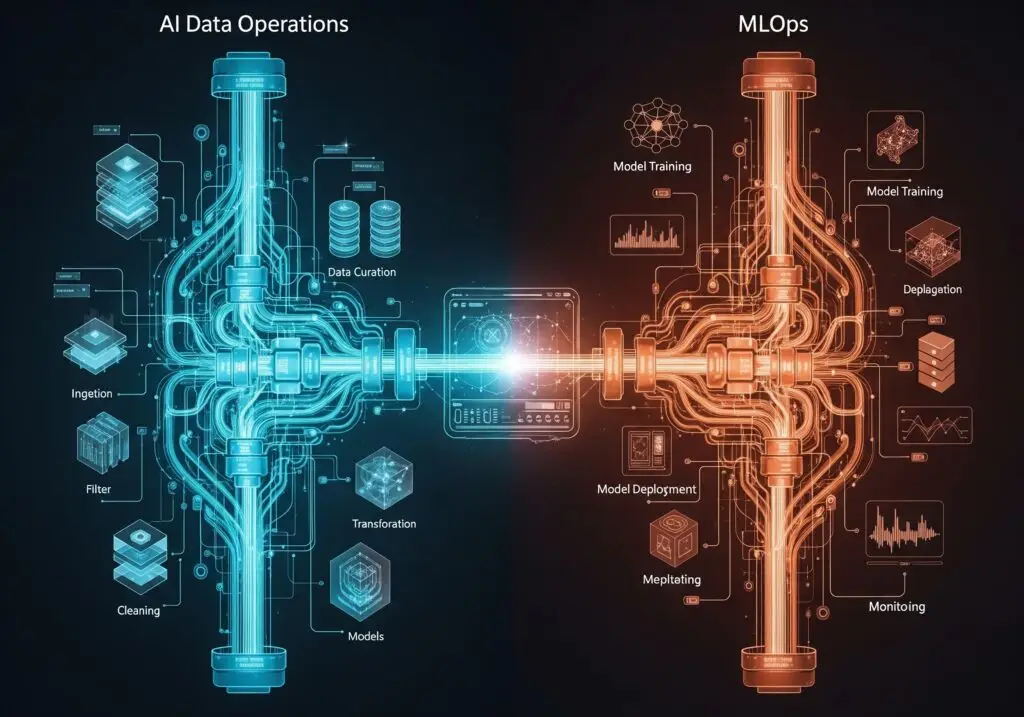
AI Data Operations is the discipline that produces and maintains the data an AI system learns from; collection, annotation, curation, human feedback, and the evaluation sets used to test it. MLOps is the discipline that trains, deploys, monitors, and retrains the models that consume that data. The two share roots in DevOps and meet at the pipeline, yet they own different assets and fail in different ways. A production AI program needs both, because a well-engineered model sitting on unreliable data still fails once it is live.

Teams usually learn the difference the hard way, when a model that passed every offline benchmark starts making strange calls in production. The cause is rarely the model code. It is almost always something upstream; a label definition that drifted, a data collection and curation process that quietly changed, or a data pipeline that started dropping a field with no warning. Treating these two functions as one job, or assuming one team owns both, is where many production AI programs lose months.

Key Takeaways

  • AI Data Operations is the work of building and maintaining the data a model learns from, while MLOps is the work of training, launching, and watching over the model itself.
  • The two are easy to confuse because they grew from the same playbook, but they look after different things and break in different ways.
  • A model can pass every test and still fail in real use if the data feeding it was messy or out of date.
  • The most common breakdowns happen at the handoff between the two teams, which is why a clear agreement on what “good data” means is so important.
  • If you have to choose where to fix things first, look at what fails more often: shaky data or shaky deployment.
  • Companies that treat data work as its own real job tend to ship more dependable AI than those who leave it as an afterthought.

What is AI Data Operations, and how is it different from classic DataOps?

AI Data Operations, sometimes called AI DataOps, is the operational discipline that turns raw signals into AI-ready datasets and keeps them reliable over time. It covers data collection, annotation, curation, human preference optimization, and the evaluation sets used to test models before and after release. Classic DataOps grew up in analytics and business intelligence, where the output is a dashboard or a report. AI Data Operations targets a different output: training and evaluation data whose quality directly changes how a model behaves.

A useful way to frame the scope comes from data-centric AI research, which organizes the work into three goals; training data development, inference data development, and data maintenance. Those goals map almost exactly onto what an AI data operations team does day to day. Building labeled training sets is training data development. Preparing prompts and retrieval context is inference data development. Re-labeling, auditing, and refreshing datasets as the world changes is data maintenance.

The hardest part of this discipline is rarely the labeling itself. It is the definition work of AI data operations that sits behind the labels. Two reasonable annotators will disagree on the same example whenever the guideline is vague, and that disagreement becomes noise the model learns as if it were signal. Measuring inter-annotator agreement, then tightening guidelines until agreement is high, is the unglamorous core of a serious data operation. Skip it, and every downstream metric inherits the ambiguity.

For most of the last decade, this work was treated as a side task for whoever happened to be free. That assumption no longer holds at production scale. Data engineering is becoming a core AI competency as models commoditize, and the data operation becomes the part of the stack that teams can actually differentiate on. Naming it as a discipline, with its own owners and standards, is the first step toward running it well.

What does MLOps actually own in the model lifecycle?

MLOps, short for machine learning operations, is the engineering discipline that moves models from a notebook into reliable production service. It borrows continuous integration, version control, and monitoring from DevOps and applies them to the model lifecycle. That lifecycle runs from experiment and training through validation, deployment, monitoring, and retraining. The asset MLOps protects is the model and its behavior in production.

MLOps assumes the training data already exists and is fit for purpose. It versions that data, tracks which dataset produced which model, and watches for drift once the model is live. What it does not do is produce the labels, resolve disagreement between annotators, or decide what a correct answer looks like. Those decisions sit upstream, in the data operation, and MLOps inherits whatever they produce.

This blind spot is well documented. A foundational paper offering a data quality-driven view of MLOps argued that most MLOps tooling concentrates on engineering concerns such as orchestration, reproducibility, and versioning, while doing little to monitor or version the datasets themselves. The gap is structural. When data quality is treated as someone else’s problem, it tends to surface later as a model incident that is expensive to trace.

Reproducibility is the other thing MLOps exists to guarantee. A model is only trustworthy in production if you can recreate exactly how it was built, roll back to a known-good version, and audit what changed between releases. That demands strict versioning of code, configuration, and the dataset reference, plus a registry that ties each deployed model to the run that produced it. None of this fixes a bad dataset. It only makes the consequences of one traceable, which is necessary but not sufficient on its own.

Where do AI Data Operations and MLOps overlap, and where do they diverge?

Both disciplines descend from DevOps, so they share a lot of mechanics. Both use version control, automated testing, continuous delivery, and monitoring. Both organize work into repeatable cycles instead of one-off projects. The overlap is real, and it is a large part of why the two are so often confused.

The divergence shows up in what each one owns and measures. AI Data Operations is judged on data quality distributed across inter-annotator agreement, label accuracy, coverage of edge cases, and freshness. MLOps is judged on model and system quality based on accuracy in production, latency, drift, and rollback safety. The table below maps the split across the dimensions that matter most when you decide who owns what.

Dimension AI Data Operations MLOps
Primary asset Training, annotation, and evaluation data Models and their behavior in production
Lifecycle Collect, annotate, curate, validate, maintain Experiment, train, validate, deploy, monitor, retrain
Core metrics Inter-annotator agreement, label accuracy, edge-case coverage, freshness Production accuracy, latency, drift, rollback safety
Typical owners Data ops leads, annotation managers, domain experts, QA ML engineers, platform and infrastructure teams, SREs
Example tooling Labeling platforms, consensus and QA tooling, dataset version control, curation pipelines Feature stores, model registries, CI/CD for models, serving and monitoring
Main failure mode Inconsistent labels, stale data, hidden bias Training and serving skew, undetected drift, fragile deployment

The shared vocabulary hides a subtle trap. Continuous integration means something different in each discipline. In MLOps, a pipeline run retrains and revalidates a model against a fixed dataset. In AI Data Operations, a pipeline run ingests new examples, routes them through annotation and QA, and publishes an updated dataset. Both are automated and both are tested, but a passing data pipeline and a passing model pipeline answer different questions. Confusing the two leads teams to trust a green build that never checked the thing that actually broke.

MLOps cannot hit its metrics if the data operation misses its own. A model registry with perfect lineage offers little comfort when the labels it points to were defined inconsistently across three annotation vendors.

Does MLOps include data operations?

This is the most common question, and the honest answer is partly. MLOps includes data handling; versioning datasets, building feature pipelines, and validating schemas at training time. It treats data as an input to be managed. It does not include the human and editorial work of producing that data, which means writing annotation guidelines, training annotators, adjudicating disagreement, and curating for coverage.

AI Data Operations and MLOps share the pipeline where data is prepared and fed to training. Upstream of that handoff, the data operation runs work that MLOps tooling was never designed to do. Downstream, MLOps runs work that no labeling platform handles. Calling one a subset of the other hides the seam where most production failures actually happen.

How does AI Data Operations feed the MLOps pipeline?

The connection point between the two is a handoff, and handoffs are where things break. The data operation produces a dataset, and MLOps consumes it for training and serving. When that boundary is informal, small upstream changes cause large downstream failures. A clear data contract, meaning an agreed schema, label taxonomy, and quality threshold, is what keeps the handoff stable.

Two failure patterns dominate this seam. The first is training and serving skew, where the transformation applied during training differs from the one applied at inference, so the model meets data it was never trained on. The second is silent schema drift, where a column changes type or a field stops arriving and nothing flags it. Data pipelines are important for AI as disciplined pipeline design prevents both, by making every transformation explicit and testable.

A data contract is what turns this from a hope into a guarantee. In practice it specifies the exact fields a dataset will contain, the label taxonomy and its allowed values, the minimum agreement and accuracy thresholds, and how changes are versioned and announced. With that contract in place, the data team can evolve its work and the model team can depend on a stable interface. Without it, every relabeling effort or new data source becomes a surprise that the MLOps team discovers through a failing model.

The feedback loop also runs the other way. Once a model is live, MLOps monitoring detects drift, which is a drop in accuracy as real-world inputs shift away from the training distribution and AI model performance degrades over time. That signal is only useful if the data operation can respond by sourcing and labeling fresh examples. 

What tools are used in AI data operations, and who owns them?

AI Data Operations runs on a different stack than MLOps. The core tools are labeling and annotation platforms, consensus and QA tooling for measuring agreement, dataset version control, and curation pipelines that filter and balance data. A 2024 survey of data quality tools for machine learning reviewed seventeen such tools and found the field still fragmented, with no single platform covering quality end to end. That fragmentation is why process and standards matter more than any one tool.

MLOps runs on feature stores, model registries, CI/CD systems built for models, and serving and monitoring platforms. The ownership split follows the tooling. Annotation managers, domain experts, and QA leads own the data operation. ML engineers, platform teams, and SREs own MLOps. Problems start when one group is held accountable for outcomes that the other group controls. A separate question is whether to run the data operation in-house at all, which the build vs. buy vs. partner decision for AI data operations works through for teams weighing their options.

Deciding where to invest first depends on what breaks more often:

  • If models pass offline tests but behave unpredictably in production, the bottleneck is usually data quality, and AI Data Operations needs attention first.
  • If models are sound but slow, fragile, or hard to deploy and roll back, the bottleneck is MLOps maturity.
  • If incidents cluster at the handoff, with schema mismatches, skew, and stale labels, the fix is a formal contract between the two, not more spending on either alone.

How Digital Divide Data Can Help

Digital Divide Data operates the data side of this split as a managed service. Our data collection and curation teams build training and evaluation datasets to an agreed taxonomy, with inter-annotator agreement tracked as a first-class metric rather than an afterthought. Domain experts and trained annotators handle the editorial decisions, including guideline design, disagreement adjudication, and edge-case coverage, that MLOps tooling cannot.

The work connects directly to the MLOps pipeline through disciplined delivery. Our model evaluation services produce the held-out and adversarial sets your team needs to validate models before release and to catch regressions after. When production monitoring flags drift, the same teams source and label fresh examples, which closes the loop between detection and response. This is the handoff that most programs leave informal, run instead as a contract with defined schemas and quality thresholds.

For programs that need the infrastructure as well as the labels, DDD builds and runs the data pipelines that move data from source to training-ready state, with quality checks at each stage. The result is an AI data operation that feeds MLOps cleanly, in place of a series of manual handoffs that fail quietly.

Build a data operation your MLOps pipeline can actually rely on. Talk to an operation and pipeline expert today.

Conclusion

AI Data Operations and MLOps are two halves of one production system. One keeps the data trustworthy, and the other keeps the model reliable. They share DevOps roots and meet at the pipeline, but they own different assets, use different tools, and fail in different ways. Treating them as a single job is how programs end up debugging model code to fix what was always a data problem.

The organizations that ship dependable AI treat the data operation as a named discipline with its own owners, metrics, and contract to the MLOps pipeline. The ones that struggle keep data work invisible, then absorb the cost downstream as drift, skew, and incidents no one can trace. As models commoditize, the gap between these two groups will widen, and it will be decided upstream, in the data operation, long before a model reaches production.

References

Zha, D., Bhat, Z. P., Lai, K.-H., Yang, F., Jiang, Z., Zhong, S., & Hu, X. (2025). Data-centric Artificial Intelligence: A Survey. ACM Computing Surveys, 57(5), 1–42. https://arxiv.org/abs/2303.10158

Zhou, Y., Tu, F., Sha, K., Ding, J., & Chen, H. (2024). A Survey on Data Quality Dimensions and Tools for Machine Learning. arXiv preprint arXiv:2406.19614. https://arxiv.org/abs/2406.19614

Renggli, C., Rimanic, L., Gürel, N. M., Karlaš, B., Wu, W., & Zhang, C. (2021). A Data Quality-Driven View of MLOps. IEEE Data Engineering Bulletin, 44(1), 11–23. https://arxiv.org/abs/2102.07750

Frequently Asked Questions

What is the difference between AI DataOps and MLOps?

AI Data Operations produces and maintains the data a model learns from, including collection, annotation, curation, and evaluation sets. MLOps trains, deploys, and monitors the model that uses that data. They overlap at the pipeline but own different assets.

Does MLOps include data operations?

Only partly. MLOps handles data as an input by versioning datasets, building feature pipelines, and validating schemas. It does not produce the labels or write the annotation guidelines, since that editorial work sits upstream in the data operation.

What tools are used in AI data operations?

Mainly labeling and annotation platforms, consensus and QA tooling for measuring agreement, dataset version control, and curation pipelines. The field is fragmented, so no single tool covers quality end to end, which is why standards and process matter as much as the tools.

Should we invest in AI Data Operations or MLOps first?

It depends on what breaks more often. If models pass offline tests but act up in production, fix data quality first. If models are sound but slow or fragile to deploy, invest in MLOps. If failures cluster at the handoff, formalize the contract between the two.

AI Data Operations vs. MLOps: Key Differences, Use Cases, and Why Both Matter for Production AI Read Post »

Data Annotation Provider Pricing Models Decoded: Per-Label, Per-Hour, or Outcome-Based?

Data Annotation Provider Pricing Models Decoded: Per-Label, Per-Hour, or Outcome-Based?

Most data annotation providers price work in one of three ways: per-label (a fixed rate per annotation unit), per-hour (time-and-materials for annotator time), or outcome-based (payment tied to a quality SLA such as accuracy or acceptance rate). Per-label rewards volume and fits high-volume, well-specified tasks; per-hour fits complex or evolving work where time per item is hard to predict; outcome-based aligns the provider with the quality your model actually needs. The cheapest headline rate is rarely the cheapest total cost, because rework, rejected batches, and re-labeling are billed somewhere downstream.

A quote that looks inexpensive per label can become the most expensive option once those hidden costs are counted. Pricing structure is not just a budget line; it sets the incentives that shape throughput, quality, and how much oversight your own team has to supply. That makes the structure behind a quote worth as much scrutiny as the number itself, especially for programs that depend on large-scale data collection and curation and on multimodal annotation spanning image, video, text, audio, and sensor data.

Key Takeaways

  • Data annotation providers usually charge in one of three ways; a set fee per label, an hourly rate for time worked, or a price tied to the quality they deliver.
  • Per-label pricing is easy to budget and works best for large, simple, repetitive jobs.
  • Hourly pricing fits complex or changing work where you can’t predict how long each item will take.
  • Outcome-based pricing costs more upfront but is the only model that pays for results instead of just effort.
  • The lowest quoted price is often the most expensive once you add in fixing and redoing poor-quality labels.
  • To compare vendors fairly, look at the cost per usable label, not the headline rate.

How do data annotation companies charge?

A data annotation provider or an annotation partner turns raw data into labeled training data for AI and ML systems. Its charges usually bundle some mix of annotation, quality assurance, tooling, project management, and, in mature engagements, downstream model evaluation that confirms the labels actually improve model behavior. Three pricing structures dominate the market: per-label (per-unit), per-hour (time-and-materials), and outcome- or SLA-based contracts. Each one moves risk between buyer and vendor in a different direction.

Published market guides put simple bounding-box labeling at roughly three to eight cents per object, with dense segmentation and 3D work costing far more, while hourly rates range from about four to sixty dollars depending on region and annotator skill. Those ranges are useful for sanity-checking a quote, but they do not tell you which structure protects you. The deeper question is which model ties what you pay to what you can actually use in training. Researchers studying high-stakes AI documented data cascades, downstream failures triggered by upstream data problems, and affecting 92% of the practitioners they surveyed, which is why pricing that quietly trades away quality rarely saves money.

What is per-label pricing, and when does it work?

Per-label pricing charges a fixed amount for each annotation unit: a bounding box, a polygon, a labeled entity, or a transcribed segment. It is the easiest model to forecast, because cost scales directly with volume, and it fits high-volume, well-specified, repetitive work where the time per item barely varies. Teams budgeting bounding box annotation cost for large image sets usually find that per-label is the most transparent option.

The structure rewards throughput, which is exactly its risk; when annotators are paid per unit, speed can quietly win over care, and ambiguous edge cases get the fastest defensible label rather than the correct one. Per-label also says nothing about quality on its own; unless your contract specifies payment on accepted units, you can pay for labels that later fail review. The economics shift further as hybrid human-and-AI labeling moves routine units to model pre-labeling and reserves people for correction, which lowers per-unit cost but concentrates the hard, judgment-heavy cases that per-label rates often underprice.

When is per-hour (time-and-materials) pricing the right model?

Per-hour pricing, also called time-and-materials, bills for the actual time annotators and reviewers spend. It suits complex or evolving works; detailed semantic segmentation, multi-step NLP, sensor-fusion labeling, etc., where time per item swings too much for a per-unit rate to be fair to either side. It is also the sensible choice early in a project, when the specification is still moving, and you do not yet know how long each item takes.

The trade-off is predictability; total cost is hard to forecast, and the model can reward slowness unless you track output. The protection is through, agree on expected units per hour from comparable past work, and review it regularly. Teams looking to speed up a data annotation project usually find the lever is workflow design and tooling, not simply paying for more hours, so per-hour contracts work best when paired with reported productivity targets.

How does outcome-based and SLA pricing change vendor incentives?

Outcome-based pricing ties payment to measurable results, usually an accuracy threshold, an accuracy threshold, an inter-annotator agreement target, an acceptance rate, or a turnaround SLA. It usually arrives as a managed service or project fee that bundles annotation, QA, tooling, and reporting. On a per-unit basis, it is often the most expensive structure, but it is the only one that aligns the provider’s incentive with the quality your model actually needs.

That alignment matters because label quality is not cosmetic. A study of ten widely used benchmark datasets found pervasive label errors averaging around 3.4%, and correcting them was enough to change which model ranked best. If a few percent of label noise can reorder model rankings, a pricing model that pays only for accepted, audited output is buying something a per-label discount cannot. Understanding what a figure like 99.5% accuracy means in production is what makes an outcome SLA enforceable rather than decorative.

What are the red flags in a data annotation pricing proposal?

A proposal’s structure reveals more than its rate. A few patterns consistently signal trouble, and most trace back to unreliable annotation that has to be fixed later:

  1. A headline rate with no acceptance definition: If the quote does not say what counts as an accepted label, rework is being priced as your problem, not the vendor’s.
  2. Quality assurance billed as an extra: QA, gold-standard audits, and review passes are part of producing usable data, not an upsell. Watch for setup, onboarding, and rework fees that surface only after signing.
  3. No throughput or quality baseline: Per-hour quotes without expected units per hour, and per-label quotes without a stated quality bar, leave you unable to predict either cost or outcome.
  4. Rush and change-order premiums left vague: Expedited work legitimately costs more, but undefined premiums of thirty to fifty percent can swamp the base rate.
  5. Lock-in disguised as low pricing: A cheap rate on a proprietary platform you cannot export from raises your switching cost later.

How to compare data annotation vendor quotes fairly?

The mistake in most comparisons is treating per-label, per-hour, and managed-service quotes as if they measure the same thing and deliver the same accuracy & quality, but they don’t. The only fair basis is cost per accepted, usable unit, i.e., the total fee divided by the labels that survive quality bar, rework included. A disciplined approach to evaluating AI training data providers should normalize every quote to that number before any rate is compared.

To compare quotes on equal footing:

  • Convert each quote to a blended cost per accepted unit using a shared sample task and identical acceptance criteria.
  • Ask for throughput and quality figures from comparable completed projects, not stated rates alone.
  • List every add-on: tooling, QA, project management, compliance, expedited delivery, and fold it into the unit cost.
  • Run a paid pilot on the same gold-standard set so each vendor is measured against the same ground truth.

How Digital Divide Data Can Help

Digital Divide Data structures pricing around the unit that matters to your model; accepted, audited output. Its data collection and curation services build quality gates, inter-annotator agreement tracking, and gold-standard auditing into the workflow rather than billing them as afterthoughts, so the number you compare is the number you can train on.

For teams weighing outcome-based contracts, DDD’s model evaluation services connect annotation quality to measured downstream behavior, which is what makes an accuracy or acceptance SLA enforceable. Engagements scale from per-unit work on well-specified tasks to managed delivery on complex multimodal and sensor data, with the pricing structure chosen to fit the program rather than the other way around.

Compare annotation quotes on what your model can actually use, not the headline rate. 

Conclusion

Pricing structure is a decision about incentives, not just budget. Per-label rewards volume, per-hour rewards time, and outcome-based rewards, the quality your model depends on; the right choice follows from how stable your specification is and whether you can measure quality at acceptance. Organizations that normalize every quote to cost per accepted unit consistently spend less over a program’s life than those anchored to the lowest headline rate, because they stop paying twice for the same labels.

The teams that get this right treat the contract as part of their quality system; the ones that do not tend to discover the true cost during a mid-project scramble. 

References

Sambasivan, N., Kapania, S., Highfill, H., Akrong, D., Paritosh, P., & Aroyo, L. (2021). “Everyone wants to do the model work, not the data work”: Data Cascades in High-Stakes AI. Proceedings of the 2021 CHI Conference on Human Factors in Computing Systems. https://doi.org/10.1145/3411764.3445518

Northcutt, C. G., Athalye, A., & Mueller, J. (2021). Pervasive Label Errors in Test Sets Destabilize Machine Learning Benchmarks. arXiv preprint arXiv:2103.14749. https://arxiv.org/abs/2103.14749

Frequently Asked Questions

How do data annotation companies charge?

Most use one of three structures: per-label (a set fee per annotation unit), per-hour (time-and-materials for annotator time), or outcome-based contracts tied to a quality SLA. The charge usually also folds in QA, tooling, and project management.

Is hourly or per-label annotation pricing better?

Neither is better in the abstract. Per-label fits high-volume, well-specified tasks where time per item barely varies, while per-hour fits complex or evolving work where you cannot predict how long each item takes. The deciding factor is how stable your specification is.

What should be in a data annotation pricing proposal?

A clear definition of what counts as an accepted label, QA and audit steps included rather than billed as extras, a throughput or quality baseline, and defined rush and change-order premiums. Missing any of these usually means rework is being priced as your problem.

How do I compare data annotation vendor quotes fairly?

Convert every quote to cost per accepted, usable unit using the same sample task and acceptance criteria, fold in all add-on fees, and run a paid pilot against an identical ground truth. Comparing headline rates alone hides where the real cost sits.

Data Annotation Provider Pricing Models Decoded: Per-Label, Per-Hour, or Outcome-Based? Read Post »

Data Annotation Provider vs. In-House Team: True Cost of Ownership Analysis

Data Annotation Provider vs. In-House Team: True Cost of Ownership Analysis

A side-by-side total cost of ownership analysis usually favors a data annotation provider for variable or specialized workloads. At the same time, a high-sensitivity program can justify the use of an in-house team. The deciding factor is rarely the headline price per label. It is the fully loaded cost: tooling, QA overhead, annotator ramp time, turnover, and the rework caused by inconsistent labels. Most teams underestimate these costs by a wide margin, which is why in-house budgets tend to overshoot, and outsourced programs win once quality and speed are priced in.

The number that matters is not what an annotator costs per hour. It is what an accepted, production-ready label costs after every revision cycle, supervisor hour, and idle seat is counted. Pricing a labeling program correctly means treating data collection and curation, and image and video annotation as operations with their own infrastructure, staffing, and failure modes. They are not a line item you can cover with spare headcount, and the data pipelines behind them carry standing costs whether or not any labeling is happening.

Key Takeaways

  • The real cost of labeling isn’t only the price per label; it’s everything around it: tools, quality checks, training time, staff turnover, idle time, and fixing mistakes.
  • Building an in-house team looks cheap on paper, but the hidden costs usually push the budget well past what businesses expect.
  • To find your true cost, divide your total spend by the labels that actually pass quality and get used, not the total number of labels that have been produced.
  • For most teams with changing or short-term needs, hiring a provider works out cheaper and faster than building a team from scratch.
  • An in-house team mainly pays off when you have steady, sensitive work that keeps everyone busy year-round, and the team has the capabilities to handle technically complex scenarios.
  • The smartest large companies often mix both, keeping sensitive work in-house while a partner handles the heavy lifting at scale.

What does the total cost of ownership mean for data annotation?

Total cost of ownership (TCO) is the full cost of producing usable labeled data over a program’s life. Many teams confuse TCO with unit price on a rate card. TCO includes direct labor, platform licensing, infrastructure, management, quality assurance, rework, and the opportunity cost of engineers pulled into data work. Where labels feed production systems, the cost of getting them wrong surfaces later in model evaluation and accuracy testing, which is why TCO has to count quality, not just throughput.

The reason TCO matters is that cheap labels are often expensive labels. Research on data cascades, the compounding downstream costs of undervalued data work, found that small early labeling problems tend to surface late as model failures and forced retraining. By then, the fix costs far more than careful labeling would have. Teams that budget only for annotator salaries consistently miss the second and third waves of cost.

What are the hidden costs of building an in-house annotation team?

Building internal capability looks cheap on a spreadsheet that contains only salaries. The costs that break budgets sit below that line. They are recurring, they scale with volume, and they are hard to forecast before the program is running. Five line items account for most of the overrun.

Tooling and infrastructure: Enterprise annotation platforms charge per seat or per label. Open-source tools are free to license but need highly skilled engineers to deploy, secure, and maintain them.

QA overhead: Someone has to write guidelines, audit samples, measure inter-annotator agreement, and adjudicate disagreements. This supervisory layer often runs 15 to 25 percent of labor.

Ramp time: New annotators take weeks to reach reliable accuracy on a non-trivial task. Output during ramp is real cost with a low usable yield.

Turnover: Repetitive labeling has high attrition. Every departure resets ramp time and erodes the institutional knowledge that keeps labels consistent.

Rework: Inconsistent labels get sent back for revision. Each cycle multiplies the effective cost of the affected items.

Outsourcing does not erase these costs. But it moves them onto a partner who amortizes tooling and QA across many clients. Choosing the wrong partner reintroduces them, and switching annotation providers mid-project adds re-onboarding, format conversion, and quality revalidation that can wipe out a season of savings. 

How do you calculate the true data annotation cost per label?

The honest unit cost is not the rate card. It is the fully loaded program cost divided by the number of labels that pass quality and reach production. Most teams divide by labels produced, which flatters the number. The denominator should be labeled.

True cost per label = (Labor + Tooling + Management + QA + Rework + Ramp/Idle) / Accepted labels

The gap between produced and accepted is where budgets quietly fail. A program that produces 100,000 labels but accepts 85,000 after QA has a true cost about 18 percent higher than its produced-label math suggests. Work on label errors and their effect on model performance shows that noisy labels measurably depress accuracy, so accepting weak labels to lower the headline rate only moves the bill downstream into retraining.

Market rates give a starting point, not an answer. Simple text classification often runs a few cents per label. Two-dimensional bounding boxes for images commonly range from roughly three to eight cents per object. Complex 3D point-cloud or medical segmentation can reach several dollars per item. The drivers of bounding box annotation cost, such as object density, occlusion, class count, and required accuracy, apply across almost every modality and explain most of the spread.

Is it cheaper to outsource data annotation or build in-house?

The answer depends on volume stability and on how honestly you account for hidden costs. In-house pushes cost into fixed overhead you pay whether or not work is flowing. A provider converts most of it into variable cost tied to output. A side-by-side makes the trade-off concrete.

Cost factor In-house team Data annotation provider
Cost structure Fixed, CAPEX-heavy; paid whether or not work flows Mostly variable, OPEX; tied to output
Tooling You buy or build, then maintain it Amortized across the provider’s clients
Ramp and turnover Your risk: each exit resets ramp time Absorbed by the partner
QA layer Your staff guidelines, audits, and adjudication Built into the service agreement
Scaling spikes Slow; bound by hiring speed Elastic; scale up or down on demand
Best fit Stable, long-term, security-sensitive volume Variable, specialized, or time-boxed work

For stable, multi-year, security-sensitive workloads with steady volume, an in-house team can reach a lower per-label cost once utilization stays high. For almost everything else, variable volume, new programs, specialized data types, or tight timelines, a provider tends to win on fully loaded cost. The break-even point moves with utilization, so the question is not which is cheaper but which keeps your seats full.

When should you choose a data annotation provider over an in-house team?

Organization size and annotation volume change the math more than any other variable. The same workload that justifies internal staff at one scale is a liability at another. Three patterns cover most cases.

  • Startups and new programs should outsource: You need to validate the approach before committing to fixed headcount, you may not need next quarter.
  • Mid-size teams with spiky volume should outsource the peaks and keep a small internal core for guidelines and QA. This caps fixed cost while preserving control of standards.
  • Large enterprises with steady, sensitive, multi-year volume usually do best with a hybrid model that splits the work by data sensitivity rather than by convenience.

The most durable arrangement is rarely all-or-nothing. Keeping schema design and the most sensitive data internal while a partner executes at scale is what the shift in enterprise labeling economics has made standard practice. It preserves control where control matters and buys elasticity everywhere else, which is exactly where in-house teams struggle most.

What is the ROI of professional data annotation services?

Return on investment shows up in three places, none of which appear on a rate card. Across a program, these gains often outweigh the unit-price difference entirely.

  • Time-to-market improves because trained teams deploy in weeks rather than months.
  • Rework falls, because mature QA catches errors before they reach training. 
  • Model performance per dollar rises because consistent labels reduce the retraining cycles that quietly consume engineering budgets. 

When data scientists spend their days on annotation triage, the opportunity cost is the model work they are not doing. A provider that delivers production-ready labels returns at that time, which is usually the most expensive resource in the whole program. Measured that way, professional services often pay for themselves before the first model ships.

How Digital Divide Data Can Help

DDD runs annotation as a managed operation, not a staffing arrangement. Across text, image, video, audio, and sensor data, multimodal data annotation services arrive with the tooling, trained workforce, and quality processes already in place. You absorb none of the ramp, turnover, or platform overhead that inflates in-house TCO, and the variable cost tracks your actual volume.

Quality is measured, not assumed. DDD tracks inter-annotator agreement, runs structured QA, and reports accepted-label yield, so the cost per production-ready label is visible rather than buried. For programs where label errors carry real downstream risk, that measurement is the difference between a low headline rate and a low true cost. It also makes the build-versus-buy comparison an honest one, because both sides are priced on accepted labels.

Whether you are validating a new program, absorbing a volume spike, or running a multi-year pipeline under a hybrid model, the engagement scales to your volume and your data sensitivity.

Run the real TCO numbers before you build or buy your next AI. Talk to an Expert

Conclusion

The cost of annotation is decided long before the first invoice. Teams that price only salaries build in-house, overshoot their budgets, and meet the hidden costs one at a time. Teams that price the fully loaded cost per accepted label make a clearer choice, and more often than not, it points toward a provider or a hybrid model.

The organizations that get this right treat labeling as an operation with measurable quality, because data quality defines the success of AI systems more than model architecture does. The ones that get it wrong keep paying for cheap labels in retraining cycles they never budgeted for. Either way, a program runs only as fast as its data, which is why teams increasingly invest in ways to speed up annotation throughput without trading away accuracy.

References

Sambasivan, N., Kapania, S., Highfill, H., Akrong, D., Paritosh, P., & Aroyo, L. M. (2021). “Everyone wants to do the model work, not the data work”: Data cascades in high-stakes AI. Proceedings of the 2021 CHI Conference on Human Factors in Computing Systems. https://doi.org/10.1145/3411764.3445518

Nahum, O., Calderon, N., Keller, O., Szpektor, I., & Reichart, R. (2024). Are LLMs better than reported? Detecting label errors and mitigating their effect on model performance. arXiv preprint arXiv:2410.18889. https://arxiv.org/abs/2410.18889

Frequently Asked Questions

Is it cheaper to outsource data annotation or do it in-house?

For variable or specialized workloads, it is usually cheaper to outsource once you count the hidden costs: tooling, QA, ramp time, and turnover. In-house tends to be cheaper only for stable, high-volume, long-running programs where the team stays fully utilized.

What are the hidden costs of data annotation?

The big ones are annotation tooling, the QA layer that writes guidelines and measures agreement, the weeks of ramp time before new annotators are reliable, turnover that resets that ramp, and the rework caused by inconsistent labels. None of these appear on a per-label rate card.

How do I calculate data annotation cost per label?

Add up labor, tooling, management, QA, rework, and ramp or idle time, then divide by the number of labels that actually pass quality and reach production, not the number produced. Accepted labels, not produced labels, give you the true unit cost.

When should I outsource data annotation?

Outsource when volume is variable, when you are validating a new program, when you need specialized data types or domain expertise, or when timelines are tight. Keep work in-house mainly for highly sensitive data with steady, long-term volume.

Data Annotation Provider vs. In-House Team: True Cost of Ownership Analysis Read Post »

Cost of Switching Data Annotation Providers

The Real Cost of Switching Data Annotation Providers Mid-Project: What Enterprises Learn Too Late

Switching a data annotation provider mid-project rarely costs what the new vendor’s per-label quote suggests. The real bill arrives through taxonomy migration, re-annotation rework, model retraining, SLA gap periods, and the loss of institutional knowledge that took months to build. Teams that price only the label rate consistently underestimate the total switching cost, and the model pays for it in production.

A mid-program vendor change touches every layer of an AI pipeline at once, from the label schema down to the model weights. Because annotation feeds directly into training, a disruption upstream propagates downstream long before it shows up on a dashboard. Programs that depend on stable data collection and curation services and a consistent labeling partner feel the disruption first, and the cost of rebuilding AI data pipelines mid-way is rarely in the original business case. Knowing where the money actually goes is the first step in deciding whether a switch is worth it.

Key Takeaways 

  • Changing your annotation provider partway through a project costs far more than the new vendor’s price-per-label suggests.
  • The highest hidden costs come from re-doing labels, fixing mismatched categories, and retraining the model afterward.
  • When a provider leaves, you also lose the hard-won knowledge their team built up about your specific data.
  • There’s usually a slow period during the handover when work drops but you’re still paying full cost.
  • Most of this pain starts at signing, so your contract should guarantee you own your data and can export it in standard formats.
  • Treating annotation as a long-term partnership, rather than a cheap one-off purchase, is what lets you switch later without a quality drop.

What does switching a data annotation provider actually involve?

A data annotation provider is usually an external partner that labels raw text, image, video, audio, or sensor data so a model can learn from it. Changing that partner mid-project is not a commodity swap; you are transferring a living system of annotation guidelines, edge-case rulings, gold-standard sets, and quality calibration. The handover affects the label schema, the tooling, and the model evaluation baselines that depend on consistent ground truth. When any of those break, the model’s behavior changes even though the architecture remains the same.

The switching cost is the total work required to make a new vendor’s output equivalent to the old one’s, plus the downstream effect on the model. It spans five major areas that compound: taxonomy migration, re-annotation rework, model retraining, the service-level gap between providers, and institutional knowledge loss. Each area looks small in isolation, which is why teams underestimate them in aggregate.

What are the risks of switching data annotation vendors?

The first and most underestimated risk is taxonomy drift. Two vendors rarely interpret the same label definitions identically, so the new team applies subtly different boundaries to the same classes. The taxonomy is the structural choice that shapes every downstream decision, and a small change in how a class boundary is drawn quietly shifts the meaning of every label that follows it. Clean migration of the taxonomy for NLP accuracy is the hardest part of any annotation vendor change mid-way.

Migrating a taxonomy means mapping the old label set to the new one, resolving classes that do not align one-to-one, and re-deriving the decision rules for ambiguous cases. The risks cluster in a few predictable places:

  • Label schema mismatch: The old and new taxonomies cannot be mapped without merging or splitting classes.
  • Annotation guideline loss: The edge-case rulings that resolved real disputes in your data are not written down anywhere that the new vendor can use.
  • Inter-annotator agreement reset: The new team starts from a lower agreement baseline and needs weeks of calibration to recover.
  • Mixed-vintage datasets: Old and new labels coexist, and the model learns the seam between them rather than the task.

What is the cost of re-annotating a dataset?

Re-annotation cost is rarely a clean multiple of the per-label rate, because the work is reconciliation, not new labeling. You pay to re-label the affected portion of the dataset, to adjudicate disagreements between old and new labels, and to rebuild the gold standard against the new guidelines. Quality issues that require multiple revision cycles effectively multiply the per-annotation cost, so a switch that looks cheaper per label can be more expensive per usable label.

The model carries the second half of the bill. Research on annotator label uncertainty shows that training with low-quality or inconsistent labels degrades a model’s generalizability and inflates its prediction uncertainty. When a new vendor’s labels diverge from the old ones, the model fits the inconsistency instead of the task, and accuracy slips on exactly the ambiguous cases that mattered. This is one of the quieter reasons AI model performance degrades over time, and recovering from it usually means a retraining cycle that the program had not budgeted for.

How do SLA gaps and institutional knowledge loss compound the cost?

Between offboarding one vendor and bringing a new one, throughput drops. During this SLA gap period, the pipeline delivers fewer usable labels per week while still carrying fixed program cost, so the effective price per label rises even before quality is considered. The gap is widest for specialized work, where domain expertise can take months to develop and cannot be hired into place overnight.

Institutional knowledge is the asset that disappears most silently. A mature annotation team holds thousands of small rulings about how to treat the messy, ambiguous cases unique to your data, and most of that lives in people, not documents. A study on annotator consistency over time found that annotators give inconsistent responses on roughly a quarter of items, which means label stability is something a team earns through calibration rather than something a contract guarantees. A new provider has to rebuild that stability from a cold start. The discipline that prevents it, described in this guide to fixing unreliable data annotation, is exactly what is lost in a handover and slowest to rebuild.

How do I avoid vendor lock-in with a data annotation company?

Most lock-in is created at signing, not at switching. If your labels live in a proprietary format inside a vendor’s tool, and your guidelines exist only in their heads, you cannot leave without paying to reconstruct both. The way to keep a switch survivable is to make the assets portable from day one, which also makes it easier to evaluate AI training data providers on equal footing later. A data annotation contract should include, at a minimum:

  • Full ownership of all labeled data, with the right to export it in open, standard formats at any time.
  • Versioned, documented annotation guidelines and decision rules delivered as a project asset, not held internally by the vendor.
  • Defined quality metrics, including inter-annotator agreement targets and the gold-standard set, transferable to any successor team.
  • A transition and offboarding clause that specifies handover artifacts, timelines, and continuity of throughput during a switch.
  • Clear SLA terms for accuracy, turnaround, and ramp, so a gap period can be measured and held to account.

How Digital Divide Data Can Help

Digital Divide Data is built to be the stable, long-term partner that removes the need to switch in the first place and to make any inherited program portable. Annotation guidelines are treated as a core, versioned deliverable of every program, with edge-case rulings and gold-standard sets documented from setup rather than held in people’s heads. That documentation is the difference between a clean handover and an expensive rebuild.

Across text, image, video, and multi-sensor work, DDD’s computer vision annotation solutions and managed data pipeline infrastructure are built around open formats, transparent inter-annotator agreement tracking, and quality controls that hold accuracy steady as teams and volumes change. When DDD inherits a mid-flight program, the work focuses on reconciling taxonomies, recovering the agreement baseline, and protecting the model from mixed-vintage labels rather than restarting the institutional knowledge clock.

Avoid paying the switching cost twice. Build an annotation program that stays portable and stable from day one. Talk to an Expert!

Conclusion

Switching a data annotation provider mid-project is rarely a clean lateral move; it is a transfer of a calibrated system whose hardest parts, taxonomy and institutional knowledge, do not appear on an invoice. Organizations that treat annotation as a long-term capability, with portable assets and documented guidelines, can change vendors when they need to without a quality cliff. Those who treat it as a per-label purchase tend to discover the full cost only after the model regresses in production.

References

Zhou, C., Prabhushankar, M., & AlRegib, G. (2024). Perceptual Quality-based Model Training under Annotator Label Uncertainty. arXiv preprint arXiv:2403.10190. https://arxiv.org/abs/2403.10190

Abercrombie, G., Dinkar, T., Curry, A. C., Rieser, V., & Hovy, D. (2023). Consistency is Key: Disentangling Label Variation in Natural Language Processing with Intra-Annotator Agreement. arXiv preprint arXiv:2301.10684. https://arxiv.org/abs/2301.10684

Frequently Asked Questions

What are the risks of switching data annotation vendors?

The main risks are taxonomy drift, lost annotation guidelines, a reset in inter-annotator agreement, and a dataset that mixes old and new labels. Each one quietly changes what your labels mean, and together they can move the model’s behavior even though nothing about the model itself changed.

How do I migrate to a new data annotation provider?

You map the old taxonomy to the new one, resolve any classes that don’t line up, hand over the documented guidelines and gold-standard set, and recalibrate the new team until inter-annotator agreement recovers. The cleaner those assets are, the shorter and cheaper the migration.

What is the cost of re-annotating a dataset?

It’s usually more than the per-label rate suggests, because re-annotation is reconciliation work: re-labeling, adjudicating old-versus-new disagreements, and rebuilding the gold standard. On top of that, inconsistent labels degrade the model and often force an unbudgeted retraining cycle.

What should I include in a data annotation contract to avoid lock-in?

Insist on full ownership of your labeled data with export in open formats, versioned guidelines delivered as a project asset, transferable quality metrics and gold sets, a clear offboarding clause, and defined SLAs. These terms keep your annotation assets portable so a future switch never starts from zero.

The Real Cost of Switching Data Annotation Providers Mid-Project: What Enterprises Learn Too Late Read Post »

Data Annotation Services for Regulated Industries

AI Data Annotation Services in Regulated Industries: What Healthcare, Finance, and Legal Teams Need Differently

AI data annotation services in regulated industries differ from general labeling in three concrete ways: the data carries legal liability (PHI, material non-public information, privileged contract terms), the annotators must hold domain credentials and clearances rather than generalist skills, and every label must leave an audit trail that a regulator can inspect. Healthcare adds HIPAA and de-identification, finance adds model-risk governance and disclosure rules, and legal adds privilege protection and clause-level precision. A vendor that meets these requirements treats compliance as part of the pipeline design, not a contract clause added afterward.

The gap between a general annotation workflow and a compliant one is not a matter of degree. Teams in healthcare, finance, and law increasingly find that the constraint on their AI roadmap is the ability to collect and curate sensitive data lawfully and label it with people qualified to make the judgment calls. That is why data annotation services for these verticals are built around credentialing, access control, and traceability before a single label is drawn.

Key Takeaways

  • Labeling data in regulated industries, such as healthcare, finance, and law, is harder than normal labeling because the data itself is protected by law before anyone touches it.
  • In healthcare, patient identifiers must be stripped out or hidden before any labeling begins, and the people doing the work need medical training.
  • In finance, every label has to be documented and traceable so a reviewer can later prove how a model was built.
  • In law, labels are applied to the exact wording of contract clauses, and the work must protect confidential and privileged terms.
  • A trustworthy annotation partner builds privacy, vetted people, and full record-keeping into the process from the start, not as an afterthought.
  • Companies that plan for these rules early can adopt AI safely, while those that add compliance later usually pay for it during a breach or audit. 

What makes data annotation in regulated industries different?

Data annotation is the process of attaching structured labels to raw data so a model can learn from it, and in machine learning, it spans bounding boxes on images, entity tags on text, and preference rankings on model outputs. Data annotation in machine learning follows the same mechanics everywhere, but the inputs in a regulated vertical are governed by law before they ever reach an annotator. In healthcare, that input is protected health information (PHI); in finance, it is material non-public information and customer financial records; in law, it is privileged and confidential contract language.

Three requirements separate regulated annotation from general labeling. First, a compliance overlay (HIPAA, GDPR, SEC, and FINRA rules, SOX) constrains who may see the data and where it may physically reside. Second, annotator credentialing replaces interchangeable crowd labor with vetted specialists, because the labeling decisions require clinical, financial, or legal judgment. Third, an audit trail records who labeled what, when, and under which guideline version, so the dataset itself can serve as evidence during an inspection or model validation.

These constraints raise the cost and complexity of annotation, which is precisely why large-scale data annotation challenges intensify in regulated settings. Throughput targets collide with access restrictions, and quality assurance has to prove not only that a label is correct but that it was produced inside a controlled environment. The rest of this guide works through each vertical and then through the compliance machinery that applies across all three.

What are the annotation requirements for healthcare AI?

Healthcare AI annotation requirements start with removing or protecting the 18 categories of PHI that HIPAA defines, and they extend to the clinical accuracy of the labels themselves. A clinical note carries names, dates, and identifiers alongside the medical content a model needs to learn, so the first task is de-identification, not labeling. Manual de-identification across millions of records is not feasible on its own, which is why teams pair automated PHI detection with human review to catch the residual cases that pattern matching misses.

What is PHI-safe data annotation?

PHI-safe data annotation means the protected identifiers are removed, masked, or tokenized before annotators work with the remaining text, and any residual exposure is governed by a Business Associate Agreement (BAA) and role-based access. Recent work on PHI handling, including the LLM-empowered privacy-protected annotation approach, shows that purpose-built clinical pipelines can detect PHI at materially higher accuracy than general-purpose models while keeping raw identifiers out of the labeling step. The practical standard is consistent tokenization, so the same identifier always maps to the same surrogate, and longitudinal patient linkage survives de-identification.

Beyond privacy, clinical labels have to capture meaning that general NLP ignores. Negation (“no evidence of stroke”), temporality (“prior MI in 2019”), and medication changes all alter the clinical story, and a model trained on annotations that flatten them will give unsafe suggestions. For AI that qualifies as Software as a Medical Device, the dataset, the labeling process, and the performance monitoring must all be documented across the product lifecycle, because that documentation becomes part of the regulatory submission. Reliable clinical annotation, therefore, depends on annotators with medical training and on data quality standards that define model success rather than generic accuracy thresholds.

How do financial services firms use data annotation?

Financial services firms use data annotation to label transactions, classify financial text, and build the labeled corpora behind fraud detection, credit decisioning, and document processing. Sentiment and intent labels on earnings calls or customer messages, entity tags on filings, and category labels on transactions all feed supervised models. Because these models drive lending, trading, and compliance decisions, the labels sit inside a model-risk governance regime that expects documentation, reproducibility, and independent validation.

The supervisory expectation, set out in the Federal Reserve and OCC interagency guidance on model risk management (SR 26-2), is that a firm can explain and defend how a model was built, which includes the data it learned from. That pushes annotation toward strict label taxonomies, recorded inter-annotator agreement, and traceable changes, so a validator can reconstruct how a training label was assigned. Annotating financial documents at volume, while keeping that lineage intact, is closer to AI-powered finance and accounts processing than to open-ended crowd labeling.

Financial text also spans languages, jurisdictions, and regulatory vocabularies, and a label scheme that works for one market often breaks in another. Building consistent multilingual NLP datasets for finance requires annotators who understand both the language and the local disclosure rules, because the same phrase can be neutral in one filing regime and material in another. Disclosure-sensitive material, including anything touching material non-public information, has to be walled off so annotation does not itself create a selective-disclosure or insider-information problem.

How is legal document annotation different from general NLP annotation?

Legal document annotation differs from general NLP annotation because the unit of meaning is the clause, the labels encode legal consequence, and the source text is often privileged. Tagging a contract is not topic classification; it is identifying which span creates an obligation, a prohibition, a renewal term, or an indemnity, and those distinctions require legal reading. The expert-annotated Contract Understanding Atticus Dataset illustrates the bar; and its annotations were produced by legal experts identifying 41 categories of clauses that lawyers actually look for, and even strong models reach only nascent performance against it.

Three properties make legal annotation distinct from general text work:

  • Clause-level precision: Labels attach to exact substrings that carry legal effect, so partial or approximate spans defeat the purpose of the dataset.
  • Expert credentialing: In datasets like CUAD, annotation was done by law students with 70 to 100 hours of specialized training under attorney supervision, not by generalist labelers.
  • Privilege and confidentiality: Contracts contain confidential and often privileged terms, so the annotation environment has to prevent disclosure that could waive privilege or breach a confidentiality undertaking.

Because legal labels feed retrieval and review systems where a missed clause has direct consequences, the review architecture matters as much as the individual label. A multi-layered data annotation pipeline with senior legal review on top of first-pass labeling is what keeps clause tagging defensible, and benchmarks such as the BRIDGE evaluation of clinical and professional text reinforce that expert-built ground truth, not crowd consensus, is the reliable reference for high-stakes domains.

What compliance standards must a data annotation company meet for regulated industries?

A data annotation company serving regulated clients must meet the standard its client is bound by, because under frameworks like HIPAA, the client remains legally responsible for what its vendors do. That makes vendor compliance a contractual and architectural question, not a checkbox. The recurring requirements across healthcare, finance, and legal work are consistent enough to list.

Signed agreements that allocate responsibility: A BAA for PHI and detailed SLAs that specify data use, breach-reporting timelines, and deletion obligations at contract termination.

Independent security attestations: Certifications such as SOC 2 Type II or ISO 27001, encryption in transit and at rest, and role-based access so only credentialed annotators reach sensitive data.

Data residency and controlled environments: The ability to keep data in a required jurisdiction and to process it inside a secure environment rather than moving it to an open labeling platform.

Audit trails and data lineage: A record of who labeled what, under which guideline version, so the dataset can demonstrate provenance to a regulator or an internal validation team.

Audit trails deserve emphasis because they are where regulated annotation most often falls short. Modern de-identification and labeling workflows increasingly pair masking with automated traceability, so compliance is built into the data lifecycle instead of reconstructed after the fact. The same logic extends to model evaluation that tests for accuracy, bias, and safety to produce the documented evidence a regulated model needs before deployment, closing the loop between how the data was labeled and how the resulting model behaves.

How Digital Divide Data Can Help

Digital Divide Data (DDD) builds annotation programs for regulated AI around the constraints described above rather than retrofitting them. For healthcare, that means PHI-aware data collection and curation with de-identification, BAAs, role-based access, and audit logging built into the workflow, so clinical text reaches annotators only in a controlled, compliant form. Annotators are credentialed for the domain, and quality assurance is measured with inter-annotator agreement against expert-defined guidelines, not generic accuracy alone.

For finance and legal work, DDD applies the same discipline through multimodal data annotation services and multilingual NLP capabilities, with strict label taxonomies, recorded label lineage, and senior review layered over first-pass annotation. Financial document and transaction labeling runs with the controls expected under model-risk governance, and legal clause tagging is handled in environments designed to protect confidentiality and privilege. Where a model must be defended to a regulator, DDD’s model evaluation services supply the accuracy, bias, and safety evidence that connects labeled data to measured model behavior.

The common thread is that compliance, credentialing, and traceability are part of the pipeline design from the start, which is what lets regulated teams scale annotation without scaling their exposure.

Build annotation programs that stand up to regulatory scrutiny. Talk to an Expert!

Conclusion

Regulated annotation is a discipline of evidence as much as accuracy. The label has to be correct, the person who made it has to be qualified, and the record has to prove both. Organizations that treat these requirements as pipeline design decisions can move PHI, financial records, and contracts into AI systems lawfully and at scale. Organizations that bolt compliance after the fact tend to discover the gap during a breach, a validation review, or a privilege dispute, when it is most expensive to fix.

The verticals will keep diverging as state AI laws, updated HIPAA security rules, and model-risk expectations tighten, so the annotation partner’s job is to absorb that complexity rather than pass it to the client. 

References

Hendrycks, D., Burns, C., Chen, A., & Ball, S. (2021). CUAD: An Expert-Annotated NLP Dataset for Legal Contract Review. arXiv preprint arXiv:2103.06268. https://arxiv.org/abs/2103.06268

Wu, J., Gu, B., Zhou, R., Xie, K., Snyder, D., Jiang, Y., Carducci, V., Wyss, R., Desai, R. J., Alsentzer, E., Celi, L. A., Rodman, A., Schneeweiss, S., Chen, J. H., Romero-Brufau, S., Lin, K. J., & Yang, J. (2025). BRIDGE: Benchmarking Large Language Models for Understanding Real-world Clinical Practice Text. arXiv preprint arXiv:2504.19467. https://arxiv.org/pdf/2504.19467

Frequently Asked Questions

What are the annotation requirements for healthcare AI?

Healthcare AI annotation starts with de-identifying the HIPAA categories of protected health information before labeling, then requires clinically trained annotators who can capture meaning like negation, timing, and medication changes. If the AI is a medical device, the dataset and labeling process also need lifecycle documentation for regulatory submission.

What is PHI-safe data annotation?

It means the protected identifiers in patient data are removed, masked, or consistently tokenized before annotators see the text, with any residual access governed by a Business Associate Agreement and role-based controls. The goal is to let people label the clinical content without exposing who the patient is.

How do financial services firms use data annotation?

They label transactions, classify financial text, and tag entities in filings to train models for fraud detection, credit decisions, and document processing. Because those models are governed by model-risk rules, the labels need strict taxonomies, recorded inter-annotator agreement, and traceable changes so a validator can reconstruct how each label was assigned.

How is legal document annotation different from general NLP annotation?

Legal annotation works at the clause level, attaching labels to the exact spans that create obligations, prohibitions, or other legal effects, and it usually needs legally trained annotators rather than generalists. The contracts are often confidential or privileged, so the work has to happen in an environment that prevents disclosure.

AI Data Annotation Services in Regulated Industries: What Healthcare, Finance, and Legal Teams Need Differently Read Post »

Hybrid Human and AI Workflows

How Hybrid Human and AI Workflows Are Reshaping Enterprise Labeling Economics

Hybrid annotation workflows, with AI pre-label data and trained human annotators, validate, correct, and escalate, are slowly replacing crowd-only labeling as the production standard. When implemented correctly, Hybrid Annotations significantly reduce labeling costs while maintaining the accuracy rates that safety-critical programs require. The gains are real, but they depend on getting the task routing, workforce tier design, and quality architecture right from the start.

Annotation costs are one of the most persistent pressure points in enterprise AI programs. For most of the last decade, the dominant answer was crowd-sourced labor; fast to spin up, cheap per label, and difficult to control at quality thresholds above roughly 90%. AI data annotation services have evolved considerably since then. Pre-annotation models combined with tiered human validation are changing the unit economics of labeling in ways that matter to program planning, vendor selection, and internal resourcing decisions alike. The organizations getting this right treat hybrids as a system design problem. Those struggling with it are treating it as a tooling swap. 

Key Takeaways

  • Hybrid annotation combines AI-generated labels with human review, and shifts annotators from doing the work from scratch to checking and correcting what the AI produces.
  • This approach can cut labeling costs by up to 70%, but only for straightforward, high-volume tasks; complex or rare scenarios still need full human annotation.
  • Organizing annotators into tiers (basic verifiers, domain specialists, senior reviewers) is what actually makes the cost savings work without hurting quality.
  • For self-driving and safety-critical AI, relying on AI pre-labeling alone is risky because its mistakes tend to repeat in patterns that are hard to catch through normal quality checks.
  • A vendor claiming high accuracy on a hybrid pipeline may only be measuring the easy portion of the data, and you should always ask whether that number covers the full dataset.
  • The real benefit of hybrid annotation comes from treating it as a deliberate workflow design, not just a technology upgrade.

What Is AI-Assisted Data Annotation and How Does It Actually Work?

AI-assisted data annotation, also called model-assisted labeling or pre-annotation, uses a trained model to generate candidate labels before a human annotator reviews the output. The human’s job shifts from drawing or typing labels from scratch to verifying, correcting, and in some cases rejecting what the model produced. The result is a workflow that assigns model output to the high-confidence, high-volume portion of a dataset, and routes genuinely difficult examples to skilled annotators.

A pre-annotation model, trained on prior labeled data from the same or a similar domain, runs inference on incoming raw data and generates bounding boxes, segmentation masks, text classifications, or other label structures. Labels above a confidence threshold go to a lightweight human verification queue. Labels below the threshold go to a full annotation queue. Labels in the ambiguous middle range may go to a secondary model or a senior reviewer.  Most production GenAI systems operate on a routing logic to increase the speed of annotation, yet maintain the accuracy. 

How Does Pre-Annotation Reduce Labeling Costs in Practice?

The cost reduction comes from two places: throughput and labor tiering. 

On throughput: Verification of a model-generated label is faster than producing a label from scratch. For image tasks like bounding box correction, studies consistently find that annotation time per instance drops by 40–70% when annotators validate pre-labeled data rather than annotating from scratch. For text classification, the time savings are more moderate because reading comprehension and category judgment take time regardless of whether a candidate label is presented. A 2025 analysis of hybrid annotation workflows on video footage confirmed that model-assisted labeling substantially reduces annotation effort, while also noting that systematic error patterns in pre-annotation require specific QA designs to catch.

On labor tiering: Hybrid systems allow programs to route simple verification tasks to lower-cost annotator tiers without sacrificing quality on hard examples. A crowd worker verifying a high-confidence bounding box is a different and cheaper task than a domain specialist annotating an edge case with occlusion, adverse lighting, or a rare object class. Programs that separate these tasks structurally recover significant cost without degrading the quality of the difficult portion of their dataset.

The cost reduction figure cited across industry reports is achievable, but it applies to specific task types under specific conditions: high object count per frame, established label taxonomy, strong pre-annotation model trained on in-domain data, and a dataset that skews toward common cases. Programs with higher edge-case density, novel categories, or tight accuracy requirements will see smaller efficiency gains. Enterprise image labeling economics at production scale are shaped as much by dataset composition as by tooling choice.

How Does a Tiered Workforce Model Look?

A tiered workforce model organizes annotators into structured roles based on task complexity and required judgment. Here is an elevated view of the three-tiered workforce model that most enterprise-grade hybrid programs follow. 

Tier 1- Verification workers: Trained crowd or managed workforce annotators who review high-confidence pre-labeled examples, approve or reject labels, and flag items that exceed their routing criteria. Fast, scalable, and cost-effective for well-defined tasks.

Tier 2- Domain annotators: Specialists with subject-matter knowledge or extended training in the target domain (e.g., medical imaging, ADAS sensor fusion, legal text classification). They handle ambiguous cases routed from Tier 1 and perform full annotation on low-confidence predictions.

Tier 3- Senior reviewers or QA leads: Experienced annotators who audit samples from both lower tiers, adjudicate inter-annotator disagreements, and maintain inter-annotator agreement (IAA) metrics across the program. They also identify systematic errors in the pre-annotation model that should trigger retraining.

Scalable multimodal annotation covering image, video, LiDAR, and text within a single program requires different labor profiles at each data modality. Routing LiDAR point cloud annotation to Tier 1 workers is a quality risk; routing standard RGB bounding box verification to Tier 2 specialists is a cost inefficiency. Matching task complexity to the annotator tier is where programs recover most of their labeling savings.

Workforce tier design also shapes the feedback loop back to the pre-annotation model. When Tier 3 reviewers log disagreements and correction patterns, those signals can drive active learning cycles that improve model confidence on precisely the categories and conditions that cost the most to annotate manually. Active learning in annotation workflow design is the mechanism that makes hybrid systems improve over time rather than plateau.

Where Does the Hybrid Model Break Down?

The hybrid model has limitations, and they matter most in the domains where annotation accuracy is hardest to recover.

Pre-annotation bias compounds at scale

When annotators are shown a candidate label, they anchor on it, even when it is wrong. Research on cognitive bias in AI-assisted annotation found that errors from pre-annotation workflows exhibit a more systematic pattern than errors from manual annotation. Instead of random mistakes scattered across the dataset, you get clusters of consistently wrong labels wherever the pre-annotation model fails coherently. This is harder to catch with standard sampling-based QA because the errors are correlated, not independent.

Safety-critical domains require full annotation

ADAS and AV annotation programs present the clearest case for limiting hybrid automation. Perception models trained on autonomous vehicle data must handle rare but consequential events: pedestrians in non-standard positions, sensor degradation in adverse weather, edge cases that occur infrequently in training data but deterministically in deployment. For these categories, the cost of a missed or incorrect label is not offset by throughput savings on common cases. Pre-annotation can accelerate common-case throughput in AV programs, but safety-critical categories should remain on full human annotation pipelines with senior reviewer adjudication.

How Digital Divide Data Can Help

DDD runs hybrid annotation programs across physical AI, ADAS, AV, and enterprise NLP/LLM use cases. The workflow architecture we use is built around the tiered workforce model described above: pre-annotation for high-volume common cases, domain specialist annotation for ambiguous and low-confidence items, and senior QA for adjudication, IAA measurement, and model feedback cycles. 

Our end-to-end data annotation services cover image, video, LiDAR, sensor fusion, text, and audio, enabling hybrid workflows across multimodal programs without fragmenting across vendors. For LLM and generative AI programs specifically, our text annotation services include structured human preference data collection and calibrated annotator workflows for RLHF and DPO programs, where model-assisted pre-labeling is inappropriate and human judgment is the primary signal.

For safety-critical ADAS and AV annotation, we maintain full human annotation pipelines for designated categories regardless of pre-annotation confidence scores. We do not route safety-critical perception tasks through Tier 1 verification workflows. Human feedback training data and hybrid pipeline design explain the broader framework for matching annotation workflow design to program risk profile.

Design a labeling program that actually controls cost without compromising quality. Talk to an Expert Today

Conclusion

The hybrid model (AI pre-annotation combined with structured human validation) is slowly becoming the current production standard for enterprise labeling at scale. It is a workflow design discipline that requires getting task routing, annotator tier structure, and QA architecture right before the savings materialize. Programs that treat it as a tooling upgrade tend to discover the failure modes (anchoring bias, accuracy denominator confusion, safety category under-coverage) after their training data is already compromised.

Organizations that approach hybrid annotation as a system with explicit routing rules, tiered workforce design, and differentiated QA standards for pre-labeled versus fully annotated examples consistently achieve better labeling economics without the accuracy regressions that crowd-only or fully automated pipelines introduce. The programs that do not will continue to spend on remediation cycles that cost more than the labeling savings they sought.

References

Beck, J., Eckman, S., Kern, C., & Kreuter, F. (2025). Bias in the Loop: How Humans Evaluate AI-Generated Suggestions. arXiv preprint. https://arxiv.org/pdf/2509.08514

Gutiérrez, J., Gutiérrez, V., Mora, Á., Rodríguez, S., & Blanco, J. L. (2025). An Evaluation of Hybrid Annotation Workflows on High-Ambiguity Spatiotemporal Video Footage. arXiv preprint. https://arxiv.org/abs/2510.21798

 Abbaspour, A., Patil, T. B., Kiran, B. R., Mohr, R., & Yogamani, S. (2026). Dataset Safety in Autonomous Driving: Requirements, Risks, and Assurance. arXiv preprint arXiv:2511.08439 (2026). https://arxiv.org/html/2511.08439v2

Frequently Asked Questions

What is AI-assisted data annotation, and how does it reduce labeling costs?

AI-assisted data annotation uses a pre-trained model to generate candidate labels before a human reviewer sees the data. The human verifies or corrects the model output rather than annotating from scratch, which reduces the time per label. Cost savings typically come from two places: faster throughput on verification tasks versus full annotation, and the ability to route simple verification work to lower-cost annotator tiers while reserving specialist labor for genuinely difficult examples.

Is hybrid annotation safe to use for autonomous driving or ADAS programs?

Hybrid annotation is safe for high-volume common-case categories in ADAS programs. It is not suggested for safety-critical perception categories, rare edge cases, or sensor degradation scenarios. For those critical categories, full human annotation with senior reviewer adjudication remains the correct approach. The risk with hybrid in safety-critical contexts is systematic error propagation; pre-annotation model failures produce correlated errors that standard sampling-based QAs are not designed to catch.

What does a tiered workforce model mean in practice?

A tiered workforce model divides annotation tasks by complexity. For example, Tier 1 workers verify high-confidence pre-labeled examples quickly, Tier 2 domain specialists annotate ambiguous or low-confidence items, and Tier 3 senior reviewers audit quality, resolve disagreements, and track inter-annotator agreement. The model reduces cost by matching task difficulty to annotator skill level, rather than routing everything through one labor pool at a single price point.

How should I evaluate vendor claims about annotation accuracy in hybrid workflows?

Accuracy claims in hybrid workflows need a denominator check. A vendor reporting 99% accuracy on a hybrid pipeline may be measuring pass rate on the high-confidence verification queue, which is a much easier target than accuracy across the full dataset, including difficult and low-confidence examples. Ask whether the reported accuracy covers the full dataset or only the pre-labeled subset, and what QA methodology is applied to the full annotation queue versus the verification queue.

How Hybrid Human and AI Workflows Are Reshaping Enterprise Labeling Economics Read Post »

Vertical SLMs Need Different Datasets Than Frontier LLMs

Why Vertical SLMs Need Different Datasets Than Frontier LLMs

Vertical small language models (SLMs) and frontier large language models (LLMs) are built for fundamentally different jobs, and their training data requirements reflect that difference. Frontier LLMs benefit from scale, breadth, and diversity, while Vertical SLMs need tight domain purity, carefully bounded vocabulary, and task-specific negative examples. Treating these two model classes as interchangeable at the data level is one of the most reliable ways to produce a fine-tuned model that underperforms both a general-purpose LLM and the specialized model your program needs.

The practical distinction between frontier models and efficient model classes matters most clearly in data strategy. Language Model fine-tuning services that work well for general-purpose adaptation frequently produce mediocre results when applied to vertical SLMs, because the data pipelines were designed for a different scale objective. 

Key Takeaways

  • Vertical SLMs are built for one specific job, so their training data must match that job precisely, scale and variety work against them.
  • A small model exposed to data from outside its target domain gets confused by competing word meanings, and that confusion shows up as unreliable outputs in production.
  • Generic benchmarks used to test large AI models tell you almost nothing useful about how a vertical SLM is actually performing.
  • The evaluation set should be built before training starts, not assembled from leftover examples afterward.
  • Showing the model what a wrong-but-plausible answer looks like requires people who know the domain well enough to construct realistic mistakes.
  • Teams that treat vertical SLM data as its own discipline, with its own standards and sourcing strategy, consistently get better models faster than those borrowing general-purpose pipelines.

What is a Vertical SLM and How Does It Differ from a Frontier LLM?

A vertical small language model (SLM) is a compact language model, typically under 10 billion parameters, trained or fine-tuned to perform well on a narrow domain of tasks. Examples include a radiology report parser, a contract clause classifier, or a parts-identification assistant for industrial equipment. The model is not trying to answer general knowledge questions or write poetry. It is trying to be highly reliable on a defined set of inputs within a specific operational context. Data collection and curation for this category of model look very different from what goes into pre-training a frontier model.

Frontier LLMs, such as GPT-4 class models or Claude Opus, are trained on massive corpora spanning hundreds of domains. Their value proposition is breadth; they handle novel inputs, transfer across tasks, and generalize well without task-specific fine-tuning. An SLM’s value proposition is depth and efficiency i.e. maximum performance on a targeted task, at a fraction of the inference cost.

On the architectural side, Frontier LLMs use hundreds of billions of parameters to build rich cross-domain representations. SLMs use far fewer parameters and compensate through targeted fine-tuning on high-quality, in-domain data. This is why the data strategy for custom LLM training diverges sharply depending on which model class is the target.

What Training Data Do Small Language Models Need Compared to Large Language Models?

SLMs need less data overall but more precise data. A frontier LLM improves with more tokens, more domains, and more linguistic variation. A vertical SLM degrades when exposed to out-of-domain content that dilutes the signal the model is trying to learn. The training objective is different, so the data design must be different.

For frontier LLMs, the training corpus typically aims for breadth across Common Crawl snapshots, books, code repositories, scientific papers, and multilingual content. Quality filtering matters, but diversity is a design goal. The model learns generalizable representations precisely because it has seen so many domains.

A vertical SLM does not benefit from that breadth. Introducing clinical text into a legal contract model, or general-purpose Q&A data into a medical coding assistant, tends to produce a model that hedges on in-domain queries rather than confidently applying domain-specific reasoning. Research on domain-adaptive pretraining consistently finds that models fine-tuned on clean, in-domain corpora outperform models fine-tuned on mixed corpora of the same token count. The quality-versus-quantity tradeoff resolves firmly in favor of quality at the SLM scale.

This has direct implications for how datasets built for LLM fine-tuning should be structured when the target is a vertical SLM. The pipeline needs domain-specific sourcing, not general-web crawling. It needs annotators with subject matter expertise, not general annotation talent. And it needs tighter filtering criteria than a frontier pre-training pipeline would apply.

Why Domain Purity Matters More Than Dataset Scale for Custom LLM Training in Vertical SLMs

Domain purity refers to the degree to which training examples fall within the target operational domain, use the correct vocabulary and ontology, and reflect real distributions of the inputs the deployed model will see. It is not the same as simply filtering for quality. A high-quality general-purpose document can still contaminate a vertical SLM training set if it introduces terminology ambiguity or shifts the model’s prior away from domain norms.

Consider a financial services SLM trained to extract covenant violations from loan agreements. If the training set includes general legal text, contracts from unrelated industries, or financial journalism alongside actual loan documents, the model will see multiple competing uses of terms like ‘default’, ‘material adverse change’, or ‘cure period’. That ambiguity does not hurt a frontier LLM, which has enough capacity to hold context-dependent representations of each usage. 

Practical domain purity requires three things:

  • Source selection: data must be sourced from the operational domain itself, not adjacent or related domains. Proxies are often insufficient.
  • Vocabulary alignment: the terminology, abbreviations, and entity types in the training data must match those in production inputs.
  • Distribution matching: the ratio of document types, query types, and difficulty levels must reflect what the deployed model will actually encounter.

This level of curation is substantially more demanding than what most general-purpose fine-tuning pipelines are built to deliver. Most enterprise LLM fine-tuning projects underdeliver, traces directly to this gap. Teams apply general-purpose data pipelines to domain-specific problems and then attribute the failure to the model architecture rather than the training data.

How Should Eval Sets Be Designed Differently for Vertical SLMs?

Standard benchmarks like MMLU, HellaSwag, or TruthfulQA are designed to probe general reasoning and knowledge breadth. They are appropriate eval instruments for frontier LLMs. They are nearly useless for evaluating vertical SLMs. An enterprise LLM training program for a vertical SLM needs a custom eval set built specifically for the target domain and task distribution.

A well-designed vertical SLM eval set has several distinct characteristics. It is tight: only examples that fall within the operational domain are included. It is adversarial in a domain-specific way: it probes failure modes that are plausible in production, not failures that are only interesting in a general reasoning context. And it is stratified: it includes examples across the full difficulty spectrum, from easy canonical cases to edge cases that require fine-grained discrimination within the domain.

One structural error teams make is treating the eval set as an afterthought, assembled from whatever labeled examples were not used in training. A vertical SLM eval set should be purpose-built before fine-tuning begins. Model evaluation services designed for this purpose treat the eval set as an independent artifact with its own sourcing, annotation, and quality assurance process. The inter-annotator agreement standards for eval data should be higher than those applied to training data, because errors in the eval set produce misleading signals about model performance at every subsequent iteration.

Why Negative Example Curation is a Structural Requirement for Vertical SLM Training

Frontier LLMs encounter enough diversity in pre-training that they develop reasonable priors about what constitutes an incorrect or unhelpful output. Vertical SLMs do not have that breadth of exposure. They need to be explicitly taught what wrong looks like in the target domain, through carefully curated negative examples.

Negative examples for vertical SLMs serve a different purpose than they do in general RLHF pipelines for frontier models. In a frontier model alignment context, rejected responses typically demonstrate generic failure modes: refusal when helpful, helpfulness when harmful, poor formatting, or factual hallucination on general knowledge. For a vertical SLM, the failure modes are domain-specific. A medical coding assistant might confidently assign a plausible but incorrect ICD code. A contract extraction model might correctly identify a clause type but miss a material qualifier. These errors do not appear in generic negative example datasets.

Curating useful negative examples for a vertical SLM requires subject matter expertise in the target domain. The annotator needs to know what a plausible wrong answer looks like, which requires understanding the domain well enough to construct near-miss errors. Fine-tuning techniques for domain-specific language models consistently identify this as one of the harder components of vertical SLM data pipeline design, precisely because general annotation talent cannot reliably produce domain-plausible negatives.

The difference between labeled and trainable data is not just annotation quality, it is whether the examples, positive and negative alike, are representative enough of the production distribution to produce a model that generalizes within the target domain.

How Digital Divide Data Can Help

Digital Divide Data builds domain-specific training datasets for vertical SLMs that prioritize purity over scale. The process starts with source analysis: understanding the operational domain’s vocabulary, document types, and query distributions before any data collection begins. Data collection and curation services are designed to produce training corpora that match the target domain precisely, with sourcing strategies adapted to the specific industry, use case, and model architecture in scope.

DDD’s annotation teams are organized around domain specialization. For vertical SLMs in sectors such as legal, financial services, healthcare, or industrial operations, annotators are recruited and trained for subject matter competency, not just annotation speed. This matters most when building negative example sets, where domain-plausible near-miss errors require annotators who understand the domain well enough to construct them. LLM fine-tuning services at DDD include this negative example curation step as a standard component, not an optional add-on.

Eval set design is treated as a separate, independent workstream. DDD builds custom evaluation sets for vertical SLMs before fine-tuning begins, with higher inter-annotator agreement thresholds than applied to training data and explicit coverage of domain-specific failure modes. The model evaluation services team works with ML engineers to define what correct, acceptable, and incorrect mean in the target domain, then builds an eval set that actually measures those distinctions.

Build a vertical SLM training program on data that was designed for it from the beginning. Talk to an Expert!

Conclusion

The data requirements for vertical SLMs and frontier LLMs diverge at every layer of the pipeline, namely; sourcing, filtering, annotation expertise, eval design, and negative example curation. Treating them as the same problem produces models that are neither as capable as a frontier LLM nor as precise as a well-built SLM should be. The organizations that get this right approach vertical SLM data as its own discipline, with its own quality standards and its own tooling decisions.

Enterprise AI teams that build domain-pure training sets, purpose-built eval corpora, and subject-matter-grounded negative examples consistently outperform teams that apply general-purpose fine-tuning pipelines to vertical SLM programs. The gap tends to compound over iteration cycles: better data produces better eval signals, which produces better fine-tuning decisions, which produces a better model faster. 

References

Gururangan, S., Marasovic, A., Swayamdipta, S., Lo, K., Beltagy, I., Downey, D., & Smith, N. A. (2020). Don’t stop pretraining: Adapt language models to domains and tasks. Proceedings of ACL 2020. https://aclanthology.org/2020.acl-main.740

Sachdeva, N., Coleman, B., Kang, W.-C., Ni, J., Hong, L., Chi, E. H., Caverlee, J., McAuley, J., & Cheng, D. Z. (2024). How to train data-efficient LLMs. arXiv preprint. https://arxiv.org/abs/2402.09668

Kumar, A., Amin, E. M., Lee, X. Y., Vidyaratne, L., Farahat, A. K., Ghosh, D. D., Koreeda, Y., & Gupta, C. (2025). Building domain-specific small language models via guided data generation. arXiv preprint. https://arxiv.org/abs/2511.21748

Frequently Asked Questions

What training data do small language models need compared to large language models?

Small language models need less data overall but far more precise data. Where frontier LLMs benefit from broad, diverse corpora spanning many domains, vertical SLMs perform better when trained on clean, in-domain data that closely matches their target task. Adding out-of-domain data to an SLM training set tends to dilute the model’s in-domain signal rather than improving its generalization, because SLMs do not have the parameter capacity to hold context-dependent representations of the same term across multiple domains.

Why does domain purity matter more for SLMs than for frontier LLMs?

Frontier LLMs have enough parameters to learn context-dependent representations of ambiguous terms across domains. If the training set introduces competing uses of domain-critical vocabulary, the SLM tends to hedge at inference time rather than apply confident domain-specific reasoning. Domain purity ensures the model’s learned representations map cleanly onto the operational domain it will encounter in production.

How should I build an eval set for a vertical SLM?

Build the eval set before fine-tuning begins, as an independent artifact. It should cover the full difficulty spectrum within the target domain, include examples that probe domain-specific failure modes, and be held to higher annotation quality standards than the training data. Generic benchmarks like MMLU are not useful for evaluating vertical SLMs because they measure general reasoning, not performance within the operational domain.

Why are negative examples harder to curate for vertical SLMs?

For a vertical SLM, useful negative examples are domain-plausible near-misses: outputs that look correct to a non-expert but are wrong in ways that matter in the target domain. Constructing those examples requires annotators who understand the domain well enough to know what a plausible wrong answer looks like. General annotation talent can produce random incorrect outputs, but those do not teach the model to avoid the specific failure modes it will encounter in production.

Why Vertical SLMs Need Different Datasets Than Frontier LLMs Read Post »

Machine Learning Data Labeling

Machine Learning Data Labeling Services: Why “Labeled” Doesn’t Always Mean “Trainable”

Labeled data is not automatically trainable data. The gap between the two is defined by three important factors: label consistency across annotators, class coverage across the distribution your model will face in production, and whether your downstream evaluation metrics actually expose annotation failures before they reach deployment. Most machine learning data labeling services close the first factor. Very few consistently address all three.

Data quality is the most cited reason AI projects underperform in production, and yet most teams don’t catch the problem until they’ve already trained on it. Understanding what makes labeled data actually useful for AI models starts with separating the act of annotation from the standard of annotation. Programs that invest in quality of data collection and curation process programs label quality upstream spend far less time debugging model failures downstream.

Key Takeaways

  • Labeled data and trainable data are two different attributes. A 100% labeled dataset can still fail to produce a model that generalizes if consistency, coverage, or schema quality is missing.
  • Low inter-annotator agreement (IAA) means your model is learning a weighted average of conflicting annotator interpretations, not actual ground truth.
  • Coverage gaps are invisible during standard evaluation because test sets are usually drawn from the same flawed collection as training data.
  • Overall accuracy many times hides annotation failures. Per-class recall, confusion matrix analysis, and slice-level performance are the metrics that actually expose them.
  • Annotation quality problems found during model debugging cost far more to fix than annotation quality standards enforced at the start of the labeling pipeline.

What is the Difference Between Labeled Data and Trainable Data?

Machine learning data labeling services produce labeled dataset files, where each sample carries an annotation, but “labeled” is a binary state. While “Trainable” is a quality threshold. A dataset can be 100% labeled and still fail to produce a model that generalizes.

Trainable data meet three conditions simultaneously. First, labels are consistent; two annotators working independently on the same sample reach the same conclusion, as measured by inter-annotator agreement (IAA) scores. Second, the dataset has sufficient class coverage; every category the model will encounter in production appears with enough examples to learn a reliable decision boundary. Third, the label schema maps correctly to the task, the taxonomy used during annotation is specific enough to be useful, but not so granular that annotators make arbitrary distinctions.

When any of these conditions fail, the model trains on noise instead of signal, producing plausible-looking accuracy numbers on a held-out set while underperforming on the specific cases that matter in deployment. This is why data annotation challenges at scale are not primarily about throughput; they’re about maintaining quality standards as volume increases.

Why Does Label Consistency Determine Whether a Dataset Is Trainable?

Label consistency is the single most predictive indicator of whether a supervised learning dataset will produce a model that transfers to production. Low inter-annotator agreement is not a minor inconvenience; it means your model is learning a weighted average of conflicting interpretations rather than a coherent concept.

When annotators disagree on boundary conditions like edge cases between adjacent categories, ambiguous instances, or samples that require domain knowledge to classify, the training signal on those samples is contradictory. The model receives conflicting gradient updates. Over a large enough dataset, systematic disagreements encode annotator bias rather than ground truth. The 99.5% annotation accuracy in production matters precisely because even small error rates compound across millions of training samples.

There are three primary sources of label inconsistency that teams consistently underestimate:

Ambiguous labeling guidelines: Guidelines written at the category level without worked examples leave annotators to resolve edge cases independently. Each annotator develops their own rules. IAA looks acceptable in aggregate but hides systematic splits on specific subclasses.

Annotator fatigue in long sessions: Accuracy on complex annotation tasks degrades after 90–120 minutes. Without session controls, later batches in a work session carry more noise than earlier batches. 

Insufficient domain expertise for specialized tasks: Tasks that require domain knowledge, like medical imaging, legal document classification, or sensor data from autonomous systems, produce very low IAA when assigned to general annotators. The resulting labels represent best guesses, not ground truth.

Fixing this after labeling is expensive. Relabeling at scale means discovering the problem late, often after a failed training run. The more reliable approach is to run IAA audits on a stratified sample before full production begins, and to build adjudication workflows, where disagreements trigger a review by a senior annotator or domain expert, into the pipeline itself. Fixing unreliable data annotation becomes costly after failed training and requires a lot of hidden costs. 

How Do Coverage Gaps Expose Your Model to Silent Failure?

Label consistency is a within-dataset property. Coverage is about the relationship between your dataset and the real-world distribution your model must handle. A dataset can have near-perfect IAA scores and still catastrophically fail in production if it systematically underrepresents the cases that matter.

Coverage gaps tend to be invisible during evaluation because most held-out test sets are drawn from the same collection as training data. If the collection process missed night-time driving scenarios, both training and test sets missed them. The model looks competent until it encounters night-time conditions in deployment. The same pattern appears in medical imaging when datasets are collected from a single hospital, in NLP when training data skews toward one dialect or register, and in robotics when physical training environments don’t replicate the range of object orientations found in real warehouses.

Three coverage problems appear most often:

Class imbalance: Rare but important categories like edge cases, failure modes, and minority demographic groups are underrepresented because they’re genuinely rare in uncurated data collection. The model learns to ignore them because ignoring them carries a minimal penalty on the training objective.

Distribution shift: Data is collected under conditions that differ from deployment conditions. This includes temporal shifts (training on last year’s data for this year’s problem), geographic shifts, and hardware shifts (different camera models, different sensor calibrations).

Missing negative examples: Classifiers trained without sufficient hard negatives, examples that resemble the positive class but should be labeled negative, develop wide decision boundaries and produce too many false positives in production.

The only reliable defense against coverage gaps is active curation. This means analyzing collection data for distributional completeness before annotation begins, augmenting underrepresented slices, and running slice-level evaluation to confirm that model performance is acceptable across each subgroup, not just in aggregate. Building AI-ready datasets at scale requires a pipeline design that treats coverage as a first-order constraint.

Which Downstream Metrics Actually Expose Annotation Problems?

Overall accuracy is never the right metric for detecting annotation quality failures. It aggregates across the entire dataset and is dominated by the majority class. Problems with rare categories, coverage gaps, and labeling inconsistencies on hard examples all hide inside an acceptable accuracy number.

The metrics that consistently surface annotation problems are those that force per-slice analysis. These include:

Per-class precision and recall: A class with very low recall relative to others is often one where annotators disagree frequently or where coverage is insufficient. High false negative rates on specific classes trace directly to annotation failures.

Confusion matrix analysis: Systematic confusions between adjacent classes, for example, where the model consistently predicts Class A when the ground truth is Class B, often indicate that the boundary between those classes was annotated inconsistently. The model learned the wrong boundary because annotators didn’t agree on where it was.

Calibration error: A model that is overconfident in its errors has typically been trained on noisy labels. Expected Calibration Error (ECE) tends to be higher for datasets with low IAA, because the model has been trained to express high confidence in examples where the “ground truth” was actually contested.

Slice-level performance on known hard subgroups: If you can define subgroups expected to be harder, rare classes, out-of-distribution conditions, or demographic subgroups, performance gaps between those slices and the overall population are a proxy for coverage and consistency failures.

If the taxonomy is wrong, and task framing doesn’t match what the model needs to do in production, high IAA and good coverage will produce a highly consistent but wrong model. Taxonomy validation, which involves domain experts reviewing the label schema against production use cases before annotation begins, is not optional for high-stakes programs. 

How Digital Divide Data Can Help

DDD’s approach to machine learning data labeling services is built around the distinction between labeled and trainable data. Every annotation program that DDD operates includes IAA measurement as a standard process step, not an optional audit. Annotator teams work against guidelines that are developed with worked examples for edge cases, and adjudication workflows are embedded directly in the pipeline so that disagreements trigger expert review rather than accumulating as noise in the final dataset.

On the coverage side, DDD’s data collection and curation services include collection strategy design, distributional analysis, and active slice augmentation for underrepresented categories. For programs in Physical AI and ADAS where coverage gaps carry safety implications, DDD runs scenario-level coverage audits that map the collected dataset against the target Operational Design Domain (ODD) before labeling begins. This ensures that annotation effort is not wasted on a distribution that will produce a model with known coverage failures.

Downstream, DDD’s model evaluation services are designed to surface annotation-level failures. Evaluation pipelines include per-class analysis, confusion matrix review, and slice-level scoring against defined hard subgroups. Where evaluation reveals category-level failures that trace back to annotation inconsistency, DDD’s teams can run targeted relabeling on the affected slice without restarting the full dataset pipeline.

Label programs that actually close performance gaps require more than throughput. They require quality architecture. Talk to an Expert!

Conclusion

The gap between labeled data and trainable data is not closed by scale. Larger volumes of low-consistency, low-coverage labeled data produce larger models with the same failure modes, at greater cost. The programs that consistently produce deployable models treat annotation quality as an upstream investment. IAA measurement, coverage analysis, and taxonomy validation should be discussed before annotation begins, not as remediation steps after a failed training run.

Teams that operate this way are better positioned to identify failures before they reach production and to iterate faster when distribution shifts require dataset updates. Teams that don’t will continue to discover annotation failures through model debugging, which is the most expensive place to find them.

References

Zha, D., Bhat, Z. P., Lai, K.-H., Yang, F., Jiang, Z., Zhong, S., & Hu, X. (2023). Data-centric AI: A survey. arXiv preprint. https://arxiv.org/abs/2303.10158

Nushi, B., Kamar, E., & Horvitz, E. (2018). Towards accountable AI: Hybrid human-machine analyses for characterizing system failure. Proceedings of AAAI HCOMP. https://arxiv.org/abs/1809.07424

Frequently Asked Questions

What makes labeled data actually useful for machine learning models?

Labeled data becomes useful when it meets three conditions at once: annotators are consistent with each other (measured by inter-annotator agreement), the dataset covers the distribution the model will face in production, and the label schema maps correctly to the actual task. Missing any one of these produces a dataset that can train a model, but won’t produce reliable performance in deployment.

How do you measure label quality before training starts?

The primary measure is inter-annotator agreement (IAA), calculated on a stratified sample where multiple annotators label the same examples. Cohen’s kappa is the standard metric for categorical labels. IAA should be measured at the category level, not just in aggregate, because high overall agreement can hide systematic disagreements on specific subclasses that matter most.

Why does a model sometimes perform well on test data but fail in production?

This usually means the test set was drawn from the same distribution as the training data, so coverage gaps and annotation errors are shared across both sets. If a class or condition was systematically underrepresented or mislabeled during collection, both training and test sets carry the same blind spot. Slice-level evaluation; testing specifically on known hard subgroups is more likely to surface these gaps than overall held-out accuracy.

How does annotator disagreement affect model training?

When annotators disagree on the same sample, the training set contains conflicting labels for similar inputs. The model receives contradictory gradient updates on those samples and tends to learn an unstable boundary around the contested region. This often shows up as high calibration error, and the model becomes overconfident in the types of examples where annotators disagreed most.

Machine Learning Data Labeling Services: Why “Labeled” Doesn’t Always Mean “Trainable” Read Post »

Scroll to Top