
Celebrating 25 years of DDD's Excellence and Social Impact.

Author name: DDD

Avatar of DDD
DigitalTwin

Building Digital Twins for Autonomous Vehicles: Architecture, Workflows, and Challenges

DDD Solutions Engineering Team

July 30, 2025

The development and deployment of Autonomy, particularly in the transportation sector, demand unprecedented levels of precision, safety, and reliability. As the complexity of autonomous vehicles (AVs) and advanced driver-assistance systems (ADAS) increases, so does the need for robust testing environments.

Digital Twin encapsulates the dynamic interaction between a vehicle’s mechanical components, its software stack, and its surrounding environment. By replicating the physical and behavioral characteristics of vehicles, sensors, and infrastructure, digital twins allow engineers to evaluate system performance under a wide spectrum of operational design domains (ODDs). This includes urban traffic, off-road conditions, extreme weather, and high-speed highways, all without exposing hardware or human lives to risk.

In this blog, we will explore how digital twins are transforming the testing and validation of autonomous systems, examine their core architectures and workflows, and highlight the key challenges.

The Need for Digital Twins in Autonomous Vehicles

Validating autonomous systems using only real-world testing presents several critical limitations.

Cost

The cost of deploying physical prototypes, outfitting them with sensors, and conducting field tests across diverse environments is prohibitively high. Even well-funded companies struggle to expose autonomous vehicles to a sufficient variety of edge cases, those rare but potentially catastrophic scenarios such as sudden pedestrian crossings, complex traffic maneuvers, or sensor failures during inclement weather. Real-world testing alone cannot guarantee consistent, repeatable exposure to such conditions, making it inadequate for comprehensive validation.

Safety

Testing AV systems in real environments carries inherent risks to human life and infrastructure. Even with remote monitoring and safety drivers, the unpredictable nature of real-world dynamics introduces variables that are not always controllable. Regulatory bodies are increasingly cautious about allowing large-scale real-world trials without prior validation in safer, simulated environments.

Scalability

Autonomous systems must be validated across a wide range of operational design domains, urban intersections, rural roads, roundabouts, tunnels, construction zones, and more. Achieving sufficient testing coverage across all these contexts in the physical world is impractical. It requires immense logistical coordination and introduces variability that can confound system performance evaluation.

Architecture of a Digital Twin for Autonomy

Designing an effective digital twin for autonomous testing requires a modular, high-fidelity architecture that replicates the physical system, the virtual environment, and the decision-making logic of the autonomous agent. At its core, this architecture must support real-time interactions between simulated components and physical hardware or software, enabling seamless transitions between development, testing, and deployment phases.

Physical System Model
The foundation of any digital twin lies in its accurate representation of the physical system. For autonomous vehicles, this includes detailed models of the vehicle’s chassis, drivetrain, suspension, and sensor layout. Each component must reflect the real-world dynamics and constraints the vehicle would encounter, including acceleration limits, turning radii, and braking behavior.

Virtual Environment
Equally important is the digital replication of the vehicle’s operating environment. This includes road networks, lane markings, signage, other vehicles, pedestrians, cyclists, and weather conditions. High-resolution mapping formats enable precise modeling of both static and dynamic elements in the environment.

Sensor Emulation
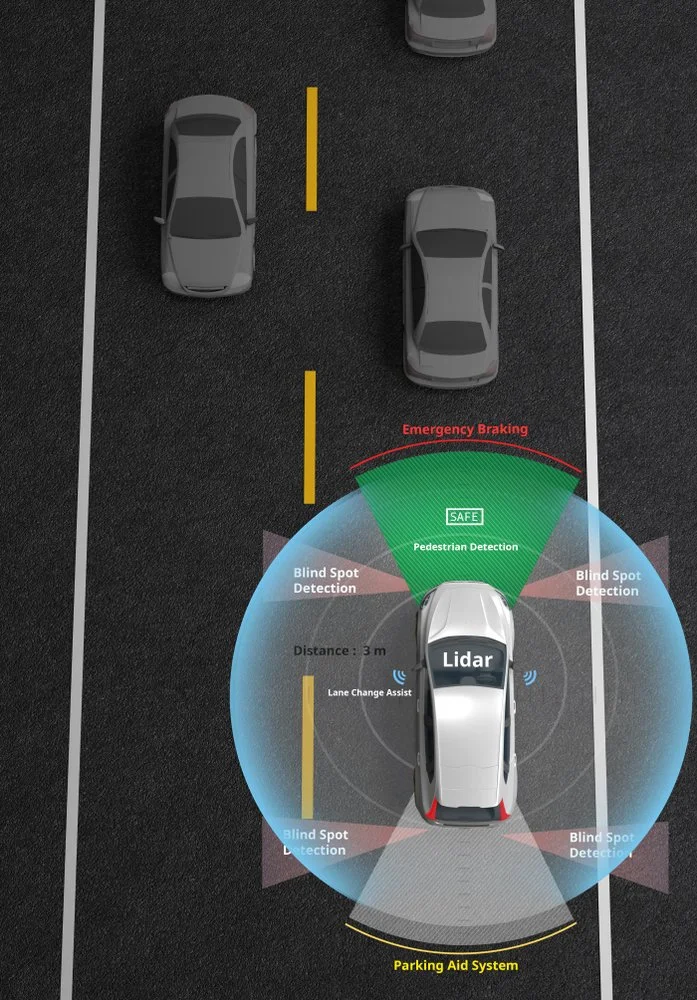
A critical component of the digital twin is its ability to simulate sensor outputs with high realism. This involves emulating data from cameras, radar, LiDAR, ultrasonic sensors, and GNSS, incorporating latency, noise, distortion, and occlusions. Sensor fidelity is essential for testing perception algorithms under varying conditions, such as nighttime glare or partial obstructions.

Simulation Engine
Digital twins rely on high-performance simulation engines to render and orchestrate complex interactions between the vehicle and its surroundings. Tools like CARLA, Unreal Engine, and Vissim are widely used to support photorealistic rendering, traffic behavior simulation, and infrastructure integration. These engines provide the visual and physical realism necessary for validating control and planning systems.

Control and Decision Stack Integration
For the digital twin to serve as a testing ground, it must interface with the vehicle’s autonomy stack. This includes modules for perception, localization, path planning, and control. Integration enables engineers to evaluate how decisions made by the autonomy stack respond to stimuli from the virtual environment.

Workflows for Digital Twin in Autonomous Driving

Software-in-the-Loop (SIL) and Hardware-in-the-Loop (HIL)
Digital twin architectures typically support both SIL and HIL configurations. SIL enables full-stack testing within a purely virtual environment, ideal for early development and rapid iteration. HIL extends this by incorporating physical hardware components, such as ECUs or sensors, into the loop, allowing engineers to validate real-time performance and hardware compatibility.

Real-World Data Ingestion and Calibration
To ensure fidelity, digital twins often ingest real-world sensor and telemetry data for calibration. This data helps refine physics models, adjust sensor emulators, and recreate specific driving scenarios for regression testing. Calibration ensures that the digital twin behaves consistently with its physical counterpart.

Fault Injection and Edge-Case Replay
One of the most powerful capabilities of a digital twin is controlled fault injection. Engineers can simulate GPS dropout, sensor failure, or algorithmic bugs to evaluate system resilience. Similarly, edge-case scenarios, recorded from real-world incidents or synthetically generated, can be replayed repeatedly to identify and fix vulnerabilities in the autonomy stack.

Validation for Digital Twin Across Scales and Domains

Autonomous systems must operate reliably across a diverse set of environments, tasks, and constraints. This variability presents one of the most formidable challenges in testing: ensuring performance consistency across operational design domains (ODDs) such as urban centers, highways, rural roads, and off-road terrain. Digital twins, when designed with scale and adaptability in mind, offer a unique solution to this challenge.

The flexibility of digital twins also supports scenario transfer between domains. For instance, a behavior tested in a dense urban model, such as reacting to jaywalking pedestrians, can be adapted and validated in a suburban context with minimal reconfiguration. This adaptability accelerates the development lifecycle by reducing the need to manually rebuild or recalibrate entire simulation environments.

A hybrid digital twin combines real-world data feeds, such as live traffic inputs or weather reports, with simulation environments to test autonomous behavior in dynamic, context-rich settings. For example, a virtual twin of a European city center may integrate actual pedestrian density patterns from recent data to evaluate crowd-aware planning algorithms. This type of testing blends the safety and control of simulation with the unpredictability of live environments.

Ultimately, the ability to test across scales and domains ensures that autonomous systems are not only technically sound but also operationally robust. It allows for testing under both ideal and degraded conditions, for simulating rare edge cases, and for validating performance in new markets without the logistical burden of deploying fleets prematurely. As autonomous systems move closer to commercial viability, scalable validation through digital twins will be a cornerstone of their success.

Read more: Multi-Modal Data Annotation for Autonomous Perception: Synchronizing LiDAR, RADAR, and Camera Inputs

Challenges and Limitations of Digital Twin

While digital twins offer powerful advantages for testing autonomous systems, their implementation is not without significant challenges. Developing and deploying high-fidelity digital twins at scale requires careful consideration of computational, technical, and organizational limitations that can affect performance, cost, and reliability.

Computational Costs and Real-Time Performance
One of the most immediate constraints is the heavy computational load required to run complex digital twin simulations. Photorealistic rendering, physics-based modeling, and real-time sensor emulation demand powerful hardware, particularly when simulations must operate at high frame rates to support hardware-in-the-loop (HIL) or real-time feedback loops. Running large-scale tests, such as simulating a full city environment or a fleet of autonomous vehicles, often requires distributed computing infrastructure and access to GPU clusters or cloud platforms, which can be prohibitively expensive for many organizations.

Sensor Fidelity and Noise Modeling
Accurate simulation of sensor behavior is critical to evaluating how an autonomous system perceives its environment. However, achieving sensor fidelity that mirrors real-world conditions is a non-trivial task. Emulating camera exposure, LiDAR reflectivity, radar interference, and occlusion patterns involves complex signal modeling and calibration. Even small deviations in simulated sensor outputs can lead to misleading performance assessments, particularly in edge-case detection, where a few pixels or milliseconds of delay may cause system failure.

Calibration Between Physical and Virtual Domains
Creating a digital twin that truly mirrors its physical counterpart requires precise calibration. This means aligning vehicle dynamics, sensor placements, environmental variables, and software behavior between the real and simulated systems. Any mismatch in this calibration introduces a disconnect that reduces trust in test results. Maintaining this alignment over time, especially as hardware and software evolve, is an ongoing engineering challenge.

Skill and Resource Barriers
Deploying a robust digital twin environment requires interdisciplinary expertise spanning robotics, systems engineering, 3D modeling, real-time computing, and AI. Many teams lack the cross-functional capacity to develop and maintain such systems in-house. This skills gap often forces organizations to rely on commercial toolkits or academic partnerships, which may not offer the flexibility or responsiveness needed for fast-paced product cycles.

Read more: Autonomous Fleet Management for Autonomy: Challenges, Strategies, and Use Cases

How We Can Help

At Digital Divide Data, we specialize in building high-quality data pipelines, simulation assets, and validation workflows that power the next generation of autonomous systems. Whether you’re testing autonomous vehicles, drones, or humanoids, our expert teams can help you design, deploy, and scale digital twin environments that meet the highest standards of realism, safety, and performance.

Conclusion

Digital twins provide a comprehensive alternative: a controlled, repeatable, and scalable testing infrastructure that allows developers to evaluate performance under a vast range of real and hypothetical conditions.

What distinguishes digital twins in the autonomous domain is their ability to simulate not just the vehicle and its software, but the full context in which that vehicle operates. From photorealistic urban landscapes and off-road terrains to dynamic sensor emulation and real-time communications, today’s digital twin platforms offer the fidelity and flexibility required to develop safe, adaptive, and resilient autonomous systems.

Looking ahead, continued innovation will likely focus on improving simulation realism, reducing computational costs, and enhancing interoperability between tools and standards. As real-world deployments increase, the feedback loop between physical and digital domains will become tighter, enabling more accurate models and faster validation cycles. For organizations developing autonomous technologies, investing in digital twin infrastructure is a strategic imperative that will shape the safety, scalability, and competitiveness of their systems in the years to come.

Ready to Accelerate Your Autonomous Testing with Scalable Digital Twin Solutions? Talk to our experts


References:

Samak, T., Smith, L., Leung, K., & Huang, Q. (2024). Towards validation across scales using an integrated digital twin framework. arXiv. https://arxiv.org/abs/2402.12670

Gürses, S., Scott-Hayward, S., Hafeez, I., & Dixit, A. (2024). Digital twins and testbeds for supporting AI research with autonomous vehicle networks. arXiv. https://arxiv.org/abs/2404.00954

Sharma, S., Moni, M., Thomas, B., & Das, M. (2024). An advanced framework for ultra-realistic simulation and digital twinning for autonomous vehicles (BlueICE). arXiv. https://arxiv.org/abs/2405.01328

Bergin, D., Carden, W. L., Huynh, K., Parikh, P., Bounker, P., Gates, B., & Whitt, J. (2023). Tailoring the digital twin for autonomous systems development and testing. The ITEA Journal of Test and Evaluation, 44(4). International Test and Evaluation Association. https://itea.org/journals/volume-44-4/tailoring-the-digital-twin-for-autonomous-systems-development-and-testing/

Volvo Autonomous Solutions. (2025, June). Digital twins: The ultimate virtual proving ground. Volvo Group. https://www.volvoautonomoussolutions.com/en-en/news-and-insights/insights/articles/2025/jun/digital-twins–the-ultimate-virtual-proving-ground.html

Frequently Asked Questions (FAQs)

1. How is a digital twin different from a traditional simulation model?

While traditional simulation models replicate system behavior under predefined conditions, a digital twin is a dynamic, continuously updated virtual replica of a real-world system. Digital twins are connected to their physical counterparts through data streams (e.g., telemetry, sensor data) and evolve in real time based on feedback. This continuous synchronization allows for predictive insights, scenario testing, and operational control that go far beyond static simulations.

2. Can digital twins be used for real-time monitoring and control of autonomous systems?

Yes, advanced digital twins can operate in real time to monitor and, in some cases, control autonomous systems. For instance, a digital twin of an AV fleet can track real-time operational data, predict maintenance needs, and identify performance deviations. In edge computing scenarios, lightweight digital twin models can also support on-board diagnostics or assist with dynamic mission planning.

3. Are digital twins used only for ground vehicles in autonomy?

No, while ground vehicles are currently the most common focus, digital twins are also used in aerial (e.g., drones), maritime (e.g., autonomous ships), and space (e.g., satellites and landers) applications. Each domain requires tailored modeling of dynamics, environments, and sensor modalities, but the underlying principles of simulating and validating autonomous behavior remain consistent.

4. How do digital twins support compliance with safety standards?

Digital twins can significantly enhance safety validation by enabling structured testing against defined safety requirements. They allow exhaustive scenario-based testing, including edge cases that are difficult or unsafe to test in physical environments. Logs and test outputs from digital twin platforms can be used to support traceability, safety cases, and certification documentation under safety-critical standards.

5. What role do synthetic data and generative AI play in digital twins for autonomy?

Synthetic data, generated via simulation or AI-driven content creation, is increasingly used to train and validate perception models in digital twins. Generative AI can create diverse and realistic scenarios, including rare edge cases, without relying on manually collected data. This expands the test coverage and helps reduce dataset bias, particularly in perception and behavior prediction modules.

6. How are human-in-the-loop simulations integrated into digital twins?

Human-in-the-loop (HITL) testing involves integrating human operators or evaluators into digital twin environments. This is especially useful for evaluating interactions between autonomous systems and human agents (e.g., handovers, overrides, teleoperation). Digital twins can simulate real-world complexity while allowing humans to interact with or assess the system in real time, supporting UX, safety, and policy validation.

Building Digital Twins for Autonomous Vehicles: Architecture, Workflows, and Challenges Read Post »

multi2Blabel2Bimage2Bclassification

Multi-Label Image Classification Challenges and Techniques

By Umang Dayal

July 29, 2025

Computer vision can identify and classify objects within an image, and has long been a fundamental task. Traditional image classification approaches focus on assigning a single label to an image, assuming that each visual sample belongs to just one category. However, real-world images are rarely so simple. A photo might simultaneously contain a person, a bicycle, a road, and a helmet.

This complexity introduces the need for multi-label image classification (MLIC), where models predict multiple relevant labels for a single image. MLIC enables systems to interpret scenes with nuanced semantics, reflecting how humans perceive and understand visual content.

This blog explores multi-label image classification, focusing on key challenges, major techniques, and real-world applications.

Major Challenges in Multi-Label Image Classification

Multi-label image classification presents a unique set of obstacles that distinguish it from single-label classification tasks. These challenges span data representation, model design, training complexity, and deployment constraints. Addressing them requires a deep understanding of how multiple semantic labels interact, how they are distributed, and how visual and contextual cues can be effectively modeled. Below, we examine six of the most pressing issues.

High-Dimensional and Sparse Label Space

As the number of possible labels increases, the label space becomes exponentially large and inherently sparse. Unlike single-label tasks with mutually exclusive classes, multi-label problems must account for every possible combination of labels. This often leads to situations where many label combinations are underrepresented or absent altogether in the training data. Additionally, some labels occur frequently while others appear only rarely, leading to class imbalance. These conditions make it challenging for models to learn meaningful patterns without overfitting to dominant classes or overlooking rare yet important ones.

Label Dependencies and Co-occurrence Complexity

In multi-label settings, labels are rarely independent. Certain objects often appear together in specific contexts. For example, a “car” is likely to co-occur with “road” and “traffic light” in urban scenes. Capturing these dependencies is crucial for improving predictive performance. However, relying too heavily on co-occurrence statistics can be misleading, especially in edge cases or uncommon contexts. Static label graphs, which model these dependencies globally, may fail to generalize when scene-specific relationships differ from global trends. Effective multi-label classification must account for both general label interactions and context-specific deviations.

Spatial and Semantic Misalignment

Another major challenge arises from the spatial distribution of labels within an image. In multi-object scenes, different labels often correspond to distinct spatial regions that may or may not overlap. For example, in a street scene, “pedestrian” and “bicycle” might be close together, while “sky” and “building” occupy completely different areas. Without mechanisms to attend to label-specific regions, models may blur or miss important details. Semantic misalignment also occurs when visual features are ambiguous or shared across categories, requiring models to differentiate subtle contextual cues.

Data Scarcity and Annotation Cost

Multi-label datasets are significantly harder to annotate than their single-label counterparts. Each image may require multiple judgments, increasing the cognitive load and time required for human annotators. In some domains, such as medical or aerial imaging, data annotations must come from experts, further escalating costs. Noisy, incomplete, or inconsistent labels are common, and they degrade model performance. As a result, many real-world datasets remain limited in scale or quality, constraining the potential of supervised learning approaches.

Overfitting on Co-occurrence Statistics

While label co-occurrence can help guide predictions, it also poses the risk of overfitting. When models learn to rely excessively on frequent label combinations, they may neglect visual cues entirely. For instance, if “helmet” is usually seen with “bicycle,” a model might incorrectly predict “helmet” even when it is absent, simply because “bicycle” is present. This reduces robustness and generalization, especially in test conditions where familiar co-occurrence patterns are violated. Disentangling visual features from statistical dependencies is essential for developing resilient multi-label classifiers.

Scalability and Real-Time Deployment Issues

Multi-label models often have larger architectures and require more computational resources than single-label ones. The need to output and evaluate predictions over many labels increases memory and inference time, which can be problematic for real-time or edge deployments. In applications like autonomous driving or mobile content moderation, latency and resource usage are critical constraints. Compressing models without sacrificing accuracy and designing efficient prediction pipelines remains a persistent challenge for practitioners working at scale.

Multi-Label Image Classification Techniques

Recent advancements in multi-label image classification have focused on addressing the fundamental challenges of label dependency modeling, data efficiency, semantic representation, and computational scalability.

Graph-Based Label Dependency Modeling

Modeling relationships among labels is central to improving MLIC performance. Traditional models often assume label independence, which limits their ability to understand structured co-occurrence patterns. Graph-based techniques have emerged to address this by explicitly representing and learning inter-label dependencies.

One of the notable contributions is Scene-Aware Label Graph Learning, which constructs dynamic graphs conditioned on the type of scene in the image. Rather than using a global, static label graph, the model adjusts its label relationship structure based on the visual context. This allows it to more accurately capture context-specific dependencies, such as recognizing that “snow” and “mountain” co-occur in alpine settings, while “building” and “car” co-occur in urban ones.

Multi-layered dynamic graphs have further advanced this concept by modeling label interactions at different semantic and spatial scales. These architectures allow label representations to evolve through multiple graph reasoning layers, improving the model’s ability to handle label sparsity and long-tail distributions.

Contrastive and Probabilistic Learning

Another promising direction has been the integration of contrastive learning with probabilistic representations. The ProbMCL framework (2024) combines supervised contrastive loss with a mixture density network to model uncertainty and capture multi-modal label distributions. This approach enables the model to learn nuanced inter-label relationships by pulling similar samples closer in the latent space, while accounting for uncertainty in label presence.

These techniques are particularly effective in settings with limited or noisy annotations. By leveraging representation-level similarity rather than raw label agreement, they help improve robustness and generalization, especially in domains with subtle or overlapping label semantics.

CAM and GCN Fusion Networks

Combining spatial attention with structural reasoning has also gained traction. Architectures that merge Class Activation Maps (CAMs) with Graph Convolutional Networks (GCNs) aim to align visual cues with label graphs. The idea is to localize features corresponding to each label via CAMs and then propagate label dependencies using GCNs.

These hybrid models can simultaneously encode spatial alignment (through CAM) and relational reasoning (through GCN), making them particularly effective in complex scenes with multiple interacting objects. This fusion helps models move beyond purely appearance-based recognition and consider the broader context of how objects co-occur spatially and semantically.

Prompt Tuning and Token Attention

Inspired by advances in natural language processing, prompt tuning has been adapted for visual classification tasks. Recent research on correlative and discriminative label grouping introduces a method that constructs soft prompts for label tokens, allowing the model to better differentiate between commonly co-occurring but semantically distinct labels.

By grouping labels based on both their correlation and discriminative attributes, the model avoids overfitting to frequent label combinations. This strategy enhances the model’s ability to learn label-specific features and maintain prediction accuracy even in less common or conflicting label scenarios.

Reinforcement-Based Active Learning

Annotation efficiency is further enhanced through reinforcement-based active learning techniques. Instead of randomly sampling data for labeling, these methods use a reinforcement learning agent to select the most informative samples that are likely to improve model performance.

This active learning framework adapts over time, learning to prioritize images that represent edge cases, underrepresented labels, or ambiguous contexts. The result is a more label-efficient training pipeline that accelerates learning and reduces dependence on large annotated datasets.

Read more: 2D vs 3D Keypoint Detection: Detailed Comparison

Industry Applications for Multi-Label Image Classification

Multi-label image classification spans a wide range of industries where understanding complex scenes, recognizing multiple entities, or tagging images with rich semantic information is essential. As real-world datasets grow in volume and complexity, multi-label classification has become a foundational capability in commercial systems, healthcare diagnostics, autonomous navigation, and beyond. This section explores prominent application domains and how multi-label models are being deployed at scale.

E-commerce and Content Moderation

In e-commerce platforms, the ability to tag images with multiple product attributes is critical for search accuracy, filtering, and personalized recommendations. A single product image might need to be labeled with attributes such as “men’s”, “leather”, “brown”, “loafers”, and “formal”. Multi-label classification enables automatic tagging of such attributes from visual data, reducing manual labor and improving metadata consistency.

Content moderation platforms also benefit from MLIC by detecting multiple types of content violations in images, such as identifying the simultaneous presence of offensive symbols, nudity, and weapons. These systems must prioritize both speed and accuracy to operate in real-time and at scale, especially in user-generated content ecosystems.

Healthcare Diagnostics

Medical imaging is a domain where multi-label classification plays a vital role. An X-ray or MRI scan may reveal several co-occurring conditions, and detecting all of them is essential for a comprehensive diagnosis. For instance, in chest X-rays, a single image might show signs of pneumonia, enlarged heart, and pleural effusion simultaneously.

Multi-label models trained on datasets help radiologists by providing automated, explainable preliminary assessments. These models often incorporate uncertainty estimation and attention maps to enhance trust and usability. While deployment in clinical settings demands high accuracy and regulatory compliance, the use of MLIC reduces diagnostic oversight and accelerates reporting workflows.

Autonomous Systems

Self-driving vehicles, drones, and robotic systems rely heavily on perception models that can identify multiple objects and contextual elements in real time. A single street-level image may contain pedestrians, cyclists, vehicles, road signs, lane markings, and construction zones. All these elements must be detected and classified simultaneously to inform navigation and safety decisions.

Multi-label classifiers help these systems interpret rich visual scenes with high granularity, particularly when combined with object detectors or semantic segmentation networks. Edge deployment constraints make efficiency a key requirement, and recent lightweight architectures have made it feasible to run MLIC models on embedded hardware without significant performance trade-offs.

Satellite and Aerial Imaging

Remote sensing applications often require identifying multiple land use types, infrastructure elements, and environmental features from a single high-resolution satellite or aerial image. For example, a frame might simultaneously include “urban”, “water body”, “vegetation”, and “industrial facility” labels.

Multi-label classification aids in geospatial mapping, disaster assessment, agricultural monitoring, and military reconnaissance. Since such datasets often lack dense annotations and exhibit high class imbalance, models trained with techniques like pseudo-labeling and graph-based label correlation are particularly effective in this domain. Moreover, the ability to generalize across regions and seasons is crucial, further highlighting the importance of robust label dependency modeling.

Across all these industries, multi-label image classification offers a critical capability: the ability to extract a structured, multi-dimensional understanding from visual data. When deployed thoughtfully, these models reduce manual workload, enhance decision-making, and enable scalable automation. However, operational deployment also raises challenges, ranging from latency and throughput constraints to interpretability and fairness, which must be addressed through careful engineering and continual model refinement.

Read more: Mitigation Strategies for Bias in Facial Recognition Systems for Computer Vision

Conclusion

Multi-label image classification has emerged as a cornerstone of modern computer vision, enabling machines to interpret complex scenes and recognize multiple semantic concepts within a single image. Unlike single-label tasks, MLIC reflects the richness and ambiguity of the real world, making it indispensable in domains such as healthcare, autonomous systems, e-commerce, and geospatial analysis.

As we look to the future, multi-label classification is poised to benefit from broader shifts in machine learning: multimodal integration, foundation models, efficient graph learning, and a growing focus on fairness and accountability. These developments not only promise more accurate models but also more inclusive and ethically aware systems. Whether you’re developing for a mission-critical domain or scaling consumer applications, multi-label classification will continue to offer both technical challenges and transformative opportunities.

By embracing advanced techniques and grounding them in sound evaluation and ethical deployment, we can build MLIC systems that are not only powerful but also aligned with the complexity and diversity of the real world.

Scale your multi-label training datasets with precision and speed, partner with DDD


References: 

Xie, S., Ding, G., & He, Y. (2024). ProbMCL: Probabilistic multi-label contrastive learning. arXiv. https://arxiv.org/abs/2401.01448

Xu, Y., Zhang, X., Sun, Z., & Hu, H. (2025). Correlative and discriminative label grouping for multi-label visual prompt tuning. arXiv. https://arxiv.org/abs/2504.09990

Zhang, Y., Zhou, F., & Yang, W. (2024). Classifier-guided CLIP distillation for unsupervised multi-label image classification. arXiv. https://arxiv.org/abs/2503.16873

Al-Maskari, A., Zhang, M., & Wang, S. (2025). Multi-label active reinforcement learning for efficient annotation under label imbalance. Computer Vision and Image Understanding, 240, 103939. https://www.sciencedirect.com/science/article/pii/S1077314225000748

Tarekegn, A. N., Adilina, D., Wu, H., & Lee, Y. (2024). A comprehensive survey of deep learning for multi-label learning. arXiv. https://arxiv.org/abs/2401.16549

OpenCV. (2025). Image classification in 2025: Insights and advances. OpenCV Blog. https://opencv.org/blog/image-classification/

SciSimple. (2025). Advancements in multimodal multi-label classification. SciSimple. https://scisimple.com/en/articles/2025-07-25-advancements-in-multimodal-multi-label-classification–akero11

Frequently Asked Questions (FAQs)

1. Can I convert a multi-label problem into multiple binary classification tasks?

Yes, this approach is known as the Binary Relevance (BR) method. Each label is treated as a separate binary classification problem. While simple and scalable, it fails to model label dependencies, which are often critical in real-world applications. More advanced approaches like Classifier Chains or label graph models are preferred when label interdependence is important.

2. How does multi-label classification differ from multi-class classification technically?

In multi-class classification, an input is assigned to exactly one class from a set of mutually exclusive categories. In multi-label classification, an input can be assigned to multiple classes simultaneously. Technically, multi-class uses a softmax activation (with categorical cross-entropy loss), while multi-label uses a sigmoid activation per class (with binary cross-entropy or similar loss functions).

3. What data augmentation techniques are suitable for multi-label image classification?

Standard techniques like flipping, rotation, scaling, and cropping are generally effective. However, care must be taken with label-preserving augmentation to ensure that all annotated labels remain valid after transformation. Mixup and CutMix can be adapted, but may require label mixing strategies to preserve label semantics. Some pipelines also use region-aware augmentation to retain context for spatially localized labels.

4. Can I use object detection models for multi-label classification?

Object detection models like YOLO or Faster R-CNN detect individual object instances with bounding boxes and labels. While they can output multiple labels per image, their primary goal is instance detection rather than scene-level classification. For coarse or scene-level tagging, MLIC models are more efficient and often more appropriate, though hybrid systems combining both can offer rich annotations.

5. How do label noise and missing labels affect multi-label training?

Label noise and incompleteness are major issues in MLIC, particularly in weakly supervised or web-crawled datasets. Common mitigation strategies include:

  • Partial label learning, which allows learning from incomplete annotations

  • Robust loss functions like soft bootstrapping or asymmetric loss

  • Consistency regularization to stabilize predictions across augmentations

Multi-Label Image Classification Challenges and Techniques Read Post »

2d2Band2B3d2BKeypoint2Bdetection

2D vs 3D Keypoint Detection: Detailed Comparison

By Umang Dayal

July 28, 2025

Keypoint detection has become a cornerstone of numerous computer vision applications, powering everything from pose estimation in sports analytics to gesture recognition in augmented reality and fine motor control in robotics.

As the field has evolved, so too has the complexity of the problems it aims to solve. Developers and researchers are increasingly faced with a critical decision: whether to rely on 2D or 3D keypoint detection models. While both approaches aim to identify salient points on objects or human bodies, they differ fundamentally in the type of spatial information they capture and the contexts in which they excel.

The challenge lies in choosing the right approach for the right application. While 3D detection provides richer data, it comes at the cost of increased computational demand, sensor requirements, and annotation complexity. Conversely, 2D methods are more lightweight and easier to deploy but may fall short when spatial reasoning or depth understanding is crucial. As new architectures, datasets, and fusion techniques emerge, the line between 2D and 3D capabilities is beginning to blur, prompting a reevaluation of how each should be used in modern computer vision pipelines.

This blog explores the key differences between 2D and 3D keypoint detection, highlighting their advantages, limitations, and practical applications.

What is Keypoint Detection?

Keypoint detection is a foundational task in computer vision where specific, semantically meaningful points on an object or human body are identified and localized. These keypoints often represent joints, landmarks, or structural features that are critical for understanding shape, motion, or orientation. Depending on the application and data requirements, keypoint detection can be performed in either two or three dimensions, each providing different levels of spatial insight.

2D keypoint detection operates in the image plane, locating points using pixel-based (x, y) coordinates. For instance, in human pose estimation, this involves identifying the positions of the nose, elbows, and knees within a single RGB image. These methods have been widely adopted in applications such as facial recognition, AR filters, animation rigging, and activity recognition.

3D keypoint detection, in contrast, extends this task into the spatial domain by estimating depth alongside image coordinates to yield (x, y, z) positions. This spatial modeling is essential in scenarios where understanding the true physical orientation, motion trajectory, or 3D structure of objects is required. Unlike 2D detection, which can be performed with standard cameras, 3D keypoint detection often requires additional input sources such as depth sensors, multi-view images, LiDAR, or stereo cameras. It plays a vital role in robotics grasp planning, biomechanics, autonomous vehicle perception, and immersive virtual or augmented reality systems.

2D Keypoint Detection

2D keypoint detection has long been the entry point for understanding visual structure in computer vision tasks. By detecting points of interest in an image’s x and y coordinates, it offers a fast and lightweight approach to modeling human poses, object parts, or gestures within a flat projection of the world. Its relative simplicity, combined with a mature ecosystem of datasets and pre-trained models, has made it widely adopted in both academic and production environments.

Advantages of 2D Keypoint Detection

One of the primary advantages of 2D keypoint detection is its computational efficiency. Models like OpenPose, BlazePose, and HRNet are capable of delivering high accuracy in real-time, even on resource-constrained platforms such as smartphones or embedded devices. This has enabled the proliferation of 2D keypoint systems in applications like fitness coaching apps, social media AR filters, and low-latency gesture recognition. The availability of extensive annotated datasets such as COCO, MPII, and AI Challenger further accelerates training and benchmarking.

Another strength lies in its accessibility. 2D detection typically requires only monocular RGB images, making it deployable with basic camera hardware. Developers can implement and scale 2D pose estimation systems quickly, with little concern for calibration, sensor fusion, or geometric reconstruction. This makes 2D keypoint detection particularly suitable for commercial applications that prioritize responsiveness, ease of deployment, and broad compatibility.

Limitations of 2D Keypoint Detection

However, the 2D approach is not without its constraints. It lacks any understanding of depth, which can lead to significant ambiguity in scenes with occlusion, unusual angles, or mirrored poses. For instance, without depth cues, it may be impossible to determine whether a hand is reaching forward or backward, or whether one leg is in front of the other. This limitation reduces the robustness of 2D models in tasks that demand precise spatial interpretation.

Moreover, 2D keypoint detection is inherently tied to the viewpoint of the camera. A pose that appears distinct in three-dimensional space may be indistinguishable in 2D from another, resulting in missed or incorrect inferences. As a result, while 2D detection is highly effective for many consumer-grade and real-time tasks, it may not suffice for applications where depth, orientation, and occlusion reasoning are critical.

3D Keypoint Detection

3D keypoint detection builds upon the foundation of 2D localization by adding the depth dimension, offering a more complete and precise understanding of an object’s or human body’s position in space. Instead of locating points only on the image plane, 3D methods estimate the spatial coordinates (x, y, z), enabling richer geometric interpretation and spatial reasoning. This capability is indispensable in domains where orientation, depth, and motion trajectories must be accurately captured and acted upon.

Advantages of 3D Keypoint Detection

One of the key advantages of 3D keypoint detection is its robustness in handling occlusions and viewpoint variations. Because 3D models can infer spatial relationships between keypoints, they are better equipped to reason about body parts or object components that are not fully visible. This makes 3D detection more reliable in crowded scenes, multi-person settings, or complex motions, scenarios that frequently cause ambiguity or failure in 2D systems.

The added depth component is also crucial for applications that depend on physical interaction or navigation. In robotics, for instance, understanding the exact position of a joint or grasp point in three-dimensional space allows for precise movement planning and object manipulation. In healthcare, 3D keypoints enable fine-grained gait analysis or postural assessment. For immersive experiences in AR and VR, 3D detection ensures consistent spatial anchoring of digital elements to the real world, dramatically improving realism and usability.

Disadvantages of 3D Keypoint Detection

3D keypoint detection typically requires more complex input data, such as depth maps, multi-view images, or 3D point clouds. Collecting and processing this data often demands additional hardware like stereo cameras, LiDAR, or RGB-D sensors. Moreover, training accurate 3D models can be resource-intensive, both in terms of computation and data annotation. Labeled 3D datasets are far less abundant than their 2D counterparts, and generating ground truth often involves motion capture systems or synthetic environments, increasing development time and expense.

Another limitation is inference speed. Compared to 2D models, 3D detection networks are generally larger and slower, which can hinder real-time deployment unless heavily optimized. Even with recent progress in model efficiency and sensor fusion techniques, achieving high-performance 3D keypoint detection at scale remains a technical challenge.

Despite these constraints, the importance of 3D keypoint detection continues to grow as applications demand more sophisticated spatial understanding. Innovations such as zero-shot 3D localization, self-supervised learning, and back-projection from 2D features are helping to bridge the gap between depth-aware accuracy and practical deployment feasibility. In contexts where precision, robustness, and depth-awareness are critical, 3D keypoint detection is not just advantageous, it is essential.

Real-World Use Cases of 2D vs 3D Keypoint Detection

Selecting between 2D and 3D keypoint detection is rarely a matter of technical preference; it’s a strategic decision shaped by the specific demands of the application. Each approach carries strengths and compromises that directly impact performance, user experience, and system complexity. Below are practical scenarios that illustrate when and why each method is more appropriate.

Use 2D Keypoints When:

Real-time feedback is crucial
2D keypoint detection is the preferred choice for applications where low latency is critical. Augmented reality filters on social media platforms, virtual try-ons, and interactive fitness applications rely on near-instantaneous pose estimation to provide smooth and responsive experiences. The lightweight nature of 2D models ensures fast inference, even on mobile processors.

Hardware is constrained
In embedded systems, smartphones, or edge devices with limited compute power and sensor input, 2D models offer a practical solution. Because they operate on single RGB images, they avoid the complexity and cost of stereo cameras or depth sensors. This makes them ideal for large-scale deployment where accessibility and scalability matter more than full spatial understanding.

Depth is not essential
For tasks like 2D activity recognition, simple joint tracking, animation rigging, or gesture classification, depth information is often unnecessary. In these contexts, 2D keypoints deliver sufficient accuracy without the overhead of 3D modeling. The majority of consumer-facing pose estimation systems fall into this category.

Use 3D Keypoints When:

Precision and spatial reasoning are essential
In domains like surgical robotics, autonomous manipulation, or industrial automation, even minor inaccuracies in joint localization can have serious consequences. 3D keypoint detection provides the spatial granularity needed for reliable movement planning, tool control, and interaction with real-world objects.

Orientation and depth are critical
Applications involving human-robot interaction, sports biomechanics, or AR/VR environments depend on understanding how the body or object is oriented in space. For example, distinguishing between a forward-leaning posture and a backward one may be impossible with 2D data alone. 3D keypoints eliminate such ambiguity by capturing true depth and orientation.

Scenes involve occlusion or multiple viewpoints
Multi-person scenes, complex body motions, or occluded camera angles often pose significant challenges to 2D models. In contrast, 3D detection systems can infer missing or hidden joints based on learned spatial relationships, providing a more robust estimate. This is especially valuable in surveillance, motion capture, or immersive media, where visibility cannot always be guaranteed.

Ultimately, the decision hinges on a careful assessment of application requirements, hardware constraints, latency tolerance, and desired accuracy. While 2D keypoint detection excels in speed and simplicity, 3D methods offer deeper insight and robustness, making them indispensable in use cases where spatial fidelity truly matters.

Read more: Mitigation Strategies for Bias in Facial Recognition Systems for Computer Vision

Technical Comparison: 2D vs 3D Keypoint Detection

To make an informed decision between 2D and 3D keypoint detection, it’s important to break down their technical characteristics across a range of operational dimensions. This comparison covers data requirements, computational demands, robustness, and deployment implications to help teams evaluate trade-offs based on their system constraints and goals.

2d+vs+3d+keypoint+detection

This comparison reveals a clear pattern: 2D methods are ideal for fast, lightweight applications where spatial depth is not critical, while 3D methods trade ease and speed for precision, robustness, and depth-aware reasoning.

In practice, this distinction often comes down to the deployment context. A fitness app delivering posture feedback through a phone camera benefits from 2D detection’s responsiveness and low overhead. Conversely, a surgical robot or VR system tracking fine motor movement in real-world space demands the accuracy and orientation-awareness only 3D detection can offer.

Understanding these technical differences is not just about choosing the best model; it’s about selecting the right paradigm for the job at hand. And increasingly, hybrid solutions that combine 2D feature extraction with depth-aware projection (as seen in recent research) are emerging as a way to balance performance with efficiency.

Read more: Understanding Semantic Segmentation: Key Challenges, Techniques, and Real-World Applications

Conclusion

2D and 3D keypoint detection each play a pivotal role in modern computer vision systems, but their strengths lie in different areas. 2D keypoint detection offers speed, simplicity, and wide accessibility. It’s ideal for applications where computational resources are limited, latency is critical, and depth is not essential. With a mature ecosystem of datasets and tools, it remains the default choice for many commercial products and mobile-first applications.

In contrast, 3D keypoint detection brings a richer and more accurate spatial understanding. It is indispensable in high-precision domains where orientation, depth perception, and robustness to occlusion are non-negotiable. Although it demands more in terms of hardware, training data, and computational power, the resulting spatial insight makes it a cornerstone for robotics, biomechanics, autonomous systems, and immersive technologies.

As research continues to evolve, the gap between 2D and 3D detection will narrow further, unlocking new possibilities for hybrid architectures and cross-domain generalization. But for now, knowing when and why to use each approach remains essential to building effective, efficient, and robust vision-based systems.

Build accurate, scalable 2D and 3D keypoint detection models with Digital Divide Data’s expert data annotation services.

Talk to our experts


References

Gong, B., Fan, L., Li, Y., Ma, C., & Bao, H. (2024). ZeroKey: Point-level reasoning and zero-shot 3D keypoint detection from large language models. arXiv. https://arxiv.org/abs/2412.06292

Wimmer, T., Wonka, P., & Ovsjanikov, M. (2024). Back to 3D: Few-shot 3D keypoint detection with back-projected 2D features. In Proceedings of the IEEE/CVF Conference on Computer Vision and Pattern Recognition (CVPR) (pp. 3252–3261). IEEE. https://openaccess.thecvf.com/content/CVPR2024/html/Wimmer_Back_to_3D_Few-Shot_3D_Keypoint_Detection_with_Back-Projected_2D_CVPR_2024_paper.html

Patsnap Eureka. (2025, July). Human pose estimation: 2D vs. 3D keypoint detection explained. Eureka by Patsnap. https://eureka.patsnap.com/article/human-pose-estimation-2d-vs-3d-keypoint-detection

Frequently Asked Questions

1. Can I convert 2D keypoints into 3D without depth sensors?

Yes, to some extent. Techniques like monocular 3D pose estimation attempt to infer depth from a single RGB image using learning-based priors or geometric constraints. However, these methods are prone to inaccuracies in unfamiliar poses or occluded environments and generally don’t achieve the same precision as systems with true 3D inputs (e.g., stereo or depth cameras).

2. Are there unified models that handle both 2D and 3D keypoint detection?

Yes. Recent research has introduced multi-task and hybrid models that predict both 2D and 3D keypoints in a single architecture. Some approaches first estimate 2D keypoints and then lift them into 3D space using learned regression modules, while others jointly optimize both outputs.

3. What role do synthetic datasets play in 3D keypoint detection?

Synthetic datasets are crucial for 3D keypoint detection, especially where real-world 3D annotations are scarce. They allow the generation of large-scale labeled data from simulated environments using tools like Unity or Blender.

4. How do keypoint detection models perform under motion blur or low light?

2D and 3D keypoint models generally struggle with degraded image quality. Some recent approaches incorporate temporal smoothing, optical flow priors, or multi-frame fusion to mitigate issues like motion blur. However, low-light performance remains a challenge, especially for RGB-based systems that lack infrared or depth input.

5. What evaluation metrics are used to compare 2D and 3D keypoint models?

For 2D models, metrics like PCK (Percentage of Correct Keypoints), mAP (mean Average Precision), and OKS (Object Keypoint Similarity) are common. In 3D, metrics include MPJPE (Mean Per Joint Position Error) and PA-MPJPE (Procrustes-aligned version). These help quantify localization error, robustness, and structural accuracy.

6. How scalable is 3D keypoint detection across diverse environments?

Scalability depends heavily on the model’s robustness to lighting, background clutter, sensor noise, and occlusion. While 2D models generalize well due to broad dataset diversity, 3D models often require domain-specific tuning, especially in robotics or outdoor scenes. Advances in self-supervised learning and domain adaptation are helping bridge this gap.

2D vs 3D Keypoint Detection: Detailed Comparison Read Post »

facial2Brecognition2Bsystems2Bfor2Bcomputer2Bvision

Mitigation Strategies for Bias in Facial Recognition Systems for Computer Vision

By Umang Dayal

July 25, 2025

Facial recognition technology has rapidly evolved from a niche innovation to a mainstream tool across various sectors, including security, retail, banking, defense, and government. Its ability to identify, verify, and analyze human faces with high precision has made it a key component in surveillance systems, customer experience platforms, and digital identity verification workflows.

A few studies reveal that many facial recognition systems are not neutral tools. Their performance often varies significantly based on demographic factors such as race, gender, and age. These disparities are not merely theoretical. Numerous studies have shown that people of color, particularly women and older individuals, are more likely to be misidentified or subjected to higher error rates. In practical terms, this can lead to wrongful arrests, exclusion from services, or unequal access to resources. The consequences are amplified when these systems are deployed in high-stakes environments without adequate oversight or safeguards.

This blog explores bias and fairness in facial recognition systems for computer vision. It outlines the different types of bias that affect these models, explains why facial recognition is uniquely susceptible, and highlights recent innovations in mitigation strategies.

Understanding Bias in Facial Recognition Systems

What Is Bias in AI?

In the context of artificial intelligence, bias refers to systematic errors in data processing or model prediction that result in unfair or inaccurate outcomes for certain groups. Bias in AI can manifest in various forms, but in facial recognition systems, three types are particularly critical.

Dataset bias arises when the training data is not representative of the broader population. For instance, if a facial recognition system is trained primarily on images of young, light-skinned males, it may perform poorly on older individuals, women, or people with darker skin tones.

Algorithmic bias emerges from the model design or training process itself. Even if the input data is balanced, the model’s internal parameters, learning objectives, or optimization techniques can lead to skewed outputs.

Representation bias occurs when the way data is labeled, structured, or selected reflects existing societal prejudices. For example, if faces are labeled or grouped using culturally narrow definitions of gender or ethnicity, the model may reinforce those definitions in its predictions.

Understanding and addressing these sources of bias is crucial because the consequences of facial recognition errors can be serious. They are not simply technical inaccuracies but reflections of deeper inequities encoded into digital systems.

Why Facial Recognition Is Especially Vulnerable

Facial recognition models rely heavily on the diversity and quality of visual training data. Unlike many other AI applications, they must generalize across an extraordinarily wide range of facial attributes, including skin tone, bone structure, lighting conditions, and facial expressions. This makes them highly sensitive to demographic variation.

Even subtle imbalances in data distribution can have measurable effects. For example, a lack of older female faces in the dataset may lead the model to underperform for that group, even if it excels overall. The visual nature of the data also introduces challenges related to lighting, camera quality, and pose variation, which can compound existing disparities.

Moreover, in many real-world deployments, users do not have the option to opt out or question system performance. This makes fairness in facial recognition not just a technical concern, but a critical human rights issue.

Mitigation Strategies for Bias in Facial Recognition Systems

As awareness of bias in facial recognition systems has grown, so too has the demand for effective mitigation strategies. Researchers and developers are approaching the problem from multiple directions, aiming to reduce disparities without compromising the core performance of these systems. Broadly, these strategies fall into three categories: data-centric, model-centric, and evaluation-centric approaches. Each tackles a different stage of the machine learning pipeline and offers complementary benefits in the pursuit of fairness.

Data-Centric Approaches

Data is the foundation of any machine learning model, and ensuring that training datasets are diverse, representative, and balanced is a crucial first step toward fairness. One widely adopted technique is dataset diversification, which involves curating training sets to include a wide range of demographic attributes, including variations in age, gender, skin tone, and ethnicity. However, collecting such data at scale can be both logistically challenging and ethically sensitive.

To address this, researchers have turned to data augmentation and synthetic data generation. Techniques such as Generative Adversarial Networks (GANs) can be used to create artificial facial images that fill demographic gaps in existing datasets. These synthetic faces can simulate underrepresented attributes without requiring real-world data collection, thereby enhancing both privacy and inclusivity.

The effectiveness of data-centric approaches depends not only on the volume of diverse data but also on how accurately that diversity reflects real-world populations. This has led to efforts to establish public benchmarks and protocols for dataset auditing, allowing practitioners to quantify and correct demographic imbalances before training even begins.

Model-Centric Approaches

Even with balanced data, models can learn biased representations if not carefully designed. Model-centric fairness techniques focus on adjusting how models are trained and how they make decisions. One common strategy is the inclusion of fairness constraints in the loss function, which penalizes performance disparities across demographic groups during training. This encourages the model to achieve a more equitable distribution of outcomes without severely degrading overall accuracy.

Another technique is post-hoc adjustment, which modifies model predictions after training to reduce observed bias. This can involve recalibrating confidence scores, adjusting thresholds, or applying demographic-aware regularization to minimize disparate impact.

Recent innovations, such as the Centroid Fairness Loss method, have introduced new architectures that explicitly consider subgroup distributions in the model’s internal representations. These methods show promising results in aligning the model’s predictions more closely across sensitive attributes like race and gender, while still preserving general utility.

Read more: Understanding Semantic Segmentation: Key Challenges, Techniques, and Real-World Applications

Evaluation-Centric Approaches

Measuring fairness is as important as achieving it. Without appropriate metrics and evaluation protocols, it is impossible to determine whether a model is treating users equitably. Evaluation-centric approaches focus on defining and applying fairness metrics that can uncover hidden biases in performance.

Metrics such as demographic parity, equalized odds, and false positive/negative rate gaps provide concrete ways to quantify how performance varies across groups. These metrics can be incorporated into development pipelines to monitor bias at every stage of training and deployment.

In addition, researchers are calling for the standardization of fairness benchmarks. Datasets like Racial Faces in the Wild (RFW) and the recently developed Faces of Fairness protocol offer structured evaluation scenarios that test models across known demographic splits. These benchmarks not only provide a consistent basis for comparison but also help organizations make informed decisions about model deployment in sensitive contexts.

Together, these three categories of mitigation strategies form a comprehensive toolkit for addressing bias in facial recognition systems. They highlight that fairness is not a single solution, but a design principle that must be embedded throughout the entire lifecycle of AI development.

Read more: Managing Multilingual Data Annotation Training: Data Quality, Diversity, and Localization

Conclusion

Bias in facial recognition systems is not a theoretical risk; it is a proven, measurable phenomenon with tangible consequences. As these systems become increasingly integrated into critical societal functions, the imperative to ensure that they operate fairly and equitably has never been greater. The challenge is complex, involving data quality, algorithmic design, evaluation metrics, and policy frameworks. However, it is not insurmountable.

Through thoughtful data curation, innovative model architectures, and rigorous evaluation protocols, it is possible to build facial recognition systems that serve all users more equitably. Techniques such as synthetic data generation, fairness-aware loss functions, and standardized demographic benchmarks are redefining what it means to create responsible AI systems. These are not just technical adjustments; they reflect a shift in how the AI community values inclusivity, transparency, and accountability.

At DDD, we believe that tackling algorithmic bias is a fundamental step toward building ethical AI systems. As facial recognition continues to evolve, so must our commitment to ethical innovation. Addressing bias is not just about fixing flawed algorithms; it is about redefining the standards by which we measure success in AI. Only by embedding fairness as a core principle, from data collection to deployment, can we build systems that are not only intelligent but also just.


References:

Conti, J.-R., & Clémençon, S. (2025). Mitigating bias in facial recognition systems: Centroid fairness loss optimization. In Pattern Recognition: ICPR 2024 International Workshops, Lecture Notes in Computer Science (Vol. 15614). Springer. (Accepted at NeurIPS AFME 2024 and ICPR 2024)

Ohki, T., Sato, Y., Nishigaki, M., & Ito, K. (2024). LabellessFace: Fair metric learning for face recognition without attribute labels. arXiv preprint arXiv:2409.09274.

Patel, S., & Kisku, D. R. (2024). Improving bias in facial attribute classification: A combined impact of KL‑divergence induced loss function and dual attention. arXiv preprint arXiv:2410.11176.

“Rethinking Bias Mitigation: Fairer Architectures Make for Fairer Face Recognition.” (2023). NeurIPS 2023.

Frequently Asked Questions (FAQs)

How does real-time facial recognition differ in terms of bias and mitigation?

Real-time facial recognition (e.g., in surveillance or access control) introduces additional challenges:

  • Operational conditions like lighting, camera angles, and motion blur can amplify demographic performance gaps.

  • There’s less opportunity for manual review or fallback, making false positives/negatives more consequential.

  • Mitigating bias here requires robust real-world testing, adaptive threshold tuning, and mechanisms for human-in-the-loop oversight.

What role does explainability play in mitigating bias?

Explainability helps developers and users understand:

  • Why a facial recognition model made a certain prediction.

  • Where biases or errors might have occurred in decision-making.

Techniques like saliency maps, attention visualization, and model attribution scores can uncover demographic sensitivities or performance disparities. Integrating explainability into the ML lifecycle supports auditing, debugging, and ethical deployment.

Is it ethical to use synthetic facial data to mitigate bias?

Using synthetic data (e.g., GAN-generated faces) raises both technical and ethical considerations:

  • On the upside, it can fill demographic gaps without infringing on real identities.

  • However, it risks introducing artifacts, reducing realism, or even reinforcing biases if the generation process is itself skewed.

Ethical use requires transparent documentation, careful validation, and alignment with privacy-by-design principles.

Are there specific industries or use cases more vulnerable to bias?

Yes. Facial recognition bias tends to have a disproportionate impact on:

  • Law enforcement: Risk of wrongful arrests.

  • Healthcare: Errors in identity verification for medical access.

  • Banking/FinTech: Biases in KYC (Know Your Customer) systems leading to denied access or delays.

  • Employment/HR: Unfair candidate screening in AI-powered hiring tools.

Can community engagement help reduce bias in deployment?

Absolutely. Community engagement allows developers and policymakers to:

  • Gather real-world feedback from affected demographics.

  • Understand cultural nuances and privacy concerns.

  • Co-design solutions with transparency and trust.

Engagement builds public legitimacy and can guide more equitable system design, especially in marginalized or historically underserved communities.

Mitigation Strategies for Bias in Facial Recognition Systems for Computer Vision Read Post »

Data2BCentric2BAI

Guide to Data-Centric AI Development for Defense

By Umang Dayal

July 24, 2025

Artificial intelligence systems in defense are entering a critical inflection point. For years, the dominant approach to building AI models has focused on refining algorithms, adjusting neural network architectures, optimizing hyperparameters, and deploying increasingly larger models with greater computational resources.

This model-centric paradigm has yielded impressive benchmarks in controlled settings. Yet, in the real-world complexity of defense operations, characterized by dynamic battlefields, sensor noise, and rapidly evolving adversarial tactics, this approach often breaks down. Models that perform well in lab environments may fail catastrophically in live scenarios due to blind spots in the data they were trained on.

In high-risk defense applications such as surveillance, autonomous targeting, battlefield analytics, and decision support systems, the stakes could not be higher. Models must function under uncertain conditions, reason with partial information, and maintain performance across edge cases.

In this blog, we discuss why a data-centric approach is critical for defense AI, how it contrasts with traditional model-centric development, and explore recommendations for shaping the future of mission-ready intelligence systems.

Why Defense Needs a Data-Centric Approach

Defense applications of AI differ from commercial ones in one crucial respect: failure is not just a business risk; it is a national security liability. In this context, continuing to iterate on models without critically examining the underlying data introduces systemic vulnerabilities.

Defense AI systems are expected to perform in extreme and unpredictable environments, such as war zones with degraded sensors, contested electromagnetic spectrums, and adversarial interference. A model trained on curated, noise-free data may perform flawlessly in simulation but collapse under the ambiguity and uncertainty of live operations.

The traditional model-centric approach often overlooks the quality, completeness, and diversity of the data itself. This creates what might be termed a data-blind development loop, one where developers attempt to compensate for poor data coverage by tuning models further, leading to overfitting, brittleness, and hallucinated outputs. For example, a visual detection model that performs well on clear, daylight images may fail to detect camouflaged threats in low-light conditions or misidentify non-combatants due to contextual ambiguity. These are not just technical failures; they are operational liabilities.

Military AI systems demand a far higher bar for robustness, explainability, and assurance than typical commercial systems. These requirements are not optional; they are essential for compliance with military ethics, international laws of armed conflict, and public accountability. Robustness means the system must generalize across unseen terrains and scenarios. Explainability requires that decisions, especially lethal ones, are traceable and interpretable by human operators. Assurance means that AI behavior under stress, uncertainty, and edge conditions can be rigorously validated before deployment.

In this context, data becomes a strategic asset, on par with weapons systems and supply chains. Programs are shifting from viewing data as a byproduct of operations to treating it as an enabler of next-generation capabilities. Whether it is building autonomous platforms that navigate in cluttered terrain or decision support tools for real-time battlefield analytics, the quality and stewardship of the underlying data is what ultimately determine trust and effectiveness in AI systems.

Defense organizations that embrace a data-centric paradigm are not simply changing their engineering process; they are evolving their strategic doctrine.

Data Challenges in Defense AI

Building reliable AI systems in defense is not just a matter of model architecture; the complexity, sensitivity, and inconsistency of the data fundamentally constrain it. Unlike commercial datasets that can be openly scraped, labeled, and standardized at scale, defense data is fragmented, classified, and operationally diverse. These conditions introduce a unique set of challenges that traditional machine learning workflows cannot solve.

Data Availability and Fragmentation

One of the most persistent issues is the limited availability and fragmented nature of defense data. Critical information is often distributed across siloed systems, each governed by distinct security protocols, formats, and access restrictions. Many defense organizations still operate legacy platforms where data collection was not designed for AI use. Systems may generate low-fidelity logs, lack metadata, or be stored in incompatible formats. Moreover, classified datasets are typically confined to secure enclaves, limiting collaborative development and cross-validation. The result is a fractured data ecosystem that impedes the creation of coherent, AI-ready training sets.

Data Quality and Bias

Even when data is accessible, quality and representativeness remain a significant concern. Data Annotation errors, missing context, or low-resolution inputs can severely impact model performance. More critically, biased datasets, whether due to overrepresentation of specific terrains, lighting conditions, or adversary types, can lead to dangerous generalization failures. For instance, a surveillance model trained predominantly on arid environments may underperform in jungle or urban settings. In adversarial contexts, data that lacks exposure to deceptive techniques such as camouflage or decoys risks enabling manipulation at deployment. The consequences are not theoretical; they can manifest in false positives, misidentification of friendlies, or critical situational awareness gaps.

Data Labeling in High-Risk Environments

Labeling defense data is uniquely difficult as operational footage may be sensitive, encrypted, or captured in chaotic conditions where even human interpretation is uncertain. Annotators often require specialized military knowledge to identify relevant objects, behaviors, or threats, making generic outsourcing infeasible. Furthermore, indiscriminately labeling large volumes of data is neither cost-effective nor strategically sound. The defense community is beginning to adopt smart-sizing approaches, prioritizing annotation of rare, ambiguous, or high-risk scenarios over routine ones. This aligns with recent research insights, such as those highlighted in the “Achilles Heel of AI” paper, which underscore the value of targeted labeling for performance gains in edge cases.

Multi-Modal and Real-Time Data Fusion

Modern military operations generate data from a wide range of sources: radar, electro-optical/infrared (EO/IR) sensors, satellite imagery, cyber intelligence, and battlefield telemetry. These modalities differ in resolution, frequency, reliability, and interpretation frameworks. Training AI systems that can reason across such disparate streams is a major challenge. Fusion models must handle asynchronous inputs, conflicting signals, and incomplete information, all while operating under real-time constraints. Achieving this demands not only sophisticated modeling but also high-quality, temporally-aligned multi-modal datasets, a resource that remains scarce and difficult to construct under operational constraints.

Emerging Innovations in Data-Centric Defense AI

To meet the demanding requirements of military AI, the defense sector is investing in a range of innovations that rethink how data is curated, annotated, and used for model training. These approaches aim to overcome the limitations of traditional workflows by targeting data quantity, quality, and strategic value. Rather than relying solely on brute-force data collection or generic annotation pipelines, these innovations focus on adaptive, secure, and context-aware data practices that are better suited to high-risk environments.

Smart-Sizing and Adaptive Annotation

One of the most impactful shifts is the move toward smart-sizing datasets, actively curating smaller but more meaningful subsets of data rather than collecting and labeling everything indiscriminately. Adaptive data annotation techniques focus human labeling efforts on the most informative samples, such as rare mission scenarios, ambiguous imagery, or areas with high model uncertainty. This approach helps reduce annotation cost while significantly improving model performance on operational edge cases. Defense organizations are integrating uncertainty sampling, active learning, and counterfactual analysis to ensure that annotated data maximally contributes to model robustness and generalizability.

Neuro-Symbolic Defense Models

To address the limitations of purely statistical models in complex decision-making environments, defense researchers are exploring neuro-symbolic systems that combine data-driven learning with human-defined logic. These models leverage symbolic rules, such as engagement criteria, no-fire zones, or identification thresholds, in conjunction with neural networks that process high-dimensional sensor data. The result is a hybrid model architecture that can both learn from data and reason with constraints, improving explainability and policy compliance. In domains like autonomous targeting or mission planning, neuro-symbolic AI offers a path toward greater control and transparency without sacrificing performance.

Synthetic Data for Combat Simulation

Real-world combat data is often scarce, classified, or unsafe to collect. Synthetic data generation, powered by techniques such as generative adversarial networks (GANs), procedural rendering, and simulation engines, is emerging as a key tool for augmenting training datasets. These synthetic environments can replicate rare or dangerous battlefield conditions, such as urban combat under smoke cover, enemy deception tactics, or night-time infrared scenarios, enabling more thorough training and validation. When combined with real-world sensor signatures and physics-based models, synthetic data can help close coverage gaps in ways that would otherwise be impractical or impossible.

Federated AI Training

Defense organizations frequently face data-sharing restrictions across national, organizational, or classification boundaries. Federated learning addresses this by enabling decentralized model training across multiple secure nodes, without ever transferring raw data. Each participant trains locally on its own encrypted data, and only model updates are aggregated centrally. This approach preserves data sovereignty while enabling collaborative development, an essential feature for coalition operations. Federated learning also supports compliance with regulatory constraints and information assurance policies, making it a compelling option for future multi-domain AI systems.

Together, these innovations represent a fundamental shift from static, siloed data practices toward dynamic, secure, and operationally aware data ecosystems. They pave the way for defense AI systems that are not only more accurate but also more aligned with real-world complexity, ethical norms, and strategic imperatives.

Read more: Applications of Computer Vision in Defense: Securing Borders and Countering Terrorism

Recommendations for Data-Centric AI Development

As defense organizations transition toward a data-centric AI development paradigm, they must realign both technical workflows and strategic planning. This shift demands more than adopting new tools; it requires a foundational change in how data is treated across the lifecycle of AI systems, from acquisition and labeling to deployment and auditing. The following recommendations are intended for practitioners, data scientists, program leads, and acquisition officers tasked with operationalizing AI in sensitive, high-stakes defense environments.

Invest in Data-Centric Metrics

Traditional model evaluation metrics, such as accuracy or precision, are insufficient for defense applications where failure modes can be mission-critical. Practitioners should adopt data-centric evaluation frameworks that assess:

  • Completeness: Does the dataset sufficiently cover all operational environments, adversary tactics, and sensor conditions?

  • Edge-Case Density: Are rare or ambiguous scenarios adequately represented and labeled?

  • Adversarial Robustness: How well do models trained on this dataset perform against manipulated or deceptive inputs?

Incorporating these metrics into both procurement and model assessment pipelines ensures that data quality is not an afterthought but a formalized requirement.

Design Domain-Specific Assurance Protocols

Defense AI systems cannot rely on generic validation procedures. Assurance protocols must be tailored to the mission context. For example, a surveillance drone should meet minimum confidence thresholds before flagging an object for escalation, while an autonomous vehicle may need to demonstrate behavior predictability under degraded GPS conditions. These protocols should integrate:

  • Scenario-specific test datasets.

  • Stress-testing for edge conditions.

  • Human-in-the-loop override and auditability mechanisms.

By embedding assurance into the AI development lifecycle, defense teams can reduce risk and increase confidence in real-world deployment.

Create Shared Annotation Schemas for Interoperability

In coalition or joint-force settings, the lack of consistent annotation standards often hampers data fusion and model integration. Practitioners should push for shared taxonomies and labeling protocols across services and partner nations. A standardized schema allows for:

  • Cross-validation of models across theaters.

  • Aggregation of training data without semantic misalignment.

  • Faster deployment of AI systems in multinational operations.

Developing these schemas in tandem with doctrine and operational policy also ensures they remain relevant and actionable in live missions.

Leverage Synthetic Data Pipelines to Fill Gaps

When operational data is unavailable or insufficient, synthetic data should be used strategically to fill high-risk blind spots. This includes:

  • Simulating rare events such as chemical exposure or infrastructure sabotage.

  • Generating low-visibility EO/IR conditions using physics-informed rendering.

  • Modeling multi-force engagements to train decision-support tools on coalition dynamics.

Synthetic data is not a replacement for real data, but when calibrated carefully, it serves as a powerful force multiplier, especially in training models to anticipate the unexpected.

Align Dual-Use Datasets for Civil-Military Synergy

Many datasets collected for defense purposes have applications in civilian domains such as disaster response, infrastructure monitoring, or border management. By designing datasets and labeling workflows with dual-use alignment, agencies can reduce duplication, increase scale, and improve public trust. This also facilitates smoother transitions of AI systems from military innovation pipelines to civilian applications, creating broader societal benefits.

Taken together, these recommendations reflect a proactive, mission-aligned approach to data-centric development. Rather than treating data curation as a one-off task, practitioners must embed data governance, representational integrity, and real-world relevance into every stage of the AI lifecycle. In doing so, they lay the groundwork for systems that are not only technically sound but operationally trusted.

Read more: Integrating AI with Geospatial Data for Autonomous Defense Systems: Trends, Applications, and Global Perspectives

Conclusion

As AI becomes embedded across the modern defense enterprise, the assumptions that once guided model development must evolve. It is no longer sufficient to build high-performing models in isolation and hope they generalize in the field. In the unforgiving context of defense operations, where a misclassification can mean mission failure, collateral damage, or escalation, data quality, completeness, and context-awareness are non-negotiable.

A data-centric approach reorients the focus from chasing incremental model gains to systematically improving the foundation on which all AI performance rests: the data. It compels practitioners to ask not just how well the model performs, but why it performs the way it does, on what data, and under what assumptions. This shift in perspective is especially critical in defense, where trust, traceability, and tactical alignment are core operational requirements.

The future of defense AI is not about bigger models or faster training cycles. It is about building the right data pipelines, validation protocols, and human-in-the-loop systems to ensure that artificial intelligence can serve as a reliable partner in mission execution. Those who invest in data strategically, structurally, and continuously will not just lead in AI capability. They will lead in operational advantage.

Partner with DDD to operationalize data-centric intelligence at scale. Talk to our experts


References:

Kapusta, A. S., Jin, D., Teague, P. M., Houston, R. A., Elliott, J. B., Park, G. Y., & Holdren, S. S. (2025, April 3). A framework for the assurance of AI‑enabled systems [Preprint]. arXiv.
Proposes a DoD‑aligned claims-based assurance framework critical for guaranteeing trustworthiness in defense AI arXiv.

National Defense Magazine. (2023, July 25). AI in defense: Navigating concerns, seizing opportunities.
Highlights the importance of data bias mitigation in ISR and command‑control AI systems U.S. Department of Defense+3National Defense Magazine+3arXiv+3.

U.S. Cybersecurity and Infrastructure Security Agency. (2023, December). Roadmap for artificial intelligence.
Outlines federal efforts to secure AI systems by design and manage data‑centric vulnerabilities, WIRED.

Frequently Asked Questions (FAQs)

1. Is a data-centric approach only relevant for defense applications?

No. While the blog emphasizes its importance in defense, the data-centric paradigm is highly relevant across industries, especially in domains where data is messy, scarce, or high-stakes (e.g., healthcare, finance, law enforcement, and autonomous driving). The lessons from defense can be adapted to commercial and civilian sectors, particularly in ensuring robustness and fairness in AI systems.

2. How does data-centric AI influence the role of data engineers and ML ops teams?

In a data-centric AI workflow, the role of data engineers and MLOps expands significantly. They are no longer just responsible for data pipelines but also for:

  • Ensuring dataset versioning and lineage

  • Enabling reproducibility through data tracking tools

  • Facilitating dynamic data validation and augmentation pipelines

This blurs the traditional boundary between data infrastructure and model development, encouraging deeper collaboration across roles.

3. How can teams assess whether their current pipeline is model-centric or data-centric?

Key indicators of a model-centric workflow include:

  • Frequent model re-training without modifying the dataset

  • Little analysis of labeling errors or distribution gaps

  • Success measured solely by model metrics (e.g., accuracy, F1)

In contrast, a data-centric pipeline will:

  • Actively curate and monitor dataset quality

  • Log and prioritize edge case failure modes

  • Use tools to automate and analyze dataset’s impact on performance

4. Can pre-trained foundation models eliminate the need for data-centric approaches?

No. Pre-trained models still rely on their training data, which may be:

  • Biased or misaligned with the defense context

  • Lacking in classified or high-risk operational scenarios

Fine-tuning or aligning foundation models with defense-specific data is essential. Thus, even when using large models, data-centric techniques remain critical to ensure operational fitness.

5. How does a data-centric approach help with adversarial robustness?

Adversarial robustness depends significantly on how well the training data represents real-world threats. A data-centric approach allows:

  • Curating examples of adversarial tactics (e.g., camouflage, spoofing)

  • Augmenting datasets with synthetic adversarial scenarios

  • Incorporating uncertainty-aware sampling and labeling

  • This strengthens model resilience by making it harder to exploit blind spots.

6. What are the risks of overly relying on synthetic data?

While synthetic data is powerful, over-reliance can:

  • Introduce simulation bias if not calibrated to real-world sensor characteristics

  • Fail to capture unanticipated human behaviors or environmental edge cases

  • Lead to overconfidence if synthetic scenarios are too “clean” or predictable

The key is to blend synthetic with real, noisy, and annotated data to maintain realism and robustness.

Guide to Data-Centric AI Development for Defense Read Post »

Autonomous2BFleet2BManagement2Bfor2BAutonomy

Autonomous Fleet Management for Autonomy: Challenges, Strategies, and Use Cases

DDD Solutions Engineering Team

July 22, 2025

Autonomous fleet management sits at the intersection of artificial intelligence, mobility innovation, and logistics transformation. As self-driving technologies mature and move beyond pilot programs, the need for reliable and scalable fleet management has become increasingly urgent.

Behind every successful deployment is a sophisticated management layer that determines which vehicle goes where, how it operates, and how it responds to unpredictable conditions on the road.

What makes this challenge particularly complex is that autonomous fleets are not merely a collection of driverless vehicles. They are dynamic, data-driven systems that must adapt to traffic patterns, customer demand, charging constraints, regulatory limits, and environmental concerns in real time. Managing them effectively requires far more than just route optimization.

It involves learning-based control, decentralized decision-making, integration with smart infrastructure, and coordination with human-driven services where necessary. Each of these capabilities must be robust, secure, and compliant with national and regional policies, many of which are still evolving.

This blog explores the current landscape of autonomous fleet management, highlighting the core challenges, strategic approaches, and real-world implementations shaping the future of mobility.

Key Challenges in Autonomous Fleet Management

Deploying autonomous vehicles at scale is far more complex than enabling a single vehicle to navigate safely. Once autonomy is introduced into a fleet context, the operational environment becomes significantly more intricate, involving coordination across diverse systems, geographies, and regulations. Below are the primary challenges that define this evolving field.

Operational and Infrastructure Complexity

Autonomous fleets must operate in dynamic, often unpredictable environments. Managing hundreds of vehicles in real time requires robust scheduling, dispatch, and routing capabilities that adapt to traffic conditions, road closures, and fluctuating demand. Unlike traditional fleet management, autonomous systems cannot rely on human intuition, making them heavily dependent on software-driven decisions that must be accurate and timely. For instance, failure to rebalance an autonomous mobility-on-demand (AMoD) fleet can result in service deserts in high-demand areas and excess idle vehicles in others. This level of orchestration requires a tightly integrated mix of sensor data, predictive analytics, and spatial modeling.

Data, System Integration, and Software Scalability

Autonomous fleet management platforms must process vast streams of data from sensors, cameras, lidar systems, traffic feeds, and customer interfaces. This data needs to be aggregated, filtered, and interpreted in real time to support vehicle decision-making and fleet-wide optimization. The complexity is magnified by the need to integrate disparate systems such as navigation software, vehicle control platforms, energy monitoring tools, and customer service portals.

Ensuring reliability at larger fleet sizes involves rigorous testing, modular software design, and infrastructure capable of supporting high availability and low-latency operations. As autonomous fleets grow, their digital backbone must scale proportionally without introducing delays, failures, or bottlenecks.

Regulatory Compliance and Safety Assurance

Regulatory frameworks around autonomous vehicle operations remain fragmented and uncertain. In the US, state-level policies can differ drastically in terms of testing, reporting, and commercial deployment requirements. In Europe, regulations are influenced by the European Union’s overarching safety standards, along with country-specific transportation codes and labor laws. This patchwork of rules complicates deployment strategies and slows down expansion.

Safety is a non-negotiable requirement, and proving that autonomous fleets are safer than their human-driven counterparts remains an ongoing challenge. Operators must demonstrate not only that individual vehicles can handle complex traffic scenarios, but that entire fleets can respond cohesively during emergencies, avoid systemic failures, and meet compliance thresholds for fault tolerance and redundancy.

Energy Management and Sustainability Pressures

As fleets transition to electric vehicles to align with sustainability goals, energy management becomes a critical operational factor. Autonomous electric vehicles must be routed and scheduled with charging needs in mind, particularly in urban environments with limited charging infrastructure. Strategies such as battery swapping, distributed charging, and grid-aware routing are being explored to overcome these limitations.

Where environmental regulation is more stringent, fleet operators are also under pressure to meet emissions targets, manage energy loads, and even integrate with renewable sources like solar. Researchers are developing cost-optimal strategies that consider vehicle design and fleet scheduling simultaneously to maximize energy efficiency while minimizing operational cost.

Equity, Accessibility, and Public Acceptance

Deploying fleets without addressing equity concerns can lead to uneven access across urban and rural regions. Academic work, such as that from TU Delft, has highlighted how subsidy models and fleet rebalancing strategies can be designed to ensure that underserved populations are not excluded from autonomous mobility services.

Trust in autonomous systems is still limited in many areas, and fleet operators must invest in transparent communication, safety demonstrations, and inclusive design to ensure that new services are both adopted and embraced.

Strategies for Scalable and Efficient Fleet Operations

Addressing the complexities of autonomous fleet management requires more than just technical capability. It demands the integration of intelligent algorithms, adaptive planning frameworks, hardware-software co-design, and sustainability-oriented thinking.

Learning-Based Optimization and Real-Time Control

One of the most promising approaches for managing autonomous fleets is the use of learning-based optimization techniques. These systems combine real-time data streams with machine learning models to make dynamic routing and dispatching decisions.

Recent research has demonstrated how reinforcement learning can be paired with online combinatorial optimization to adaptively assign vehicles to customer requests in mobility-on-demand systems. These methods can significantly outperform traditional static models, especially in high-density urban settings where traffic and demand patterns shift rapidly.

Such models are being actively explored by ride-hailing services and logistics platforms, where the ability to reduce idle time, improve vehicle utilization, and minimize passenger wait times translates directly into operational gains.

Decentralized and Collaborative Coordination

Traditional fleet management often relies on centralized control, where a central server or dispatcher determines the movements of all vehicles. However, this model does not scale well when fleets grow beyond a certain size or when they operate in distributed environments with varying connectivity. Decentralized coordination strategies are now gaining traction, where vehicles communicate locally and make joint decisions without relying on a central system.

The research community has explored multi-agent coordination frameworks that allow vehicles to negotiate task allocation, handle local congestion, and reassign deliveries on the fly. A study compared centralized, distributed, and fully decentralized methods, showing that under certain conditions, decentralized approaches can yield comparable or better results in terms of scalability and resilience.

Hardware-Software Co-Design for Operational Efficiency

Another emerging strategy is to optimize the physical design of the vehicles alongside the fleet management logic. Instead of assuming fixed vehicle capabilities, researchers are investigating how choices around battery size, cargo capacity, and energy consumption can be integrated into the fleet’s scheduling and dispatch algorithms.

For example, in dense urban areas like Manhattan, smaller and more energy-efficient vehicles were shown to outperform larger, generic ones when properly managed. This co-design approach allows fleet operators to tailor their assets to specific deployment environments, leading to lower costs, improved sustainability, and better customer experience.

Predictive Maintenance and Health Monitoring

Efficient fleet operation is not only about where the vehicles go, but also about how well they perform over time. Predictive maintenance strategies use sensor data, usage patterns, and machine learning to detect early signs of mechanical or software failure. By anticipating issues before they result in vehicle downtime, operators can maintain high service availability and reduce unexpected costs.

This becomes particularly important in autonomous contexts, where vehicle failure without a driver on board introduces significant safety and liability risks. Advanced monitoring systems are now being integrated into fleet platforms, providing continuous diagnostics, alerting, and automated maintenance scheduling.

Energy-Aware Routing and Sustainability Integration

As fleets become increasingly electrified, energy constraints need to be incorporated into fleet operations. Routing algorithms now take into account the state of charge, charging station availability, grid pricing, and even solar charging potential. Cost-optimal strategies can explore how vehicle design and energy consumption profiles can be managed together to optimize overall fleet performance in electric AMoD systems.

In practice, this involves building energy-aware dispatch systems that know not just where to send a vehicle, but whether it can complete a trip and recharge efficiently afterward. Integrating vehicle-to-grid (V2G) capabilities adds another layer of flexibility, allowing fleets to act as distributed energy resources when not in active use.

Real-World Use Cases of Fleet Management

The practical deployment of autonomous fleet management systems is no longer theoretical. In recent years, several real-world pilots and commercial operations have provided valuable insights into how autonomy at scale performs across different contexts.

Autonomous Trucking and Long-Haul Logistics

In the United States, autonomous trucking has become one of the most mature use cases for fleet-scale autonomy. Companies like Aurora, Kodiak Robotics, and Waymo Via have launched extensive pilot programs focusing on depot-to-depot freight movement across states such as Texas, Arizona, and California. These vehicles operate primarily on highways, where conditions are more structured and predictable than in urban environments.

Fleet management platforms in these use cases are designed to coordinate vehicle dispatching, ensure compliance with state-level regulations, and optimize delivery schedules based on road conditions and load requirements. Because these trucks often operate in mixed environments with human-driven vehicles, the systems must also maintain high situational awareness and support remote supervision when needed.

What makes this use case particularly impactful is its alignment with economic imperatives. Long-haul freight is a high-cost, high-volume industry facing driver shortages and tight delivery windows. Autonomous fleet solutions in this domain offer clear cost savings and performance improvements, provided that management systems can handle the scale and safety requirements involved.

Urban Ride-Hailing and Mobility-on-Demand Services

In European cities such as Hamburg, Paris, and Amsterdam, autonomous mobility-on-demand (AMoD) systems have been tested as alternatives to traditional ride-hailing. These trials often involve small, electric shuttles or compact autonomous cars operating within geofenced areas. The challenge lies in routing vehicles dynamically to meet passenger demand while also navigating complex urban traffic, pedestrian zones, and evolving road conditions.

Projects led by research institutions and municipalities often integrate learning-based fleet control models that adjust vehicle allocation in real time. In some cases, these systems are paired with equity-aware dispatch strategies to ensure that underserved neighborhoods receive adequate service coverage.

The Amsterdam pilot, for instance, tested the viability of real-time fleet rebalancing using predictive models trained on urban mobility patterns. These systems demonstrated measurable reductions in passenger wait times and idle vehicle clustering, even in high-density urban settings.

Last-Mile Delivery in Dense Urban Environments

Last-mile logistics has become a proving ground for lightweight, autonomous delivery vehicles. A study modeled the use of small electric autonomous vehicles for food and parcel delivery, examining variables such as fleet size, delivery timing, and energy usage. Results indicated that these vehicles could reduce traffic congestion and environmental impact when optimally managed.

Fleet management in these scenarios involves intricate coordination between order ingestion, vehicle routing, and customer notification systems. Because delivery tasks are high-frequency and time-sensitive, the underlying platform must operate with low latency and high reliability. Charging logistics and route constraints must be integrated into planning algorithms, particularly in cities where curb space is limited and infrastructure access is tightly regulated.

Autonomous Operations in Ports and Industrial Logistics

Outside of road-based transport, autonomous fleets are also being deployed in semi-structured environments such as ports and terminals. A recent study explored how autonomous vehicles can be managed in container terminals to improve throughput and reduce congestion. These systems rely on centralized fleet orchestration paired with localized vehicle autonomy to manage container movement between ships, storage yards, and loading zones.

Port-based autonomous fleet management systems face unique challenges such as variable container weights, safety compliance, and limited GPS availability. However, their semi-structured nature also provides a controlled environment for testing high-frequency autonomous coordination at scale.

These industrial use cases often serve as test beds for emerging software and coordination models that can later be adapted to more dynamic public road environments.

Read more: Major Challenges in Scaling Autonomous Fleet Operations

How We Can Help

At DDD, we provide end-to-end Fleet Operations Solutions for Autonomy, improving safety, efficiency, and scalability across core functions.

  • RVA UXR Studies: We assess cognitive load, response times, and multi-vehicle control to optimize remote operator performance and accelerate RVA development.

  • DMS/CMS UXR: Our validation and testing expertise enhances driver and cabin monitoring systems for improved accuracy and safety compliance.

  • Remote Assistance: We build and operate secure US-based RVA centers to support AVs in real time using live video, telemetry, and metadata.

  • Remote Annotations: Our teams deliver high-quality event tagging for pedestrian interactions, edge cases, and model training, reducing engineering overhead.

  • Operating Conditions Classification: We classify AV exposure to weather, traffic, and road types, helping teams improve model robustness and deployment strategies.

  • Video Snippet Tagging: We enable fast retrieval and analysis of AV footage for compliance and ML training by tagging critical events at scale.

  • Operational Exposure Analysis: We generate detailed reports on fleet exposure to diverse driving scenarios to optimize real-world test coverage and system readiness.

Read more: Multi-Modal Data Annotation for Autonomous Perception: Synchronizing LiDAR, RADAR, and Camera Inputs

Conclusion

Autonomous fleet management is rapidly evolving from a niche technical challenge into a foundational capability for next-generation mobility and logistics systems.

The success of autonomous fleet management will not hinge on any single technology or platform, but on the ability to orchestrate complex systems in service of real-world goals. The progress made in the past two years suggests that while the journey is still underway, the foundations for a scalable, sustainable, and equitable autonomous mobility future are already taking shape.

Build safer, smarter, and more scalable Autonomous Vehicle systems with DDD. Talk to our experts!


References: 

Jungel, K., Amelkin, V., Ozdaglar, A., & Simchi-Levi, D. (2023). Learning-based online optimization for autonomous mobility-on-demand fleet control. arXiv. https://arxiv.org/abs/2302.03963

Lujak, M., Morbidi, F., & Pistore, M. (2024). Decentralizing coordination in open vehicle fleets: Comparing centralized, distributed, and decentralized strategies. arXiv. https://arxiv.org/abs/2401.10965

Paparella, M., Elbanhawy, E., & Martens, J. (2023). Electric autonomous mobility-on-demand: Jointly optimal vehicle design and fleet operation. arXiv. https://arxiv.org/abs/2309.13012

Tegmark, M., & Blanchard, A. (2024). Operational exposure analysis for AV fleets: Methods and metrics for balanced testing. TU Delft Research Portal. https://research.tudelft.nl

Frequently Asked Questions (FAQs)

1. How do autonomous fleet operations differ from traditional fleet management?

Autonomous fleet operations require managing vehicles without human drivers, which introduces challenges such as remote monitoring, real-time software updates, and incident response coordination. Unlike traditional fleets, AVs depend on high-precision mapping, sensor fusion, and AI-driven decision-making, requiring close integration between fleet management systems and the vehicle’s autonomy stack.

2. What skills are needed to operate and maintain autonomous fleets?

Operating autonomous fleets requires a multidisciplinary team, including fleet technicians with robotics knowledge, software engineers, remote vehicle operators, data annotators, and safety compliance officers. Skills in systems integration, telemetry monitoring, cybersecurity, and user experience design are also critical.

3. How do companies ensure the security of remote operations in AV fleets?

Security in remote operations involves encrypted communication channels, strict access control, continuous monitoring for anomalies, and hardware authentication. Many organizations deploy zero-trust architectures and conduct regular penetration testing to secure remote assistance platforms.

4. What role does simulation play in autonomous fleet management?

Simulation is essential for testing edge cases, training perception models, and validating fleet strategies in controlled environments. It enables teams to replicate rare events and stress-test coordination algorithms before real-world deployment, reducing risk and accelerating development cycles.

Autonomous Fleet Management for Autonomy: Challenges, Strategies, and Use Cases Read Post »

Gen2BAI2BSafety

Building Robust Safety Evaluation Pipelines for GenAI

By Umang Dayal

July 21, 2025

Gen AI outputs are shaped by probabilistic inference and vast training data, often behaving unpredictably when exposed to new prompts or edge-case scenarios. As such, the safety of these models cannot be fully validated with standard test cases or unit tests. Instead, safety must be evaluated through comprehensive pipelines that consider a broader range of risks, at the level of model outputs, user interactions, and downstream societal effects.

This blog explores how to build robust safety evaluation pipelines for Gen AI. Examines the key dimensions of safety, and infrastructure supporting them, and the strategic choices you must make to align safety with performance, innovation, and accountability.

The New Paradigm of Gen AI Risk

As generative AI becomes deeply embedded in products and platforms, the traditional metrics used to evaluate machine learning models, such as accuracy, BLEU scores, or perplexity, are proving insufficient. These metrics, while useful for benchmarking model performance on specific datasets, do not meaningfully capture the safety profile of a generative system operating in real-world environments. What matters now is not just whether a model can generate coherent or relevant content, but whether it can do so safely, reliably, and in alignment with human intent and societal norms.

The risks associated with GenAI are not monolithic, they span a wide spectrum and vary depending on use case, user behavior, deployment context, and system architecture. At the most immediate level, there is the risk of harmful content generation, outputs that are toxic, biased, misleading, or inappropriate. These can have direct consequences, such as spreading misinformation, reinforcing stereotypes, or causing psychological harm to users.

Equally important is the risk of malicious use by bad actors. Generative systems can be co-opted to create phishing emails, fake identities, deepfake media, or automated propaganda at scale. These capabilities introduce new threat vectors in cybersecurity, national security, and public trust. Compounding this is the challenge of attribution, tracing responsibility across a complex stack of model providers, application developers, and end users.

Beyond individual harms, there are broader systemic and societal risks. The widespread availability of generative models can shift the information ecosystem in subtle but profound ways, such as undermining trust in digital content, distorting public discourse, or influencing collective behavior. These impacts are harder to detect and measure, but they are no less critical to evaluate.

A robust safety evaluation pipeline must therefore account for this multi-dimensional risk landscape. It must move beyond snapshot evaluations conducted at the point of model release and instead adopt a lifecycle lens, one that considers how safety evolves as models are fine-tuned, integrated into new applications, or exposed to novel prompts in deployment. This shift in perspective is foundational to building generative AI systems that are not only powerful, but trustworthy and accountable in the long run.

Building a Robust Safety Evaluation Pipeline for Gen AI

Designing a safety evaluation pipeline for generative AI requires more than testing for isolated failures. It demands a structured approach that spans multiple layers of risk and aligns evaluation efforts with how these systems are used in practice. At a minimum, robust safety evaluation should address three interconnected dimensions: model capabilities, human interaction risks, and broader systemic impacts.

Capability-Level Evaluation

The first layer focuses on the model’s direct outputs. This involves systematically testing how the model behaves when asked to generate information across a range of scenarios and edge cases. Key evaluation criteria at this level include bias, toxicity, factual consistency, instruction adherence, and resistance to adversarial inputs.

Evaluators often use both automated metrics and human annotators to measure performance across these dimensions. Automated tools can efficiently flag patterns like repeated hallucinations or prompt injections, while human reviewers are better suited to assess subtle issues like misleading tone or contextually inappropriate responses. In more mature pipelines, adversarial prompting, intentionally pushing the model toward unsafe outputs, is used to stress-test its behavior and identify latent vulnerabilities.

Incorporating evaluation into the training and fine-tuning process helps teams catch regressions early and calibrate trade-offs between safety and creativity. As models become more general-purpose, the scope of these tests must grow accordingly.

Human Interaction Risks

While model output evaluation is essential, it is not sufficient. A second, equally critical layer considers how humans interact with the model in real-world settings. Even safe-seeming outputs can lead to harm if misunderstood, misapplied, or trusted too readily by users.

This layer focuses on issues such as usability, interpretability, and the potential for over-reliance. For example, a model that generates plausible-sounding but inaccurate medical advice poses serious risks if users act on it without verification. Evaluators assess whether users can distinguish between authoritative and speculative outputs, whether explanations are clear, and whether the interface encourages responsible use.

In increasingly autonomous systems, such as AI agents that can execute code, browse the web, or complete multi-step tasks, the risks grow more complex. Evaluating the handoff between human intention and machine execution becomes essential, especially when these systems are embedded in high-stakes domains like finance or legal reasoning.

Systemic and Societal Impact

The final dimension examines how generative AI systems interact with society at scale. This includes both foreseeable and emergent harms that may not surface in controlled settings but become visible over time and through aggregate use.

Evaluation at this level involves simulating or modeling long-term effects, such as the spread of misinformation, the amplification of ideological polarization, or the reinforcement of social inequities. Cross-cultural and multilingual testing is especially important to surface harms that may be obscured in English-only or Western-centric evaluations.

Red-teaming exercises also play a critical role here, these simulations involve diverse groups attempting to exploit or misuse the system in creative ways, revealing vulnerabilities that structured testing may miss. When conducted at scale, these efforts can uncover threats relevant to election integrity, consumer fraud, or geopolitical manipulation.

Together, these three dimensions form the backbone of a comprehensive safety evaluation strategy. Addressing only one or two is no longer enough. GenAI systems now operate at the intersection of language, logic, perception, and behavior, and their evaluation must reflect that full complexity.

Safety Evaluation Infrastructure for Gen AI

Building a safety evaluation pipeline is not solely a conceptual exercise. It requires practical infrastructure, tools, and workflows that can scale alongside the complexity and velocity of generative AI development. From automated evaluation frameworks to sandboxed testing environments, organizations need a robust and adaptable technology stack to operationalize safety across the development lifecycle.

Evaluation Toolkits

Modern safety evaluation begins with modular toolkits designed to probe a wide spectrum of failure modes. These include tests for jailbreak vulnerabilities, prompt injections, output consistency, and behavioral robustness. Many of these toolkits support customizable evaluation scripts, enabling teams to create domain-specific test cases or reuse standardized ones across models and iterations.

Several open-source benchmarking suites now exist that allow comparison of model behavior under controlled conditions. These benchmarks often include metrics for toxicity, bias, factual accuracy, and refusal rates. While not exhaustive, they provide a baseline to identify trends, regressions, or gaps in model safety across releases.

Importantly, these toolkits are increasingly designed to support both automated testing and human evaluation. This hybrid approach is essential, as many nuanced safety issues, such as subtle stereotyping or manipulative tone, are difficult to detect through automation alone.

Integration into Model Pipelines

Safety evaluation is most effective when integrated into the model development pipeline itself, rather than applied as a final check before deployment. This includes embedding evaluations into CI/CD workflows so that safety metrics are treated as first-class performance indicators alongside accuracy or latency.

During training and fine-tuning, intermediate checkpoints can be automatically evaluated on safety benchmarks to guide model selection and hyperparameter tuning. When models are deployed, inference-time monitoring can log and flag outputs that meet predefined risk criteria, allowing real-time interventions, human review, or adaptive filtering.

Some teams also use feedback loops to continuously update their safety evaluations. For example, insights from post-deployment user reports or red-teaming exercises can be converted into new test cases, expanding the coverage of the evaluation pipeline over time.

Sandboxing and Staging Environments

Before a model is released into production, it must be evaluated in environments that closely simulate real-world use, without exposing real users to potential harm. Sandboxing environments enable rigorous safety testing by isolating models and constraining their capabilities. This can include controlling access to tools like web browsers or code execution modules, simulating adversarial scenarios, or enforcing stricter guardrails during experimentation.

Staging environments are also critical for stress-testing models under production-like traffic and usage patterns. This helps evaluate how safety mechanisms perform at scale and under load, and how they interact with deployment-specific architectures like APIs, user interfaces, or plug-in ecosystems.

Together, these layers of tooling and infrastructure transform safety evaluation from an abstract principle into a repeatable engineering practice. They support faster iteration cycles, more accountable development workflows, and ultimately more trustworthy GenAI deployments. As models evolve, so too must the tools used to evaluate them, toward greater precision, broader coverage, and tighter integration into the systems they aim to protect.

Read more: Scaling Generative AI Projects: How Model Size Affects Performance & Cost 

Safety Evaluation Strategy for Gen AI

Creating an effective safety evaluation pipeline is not a matter of adopting a single framework or tool. It requires strategic planning, thoughtful design, and ongoing iteration tailored to the specific risks and requirements of your model, use case, and deployment environment. Whether you are building a foundation model, fine-tuning an open-source base, or deploying a task-specific assistant, your evaluation strategy should be guided by clear goals, structured layers, and responsive governance.

Step-by-Step Guide

Define Your Use Case and Potential Harm Vectors
Start by mapping out how your generative system will be used, by whom, and in what contexts. Identify failure scenarios that could cause harm, whether through misinformation, privacy breaches, or unsafe automation. Understanding where risk might emerge is essential to shaping the scope of your evaluation.

Segment Evaluation Across Three Layers
Design your evaluation pipeline to test safety at three critical levels: model outputs (capability evaluation), user interaction (interface and trustworthiness), and systemic effects (social or operational impact). This layered approach ensures that both immediate and downstream risks are addressed.

Choose Tools Aligned With Your Architecture and Risks
Select or build safety toolkits that align with your model’s architecture and application domain. Modular evaluation harnesses, benchmarking tools, red-teaming frameworks, and adversarial prompt generators can be combined to stress-test the system under diverse conditions. Prioritize extensibility and the ability to incorporate new risks over time.

Run Iterative Evaluations, Not One-Time Checks
Treat safety evaluation as an ongoing process. Integrate it into model training loops, fine-tuning decisions, and product release cycles. Each iteration of the model or system should trigger a full or partial safety review, with metrics tracked over time to detect regressions or emerging vulnerabilities.

Build Cross-Functional Safety Teams
Effective evaluation cannot rely solely on ML engineers. It requires collaboration among technical, design, policy, and legal experts. A cross-functional team ensures that safety goals are not only technically feasible but also ethically grounded, user-centric, and legally defensible.

Report, Adapt, and Repeat
Document evaluation results clearly, including test coverage, known limitations, and mitigation plans. Use these insights to inform future iterations and update stakeholders. Safety evaluations should not be treated as static audits but as living systems that evolve alongside your product and the broader GenAI ecosystem.

Read more: Best Practices for Synthetic Data Generation in Generative AI

Conclusion

As generative AI systems become more capable, more accessible, and more integrated into critical workflows, the need for rigorous safety evaluation has shifted from an optional research concern to an operational necessity. These models are embedded in tools used by millions, influencing decisions, shaping conversations, and acting on behalf of users in increasingly complex ways. In this environment, building robust safety pipelines is not simply about preventing obvious harm, it is about establishing trust, accountability, and resilience in systems that are fundamentally open-ended.

The key takeaway is clear: safety must be treated as a system-level property. It cannot be retrofitted through isolated filters or addressed through narrow benchmarks. Instead, it must be anticipated, measured, and iteratively refined through collaboration across technical, legal, and human domains.

In a field evolving as rapidly as generative AI, the only constant is change. The systems we build today will shape how we inform, create, and decide tomorrow. Ensuring they do so safely is not just a technical challenge, it is a collective responsibility.

Ready to make GenAI safer, smarter, and more accountable with DDD? Let’s build your safety infrastructure together. Contact us today


References:

Weidinger, L., Rauh, M., Marchal, N., Manzini, A., Hendricks, L. A., Mateos‑Garcia, J., … Isaac, W. (2023, October 18). Sociotechnical safety evaluation of generative AI systems [Preprint]. arXiv. https://doi.org/10.48550/arXiv.2310.11986

Longpre, S., Kapoor, S., Klyman, K., Ramaswami, A., Bommasani, R., Blili‑Hamelin, B., … Liang, P. (2024, March 7). A safe harbor for AI evaluation and red teaming [Preprint]. arXiv. https://doi.org/10.48550/arXiv.2403.04893

FAQs

1. What is the difference between alignment and safety in GenAI systems?

Alignment refers to ensuring that a model’s goals and outputs match human values, intent, and ethical standards. Safety, on the other hand, focuses on minimizing harm, both expected and unexpected, across a range of deployment contexts. A system can be aligned in theory (e.g., obeying instructions) but still be unsafe in practice (e.g., hallucinating plausible but incorrect information in healthcare or legal applications). True robustness requires addressing both.

2. Do open-source GenAI models pose different safety challenges than proprietary ones?

Yes. Open-source models introduce unique safety challenges due to their wide accessibility, customization potential, and lack of centralized control. Malicious actors can fine-tune or prompt such models in harmful ways. While transparency aids research and community-driven safety improvements, it also increases the attack surface. Safety pipelines must account for model provenance, deployment restrictions, and community governance.

3. How does safety evaluation differ for multimodal (e.g., image + text) GenAI systems?

Multimodal systems introduce new complexities: the interaction between modalities can amplify risks or create novel ones. For instance, text describing an image may be benign while the image itself contains misleading or harmful content. Safety pipelines must evaluate coherence, consistency, and context across modalities, often requiring specialized tools for vision-language alignment and adversarial testing.

4. Can safety evaluations be fully automated?

No, while automation is critical for scale and speed, many safety concerns (like subtle bias, manipulation, or cultural insensitivity) require human judgment. Hybrid approaches combining automated tools with human-in-the-loop processes are the gold standard. Human evaluators bring context, empathy, and nuance that machines still lack, especially for edge cases, multilingual inputs, or domain-specific risks.

5. What role does user feedback play in improving GenAI safety pipelines?

User feedback is a vital component of post-deployment safety. It uncovers real-world failure modes that static evaluation may miss. Integrating feedback into safety pipelines enables dynamic updates, better test coverage, and continuous learning. Organizations should establish clear channels for reporting, triage, and remediation, especially for high-impact or regulated use cases.

Building Robust Safety Evaluation Pipelines for GenAI Read Post »

Multilingual2BData2BAnnotation

Managing Multilingual Data Annotation Training: Data Quality, Diversity, and Localization

By Umang Dayal

July 18, 2025

Over the past decade, Gen AI has rapidly evolved from experimental research into a foundational technology embedded in everyday life. From voice assistants like Alexa and Siri to real-time translation services, personalized search engines, and generative tools powering customer support and content creation, AI systems now operate in an increasingly multilingual world.

The effectiveness and fairness of these systems are heavily dependent on the quality and breadth of the data used to train them. While the need for multilingual AI is widely acknowledged, the process of managing multilingual training data remains deeply complex. At the core lies a persistent tension between three interdependent objectives: ensuring high data quality, capturing genuine linguistic diversity, and incorporating effective localization. Each of these elements introduces its own challenges, from inconsistent annotation practices across languages to a lack of tooling for region-specific nuance.

This blog explores why multilingual data annotation is uniquely challenging, outlines the key dimensions that define its quality and value, and presents scalable strategies to build reliable annotation pipelines.

Why Multilingual Data Annotation Is Challenging

Creating high-quality annotated datasets for machine learning is inherently complex. When those datasets span multiple languages, the complexity increases significantly. Language is not just a system of grammar and vocabulary. It is embedded with cultural meaning, local norms, regional variations, and historical context. These layers pose unique challenges for data annotation teams trying to scale multilingual training pipelines while maintaining consistency, accuracy, and relevance.

Language-Specific Ambiguities

Every language presents its own set of semantic and syntactic ambiguities. Words with multiple meanings, idiomatic expressions, and syntactic flexibility can all create confusion during annotation. For example, a phrase that is unambiguous in English may require careful disambiguation in Arabic, Japanese, or Finnish due to different grammatical structures or word-order conventions.

This challenge is compounded by the lack of standardized annotation guidelines across languages. While annotation schemes may exist in English for tasks such as named entity recognition or sentiment classification, these often do not translate cleanly to other languages. In practice, teams are forced to adapt or reinvent guidelines on a per-language basis, which introduces inconsistency and raises the cognitive burden on annotators.

Cultural and Contextual Localization

Languages are shaped by the cultures in which they are spoken. This means that words carry different connotations and social meanings across regions, even when the underlying language is technically the same. A sentence that sounds neutral in French as spoken in France may feel offensive or obscure in Francophone Africa. Similarly, expressions common in Mexican Spanish may be unfamiliar or misleading in Spain.

These contextual nuances demand a deep understanding of local language use, which cannot be addressed by machine translation alone. Native-speaking annotators and localization subject matter experts are crucial in capturing the intended meaning and ensuring that the resulting data accurately reflects how language is used in real-world settings. Without this human insight, annotations risk being technically correct but culturally irrelevant or misleading.

Tooling Limitations

Despite advances in annotation platforms, most tools are still optimized for English-centric workflows. Right-to-left scripts, such as Arabic or Hebrew, often render poorly or cause layout issues. Languages that rely on character-based writing systems, such as Chinese or Thai, may not be well supported by tokenization tools or annotation interfaces. Even widely spoken languages like Hindi or Bengali frequently lack robust NLP tooling and infrastructure.

Annotation tools also tend to fall short in terms of user interface design for multilingual workflows. For instance, switching between language modes, managing mixed-language content, or applying language-specific rules often requires manual workarounds. These inefficiencies lead to lower throughput, higher error rates, and additional time spent on quality assurance.

Core Dimensions of Multilingual Data Management

Managing multilingual data annotation at scale requires a strategic approach rooted in three critical dimensions: data quality, diversity, and localization. Each plays a distinct role in shaping the reliability and applicability of annotated datasets, especially when those datasets will be used to train models for global deployment. Neglecting any one of these dimensions can severely compromise the overall performance and fairness of the resulting systems.

Data Quality

At the foundation of any useful dataset is annotation quality. Errors in labeling, inconsistencies across annotators, or a lack of clarity in guidelines can undermine the learning process of even the most capable models. This is especially true in multilingual contexts where linguistic structures vary widely and cultural nuance adds additional layers of interpretation.

Quality management in multilingual annotation involves rigorous processes such as inter-annotator agreement analysis, adjudication of disagreements, and iterative validation.

Diversity

A diverse dataset is essential for building models that generalize well across different linguistic and cultural contexts. Diversity here refers not only to the number of languages represented but also to the inclusion of regional dialects, sociolects, and domain-specific variants. For example, conversational Spanish used in social media differs significantly from formal Spanish found in legal documents. Data collected from a wide range of sources can be noisy, unaligned, and of varying relevance to the task at hand.

Localization

Localization in data annotation goes beyond translating text from one language to another. It involves tailoring the dataset to reflect regional norms, cultural references, and use-case-specific terminology. In the context of legal, medical, or financial domains, even minor localization errors can introduce critical misunderstandings.

Effective localization depends on deep cultural fluency. Annotators must understand not only what is being said, but also how and why it is being said in a particular way. DDD emphasizes the importance of human-in-loop validation, where native-speaking experts with subject-matter knowledge oversee both the annotation and the quality review process.

We advocate a layered approach: machine-assisted pre-annotation, SME-guided instruction, and cultural validation cycles. This ensures that the final data is not only linguistically correct but also contextually meaningful for the specific audience and application.

Read more: Synthetic Data for Computer Vision Training: How and When to Use It

Scalable Techniques for Multilingual Data Annotation

Building a multilingual training dataset that is both high quality and scalable requires more than just manpower. As the number of languages, domains, and use cases expands, manual annotation quickly becomes inefficient and error-prone without the right infrastructure and workflows. Organizations must combine human expertise with intelligent automation, using a blend of tools, models, and iterative processes to meet both scale and quality demands.

Human-in-the-Loop Workflows

Human oversight remains essential in multilingual annotation, particularly when dealing with complex linguistic nuances, cultural context, or domain-specific content. However, fully manual processes are unsustainable. The solution lies in human-in-the-loop (HITL) frameworks that combine automated pre-annotation with expert review and correction.

Subject matter experts (SMEs) play a key role in defining annotation guidelines, validating edge cases, and resolving disagreements. These experts ensure that annotation choices reflect both linguistic correctness and task-specific relevance.

In a HITL setup, annotators first work on model-preprocessed data. SMEs then review contentious items and refine guidelines based on ongoing insights. This loop creates a system of continual improvement while keeping human judgment at the core.

Model-Based Filtering and Selection

Not every sample deserves equal attention. Processing large-scale raw data across many languages without any filtration leads to inefficiencies and inconsistent outcomes. Model-based filtering addresses this problem by ranking and selecting samples based on quality and relevance, before human annotation even begins.

Techniques like JQL (Judging Quality Across Languages) and MuRating (Multilingual Rating) exemplify this shift. These approaches use multilingual embeddings and entropy-based scoring to automatically prioritize data that is more coherent, task-relevant, and well-formed. By applying such pre-selection, annotation teams can focus their resources on the most impactful samples.

For instance, in a multilingual sentiment classification task, a filtering layer can remove non-informative or ambiguous sentences, allowing human annotators to work only on data that is more likely to contribute to model generalization. This improves annotation throughput and also enhances final model accuracy.

Active Learning and Feedback Loops

Another method for scaling annotation efficiently is active learning, where the model identifies which samples it is most uncertain about and prioritizes them for human labeling. This process ensures that annotation efforts are directed where they have the greatest impact on model learning.

Active learning can be combined with multilingual uncertainty estimation, domain sampling strategies, and annotator feedback to create adaptive annotation pipelines. Over time, the model becomes more confident and requires fewer manual labels, while feedback from annotators is used to continuously refine the data selection and labeling criteria.

This creates a virtuous cycle. As models become more capable, they assist more intelligently in annotation. Meanwhile, human reviewers provide grounded corrections that feed back into both model training and data curation policies.

Read more: Understanding Semantic Segmentation: Key Challenges, Techniques, and Real-World Applications

How We Can Help

At Digital Divide Data (DDD), we specialize in delivering high-quality, culturally aware multilingual data annotation at scale. With a global workforce of trained annotators, native speakers, and subject matter experts, we bring deep localization insight and operational rigor.

We offer end-to-end data training services combining human-in-the-loop validation, custom annotation tooling, and multilingual quality frameworks to help leading AI teams build inclusive, accurate, and globally deployable models.

Conclusion

The global ambition of AI demands that systems understand, reason, and respond across the full spectrum of human languages and cultures. This ambition, however, cannot be realized with careless or inconsistent training data. Poorly annotated multilingual datasets not only hinder performance but can reinforce systemic biases, exclude entire populations, and diminish user trust.

Effective annotation pipelines must be guided by rigorous quality assurance, selective data filtering, culturally-aware localization, and continuous feedback loops. These are not optional safeguards but core enablers of inclusive and accurate AI.

The path forward is not just about collecting more data, it is about collecting the right data in the right way.

Contact us to learn how DDD can support your next multilingual data training.


References

Klie, J.-C., Haladjian, J., Kirchner, M., & Nair, R. (2024). On efficient and statistical quality estimation for data annotation. In Proceedings of the 62nd Annual Meeting of the Association for Computational Linguistics (ACL) (pp. 15680–15696). Association for Computational Linguistics. https://aclanthology.org/2024.acl-long.837

Ali, M., Brack, M., Lübbering, M., Fu, Z., & Klein, D. (2025). Judging quality across languages: A multilingual approach to pretraining data filtering with language models. arXiv. https://arxiv.org/abs/2505.22232

FAQs

1. How do I choose which languages to prioritize in a multilingual annotation project?

Language selection should align with your business goals, target markets, and user base. In high-impact applications, prioritize languages based on usage frequency, customer demand, and market expansion plans. You should also consider linguistic coverage (e.g., Indo-European, Afro-Asiatic) and legal or compliance requirements in specific geographies.

2. Is synthetic data effective for multilingual training?

Yes, synthetic data can help fill gaps in low-resource languages, especially when authentic labeled data is unavailable. However, it must be used with caution. Synthetic translations or paraphrases often lack the cultural and contextual depth of real-world data. Synthetic data is most effective when combined with human validation and used for model pretraining rather than fine-tuning.

3. How do I handle code-switching or mixed-language content in annotation?

Code-switching, where speakers alternate between languages, requires clear annotation guidelines. Define language boundaries, expected labels, and fallback strategies. It’s also important to ensure that your annotation tool supports multi-language tokens and proper encoding. In many cases, employing annotators who are fluent in both languages is essential.

Managing Multilingual Data Annotation Training: Data Quality, Diversity, and Localization Read Post »

semantic2Bsegmentation

Understanding Semantic Segmentation: Key Challenges, Techniques, and Real-World Applications

By Umang Dayal

July 17, 2025

Semantic segmentation is a cornerstone task in computer vision that involves classifying each pixel in an image into a predefined category. It provides a dense, pixel-level understanding of the visual content. This granularity is essential for applications that require precise spatial localization and category information, such as autonomous driving, medical image analysis, robotics, and augmented reality.

This blog explores semantic segmentation in detail, focusing on the most pressing challenges, the latest advancements in techniques and architectures, and the real-world use cases where these systems have the most impact.

Understanding Semantic Segmentation

Semantic segmentation is a core task in computer vision that involves classifying each pixel in an image into a predefined category or label. Unlike traditional image classification, which assigns a single label to an entire image, or object detection, which draws bounding boxes around detected objects, semantic segmentation goes a step further by delivering dense, pixel-level understanding of scenes. This granularity is what makes it so valuable in fields where spatial precision is critical, such as autonomous driving, medical imaging, agriculture, and robotics.

At its heart, semantic segmentation asks the question: “What is where?” Every pixel is assigned a class label, such as road, pedestrian, building, sky, or background. Importantly, semantic segmentation does not distinguish between separate instances of the same object class. For example, all cars in an image are labeled simply as “car” rather than as separate entities (for that, instance segmentation is needed). This means the primary goal is not object identity, but semantic context across the image.

How It Works

Modern semantic segmentation methods rely heavily on deep learning, particularly convolutional neural networks (CNNs). Early approaches used architectures like Fully Convolutional Networks (FCNs), which replaced the fully connected layers of classification networks with convolutional ones to maintain spatial resolution. These laid the foundation for more sophisticated models, which typically follow an encoder-decoder architecture. The encoder extracts high-level semantic features from the image, often downsampling it, while the decoder reconstructs a pixel-wise segmentation map, sometimes using skip connections to preserve fine details from early layers.

Major Challenges in Semantic Segmentation

Annotation Cost and Data Scarcity

One of the most persistent bottlenecks in semantic segmentation is the sheer cost and effort required to generate high-quality pixel-level annotations. Unlike image classification, where a single label per image suffices, semantic segmentation demands that each pixel be labeled with precision. This complexity makes annotation labor-intensive and expensive, particularly in domains such as medical imaging or remote sensing, where domain expertise is required.

Moreover, the challenge multiplies when deploying models across diverse geographies and environments. For example, a segmentation model trained on data from one city may underperform when applied to images from another due to differences in architecture, lighting, or infrastructure. The dataset highlights these disparities and emphasizes the need for scalable solutions that can generalize beyond a narrow training distribution.

Generalization and Domain Shift

Semantic segmentation models often exhibit significant performance degradation when tested outside their training domain. Variations in weather conditions, lighting, sensor characteristics, and geographic context can introduce domain shifts that traditional models fail to handle gracefully. This lack of generalization limits the real-world applicability of even the most accurate segmentation systems.

Edge Deployment Constraints

While high-capacity models perform well in controlled settings, their computational requirements often make them impractical for deployment on resource-constrained edge devices such as drones, robots, or mobile phones. The demand for real-time inference further compounds this challenge, pushing researchers to design models that are both lightweight and fast without sacrificing accuracy.

Techniques such as model pruning, quantization, and efficient backbone designs are becoming essential to bring semantic segmentation into operational environments where latency and power consumption are critical constraints.

Low-Contrast and Ambiguous Boundaries

In domains like medical imaging, manufacturing inspection, or satellite analysis, images often suffer from low contrast and ambiguous object boundaries. This presents a major challenge for segmentation algorithms, which may struggle to differentiate between subtle variations in texture or grayscale intensities.

Few-Shot and Imbalanced Classes

Real-world segmentation tasks rarely come with balanced datasets. In many cases, important categories, such as road signs in autonomous driving or tumors in medical scans, are underrepresented. Standard models tend to be biased toward frequently occurring classes, often failing to detect rare but critical instances.

Evolving Techniques and Architectures in Semantic Segmentation

Traditional CNN-Based Approaches

Early progress in semantic segmentation was driven largely by convolutional neural networks (CNNs). Models such as U-Net, DeepLab, and PSPNet introduced architectural innovations that allowed for multi-scale context aggregation and finer boundary prediction. U-Net, for instance, became a cornerstone in biomedical segmentation by using symmetric encoder-decoder structures with skip connections. Other variants brought in atrous convolutions and Conditional Random Fields to enhance spatial precision. These methods remain relevant, particularly in scenarios where computational resources are limited and deployment needs are well-defined.

However, the reliance on local receptive fields in CNNs imposes limitations in modeling long-range dependencies and global context, which can be critical in understanding complex scenes. This gap set the stage for the emergence of transformer-based architectures.

Transformer-Based Architectures

Vision Transformers (ViTs) have disrupted the design paradigm of semantic segmentation by introducing attention-based mechanisms that inherently capture global relationships across an image. Unlike CNNs, which aggregate features hierarchically through convolutional kernels, ViT model pairwise dependencies across spatial locations, allowing the network to learn holistic scene structures.

Segmenter and similar architectures integrate ViTs into segmentation pipelines, sometimes in combination with CNN encoders to balance efficiency and expressiveness. Despite their superior performance, ViTs are often computationally expensive. Research is increasingly focused on making them more lightweight and viable for real-time use, through innovations in sparse attention, patch selection, and hybrid designs.

Semi-Supervised and Weakly-Supervised Methods

Given the high cost of annotated data, semi-supervised and weakly-supervised segmentation methods have gained traction. These approaches leverage large quantities of unlabeled or coarsely labeled data to improve model performance while reducing labeling requirements.

These strategies have demonstrated competitive results, especially in domains like urban scene parsing and medical imaging, where data collection outpaces labeling capabilities. Incorporating such methods into production pipelines can significantly enhance scalability and adaptability across new environments.

Few-Shot Learning Approaches

Few-shot segmentation extends the semi-supervised philosophy further by training models to recognize new categories from only a few labeled examples. This is particularly valuable in applications where collecting data is infeasible for all possible classes or scenarios.

These methods focus on extracting class-level representations that can generalize from sparse inputs. Although promising, few-shot models often face challenges in maintaining accuracy across large-scale deployments and diverse datasets, especially when class definitions are subjective or ill-defined.

Domain Adaptation and Generalization

Robust semantic segmentation in the wild requires models that can handle unseen domains without exhaustive retraining. Domain adaptation techniques address this by aligning feature distributions between source and target domains, often using adversarial learning or domain-specific normalization layers.

Domain generalization strategies go a step further by training models to perform well on completely unseen environments using domain-agnostic representations and data augmentation techniques. These are critical for deploying segmentation systems in safety-critical contexts such as autonomous navigation, where retraining on every possible environment is impractical.

Reliability and Calibration Techniques

Beyond accuracy, reliability has become a central concern in segmentation, particularly in safety-critical applications. It is essential that models not only make correct predictions but also know when they are likely to be wrong.

Techniques such as confidence thresholding, out-of-distribution detection, and uncertainty estimation are gaining prominence. These methods help build more trustworthy systems, capable of deferring to human oversight or backup systems when confidence is low.

Real-World Use Cases of Semantic Segmentation

Autonomous Driving and Aerial Imaging

Semantic segmentation is foundational to modern autonomous driving systems. By labeling every pixel in a scene, whether it belongs to a road, pedestrian, vehicle, or traffic sign, these systems build a comprehensive understanding of their environment.

Recent segmentation models have started to incorporate domain adaptation techniques to maintain robustness across cities and conditions. HighDAN, for example, focuses on aligning segmentation performance across geographically diverse urban areas. In aerial imaging, semantic segmentation is used for land cover classification, infrastructure mapping, and disaster response planning. Here, the ability to handle high-resolution, top-down imagery and generalize across terrain types is essential.

Medical Image Segmentation

In the medical domain, semantic segmentation enables precise identification of anatomical structures and pathological features in modalities such as MRI, CT, and X-rays. Tasks include tumor delineation, organ boundary detection, and tissue classification. Accuracy and boundary precision are critical, as errors can directly affect diagnosis and treatment planning.

Advanced models using attention mechanisms and hybrid CNN-Transformer architectures have shown improved performance in these challenging scenarios. However, issues like data scarcity, domain shift between imaging devices, and the need for interpretability continue to limit widespread clinical deployment.

Retail and AR/VR Applications

In retail, semantic segmentation is used for shelf analytics, inventory monitoring, and checkout automation. By segmenting product regions from shelf backgrounds or customer interactions, retailers can automate stock assessments and customer engagement analytics. This application often demands real-time performance and strong generalization across product appearances and lighting conditions.

Augmented reality (AR) and virtual reality (VR) systems also rely on semantic segmentation to anchor digital content accurately within the physical environment. For example, in AR, placing a virtual object on a table requires understanding where the table ends and other objects begin. Scene parsing and spatial mapping powered by segmentation models enable smoother, more immersive user experiences.

Robotics and Industrial Inspection

In robotics, especially in manufacturing and logistics, semantic segmentation aids in real-time object recognition and spatial navigation. Robots use segmentation to identify tools, parts, or areas of interest for manipulation or avoidance. Industrial inspection systems also leverage it to detect defects, misalignments, or anomalies in product surfaces.

What sets these applications apart is the need for real-time inference under tight computational constraints. Models must be both accurate and efficient, which is why edge-optimized architectures and compressed models are often deployed. Robotics platforms increasingly rely on temporal segmentation as well, where consistency across video frames is as important as per-frame accuracy.

Remote Sensing and Urban Planning

Semantic segmentation has become a critical tool in processing satellite and aerial imagery for tasks such as urban expansion monitoring, land use classification, crop health assessment, and disaster damage evaluation. These tasks involve segmenting large-scale imagery into classes like buildings, vegetation, water bodies, and transportation networks.

Because satellite images vary significantly in resolution, lighting, and environmental features, models must be robust to these inconsistencies. Domain adaptation and multi-modal data annotation with LiDAR or radar signals are often used to improve performance. For urban planners and policy-makers, these tools provide timely and scalable insights into changing landscapes, infrastructure development, and resource allocation.

Conclusion

Semantic segmentation has undergone a remarkable transformation over the past years, driven by advances in architecture design, learning paradigms, and real-world deployment strategies. From the rise of Vision Transformers and hybrid models to the emergence of few-shot and semi-supervised approaches, the field has steadily moved toward more scalable, robust, and adaptable systems.

By understanding both its technical underpinnings and its application-specific constraints, we can build systems that are not only cutting-edge but also grounded, responsible, and impactful.

At Digital Divide Data (DDD), we combine deep expertise in computer vision solutions with a mission-driven approach to deliver high-quality, scalable AI solutions. If your organization is looking to implement or enhance semantic segmentation pipelines, whether for autonomous systems, healthcare diagnostics, satellite imagery, or beyond, our skilled teams can help you build accurate, ethical, and efficient models tailored to your needs.

Reach out to explore how our AI and data annotation services can drive your vision forward.


References

Barbosa, F. M., & Osório, F. S. (2023). A threefold review on deep semantic segmentation: Efficiency‑oriented, temporal and depth‑aware design. arXiv. https://doi.org/10.48550/arXiv.2303.04315

Hasan Rafi, T., Mahjabin, R., Ghosh, E., Ko, Y.-W., & Lee, J.-G. (2024). Domain generalization for semantic segmentation: A survey. Artificial Intelligence Review, 57, 247.https://doi.org/10.1007/s10462-024-10817-z

Frequently Asked Questions (FAQs)

1. How is instance segmentation different from semantic segmentation?

While semantic segmentation assigns a class label to every pixel (e.g., “car” or “road”), it does not differentiate between different instances of the same class. Instance segmentation, on the other hand, combines semantic segmentation with object detection by identifying and segmenting individual objects separately (e.g., distinguishing between two different cars). This distinction is critical for tasks like tracking multiple people or objects in a scene.

2. What evaluation metrics are typically used in semantic segmentation?

The most common metrics include:

  • Intersection over Union (IoU) or Jaccard Index: Measures overlap between predicted and ground truth masks.

  • Pixel Accuracy: Proportion of correctly classified pixels.

  • Mean Accuracy: Average accuracy across all classes.

  • Dice Coefficient: Particularly useful in medical imaging to measure spatial overlap.

3. What are some real-time semantic segmentation models?

For applications requiring low-latency inference, the following models are often used:

  • ENet: One of the earliest efficient models for real-time segmentation.

  • BiSeNet: Combines spatial and context pathways for speed and accuracy.

  • Fast-SCNN: Designed specifically for mobile and edge devices.

  • Lightweight ViTs: Emerging models with sparse attention or token pruning.

4. Can semantic segmentation be applied to 3D data?

Yes. While most traditional segmentation models operate on 2D images, extensions to 3D data are increasingly common, particularly in medical imaging (CT/MRI volumes), LiDAR point clouds (autonomous vehicles), and 3D scene reconstruction.

5. How do self-supervised or foundation models relate to semantic segmentation?

Self-supervised learning is increasingly used to pretrain segmentation models on unlabeled data. Techniques like contrastive learning help in learning feature representations that can be fine-tuned with fewer labels. Additionally, large vision-language foundation models are being adapted for zero-shot or interactive segmentation tasks with impressive generalization across domains.

Understanding Semantic Segmentation: Key Challenges, Techniques, and Real-World Applications Read Post »

Scroll to Top