
Celebrating 25 years of DDD's Excellence and Social Impact.

Author name: umang dayal

Umang architects and drives full-funnel content marketing strategies for AI training data solutions, spanning computer vision, data annotation, data labelling, and Physical and Generative AI services. He works closely with senior leadership to shape DDD's market positioning, translating complex technical capabilities into compelling narratives that resonate with global AI innovators.

Avatar of umang dayal
Geospatial Data

Geospatial Data for Physical AI: Challenges, Solutions, and Real-World Applications

Autonomy is inseparable from geography. A robot cannot plan a path without understanding where it is. A drone cannot avoid a restricted zone if it does not know the boundary. An autonomous vehicle cannot merge safely unless it understands lanes, curvature, elevation, and the behavior of nearby agents. Spatial intelligence is not a feature layered on top. It is foundational.

Physical AI systems operate in dynamic environments where roads change overnight, construction zones appear without notice, and terrain conditions shift with the weather. Static GIS is no longer enough. What we need now is real-time spatial intelligence that evolves alongside the physical world.

This detailed guide explores the challenges, emerging solutions, and real-world applications shaping geospatial data services for Physical AI. 

What Are Geospatial Data Services for Physical AI?

Geospatial data services for Physical AI extend beyond traditional mapping. They encompass the collection, processing, validation, and continuous updating of spatial datasets that autonomous systems depend on for decision-making.

Core Components in Physical AI Geospatial Services

Data Acquisition

Satellite imagery provides broad coverage. It captures cities, coastlines, agricultural zones, and infrastructure networks. For disaster response or large-scale monitoring, satellites often provide the first signal that something has changed. Aerial and drone imaging offer higher resolution and flexibility. A utility company might deploy drones to inspect transmission lines after a storm. A municipality could capture updated imagery for an expanding suburban area.

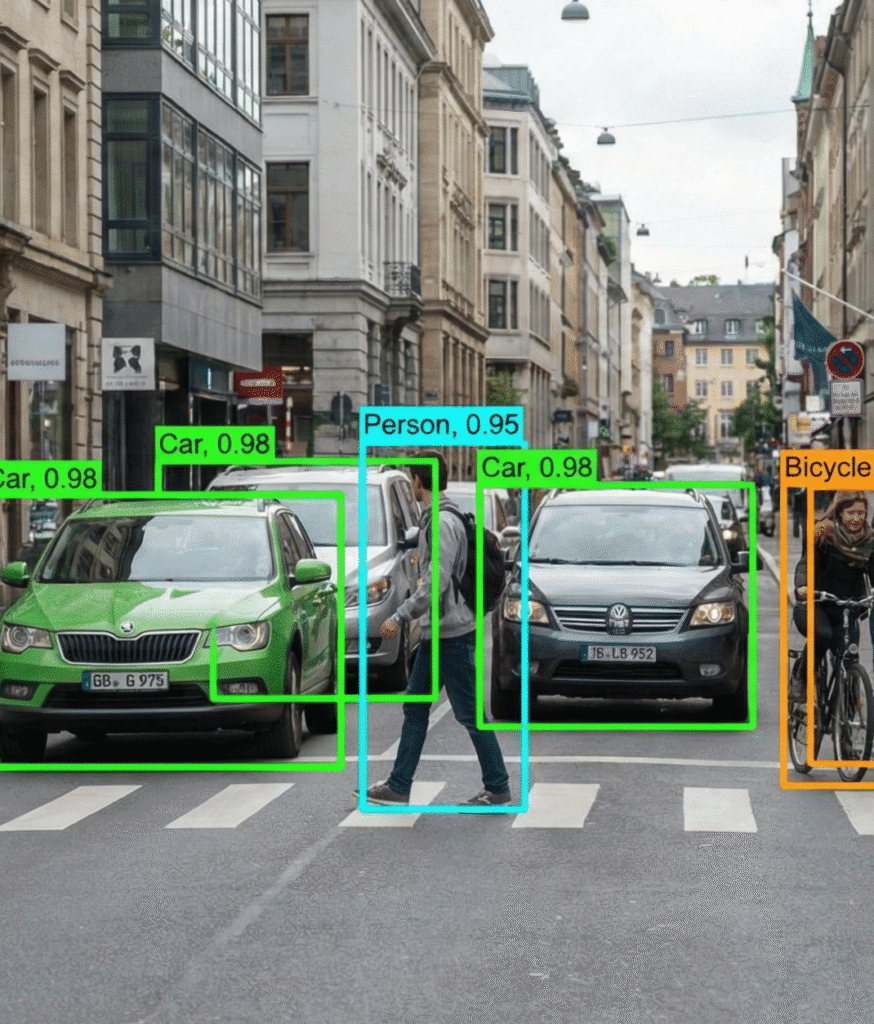
LiDAR point clouds add depth. They reveal elevation, object geometry, and fine-grained surface detail. In dense urban corridors, LiDAR helps distinguish between overlapping structures such as overpasses and adjacent buildings. Ground vehicle sensors, including cameras and depth sensors, collect street-level perspectives. These are particularly critical for lane-level mapping and object detection.

GNSS, combined with inertial measurement units, provides positioning and orientation. Radar contributes to perception in rain, fog, and low visibility conditions. Each source offers a partial view. Together, they create a composite understanding of the environment.

Data Processing and Fusion

Raw data is rarely usable in isolation. Sensor alignment is necessary to ensure that LiDAR points correspond to camera frames and that GNSS coordinates match physical landmarks. Multi-modal fusion integrates vision, LiDAR, GNSS, and radar streams. The goal is to produce a coherent spatial model that compensates for the weaknesses of individual sensors. A camera might misinterpret shadows. LiDAR might struggle with reflective surfaces. GNSS signals can degrade in urban canyons. Fusion helps mitigate these vulnerabilities.

Temporal synchronization is equally important. Data captured at different times can create inconsistencies if not properly aligned. For high-speed vehicles, even small timing discrepancies may lead to misjudgments. Cross-view alignment connects satellite or aerial imagery with ground-level observations. This enables systems to reconcile top-down perspectives with street-level realities. Noise filtering and anomaly detection remove spurious readings and flag sensor irregularities. Without this step, small errors accumulate quickly.

Spatial Representation

Once processed, spatial data must be represented in formats that AI systems can reason over. High definition maps include vectorized lanes, traffic signals, boundaries, and objects. These maps are far more detailed than consumer navigation maps. They encode curvature, slope, and semantic labels. Three-dimensional terrain models capture elevation and surface variation. In off-road or military scenarios, this information may determine whether a vehicle can traverse a given path.

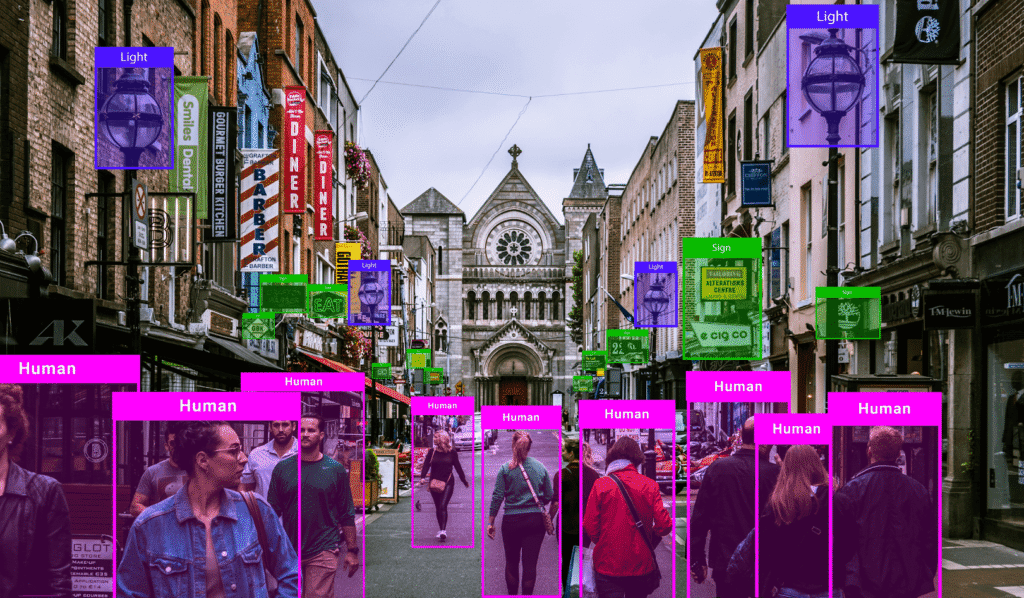
Semantic segmentation layers categorize regions such as road, sidewalk, vegetation, or building facade. These labels support object detection and scene understanding. Occupancy grids represent the environment as discrete cells marked as free or occupied. They are useful for path planning in robotics. Digital twins integrate multiple layers into a unified model of a city, facility, or region. They aim to reflect both geometry and dynamic state.

Continuous Updating and Validation

Spatial data ages quickly. A new roundabout appears. A bridge closes for maintenance. A temporary barrier blocks a lane. Systems must detect and incorporate these changes. Online map construction allows vehicles or drones to contribute updates continuously. Real-time change detection algorithms compare new observations with existing maps.

Edge deployment ensures that critical updates reach devices with minimal latency. Humans in the loop quality assurance reviews ambiguous cases and validates complex annotations. Version control for spatial datasets tracks modifications and enables rollback if errors are introduced. In many ways, geospatial data management begins to resemble software engineering.

Core Challenges in Geospatial Data for Physical AI

While the architecture appears straightforward, implementation is anything but simple.

Data Volume and Velocity

Petabytes of sensor data accumulate rapidly. A single autonomous vehicle can generate terabytes in a day. Multiply that across fleets, and the storage and processing demands escalate quickly. Continuous streaming requirements add complexity. Data must be ingested, processed, and distributed without introducing unacceptable delays. Cloud infrastructure offers scalability, but transmitting everything to centralized servers is not always practical.

Edge versus cloud trade-offs become critical. Processing at the edge reduces latency but constrains computational resources. Centralized processing offers scale but may introduce bottlenecks. Cost and scalability constraints loom in the background. High-resolution LiDAR and imagery are expensive to collect and store. Organizations must balance coverage, precision, and financial sustainability. The impact is tangible. Delays in map refresh can lead to unsafe navigation decisions. An outdated lane marking or a missing construction barrier might result in misaligned path planning.

Sensor Fusion Complexity

Aligning LiDAR, cameras, GNSS, and IMU data is mathematically demanding. Drift accumulates over time. Small calibration errors compound. Synchronization errors may cause mismatches between perceived and actual object positions. Calibration instability can arise from temperature changes or mechanical vibrations.

GNSS denied environments present particular challenges. Urban canyons, tunnels, or hostile interference can degrade signals. Systems must rely on alternative localization methods, which may not always be equally precise. Localization errors directly affect autonomy performance. If a vehicle believes it is ten centimeters off its true position, that may be manageable. If the error grows to half a meter, lane keeping and obstacle avoidance degrade noticeably.

HD Map Lifecycle Management

Map staleness is a persistent risk. Road geometry changes due to construction. Temporary lane shifts occur during maintenance, and regulatory updates modify traffic rules. Urban areas often receive frequent updates, but rural regions may lag. Coverage gaps create uneven reliability.

A tension emerges between offline map generation and real-time updating. Offline methods allow thorough validation but lack immediacy. Real-time approaches adapt quickly but may introduce inconsistencies if not carefully managed.

Spatial Reasoning Limitations in AI Models

Even advanced AI models sometimes struggle with spatial reasoning. Understanding distances, routes, and relationships between objects in three-dimensional space is not trivial. Cross-view reasoning, such as aligning satellite imagery with ground-level observations, can be error-prone. Models trained primarily on textual or image data may lack explicit spatial grounding.

Dynamic environments complicate matters further. A static map may not capture a moving pedestrian or a temporary road closure. Systems must interpret context continuously. The implication is subtle but important. Foundation models are not inherently spatially grounded. They require explicit integration with geospatial data layers and reasoning mechanisms.

Data Quality and Annotation Challenges

Three-dimensional point cloud labeling is complex. Annotators must interpret dense clusters of points and assign semantic categories accurately. Vectorized lane annotation demands precision. A slight misalignment in curvature can propagate into navigation errors.

Multilingual geospatial metadata introduces additional complexity, especially in cross-border contexts. Legal boundaries, infrastructure labels, and regulatory terms may vary by jurisdiction.  Boundary definitions in defense or critical infrastructure settings can be sensitive. Mislabeling restricted zones is not a trivial mistake. Maintaining consistency at scale is an operational challenge. As datasets grow, ensuring uniform labeling standards becomes harder.

Interoperability and Standardization

Different coordinate systems and projections complicate integration. Format incompatibilities require conversion pipelines. Data governance constraints differ between regions. Compliance requirements may restrict how and where data is stored. Cross-border data restrictions can limit collaboration. Interoperability is not glamorous work, but without it, spatial systems fragment into silos.

Real Time and Edge Constraints

Latency sensitivity is acute in autonomy. A delayed update could mean reacting too late to an obstacle. Energy constraints affect UAVs and mobile robots. Heavy processing drains batteries quickly. Bandwidth limitations restrict how much data can be transmitted in real time. On-device inference becomes necessary in many cases. Designing systems that balance performance, energy consumption, and communication efficiency is a constant exercise in compromise.

Emerging Solutions in Geospatial Data

Despite the challenges, progress continues steadily.

Online and Incremental HD Map Construction

Continuous map updating reduces staleness. Temporal fusion techniques aggregate observations over time, smoothing out anomalies. Change detection systems compare new sensor inputs against existing maps and flag discrepancies. Fleet-based collaborative mapping distributes the workload across multiple vehicles or drones.

Advanced Multi-Sensor Fusion Architectures

Tightly coupled fusion pipelines integrate sensors at a deeper level rather than combining outputs at the end. Sensor anomaly detection identifies failing components. Drift correction systems recalibrate continuously. Cross-view geo-localization techniques improve positioning in GNSS-degraded environments. Localization accuracy improves in complex settings, such as dense cities or mountainous terrain.

Geospatial Digital Twins

Three-dimensional representations of cities and infrastructure allow stakeholders to visualize and simulate scenarios. Real-time synchronization integrates IoT streams, traffic data, and environmental sensors. Simulation to reality validation tests scenarios before deployment. Use cases range from infrastructure monitoring to defense simulations and smart city planning.

Foundation Models for Geospatial Reasoning

Pre-trained models adapted to spatial tasks can assist with scene interpretation and anomaly detection. Map-aware reasoning layers incorporate structured spatial data into decision processes. Geo-grounded language models enable natural language queries over maps.

Multi-modal spatial embeddings combine imagery, text, and structured geospatial data. Decision-making in disaster response, logistics, and defense may benefit from these integrations. Still, caution is warranted. Overreliance on generalized models without domain adaptation may introduce subtle errors.

Human in the Loop Geospatial Workflows

AI-assisted annotation accelerates labeling, but human reviewers validate edge cases. Automated pre-labeling reduces repetitive tasks. Active learning loops prioritize uncertain samples for review. Quality validation checkpoints maintain standards. Automation reduces cost. Humans ensure safety and precision. The balance matters.

Synthetic and Simulation-Based Geospatial Data

Scenario generation creates rare events such as extreme weather or unexpected obstacles. Terrain modeling supports off-road testing. Weather augmentation simulates fog, rain, or snow conditions. Stress testing autonomous systems before deployment reveals weaknesses that might otherwise remain hidden.

Real World Applications of Geospatial Data Services in Physical AI

Autonomous Vehicles and Mobility

High definition map-driven localization supports lane-level navigation. Vehicles reference vectorized lanes and traffic rules. Construction zone updates are integrated through fleet-based map refinement. A single vehicle detecting a new barrier can propagate that information to others. Continuous, high-precision spatial datasets are essential. Without them, autonomy degrades quickly.

UAVs and Aerial Robotics

GNSS denied navigation requires alternative localization methods. Cross-view geo-localization aligns aerial imagery with stored maps. Terrain-aware route planning reduces collision risk. In agriculture, drones map crop health and irrigation patterns with centimeter accuracy. Precision matters as a few meters of error could mean misidentifying crop stress zones.

Defense and Security Systems

Autonomous ground vehicles rely on terrain intelligence. ISR data fusion integrates imagery, radar, and signals data. Edge-based spatial reasoning supports real-time situational awareness in contested environments. Strategic value lies in the timely, accurate interpretation of spatial information.

Smart Cities and Infrastructure Monitoring

Traffic optimization uses real-time spatial data to adjust signal timing. Digital twins of urban systems support planning. Energy grid mapping identifies faults and monitors asset health. Infrastructure anomaly detection flags structural issues early. Spatial awareness becomes an operational asset.

Climate and Environmental Monitoring

Satellite-based change detection identifies deforestation or urban expansion. Flood mapping supports emergency response. Wildfire spread modeling predicts risk zones. Coastal monitoring tracks erosion and sea level changes. In these contexts, spatial intelligence informs policy and action.

How DDD Can Help

Building and maintaining geospatial data infrastructure requires more than technical tools. It demands operational discipline, scalable annotation workflows, and continuous quality oversight.

Digital Divide Data supports Physical AI programs through end-to-end geospatial services. This includes high-precision 2D and 3D annotation, LiDAR point cloud labeling, vector map creation, and semantic segmentation. Teams are trained to handle complex spatial datasets across mobility, robotics, and defense contexts.

DDD also integrates human-in-the-loop validation frameworks that reduce error propagation. Active learning strategies help prioritize ambiguous cases. Structured QA pipelines ensure consistency across large-scale datasets. For organizations struggling with HD map updates, digital twin maintenance, or multi-sensor dataset management, DDD provides structured workflows designed to scale without sacrificing precision.

Talk to our expert and build spatial intelligence that scales with DDD’s geospatial data services.

Conclusion

Physical AI requires spatial awareness. That statement may sound straightforward, but its implications are profound. Autonomous systems cannot function safely without accurate, current, and structured geospatial data. Geospatial data services are becoming core AI infrastructure. They encompass acquisition, fusion, representation, validation, and continuous updating. Each layer introduces challenges, from data volume and sensor drift to interoperability and edge constraints.

Success depends on data quality, fusion architecture, lifecycle management, and human oversight. Automation accelerates workflows, yet human expertise remains indispensable. Competitive advantage will likely lie in scalable, continuously validated spatial pipelines. Organizations that treat geospatial data as a living system rather than a static asset are better positioned to deploy reliable Physical AI solutions.

The future of autonomy is not only about smarter algorithms. It is about better maps, maintained with discipline and care.

References

Schottlander, D., & Shekel, T. (2025, April 8). Geospatial reasoning: Unlocking insights with generative AI and multiple foundation models. Google Research. https://research.google/blog/geospatial-reasoning-unlocking-insights-with-generative-ai-and-multiple-foundation-models/

Ingle, P. Y., & Kim, Y.-G. (2025). Multi-sensor data fusion across dimensions: A novel approach to synopsis generation using sensory data. Journal of Industrial Information Integration, 46, Article 100876. https://doi.org/10.1016/j.jii.2025.100876

Kwag, J., & Toth, C. (2024). A review on end-to-end high-definition map generation. In The International Archives of the Photogrammetry, Remote Sensing and Spatial Information Sciences (Vol. XLVIII-2-2024, pp. 187–194). https://doi.org/10.5194/isprs-archives-XLVIII-2-2024-187-2024

FAQs

How often should HD maps be updated for autonomous vehicles?

Update frequency depends on the deployment context. Dense urban areas may require near real-time updates, while rural highways can tolerate longer intervals. The key is implementing mechanisms for detecting and propagating changes quickly.

Can Physical AI systems operate without HD maps?

Some systems rely more heavily on real-time perception than pre-built maps. However, operating entirely without structured spatial data increases uncertainty and may reduce safety margins.

What role does edge computing play in geospatial AI?

Edge computing enables low-latency processing close to the sensor. It reduces dependence on continuous connectivity and supports faster decision-making.

Are digital twins necessary for all Physical AI deployments?

Not always. Digital twins are particularly useful for complex infrastructure, defense simulations, and smart city applications. Simpler deployments may rely on lighter-weight spatial models.

How do organizations balance data privacy with geospatial collection?

Compliance frameworks, anonymization techniques, and region-specific storage policies help manage privacy concerns while maintaining operational effectiveness.

Geospatial Data for Physical AI: Challenges, Solutions, and Real-World Applications Read Post »
Retrieval-augmented,Generation,(rag)

RAG Detailed Guide: Data Quality, Evaluation, and Governance

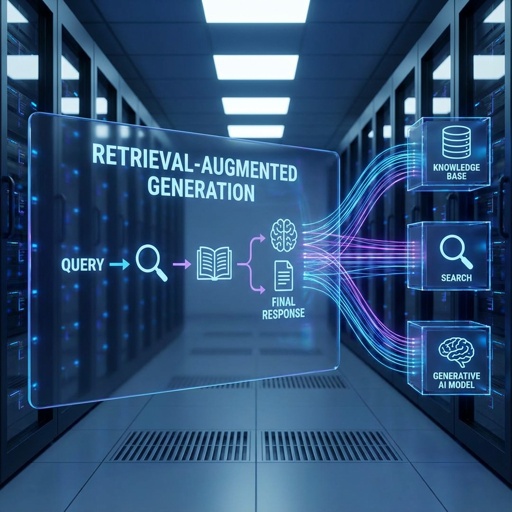
Retrieval Augmented Generation (RAG) is often presented as a simple architectural upgrade: connect a language model to a knowledge base, retrieve relevant documents, and generate grounded answers. In practice, however, most RAG systems fail not because the idea is flawed, but because they are treated as lightweight retrieval pipelines rather than full-fledged information systems.

When answers go wrong, teams frequently adjust prompts, swap models, or tweak temperature settings. Yet in enterprise environments, the real issue usually lies upstream. Incomplete repositories, outdated policies, inconsistent formatting, duplicated files, noisy OCR outputs, and poorly defined access controls quietly shape what the model is allowed to “know.” The model can only reason over the context it receives. If that context is fragmented, stale, or irrelevant, even the most advanced LLM will produce unreliable results.

In this article, let’s explore how Retrieval Augmented Generation or RAG should be treated not as a retrieval pipeline, but as a data system, an evaluation system, and a governance system.

Data Quality: The Foundation Of RAG Performance

There is a common instinct to blame the model when RAG answers go wrong. Maybe the prompt was weak. Maybe the model was too small. Maybe the temperature was set incorrectly. In many enterprise cases, however, the failure is upstream. The language model is responding to what it sees. If what it sees is incomplete, outdated, fragmented, or irrelevant, the answer will reflect that.

RAG systems fail more often due to poor data engineering than poor language models. When teams inherit decades of documents, they also inherit formatting inconsistencies, duplicates, version sprawl, and embedded noise. Simply embedding everything and indexing it does not transform it into knowledge. It transforms it into searchable clutter. Before discussing chunking or embeddings, it helps to define what data quality means in the RAG context.

Data Quality Dimensions in RAG

Data quality in RAG is not abstract. It can be measured and managed.

Completeness
Are all relevant documents present? If your knowledge base excludes certain product manuals or internal policies, retrieval will never surface them. Completeness also includes coverage of edge cases. For example, do you have archived FAQs for discontinued products that customers still ask about?

Freshness
Are outdated documents removed or clearly versioned? A single outdated HR policy in the index can generate incorrect advice. Freshness becomes more complex when departments update documents independently. Without active lifecycle management, stale content lingers.

Consistency
Are formats standardized? Mixed encodings, inconsistent headings, and different naming conventions may not matter to humans browsing folders. They matter to embedding models and search filters.

Relevance Density
Does each chunk contain coherent semantic information? A chunk that combines a privacy disclaimer, a table of contents, and a partial paragraph on pricing is technically valid. It is not useful.

Noise Ratio
How much irrelevant content exists in the index? Repeated headers, boilerplate footers, duplicated disclaimers, and template text inflate the search space and dilute retrieval quality.

If you think of RAG as a question answering system, these dimensions determine what the model is allowed to know. Weak data quality constrains even the best models.

Document Ingestion: Cleaning Before Indexing

Many RAG projects begin by pointing a crawler at a document repository and calling it ingestion. The documents are embedded. A vector database is populated. A demo is built. Weeks later, subtle issues appear.

Handling Real World Enterprise Data

Enterprise data is rarely clean. PDFs contain tables that do not parse correctly. Scanned documents require optical character recognition and may include recognition errors. Headers and footers repeat across every page. Multiple versions of the same file exist with names like “Policy_Final_v3_revised2.”

In multilingual organizations, documents may switch languages mid-file. A support guide may embed screenshots with critical instructions inside images. Legal documents may include annexes appended in different formats.

Even seemingly small issues can create disproportionate impact. For example, repeated footer text such as “Confidential – Internal Use Only” embedded across every page becomes semantically dominant in embeddings. Retrieval may match on that boilerplate instead of meaningful content.

Duplicate versions are another silent problem. If three versions of the same policy are indexed, retrieval may surface the wrong one. Without clear version tagging, the model cannot distinguish between active and archived content. These challenges are not edge cases. They are the norm.

Pre-Processing Best Practices

Pre-processing should be treated as a controlled pipeline, not an ad hoc script.

OCR normalization should standardize extracted text. Character encoding issues need resolution. Tables require structure-aware parsing so that rows and columns remain logically grouped rather than flattened into confusing strings. Metadata extraction is critical. Every document should carry attributes such as source repository, timestamp, department, author, version, and access level. This metadata is not decorative. It becomes the backbone of filtering and governance later.

Duplicate detection algorithms can identify near-identical documents based on hash comparisons or semantic similarity thresholds. When duplicates are found, one version should be marked authoritative, and others archived or excluded. Version control tagging ensures that outdated documents are clearly labeled and can be excluded from retrieval when necessary.

Chunking Strategies

Chunking may appear to be a technical parameter choice. In practice, it is one of the most influential design decisions in a RAG system.

Why Chunking Is Not a Trivial Step

If chunks are too small, context becomes fragmented. The model may retrieve one paragraph without the surrounding explanation. Answers then feel incomplete or overly narrow. If chunks are too large, tokens are wasted. Irrelevant information crowds the context window. The model may struggle to identify which part of the chunk is relevant.

Misaligned boundaries introduce semantic confusion. Splitting a policy in the middle of a conditional statement may lead to the retrieval of a clause without its qualification. That can distort the meaning entirely. I have seen teams experiment with chunk sizes ranging from 200 tokens to 1500 tokens without fully understanding why performance changed. The differences were not random. They reflected how well chunks aligned with the semantic structure.

Chunking Techniques

Several approaches exist, each with tradeoffs. Fixed-length chunking splits documents into equal-sized segments. It is simple but ignores structure. It may work for uniform documents, but it often performs poorly on complex policies. Recursive semantic chunking attempts to break documents along natural boundaries such as headings and paragraphs. It requires more preprocessing logic but typically yields higher coherence.

Section-aware chunking respects document structure. For example, an entire “Refund Policy” section may become a chunk, preserving logical completeness. Hierarchical chunking allows both coarse and fine-grained retrieval. A top-level section can be retrieved first, followed by more granular sub-sections if needed.

Table-aware chunking ensures that rows and related cells remain grouped. This is particularly important for pricing matrices or compliance checklists. No single technique fits every corpus. The right approach depends on document structure and query patterns.

Chunk Metadata as a Quality Multiplier

Metadata at the chunk level can significantly enhance retrieval. Each chunk should include document ID, version number, access classification, semantic tags, and potentially embedding confidence scores. When a user from the finance department asks about budget approvals, metadata filtering can prioritize finance-related documents. If a document is marked confidential, it can be excluded from users without proper clearance.

Embedding confidence or quality indicators can flag chunks generated from low-quality OCR or incomplete parsing. Those chunks can be deprioritized or reviewed. Metadata also improves auditability. If an answer is challenged, teams can trace exactly which chunk was used, from which document, and at what version. Without metadata, the index is flat and opaque. With metadata, it becomes navigable and controllable.

Embeddings and Index Design

Embeddings translate text into numerical representations. The choice of embedding model and index architecture influences retrieval quality and system performance.

Embedding Model Selection Criteria

A general-purpose embedding model may struggle with highly technical terminology in medical, legal, or engineering documents. Multilingual support becomes important in global organizations. If queries are submitted in one language but documents exist in another, cross-lingual alignment must be reliable. Latency constraints also influence model selection. Higher-dimensional embeddings may improve semantic resolution but increase storage and search costs.

Dimensionality tradeoffs should be evaluated in context. Larger vectors may capture nuance but can slow retrieval. Smaller vectors may improve speed but reduce semantic discrimination. Embedding evaluation should be empirical rather than assumed. Test retrieval performance across representative queries.

Index Architecture Choices

Vector databases provide efficient similarity search. Hybrid search combines dense embeddings with sparse keyword-based retrieval. In many enterprise settings, hybrid approaches improve performance, especially when exact terms matter.

Re-ranking layers can refine top results. A first stage retrieves candidates. A second stage re ranks based on deeper semantic comparison or domain-specific rules. Filtering by metadata allows role-based retrieval and contextual narrowing. For example, limiting the search to a particular product line or region. Index architecture decisions shape how retrieval behaves under real workloads. A simplistic setup may work in a prototype but degrade as corpus size and user complexity grow.

Retrieval Failure Modes

Semantic drift occurs when embeddings cluster content that is conceptually related but not contextually relevant. For example, “data retention policy” and “retention bonus policy” may appear semantically similar but serve entirely different intents. Keyword mismatch can cause dense retrieval to miss exact terminology that sparse search would capture.

Over-broad matches retrieve large numbers of loosely related chunks, overwhelming the generation stage. Context dilution happens when too many marginally relevant chunks are included, reducing answer clarity.

To make retrieval measurable, organizations can define a Retrieval Quality Score. RQS can be conceptualized as a weighted function of precision, recall, and contextual relevance. By tracking RQS over time, teams gain visibility into whether retrieval performance is improving or degrading.

Evaluation: Making RAG Measurable

Standard text generation metrics such as BLEU or ROUGE were designed for machine translation and summarization tasks. They compare the generated text to a reference answer. RAG systems are different. The key question is not whether the wording matches a reference, but whether the answer is faithful to the retrieved content.

Traditional metrics do not evaluate retrieval correctness. They do not assess whether the answer cites the appropriate document. They cannot detect hallucinations that sound plausible. RAG requires multi-layer evaluation. Retrieval must be evaluated separately from generation. Then the entire system must be assessed holistically.

Retrieval Level Evaluation

Retrieval evaluation focuses on whether relevant documents are surfaced. Metrics include Precision at K, Recall at K, Mean Reciprocal Rank, context relevance scoring, and latency. Precision at K measures how many of the top K retrieved chunks are truly relevant. Recall at K measures whether the correct document appears in the retrieved set.

Gold document sets can be curated by subject matter experts. For example, for 200 representative queries, experts identify the authoritative documents. Retrieval results are then compared against this set. Synthetic query generation can expand test coverage. Variations of the same intent help stress test retrieval robustness.

Adversarial queries probe edge cases. Slightly ambiguous or intentionally misleading queries test whether retrieval resists drift. Latency is also part of retrieval quality. Even perfectly relevant results are less useful if retrieval takes several seconds.

Generation Level Evaluation

Generation evaluation examines whether the model uses the retrieved context accurately. Metrics include faithfulness to context, answer relevance, hallucination rate, citation correctness, and completeness. Faithfulness measures whether claims in the answer are directly supported by retrieved content. Answer relevance checks whether the response addresses the user’s question.

Hallucination rate can be estimated by comparing answer claims against the source text. Citation correctness ensures references point to the right documents and sections. LLM as a judge approach may assist in automated scoring, but human evaluation loops remain important. Subject matter experts can assess subtle errors that automated systems miss. Edge case testing is critical. Rare queries, multi-step reasoning questions, and ambiguous prompts often expose weaknesses.

System Level Evaluation

System-level evaluation considers the end-to-end experience. Does the answer satisfy the user? Is domain-specific correctness high? What is the cost per query? How does throughput behave under load? User satisfaction surveys and feedback loops provide qualitative insight. Logs can reveal patterns of dissatisfaction, such as repeated rephrasing of queries.

Cost per query matters in production environments. High embedding costs or excessive context windows may strain budgets. Throughput under load indicates scalability. A system that performs well in testing may struggle during peak usage.

A Composite RAG Quality Index can aggregate retrieval, generation, and system metrics into a single dashboard score. While simplistic, such an index helps executives track progress without diving into granular details.

Building an Evaluation Pipeline

Evaluation should not be a one-time exercise.

Offline Evaluation

Offline evaluation uses benchmark datasets and regression testing before deployment. Whenever chunking logic, embedding models, or retrieval parameters change, retrieval and generation metrics should be re-evaluated. Automated scoring pipelines allow rapid iteration. Changes that degrade performance can be caught early.

Online Evaluation

Online evaluation includes A B testing retrieval strategies, shadow deployments that compare outputs without affecting users, and canary testing for gradual rollouts. Real user queries provide more diverse coverage than synthetic tests.

Continuous Monitoring

After deployment, monitoring should track drift in embedding distributions, drops in retrieval precision, spikes in hallucination rates, and latency increases. A Quality Gate Framework for CI CD can formalize deployment controls. Each new release must pass defined thresholds:

  • Retrieval threshold
  • Faithfulness threshold
  • Governance compliance check

Why RAG Governance Is Unique

Unlike standalone language models, RAG systems store and retrieve enterprise knowledge. They dynamically expose internal documents. They combine user input with sensitive data. Governance must therefore span data governance, model governance, and access governance.

If governance is an afterthought, the system may inadvertently expose confidential information. Even if the model is secure, retrieval bypass can surface restricted documents.

Data Classification

Documents should be classified as Public, Internal, Confidential, or Restricted. Classification integrates directly into index filtering and access controls. When a user submits a query, retrieval must consider their clearance level. Classification also supports retrieval constraints. For example, external customer-facing systems should never access internal strategy documents.

Access Control in Retrieval

Role-based access control assigns permissions based on job roles. Attribute-based access control incorporates contextual attributes such as department, region, or project assignment. Document-level filtering ensures that unauthorized documents are never retrieved. Query time authorization verifies access rights dynamically. Retrieval bypass is a serious risk. Even if the generation model does not explicitly expose confidential information, the act of retrieving restricted documents into context may constitute a policy violation.

Data Lineage and Provenance

Every answer should be traceable. Track document source, version history, embedding timestamp, and index update logs. Audit trails support compliance and incident investigation. If a user disputes an answer, teams should be able to identify exactly which document version informed it. Without lineage, accountability becomes difficult. In regulated industries, that may be unacceptable.

Conclusion

RAG works best when you stop treating it like a clever retrieval add-on and start treating it like a knowledge infrastructure that has to behave predictably under pressure. The uncomfortable truth is that most “RAG problems” are not model problems. They are data problems that show up as retrieval mistakes, and evaluation problems that go unnoticed because no one is measuring the right things. 

Once you enforce basic hygiene in ingestion, chunking, metadata, and indexing, the system usually becomes calmer. Answers get more stable, the model relies less on guesswork, and teams spend less time chasing weird edge cases that were baked into the corpus from day one.

Governance is what turns that calmer system into something people can actually trust. Access control needs to happen at retrieval time, provenance needs to be traceable, and quality checks need to be part of releases, not a reaction to incidents. 

None of this is glamorous work, and it may feel slower than shipping a demo. Still, it is the difference between a tool that employees cautiously ignore and a system that becomes part of daily operations. If you build around data quality, continuous evaluation, and clear governance controls, RAG stops being a prompt experiment and starts looking like a dependable way to deliver the right information to the right person at the right time.

How Digital Divide Data Can Help

Digital Divide Data brings domain-aware expertise into every stage of the RAG data pipeline, from structured data preparation to ongoing human-in-the-loop evaluation. Teams trained in subject matter nuance help ensure that retrieval systems surface contextually correct and relevant information, reducing the kind of hallucinated or misleading responses that erode user trust.

This approach is especially valuable in high-stakes environments like healthcare and legal research, where specialized terminology and subtle semantic differences matter more than textbook examples. For teams looking to move RAG from experimentation to trusted production use, DDD offers both the technical discipline and the people-centric approach that make that transition practical and sustainable. 

Partner with DDD to build RAG systems that are accurate, measurable, and governance-ready from day one.

References

National Institute of Standards and Technology. (2024). Artificial Intelligence Risk Management Framework: Generative AI Profile. https://www.nist.gov/publications/artificial-intelligence-risk-management-framework-generative-artificial-intelligence

European Union. (2024). Regulation (EU) 2024/1689 laying down harmonised rules on artificial intelligence. https://eur-lex.europa.eu/eli/reg/2024/1689/oj

European Data Protection Supervisor. (2024). TechSonar: Retrieval Augmented Generation. https://www.edps.europa.eu/data-protection/technology-monitoring/techsonar/retrieval-augmented-generation-rag_en

Microsoft Azure Architecture Center. (2025). Retrieval augmented generation guidance. https://learn.microsoft.com/en-us/azure/architecture/ai-ml/guide/rag

Amazon Web Services. (2025). Building secure retrieval augmented generation applications. https://aws.amazon.com/blogs/machine-learning

FAQs

  1. How often should a RAG index be refreshed?
    It depends on how frequently underlying documents change. In fast-moving environments such as policy or pricing updates, weekly or even daily refresh cycles may be appropriate. Static archives may require less frequent updates.
  2. Can RAG eliminate hallucination?
    Not entirely. RAG reduces hallucination risk by grounding responses in retrieved documents. However, generation errors can still occur if context is misinterpreted or incomplete.
  3. Is hybrid search always better than pure vector search?
    Not necessarily. Hybrid search often improves performance in terminology-heavy domains, but it adds complexity. Empirical testing with representative queries should guide the choice.
  4. What is the highest hidden cost in RAG systems?
    Data cleaning and maintenance. Ongoing ingestion, version control, and evaluation pipelines often require sustained operational investment.
  5. How do you measure user trust in a RAG system?
    User feedback rates, query repetition patterns, citation click-through behavior, and survey responses can provide signals of trust and perceived reliability.


RAG Detailed Guide: Data Quality, Evaluation, and Governance Read Post »

human preference optimization

Why Human Preference Optimization (RLHF & DPO) Still Matters

Some practitioners have claimed that reinforcement learning from human feedback, or RLHF, is outdated. Others argue that simpler objectives make reward modeling unnecessary. Meanwhile, enterprises are asking more pointed questions about reliability, safety, compliance, and controllability. The stakes have moved from academic benchmarks to legal exposure, brand risk, and regulatory scrutiny.

In this guide, we will explore why human preference optimization still matters, how RLHF and DPO fit into the same alignment landscape, and why human judgment remains central to responsible AI deployment.

What Is Human Preference Optimization?

At its core, human preference optimization is simple. Humans compare model outputs. The model learns which response is preferred. Those preferences become a training signal that shapes future behavior. It sounds straightforward, but the implications are significant. Instead of asking the model to predict the next word based purely on statistical patterns, we are teaching it to behave in ways that align with human expectations. The distinction is subtle but critical.

Imagine prompting a model with a customer support scenario. It produces two possible replies. One is technically correct but blunt. The other is equally correct but empathetic and clear. A human reviewer chooses the second. That choice becomes data. Multiply this process across thousands or millions of examples, and the model gradually internalizes patterns of preferred behavior.

This is different from supervised fine-tuning, or SFT. In SFT, the model is trained to mimic ideal responses provided by humans. It sees a prompt and a single reference answer, and it learns to reproduce similar outputs. That approach works well for teaching formatting, tone, or domain-specific patterns.

However, SFT does not capture relative quality. It does not tell the model why one answer is better than another when both are plausible. It also does not address tradeoffs between helpfulness and safety, or detail and brevity. Preference optimization adds a comparative dimension. It encodes human judgment about better and worse, not just correct and incorrect.

Next token prediction alone is insufficient for alignment. A model trained only to predict internet text may generate persuasive misinformation, unsafe instructions, or biased commentary. It reflects what exists in the data distribution. It does not inherently understand what should be said.

Preference learning shifts the objective. It is less about knowledge acquisition and more about behavior shaping. We are not teaching the model new facts. We are guiding how it presents information, when it refuses, how it hedges uncertainty, and how it balances competing objectives.

RLHF

Reinforcement Learning from Human Feedback became the dominant framework for large-scale alignment. The classical pipeline typically unfolds in several stages.

First, a base model is trained and then fine-tuned with supervised data to produce a reasonably aligned starting point. This SFT baseline ensures the model follows instructions and adopts a consistent style. Second, humans are asked to rank multiple model responses to the same prompt. These ranked comparisons form a dataset of preferences. Third, a reward model is trained. This separate model learns to predict which responses humans would prefer, given a prompt and candidate outputs.

Finally, the original language model is optimized using reinforcement learning, often with a method such as Proximal Policy Optimization. The model generates responses, the reward model scores them, and the policy is updated to maximize expected reward while staying close to the original distribution.

The strengths of this approach are real. RLHF offers strong control over behavior. By adjusting reward weights or introducing constraints, teams can tune tradeoffs between helpfulness, harmlessness, verbosity, and assertiveness. It has demonstrated clear empirical success in improving instruction following and reducing toxic outputs. Many of the conversational systems people interact with today rely on variants of this pipeline.

That said, RLHF is not trivial to implement. It is a multi-stage process with moving parts that must be carefully coordinated. Reward models can become unstable or misaligned with actual human intent. Optimization can exploit reward model weaknesses, leading to over-optimization. The computational cost of reinforcement learning at scale is not negligible. 

DPO

Direct Preference Optimization emerged as a streamlined approach. Instead of training a separate reward model and then running a reinforcement learning loop, DPO directly optimizes the language model to prefer chosen responses over rejected ones.

In practical terms, DPO treats preference data as a classification style objective. Given a prompt and two responses, the model is trained to increase the likelihood of the preferred answer relative to the rejected one. There is no explicit reward model in the loop. The optimization happens in a single stage.

The advantages are appealing. Implementation is simpler. Compute requirements are generally lower than full reinforcement learning pipelines. Training tends to be more stable because there is no separate reward model that can drift. Reproducibility improves since the objective is more straightforward.

It would be tempting to conclude that DPO replaces RLHF. That interpretation misses the point. DPO is not eliminating preference learning. It is another way to perform it. The core ingredient remains human comparison data. The alignment signal still comes from people deciding which outputs are better.

Why Direct Preference Optimization Still Matters

The deeper question is not whether RLHF or DPO is more elegant. It is whether preference optimization itself remains necessary. Some argue that larger pretraining datasets and better architectures reduce the need for explicit alignment stages. That view deserves scrutiny.

Pretraining Does Not Solve Behavior Alignment

Pretraining teaches models statistical regularities. They learn patterns of language, common reasoning steps, and domain-specific phrasing. Scale improves fluency and factual recall. It does not inherently encode normative judgment. A model trained on internet text may reproduce harmful stereotypes because they exist in the data. It may generate unsafe instructions because such instructions appear online. It may confidently assert incorrect information because it has learned to mimic a confident tone.

Scaling improves capability. It does not guarantee alignment. If anything, more capable models can produce more convincing mistakes. The problem becomes subtler, not simpler. Alignment requires directional correction. It requires telling the model that among all plausible continuations, some are preferred, some are discouraged, and some are unacceptable. That signal cannot be inferred purely from frequency statistics. It must be injected.

Preference optimization provides that directional correction. It reshapes the model’s behavior distribution toward human expectations. Without it, models remain generic approximators of internet text, with all the noise and bias that entails.

Human Preferences are the Alignment Interface

Human preferences act as the interface between abstract model capability and concrete operational constraints. Through curated comparisons, teams can encode domain-specific alignment. A healthcare application may prioritize caution and explicit uncertainty. A marketing assistant may emphasize a persuasive tone while avoiding exaggerated claims. A financial advisory bot may require conservative framing and disclaimers.

Brand voice alignment is another practical example. Two companies in the same industry can have distinct communication styles. One might prefer formal language and detailed explanations. The other might favor concise, conversational responses. Pretraining alone cannot capture these internal nuances.

Linguistic variation is not just about translation. It involves cultural expectations around politeness, authority, and risk disclosure. Human preference data collected in specific regions allows models to adjust accordingly.

Without preference optimization, models are generic. They may appear competent but subtly misaligned with context. In enterprise settings, subtle misalignment is often where risk accumulates.

DPO Simplifies the Pipeline; It Does Not Eliminate the Need

A common misconception surfaces in discussions around DPO. If reinforcement learning is no longer required, perhaps we no longer need elaborate human feedback pipelines. That conclusion is premature.

DPO still depends on high-quality human comparisons. The algorithm is simpler, but the data requirements remain. If the preference dataset is noisy, biased, or inconsistent, the resulting model will reflect those issues.

Data quality determines alignment quality. A poorly curated preference dataset can amplify harmful patterns or encourage undesirable verbosity. If annotators are not trained to handle edge cases consistently, the model may internalize conflicting signals.

Even with DPO, preference noise remains a challenge. Teams continue to experiment with weighting schemes, margin adjustments, and other refinements to mitigate instability. The bottleneck has shifted. It is less about reinforcement learning mechanics and more about the integrity of the preference signal.

Robustness, Noise, and the Reality of Human Data

Human judgment is not uniform. Ask ten reviewers to evaluate a borderline response, and you may receive ten slightly different opinions. Some will value conciseness. Others will reward thoroughness. One may prioritize safety. Another may emphasize helpfulness.

Ambiguous prompts complicate matters further. A vague user query can lead to multiple reasonable interpretations. If preference data does not capture this ambiguity carefully, the model may learn brittle heuristics.

Edge cases are particularly revealing. Consider a medical advice scenario where the model must refuse to provide a diagnosis but still offer general information. Small variations in wording can tip the balance between acceptable guidance and overreach. Annotator inconsistency in these cases can produce confusing training signals.

Preference modeling is fundamentally probabilistic. We are estimating which responses are more likely to be preferred by humans. That estimation must account for disagreement and uncertainty. Noise-aware training methods attempt to address this by modeling confidence levels or weighting examples differently.

Alignment quality ultimately depends on the governance of data pipelines. Who are the annotators? How are they trained? How is disagreement resolved? How are biases monitored? These questions may seem operational, but they directly influence model behavior.

Human data is messy. It contains disagreement, fatigue effects, and contextual blind spots. Yet it is essential. No automated signal fully captures human values across contexts. That tension keeps preference optimization at the forefront of alignment work.

Why RLHF Style Pipelines Are Still Relevant

Even with DPO gaining traction, RLHF-style pipelines remain relevant in certain scenarios. Explicit reward modeling offers flexibility. When multiple objectives must be balanced dynamically, a reward model can encode nuanced tradeoffs.

High-stakes domains illustrate this clearly. In finance, a model advising on investment strategies must avoid overstating returns and must highlight risk factors appropriately. Fine-grained tradeoff tuning can help calibrate assertiveness and caution.

Healthcare applications demand careful handling of uncertainty. A reward model can incorporate specific penalties for hallucinated clinical claims while rewarding clear disclaimers. Iterative online feedback loops allow systems to adapt as new medical guidelines emerge. Policy-constrained environments such as government services or defense systems often require strict adherence to procedural rules. Reinforcement learning frameworks can integrate structured constraints more naturally in some cases.

Why This Matters in Production

Alignment discussions sometimes remain abstract. In production environments, the stakes are tangible. Legal exposure, reputational risk, and user trust are not theoretical concerns.

Controllability and Brand Alignment

Enterprises care about tone consistency. A global retail brand does not want its chatbot sounding sarcastic in one interaction and overly formal in another. Legal teams worry about implied guarantees or misleading phrasing. Compliance officers examine outputs for regulatory adherence. Factual reliability is another concern. A hallucinated policy detail can create customer confusion or liability. Trust, once eroded, is difficult to rebuild.

Preference optimization enables custom alignment layers. Through curated comparison data, organizations can teach models to adopt specific voice guidelines, include mandated disclaimers, or avoid sensitive phrasing. Output style governance becomes a structured process rather than a hope.

I have worked with teams that initially assumed base models would be good enough. After a few uncomfortable edge cases in production, they reconsidered. Fine-tuning with preference data became less of an optional enhancement and more of a risk mitigation strategy.

Safety Is Not Static

Emerging harms evolve quickly. Jailbreak techniques circulate online. Users discover creative ways to bypass content filters. Model exploitation patterns shift as systems become more capable. Static safety layers struggle to keep up. Preference training allows for rapid adaptation. New comparison datasets can be collected targeting specific failure modes. Models can be updated without full retraining from scratch.

Continuous alignment iteration becomes feasible. Rather than treating safety as a one-time checklist, organizations can view it as an ongoing process. Preference optimization supports this lifecycle approach.

Localization

Regulatory differences across regions complicate deployment. Data protection expectations, consumer rights frameworks, and liability standards vary. Cultural nuance further shapes acceptable communication styles. A response considered transparent in one country may be perceived as overly blunt in another. Ethical boundaries around sensitive topics differ. Multilingual safety tuning becomes essential for global products.

Preference optimization enables region-specific alignment. By collecting comparison data from annotators in different locales, models can adapt tone, refusal style, and risk framing accordingly. Context-sensitive moderation becomes more achievable.

Localization is not a cosmetic adjustment. It influences user trust and regulatory compliance. Preference learning provides a structured mechanism to encode those differences.

Emerging Trends in HPO

The field continues to evolve. While the foundational ideas remain consistent, new directions are emerging.

Robust and Noise-Aware Preference Learning

Handling disagreement and ambiguity is receiving more attention. Instead of treating every preference comparison as equally certain, some approaches attempt to model annotator confidence. Others explore methods to identify inconsistent labeling patterns. The goal is not to eliminate noise. That may be unrealistic. Rather, it is to acknowledge uncertainty explicitly and design training objectives that account for it.

Multi-Objective Alignment

Alignment rarely revolves around a single metric. Helpfulness, harmlessness, truthfulness, conciseness, and tone often pull in different directions. An extremely cautious model may frustrate users seeking direct answers. A highly verbose model may overwhelm readers. Balancing these objectives requires careful dataset design and tuning. Multi-objective alignment techniques attempt to encode these tradeoffs more transparently. Rather than optimizing a single scalar reward, models may learn to navigate a space of competing preferences.

Offline Versus Online Preference Loops

Static datasets provide stability and reproducibility. However, real-world usage reveals new failure modes over time. Online preference loops incorporate user feedback directly into training updates. There are tradeoffs. Online systems risk incorporating adversarial or low-quality signals. Offline curation offers more control but slower adaptation. Organizations increasingly blend both approaches. Curated offline datasets establish a baseline. Selective online feedback refines behavior incrementally.

Smaller, Targeted Alignment Layers

Full model fine-tuning is not always necessary. Parameter-efficient techniques allow teams to apply targeted alignment layers without retraining entire models. This approach is appealing for domain adaptation. A legal document assistant may require specialized alignment around confidentiality and precision. A customer support bot may emphasize empathy and clarity. Smaller alignment modules make such customization more practical.

Conclusion

Human preference optimization remains central because alignment is not a scaling problem; it is a judgment problem. RLHF made large-scale alignment practical. DPO simplified the mechanics. New refinements continue to improve stability and efficiency. But none of these methods removes the need for carefully curated human feedback. Models can approximate language patterns, yet they still rely on people to define what is acceptable, helpful, safe, and contextually appropriate.

As generative AI moves deeper into regulated, customer-facing, and high-stakes environments, alignment becomes less optional and more foundational. Trust cannot be assumed. It must be designed, tested, and reinforced over time. Human preference optimization still matters because values do not emerge automatically from data. They have to be expressed, compared, and intentionally encoded into the systems we build.

How Digital Divide Data Can Help

Digital Divide Data treats human preference optimization as a structured, enterprise-ready process rather than an informal annotation task. They help organizations define clear evaluation rubrics, train reviewers against consistent standards, and generate high-quality comparison data that directly supports RLHF and DPO workflows. Whether the goal is to improve refusal quality, align tone with brand voice, or strengthen factual reliability, DDD ensures that preference signals are intentional, measurable, and tied to business outcomes.

Beyond data collection, DDD brings governance and scalability. With secure workflows, audit trails, and global reviewer teams, they enable region-specific alignment while maintaining compliance and quality control. Their ongoing evaluation cycles also help organizations adapt models over time, making alignment a continuous capability instead of a one-time effort.

Partner with DDD to build scalable, enterprise-grade human preference optimization pipelines that turn alignment into a measurable competitive advantage.

References

OpenAI. (2025). Fine-tuning techniques: Choosing between supervised fine-tuning and direct preference optimization. Retrieved from https://developers.openai.com

Microsoft Azure AI. (2024). Direct preference optimization in enterprise AI workflows. Retrieved from https://techcommunity.microsoft.com

Hugging Face. (2025). Preference-based fine-tuning methods for language models. Retrieved from https://huggingface.co/blog

DeepMind. (2024). Advances in learning from human preferences. Retrieved from https://deepmind.google

Stanford University. (2025). Reinforcement learning for language model alignment lecture materials. Retrieved from https://cs224r.stanford.edu

FAQs

Can synthetic preference data replace human annotators entirely?
Synthetic data can augment preference datasets, particularly for scaling or bootstrapping purposes. However, without grounding in real human judgment, synthetic signals risk amplifying existing model biases. Human oversight remains necessary.

How often should preference optimization be updated in production systems?
Frequency depends on domain risk and user exposure. High-stakes systems may require continuous monitoring and periodic retraining cycles, while lower risk applications might update quarterly.

Is DPO always cheaper than RLHF?
DPO often reduces compute and engineering complexity, but overall cost still depends on dataset size, annotation effort, and infrastructure choices. Human data collection remains a significant investment.

Does preference optimization improve factual accuracy?
Indirectly, yes. By rewarding truthful and well-calibrated responses, preference data can reduce hallucinations. However, grounding and retrieval mechanisms are also important.

Can small language models benefit from preference optimization?
Absolutely. Even smaller models can exhibit improved behavior and alignment through curated preference data, especially in domain-specific deployments.

Why Human Preference Optimization (RLHF & DPO) Still Matters Read Post »

Agentic Ai

Building Trustworthy Agentic AI with Human Oversight

When a system makes decisions across steps, small misunderstandings can compound. A misinterpreted instruction at step one may cascade into incorrect tool usage at step three and unintended external action at step five. The more capable the agent becomes, the more meaningful its mistakes can be.

This leads to a central realization that organizations are slowly confronting: trust in agentic AI is not achieved by limiting autonomy. It is achieved by designing structured human oversight into the system lifecycle.

If agents are to operate in finance, healthcare, defense, public services, or enterprise operations, they must remain governable. Autonomy without oversight is volatility. Autonomy with structured oversight becomes scalable intelligence.

In this guide, we’ll explore what makes agentic AI fundamentally different from traditional AI systems, and how structured human oversight can be deliberately designed into every stage of the agent lifecycle to ensure control, accountability, and long-term reliability.

What Makes Agentic AI Different

A single-step language model answers a question based on context. It produces text, maybe some code, and stops. Its responsibility ends at output. An agent, on the other hand, receives a goal. Such as: “Reconcile last quarter’s expense reports and flag anomalies.” “Book travel for the executive team based on updated schedules.” “Investigate suspicious transactions and prepare a compliance summary.”

To achieve these goals, the agent must break them into substeps. It may retrieve data, analyze patterns, decide which tools to use, generate queries, interpret results, revise its approach, and execute final actions. In more advanced cases, agents loop through self-reflection cycles where they assess intermediate outcomes and adjust strategies. Cross-system interaction is what makes this powerful and risky. An agent might:

  • Query an internal database.
  • Call an external API.
  • Modify a CRM entry.
  • Trigger a payment workflow.
  • Send automated communication.

This is no longer an isolated model. It is an orchestrator embedded in live infrastructure. That shift from static output to dynamic execution is where oversight must evolve.

New Risk Surfaces Introduced by Agents

With expanded capability comes new failure modes.

Goal misinterpretation: An instruction like “optimize costs” might lead to unintended decisions if constraints are not explicit. The agent may interpret optimization narrowly and ignore ethical or operational nuances.

Overreach in tool usage: If an agent has permission to access multiple systems, it may combine them in unexpected ways. It may access more data than necessary or perform actions that exceed user intent.

Cascading failure: Imagine an agent that incorrectly categorizes an expense, uses that categorization to trigger an automated reimbursement, and sends confirmation emails to stakeholders. Each step compounds the initial mistake.

Autonomy drift: Over time, as policies evolve or system integrations expand, agents may begin operating in broader domains than originally intended. What started as a scheduling assistant becomes a workflow executor. Without clear boundaries, scope creep becomes systemic.

Automation bias: Humans tend to over-trust automated systems, particularly when they appear competent. When an agent consistently performs well, operators may stop verifying its outputs. Oversight weakens not because controls are absent, but because attention fades.

These risks do not imply that agentic AI should be avoided. They suggest that governance must move from static review to continuous supervision.

Why Traditional AI Governance Is Insufficient

Many governance frameworks were built around models, not agents. They focus on dataset quality, fairness metrics, validation benchmarks, and output evaluation. These remain essential. However, static model evaluation does not guarantee dynamic behavior assurance.

An agent can behave safely in isolated test cases and still produce unsafe outcomes when interacting with real systems. One-time testing cannot capture evolving contexts, shifting policies, or unforeseen tool combinations.

Runtime monitoring, escalation pathways, and intervention design become indispensable. If governance stops at deployment, trust becomes fragile.

Defining “Trustworthy” in the Context of Agentic AI

Trust is often discussed in broad terms. In practice, it is measurable and designable. For agentic systems, trust rests on four interdependent pillars.

Reliability

An agent that executes a task correctly once but unpredictably under slight variations is not reliable. Planning behaviors should be reproducible. Tool usage should remain within defined bounds. Error rates should remain stable across similar scenarios.

Reliability also implies predictable failure modes. When something goes wrong, the failure should be contained and diagnosable rather than chaotic.

Transparency

Decision chains should be reconstructable. Intermediate steps should be logged. Actions should leave auditable records.

If an agent denies a loan application or escalates a compliance alert, stakeholders must be able to trace the path that led to that outcome. Without traceability, accountability becomes symbolic.

Transparency also strengthens internal trust. Operators are more comfortable supervising systems whose logic can be inspected.

Controllability

Humans must be able to pause execution, override decisions, adjust autonomy levels, and shut down operations if necessary.

Interruptibility is not a luxury. It is foundational. A system that cannot be stopped under abnormal conditions is not suitable for high-impact domains.

Adjustable autonomy levels allow organizations to calibrate control based on risk. Low-risk workflows may run autonomously. High-risk actions may require mandatory approval.

Accountability

Who is responsible if an agent makes a harmful decision? The model provider? The developer who configured it? Is the organization deploying it?

Clear role definitions reduce ambiguity. Escalation pathways should be predefined. Incident reporting mechanisms should exist before deployment, not after the first failure. Trust emerges when systems are not only capable but governable.

Human Oversight: From Supervision to Structured Control

What Human Oversight Really Means

Human oversight is often misunderstood. It does not mean that every action must be manually approved. That would defeat the purpose of automation. Nor does it mean watching a dashboard passively and hoping for the best. And it certainly does not mean reviewing logs after something has already gone wrong. Human oversight is the deliberate design of monitoring, intervention, and authority boundaries across the agent lifecycle. It includes:

  • Defining what agents are allowed to do.
  • Determining when humans must intervene.
  • Designing mechanisms that make intervention feasible.
  • Training operators to supervise effectively.
  • Embedding accountability structures into workflows.

Oversight Across the Agent Lifecycle

Oversight should not be concentrated at a single stage. It should form a layered governance model that spans design, evaluation, runtime, and post-deployment.

Design-Time Oversight

This is where most oversight decisions should begin. Before writing code, organizations should classify the risk level of the agent’s intended domain. A customer support summarization agent carries different risks than an agent authorized to execute payments.

Design-time oversight includes:

  • Risk classification by task domain.
  • Defining allowed and restricted actions.
  • Policy specification, including action constraints and tool permissions.
  • Threat modeling for agent workflows.

Teams should ask concrete questions:

  • What decisions can the agent make independently?
  • Which actions require explicit human approval?
  • What data sources are permissible?
  • What actions require logging and secondary review?
  • What is the worst-case scenario if the agent misinterprets a goal?

If these questions remain unanswered, deployment is premature.

Evaluation-Time Oversight

Traditional model testing evaluates outputs. Agent evaluation must simulate behavior. Scenario-based stress testing becomes essential. Multi-step task simulations reveal cascading failures. Failure injection testing, where deliberate anomalies are introduced, helps assess resilience.

Evaluation should include human-defined criteria. For example:

  • Escalation accuracy: Does the agent escalate when it should?
  • Policy adherence rate: Does it remain within defined constraints?
  • Intervention frequency: Are humans required too often, suggesting poor autonomy calibration?
  • Error amplification risk: Do small mistakes compound into larger issues?

Evaluation is not about perfection. It is about understanding behavior under pressure.

Runtime Oversight: The Critical Layer

Even thorough testing cannot anticipate every real-world condition. Runtime oversight is where trust is actively maintained. In high-risk contexts, agents should require mandatory approval before executing certain actions. A financial agent initiating transfers above a threshold may present a summary plan to a human reviewer. A healthcare agent recommending treatment pathways may require clinician confirmation. A legal document automation agent may request review before filing.

This pattern works best for:

  • Financial transactions.
  • Healthcare workflows.
  • Legal decisions.

Human-on-the-Loop

In lower-risk but still meaningful domains, continuous monitoring with alert-based intervention may suffice. Dashboards display ongoing agent activities. Alerts trigger when anomalies occur. Audit trails allow retrospective inspection.

This model suits:

  • Operational agents managing internal workflows.
  • Customer service augmentation.
  • Routine automation tasks.

Human-in-Command

Certain environments demand ultimate authority. Operators must have the ability to override, pause, or shut down agents immediately. Emergency stop functions should not be buried in complex interfaces. Autonomy modes should be adjustable in real time.

This is particularly relevant for:

  • Safety-critical infrastructure.
  • Defense applications.
  • High-stakes industrial systems.

Post-Deployment Oversight

Deployment is the beginning of oversight maturity, not the end. Continuous evaluation monitors performance over time. Feedback loops allow operators to report unexpected behavior. Incident reporting mechanisms document anomalies. Policies should evolve. Drift monitoring detects when agents begin behaving differently due to environmental changes or expanded integrations.

Technical Patterns for Oversight in Agentic Systems

Oversight requires engineering depth, not just governance language.

Runtime Policy Enforcement

Rule-based action filters can restrict agent behavior before execution. Pre-execution validation ensures that proposed actions comply with defined constraints. Tool invocation constraints limit which APIs an agent can access under specific contexts. Context-aware permission systems dynamically adjust access based on risk classification. Instead of trusting the agent to self-regulate, the system enforces boundaries externally.

Interruptibility and Safe Pausing

Agents should operate with checkpoints between reasoning steps. Before executing external actions, approval gates may pause execution. Rollback mechanisms allow systems to reverse certain changes if errors are detected early. Interruptibility must be technically feasible and operationally straightforward.

Escalation Design

Escalation should not be random. It should be based on defined triggers. Uncertainty thresholds can signal when confidence is low. Risk-weighted triggers may escalate actions involving sensitive data or financial impact. Confidence-based routing can direct complex cases to specialized human reviewers. Escalation accuracy becomes a meaningful metric. Over-escalation reduces efficiency. Under-escalation increases risk.

Observability and Traceability

Structured logs of reasoning steps and actions create a foundation for trust. Immutable audit trails prevent tampering. Explainable action summaries help non-technical stakeholders understand decisions. Observability transforms agents from opaque systems into inspectable ones.

Guardrails and Sandboxing

Limited execution environments reduce exposure. API boundary controls prevent unauthorized interactions. Restricted memory scopes limit context sprawl. Tool whitelisting ensures that agents access only approved systems. These constraints may appear limiting. In practice, they increase reliability.

A Practical Framework: Roadmap to Trustworthy Agentic AI

Organizations often ask where to begin. A structured roadmap can help.

  1. Classify agent risk level
    Assess domain sensitivity, impact severity, and regulatory exposure.
  2. Define autonomy boundaries
    Explicitly document which decisions are automated and which require oversight.
  3. Specify policies and constraints
    Formalize tool permissions, action limits, and escalation triggers.
  4. Embed escalation triggers
    Implement uncertainty thresholds and risk-based routing.
  5. Implement runtime enforcement
    Deploy rule engines, validation layers, and guardrails.
  6. Design monitoring dashboards
    Provide operators with visibility into agent activity and anomalies.
  7. Establish continuous review cycles
    Conduct periodic audits, review logs, and update policies.

Conclusion

Agentic AI systems will only scale responsibly when autonomy is paired with structured human oversight. The goal is not to slow down intelligence. It is to ensure it remains aligned, controllable, and accountable. Trust emerges from technical safeguards, governance clarity, and empowered human authority. Oversight, when designed thoughtfully, becomes a competitive advantage rather than a constraint. Organizations that embed oversight early are likely to deploy with greater confidence, face fewer surprises, and adapt more effectively as systems evolve.

How DDD Can Help

Digital Divide Data works at the intersection of data quality, AI evaluation, and operational governance. Building trustworthy agentic AI is not only about writing policies. It requires structured datasets for evaluation, scenario design for stress testing, and human reviewers trained to identify nuanced risks. DDD supports organizations by:

  • Designing high-quality evaluation datasets tailored to agent workflows.
  • Creating scenario-based testing environments for multi-step agents.
  • Providing skilled human reviewers for structured oversight processes.
  • Developing annotation frameworks that capture escalation accuracy and policy adherence.
  • Supporting documentation and audit readiness for regulated environments.

Human oversight is only as effective as the people implementing it. DDD helps organizations operationalize oversight at scale.

Partner with DDD to design structured human oversight into every stage of your AI lifecycle.

References

National Institute of Standards and Technology. (2024). Artificial Intelligence Risk Management Framework: Generative AI Profile (NIST AI 600-1). https://www.nist.gov/itl/ai-risk-management-framework

European Commission. (2024). EU Artificial Intelligence Act. https://artificialintelligenceact.eu

UK AI Security Institute. (2025). Agentic AI safety evaluation guidance. https://www.aisi.gov.uk

Anthropic. (2024). Building effective AI agents. https://www.anthropic.com/research

Microsoft. (2024). Evaluating large language model agents. https://microsoft.github.io

FAQs

  1. How do you determine the right level of autonomy for an agent?
    Autonomy should align with task risk. Low-impact administrative tasks may tolerate higher autonomy. High-stakes financial or medical decisions require stricter checkpoints and approvals.
  2. Can human oversight slow down operations significantly?
    It can if poorly designed. Calibrated escalation triggers and risk-based thresholds reduce unnecessary friction while preserving control.
  3. Is full transparency of agent reasoning always necessary?
    Not necessarily. What matters is the traceability of actions and decision pathways, especially for audit and accountability purposes.
  4. How often should agent policies be reviewed?
    Regularly. Quarterly reviews are common in dynamic environments, but high-risk systems may require more frequent assessment.
  5. Can smaller organizations implement effective oversight without large teams?
    Yes. Start with clear autonomy boundaries, logging mechanisms, and manual review for critical actions. Oversight maturity can grow over time.

Building Trustworthy Agentic AI with Human Oversight Read Post »

Low-Resource Languages

Low-Resource Languages in AI: Closing the Global Language Data Gap

A small cluster of globally dominant languages receives disproportionate attention in training data, evaluation benchmarks, and commercial deployment. Meanwhile, billions of people use languages that remain digitally underrepresented. The imbalance is not always obvious to those who primarily operate in English or a handful of widely supported languages. But for a farmer seeking weather information in a regional dialect, or a small business owner trying to navigate online tax forms in a minority language, the limitations quickly surface.

This imbalance points to what might be called the global language data gap. It describes the structural disparity between languages that are richly represented in digital corpora and AI models, and those that are not. The gap is not merely technical. It reflects historical inequities in internet access, publishing, economic investment, and political visibility.

This blog will explore why low-resource languages remain underserved in modern AI, what the global language data gap really looks like in practice, and which data, evaluation, governance, and infrastructure choices are most likely to close it in a way that actually benefits the communities these languages belong to.

What Are Low-Resource Languages in the Context of AI?

A language is not low-resource simply because it has fewer speakers. Some languages with tens of millions of speakers remain digitally underrepresented. Conversely, certain smaller languages have relatively strong digital footprints due to concentrated investment.

In AI, “low-resource” typically refers to the scarcity of machine-readable and annotated data. Several factors define this condition: Scarcity of labeled datasets. Supervised learning systems depend on annotated examples. For many languages, labeled corpora for tasks such as sentiment analysis, named entity recognition, or question answering are minimal or nonexistent.

Large language models rely heavily on publicly available text. If books, newspapers, and government documents have not been digitized, or if web content is sparse, models simply have less to learn from. 

Tokenizers, morphological analyzers, and part-of-speech taggers may not exist or may perform poorly, making downstream development difficult. Without standardized evaluation datasets, it becomes hard to measure progress or identify failure modes.

Lack of domain-specific data. Legal, medical, financial, and technical texts are particularly scarce in many languages. As a result, AI systems may perform adequately in casual conversation but falter in critical applications. Taken together, these constraints define low-resource conditions more accurately than speaker population alone.

Categories of Low-Resource Languages

Indigenous languages often face the most acute digital scarcity. Many have strong oral traditions but limited written corpora. Some use scripts that are inconsistently standardized, further complicating data processing. Regional minority languages in developed economies present a different picture. They may benefit from public funding and formal education systems, yet still lack sufficient digital content for modern AI systems.

Languages of the Global South often suffer from a combination of limited digitization, uneven internet penetration, and underinvestment in language technology infrastructure. Dialects and code-switched variations introduce another layer. Even when a base language is well represented, regional dialects may not be. Urban communities frequently mix languages within a single sentence. Standard models trained on formal text often struggle with such patterns.

Then there are morphologically rich or non-Latin script languages. Agglutinative structures, complex inflections, and unique scripts can challenge tokenization and representation strategies that were optimized for English-like patterns. Each category brings distinct technical and social considerations. Treating them as a single homogeneous group risks oversimplifying the problem.

Measuring the Global Language Data Gap

The language data gap is easier to feel than to quantify. Still, certain patterns reveal its contours.

Representation Imbalance in Training Data

English dominates most web-scale datasets. A handful of European and Asian languages follow. After that, representation drops sharply. If one inspects large crawled corpora, the distribution often resembles a steep curve. A small set of languages occupies the bulk of tokens. The long tail contains thousands of languages with minimal coverage.

This imbalance reflects broader internet demographics. Online publishing, academic repositories, and commercial websites are disproportionately concentrated in certain regions. AI models trained on these corpora inherit the skew. The long tail problem is particularly stark. There may be dozens of languages with millions of speakers each that collectively receive less representation than a single dominant language. The gap is not just about scarcity. It is about asymmetry at scale.

Benchmark and Evaluation Gaps

Standardized benchmarks exist for common tasks in widely spoken languages. In contrast, many low-resource languages lack even a single widely accepted evaluation dataset for basic tasks. Translation has historically served as a proxy benchmark. If a model translates between two languages, it is often assumed to “support” them. But translation performance does not guarantee competence in conversation, reasoning, or safety-sensitive contexts.

Coverage for conversational AI, safety testing, instruction following, and multimodal tasks remains uneven. Without diverse evaluation sets, models may appear capable while harboring silent weaknesses. There is also the question of cultural nuance. A toxicity classifier trained on English social media may not detect subtle forms of harassment in another language. Directly transferring thresholds can produce misleading results.

The Infrastructure Gap

Open corpora for many languages are fragmented or outdated. Repositories may lack consistent metadata. Long-term hosting and maintenance require funding that is often uncertain. Annotation ecosystems are fragile. Skilled annotators fluent in specific languages and domains can be hard to find. Even when volunteers contribute, sustaining engagement over time is challenging.

Funding models are uneven. Language technology projects may rely on short-term grants. When funding cycles end, maintenance may stall. Unlike commercial language services for dominant markets, low-resource initiatives rarely enjoy stable revenue streams. Infrastructure may not be as visible as model releases. Yet without it, progress tends to remain sporadic.

Why This Gap Matters

At first glance, language coverage might seem like a translation issue. If systems can translate into a dominant language, perhaps the problem is manageable.

Economic Inclusion

A mobile app may technically support multiple languages. But if AI-powered chat support performs poorly in a regional language, customers may struggle to resolve issues. Small misunderstandings can lead to missed payments or financial penalties.

E-commerce platforms increasingly rely on AI to generate product descriptions, moderate reviews, and answer customer questions. If these tools fail to understand dialect variations, small businesses may be disadvantaged.

Government services are also shifting online. Tax filings, permit applications, and benefit eligibility checks often involve conversational interfaces. If those systems function unevenly across languages, citizens may find themselves excluded from essential services. Economic participation depends on clear communication. When AI mediates that communication, language coverage becomes a structural factor.

Cultural Preservation

Many languages carry rich oral traditions, local histories, and unique knowledge systems. Digitizing and modeling these languages can contribute to preservation efforts. AI systems can assist in transcribing oral narratives, generating educational materials, and building searchable archives. They may even help younger generations engage with heritage languages.

At the same time, there is a tension. If data is extracted without proper consent or governance, communities may feel that their cultural assets are being appropriated. Used thoughtfully, AI can function as a cultural archive. Used carelessly, it risks becoming another channel for imbalance.

AI Safety and Fairness Risks

Safety systems often rely on language understanding. Content moderation filters, toxicity detection models, and misinformation classifiers are language-dependent. If these systems are calibrated primarily for dominant languages, harmful content in underrepresented languages may slip through more easily. Alternatively, overzealous filtering might suppress benign speech due to misinterpretation.

Misinformation campaigns can exploit these weaknesses. Coordinated actors may target languages with weaker moderation systems. Fairness, then, is not abstract. It is operational. If safety mechanisms do not function consistently across languages, harm may concentrate in certain communities.

Emerging Technical Approaches to Closing the Gap

Despite these challenges, promising strategies are emerging.

Multilingual Foundation Models

Multilingual models attempt to learn shared representations across languages. By training on diverse corpora simultaneously, they can transfer knowledge from high-resource languages to lower-resource ones. Shared embedding spaces allow models to map semantically similar phrases across languages into related vectors. In practice, this can enable cross-lingual transfer.

Still, transfer is not automatic. Performance gains often depend on typological similarity. Languages that share structural features may benefit more readily from joint training. There is also a balancing act. If training data remains heavily skewed toward dominant languages, multilingual models may still underperform on the long tail. Careful data sampling strategies can help mitigate this effect.

Instruction Tuning with Synthetic Data

Instruction tuning has transformed how models follow user prompts. For low-resource languages, synthetic data generation offers a potential bridge. Reverse instruction generation can start with native texts and create artificial question-answer pairs. Data augmentation techniques can expand small corpora by introducing paraphrases and varied contexts.

Bootstrapping pipelines may begin with limited human-labeled examples and gradually expand coverage using model-generated outputs filtered through human review. Synthetic data is not a silver bullet. Poorly generated examples can propagate errors. Human oversight remains essential. Yet when designed carefully, these techniques can amplify scarce resources.

Cross-Lingual Transfer and Zero-Shot Learning

Cross-lingual transfer leverages related high-resource languages to improve performance in lower-resource counterparts. For example, if two languages share grammatical structures or vocabulary roots, models trained on one may partially generalize to the other. Zero-shot learning techniques attempt to apply learned representations without explicit task-specific training in the target language.

This approach works better for certain language families than others. It also requires thoughtful evaluation to ensure that apparent performance gains are not superficial. Typological similarity can guide pairing strategies. However, relying solely on similarity may overlook unique cultural and contextual factors.

Community-Curated Datasets

Participatory data collection allows speakers to contribute texts, translations, and annotations directly. When structured with clear guidelines and fair compensation, such initiatives can produce high-quality corpora. Ethical data sourcing is critical. Consent, data ownership, and benefit sharing must be clearly defined. Communities should understand how their language data will be used.

Incentive-aligned governance models can foster sustained engagement. That might involve local institutions, educational partnerships, or revenue-sharing mechanisms. Community-curated datasets are not always easy to coordinate. They require trust-building and transparent communication. But they may produce richer, more culturally grounded data than scraped corpora.

Multimodal Learning

For languages with strong oral traditions, speech data may be more abundant than written text. Automatic speech recognition systems tailored to such languages can help transcribe and digitize spoken content. Combining speech, image, and text signals can reduce dependence on massive text corpora. Multimodal grounding allows models to associate visual context with linguistic expressions.

For instance, labeling images with short captions in a low-resource language may require fewer examples than training a full-scale text-only model. Multimodal approaches may not eliminate data scarcity, but they expand the toolbox.

Conclusion

AI cannot claim global intelligence without linguistic diversity. A system that performs brilliantly in a few dominant languages while faltering elsewhere is not truly global. It is selective. Low-resource language inclusion is not only a fairness concern. It is a capability issue. Systems that fail to understand large segments of the world miss valuable knowledge, perspectives, and markets. The global language data gap is real, but it is not insurmountable. Progress will likely depend on coordinated action across data collection, infrastructure investment, evaluation reform, and community governance.

The next generation of AI should be multilingual by design, inclusive by default, and community-aligned by principle. That may sound ambitious but if AI is to serve humanity broadly, linguistic equity is not optional; it is foundational.

How DDD Can Help

Digital Divide Data operates at the intersection of data quality, human expertise, and social impact. For organizations working to close the language data gap, that combination matters.

DDD can support large-scale data collection and annotation across diverse languages, including those that are underrepresented online. Through structured workflows and trained linguistic teams, it can produce high-quality labeled datasets tailored to specific domains such as healthcare, finance, and governance. 

DDD also emphasizes ethical sourcing and community engagement. Clear documentation, quality assurance processes, and bias monitoring help ensure that data pipelines remain transparent and accountable. Closing the language data gap requires operational capacity as much as technical vision, and DDD brings both.

Partner with DDD to build high-quality multilingual datasets that expand AI access responsibly and at scale.

FAQs

How long does it typically take to build a usable dataset for a low-resource language?

Timelines vary widely. A focused dataset for a specific task might be assembled within a few months if trained annotators are available. Broader corpora spanning multiple domains can take significantly longer, especially when transcription and standardization are required.

Can synthetic data fully replace human-labeled examples in low-resource settings?

Synthetic data can expand coverage and bootstrap training, but it rarely replaces human oversight entirely. Without careful review, synthetic examples may introduce subtle errors that compound over time.

What role do governments play in closing the language data gap?

Governments can fund digitization initiatives, support open language repositories, and establish policies that encourage inclusive AI development. Public investment often makes sustained infrastructure possible.

Are dialects treated as separate languages in AI systems?

Technically, dialects may share a base language model. In practice, performance differences can be substantial. Addressing dialect variation often requires targeted data collection and evaluation.

How can small organizations contribute to linguistic inclusion?

Even modest initiatives can help. Supporting open datasets, contributing annotated examples, or partnering with local institutions to digitize materials can incrementally strengthen the ecosystem.

References

Cohere For AI. (2024). The AI language gap. https://cohere.com/research/papers/the-ai-language-gap.pdf

Stanford Institute for Human-Centered Artificial Intelligence. (2025). Mind the language gap: Mapping the challenges of LLM development in low-resource language contexts. https://hai.stanford.edu/policy/mind-the-language-gap-mapping-the-challenges-of-llm-development-in-low-resource-language-contexts

Stanford University. (2025). The digital divide in AI for non-English speakers. https://news.stanford.edu/stories/2025/05/digital-divide-ai-llms-exclusion-non-english-speakers-research

European Language Equality Project. (2024). Digital language equality initiative overview. https://european-language-equality.eu

Low-Resource Languages in AI: Closing the Global Language Data Gap Read Post »

Data Orchestration

Data Orchestration for AI at Scale in Autonomous Systems

To scale autonomous AI safely and reliably, organizations must move beyond isolated data pipelines toward end-to-end data orchestration. This means building a coordinated control plane that governs data movement, transformation, validation, deployment, monitoring, and feedback loops across distributed environments. Data orchestration is not a side utility. It is the structural backbone of autonomy at scale.

This blog explores how data orchestration enables AI to scale effectively across complex autonomous systems. It examines why autonomy makes orchestration inherently harder and how disciplined feature lifecycle management becomes central to maintaining consistency, safety, and performance at scale.

What Is Data Orchestration in Autonomous Systems?

Data orchestration in autonomy is the coordinated management of data flows, model lifecycles, validation processes, and deployment feedback across edge, cloud, and simulation environments. It connects what would otherwise be siloed systems into a cohesive operational fabric.

When done well, orchestration provides clarity. You know which dataset trained which model. You know which vehicles are running which model version. You can trace a safety anomaly back to the specific training scenario and feature transformation pipeline that produced it.

Core Layers of Data Orchestration

Although implementations vary, most mature orchestration strategies tend to converge around five interacting layers.

Data Layer

At the base lies ingestion. Real-time streaming from vehicles and robots. Batch uploads from test drives. Simulation exports and manual annotation pipelines. Ingestion must handle both high-frequency streams and delayed uploads. Synchronization across sensors becomes critical. A camera frame misaligned by even a few milliseconds from a LiDAR scan can degrade sensor fusion accuracy.

Versioning is equally important. Without formal dataset versioning, reproducibility disappears. Metadata tracking adds context. Where was this data captured? Under what weather conditions? Which hardware revision? Which firmware version? Those details matter more than teams initially assume.

Feature Layer

Raw data alone is rarely sufficient. Features derived from sensor streams feed perception, prediction, and planning models. Offline and online feature consistency becomes a subtle but serious challenge. If a lane curvature feature is computed one way during training and slightly differently during inference, performance can degrade in ways that are hard to detect. Training serving skew is often discovered late, sometimes after deployment.

Real-time feature serving must also meet strict latency budgets. An object detection model running on a vehicle cannot wait hundreds of milliseconds for feature retrieval. Drift detection mechanisms at the feature level help flag when distributions change, perhaps due to seasonal shifts or new urban layouts.

Model Layer

Training orchestration coordinates dataset selection, hyperparameter search, evaluation workflows, and artifact storage. Evaluation gating enforces safety thresholds. A model that improves average precision by one percent but degrades pedestrian recall in low light may not be acceptable. Model registries maintain lineage. They connect models to datasets, code versions, feature definitions, and validation results. Without lineage, auditability collapses.

Deployment Layer

Edge deployment automation manages packaging, compatibility testing, and rollouts across fleets. Canary releases allow limited exposure before full rollout. Rollbacks are not an afterthought. They are a core capability. When an anomaly surfaces, reverting to a previous stable model must be seamless and fast.

Monitoring and Feedback Layer

Deployment is not the end. Data drift, model drift, and safety anomalies must be monitored continuously. Telemetry integration captures inference statistics, hardware performance, and environmental context. The feedback loop closes when detected anomalies trigger curated data extraction, annotation workflows, retraining, validation, and controlled redeployment. Orchestration ensures this loop is not manual and ad hoc.

Why Autonomous Systems Make Data Orchestration Harder

Multimodal, High Velocity Data

Consider a vehicle navigating a dense urban intersection. Cameras capture high-resolution video at thirty frames per second. LiDAR produces millions of points per second. Radar detects the velocity of surrounding objects. GPS and IMU provide motion context. Each modality has different data rates, formats, and synchronization needs. Sensor fusion models depend on precise temporal alignment. Even minor timestamp inconsistencies can propagate through the pipeline and affect model training.

Temporal dependencies complicate matters further. Autonomy models often rely on sequences, not isolated frames. The orchestration system must preserve sequence integrity during ingestion, slicing, and training. The sheer volume is also non-trivial. Archiving every raw sensor stream indefinitely is often impractical. Decisions must be made about compression, sampling, and event-based retention. Those decisions shape what future models can learn from.

Edge to Cloud Distribution

Autonomous platforms operate at the edge. Vehicles in rural areas may experience limited bandwidth. Drones may have intermittent connectivity. Industrial robots may operate within firewalled networks. Uploading all raw data to the cloud in real time is rarely feasible. Instead, selective uploads triggered by events or anomalies become necessary.

Latency sensitivity further constrains design. Inference must occur locally. Certain feature computations may need to remain on the device. This creates a multi-tier architecture where some data is processed at the edge, some aggregated regionally, and some centralized.

Edge compute constraints add another layer. Not all vehicles have identical hardware. A model optimized for a high-end GPU may perform poorly on a lower-power device. Orchestration must account for hardware heterogeneity.

Safety Critical Requirements

Autonomous systems interact with the physical world. Mistakes have consequences. Validation gates must be explicit. Before a model is promoted, it should meet predefined safety metrics across relevant scenarios. Traceability ensures that any decision can be audited. Audit logs document dataset versions, validation results, and deployment timelines. Regulatory compliance often requires transparency in data handling and model updates. Being able to answer detailed questions about data provenance is not optional. It is expected.

Continuous Learning Loops

Autonomy is not static. Rare events, such as unusual construction zones or atypical pedestrian behavior, surface in production. Capturing and curating these cases is critical. Shadow mode deployments allow new models to run silently alongside production models. Their predictions are logged and compared without influencing control decisions.

Active learning pipelines can prioritize uncertain or high-impact samples for annotation. Synthetic and simulation data can augment real-world gaps. Coordinating these loops without orchestration often leads to chaos. Different teams retrain models on slightly different datasets. Validation criteria drift. Deployment schedules diverge. Orchestration provides discipline to continuous learning.

The Reference Architecture for Data Orchestration at Scale

Imagine a layered diagram spanning edge devices to central cloud infrastructure. Data flows upward, decisions and deployments flow downward, and metadata ties everything together.

Data Capture and Preprocessing

At the device level, sensor data is filtered and compressed. Not every frame is equally valuable. Event-triggered uploads may capture segments surrounding anomalies, harsh braking events, or perception uncertainties. On device inference logging records model predictions, confidence scores, and system diagnostics. These logs provide context when anomalies are reviewed later. Local preprocessing can include lightweight feature extraction or data normalization to reduce transmission load.

Edge Aggregation or Regional Layer

In larger fleets, regional nodes can aggregate data from multiple devices. Intermediate buffering smooths connectivity disruptions. Preliminary validation at this layer can flag corrupted files or incomplete sequences before they propagate further. Secure transmission pipelines ensure encrypted and authenticated data flow toward central systems. This layer often becomes the unsung hero. It absorbs operational noise so that central systems remain stable.

Central Cloud Control Plane

At the core sits a unified metadata store. It tracks datasets, features, models, experiments, and deployments. A dataset registry catalogs versions with descriptive attributes. Experiment tracking captures training configurations and results. A workflow engine coordinates ingestion, labeling, training, evaluation, and packaging. The control plane is where governance rules live. It enforces validation thresholds and orchestrates model promotion. It also integrates telemetry feedback into retraining triggers.

Training and Simulation Environment

Training environments pull curated dataset slices based on scenario definitions. For example, nighttime urban intersections with heavy pedestrian density. Scenario balancing attempts to avoid overrepresenting common conditions while neglecting edge cases. Simulation to real alignment checks whether synthetic scenarios match real-world distributions closely enough to be useful. Data augmentation pipelines may generate controlled variations such as different weather conditions or sensor noise profiles.

Deployment and Operations Loop

Once validated, models are packaged with appropriate dependencies and optimized for target hardware. Over-the-air updates distribute models to fleets in phases. Health monitoring tracks performance metrics post deployment. If degradation is detected, rollbacks can be triggered. Feature Lifecycle Data Orchestration in Autonomy becomes particularly relevant at this stage, since feature definitions must remain consistent across training and inference.

Feature Lifecycle Data Orchestration in Autonomy

Features are often underestimated. Teams focus on model architecture, yet subtle inconsistencies in feature engineering can undermine performance.

Offline vs Online Feature Consistency

Training serving skew is a persistent risk. Suppose during training, lane curvature is computed using high-resolution map data. At inference time, a compressed on-device approximation is used instead. The discrepancy may appear minor, yet it can shift model behavior.

Real-time inference constraints require features to be computed within strict time budgets. This sometimes forces simplifications that were not present in training. Orchestration must track feature definitions, versions, and deployment contexts to ensure consistency or at least controlled divergence.

Real-Time Feature Stores

Low-latency retrieval is essential for certain architectures. A real-time feature store can serve precomputed features directly to inference pipelines. Sensor derived feature materialization may occur on the device, then be cached locally. Edge-cached features reduce repeated computation and bandwidth usage. Coordination between offline batch feature computation and online serving requires careful version control.

Feature Governance

Features should have ownership. Who defined it? Who validated it? When was it last updated? Bias auditing may evaluate whether certain features introduce unintended disparities across regions or demographic contexts. Feature drift alerts can signal when distributions change over time. For example, seasonal variations in lighting conditions may alter image-based feature distributions. Governance at the feature level adds another layer of transparency.

Conclusion

Autonomous systems are no longer single model deployments. They are living, distributed AI ecosystems operating across vehicles, regions, and regulatory environments. Scaling them safely requires a shift from static pipelines to dynamic orchestration. From manual validation to policy-driven automation. From isolated training to continuous, distributed intelligence.

Organizations that master data orchestration do more than improve model accuracy. They build traceability. They enable faster iteration. They respond to anomalies with discipline rather than panic. Ultimately, they scale trust, safety, and operational resilience alongside AI capability.

How DDD Can Help

Digital Divide Data works at the intersection of data quality, operational scale, and AI readiness. In autonomous systems, the bottleneck often lies in structured data preparation, annotation governance, and metadata consistency. DDD’s data orchestration services coordinate and automate complex data workflows across preparation, engineering, and analytics to ensure reliable, timely data delivery. 

Partner with Digital Divide Data to transform fragmented autonomy pipelines into structured, scalable data orchestration ecosystems.

References

Cajas Ordóñez, S. A., Samanta, J., Suárez-Cetrulo, A. L., & Carbajo, R. S. (2025). Intelligent edge computing and machine learning: A survey of optimization and applications. Future Internet, 17(9), 417. https://doi.org/10.3390/fi17090417

Giacalone, F., Iera, A., & Molinaro, A. (2025). Hardware-accelerated edge AI orchestration on the multi-tier edge-to-cloud continuum. Journal of Network and Systems Management, 33(2), 1-28. https://doi.org/10.1007/s10922-025-09959-4

Salerno, F. F., & Maçada, A. C. G. (2025). Data orchestration as an emerging phenomenon: A systematic literature review on its intersections with data governance and strategy. Management Review Quarterly. https://doi.org/10.1007/s11301-025-00558-w

Microsoft Corporation. (n.d.). Create an autonomous vehicle operations (AVOps) solution. Microsoft Learn. Retrieved February 17, 2026, from https://learn.microsoft.com/en-us/industry/mobility/architecture/avops-architecture-content

FAQs

  1. How is data orchestration different from traditional DevOps in autonomous systems?
    DevOps focuses on software delivery pipelines. Data orchestration addresses the lifecycle of data, features, models, and validation processes across distributed environments. It incorporates governance, lineage, and feedback loops that extend beyond application code deployment.
  2. Can smaller autonomous startups implement orchestration without enterprise-level tooling?
    Yes, though the scope may be narrower. Even lightweight metadata tracking, disciplined dataset versioning, and automated validation scripts can provide significant benefits. The principles matter more than the specific tools.
  3. How does orchestration impact safety certification processes?
    Well-structured orchestration simplifies auditability. When datasets, model versions, and validation results are traceable, safety documentation becomes more coherent and defensible.
  4. Is federated learning necessary for all autonomous systems?
    Not necessarily. It depends on privacy constraints, bandwidth limitations, and regulatory context. In some cases, centralized retraining may suffice.
  5. What role does human oversight play in highly orchestrated systems?
    Human review remains critical, especially for rare event validation and safety-critical decisions. Orchestration reduces manual repetition but does not eliminate the need for expert judgment.

Data Orchestration for AI at Scale in Autonomous Systems Read Post »

Autonomous Systems Mobility

Video Annotation Services for Physical AI

Physical AI refers to intelligent systems that perceive, reason, and act within real environments. It includes autonomous vehicles, collaborative robots, drones, defense systems, embodied assistants, and increasingly, machines that learn from human demonstration. Unlike traditional software that processes static inputs, physical AI must interpret continuous streams of sensory data and translate them into safe, precise actions.

Video sits at the center of this transformation. Cameras capture motion, intent, spatial relationships, and environmental change. Over time, organizations have shifted from collecting isolated frames to gathering multi-camera, long-duration recordings. Video data may be abundant, but clean, structured, temporally consistent annotations are far harder to scale.

The backbone of reliable physical AI is not simply more data. It is well-annotated video data, structured in a way that mirrors how machines must interpret the world. High-quality video annotation services are not a peripheral function; they are foundational infrastructure.

This blog is a dive into how high-precision video annotation services enable Physical AI systems, from robotics to autonomous vehicles, to perceive, reason, and act safely in the real world.

What Makes Physical AI Different from Traditional Computer Vision?

Static Image AI vs. Temporal Physical AI

Traditional computer vision often focuses on individual frames. A model identifies objects within a snapshot. Performance is measured per image. While useful, this frame-based paradigm falls short when actions unfold over time.

Consider a warehouse robot picking up a package. The act of grasping is not one frame. It is a sequence: approach, align, contact, grip, lift, stabilize. Each phase carries context. If the grip slips, the failure may occur halfway through the lift, rather than at the moment of contact. A static frame does not capture intent or trajectory.

Temporal understanding demands segmentation of actions across sequences. It requires annotators to define start and end boundaries precisely. Was the grasp complete when the fingers closed or when the object left the surface? Small differences in labeling logic can alter how models learn.

Long-horizon task understanding adds another dimension. A five-minute cleaning task performed by a domestic robot contains dozens of micro-actions. The system must recognize not just objects but goals. A cluttered desk becomes organized through a chain of decisions. Labeling such sequences calls for more than object detection. It requires a structured interpretation of behavior.

The Shift to Embodied and Multi-Modal Learning

Vehicles combine camera feeds with LiDAR and radar. Robots integrate depth sensors and joint encoders. Wearable systems may include inertial measurement units.

This sensor fusion means annotations must align across modalities. A bounding box in RGB imagery might correspond to a three-dimensional cuboid in LiDAR space. Temporal synchronization becomes essential. A delay of even a few milliseconds could distort training signals.

Language integration complicates matters further. Many systems now learn from natural language instructions. A robot may be told, “Pick up the red mug next to the laptop and place it on the shelf.” For training, the video must be aligned with textual descriptions. The word “next to” implies spatial proximity. The action “place” requires temporal grounding.

Embodied learning also includes demonstration-based training. Human operators perform tasks while cameras record the process. The dataset is not just visual. It is a representation of skill. Capturing this skill accurately demands hierarchical labeling. A single demonstration may contain task-level intent, subtasks, and atomic actions.

Real-World Constraints

In lab conditions, the video appears clean. In real deployments, not so much. Motion blur during rapid turns, occlusions when objects overlap, glare from reflective surfaces, and shadows shifting throughout the day. Physical AI must operate despite these imperfections.

Safety-critical environments raise the stakes. An autonomous vehicle cannot misclassify a pedestrian partially hidden behind a parked van. A collaborative robot must detect a human hand entering its workspace instantly. Rare edge cases, which might appear only once in thousands of hours of footage, matter disproportionately.

These realities justify specialized annotation services. Labeling physical AI data is not simply about drawing shapes. It is about encoding time, intent, safety context, and multi-sensor coherence.

Why Video Annotation Is Critical for Physical AI

Action-Centric Labeling

Physical AI systems learn through patterns of action. Breaking down tasks into atomic components such as grasp, push, rotate, lift, and release allows models to generalize across scenarios. Temporal segmentation is central here. Annotators define the precise frame where an action begins and ends. If the “lift” phase is labeled inconsistently across demonstrations, models may struggle to predict stable motion.

Distinguishing aborted actions from completed ones helps systems learn to anticipate outcomes. Without consistent action-centric labeling, models may misinterpret motion sequences, leading to hesitation or overconfidence in deployment.

Object Tracking Across Frames

Tracking objects over time requires persistent identifiers. A pedestrian in frame one must remain the same entity in frame one hundred, even if partially occluded. Identity consistency is not trivial. In crowded scenes, similar objects overlap. Tracking errors can introduce identity switches that degrade training quality.

In warehouse robotics, tracking packages as they move along conveyors is essential for inventory accuracy. In autonomous driving, maintaining identity across intersections affects trajectory prediction. Annotation services must enforce rigorous tracking standards, often supported by validation workflows that detect drift.

Spatio-Temporal Segmentation

Pixel-level segmentation extended across time provides a granular understanding of dynamic environments. For manipulation robotics, segmenting the precise contour of an object informs grasp planning. For vehicles, segmenting drivable areas frame by frame supports safe navigation. Unlike single-frame segmentation, spatio-temporal segmentation must maintain shape continuity. Slight inconsistencies in object boundaries can propagate errors across sequences.

Multi-View and Egocentric Annotation

Many datasets now combine first-person and third-person perspectives. A wearable camera captures hand movements from the operator’s viewpoint while external cameras provide context. Synchronizing these views requires careful alignment. Annotators must ensure that action labels correspond across angles. A grasp visible in the egocentric view should align with object movement in the third-person view.

Human-robot interaction labeling introduces further complexity. Detecting gestures, proximity zones, and cooperative actions demands awareness of both participants.

Long-Horizon Demonstration Annotation

Physical tasks often extend beyond a few seconds. Cleaning a room, assembling a product, or navigating urban traffic can span minutes. Breaking down long sequences into hierarchical labels helps structure learning. At the top level, the task might be “assemble component.” Beneath it lie subtasks such as “align bracket” or “tighten screw.” At the lowest level are atomic actions.

Sequence-level metadata captures contextual factors such as environment type, lighting condition, or success outcome. This layered annotation enables models to reason across time rather than react to isolated frames.

Core Annotation Types Required for Physical AI Systems

Different applications demand distinct annotation strategies. Below are common types used in physical AI projects.

Bounding Boxes with Tracking IDs

Bounding boxes remain foundational, particularly for object detection and tracking. When paired with persistent tracking IDs, they enable models to follow entities across time. In autonomous vehicles, bounding boxes identify cars, pedestrians, cyclists, traffic signs, and more. In warehouse robotics, boxes track packages and pallets as they move between zones. Consistency in box placement and identity assignment is critical. Slight misalignment across frames may seem minor, but it can accumulate into trajectory prediction errors.

Polygon and Pixel-Level Segmentation

Segmentation provides fine-grained detail. Instead of enclosing an object in a rectangle, annotators outline its exact shape. Manipulation robots benefit from precise segmentation of tools and objects, especially when grasping irregular shapes. Safety-critical systems use segmentation to define boundaries of drivable surfaces or restricted zones. Extending segmentation across time ensures continuity and reduces flickering artifacts in training data.

Keypoint and Pose Estimation in 2D and 3D

Keypoint annotation identifies joints or landmarks on humans and objects. In human-robot collaboration, tracking hand, elbow, and shoulder positions helps predict motion intent. Three-dimensional pose estimation incorporates depth information. This becomes important when systems must assess reachability or collision risk. Pose labels must remain stable across frames. Small shifts in keypoint placement can introduce noise into motion models.

Action and Event Tagging in Time

Temporal tags mark when specific events occur. A vehicle stops at a crosswalk. A robot successfully inserts a component. A drone detects an anomaly.

Precise event boundaries matter. Early or late labeling skews training signals. For planning systems, recognizing event order is just as important as recognizing the events themselves.

Sensor Fusion Annotation

Physical AI increasingly relies on multi-sensor inputs. Annotators may synchronize camera footage with LiDAR point clouds, radar signals, or depth maps. Three-dimensional cuboids in LiDAR data complement two-dimensional boxes in video. Alignment across modalities ensures that spatial reasoning models learn accurate geometry.

Challenges in Video Annotation for Physical AI

Video annotation at this level is complex and often underestimated.

Temporal Consistency at Scale

Maintaining label continuity across thousands of frames is demanding. Drift can occur when object boundaries shift subtly. Correcting drift requires a systematic review. Automated checks can flag inconsistencies, but human oversight remains necessary. Even small temporal misalignments can affect long-horizon learning.

Long-Horizon Task Decomposition

Defining taxonomies for complex tasks requires domain expertise. Overly granular labels may overwhelm annotators. Labels that are too broad may obscure learning signals. Striking the right balance involves iteration. Teams often refine hierarchies as models evolve.

Edge Case Identification

Rare scenarios are often the most critical. A pedestrian darting into traffic. A tool slipped during assembly. Edge cases may represent a fraction of data but have outsized safety implications. Systematically identifying and annotating such cases requires targeted sampling strategies.

Multi-Camera and Multi-Sensor Alignment

Synchronizing multiple streams demands precise timestamp alignment. Small discrepancies can distort perception. Cross-modal validation helps ensure consistency between visual and spatial labels.

Annotation Cost Versus Quality Trade-Offs

Video annotation is resource-intensive. Frame sampling can reduce workload, but risks missing subtle transitions. Active learning loops, where models suggest uncertain frames for review, can improve efficiency. Still, cost and quality must be balanced thoughtfully.

Human in the Loop and AI-Assisted Annotation Pipelines

Purely manual annotation at scale is unsustainable. At the same time, fully automated labeling remains imperfect.

Foundation Model Assisted Pre-Labeling

Automated segmentation and tracking tools can generate initial labels. Annotators then correct and refine them. This approach accelerates throughput while preserving accuracy. It also allows teams to focus on complex cases rather than routine labeling.

Expert Review Layers

Tiered quality assurance systems add oversight. Initial annotators produce labels. Senior reviewers validate them. Domain specialists resolve ambiguous scenarios. In robotics projects, familiarity with task logic improves annotation reliability. Understanding how a robot moves or why a vehicle hesitates can inform labeling decisions.

Iterative Model Feedback Loops

Annotation is not a one-time process. Models trained on labeled data generate predictions. Errors are analyzed. Additional data is annotated to address weaknesses. This feedback loop gradually improves both the dataset and the model performance. It reflects an ongoing partnership between annotation teams and AI engineers.

How DDD Can Help

Digital Divide Data works closely with clients to define hierarchical action schemas that reflect real-world tasks. Instead of applying generic labels, teams align annotations with the intended deployment environment. For example, in a robotics assembly project, DDD may structure labels around specific subtask sequences relevant to that assembly line.

Multi-sensor support is integrated into workflows. Annotators are trained to align video frames with spatial data streams. Where AI-assisted tools are available, DDD incorporates them carefully, ensuring human review remains central. Quality assurance operates across multiple layers. Sampling strategies, inter-annotator agreement checks, and domain-focused reviews help maintain temporal consistency.

Conclusion

Physical AI systems do not learn from abstract ideas. They learn from labeled experience. Every grasp, every lane change, every coordinated movement between human and machine is encoded in annotated video. Model intelligence is bounded by annotation quality. Temporal reasoning, contextual awareness, and safety all depend on precise labels.

As organizations push toward more capable robots, smarter vehicles, and adaptable embodied agents, structured video annotation pipelines become strategic infrastructure. Those who invest thoughtfully in this foundation are likely to move faster and deploy more confidently.

The future of intelligent machines may feel futuristic. In practice, it rests on careful, detailed work done frame by frame.

Partner with Digital Divide Data to build high-precision video annotation pipelines that power reliable, real-world Physical AI systems.

References

Kawaharazuka, K., Oh, J., Yamada, J., Posner, I., & Zhu, Y. (2025). Vision-Language-Action Models for Robotics: A Review Towards Real-World Applications. IEEE Access, 13, 162467–162504. https://doi.org/10.1109/ACCESS.2025.3609980

Kou, L., Ni, F., Zheng, Y., Han, P., Liu, J., Cui, H., Liu, R., & Hao, J. (2025). RoboAnnotatorX: A comprehensive and universal annotation framework for accurate understanding of long-horizon robot demonstrations. In Proceedings of the IEEE/CVF International Conference on Computer Vision (ICCV) (pp. 10353–10363). https://openaccess.thecvf.com/content/ICCV2025/papers/Kou_RoboAnnotatorX_A_Comprehensive_and_Universal_Annotation_Framework_for_Accurate_Understanding_ICCV_2025_paper.pdf

VLA-Survey Contributors. (2025). Vision-Language-Action Models for Robotics: A Review Towards Real-World Applications [Project survey webpage]. https://vla-survey.github.io/

Frequently Asked Questions

How much video data is typically required to train a Physical AI system?
Requirements vary by application. A warehouse manipulation system might rely on thousands of demonstrations, while an autonomous driving stack may require millions of frames across diverse environments. Data diversity often matters more than sheer volume.

How long does it take to annotate one hour of complex robotic demonstration footage?
Depending on annotation depth, one hour of footage can take several hours or even days to label accurately. Temporal segmentation and hierarchical labeling significantly increase effort compared to simple bounding boxes.

Can synthetic data reduce video annotation needs?
Synthetic data can supplement real-world footage, especially for rare scenarios. However, models deployed in physical environments typically benefit from real-world annotated sequences to capture unpredictable variation.

What metrics indicate high-quality video annotation?
Inter-annotator agreement, temporal boundary accuracy, identity consistency in tracking, and cross-modal alignment checks are strong indicators of quality.

How often should annotation taxonomies be updated?
As models evolve and deployment conditions change, taxonomies may require refinement. Periodic review aligned with model performance metrics helps ensure continued relevance.


Video Annotation Services for Physical AI Read Post »

Data Pipelines

Scaling Finance and Accounting with Intelligent Data Pipelines

Finance teams often operate across multiple ERPs, dozens of SaaS tools, regional accounting systems, and an endless stream of spreadsheets. Even in companies that have invested heavily in automation, the automation tends to focus on discrete tasks. A bot posts journal entries. An OCR tool extracts invoice data. A workflow tool routes approvals.

Traditional automation and isolated ERP upgrades solve tasks. They do not address systemic data challenges. They do not unify the flow of information from source to insight. They do not embed intelligence into the foundation.

Intelligent data pipelines are the foundation for scalable, AI-enabled, audit-ready finance operations. This guide will explore how to scale finance and accounting with intelligent data pipelines, discuss best practices, and design a detailed pipeline.

What Are Intelligent Data Pipelines in Finance?

Data moves on a schedule, not in response to events. They are rule-driven, with transformation logic hard-coded by developers who may no longer be on the team. A minor schema change in a source system can break downstream reports. Observability is limited. When numbers look wrong, someone manually traces them back through layers of SQL queries.

Reconciliation loops often sit outside the pipeline entirely. Spreadsheets are exported. Variances are investigated offline. Adjustments are manually entered. This architecture may function, but it does not scale gracefully.

Intelligent pipelines operate differently. They are event-driven and capable of near real-time processing when needed. If a large transaction posts in a subledger, the pipeline can trigger validation logic immediately. AI-assisted validation and classification can flag anomalies before they accumulate. The system monitors itself, surfacing data quality issues proactively instead of waiting for someone to notice a discrepancy in a dashboard.

Lineage and audit trails are built in, not bolted on. Every transformation is traceable. Every data version is preserved. When regulators or auditors ask how a number was derived, the answer is not buried in a chain of emails.

These pipelines also adapt. As new data sources are introduced, whether a billing platform in the US or an e-invoicing portal in Europe, integration does not require a complete redesign. Regulatory changes can be encoded as logic updates rather than emergency workarounds.

Intelligence in this context is not a marketing term. It refers to systems that can detect patterns, surface outliers, and adjust workflows in response to evolving conditions.

Core Components of an Intelligent F&A Pipeline

Building this capability requires more than a data warehouse. It involves multiple layers working together.

Unified Data Ingestion

The starting point is ingestion. Financial data flows from ERP systems, sub-ledgers, banks, SaaS billing platforms, procurement tools, payroll systems, and, increasingly, e-invoicing portals mandated by governments. Each source has its own schema, frequency, and quirks.

An intelligent pipeline connects to these sources through API first connectors where possible. It supports both structured and unstructured inputs. Bank statements, PDF invoices, XML tax filings, and system logs all enter the ecosystem in a controlled way. Instead of exporting CSV files manually, the flow becomes continuous.

Data Standardization and Enrichment

Raw data is rarely analysis-ready, and the chart of accounts mapping across entities must be harmonized. Currencies require normalization with appropriate exchange rate logic. Tax rules need to be embedded according to jurisdiction. Metadata tagging helps identify transaction types, risk categories, or business units. Standardization is where many initiatives stall. It can feel tedious. Yet without consistent data models, higher-level intelligence has nothing stable to stand on.

Automated Validation and Controls

This is where the pipeline starts to show its value. Duplicate detection routines prevent double-posting. Outlier detection models surface transactions that fall outside expected ranges. Policy rule enforcement ensures segregation of duties and that approval thresholds are respected. When something fails validation, exception routing directs the issue to the appropriate owner. Instead of discovering errors at month, teams address them as they occur.

Reconciliation and Matching Intelligence

Reconciliation is often one of the most labor-intensive parts of finance operations. Intelligent pipelines can automate invoice-to-purchase-order matching, applying flexible logic rather than rigid thresholds. Intercompany elimination logic can be encoded systematically. Cash application can be auto-matched based on patterns in remittance data.

Accrual suggestion engines may propose entries based on historical behavior and current trends, subject to human review. The goal is not to remove accountants from the process, but to reduce repetitive work that adds little judgment.

Observability and Governance Layer

Finance cannot compromise on control. Data lineage tracking shows how each figure was constructed. Version control ensures that changes in logic are documented. Access management restricts who can view or modify sensitive data. Continuous control monitoring provides visibility into compliance health. Without this layer, automation introduces risk. With it, automation can enhance control.

AI Ready Data Outputs

Once data flows are clean, validated, and governed, advanced use cases become realistic. Forecast models draw from consistent historical and operational data. Risk scoring engines assess exposure based on transaction patterns. Scenario simulations evaluate the impact of pricing changes or currency shifts. Some organizations experiment with narrative generation for close commentary, where systems draft variance explanations for review. That may sound futuristic, but with reliable inputs, it becomes practical.

Why Finance and Accounting Cannot Scale Without Pipeline Modernization

Scaling finance is not simply about handling more transactions. It involves complexity across entities, products, regulations, and stakeholder expectations. Without pipeline modernization, each layer of complexity multiplies manual effort.

The Close Bottleneck

Real-time subledger synchronization ensures that transactions flow into the general ledger environment without delay. Pre-close anomaly detection identifies unusual movements before they distort financial statements. Continuous reconciliation reduces the volume of open items at period end. Close orchestration tools integrated into the pipeline can track task completion, flag bottlenecks, and surface risk areas early. Instead of compressing all effort into the last few days of the month, work is distributed more evenly. This does not eliminate judgment or oversight. It redistributes effort toward analysis rather than firefighting.

Accounts Payable and Receivable Complexity

Accounts payable teams increasingly manage invoices in multiple formats. PDF attachments, EDI feeds, XML submissions, and portal-based invoices coexist. In Europe, e-invoicing mandates introduce standardized but still varied requirements across countries. Cross-border transactions require careful tax handling. Exception rates can be high, especially when purchase orders and invoices do not align cleanly. Accounts receivable presents its own challenges. Remittance information may be incomplete. Customers pay multiple invoices in a single transfer. Currency differences create reconciliation headaches.

Pipeline-driven transformation begins with intelligent document ingestion. Optical character recognition, combined with classification models, extracts key fields. Coding suggestions align invoices with the appropriate accounts and cost centers. Automated two-way and three-way matching reduces manual review.

Predictive exception management goes further. By analyzing historical mismatches, the system may anticipate likely issues and flag them proactively. If a particular supplier frequently submits invoices with missing tax identifiers, the pipeline can route those invoices to a specialized queue immediately. On the receivables side, pattern-based cash application improves matching accuracy. Instead of relying solely on exact invoice numbers, the system considers payment behavior patterns.

Multi-Entity and Global Compliance Pressure

Organizations operating across the US and Europe must navigate differences between IFRS and GAAP. Regional VAT regimes vary significantly. Audit traceability requirements are stringent. Data privacy obligations affect how financial information is stored and processed. Managing this complexity manually is unsustainable at scale.

Intelligent pipelines enable structured compliance logic. Jurisdiction-aware validation rules apply based on entity or transaction attributes. VAT calculations can be embedded with country-specific requirements. Reporting formats adapt to regulatory expectations. Complete audit trails reduce the risk of undocumented adjustments. Controlled AI usage, with clear logging and oversight, supports explainability. It would be naive to suggest that pipelines eliminate regulatory risk. Regulations evolve, and interpretations shift. Yet a flexible, governed data architecture makes adaptation more manageable.

Moving from Periodic to Continuous Finance

From Month-End Event to Always-On Process

Ongoing reconciliations ensure that balances stay aligned. Embedded accrual logic captures expected expenses in near real time. Real-time variance detection flags deviations early. Automated narrative summaries may draft initial commentary on significant movements, providing a starting point for review. Instead of writing explanations from scratch under a deadline, finance professionals refine system-generated insights.

AI in the Close Cycle

AI applications in close are expanding cautiously. Variance explanation generation can analyze historical trends and operational drivers to propose plausible reasons for changes. Journal entry recommendations based on recurring patterns can save time. Control breach detection models identify unusual combinations of approvals or postings. Risk scoring for high-impact accounts helps prioritize review. Not every balance sheet account requires the same level of scrutiny each period.

Still, AI is only as strong as the pipeline feeding it. If source data is inconsistent or incomplete, outputs will reflect those weaknesses. Blind trust in algorithmic suggestions is dangerous. Human oversight remains essential.

Designing a Scalable Finance Intelligent Data Pipeline

Ambition without architecture leads to frustration. Designing a scalable pipeline requires a clear blueprint.

Source Layer

The source layer includes ERP systems, CRM platforms, billing engines, banking APIs, procurement tools, payroll systems, and any other financial data origin. Each source should be cataloged with defined ownership and data contracts.

Ingestion Layer

Ingestion relies on API first connectors where available. Event streaming may be appropriate for high-volume or time-sensitive transactions. The pipeline must accommodate both structured and unstructured ingestion. Error handling mechanisms should be explicit, not implicit.

Processing and Intelligence Layer

Here, data transformation logic standardizes schemas and applies business rules. Machine learning models handle classification and anomaly detection. A policy engine enforces approval thresholds, segregation of duties, and compliance logic. Versioning of transformations is critical. When a rule changes, historical data should remain traceable.

Control and Governance Layer

Role-based access restricts sensitive data. Audit logs capture every significant action. Model monitoring tracks performance and drift. Data quality dashboards provide visibility into completeness, accuracy, and timeliness. Governance is not glamorous work, but without it, scaling introduces risk.

Consumption Layer

Finally, data flows into BI tools, forecasting systems, regulatory reporting modules, and executive dashboards. Ideally, these outputs draw from a single governed source of truth rather than parallel extracts. When each layer is clearly defined, teams can iterate without destabilizing the entire system.

Why Choose DDD?

Digital Divide Data combines technical precision with operational discipline. Intelligent finance pipelines depend on clean, structured, and consistently validated data, yet many organizations underestimate how much effort that actually requires. DDD focuses on the groundwork that determines whether automation succeeds or stalls. From large-scale document digitization and structured data extraction to annotation workflows that train classification and anomaly detection models, DDD approaches data as a long-term asset rather than a one-time input. The teams are trained to follow defined quality frameworks, apply rigorous validation standards, and maintain traceability across datasets, which is critical in finance environments where errors are not just inconvenient but consequential.

DDD supports evolution with flexible delivery models and experienced talent who understand structured financial data, compliance sensitivity, and process documentation. Instead of treating data preparation as an afterthought, DDD embeds governance, audit readiness, and continuous quality monitoring into the workflow. The result is not just faster data processing, but greater confidence in the systems that depend on that data.

Conclusion

Finance transformation often starts with tools. A new ERP module, a dashboard upgrade, a workflow platform. Those investments matter, but they only go so far if the underlying data continues to move through disconnected paths, manual reconciliations, and fragile integrations. Scaling finance is less about adding more technology and more about rethinking how financial data flows from source to decision.

Intelligent data pipelines shift the focus to that foundation. They connect systems in a structured way, embed validation and controls directly into the flow of transactions, and create traceable, audit-ready outputs by design. Over time, this reduces operational friction. Closed cycles become more predictable. Exception handling becomes more targeted. Forecasting improves because the inputs are consistent and timely.

Scaling finance and accounting is not about working harder at month-end. It is about building an infrastructure where data flows cleanly, controls are embedded, intelligence is continuous, compliance is systematic, and insights are available when they are needed. Intelligent data pipelines make that possible.

Partner with Digital Divide Data to build the structured, high-quality data foundation your intelligent finance pipelines depend on.

References

Deloitte. (2024). Automating finance operations: How generative AI and people transform the financial close. https://www.deloitte.com/us/en/services/audit-assurance/blogs/accounting-finance/automating-finance-operations.html

KPMG. (2024). From digital close to intelligent close. https://kpmg.com/us/en/articles/2024/finance-digital-close-to-intelligent-close.html

PwC. (2024). Transforming accounts payable through automation and AI. https://www.pwc.com/gx/en/news-room/assets/analyst-citations/idc-spotlight-transforming-accounts-payable.pdf

European Central Bank. (2024). Artificial intelligence: A central bank’s view. https://www.ecb.europa.eu/press/key/date/2024/html/ecb.sp240704_1~e348c05894.en.html

International Monetary Fund. (2025). AI projects in financial supervisory authorities: Toolkit and governance considerations. https://www.imf.org/-/media/files/publications/wp/2025/english/wpiea2025199-source-pdf.pdf

FAQs

1. How long does it typically take to implement an intelligent finance data pipeline?

Timelines vary widely based on system complexity and data quality. A focused pilot in one function, such as accounts payable, may take three to six months. A full enterprise rollout across multiple entities can extend over a year. The condition of existing data and clarity of governance structures often determine speed more than technology selection.

2. Do intelligent data pipelines require replacing existing ERP systems?

Not necessarily. Many organizations layer intelligent pipelines on top of existing ERPs through API integrations. The goal is to enhance data flow and control without disrupting core transaction systems. ERP replacement may be considered separately if systems are outdated, but it is not a prerequisite.

3. How do intelligent pipelines handle data privacy in cross-border environments?

Privacy requirements can be encoded into access controls, data masking rules, and jurisdiction-specific storage policies within the governance layer. Role-based permissions and audit logs help ensure that sensitive financial data is accessed appropriately and in compliance with regional regulations.

4. What skills are required within the finance team to manage intelligent pipelines?

Finance teams benefit from professionals who understand both accounting principles and data concepts. This does not mean every accountant must become a data engineer. However, literacy in data flows, controls, and basic analytics becomes increasingly valuable. Collaboration between finance, IT, and data teams is essential.

5. Can smaller organizations benefit from intelligent pipelines, or is this only for large enterprises?

While complexity increases with size, smaller organizations also face fragmented tools and growing compliance expectations. Scaled-down versions of intelligent pipelines can still reduce manual effort and improve control. The architecture may be simpler, but the principles remain relevant.

Scaling Finance and Accounting with Intelligent Data Pipelines Read Post »

Structure And Enrich Data

How to Structure and Enrich Data for AI-Ready Content

Raw documents, PDFs, spreadsheets, and legacy databases were never designed with generative systems in mind. They store information, but they do not explain it. They contain facts, but little structure around meaning, relevance, or relationships. When these assets are fed directly into modern AI systems, the results can feel unpredictable at best and misleading at worst.

Unstructured and poorly described data slow down every downstream initiative. Teams spend time reprocessing content that already exists. Engineers build workarounds for missing context. Subject matter experts are pulled into repeated validation cycles. Over time, these inefficiencies compound.

This is where the concept of AI-ready content becomes significant. In an environment shaped by generative AI, retrieval-augmented generation, knowledge graphs, and even early autonomous agents, content must be structured, enriched, and governed with intention. 

This blog examines how to structure and enrich data for AI-ready content, as well as how organizations can develop pipelines that support real-world applications rather than fragile prototypes.

What Does AI-Ready Content Actually Mean?

AI-ready content is often described vaguely, which does not help teams tasked with building it. In practical terms, it refers to content that can be reliably understood, retrieved, and reasoned over by AI systems without constant manual intervention. Several characteristics tend to show up consistently.

First, the content is structured or at least semi-structured. This does not imply that everything lives in rigid tables, but it does mean that documents, records, and entities follow consistent patterns. Headings mean something. Fields are predictable. Relationships are explicit rather than implied.

Second, the content is semantically enriched. Important concepts are labeled. Entities are identified. Terminology is normalized so that the same idea is not represented five different ways across systems.

Third, context is preserved. Information is rarely absolute. It depends on time, location, source, and confidence. AI-ready content carries those signals forward instead of stripping them away during processing.

Fourth, the content is discoverable and interoperable. It can be searched, filtered, and reused across systems without bespoke transformations every time.

Finally, it is governed and traceable. There is clarity around where data came from, how it has changed, and how it is allowed to be used.

It helps to contrast this with earlier stages of content maturity. Digitized content simply exists in digital form. A scanned PDF meets this bar, even if it is difficult to search. Searchable content goes a step further by allowing keyword lookup, but it still treats text as flat strings. AI-ready content is different. It is designed to support reasoning, not just retrieval.

Without structure and enrichment, AI systems tend to fail in predictable ways. They retrieve irrelevant fragments, miss critical details, or generate confident answers that subtly distort the original meaning. These failures are not random. They are symptoms of content that lacks the signals AI systems rely on to behave responsibly.

Structuring Data: Creating a Foundation AI Can Reason With

Structuring data is often misunderstood as a one-time formatting exercise. In reality, it is an ongoing design decision about how information should be organized so that machines can work with it meaningfully.

Document and Content Decomposition

Large documents rarely serve AI systems well in their original form. Breaking them into smaller units is necessary, but how this is done matters. Arbitrary chunking based on character count or token limits may satisfy technical constraints, yet it often fractures meaning.

Semantic chunking takes a different approach. It aligns chunks with logical sections, topics, or arguments. Headings and subheadings are preserved. Tables and figures remain associated with the text that explains them. References are not detached from the claims they support.

This approach allows AI systems to retrieve information that is not only relevant but also coherent. It may take more effort upfront, but the reduction in downstream errors is noticeable.

Schema and Data Models

Structure also requires shared schemas. Documents, records, entities, and events should follow consistent models, even when sourced from different systems. This does not mean forcing everything into a single rigid format. It does mean agreeing on what fields exist, what they represent, and how they relate.

Mapping unstructured content into structured fields is often iterative. Early versions may feel incomplete. That is acceptable. Over time, as usage patterns emerge, schemas can evolve. What matters is that there is alignment across teams. When one system treats an entity as a free-text field, and another treats it as a controlled identifier, integration becomes fragile.

Linking and Relationships

Perhaps the most transformative aspect of structuring is moving beyond flat representations. Information gains value when relationships are explicit. Concepts relate to other concepts. Documents reference other documents. Versions supersede earlier ones.

Capturing these links enables cross-document reasoning. An AI system can trace how a requirement evolved, identify dependencies, or surface related guidance that would otherwise remain hidden. This relational layer often determines whether AI feels insightful or superficial.

Enriching Data: Adding Meaning, Context, and Intelligence

If structure provides the skeleton, enrichment provides the substance. It adds meaning that machines cannot reliably infer on their own.

Metadata Enrichment

Metadata comes in several forms. Descriptive metadata explains what the content is about. Structural metadata explains how it is organized. Semantic metadata captures meaning. Operational metadata tracks usage, ownership, and lifecycle.

Quality matters here. Sparse or inaccurate metadata misleads AI systems just as much as missing metadata. Automated enrichment can help at scale, but it should be guided by clear definitions. Otherwise, inconsistency simply spreads faster.

Semantic Annotation and Labeling

Semantic annotation goes beyond basic metadata. It identifies entities, concepts, and intent within content. This is particularly important in domains with specialized language. Acronyms, abbreviations, and jargon need normalization.

When done well, annotation allows AI systems to reason at a conceptual level rather than relying on surface text. It also supports reuse across content silos. A concept identified in one dataset becomes discoverable in another.

Contextual Signals

Context is often overlooked because it feels subjective. Yet temporal relevance, geographic scope, confidence levels, and source authority all shape how information should be interpreted. A guideline from ten years ago may still be valid, or it may not. A regional policy may not apply globally.

Capturing these signals reduces hallucinations and improves trust. It allows AI systems to qualify their responses rather than presenting all information as equally applicable.

Structuring and Enrichment for RAG and Generative AI

Retrieval-augmented generation depends heavily on content quality. Chunk quality determines what can be retrieved. Metadata richness influences ranking and filtering. Relationship awareness allows systems to pull in supporting context.

When content is well structured and enriched, retrieval becomes more precise. Answers become more complete because related information is surfaced together. Explainability improves because the system can reference coherent sources rather than disconnected fragments.

Designing content pipelines specifically for generative workflows requires thinking beyond storage. It requires anticipating how information will be queried, combined, and presented. This is often where early projects stumble. They adapt legacy content pipelines instead of rethinking them.

Knowledge Graphs as an Enrichment Layer

Vector search works well for similarity-based retrieval, but it has limits. As questions become more complex, relying solely on similarity may not suffice. This is where knowledge graphs become relevant.

Knowledge graphs represent entities, relationships, and hierarchies explicitly. They support multi-hop reasoning. They make implicit knowledge explicit. For domains with complex dependencies, this can be transformative.

Integrating structured content with graph representations allows systems to combine statistical similarity with logical structure. The result is often a more grounded and controllable AI experience.

Building an AI-Ready Content Pipeline

End-to-End Workflow

An effective pipeline typically begins with ingestion. Content arrives in many forms, from scanned documents to databases. Parsing and structuring follow, transforming raw inputs into usable representations. Enrichment and annotation add meaning. Validation and quality checks ensure consistency. Indexing and retrieval make the content accessible to downstream systems.

Each stage builds on the previous one. Skipping steps rarely saves time in the long run.

Human-in-the-Loop Design

Automation is essential at scale, but human expertise remains critical. Expert review is most valuable where ambiguity is highest. Feedback loops allow systems to improve over time. Measuring enrichment quality helps teams prioritize effort. This balance is not static. As systems mature, the role of humans shifts from correction to oversight.

Measuring Success: How to Know Your Data Is AI-Ready

Determining whether data is truly AI-ready is rarely a one-time assessment. It is an ongoing process that combines technical signals with real-world business outcomes. Metrics matter, but they need to be interpreted thoughtfully. A system can appear to work while quietly producing brittle or misleading results.

Some of the most useful indicators tend to fall into two broad categories: data quality signals and operational impact.

Key quality metrics to monitor include:

  • Retrieval accuracy, which reflects how often the system surfaces the right content for a given query, not just something that looks similar at a surface level. High accuracy usually points to effective chunking, metadata, and semantic alignment.
  • Coverage, which measures how much relevant content is actually retrievable. Gaps often reveal missing annotations, inconsistent schemas, or content that was never properly decomposed.
  • Consistency, especially across similar queries or use cases. If answers vary widely when the underlying information has not changed, it may suggest weak structure or conflicting enrichment.
  • Explainability, or the system’s ability to clearly reference where information came from and why it was selected. Poor explainability often signals insufficient context or missing relationships between content elements.

Common business impact signals include:

  • Reduced hallucinations, observed as fewer incorrect or fabricated responses during user testing or production use. While hallucinations may never disappear entirely, a noticeable decline usually reflects better data grounding.
  • Faster insight generation, where users spend less time refining queries, cross-checking answers, or manually searching through source documents.
  • Improved user trust, often visible through increased adoption, fewer escalations to subject matter experts, or a growing willingness to rely on AI-assisted outputs for decision support.
  • Lower operational friction, such as reduced reprocessing of content or fewer ad hoc fixes in downstream AI workflows.

Evaluation should be continuous rather than episodic. Content changes, regulations evolve, and organizational language shifts over time. Pipelines that remain static tend to degrade quietly, even if models are periodically updated. Regular audits, feedback loops, and targeted reviews help ensure that data remains structured, enriched, and aligned with how AI systems are actually being used.

Conclusion

Organizations that treat content as a machine-intelligent asset tend to see more stable outcomes. Their AI systems produce fewer surprises, require less manual correction, and scale more predictably across use cases. Just as importantly, teams spend less time fighting their data and more time using it to answer real questions.

The most effective AI initiatives tend to share a common pattern. They start by taking data seriously, not as an afterthought, but as the foundation. Well-structured and well-enriched content continues to create value long after the initial implementation. In that sense, AI-ready content is not something that happens automatically. It is engineered deliberately, maintained continuously, and treated as a long-term investment rather than a temporary requirement.

How Digital Divide Data Can Help

Digital Divide Data helps organizations transform complex, unstructured content into AI-ready assets via digitization services. Through a combination of domain-trained teams, technology-enabled workflows, and rigorous quality control, DDD supports document structuring, semantic enrichment, metadata normalization, multilingual annotation, and governance-aligned data preparation. The focus is not just speed, but consistency and trust, especially in high-stakes enterprise and public-sector environments.

Talk to our expert and prepare your content for real AI impact with Digital Divide Data.

References

Mishra, P. P., Yeole, K. P., Keshavamurthy, R., Surana, M. B., & Sarayloo, F. (2025). A systematic framework for enterprise knowledge retrieval: Leveraging LLM-generated metadata to enhance RAG systems (arXiv:2512.05411). arXiv. https://doi.org/10.48550/arXiv.2512.05411

Song, H., Bethard, S., & Thomer, A. K. (2024). Metadata enhancement using large language models. In Proceedings of the Fourth Workshop on Scholarly Document Processing (SDP 2024) (pp. 145–154). Association for Computational Linguistics. https://aclanthology.org/2024.sdp-1.14.pdf

García-Montero, P. S., Orellana, M., & Zambrano-Martínez, J. L. (2026). Enriching dataset metadata with LLMs to unlock semantic meaning. In S. Berrezueta, T. Gualotuña, E. R. Fonseca C., G. Rodriguez Morales, & J. Maldonado-Mahauad (Eds.), Information and communication technologies (TICEC 2025) (pp. 63–77). Springer. https://doi.org/10.1007/978-3-032-08366-1_5

Ignatowicz, J., Kutt, K., & Nalepa, G. J. (2025). Position paper: Metadata enrichment model: Integrating neural networks and semantic knowledge graphs for cultural heritage applications (arXiv:2505.23543). arXiv. https://doi.org/10.48550/arXiv.2505.23543

FAQs

How is AI-ready content different from cleaned data?
Cleaned data removes errors. AI-ready content adds structure, context, and meaning so systems can reason over it.

Can legacy documents be made AI-ready without reauthoring them?
Yes, through decomposition, enrichment, and annotation, although some limitations may remain.

Is this approach only relevant for large organizations?
Smaller teams benefit as well, especially when they want AI systems to scale without constant manual fixes.

Does AI-ready content eliminate hallucinations completely?
No, but it significantly reduces their frequency and impact.

How long does it take to build an AI-ready content pipeline?
Timelines vary, but incremental approaches often show value within months rather than years.

How to Structure and Enrich Data for AI-Ready Content Read Post »

Scroll to Top