Celebrating 25 years of DDD's Excellence and Social Impact.

Autonomy

Geospatial AI

Geospatial Intelligence and AI: Defense and Government Applications

The National Geospatial-Intelligence Agency describes geospatial AI as the integration of AI into GEOINT to automate imagery exploitation, detect change, classify objects, and extract patterns from spatial data at a scale that manual analysis cannot approach. For defense and government customers, this capability shift has operational consequences: the time between satellite collection and actionable intelligence can compress from days to minutes, and the coverage that was once limited by analyst capacity can expand to encompass entire theaters of operation continuously.

This blog examines where AI is being applied across defense and government geospatial use cases, what the annotation and data quality requirements are for each application, and where the critical gaps between current capability and mission-reliable performance remain. HD map annotation services and 3D LiDAR data annotation are the two annotation capabilities most directly relevant to government geospatial AI programs.

Key Takeaways

  • The core data challenge in defense geospatial AI is not sensor capability, which has advanced dramatically, but annotation quality: models trained on poorly labeled satellite imagery produce false positives and missed detections that undermine the operational decisions they are meant to support.
  • SAR imagery annotation requires domain expertise in radar physics that generic computer vision annotators do not possess, making specialist annotation capability a limiting factor for many defense programs.
  • Change detection, the identification of differences between imagery of the same location at different times, requires temporally consistent annotation across multi-date datasets that standard single-image annotation workflows do not support.
  • Government geospatial AI programs increasingly combine optical satellite imagery, SAR, LiDAR, and signals data; models trained on single-modality data fail at the fusion boundaries where most operationally interesting events occur.
  • Humanitarian and emergency response applications of government geospatial AI share the same annotation requirements as defense intelligence programs, but operate under tighter time constraints and with less tolerance for model errors that affect aid distribution.

The Geospatial AI Landscape in Defense and Government

From Imagery Collection to Intelligence Production

The traditional geospatial intelligence workflow moves from satellite or aerial collection through manual imagery analysis to intelligence production. The bottleneck has always been the analysis step: a skilled imagery analyst can examine a limited number of images per day, and the volume of collected imagery has long exceeded what any analyst population can process. AI changes the economics of this step by automating the detection and classification tasks that consume most analyst time, allowing human analysts to focus on the complex interpretive judgments that remain beyond current model capability.

The operational shift this enables is significant. Rather than analyzing imagery of priority locations on a tasked collection schedule, AI-assisted GEOINT programs can monitor entire geographic areas continuously, flagging any change or anomaly for human review. The lessons from geospatial intelligence use in the Russia-Ukraine conflict have accelerated government investment in this capability: the conflict demonstrated that commercial satellite imagery combined with AI analysis can provide operationally relevant intelligence within hours of collection, compressing decision cycles in ways that traditional classified collection pipelines cannot match.

Government Use Cases Beyond Defense

Geospatial AI applications extend across the full scope of government operations beyond military intelligence. Border surveillance programs use AI to detect crossings and movement patterns across large perimeters that no physical patrol force could continuously monitor. Customs and trade enforcement use satellite imagery analysis to verify declared shipping activity against actual vessel movements. 

Disaster response agencies use AI-processed imagery to assess damage and direct resources hours after an event. Critical infrastructure protection programs use change detection to identify construction or activity near sensitive installations. Each of these applications has distinct annotation requirements determined by the specific objects, events, and changes the model needs to detect.

Optical Satellite Imagery: Object Detection and Classification

What AI Needs to Detect in Satellite Imagery

Object detection in satellite imagery involves identifying specific targets within images that may cover hundreds of square kilometres. Target categories in defense applications include military vehicles, aircraft, vessels, weapons systems, and infrastructure. Target categories in government applications include buildings, road networks, agricultural land use, and economic activity indicators. The fundamental challenge in both contexts is that targets in satellite imagery are small relative to the image extent, may be partially obscured by shadows or clouds, and may be visually similar to background clutter that the model must not classify as a target.

Annotation for satellite object detection requires bounding boxes or polygon masks placed with spatial precision that accounts for the overhead viewing geometry. Unlike ground-level photography, where objects face a camera and present a familiar visual profile, satellite imagery shows objects from directly or near-directly above, where the visible surface may be a roof, a vehicle top, or a shadow rather than the identifying features an analyst would use in a ground-level view. 

Annotators working on satellite imagery need specific training in overhead recognition that generic computer vision annotation experience does not provide. Why high-quality data annotation defines computer vision model performance examines how annotation precision requirements scale with the operational consequences of model errors, which in defense contexts are direct.

Resolution and Scale Dependencies

Satellite imagery is collected at varying spatial resolutions, from sub-meter commercial imagery capable of identifying individual vehicles to ten-meter government archives suited for land cover classification. A model trained on sub-meter imagery cannot be applied to ten-meter imagery without retraining, and vice versa. 

This resolution dependency means that annotation programs must be designed around the specific imagery resolution that the deployed model will operate on, with separate annotation investments for each resolution band if the program needs to exploit multiple imagery sources. Recent research on AI in remote sensing confirms that deep learning models trained on one spatial resolution show significant accuracy degradation when applied to imagery at a different resolution, even when the same object categories are present.

SAR Imagery: The Specialist Annotation Challenge

Why SAR Is Operationally Critical and Annotation-Difficult

Synthetic Aperture Radar operates by emitting microwave pulses and measuring how they reflect from the Earth’s surface, producing imagery that is independent of daylight, cloud cover, and most weather conditions. This all-weather, day-and-night capability makes SAR indispensable for military and government programs that cannot wait for clear optical conditions before collection. Flood extent mapping, maritime vessel detection, ground deformation measurement, and damage assessment in obscured areas all rely on SAR data precisely because optical imagery is unavailable when these events occur.

The annotation challenge is that SAR imagery does not look like optical imagery. Objects appear as characteristic backscatter patterns that reflect the radar properties of their surfaces rather than their visual appearance. A metallic vehicle produces a bright, specular reflection. Water appears dark, absorbing radar energy. Vegetation creates a diffuse, textured return. Annotators who understand radar physics can reliably interpret these signatures; annotators with only optical imagery experience cannot. This domain expertise gap is one of the most significant bottlenecks in defense geospatial AI programs, particularly as SAR becomes more central to operational workflows. The role of multisensor fusion data in Physical AI describes how radar and optical modalities are combined at the data level to leverage the complementary strengths of each.

The Scarcity of Labeled SAR Data

Labeled SAR datasets for defense applications are scarce relative to optical imagery datasets. Collection restrictions on military vehicle imagery, the sensitivity of SAR signatures as intelligence sources, and the specialist expertise required for annotation have all limited the size and accessibility of SAR training datasets. Programs building SAR-based AI capabilities typically find that their annotation investment needs to be substantially higher per labeled example than for optical imagery, because each labeled example requires more time from a specialist annotator working with more complex data. The scarcity of existing labeled data also means that transfer learning from publicly available models is less effective for SAR than for optical imagery, where large pretrained models provide a useful starting point.

Change Detection: The Temporal Annotation Problem

What Change Detection Requires and Why It Is Difficult

Change detection identifies differences between satellite or aerial imagery of the same location captured at different times, flagging construction, demolition, movement of equipment, changes in land use, or any other modification of the physical environment. It is among the most operationally valuable geospatial AI capabilities because it automatically directs analyst attention to locations where something has changed, rather than requiring analysts to review entire areas for possible changes.

The annotation challenge is temporal consistency. A change detection model needs training examples that show the same scene at two or more time points, with the areas of genuine change labeled separately from the areas of apparent change caused by differences in illumination angle, cloud shadow, seasonal vegetation, or sensor calibration differences between collection dates. An annotator labeling a pair of images without understanding these sources of apparent change will produce training data that teaches the model to flag imaging artifacts as meaningful events. Building temporally consistent annotation protocols and training annotators to apply them consistently across multi-date image pairs requires a workflow design that single-image annotation programs do not address.

Multi-Temporal Annotation at Scale

Government programs that monitor large geographic areas for change need annotation datasets that cover the range of change types and magnitudes the model will be asked to detect, across the range of seasonal and atmospheric conditions in which collection occurs. A change detection model trained only on summer imagery will produce unreliable results on winter imagery, where vegetation state, snow cover, and shadow geometry all differ. 

The European Union’s Copernicus programme, which provides open satellite imagery for environmental and humanitarian monitoring, has generated extensive multi-temporal datasets that demonstrate both the operational value and the annotation complexity of change detection at a continental scale: ensuring consistent labeling across imagery captured under different conditions by different sensors requires annotation infrastructure that treats temporal consistency as a first-class quality requirement.

Maritime Domain Awareness and Vessel Tracking

The AI Monitoring Problem at Sea

Maritime domain awareness requires tracking vessel movements across ocean areas too vast for any physical surveillance presence to cover. AI applied to satellite imagery, including both optical and SAR data, can detect vessels, classify them by type and size, and compare their positions against Automatic Identification System transmissions to identify vessels that are operating without broadcasting their location. This dark vessel detection capability is directly relevant to counter-piracy, counter-smuggling, sanctions enforcement, and illegal fishing interdiction programs across multiple government agencies.

Training a maritime AI system requires annotation of vessel detection across a wide range of sea states, vessel sizes, and imaging conditions. Small fishing vessels in high sea states present very different SAR signatures than large tankers in calm water, and a model trained predominantly on large vessel examples will have poor detection rates for the smaller vessels that often represent the highest-priority targets for enforcement programs. Integrating AI with geospatial data for autonomous defense systems examines the multi-sensor approach that combines satellite detection with signals intelligence to maintain vessel tracks through coverage gaps.

Port and Infrastructure Monitoring

Government programs monitoring port activity, airfield operations, and logistics infrastructure use AI to identify changes in vessel loading patterns, aircraft movements, and vehicle concentrations that indicate changes in operational status or activity levels. These applications require annotation of activity patterns rather than just object presence: the model needs to learn what normal port activity looks like to flag deviations that indicate something operationally significant. This behavioral pattern annotation is more demanding than static object detection because the training data needs to represent the full range of normal activity, not just the specific events to be detected.

Humanitarian and Disaster Response Applications

Where GEOINT Meets Crisis Response

Geospatial AI serves government programs beyond defense intelligence. Humanitarian organizations and government emergency management agencies use AI-processed satellite imagery to assess damage after earthquakes, floods, and conflicts, directing aid and response resources to the areas of greatest need. These applications face the same annotation requirements as defense programs, the same need for specialist annotators who understand overhead imagery, the same challenges with SAR data in adverse weather conditions, but with the additional constraint of time: damage assessments for humanitarian response must be produced within hours of an event to be operationally useful.

Building damage assessment models need to be trained on imagery from multiple geographic regions and multiple disaster types, because the visual signature of earthquake damage in a concrete-construction urban environment differs substantially from flood damage in a wooden-construction agricultural area. A model trained only on one disaster type or one geographic context will produce unreliable assessments when deployed for a different disaster, and humanitarian programs need to deploy quickly to novel events rather than having time to retrain on locally relevant data. 

This geographic and disaster-type generalization requirement is one of the strongest arguments for pre-building annotation-rich training datasets across diverse contexts before operational need arises. Data collection and curation services that build geographically diverse geospatial training datasets across disaster types enable rapid deployment of damage assessment models to novel events without a retraining cycle.

Dual-Use Geospatial Data and Its Governance Implications

Geospatial imagery of civilian infrastructure, population movement, and land use patterns serves both legitimate government purposes and potential misuse. Government programs handling this data operate under legal frameworks including privacy law, data sovereignty requirements, and, in some contexts, international humanitarian law. The annotation programs that label this imagery need to manage data access controls, annotator vetting, and documentation of data provenance to satisfy the governance requirements of the programs they serve. These governance requirements are more demanding than those for commercial computer vision programs, and annotation service providers working on government geospatial programs need to demonstrate compliance with the relevant security and governance frameworks.

The Fusion Challenge: Building Models That Combine Data Sources

Why Single-Modality Models Fall Short

The most operationally interesting events in defense and government geospatial contexts rarely manifest clearly in any single data source. A military movement may be visible in optical imagery under clear conditions and in SAR imagery under cloud, but neither alone provides the full picture. A vessel conducting illegal activity may appear in satellite imagery, but can only be identified as suspicious by comparing its position against AIS data showing where it claimed to be. Infrastructure under construction may be detectable through building footprint change in optical imagery and through ground deformation in SAR, with the combination providing higher confidence than either alone.

Training fusion models requires annotation that is consistent across modalities: an object labeled in the optical channel must be co-registered with the corresponding annotation in the SAR or LiDAR channel, so that the model learns to associate corresponding features across data types. This cross-modal annotation consistency is technically demanding and requires annotation workflows that handle the co-registration of data from different sensors and collection times. Multisensor fusion data services address the cross-modal consistency requirement that single-modality annotation programs do not support.

LiDAR Integration for Terrain and Structure Analysis

LiDAR data provides precise three-dimensional terrain models and building height information that satellite imagery cannot supply. Government programs use LiDAR for terrain analysis, urban structure mapping, vegetation height mapping, and infrastructure assessment. Annotating LiDAR point clouds for government geospatial applications requires the same specialist skills and three-dimensional annotation precision as defense-oriented LiDAR annotation programs. 3D LiDAR data annotation at the precision levels that terrain analysis and structure assessment require uses the same annotation discipline that enables reliable perception in autonomous driving, applied to geospatial rather than road scene contexts.

Data Governance, Security, and Annotation in Classified Contexts

The Security Requirements That Shape Annotation Programs

Defense and intelligence geospatial AI programs operate under security requirements that fundamentally shape how annotation can be conducted. Classified imagery cannot be annotated on standard commercial annotation platforms. Annotators may require security clearances at specific levels depending on the classification of the imagery they are labeling. Annotation results may themselves be classified if they reveal sensitive analytical methods, target identities, or collection capabilities. These constraints mean that annotation programs for classified geospatial AI cannot simply engage commercial annotation services without first establishing the data handling infrastructure and personnel clearance frameworks that classified work requires.

Unclassified geospatial AI programs, including those using commercial satellite imagery for civilian government applications, still face data governance requirements related to data sovereignty, privacy, and the acceptable use of imagery that may capture civilian populations. Government programs in European Union jurisdictions face GDPR requirements when geospatial imagery captures identifiable individuals, and the EU AI Act’s provisions for high-risk AI systems apply to government AI used in consequential decisions about individuals.

The Shift Toward Commercial Data and Open-Source Intelligence

A significant development in defense geospatial AI is the increasing use of commercial satellite imagery and open-source intelligence alongside classified government collection. Commercial providers now offer sub-meter resolution imagery with daily revisit rates that rival or exceed classified systems for many applications. This commercial imagery can be annotated and used to train models on unclassified infrastructure, with the trained models then applied to classified imagery in classified environments. 

This approach reduces the annotation burden on classified programs by allowing training data development to proceed on unclassified commercial imagery before deployment against classified collection. The National Geospatial-Intelligence Agency’s GEOINT AI program reflects this direction, emphasizing the integration of commercial capabilities and open-source data into government intelligence workflows.

How Digital Divide Data Can Help

Digital Divide Data provides geospatial annotation services tailored to the specialist requirements of defense and government applications, from optical satellite imagery annotation and SAR interpretation to multi-temporal change-detection labeling and LiDAR point-cloud annotation.

The image annotation services capability for geospatial programs covers overhead object detection with the spatial precision and overhead-geometry expertise that satellite imagery requires, building and infrastructure segmentation for government mapping applications, and vehicle and vessel classification across the resolution ranges and imaging conditions that operational programs encounter. Annotation workflows are designed to preserve geospatial coordinate metadata through the annotation process, producing labeled datasets that are directly usable in geospatial AI training pipelines.

For multi-temporal programs, data collection and curation services build temporally consistent annotation protocols that distinguish genuine change from imaging artifacts, covering the range of seasonal and atmospheric conditions that change detection models need to handle reliably. Multisensor fusion data services support cross-modal annotation consistency for programs combining optical, SAR, and LiDAR data sources.

For programs building toward mission deployment, model evaluation services provide geographically stratified performance assessment across the imaging conditions, target categories, and resolution ranges the deployed model will encounter. HD map annotation services and 3D LiDAR annotation extend these capabilities to terrain modeling and precision mapping applications across government programs.

Build geospatial AI training data that meets the precision and domain expertise requirements of defense and government applications. Talk to an expert!

Conclusion

The AI transformation of defense and government geospatial intelligence is well underway. What remains the binding constraint in most programs is not sensor capability, which has advanced to the point where continuous global monitoring is technically achievable, but training data quality. Models trained on poorly annotated satellite imagery, on SAR data labeled by annotators without radar domain expertise, on single-date datasets that cannot support change detection, or on single-modality data that cannot be fused with complementary sensors will fail to deliver the operational reliability that mission-critical applications demand. The annotation investment required to close these gaps is substantial, specialized, and ongoing.

Government programs that invest in annotation quality as a primary capability, rather than as a data preparation step before the interesting AI work begins, build systems with materially better operational performance and greater reliability under the changing conditions that deployed systems encounter. Image annotation, LiDAR annotation, and multisensor fusion annotation built to the domain expertise standards that geospatial AI requires are the foundation that separates programs that perform in deployment from those that perform only in demonstration.

References

Kazanskiy, N., Khabibullin, R., Nikonorov, A., & Khonina, S. (2025). A comprehensive review of remote sensing and artificial intelligence integration: Advances, applications, and challenges. Sensors, 25(19), 5965. https://doi.org/10.3390/s25195965

National Geospatial-Intelligence Agency. (2024). GEOINT artificial intelligence. NGA. https://www.nga.mil/news/GEOINT_Artificial_Intelligence_.html

United States Geospatial Intelligence Foundation. (2024). GEOINT lessons being learned from the Russian-Ukrainian war. USGIF. https://usgif.org/geoint-lessons-being-learned-from-the-russian-ukrainian-war/

Frequently Asked Questions

Q1. Why does SAR imagery annotation require specialist expertise that optical imagery annotation does not?

SAR imagery captures radar backscatter rather than visual appearance. Objects appear as characteristic reflectance patterns determined by their material properties and surface geometry rather than their colour or shape. Annotators need training in radar physics to reliably interpret these signatures, which are not legible to annotators with only optical imagery experience.

Q2. What is change detection in geospatial AI, and why is annotation for it challenging?

Change detection identifies genuine physical changes between satellite images of the same location at different times. Annotation is challenging because images captured at different times differ due to illumination angle, seasonal vegetation state, cloud shadow, and sensor calibration variation, all of which can appear as a change but are not operationally significant. Annotation protocols must be specifically designed to distinguish genuine change from these imaging artifacts.

Q3. How do government geospatial AI programs handle security constraints on annotation?

Classified imagery cannot be annotated on standard commercial platforms and may require annotators with appropriate security clearances. Many programs address this by developing training data on unclassified commercial imagery and then applying trained models in classified environments, separating the annotation workflow from the most sensitive collection.

Q4. Why do geospatial AI models trained on single-modality data fail at sensor fusion applications?

Single-modality models learn features specific to one sensor type. When applied to fused data, they cannot associate corresponding features across modalities, and the cross-modal relationships that provide the most operationally useful intelligence are not represented in their training data. Fusion model training requires cross-modal annotation where the same objects are consistently labeled across all data sources.

Q5. What annotation requirements are specific to humanitarian and disaster response geospatial AI?

Humanitarian damage assessment models need annotation datasets that cover multiple geographic regions, construction types, and disaster types to generalize reliably to novel events. They also need to be trained and ready for rapid deployment, which requires pre-built, diverse training datasets rather than post-event annotation when response time is critical.

Geospatial Intelligence and AI: Defense and Government Applications Read Post »
3D LiDAR Data Annotation

3D LiDAR Data Annotation: What Precision Actually Demands

The consequences of getting LiDAR annotation wrong propagate directly into perception model failures. A bounding box that is too loose teaches the model an inflated estimate of object size. A box placed two frames late on a decelerating vehicle teaches the model incorrect velocity dynamics.

A pedestrian annotated as fully absent because occlusion made it difficult to label leaves the model with no training signal for one of the most safety-critical object categories. These are not edge cases in production LiDAR annotation programs. They are systematic failure modes that require specific annotation discipline and quality assurance infrastructure to prevent.

This blog examines what 3D LiDAR annotation precision actually demands, from the annotation task types and their quality requirements to the specific challenges of occlusion, sparsity, weather degradation, and temporal consistency. 3D LiDAR data annotation and multisensor fusion data services are the two annotation capabilities where Physical AI perception quality is most directly determined.

Key Takeaways

  • 3D LiDAR annotation requires spatial precision in all three dimensions simultaneously; positional errors that are acceptable in 2D bounding boxes produce systematic model failures when placed on point cloud data.
  • Temporal consistency across frames is a distinct annotation requirement for LiDAR: frame-to-frame box size fluctuations and incorrect object tracking IDs teach models incorrect velocity and motion dynamics.
  • Occluded and partially visible objects must be annotated with predicted geometry based on contextual inference, not simply omitted; omission produces models that miss objects whenever occlusion occurs.
  • Weather conditions, including rain, fog, and snow, degrade point cloud quality and introduce false returns, requiring annotators with the expertise to distinguish genuine objects from environmental artifacts.
  • Camera-LiDAR fusion annotation requires cross-modal consistency that single-modality QA does not check; an object correctly labeled in one modality but incorrectly in the other produces a conflicting training signal.

What LiDAR Produces and Why It Requires Different Annotation Skills

Point Clouds: Structure, Density, and the Annotator’s Challenge

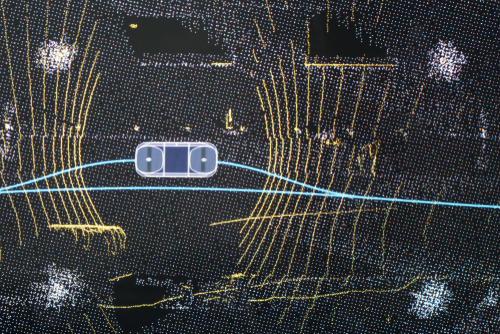
A LiDAR sensor emits laser pulses and measures the time each takes to return from a surface, building a three-dimensional map of the surrounding environment expressed as a set of x, y, z coordinates. Each point carries a position and typically a reflectance intensity value. The resulting point cloud has no inherent pixel grid, no colour information, and no fixed spatial resolution. Object density in the cloud varies with distance from the sensor: objects close to the vehicle may be represented by thousands of points, while an object at 80 metres may be represented by only a handful.

Annotators working with point clouds must navigate a three-dimensional space using software tools that allow rotation and zoom through the data, typically combining top-down, front-facing, and side-facing views simultaneously. Identifying an object’s boundaries requires understanding its three-dimensional geometry, not its visual appearance. The skills required are closer to spatial reasoning under geometric constraints than to the visual pattern recognition that image annotation demands, and the onboarding time for LiDAR annotation teams reflects this difference.

Why Point Cloud Data Is Not Just Another Image Format

Image annotation tools and workflows are not transferable to point cloud annotation without significant modification. The quality dimensions that matter are different: in image annotation, boundary placement accuracy is measured in pixels. In LiDAR annotation, it is measured in centimetres across three spatial axes simultaneously, and errors in any axis affect the model’s learned representation of object size, position, and orientation. 

The model architectures trained on LiDAR data, including voxel-based, pillar-based, and point-based processing networks, are sensitive to annotation precision in ways that differ from convolutional image models. The relationship between annotation quality and computer vision model performance is more direct and more spatially specific in LiDAR contexts than in standard image annotation.

Annotation Task Types and Their Precision Requirements

3D Bounding Boxes: The Core Task and Its Constraints

Three-dimensional bounding boxes, also called cuboids or 3D boxes, are the primary annotation type for object detection in LiDAR point clouds. A well-placed 3D bounding box encloses all points belonging to the object while excluding points from the surrounding environment, with the box oriented to match the object’s heading direction. The precision requirements are demanding: box dimensions should reflect the actual physical size of the object, not the extent of visible points, which means annotators must infer full geometry for partially visible or occluded objects. 

Orientation accuracy matters because the model uses heading direction for trajectory prediction and path planning. ADAS data services for safety-critical functions require 3D bounding box annotation at the precision standard set by the safety requirements of the specific perception function being trained, not a generic commercial annotation standard.

Semantic Segmentation: Classifying Every Point

LiDAR semantic segmentation assigns a class label to every point in the cloud, distinguishing road surface from sidewalk, building from vegetation, and vehicle from pedestrian at the point level. The precision requirement is higher than for bounding box annotation because every point contributes to the model’s learned class boundaries. Boundary regions between classes, where a road surface meets a kerb or where a vehicle body meets its shadow on the ground, are the areas where annotator judgment is most consequential and where inter-annotator disagreement is most likely. Annotation guidelines for semantic segmentation need to be specific about boundary point treatment, not just about object class definitions.

Instance Segmentation and Object Tracking

Instance segmentation distinguishes between individual objects of the same class, assigning unique instance identifiers to each car, each pedestrian, and each cyclist in a scene. It is the annotation type required for multi-object tracking, where the model must maintain the identity of each object across successive frames as the vehicle moves. Tracking annotation requires that each object receive the same identifier across every frame in which it appears, and that the identifier is consistent even when the object is temporarily occluded and reappears. 

Maintaining this consistency across large annotation datasets requires systematic quality assurance that checks identifier continuity, not just frame-level box accuracy. Sensor data annotation at the quality level required for tracking-capable perception models requires this cross-frame consistency checking as a structural component of the QA workflow.

The Occlusion Problem: Annotating What Cannot Be Seen

Why Occlusion Cannot Simply Be Ignored

Occlusion is the most common source of annotation difficulty in LiDAR data. A pedestrian partially hidden behind a parked car, a cyclist whose lower body is obscured by road furniture, a truck whose rear is out of the sensor’s direct line of sight: these are not rare scenarios. They are the normal condition in dense urban traffic. Annotators who respond to occlusion by omitting the occluded object or reducing the bounding box to cover only visible points produce training data that teaches the model to be uncertain about or to miss objects whenever occlusion occurs. In a deployed autonomous driving system, this produces exactly the failure mode in dense traffic that is most dangerous.

Predictive Annotation for Occluded Objects

The correct annotation approach for occluded objects requires annotators to infer the full geometry of the object based on contextual information: the visible portion of the object, knowledge of typical object dimensions for that class, the object’s trajectory in preceding frames, and contextual cues from other sensors. A pedestrian whose body is 60 percent visible allows a trained annotator to infer full height, approximate width, and likely heading with reasonable accuracy.

Annotation guidelines must specify this inference requirement explicitly, with worked examples and decision rules for different occlusion levels. Annotators who are not trained in this inference discipline will default to visible-point-only annotation, which is faster but produces systematically degraded training data for occluded scenarios.

Occlusion State Labeling

Beyond annotating the geometry of occluded objects, many LiDAR annotation programs require that annotators record the occlusion state of each annotation explicitly, classifying objects as fully visible, partially occluded, or heavily occluded. This metadata allows model training pipelines to weight examples differently based on annotation confidence, to analyze model performance separately for different occlusion levels, and to identify where the training dataset is under-represented in high-occlusion scenarios. Edge case curation services specifically address the under-representation of high-occlusion scenarios in standard LiDAR training datasets, ensuring that the scenarios where annotation is most demanding and model failures are most consequential receive adequate coverage in the training corpus.

Temporal Consistency in LiDAR

Why Frame-Level Accuracy Is Not Enough

LiDAR data for autonomous driving is collected as continuous sequences of frames, typically at 10 to 20 Hz, capturing the dynamic scene as the vehicle moves. A model trained on this data learns not only to detect objects in individual frames but to understand their motion, velocity, and trajectory across frames. This means annotation errors that are consistent across a sequence are less damaging than inconsistencies between frames, because a consistent error teaches a consistent but wrong pattern, while frame-to-frame inconsistency teaches no coherent pattern at all.

The most common temporal consistency failure is bounding box size fluctuation: annotators placing boxes of slightly different dimensions around the same object in successive frames because the point density and viewing angle change as the vehicle moves. A vehicle that appears to change physical size between consecutive frames is producing a training signal that will undermine the model’s size estimation accuracy. Annotation guidelines need to specify size consistency requirements across frames, and QA processes need to measure frame-to-frame size variance as an explicit quality metric.

Object Identity Consistency Across Long Sequences

Maintaining consistent object identifiers across long annotation sequences is particularly challenging when objects temporarily leave the sensor’s field of view and re-enter, when two objects of the same class pass close to each other, and their point clouds briefly merge, or when an object is first obscured and then reappears from behind cover. 

Annotation teams without systematic identity management protocols will produce sequences with identifier reassignment errors that teach the tracking model incorrect trajectory continuities. Video annotation discipline for temporal consistency in conventional video annotation carries over to LiDAR sequence annotation, but the three-dimensional nature of the data and the absence of visual cues make LiDAR identity management a harder problem requiring more structured annotator training.

Weather, Distance, and Sensor Challenges in LiDAR

How Adverse Weather Degrades Point Cloud Quality

Rain, fog, snow, and dust all degrade LiDAR point cloud quality in ways that create annotation challenges with no equivalent in camera data. Water droplets and snowflakes reflect laser pulses and produce false returns in the point cloud, appearing as clusters of points that do not correspond to any physical object. These false returns can superficially resemble real objects of similar reflectance, and distinguishing them from genuine objects requires annotators who understand both the physics of the degradation and the characteristic patterns it produces in the point cloud.

Annotation guidelines for adverse weather conditions need to specify how annotators should handle ambiguous clusters that may be environmental artifacts, what contextual evidence is required before annotating a possible object, and how to record uncertainty levels when annotation confidence is reduced. Programs that apply the same annotation guidelines to clear-weather and adverse-weather data without differentiation will produce an inconsistent training signal for exactly the conditions where perception reliability matters most.

Sparsity at Range and Its Annotation Implications

Point density decreases with distance from the sensor as laser beams diverge and fewer pulses return from any given object. An object at 10 metres may be represented by hundreds of points; the same object class at 80 metres may be represented by only a dozen. The annotation challenge at long range is that sparse representations make it harder to determine object boundaries accurately, to distinguish one object class from another of similar geometry, and to identify the orientation of an object with limited point coverage. 

The ODD analysis for autonomous systems framework is relevant here: the distance ranges that fall within the system’s operational design domain determine the annotation precision requirements that the training data must satisfy, and ODD-aware annotation programs specify different quality thresholds for different distance bands.

Sensor Fusion Annotation

Why LiDAR-Camera Fusion Annotation Is Not Two Separate Tasks

Autonomous driving perception systems increasingly fuse LiDAR point clouds with camera images to combine the spatial precision of LiDAR with the semantic richness of cameras. Training these fusion models requires annotation that is consistent across both modalities: an object labeled in the camera image must correspond exactly to the same object labeled in the point cloud, with matching identifiers, matching spatial extent, and temporally synchronized labels. 

Inconsistency between modalities, where a pedestrian is correctly labeled in the camera frame but slightly offset in the point cloud or vice versa, produces conflicting training signal that degrades fusion model performance. The role of multisensor fusion data in Physical AI covers the full scope of this cross-modal consistency requirement and its implications for annotation program design.

Calibration and Coordinate Alignment

Camera-LiDAR fusion annotation requires that the sensor calibration parameters are correct and that both annotation streams are operating in a consistent coordinate system. If the extrinsic calibration between the LiDAR and camera has drifted or was not precisely determined, points in the LiDAR coordinate frame will not project accurately onto the camera image plane. 

Annotators working on both streams simultaneously may compensate for calibration errors by adjusting their annotations in ways that introduce systematic inconsistencies. Annotation programs that treat calibration validation as a prerequisite for annotation, rather than as a separate engineering concern, produce more consistent fusion training data.

4D LiDAR and the Emerging Annotation Requirement

Newer LiDAR systems operating on frequency-modulated continuous wave principles add instantaneous velocity as a fourth dimension to each point, providing direct measurement of object radial velocity rather than requiring it to be inferred from position change across frames. Annotating 4D LiDAR data requires that velocity attributes are verified for consistency with observed object motion, adding a new quality dimension to the annotation task. As 4D LiDAR adoption increases in production autonomous driving programs, annotation services that can handle velocity attribute validation alongside spatial annotation will become a differentiating capability. Autonomous driving data services designed for next-generation sensor configurations need to accommodate this expanded annotation schema before 4D LiDAR becomes the production standard in new vehicle programs.

Quality Assurance for 3D LiDAR Annotation

Why Standard QA Metrics Are Insufficient

Annotation accuracy metrics for 2D image annotation, including bounding box IoU and per-class label accuracy, do not translate directly to LiDAR annotation quality assessment. A 3D bounding box that achieves an acceptable 2D IoU when projected onto a ground plane may still be incorrectly oriented or sized in the vertical dimension. Metrics that measure accuracy in the bird’s-eye view projection alone miss annotation errors in the height dimension that are consequential for object classification and for applications requiring accurate height estimation. Full 3D IoU measurement, orientation angle error, and explicit heading accuracy metrics are the quality dimensions that LiDAR QA frameworks should measure.

Gold Standard Design for LiDAR Annotation

Gold standard examples for LiDAR annotation QA present specific challenges that image annotation gold standards do not. A gold standard LiDAR scene needs to cover the full range of difficulty conditions: varying object distances, different occlusion levels, adverse weather representations, and the object classes that are most frequently annotated incorrectly. 

Designing gold standard scenes that adequately represent the tail of the difficulty distribution, rather than the average of the annotation task, is what distinguishes gold standard sets that actually surface annotator quality gaps from those that measure performance on the easy cases. Human-in-the-loop computer vision for safety-critical systems describes the quality assurance architecture where human expert review is systematically applied to the most safety-consequential annotation categories.

Inter-Annotator Agreement in 3D Space

Inter-annotator agreement for 3D bounding boxes is harder to measure than for 2D annotations because agreement must be assessed across position, dimensions, and orientation simultaneously. Two annotators may agree perfectly on an object’s position and dimensions but disagree on its heading by 15 degrees, which produces a meaningful difference in the model’s learned orientation representation. Agreement measurement frameworks for LiDAR annotation need to decompose agreement into these separate spatial components, identify which components show the highest disagreement across annotator pairs, and target guideline refinements at the specific spatial dimensions where annotator interpretation diverges.

Applications Beyond Autonomous Driving

Robotics and Industrial Automation

LiDAR annotation requirements for robotics and industrial automation differ from automotive perception in ways that affect annotation standards. Industrial manipulation robots need highly precise 3D object pose annotation, including not just position and orientation but specific grasp point locations on object surfaces. Warehouse autonomous mobile robots need accurate annotation of dynamic obstacles at close range in environments with dense, reflective infrastructure. 

The annotation standards developed for automotive LiDAR, which are optimized for road scene objects at driving speeds and distances, may not transfer directly to these contexts without domain-specific adaptation. Robotics data services address the specific annotation requirements of manipulation and mobile robot perception, including the close-range precision and object pose annotation that automotive-focused LiDAR annotation workflows do not typically prioritise.

Infrastructure, Mapping, and Geospatial Applications

LiDAR annotation for infrastructure inspection, corridor mapping, and smart city applications involves different object categories, different precision standards, and different temporal requirements from automotive perception annotation. Infrastructure LiDAR data needs annotation of linear features such as power lines and road markings, structural elements of varying scale, and vegetation that changes between survey passes. 

The annotation challenge in these contexts is less about temporal consistency at high frame rates and more about spatial precision and category consistency across long survey corridors. Annotation teams calibrated for automotive LiDAR need specific domain training before working on infrastructure annotation tasks.

How Digital Divide Data Can Help

Digital Divide Data provides 3D LiDAR annotation services designed around the precision standards, temporal consistency requirements, and cross-modal fusion demands that production Physical AI programs require.

The 3D LiDAR data annotation capability covers all primary annotation types, including 3D bounding boxes with full orientation and dimension accuracy, semantic segmentation at the point level, instance segmentation with cross-frame identity consistency, and object tracking across long sequences. Annotation teams are trained to handle occluded objects with predictive geometry inference, not visible-point-only annotation, and occlusion state metadata is captured as a standard annotation attribute.

For programs requiring camera-LiDAR fusion training data, multisensor fusion data services provide cross-modal consistency checking as a structural component of the QA workflow, not a post-hoc audit. Calibration validation is treated as a prerequisite for annotation, and cross-modal annotation agreement is measured alongside single-modality accuracy metrics.

QA frameworks include full 3D IoU measurement, orientation angle error tracking, frame-to-frame size consistency metrics, and gold standard sampling stratified across distance bands, occlusion levels, and adverse weather conditions. Performance evaluation services connect annotation quality to downstream model performance, closing the loop between data quality investment and perception system reliability in the deployment environment.

Build LiDAR training datasets that meet the precision standards and production perception demands. Talk to an expert!

Conclusion

3D LiDAR annotation is technically demanding in ways that standard image annotation experience does not prepare teams for. The spatial precision requirements, the temporal consistency obligations across dynamic sequences, the occlusion handling discipline, the weather artifact identification skills, and the cross-modal consistency demands of fusion annotation are all distinct competencies that require specific training, specific tooling, and specific quality assurance frameworks. 

Programs that approach LiDAR annotation as a harder version of image annotation, and apply image annotation standards and QA methodologies to point cloud data, will produce training datasets with systematic error patterns that surface in production as perception failures in exactly the conditions that matter most: dense traffic, occlusion, adverse weather, and long range.

The investment required to build annotation programs that meet the precision standards LiDAR perception models need is substantially higher than for image annotation, and it is justified by the role that LiDAR plays in the perception stack of safety-critical Physical AI systems. A perception model trained on precisely annotated LiDAR data is more reliable across the full operational envelope of the system. A model trained on imprecisely annotated data will fail in the scenarios where annotation difficulty was highest, which are also the scenarios where perception reliability matters most.

References

Valverde, M., Moutinho, A., & Zacchi, J.-V. (2025). A survey of deep learning-based 3D object detection methods for autonomous driving across different sensor modalities. Sensors, 25(17), 5264. https://doi.org/10.3390/s25175264

Zhang, X., Wang, H., & Dong, H. (2025). A survey of deep learning-driven 3D object detection: Sensor modalities, technical architectures, and applications. Sensors, 25(12), 3668. https://doi.org/10.3390/s25123668

Jiang, H., Elmasry, H., Lim, S., & El-Basyouny, K. (2025). Utilizing deep learning models and LiDAR data for automated semantic segmentation of infrastructure on multilane rural highways. Canadian Journal of Civil Engineering, 52(8), 1523-1543. https://doi.org/10.1139/cjce-2024-0312

Frequently Asked Questions

Q1. What is the difference between 3D bounding box annotation and semantic segmentation for LiDAR data?

3D bounding boxes place a cuboid around individual objects to define their position, dimensions, and orientation. Semantic segmentation assigns a class label to every individual point in the cloud, producing a complete spatial classification of the scene without object-level instance boundaries.

Q2. How should annotators handle occluded objects in LiDAR point clouds?

Occluded objects should be annotated with their full inferred geometry based on visible portions, object class size priors, and trajectory context from adjacent frames — not reduced to cover only visible points or omitted, as either approach produces models that miss or underestimate objects under occlusion.

Q3. Why is frame-to-frame bounding box consistency important for LiDAR training data?

Models trained on LiDAR sequences learn velocity and motion dynamics across frames. Box size fluctuations between frames for the same object produce conflicting signals about object dimensions and produce models with inaccurate size estimation and trajectory prediction capabilities.

Q4. What annotation challenges does adverse weather introduce for LiDAR data?

Rain, fog, and snow create false returns in the point cloud that can resemble real objects, requiring annotators with domain expertise to distinguish environmental artifacts from genuine objects and to record appropriate confidence levels when scan quality is degraded.

3D LiDAR Data Annotation: What Precision Actually Demands Read Post »

ODD Analysis

ODD Analysis for AV: Why It Matters, and How to Get It Right

Every autonomous driving program reaches a moment when the question shifts from whether the technology works to where and under what conditions it works reliably enough to be deployed. That question has a formal answer in the engineering and regulatory world, and it is called the Operational Design Domain (ODD). The ODD is the structured specification of the environments, conditions, and scenarios within which an automated driving system is designed to operate safely. It is not a general claim about system capability. It is a bounded, documented commitment that defines the edges of what the system is built to handle, and by implication, what lies outside those edges.

The gap between programs that manage their ODD thoughtfully and those that treat it as paperwork shows up early. A poorly defined ODD leads to underspecified test coverage, safety cases that do not hold up under regulatory review, and systems that are deployed in conditions they were never validated against. A well-defined ODD, by contrast, anchors the entire development and validation process. It determines which scenarios need to be tested, which edge cases need to be curated, where simulation is sufficient, and where real-world data is necessary, and how expansion to new geographies or operating conditions should be managed. Getting ODD analysis right is therefore not a compliance exercise. It is a foundation for everything that comes after it.

This blog explains what ODD analysis actually involves for ADAS and autonomous driving programs, how ODD taxonomies and standards structure the domain definition process, and what the data and annotation implications of a well-specified ODD are, and how to get it right.

What the Operational Design Domain Actually Defines

The Operational Design Domain specifies the conditions under which a given driving automation system is designed to function. That definition is precise by intent. The ODD does not describe where a system usually works or where it works most of the time. It describes the bounded set of conditions within which the system is designed to operate safely, and outside of which the system is expected to either hand control back to a human or execute a minimal risk condition.

Those conditions span multiple dimensions. 

Road type and geometry: Is the system designed for motorways, urban arterials, residential streets, or a specific mix? 

Speed range: what is the minimum and maximum vehicle speed within the ODD? 

Time of day: Is a daytime-only operation assumed, or does the system operate at night? 

Weather and visibility: what precipitation levels, fog densities, and ambient light conditions are within scope? 

Infrastructure requirements: Does the system require lane markings to be present and legible, traffic signals to be functioning, or specific road surface conditions? 

Traffic density and agent types: Is the system validated against cyclists and pedestrians, or only against other motor vehicles?

Why Unstructured ODD Definitions Fail

The instinct among many development teams, particularly at early program stages, is to define the ODD in natural language. The system will operate on highways in good weather. That kind of description has the virtue of being readable and the significant vice of being ambiguous. What counts as a highway? What counts as good weather? At what point does light rain become weather outside the ODD? Without a structured taxonomy, these questions have no definitive answers, and the gaps between them create space for validation that is technically compliant but substantively incomplete.

Structured taxonomies solve this by breaking the ODD into hierarchically organized, formally defined attributes, each with specified values or value ranges. Road type is not a single attribute. It branches into motorway, dual carriageway, single carriageway, urban road, and sub-categories within each, each with associated infrastructure characteristics. Environmental conditions branch into precipitation type and intensity, visibility range, lighting conditions, road surface state, and seasonal factors. Each branch can be assigned a permissive value (within ODD), a non-permissive value (outside ODD), or a conditional value (within ODD subject to specific constraints).

ODD Analysis as an Engineering Process

The Difference Between Defining and Analyzing

ODD definition, the act of specifying which conditions are within scope, is the starting point. ODD analysis goes further. It asks what the system’s behavior looks like across the full breadth of the defined ODD, where the system’s performance begins to degrade as conditions approach the ODD boundary, and what the transition behavior looks like when conditions move from inside to outside the ODD. A system that functions well in the center of its ODD but degrades unpredictably as it approaches boundary conditions has an ODD analysis problem, even if the ODD specification itself is well-formed.

The process of analyzing the ODD begins with mapping system capabilities against ODD attributes. For each attribute in the ODD taxonomy, the engineering team should understand how the system’s performance varies across the range of permissive values, where performance begins to degrade, and what triggers the boundary between permissive and non-permissive. That understanding comes from systematic testing across the attribute space, which requires both real-world data collection in representative conditions and simulation for conditions that cannot be safely or efficiently collected in the real world.

The Relationship Between ODD Analysis and Scenario Selection

The ODD specification is the source document for scenario-based testing. Once the ODD is formally defined, the scenario library for validation should cover the full cross-product of ODD attributes at sufficient density to demonstrate that system performance is acceptable across the entire space, not just at the attribute midpoints that are most convenient to test. 

ODD coverage metrics, which quantify what proportion of the attribute space has been tested at what density, provide the only rigorous basis for answering the question of whether testing is complete. Edge case curation is the process of specifically targeting the parts of the ODD that are most likely to produce safety-relevant behavior but least likely to be encountered during normal testing, the boundary conditions, the rare combinations of adverse attributes, and the scenarios that fall just inside the ODD limit. Without systematic edge case coverage, a validation program may have excellent average-case performance evidence and serious gaps in the conditions that matter most.

Coverage Metrics and When Testing Is Enough

Coverage metrics for ODD-based testing answer the question that every validation team needs to answer before a regulatory submission: how much of the ODD has been tested, and how thoroughly? The most basic metric is scenario coverage, the proportion of ODD attribute combinations that have at least one test case. More sophisticated metrics weight coverage by the frequency of conditions in the intended deployment environment, by the risk level associated with each condition combination, or by the sensitivity of system performance to variation in each attribute. Performance evaluation against these metrics provides the quantitative basis for the safety argument that the system has been tested across a representative and complete sample of its operational domain.

Data and Annotation Implications of ODD Analysis

How the ODD Shapes Data Collection Requirements

The ODD is not just an engineering specification. It is a data requirements document. Every attribute in the ODD taxonomy implies a data collection and annotation requirement. If the ODD includes nighttime operation, the program needs annotated data from nighttime driving across the range of road types and weather conditions within scope. If the ODD includes adverse weather, the program needs data from rain, fog, and low-visibility conditions, annotated with the same label quality as clear-weather data. If the ODD includes specific road infrastructure types, the program needs data from those infrastructure types, annotated with the infrastructure attributes that the perception system depends on. The ML data annotation pipeline is therefore directly shaped by the ODD specification: what data is needed, in what conditions, at what volume and diversity, and to what accuracy standard.

The annotation implications of boundary conditions deserve particular attention. Data collected near the ODD boundary, in conditions that approach but do not cross the non-permissive threshold, is the most safety-critical data in the training and validation corpus. A perception model that has been trained primarily on clear, well-lit, high-visibility data but is expected to operate right up to the edge of its low-visibility ODD boundary needs specific training exposure to data collected at that boundary. Annotating boundary-condition data correctly, ensuring that object labels remain accurate and complete as conditions degrade, requires annotators who understand both the task and the sensor physics of the conditions being labeled.

Geospatial Data and ODD Geography

For programs with geographically bounded ODDs, the annotation implications also extend to geospatial data. A system designed to operate in a specific city or region needs HD map coverage, infrastructure data, and traffic behavior annotations for that geography. A system designed to expand its ODD to a new market needs equivalent data from the new geography before the expansion can be validated. DDD’s geospatial data capabilities and the broader context of geospatial data challenges for Physical AI directly address this requirement, ensuring that the geographic scope of the ODD is matched by the geographic scope of the annotated data underlying the system.

The Multisensor Challenge at ODD Boundaries

At ODD boundary conditions, multisensor fusion behavior is particularly important and particularly difficult to annotate. In clear conditions, camera, LiDAR, and radar outputs are consistent and mutually reinforcing. At the edge of the ODD, sensor degradation modes begin to diverge. A dense fog condition that keeps visibility just within the ODD limit will degrade camera performance substantially while affecting LiDAR and radar differently and to different degrees. The fusion system’s behavior in these divergent-degradation conditions is what determines whether the system responds safely or not. Annotating the ground truth for sensor fusion behavior at ODD boundaries requires understanding of both the sensor physics and the fusion logic, and it is one of the more technically demanding annotation tasks in the ADAS data workflow.

ODD Boundaries and the Transition to Minimal Risk Condition

A well-specified ODD not only defines what is inside. It defines what the system does when conditions move outside. The minimal risk condition, the safe state the system transitions to when it can no longer operate within its ODD, is a fundamental component of the safety case for any Level 3 or higher system. Whether that condition is a controlled stop at the roadside, a handover to human control with appropriate warning time, or a gradual speed reduction to a safe following mode depends on the system architecture and the nature of the ODD exit.

Specifying the transition behavior is part of ODD analysis, not separate from it. The engineering team needs to understand not just where the ODD boundary is but how quickly boundary conditions can be reached from typical operating conditions, how reliably the system detects that it is approaching the boundary, and whether the transition behavior provides sufficient time and warning for safe human takeover where human intervention is the intended response. Systems that detect ODD exit late, or that transition abruptly without adequate warning, may have a correctly specified ODD and a dangerously incomplete ODD analysis.

Common Mistakes in ODD Definition and Analysis

Defining the ODD to Fit the Existing Test Coverage

The most common and consequential mistake in the ODD definition is working backwards from what has been tested rather than forward from the system’s intended deployment environment. A team that defines its ODD after the fact to match the test conditions it has already covered may produce a formally complete ODD specification that nonetheless excludes conditions the system will encounter in real deployment. This approach inverts the intended logic of ODD analysis, where the ODD should drive the test coverage, not be shaped by it.

Underspecifying Boundary Conditions

A related mistake is specifying ODD attributes as simple binary permissive or non-permissive categories without capturing the performance gradient that exists between the attribute midpoint and the boundary. A system that works reliably in rain up to 10mm per hour but begins to degrade at 8mm per hour has an ODD boundary that the simple specification may not capture. Underspecifying boundary conditions leads to safety margins that are tighter than the specification suggests, which in turn leads to ODD monitoring systems that trigger transitions too late.

Treating ODD Expansion as a Software Update

Expanding the ODD, adding nighttime operation, extending the speed range, and including new road types or geographies is not a software update. It is a re-validation event that requires new data collection, new annotation, new scenario coverage analysis, and updated safety case evidence for every attribute that has changed. Programs that treat ODD expansion as a configuration change rather than a validation exercise introduce unquantified risk into their systems. The incremental expansion methodology, where each new ODD attribute is validated separately and then integrated with existing coverage evidence, is the appropriate approach. 

Disconnecting ODD Analysis from the Scenario Library

A final common failure mode is maintaining the ODD specification and the scenario library as separate artifacts that are not formally linked. When the ODD changes and the scenario library is not automatically updated to reflect the new attribute space, coverage gaps accumulate silently. Programs that maintain a formal, traceable link between ODD attributes and scenario metadata, so that each scenario is tagged with the ODD conditions it exercises, are in a significantly better position to detect and close coverage gaps when the ODD evolves. DDD’s simulation operations services include scenario tagging workflows designed to maintain exactly this kind of traceability between ODD specifications and the scenario library.

How Digital Divide Data Can Help

Digital Divide Data provides end-to-end ODD analysis services for autonomous driving and broader Physical AI programs, supporting the structured definition, validation, and expansion of operational design domains at every stage of the development lifecycle. The approach starts from the recognition that ODD analysis is a data discipline, not just a specification exercise, and that the quality of the data and annotation underlying each ODD attribute is what determines whether the ODD commitment can actually be validated.

On the validation side, DDD’s edge case curation services identify and build annotated examples of the ODD boundary conditions that most need validation coverage, while the simulation operations capabilities support scenario library development that is systematically linked to the ODD attribute space. ODD coverage metrics are tracked against the scenario library throughout the validation program, providing the quantitative coverage evidence that regulatory submissions require.

For programs preparing regulatory submissions, Digital Divide Data‘s safety case analysis services support the documentation and evidence generation required to demonstrate that the ODD has been defined, validated, and monitored to the standards that NHTSA, UNECE, and EU regulators expect. For teams expanding their ODD to new geographies or conditions, DDD provides the data collection planning, annotation, and coverage analysis support that each incremental expansion requires.

Build a rigorous ODD analysis program that regulators and safety teams can trust. Talk to an expert!

Conclusion

ODD analysis is the foundation on which everything else in autonomous driving development rests. The scenario library, the training data requirements, the simulation environment, the safety case, and the regulatory submission: all of them trace back to a clear, structured, and rigorously validated specification of the conditions the system is designed to handle. Programs that invest in getting this foundation right from the start, using structured taxonomies, machine-readable specifications, and ODD-linked coverage metrics, build on solid ground. Those who treat the ODD as a compliance artifact to be completed after the fact find themselves reconstructing it under pressure, often with gaps they cannot close before a submission deadline. The investment in rigorous ODD analysis is not proportional to the ODD’s complexity. It is proportional to everything that depends on it.

As autonomous systems move from structured, controlled deployment environments to broader public operation across diverse geographies and conditions, the ODD becomes not just an engineering tool but a public safety instrument. The clarity with which a development team can answer the question ‘where does your system operate safely’ is the clarity with which regulators, insurers, and the public can assess the system’s safety case. 

References 

International Organization for Standardization. (2023). ISO 34503:2023 Road vehicles: Test scenarios for automated driving systems — Specification and categorization of the operational design domain. ISO. https://www.iso.org/standard/78952.html

ASAM e.V. (2024). ASAM OpenODD: Operational design domain standard for ADAS and ADS. ASAM. https://www.asam.net/standards/detail/openodd/

United Nations Economic Commission for Europe. (2024). Guidelines and recommendations for ADS safety requirements, assessments, and test methods. UNECE WP.29. https://unece.org/transport/publications/guidelines-and-recommendations-ads-safety-requirements-assessments-and-test

Hans, O., & Walter, B. (2024). ODD design for automated and remote driving systems: A path to remotely backed autonomy. IEEE International Conference on Intelligent Transportation Engineering (ICITE). https://www.techrxiv.org/users/894908/articles/1271408

Frequently Asked Questions

What is the difference between an ODD and an operational domain?

An operational domain describes all conditions the vehicle might encounter, while the ODD is the bounded subset of those conditions that the automated system is specifically designed and validated to handle safely.

Can an ODD be defined before the system is built?

Yes, and it should be. Defining the ODD early shapes the data collection, annotation, and validation program rather than being reconstructed from whatever testing has already been completed, which is the more common but less rigorous approach.

How does the ODD relate to edge case testing?

Edge cases are the scenarios at or near the ODD boundary that are most likely to produce safety-relevant behavior and least likely to be encountered during normal testing, making them the most critical part of the ODD to curate and validate specifically.

What happens when a vehicle exits its ODD during operation?

The system is expected to either transfer control to a human driver with sufficient warning time or execute a low-risk maneuver, such as a controlled stop, depending on the automation level and the nature of the ODD exceedance.

ODD Analysis for AV: Why It Matters, and How to Get It Right Read Post »

Humanoid Training Data and the Problem Nobody Is Talking About

Humanoid Training Data and the Problem Nobody Is Talking About

Spend a week reading humanoid robotics coverage, and you will hear a great deal about joint torque, degrees of freedom, battery runtime, and the competitive landscape between Figure, Agility, Tesla, and Boston Dynamics. These are real and important topics. They are also the visible part of a much larger iceberg. The part below the waterline is data: the enormous, structurally complex, expensive-to-produce training data that determines whether a humanoid robot that can walk and lift boxes in a controlled warehouse pilot can also navigate an unexpected obstacle, pick up an unfamiliar container, or recover gracefully from a failed grasp in a real facility with real variation.

In this blog, we examine why humanoid training data is harder to collect and annotate than text or image data, what specific data modalities system requires, and what development teams need to build real-world systems.

What Humanoid Training Data Actually Involves

The modality stack

A production-capable humanoid robot learning to perform a manipulation task in a real environment needs training data that captures the full sensorimotor loop of the task. That means egocentric RGB video from cameras mounted on or near the robot’s head, capturing what the robot sees as it acts. It means depth data providing metric scene geometry. It means 3D LiDAR point clouds for spatial awareness in larger environments. It means joint angle and joint velocity time series for every degree of freedom in the kinematic chain. It means force and torque sensor readings at the wrist and end-effector. And for dexterous manipulation tasks, it means tactile sensor data from fingertip sensors that can distinguish the difference between a secure grip and one that is about to slip.

The annotation requirements that follow

Raw multi-modal sensor data is not training data. It becomes training data through annotation: the labeling of object identities and spatial positions, the segmentation of task phases and sub-task boundaries, the labeling of contact events, grasp outcomes, and failure modes, the assignment of natural language descriptions to action sequences, and the quality filtering that removes demonstrations that are too noisy, too slow, or too inconsistent to contribute usefully to policy learning. Each of these annotation tasks has different requirements, different skill demands, and different quality standards. Producing them at the volume and consistency that foundation model training needs is not a bottleneck that better algorithms alone will resolve. It is a data collection and annotation infrastructure problem, and it requires dedicated annotation capacity built specifically for physical AI data.

Teleoperation: The Primary Data Collection Method and Its Limits

Why teleoperation dominates humanoid data collection

Teleoperation, where a human operator directly controls the humanoid robot’s movements while the robot records its sensor outputs and the operator’s control signals as a training demonstration, has become the dominant method for humanoid training data collection. The reason is straightforward: it is the most reliable way to generate high-quality demonstrations of complex tasks that the robot cannot yet perform autonomously. A teleoperated demonstration shows the robot what success looks like at the level of sensor-to-action detail that imitation learning algorithms require.

The quality problem in teleoperated demonstrations

Teleoperated demonstrations vary enormously in quality. An operator who is fatigued, distracted, or performing an unfamiliar task will produce demonstrations that include inefficient trajectories, hesitation pauses, unnecessary corrective movements, and failed attempts that have to be discarded or carefully annotated as negative examples. Demonstrations produced by expert operators in controlled conditions transfer poorly to the diversity of real operating environments. A demonstration of picking up a specific bottle in a specific lighting condition, at a specific position on a shelf, does not generalize to picking up a different container at a different position in different light. Generalization requires demonstration diversity, and producing diverse demonstrations of sufficient quality is expensive.

The annotation layer on top of teleoperated demonstrations adds further complexity. Determining which demonstrations are high-quality enough to include in the training set, where in each demonstration the relevant task phases begin and end, and whether a grasp that succeeded in the demonstration would generalize to variations of the same task: these are judgment calls that require annotators with domain knowledge. Human-in-the-loop annotation for humanoid training data is not the same as image labeling. It requires annotators who understand embodied motion, task structure, and the relationship between sensor signals and physical outcomes.

Imitation Learning and the Data Volume Problem

Imitation learning, where a robot policy is trained to reproduce the actions observed in human demonstrations, is the dominant learning paradigm for humanoid manipulation tasks. Its appeal is clear: if you can show the robot what to do with enough fidelity and enough variation, it can learn to reproduce that behavior across a range of conditions. The challenge is that imitation learning’s performance typically scales with both the volume and diversity of demonstration data. A policy trained on 50 demonstrations of a task in one configuration may perform reliably in that configuration but fail in any configuration that differs meaningfully from the training distribution. Achieving the kind of generalization that makes a humanoid robot commercially useful, the ability to perform a task across the range of objects, positions, lighting conditions, and human interaction patterns that a real deployment environment involves requires a demonstration library that may run to thousands of episodes per task category.

What makes demonstration data diverse enough to generalize

The diversity requirements for humanoid demonstration data are more demanding than they might appear. It is not sufficient to vary the visual appearance of the scene. A demonstration library that includes images of the same object in ten different lighting conditions, but always at the same height and orientation, has not solved the generalization problem. True generalization requires variation across object instances, object positions and orientations, operator approaches, surface properties, partial occlusions, and interaction sequences. Producing that variation systematically, and annotating it consistently, requires a data collection methodology that is closer to scientific experimental design than to ad hoc video capture. 

The Sim-to-Real Gap: Why Simulation Data Alone Is Not Enough

What simulation can and cannot do for humanoid training

Simulation is an attractive solution to the data volume problem in humanoid robotics, and it does provide genuine value. Simulation operations can generate locomotion training data at a scale that physical collection cannot match, exposing a locomotion controller to millions of terrain configurations, perturbations, and recovery scenarios that would take years to collect physically. 

The sim-to-real gap is the problem that limits how far simulation can be pushed as a substitute for real-world data in humanoid training. Humanoid robots are highly sensitive to physical variables, including surface friction, object deformation, contact dynamics, and the timing of force transmission through compliant joints. Simulation models of these phenomena are approximations. The approximations that are good enough for locomotion training are often not good enough for dexterous manipulation training, where the difference between a successful grasp and a failed one may depend on contact dynamics that even sophisticated simulators do not fully replicate.

The data annotation demands of sim-to-real transfer

Managing the sim-to-real gap requires real-world data for calibration and transfer validation. A team that trains a manipulation policy in simulation needs annotated real-world data from the target environment to measure the size of the gap and to identify which aspects of the policy need fine-tuning on real demonstrations. That fine-tuning step requires its own demonstration collection and annotation pipeline, operating at the intersection of simulation-aware annotation and real physical deployment data. DDD’s digital twin validation services and simulation operations capabilities are built to support exactly this kind of iterative sim-to-real data workflow, ensuring that the transition from simulation training to physical deployment is grounded in real-world data at every calibration stage.

The annotation challenges specific to sim-to-real transfer are also worth naming directly. Annotators working on sim-to-real data need to label not only what happened in the real-world interaction, but why the policy behaved differently from the simulation expectation. Identifying the specific contact dynamics, object properties, or environmental conditions that explain a performance gap requires physical intuition that cannot be reduced to simple object labeling. It is closer to failure mode analysis than to standard annotation work.

Why Touch Matters More Than Vision for Dexterous Tasks

The current dominant paradigm in humanoid robot perception is vision-first: cameras capture what the robot sees, and perception algorithms process that visual data to plan manipulation actions. For many tasks, this is sufficient. Picking up a rigid object from a known position against a contrasting background is tractable with vision alone. But the manipulation tasks that would make a humanoid commercially valuable in real environments, sorting mixed containers, handling deformable materials, performing assembly operations with tight tolerances, adjusting grip when an object begins to slip, are tasks where tactile and force data are not supplementary. They are necessary.

The manipulation bottleneck that the humanoid industry is beginning to acknowledge is partly a tactile data problem. A robot that cannot sense contact forces and fingertip pressure cannot adjust grip dynamically, cannot detect an impending drop, and cannot handle objects whose properties vary in ways that vision does not reveal. Current fingertip tactile sensors exist and are being integrated into leading humanoid platforms, but the training data infrastructure for tactile-augmented manipulation is still in early development.

What tactile data annotation requires

Tactile sensor data annotation is among the least standardized modalities in the Physical AI data ecosystem. Pressure maps, shear force readings, and vibrotactile signals from fingertip sensors need to be labeled in the context of the manipulation task they accompany, correlating contact events with grasp outcomes, surface properties, and the visual and kinematic data recorded simultaneously. The multisensor fusion demands of tactile-augmented humanoid data are significantly higher than those of vision-only systems, because the temporal synchronization requirements are strict and the physical interpretation of the sensor signals requires annotators who understand both the sensor physics and the task structure being labeled.

Why annotation quality matters more at foundation model scale

At the scale of foundation model training, annotation quality errors do not average out. They compound. A systematic labeling error in task phase boundaries, consistently applied across thousands of demonstrations, will produce a model that learns the wrong task decomposition. A set of demonstrations that are annotated as successful but that include borderline or partially failed grasps will produce a model with an optimistic view of its own manipulation reliability. The quality standards that matter for smaller-scale policy training become critical at foundation model scale, where the training corpus is large enough that individual annotation errors have diffuse effects that are difficult to diagnose after the fact. Investing in high-quality ML data annotation and structured quality assurance protocols from the start of a humanoid data program is considerably more cost-effective than attempting to audit and correct a large, inconsistently annotated corpus later.

What the Data Infrastructure Gap Means for Commercial Timelines

The honest assessment of where the industry stands

The humanoid robotics programs that are most credibly advancing toward commercial deployment in 2026 are the ones that have invested seriously in their data infrastructure alongside their hardware development. 

For development teams that do not have access to large proprietary deployment environments to generate operational data, the path to the demonstration volume and diversity that commercially viable generalization requires runs through specialist data infrastructure: teleoperation setups capable of producing high-quality, diverse demonstrations at volume, annotation teams with the domain knowledge to label multi-modal physical AI data to the standards that foundation model training demands, and quality assurance pipelines that can maintain consistency across large demonstration corpora.

The cost reality that is underweighted in roadmaps

Humanoid robotics roadmaps published by development teams and market analysts tend to foreground hardware milestones and underweight data infrastructure costs. The cost of collecting, synchronizing, and annotating a demonstration library large enough to support meaningful generalization is not a rounding error in a humanoid development budget. For a team targeting deployment across multiple task categories in a real operating environment, the data infrastructure investment is likely to be comparable to, and in some cases larger than, the hardware development cost. Teams that discover this late in the development cycle face difficult choices between delaying deployment to build the data they need and accepting a narrower generalization than their product roadmaps promised. Physical AI data services from specialist partners offer an alternative: access to annotation infrastructure and domain expertise that development teams can engage without building the full capability in-house.

How DDD Can Help

Digital Divide Data provides comprehensive humanoid AI data solutions designed to support development programs at every stage of the training data lifecycle. DDD’s teams have the domain expertise and operational capacity to handle the multi-modal annotation demands that humanoid robotics training data requires, from synchronized video and depth annotation to joint pose labeling, task phase segmentation, and grasp outcome classification.

On the teleoperation and demonstration data side, DDD’s ML data collection services support the design and execution of structured demonstration collection programs that produce the diversity and quality that imitation learning algorithms need. Rather than capturing demonstrations opportunistically, DDD works with development teams to define the coverage requirements for their operational design domain and design data collection protocols that systematically address those requirements.

For teams building toward Large Behavior Models and vision-language-action systems, DDD’s VLA model analysis capabilities and multi-modal annotation workflows support the natural language annotation, task phase labeling, and cross-task consistency checking that foundation model training data requires. DDD’s robotics data services extend this support to the broader robotics data ecosystem, including annotation for locomotion training data, environment mapping for simulation foundation models, and quality assurance for sim-to-real transfer validation datasets.

Teams working on the tactile and force data frontier can engage DDD’s annotation specialists for the physical AI data modalities that require domain-specific expertise: contact event labeling, grasp outcome classification, and the correlation of multisensor fusion data across tactile, kinematic, and visual streams. For C-level decision-makers evaluating their data infrastructure strategy, DDD offers a realistic assessment of what production-grade humanoid training data requires and a delivery model that scales with the program.

Build the data infrastructure your humanoid robotics program actually needs. Talk to an expert!

Conclusion

The humanoid robotics industry is at a genuine inflection point, and the coverage of that inflection point reflects a real shift in what these systems can do. What the coverage does not yet fully reflect is the structural dependency between what humanoid robots can do in controlled demonstrations and what they can do in the real-world environments that commercial deployment actually involves. That gap is primarily a data gap. The manipulation tasks, the environmental diversity, the dexterous skill generalization, and the recovery from unexpected failures that would make a humanoid robot genuinely useful in an industrial or domestic setting require training data at a volume, diversity, and multi-modal quality that most development programs have not yet built the infrastructure to produce. Recognizing that the data infrastructure is the critical path, not an implementation detail to be addressed after the hardware is ready, is the first step toward realistic commercial planning.

The programs that close the gap first will not necessarily be the ones with the best actuators or the most capable base models. They will be the ones who treat Physical AI data infrastructure as a first-class engineering investment, building the teleoperation capacity, annotation pipelines, and quality assurance frameworks that turn raw sensor data into training data capable of generalizing to the real world. The hardware plateau that the industry is approaching makes this clearer, not less so. When mechanical capability is no longer the differentiator, the quality of the data behind the intelligence becomes the thing that determines which programs reach commercial scale and which ones remain compelling prototypes.

References 

Welte, E., & Rayyes, R. (2025). Interactive imitation learning for dexterous robotic manipulation: Challenges and perspectives — a survey. Frontiers in Robotics and AI, 12, Article 1682437. https://doi.org/10.3389/frobt.2025.1682437

NVIDIA Developer Blog. (2025, November 6). Streamline robot learning with whole-body control and enhanced teleoperation in NVIDIA Isaac Lab 2.3. https://developer.nvidia.com/blog/streamline-robot-learning-with-whole-body-control-and-enhanced-teleoperation-in-nvidia-isaac-lab-2-3/

Rokoko. (2025). Unlocking the data infrastructure for humanoid robotics. Rokoko Insights. https://www.rokoko.com/insights/unlocking-the-data-infrastructure-for-humanoid-robotics 

Frequently Asked Questions

What types of sensors generate training data for humanoid robots?

Production-grade humanoid training requires synchronized data from cameras, depth sensors, LiDAR, joint encoders, force-torque sensors at the wrist, IMUs, and fingertip tactile sensors, all recorded at high frequency during demonstration or operation episodes.

How many demonstrations does a humanoid robot need to learn a manipulation task?

It varies significantly by task complexity and demonstration diversity, but research suggests hundreds to thousands of diverse demonstrations per task category are typically needed for meaningful generalization beyond the specific training configurations.

Why can’t humanoid robots just use simulation data instead of expensive real demonstrations?

Simulation is useful for locomotion and coarse motor training, but dexterous manipulation requires accurate contact dynamics and surface properties that simulators still do not replicate with sufficient fidelity, making real-world demonstration data necessary for the most challenging tasks.

What is the sim-to-real gap and why does it matter for humanoid deployment?

The sim-to-real gap refers to the performance drop when a policy trained in simulation is deployed on real hardware, caused by differences in physics, sensor noise, and contact dynamics between the simulated and real environments that require real-world data to bridge. 

Humanoid Training Data and the Problem Nobody Is Talking About Read Post »

Digital Twin Validation

Digital Twin Validation for ADAS: How Simulation Is Replacing Miles on the Road

The argument for extensive real-world testing in ADAS development is intuitive. Drive enough miles, encounter enough situations, and the system will have seen the breadth of conditions it needs to handle. The problem is that the arithmetic does not support the strategy. 

Demonstrating safety at a statistically meaningful confidence level for a full-autonomy system would require hundreds of millions, possibly billions, of real-world miles, run at a pace no single development program can sustain within any reasonable timeline. 

The events that determine whether an automatic emergency braking system fires correctly when a cyclist cuts across at night, or whether a lane-keeping system handles an unmarked temporary lane on a construction approach, are not the events that accumulate steadily during normal testing. They surface occasionally, in conditions that make systematic analysis difficult, and often in circumstances where no one is watching carefully enough to capture what happened. The rarest events are precisely the ones that most need to be tested deliberately and repeatedly.

This blog examines what digital twin validation actually involves for ADAS programs, how sensor simulation fidelity determines whether results transfer to real-world performance, and what data and annotation workflows underpin an effective digital twin program. 

What a Digital Twin for ADAS Validation Actually Is

The term digital twin has accumulated enough promotional weight that it now covers a wide range of things, some genuinely sophisticated and some that amount to a conventional simulator with better graphics. In the specific context of ADAS validation, a digital twin has a reasonably precise meaning: a virtual environment that models the vehicle under test, the sensor suite on that vehicle, the road infrastructure the vehicle operates within, and the other road users it interacts with, at a fidelity level sufficient to produce sensor outputs that a real ADAS perception and control stack would respond to in the same way it would respond to the real-world equivalents.

The test of a digital twin’s validity is not whether it looks realistic to a human observer. It is whether the system being tested behaves in the digital twin as it would in the corresponding real scenario. A twin that produces beautiful photorealistic renders but whose simulated LiDAR point clouds have noise characteristics that differ from those of a real sensor will produce test results that do not transfer. A system that passes in simulation may fail in the field, not because the scenario was wrongly constructed but because the sensor simulation was insufficiently faithful to the physics of the hardware it was supposed to represent.

The components that define simulation fidelity

A production-grade digital twin for ADAS validation has several interdependent components. The vehicle dynamics model must replicate how the test vehicle responds to control inputs under realistic conditions, including stress scenarios like emergency braking on reduced-friction surfaces. 

The environment model must replicate road geometry, surface material properties, and surrounding road user behavior in physically grounded ways. And the sensor simulation layer, where most of the difficulty lives, must replicate how each sensor in the multisensor fusion stack responds to the simulated environment, including the degradation modes that matter most for safety testing: LiDAR scatter in precipitation, camera behavior under low light, and radar multipath behavior near metallic infrastructure. Sensor simulation fidelity is the component that most frequently limits the usefulness of digital twin validation in practice, and it is the one most directly dependent on the quality of underlying real-world annotation data.

Sensor Simulation Fidelity: The Core Technical Challenge

LiDAR simulation and why physics matters

LiDAR is among the most demanding sensors to simulate accurately. Real sensors fire discrete laser pulses and measure the time of flight of reflected light. The returned point cloud is shaped by scene geometry, surface reflectivity, and atmospheric conditions affecting pulse propagation. Rain, fog, and airborne particulates all introduce scatter that modifies the point cloud in ways that directly affect the perception algorithms operating on it and the 3D LiDAR annotation used to build ground-truth training data for those algorithms.

A high-fidelity LiDAR simulator must model the angular resolution and range characteristics of the specific sensor being tested, apply realistic reflectivity based on material properties of every surface in the scene, and introduce atmospheric degradation that varies with simulated weather conditions. 

High-fidelity digital twin framework incorporating real-world background geometry, sensor-specific specifications, and lane-level road topology produced LiDAR training data that, when used to train a 3D object detector, outperformed an equivalent model trained on real collected data by nearly five percentage points on the same evaluation set. That result illustrates the ceiling for what high-fidelity simulation can achieve. It also illustrates why fidelity is non-negotiable: a simulator that misrepresents surface reflectivity or atmospheric scatter will generate a training-validation gap that no amount of hyperparameter tuning will fully close.

Camera simulation and the domain adaptation problem

Camera simulation presents a structurally different set of challenges. Real automotive cameras are complex electro-optical systems with specific spectral sensitivities, noise floors, lens distortions, rolling shutter effects, and dynamic range limits. A simulation that renders scenes using a game engine’s default camera model produces images that differ from real sensor output in precisely the conditions where safety matters most: low light, the edges of dynamic range, and environments where lens flare or bloom are factors.

Two main approaches have emerged for closing this gap. Physics-based camera models, which simulate light propagation, surface material interactions, lens optics, and sensor electronics explicitly, produce high-fidelity outputs but are computationally intensive. Data-driven approaches using neural rendering techniques, including neural radiance fields and Gaussian splatting, can reconstruct real-world scenes with high realism at lower computational cost for captured environments, but they lack the flexibility to generate novel scenarios that differ substantially from the captured training distribution. Most mature programs use a combination, applying physics-based modeling for safety-critical validation scenarios where fidelity is paramount and data-driven rendering for large-scale scenario sweeps where throughput is the priority.

Radar simulation

Radar simulation is arguably harder than LiDAR or camera simulation because the electromagnetic phenomena involved are more complex and less amenable to the ray-tracing approximations that work reasonably well for optical sensors. Physically accurate radar simulation must model multipath reflections, Doppler frequency shifts from moving objects, polarimetric properties of target surfaces, and the interference patterns that arise in dense traffic. 

Unreal Engine environment represents one of the more mature approaches to this problem, generating detailed radar returns including tens of thousands of reflection points with accurate signal amplitudes within a photorealistic simulation environment. For ADAS programs increasingly moving toward raw-data sensor fusion rather than object-list fusion, this level of radar simulation fidelity becomes necessary for meaningful validation rather than an optional enhancement.

The Data Infrastructure Behind a Reliable Digital Twin

Real-world data as the foundation

A digital twin does not materialize from scratch. The environment models, sensor calibration parameters, traffic behavior distributions, and road geometry that populate a production-grade digital twin all derive from real-world data collection and annotation. Building a digital twin of a specific urban intersection requires photogrammetric capture of the intersection’s three-dimensional geometry, material property data for each road surface element, and empirical traffic behavior data characterizing how vehicles and pedestrians actually move through the space. All of that data requires annotation before it becomes usable. DDD’s simulation operations services are built around exactly this dependency, ensuring that data feeding a simulation environment meets the standards the environment needs to produce trustworthy test results.

The quality chain is direct and unforgiving. An environment model built from inaccurately annotated photogrammetric data misrepresents road geometry in ways that propagate through every test run conducted in that environment. Surface material properties that are incorrectly labeled produce incorrect sensor outputs, which produce incorrect model responses, none of which will transfer to real hardware. The annotation quality of the underlying real-world data is not a secondary consideration in digital twin validation. It is the foundation on which everything else depends.

Scenario libraries and how they are constructed

The value of a digital twin validation program is proportional to the breadth and coverage quality of the scenario library it tests against. A scenario library is a structured collection of test cases, each specifying the environment type, initial vehicle state, behavior of surrounding road users, any infrastructure conditions relevant to the test, and the expected system response. Building a comprehensive library requires systematic analysis of the operational design domain, identification of safety-relevant scenario categories within that domain, and construction of specific annotated instances of each category in a format the simulation environment can execute.

This is where ODD analysis and edge case curation connect directly to the digital twin workflow. ODD analysis defines the boundaries of the operational domain the system is designed for, determining which scenario categories belong in the test library. Edge case curation identifies the rare, safety-critical scenarios that most need simulation coverage precisely because they cannot be reliably encountered in real-world fleet testing. Together, they determine what the digital twin program actually validates, and gaps in either translate directly into gaps in the safety case.

Annotation for sensor simulation validation

Validating sensor simulation fidelity requires annotated real-world data collected under conditions corresponding to the simulated scenarios. If the digital twin needs to simulate a junction at dusk in moderate rain, the validation process requires real sensor data from a comparable junction under comparable conditions, with relevant objects annotated to ground truth, so simulated sensor outputs can be quantitatively compared against what real hardware produces. 

This is a specialized annotation task sitting at the intersection of ML data annotation and sensor physics. It requires annotators who understand multi-modal sensor data structures and the physical processes that determine whether a simulated output is genuinely faithful to real hardware behavior. Teams that treat this as a commodity annotation task tend to discover the inadequacy of that assumption when their simulation results diverge from real-world performance at an inopportune moment.

What Simulation Can Reach That Physical Testing Cannot

The categories simulation was designed for

The strongest argument for digital twin validation is the coverage it provides in scenario categories where physical testing is genuinely impractical. Dangerous scenarios top that list. A test of how an AEB system responds when a child runs from behind a parked car directly into the vehicle’s path cannot be safely conducted with a real child. In a digital twin, that scenario can be executed thousands of times, with systematic variation of the child’s speed, trajectory, starting distance, the vehicle’s initial speed, road surface friction, and ambient light. Each variation is reproducible on demand, producing runs that physical testing cannot replicate under controlled conditions.

Weather extremes offer another category where simulation provides coverage that physical testing cannot schedule reliably. Dense fog at sunrise over wet asphalt, heavy snowfall on a motorway approach, direct sun glare at a westward-facing junction at late afternoon: all can be parameterized in a high-fidelity digital twin and tested systematically. A physical program that wanted equivalent weather coverage would need to wait for the right meteorological conditions, mobilize quickly when they appeared, and accept that exact conditions could not be reproduced for follow-up runs after a system change. The reproducibility advantage of simulation alone, independent of scale, provides meaningful validation depth that physical testing cannot match.

The domain gap as a structural limit

The domain gap between simulation and reality remains the fundamental constraint on how far digital twin evidence can be pushed without physical corroboration. No matter how high the fidelity, there will be aspects of the real world that the simulation does not capture with full accuracy. The question is not whether the gap exists but how large it is for each relevant scenario category, which performance dimensions it affects, and whether the scenarios that produce passing results in simulation are the same scenarios that would produce passing results on a test track.

Quantifying the domain gap requires a systematic comparison of system behavior in matched simulation and real-world scenarios. This is expensive to do comprehensively, so most programs use it selectively, validating the twins’ fidelity for specific scenario categories and calibrating confidence in simulation evidence accordingly. Programs that skip this calibration, treating simulation results as equivalent to physical test results without establishing the fidelity basis, build a safety case on a foundation they have not verified.

Hardware-in-the-loop as a bridge

Hardware-in-the-loop testing, where real ADAS hardware connects to a virtual environment that provides synthetic sensor inputs in real time, occupies a useful middle ground between pure software simulation and track testing. HIL setups allow actual ADAS ECUs and perception stacks to process synthetic sensor data under real timing constraints, catching failure modes that arise from hardware-software interaction but would not surface in a purely software simulation. The sensor injection systems required for HIL testing, which convert simulated sensor outputs into the electrical signals a real ECU expects, are themselves complex engineering systems whose fidelity contributes to the overall validity of the results they produce.

What a Mature Digital Twin Validation Program Actually Looks Like

The validation pyramid

Mature digital twin validation programs organize their testing across a layered architecture. At the base are large-scale automated simulation runs testing individual functions across broad scenario spaces, potentially covering millions of test cases. In the middle layer are hardware-in-the-loop tests validating software-hardware integration for critical scenarios. At the top are track evaluations and limited real-world testing that calibrate confidence in simulation results and satisfy regulatory physical test requirements. Performance evaluation against a stable, versioned scenario library in simulation provides a consistent regression benchmark that physical testing cannot replicate, since track conditions and ambient environment vary unavoidably between test sessions.

The ratio of simulation to physical testing has been shifting steadily toward simulation as digital twin fidelity improves and regulatory acceptance grows. Programs that were running most of their validation miles on physical roads five years ago may now be running the majority of their scenario coverage in simulation, with physical testing focused on calibration runs, regulatory demonstrations, and specific scenario categories where the domain gap is known to be larger and where physical corroboration carries more weight.

Continuous integration and the speed advantage

One structural advantage of digital twin validation over physical testing is its natural compatibility with continuous integration development workflows. A software update that would take weeks to validate through track testing can be run against a full scenario library in simulation overnight. Development teams can catch regressions quickly and maintain a higher release cadence without sacrificing validation coverage. 

Autonomous driving programs increasingly use simulation-based regression testing as a gating requirement for software changes, ensuring that every modification is validated against the full scenario library before being promoted to the next development stage. The economics of this approach favor programs that invest early in building a well-maintained, high-coverage scenario library that grows with the program.

The feedback loop from deployment

Digital twin environments are most valuable when they remain connected to real-world operational experience. Incidents from deployed vehicles, near-miss events flagged by safety operators, low-confidence detection events, and novel scenario types identified through ODD monitoring should all feed back into the digital twin scenario library, generating new test cases that directly address the failure modes operational deployment has revealed. This feedback loop transforms a digital twin from a static artifact built at program initiation into a living development tool that improves as the program matures. Programs that treat their scenario library as fixed after initial validation are leaving most of the long-term value of digital twin validation on the table.

Common Failure Modes in Digital Twin Validation Programs

Overconfidence in simulation results

The failure mode that most frequently undermines digital twin programs in practice is treating simulation results as equivalent to physical test results without establishing the fidelity basis that would justify that equivalence. A team that runs hundreds of thousands of simulation test cases and reports a high pass rate has produced meaningful evidence only if the simulation environment has been validated against real-world data for the tested scenario categories. Without that validation, high simulation pass rates can provide a false sense of security. The scenarios that fail in the real world may be precisely the scenarios for which the simulation was least faithful to actual physics.

Scenario library gaps

Another common failure mode is scenario library gaps, where the set of test cases run in simulation does not reflect the actual breadth of the operational design domain. Teams sometimes build libraries around the scenarios that are easiest to generate rather than the ones that are most safety-relevant. The edge case curation process is specifically designed to address this problem, identifying rare but high-consequence scenarios that must be covered regardless of the difficulty of constructing them in simulation. A digital twin program whose scenario library has not been systematically reviewed for ODD coverage gaps is likely to have tested the easy scenarios comprehensively and the important ones insufficiently.

Annotation quality in the simulation foundation

A third major failure mode is annotation quality problems in the underlying real-world data used to build or calibrate the simulation environment. Environmental geometry that is inaccurately captured, material properties that are mislabeled, or traffic behavior data that is unrepresentative of the actual deployment environment all degrade simulation fidelity in ways that are often invisible until real-world performance diverges from simulation predictions. 

Teams that invest heavily in simulation tooling but treat the underlying data annotation as a commodity task typically discover this mismatch at the worst possible moment. High-quality annotation in the simulation foundation data is not optional. It is among the most cost-effective investments in overall simulation program quality available.  

How DDD Can Help

Digital Divide Data provides dedicated digital twin validation services for ADAS and autonomous driving programs, supporting the data and annotation workflows that underpin effective simulation-based testing. DDD’s approach starts from the recognition that a digital twin is only as reliable as the data that builds and validates it, and that annotation quality in the underlying real-world data determines whether simulation results actually transfer to real-world performance.

On the simulation foundation side, DDD’s simulation operations capabilities support scenario library development, simulation environment data annotation, and systematic validation of sensor simulation fidelity against annotated real-world reference datasets. DDD annotation teams trained in multisensor fusion data produce the high-quality labeled datasets needed to validate whether simulated LiDAR, camera, and radar outputs match real-world sensor behavior under the conditions that matter most for safety testing.

For programs preparing regulatory submissions that include simulation-based evidence, DDD’s safety case analysis and performance evaluation services support the documentation and evidence generation required to demonstrate that the digital twin validation program meets the credibility standards regulators and certification bodies expect. 

Talk to our expert and accelerate your ADAS validation program with a simulation-backed data infrastructure built to production quality.

Conclusion

Digital twin validation is not a shortcut around the hard work of ADAS development. It is a way of doing that work more thoroughly than physical testing can reach on its own. The scenarios that matter most for safety are precisely the ones physical testing cannot encounter efficiently: the rare, the dangerous, and the meteorologically specific. 

A well-built digital twin, grounded in high-quality annotated data and systematically validated against real sensor outputs, makes it possible to test those scenarios deliberately, repeatedly, and at a scale that produces evidence meaningful enough to support both internal safety decisions and regulatory submissions. The teams that build this capability well, treating sensor simulation fidelity and annotation quality as foundational requirements rather than implementation details, will validate more completely, iterate more quickly, and produce safety cases that hold up under scrutiny from regulators who are themselves becoming more sophisticated about what credible simulation evidence actually looks like.

Regulators are not accepting all simulation results: they are accepting results from environments that have been demonstrated to be fit for purpose. That demonstration requires the same careful attention to data quality, annotation standards, and systematic validation that governs the rest of the Physical AI development pipeline. Digital twin validation does not reduce the importance of getting data right. If anything, it raises the stakes, because the credibility of every test result that flows through the simulation depends on the quality of the real-world data the simulation was built from and calibrated against.

References

Alirezaei, M., Singh, T., Gali, A., Ploeg, J., & van Hassel, E. (2024). Virtual verification and validation of autonomous vehicles: Toolchain and workflow. IntechOpen. https://www.intechopen.com/chapters/1206671

Volvo Autonomous Solutions. (2025, June). Digital twins: The ultimate virtual proving ground. Volvo Group. https://www.volvoautonomoussolutions.com/en-en/news-and-insights/insights/articles/2025/jun/digital-twins–the-ultimate-virtual-proving-ground.html

Siemens Digital Industries Software. (2025, August). Unlocking high fidelity radar simulation: Siemens and AnteMotion join forces. Simcenter Blog. https://blogs.sw.siemens.com/simcenter/siemens-antemotion-join-forces/

United Nations Economic Commission for Europe. (2024). Guidelines and recommendations for ADS safety requirements, assessments, and test methods. UNECE WP.29. https://unece.org/transport/publications/guidelines-and-recommendations-ads-safety-requirements-assessments-and-test

Frequently Asked Questions

How is a digital twin different from a conventional ADAS simulator?

A digital twin is continuously calibrated against real-world sensor data and validated to ensure its outputs match real hardware behavior, whereas a conventional simulator approximates reality without that ongoing fidelity verification and calibration loop.

What sensor is hardest to simulate accurately in a digital twin?

Radar is generally the most difficult to simulate with full physical accuracy because electromagnetic phenomena such as multipath reflection and Doppler effects require computationally expensive full-wave modeling, whereas LiDAR and camera simulation can be approximated more tractably with existing methods.

How often should a digital twin scenario library be updated?

Scenario libraries should be updated continuously as operational data reveals new edge cases, ODD boundaries shift, or system changes introduce new failure modes, rather than being treated as static artifacts constructed once at program initiation.

Digital Twin Validation for ADAS: How Simulation Is Replacing Miles on the Road Read Post »

HD Map Annotation vs. Sparse Maps

HD Map Annotation vs. Sparse Maps for Physical AI

Autonomous driving systems do not navigate purely based on what their sensors see in the moment. Sensors have a finite range, limited by physics, weather, and occlusion. A camera cannot see around a blind corner. A LiDAR cannot reliably detect a lane boundary that is worn away or covered in snow. Maps fill those gaps by providing a pre-computed, verified representation of the environment that the system can query faster than it can build one from raw sensor data.

The choice of which type of map to use is therefore not only an engineering decision about data structures and localization algorithms. It is a decision about what data needs to be collected, how it needs to be annotated, at what frequency it needs to be updated, and how coverage can be scaled across new geographies. Those are data operations decisions as much as they are software architecture decisions, and the two cannot be separated.

This blog examines HD Map annotation vs. sparse maps for physical AI, and how programs are increasingly moving toward hybrid strategies, and what engineers and product leads need to understand before committing to a mapping architecture.

What HD Maps Actually Contain

Geometry, semantics, and layers

A high-definition map, at its core, is a multi-layer digital representation of the road environment at centimeter-level accuracy. Where a conventional navigation map tells a driver to turn left at the next junction, an HD map tells an autonomous system exactly where each lane boundary is in three-dimensional space, what the road surface gradient is, where traffic signs and signals are positioned to the nearest centimeter, and what the legal lane connectivity is at a complex interchange.

HD maps are typically organized into distinct data layers. The geometric layer encodes the precise three-dimensional shape of the road network, including lane boundaries, road edges, and surface elevation. The semantic layer adds meaning to those geometries, distinguishing between solid lane markings and dashed ones, identifying crosswalks and stop lines, and annotating the functional class of each lane. The dynamic layer carries information that changes over time, such as speed limits, active lane closures, and temporary road works. Some implementations add a localization layer that stores the distinctive environmental features a vehicle can match against its real-time sensor output to determine its exact position within the map.

The production cost that defines HD map economics

Producing an HD map requires survey-grade data collection. Specialized vehicles equipped with high-precision LiDAR, calibrated cameras, and centimeter-accurate GNSS systems traverse the road network and capture raw point clouds and imagery. That raw data then requires extensive processing and annotation before it becomes a usable map layer. Lane boundaries must be extracted and verified. Traffic signs must be detected, classified, and georeferenced. Semantic attributes must be assigned consistently across the entire coverage area.

The annotation work involved in HD map production is substantial. HD map annotation at the precision and semantic depth required for production-grade autonomous driving is not the same as general-purpose image labeling. Annotators must work with point clouds, imagery, and vector geometry simultaneously, and the accuracy requirements are strict enough that systematic errors in any one element can compromise localization reliability across the affected road segments.

Cost estimates for HD map production have historically ranged from several hundred to over a thousand dollars per kilometer, depending on the density of the road network and the semantic richness required. Maintenance compounds that cost. A road network changes continuously: construction zones appear and disappear, lane configurations are modified, and new signage is installed. An HD map that is not kept current becomes a source of localization error rather than a source of localization confidence. Keeping a large-scale HD map current across a production deployment area requires ongoing annotation effort that many teams underestimate when they commit to the approach.

Understanding Sparse Maps

Landmark-based localization

Sparse maps take a fundamentally different approach. Rather than encoding the full geometric and semantic richness of the road environment, a sparse map stores only the features a localization system needs to determine where it is. These features are typically stable, visually distinctive landmarks that appear reliably in sensor data across different lighting and weather conditions: traffic sign positions, road marking patterns, pole locations, bridge abutments, and overhead structures.

Mobileye’s Road Experience Management system, which underpins much of the industry conversation about sparse mapping, collects landmark data from production vehicles’ cameras and builds a crowdsourced sparse map that can be updated continuously as more vehicles traverse the same routes. The localization accuracy achievable with a well-maintained sparse map is sufficient for many ADAS applications and for certain Level 3 scenarios on structured road environments.

What sparse maps trade away

A sparse map does not contain lane-level geometry in the way an HD map does. It does not encode the semantic richness of road marking types, the precise positions of traffic signals, or the surface elevation data that HD maps use for predictive control. A system relying solely on a sparse map for its environmental representation depends more heavily on real-time perception to fill those gaps. In clear conditions with functioning sensors, that dependency may be manageable. In adverse weather, at night, or when a sensor is partially obscured, the system has less map-derived information to fall back on.

Annotation demands for sparse map production

Sparse map annotation is less labor-intensive per kilometer than HD map annotation, but it is not trivial. Landmark detection and verification requires that annotators identify and validate the landmarks extracted from sensor data, checking their geometric accuracy and ensuring that the landmark database does not accumulate errors that would degrade localization over time. ADAS sparse map services require a different annotation skill set than HD map production, one more focused on landmark geometry verification and localization accuracy testing than on semantic lane-level labeling.

The crowdsourced update model that makes sparse maps scalable also introduces quality control challenges. When landmark data is contributed by production vehicles rather than dedicated survey vehicles, the signal quality varies. A vehicle with a partially obscured camera, a vehicle traveling at high speed, or a vehicle whose sensor calibration has drifted will contribute landmark observations that are less reliable than those from a calibrated survey run. Managing that variability requires systematic quality filtering, which is itself a data annotation and validation task.

Localization Accuracy: Where the Performance Gap Appears

What centimeter-level accuracy actually means in practice

HD maps deliver localization accuracy in the range of 5 to 10 centimeters in typical deployment conditions. For Level 4 autonomous driving, where the system is making all control decisions without a human backup, that level of accuracy is generally considered necessary. A vehicle that is uncertain of its lateral position by more than a few centimeters cannot reliably maintain lane position in narrow urban lanes or manage complex merges with confidence.

Sparse map localization typically achieves accuracy in the range of 10 to 30 centimeters, depending on landmark density and sensor quality. For Level 2 and Level 3 ADAS applications, particularly on structured highway environments where lane widths are generous, and the primary localization use case is predictive path planning rather than precise lane-centering, that accuracy range is often sufficient.

Where the gap closes and where it widens

The performance gap between HD and sparse map localization is not static. It narrows in environments with high landmark density and good sensor conditions, and it widens in environments where landmarks are sparse, where weather degrades sensor performance, or where road geometry is complex. Urban environments with dense signage and road markings tend to support better sparse map localization than rural highways with minimal infrastructure. Geospatial intelligence analysis, such as DDD’s GeoIntel Analysis service, can help teams assess localization accuracy expectations for specific deployment environments before committing to a map architecture.

It is also worth noting that localization accuracy is not the only performance dimension on which the two approaches differ. HD maps support predictive control, allowing a system to adjust speed before a curve rather than only after it detects the curve with onboard sensors. They provide contextual information about lane restrictions, signal states, and intersection topology that sparse maps do not carry. For systems that rely on map data to support higher-level planning decisions, those additional information layers have value that pure localization accuracy metrics do not capture.

 Scalability in HD Map Annotation and Sparse Maps

The scalability problem with HD maps

HD maps do not scale easily. Covering a new city requires dedicated survey runs, substantial annotation effort, and quality validation before the coverage is usable. Extending HD map coverage internationally multiplies that effort by the number of markets, each with its own road network complexity, regulatory requirements for map data collection, and update cadence demands.

The update problem is equally significant. A road network that has been comprehensively mapped in HD detail today will have changed in ways that matter within weeks. Construction zones appear. Temporary speed limits are imposed. New lane configurations are introduced. Keeping the map current requires a continuous flow of survey runs and annotation updates, or a sophisticated system for automated change detection that can flag affected areas for human review.

How sparse maps handle scale

Sparse maps scale better because the crowdsourcing model distributes the data collection cost across the vehicle fleet. Every production vehicle that drives a route contributes landmark observations that can be aggregated into the map. Coverage expands as the fleet expands, and updates happen at a frequency determined by fleet density rather than by dedicated survey scheduling.

The scalability advantage of sparse maps is real, but it comes with the quality control challenges described earlier. Teams operating autonomous driving programs that plan to scale across multiple geographies should factor the annotation and validation infrastructure for crowdsourced map data into their resource planning from the start. The cost does not disappear; it shifts from survey and annotation to filtering and quality assurance.

The regulatory dimension of map freshness

A system that depends on map data that may be significantly out of date in certain coverage areas has a harder time demonstrating that its safety performance is consistent across the operational design domain. Map freshness is becoming a regulatory consideration, not just an engineering one, and the annotation infrastructure for maintaining map currency is part of what development teams need to budget for.

The Hybrid Approach

Why pure HD or pure sparse is rarely the answer

The framing of HD map versus sparse map as a binary choice has become less useful as the industry has matured. Most production programs at a meaningful scale are building hybrid architectures that use different map types for different parts of the system and for different operational contexts. HD maps provide the dense, semantically rich foundation for high-automation scenarios and complex urban environments. Sparse maps provide scalable, continuously updated localization coverage for the broader operational area where HD coverage does not yet exist or where the cost of full HD coverage is not justified by the automation level required.

What hybrid mean for annotation teams

A hybrid mapping program is, in annotation terms, two programs running in parallel with a shared quality standard. HD map segments require the full annotation stack: point cloud processing, lane geometry extraction, semantic attribute labeling, and localization layer validation. Sparse map segments require landmark verification and crowdsourced data filtering. Map issue triage becomes a continuous operational function rather than a periodic quality audit, because errors in either layer can propagate to the localization system in ways that are not always immediately obvious from a model performance perspective.

The boundary between HD-covered and sparse-covered operational areas is itself a data engineering challenge. Transitions between map types need to be handled gracefully by the localization system, which means the annotation of boundary zones requires particular care. A vehicle transitioning from an HD-covered urban core to a sparse-covered suburban area needs map data that supports a smooth handoff, not an abrupt change in localization confidence.

Annotation Workflows: What Each Approach Demands from Data Teams

HD map annotation in practice

HD map annotation is one of the more demanding annotation tasks in Physical AI. Annotators work with multi-modal data, typically combining 3D LiDAR point clouds with camera imagery and GPS-referenced coordinate systems, to produce lane-level vector geometry and semantic attributes that meet centimeter-level accuracy requirements.

Lane boundary extraction from point clouds requires annotators to identify the precise lateral edges of each lane across the full road width, including in areas where markings are faded, partially occluded by vehicles, or ambiguous due to complex intersection geometry. The accuracy requirement is strict: a lane boundary that is annotated 15 centimeters from its true position in an HD map will produce 15 centimeters of systematic localization error in every vehicle that uses that map segment.

Traffic sign and signal annotation in HD maps requires not only detection and classification but precise georeferencing. A stop sign that is annotated one meter from its true position will not correctly align with the camera image when the vehicle approaches from a different angle than the survey run. Cross-modality consistency between the point cloud annotation and the camera-referenced position is essential.

Sparse map annotation in practice

Sparse map annotation focuses on landmark geometry verification rather than full scene labeling. The multisensor fusion involved in aggregating landmark observations from multiple vehicle passes requires that annotators validate the consistency of landmark positions across passes, flag observations that appear to come from sensor calibration drift or temporary occlusions, and verify that the landmark database correctly represents the stable environment features rather than transient ones.

One challenge specific to sparse map annotation is that the correct ground truth is sometimes ambiguous in ways that HD map annotation is not. A lane boundary has a well-defined correct position. A landmark cluster derived from crowdsourced observations has a statistical distribution of positions, and deciding which position to annotate as the ground truth requires judgment about the reliability of the contributing observations.

Quality assurance across both types

Quality assurance for both HD and sparse map annotation benefits from systematic consistency checking, where automated tools flag annotated features that appear geometrically inconsistent with neighboring features or with the sensor data they were derived from. DDD’s ML model development and annotation teams apply this kind of consistency checking as a standard part of geospatial annotation workflows, reducing the rate of systematic errors that would otherwise propagate into localization performance.

Choosing the Right Approach for Your Physical AI

Questions that should drive the decision

The HD versus sparse map question cannot be answered in the abstract. It depends on the automation level the system is designed to achieve, the operational design domain it will be deployed in, the geographic scale of the initial deployment, the update cadence the program can sustain, and the annotation infrastructure available to support whichever approach is chosen.

Level 4 programs targeting complex urban environments and needing to demonstrate centimeter-level localization reliability for regulatory approval will almost certainly need HD map coverage for their core operational areas. The annotation investment is significant but largely unavoidable given the performance and validation requirements. Level 2 and Level 3 programs targeting highway and structured road environments, where localization demands are less stringent, and geographic scale is a priority, may find that a sparse or hybrid approach better matches their operational profile.

The annotation capacity question

One factor that does not get enough weight in the map architecture decision is annotation capacity. A program that chooses HD mapping without access to annotation teams with the right skills and quality standards will end up with HD map data that does not actually deliver HD map accuracy. An HD map with systematic annotation errors is not a better localization resource than a well-maintained sparse map. 

HD map costs are front-loaded in survey and annotation, with ongoing maintenance costs that scale with the coverage area and the rate of road network change. Sparse map costs are more distributed, with ongoing filtering and quality assurance costs that scale with fleet size and data volume. Programs with access to large vehicle fleets may find sparse map economics more favorable over the long run, even if HD map annotation would be technically preferable.

How DDD Can Help

Digital Divide Data (DDD) provides comprehensive geospatial data services for Physical AI programs at every stage of the mapping lifecycle. Whether a program is building its first HD map coverage area, scaling a sparse map to a new geography, or developing the annotation infrastructure for a hybrid approach, DDD’s geospatial team brings the domain expertise and operational capacity to support that work.

On the HD map side, DDD’s HD map annotation services cover the full annotation stack required for production-grade HD map production: lane geometry extraction, semantic attribute labeling, traffic sign and signal georeferencing, and localization layer validation. Annotation workflows are designed to meet the strict accuracy requirements of centimeter-level HD mapping, with systematic consistency checking and multi-annotator review for high-complexity road segments.

On the sparse map side, DDD’s ADAS sparse map services support landmark verification, crowdsourced data quality filtering, and localization accuracy validation for sparse map production. For programs building hybrid mapping architectures, DDD can support both annotation streams in parallel, ensuring consistent quality standards across the HD and sparse components of the map.

For engineering leaders and C-level decision-makers who need a data partner that understands both the technical demands of geospatial annotation and the operational realities of scaling a Physical AI program, DDD offers the depth of expertise and the global delivery capacity to support that work at scale.

Connect with DDD to build the geospatial data foundation for your physical AI program

Conclusion

The mapping architecture decision in Physical AI is, at its core, a decision about what kind of data your program can produce and maintain reliably. HD maps offer localization precision and semantic richness that no sparse approach can match. Still, they come with annotation demands, maintenance costs, and geographic scaling challenges that are real constraints for any program. Sparse maps offer scalability and update economics that HD maps cannot easily achieve, at the cost of the richer environmental representation that higher automation levels increasingly require. Neither approach is universally correct, and the industry’s movement toward hybrid architectures reflects an honest reckoning with the trade-offs on both sides. What matters most is that the map architecture decision is made with a clear understanding of the annotation workflows each approach demands, not just the engineering properties it offers.

As Physical AI programs mature from proof-of-concept to production deployment, the data infrastructure behind their mapping strategy becomes a competitive differentiator. Programs that invest early in the right annotation capabilities, quality assurance frameworks, and map maintenance workflows will find that their systems localize more reliably, validate more easily against regulatory requirements, and scale more predictably to new geographies. 

The map is only as good as the data behind it, and the data is only as good as the annotation workflow that produced it. Getting that right from the start is worth the investment.

References 

University of Central Florida, CAVREL. (2022). High-definition map representation techniques for automated vehicles. Electronics, 11(20), 3374. https://doi.org/10.3390/electronics11203374

European Parliament and Council of the European Union. (2019). Regulation (EU) 2019/2144 on type-approval requirements for motor vehicles. Official Journal of the European Union. https://eur-lex.europa.eu/legal-content/EN/TXT/?uri=CELEX%3A32019R2144

Frequently Asked Questions

Q1. Can an autonomous vehicle operate safely without any map at all?

Mapless driving using only real-time sensor perception is technically possible for structured environments at low automation levels, but for Level 3 and above, the absence of a map removes critical predictive context and localization confidence that sensors alone cannot reliably replace.

Q2. How often does an HD map need to be updated to remain reliable?

In active urban environments, meaningful road changes occur weekly. Most production HD map programs target update cycles of days to weeks for dynamic layers and continuous monitoring for permanent infrastructure changes.

Q3. What is the difference between a sparse map and a standard SD navigation map?

Standard SD maps encode road topology and names for human navigation. Sparse maps encode precise landmark positions for machine localization, offering meaningfully higher geometric accuracy even though both are far less detailed than HD maps.

Q4. Does using a sparse map increase the perception burden on onboard sensors?

Yes. A system without HD map context relies more heavily on real-time perception to classify lane types, read signs, and understand intersection topology, which increases computational load and amplifies the impact of sensor degradation.

HD Map Annotation vs. Sparse Maps for Physical AI Read Post »

Edge Case Curation in Autonomous Driving

Edge Case Curation in Autonomous Driving

Current publicly available datasets reveal just how skewed the coverage actually is. Analyses of major benchmark datasets suggest that annotated data come from clear weather, well-lit conditions, and conventional road scenarios. Fog, heavy rain, snow, nighttime with degraded visibility, unusual road users like mobility scooters or street-cleaning machinery, unexpected road obstructions like fallen cargo or roadworks without signage, these categories are systematically thin. And thinness in training data translates directly into model fragility in deployment.

Teams building autonomous driving systems have understood that the long tail of rare scenarios is where safety gaps live. What has changed is the urgency. As Level 2 and Level 3 systems accumulate real-world deployment miles, the incidents that occur are disproportionately clustered in exactly the edge scenarios that training datasets underrepresented. The gap between what the data covered and what the real world eventually presented is showing up as real failures.

Edge case curation is the field’s response to this problem. It is a deliberate, structured approach to ensuring that the rare scenarios receive the annotation coverage they need, even when they are genuinely rare in the real world. In this detailed guide, we will discuss what edge cases actually are in the context of autonomous driving, why conventional data collection pipelines systematically underrepresent them, and how teams are approaching the curation challenge through both real-world and synthetic methods.

Defining the Edge Case in Autonomous Driving

The term edge case gets used loosely, which causes problems when teams try to build systematic programs around it. For autonomous driving development, an edge case is best understood as any scenario that falls outside the common distribution of a system’s training data and that, if encountered in deployment, poses a meaningful safety or performance risk. That definition has two important components. 

First, the rarity relative to the training distribution

A scenario that is genuinely common in real-world driving but has been underrepresented in data collection is functionally an edge case from the model’s perspective, even if it would not seem unusual to a human driver. A rain-soaked urban junction at night is not an extraordinary event in many European cities. But if it barely appears in training data, the model has not learned to handle it.

Second, the safety or performance relevance

Not every unusual scenario is an edge case worth prioritizing. A vehicle with an unusually colored paint job is unusual, but probably does not challenge the model’s object detection in a meaningful way. A vehicle towing a wide load that partially overlaps the adjacent lane challenges lane occupancy detection in ways that could have consequences. The edge cases worth curating are those where the model’s potential failure mode carries real risk.

It is worth distinguishing edge cases from corner cases, a term sometimes used interchangeably. Corner cases are generally considered a subset of edge cases, scenarios that sit at the extreme boundaries of the operational design domain, where multiple unusual conditions combine simultaneously. A partially visible pedestrian crossing a poorly marked intersection in heavy fog at night, while a construction vehicle partially blocks the camera’s field of view, is a corner case. These are rarer still, and handling them typically requires that the model have already been trained on each constituent unusual condition independently before being asked to handle their combination.

Practically, edge cases in autonomous driving tend to cluster into a few broad categories: unusual or unexpected objects in the road, adverse weather and lighting conditions, atypical road infrastructure or markings, unpredictable behavior from other road users, and sensor degradation scenarios where one or more modalities are compromised. Each category has its own data collection challenges and its own annotation requirements.

Why Standard Data Collection Pipelines Cannot Solve This

The instinctive response to an underrepresented scenario is to collect more data. If the model is weak on rainy nights, send the data collection vehicles out in the rain at night. If the model struggles with unusual road users, drive more miles in environments where those users appear. This approach has genuine value, but it runs into practical limits that become significant when applied to the full distribution of safety-relevant edge cases.

The fundamental problem is that truly rare events are rare

A fallen load blocking a motorway lane happens, but not predictably, not reliably, and not on a schedule that a data collection vehicle can anticipate. Certain pedestrian behaviors, such as a person stumbling into traffic, a child running between parked cars, or a wheelchair user whose chair has stopped working in a live lane, are similarly unpredictable and ethically impossible to engineer in real-world collection.

Weather-dependent scenarios add logistical complexity

Heavy fog is not available on demand. Black ice conditions require specific temperatures, humidity, and timing that may only occur for a few hours on select mornings during the winter months. Collecting useful annotated sensor data in these conditions requires both the operational capacity to mobilize quickly when conditions arise and the annotation infrastructure to process that data efficiently before the window closes.

Geographic concentration problem

Data collection fleets tend to operate in areas near their engineering bases, which introduces systematic biases toward the road infrastructure, traffic behavior norms, and environmental conditions of those regions. A fleet primarily collecting data in the American Southwest will systematically underrepresent icy roads, dense fog, and the traffic behaviors common to Northern European urban environments. This matters because Level 3 systems being developed for global deployment need genuinely global training coverage.

The result is that pure real-world data collection, no matter how extensive, is unlikely to achieve the edge case coverage that a production-grade autonomous driving system requires. Estimates vary, but the notion that a system would need to drive hundreds of millions or even billions of miles in the real world to encounter rare scenarios with sufficient statistical frequency to train from them is well established in the autonomous driving research community. The numbers simply do not work as a primary strategy for edge case coverage.

The Two Main Approaches to Edge Case Identification

Edge case identification can happen through two broad mechanisms, and most mature programs use both in combination.

Data-driven identification from existing datasets

This means systematically mining large collections of recorded real-world data for scenarios that are statistically unusual or that have historically been associated with model failures. Automated methods, including anomaly detection algorithms, uncertainty estimation from existing models, and clustering approaches that identify underrepresented regions of the scenario distribution, are all used for this purpose. When a deployed model logs a low-confidence detection or triggers a disengagement, that event becomes a candidate for review and potential inclusion in the edge case dataset. The data flywheel approach, where deployment generates data that feeds back into training, is built around this principle.

Knowledge-driven identification

Where domain experts and safety engineers define the scenario categories that matter based on their understanding of system failure modes, regulatory requirements, and real-world accident data. NHTSA crash databases, Euro NCAP test protocols, and incident reports from deployed AV programs all provide structured information about the kinds of scenarios that have caused or nearly caused harm. These scenarios can be used to define edge case requirements proactively, before the system has been deployed long enough to encounter them organically.

In practice, the most effective edge case programs combine both approaches. Data-driven mining catches the unexpected, scenarios that no one anticipated, but that the system turned out to struggle with. Knowledge-driven definition ensures that the known high-risk categories are addressed systematically, not left to chance. The combination produces edge case coverage that is both reactive to observed failure modes and proactive about anticipated ones.

Simulation and Synthetic Data in Edge Case Curation

Simulation has become a central tool in edge case curation, and for good reason. Scenarios that are dangerous, rare, or logistically impractical to collect in the real world can be generated at scale in simulation environments. DDD’s simulation operations services reflect how seriously production teams now treat simulation as a data generation strategy, not just a testing convenience.

Straightforward

If you need ten thousand examples of a vehicle approaching a partially obstructed pedestrian crossing in heavy rain at night, collecting those examples in the real world is not feasible. Generating them in a physically accurate simulation environment is. With appropriate sensor simulation, models of how LiDAR performs in rain, how camera images degrade in low light, and how radar returns are affected by puddles on the road surface, synthetic scenarios can produce training data that is genuinely useful for model training on those conditions.

Physical Accuracy

A simulation that renders rain as a visual effect without modeling how individual water droplets scatter laser pulses will produce LiDAR data that looks different from real rainy-condition LiDAR data. A model trained on that synthetic data will likely have learned something that does not transfer to real sensors. The domain gap between synthetic and real sensor data is one of the persistent challenges in simulation-based edge case generation, and it requires careful attention to sensor simulation fidelity.

Hybrid Approaches 

Combining synthetic and real data has become the practical standard. Synthetic data is used to saturate coverage of known edge case categories, particularly those involving physical conditions like weather and lighting that are hard to collect in the real world. Real data remains the anchor for the common scenario distribution and provides the ground truth against which synthetic data quality is validated. The ratio varies by program and by the maturity of the simulation environment, but the combination is generally more effective than either approach alone.

Generative Methods

Including diffusion models and generative adversarial networks, are also being applied to edge case generation, particularly for camera imagery. These methods can produce photorealistic variations of existing scenes with modified conditions, adding rain, changing lighting, and inserting unusual objects, without the overhead of running a full physics simulation. The annotation challenge with generative methods is that automatically generated labels may not be reliable enough for safety-critical training data without human review.

The Annotation Demands of Edge Case Data

Edge case annotation is harder than standard annotation, and teams that underestimate this tend to end up with edge case datasets that are not actually useful. The difficulty compounds when edge cases involve multisensor data, which most serious autonomous driving programs do.

Annotator Familiarity

Annotators who are well-trained on clear-condition highway scenarios may not have developed the visual and spatial judgment needed to correctly annotate a partially visible pedestrian in heavy fog, or a fallen object in a point cloud where the geometry is ambiguous. Edge case annotation typically requires more experienced annotators, more time per scene, and more robust quality control than standard scenarios.

Ground Truth Ambiguity

In a standard scene, it is usually clear what the correct annotation is. In an edge case scene, it may be genuinely unclear. Is that cluster of LiDAR points a pedestrian or a roadside feature? Is that camera region showing a partially occluded cyclist or a shadow? Ambiguous ground truth is a fundamental problem in edge case annotation because the model will learn from whatever label is assigned. Systematic processes for handling annotator disagreement and labeling uncertainty are essential.

Consistency at Low Volume

Standard annotation quality is maintained partly through the law of large numbers; with enough training examples, individual annotation errors average out. Edge case scenarios, by definition, appear less frequently in the dataset. A labeling error in an edge case scenario has a proportionally larger impact on what the model learns about that scenario. This means quality thresholds for edge case annotation need to be higher, not lower, than for common scenarios.

DDD’s edge case curation services address these challenges through specialized annotator training for rare scenario types, multi-annotator consensus workflows for ambiguous cases, and targeted QA processes that apply stricter review thresholds to edge case annotation batches than to standard data.

Building a Systematic Edge Case Curation Program

Ad hoc edge case collection, sending a vehicle out when interesting weather occurs, and adding a few unusual scenarios when a model fails a specific test, is better than nothing but considerably less effective than a systematic program. Teams that take edge case curation seriously tend to build it around a few structural elements.

Scenario Taxonomy

Before you can curate edge cases systematically, you need a structured definition of what edge case categories exist and which ones are priorities. This taxonomy should be grounded in the operational design domain of the system being developed, the regulatory requirements that apply to it, and the historical record of where autonomous system failures have occurred. A well-defined taxonomy makes it possible to measure coverage, to know not just that you have edge case data but that you have adequate coverage of the specific categories that matter.

Coverage Tracking System

This means maintaining a map of which edge case categories are adequately represented in the training dataset and which ones have gaps. Coverage is not just about the number of scenes; it involves scenario diversity within each category, geographic spread, time-of-day and weather distribution, and object class balance. Without systematic tracking, edge case programs tend to over-invest in the scenarios that are easiest to generate and neglect the hardest ones.

Feedback Loop from Deployment

The richest source of edge case candidates is the system’s own deployment experience. Low-confidence detections, unexpected disengagements, and novel scenario types flagged by safety operators are all of these are signals about where the training data may be thin. Building the infrastructure to capture these signals, review them efficiently, and route the most valuable ones into the annotation pipeline closes the loop between deployed performance and training data improvement.

Clear Annotation Standard

Edge cases have higher annotation stakes and more ambiguity than standard scenarios; they benefit from explicitly documented annotation guidelines that address the specific challenges of each category. How should annotators handle objects that are partially outside the sensor range? What is the correct approach when the camera and LiDAR disagree about whether an object is present? Documented standards make it possible to audit annotation quality and to maintain consistency as annotator teams change over time.

How DDD Can Help

Digital Divide Data (DDD) provides dedicated edge case curation services built specifically for the demands of autonomous driving and Physical AI development. DDD’s approach to edge case work goes beyond collecting unusual data. It involves structured scenario taxonomy development, coverage gap analysis, and annotation workflows designed for the higher quality thresholds that rare-scenario data requires.

DDD supports edge-case programs throughout the full pipeline. On the data side, our data collection services include targeted collection for specific scenario categories, including adverse weather, unusual road users, and complex infrastructure environments. On the simulation side, our simulation operations capabilities enable synthetic edge case generation at scale, with sensor simulation fidelity appropriate for training data production.

Annotation of edge case data at DDD is handled through specialized workflows that apply multi-annotator consensus review for ambiguous scenes, targeted QA sampling rates higher than standard data, and annotator training specific to the scenario categories being curated. DDD’s ML data annotations capabilities span 2D and 3D modalities, making us well-suited to the multisensor annotation that most edge case scenarios require.

For teams building or scaling autonomous driving programs who need a data partner that understands both the technical complexity and the safety stakes of edge case curation, DDD offers the operational depth and domain expertise to support that work effectively.

Build the edge case dataset your autonomous driving system needs to be trusted in the real world.

References

Rahmani, S., Mojtahedi, S., Rezaei, M., Ecker, A., Sappa, A., Kanaci, A., & Lim, J. (2024). A systematic review of edge case detection in automated driving: Methods, challenges and future directions. arXiv. https://arxiv.org/abs/2410.08491

Karunakaran, D., Berrio Perez, J. S., & Worrall, S. (2024). Generating edge cases for testing autonomous vehicles using real-world data. Sensors, 24(1), 108. https://doi.org/10.3390/s24010108

Moradloo, N., Mahdinia, I., & Khattak, A. J. (2025). Safety in higher-level automated vehicles: Investigating edge cases in crashes of vehicles equipped with automated driving systems. Transportation Research Part C: Emerging Technologies. https://www.sciencedirect.com/science/article/abs/pii/S0001457524001520

Frequently Asked Questions

How do you decide which edge cases to prioritize when resources are limited?

Prioritization is best guided by a combination of failure severity and the size of the training data gap. Scenarios where a model failure would be most likely to cause harm and where current dataset coverage is thinnest should move to the top of the list. Safety FMEAs and analysis of incident databases from deployed programs can help quantify both dimensions.

Can a model trained on enough common scenarios generalize to edge cases without explicit edge case training data?

Generalization to genuinely rare scenarios without explicit training exposure is unreliable for safety-critical systems. Foundation models and large pre-trained vision models do show some capacity to handle unfamiliar scenarios, but the failure modes are unpredictable, and the confidence calibration tends to be poor. For production ADAS and autonomous driving, explicit edge case training data is considered necessary, not optional.

What is the difference between edge case curation and active learning?

Active learning selects the most informative unlabeled examples from an existing data pool for annotation, typically guided by model uncertainty. Edge case curation is broader: it involves identifying and acquiring scenarios that may not exist in any current data pool, including through targeted collection and synthetic generation. Active learning is a useful tool within an edge case program, but it does not replace it.

Edge Case Curation in Autonomous Driving Read Post »

In-Cabin AI

In-Cabin AI: Why Driver Condition & Behavior Annotation Matters

As vehicles move toward higher levels of automation, monitoring the human behind the wheel becomes just as important as monitoring traffic. When control shifts between machine and driver, even briefly, the system must know whether the person in the seat is alert, distracted, fatigued, or simply not paying attention.

Driver Monitoring Systems and Cabin Monitoring Systems are no longer optional features available only on premium trims. They are becoming regulatory expectations and safety differentiators. The conversation has shifted from convenience to accountability.

Here is the uncomfortable truth: in-cabin AI is only as reliable as the quality of the data used to train it. And that makes driver condition and behavior annotation mission-critical.

In this guide, we will explore what in-cabin AI actually does, why understanding human state is far more complex, how annotation defines system performance, and what a practical labeling taxonomy looks like.

What In-Cabin AI Actually Does

At a practical level, In-Cabin AI observes, measures, and interprets what is happening inside the vehicle in real time. Most commonly, that means tracking the driver’s face, eyes, posture, and interaction with controls to determine whether they are attentive and capable of driving safely.

A typical system starts with cameras positioned on the dashboard or steering column. These cameras capture facial landmarks, eye movement, and head orientation. From there, computer vision models estimate gaze direction, blink duration, and head pose. If a driver’s eyes remain off the road for longer than a defined threshold, the system may classify that as a distraction. If eye closure persists beyond a certain duration or blink frequency increases noticeably, it may indicate drowsiness. These are not guesses in the human sense. They are statistical inferences built on labeled behavioral patterns.

What makes this especially complex is that the system is continuously evaluating capability. In partially automated vehicles, the car may handle steering and speed for extended periods. Still, it must be ready to hand control back to the human. In that moment, the AI needs to assess whether the driver is alert enough to respond. Is their gaze forward? Are their hands positioned to take control? Have they been disengaged for the past thirty seconds? The system is effectively asking, several times per second, “Can this person safely drive right now?”

Understanding Human State Is Hard

Detecting a pedestrian is difficult, but at least it is visible. A pedestrian has edges, motion, shape, and a defined spatial boundary. Human internal state is different. Monitoring a driver involves subtle behavioral signals. A slight head tilt, a prolonged blink, a gaze that drifts for a fraction too long.

Interpretation depends on context. Looking left could mean checking a mirror. It could mean looking at a roadside billboard. The model must decide. And the data is inherently privacy sensitive. Faces, eyes, expressions, interior scenes. Annotation teams must handle such data carefully and ethically.

A model does not learn fatigue directly. It learns patterns mapped from labeled behavioral signals. If the annotation defines prolonged eye closure as greater than a specific duration, the model internalizes that threshold. If distraction is labeled only when gaze is off the road for more than two seconds, that becomes the operational definition.

Annotation is the bridge between pixels and interpretation. Without clear labels, models guess. With inconsistent labels, models drift. With carefully defined labels, models can approach reliability.

Why Driver Condition and Behavior Annotation Is Foundational

In many AI domains, annotation is treated as a preprocessing step. Something to complete before the real work begins. In-cabin AI challenges that assumption.

Defining What Distraction Actually Means

Consider a simple scenario. A driver glances at the infotainment screen for one second to change a song. Is that a distraction? What about two seconds? What about three? Now, imagine the driver checks the side mirror for a lane change. Their gaze leaves the forward road scene. Is that a distraction?

Without structured annotation guidelines, annotators will make inconsistent decisions. One annotator may label any gaze off-road as a distraction. Another may exclude mirror checks. A third may factor in steering input. Annotation defines thresholds, temporal windows, class boundaries, and edge case rules.

  • How long must the gaze deviate from the road to count as a distraction?
  • Does cognitive distraction require observable physical cues?
  • How do we treat brief glances at navigation screens?

These decisions shape system behavior. Clarity creates consistency, and consistency supports defensibility. When safety ratings and regulatory scrutiny enter the picture, being able to explain how distraction was defined and measured is not optional. Annotation transforms subjective human behavior into measurable system performance.

Temporal Complexity: Behavior Is Not a Single Frame

A micro sleep may last between one and three seconds. A single frame of closed eyes does not prove drowsiness. Cognitive distraction may occur while gaze remains forward because the driver is mentally preoccupied. Yawning might signal fatigue, or it might not. If annotation is limited to frame-by-frame labeling, nuance disappears.

Instead, annotation must capture sequences. It must define start and end timestamps. It must mark transitions between states and sometimes escalation patterns. A driver who repeatedly glances at a phone may shift from momentary distraction to sustained inattention. This requires video-level annotation, event segmentation, and state continuity logic.

Annotators need guidance. When does an event begin? When does it end? What if signals overlap? A driver may be fatigued and distracted simultaneously.

The more I examine these systems, the clearer it becomes that temporal labeling is one of the hardest challenges. Static images are simpler. Human behavior unfolds over time.

Handling Edge Cases

Drivers wear sunglasses. They wear face masks. They rest a hand on their chin. The cabin lighting shifts from bright sunlight to tunnel darkness. Reflections appear on glasses. Steering wheels partially occlude faces. If these conditions are not deliberately represented and annotated, models overfit to ideal conditions. They perform well in controlled tests and degrade in real traffic.

High-quality annotation anticipates these realities. It includes occlusion flags, records environmental metadata such as lighting conditions, and captures sensor quality variations. It may even assign confidence scores when visibility is compromised. Ignoring edge cases is tempting during early development. It is also costly in deployment.

Building a Practical Annotation Taxonomy for In-Cabin AI

Taxonomy design often receives less attention than model architecture. A well-structured labeling framework determines how consistently human behavior is represented across datasets.

Core Label Categories

A practical taxonomy typically spans multiple dimensions. Some organizations prefer binary labels. Others choose graded scales. For example, distraction might be labeled as mild, moderate, or severe based on duration and context.

The choice affects model output. Binary systems are simpler but less nuanced. Graded systems provide richer information but require more training data and clearer definitions.

It is also worth acknowledging that certain states, especially emotional inference, may be contentious. Inferring stress or aggression from facial cues is not straightforward. Annotation teams must approach such labels with caution and clear criteria.

Multi-Modal Annotation Layers

Systems often integrate RGB cameras, infrared cameras for low light performance, depth sensors, steering input, and vehicle telemetry. Annotation may need to align visual signals with CAN bus signals, audio events, and sometimes biometric data if available. This introduces synchronization challenges.

Cross-stream alignment becomes essential. A blink detected in the video must correspond to a timestamp in vehicle telemetry. If steering correction occurs simultaneously with gaze deviation, that context matters. Unified timestamping and structured metadata alignment are foundational.

In practice, annotation platforms must support multimodal views. Annotators may need to inspect video, telemetry graphs, and event logs simultaneously to label behavior accurately. Without alignment, signals become isolated fragments. With alignment, they form a coherent behavioral narrative.

Evaluation and Safety: Annotation Drives Metrics

Performance measurement depends on labeled ground truth. If labels are flawed, metrics become misleading.

Key Evaluation Metrics

True positive rate measures how often the system correctly detects fatigue or distraction. False positive rate measures over-alerting. A system that identifies drowsiness five seconds too late may not prevent an incident.

Missed critical events represent the most severe failures. Robustness under occlusion tests performance when visibility is impaired. Each metric traces back to an annotation. If the ground truth for drowsiness is inconsistently defined, true positive rates lose meaning. Teams sometimes focus heavily on model tuning while overlooking annotation quality audits. That imbalance can create a false sense of progress.

The Cost of Poor Annotation

Alert fatigue occurs when drivers receive excessive warnings. They learn to ignore the system. Unnecessary disengagement of automation frustrates users and reduces adoption. Legal exposure increases if systems cannot demonstrate consistent behavior under defined conditions. Consumer trust declines quickly after visible failures.

Regulatory penalties are not hypothetical. Compliance increasingly requires clear evidence of system performance. Annotation quality directly impacts safety certification readiness, market adoption, and OEM partnerships. In many cases, annotation investment may appear expensive upfront. Yet the downstream cost of unreliable behavior is higher.

Why Annotation Is the Competitive Advantage

Competitive advantage is more likely to emerge from structured driver state definitions, comprehensive edge case coverage, temporal accuracy, bias-resilient datasets, and high-fidelity behavioral labeling. Companies that invest early in deep taxonomy design, disciplined annotation workflows, and safety-aligned validation pipelines position themselves differently.

They can explain their system decisions. They can demonstrate performance across diverse populations. They can adapt definitions as regulations evolve. In a field where accountability is rising, clarity becomes currency.

How DDD Can Help

Developing high-quality driver condition and behavior datasets requires more than labeling tools. It requires domain understanding, structured workflows, and scalable quality control.

Digital Divide Data supports automotive and AI companies with specialized in-cabin and driver monitoring data annotation solutions. This includes:

  • Detailed driver condition labeling across distraction, drowsiness, and engagement categories
  • Temporal event segmentation with precise timestamping
  • Occlusion handling and environmental condition tagging
  • Multi-modal data alignment across video and vehicle telemetry
  • Tiered quality assurance processes for consistency and compliance

Driver monitoring data is sensitive and complex. DDD applies structured protocols to ensure privacy protection, bias awareness, and high inter-annotator agreement. Instead of treating annotation as a transactional service, DDD approaches it as a long-term partnership focused on safety outcomes.

Partner with DDD to build safer in-cabin AI systems grounded in precise, scalable driver behavior annotation.

Conclusion

Autonomous driving systems have become remarkably good at interpreting the external world. They can detect lane markings in heavy rain, identify pedestrians at night, and calculate safe following distances in milliseconds. Yet the human inside the vehicle remains far less predictable. 

If in-cabin AI is meant to bridge the gap between automation and human control, it has to be grounded in something more deliberate than assumptions. It has to be trained on clearly defined, carefully labeled human behavior.

Driver condition and behavior annotation may not be the most visible part of the AI stack, but it quietly shapes everything above it. The thresholds we define, the edge cases we capture, and the temporal patterns we label ultimately determine how a system responds in critical moments. Treating annotation as a strategic investment rather than a background task is likely to separate dependable systems from unreliable ones. As vehicles continue to share responsibility with drivers, the quality of that shared intelligence will depend, first and foremost, on the quality of the data beneath it.

FAQs

How much data is typically required to train an effective driver monitoring system?
The volume varies depending on the number of behavioral states and environmental conditions covered. Systems that account for multiple lighting scenarios, demographics, and edge cases often require thousands of hours of annotated driving footage to achieve stable performance.

Can synthetic data replace real-world driver monitoring datasets?
Synthetic data can help simulate rare events or challenging lighting conditions. However, human behavior is complex and context-dependent. Real-world data remains essential to capture authentic variability.

How do companies address bias in driver monitoring systems?
Bias mitigation begins with diverse data collection and balanced annotation across demographics. Ongoing validation across population groups is critical to ensure consistent performance.

What privacy safeguards are necessary for in-cabin data annotation?
Best practices include anonymization protocols, secure data handling environments, restricted access controls, and compliance with regional data protection regulations.

How often should annotation guidelines be updated?
Guidelines should evolve alongside regulatory expectations, new sensor configurations, and insights from field deployments. Periodic audits help ensure definitions remain aligned with real-world behavior.

References

Deans, A., Guy, I., Gupta, B., Jamal, O., Seidl, M., & Hynd, D. (2025, June). Status of driver state monitoring technologies and validation methods (Report No. PPR2068). TRL Limited. https://doi.org/10.58446/laik8967
https://www.trl.co.uk/uploads/trl/documents/PPR2068-Driver-Fatigue-and-Attention-Monitoring_1.pdf

U.S. Government Accountability Office. (2024). Driver assistance technologies: NHTSA should take action to enhance consumer understanding of capabilities and limitations (GAO-24-106255). https://www.gao.gov/assets/d24106255.pdf

Cañas, P. N., Diez, A., Galvañ, D., Nieto, M., & Rodríguez, I. (2025). Occlusion-aware driver monitoring system using the driver monitoring dataset (arXiv:2504.20677). arXiv.
https://arxiv.org/abs/2504.20677

In-Cabin AI: Why Driver Condition & Behavior Annotation Matters Read Post »

Geospatial Data

Geospatial Data for Physical AI: Challenges, Solutions, and Real-World Applications

Autonomy is inseparable from geography. A robot cannot plan a path without understanding where it is. A drone cannot avoid a restricted zone if it does not know the boundary. An autonomous vehicle cannot merge safely unless it understands lanes, curvature, elevation, and the behavior of nearby agents. Spatial intelligence is not a feature layered on top. It is foundational.

Physical AI systems operate in dynamic environments where roads change overnight, construction zones appear without notice, and terrain conditions shift with the weather. Static GIS is no longer enough. What we need now is real-time spatial intelligence that evolves alongside the physical world.

This detailed guide explores the challenges, emerging solutions, and real-world applications shaping geospatial data services for Physical AI. 

What Are Geospatial Data Services for Physical AI?

Geospatial data services for Physical AI extend beyond traditional mapping. They encompass the collection, processing, validation, and continuous updating of spatial datasets that autonomous systems depend on for decision-making.

Core Components in Physical AI Geospatial Services

Data Acquisition

Satellite imagery provides broad coverage. It captures cities, coastlines, agricultural zones, and infrastructure networks. For disaster response or large-scale monitoring, satellites often provide the first signal that something has changed. Aerial and drone imaging offer higher resolution and flexibility. A utility company might deploy drones to inspect transmission lines after a storm. A municipality could capture updated imagery for an expanding suburban area.

LiDAR point clouds add depth. They reveal elevation, object geometry, and fine-grained surface detail. In dense urban corridors, LiDAR helps distinguish between overlapping structures such as overpasses and adjacent buildings. Ground vehicle sensors, including cameras and depth sensors, collect street-level perspectives. These are particularly critical for lane-level mapping and object detection.

GNSS, combined with inertial measurement units, provides positioning and orientation. Radar contributes to perception in rain, fog, and low visibility conditions. Each source offers a partial view. Together, they create a composite understanding of the environment.

Data Processing and Fusion

Raw data is rarely usable in isolation. Sensor alignment is necessary to ensure that LiDAR points correspond to camera frames and that GNSS coordinates match physical landmarks. Multi-modal fusion integrates vision, LiDAR, GNSS, and radar streams. The goal is to produce a coherent spatial model that compensates for the weaknesses of individual sensors. A camera might misinterpret shadows. LiDAR might struggle with reflective surfaces. GNSS signals can degrade in urban canyons. Fusion helps mitigate these vulnerabilities.

Temporal synchronization is equally important. Data captured at different times can create inconsistencies if not properly aligned. For high-speed vehicles, even small timing discrepancies may lead to misjudgments. Cross-view alignment connects satellite or aerial imagery with ground-level observations. This enables systems to reconcile top-down perspectives with street-level realities. Noise filtering and anomaly detection remove spurious readings and flag sensor irregularities. Without this step, small errors accumulate quickly.

Spatial Representation

Once processed, spatial data must be represented in formats that AI systems can reason over. High definition maps include vectorized lanes, traffic signals, boundaries, and objects. These maps are far more detailed than consumer navigation maps. They encode curvature, slope, and semantic labels. Three-dimensional terrain models capture elevation and surface variation. In off-road or military scenarios, this information may determine whether a vehicle can traverse a given path.

Semantic segmentation layers categorize regions such as road, sidewalk, vegetation, or building facade. These labels support object detection and scene understanding. Occupancy grids represent the environment as discrete cells marked as free or occupied. They are useful for path planning in robotics. Digital twins integrate multiple layers into a unified model of a city, facility, or region. They aim to reflect both geometry and dynamic state.

Continuous Updating and Validation

Spatial data ages quickly. A new roundabout appears. A bridge closes for maintenance. A temporary barrier blocks a lane. Systems must detect and incorporate these changes. Online map construction allows vehicles or drones to contribute updates continuously. Real-time change detection algorithms compare new observations with existing maps.

Edge deployment ensures that critical updates reach devices with minimal latency. Humans in the loop quality assurance reviews ambiguous cases and validates complex annotations. Version control for spatial datasets tracks modifications and enables rollback if errors are introduced. In many ways, geospatial data management begins to resemble software engineering.

Core Challenges in Geospatial Data for Physical AI

While the architecture appears straightforward, implementation is anything but simple.

Data Volume and Velocity

Petabytes of sensor data accumulate rapidly. A single autonomous vehicle can generate terabytes in a day. Multiply that across fleets, and the storage and processing demands escalate quickly. Continuous streaming requirements add complexity. Data must be ingested, processed, and distributed without introducing unacceptable delays. Cloud infrastructure offers scalability, but transmitting everything to centralized servers is not always practical.

Edge versus cloud trade-offs become critical. Processing at the edge reduces latency but constrains computational resources. Centralized processing offers scale but may introduce bottlenecks. Cost and scalability constraints loom in the background. High-resolution LiDAR and imagery are expensive to collect and store. Organizations must balance coverage, precision, and financial sustainability. The impact is tangible. Delays in map refresh can lead to unsafe navigation decisions. An outdated lane marking or a missing construction barrier might result in misaligned path planning.

Sensor Fusion Complexity

Aligning LiDAR, cameras, GNSS, and IMU data is mathematically demanding. Drift accumulates over time. Small calibration errors compound. Synchronization errors may cause mismatches between perceived and actual object positions. Calibration instability can arise from temperature changes or mechanical vibrations.

GNSS denied environments present particular challenges. Urban canyons, tunnels, or hostile interference can degrade signals. Systems must rely on alternative localization methods, which may not always be equally precise. Localization errors directly affect autonomy performance. If a vehicle believes it is ten centimeters off its true position, that may be manageable. If the error grows to half a meter, lane keeping and obstacle avoidance degrade noticeably.

HD Map Lifecycle Management

Map staleness is a persistent risk. Road geometry changes due to construction. Temporary lane shifts occur during maintenance, and regulatory updates modify traffic rules. Urban areas often receive frequent updates, but rural regions may lag. Coverage gaps create uneven reliability.

A tension emerges between offline map generation and real-time updating. Offline methods allow thorough validation but lack immediacy. Real-time approaches adapt quickly but may introduce inconsistencies if not carefully managed.

Spatial Reasoning Limitations in AI Models

Even advanced AI models sometimes struggle with spatial reasoning. Understanding distances, routes, and relationships between objects in three-dimensional space is not trivial. Cross-view reasoning, such as aligning satellite imagery with ground-level observations, can be error-prone. Models trained primarily on textual or image data may lack explicit spatial grounding.

Dynamic environments complicate matters further. A static map may not capture a moving pedestrian or a temporary road closure. Systems must interpret context continuously. The implication is subtle but important. Foundation models are not inherently spatially grounded. They require explicit integration with geospatial data layers and reasoning mechanisms.

Data Quality and Annotation Challenges

Three-dimensional point cloud labeling is complex. Annotators must interpret dense clusters of points and assign semantic categories accurately. Vectorized lane annotation demands precision. A slight misalignment in curvature can propagate into navigation errors.

Multilingual geospatial metadata introduces additional complexity, especially in cross-border contexts. Legal boundaries, infrastructure labels, and regulatory terms may vary by jurisdiction.  Boundary definitions in defense or critical infrastructure settings can be sensitive. Mislabeling restricted zones is not a trivial mistake. Maintaining consistency at scale is an operational challenge. As datasets grow, ensuring uniform labeling standards becomes harder.

Interoperability and Standardization

Different coordinate systems and projections complicate integration. Format incompatibilities require conversion pipelines. Data governance constraints differ between regions. Compliance requirements may restrict how and where data is stored. Cross-border data restrictions can limit collaboration. Interoperability is not glamorous work, but without it, spatial systems fragment into silos.

Real Time and Edge Constraints

Latency sensitivity is acute in autonomy. A delayed update could mean reacting too late to an obstacle. Energy constraints affect UAVs and mobile robots. Heavy processing drains batteries quickly. Bandwidth limitations restrict how much data can be transmitted in real time. On-device inference becomes necessary in many cases. Designing systems that balance performance, energy consumption, and communication efficiency is a constant exercise in compromise.

Emerging Solutions in Geospatial Data

Despite the challenges, progress continues steadily.

Online and Incremental HD Map Construction

Continuous map updating reduces staleness. Temporal fusion techniques aggregate observations over time, smoothing out anomalies. Change detection systems compare new sensor inputs against existing maps and flag discrepancies. Fleet-based collaborative mapping distributes the workload across multiple vehicles or drones.

Advanced Multi-Sensor Fusion Architectures

Tightly coupled fusion pipelines integrate sensors at a deeper level rather than combining outputs at the end. Sensor anomaly detection identifies failing components. Drift correction systems recalibrate continuously. Cross-view geo-localization techniques improve positioning in GNSS-degraded environments. Localization accuracy improves in complex settings, such as dense cities or mountainous terrain.

Geospatial Digital Twins

Three-dimensional representations of cities and infrastructure allow stakeholders to visualize and simulate scenarios. Real-time synchronization integrates IoT streams, traffic data, and environmental sensors. Simulation to reality validation tests scenarios before deployment. Use cases range from infrastructure monitoring to defense simulations and smart city planning.

Foundation Models for Geospatial Reasoning

Pre-trained models adapted to spatial tasks can assist with scene interpretation and anomaly detection. Map-aware reasoning layers incorporate structured spatial data into decision processes. Geo-grounded language models enable natural language queries over maps.

Multi-modal spatial embeddings combine imagery, text, and structured geospatial data. Decision-making in disaster response, logistics, and defense may benefit from these integrations. Still, caution is warranted. Overreliance on generalized models without domain adaptation may introduce subtle errors.

Human in the Loop Geospatial Workflows

AI-assisted annotation accelerates labeling, but human reviewers validate edge cases. Automated pre-labeling reduces repetitive tasks. Active learning loops prioritize uncertain samples for review. Quality validation checkpoints maintain standards. Automation reduces cost. Humans ensure safety and precision. The balance matters.

Synthetic and Simulation-Based Geospatial Data

Scenario generation creates rare events such as extreme weather or unexpected obstacles. Terrain modeling supports off-road testing. Weather augmentation simulates fog, rain, or snow conditions. Stress testing autonomous systems before deployment reveals weaknesses that might otherwise remain hidden.

Real World Applications of Geospatial Data Services in Physical AI

Autonomous Vehicles and Mobility

High definition map-driven localization supports lane-level navigation. Vehicles reference vectorized lanes and traffic rules. Construction zone updates are integrated through fleet-based map refinement. A single vehicle detecting a new barrier can propagate that information to others. Continuous, high-precision spatial datasets are essential. Without them, autonomy degrades quickly.

UAVs and Aerial Robotics

GNSS denied navigation requires alternative localization methods. Cross-view geo-localization aligns aerial imagery with stored maps. Terrain-aware route planning reduces collision risk. In agriculture, drones map crop health and irrigation patterns with centimeter accuracy. Precision matters as a few meters of error could mean misidentifying crop stress zones.

Defense and Security Systems

Autonomous ground vehicles rely on terrain intelligence. ISR data fusion integrates imagery, radar, and signals data. Edge-based spatial reasoning supports real-time situational awareness in contested environments. Strategic value lies in the timely, accurate interpretation of spatial information.

Smart Cities and Infrastructure Monitoring

Traffic optimization uses real-time spatial data to adjust signal timing. Digital twins of urban systems support planning. Energy grid mapping identifies faults and monitors asset health. Infrastructure anomaly detection flags structural issues early. Spatial awareness becomes an operational asset.

Climate and Environmental Monitoring

Satellite-based change detection identifies deforestation or urban expansion. Flood mapping supports emergency response. Wildfire spread modeling predicts risk zones. Coastal monitoring tracks erosion and sea level changes. In these contexts, spatial intelligence informs policy and action.

How DDD Can Help

Building and maintaining geospatial data infrastructure requires more than technical tools. It demands operational discipline, scalable annotation workflows, and continuous quality oversight.

Digital Divide Data supports Physical AI programs through end-to-end geospatial services. This includes high-precision 2D and 3D annotation, LiDAR point cloud labeling, vector map creation, and semantic segmentation. Teams are trained to handle complex spatial datasets across mobility, robotics, and defense contexts.

DDD also integrates human-in-the-loop validation frameworks that reduce error propagation. Active learning strategies help prioritize ambiguous cases. Structured QA pipelines ensure consistency across large-scale datasets. For organizations struggling with HD map updates, digital twin maintenance, or multi-sensor dataset management, DDD provides structured workflows designed to scale without sacrificing precision.

Talk to our expert and build spatial intelligence that scales with DDD’s geospatial data services.

Conclusion

Physical AI requires spatial awareness. That statement may sound straightforward, but its implications are profound. Autonomous systems cannot function safely without accurate, current, and structured geospatial data. Geospatial data services are becoming core AI infrastructure. They encompass acquisition, fusion, representation, validation, and continuous updating. Each layer introduces challenges, from data volume and sensor drift to interoperability and edge constraints.

Success depends on data quality, fusion architecture, lifecycle management, and human oversight. Automation accelerates workflows, yet human expertise remains indispensable. Competitive advantage will likely lie in scalable, continuously validated spatial pipelines. Organizations that treat geospatial data as a living system rather than a static asset are better positioned to deploy reliable Physical AI solutions.

The future of autonomy is not only about smarter algorithms. It is about better maps, maintained with discipline and care.

References

Schottlander, D., & Shekel, T. (2025, April 8). Geospatial reasoning: Unlocking insights with generative AI and multiple foundation models. Google Research. https://research.google/blog/geospatial-reasoning-unlocking-insights-with-generative-ai-and-multiple-foundation-models/

Ingle, P. Y., & Kim, Y.-G. (2025). Multi-sensor data fusion across dimensions: A novel approach to synopsis generation using sensory data. Journal of Industrial Information Integration, 46, Article 100876. https://doi.org/10.1016/j.jii.2025.100876

Kwag, J., & Toth, C. (2024). A review on end-to-end high-definition map generation. In The International Archives of the Photogrammetry, Remote Sensing and Spatial Information Sciences (Vol. XLVIII-2-2024, pp. 187–194). https://doi.org/10.5194/isprs-archives-XLVIII-2-2024-187-2024

FAQs

How often should HD maps be updated for autonomous vehicles?

Update frequency depends on the deployment context. Dense urban areas may require near real-time updates, while rural highways can tolerate longer intervals. The key is implementing mechanisms for detecting and propagating changes quickly.

Can Physical AI systems operate without HD maps?

Some systems rely more heavily on real-time perception than pre-built maps. However, operating entirely without structured spatial data increases uncertainty and may reduce safety margins.

What role does edge computing play in geospatial AI?

Edge computing enables low-latency processing close to the sensor. It reduces dependence on continuous connectivity and supports faster decision-making.

Are digital twins necessary for all Physical AI deployments?

Not always. Digital twins are particularly useful for complex infrastructure, defense simulations, and smart city applications. Simpler deployments may rely on lighter-weight spatial models.

How do organizations balance data privacy with geospatial collection?

Compliance frameworks, anonymization techniques, and region-specific storage policies help manage privacy concerns while maintaining operational effectiveness.

Geospatial Data for Physical AI: Challenges, Solutions, and Real-World Applications Read Post »

Scroll to Top