
Celebrating 25 years of DDD's Excellence and Social Impact.

Gen AI

Data Collection and Curation

Data Collection and Curation at Scale: What It Actually Takes to Build AI-Ready Datasets

Data collection and curation at scale presents a different class of problem from small-scale annotation work. Quality assurance methods that work for thousands of examples break down at millions. Diversity gaps that are invisible in small samples become systematic biases in large ones. Deduplication that is trivially implemented on a workstation requires a distributed infrastructure at web-corpus scale. Filtering decisions that seem straightforward on single documents become judgment calls with significant model-quality implications when applied uniformly across a hundred billion tokens. Each of these challenges has solutions, but they require explicit engineering investment that many programs fail to plan for.

This blog examines what data collection and curation at scale actually involves, covering the pipeline stages that determine dataset quality, the specific failure modes that emerge at each stage, and the role of synthetic data as a complement to human-generated content.

The Data-Centric View of AI Development

Why Data Quality Outweighs Model Architecture for Most Programs

The research community has made significant progress on model architectures over the past decade. The result is that for most practical AI applications, architecture choices among competitive modern approaches contribute relatively little to the variance in production outcomes. What contributes most is the data. The same architecture trained on a carefully curated dataset consistently outperforms the same architecture trained on a noisy one, often by a wider margin than any achievable through architectural modification.

This principle is increasingly well understood at the theoretical level. It is less consistently acted on at the program level, where data collection is still often treated as a precursor to the real work rather than as the primary determinant of results. Teams that invest in data quality systematically, treating curation as a discipline with its own engineering rigor, tend to close more of the gap between what their models can achieve and what they actually deliver in deployment.

The Scale at Which Problems Become Structural

Problems that are manageable at a small scale become structural constraints at a large scale. With a thousand examples, a human reviewer can catch most quality issues. At a million, systematic automated quality assessment is required, and the quality criteria encoded in those automated filters directly shape what the model learns. 

At a billion tokens, deduplication becomes a distributed computing problem. At a hundred billion, even small systematic biases in the filtering logic can produce measurable skews in model behavior. Data engineering for AI at scale requires pipeline infrastructure, tooling, and quality standards designed for the target volume from the beginning, not retrofitted after the dataset is already assembled.

The Data Collection Stage

Source Selection and Coverage Planning

The sources from which training data is collected determine the model’s coverage of the variation space the program cares about. A source selection process that prioritizes easily accessible data over representative data will produce a corpus that is large but systematically skewed toward whatever content the accessible sources contain. Web-crawled text over-represents English, over-represents content produced by educated, English-speaking adults, and under-represents the variation of language use, domain expertise, and cultural context that broad-coverage models require.

Coverage planning means defining the variation space explicitly before data collection begins, then assessing source options against coverage of that space rather than primarily against volume. For domain-specific programs, this means mapping the target domain’s terminology, use cases, and content types and identifying sources that cover each dimension. For general-purpose programs, it means explicit coverage planning across languages, registers, domains, and demographic perspectives.

Consent, Licensing, and Provenance

Data provenance documentation has moved from a best practice to an operational requirement in most jurisdictions where AI systems are deployed. Knowing where training data came from, whether it was collected with appropriate consent, and what licensing terms apply to it is no longer a compliance afterthought. 

Programs that cannot document their data provenance face increasing regulatory exposure in the EU under the AI Act, in the US under evolving copyright and privacy frameworks, and in any regulated industry application where data handling accountability is a direct requirement. Data collection and curation services that maintain full provenance documentation for every data source are providing a compliance asset alongside a training asset, and that distinction matters more with each passing regulatory cycle.

Human-Generated vs. Synthetic Data

Synthetic data generated by language models has become a significant component of training corpora for many programs, addressing the scarcity of high-quality human-generated data in specific domains or for specific tasks. 

Synthetic data can fill coverage gaps, augment rare categories, and provide labeled examples for tasks where human annotation would be prohibitively expensive. It also introduces risks that human-generated data does not: the distribution of synthetic data reflects the biases and limitations of the model that generated it, and training on synthetic data that is too close in distribution to the training data of the generator can produce circular reinforcement of existing capabilities rather than genuine capability expansion.

The practical guidance is to use synthetic data as a targeted supplement to human-generated data, not as a wholesale replacement. Synthetic examples that are conditioned on real, verified source material and that are evaluated for quality against the same standards as human-generated examples contribute positively to training corpora. Unconditioned synthetic generation at scale, without quality verification, tends to introduce the kind of fluent-but-shallow content that degrades model reasoning quality even as it inflates apparent dataset size.

Deduplication in Building AI-Ready Datasets

Why Duplicates Harm Model Quality

Duplicate content in a training corpus has two harmful effects. First, it causes the model to over-weight the statistical patterns present in the duplicated content, amplifying whatever biases or idiosyncrasies that content contains. Second, at sufficient duplication rates, it can cause the model to memorize specific sequences verbatim rather than learning generalizable patterns, which produces unreliable behavior on novel inputs and creates privacy and copyright exposure if the memorized content contains personal or proprietary information.

The problem is not limited to exact duplicates. Near-duplicate documents, boilerplate paragraphs that appear across thousands of web pages, and paraphrased versions of the same underlying content all introduce correlated redundancy that has similar effects on model training at a less obvious level. Effective deduplication needs to identify not just exact matches but near-matches and semantic near-duplicates, which requires more sophisticated tooling than simple hash comparison.

Deduplication at Web Corpus Scale

At the scale of modern pre-training corpora, deduplication is a distributed computing problem. Pairwise comparison across hundreds of billions of documents is computationally infeasible. Practical approaches use locality-sensitive hashing methods that identify candidate duplicates efficiently without exhaustive comparison, at the cost of some recall precision tradeoffs that need to be calibrated against the program’s quality requirements. 

The choice of deduplication threshold directly affects dataset diversity: aggressive deduplication removes more redundancy but may also remove legitimate variation in how similar topics are expressed, reducing the corpus’s coverage of linguistic diversity. Data orchestration for AI at scale covers the infrastructure context in which these deduplication decisions are made and the engineering tradeoffs that arise at different pipeline scales.

Semantic Deduplication Beyond Exact Matching

Semantic deduplication, which identifies documents that express similar content in different words, is an emerging practice in large-scale curation pipelines. It addresses the limitation that exact and near-exact deduplication methods miss the meaningful redundancy introduced when different sources independently describe the same events or concepts in different languages. 

Semantic deduplication uses embedding-based similarity measurement to identify and selectively remove documents that are informationally redundant, even when their surface text differs. It is computationally more expensive than hash-based methods and requires careful calibration to avoid removing genuinely distinct perspectives on similar topics.

Quality Filtering: The Most Consequential Curation Decision

What Quality Means at Scale

Quality filtering at scale means making automated decisions about which documents or examples to include in the training corpus based on signals that can be measured programmatically. The challenge is that quality is multidimensional and context-dependent. A document can be high-quality for some training objectives and low-quality for others. A product review that is well-written and informative for a sentiment analysis corpus may be low-quality for a scientific reasoning corpus. Encoding quality filters that are appropriate for the program’s actual training objectives, rather than applying generic quality heuristics from the literature, requires explicit reasoning about what the model needs to learn.

Rule-Based vs. Model-Based Filtering

Rule-based quality filters apply heuristics based on measurable document properties: text length, punctuation density, stop word fraction, repetition rates, and language identification scores. They are computationally cheap, transparent, and consistent. They are also limited to the quality dimensions that can be measured by simple statistics, which excludes many of the subtle quality signals that most affect model performance.

Model-based filters use learned classifiers or language model scoring to assess quality in ways that capture more nuanced signals, including educational value, coherence, and factual grounding. They are more effective for capturing the quality dimensions that matter most, but are also more expensive to run at scale and less transparent in what they are measuring. AI data preparation services that combine rule-based pre-filtering with model-based quality scoring get the efficiency benefits of heuristic filters alongside the accuracy benefits of learned quality assessment.

Toxicity and Harmful Content Filtering

Filtering toxic and harmful content from training corpora is a quality requirement with direct safety implications. A model trained on data that contains hate speech, instructions for harmful activities, or manipulative content will reproduce those patterns in its outputs. Naive toxicity filters based on keyword blocklists are insufficient: they incorrectly flag legitimate medical, educational, or social science content that uses sensitive vocabulary in appropriate contexts, while missing harmful content expressed in ways the keyword list does not anticipate.

 Multi-level classifiers that assess content by category and severity, calibrated to distinguish harmful content from legitimate discussion of difficult topics, are a more reliable approach to toxicity filtering at scale. Trust and safety solutions applied at the data curation stage, before training, prevent the downstream requirement to retroactively correct safety failures through post-training alignment.

Human Annotation at Scale: Where Quality Requires Human Judgment

The Tasks That Cannot Be Automated

Not every quality judgment that matters for training data quality can be assessed by automated methods. Factual accuracy, particularly in specialized domains, requires human expertise to verify. Nuanced sentiment and emotional content require human perception to assess reliably. Cultural appropriateness varies across communities in ways that automated classifiers trained on majority-culture data cannot reliably measure. 

Safety edge cases that involve subtle manipulation or context-dependent harm require human judgment that current automated systems cannot replicate. Building generative AI datasets with human-in-the-loop workflows is specifically about the design of annotation workflows that bring human judgment to bear efficiently at scale, without sacrificing the quality that automation alone cannot provide.

Annotator Diversity and Its Effect on Data Quality

The demographic composition of annotation teams affects the data they produce. Annotation panels that draw from a narrow demographic background will encode the perspectives, cultural assumptions, and linguistic patterns of that background into quality judgments and labels. For programs that need models to serve diverse user populations, annotation team diversity is not a separate equity concern. It is a data quality requirement. Content that an annotation team from one cultural background labels as neutral may carry different connotations for users from other backgrounds, and a model trained on those labels will reflect that mismatch.

Consistency and Inter-Annotator Agreement

At scale, annotation quality is largely a function of guideline quality and consistency measurement. Guidelines that are specific enough to produce high inter-annotator agreement on borderline cases, and quality assurance processes that measure that agreement systematically and use disagreements to refine guidelines, produce a consistent training signal. Guidelines that leave judgment calls to individual annotators produce data that encodes the variance across those individual judgments as apparent label noise. 

Data annotation solutions that treat guideline development as an iterative process, using pilot annotation rounds to identify ambiguous cases before full-scale data collection, deliver substantially better label consistency than those that finalize guidelines before seeing real annotation challenges.

Post-Curation Validation: Closing the Loop Between Data and Model

Dataset Quality Audits Before Training

A dataset quality audit before training runs systematically checks the assembled corpus against the quality and coverage requirements that were defined at the start of the program. It verifies that deduplication has been effective, that quality filtering thresholds have produced the intended distribution of document quality, that coverage across the defined diversity dimensions is sufficient, and that the label distribution for supervised tasks reflects the intended training objective. Programs that skip this step regularly discover coverage gaps and quality problems after training runs have been completed and partially wasted.

Data Mix and Domain Weighting

The proportional representation of different data sources and domains in the training mix is a curation decision with direct model performance implications. A model trained on a corpus where one domain contributes a disproportionate volume of tokens will over-index on that domain’s patterns relative to all others. Deliberate data mix design, which determines the sampling proportions across sources based on the model’s intended capabilities rather than the natural availability of content from each source, is a curation decision that belongs in the pipeline design phase. 

Human preference optimization data is also subject to mixed considerations: the distribution of preference pairs across capability dimensions shapes which capabilities the reward model learns to value most strongly.

Ongoing Monitoring for Distribution Shift

Training data quality is not a static property. Data sources evolve: web content changes, domain terminology shifts, and the production distribution the model will encounter may differ from the training distribution as deployment continues. Programs that treat data curation as a one-time pre-training activity will find their models becoming less aligned with the production data distribution over time. Continuous monitoring of the production input distribution and periodic updates to the curation pipeline to reflect changes in that distribution are operational requirements for programs that depend on sustained model performance.

How Digital Divide Data Can Help

Digital Divide Data provides end-to-end data collection and curation infrastructure for AI programs across the full pipeline, from source identification and coverage planning through deduplication, quality filtering, annotation, and post-curation validation.

The data collection and curation services cover structured diversity planning across languages, domains, demographic groups, and content types, ensuring that dataset assembly targets the coverage gaps that most affect model performance rather than the dimensions that are easiest to source at volume.

For annotation at scale, text annotation, image annotation, audio annotation, and video annotation services all operate with iterative guideline development, systematic inter-annotator agreement measurement, and annotation team composition designed to reflect the demographic diversity of the intended user population.

For programs with language coverage requirements beyond English and major world languages, low-resource language services address the collection and annotation challenges for linguistic communities that standard data pipelines systematically underserve. Trust and safety solutions integrated into the curation pipeline handle toxicity filtering and harmful content removal with the category-level specificity that keyword-based approaches cannot provide.

Talk to an expert and build training datasets that determine model quality from the start. 

Conclusion

Data collection and curation at scale is the discipline that determines what AI programs can actually achieve, and it is the discipline that receives the least systematic investment relative to its contribution to outcomes. The challenges that emerge at scale are not simply amplified versions of small-scale challenges. They are structurally different problems that require pipeline infrastructure, quality measurement methodologies, and annotation frameworks that are designed for scale from the beginning. Programs that treat data curation as a preparatory step before the real engineering work will consistently find that the limits they encounter in production trace back to decisions made, or not made, during data assembly.

The compounding effect of data quality decisions becomes clearer over the course of a model’s lifecycle. Early investments in coverage planning, diversity measurement, consistent annotation guidelines, and systematic quality validation yield returns that accumulate across subsequent training runs, fine-tuning cycles, and model updates. Late investment in data quality, typically prompted by production failures that make the gaps visible, is more expensive and less effective than building quality in from the start. AI data preparation that treats data collection and curation as a first-class engineering discipline, with the same rigor and systematic measurement applied to generative AI development more broadly, is the foundation on which production model performance depends.

References

Calian, D. A., & Farquhar, G. (2025). DataRater: Meta-learned dataset curation. Proceedings of the 39th Conference on Neural Information Processing Systems. https://openreview.net/pdf?id=vUtQFnlDyv

Diaz, M., Lum, K., Hebert-Johnson, U., Perlman, A., & Kuo, T. (2024). A taxonomy of challenges to curating fair datasets. Proceedings of the 38th Annual Conference on Neural Information Processing Systems (NeurIPS 2024). https://ai.sony/blog/Exploring-the-Challenges-of-Fair-Dataset-Curation-Insights-from-NeurIPS-2024/

Bevendorff, J., Kim, S., Park, C., Seo, H., & Na, S.-H. (2025). LP data pipeline: Lightweight, purpose-driven data pipeline for large language models. Proceedings of EMNLP 2025 Industry Track. https://aclanthology.org/2025.emnlp-industry.11.pdf

Frequently Asked Questions

Q1. What is the most common reason AI training data fails to produce good model performance?

Systematic coverage gaps, where the training corpus does not adequately represent the variation in inputs the model will encounter in deployment, are the most common data-side explanation for underperformance, followed closely by label inconsistency in supervised annotation tasks.

Q2. Why is deduplication important for model quality, not just storage efficiency?

Duplicate content causes models to over-weight the statistical patterns in that content, and at high rates can cause verbatim memorization, which reduces generalization on novel inputs and creates privacy and copyright exposure if the memorized content is sensitive.

Q3. When is synthetic data appropriate to include in a training corpus?

Synthetic data is most appropriate as a targeted supplement to fill specific coverage gaps, conditioned on real source material and evaluated against the same quality standards as human-generated content, rather than as a bulk substitute for human-generated data.

Q4. How does annotator demographic diversity affect data quality?

Annotation panels from narrow demographic backgrounds encode the perspectives and cultural assumptions of that background into quality labels, producing training data that reflects those assumptions and models that perform less reliably for users outside that background.

Data Collection and Curation at Scale: What It Actually Takes to Build AI-Ready Datasets Read Post »

Model Evaluation for GenAI

Model Evaluation for GenAI: Why Benchmarks Alone Are Not Enough

  1. The gap between benchmark performance and production performance is well understood among practitioners, but it rarely changes how programs approach evaluation in practice. Teams select models based on leaderboard positions, set deployment thresholds based on accuracy scores from public datasets, and, in production, discover that the dimensions that mattered were never measured. 

Benchmark saturation, training data contamination, and the structural limitations of static multiple-choice tests combine to make public benchmarks poor predictors of production behavior for any task that departs meaningfully from the benchmark’s design.

This blog examines why GenAI model evaluation requires a framework that extends well beyond standard benchmarks, covering how benchmark contamination and saturation distort performance signals and what a well-designed evaluation program for a production GenAI system actually looks like. Model evaluation services and human preference optimization are the two evaluation capabilities that production programs most consistently underinvest in relative to the return they deliver.

Why Public Benchmarks are an Unreliable Signal

The Saturation Problem

Many of the most widely cited benchmarks in language model evaluation have saturated. A benchmark saturates when leading models reach near-ceiling scores, at which point the benchmark no longer distinguishes between models of genuinely different capability. Tests that were challenging when first published have been solved or near-solved by frontier models within two to three years of release, rendering them useless for comparative evaluation at the top of the performance distribution.

Saturation is not only a problem for frontier model comparisons. It affects enterprise model selection whenever a team uses a benchmark that was already saturated at the time they ran their evaluation. A model that scores 95% on a saturated benchmark may be no better suited to the production task than a model that scores 88%, and the 7-point gap in the leaderboard number conveys a false sense of differentiation.

The Contamination Problem

Benchmark contamination, where test questions from public evaluation datasets appear in a model’s pre-training corpus, is a pervasive and difficult-to-quantify problem. When a model has seen test set questions during training, its benchmark score reflects memorization rather than generalization. 

The higher the score, the more ambiguous the interpretation: a near-perfect score on a widely published benchmark may indicate genuine capability or extensive training-time exposure to the test set, and there is frequently no reliable way to distinguish between the two from the outside. Detecting and quantifying contamination requires access to training data provenance information that model providers rarely disclose fully.

The practical consequence for teams selecting or evaluating models is that public benchmark scores should be treated as lower-bound estimates of the uncertainty in model capability assessment, not as reliable performance guarantees. This does not mean ignoring benchmarks. It means treating them as one signal among several, weighted by how recently the benchmark was published, how closely its task structure resembles the production task, and how plausible it is that the benchmark data appeared in training.

The Task Structure Mismatch

Most public benchmarks are structured as multiple-choice or short-answer tasks with verifiable correct answers. Most production GenAI tasks are open-ended generation tasks with no single correct answer. The evaluation methods that produce reliable scores on multiple-choice tasks, accuracy against a reference answer key, do not apply to open-ended generation. 

A model that performs well on a multiple-choice reasoning benchmark has demonstrated one capability. Whether it can produce high-quality, contextually appropriate, factually grounded, and tonally suitable open-ended responses to production inputs is a different question that the benchmark does not address.

What Benchmarks Miss: The Dimensions That Determine Production Quality

Behavioral Consistency

A production GenAI system is not evaluated once against a fixed test set. It is evaluated continuously by users who ask the same question in different ways, with different phrasing, different context, and different surrounding conversations. Behavioral consistency, the property that semantically equivalent inputs produce semantically equivalent outputs, is a quality dimension that static benchmarks do not test.

A model that gives contradictory answers to equivalent questions rephrased differently is producing a reliability problem that accuracy on a benchmark will not reveal. Evaluating behavioral consistency requires generating semantically equivalent input variants and measuring output stability, a methodology that requires custom evaluation data collection rather than benchmark lookup.

Calibration and Uncertainty

A well-calibrated model is one whose expressed confidence correlates with its actual accuracy: when it says it is confident, it is usually correct, and when it hedges, it is usually less certain. Calibration is not measured by most public benchmarks. It is an important property for any production system where users make decisions based on model outputs, because an overconfident model that produces plausible-sounding incorrect answers with the same tone and phrasing as correct ones creates a higher risk of harm than a model that signals its uncertainty appropriately.

Robustness to Adversarial and Edge Case Inputs

Benchmarks are designed to be answerable. They contain well-formed, unambiguous questions drawn from the distribution that the benchmark designers anticipated. Production inputs include badly formed queries, ambiguous requests, adversarial attempts to elicit unsafe behavior, and edge cases that fall outside the distribution the model was trained on. Evaluating robustness to these inputs requires test data that was specifically constructed to probe failure modes, not standard benchmark items that were selected because they represent the normal distribution.

Domain-Specific Accuracy in Context

General-purpose benchmarks measure general-purpose capabilities. A healthcare AI system that scores well on general language understanding benchmarks may still produce clinically inaccurate content when deployed in a medical context. A legal AI that excels on reasoning benchmarks may misapply specific statutes. 

Domain accuracy in the deployment context is a distinct evaluation requirement from general benchmark performance, and measuring it requires task-specific evaluation datasets developed with domain expert involvement. Text annotation for domain-specific evaluation data is one of the more consequential investments a deployment program can make, because the domain evaluation set is what will tell the team whether the system is actually reliable in the context it will be used.

Human Evaluation in Model Evaluation for GenAI

Why Automated Metrics Cannot Replace Human Judgment for Generative Tasks

Automated metrics like BLEU, ROUGE, and BERTScore measure overlap between generated text and reference outputs. They are useful for tasks where a reference output exists, and quality can be operationalized as closeness to that reference. For open-ended generation tasks, including summarization, question answering, creative writing, and conversational assistance, there is often no single reference output, and quality has dimensions that overlap metrics cannot capture: helpfulness, appropriate tone, factual accuracy, contextual relevance, and safety.

Human evaluation fills this gap. It captures the dimensions of output quality that automated metrics miss, and it reflects the actual user experience in a way that reference-based metrics cannot. The cost of human evaluation is real, but so is the cost of deploying a model whose quality on the dimensions that matter was never measured.

What Human Evaluation Should Measure

A well-designed human evaluation for a production GenAI system measures multiple output dimensions independently rather than asking evaluators to produce a single overall quality score. Factual accuracy, assessed by evaluators with domain expertise. Helpfulness, assessed by evaluators representing the target user population. Tone appropriateness is assessed against the system’s stated behavioral guidelines. Safety, assessed against a comprehensive set of harm categories relevant to the deployment context. 

Collecting these signals systematically and at scale requires an annotation infrastructure that treats human evaluation as a first-class engineering discipline, not an ad hoc review process. Building GenAI datasets with human-in-the-loop workflows covers the methodological foundations for this kind of systematic human signal collection.

The LLM-as-Judge Approach and Its Limits

Using a language model as an automated evaluator, the LLM-as-judge approach is increasingly common as a way to scale evaluation beyond what human annotation capacity allows. It captures some dimensions of quality better than reference-based metrics and can process large evaluation sets quickly. The method has documented limitations that teams should understand before relying on it as the primary evaluation signal.

LLMs used as judges exhibit systematic biases: preference for longer responses, preference for outputs from architecturally similar models, sensitivity to framing and ordering of the options presented. For safety-critical evaluation, these biases matter. A system evaluated primarily by LLM judges that were themselves trained on similar data may be systematically blind to the failure modes most likely to produce unsafe or incorrect behavior in deployment. Human evaluation remains essential for validating the reliability of LLM judge behavior and for any dimension where systematic bias in the judge would have consequential downstream effects.

Task-Specific and Deployment-Specific Evaluation

Building Evaluation Sets That Reflect the Production Task

The most reliable predictor of production performance is evaluation against a dataset that closely reflects the actual production input distribution. This means drawing evaluation inputs from real user queries where available, constructing synthetic inputs that cover the realistic variation range of the production task, and including explicit coverage of the edge cases and unusual inputs that the production workload contains. 

A program that builds its evaluation set from the production data distribution, rather than from public benchmark datasets, will have a much more accurate picture of whether its model is ready for deployment. Data collection and curation services that sample from or synthesize production-representative inputs are a direct investment in evaluation accuracy.

Red-Teaming as a Systematic Evaluation Method

Red-teaming, the systematic attempt to elicit harmful, unsafe, or policy-violating behavior from a model using carefully constructed adversarial inputs, is an evaluation method that public benchmarks do not replicate. 

A model can score well on every standard safety benchmark while being vulnerable to specific adversarial prompt patterns that a motivated user could discover. Red-teaming before deployment is the most reliable way to identify these vulnerabilities. It requires evaluators with the expertise and mandate to attempt to break the system, not just to assess its average-case behavior. Trust and safety evaluation that incorporates systematic red-teaming alongside standard safety metrics provides a safety assurance signal that automated safety benchmark scores cannot supply.

Regression Testing Across Model Versions

A model evaluation program is not a point-in-time exercise. Models are updated, fine-tuned, and modified throughout their deployment lifecycle, and each change that affects a safety-relevant or quality-relevant behavior needs to be evaluated against the previous version before deployment. A regression test suite that runs on each model update catches capability degradations before they reach users. Building and maintaining this suite is an ongoing investment that most programs underestimate at project inception.

Evaluating RAG Systems for Gen AI

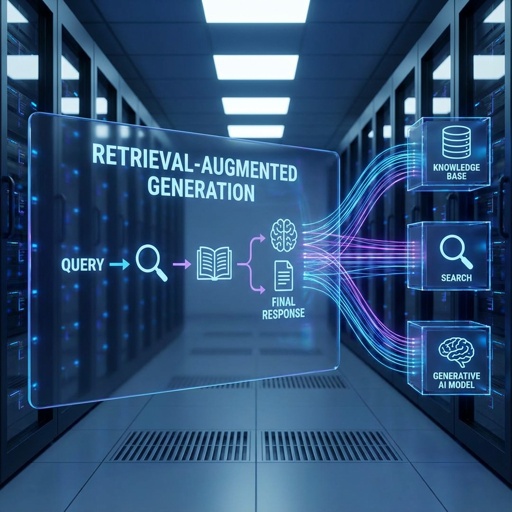
Retrieval-augmented generation systems have a more complex failure surface than standalone language models. The retrieval component can fail to find relevant documents. The reranking component can return the wrong documents as the most relevant. The generation component can fail to use the retrieved documents correctly, ignoring relevant content or hallucinating content not present in the retrieved context. 

Evaluating a RAG system requires measuring each of these components separately, not just the end-to-end output quality. End-to-end metrics that look good can mask retrieval failures that are being compensated for by a capable generator, or generation quality failures that are being compensated for by excellent retrieval. DDD’s detailed guide on RAG data quality, evaluation, and governance covers the RAG-specific evaluation methodology in depth.

Context Faithfulness as a Core RAG Evaluation Metric

Context faithfulness, the property that generated responses are grounded in and consistent with the retrieved context rather than generated from the model’s parametric knowledge, is a critical evaluation dimension for RAG systems that standard output quality metrics do not assess. 

A RAG system that produces accurate responses by ignoring the retrieved context and falling back on parametric knowledge is not providing the factual grounding that the RAG architecture was intended to supply. Measuring context faithfulness requires an evaluation methodology that compares the generated output against the retrieved documents, not just against a reference answer.

Evaluating Agentic AI Systems

Why Task Completion Is Not Enough

Agentic AI systems take sequences of actions in dynamic environments, using tools, APIs, and external services to accomplish multi-step goals. Evaluating them requires a fundamentally different framework from evaluating single-turn text generation. Task completion rate, whether the agent successfully achieves the stated goal, is a necessary but insufficient evaluation metric. 

An agent that completes tasks using inefficient action sequences, makes unnecessary tool calls, or produces correct outcomes through reasoning paths that would fail on slightly different inputs is not a reliable production system, even if its task completion rate looks acceptable. Building trustworthy agentic AI with human oversight discusses the evaluation and governance frameworks that agentic systems require.

Reliability, Safety, and Trajectory Evaluation

Agentic evaluation needs to measure at least four dimensions beyond task completion: reasoning trajectory quality, which assesses whether the agent’s reasoning steps are sound even when the outcome is correct; tool use accuracy, which evaluates whether tools are invoked appropriately with correct parameters; robustness to unexpected inputs during multi-turn interactions; and safety under adversarial conditions, including attempts to manipulate the agent into taking unauthorized actions. Human-in-the-loop evaluation remains the reference standard for agentic safety assessment, particularly for systems that take actions with real-world consequences. Agentic AI deployments that skip systematic safety evaluation before production release create liability exposure that standard output quality metrics will not have revealed.

The Evaluation Stack: What a Complete Program Looks Like

Layering Benchmark, Automated, and Human Evaluation

A complete evaluation program for a production GenAI system combines multiple layers. Public benchmarks provide broad capability signals and facilitate external comparisons, with appropriate discounting for contamination risk and saturation. Automated metrics, including reference-based metrics for structured tasks and LLM-judge approaches for open-ended generation, provide scalable quality signals that can run on large evaluation sets.

Human evaluation provides the ground truth for dimensions that automated methods cannot reliably assess, including safety, domain accuracy, and output quality in the deployment context. Each layer informs a different aspect of the deployment decision.

The Evaluation Timeline

Evaluation should be integrated into the development lifecycle, not run as a pre-deployment checkpoint. Capability assessment runs during model or fine-tuning selection. Task-specific evaluation runs after initial fine-tuning to assess whether the fine-tuned model actually improved on the target task. Red-teaming and safety evaluation run before any production deployment. Regression testing runs on every model update that touches safety-relevant or quality-relevant components. Post-deployment monitoring provides an ongoing signal that the production distribution has not drifted in ways that have degraded model performance.

The Common Gap: Evaluation Data Quality

The most common single failure point in enterprise evaluation programs is not the choice of metrics or the evaluation methodology. It is the quality and representativeness of the evaluation data itself. 

An evaluation set that was assembled quickly from available examples, which over-represents easy cases and under-represents the edge cases and domain variations that matter for production reliability, will produce evaluation scores that overestimate the model’s readiness for deployment. Annotation solutions that bring the same quality discipline to evaluation data as to training data are a structural requirement for evaluation programs that actually predict production performance.

How Digital Divide Data Can Help

Digital Divide Data provides an end-to-end evaluation infrastructure for GenAI programs, from evaluation dataset design through human annotation and LLM-judge calibration to ongoing regression testing and post-deployment monitoring.

The model evaluation services cover task-specific evaluation dataset construction, with explicit coverage of edge cases, domain-specific inputs, and behavioral consistency test variants. Evaluation sets are built from production-representative inputs rather than repurposed public benchmarks, producing evaluation scores that predict deployment performance rather than benchmark-suite performance.

For safety and quality evaluation, human preference optimization services provide systematic human quality signal collection across the dimensions that automated metrics miss: factual accuracy, helpfulness, tone appropriateness, and safety. Red-teaming capability is integrated into safety evaluation workflows, covering adversarial prompt patterns relevant to the specific deployment context rather than generic safety benchmarks.

For agentic deployments, evaluation methodology extends to trajectory assessment, tool use accuracy, and multi-turn robustness, with human evaluation covering the safety-critical judgment calls that LLMs cannot reliably assess. Trust and safety solutions include structured red-teaming protocols and ongoing monitoring frameworks that keep the safety signal current as models and user behavior evolve.

Talk to an Expert and build an evaluation program that actually predicts production performance

Conclusion

Benchmark scores are starting points for model assessment, not finishing lines. The dimensions that determine whether a GenAI system actually performs in production, behavioral consistency, calibration, domain accuracy, safety under adversarial conditions, and output quality on open-ended tasks are systematically undercovered by public benchmarks and require a purpose-built evaluation methodology to measure reliably. 

Teams that invest in evaluation infrastructure commensurate with what they invest in model development will have an accurate picture of their system’s readiness before deployment. Teams that rely on benchmark numbers as their primary evidence for production readiness will consistently be surprised by what they encounter after launch.

As GenAI systems take on more consequential tasks, including customer-facing interactions, regulated industry applications, and agentic workflows with real-world effects, the cost of inadequate evaluation rises accordingly. 

The investment in evaluation data quality, human annotation capacity, and task-specific evaluation methodology is not overhead on the development program. It is the mechanism that transforms a model that performs in controlled conditions into a system that can be trusted in production. Generative AI evaluation built around production-representative data and systematic human quality signal is the foundation that makes that trust warranted.

References

Mohammadi, M., Li, Y., Lo, J., & Yip, W. (2025). Evaluation and benchmarking of LLM agents: A survey. Proceedings of the 31st ACM SIGKDD Conference on Knowledge Discovery and Data Mining V.2. ACM. https://doi.org/10.1145/3711896.3736570

Stanford HAI. (2024). Technical performance. 2024 AI Index Report. Stanford University Human-Centered AI. https://hai.stanford.edu/ai-index/2024-ai-index-report/technical-performance

Frequently Asked Questions

Q1. What is benchmark contamination, and why does it matter for model selection?

Benchmark contamination occurs when test questions from public datasets appear in a model’s pre-training corpus, causing scores to reflect memorization rather than genuine capability, which means leaderboard rankings may not accurately reflect how models will perform on unseen production inputs.

Q2. When is human evaluation necessary versus automated metrics?

Human evaluation is necessary for open-ended generation tasks where quality has subjective dimensions, for safety-critical judgment calls where automated judge bias could mask failure modes, and for domain-specific accuracy assessment that requires expert knowledge.

Q3. What evaluation dimensions do public benchmarks consistently miss?

Behavioral consistency across rephrased inputs, output calibration, robustness to adversarial inputs, domain accuracy in specific deployment contexts, and open-ended generation quality are the dimensions most systematically undercovered by standard public benchmarks.

Q4. How should RAG systems be evaluated differently from standalone language models?

RAG evaluation requires measuring retrieval component performance, reranking accuracy, and context faithfulness separately from end-to-end output quality, since good end-to-end results can mask component failures that will cause problems under different input distributions.

Model Evaluation for GenAI: Why Benchmarks Alone Are Not Enough Read Post »

Multimodal AI Training

Multimodal AI Training: What the Data Actually Demands

The difficulty of multimodal training data is not simply that there is more of it to produce. It is that the relationships between modalities must be correct, not just the data within each modality. An image that is accurately labeled for object detection but paired with a caption that misrepresents the scene produces a model that learns a contradictory representation of reality. 

A video correctly annotated for action recognition but whose audio is misaligned with the visual frames teaches the model the wrong temporal relationship between what happens and how it sounds. These cross-modal consistency problems do not show up in single-modality quality checks. They require a different category of annotation discipline and quality assurance, one that the industry is still in the process of developing the infrastructure to apply at scale.

This blog examines what multimodal AI training actually demands from a data perspective, covering how cross-modal alignment determines model behavior, what annotation quality requirements differ across image, video, and audio modalities, why multimodal hallucination is primarily a data problem rather than an architecture problem, how the data requirements shift as multimodal systems move into embodied and agentic applications, and what development teams need to get right before their training data.

What Multimodal AI Training Actually Involves

The Architecture and Where Data Shapes It

Multimodal large language models process inputs from multiple data types by routing each through a modality-specific encoder that converts raw data into a mathematical representation, then passing those representations through a fusion mechanism that aligns and combines them into a shared embedding space that the language model backbone can operate over. The vision encoder handles images and video frames. The audio encoder handles speech and sound. The text encoder handles written content. The fusion layer or connector module is where the modalities are brought together, and it is the component whose quality is most directly determined by the quality of the training data.

A fusion layer that has been trained on accurately paired, consistently annotated, well-aligned multimodal data learns to produce representations where the image of a dog and the word dog, and the sound of a bark occupy regions of the embedding space that are meaningfully related. A fusion layer trained on noisily paired, inconsistently annotated data learns a blurrier, less reliable mapping that produces the hallucination and cross-modal reasoning failures that characterize underperforming multimodal systems. The architecture sets the ceiling. The training data determines how close to that ceiling the deployed model performs.

The Scale Requirement That Changes the Data Economics

Multimodal systems require significantly more training data than their unimodal counterparts, not only in absolute volume but in the combinatorial variety needed to train the cross-modal relationships that define the system’s capabilities. A vision-language model that is trained primarily on image-caption pairs from a narrow visual domain will learn image-language relationships within that domain and generalize poorly to images with different characteristics, different object categories, or different spatial arrangements. 

The diversity requirement is multiplicative across modalities: a system that needs to handle diverse images, diverse language, and diverse audio needs training data whose diversity spans all three dimensions simultaneously, which is a considerably harder curation problem than assembling diverse data in any one modality.

Cross-Modal Alignment: The Central Data Quality Problem

What Alignment Means and Why It Fails

Cross-modal alignment is the property that makes a multimodal model genuinely multimodal rather than simply a collection of unimodal models whose outputs are concatenated. A model with good cross-modal alignment has learned that the visual representation of a specific object class, the textual description of that class, and the auditory signature associated with it are related, and it uses that learned relationship to improve its performance on tasks that involve any combination of the three. A model with poor cross-modal alignment has learned statistical correlations within each modality separately but has not learned the deeper relationships between them.

Alignment failures in training data take several forms. The most straightforward is incorrect pairing: an image paired with a caption that does not accurately describe it, a video clip paired with a transcript that corresponds to a different moment, or an audio recording labeled with a description of a different sound source. Less obvious but equally damaging is partial alignment: a caption that accurately describes some elements of the image but misses others, a transcript that is textually accurate but temporally misaligned with the audio, or an annotation that correctly labels the dominant object in a scene but ignores the contextual elements that determine the scene’s meaning.

The Temporal Alignment Problem in Video and Audio

Temporal alignment is a specific and particularly demanding form of cross-modal alignment that arises in video and audio data. A video is not a collection of independent frames. It is a sequence in which the relationship between what happens at time T and what happens at time T+1 carries meaning that neither frame conveys alone. An action recognition model trained on video data where frame-level annotations do not accurately reflect the temporal extent of the action, or where the action label is assigned to the wrong temporal segment, learns an imprecise representation of the action’s dynamics. Video annotation for multimodal training requires temporal precision that static image annotation does not, including accurate action boundary detection, consistent labeling of motion across frames, and synchronization between visual events and their corresponding audio or textual descriptions.

Audio-visual synchronization is a related challenge that receives less attention than it deserves in multimodal data quality discussions. Human speech is perceived as synchronous with lip movements within a tolerance of roughly 40 to 100 milliseconds. Outside that window, the perceptual mismatch is noticeable to human observers. For a multimodal model learning audio-visual correspondence, even smaller misalignments can introduce noise into the learned relationship between the audio signal and the visual event it accompanies. At scale, systematic small misalignments across a large training corpus can produce a model that has learned a subtly incorrect temporal model of the audio-visual world.

Image Annotation for Multimodal Training

Beyond Object Detection Labels

Image annotation for multimodal training differs from image annotation for standard computer vision in a dimension that is easy to underestimate: the relationship between the image content and the language that describes it is part of what is being learned, not a byproduct of the annotation. 

An object detection label that places a bounding box around a car is sufficient for training a car detector. The same bounding box is insufficient for training a vision-language model, because the model needs to learn not only that the object is a car but how the visual appearance of that car relates to the range of language that might describe it: vehicle, automobile, sedan, the red car in the foreground, the car partially occluded by the pedestrian. Image annotation services designed for multimodal training need to produce richer, more linguistically diverse descriptions than standard computer vision annotation, and the consistency of those descriptions across similar images is a quality dimension that directly affects cross-modal alignment.

The Caption Diversity Requirement

Caption diversity is a specific data quality requirement for vision-language model training that is frequently underappreciated. A model trained on image-caption pairs where all captions follow a similar template learns to associate visual features with a narrow range of linguistic expression. The model will perform well on evaluation tasks that use similar language but will generalize poorly to the diversity of phrasing, vocabulary, and descriptive style that real-world applications produce. Producing captions with sufficient linguistic diversity while maintaining semantic accuracy requires annotation workflows that explicitly vary phrasing, descriptive focus, and level of detail across multiple captions for the same image, rather than treating caption generation as a single-pass labeling task.

Spatial Relationship and Compositional Annotation

Spatial relationship annotation, which labels the geometric and semantic relationships between objects within an image rather than just the identities of the objects themselves, is a category of annotation that matters significantly more for multimodal model training than for standard object detection.

A vision-language model that needs to answer the question which cup is to the left of the keyboard requires training data that explicitly annotates spatial relationships, not just object identities. The compositional reasoning failures that characterize many current vision-language models, where the model correctly identifies all objects in a scene but fails on questions about their spatial or semantic relationships, are in part a reflection of training data that under-annotates these relationships.

Video Annotation: The Complexity That Scale Does Not Resolve

Why Video Annotation Is Not Image Annotation at Scale

Video is not a large collection of images. The temporal dimension introduces annotation requirements that have no equivalent in static image labeling. Action boundaries, the precise frame at which an action begins and ends, must be annotated consistently across thousands of video clips for the model to learn accurate representations of action timing. Event co-occurrence relationships, which events happen simultaneously and which happen sequentially, must be annotated explicitly rather than inferred. 

Long-range temporal dependencies, where an event at the beginning of a clip affects the interpretation of an event at the end, require annotators who watch and understand the full clip before making frame-level annotations. 

Dense Video Captioning and the Annotation Depth It Requires

Dense video captioning, the task of generating textual descriptions of all events in a video with accurate temporal localization, is one of the most data-demanding tasks in multimodal AI training. Training data for dense captioning requires that every significant event in a video clip be identified, temporally localized to its start and end frames, and described in natural language with sufficient specificity to distinguish it from similar events in other clips. The annotation effort per minute of video for dense captioning is dramatically higher than for single-label video classification, and the quality of the temporal localization directly determines the precision of the cross-modal correspondence the model learns.

Multi-Camera and Multi-View Video

As multimodal AI systems move into embodied and Physical AI applications, video annotation requirements extend to multi-camera setups where the same event must be annotated consistently across multiple viewpoints simultaneously. 

A manipulation action that is visible from the robot’s wrist camera, the overhead camera, and a side camera must be labeled with consistent action boundaries, consistent object identities, and consistent descriptions across all three views. Inconsistencies across views produce training data that teaches the model contradictory representations of the same physical event. The multisensor fusion annotation challenges that arise in Physical AI settings apply equally to multi-view video annotation, and the annotation infrastructure needed to handle them is considerably more complex than what single-camera video annotation requires.

Audio Annotation: The Modality Whose Data Quality Is Least Standardized

What Audio Annotation for Multimodal Training Requires

Audio annotation for multimodal training is less standardized than image or text annotation, and the quality standards that exist in the field are less widely adopted. A multimodal system that processes speech needs training data where speech is accurately transcribed, speaker-attributed in multi-speaker contexts, and annotated for the non-linguistic features, tone, emotion, pace, and prosody that carry meaning beyond the words themselves. 

A system that processes environmental audio needs training data where sound events are accurately identified, temporally localized, and described in a way that captures the semantic relationship between the sound and its source. Audio annotation at the quality level that multimodal model training requires is more demanding than transcription alone, and teams that treat audio annotation as a transcription task will produce training data that gives their models a linguistically accurate but perceptually shallow representation of audio content.

The Language Coverage Problem in Audio Training Data

Audio training data for speech-capable multimodal systems faces an acute version of the language coverage problem that affects text-only language model training. Systems trained predominantly on English speech data perform significantly worse on other languages, and the performance gap is larger for audio than for text because the acoustic characteristics of speech vary across languages in ways that require explicit representation in the training data rather than cross-lingual transfer. 

Building multimodal systems that perform equitably across languages requires intentional investment in audio data collection and annotation across linguistic communities, an investment that most programs underweight relative to its impact on deployed model performance. Low-resource languages in AI are directly relevant to audio-grounded multimodal training, where low-resource language communities face the sharpest capability gaps.

Emotion and Paralinguistic Annotation

Paralinguistic annotation, the labeling of speech features that convey meaning beyond the literal content of the words, is a category of audio annotation that is increasingly important for multimodal systems designed for human interaction applications. Tone, emotional valence, speech rate variation, and prosodic emphasis all carry semantic information that a model interacting with humans needs to process correctly. Annotating these features requires annotators who can make consistent judgments about inherently subjective qualities, which in turn requires annotation guidelines that are specific enough to produce inter-annotator agreement and quality assurance processes that measure that agreement systematically.

Multimodal Hallucination: A Data Problem More Than an Architecture Problem

How Hallucination in Multimodal Models Differs From Text-Only Hallucination

Hallucination in language models is a well-documented failure mode where the model generates content that is plausible in form but factually incorrect. In multimodal models, hallucination takes an additional dimension: the model generates content that is inconsistent with the visual or audio input it has been given, not just with external reality. A model that correctly processes an image of an empty table but generates a description that includes objects not present in the image is exhibiting cross-modal hallucination, a failure mode distinct from factual hallucination and caused by a different mechanism.

Cross-modal hallucination is primarily a training data problem. It arises when the training data contains image-caption pairs where the caption describes content not visible in the image, when the model has been exposed to so much text describing common image configurations that it generates those descriptions regardless of what the image actually shows, or when the cross-modal alignment in the training data is weak enough that the model’s language prior dominates its visual processing. The tendency for multimodal models to generate plausible-sounding descriptions that prioritize language fluency over visual fidelity is a direct consequence of training data where language quality was prioritized over cross-modal accuracy.

How Training Data Design Can Reduce Hallucination

Reducing cross-modal hallucination through training data design requires explicit attention to the accuracy of the correspondence between modalities, not just the quality of each modality independently. Negative examples that show the model what it looks like when language is inconsistent with visual content, preference data that systematically favors visually grounded descriptions over hallucinated ones, and fine-grained correction annotations that identify specific hallucinated elements and provide corrected descriptions are all categories of training data that target the cross-modal alignment failure underlying hallucination. Human preference optimization approaches applied specifically to cross-modal faithfulness, where human annotators compare model outputs for their visual grounding rather than general quality, are among the most effective interventions currently in use for reducing multimodal hallucination in production systems.

Evaluation Data for Hallucination Assessment

Measuring hallucination in multimodal models requires evaluation data that is specifically designed to surface cross-modal inconsistencies, not just general performance benchmarks. Evaluation sets that include images with unusual configurations, rare object combinations, and scenes that contradict common statistical associations are more diagnostic of hallucination than standard benchmark images that conform to typical visual patterns the model has likely seen during training. Building evaluation data specifically for hallucination assessment is a distinct annotation task from building training data; model evaluation services are addressed through targeted adversarial data curation designed to reveal the specific cross-modal failure modes most relevant to each system’s deployment context.

Multimodal Data for Embodied and Agentic AI

When Modalities Include Action

The multimodal AI training challenge takes on additional complexity when the system is not only processing visual, audio, and language inputs but also taking actions in the physical world. Vision-language-action models, which underpin much of the current development in robotics and Physical AI, must learn not only to understand what they see and hear but to connect that understanding to appropriate physical actions. 

The training data for these systems is not image-caption pairs. It is sensorimotor sequences: synchronized streams of visual input, proprioceptive sensor readings, force feedback, and the action commands that a human operator or an expert policy selects in response to those inputs. VLA model analysis services and the broader context of vision-language-action models and autonomy address the annotation demands specific to this category of multimodal training data.

Instruction Tuning Data for Multimodal Agents

Instruction tuning for multimodal agents, which teaches a system to follow complex multi-step instructions that involve perception, reasoning, and action, requires training data that is structured differently from standard multimodal pairs. Each training example is a sequence: an instruction, a series of observations, a series of intermediate reasoning steps, and a series of actions, all of which need to be consistently annotated and correctly attributed. The annotation effort for multimodal instruction tuning data is substantially higher per example than for standard image-caption pairs, and the quality standards are more demanding because errors in the action sequence or the reasoning annotation propagate directly into the model’s learned behavior. Building generative AI datasets with human-in-the-loop workflows is particularly valuable for this category of training data, where the judgment required to evaluate whether a multi-step action sequence is correctly annotated exceeds what automated quality checks can reliably assess.

Quality Assurance Across Modalities

Why Single-Modality QA Is Not Enough

Quality assurance for multimodal training data requires checking not only within each modality but across modalities simultaneously. A QA process that verifies image annotation quality independently and caption quality independently will pass image-caption pairs where both elements are individually correct, but the pairing is inaccurate. A QA process that checks audio transcription quality independently and video annotation quality independently will pass audio-video pairs where the transcript is accurate but temporally misaligned with the video. Cross-modal QA, which treats the relationship between modalities as the primary quality dimension, is a distinct capability from single-modality QA and requires annotation infrastructure and annotator training that most programs have not yet fully developed.

Inter-Annotator Agreement in Multimodal Annotation

Inter-annotator agreement, the standard quality metric for annotation consistency, is more complex to measure in multimodal settings than in single-modality settings. Agreement on object identity within an image is straightforward to quantify. Agreement on whether a caption accurately represents the full semantic content of an image requires subjective judgment that different annotators may apply differently. 

Agreement on the correct temporal boundary of an action in a video requires a level of precision that different annotators may interpret differently, even when given identical guidelines. Building annotation guidelines that are specific enough to produce measurable inter-annotator agreement on cross-modal quality dimensions, and measuring that agreement systematically, is a precondition for the kind of training data quality that production of multimodal systems requires.

Trust and Safety Annotation in Multimodal Data

Multimodal training data introduces trust and safety annotation requirements that are qualitatively different from text-only content moderation. Images and videos can carry harmful content in ways that text descriptions do not capture. Audio can include harmful speech that automated transcription produces as apparently neutral text. The combination of modalities can produce harmful associations that would not arise from either modality alone. Trust and safety solutions for multimodal systems need to operate across all modalities simultaneously and need to be designed with the specific cross-modal harmful content patterns in mind, not simply extended from text-only content moderation frameworks.

How Digital Divide Data Can Help

Digital Divide Data provides end-to-end multimodal data solutions for AI development programs across the full modality stack. The approach is built around the recognition that multimodal model quality is determined by cross-modal data quality, not by the quality of each modality independently, and that the annotation infrastructure to assess and ensure cross-modal quality requires specific investment rather than extension of single-modality workflows.

On the image side, our image annotation services produce the linguistically diverse, relationship-rich, spatially accurate descriptions that vision-language model training requires, with explicit coverage of compositional and spatial relationships rather than object identity alone. Caption diversity and cross-modal consistency are treated as primary quality dimensions in annotation guidelines and QA protocols.

On the video side, our video annotation capabilities address the temporal annotation requirements of multimodal training data with clip-level understanding as a prerequisite for frame-level labeling, consistent action boundary detection, and synchronization between visual, audio, and textual annotation streams. For embodied AI programs, DDD’s annotation teams handle multi-camera, multi-view annotation with cross-view consistency required for action model training.

On the audio side, our annotation services extend beyond transcription to include paralinguistic feature annotation, speaker attribution, sound event localization, and multilingual coverage, with explicit attention to low-resource linguistic communities. For multimodal programs targeting equitable performance across languages, DDD provides the audio data coverage that standard English-dominant datasets cannot supply.

For programs addressing multimodal hallucination, our human preference optimization services include cross-modal faithfulness evaluation, producing preference data that specifically targets the visual grounding failures underlying hallucination. Model evaluation services provide adversarial multimodal evaluation sets designed to surface hallucination and cross-modal reasoning failures before they appear in production.

Build multimodal AI systems grounded in data that actually integrates modalities. Talk to an expert!

Conclusion

Multimodal AI training is not primarily a harder version of unimodal training. It is a different kind of problem, one where the quality of the relationships between modalities determines model behavior more than the quality of each modality independently. The teams that produce the most capable multimodal systems are not those with the largest training corpora or the most sophisticated architectures. 

They are those that invest in annotation infrastructure that can produce and verify cross-modal accuracy at scale, in evaluation frameworks that measure cross-modal reasoning and hallucination rather than unimodal benchmarks, and in data diversity strategies that explicitly span the variation space across all modalities simultaneously. Each of these investments requires a level of annotation sophistication that is higher than what single-modality programs have needed, and teams that attempt to scale unimodal annotation infrastructure to multimodal requirements will consistently find that the cross-modal quality gaps they did not build for are the gaps that limit their model’s real-world performance.

The trajectory of AI development is toward systems that process the world the way humans do, through the simultaneous integration of what they see, hear, read, and do. That trajectory makes multimodal training data quality an increasingly central competitive factor rather than a technical detail. Programs that build the annotation infrastructure, quality assurance processes, and cross-modal consistency standards now will be better positioned to develop the next generation of multimodal capabilities than those that treat data quality as a problem to be addressed after model performance plateaus. 

Digital Divide Data is built to provide the multimodal data infrastructure that makes that early investment possible across every modality that production AI systems require.

References

Lan, Z., Chakraborty, R., Munikoti, S., & Agarwal, S. (2025). Multimodal AI: Integrating diverse data modalities for advanced intelligence. Emergent Mind. https://www.emergentmind.com/topics/multimodal-ai

Gui, L. (2025). Toward data-efficient multimodal learning. Carnegie Mellon University Language Technologies Institute Dissertation. https://lti.cmu.edu/research/dissertations/gui-liangke-dissertation-document.pdf

Chen, L., Lin, F., Shen, Y., Cai, Z., Chen, B., Zhao, Z., Liang, T., & Zhu, W. (2025). Efficient multimodal large language models: A survey. Visual Intelligence, 3(10). https://doi.org/10.1007/s44267-025-00099-6

Frequently Asked Questions

What makes multimodal training data harder to produce than single-modality data?

Cross-modal alignment accuracy, where the relationship between modalities must be correct rather than just the content within each modality, adds a quality dimension that single-modality annotation workflows are not designed to verify and that requires distinct QA infrastructure to assess systematically.

What is cross-modal hallucination, and how is it different from standard LLM hallucination?

Cross-modal hallucination occurs when a multimodal model generates content inconsistent with its visual or audio input, rather than just inconsistent with factual reality, arising from weak cross-modal alignment in training data rather than from language model statistical biases alone.

How much more training data does a multimodal system need compared to a text-only model?

The volume requirement is substantially higher because diversity must span multiple modality dimensions simultaneously, and quality requirements are more demanding since cross-modal accuracy must be verified in addition to within-modality quality.

Why is temporal alignment in video annotation so important for multimodal model training?

Temporal misalignment in video annotation teaches the model incorrect associations between what happens visually and what is described linguistically or heard aurally, producing models with systematically wrong temporal representations of events and actions.

Multimodal AI Training: What the Data Actually Demands Read Post »

LLM Fine-Tuning

Why Most Enterprise LLM Fine-Tuning Projects Underdeliver

The premise of enterprise LLM fine-tuning is straightforward enough to be compelling. Take a capable general-purpose language model, train it further on proprietary data from your domain, and get a model that performs markedly better on the tasks that matter to your organization. 

The gap between that premise and what most enterprise fine-tuning projects actually deliver is wide enough to have become one of the more reliably frustrating patterns in enterprise AI adoption. Teams spend months on data preparation and training runs, consume substantial GPU budgets, and arrive at a model that performs comparably to the base model they started with, or worse, performs well on the benchmark they optimized for and poorly on the actual production workload.

The gap is not primarily a technical failure. The algorithms work. Parameter-efficient fine-tuning techniques have matured significantly and are accessible to any team with reasonable engineering resources. The failures are upstream and downstream of the training run itself: in the quality and relevance of the training data, in the mismatch between the fine-tuning objective and the actual production task, in the absence of evaluation frameworks that measure what actually matters, and in the organizational assumptions about what fine-tuning is and is not appropriate for. Addressing these failures requires a clearer understanding of what enterprise LLM fine-tuning can and cannot be expected to deliver, and what the preconditions for a project that actually closes the performance gap look like.

This blog examines why most enterprise LLM fine-tuning projects underdeliver, covering the structural reasons that data quality problems dominate fine-tuning outcomes, and how catastrophic forgetting undermines performance.

What Enterprise Fine-Tuning Is Actually Trying to Solve

The Gap That Fine-Tuning Is Supposed to Close

A general-purpose language model trained on broad internet-scale data has learned a great deal about language, reasoning, and general world knowledge. What it has not learned is your organization’s specific terminology, your domain’s particular conventions, your internal document formats, your compliance constraints, or the nuanced judgment calls your subject matter experts make. Fine-tuning promises that additional training on domain-specific examples can close that gap, producing a model that speaks your domain’s language, follows your conventions, and applies the judgment patterns you need.

That promise is real, but it is more conditional than it usually appears in the initial project framing. Fine-tuning is effective at teaching a model to change its style, follow specific output formats, apply domain vocabulary consistently, and replicate the structure of domain-specific responses. It is considerably less effective at teaching a model new factual knowledge, correcting systematic reasoning errors in the base model, or producing reliable behavior on tasks that differ in meaningful ways from the fine-tuning examples. The mismatch between what teams expect fine-tuning to accomplish and what it reliably delivers is the first place where projects begin to underdeliver.

When Fine-Tuning Is the Right Tool

Fine-tuning is most effective when the production task has a consistent structure that can be demonstrated through examples, when the required behavior is primarily a matter of style, format, or domain register rather than novel knowledge, and when a sufficient volume of high-quality task-representative examples can be assembled. 

Legal document summarization with consistent output structure, customer service response generation in a specific organizational tone, and clinical note formatting for a defined documentation standard: these are use cases where fine-tuning is likely to deliver measurable improvement over prompting alone. Tasks that require the model to retrieve specific factual information, reason across long documents, or apply judgment that varies substantially across cases are often better addressed through retrieval-augmented generation or prompt engineering, and deploying fine-tuning for them is a common source of underperformance.

The Data Quality Problem That Derails Most Projects

Why Training Data Quality Is the Primary Determinant of Fine-Tuning Outcomes

The most consistent finding across enterprise fine-tuning programs that underdeliver is that the training data was not as good as the team believed it to be. This is not a subtle problem. It is the dominant failure mode, appearing in various forms across virtually every project that does not achieve its intended performance improvement. 

The relationship between training data quality and fine-tuning outcome is more direct than in pre-training, because the fine-tuning dataset is small enough that individual quality problems have disproportionate influence on the model’s learned behavior. A systematic error in a pre-training corpus of a hundred billion tokens will have a negligible effect on the model’s overall behavior. The same systematic error in a fine-tuning dataset of ten thousand examples will produce a model that reliably replicates the error. 

The Three Most Common Data Quality Failures

The first is inconsistency across examples. Enterprise data assembled from operational systems, human-written documents, or labeled outputs from multiple annotators will typically contain inconsistent patterns: different levels of formality, different approaches to similar cases, and different levels of detail. A model trained on this inconsistency does not learn a clear behavior pattern. It learns an average of conflicting patterns, which produces outputs that are neither definitively one approach nor definitively another, and that satisfy no one’s actual requirements.

The second is contamination by low-quality examples that are included because they are available rather than because they are good. In enterprise data collection, the temptation to include more examples to reach a volume target is strong, and the quality bar for inclusion is often lower than it should be. Examples that are technically correct but poorly constructed, that use domain vocabulary inconsistently, or that apply the target behavior only partially will actively degrade model performance relative to a smaller, cleaner dataset. The quality-over-quantity principle in fine-tuning data assembly is not a platitude. It reflects how the fine-tuning gradient update works: every example in the dataset shifts the model’s parameters, and bad examples shift them in the wrong direction. Text annotation services that apply consistent quality standards across the full dataset, rather than accepting examples that merely pass a minimum threshold, are a structural requirement for fine-tuning data that actually improves model performance.

The third is a distribution mismatch between the fine-tuning data and the actual production inputs. Teams often assemble fine-tuning data from the examples that are easiest to collect, which are the well-structured, easy cases. The production workload includes edge cases, ambiguous inputs, unusual phrasing patterns, and domain variants that the easy-case dataset does not cover. A model fine-tuned on the easy cases will perform well on easy cases and no better than the base model on everything else. If the easy cases constitute a minority of the production workload, the fine-tuning project will yield disappointing real-world results even when benchmark metrics appear acceptable.

Catastrophic Forgetting: The Problem Teams Discover Too Late

What Catastrophic Forgetting Actually Means in Practice

Catastrophic forgetting is the phenomenon where a language model, when fine-tuned on a specific task, loses some of the general capabilities it possessed before fine-tuning. The mechanism is straightforward: the parameter updates that teach the model the new task overwrite some of the parameter configurations that supported pre-existing capabilities. The result is a model that is better at the fine-tuning task and worse at other tasks it previously handled well.

For enterprise programs, catastrophic forgetting shows up in ways that are not always immediately obvious. A model fine-tuned on legal document analysis may become noticeably worse at general reasoning tasks that legal work occasionally requires. A model fine-tuned on customer service responses may lose some of its ability to handle the off-script queries that make up a meaningful fraction of real customer interactions. A model fine-tuned on a narrow set of document formats may fail to handle format variations that it would have managed competently before fine-tuning. These regressions are often discovered after deployment, when users encounter cases that the evaluation framework did not cover.

Why Parameter-Efficient Fine-Tuning Does Not Fully Solve the Problem

Parameter-efficient fine-tuning approaches, which modify only a small fraction of the model’s parameters while keeping the rest frozen, are often presented as a solution to catastrophic forgetting. The intuition is that smaller parameter changes mean less disruption to pre-existing capabilities. This intuition is partially correct but overstated. Research across multiple model families has demonstrated that even low-rank adaptation methods, which are among the most parameter-efficient approaches available, can produce significant forgetting on tasks that differ from the fine-tuning distribution, particularly when fine-tuning datasets are small and the fine-tuning task is narrow.

There is also a specific forgetting risk that receives less attention in enterprise contexts: the erosion of safety behaviors. Models that have been trained with safety guardrails through preference optimization can lose those guardrails when fine-tuned on datasets that do not reinforce them. An enterprise fine-tuning project that improves task performance while inadvertently degrading safety behavior has created a production risk that may not surface in standard evaluation until it produces a visible failure.

Managing Forgetting Through Dataset Design

The most practical mitigation for catastrophic forgetting in enterprise fine-tuning is dataset design rather than algorithm selection. Including a representative sample of general task examples alongside domain-specific examples in the fine-tuning dataset, sometimes called experience replay or rehearsal, helps preserve the parameter configurations that support general capabilities.

Including examples that exercise the model’s safety behaviors alongside domain task examples helps preserve those behaviors. The tradeoff is that a more diverse fine-tuning dataset requires more careful curation and a larger annotation investment. Human-in-the-loop approaches to building generative AI datasets that include deliberate coverage of both domain-specific and general behavioral requirements produce fine-tuning datasets that are less likely to create the forgetting regressions that teams discover in production.

The Evaluation Problem: Measuring the Wrong Thing

Why Benchmark Performance Does Not Predict Production Performance

The evaluation framework used for a fine-tuning project determines what the project appears to achieve. Teams that evaluate their fine-tuned model against a benchmark constructed from the same distribution as the training data will consistently find that their model performs well. Teams that evaluate against production inputs, including the edge cases, the unusual phrasings, the ambiguous requests, and the off-task queries that real users generate, will find a different picture. The gap between these two pictures is the gap between benchmark performance and production performance, and it is one of the most reliable explanations for why fine-tuning projects that look successful in development underperform in deployment.

The construction of the evaluation set is the most consequential methodological decision in a fine-tuning program. An evaluation set drawn from the same source as the training data, or constructed by the same team with the same selection criteria, will not reveal the distribution gaps and edge case failures that determine real-world performance. An evaluation set that is constructed independently, drawn from actual production inputs, and includes deliberate coverage of the cases the team is most uncertain about is significantly more predictive of deployment performance. Model evaluation services that maintain methodological independence between the fine-tuning program and the evaluation framework are a structural requirement for getting an honest picture of what the fine-tuned model actually delivers.

The Missing Behavioral Dimensions in Standard Evaluation

Standard fine-tuning evaluations typically measure task accuracy on held-out examples from the training distribution. What they rarely measure is behavioral consistency across rephrased inputs, robustness to adversarial or unusual inputs, calibration of confidence alongside accuracy, behavior under out-of-distribution conditions, and adherence to the safety and compliance behaviors the model is expected to maintain. Each of these dimensions can reveal failures that task accuracy does not capture.

Behavioral consistency is particularly important for enterprise deployments. A customer service model that gives different answers to semantically equivalent questions phrased differently is producing a user experience problem that accuracy metrics on a fixed test set will not reveal. A compliance-sensitive application that behaves correctly on standard inputs but incorrectly on slight rephrasings has a reliability problem that only behavioral consistency testing will surface. 

Building these dimensions into the evaluation framework from the start of the project, rather than adding them after a deployment failure draws attention to them, is one of the clearest differences between fine-tuning programs that deliver on their promises and those that do not.

Human Evaluation and Where It Cannot Be Replaced

Automated metrics capture some dimensions of output quality and miss others. For tasks where quality is partially subjective, where the correct answer depends on context that is difficult to encode in a metric, or where the model’s behavior needs to meet standards that are easier to recognize than to specify, human evaluation is not supplementary to automated metrics. It is the primary signal. Human preference optimization approaches that systematically collect and incorporate human quality judgments produce evaluation signals that automated metrics cannot replicate, and they are particularly important for catching the behavioral failures that look fine on paper but produce poor experiences when encountered by actual users.

Confusing Fine-Tuning With the Right Solution

When RAG Should Have Been the Answer

One of the most common patterns in enterprise fine-tuning projects that underdeliver is that fine-tuning was the answer to a question that was better answered by retrieval-augmented generation. Fine-tuning teaches a model behavioral patterns and stylistic preferences. It does not give a model reliable access to specific current facts, internal documents, or proprietary information that changes frequently. 

An enterprise that wants its language model to answer accurately about current product specifications, internal policy documents, or recent organizational decisions is unlikely to achieve that through fine-tuning, because fine-tuning encodes statistical patterns from training examples rather than providing a queryable knowledge store. RAG systems that retrieve relevant document chunks at inference time and condition the model’s response on retrieved context are a more appropriate architecture for this category of task, and deploying fine-tuning for it will produce a model that occasionally generates plausible-sounding but incorrect information derived from stale training patterns.

When Prompt Engineering Should Have Come First

Fine-tuning is also regularly deployed as a solution to problems that careful prompt engineering would have resolved at a fraction of the cost. A model that produces outputs in the wrong format when prompted naively may produce the correct format when given a well-structured system prompt with clear instructions and representative examples. A model that uses incorrect terminology when instructed generically may use the correct terminology when provided with a domain glossary in context. 

Prompt engineering services that systematically test the performance improvement achievable through prompt design before committing to a fine-tuning program are a practical and cost-effective step that many projects skip in their eagerness to begin training. The performance ceiling for well-engineered prompts on a capable base model is often higher than teams expect, and establishing that ceiling provides a realistic baseline for evaluating whether fine-tuning delivers meaningful incremental improvement.

The Organizational Assumption That Fine-Tuning Is a One-Time Event

A final underappreciated source of underdelivery is the organizational treatment of fine-tuning as a one-time project rather than a continuous lifecycle. A fine-tuned model that is deployed and left unchanged will experience performance degradation as the production data distribution shifts, as user needs evolve, as new domain terminology emerges, and as the base model it was derived from is updated. 

The initial fine-tuning project is the beginning of a model maintenance commitment, not the end of a capability acquisition effort. Programs that plan and budget for ongoing evaluation, data collection, and re-tuning cycles consistently outperform programs that treat the initial deployment as the finish line.

The Data Flywheel: Why Production Deployment Should Feed Back Into Training

Using Deployment Data to Improve Fine-Tuning Quality

The most valuable source of fine-tuning data for an enterprise model is not a manually curated dataset assembled before training. It is the production data generated by deploying the model and observing how it behaves on real inputs. Production data contains the actual distribution of inputs the model encounters, including the edge cases and unusual patterns that pre-deployment data collection typically underrepresents. It also contains the model’s failures, which are more informative for fine-tuning improvement than its successes.

Building a feedback loop between production deployment and the fine-tuning data pipeline, where failures are flagged, reviewed, corrected by subject matter experts, and incorporated into subsequent training rounds, is the mechanism that transforms a one-time fine-tuning project into a model that continuously improves against the actual production task. This feedback loop requires monitoring infrastructure to detect failures, review workflows to process flagged outputs, and annotation capacity to produce corrected examples at the rate the production system generates failures. Teams that build this infrastructure as part of the initial program design are significantly better positioned than those that attempt to add it retrospectively.

Active Learning and Prioritizing Annotation Effort

Not all production inputs are equally informative for fine-tuning improvement. Inputs on which the model produces confident, correct outputs contribute little to the next training round. Inputs on which the model is uncertain, incorrect, or inconsistent are the most valuable targets for human review and correction. Active learning approaches that prioritize annotation effort toward the most informative examples, rather than randomly sampling from the production stream, produce higher-quality fine-tuning datasets per annotation hour and deliver faster performance improvement per training cycle.

What a Fine-Tuning Project That Delivers Actually Looks Like

The Preconditions That Predict Success

Fine-tuning projects that deliver on their performance goals share a set of preconditions that projects that underdeliver typically lack. The use case has a clear, consistent structure that can be demonstrated through examples. The performance gap between the base model and the target is primarily a matter of style, domain register, or output format rather than factual knowledge. The evaluation framework measures production-relevant behavior rather than benchmark performance on training-distribution examples. The training dataset is small, clean, and highly representative of the production task rather than large, inconsistent, and assembled from whatever data was available. And the team has established clear baselines through prompt engineering before committing resources to fine-tuning.

The Program Architecture That Supports Sustained Performance

Beyond the initial project, the organizational architecture that supports sustained fine-tuning performance includes monitoring infrastructure to detect production failures and distribution shift, annotation capacity to process flagged outputs and produce corrected training examples, a regular re-tuning cycle that keeps the model current with production data distribution, and an evaluation framework that runs on each model version to catch regressions before deployment. Agentic AI systems that incorporate LLMs into complex workflows place additional demands on this architecture because failures in fine-tuned components can compound across the workflow in ways that are harder to diagnose than failures in standalone model deployments.

How Digital Divide Data Can Help

Digital Divide Data provides the data quality, annotation, and evaluation infrastructure that enterprise LLM fine-tuning programs need to deliver on their performance goals rather than falling into the familiar patterns of underperformance. The approach is built around the recognition that fine-tuning outcomes are primarily determined upstream and downstream of the training run itself, and that the training algorithm is rarely the limiting factor.

On the data side, DDD’s data collection and curation services are designed to produce fine-tuning datasets that are genuinely representative of the production task, consistent in quality across all examples, and diverse enough to cover the distribution the model will encounter in deployment. Dataset design explicitly addresses the coverage of edge cases, behavioral consistency requirements, and safety-relevant examples that standard data assembly processes tend to underweight.

On the evaluation side, our model evaluation services provide the methodological independence between the fine-tuning program and the evaluation framework that is necessary for an honest assessment of production performance. Evaluation frameworks are designed to cover production-relevant behavior, including edge cases, behavioral consistency, safety adherence, and out-of-distribution robustness, rather than focusing exclusively on benchmark accuracy.

For programs working with human preference optimization to align fine-tuned models with quality and safety requirements, RLHF and DPO data services provide the human quality signal that automated metrics cannot supply. For teams designing the fine-tuning data pipeline to incorporate production feedback, DDD’s active learning-informed annotation workflows ensure that human review effort is directed toward the examples that most improve model performance rather than spread uniformly across a production stream.

Build fine-tuning programs that actually close the performance gap. Talk to an Expert!

Conclusion

The underdelivery pattern in enterprise LLM fine-tuning is not a mystery. It follows predictably from a set of recurring errors: training data that is inconsistent, unrepresentative, or assembled from whatever was available rather than what was needed; evaluation frameworks that measure benchmark performance rather than production-relevant behavior; catastrophic forgetting that erodes general capabilities and safety behaviors in ways that standard evaluation does not detect; and organizational assumptions about fine-tuning that treat it as a one-time project rather than a continuous lifecycle. Each of these errors has a solution that is known, practical, and implementable without heroic engineering effort. The programs that deliver on their fine-tuning goals are not those that have access to better algorithms. They are those who treat data quality, evaluation rigor, and lifecycle planning with the same seriousness that they bring to model selection and training infrastructure.

For enterprise leaders evaluating their AI investment, the practical implication is that the return on a fine-tuning program is more sensitive to the quality of the data and evaluation infrastructure than to the choice of base model or fine-tuning technique. Investing in those foundations, through structured data curation, production-representative evaluation, and ongoing annotation capacity, is the most reliable lever for closing the gap between the performance that fine-tuning promises and the performance that production deployments actually need. 

Digital Divide Data is built to provide exactly that infrastructure, ensuring that the fine-tuning investment produces models that perform in deployment, not just in development.

References 

Raj J, M., Warrier, H., Desai, A., & Menon, S. (2024). Fine-tuning LLM for enterprise: Practical guidelines and recommendations. arXiv. https://arxiv.org/abs/2404.10779

Li, H., Ding, L., Fang, M., & Tao, D. (2024). Revisiting catastrophic forgetting in large language model tuning. Findings of EMNLP 2024. Association for Computational Linguistics. https://aclanthology.org/2024.findings-emnlp.249

Biderman, S., Portes, J., Ortiz, J. J., Paul, M., Greengard, A., Jennings, C., King, D., Havens, S., Chiley, V., Frankle, J., Blakeney, C., & Cunningham, J. P. (2024). LoRA learns less and forgets less. Transactions on Machine Learning Research. https://arxiv.org/abs/2405.09673

VentureBeat. (2025, February). MIT’s new fine-tuning method lets LLMs learn new skills without losing old ones. VentureBeat. https://venturebeat.com/orchestration/mits-new-fine-tuning-method-lets-llms-learn-new-skills-without-losing-old

Frequently Asked Questions

How much training data does an enterprise LLM fine-tuning project typically need?

A few hundred to a few thousand high-quality, task-representative examples are often sufficient for meaningful fine-tuning improvement; volume matters less than quality and representativeness of the production distribution.

What is catastrophic forgetting, and how does it affect enterprise models?

Catastrophic forgetting occurs when fine-tuning on a specific task overwrites parameter configurations supporting other capabilities, causing the model to perform worse on tasks it handled well before fine-tuning, including general reasoning and safety behaviors.

When should an enterprise choose RAG over fine-tuning?

RAG is more appropriate when the task requires access to specific, current, or frequently updated factual information, since fine-tuning encodes behavioral patterns rather than providing reliable access to specific knowledge.

How do you build an evaluation framework that reflects production performance?

Draw the evaluation set from actual production inputs rather than the same source as training data, include deliberate coverage of edge cases and behavioral consistency, and maintain methodological independence between the team building the fine-tuning dataset and the team constructing the evaluation set.

Why Most Enterprise LLM Fine-Tuning Projects Underdeliver Read Post »

Retrieval-augmented,Generation,(rag)

RAG Detailed Guide: Data Quality, Evaluation, and Governance

Retrieval Augmented Generation (RAG) is often presented as a simple architectural upgrade: connect a language model to a knowledge base, retrieve relevant documents, and generate grounded answers. In practice, however, most RAG systems fail not because the idea is flawed, but because they are treated as lightweight retrieval pipelines rather than full-fledged information systems.

When answers go wrong, teams frequently adjust prompts, swap models, or tweak temperature settings. Yet in enterprise environments, the real issue usually lies upstream. Incomplete repositories, outdated policies, inconsistent formatting, duplicated files, noisy OCR outputs, and poorly defined access controls quietly shape what the model is allowed to “know.” The model can only reason over the context it receives. If that context is fragmented, stale, or irrelevant, even the most advanced LLM will produce unreliable results.

In this article, let’s explore how Retrieval Augmented Generation or RAG should be treated not as a retrieval pipeline, but as a data system, an evaluation system, and a governance system.

Data Quality: The Foundation Of RAG Performance

There is a common instinct to blame the model when RAG answers go wrong. Maybe the prompt was weak. Maybe the model was too small. Maybe the temperature was set incorrectly. In many enterprise cases, however, the failure is upstream. The language model is responding to what it sees. If what it sees is incomplete, outdated, fragmented, or irrelevant, the answer will reflect that.

RAG systems fail more often due to poor data engineering than poor language models. When teams inherit decades of documents, they also inherit formatting inconsistencies, duplicates, version sprawl, and embedded noise. Simply embedding everything and indexing it does not transform it into knowledge. It transforms it into searchable clutter. Before discussing chunking or embeddings, it helps to define what data quality means in the RAG context.

Data Quality Dimensions in RAG

Data quality in RAG is not abstract. It can be measured and managed.

Completeness
Are all relevant documents present? If your knowledge base excludes certain product manuals or internal policies, retrieval will never surface them. Completeness also includes coverage of edge cases. For example, do you have archived FAQs for discontinued products that customers still ask about?

Freshness
Are outdated documents removed or clearly versioned? A single outdated HR policy in the index can generate incorrect advice. Freshness becomes more complex when departments update documents independently. Without active lifecycle management, stale content lingers.

Consistency
Are formats standardized? Mixed encodings, inconsistent headings, and different naming conventions may not matter to humans browsing folders. They matter to embedding models and search filters.

Relevance Density
Does each chunk contain coherent semantic information? A chunk that combines a privacy disclaimer, a table of contents, and a partial paragraph on pricing is technically valid. It is not useful.

Noise Ratio
How much irrelevant content exists in the index? Repeated headers, boilerplate footers, duplicated disclaimers, and template text inflate the search space and dilute retrieval quality.

If you think of RAG as a question answering system, these dimensions determine what the model is allowed to know. Weak data quality constrains even the best models.

Document Ingestion: Cleaning Before Indexing

Many RAG projects begin by pointing a crawler at a document repository and calling it ingestion. The documents are embedded. A vector database is populated. A demo is built. Weeks later, subtle issues appear.

Handling Real World Enterprise Data

Enterprise data is rarely clean. PDFs contain tables that do not parse correctly. Scanned documents require optical character recognition and may include recognition errors. Headers and footers repeat across every page. Multiple versions of the same file exist with names like “Policy_Final_v3_revised2.”

In multilingual organizations, documents may switch languages mid-file. A support guide may embed screenshots with critical instructions inside images. Legal documents may include annexes appended in different formats.

Even seemingly small issues can create disproportionate impact. For example, repeated footer text such as “Confidential – Internal Use Only” embedded across every page becomes semantically dominant in embeddings. Retrieval may match on that boilerplate instead of meaningful content.

Duplicate versions are another silent problem. If three versions of the same policy are indexed, retrieval may surface the wrong one. Without clear version tagging, the model cannot distinguish between active and archived content. These challenges are not edge cases. They are the norm.

Pre-Processing Best Practices

Pre-processing should be treated as a controlled pipeline, not an ad hoc script.

OCR normalization should standardize extracted text. Character encoding issues need resolution. Tables require structure-aware parsing so that rows and columns remain logically grouped rather than flattened into confusing strings. Metadata extraction is critical. Every document should carry attributes such as source repository, timestamp, department, author, version, and access level. This metadata is not decorative. It becomes the backbone of filtering and governance later.

Duplicate detection algorithms can identify near-identical documents based on hash comparisons or semantic similarity thresholds. When duplicates are found, one version should be marked authoritative, and others archived or excluded. Version control tagging ensures that outdated documents are clearly labeled and can be excluded from retrieval when necessary.

Chunking Strategies

Chunking may appear to be a technical parameter choice. In practice, it is one of the most influential design decisions in a RAG system.

Why Chunking Is Not a Trivial Step

If chunks are too small, context becomes fragmented. The model may retrieve one paragraph without the surrounding explanation. Answers then feel incomplete or overly narrow. If chunks are too large, tokens are wasted. Irrelevant information crowds the context window. The model may struggle to identify which part of the chunk is relevant.

Misaligned boundaries introduce semantic confusion. Splitting a policy in the middle of a conditional statement may lead to the retrieval of a clause without its qualification. That can distort the meaning entirely. I have seen teams experiment with chunk sizes ranging from 200 tokens to 1500 tokens without fully understanding why performance changed. The differences were not random. They reflected how well chunks aligned with the semantic structure.

Chunking Techniques

Several approaches exist, each with tradeoffs. Fixed-length chunking splits documents into equal-sized segments. It is simple but ignores structure. It may work for uniform documents, but it often performs poorly on complex policies. Recursive semantic chunking attempts to break documents along natural boundaries such as headings and paragraphs. It requires more preprocessing logic but typically yields higher coherence.

Section-aware chunking respects document structure. For example, an entire “Refund Policy” section may become a chunk, preserving logical completeness. Hierarchical chunking allows both coarse and fine-grained retrieval. A top-level section can be retrieved first, followed by more granular sub-sections if needed.

Table-aware chunking ensures that rows and related cells remain grouped. This is particularly important for pricing matrices or compliance checklists. No single technique fits every corpus. The right approach depends on document structure and query patterns.

Chunk Metadata as a Quality Multiplier

Metadata at the chunk level can significantly enhance retrieval. Each chunk should include document ID, version number, access classification, semantic tags, and potentially embedding confidence scores. When a user from the finance department asks about budget approvals, metadata filtering can prioritize finance-related documents. If a document is marked confidential, it can be excluded from users without proper clearance.

Embedding confidence or quality indicators can flag chunks generated from low-quality OCR or incomplete parsing. Those chunks can be deprioritized or reviewed. Metadata also improves auditability. If an answer is challenged, teams can trace exactly which chunk was used, from which document, and at what version. Without metadata, the index is flat and opaque. With metadata, it becomes navigable and controllable.

Embeddings and Index Design

Embeddings translate text into numerical representations. The choice of embedding model and index architecture influences retrieval quality and system performance.

Embedding Model Selection Criteria

A general-purpose embedding model may struggle with highly technical terminology in medical, legal, or engineering documents. Multilingual support becomes important in global organizations. If queries are submitted in one language but documents exist in another, cross-lingual alignment must be reliable. Latency constraints also influence model selection. Higher-dimensional embeddings may improve semantic resolution but increase storage and search costs.

Dimensionality tradeoffs should be evaluated in context. Larger vectors may capture nuance but can slow retrieval. Smaller vectors may improve speed but reduce semantic discrimination. Embedding evaluation should be empirical rather than assumed. Test retrieval performance across representative queries.

Index Architecture Choices

Vector databases provide efficient similarity search. Hybrid search combines dense embeddings with sparse keyword-based retrieval. In many enterprise settings, hybrid approaches improve performance, especially when exact terms matter.

Re-ranking layers can refine top results. A first stage retrieves candidates. A second stage re ranks based on deeper semantic comparison or domain-specific rules. Filtering by metadata allows role-based retrieval and contextual narrowing. For example, limiting the search to a particular product line or region. Index architecture decisions shape how retrieval behaves under real workloads. A simplistic setup may work in a prototype but degrade as corpus size and user complexity grow.

Retrieval Failure Modes

Semantic drift occurs when embeddings cluster content that is conceptually related but not contextually relevant. For example, “data retention policy” and “retention bonus policy” may appear semantically similar but serve entirely different intents. Keyword mismatch can cause dense retrieval to miss exact terminology that sparse search would capture.

Over-broad matches retrieve large numbers of loosely related chunks, overwhelming the generation stage. Context dilution happens when too many marginally relevant chunks are included, reducing answer clarity.

To make retrieval measurable, organizations can define a Retrieval Quality Score. RQS can be conceptualized as a weighted function of precision, recall, and contextual relevance. By tracking RQS over time, teams gain visibility into whether retrieval performance is improving or degrading.

Evaluation: Making RAG Measurable

Standard text generation metrics such as BLEU or ROUGE were designed for machine translation and summarization tasks. They compare the generated text to a reference answer. RAG systems are different. The key question is not whether the wording matches a reference, but whether the answer is faithful to the retrieved content.

Traditional metrics do not evaluate retrieval correctness. They do not assess whether the answer cites the appropriate document. They cannot detect hallucinations that sound plausible. RAG requires multi-layer evaluation. Retrieval must be evaluated separately from generation. Then the entire system must be assessed holistically.

Retrieval Level Evaluation

Retrieval evaluation focuses on whether relevant documents are surfaced. Metrics include Precision at K, Recall at K, Mean Reciprocal Rank, context relevance scoring, and latency. Precision at K measures how many of the top K retrieved chunks are truly relevant. Recall at K measures whether the correct document appears in the retrieved set.

Gold document sets can be curated by subject matter experts. For example, for 200 representative queries, experts identify the authoritative documents. Retrieval results are then compared against this set. Synthetic query generation can expand test coverage. Variations of the same intent help stress test retrieval robustness.

Adversarial queries probe edge cases. Slightly ambiguous or intentionally misleading queries test whether retrieval resists drift. Latency is also part of retrieval quality. Even perfectly relevant results are less useful if retrieval takes several seconds.

Generation Level Evaluation

Generation evaluation examines whether the model uses the retrieved context accurately. Metrics include faithfulness to context, answer relevance, hallucination rate, citation correctness, and completeness. Faithfulness measures whether claims in the answer are directly supported by retrieved content. Answer relevance checks whether the response addresses the user’s question.

Hallucination rate can be estimated by comparing answer claims against the source text. Citation correctness ensures references point to the right documents and sections. LLM as a judge approach may assist in automated scoring, but human evaluation loops remain important. Subject matter experts can assess subtle errors that automated systems miss. Edge case testing is critical. Rare queries, multi-step reasoning questions, and ambiguous prompts often expose weaknesses.

System Level Evaluation

System-level evaluation considers the end-to-end experience. Does the answer satisfy the user? Is domain-specific correctness high? What is the cost per query? How does throughput behave under load? User satisfaction surveys and feedback loops provide qualitative insight. Logs can reveal patterns of dissatisfaction, such as repeated rephrasing of queries.

Cost per query matters in production environments. High embedding costs or excessive context windows may strain budgets. Throughput under load indicates scalability. A system that performs well in testing may struggle during peak usage.

A Composite RAG Quality Index can aggregate retrieval, generation, and system metrics into a single dashboard score. While simplistic, such an index helps executives track progress without diving into granular details.

Building an Evaluation Pipeline

Evaluation should not be a one-time exercise.

Offline Evaluation

Offline evaluation uses benchmark datasets and regression testing before deployment. Whenever chunking logic, embedding models, or retrieval parameters change, retrieval and generation metrics should be re-evaluated. Automated scoring pipelines allow rapid iteration. Changes that degrade performance can be caught early.

Online Evaluation

Online evaluation includes A B testing retrieval strategies, shadow deployments that compare outputs without affecting users, and canary testing for gradual rollouts. Real user queries provide more diverse coverage than synthetic tests.

Continuous Monitoring

After deployment, monitoring should track drift in embedding distributions, drops in retrieval precision, spikes in hallucination rates, and latency increases. A Quality Gate Framework for CI CD can formalize deployment controls. Each new release must pass defined thresholds:

  • Retrieval threshold
  • Faithfulness threshold
  • Governance compliance check

Why RAG Governance Is Unique

Unlike standalone language models, RAG systems store and retrieve enterprise knowledge. They dynamically expose internal documents. They combine user input with sensitive data. Governance must therefore span data governance, model governance, and access governance.

If governance is an afterthought, the system may inadvertently expose confidential information. Even if the model is secure, retrieval bypass can surface restricted documents.

Data Classification

Documents should be classified as Public, Internal, Confidential, or Restricted. Classification integrates directly into index filtering and access controls. When a user submits a query, retrieval must consider their clearance level. Classification also supports retrieval constraints. For example, external customer-facing systems should never access internal strategy documents.

Access Control in Retrieval

Role-based access control assigns permissions based on job roles. Attribute-based access control incorporates contextual attributes such as department, region, or project assignment. Document-level filtering ensures that unauthorized documents are never retrieved. Query time authorization verifies access rights dynamically. Retrieval bypass is a serious risk. Even if the generation model does not explicitly expose confidential information, the act of retrieving restricted documents into context may constitute a policy violation.

Data Lineage and Provenance

Every answer should be traceable. Track document source, version history, embedding timestamp, and index update logs. Audit trails support compliance and incident investigation. If a user disputes an answer, teams should be able to identify exactly which document version informed it. Without lineage, accountability becomes difficult. In regulated industries, that may be unacceptable.

Conclusion

RAG works best when you stop treating it like a clever retrieval add-on and start treating it like a knowledge infrastructure that has to behave predictably under pressure. The uncomfortable truth is that most “RAG problems” are not model problems. They are data problems that show up as retrieval mistakes, and evaluation problems that go unnoticed because no one is measuring the right things. 

Once you enforce basic hygiene in ingestion, chunking, metadata, and indexing, the system usually becomes calmer. Answers get more stable, the model relies less on guesswork, and teams spend less time chasing weird edge cases that were baked into the corpus from day one.

Governance is what turns that calmer system into something people can actually trust. Access control needs to happen at retrieval time, provenance needs to be traceable, and quality checks need to be part of releases, not a reaction to incidents. 

None of this is glamorous work, and it may feel slower than shipping a demo. Still, it is the difference between a tool that employees cautiously ignore and a system that becomes part of daily operations. If you build around data quality, continuous evaluation, and clear governance controls, RAG stops being a prompt experiment and starts looking like a dependable way to deliver the right information to the right person at the right time.

How Digital Divide Data Can Help

Digital Divide Data brings domain-aware expertise into every stage of the RAG data pipeline, from structured data preparation to ongoing human-in-the-loop evaluation. Teams trained in subject matter nuance help ensure that retrieval systems surface contextually correct and relevant information, reducing the kind of hallucinated or misleading responses that erode user trust.

This approach is especially valuable in high-stakes environments like healthcare and legal research, where specialized terminology and subtle semantic differences matter more than textbook examples. For teams looking to move RAG from experimentation to trusted production use, DDD offers both the technical discipline and the people-centric approach that make that transition practical and sustainable. 

Partner with DDD to build RAG systems that are accurate, measurable, and governance-ready from day one.

References

National Institute of Standards and Technology. (2024). Artificial Intelligence Risk Management Framework: Generative AI Profile. https://www.nist.gov/publications/artificial-intelligence-risk-management-framework-generative-artificial-intelligence

European Union. (2024). Regulation (EU) 2024/1689 laying down harmonised rules on artificial intelligence. https://eur-lex.europa.eu/eli/reg/2024/1689/oj

European Data Protection Supervisor. (2024). TechSonar: Retrieval Augmented Generation. https://www.edps.europa.eu/data-protection/technology-monitoring/techsonar/retrieval-augmented-generation-rag_en

Microsoft Azure Architecture Center. (2025). Retrieval augmented generation guidance. https://learn.microsoft.com/en-us/azure/architecture/ai-ml/guide/rag

Amazon Web Services. (2025). Building secure retrieval augmented generation applications. https://aws.amazon.com/blogs/machine-learning

FAQs

  1. How often should a RAG index be refreshed?
    It depends on how frequently underlying documents change. In fast-moving environments such as policy or pricing updates, weekly or even daily refresh cycles may be appropriate. Static archives may require less frequent updates.
  2. Can RAG eliminate hallucination?
    Not entirely. RAG reduces hallucination risk by grounding responses in retrieved documents. However, generation errors can still occur if context is misinterpreted or incomplete.
  3. Is hybrid search always better than pure vector search?
    Not necessarily. Hybrid search often improves performance in terminology-heavy domains, but it adds complexity. Empirical testing with representative queries should guide the choice.
  4. What is the highest hidden cost in RAG systems?
    Data cleaning and maintenance. Ongoing ingestion, version control, and evaluation pipelines often require sustained operational investment.
  5. How do you measure user trust in a RAG system?
    User feedback rates, query repetition patterns, citation click-through behavior, and survey responses can provide signals of trust and perceived reliability.


RAG Detailed Guide: Data Quality, Evaluation, and Governance Read Post »

human preference optimization

Why Human Preference Optimization (RLHF & DPO) Still Matters

Some practitioners have claimed that reinforcement learning from human feedback, or RLHF, is outdated. Others argue that simpler objectives make reward modeling unnecessary. Meanwhile, enterprises are asking more pointed questions about reliability, safety, compliance, and controllability. The stakes have moved from academic benchmarks to legal exposure, brand risk, and regulatory scrutiny.

In this guide, we will explore why human preference optimization still matters, how RLHF and DPO fit into the same alignment landscape, and why human judgment remains central to responsible AI deployment.

What Is Human Preference Optimization?

At its core, human preference optimization is simple. Humans compare model outputs. The model learns which response is preferred. Those preferences become a training signal that shapes future behavior. It sounds straightforward, but the implications are significant. Instead of asking the model to predict the next word based purely on statistical patterns, we are teaching it to behave in ways that align with human expectations. The distinction is subtle but critical.

Imagine prompting a model with a customer support scenario. It produces two possible replies. One is technically correct but blunt. The other is equally correct but empathetic and clear. A human reviewer chooses the second. That choice becomes data. Multiply this process across thousands or millions of examples, and the model gradually internalizes patterns of preferred behavior.

This is different from supervised fine-tuning, or SFT. In SFT, the model is trained to mimic ideal responses provided by humans. It sees a prompt and a single reference answer, and it learns to reproduce similar outputs. That approach works well for teaching formatting, tone, or domain-specific patterns.

However, SFT does not capture relative quality. It does not tell the model why one answer is better than another when both are plausible. It also does not address tradeoffs between helpfulness and safety, or detail and brevity. Preference optimization adds a comparative dimension. It encodes human judgment about better and worse, not just correct and incorrect.

Next token prediction alone is insufficient for alignment. A model trained only to predict internet text may generate persuasive misinformation, unsafe instructions, or biased commentary. It reflects what exists in the data distribution. It does not inherently understand what should be said.

Preference learning shifts the objective. It is less about knowledge acquisition and more about behavior shaping. We are not teaching the model new facts. We are guiding how it presents information, when it refuses, how it hedges uncertainty, and how it balances competing objectives.

RLHF

Reinforcement Learning from Human Feedback became the dominant framework for large-scale alignment. The classical pipeline typically unfolds in several stages.

First, a base model is trained and then fine-tuned with supervised data to produce a reasonably aligned starting point. This SFT baseline ensures the model follows instructions and adopts a consistent style. Second, humans are asked to rank multiple model responses to the same prompt. These ranked comparisons form a dataset of preferences. Third, a reward model is trained. This separate model learns to predict which responses humans would prefer, given a prompt and candidate outputs.

Finally, the original language model is optimized using reinforcement learning, often with a method such as Proximal Policy Optimization. The model generates responses, the reward model scores them, and the policy is updated to maximize expected reward while staying close to the original distribution.

The strengths of this approach are real. RLHF offers strong control over behavior. By adjusting reward weights or introducing constraints, teams can tune tradeoffs between helpfulness, harmlessness, verbosity, and assertiveness. It has demonstrated clear empirical success in improving instruction following and reducing toxic outputs. Many of the conversational systems people interact with today rely on variants of this pipeline.

That said, RLHF is not trivial to implement. It is a multi-stage process with moving parts that must be carefully coordinated. Reward models can become unstable or misaligned with actual human intent. Optimization can exploit reward model weaknesses, leading to over-optimization. The computational cost of reinforcement learning at scale is not negligible. 

DPO

Direct Preference Optimization emerged as a streamlined approach. Instead of training a separate reward model and then running a reinforcement learning loop, DPO directly optimizes the language model to prefer chosen responses over rejected ones.

In practical terms, DPO treats preference data as a classification style objective. Given a prompt and two responses, the model is trained to increase the likelihood of the preferred answer relative to the rejected one. There is no explicit reward model in the loop. The optimization happens in a single stage.

The advantages are appealing. Implementation is simpler. Compute requirements are generally lower than full reinforcement learning pipelines. Training tends to be more stable because there is no separate reward model that can drift. Reproducibility improves since the objective is more straightforward.

It would be tempting to conclude that DPO replaces RLHF. That interpretation misses the point. DPO is not eliminating preference learning. It is another way to perform it. The core ingredient remains human comparison data. The alignment signal still comes from people deciding which outputs are better.

Why Direct Preference Optimization Still Matters

The deeper question is not whether RLHF or DPO is more elegant. It is whether preference optimization itself remains necessary. Some argue that larger pretraining datasets and better architectures reduce the need for explicit alignment stages. That view deserves scrutiny.

Pretraining Does Not Solve Behavior Alignment

Pretraining teaches models statistical regularities. They learn patterns of language, common reasoning steps, and domain-specific phrasing. Scale improves fluency and factual recall. It does not inherently encode normative judgment. A model trained on internet text may reproduce harmful stereotypes because they exist in the data. It may generate unsafe instructions because such instructions appear online. It may confidently assert incorrect information because it has learned to mimic a confident tone.

Scaling improves capability. It does not guarantee alignment. If anything, more capable models can produce more convincing mistakes. The problem becomes subtler, not simpler. Alignment requires directional correction. It requires telling the model that among all plausible continuations, some are preferred, some are discouraged, and some are unacceptable. That signal cannot be inferred purely from frequency statistics. It must be injected.

Preference optimization provides that directional correction. It reshapes the model’s behavior distribution toward human expectations. Without it, models remain generic approximators of internet text, with all the noise and bias that entails.

Human Preferences are the Alignment Interface

Human preferences act as the interface between abstract model capability and concrete operational constraints. Through curated comparisons, teams can encode domain-specific alignment. A healthcare application may prioritize caution and explicit uncertainty. A marketing assistant may emphasize a persuasive tone while avoiding exaggerated claims. A financial advisory bot may require conservative framing and disclaimers.

Brand voice alignment is another practical example. Two companies in the same industry can have distinct communication styles. One might prefer formal language and detailed explanations. The other might favor concise, conversational responses. Pretraining alone cannot capture these internal nuances.

Linguistic variation is not just about translation. It involves cultural expectations around politeness, authority, and risk disclosure. Human preference data collected in specific regions allows models to adjust accordingly.

Without preference optimization, models are generic. They may appear competent but subtly misaligned with context. In enterprise settings, subtle misalignment is often where risk accumulates.

DPO Simplifies the Pipeline; It Does Not Eliminate the Need

A common misconception surfaces in discussions around DPO. If reinforcement learning is no longer required, perhaps we no longer need elaborate human feedback pipelines. That conclusion is premature.

DPO still depends on high-quality human comparisons. The algorithm is simpler, but the data requirements remain. If the preference dataset is noisy, biased, or inconsistent, the resulting model will reflect those issues.

Data quality determines alignment quality. A poorly curated preference dataset can amplify harmful patterns or encourage undesirable verbosity. If annotators are not trained to handle edge cases consistently, the model may internalize conflicting signals.

Even with DPO, preference noise remains a challenge. Teams continue to experiment with weighting schemes, margin adjustments, and other refinements to mitigate instability. The bottleneck has shifted. It is less about reinforcement learning mechanics and more about the integrity of the preference signal.

Robustness, Noise, and the Reality of Human Data

Human judgment is not uniform. Ask ten reviewers to evaluate a borderline response, and you may receive ten slightly different opinions. Some will value conciseness. Others will reward thoroughness. One may prioritize safety. Another may emphasize helpfulness.

Ambiguous prompts complicate matters further. A vague user query can lead to multiple reasonable interpretations. If preference data does not capture this ambiguity carefully, the model may learn brittle heuristics.

Edge cases are particularly revealing. Consider a medical advice scenario where the model must refuse to provide a diagnosis but still offer general information. Small variations in wording can tip the balance between acceptable guidance and overreach. Annotator inconsistency in these cases can produce confusing training signals.

Preference modeling is fundamentally probabilistic. We are estimating which responses are more likely to be preferred by humans. That estimation must account for disagreement and uncertainty. Noise-aware training methods attempt to address this by modeling confidence levels or weighting examples differently.

Alignment quality ultimately depends on the governance of data pipelines. Who are the annotators? How are they trained? How is disagreement resolved? How are biases monitored? These questions may seem operational, but they directly influence model behavior.

Human data is messy. It contains disagreement, fatigue effects, and contextual blind spots. Yet it is essential. No automated signal fully captures human values across contexts. That tension keeps preference optimization at the forefront of alignment work.

Why RLHF Style Pipelines Are Still Relevant

Even with DPO gaining traction, RLHF-style pipelines remain relevant in certain scenarios. Explicit reward modeling offers flexibility. When multiple objectives must be balanced dynamically, a reward model can encode nuanced tradeoffs.

High-stakes domains illustrate this clearly. In finance, a model advising on investment strategies must avoid overstating returns and must highlight risk factors appropriately. Fine-grained tradeoff tuning can help calibrate assertiveness and caution.

Healthcare applications demand careful handling of uncertainty. A reward model can incorporate specific penalties for hallucinated clinical claims while rewarding clear disclaimers. Iterative online feedback loops allow systems to adapt as new medical guidelines emerge. Policy-constrained environments such as government services or defense systems often require strict adherence to procedural rules. Reinforcement learning frameworks can integrate structured constraints more naturally in some cases.

Why This Matters in Production

Alignment discussions sometimes remain abstract. In production environments, the stakes are tangible. Legal exposure, reputational risk, and user trust are not theoretical concerns.

Controllability and Brand Alignment

Enterprises care about tone consistency. A global retail brand does not want its chatbot sounding sarcastic in one interaction and overly formal in another. Legal teams worry about implied guarantees or misleading phrasing. Compliance officers examine outputs for regulatory adherence. Factual reliability is another concern. A hallucinated policy detail can create customer confusion or liability. Trust, once eroded, is difficult to rebuild.

Preference optimization enables custom alignment layers. Through curated comparison data, organizations can teach models to adopt specific voice guidelines, include mandated disclaimers, or avoid sensitive phrasing. Output style governance becomes a structured process rather than a hope.

I have worked with teams that initially assumed base models would be good enough. After a few uncomfortable edge cases in production, they reconsidered. Fine-tuning with preference data became less of an optional enhancement and more of a risk mitigation strategy.

Safety Is Not Static

Emerging harms evolve quickly. Jailbreak techniques circulate online. Users discover creative ways to bypass content filters. Model exploitation patterns shift as systems become more capable. Static safety layers struggle to keep up. Preference training allows for rapid adaptation. New comparison datasets can be collected targeting specific failure modes. Models can be updated without full retraining from scratch.

Continuous alignment iteration becomes feasible. Rather than treating safety as a one-time checklist, organizations can view it as an ongoing process. Preference optimization supports this lifecycle approach.

Localization

Regulatory differences across regions complicate deployment. Data protection expectations, consumer rights frameworks, and liability standards vary. Cultural nuance further shapes acceptable communication styles. A response considered transparent in one country may be perceived as overly blunt in another. Ethical boundaries around sensitive topics differ. Multilingual safety tuning becomes essential for global products.

Preference optimization enables region-specific alignment. By collecting comparison data from annotators in different locales, models can adapt tone, refusal style, and risk framing accordingly. Context-sensitive moderation becomes more achievable.

Localization is not a cosmetic adjustment. It influences user trust and regulatory compliance. Preference learning provides a structured mechanism to encode those differences.

Emerging Trends in HPO

The field continues to evolve. While the foundational ideas remain consistent, new directions are emerging.

Robust and Noise-Aware Preference Learning

Handling disagreement and ambiguity is receiving more attention. Instead of treating every preference comparison as equally certain, some approaches attempt to model annotator confidence. Others explore methods to identify inconsistent labeling patterns. The goal is not to eliminate noise. That may be unrealistic. Rather, it is to acknowledge uncertainty explicitly and design training objectives that account for it.

Multi-Objective Alignment

Alignment rarely revolves around a single metric. Helpfulness, harmlessness, truthfulness, conciseness, and tone often pull in different directions. An extremely cautious model may frustrate users seeking direct answers. A highly verbose model may overwhelm readers. Balancing these objectives requires careful dataset design and tuning. Multi-objective alignment techniques attempt to encode these tradeoffs more transparently. Rather than optimizing a single scalar reward, models may learn to navigate a space of competing preferences.

Offline Versus Online Preference Loops

Static datasets provide stability and reproducibility. However, real-world usage reveals new failure modes over time. Online preference loops incorporate user feedback directly into training updates. There are tradeoffs. Online systems risk incorporating adversarial or low-quality signals. Offline curation offers more control but slower adaptation. Organizations increasingly blend both approaches. Curated offline datasets establish a baseline. Selective online feedback refines behavior incrementally.

Smaller, Targeted Alignment Layers

Full model fine-tuning is not always necessary. Parameter-efficient techniques allow teams to apply targeted alignment layers without retraining entire models. This approach is appealing for domain adaptation. A legal document assistant may require specialized alignment around confidentiality and precision. A customer support bot may emphasize empathy and clarity. Smaller alignment modules make such customization more practical.

Conclusion

Human preference optimization remains central because alignment is not a scaling problem; it is a judgment problem. RLHF made large-scale alignment practical. DPO simplified the mechanics. New refinements continue to improve stability and efficiency. But none of these methods removes the need for carefully curated human feedback. Models can approximate language patterns, yet they still rely on people to define what is acceptable, helpful, safe, and contextually appropriate.

As generative AI moves deeper into regulated, customer-facing, and high-stakes environments, alignment becomes less optional and more foundational. Trust cannot be assumed. It must be designed, tested, and reinforced over time. Human preference optimization still matters because values do not emerge automatically from data. They have to be expressed, compared, and intentionally encoded into the systems we build.

How Digital Divide Data Can Help

Digital Divide Data treats human preference optimization as a structured, enterprise-ready process rather than an informal annotation task. They help organizations define clear evaluation rubrics, train reviewers against consistent standards, and generate high-quality comparison data that directly supports RLHF and DPO workflows. Whether the goal is to improve refusal quality, align tone with brand voice, or strengthen factual reliability, DDD ensures that preference signals are intentional, measurable, and tied to business outcomes.

Beyond data collection, DDD brings governance and scalability. With secure workflows, audit trails, and global reviewer teams, they enable region-specific alignment while maintaining compliance and quality control. Their ongoing evaluation cycles also help organizations adapt models over time, making alignment a continuous capability instead of a one-time effort.

Partner with DDD to build scalable, enterprise-grade human preference optimization pipelines that turn alignment into a measurable competitive advantage.

References

OpenAI. (2025). Fine-tuning techniques: Choosing between supervised fine-tuning and direct preference optimization. Retrieved from https://developers.openai.com

Microsoft Azure AI. (2024). Direct preference optimization in enterprise AI workflows. Retrieved from https://techcommunity.microsoft.com

Hugging Face. (2025). Preference-based fine-tuning methods for language models. Retrieved from https://huggingface.co/blog

DeepMind. (2024). Advances in learning from human preferences. Retrieved from https://deepmind.google

Stanford University. (2025). Reinforcement learning for language model alignment lecture materials. Retrieved from https://cs224r.stanford.edu

FAQs

Can synthetic preference data replace human annotators entirely?
Synthetic data can augment preference datasets, particularly for scaling or bootstrapping purposes. However, without grounding in real human judgment, synthetic signals risk amplifying existing model biases. Human oversight remains necessary.

How often should preference optimization be updated in production systems?
Frequency depends on domain risk and user exposure. High-stakes systems may require continuous monitoring and periodic retraining cycles, while lower risk applications might update quarterly.

Is DPO always cheaper than RLHF?
DPO often reduces compute and engineering complexity, but overall cost still depends on dataset size, annotation effort, and infrastructure choices. Human data collection remains a significant investment.

Does preference optimization improve factual accuracy?
Indirectly, yes. By rewarding truthful and well-calibrated responses, preference data can reduce hallucinations. However, grounding and retrieval mechanisms are also important.

Can small language models benefit from preference optimization?
Absolutely. Even smaller models can exhibit improved behavior and alignment through curated preference data, especially in domain-specific deployments.

Why Human Preference Optimization (RLHF & DPO) Still Matters Read Post »

Language Services

Scaling Multilingual AI: How Language Services Power Global NLP Models

Modern AI systems must handle hundreds of languages, but the challenge does not stop there. They must also cope with dialects, regional variants, and informal code-switching that rarely appear in curated datasets. They must perform reasonably well in low-resource and emerging languages where data is sparse, inconsistent, or culturally specific. In practice, this means dealing with messy, uneven, and deeply human language at scale.

In this guide, we’ll discuss how language data services shape what data enters the system, how it is interpreted, how quality is enforced, and how failures are detected. 

What Does It Mean to Scale Multilingual AI?

Scaling is often described in numbers. How many languages does the model support? How many tokens did it see during training? How many parameters does it have? These metrics are easy to communicate and easy to celebrate. They are also incomplete.

Moving beyond language count as a success metric is the first step. A system that technically supports fifty languages but fails consistently in ten of them is not truly multilingual in any meaningful sense. Nor is it a model that performs well only on standardized text while breaking down on real-world input.

A more useful way to think about scale is through several interconnected dimensions. Linguistic coverage matters, but it includes more than just languages. Scripts, orthographic conventions, dialects, and mixed-language usage all shape how text appears in the wild. A model trained primarily on standardized forms may appear competent until it encounters colloquial spelling, regional vocabulary, or blended language patterns.

Data volume is another obvious dimension, yet it is inseparable from data balance. Adding more data in dominant languages often improves aggregate metrics while quietly degrading performance elsewhere. The distribution of training data matters at least as much as its size.

Quality consistency across languages is harder to measure and easier to ignore. Data annotation guidelines that work well in one language may produce ambiguous or misleading labels in another. Translation shortcuts that are acceptable for high-level summaries may introduce subtle semantic shifts that confuse downstream tasks.

Generalization to unseen or sparsely represented languages is often presented as a strength of multilingual models. In practice, this generalization appears uneven. Some languages benefit from shared structure or vocabulary, while others remain isolated despite superficial similarity.

Language Services in the AI Pipeline

Language services are sometimes described narrowly as translation or localization. In the context of AI, that definition is far too limited. Translation, localization, and transcreation form one layer. Translation moves meaning between languages. Localization adapts content to regional norms. Transcreation goes further, reshaping content so that intent and tone survive cultural shifts. Each plays a role when multilingual data must reflect real usage rather than textbook examples.

Multilingual data annotation and labeling represent another critical layer. This includes tasks such as intent classification, sentiment labeling, entity recognition, and content categorization across languages. The complexity increases when labels are subjective or culturally dependent. Linguistic quality assurance, validation, and adjudication sit on top of annotation. These processes resolve disagreements, enforce consistency, and identify systematic errors that automation alone cannot catch.

Finally, language-specific evaluation and benchmarking determine whether the system is actually improving. These evaluations must account for linguistic nuance rather than relying solely on aggregate scores.

Major Challenges in Multilingual Data at Scale

Data Imbalance and Language Dominance

One of the most persistent challenges in multilingual AI is data imbalance. High-resource languages tend to dominate training mixtures simply because data is easier to collect. News articles, web pages, and public datasets are disproportionately available in a small number of languages.

As a result, models learn to optimize for these dominant languages. Performance improves rapidly where data is abundant and stagnates elsewhere. Attempts to compensate by oversampling low-resource languages can introduce new issues, such as overfitting or distorted representations. 

There is also a tradeoff between global consistency and local relevance. A model optimized for global benchmarks may ignore region-specific usage patterns. Conversely, tuning aggressively for local performance can reduce generalization. Balancing these forces requires more than algorithmic adjustments. It requires deliberate curation, informed by linguistic expertise.

Dialects, Variants, and Code-Switching

The idea that one language equals one data distribution does not hold in practice. Even widely spoken languages exhibit enormous variation. Vocabulary, syntax, and tone shift across regions, age groups, and social contexts. Code-switching complicates matters further. Users frequently mix languages within a single sentence or conversation. This behavior is common in multilingual communities but poorly represented in many datasets.

Ignoring these variations leads to brittle systems. Conversational AI may misinterpret user intent. Search systems may fail to retrieve relevant results. Moderation pipelines may overflag benign content or miss harmful speech expressed in regional slang. Addressing these issues requires data that reflects real usage, not idealized forms. Language services play a central role in collecting, annotating, and validating such data.

Quality Decay at Scale

As multilingual datasets grow, quality tends to decay. Annotation inconsistency becomes more likely as teams expand across regions. Guidelines are interpreted differently. Edge cases accumulate. Translation drift introduces another layer of risk. When content is translated multiple times or through automated pipelines without sufficient review, meaning subtly shifts. These shifts may go unnoticed until they affect downstream predictions.

Automation-only pipelines, while efficient, often introduce hidden noise. Models trained on such data may internalize errors and propagate them at scale. Over time, these issues compound. Preventing quality decay requires active oversight and structured QA processes that adapt as scale increases.

How Language Services Enable Effective Multilingual Scaling

Designing Balanced Multilingual Training Data

Effective multilingual scaling begins with intentional data design. Language-aware sampling strategies help ensure that low-resource languages are neither drowned out nor artificially inflated. The goal is not uniform representation but meaningful exposure.

Human-in-the-loop corrections are especially valuable for low-resource languages. Native speakers can identify systematic errors that automated filters miss. These corrections, when fed back into the pipeline, gradually improve data quality.

Controlled augmentation can also help. Instead of indiscriminately expanding datasets, targeted augmentation focuses on underrepresented structures or usage patterns. This approach tends to preserve semantic integrity better than raw expansion.

Human Expertise Where Models Struggle Most

Models struggle most where language intersects with culture. Sarcasm, politeness, humor, and taboo topics often defy straightforward labeling. Linguists and native speakers are uniquely positioned to identify outputs that are technically correct yet culturally inappropriate or misleading.

Native-speaker review also helps preserve intent and tone. A translation may convey literal meaning while completely missing pragmatic intent. Without human review, models learn from these distortions.

Another subtle issue is hallucination amplified by translation layers. When a model generates uncertain content in one language and that content is translated, the uncertainty can be masked. Human reviewers are often the first to notice these patterns.

Language-Specific Quality Assurance

Quality assurance must operate at the language level. Per-language validation criteria acknowledge that what counts as “correct” varies. Some languages allow greater ambiguity. Others rely heavily on context. Adjudication frameworks help resolve subjective disagreements in annotation. Rather than forcing consensus prematurely, they document rationale and refine guidelines over time.

Continuous feedback loops from production systems close the gap between training and real-world use. User feedback, error analysis, and targeted audits inform ongoing improvements.

Multimodal and Multilingual Complexity

Speech, Audio, and Accent Diversity

Speech introduces a new layer of complexity. Accents, intonation, and background noise vary widely across regions. Transcription systems trained on limited accent diversity often struggle in real-world conditions. Errors at the transcription stage propagate downstream. Misrecognized words affect intent detection, sentiment analysis, and response generation. Fixing these issues after the fact is difficult.

Language services that include accent-aware transcription and review help mitigate these risks. They ensure that speech data reflects the diversity of actual users.

Vision-Language and Cross-Modal Semantics

Vision-language systems rely on accurate alignment between visual content and text. Multilingual captions add complexity. A caption that works in one language may misrepresent the image in another due to cultural assumptions. Grounding errors occur when textual descriptions do not match visual reality. These errors can be subtle and language-specific. Cultural context loss is another risk. Visual symbols carry different meanings across cultures. Without linguistic and cultural review, models may misinterpret or mislabel content.

How Digital Divide Data Can Help

Digital Divide Data works at the intersection of language, data, and scale. Our teams support multilingual AI systems across the full data lifecycle, from data collection and annotation to validation and evaluation.

We specialize in multilingual data annotation that reflects real-world language use, including dialects, informal speech, and low-resource languages. Our linguistically trained teams apply consistent guidelines while remaining sensitive to cultural nuance. We use structured adjudication, multi-level review, and continuous feedback to prevent quality decay as datasets grow. Beyond execution, we help organizations design scalable language workflows. This includes advising on sampling strategies, evaluation frameworks, and human-in-the-loop integration.

Our approach combines operational rigor with linguistic expertise, enabling AI teams to scale multilingual systems without sacrificing reliability.

Talk to our expert to build or scale multilingual AI systems. 

References

He, Y., Benhaim, A., Patra, B., Vaddamanu, P., Ahuja, S., Chaudhary, V., Zhao, H., & Song, X. (2025). Scaling laws for multilingual language models. In Findings of the Association for Computational Linguistics: ACL 2025 (pp. 4257–4273). Association for Computational Linguistics. https://aclanthology.org/2025.findings-acl.221.pdf

Chen, W., Tian, J., Peng, Y., Yan, B., Yang, C.-H. H., & Watanabe, S. (2025). OWLS: Scaling laws for multilingual speech recognition and translation models (arXiv:2502.10373). arXiv. https://doi.org/10.48550/arXiv.2502.10373

Google Research. (2026). ATLAS: Practical scaling laws for multilingual models. https://research.google/blog/atlas-practical-scaling-laws-for-multilingual-models/

European Commission. (2024). ALT-EDIC: European Digital Infrastructure Consortium for language technologies. https://language-data-space.ec.europa.eu/related-initiatives/alt-edic_en

Frequently Asked Questions

How is multilingual AI different from simply translating content?
Translation converts text between languages, but multilingual AI must understand intent, context, and variation within each language. This requires deeper linguistic modeling and data preparation.

Can large language models replace human linguists entirely?
They can automate many tasks, but human expertise remains essential for quality control, cultural nuance, and error detection, especially in low-resource settings.

Why do multilingual systems perform worse in production than in testing?
Testing often relies on standardized data and aggregate metrics. Production data is messier and more diverse, revealing weaknesses that benchmarks hide.

Is it better to train separate models per language or one multilingual model?
Both approaches have tradeoffs. Multilingual models offer efficiency and shared learning, but require careful data curation to avoid imbalance.

How early should language services be integrated into an AI project?
Ideally, from the start. Early integration shapes data quality and reduces costly rework later in the lifecycle.

Scaling Multilingual AI: How Language Services Power Global NLP Models Read Post »

DatasetsforLargeLanguageModelFine Tuning

Building Datasets for Large Language Model Fine-Tuning

LLM fine-tuning has become the quiet workhorse of the large language model era. It is what transforms a general-purpose model into something that feels intentional, context-aware, and, at times, almost specialized in its understanding. While a pretrained model can mimic human conversation or summarize an article, it rarely performs well enough for niche use cases like legal drafting, medical analysis, or customer support. Fine-tuning fills that gap by adapting an existing model to the particular tone, logic, and vocabulary of a given domain or task.

What often surprises people is how dramatically the quality of the dataset determines a model’s behavior. A model fine-tuned on inconsistent or noisy data tends to become erratic, hallucinating facts or overfitting to narrow phrasing styles. In contrast, a dataset that is balanced, precise, and contextually relevant can make even a smaller model feel more intelligent and aligned. The effort invested in dataset construction, how data is selected, cleaned, filtered, and organized, directly shapes the reliability and tone of the resulting model.

The broader conversation in AI seems to be shifting as well. For years, the focus was on training ever-larger models with ever-increasing computational budgets. That race has started to slow. The new frontier is data itself: understanding how to build, curate, and maintain datasets that truly capture the subtleties of human intent. The conversation is no longer just about model size or architecture; it is about what kind of data we choose to teach them with.

In this blog, we will explore how datasets for LLM fine-tuning are built, refined, and evaluated, as well as the principles that guide their design. We will also examine why data quality has quietly become the most decisive factor in shaping useful and trustworthy language models.

Understanding the LLM Fine-Tuning Process

Fine-tuning sits somewhere between engineering and craftsmanship. It takes a pretrained model, a system that already “knows” a lot about language, and reshapes its behavior through targeted exposure to new data. The process seems straightforward at first: feed the model examples of the kinds of outputs you want, and it learns to imitate them. But beneath that simplicity lies a layered workflow that varies depending on the stage of the model’s life cycle and the purpose of the fine-tuning effort.

Pretraining is where everything begins. In that phase, a model reads vast amounts of text from books, websites, and other open sources. It learns general language patterns, world facts, and common reasoning structures. The result is a broadly capable system, but one that lacks focus. Instruction tuning then takes over, narrowing the model’s behavior so it can understand and follow human commands. This involves datasets built around prompts and responses, often phrased as questions, requests, or task descriptions. The model learns not only what to say but also how to interpret intent.

Alignment tuning is a different story. Sometimes called reinforcement learning from human feedback (RLHF) or direct preference optimization (DPO), it’s less about facts and more about judgment. At this point, the model is exposed to pairs of outputs ranked by human preference, learning which responses feel more useful, safe, or natural. The resulting changes make the model less likely to produce harmful or nonsensical content and more likely to mirror human expectations of appropriateness.

What ties these stages together is the design of the dataset itself. Pretraining data needs breadth; instruction data needs clarity and variety; alignment data needs nuance. Each phase demands a different flavor of curation. Too much overlap between them can dull a model’s adaptability, while inconsistent formatting or labeling can introduce subtle biases.

When viewed as a pipeline, fine-tuning becomes a cycle rather than a single step. It typically starts with data sourcing, collecting raw material from internal archives, user interactions, or open repositories. That data then moves through cleaning, where errors, duplicates, and irrelevant snippets are removed. Filtering comes next, applying both automated and human review to ensure factuality and tone. Formatting aligns the data into the input–output structures the model expects. Evaluation closes the loop, testing how new data affects performance, and iteration begins again.

Core Principles of Building Datasets for LLMs

When people talk about fine-tuning, they often rush toward the model, its parameters, loss curves, or performance metrics. But nearly every successful fine-tuning project starts not with code, but with a discussion about data principles. How should examples be chosen? What defines quality? And how do you know when your dataset is “good enough”? The answers aren’t fixed; they depend on judgment, trade-offs, and context. Still, a few guiding ideas tend to hold up across most efforts.

Quality Over Quantity

It’s tempting to believe that more data guarantees better results. In practice, quantity often hides problems rather than solves them. Large datasets can drown useful signals in repetition or noise. Models trained on bloated, unfiltered corpora tend to memorize quirks, misinterpret structure, or lose precision in reasoning. Smaller, cleaner datasets, curated with care, often produce more stable and predictable outcomes. The key lies in selecting data that truly represents what the model needs to learn, not just what is available.

Diversity and Balance

A good dataset reflects the many ways humans express ideas. If all examples share a single tone or demographic bias, the fine-tuned model will likely echo those limits. Including a mix of linguistic styles, registers, and perspectives helps the model adapt to different voices. For instance, a dataset that combines conversational queries, technical instructions, and narrative summaries might prepare a model to handle a wider range of tasks. Balance doesn’t mean randomness; it means deliberate variation.

Relevance

Even a beautifully diverse dataset fails if it’s irrelevant. Fine-tuning data should connect directly to the target domain or behavior. A model built to summarize financial reports gains little from creative writing samples, just as a customer support chatbot shouldn’t be trained on legal filings. Relevance requires human understanding of the problem space: what knowledge, tone, and reasoning patterns actually matter for the task at hand.

Representativeness and Fairness

The issue of fairness in datasets is less about political correctness and more about representational integrity. If certain groups or dialects appear rarely in the data, the model learns to treat them as outliers. This can manifest subtly, in tone, assumptions, or confidence levels. Building representative datasets means checking not only what is included but also what is missing. It’s an ongoing, imperfect process that asks creators to think critically about whose language and knowledge the model is learning from.

Ethical and Legal Compliance

Data doesn’t exist in a vacuum. Every dataset comes with origin stories, usage rights, and potential risks. Collecting, storing, and sharing text that includes personal information or copyrighted material invites ethical and legal consequences. Teams that treat compliance as a checklist often underestimate its complexity. Responsible dataset development requires clear consent pathways, anonymization when needed, and transparency about what data was used. The goal isn’t simply to avoid lawsuits, it’s to maintain trust in the systems we build.

Ultimately, these principles are less a set of rules than a mindset. Building a fine-tuning dataset is an act of translation, turning messy human language into structured examples that teach a model how to think within certain boundaries. The more care taken in defining those boundaries, the closer the model’s behavior will align with human intent.

Data Sources and Curation Strategies for Building Datasets for LLMs

Behind every well-tuned model is a quiet network of human choices about where data comes from, what stays, and what gets left out. The process isn’t just technical; it’s interpretive. You’re not merely collecting text, you’re defining what kind of “world” the model will inhabit. That world is shaped by the sources you choose and how you handle them along the way.

Human-Generated Data

Some of the most reliable fine-tuning datasets begin with real human language, customer chats, support tickets, internal reports, training manuals, or expert commentary. These examples tend to capture authentic phrasing, domain-specific nuance, and implicit reasoning patterns that models rarely pick up from general web data. Still, they come with trade-offs. Human-generated data often needs thorough cleaning to remove sensitive information, off-topic content, or inconsistencies in style. The strength of this approach lies in its realism, but that realism must be managed carefully.

Synthetic Data Generation

When human data is scarce or proprietary, synthetic examples can fill the gap. This approach typically uses a stronger “teacher” model to generate new instructions, responses, or paraphrases based on prompts designed by human curators. Synthetic data helps diversify phrasing and expand edge cases that real users might not cover. Yet, it’s not a perfect substitute. Generated content can subtly reinforce a teacher model’s biases or factual mistakes, creating a feedback loop that’s hard to detect without rigorous review. The best practice often combines both: use synthetic data to explore the edges, and human examples to anchor the center.

Data Cleaning and De-Duplication

Raw text almost always carries clutter, redundant phrases, incomplete sentences, and outdated references. Cleaning isn’t glamorous, but it’s critical. Removing duplicates ensures the model doesn’t overweight recurring ideas. Filtering inconsistent formatting or irrelevant sections reduces noise that might confuse tokenization or context understanding. Even small inconsistencies, like mismatched punctuation or uneven spacing, can cause the model to interpret patterns incorrectly. Good cleaning practices make the rest of the fine-tuning pipeline far more efficient.

Filtering Pipelines

Filtering pipelines act as a gatekeeper, screening for factual accuracy, readability, and tone. Automated classifiers or scoring models often do the first pass, flagging samples that seem off-topic, incoherent, or unsafe. Human reviewers then make judgment calls on borderline cases. The goal isn’t to sterilize the dataset but to ensure that what remains aligns with the model’s intended purpose. A customer-service model, for example, benefits from conversational data that feels polite and direct, not overly academic or sarcastic.

Annotation and Review

Data Annotation turns text into instructions. Adding labels, like sentiment, intent, or preference, transforms raw material into structured learning signals. Human-in-the-loop review adds another layer, catching subtle issues that automation might miss: tone mismatches, unclear prompts, or misleading answers. This feedback loop creates resilience in the dataset. Over time, as reviewers refine criteria and context, the data improves in both accuracy and teaching value.

Curation, at its best, feels iterative rather than mechanical. You start broad, then narrow, reexamine, and expand again. Each step teaches you something about the limits of your domain and the boundaries of model behavior. Building a dataset isn’t just about volume or efficiency; it’s about maintaining a living record of decisions that define what your model understands and what it overlooks.

Data Selection and Filtering Techniques for Building LLM Datasets

Once the raw material is collected and cleaned, the harder question emerges: what should actually make it into the final dataset? At scale, inclusion is an act of judgment, not automation. Selecting the right subset of examples often matters more than gathering millions of them. The subtle art lies in knowing what to keep, what to cut, and how to make those decisions reproducible.

Influence-Based and Similarity-Based Selection

A useful way to think about dataset selection is through influence. Some examples shape a model’s behavior more strongly than others. Influence-based methods try to identify these “high-impact” samples, the ones most likely to alter model predictions in the direction you want. Similarity-based selection, by contrast, looks for examples that best represent the kind of inputs the model will encounter in the real world. For instance, if a company is fine-tuning an LLM for customer support, the goal is to prioritize examples that mirror the tone, structure, and problem types of actual user interactions rather than random text scraped from manuals or forums.

This kind of targeted curation doesn’t just improve accuracy; it saves resources. Smaller, well-selected datasets require fewer fine-tuning cycles, less compute, and often generalize better than larger, loosely defined ones. Still, influence is tricky to quantify. Automated scoring can help, but human intuition, what feels “right” for the task, remains central to these choices.

Quality-Driven Filtering

Even after selection, not all examples deserve equal weight. Some might be grammatically fine but semantically weak. Others could carry subtle toxicity or misinformation that would bias the model later. Quality-driven filtering introduces a second layer of scrutiny. Automated pipelines often score text for readability, coherence, or factual soundness before passing it along for human verification.

This process may sound clinical, but it raises creative questions too: Should data that contains occasional human errors be excluded, or does it teach the model to handle imperfection? There’s no single rule. Some fine-tuning efforts intentionally retain minor mistakes to make models more tolerant of user typos or informal phrasing. In that sense, “quality” isn’t universal; it depends on context and purpose.

Scalable Filtering Frameworks

For organizations dealing with millions or even billions of text samples, manual review quickly becomes infeasible. Scalable frameworks rely on model-assisted filtering, clustering, and heuristic ranking to triage data efficiently. These systems might prioritize examples that score high on relevance or remove those with duplicate semantic content. The challenge lies in keeping the process interpretable. Over-automating selection risks creating blind spots, data that was wrongly excluded because the filter misunderstood nuance.

A balanced approach uses automation for the bulk work but reserves a portion of samples for periodic human auditing. Those audits often reveal hidden biases or failure modes that automated scoring overlooks, prompting adjustments to future iterations.

Adaptive Curation Loops

Data curation isn’t a one-time event. Models evolve, and so should their datasets. Adaptive loops close the gap between training and feedback: once a fine-tuned model is deployed, its real-world performance helps identify weaknesses in the data that shaped it. Maybe the model struggles with ambiguous instructions or underperforms in certain dialects. Those insights feed back into the next round of data collection and filtering.

This cycle: collect, filter, train, evaluate, refine, gradually aligns the dataset with how the model is actually used. Over time, it builds a kind of institutional knowledge about what kinds of data matter most. The process may appear repetitive, but in practice, it’s how high-performing models stay aligned with changing user expectations and linguistic trends.

Validation and Integration for Building LLM Datasets

Before merging synthetic data with human examples, it helps to pass it through multi-stage validation. Automated tools can score coherence and detect contradictions, while human reviewers assess tone, clarity, and factual alignment. In many cases, synthetic samples that initially look fine reveal subtle logical gaps or awkward phrasing on closer reading.

The final integration should feel seamless; the model shouldn’t be able to “tell” which examples were written by humans and which were machine-generated. Achieving that balance takes iteration: generating, testing, revising, and filtering until synthetic and human data reinforce rather than compete with each other.

Synthetic data workflows often spark debate. Some practitioners argue they risk turning models into echoes of other models, while others see them as a practical bridge toward domain-specific intelligence. The truth probably lies somewhere in between. Synthetic methods, used thoughtfully, can accelerate fine-tuning and extend human creativity, but they work best when grounded in the messy, imperfect texture of real human language.

Benchmarking and Evaluation of LLM Datasets

Once a dataset looks clean, complete, and well-structured, the temptation is to move straight into training. But appearances can be deceptive. Even well-organized datasets can hide blind spots, imbalances in tone, factual inconsistencies, or gaps in representation that only show up once the model starts making mistakes. Benchmarking and evaluation are how those hidden flaws come to light.

Defining What “Good” Means

Evaluating dataset quality starts with a deceptively simple question: What does good data look like for this task? The answer depends on the model’s goals. A conversational assistant might prioritize clarity and tone; a scientific summarizer might care more about factual precision. Setting those criteria early helps shape the rest of the evaluation process. Without them, teams often drift into circular reasoning, judging the dataset by the same behaviors the model later exhibits.

Core Quality Criteria

Several dimensions typically guide assessment:

  • Diversity: Does the dataset include a variety of styles, dialects, and perspectives, or does it reflect a narrow linguistic niche?

  • Coherence: Are examples logically consistent and internally aligned with their instructions or labels?

  • Relevance: Does each entry contribute meaningfully to the intended skill or domain?

  • Ethical Balance: Does the data unintentionally privilege certain groups, topics, or tones?

These questions may sound qualitative, but they can be approximated with measurable proxies. Tools that estimate lexical diversity, detect duplicates, or assess readability give curators early warning signs of imbalance.

Automated vs. Human Review

Automated metrics like entropy, perplexity, or lexical richness offer useful first impressions. They can flag low-information examples or detect text that’s overly repetitive or formulaic. Yet, numbers alone rarely tell the whole story. A dataset can score well statistically while still feeling hollow or inconsistent to human readers.

That’s where structured human review comes in. Small teams can evaluate samples using rubrics for factual accuracy, usefulness, and tone consistency. This hybrid approach, machine-assisted scoring with human interpretation, balances efficiency with discernment. Some projects use iterative “review-by-exception,” where humans only check examples that trigger certain automated flags, keeping the process manageable at scale.

Auditing and Transparency

Transparency doesn’t just protect against errors; it builds institutional memory. Documenting data sources, filtering steps, and exclusion criteria makes it easier to trace downstream effects. If a fine-tuned model later exhibits bias or inaccuracy, audit logs help identify whether the issue originated in the dataset or during training.

Data documentation, sometimes called dataset cards or data sheets, may feel bureaucratic, but it’s the backbone of reproducibility. They capture choices that are otherwise lost: why certain sources were preferred, how ambiguous examples were resolved, and what ethical trade-offs were made. Over time, these records evolve into a shared understanding of what quality actually means for a given organization or product.

Why Evaluation Never Really Ends

Benchmarking is often treated as the final checkpoint before fine-tuning, but in practice, it’s more like an ongoing dialogue. As new data flows in or as user feedback accumulates, evaluations should evolve too. What looked high-quality six months ago might feel outdated once user behavior shifts or domain terminology changes.

Dataset evaluation, at its best, isn’t about passing a test; it’s about cultivating awareness. It encourages teams to see data not as a static asset but as a living component of the model’s intelligence, one that requires the same attention and upkeep as the model itself.

Challenges in Large-Scale Dataset Construction

The larger and more diverse the dataset, the more unpredictable the trade-offs become. What works for ten thousand samples can fail spectacularly for a hundred million.

Scale and Cost

Scaling up introduces practical friction that often catches teams off guard. Managing millions of text samples means dealing with storage bottlenecks, indexing delays, and compute costs that multiply with every iteration. Cloud pipelines make this more accessible, but “accessible” doesn’t mean cheap. Even simple operations like deduplication or reformatting balloon in cost as datasets grow. At some point, the question isn’t how to get more data, it’s how to decide what’s worth keeping.

Data Drift

Language doesn’t stand still. Terminology shifts, public sentiment changes, and new knowledge constantly emerge. A dataset built a year ago might already feel stale, particularly in fast-moving fields like finance or technology. This slow decay, often called data drift, can make fine-tuned models sound outdated or subtly wrong. Addressing drift isn’t just about adding new data; it’s about understanding what to retire, what to refresh, and how to do it without breaking previous alignment.

Ethical Risks

At large scales, even small lapses in judgment can turn into systemic issues. Sensitive personal information can slip through filters, biased phrasing can reinforce stereotypes, or copyrighted material can surface without attribution. These aren’t just compliance concerns; they directly affect how models behave in the real world. Building defensible datasets requires vigilance: automated detection systems, diverse review teams, and clear escalation paths for questionable content. Still, perfection is elusive. The aim is to minimize harm, not pretend it doesn’t exist.

Infrastructure and Versioning

Most organizations underestimate how much infrastructure fine-tuning demands. Beyond compute and storage, there’s the need for version control, tracking which dataset version trained which model and why. Without this, it’s nearly impossible to debug performance regressions or replicate results later. Proper data versioning also supports transparency: if a model changes behavior, teams can trace the root cause back to the specific batch or filtering logic that shaped it.

Evaluation Bottlenecks

Perhaps the most frustrating challenge is knowing whether your dataset actually worked. Measuring downstream impact is hard, especially when improvements are subtle or task-specific. Some organizations rely heavily on automated benchmarks; others use human testing to measure qualitative shifts. Both approaches struggle with scalability. When datasets become massive, evaluation risks turning into a formality, checked off but not fully understood.

Best Practices for Building GenAI Datasets

The best systems tend to come from teams that design repeatable habits; structures that balance automation with human judgment, speed with care, and experimentation with accountability.

Data Versioning and Lineage Tracking

Every dataset should have a history. Knowing when a batch was created, which filters were applied, and what sources contributed to it is essential for transparency and reproducibility. Without that lineage, you can’t tell whether performance shifts in a fine-tuned model stem from better data or random chance. Simple tools for version control, paired with clear documentation, create long-term stability and trust across projects.

Balanced Automation

Automation accelerates the cleaning and filtering process, but it should never replace human intuition entirely. Machines are excellent at detecting patterns, not at interpreting nuance. Automated filters might remove entire clusters of text that appear repetitive but actually convey subtle domain differences. A balanced pipeline keeps humans in the loop for edge cases and validation, ensuring that the model learns both accuracy and tone.

Iterative Feedback Loops

Data curation doesn’t stop once the model is fine-tuned. Real-world deployment exposes weak spots, confusing prompts, missing context, or user inputs that the dataset never anticipated. Feeding those lessons back into the data pipeline closes the loop between performance and source material. Over time, this cycle becomes a quiet feedback system that improves the dataset as much as the model itself.

Ethical Governance

Good governance is less about bureaucracy and more about clarity. Establishing who decides what gets included, how sensitive data is handled, and what review standards apply keeps the process grounded. Setting up small internal audits or rotating review roles prevents ethical fatigue, the creeping tendency to normalize questionable data just because deadlines loom.

Treat Data as an Asset

Perhaps the most overlooked best practice is mindset. Data isn’t a byproduct of model training; it’s the product. Investing in its design, documentation, and stewardship pays off far more consistently than chasing marginal gains through hyperparameter tuning. When teams treat data as a strategic asset, they naturally prioritize consistency, provenance, and quality, which in turn lead to more predictable and aligned model outcomes.

Fine-tuning may rely on sophisticated algorithms, but its foundation is still human judgment. The more deliberately teams manage their datasets, the more meaningful and trustworthy their models become. The most successful organizations aren’t those with the biggest data warehouses; they’re the ones that know exactly what’s inside them and why it’s there.

Read more: Building Reliable GenAI Datasets with HITL

How We Can Help

Many organizations underestimate how much manual interpretation, contextual understanding, and ethical oversight go into shaping data that a model can truly learn from. That’s where Digital Divide Data (DDD) makes a difference.

DDD brings together human expertise and structured data operations to support every stage of the dataset lifecycle. Our teams specialize in transforming unstructured, messy, or domain-specific text into fine-tuning–ready datasets that reflect real-world intent and accuracy. We handle complex workflows that combine automation with skilled human review, because context, tone, and judgment still require a human eye.

Read more: Why Data Quality Defines the Success of AI Systems

Conclusion

The journey of building datasets for LLM fine-tuning is rarely linear. It moves through cycles of discovery, correction, and reflection, revealing that the quality of a model depends less on its size and more on the depth of care behind its data. Every cleaning pass, annotation guideline, and selection filter quietly shapes the way a model interprets human language. Those decisions may seem small in isolation, but together they define what a model understands, and what it ignores.

What’s emerging across the AI landscape is a subtle shift in perspective. The conversation is no longer about chasing the biggest architectures or the most training tokens. It’s about intentionality. Teams that prioritize clarity in dataset design often find their models easier to trust, maintain, and adapt. Those that treat data as an afterthought, meanwhile, spend months debugging outcomes that could have been prevented at the source.

A dataset built with precision, fairness, and accountability produces models that behave the same way. When organizations commit to that level of integrity, they move beyond performance metrics and toward something harder to quantify – credibility.

As LLMs become woven into more industries and decisions, the value of deliberate data engineering will only grow. Building fine-tuning datasets is, at its core, a collaborative act between humans and machines, a process that rewards patience, transparency, and continuous learning. The models of the future won’t just be trained on data; they’ll be shaped by how responsibly that data was built and maintained.

Partner with Digital Divide Data to build high-quality, ethically sourced datasets for LLM fine-tuning.


References

Hugging Face. (2024). Instruction tuning with efficient data curation. Retrieved from https://huggingface.co

OpenAI Research. (2023). Challenges in alignment data collection for fine-tuning.

University of Edinburgh. (2024). Data-centric pipelines for LLM fine-tuning. Journal of Machine Learning Research.

Stanford University. (2023). Data selection and influence methods for instruction-tuned language models. NeurIPS Workshop.


FAQs

Q1. How is fine-tuning different from pretraining a model?
Pretraining builds general language understanding from massive, unstructured text, while fine-tuning adapts that knowledge to specific tasks or domains using carefully curated examples.

Q2. Can open-source data alone produce good fine-tuning results?
It can, but results often improve when open data is combined with proprietary or expert-reviewed sources that add depth, context, and accuracy.

Q3. What’s the biggest mistake teams make when curating datasets?
Focusing too much on volume. Many teams collect massive datasets but spend too little time cleaning or validating them, leading to models that sound fluent but reason poorly.

Q4. How do I know if my dataset is too biased?
Run audits across demographic and topical dimensions, then test the fine-tuned model for inconsistencies in tone, assumptions, or factual treatment across groups.

Q5. How often should fine-tuning data be updated?
That depends on the domain’s pace of change. Technical and financial datasets may need quarterly refreshes, while general conversational data can remain relevant for longer.

Building Datasets for Large Language Model Fine-Tuning Read Post »

FinetuningvsPromptengineering

Comparing Prompt Engineering vs. Fine-Tuning for Gen AI

By Umang Dayal

18 Aug, 2025

Adapting large language models (LLMs) to specific business needs has become one of the most pressing challenges in the current wave of generative AI adoption. Organizations quickly discover that while off-the-shelf models are powerful, they are not always optimized for the unique vocabulary, workflows, and compliance standards of a given domain. The question then becomes how to bridge the gap between general capability and specialized performance without overextending time, budget, or technical resources.

Two primary approaches have emerged to address this challenge: prompt engineering and fine-tuning. Prompt engineering focuses on shaping model behavior through carefully crafted instructions, contextual cues, and formatting strategies. It is lightweight, flexible, and can be applied immediately, often with little to no technical overhead. Fine-tuning, in contrast, adapts the model itself by training on domain-specific or task-specific data. This approach requires more investment but yields greater stability, consistency, and alignment with specialized requirements.

Choosing between these methods is a strategic decision that involves considering cost, implementation speed, level of control, and the ability to scale reliably.

This blog explores the advantages and limitations of Prompt Engineering vs. Fine-Tuning for Gen AI, offering practical guidance on when to apply each approach and how organizations can combine them for scalable, reliable outcomes.

Understanding Prompt Engineering in Gen AI

Prompt engineering is the practice of shaping how a large language model responds by carefully designing the inputs it receives. Rather than changing the underlying model itself, prompt engineering relies on structured instructions, contextual framing, and task-specific cues to guide the output. At its core, it is about communicating with the model in a way that maximizes clarity and minimizes ambiguity.

It can be implemented quickly, often without any specialized infrastructure or datasets. Teams can iterate rapidly, testing variations of instructions to discover which phrasing yields the most reliable results. This makes prompt engineering particularly attractive during early experimentation or when working across multiple use cases, since it does not require altering the model or investing heavily in training pipelines.

However, this flexibility comes with limitations as prompts can be fragile, with small changes in wording producing inconsistent or unintended outputs. Maintaining quality over time often requires ongoing iteration, which can introduce operational overhead as applications scale. Additionally, prompts have limited capacity to enforce deep domain knowledge or stylistic consistency, especially in areas where accuracy and reliability are critical.

Prompt engineering is therefore best viewed as a fast, cost-effective way to extract value from a general-purpose model, but not always sufficient when tasks demand precision, control, and domain-specific expertise.

When to Choose Prompt Engineering

Prompt engineering is often the first step organizations take when adopting generative AI. It provides a way to shape outputs through carefully designed instructions without altering the model itself. This approach is lightweight, accessible, and adaptable, making it well suited to scenarios where speed, flexibility, and experimentation are more important than absolute precision.

A Starting Point for Exploration and Prototyping

Prompt engineering is the most practical entry point for organizations exploring how generative AI might integrate into their workflows. By simply adjusting instructions, teams can quickly test a model’s ability to handle tasks such as summarization, drafting, or information retrieval. The process requires little upfront investment, making it ideal for early-stage exploration.

In this stage, the goal is not perfection but discovery. Teams can evaluate whether the model adds value to specific processes, identify areas of strength, and uncover limitations. Because prompts can be modified instantly, experimentation is fast and iterative. This agility allows organizations to validate ideas before deciding whether to commit resources to a more permanent solution like fine-tuning.

Flexibility Across Multiple Use Cases

Another strength of prompt engineering is its ability to adapt a single model across many tasks. With thoughtful prompt design, organizations can shift the model’s output tone, style, or level of detail depending on the situation. A single system can, for instance, provide concise bullet-point summaries in one workflow and detailed narrative explanations in another.

This adaptability makes prompt engineering particularly effective for creative industries, productivity tools, or internal business functions where occasional inconsistency is not a major concern. In these contexts, the priority is responsiveness and breadth of capability rather than strict reliability. Prompt engineering gives teams the versatility they need without requiring separate models for each task.

A Low-Risk Entry Point into Customization

For organizations that are new to generative AI, prompt engineering serves as a safe and low-risk way to begin customizing model behavior. Unlike fine-tuning, which requires curated datasets and training infrastructure, prompt engineering can be implemented by non-technical teams with little more than a structured process for testing instructions.

This approach also provides valuable insights into where a model struggles. For instance, if prompts consistently fail to produce accurate results in compliance-heavy content, this signals that fine-tuning may be necessary. By starting with prompts, organizations gather evidence about performance gaps, helping them make informed decisions about whether a deeper investment in fine-tuning is warranted.

Supporting Continuous Learning and Improvement

Prompt engineering encourages a cycle of experimentation and learning. Teams observe how small changes in instructions influence outputs, gradually building an understanding of the model’s behavior. This process not only improves results but also develops internal expertise in working with generative AI.

As organizations refine prompts, they also identify where additional data or governance might be needed. This incremental approach minimizes risk while building a foundation for more advanced customization. It allows organizations to grow their AI capabilities step by step rather than committing to large-scale projects from the outset.

Best Suited for Speed, Experimentation, and Versatility

Ultimately, prompt engineering is most effective in contexts where speed matters more than absolute precision. It empowers organizations to innovate quickly, try out multiple applications, and adapt models to diverse needs without significant investment. While it may not deliver the consistency required for regulated or mission-critical applications, it is a powerful tool for prototyping, creative exploration, and general-purpose tasks.

By leveraging prompt engineering first, organizations can harness the versatility of generative AI while keeping costs and risks under control. This makes it an essential strategy for early adoption and ongoing experimentation, even if fine-tuning becomes the preferred option later in the development lifecycle.

Understanding Fine-Tuning in Gen AI

Fine-tuning takes a different path by adapting the model itself rather than relying solely on instructions. It involves training a pre-existing large language model on additional domain-specific or task-specific data so that the model learns new patterns, vocabulary, and behaviors. The outcome is a version of the model that is more aligned with a particular use case and less dependent on carefully worded prompts to achieve consistent results.

One of the main advantages of fine-tuning is the stability it provides. Once a model has been fine-tuned, its responses tend to be more predictable, reducing the variability that often arises with prompt-based approaches. This makes it particularly valuable in scenarios where accuracy and reliability are essential, such as customer-facing applications, specialized professional services, or regulated industries. Fine-tuning also enables organizations to embed proprietary knowledge directly into the model, ensuring it reflects the language, standards, and expectations unique to that domain.

The trade-off lies in the cost and complexity of the process. Fine-tuning requires high-quality datasets that are representative of the intended tasks, along with the compute resources and expertise to train the model effectively. Ongoing governance is equally important, since poorly curated data can introduce bias, inaccuracies, or compliance risks. Additionally, a fine-tuned model is less flexible across varied tasks, as it has been tailored to excel in specific areas.

In practice, fine-tuning offers a path toward stronger control and customization, but it demands a greater upfront investment and careful oversight to ensure that the benefits outweigh the risks.

When to Choose Fine-Tuning

Fine-tuning is not always necessary, but it becomes the superior strategy when precision, consistency, and domain alignment are more important than speed or flexibility. Unlike prompt engineering, which relies on instructions to shape behavior, fine-tuning adapts the model itself, embedding knowledge and standards directly into its architecture. Below are the scenarios and reasons why fine-tuning may be the most effective approach.

High-Stakes Applications Where Errors Are Costly

Fine-tuning is particularly well-suited for environments where mistakes carry significant consequences. Customer-facing applications in regulated industries such as banking, insurance, or healthcare cannot afford inconsistent or inaccurate responses. Similarly, mission-critical tools used in legal services, compliance-driven content generation, or government communications demand reliability and adherence to strict rules.

In these scenarios, prompt engineering alone often falls short. While prompts can guide the model, they remain sensitive to wording variations and may generate unpredictable results under slightly different contexts. Fine-tuning addresses this by instilling domain-specific expertise into the model, ensuring predictable behavior across use cases. This reduces the risk of costly errors and helps maintain trust with end users.

Leveraging Proprietary Data for Competitive Advantage

Organizations that hold proprietary datasets can extract significant value from fine-tuning. By training a model on curated, domain-specific data, companies can embed knowledge that is unavailable in general-purpose models. This includes specialized terminology, workflows unique to the business, or datasets reflecting cultural or linguistic nuances.

For example, a pharmaceutical company may fine-tune a model on internal research papers to support drug discovery workflows, while a financial institution may train the model on compliance documents to ensure regulatory accuracy. Beyond improving accuracy, this process also creates differentiation. A fine-tuned model reflects expertise that competitors cannot replicate simply by adjusting prompts, providing a lasting strategic edge.

Alignment with Organizational Standards and Brand Voice

Consistency across outputs is another critical advantage of fine-tuning. Organizations often need models to reflect a specific tone, style, or set of communication guidelines. While prompt engineering can approximate these requirements, it is rarely able to enforce them with complete reliability at scale.

Fine-tuning solves this by embedding stylistic and compliance rules into the model’s parameters. A fine-tuned model can consistently generate outputs aligned with brand identity, customer communication policies, or legal standards. This uniformity is particularly important for large organizations where customer-facing content must maintain a professional, reliable image across thousands of interactions.

Long-Term Efficiency and Reduced Operational Overhead

One of the trade-offs of prompt engineering is the need for constant iteration. As applications scale, teams may spend significant time refining, testing, and updating prompt libraries to keep outputs consistent. This creates operational overhead and may slow down deployment timelines.

Fine-tuning requires a greater upfront investment in training data, compute resources, and governance processes. However, once completed, it provides long-term efficiency. The model becomes less dependent on fragile prompts, reducing the need for continuous adjustments and freeing teams to focus on higher-value innovation. Over time, this stability leads to faster scaling and lower maintenance costs.

Balancing Investment with Strategic Value

The most important consideration is whether the benefits of fine-tuning justify the investment. For smaller projects or low-stakes experimentation, the cost and complexity may not be warranted. But for organizations that prioritize accuracy, compliance, and brand consistency, fine-tuning offers a sustainable path forward.

Preparing high-quality training data, managing governance, and ensuring ethical oversight are challenges, but they also create a more reliable and trusted system. For organizations willing to make this commitment, fine-tuning provides more than just incremental improvement. It becomes a foundation for enterprise-level generative AI that can operate at scale with confidence.

Comparing Prompt Engineering vs. Fine-Tuning

While both prompt engineering and fine-tuning aim to adapt large language models for specific needs, they differ significantly in cost, reliability, scalability, and governance. Understanding these distinctions helps organizations decide which approach best fits their goals.

Speed and Cost

Prompt engineering delivers immediate results with minimal investment. It requires little more than iterative testing and refinement of instructions, making it an accessible option for teams exploring possibilities or working within limited budgets. Fine-tuning, by contrast, demands upfront resources to prepare data, allocate compute power, and manage training cycles. Although this investment is greater, it can deliver long-term savings by reducing reliance on constant prompt adjustments.

Consistency and Reliability

Prompts can produce varying outputs depending on how instructions are phrased or how the model interprets subtle contextual shifts. This unpredictability can be manageable for experimentation but problematic in high-stakes environments. Fine-tuned models are more consistent, as the adjustments are embedded directly in the model parameters, leading to greater reliability over repeated use.

Domain Adaptation

Prompt engineering allows lightweight customization, such as shifting tone or formatting, but it struggles to capture deep expertise in technical or regulated fields. Fine-tuning, on the other hand, excels at domain adaptation. By training on curated datasets, the model internalizes specific knowledge, enabling it to perform accurately and consistently in specialized areas like healthcare, finance, or legal services.

Scalability and Maintenance

At a small scale, prompts are easy to manage. However, as applications grow, maintaining prompt libraries, testing variations, and ensuring consistent results across multiple tasks can become burdensome. Fine-tuned models require periodic retraining, but once adapted, they offer a more efficient long-term solution with reduced operational overhead.

Risk and Governance

Prompt engineering carries the risk of hidden vulnerabilities. Poorly designed prompts may inadvertently expose loopholes, generate unsafe content, or produce outputs that drift from compliance standards. Fine-tuning provides tighter control, but this comes with its risks. The quality of the training data directly shapes model behavior, so governance around data collection, annotation, and validation becomes critical.

In summary, prompt engineering prioritizes flexibility and speed, while fine-tuning emphasizes stability and control. The choice depends on whether an organization values rapid experimentation or long-term reliability in its generative AI strategy.

Read more: Why Quality Data is Still Critical for Generative AI Models

Blended Approach of Fine-tuning and Prompt Engineering

In practice, organizations rarely view prompt engineering and fine-tuning as mutually exclusive. Instead, many adopt a layered approach that leverages the strengths of both methods at different stages of development. This blended strategy allows teams to maximize flexibility during experimentation while building toward long-term stability as solutions mature.

A common workflow begins with prompt engineering. Teams use carefully structured instructions to explore what the model can achieve and identify areas where outputs fall short. This phase provides valuable insights into task complexity, data requirements, and user expectations. Once the limits of prompting are clear, fine-tuning can be introduced to address persistent gaps, embed domain knowledge, and ensure greater reliability.

Emerging techniques are making blended strategies even more practical. Parameter-efficient tuning methods, such as adapters or low-rank adaptation (LoRA), allow organizations to fine-tune models with fewer resources. These approaches reduce the cost and complexity of training while still delivering many of the benefits of customization. They serve as a bridge between lightweight prompt engineering and full fine-tuning, enabling teams to scale gradually without overcommitting resources upfront.

This combination of prompt iteration, evaluation, and targeted fine-tuning creates a more sustainable path for deploying generative AI. It gives organizations the ability to experiment quickly, validate ideas, and then invest in deeper model adaptation, where it creates the most value. The result is a balanced strategy that keeps both short-term agility and long-term performance in focus.

How We Can Help

Adapting large language models to specific business needs requires more than just technical choices between prompt engineering and fine-tuning. Success depends on the availability of high-quality data, rigorous evaluation processes, and the ability to scale efficiently while maintaining control over accuracy and compliance. This is where Digital Divide Data (DDD) plays a critical role.

DDD specializes in building and curating domain-specific datasets that form the foundation for effective fine-tuning. Our teams ensure that training data is accurate, representative, and free from inconsistencies that could undermine model performance. By combining data preparation with human-in-the-loop validation, we help organizations create models that are not only smarter but also more trustworthy.

We also support organizations in the earlier stages of model development, where prompt engineering is often the primary focus. DDD helps design structured evaluation frameworks to test prompt effectiveness, reduce brittleness, and improve consistency. This allows teams to maximize the value of prompt engineering before deciding whether fine-tuning is necessary.

Whether your organization is just experimenting with generative AI or preparing for enterprise-grade deployment, DDD provides the end-to-end support needed to move from exploration to production with confidence.

Read more: Quality Control in Synthetic Data Labeling for Generative AI

Conclusion

The decision to rely on prompt engineering or fine-tuning should not be seen as an either-or choice. Both approaches offer unique strengths, and together they provide a complete toolkit for adapting generative AI models to practical business needs. Prompt engineering excels as the first step because it is fast, inexpensive, and highly adaptable. It allows teams to experiment quickly, validate ideas, and uncover where models succeed or struggle. For organizations that are still exploring how generative AI fits into their workflows, prompt engineering offers a low-risk way to test possibilities without committing significant resources.

For most organizations, the most effective strategy is a combination approach. Starting with prompts offers speed and flexibility, while targeted fine-tuning addresses the gaps that prompts alone cannot close. Parameter-efficient methods such as adapters and LoRA have made this combined approach even more practical, reducing the cost and complexity of customization while retaining its benefits. By treating prompt engineering and fine-tuning as complementary rather than competing, organizations can remain agile in the short term while building systems that deliver stable, reliable performance over time.

The key is recognizing that both strategies are tools in the same toolbox, each designed to solve different aspects of the challenge of adapting large language models to real-world applications.

Ready to take the next step in your generative AI journey? Partner with Digital Divide Data to design, evaluate, and scale solutions that combine the agility of prompt engineering with the reliability of fine-tuning.


References

DeepMind. (2024, November). Prompting considered harmful. DeepMind. https://deepmind.google

Hugging Face. (2025, January). Can RLHF with preference optimization help? Hugging Face Blog. https://huggingface.co/blog

OpenAI. (2024). Model optimization: When to use prompt engineering or fine-tuning. OpenAI. https://platform.openai.com/docs/guides

Soylu, D., Potts, C., & Khattab, O. (2024). Fine-tuning and prompt optimization: Two great steps that work better together. arXiv. https://arxiv.org/abs/2407.10930


Frequently Asked Questions (FAQs)

Can prompt engineering and fine-tuning improve each other?
Yes. Well-designed prompts can highlight where fine-tuning will provide the most benefit. Similarly, once a model is fine-tuned, prompts can still be used to fine-tune outputs in real time, such as adjusting tone, length, or style for different audiences.

How do organizations decide when to transition from prompting to fine-tuning?
The transition usually happens when prompts no longer deliver reliable or efficient results. If teams find themselves creating large prompt libraries, spending significant time on trial and error, or needing consistency in a high-stakes environment, fine-tuning often becomes the more sustainable path.

Are there risks in over-relying on fine-tuning?
Yes. Over-tuning a model to one dataset can make it less flexible, causing it to underperform on tasks outside that scope. It can also amplify biases present in the training data. Ongoing governance and balanced data selection are essential to avoid these issues.

What role does human oversight play in both methods?
Human oversight is critical for both approaches. With prompts, humans validate whether outputs meet expectations and refine instructions accordingly. With fine-tuning, humans ensure the data used is accurate, representative, and free from bias. In both cases, human-in-the-loop processes safeguard quality and trust.

Can small organizations benefit from fine-tuning, or is it only for large enterprises?
Small and mid-sized organizations can benefit as well, especially with the rise of parameter-efficient techniques such as LoRA. These approaches reduce the cost of training while making it possible to tailor models to specific business needs without requiring enterprise-scale infrastructure.

Comparing Prompt Engineering vs. Fine-Tuning for Gen AI Read Post »

Scroll to Top