

Celebrating 25 years of DDD's Excellence and Social Impact. ✖

Generative AI

LLM Fine-Tuning

Why Most Enterprise LLM Fine-Tuning Projects Underdeliver

The premise of enterprise LLM fine-tuning is straightforward enough to be compelling. Take a capable general-purpose language model, train it further on proprietary data from your domain, and get a model that performs markedly better on the tasks that matter to your organization. 

The gap between that premise and what most enterprise fine-tuning projects actually deliver is wide enough to have become one of the more reliably frustrating patterns in enterprise AI adoption. Teams spend months on data preparation and training runs, consume substantial GPU budgets, and arrive at a model that performs comparably to the base model they started with, or worse, performs well on the benchmark they optimized for and poorly on the actual production workload.

The gap is not primarily a technical failure. The algorithms work. Parameter-efficient fine-tuning techniques have matured significantly and are accessible to any team with reasonable engineering resources. The failures are upstream and downstream of the training run itself: in the quality and relevance of the training data, in the mismatch between the fine-tuning objective and the actual production task, in the absence of evaluation frameworks that measure what actually matters, and in the organizational assumptions about what fine-tuning is and is not appropriate for. Addressing these failures requires a clearer understanding of what enterprise LLM fine-tuning can and cannot be expected to deliver, and what the preconditions for a project that actually closes the performance gap look like.

This blog examines why most enterprise LLM fine-tuning projects underdeliver, covering the structural reasons that data quality problems dominate fine-tuning outcomes, and how catastrophic forgetting undermines performance.

What Enterprise Fine-Tuning Is Actually Trying to Solve

The Gap That Fine-Tuning Is Supposed to Close

A general-purpose language model trained on broad internet-scale data has learned a great deal about language, reasoning, and general world knowledge. What it has not learned is your organization’s specific terminology, your domain’s particular conventions, your internal document formats, your compliance constraints, or the nuanced judgment calls your subject matter experts make. Fine-tuning promises that additional training on domain-specific examples can close that gap, producing a model that speaks your domain’s language, follows your conventions, and applies the judgment patterns you need.

That promise is real, but it is more conditional than it usually appears in the initial project framing. Fine-tuning is effective at teaching a model to change its style, follow specific output formats, apply domain vocabulary consistently, and replicate the structure of domain-specific responses. It is considerably less effective at teaching a model new factual knowledge, correcting systematic reasoning errors in the base model, or producing reliable behavior on tasks that differ in meaningful ways from the fine-tuning examples. The mismatch between what teams expect fine-tuning to accomplish and what it reliably delivers is the first place where projects begin to underdeliver.

When Fine-Tuning Is the Right Tool

Fine-tuning is most effective when the production task has a consistent structure that can be demonstrated through examples, when the required behavior is primarily a matter of style, format, or domain register rather than novel knowledge, and when a sufficient volume of high-quality task-representative examples can be assembled. 

Legal document summarization with consistent output structure, customer service response generation in a specific organizational tone, and clinical note formatting for a defined documentation standard: these are use cases where fine-tuning is likely to deliver measurable improvement over prompting alone. Tasks that require the model to retrieve specific factual information, reason across long documents, or apply judgment that varies substantially across cases are often better addressed through retrieval-augmented generation or prompt engineering, and deploying fine-tuning for them is a common source of underperformance.

The Data Quality Problem That Derails Most Projects

Why Training Data Quality Is the Primary Determinant of Fine-Tuning Outcomes

The most consistent finding across enterprise fine-tuning programs that underdeliver is that the training data was not as good as the team believed it to be. This is not a subtle problem. It is the dominant failure mode, appearing in various forms across virtually every project that does not achieve its intended performance improvement. 

The relationship between training data quality and fine-tuning outcome is more direct than in pre-training, because the fine-tuning dataset is small enough that individual quality problems have disproportionate influence on the model’s learned behavior. A systematic error in a pre-training corpus of a hundred billion tokens will have a negligible effect on the model’s overall behavior. The same systematic error in a fine-tuning dataset of ten thousand examples will produce a model that reliably replicates the error. 

The Three Most Common Data Quality Failures

The first is inconsistency across examples. Enterprise data assembled from operational systems, human-written documents, or labeled outputs from multiple annotators will typically contain inconsistent patterns: different levels of formality, different approaches to similar cases, and different levels of detail. A model trained on this inconsistency does not learn a clear behavior pattern. It learns an average of conflicting patterns, which produces outputs that are neither definitively one approach nor definitively another, and that satisfy no one’s actual requirements.

The second is contamination by low-quality examples that are included because they are available rather than because they are good. In enterprise data collection, the temptation to include more examples to reach a volume target is strong, and the quality bar for inclusion is often lower than it should be. Examples that are technically correct but poorly constructed, that use domain vocabulary inconsistently, or that apply the target behavior only partially will actively degrade model performance relative to a smaller, cleaner dataset. The quality-over-quantity principle in fine-tuning data assembly is not a platitude. It reflects how the fine-tuning gradient update works: every example in the dataset shifts the model’s parameters, and bad examples shift them in the wrong direction. Text annotation services that apply consistent quality standards across the full dataset, rather than accepting examples that merely pass a minimum threshold, are a structural requirement for fine-tuning data that actually improves model performance.

The third is a distribution mismatch between the fine-tuning data and the actual production inputs. Teams often assemble fine-tuning data from the examples that are easiest to collect, which are the well-structured, easy cases. The production workload includes edge cases, ambiguous inputs, unusual phrasing patterns, and domain variants that the easy-case dataset does not cover. A model fine-tuned on the easy cases will perform well on easy cases and no better than the base model on everything else. If the easy cases constitute a minority of the production workload, the fine-tuning project will yield disappointing real-world results even when benchmark metrics appear acceptable.

Catastrophic Forgetting: The Problem Teams Discover Too Late

What Catastrophic Forgetting Actually Means in Practice

Catastrophic forgetting is the phenomenon where a language model, when fine-tuned on a specific task, loses some of the general capabilities it possessed before fine-tuning. The mechanism is straightforward: the parameter updates that teach the model the new task overwrite some of the parameter configurations that supported pre-existing capabilities. The result is a model that is better at the fine-tuning task and worse at other tasks it previously handled well.

For enterprise programs, catastrophic forgetting shows up in ways that are not always immediately obvious. A model fine-tuned on legal document analysis may become noticeably worse at general reasoning tasks that legal work occasionally requires. A model fine-tuned on customer service responses may lose some of its ability to handle the off-script queries that make up a meaningful fraction of real customer interactions. A model fine-tuned on a narrow set of document formats may fail to handle format variations that it would have managed competently before fine-tuning. These regressions are often discovered after deployment, when users encounter cases that the evaluation framework did not cover.

Why Parameter-Efficient Fine-Tuning Does Not Fully Solve the Problem

Parameter-efficient fine-tuning approaches, which modify only a small fraction of the model’s parameters while keeping the rest frozen, are often presented as a solution to catastrophic forgetting. The intuition is that smaller parameter changes mean less disruption to pre-existing capabilities. This intuition is partially correct but overstated. Research across multiple model families has demonstrated that even low-rank adaptation methods, which are among the most parameter-efficient approaches available, can produce significant forgetting on tasks that differ from the fine-tuning distribution, particularly when fine-tuning datasets are small and the fine-tuning task is narrow.

There is also a specific forgetting risk that receives less attention in enterprise contexts: the erosion of safety behaviors. Models that have been trained with safety guardrails through preference optimization can lose those guardrails when fine-tuned on datasets that do not reinforce them. An enterprise fine-tuning project that improves task performance while inadvertently degrading safety behavior has created a production risk that may not surface in standard evaluation until it produces a visible failure.

Managing Forgetting Through Dataset Design

The most practical mitigation for catastrophic forgetting in enterprise fine-tuning is dataset design rather than algorithm selection. Including a representative sample of general task examples alongside domain-specific examples in the fine-tuning dataset, sometimes called experience replay or rehearsal, helps preserve the parameter configurations that support general capabilities.

Including examples that exercise the model’s safety behaviors alongside domain task examples helps preserve those behaviors. The tradeoff is that a more diverse fine-tuning dataset requires more careful curation and a larger annotation investment. Human-in-the-loop approaches to building generative AI datasets that include deliberate coverage of both domain-specific and general behavioral requirements produce fine-tuning datasets that are less likely to create the forgetting regressions that teams discover in production.

The Evaluation Problem: Measuring the Wrong Thing

Why Benchmark Performance Does Not Predict Production Performance

The evaluation framework used for a fine-tuning project determines what the project appears to achieve. Teams that evaluate their fine-tuned model against a benchmark constructed from the same distribution as the training data will consistently find that their model performs well. Teams that evaluate against production inputs, including the edge cases, the unusual phrasings, the ambiguous requests, and the off-task queries that real users generate, will find a different picture. The gap between these two pictures is the gap between benchmark performance and production performance, and it is one of the most reliable explanations for why fine-tuning projects that look successful in development underperform in deployment.

The construction of the evaluation set is the most consequential methodological decision in a fine-tuning program. An evaluation set drawn from the same source as the training data, or constructed by the same team with the same selection criteria, will not reveal the distribution gaps and edge case failures that determine real-world performance. An evaluation set that is constructed independently, drawn from actual production inputs, and includes deliberate coverage of the cases the team is most uncertain about is significantly more predictive of deployment performance. Model evaluation services that maintain methodological independence between the fine-tuning program and the evaluation framework are a structural requirement for getting an honest picture of what the fine-tuned model actually delivers.

The Missing Behavioral Dimensions in Standard Evaluation

Standard fine-tuning evaluations typically measure task accuracy on held-out examples from the training distribution. What they rarely measure is behavioral consistency across rephrased inputs, robustness to adversarial or unusual inputs, calibration of confidence alongside accuracy, behavior under out-of-distribution conditions, and adherence to the safety and compliance behaviors the model is expected to maintain. Each of these dimensions can reveal failures that task accuracy does not capture.

Behavioral consistency is particularly important for enterprise deployments. A customer service model that gives different answers to semantically equivalent questions phrased differently is producing a user experience problem that accuracy metrics on a fixed test set will not reveal. A compliance-sensitive application that behaves correctly on standard inputs but incorrectly on slight rephrasings has a reliability problem that only behavioral consistency testing will surface. 

Building these dimensions into the evaluation framework from the start of the project, rather than adding them after a deployment failure draws attention to them, is one of the clearest differences between fine-tuning programs that deliver on their promises and those that do not.

Human Evaluation and Where It Cannot Be Replaced

Automated metrics capture some dimensions of output quality and miss others. For tasks where quality is partially subjective, where the correct answer depends on context that is difficult to encode in a metric, or where the model’s behavior needs to meet standards that are easier to recognize than to specify, human evaluation is not supplementary to automated metrics. It is the primary signal. Human preference optimization approaches that systematically collect and incorporate human quality judgments produce evaluation signals that automated metrics cannot replicate, and they are particularly important for catching the behavioral failures that look fine on paper but produce poor experiences when encountered by actual users.

Confusing Fine-Tuning With the Right Solution

When RAG Should Have Been the Answer

One of the most common patterns in enterprise fine-tuning projects that underdeliver is that fine-tuning was the answer to a question that was better answered by retrieval-augmented generation. Fine-tuning teaches a model behavioral patterns and stylistic preferences. It does not give a model reliable access to specific current facts, internal documents, or proprietary information that changes frequently. 

An enterprise that wants its language model to answer accurately about current product specifications, internal policy documents, or recent organizational decisions is unlikely to achieve that through fine-tuning, because fine-tuning encodes statistical patterns from training examples rather than providing a queryable knowledge store. RAG systems that retrieve relevant document chunks at inference time and condition the model’s response on retrieved context are a more appropriate architecture for this category of task, and deploying fine-tuning for it will produce a model that occasionally generates plausible-sounding but incorrect information derived from stale training patterns.

When Prompt Engineering Should Have Come First

Fine-tuning is also regularly deployed as a solution to problems that careful prompt engineering would have resolved at a fraction of the cost. A model that produces outputs in the wrong format when prompted naively may produce the correct format when given a well-structured system prompt with clear instructions and representative examples. A model that uses incorrect terminology when instructed generically may use the correct terminology when provided with a domain glossary in context. 

Prompt engineering services that systematically test the performance improvement achievable through prompt design before committing to a fine-tuning program are a practical and cost-effective step that many projects skip in their eagerness to begin training. The performance ceiling for well-engineered prompts on a capable base model is often higher than teams expect, and establishing that ceiling provides a realistic baseline for evaluating whether fine-tuning delivers meaningful incremental improvement.

The Organizational Assumption That Fine-Tuning Is a One-Time Event

A final underappreciated source of underdelivery is the organizational treatment of fine-tuning as a one-time project rather than a continuous lifecycle. A fine-tuned model that is deployed and left unchanged will experience performance degradation as the production data distribution shifts, as user needs evolve, as new domain terminology emerges, and as the base model it was derived from is updated. 

The initial fine-tuning project is the beginning of a model maintenance commitment, not the end of a capability acquisition effort. Programs that plan and budget for ongoing evaluation, data collection, and re-tuning cycles consistently outperform programs that treat the initial deployment as the finish line.

The Data Flywheel: Why Production Deployment Should Feed Back Into Training

Using Deployment Data to Improve Fine-Tuning Quality

The most valuable source of fine-tuning data for an enterprise model is not a manually curated dataset assembled before training. It is the production data generated by deploying the model and observing how it behaves on real inputs. Production data contains the actual distribution of inputs the model encounters, including the edge cases and unusual patterns that pre-deployment data collection typically underrepresents. It also contains the model’s failures, which are more informative for fine-tuning improvement than its successes.

Building a feedback loop between production deployment and the fine-tuning data pipeline, where failures are flagged, reviewed, corrected by subject matter experts, and incorporated into subsequent training rounds, is the mechanism that transforms a one-time fine-tuning project into a model that continuously improves against the actual production task. This feedback loop requires monitoring infrastructure to detect failures, review workflows to process flagged outputs, and annotation capacity to produce corrected examples at the rate the production system generates failures. Teams that build this infrastructure as part of the initial program design are significantly better positioned than those that attempt to add it retrospectively.

Active Learning and Prioritizing Annotation Effort

Not all production inputs are equally informative for fine-tuning improvement. Inputs on which the model produces confident, correct outputs contribute little to the next training round. Inputs on which the model is uncertain, incorrect, or inconsistent are the most valuable targets for human review and correction. Active learning approaches that prioritize annotation effort toward the most informative examples, rather than randomly sampling from the production stream, produce higher-quality fine-tuning datasets per annotation hour and deliver faster performance improvement per training cycle.

What a Fine-Tuning Project That Delivers Actually Looks Like

The Preconditions That Predict Success

Fine-tuning projects that deliver on their performance goals share a set of preconditions that projects that underdeliver typically lack. The use case has a clear, consistent structure that can be demonstrated through examples. The performance gap between the base model and the target is primarily a matter of style, domain register, or output format rather than factual knowledge. The evaluation framework measures production-relevant behavior rather than benchmark performance on training-distribution examples. The training dataset is small, clean, and highly representative of the production task rather than large, inconsistent, and assembled from whatever data was available. And the team has established clear baselines through prompt engineering before committing resources to fine-tuning.

The Program Architecture That Supports Sustained Performance

Beyond the initial project, the organizational architecture that supports sustained fine-tuning performance includes monitoring infrastructure to detect production failures and distribution shift, annotation capacity to process flagged outputs and produce corrected training examples, a regular re-tuning cycle that keeps the model current with production data distribution, and an evaluation framework that runs on each model version to catch regressions before deployment. Agentic AI systems that incorporate LLMs into complex workflows place additional demands on this architecture because failures in fine-tuned components can compound across the workflow in ways that are harder to diagnose than failures in standalone model deployments.

How Digital Divide Data Can Help

Digital Divide Data provides the data quality, annotation, and evaluation infrastructure that enterprise LLM fine-tuning programs need to deliver on their performance goals rather than falling into the familiar patterns of underperformance. The approach is built around the recognition that fine-tuning outcomes are primarily determined upstream and downstream of the training run itself, and that the training algorithm is rarely the limiting factor.

On the data side, DDD’s data collection and curation services are designed to produce fine-tuning datasets that are genuinely representative of the production task, consistent in quality across all examples, and diverse enough to cover the distribution the model will encounter in deployment. Dataset design explicitly addresses the coverage of edge cases, behavioral consistency requirements, and safety-relevant examples that standard data assembly processes tend to underweight.

On the evaluation side, our model evaluation services provide the methodological independence between the fine-tuning program and the evaluation framework that is necessary for an honest assessment of production performance. Evaluation frameworks are designed to cover production-relevant behavior, including edge cases, behavioral consistency, safety adherence, and out-of-distribution robustness, rather than focusing exclusively on benchmark accuracy.

For programs working with human preference optimization to align fine-tuned models with quality and safety requirements, RLHF and DPO data services provide the human quality signal that automated metrics cannot supply. For teams designing the fine-tuning data pipeline to incorporate production feedback, DDD’s active learning-informed annotation workflows ensure that human review effort is directed toward the examples that most improve model performance rather than spread uniformly across a production stream.

Build fine-tuning programs that actually close the performance gap. Talk to an Expert!

Conclusion

The underdelivery pattern in enterprise LLM fine-tuning is not a mystery. It follows predictably from a set of recurring errors: training data that is inconsistent, unrepresentative, or assembled from whatever was available rather than what was needed; evaluation frameworks that measure benchmark performance rather than production-relevant behavior; catastrophic forgetting that erodes general capabilities and safety behaviors in ways that standard evaluation does not detect; and organizational assumptions about fine-tuning that treat it as a one-time project rather than a continuous lifecycle. Each of these errors has a solution that is known, practical, and implementable without heroic engineering effort. The programs that deliver on their fine-tuning goals are not those that have access to better algorithms. They are those who treat data quality, evaluation rigor, and lifecycle planning with the same seriousness that they bring to model selection and training infrastructure.

For enterprise leaders evaluating their AI investment, the practical implication is that the return on a fine-tuning program is more sensitive to the quality of the data and evaluation infrastructure than to the choice of base model or fine-tuning technique. Investing in those foundations, through structured data curation, production-representative evaluation, and ongoing annotation capacity, is the most reliable lever for closing the gap between the performance that fine-tuning promises and the performance that production deployments actually need. 

Digital Divide Data is built to provide exactly that infrastructure, ensuring that the fine-tuning investment produces models that perform in deployment, not just in development.

References 

Raj J, M., Warrier, H., Desai, A., & Menon, S. (2024). Fine-tuning LLM for enterprise: Practical guidelines and recommendations. arXiv. https://arxiv.org/abs/2404.10779

Li, H., Ding, L., Fang, M., & Tao, D. (2024). Revisiting catastrophic forgetting in large language model tuning. Findings of EMNLP 2024. Association for Computational Linguistics. https://aclanthology.org/2024.findings-emnlp.249

Biderman, S., Portes, J., Ortiz, J. J., Paul, M., Greengard, A., Jennings, C., King, D., Havens, S., Chiley, V., Frankle, J., Blakeney, C., & Cunningham, J. P. (2024). LoRA learns less and forgets less. Transactions on Machine Learning Research. https://arxiv.org/abs/2405.09673

VentureBeat. (2025, February). MIT’s new fine-tuning method lets LLMs learn new skills without losing old ones. VentureBeat. https://venturebeat.com/orchestration/mits-new-fine-tuning-method-lets-llms-learn-new-skills-without-losing-old

Frequently Asked Questions

How much training data does an enterprise LLM fine-tuning project typically need?

A few hundred to a few thousand high-quality, task-representative examples are often sufficient for meaningful fine-tuning improvement; volume matters less than quality and representativeness of the production distribution.

What is catastrophic forgetting, and how does it affect enterprise models?

Catastrophic forgetting occurs when fine-tuning on a specific task overwrites parameter configurations supporting other capabilities, causing the model to perform worse on tasks it handled well before fine-tuning, including general reasoning and safety behaviors.

When should an enterprise choose RAG over fine-tuning?

RAG is more appropriate when the task requires access to specific, current, or frequently updated factual information, since fine-tuning encodes behavioral patterns rather than providing reliable access to specific knowledge.

How do you build an evaluation framework that reflects production performance?

Draw the evaluation set from actual production inputs rather than the same source as training data, include deliberate coverage of edge cases and behavioral consistency, and maintain methodological independence between the team building the fine-tuning dataset and the team constructing the evaluation set.

Why Most Enterprise LLM Fine-Tuning Projects Underdeliver Read Post »
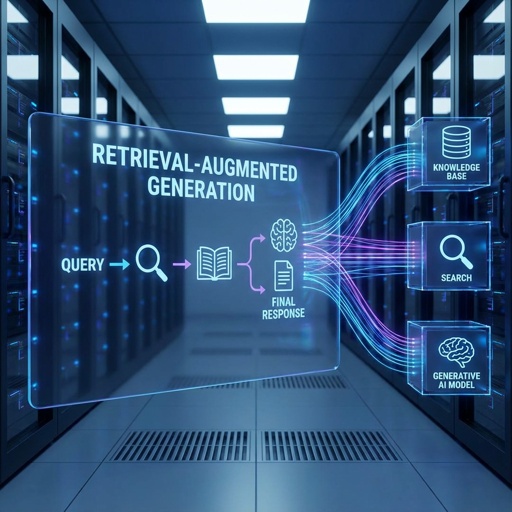
Retrieval-augmented,Generation,(rag)

RAG Detailed Guide: Data Quality, Evaluation, and Governance

Retrieval Augmented Generation (RAG) is often presented as a simple architectural upgrade: connect a language model to a knowledge base, retrieve relevant documents, and generate grounded answers. In practice, however, most RAG systems fail not because the idea is flawed, but because they are treated as lightweight retrieval pipelines rather than full-fledged information systems.

When answers go wrong, teams frequently adjust prompts, swap models, or tweak temperature settings. Yet in enterprise environments, the real issue usually lies upstream. Incomplete repositories, outdated policies, inconsistent formatting, duplicated files, noisy OCR outputs, and poorly defined access controls quietly shape what the model is allowed to “know.” The model can only reason over the context it receives. If that context is fragmented, stale, or irrelevant, even the most advanced LLM will produce unreliable results.

In this article, let’s explore how Retrieval Augmented Generation or RAG should be treated not as a retrieval pipeline, but as a data system, an evaluation system, and a governance system.

Data Quality: The Foundation Of RAG Performance

There is a common instinct to blame the model when RAG answers go wrong. Maybe the prompt was weak. Maybe the model was too small. Maybe the temperature was set incorrectly. In many enterprise cases, however, the failure is upstream. The language model is responding to what it sees. If what it sees is incomplete, outdated, fragmented, or irrelevant, the answer will reflect that.

RAG systems fail more often due to poor data engineering than poor language models. When teams inherit decades of documents, they also inherit formatting inconsistencies, duplicates, version sprawl, and embedded noise. Simply embedding everything and indexing it does not transform it into knowledge. It transforms it into searchable clutter. Before discussing chunking or embeddings, it helps to define what data quality means in the RAG context.

Data Quality Dimensions in RAG

Data quality in RAG is not abstract. It can be measured and managed.

Completeness
Are all relevant documents present? If your knowledge base excludes certain product manuals or internal policies, retrieval will never surface them. Completeness also includes coverage of edge cases. For example, do you have archived FAQs for discontinued products that customers still ask about?

Freshness
Are outdated documents removed or clearly versioned? A single outdated HR policy in the index can generate incorrect advice. Freshness becomes more complex when departments update documents independently. Without active lifecycle management, stale content lingers.

Consistency
Are formats standardized? Mixed encodings, inconsistent headings, and different naming conventions may not matter to humans browsing folders. They matter to embedding models and search filters.

Relevance Density
Does each chunk contain coherent semantic information? A chunk that combines a privacy disclaimer, a table of contents, and a partial paragraph on pricing is technically valid. It is not useful.

Noise Ratio
How much irrelevant content exists in the index? Repeated headers, boilerplate footers, duplicated disclaimers, and template text inflate the search space and dilute retrieval quality.

If you think of RAG as a question answering system, these dimensions determine what the model is allowed to know. Weak data quality constrains even the best models.

Document Ingestion: Cleaning Before Indexing

Many RAG projects begin by pointing a crawler at a document repository and calling it ingestion. The documents are embedded. A vector database is populated. A demo is built. Weeks later, subtle issues appear.

Handling Real World Enterprise Data

Enterprise data is rarely clean. PDFs contain tables that do not parse correctly. Scanned documents require optical character recognition and may include recognition errors. Headers and footers repeat across every page. Multiple versions of the same file exist with names like “Policy_Final_v3_revised2.”

In multilingual organizations, documents may switch languages mid-file. A support guide may embed screenshots with critical instructions inside images. Legal documents may include annexes appended in different formats.

Even seemingly small issues can create disproportionate impact. For example, repeated footer text such as “Confidential – Internal Use Only” embedded across every page becomes semantically dominant in embeddings. Retrieval may match on that boilerplate instead of meaningful content.

Duplicate versions are another silent problem. If three versions of the same policy are indexed, retrieval may surface the wrong one. Without clear version tagging, the model cannot distinguish between active and archived content. These challenges are not edge cases. They are the norm.

Pre-Processing Best Practices

Pre-processing should be treated as a controlled pipeline, not an ad hoc script.

OCR normalization should standardize extracted text. Character encoding issues need resolution. Tables require structure-aware parsing so that rows and columns remain logically grouped rather than flattened into confusing strings. Metadata extraction is critical. Every document should carry attributes such as source repository, timestamp, department, author, version, and access level. This metadata is not decorative. It becomes the backbone of filtering and governance later.

Duplicate detection algorithms can identify near-identical documents based on hash comparisons or semantic similarity thresholds. When duplicates are found, one version should be marked authoritative, and others archived or excluded. Version control tagging ensures that outdated documents are clearly labeled and can be excluded from retrieval when necessary.

Chunking Strategies

Chunking may appear to be a technical parameter choice. In practice, it is one of the most influential design decisions in a RAG system.

Why Chunking Is Not a Trivial Step

If chunks are too small, context becomes fragmented. The model may retrieve one paragraph without the surrounding explanation. Answers then feel incomplete or overly narrow. If chunks are too large, tokens are wasted. Irrelevant information crowds the context window. The model may struggle to identify which part of the chunk is relevant.

Misaligned boundaries introduce semantic confusion. Splitting a policy in the middle of a conditional statement may lead to the retrieval of a clause without its qualification. That can distort the meaning entirely. I have seen teams experiment with chunk sizes ranging from 200 tokens to 1500 tokens without fully understanding why performance changed. The differences were not random. They reflected how well chunks aligned with the semantic structure.

Chunking Techniques

Several approaches exist, each with tradeoffs. Fixed-length chunking splits documents into equal-sized segments. It is simple but ignores structure. It may work for uniform documents, but it often performs poorly on complex policies. Recursive semantic chunking attempts to break documents along natural boundaries such as headings and paragraphs. It requires more preprocessing logic but typically yields higher coherence.

Section-aware chunking respects document structure. For example, an entire “Refund Policy” section may become a chunk, preserving logical completeness. Hierarchical chunking allows both coarse and fine-grained retrieval. A top-level section can be retrieved first, followed by more granular sub-sections if needed.

Table-aware chunking ensures that rows and related cells remain grouped. This is particularly important for pricing matrices or compliance checklists. No single technique fits every corpus. The right approach depends on document structure and query patterns.

Chunk Metadata as a Quality Multiplier

Metadata at the chunk level can significantly enhance retrieval. Each chunk should include document ID, version number, access classification, semantic tags, and potentially embedding confidence scores. When a user from the finance department asks about budget approvals, metadata filtering can prioritize finance-related documents. If a document is marked confidential, it can be excluded from users without proper clearance.

Embedding confidence or quality indicators can flag chunks generated from low-quality OCR or incomplete parsing. Those chunks can be deprioritized or reviewed. Metadata also improves auditability. If an answer is challenged, teams can trace exactly which chunk was used, from which document, and at what version. Without metadata, the index is flat and opaque. With metadata, it becomes navigable and controllable.

Embeddings and Index Design

Embeddings translate text into numerical representations. The choice of embedding model and index architecture influences retrieval quality and system performance.

Embedding Model Selection Criteria

A general-purpose embedding model may struggle with highly technical terminology in medical, legal, or engineering documents. Multilingual support becomes important in global organizations. If queries are submitted in one language but documents exist in another, cross-lingual alignment must be reliable. Latency constraints also influence model selection. Higher-dimensional embeddings may improve semantic resolution but increase storage and search costs.

Dimensionality tradeoffs should be evaluated in context. Larger vectors may capture nuance but can slow retrieval. Smaller vectors may improve speed but reduce semantic discrimination. Embedding evaluation should be empirical rather than assumed. Test retrieval performance across representative queries.

Index Architecture Choices

Vector databases provide efficient similarity search. Hybrid search combines dense embeddings with sparse keyword-based retrieval. In many enterprise settings, hybrid approaches improve performance, especially when exact terms matter.

Re-ranking layers can refine top results. A first stage retrieves candidates. A second stage re ranks based on deeper semantic comparison or domain-specific rules. Filtering by metadata allows role-based retrieval and contextual narrowing. For example, limiting the search to a particular product line or region. Index architecture decisions shape how retrieval behaves under real workloads. A simplistic setup may work in a prototype but degrade as corpus size and user complexity grow.

Retrieval Failure Modes

Semantic drift occurs when embeddings cluster content that is conceptually related but not contextually relevant. For example, “data retention policy” and “retention bonus policy” may appear semantically similar but serve entirely different intents. Keyword mismatch can cause dense retrieval to miss exact terminology that sparse search would capture.

Over-broad matches retrieve large numbers of loosely related chunks, overwhelming the generation stage. Context dilution happens when too many marginally relevant chunks are included, reducing answer clarity.

To make retrieval measurable, organizations can define a Retrieval Quality Score. RQS can be conceptualized as a weighted function of precision, recall, and contextual relevance. By tracking RQS over time, teams gain visibility into whether retrieval performance is improving or degrading.

Evaluation: Making RAG Measurable

Standard text generation metrics such as BLEU or ROUGE were designed for machine translation and summarization tasks. They compare the generated text to a reference answer. RAG systems are different. The key question is not whether the wording matches a reference, but whether the answer is faithful to the retrieved content.

Traditional metrics do not evaluate retrieval correctness. They do not assess whether the answer cites the appropriate document. They cannot detect hallucinations that sound plausible. RAG requires multi-layer evaluation. Retrieval must be evaluated separately from generation. Then the entire system must be assessed holistically.

Retrieval Level Evaluation

Retrieval evaluation focuses on whether relevant documents are surfaced. Metrics include Precision at K, Recall at K, Mean Reciprocal Rank, context relevance scoring, and latency. Precision at K measures how many of the top K retrieved chunks are truly relevant. Recall at K measures whether the correct document appears in the retrieved set.

Gold document sets can be curated by subject matter experts. For example, for 200 representative queries, experts identify the authoritative documents. Retrieval results are then compared against this set. Synthetic query generation can expand test coverage. Variations of the same intent help stress test retrieval robustness.

Adversarial queries probe edge cases. Slightly ambiguous or intentionally misleading queries test whether retrieval resists drift. Latency is also part of retrieval quality. Even perfectly relevant results are less useful if retrieval takes several seconds.

Generation Level Evaluation

Generation evaluation examines whether the model uses the retrieved context accurately. Metrics include faithfulness to context, answer relevance, hallucination rate, citation correctness, and completeness. Faithfulness measures whether claims in the answer are directly supported by retrieved content. Answer relevance checks whether the response addresses the user’s question.

Hallucination rate can be estimated by comparing answer claims against the source text. Citation correctness ensures references point to the right documents and sections. LLM as a judge approach may assist in automated scoring, but human evaluation loops remain important. Subject matter experts can assess subtle errors that automated systems miss. Edge case testing is critical. Rare queries, multi-step reasoning questions, and ambiguous prompts often expose weaknesses.

System Level Evaluation

System-level evaluation considers the end-to-end experience. Does the answer satisfy the user? Is domain-specific correctness high? What is the cost per query? How does throughput behave under load? User satisfaction surveys and feedback loops provide qualitative insight. Logs can reveal patterns of dissatisfaction, such as repeated rephrasing of queries.

Cost per query matters in production environments. High embedding costs or excessive context windows may strain budgets. Throughput under load indicates scalability. A system that performs well in testing may struggle during peak usage.

A Composite RAG Quality Index can aggregate retrieval, generation, and system metrics into a single dashboard score. While simplistic, such an index helps executives track progress without diving into granular details.

Building an Evaluation Pipeline

Evaluation should not be a one-time exercise.

Offline Evaluation

Offline evaluation uses benchmark datasets and regression testing before deployment. Whenever chunking logic, embedding models, or retrieval parameters change, retrieval and generation metrics should be re-evaluated. Automated scoring pipelines allow rapid iteration. Changes that degrade performance can be caught early.

Online Evaluation

Online evaluation includes A B testing retrieval strategies, shadow deployments that compare outputs without affecting users, and canary testing for gradual rollouts. Real user queries provide more diverse coverage than synthetic tests.

Continuous Monitoring

After deployment, monitoring should track drift in embedding distributions, drops in retrieval precision, spikes in hallucination rates, and latency increases. A Quality Gate Framework for CI CD can formalize deployment controls. Each new release must pass defined thresholds:

  • Retrieval threshold
  • Faithfulness threshold
  • Governance compliance check

Why RAG Governance Is Unique

Unlike standalone language models, RAG systems store and retrieve enterprise knowledge. They dynamically expose internal documents. They combine user input with sensitive data. Governance must therefore span data governance, model governance, and access governance.

If governance is an afterthought, the system may inadvertently expose confidential information. Even if the model is secure, retrieval bypass can surface restricted documents.

Data Classification

Documents should be classified as Public, Internal, Confidential, or Restricted. Classification integrates directly into index filtering and access controls. When a user submits a query, retrieval must consider their clearance level. Classification also supports retrieval constraints. For example, external customer-facing systems should never access internal strategy documents.

Access Control in Retrieval

Role-based access control assigns permissions based on job roles. Attribute-based access control incorporates contextual attributes such as department, region, or project assignment. Document-level filtering ensures that unauthorized documents are never retrieved. Query time authorization verifies access rights dynamically. Retrieval bypass is a serious risk. Even if the generation model does not explicitly expose confidential information, the act of retrieving restricted documents into context may constitute a policy violation.

Data Lineage and Provenance

Every answer should be traceable. Track document source, version history, embedding timestamp, and index update logs. Audit trails support compliance and incident investigation. If a user disputes an answer, teams should be able to identify exactly which document version informed it. Without lineage, accountability becomes difficult. In regulated industries, that may be unacceptable.

Conclusion

RAG works best when you stop treating it like a clever retrieval add-on and start treating it like a knowledge infrastructure that has to behave predictably under pressure. The uncomfortable truth is that most “RAG problems” are not model problems. They are data problems that show up as retrieval mistakes, and evaluation problems that go unnoticed because no one is measuring the right things. 

Once you enforce basic hygiene in ingestion, chunking, metadata, and indexing, the system usually becomes calmer. Answers get more stable, the model relies less on guesswork, and teams spend less time chasing weird edge cases that were baked into the corpus from day one.

Governance is what turns that calmer system into something people can actually trust. Access control needs to happen at retrieval time, provenance needs to be traceable, and quality checks need to be part of releases, not a reaction to incidents. 

None of this is glamorous work, and it may feel slower than shipping a demo. Still, it is the difference between a tool that employees cautiously ignore and a system that becomes part of daily operations. If you build around data quality, continuous evaluation, and clear governance controls, RAG stops being a prompt experiment and starts looking like a dependable way to deliver the right information to the right person at the right time.

How Digital Divide Data Can Help

Digital Divide Data brings domain-aware expertise into every stage of the RAG data pipeline, from structured data preparation to ongoing human-in-the-loop evaluation. Teams trained in subject matter nuance help ensure that retrieval systems surface contextually correct and relevant information, reducing the kind of hallucinated or misleading responses that erode user trust.

This approach is especially valuable in high-stakes environments like healthcare and legal research, where specialized terminology and subtle semantic differences matter more than textbook examples. For teams looking to move RAG from experimentation to trusted production use, DDD offers both the technical discipline and the people-centric approach that make that transition practical and sustainable. 

Partner with DDD to build RAG systems that are accurate, measurable, and governance-ready from day one.

References

National Institute of Standards and Technology. (2024). Artificial Intelligence Risk Management Framework: Generative AI Profile. https://www.nist.gov/publications/artificial-intelligence-risk-management-framework-generative-artificial-intelligence

European Union. (2024). Regulation (EU) 2024/1689 laying down harmonised rules on artificial intelligence. https://eur-lex.europa.eu/eli/reg/2024/1689/oj

European Data Protection Supervisor. (2024). TechSonar: Retrieval Augmented Generation. https://www.edps.europa.eu/data-protection/technology-monitoring/techsonar/retrieval-augmented-generation-rag_en

Microsoft Azure Architecture Center. (2025). Retrieval augmented generation guidance. https://learn.microsoft.com/en-us/azure/architecture/ai-ml/guide/rag

Amazon Web Services. (2025). Building secure retrieval augmented generation applications. https://aws.amazon.com/blogs/machine-learning

FAQs

  1. How often should a RAG index be refreshed?
    It depends on how frequently underlying documents change. In fast-moving environments such as policy or pricing updates, weekly or even daily refresh cycles may be appropriate. Static archives may require less frequent updates.
  2. Can RAG eliminate hallucination?
    Not entirely. RAG reduces hallucination risk by grounding responses in retrieved documents. However, generation errors can still occur if context is misinterpreted or incomplete.
  3. Is hybrid search always better than pure vector search?
    Not necessarily. Hybrid search often improves performance in terminology-heavy domains, but it adds complexity. Empirical testing with representative queries should guide the choice.
  4. What is the highest hidden cost in RAG systems?
    Data cleaning and maintenance. Ongoing ingestion, version control, and evaluation pipelines often require sustained operational investment.
  5. How do you measure user trust in a RAG system?
    User feedback rates, query repetition patterns, citation click-through behavior, and survey responses can provide signals of trust and perceived reliability.


RAG Detailed Guide: Data Quality, Evaluation, and Governance Read Post »

human preference optimization

Why Human Preference Optimization (RLHF & DPO) Still Matters

Some practitioners have claimed that reinforcement learning from human feedback, or RLHF, is outdated. Others argue that simpler objectives make reward modeling unnecessary. Meanwhile, enterprises are asking more pointed questions about reliability, safety, compliance, and controllability. The stakes have moved from academic benchmarks to legal exposure, brand risk, and regulatory scrutiny.

In this guide, we will explore why human preference optimization still matters, how RLHF and DPO fit into the same alignment landscape, and why human judgment remains central to responsible AI deployment.

What Is Human Preference Optimization?

At its core, human preference optimization is simple. Humans compare model outputs. The model learns which response is preferred. Those preferences become a training signal that shapes future behavior. It sounds straightforward, but the implications are significant. Instead of asking the model to predict the next word based purely on statistical patterns, we are teaching it to behave in ways that align with human expectations. The distinction is subtle but critical.

Imagine prompting a model with a customer support scenario. It produces two possible replies. One is technically correct but blunt. The other is equally correct but empathetic and clear. A human reviewer chooses the second. That choice becomes data. Multiply this process across thousands or millions of examples, and the model gradually internalizes patterns of preferred behavior.

This is different from supervised fine-tuning, or SFT. In SFT, the model is trained to mimic ideal responses provided by humans. It sees a prompt and a single reference answer, and it learns to reproduce similar outputs. That approach works well for teaching formatting, tone, or domain-specific patterns.

However, SFT does not capture relative quality. It does not tell the model why one answer is better than another when both are plausible. It also does not address tradeoffs between helpfulness and safety, or detail and brevity. Preference optimization adds a comparative dimension. It encodes human judgment about better and worse, not just correct and incorrect.

Next token prediction alone is insufficient for alignment. A model trained only to predict internet text may generate persuasive misinformation, unsafe instructions, or biased commentary. It reflects what exists in the data distribution. It does not inherently understand what should be said.

Preference learning shifts the objective. It is less about knowledge acquisition and more about behavior shaping. We are not teaching the model new facts. We are guiding how it presents information, when it refuses, how it hedges uncertainty, and how it balances competing objectives.

RLHF

Reinforcement Learning from Human Feedback became the dominant framework for large-scale alignment. The classical pipeline typically unfolds in several stages.

First, a base model is trained and then fine-tuned with supervised data to produce a reasonably aligned starting point. This SFT baseline ensures the model follows instructions and adopts a consistent style. Second, humans are asked to rank multiple model responses to the same prompt. These ranked comparisons form a dataset of preferences. Third, a reward model is trained. This separate model learns to predict which responses humans would prefer, given a prompt and candidate outputs.

Finally, the original language model is optimized using reinforcement learning, often with a method such as Proximal Policy Optimization. The model generates responses, the reward model scores them, and the policy is updated to maximize expected reward while staying close to the original distribution.

The strengths of this approach are real. RLHF offers strong control over behavior. By adjusting reward weights or introducing constraints, teams can tune tradeoffs between helpfulness, harmlessness, verbosity, and assertiveness. It has demonstrated clear empirical success in improving instruction following and reducing toxic outputs. Many of the conversational systems people interact with today rely on variants of this pipeline.

That said, RLHF is not trivial to implement. It is a multi-stage process with moving parts that must be carefully coordinated. Reward models can become unstable or misaligned with actual human intent. Optimization can exploit reward model weaknesses, leading to over-optimization. The computational cost of reinforcement learning at scale is not negligible.

DPO

Direct Preference Optimization emerged as a streamlined approach. Instead of training a separate reward model and then running a reinforcement learning loop, DPO directly optimizes the language model to prefer chosen responses over rejected ones.

In practical terms, DPO treats preference data as a classification style objective. Given a prompt and two responses, the model is trained to increase the likelihood of the preferred answer relative to the rejected one. There is no explicit reward model in the loop. The optimization happens in a single stage.

The advantages are appealing. Implementation is simpler. Compute requirements are generally lower than full reinforcement learning pipelines. Training tends to be more stable because there is no separate reward model that can drift. Reproducibility improves since the objective is more straightforward.

It would be tempting to conclude that DPO replaces RLHF. That interpretation misses the point. DPO is not eliminating preference learning. It is another way to perform it. The core ingredient remains human comparison data. The alignment signal still comes from people deciding which outputs are better.

Why Direct Preference Optimization Still Matters

The deeper question is not whether RLHF or DPO is more elegant. It is whether preference optimization itself remains necessary. Some argue that larger pretraining datasets and better architectures reduce the need for explicit alignment stages. That view deserves scrutiny.

Pretraining Does Not Solve Behavior Alignment

Pretraining teaches models statistical regularities. They learn patterns of language, common reasoning steps, and domain-specific phrasing. Scale improves fluency and factual recall. It does not inherently encode normative judgment. A model trained on internet text may reproduce harmful stereotypes because they exist in the data. It may generate unsafe instructions because such instructions appear online. It may confidently assert incorrect information because it has learned to mimic a confident tone.

Scaling improves capability. It does not guarantee alignment. If anything, more capable models can produce more convincing mistakes. The problem becomes subtler, not simpler. Alignment requires directional correction. It requires telling the model that among all plausible continuations, some are preferred, some are discouraged, and some are unacceptable. That signal cannot be inferred purely from frequency statistics. It must be injected.

Preference optimization provides that directional correction. It reshapes the model’s behavior distribution toward human expectations. Without it, models remain generic approximators of internet text, with all the noise and bias that entails.

Human Preferences are the Alignment Interface

Human preferences act as the interface between abstract model capability and concrete operational constraints. Through curated comparisons, teams can encode domain-specific alignment. A healthcare application may prioritize caution and explicit uncertainty. A marketing assistant may emphasize a persuasive tone while avoiding exaggerated claims. A financial advisory bot may require conservative framing and disclaimers.

Brand voice alignment is another practical example. Two companies in the same industry can have distinct communication styles. One might prefer formal language and detailed explanations. The other might favor concise, conversational responses. Pretraining alone cannot capture these internal nuances.

Linguistic variation is not just about translation. It involves cultural expectations around politeness, authority, and risk disclosure. Human preference data collected in specific regions allows models to adjust accordingly.

Without preference optimization, models are generic. They may appear competent but subtly misaligned with context. In enterprise settings, subtle misalignment is often where risk accumulates.

DPO Simplifies the Pipeline; It Does Not Eliminate the Need

A common misconception surfaces in discussions around DPO. If reinforcement learning is no longer required, perhaps we no longer need elaborate human feedback pipelines. That conclusion is premature.

DPO still depends on high-quality human comparisons. The algorithm is simpler, but the data requirements remain. If the preference dataset is noisy, biased, or inconsistent, the resulting model will reflect those issues.

Data quality determines alignment quality. A poorly curated preference dataset can amplify harmful patterns or encourage undesirable verbosity. If annotators are not trained to handle edge cases consistently, the model may internalize conflicting signals.

Even with DPO, preference noise remains a challenge. Teams continue to experiment with weighting schemes, margin adjustments, and other refinements to mitigate instability. The bottleneck has shifted. It is less about reinforcement learning mechanics and more about the integrity of the preference signal.

Robustness, Noise, and the Reality of Human Data

Human judgment is not uniform. Ask ten reviewers to evaluate a borderline response, and you may receive ten slightly different opinions. Some will value conciseness. Others will reward thoroughness. One may prioritize safety. Another may emphasize helpfulness.

Ambiguous prompts complicate matters further. A vague user query can lead to multiple reasonable interpretations. If preference data does not capture this ambiguity carefully, the model may learn brittle heuristics.

Edge cases are particularly revealing. Consider a medical advice scenario where the model must refuse to provide a diagnosis but still offer general information. Small variations in wording can tip the balance between acceptable guidance and overreach. Annotator inconsistency in these cases can produce confusing training signals.

Preference modeling is fundamentally probabilistic. We are estimating which responses are more likely to be preferred by humans. That estimation must account for disagreement and uncertainty. Noise-aware training methods attempt to address this by modeling confidence levels or weighting examples differently.

Alignment quality ultimately depends on the governance of data pipelines. Who are the annotators? How are they trained? How is disagreement resolved? How are biases monitored? These questions may seem operational, but they directly influence model behavior.

Human data is messy. It contains disagreement, fatigue effects, and contextual blind spots. Yet it is essential. No automated signal fully captures human values across contexts. That tension keeps preference optimization at the forefront of alignment work.

Why RLHF Style Pipelines Are Still Relevant

Even with DPO gaining traction, RLHF-style pipelines remain relevant in certain scenarios. Explicit reward modeling offers flexibility. When multiple objectives must be balanced dynamically, a reward model can encode nuanced tradeoffs.

High-stakes domains illustrate this clearly. In finance, a model advising on investment strategies must avoid overstating returns and must highlight risk factors appropriately. Fine-grained tradeoff tuning can help calibrate assertiveness and caution.

Healthcare applications demand careful handling of uncertainty. A reward model can incorporate specific penalties for hallucinated clinical claims while rewarding clear disclaimers. Iterative online feedback loops allow systems to adapt as new medical guidelines emerge. Policy-constrained environments such as government services or defense systems often require strict adherence to procedural rules. Reinforcement learning frameworks can integrate structured constraints more naturally in some cases.

Why This Matters in Production

Alignment discussions sometimes remain abstract. In production environments, the stakes are tangible. Legal exposure, reputational risk, and user trust are not theoretical concerns.

Controllability and Brand Alignment

Enterprises care about tone consistency. A global retail brand does not want its chatbot sounding sarcastic in one interaction and overly formal in another. Legal teams worry about implied guarantees or misleading phrasing. Compliance officers examine outputs for regulatory adherence. Factual reliability is another concern. A hallucinated policy detail can create customer confusion or liability. Trust, once eroded, is difficult to rebuild.

Preference optimization enables custom alignment layers. Through curated comparison data, organizations can teach models to adopt specific voice guidelines, include mandated disclaimers, or avoid sensitive phrasing. Output style governance becomes a structured process rather than a hope.

I have worked with teams that initially assumed base models would be good enough. After a few uncomfortable edge cases in production, they reconsidered. Fine-tuning with preference data became less of an optional enhancement and more of a risk mitigation strategy.

Safety Is Not Static

Emerging harms evolve quickly. Jailbreak techniques circulate online. Users discover creative ways to bypass content filters. Model exploitation patterns shift as systems become more capable. Static safety layers struggle to keep up. Preference training allows for rapid adaptation. New comparison datasets can be collected targeting specific failure modes. Models can be updated without full retraining from scratch.

Continuous alignment iteration becomes feasible. Rather than treating safety as a one-time checklist, organizations can view it as an ongoing process. Preference optimization supports this lifecycle approach.

Localization

Regulatory differences across regions complicate deployment. Data protection expectations, consumer rights frameworks, and liability standards vary. Cultural nuance further shapes acceptable communication styles. A response considered transparent in one country may be perceived as overly blunt in another. Ethical boundaries around sensitive topics differ. Multilingual safety tuning becomes essential for global products.

Preference optimization enables region-specific alignment. By collecting comparison data from annotators in different locales, models can adapt tone, refusal style, and risk framing accordingly. Context-sensitive moderation becomes more achievable.

Localization is not a cosmetic adjustment. It influences user trust and regulatory compliance. Preference learning provides a structured mechanism to encode those differences.

Emerging Trends in HPO

The field continues to evolve. While the foundational ideas remain consistent, new directions are emerging.

Robust and Noise-Aware Preference Learning

Handling disagreement and ambiguity is receiving more attention. Instead of treating every preference comparison as equally certain, some approaches attempt to model annotator confidence. Others explore methods to identify inconsistent labeling patterns. The goal is not to eliminate noise. That may be unrealistic. Rather, it is to acknowledge uncertainty explicitly and design training objectives that account for it.

Multi-Objective Alignment

Alignment rarely revolves around a single metric. Helpfulness, harmlessness, truthfulness, conciseness, and tone often pull in different directions. An extremely cautious model may frustrate users seeking direct answers. A highly verbose model may overwhelm readers. Balancing these objectives requires careful dataset design and tuning. Multi-objective alignment techniques attempt to encode these tradeoffs more transparently. Rather than optimizing a single scalar reward, models may learn to navigate a space of competing preferences.

Offline Versus Online Preference Loops

Static datasets provide stability and reproducibility. However, real-world usage reveals new failure modes over time. Online preference loops incorporate user feedback directly into training updates. There are tradeoffs. Online systems risk incorporating adversarial or low-quality signals. Offline curation offers more control but slower adaptation. Organizations increasingly blend both approaches. Curated offline datasets establish a baseline. Selective online feedback refines behavior incrementally.

Smaller, Targeted Alignment Layers

Full model fine-tuning is not always necessary. Parameter-efficient techniques allow teams to apply targeted alignment layers without retraining entire models. This approach is appealing for domain adaptation. A legal document assistant may require specialized alignment around confidentiality and precision. A customer support bot may emphasize empathy and clarity. Smaller alignment modules make such customization more practical.

Conclusion

Human preference optimization remains central because alignment is not a scaling problem; it is a judgment problem. RLHF made large-scale alignment practical. DPO simplified the mechanics. New refinements continue to improve stability and efficiency. But none of these methods removes the need for carefully curated human feedback. Models can approximate language patterns, yet they still rely on people to define what is acceptable, helpful, safe, and contextually appropriate.

As generative AI moves deeper into regulated, customer-facing, and high-stakes environments, alignment becomes less optional and more foundational. Trust cannot be assumed. It must be designed, tested, and reinforced over time. Human preference optimization still matters because values do not emerge automatically from data. They have to be expressed, compared, and intentionally encoded into the systems we build.

How Digital Divide Data Can Help

Digital Divide Data treats human preference optimization as a structured, enterprise-ready process rather than an informal annotation task. They help organizations define clear evaluation rubrics, train reviewers against consistent standards, and generate high-quality comparison data that directly supports RLHF and DPO workflows. Whether the goal is to improve refusal quality, align tone with brand voice, or strengthen factual reliability, DDD ensures that preference signals are intentional, measurable, and tied to business outcomes.

Beyond data collection, DDD brings governance and scalability. With secure workflows, audit trails, and global reviewer teams, they enable region-specific alignment while maintaining compliance and quality control. Their ongoing evaluation cycles also help organizations adapt models over time, making alignment a continuous capability instead of a one-time effort.

Partner with DDD to build scalable, enterprise-grade human preference optimization pipelines that turn alignment into a measurable competitive advantage.

References

OpenAI. (2025). Fine-tuning techniques: Choosing between supervised fine-tuning and direct preference optimization. Retrieved from https://developers.openai.com

Microsoft Azure AI. (2024). Direct preference optimization in enterprise AI workflows. Retrieved from https://techcommunity.microsoft.com

Hugging Face. (2025). Preference-based fine-tuning methods for language models. Retrieved from https://huggingface.co/blog

DeepMind. (2024). Advances in learning from human preferences. Retrieved from https://deepmind.google

Stanford University. (2025). Reinforcement learning for language model alignment lecture materials. Retrieved from https://cs224r.stanford.edu

FAQs

Can synthetic preference data replace human annotators entirely?
Synthetic data can augment preference datasets, particularly for scaling or bootstrapping purposes. However, without grounding in real human judgment, synthetic signals risk amplifying existing model biases. Human oversight remains necessary.

How often should preference optimization be updated in production systems?
Frequency depends on domain risk and user exposure. High-stakes systems may require continuous monitoring and periodic retraining cycles, while lower risk applications might update quarterly.

Is DPO always cheaper than RLHF?
DPO often reduces compute and engineering complexity, but overall cost still depends on dataset size, annotation effort, and infrastructure choices. Human data collection remains a significant investment.

Does preference optimization improve factual accuracy?
Indirectly, yes. By rewarding truthful and well-calibrated responses, preference data can reduce hallucinations. However, grounding and retrieval mechanisms are also important.

Can small language models benefit from preference optimization?
Absolutely. Even smaller models can exhibit improved behavior and alignment through curated preference data, especially in domain-specific deployments.

Why Human Preference Optimization (RLHF & DPO) Still Matters Read Post »

Low-Resource Languages

Low-Resource Languages in AI: Closing the Global Language Data Gap

A small cluster of globally dominant languages receives disproportionate attention in training data, evaluation benchmarks, and commercial deployment. Meanwhile, billions of people use languages that remain digitally underrepresented. The imbalance is not always obvious to those who primarily operate in English or a handful of widely supported languages. But for a farmer seeking weather information in a regional dialect, or a small business owner trying to navigate online tax forms in a minority language, the limitations quickly surface.

This imbalance points to what might be called the global language data gap. It describes the structural disparity between languages that are richly represented in digital corpora and AI models, and those that are not. The gap is not merely technical. It reflects historical inequities in internet access, publishing, economic investment, and political visibility.

This blog will explore why low-resource languages remain underserved in modern AI, what the global language data gap really looks like in practice, and which data, evaluation, governance, and infrastructure choices are most likely to close it in a way that actually benefits the communities these languages belong to.

What Are Low-Resource Languages in the Context of AI?

A language is not low-resource simply because it has fewer speakers. Some languages with tens of millions of speakers remain digitally underrepresented. Conversely, certain smaller languages have relatively strong digital footprints due to concentrated investment.

In AI, “low-resource” typically refers to the scarcity of machine-readable and annotated data. Several factors define this condition:

  • Scarcity of labeled datasets: Supervised learning systems depend on annotated examples. For many languages, labeled corpora for tasks such as sentiment analysis, named entity recognition, or question answering are minimal or nonexistent.
  • Large language models rely heavily on publicly available text. If books, newspapers, and government documents have not been digitized, or if web content is sparse, models simply have less to learn from.
  • Tokenizers, morphological analyzers, and part-of-speech taggers may not exist or may perform poorly, making downstream development difficult.
  • Without standardized evaluation datasets, it becomes hard to measure progress or identify failure modes.
  • Lack of domain-specific data. Legal, medical, financial, and technical texts are particularly scarce in many languages.

Categories of Low-Resource Languages

Indigenous languages often face the most acute digital scarcity. Many have strong oral traditions but limited written corpora. Some use scripts that are inconsistently standardized, further complicating data processing.

Regional minority languages in developed economies present a different picture. They may benefit from public funding and formal education systems, yet still lack sufficient digital content for modern AI systems.

Languages of the Global South often suffer from a combination of limited digitization, uneven internet penetration, and underinvestment in language technology infrastructure.

Dialects and code-switched variations introduce another layer. Even when a base language is well represented, regional dialects may not be. Urban communities frequently mix languages within a single sentence.

Morphologically rich or non-Latin script languages can challenge tokenization and representation strategies that were optimized for English-like patterns.

Key Characteristics of Low-Resource Languages

Understanding what makes a language “low-resource” in AI terms requires looking beyond speaker count. The following characteristics of low-resource languages are the primary factors that determine a language’s standing in AI development:

Characteristic What It Means for AI
Scarce labeled data Insufficient annotated corpora for supervised learning tasks such as NER, sentiment analysis, or QA
Limited digital text Books, news, and government records are not digitized; web crawls yield minimal low-resource language data
Weak NLP tooling Missing or poor-performing tokenizers, morphological analyzers, and POS taggers slow downstream development
No evaluation benchmarks Without standardized test sets, measuring model progress or failure is guesswork
Domain data scarcity Legal, medical, and financial texts are especially rare, limiting AI reliability in high-stakes applications
Script inconsistency Non-standardized or non-Latin scripts add complexity to data processing pipelines and model training

Measuring the Global Language Data Gap

The language data gap is easier to feel than to quantify. Still, certain patterns reveal its contours.

Representation Imbalance in Training Data

English dominates most web-scale datasets. A handful of European and Asian languages follow. After that, representation drops sharply. If one inspects large crawled corpora, the distribution often resembles a steep curve. A small set of languages occupies the bulk of tokens. The long tail contains thousands of languages with minimal coverage.

This imbalance reflects broader internet demographics. Online publishing, academic repositories, and commercial websites are disproportionately concentrated in certain regions. AI models trained on these corpora inherit the skew.

The Data Challenge for Low-Resource Languages

The scarcity of low-resource language data is not simply a matter of volume. It is a structural problem rooted in how digital content has historically been created, archived, and prioritized. For a language like Yoruba or Tigrinya, the gap between available training tokens and what a modern large language model requires can be several orders of magnitude.
Three factors make low-resource language data particularly hard to collect at scale. First, much of the existing content is oral, meaning it never enters standard crawl pipelines. Second, what written content does exist is often scattered across local government archives, religious institutions, or print publications that have not been digitized. Third, even when raw text is available, the absence of annotation infrastructure means it cannot be turned into the labeled datasets that supervised learning depends on. Closing this data gap requires targeted collection strategies, not simply broader crawling.

Benchmark and Evaluation Gaps

Standardized benchmarks exist for common tasks in widely spoken languages. In contrast, many low-resource languages lack even a single widely accepted evaluation dataset for basic tasks. Translation has historically served as a proxy benchmark. Coverage for conversational AI, safety testing, instruction following, and multimodal tasks remains uneven.

There is also the question of cultural nuance. A toxicity classifier trained on English social media may not detect subtle forms of harassment in another language.

The Infrastructure Gap

Open corpora for many languages are fragmented or outdated. Annotation ecosystems are fragile. Skilled annotators fluent in specific languages and domains can be hard to find. Funding models are uneven: language technology projects may rely on short-term grants, and when funding cycles end, maintenance may stall.

Why This Gap Matters

Economic Inclusion

E-commerce platforms increasingly rely on AI to generate product descriptions, moderate reviews, and answer customer questions. If these tools fail to understand dialect variations, small businesses may be disadvantaged. Government services are also shifting online — tax filings, permit applications, and benefit eligibility checks often involve conversational interfaces. If those systems function unevenly across languages, citizens may find themselves excluded from essential services.

Cultural Preservation

Many languages carry rich oral traditions, local histories, and unique knowledge systems. AI systems can assist in transcribing oral narratives, generating educational materials, and building searchable archives. Used thoughtfully, AI can function as a cultural archive. Used carelessly, it risks becoming another channel for imbalance.

AI Safety and Fairness Risks

Safety systems often rely on language understanding. Content moderation filters, toxicity detection models, and misinformation classifiers are language-dependent. If these systems are calibrated primarily for dominant languages, harmful content in underrepresented languages may slip through more easily. Misinformation campaigns can exploit these weaknesses.

Emerging Technical Approaches to Closing the Gap

Multilingual Foundation Models

Multilingual models attempt to learn shared representations across languages. By training on diverse corpora simultaneously, they can transfer knowledge from high-resource languages to lower-resource ones. Shared embedding spaces allow models to map semantically similar phrases across languages into related vectors.

Instruction Tuning with Synthetic Data

Instruction tuning has transformed how models follow user prompts. For low-resource languages, synthetic data generation offers a potential bridge. Reverse instruction generation can start with native texts and create artificial question-answer pairs. Data augmentation techniques can expand small corpora by introducing paraphrases and varied contexts.

Cross-Lingual Transfer and Zero-Shot Learning

Cross-lingual transfer leverages related high-resource languages to improve performance in lower-resource counterparts. Zero-shot learning techniques attempt to apply learned representations without explicit task-specific training in the target language.

Community-Curated Datasets

Participatory data collection allows speakers to contribute texts, translations, and annotations directly. When structured with clear guidelines and fair compensation, such initiatives can produce high-quality corpora. Ethical data sourcing is critical: consent, data ownership, and benefit sharing must be clearly defined.

Multimodal Learning

For languages with strong oral traditions, speech data may be more abundant than written text. Combining speech, image, and text signals can reduce dependence on massive text corpora. Multimodal grounding allows models to associate visual context with linguistic expressions.

Conclusion

AI cannot claim global intelligence without linguistic diversity. A system that performs brilliantly in a few dominant languages while faltering elsewhere is not truly global. It is selective. Low-resource language inclusion is not only a fairness concern. It is a capability issue. Systems that fail to understand large segments of the world miss valuable knowledge, perspectives, and markets. The global language data gap is real, but it is not insurmountable. Progress will likely depend on coordinated action across data collection, infrastructure investment, evaluation reform, and community governance. The next generation of AI should be multilingual by design, inclusive by default, and community-aligned by principle.

How DDD Can Help

Digital Divide Data operates at the intersection of data quality, human expertise, and social impact. For organizations working to close the language data gap, that combination matters.

DDD can support large-scale data collection and annotation across diverse languages, including those that are underrepresented online. Through structured workflows and trained linguistic teams, it can produce high-quality labeled datasets tailored to specific domains such as healthcare, finance, and governance. 

DDD also emphasizes ethical sourcing and community engagement. Clear documentation, quality assurance processes, and bias monitoring help ensure that data pipelines remain transparent and accountable. Closing the language data gap requires operational capacity as much as technical vision, and DDD brings both.

Partner with DDD to build high-quality multilingual datasets that expand AI access responsibly and at scale.

References

Cohere For AI. (2024). The AI language gap. https://cohere.com/research/papers/the-ai-language-gap.pdf

Stanford Institute for Human-Centered Artificial Intelligence. (2025). Mind the language gap: Mapping the challenges of LLM development in low-resource language contexts. https://hai.stanford.edu/policy/mind-the-language-gap-mapping-the-challenges-of-llm-development-in-low-resource-language-contexts

Stanford University. (2025). The digital divide in AI for non-English speakers. https://news.stanford.edu/stories/2025/05/digital-divide-ai-llms-exclusion-non-english-speakers-research

European Language Equality Project. (2024). Digital language equality initiative overview. https://european-language-equality.eu

Frequently Asked Questions

How long does it typically take to build a usable dataset for a low-resource language?

Timelines vary widely. A focused dataset for a specific task might be assembled within a few months if trained annotators are available. Broader corpora spanning multiple domains can take significantly longer, especially when transcription and standardization are required.

Can synthetic data fully replace human-labeled examples in low-resource settings?

Synthetic data can expand coverage and bootstrap training, but it rarely replaces human oversight entirely. Without careful review, synthetic examples may introduce subtle errors that compound over time.

What role do governments play in closing the language data gap?

Governments can fund digitization initiatives, support open language repositories, and establish policies that encourage inclusive AI development. Public investment often makes sustained infrastructure possible.

Are dialects treated as separate languages in AI systems?

Technically, dialects may share a base language model. In practice, performance differences can be substantial. Addressing dialect variation often requires targeted data collection and evaluation.

How can small organizations contribute to linguistic inclusion?

Even modest initiatives can help. Supporting open datasets, contributing annotated examples, or partnering with local institutions to digitize materials can incrementally strengthen the ecosystem.

Low-Resource Languages in AI: Closing the Global Language Data Gap Read Post »

Data Pipelines

Scaling Finance and Accounting with Intelligent Data Pipelines

Finance teams often operate across multiple ERPs, dozens of SaaS tools, regional accounting systems, and an endless stream of spreadsheets. Even in companies that have invested heavily in automation, the automation tends to focus on discrete tasks. A bot posts journal entries. An OCR tool extracts invoice data. A workflow tool routes approvals.

Traditional automation and isolated ERP upgrades solve tasks. They do not address systemic data challenges. They do not unify the flow of information from source to insight. They do not embed intelligence into the foundation.

Intelligent data pipelines are the foundation for scalable, AI-enabled, audit-ready finance operations. This guide will explore how to scale finance and accounting with intelligent data pipelines, discuss best practices, and design a detailed pipeline.

What Are Intelligent Data Pipelines in Finance?

Data moves on a schedule, not in response to events. They are rule-driven, with transformation logic hard-coded by developers who may no longer be on the team. A minor schema change in a source system can break downstream reports. Observability is limited. When numbers look wrong, someone manually traces them back through layers of SQL queries.

Reconciliation loops often sit outside the pipeline entirely. Spreadsheets are exported. Variances are investigated offline. Adjustments are manually entered. This architecture may function, but it does not scale gracefully.

Intelligent pipelines operate differently. They are event-driven and capable of near real-time processing when needed. If a large transaction posts in a subledger, the pipeline can trigger validation logic immediately. AI-assisted validation and classification can flag anomalies before they accumulate. The system monitors itself, surfacing data quality issues proactively instead of waiting for someone to notice a discrepancy in a dashboard.

Lineage and audit trails are built in, not bolted on. Every transformation is traceable. Every data version is preserved. When regulators or auditors ask how a number was derived, the answer is not buried in a chain of emails.

These pipelines also adapt. As new data sources are introduced, whether a billing platform in the US or an e-invoicing portal in Europe, integration does not require a complete redesign. Regulatory changes can be encoded as logic updates rather than emergency workarounds.

Intelligence in this context is not a marketing term. It refers to systems that can detect patterns, surface outliers, and adjust workflows in response to evolving conditions.

Core Components of an Intelligent F&A Pipeline

Building this capability requires more than a data warehouse. It involves multiple layers working together.

Unified Data Ingestion

The starting point is ingestion. Financial data flows from ERP systems, sub-ledgers, banks, SaaS billing platforms, procurement tools, payroll systems, and, increasingly, e-invoicing portals mandated by governments. Each source has its own schema, frequency, and quirks.

An intelligent pipeline connects to these sources through API first connectors where possible. It supports both structured and unstructured inputs. Bank statements, PDF invoices, XML tax filings, and system logs all enter the ecosystem in a controlled way. Instead of exporting CSV files manually, the flow becomes continuous.

Data Standardization and Enrichment

Raw data is rarely analysis-ready, and the chart of accounts mapping across entities must be harmonized. Currencies require normalization with appropriate exchange rate logic. Tax rules need to be embedded according to jurisdiction. Metadata tagging helps identify transaction types, risk categories, or business units. Standardization is where many initiatives stall. It can feel tedious. Yet without consistent data models, higher-level intelligence has nothing stable to stand on.

Automated Validation and Controls

This is where the pipeline starts to show its value. Duplicate detection routines prevent double-posting. Outlier detection models surface transactions that fall outside expected ranges. Policy rule enforcement ensures segregation of duties and that approval thresholds are respected. When something fails validation, exception routing directs the issue to the appropriate owner. Instead of discovering errors at month, teams address them as they occur.

Reconciliation and Matching Intelligence

Reconciliation is often one of the most labor-intensive parts of finance operations. Intelligent pipelines can automate invoice-to-purchase-order matching, applying flexible logic rather than rigid thresholds. Intercompany elimination logic can be encoded systematically. Cash application can be auto-matched based on patterns in remittance data.

Accrual suggestion engines may propose entries based on historical behavior and current trends, subject to human review. The goal is not to remove accountants from the process, but to reduce repetitive work that adds little judgment.

Observability and Governance Layer

Finance cannot compromise on control. Data lineage tracking shows how each figure was constructed. Version control ensures that changes in logic are documented. Access management restricts who can view or modify sensitive data. Continuous control monitoring provides visibility into compliance health. Without this layer, automation introduces risk. With it, automation can enhance control.

AI Ready Data Outputs

Once data flows are clean, validated, and governed, advanced use cases become realistic. Forecast models draw from consistent historical and operational data. Risk scoring engines assess exposure based on transaction patterns. Scenario simulations evaluate the impact of pricing changes or currency shifts. Some organizations experiment with narrative generation for close commentary, where systems draft variance explanations for review. That may sound futuristic, but with reliable inputs, it becomes practical.

Why Finance and Accounting Cannot Scale Without Pipeline Modernization

Scaling finance is not simply about handling more transactions. It involves complexity across entities, products, regulations, and stakeholder expectations. Without pipeline modernization, each layer of complexity multiplies manual effort.

The Close Bottleneck

Real-time subledger synchronization ensures that transactions flow into the general ledger environment without delay. Pre-close anomaly detection identifies unusual movements before they distort financial statements. Continuous reconciliation reduces the volume of open items at period end. Close orchestration tools integrated into the pipeline can track task completion, flag bottlenecks, and surface risk areas early. Instead of compressing all effort into the last few days of the month, work is distributed more evenly. This does not eliminate judgment or oversight. It redistributes effort toward analysis rather than firefighting.

Accounts Payable and Receivable Complexity

Accounts payable teams increasingly manage invoices in multiple formats. PDF attachments, EDI feeds, XML submissions, and portal-based invoices coexist. In Europe, e-invoicing mandates introduce standardized but still varied requirements across countries. Cross-border transactions require careful tax handling. Exception rates can be high, especially when purchase orders and invoices do not align cleanly. Accounts receivable presents its own challenges. Remittance information may be incomplete. Customers pay multiple invoices in a single transfer. Currency differences create reconciliation headaches.

Pipeline-driven transformation begins with intelligent document ingestion. Optical character recognition, combined with classification models, extracts key fields. Coding suggestions align invoices with the appropriate accounts and cost centers. Automated two-way and three-way matching reduces manual review.

Predictive exception management goes further. By analyzing historical mismatches, the system may anticipate likely issues and flag them proactively. If a particular supplier frequently submits invoices with missing tax identifiers, the pipeline can route those invoices to a specialized queue immediately. On the receivables side, pattern-based cash application improves matching accuracy. Instead of relying solely on exact invoice numbers, the system considers payment behavior patterns.

Multi-Entity and Global Compliance Pressure

Organizations operating across the US and Europe must navigate differences between IFRS and GAAP. Regional VAT regimes vary significantly. Audit traceability requirements are stringent. Data privacy obligations affect how financial information is stored and processed. Managing this complexity manually is unsustainable at scale.

Intelligent pipelines enable structured compliance logic. Jurisdiction-aware validation rules apply based on entity or transaction attributes. VAT calculations can be embedded with country-specific requirements. Reporting formats adapt to regulatory expectations. Complete audit trails reduce the risk of undocumented adjustments. Controlled AI usage, with clear logging and oversight, supports explainability. It would be naive to suggest that pipelines eliminate regulatory risk. Regulations evolve, and interpretations shift. Yet a flexible, governed data architecture makes adaptation more manageable.

Moving from Periodic to Continuous Finance

From Month-End Event to Always-On Process

Ongoing reconciliations ensure that balances stay aligned. Embedded accrual logic captures expected expenses in near real time. Real-time variance detection flags deviations early. Automated narrative summaries may draft initial commentary on significant movements, providing a starting point for review. Instead of writing explanations from scratch under a deadline, finance professionals refine system-generated insights.

AI in the Close Cycle

AI applications in close are expanding cautiously. Variance explanation generation can analyze historical trends and operational drivers to propose plausible reasons for changes. Journal entry recommendations based on recurring patterns can save time. Control breach detection models identify unusual combinations of approvals or postings. Risk scoring for high-impact accounts helps prioritize review. Not every balance sheet account requires the same level of scrutiny each period.

Still, AI is only as strong as the pipeline feeding it. If source data is inconsistent or incomplete, outputs will reflect those weaknesses. Blind trust in algorithmic suggestions is dangerous. Human oversight remains essential.

Designing a Scalable Finance Intelligent Data Pipeline

Ambition without architecture leads to frustration. Designing a scalable pipeline requires a clear blueprint.

Source Layer

The source layer includes ERP systems, CRM platforms, billing engines, banking APIs, procurement tools, payroll systems, and any other financial data origin. Each source should be cataloged with defined ownership and data contracts.

Ingestion Layer

Ingestion relies on API first connectors where available. Event streaming may be appropriate for high-volume or time-sensitive transactions. The pipeline must accommodate both structured and unstructured ingestion. Error handling mechanisms should be explicit, not implicit.

Processing and Intelligence Layer

Here, data transformation logic standardizes schemas and applies business rules. Machine learning models handle classification and anomaly detection. A policy engine enforces approval thresholds, segregation of duties, and compliance logic. Versioning of transformations is critical. When a rule changes, historical data should remain traceable.

Control and Governance Layer

Role-based access restricts sensitive data. Audit logs capture every significant action. Model monitoring tracks performance and drift. Data quality dashboards provide visibility into completeness, accuracy, and timeliness. Governance is not glamorous work, but without it, scaling introduces risk.

Consumption Layer

Finally, data flows into BI tools, forecasting systems, regulatory reporting modules, and executive dashboards. Ideally, these outputs draw from a single governed source of truth rather than parallel extracts. When each layer is clearly defined, teams can iterate without destabilizing the entire system.

Why Choose DDD?

Digital Divide Data combines technical precision with operational discipline. Intelligent finance pipelines depend on clean, structured, and consistently validated data, yet many organizations underestimate how much effort that actually requires. DDD focuses on the groundwork that determines whether automation succeeds or stalls. From large-scale document digitization and structured data extraction to annotation workflows that train classification and anomaly detection models, DDD approaches data as a long-term asset rather than a one-time input. The teams are trained to follow defined quality frameworks, apply rigorous validation standards, and maintain traceability across datasets, which is critical in finance environments where errors are not just inconvenient but consequential.

DDD supports evolution with flexible delivery models and experienced talent who understand structured financial data, compliance sensitivity, and process documentation. Instead of treating data preparation as an afterthought, DDD embeds governance, audit readiness, and continuous quality monitoring into the workflow. The result is not just faster data processing, but greater confidence in the systems that depend on that data.

Conclusion

Finance transformation often starts with tools. A new ERP module, a dashboard upgrade, a workflow platform. Those investments matter, but they only go so far if the underlying data continues to move through disconnected paths, manual reconciliations, and fragile integrations. Scaling finance is less about adding more technology and more about rethinking how financial data flows from source to decision.

Intelligent data pipelines shift the focus to that foundation. They connect systems in a structured way, embed validation and controls directly into the flow of transactions, and create traceable, audit-ready outputs by design. Over time, this reduces operational friction. Closed cycles become more predictable. Exception handling becomes more targeted. Forecasting improves because the inputs are consistent and timely.

Scaling finance and accounting is not about working harder at month-end. It is about building an infrastructure where data flows cleanly, controls are embedded, intelligence is continuous, compliance is systematic, and insights are available when they are needed. Intelligent data pipelines make that possible.

Partner with Digital Divide Data to build the structured, high-quality data foundation your intelligent finance pipelines depend on.

References

Deloitte. (2024). Automating finance operations: How generative AI and people transform the financial close. https://www.deloitte.com/us/en/services/audit-assurance/blogs/accounting-finance/automating-finance-operations.html

KPMG. (2024). From digital close to intelligent close. https://kpmg.com/us/en/articles/2024/finance-digital-close-to-intelligent-close.html

PwC. (2024). Transforming accounts payable through automation and AI. https://www.pwc.com/gx/en/news-room/assets/analyst-citations/idc-spotlight-transforming-accounts-payable.pdf

European Central Bank. (2024). Artificial intelligence: A central bank’s view. https://www.ecb.europa.eu/press/key/date/2024/html/ecb.sp240704_1~e348c05894.en.html

International Monetary Fund. (2025). AI projects in financial supervisory authorities: Toolkit and governance considerations. https://www.imf.org/-/media/files/publications/wp/2025/english/wpiea2025199-source-pdf.pdf

FAQs

1. How long does it typically take to implement an intelligent finance data pipeline?

Timelines vary widely based on system complexity and data quality. A focused pilot in one function, such as accounts payable, may take three to six months. A full enterprise rollout across multiple entities can extend over a year. The condition of existing data and clarity of governance structures often determine speed more than technology selection.

2. Do intelligent data pipelines require replacing existing ERP systems?

Not necessarily. Many organizations layer intelligent pipelines on top of existing ERPs through API integrations. The goal is to enhance data flow and control without disrupting core transaction systems. ERP replacement may be considered separately if systems are outdated, but it is not a prerequisite.

3. How do intelligent pipelines handle data privacy in cross-border environments?

Privacy requirements can be encoded into access controls, data masking rules, and jurisdiction-specific storage policies within the governance layer. Role-based permissions and audit logs help ensure that sensitive financial data is accessed appropriately and in compliance with regional regulations.

4. What skills are required within the finance team to manage intelligent pipelines?

Finance teams benefit from professionals who understand both accounting principles and data concepts. This does not mean every accountant must become a data engineer. However, literacy in data flows, controls, and basic analytics becomes increasingly valuable. Collaboration between finance, IT, and data teams is essential.

5. Can smaller organizations benefit from intelligent pipelines, or is this only for large enterprises?

While complexity increases with size, smaller organizations also face fragmented tools and growing compliance expectations. Scaled-down versions of intelligent pipelines can still reduce manual effort and improve control. The architecture may be simpler, but the principles remain relevant.

Scaling Finance and Accounting with Intelligent Data Pipelines Read Post »

Transcription Services

The Role of Transcription Services in AI

What is striking is not just how much audio exists, but how little of it is directly usable by AI systems in its raw form. Despite recent advances, most AI systems still reason, learn, and make decisions primarily through text. Language models consume text. Search engines index text. Analytics platforms extract patterns from text. Governance and compliance systems audit text. Speech, on its own, remains largely opaque to these tools.

This is where transcription services come in; they operate as a translation layer between the physical world of spoken language and the symbolic world where AI actually functions. Without transcription, audio stays locked away. With transcription, it becomes searchable, analyzable, comparable, and reusable across systems.

This blog explores how transcription services function in AI systems, shaping how speech data is captured, interpreted, trusted, and ultimately used to train, evaluate, and operate AI at scale.

Where Transcription Fits in the AI Stack

Transcription does not sit at the edge of AI systems. It sits near the center. Understanding its role requires looking at how modern AI pipelines actually work.

Speech Capture and Pre-Processing

Before transcription even begins, speech must be captured and segmented. This includes identifying when someone starts and stops speaking, separating speakers, aligning timestamps, and attaching metadata. Without proper segmentation, even accurate word recognition becomes hard to use. A paragraph of text with no indication of who said what or when it was said loses much of its meaning.

Metadata such as language, channel, or recording context often determines how the transcript can be used later. When these steps are rushed or skipped, problems appear downstream. AI systems are very literal. They do not infer missing structure unless explicitly trained to do so.

Transcription as the Text Interface for AI

Once speech becomes text, it enters the part of the stack where most AI tools operate. Large language models summarize transcripts, extract key points, answer questions, and generate follow-ups. Search systems index transcripts so that users can retrieve moments from hours of audio with a short query. Monitoring tools scan conversations for compliance risks, customer sentiment, or policy violations.

This handoff from audio to text is fragile. A poorly structured transcript can break downstream tasks in subtle ways. If speaker turns are unclear, summaries may attribute statements to the wrong person. If punctuation is inconsistent, sentence boundaries blur, and extraction models struggle. If timestamps drift, verification becomes difficult.

What often gets overlooked is that transcription is not just about words. It is about making spoken language legible to machines that were trained on written language. Spoken language is messy. People repeat themselves, interrupt, hedge, and change direction mid-thought. Transcription services that recognize and normalize this messiness tend to produce text that AI systems can work with. Raw speech-to-text output, left unrefined, often does not.

Transcription as Training Data

Beyond operational use, transcripts also serve as training data. Speech recognition models are trained on paired audio and text. Language models learn from vast corpora that include transcribed conversations. Multimodal systems rely on aligned speech and text to learn cross-modal relationships.

Small transcription errors may appear harmless in isolation. At scale, they compound. Misheard numbers in financial conversations. Incorrect names in legal testimony. Slight shifts in phrasing that change intent. When such errors repeat across thousands or millions of examples, models internalize them as patterns.

Evaluation also depends on transcription. Benchmarks compare predicted outputs against reference transcripts. If the references are flawed, model performance appears better or worse than it actually is. Decisions about deployment, risk, and investment can hinge on these evaluations. In this sense, transcription services influence not only how AI behaves today, but how it evolves tomorrow.

Transcription Services in AI

The availability of strong automated speech recognition has led some teams to question whether transcription services are still necessary. The answer depends on what one means by “necessary.” For low-risk, informal use, raw output may be sufficient. For systems that inform decisions, carry legal weight, or shape future models, the gap becomes clear.

Accuracy vs. Usability

Accuracy is often reduced to a single number. Word Error Rate is easy to compute and easy to compare. Yet it says little about whether a transcript is usable. A transcript can have a low error rate and still fail in practice.

Consider a medical dictation where every word is correct except a dosage number. Or a financial call where a decimal point is misplaced. Or a legal deposition where a name is slightly altered. From a numerical standpoint, the transcript looks fine. From a practical standpoint, it is dangerous.

Usability depends on semantic correctness. Did the transcript preserve meaning? Did it capture intent? Did it represent what was actually said, not just what sounded similar? Domain terminology matters here. General models struggle with specialized vocabulary unless guided or corrected. Names, acronyms, and jargon often require contextual awareness that generic systems lack.

Contextual Understanding

Spoken language relies heavily on context. Homophones are resolved by the surrounding meaning. Abbreviations change depending on the domain. A pause can signal uncertainty or emphasis. Sarcasm and emotional tone shape interpretation.

In long or complex dialogues, context accumulates over time. A decision discussed at minute forty depends on assumptions made at minute ten. A speaker may refer back to something said earlier without restating it. Transcription services that account for this continuity produce outputs that feel coherent. Those who treat speech as isolated fragments often miss the thread.

Maintaining speaker intent over long recordings is not trivial. It requires attention to flow, not just phonetics. Automated systems can approximate this. Human review still appears to play a role when the stakes are high.

The Cost of Silent Errors

Some transcription failures are obvious. A hallucinated phrase that was never spoken. A fabricated sentence inserted to fill a perceived gap. A confident-sounding correction that is simply wrong. These errors are particularly risky because they are hard to detect. Downstream AI systems assume the transcript is ground truth. They do not question whether a sentence was actually spoken. In regulated or safety-critical environments, this assumption can have serious consequences.

Transcription errors do not just reduce accuracy. They distort reality for AI systems. Once reality is distorted at the input layer, everything built on top inherits that distortion.

How Human-in-the-Loop Process Improves Transcription

Human involvement in transcription is sometimes framed as a temporary crutch. The expectation is that models will eventually eliminate the need. The evidence suggests a more nuanced picture.

Why Fully Automated Transcription Still Falls Short

Low-resource languages and dialects are underrepresented in training data. Emotional speech changes cadence and pronunciation. Overlapping voices confuse segmentation. Background noise introduces ambiguity.

There are also ethical and legal consequences to consider. In some contexts, transcripts become records. They may be used in court, in audits, or in medical decision-making. An incorrect transcript can misrepresent a person’s words or intentions. Responsibility does not disappear simply because a machine produced the output.

Human Review as AI Quality Control

Human reviewers do more than correct mistakes. They validate meaning and resolve ambiguities. They enrich transcripts with information that models struggle to infer reliably.

This enrichment can include labeling sentiment, identifying entities, tagging events, or marking intent. These layers add value far beyond verbatim text. They turn transcripts into structured data that downstream systems can reason over more effectively. Seen this way, human review functions as quality control for AI. It is not an admission of failure. It is a design choice that prioritizes reliability.

Feedback Loops That Improve AI Models

Corrected transcripts do not have to end their journey as static artifacts. When fed back into training pipelines, they help models improve. Errors are not just fixed. They are learned from.

Over time, this creates a feedback loop. Automated systems handle the bulk of transcription, Humans focus on difficult cases, and corrections refine future outputs. This cycle only works if transcription services are integrated into the AI lifecycle, not treated as an external add-on.

How Transcription Impacts AI Trust

Detecting and Preventing Hallucinations

When transcription systems introduce text that was never spoken, the consequences ripple outward. Summaries include fabricated points. Analytics detect trends that do not exist. Decisions are made based on false premises. Standard accuracy metrics often fail to catch this. They focus on mismatches between words, not on the presence of invented content. Detecting hallucinations requires careful validation and, in many cases, human oversight.

Auditability and Traceability

Trust also depends on the ability to verify. Can a transcript be traced back to the original audio? Are timestamps accurate? Can speaker identities be confirmed? Has the transcript changed over time? Versioning, timestamps, and speaker labels may sound mundane. In practice, they enable accountability. They allow organizations to answer questions when something goes wrong.

Transcription in Regulated and High-Risk Domains

In healthcare, finance, legal, defense, and public sector contexts, transcription errors can carry legal or ethical weight. Regulations often require demonstrable accuracy and traceability. Human-validated transcription remains common here for a reason. The cost of getting it wrong outweighs the cost of doing it carefully.

How Digital Divide Data Can Help

By combining AI-assisted workflows with trained human teams, Digital Divide Data helps ensure transcripts are accurate, context-aware, and fit for downstream AI use. We provide enrichment, validation, and feedback processes that improve data quality over time while supporting scalable AI initiatives across domains and geographies.

Partner with Digital Divide Data to turn speech into reliable intelligence.

Conclusion

AI systems reason over representations of reality. Transcription determines how speech is represented. When transcripts are accurate, structured, and faithful to what was actually said, AI systems learn from reality. When they are not, AI learns from guesses.

As AI becomes more autonomous and more deeply embedded in decision-making, transcription becomes more important, not less. It remains one of the most overlooked and most consequential layers in the AI stack.

References

Nguyen, M. T. A., & Thach, H. S. (2024). Improving speech recognition with prompt-based contextualized ASR and LLM-based re-predictor. In Proceedings of INTERSPEECH 2024. ISCA Archive. https://www.isca-archive.org/interspeech_2024/manhtienanh24_interspeech.pdf

Atwany, H., Waheed, A., Singh, R., Choudhury, M., & Raj, B. (2025). Lost in transcription, found in distribution shift: Demystifying hallucination in speech foundation models. arXiv. https://arxiv.org/abs/2502.12414

Automatic speech recognition: A survey of deep learning techniques and approaches. (2024). Speech Communication. https://www.sciencedirect.com/science/article/pii/S2666307424000573

Koluguri, N. R., Sekoyan, M., Zelenfroynd, G., Meister, S., Ding, S., Kostandian, S., Huang, H., Karpov, N., Balam, J., Lavrukhin, V., Peng, Y., Papi, S., Gaido, M., Brutti, A., & Ginsburg, B. (2025). Granary: Speech recognition and translation dataset in 25 European languages. arXiv. https://arxiv.org/abs/2505.13404

FAQs

How is transcription different from speech recognition?
Speech recognition converts audio into text. Transcription services focus on producing usable, accurate, and context-aware text that can support analysis, compliance, and AI training.

Can AI-generated transcripts be trusted without human review?
In low-risk settings, they may be acceptable. In regulated or decision-critical environments, human validation remains important to reduce silent errors and hallucinations.

Why does transcription quality matter for AI training?
Models learn patterns from transcripts. Errors and distortions in training data propagate into model behavior, affecting accuracy and fairness.

Is transcription still relevant as multimodal AI improves?
Yes. Even multimodal systems rely heavily on text representations for reasoning, evaluation, and integration with existing tools.

What should organizations prioritize when selecting transcription solutions?
Accuracy in meaning, domain awareness, traceability, and the ability to integrate transcription into broader AI and governance workflows.

The Role of Transcription Services in AI Read Post »

Language Services

Scaling Multilingual AI: How Language Services Power Global NLP Models

Modern AI systems must handle hundreds of languages, but the challenge does not stop there. They must also cope with dialects, regional variants, and informal code-switching that rarely appear in curated datasets. They must perform reasonably well in low-resource and emerging languages where data is sparse, inconsistent, or culturally specific. In practice, this means dealing with messy, uneven, and deeply human language at scale.

In this guide, we’ll discuss how language data services shape what data enters the system, how it is interpreted, how quality is enforced, and how failures are detected. 

What Does It Mean to Scale Multilingual AI?

Scaling is often described in numbers. How many languages does the model support? How many tokens did it see during training? How many parameters does it have? These metrics are easy to communicate and easy to celebrate. They are also incomplete.

Moving beyond language count as a success metric is the first step. A system that technically supports fifty languages but fails consistently in ten of them is not truly multilingual in any meaningful sense. Nor is it a model that performs well only on standardized text while breaking down on real-world input.

A more useful way to think about scale is through several interconnected dimensions. Linguistic coverage matters, but it includes more than just languages. Scripts, orthographic conventions, dialects, and mixed-language usage all shape how text appears in the wild. A model trained primarily on standardized forms may appear competent until it encounters colloquial spelling, regional vocabulary, or blended language patterns.

Data volume is another obvious dimension, yet it is inseparable from data balance. Adding more data in dominant languages often improves aggregate metrics while quietly degrading performance elsewhere. The distribution of training data matters at least as much as its size.

Quality consistency across languages is harder to measure and easier to ignore. Data annotation guidelines that work well in one language may produce ambiguous or misleading labels in another. Translation shortcuts that are acceptable for high-level summaries may introduce subtle semantic shifts that confuse downstream tasks.

Generalization to unseen or sparsely represented languages is often presented as a strength of multilingual models. In practice, this generalization appears uneven. Some languages benefit from shared structure or vocabulary, while others remain isolated despite superficial similarity.

Language Services in the AI Pipeline

Language services are sometimes described narrowly as translation or localization. In the context of AI, that definition is far too limited. Translation, localization, and transcreation form one layer. Translation moves meaning between languages. Localization adapts content to regional norms. Transcreation goes further, reshaping content so that intent and tone survive cultural shifts. Each plays a role when multilingual data must reflect real usage rather than textbook examples.

Multilingual data annotation and labeling represent another critical layer. This includes tasks such as intent classification, sentiment labeling, entity recognition, and content categorization across languages. The complexity increases when labels are subjective or culturally dependent. Linguistic quality assurance, validation, and adjudication sit on top of annotation. These processes resolve disagreements, enforce consistency, and identify systematic errors that automation alone cannot catch.

Finally, language-specific evaluation and benchmarking determine whether the system is actually improving. These evaluations must account for linguistic nuance rather than relying solely on aggregate scores.

Major Challenges in Multilingual Data at Scale

Data Imbalance and Language Dominance

One of the most persistent challenges in multilingual AI is data imbalance. High-resource languages tend to dominate training mixtures simply because data is easier to collect. News articles, web pages, and public datasets are disproportionately available in a small number of languages.

As a result, models learn to optimize for these dominant languages. Performance improves rapidly where data is abundant and stagnates elsewhere. Attempts to compensate by oversampling low-resource languages can introduce new issues, such as overfitting or distorted representations. 

There is also a tradeoff between global consistency and local relevance. A model optimized for global benchmarks may ignore region-specific usage patterns. Conversely, tuning aggressively for local performance can reduce generalization. Balancing these forces requires more than algorithmic adjustments. It requires deliberate curation, informed by linguistic expertise.

Dialects, Variants, and Code-Switching

The idea that one language equals one data distribution does not hold in practice. Even widely spoken languages exhibit enormous variation. Vocabulary, syntax, and tone shift across regions, age groups, and social contexts. Code-switching complicates matters further. Users frequently mix languages within a single sentence or conversation. This behavior is common in multilingual communities but poorly represented in many datasets.

Ignoring these variations leads to brittle systems. Conversational AI may misinterpret user intent. Search systems may fail to retrieve relevant results. Moderation pipelines may overflag benign content or miss harmful speech expressed in regional slang. Addressing these issues requires data that reflects real usage, not idealized forms. Language services play a central role in collecting, annotating, and validating such data.

Quality Decay at Scale

As multilingual datasets grow, quality tends to decay. Annotation inconsistency becomes more likely as teams expand across regions. Guidelines are interpreted differently. Edge cases accumulate. Translation drift introduces another layer of risk. When content is translated multiple times or through automated pipelines without sufficient review, meaning subtly shifts. These shifts may go unnoticed until they affect downstream predictions.

Automation-only pipelines, while efficient, often introduce hidden noise. Models trained on such data may internalize errors and propagate them at scale. Over time, these issues compound. Preventing quality decay requires active oversight and structured QA processes that adapt as scale increases.

How Language Services Enable Effective Multilingual Scaling

Designing Balanced Multilingual Training Data

Effective multilingual scaling begins with intentional data design. Language-aware sampling strategies help ensure that low-resource languages are neither drowned out nor artificially inflated. The goal is not uniform representation but meaningful exposure.

Human-in-the-loop corrections are especially valuable for low-resource languages. Native speakers can identify systematic errors that automated filters miss. These corrections, when fed back into the pipeline, gradually improve data quality.

Controlled augmentation can also help. Instead of indiscriminately expanding datasets, targeted augmentation focuses on underrepresented structures or usage patterns. This approach tends to preserve semantic integrity better than raw expansion.

Human Expertise Where Models Struggle Most

Models struggle most where language intersects with culture. Sarcasm, politeness, humor, and taboo topics often defy straightforward labeling. Linguists and native speakers are uniquely positioned to identify outputs that are technically correct yet culturally inappropriate or misleading.

Native-speaker review also helps preserve intent and tone. A translation may convey literal meaning while completely missing pragmatic intent. Without human review, models learn from these distortions.

Another subtle issue is hallucination amplified by translation layers. When a model generates uncertain content in one language and that content is translated, the uncertainty can be masked. Human reviewers are often the first to notice these patterns.

Language-Specific Quality Assurance

Quality assurance must operate at the language level. Per-language validation criteria acknowledge that what counts as “correct” varies. Some languages allow greater ambiguity. Others rely heavily on context. Adjudication frameworks help resolve subjective disagreements in annotation. Rather than forcing consensus prematurely, they document rationale and refine guidelines over time.

Continuous feedback loops from production systems close the gap between training and real-world use. User feedback, error analysis, and targeted audits inform ongoing improvements.

Multimodal and Multilingual Complexity

Speech, Audio, and Accent Diversity

Speech introduces a new layer of complexity. Accents, intonation, and background noise vary widely across regions. Transcription systems trained on limited accent diversity often struggle in real-world conditions. Errors at the transcription stage propagate downstream. Misrecognized words affect intent detection, sentiment analysis, and response generation. Fixing these issues after the fact is difficult.

Language services that include accent-aware transcription and review help mitigate these risks. They ensure that speech data reflects the diversity of actual users.

Vision-Language and Cross-Modal Semantics

Vision-language systems rely on accurate alignment between visual content and text. Multilingual captions add complexity. A caption that works in one language may misrepresent the image in another due to cultural assumptions. Grounding errors occur when textual descriptions do not match visual reality. These errors can be subtle and language-specific. Cultural context loss is another risk. Visual symbols carry different meanings across cultures. Without linguistic and cultural review, models may misinterpret or mislabel content.

How Digital Divide Data Can Help

Digital Divide Data works at the intersection of language, data, and scale. Our teams support multilingual AI systems across the full data lifecycle, from data collection and annotation to validation and evaluation.

We specialize in multilingual data annotation that reflects real-world language use, including dialects, informal speech, and low-resource languages. Our linguistically trained teams apply consistent guidelines while remaining sensitive to cultural nuance. We use structured adjudication, multi-level review, and continuous feedback to prevent quality decay as datasets grow. Beyond execution, we help organizations design scalable language workflows. This includes advising on sampling strategies, evaluation frameworks, and human-in-the-loop integration.

Our approach combines operational rigor with linguistic expertise, enabling AI teams to scale multilingual systems without sacrificing reliability.

Talk to our expert to build or scale multilingual AI systems. 

References

He, Y., Benhaim, A., Patra, B., Vaddamanu, P., Ahuja, S., Chaudhary, V., Zhao, H., & Song, X. (2025). Scaling laws for multilingual language models. In Findings of the Association for Computational Linguistics: ACL 2025 (pp. 4257–4273). Association for Computational Linguistics. https://aclanthology.org/2025.findings-acl.221.pdf

Chen, W., Tian, J., Peng, Y., Yan, B., Yang, C.-H. H., & Watanabe, S. (2025). OWLS: Scaling laws for multilingual speech recognition and translation models (arXiv:2502.10373). arXiv. https://doi.org/10.48550/arXiv.2502.10373

Google Research. (2026). ATLAS: Practical scaling laws for multilingual models. https://research.google/blog/atlas-practical-scaling-laws-for-multilingual-models/

European Commission. (2024). ALT-EDIC: European Digital Infrastructure Consortium for language technologies. https://language-data-space.ec.europa.eu/related-initiatives/alt-edic_en

Frequently Asked Questions

How is multilingual AI different from simply translating content?
Translation converts text between languages, but multilingual AI must understand intent, context, and variation within each language. This requires deeper linguistic modeling and data preparation.

Can large language models replace human linguists entirely?
They can automate many tasks, but human expertise remains essential for quality control, cultural nuance, and error detection, especially in low-resource settings.

Why do multilingual systems perform worse in production than in testing?
Testing often relies on standardized data and aggregate metrics. Production data is messier and more diverse, revealing weaknesses that benchmarks hide.

Is it better to train separate models per language or one multilingual model?
Both approaches have tradeoffs. Multilingual models offer efficiency and shared learning, but require careful data curation to avoid imbalance.

How early should language services be integrated into an AI project?
Ideally, from the start. Early integration shapes data quality and reduces costly rework later in the lifecycle.

Scaling Multilingual AI: How Language Services Power Global NLP Models Read Post »

Data pipelines

Why Are Data Pipelines Important for AI?

When an AI system underperforms, the first instinct is often to blame the model. Was the architecture wrong? Did it need more parameters? Should it be retrained with a different objective? Those questions feel technical and satisfying, but they often miss the real issue.

In practice, many AI systems fail quietly and slowly. Predictions become less accurate over time. Outputs start to feel inconsistent. Edge cases appear more often. The system still runs, dashboards stay green, and nothing crashes. Yet the value it delivers erodes.

Real-world AI systems tend to fail because of inconsistent data, broken preprocessing logic, silent schema changes, or features that drift without anyone noticing. These problems rarely announce themselves. They slip in during routine data updates, small engineering changes, or new integrations that seem harmless at the time.

This is where data pipeline services come in. They are the invisible infrastructure that determines whether AI systems work outside of demos and controlled experiments. Pipelines shape what data reaches the model, how it is transformed, how often it changes, and whether anyone can trace what happened when something goes wrong.

What Is a Data Pipeline in an AI Context?

Traditional data pipelines were built primarily for reporting and analytics. Their goal was accuracy at rest. If yesterday’s sales numbers matched across dashboards, the pipeline was considered healthy. Latency was often measured in hours. Changes were infrequent and usually planned well in advance. 

AI pipelines operate under very different constraints. They must support training, validation, inference, and often continuous learning. They feed systems that make decisions in real-time or near real-time. They evolve constantly as data sources change, models are updated, and new use cases appear. Another key difference lies in how errors surface. In analytics pipelines, errors usually appear as broken dashboards or missing reports. In AI pipelines, errors can manifest as subtle shifts in predictions that appear plausible but are incorrect in meaningful ways.

AI pipelines also tend to be more diverse in how data flows. Batch pipelines still exist, especially for training and retraining. Streaming pipelines are common for real-time inference and monitoring. Many production systems rely on hybrid approaches that combine both, which adds complexity and coordination challenges.

Core Components of an AI Data Pipeline

Data ingestion
AI data pipelines start with ingesting data from multiple sources. This may include structured data such as tables and logs, unstructured data like text and documents, or multimodal inputs such as images, video, and audio. Each data type introduces different challenges, edge cases, and failure modes that must be handled explicitly.

Data validation and quality checks
Once data is ingested, it needs to be validated before it moves further downstream. Validation typically involves checking schema consistency, expected value ranges, missing or null fields, and basic statistical properties. When this step is skipped or treated lightly, low-quality or malformed data can pass through the pipeline without detection.

Feature extraction and transformation
Raw data is then transformed into features that models can consume. This includes normalization, encoding, aggregation, and other domain-specific transformations. The transformation logic must remain consistent across training and inference environments, since even small mismatches can lead to unpredictable model behavior.

Versioning and lineage tracking
Effective pipelines track which datasets, features, and transformations were used for each model version. This lineage makes it possible to understand how features evolved and to trace production behavior back to specific data inputs. Without this context, diagnosing issues becomes largely guesswork.

Model training and retraining hooks
AI data pipelines include mechanisms that define when and how models are trained or retrained. These hooks determine what conditions trigger retraining, how new data is incorporated, and how models are evaluated before being deployed to production.

Monitoring and feedback loops
The pipeline is completed by monitoring and feedback mechanisms. These capture signals from production systems, detect data or feature drift, and feed insights back into earlier stages of the pipeline. Without active feedback loops, models gradually lose relevance as real-world conditions change.

Why Data Pipelines Are Foundational to AI Performance

It may sound abstract to say that pipelines determine AI performance, but the connection is direct and practical. The way data flows into and through a system shapes how models behave in the real world. The phrase garbage in, garbage out still applies, but at scale, the consequences are harder to spot. A single corrupted batch or mislabeled dataset might not crash a system. Instead, it subtly nudges the model in the wrong direction. Pipelines are where data quality is enforced. They define rules around completeness, consistency, freshness, and label integrity. If these rules are weak or absent, quality failures propagate downstream and become harder to detect later.

Consider a recommendation system that relies on user interaction data. If one upstream service changes how it logs events, certain interactions may suddenly disappear or be double-counted. The model still trains successfully. Metrics might even look stable at first. Weeks later, engagement drops, and no one is quite sure why. At that point, tracing the issue back to a logging change becomes difficult without strong pipeline controls and historical context.

Data Pipelines as the Backbone of MLOps and LLMOps

As organizations move from isolated models to AI-powered products, operational concerns start to dominate. This is where pipelines become central to MLOps and, increasingly, LLMOps.

Automation and Continuous Learning

Automation is not just about convenience. It is about reliability. Scheduled retraining ensures models stay up to date as data evolves. Trigger-based updates allow systems to respond to drift or new patterns without manual intervention. Many teams apply CI/CD concepts to models but overlook data. In practice, data changes more often than code. Pipelines that treat data updates as first-class events help maintain alignment between models and the world they operate in.

Continuous learning sounds appealing, but without controlled pipelines, it can become risky. Automated retraining on low-quality or biased data can amplify problems rather than fix them. 

Monitoring, Observability, and Reliability

AI systems need monitoring beyond uptime and latency. Data pipelines must be treated as first-class monitored systems. Key metrics include data drift, feature distribution shifts, and pipeline failures. When these metrics move outside expected ranges, teams need alerts and clear escalation paths. Incident response should apply to data issues, not just model bugs. If a pipeline breaks or produces unexpected outputs, the response should be as structured as it would be for a production outage. Without observability, teams often discover problems only after users complain or business metrics drop.

Enabling Responsible and Trustworthy AI

Responsible AI depends on traceability. Teams need to know where data came from, how it was transformed, and why a model made a particular decision. Pipelines provide lineage. They make it possible to audit decisions, reproduce past outputs, and explain system behavior to stakeholders. In regulated industries, this is not optional. Even in less regulated contexts, transparency builds trust. Explainability often focuses on models, but explanations are incomplete without understanding the data pipeline behind them. A model explanation that ignores flawed inputs can be misleading.

The Hidden Costs of Weak  Data Pipelines

Weak pipelines rarely fail loudly. Instead, they accumulate hidden costs that surface over time.

Operational Risk

Silent data failures are particularly dangerous. A pipeline may continue running while producing incorrect outputs. Models degrade without triggering alerts. Downstream systems consume flawed predictions and make poor decisions. Because nothing technically breaks, these issues can persist for months. By the time they are noticed, the impact is widespread and difficult to reverse.

Increased Engineering Overhead

When pipelines are brittle, engineers spend more time fixing issues and less time improving systems. Manual fixes become routine. Features are reimplemented multiple times by different teams. Debugging without visibility is slow and frustrating. Engineers resort to guesswork, adding logging after the fact, or rerunning jobs with modified inputs. Over time, this erodes confidence and morale.

Compliance and Governance Gaps

Weak pipelines also create governance gaps. Documentation is incomplete or outdated. Data sources cannot be verified. Past decisions cannot be reproduced. When audits or investigations arise, teams scramble to reconstruct history from logs and memory. Strong pipelines make governance part of daily operations rather than a last-minute scramble.

Data Pipelines in Generative AI

Generative AI has raised the stakes for data pipelines. The models may be new, but the underlying challenges are familiar, only amplified.

LLMs Increase Data Pipeline Complexity

Large language models rely on massive volumes of unstructured data. Text from different sources varies widely in quality, tone, and relevance. Cleaning and filtering this data is nontrivial. Prompt engineering adds another layer. Prompts themselves become inputs that must be versioned and evaluated. Feedback signals from users and automated systems flow back into the pipeline, increasing complexity. Without careful pipeline design, these systems quickly become opaque.

Continuous Evaluation and Feedback Loops

Generative systems often improve through feedback. Capturing real-world usage data is essential, but raw feedback is noisy. Some inputs are low quality or adversarial. Others reflect edge cases that should not drive retraining. Pipelines must filter and curate feedback before feeding it back into training. This process requires judgment and clear criteria. Automated loops without oversight can cause models to drift in unintended directions.

Multimodal and Real-Time Pipelines

Many generative applications combine text, images, audio, and video. Each modality has different latency and reliability constraints. Streaming inference use cases, such as real-time translation or content moderation, demand fast and predictable pipelines. Even small delays can degrade user experience. Designing pipelines that handle these demands requires careful tradeoffs between speed, accuracy, and cost.

Best Practices for Building AI-Ready Data Pipelines

There is no single blueprint for AI pipelines, but certain principles appear consistently across successful systems.

Design for reproducibility from the start
Every stage of the pipeline should be reproducible. This means versioning datasets, features, and schemas, and ensuring transformations behave deterministically. When results can be reproduced reliably, debugging and iteration become far less painful.

Keep training and inference pipelines aligned
The same data transformations should be applied during both model training and production inference. Centralizing feature logic and avoiding duplicate implementations reduces the risk of subtle inconsistencies that degrade model performance.

Treat data as a product, not a by-product
Data should have clear ownership and accountability. Teams should define expectations around freshness, completeness, and quality, and document how data is produced and consumed across systems.

Shift data quality checks as early as possible
Validate data at ingestion rather than after model training. Automated checks for schema changes, missing values, and abnormal distributions help catch issues before they affect models and downstream systems.

Build observability into the pipeline
Pipelines should expose metrics and logs that make it easy to understand what data is flowing through the system and how it is changing over time. Visibility into failures, delays, and anomalies is essential for reliable AI operations.

Plan for change, not stability
Data schemas, sources, and requirements will evolve. Pipelines should be designed to accommodate schema evolution, new features, and changing business or regulatory needs without frequent rewrites.

Automate wherever consistency matters
Manual steps introduce variability and errors. Automating ingestion, validation, transformation, and retraining workflows helps maintain consistency and reduces operational risk.

Enable safe experimentation alongside production systems
Pipelines should support parallel experimentation without affecting live models. Versioning and isolation make it possible to test new ideas while keeping production systems stable.

Close the loop with feedback mechanisms
Capture signals from production usage, monitor data and feature drift, and feed relevant insights back into the pipeline. Continuous feedback helps models remain aligned with real-world conditions over time.

How We Can Help

Digital Divide Data helps organizations design, operate, and improve AI-ready data pipelines by focusing on the most fragile parts of the lifecycle. From large-scale data preparation and annotation to quality assurance, validation workflows, and feedback loop support, DDD works where AI systems most often break.

By combining deep operational expertise with scalable human-in-the-loop processes, DDD enables teams to maintain data consistency, reduce hidden pipeline risk, and support continuous model improvement across both traditional AI and generative AI use cases.

Conclusion

Models tend to get the attention. They are visible, exciting, and easy to talk about. Pipelines are quieter. They run in the background and rarely get credit when things work. Yet pipelines determine success. AI maturity is closely tied to pipeline maturity. Organizations that take data pipelines seriously are better positioned to scale, adapt, and build trust in their AI systems. Investing in data quality, automation, observability, and governance is not glamorous, but it is necessary. Great AI systems are built on great data pipelines, quietly, continuously, and deliberately.

Build AI systems with our data as a service for scalable and trustworthy models. Talk to our expert to learn more.

References

Google Cloud. (2024). MLOps: Continuous delivery and automation pipelines in machine learning.
https://cloud.google.com/architecture/mlops-continuous-delivery-and-automation-pipelines-in-machine-learning

Rahal, M., Ahmed, B. S., Szabados, G., Fornstedt, T., & Samuelsson, J. (2025). Enhancing machine learning performance through intelligent data quality assessment: An unsupervised data-centric framework (arXiv:2502.13198) [Preprint]. arXiv. https://arxiv.org/abs/2502.13198

FAQs

How are data pipelines different for AI compared to analytics?
AI pipelines must support training, inference, monitoring, and feedback loops, not just reporting. They also require stricter consistency and versioning.

Can strong models compensate for weak data pipelines?
Only temporarily. Over time, weak pipelines introduce drift, inconsistency, and hidden errors that models cannot overcome.

Are data pipelines only important for large AI systems?
No. Even small systems benefit from disciplined pipelines. The cost of fixing pipeline issues grows quickly as systems scale.

Do generative AI systems need different pipelines than traditional ML?
They often need more complex pipelines due to unstructured data, feedback loops, and multimodal inputs, but the core principles remain the same.

When should teams invest in improving pipelines?
Earlier than they think. Retrofitting pipelines after deployment is far more expensive than designing them well from the start.

Why Are Data Pipelines Important for AI? Read Post »

Generative AI​

Challenges in Building Multilingual Datasets for Generative AI

When we talk about the progress of generative AI, the conversation often circles back to the same foundation: data. Large language models, image generators, and conversational systems all learn from the patterns they find in the text and speech we produce. The breadth and quality of that data decide how well these systems understand human expression across cultures and contexts. But there’s a catch: most of what we call “global data” isn’t very global at all.

Despite the rapid growth of AI datasets, English continues to dominate the landscape. A handful of other major languages follow closely behind, while thousands of others remain sidelined or absent altogether. It’s not that these languages lack speakers or stories. Many simply lack the digital presence or standardized formats that make them easy to collect and train on. The result is an uneven playing field where AI performs fluently in one language but stumbles when faced with another.

Building multilingual datasets for generative AI is far from straightforward. It involves a mix of technical, linguistic, and ethical challenges that rarely align neatly. Gathering enough data for one language can take years of collaboration, while maintaining consistency across dozens of languages can feel nearly impossible. And yet, this effort is essential if we want AI systems that truly reflect the diversity of global communication.

In this blog, we will explore the major challenges involved in creating multilingual datasets for generative AI. We will look at why data imbalance persists, what makes multilingual annotation so complex, how governance and infrastructure affect data accessibility, and what strategies are emerging to address these gaps.

The Importance of Multilingual Data in Generative AI

Generative AI might appear to understand the world, but in reality, it only understands what it has been taught. The boundaries of that understanding are drawn by the data it consumes. When most of this data exists in a few dominant languages, it quietly narrows the scope of what AI can represent. A model trained mostly in English will likely perform well in global markets that use English, yet falter when faced with languages rich in context, idioms, or scripts it has rarely seen.

For AI to serve a truly global audience, multilingual capability is not optional; it’s foundational. Multilingual models allow people to engage with technology in the language they think, dream, and argue in. That kind of accessibility changes how students learn, how companies communicate, and how public institutions deliver information. Without it, AI risks reinforcing existing inequalities rather than bridging them.

The effect of language diversity on model performance is more intricate than it first appears. Expanding a model’s linguistic range isn’t just about adding more words or translations; it’s about capturing how meaning shifts across cultures. Instruction tuning, semantic understanding, and even humor all depend on these subtle differences. A sentence in Italian might carry a tone or rhythm that doesn’t exist in English, and a literal translation can strip it of intent. Models trained with diverse linguistic data are better equipped to preserve that nuance and, in turn, generate responses that feel accurate and natural to native speakers.

The social and economic implications are also significant. Multilingual AI systems can support local entrepreneurship, enable small businesses to serve broader markets, and make public content accessible to communities that were previously excluded from digital participation. In education, they can make learning materials available in native languages, improving comprehension and retention. In customer service, they can bridge cultural gaps by responding naturally to regional language variations.

Many languages remain underrepresented, not because they lack value, but because the effort to digitize, annotate, and maintain their data has been slow or fragmented. Until multilingual data becomes as much a priority as algorithmic performance, AI will continue to be fluent in only part of the human story.

Key Challenges in Building Multilingual Datasets

Creating multilingual datasets for generative AI may sound like a matter of collecting enough text, translating it, and feeding it into a model. In practice, each of those steps hides layers of difficulty. The problems aren’t only technical; they’re linguistic, cultural, and even political. Below are some of the most pressing challenges shaping how these datasets are built and why progress still feels uneven.

Data Availability and Language Imbalance

The most obvious obstacle is the uneven distribution of digital language content. High-resource languages like English, Spanish, and French dominate the internet, which makes their data easy to find and use. But for languages spoken by smaller or regionally concentrated populations, digital traces are thin or fragmented. Some languages exist mostly in oral form, with limited standardized spelling or writing systems. Others have digital content trapped in scanned documents, PDFs, or community platforms that aren’t easily scraped.

Even when data exists, it often lacks metadata or structure, making it difficult to integrate into large-scale datasets. This imbalance perpetuates itself; AI tools trained on major languages become more useful, drawing in more users, while underrepresented languages fall further behind in digital representation.

Data Quality, Cleaning, and Deduplication

Raw multilingual data rarely comes clean. It’s often riddled with spam, repeated content, or automatically translated text of questionable accuracy. Identifying which lines belong to which language, filtering offensive material, and avoiding duplication are recurring problems that drain both time and computing power.

The cleaning process may appear purely technical, but it requires contextual judgment. A word that’s harmless in one dialect might be offensive in another. Deduplication, too, is tricky when scripts share similar structures or transliteration conventions. Maintaining semantic integrity across alphabets, diacritics, and non-Latin characters demands a deep awareness of linguistic nuance that algorithms still struggle to match.

Annotation and Translation Complexity

Annotation is where human expertise becomes indispensable and expensive. Labeling data across multiple languages requires trained linguists who understand local syntax, idioms, and cultural cues. For many lesser-known languages, there are simply not enough qualified annotators to meet the growing demand.

Machine translation can fill some gaps, but not without trade-offs. Automated translations may capture literal meaning while missing tone, irony, or context. This becomes particularly problematic when curating conversational or instruction datasets, where intent matters as much as accuracy. Balancing cost and precision often forces teams to make uncomfortable compromises.

Bias, Representation, and Fairness

Language datasets are mirrors of the societies they come from. When those mirrors are distorted, say, overrepresenting urban dialects or Western perspectives, the models trained on them inherit those distortions. In multilingual contexts, the risks multiply. Bias can appear not only in what’s said but in which languages or dialects are deemed “worthy” of inclusion.

There’s also the subtler problem of evaluation bias. A model might perform well in benchmark tests because those benchmarks themselves favor certain language families. Without balanced datasets and culturally aware evaluation metrics, claims of fairness can be misleading.

Legal, Ethical, and Governance Barriers

Collecting multilingual data across borders is complicated by differing privacy laws and ethical standards. Regulations like the GDPR have pushed data teams to think harder about consent, data ownership, and personal information embedded in public text. While these rules are crucial for accountability, they can also slow down open data collaboration.

Beyond legality, there’s the question of cultural consent. Some communities may object to their languages or stories being used for AI training at all, particularly when it’s done without clear benefit-sharing or acknowledgment. Governance frameworks are evolving, but there’s still no universal standard for what ethical multilingual data collection should look like.

Infrastructure and Resource Limitations

Finally, even when the data exists, managing it efficiently is another challenge altogether. Multilingual datasets can easily reach petabyte scale, demanding sophisticated infrastructure for storage, indexing, and version control. Ensuring that updates, corrections, and metadata remain consistent across hundreds of languages becomes a logistical maze.

Smaller organizations or research groups often find the computational cost prohibitive. Evaluating models across multiple languages adds another layer of expense and complexity. The result is a concentration of multilingual AI development among large institutions, leaving smaller players dependent on whatever datasets are publicly available.

Emerging Strategies in Building Multilingual Datasets for Generative AI

Despite the long list of challenges, there’s a quiet shift underway. Data scientists, linguists, and AI developers are rethinking how multilingual data should be sourced, cleaned, and shared. What used to be a niche problem in computational linguistics is now a central discussion in global AI development. While progress is uneven, a few emerging strategies are showing promise in how we approach the creation of inclusive and culturally aware datasets.

Community-Driven and Participatory Data Collection

One of the most meaningful changes is the move toward community participation. Instead of treating speakers of underrepresented languages as data sources, many initiatives now view them as collaborators. Native speakers contribute translations, validate content, and shape guidelines that reflect how their language is actually used.

This approach may sound slower, but it builds legitimacy and trust. When communities see direct benefits, like educational tools or localized AI applications, they are more willing to contribute. Community-led annotation also captures dialectal richness that large-scale scraping simply misses. It’s a more human, sustainable model that aligns technology development with local ownership.

Synthetic and Augmented Data Generation

Synthetic data is becoming an important tool for filling linguistic gaps, particularly where natural data is scarce. Techniques like back-translation, paraphrasing, or controlled text generation can multiply existing datasets while preserving diversity. For instance, a small corpus in a low-resource language can be expanded by automatically generating equivalent paraphrases or contextually similar sentences.

Still, synthetic data comes with its own caution. It can amplify translation errors or introduce artificial patterns that distort real-world usage. The challenge is not to replace human-generated content but to blend both carefully, using synthetic augmentation as a scaffold, not a substitute.

Governance Frameworks and Collaborative Platforms

Data sharing across borders has always been messy, but newer governance models are starting to reduce that friction. Frameworks that define data provenance, consent, and licensing upfront can make collaboration more predictable and transparent. Federated or shared data infrastructures are also gaining traction, allowing different organizations to contribute to multilingual datasets without relinquishing full control of their data.

These frameworks don’t only solve legal problems, they help balance power dynamics between large tech companies and smaller research groups. When standards for data ethics and accessibility are agreed upon collectively, it levels the playing field and encourages long-term cooperation.

Advances in Multilingual Evaluation and Benchmarking

Improving multilingual AI isn’t just about building bigger datasets; it’s also about measuring quality in fairer ways. Recent benchmarking practices emphasize cultural and linguistic diversity instead of relying solely on English-centric metrics. These tests aim to capture how well a model understands nuance, pragmatics, and context rather than just grammar or vocabulary.

A multilingual evaluation framework may sound like an academic detail, but it’s quietly reshaping the industry. When benchmarks reward diversity and contextual accuracy, teams are more motivated to invest in better data curation across languages. Over time, this shift can move the focus from “translation accuracy” to “linguistic understanding.”

Read more: How Human Feedback in Model Training Improves Conversational AI Accuracy

How We Can Help

At Digital Divide Data (DDD), we work directly with organizations to make multilingual AI development practical, ethical, and scalable. Our teams specialize in data annotation, linguistic validation, and cultural adaptation across a wide range of languages. Whether you need conversational data labeled for regional dialects or multilingual text aligned for instruction-tuning, we bring together human expertise and process-driven quality assurance.

Our experience shows that linguistic diversity is not a barrier but an advantage, if it’s handled with the right mix of precision and empathy. We help AI teams build datasets that not only meet performance goals but also reflect the diversity of the people who use them.

Read more: Building Datasets for Large Language Model Fine-Tuning

Conclusion

Building multilingual datasets for generative AI sits at the intersection of technology, culture, and ethics. It’s a process that forces us to confront what “inclusivity” actually means in machine learning. The challenge isn’t just collecting words in different languages; it’s capturing meaning, intent, and identity in a way that models can learn from without distorting them.

What’s emerging is a realization that diversity cannot be automated. Tools and pipelines help, but the foundation still relies on human insight, on people who understand not just the grammar of a language, but the rhythm and emotion behind it. Progress may appear slow because the goal is no longer scale alone; it’s quality, fairness, and accountability.

As AI systems become more embedded in education, healthcare, and governance, the stakes grow higher. A system that fails to understand a user’s language risks more than miscommunication; it risks exclusion. Closing this gap requires collective effort, technologists, linguists, policymakers, and communities working toward the same purpose: making language technology serve everyone, not just those who speak the world’s dominant tongues.

The future of generative AI will depend on how seriously we take this challenge. The tools are advancing quickly, but the responsibility to represent all voices remains human.

Partner with Digital Divide Data to build multilingual datasets that power inclusive, ethical, and globally relevant AI.


References

European Commission. (2024). Common European Language Data Space: Governance and implementation roadmap. Publications Office of the European Union.

Schmidt, T., & Brack, A. (2025). Auditing multilingual speech datasets: Data quality, accent coverage, and bias detection. Proceedings of LREC-COLING 2025.

Vázquez, M., & Lison, P. (2024). High-quality multilingual corpora for generative AI: Data quality, governance, and evaluation. European Language Resources Association (ELRA).

OpenAI Research. (2023). Bias and fairness in multilingual model alignment. Retrieved from https://openai.com/research


FAQs

Why do some languages remain absent from large AI datasets even today?
Many languages have little written or digitized content online, making them difficult to collect automatically. Additionally, some communities prefer oral transmission or have privacy concerns about sharing cultural material for AI use.

Can multilingual AI ever achieve equal performance across all languages?
In theory, it’s possible, but practically unlikely. Differences in data size, cultural context, and linguistic structure mean some imbalance will always exist. The goal is to minimize these gaps, not eliminate them.

How do organizations ensure fairness when expanding language coverage?
Fairness begins with transparent data sourcing, ethical consent processes, and community collaboration. Teams should also include native speakers in quality assurance and evaluation.

What are the biggest cost drivers in multilingual dataset creation?
Human annotation, translation quality assurance, and infrastructure costs for managing massive data volumes are the primary expenses. Balancing automation with skilled human review helps control cost without sacrificing accuracy.

How can smaller organizations contribute to improving multilingual datasets?
They can participate in open data initiatives, sponsor community-driven projects, or share localized datasets under permissive licenses. Even small contributions can have a meaningful impact on language inclusivity in AI.

Challenges in Building Multilingual Datasets for Generative AI Read Post »

Scroll to Top