
Celebrating 25 years of DDD's Excellence and Social Impact.

Author name: DDD

Avatar of DDD
shutterstock 2404121267

Enhancing Image Categorization with the Quantized Object Detection Model in Surveillance Systems

By Umang Dayal

April 24, 2025

As surveillance technologies continue to evolve, their role in maintaining public safety, enforcing law and order, and monitoring critical infrastructure becomes increasingly indispensable. Central to the efficacy of these systems is the ability to process visual information rapidly and accurately. Image categorization is at the core of this capability, classifying visual data into predefined categories such as humans, vehicles, or suspicious objects.

With the rising deployment of surveillance systems across smart cities, airports, borders, and industrial zones, there’s a growing need to make these systems more intelligent and efficient. One promising approach that addresses both performance and resource constraints is the use of quantized object detection models. These models offer a compelling balance between computational speed and categorization accuracy, making them ideal for modern surveillance deployments.

In this blog, we will discuss object detection in surveillance systems and how quantized object detection models are reshaping image categorization. We’ll explore the challenges of categorizing visual data in real-world surveillance environments, define what quantized models are and how they work, and examine the specific advantages they bring to the table.

Image Categorization in Surveillance and Associated Challenges

Image recognition, at its core, involves assigning labels to objects or scenes captured in visual data. In the context of general computer vision, this might seem like a straightforward process. But when you introduce real-world surveillance environments into the equation, the complexity rises dramatically.

Surveillance systems aren’t operating in controlled lab conditions, they’re monitoring busy streets, crowded public transport terminals, remote borders, industrial facilities, and more. These environments are unpredictable, fast-paced, and often noisy, both visually and audibly.

One of the biggest hurdles is the sheer variability in the data. Unlike curated datasets used to train traditional models, surveillance footage often includes obstructions, varying light conditions (nighttime, glare from headlights, heavy shadows), different angles, and partial views of people or objects. An object might be partially hidden by another or captured at a resolution that makes it hard to distinguish. For example, identifying a person wearing a hood in a shadowed alley or detecting a small object on a cluttered sidewalk is far more difficult than recognizing clearly labeled items in a dataset.

Another layer of complexity comes from the real-time performance expectations. Surveillance isn’t just about recording; it’s about actively analyzing and reacting. Whether it’s a city-wide camera network or a drone patrolling a perimeter, the system needs to process data continuously and make decisions.

The volume of data generated by surveillance systems is enormous. A single high-definition camera running 24/7 can produce terabytes of video data per week. Multiply that by dozens, hundreds, or thousands of cameras in a city or facility, and you’re dealing with an overwhelming amount of visual information. It’s not feasible, either technically or financially, to send all this data to the cloud for analysis. The processing has to happen closer to the source, which introduces another challenge: resource constraints.

Edge devices like cameras, drones, or embedded sensors typically don’t have the luxury of high-end GPUs or abundant memory. They’re designed to be lightweight and energy-efficient. Running large, traditional deep learning models on these devices is impractical. These models can be too slow, too power-hungry, and too demanding in terms of memory and thermal management. As a result, there’s a growing demand for models that are compact, efficient, and still capable of handling the nuanced demands of surveillance categorization.

In short, image categorization in surveillance is not just a technical problem, it’s an operational and logistical challenge that sits at the intersection of AI, hardware constraints, and real-world complexity. And this is precisely where innovations like quantized object recognition models come in, offering the potential to bridge the gap between what’s technically possible and what’s practically deployable.

What is a Quantized Object Recognition Model?

In the realm of machine learning, especially deep learning, models are traditionally built using high-precision numbers, specifically, 32-bit floating point (FP32) values. These numbers are used to represent everything from the weights of neural networks to the activation values calculated during inference.

While this level of precision ensures accuracy, it also comes with a significant computational cost. Large models can be slow to run, require a lot of memory, and consume substantial energy, especially problematic when deploying to edge devices like security cameras, drones, or embedded systems in surveillance environments.

This is where quantization enters the picture. Quantization is the process of reducing the precision of a model’s parameters and computations. Instead of using 32-bit floats, quantized models use lower-bit formats such as 16-bit, 8-bit, or even 4-bit integers. This seemingly simple reduction can lead to significant benefits: smaller model sizes, faster inference times, and lower power consumption. It allows developers to compress large neural networks into lightweight versions that can run efficiently on limited hardware, without having to fundamentally redesign the model architecture.

A quantized object recognition model is exactly what it sounds like: an object detection model, such as YOLO (You Only Look Once), SSD (Single Shot Multibox Detector), or MobileNet, that has been quantized to operate more efficiently. These models are trained to detect and classify objects (like people, vehicles, or bags) in an image or video feed, and quantization makes them more suitable for real-time use in edge-based surveillance systems.

There are two main types of quantization methods:

  1. Post-Training Quantization – This is applied after the model is trained. It’s fast and easy but may result in slight drops in accuracy, especially if the original model is sensitive to precision loss.

  2. Quantization-Aware Training (QAT) – In this approach, the model is trained with quantization in mind from the beginning. It simulates lower-precision operations during training, helping the model learn to adapt. This generally results in better performance after quantization, especially in complex tasks like object detection.

How Quantized Object Recognition Model Improves Image Categorization

Quantized models are reshaping how we approach image categorization in surveillance systems, primarily by making intelligent analysis possible on devices that were previously too resource-constrained to run modern deep learning models. Their impact is felt not only in technical efficiency but also in the way they influence operational workflows and real-time decision-making in high-stakes security environments. Let’s discuss how this model improves image categorization:

Real-Time Processing on Edge Devices

With quantized models, the image categorization task can happen locally on the device itself. A security camera equipped with a quantized model can identify vehicles, detect weapons, or differentiate between authorized and unauthorized personnel, right at the source, without the need to send video data to a data center. This dramatically shortens response time and also alleviates bandwidth demands, which is crucial for large-scale deployments where hundreds of devices are simultaneously streaming video.

Scalability and Cost Efficiency

Quantized models enable surveillance systems to scale more cost-effectively. When models require fewer resources, organizations can deploy them across a wider range of hardware: older devices, smaller drones, portable surveillance kits, and low-power embedded processors. This is particularly valuable in large-scale deployments like smart cities or airport security networks, where infrastructure costs can increase rapidly.

The cost savings go beyond just hardware. Quantized models reduce energy consumption, which extends the operational time of battery-powered devices and lowers overall energy costs. In military or remote applications where power sources are limited, this added efficiency means longer missions and fewer interruptions.

Improved Data Privacy and Security

Performing categorization tasks locally with quantized models also enhances privacy and data security. Instead of transmitting raw video footage, which may contain sensitive personal or strategic information, only metadata or categorization results (e.g., “suspicious vehicle detected in zone 3”) need to be sent back to a central system. This approach aligns with modern privacy protocols and regulatory requirements, especially in public surveillance scenarios where personal data protection is a concern.

Maintaining Accuracy in Resource-Limited Conditions

Quantized models can be fine-tuned on surveillance-specific datasets. This domain adaptation helps ensure the model continues to perform well in varied lighting, weather, and background conditions, hallmarks of real-world surveillance environments. In many cases, this tuned performance rivals or even exceeds that of bulkier, full-precision models running in idealized lab settings.

Enables Continuous Operation and Edge Learning

With lower processing demands, quantized models contribute to more stable and sustained system operation. Surveillance devices can remain active longer without overheating or needing to offload tasks. And as adaptive learning technologies mature, it’s becoming possible to retrain or fine-tune quantized models on-device using small amounts of new data, a concept known as edge learning. This allows surveillance systems to improve over time, adapting to new threats, behavioral patterns, or environmental changes without requiring a complete retraining cycle.

Application Scenarios

In border security applications, quantized models deployed on UAVs or thermal cameras help detect unauthorized crossings or movement patterns that deviate from the norm. Their efficiency allows them to process high-definition video feeds on the fly, delivering actionable intelligence directly to security personnel.

Another compelling use case is in public event monitoring. During large gatherings or protests, security forces use surveillance systems to detect anomalies such as sudden crowd dispersals, aggressive behavior, or the presence of weapons. With quantized models, such capabilities can be extended to mobile devices, allowing law enforcement teams to analyze video streams from body-worn cameras or drones in real time.

Learn more: Synthetic Data Generation for Edge Cases in Perception AI

Future Outlook

Looking ahead, the use of quantized models in surveillance is expected to expand significantly. As edge computing becomes more powerful and widespread, we can anticipate a shift toward fully decentralized AI surveillance systems capable of operating autonomously and securely.

The convergence of quantized models with other technologies, such as multi-modal learning, sensor fusion, and federated learning, will open new possibilities. For instance, future systems might combine audio, thermal, and visual data in quantized form to deliver holistic situational awareness. Furthermore, emerging standards around secure AI deployment will make it easier to validate and certify quantized models for use in sensitive applications.

Learn more: How AI-Powered Object Detection is Reshaping Defense

Conclusion

Quantized object recognition models represent a pivotal advancement in the field of AI-powered surveillance. By enabling efficient and accurate image categorization on edge devices, they solve one of the biggest challenges in scaling smart surveillance systems. These models are not just tools of convenience; they are strategic enablers that allow security systems to operate faster, smarter, and more autonomously. As technology continues to evolve, their role will only grow more central in the effort to build safe and resilient public and private spaces.

At DDD, we help organizations deploy and scale AI-powered object detection and categorization in real-world surveillance environments. Have questions about integrating advanced object recognition into your security systems? Talk to our experts today.

References:

NVIDIA. (n.d.). Jetson edge AI benchmark. NVIDIA Developer. https://developer.nvidia.com/embedded/jetson-benchmarks

Intel. (n.d.). OpenVINO™ toolkit overview. Intel Developer Zone. https://www.intel.com/content/www/us/en/developer/tools/openvino-toolkit/overview.html

Papers with Code. (n.d.). Object detection on COCO. https://paperswithcode.com/sota/object-detection-on-coco

Song, H., Wang, X., Bai, X., Wang, C., & Li, X. (2023). Vision-based object detection in autonomous driving: A survey. Expert Systems with Applications, 234, 120103. https://doi.org/10.1016/j.eswa.2023.120103

Enhancing Image Categorization with the Quantized Object Detection Model in Surveillance Systems Read Post »

Vertical2Bvs2BHorizontal2BAI

Horizontal vs. Vertical AI: Which Is Right for Your Organization?

By Umang Dayal

21 April, 2025

As adoption accelerates across industries, organizations are increasingly faced with a strategic choice: should they implement horizontal AI, designed to work across many sectors and functions, or vertical AI, built specifically for niche industry use cases?

Understanding the differences between these two approaches is crucial for aligning AI investments with business goals, operational needs, and regulatory requirements.

This blog explores horizontal AI and vertical AI in depth, highlighting their advantages, challenges, and key differences, so you can decide which AI strategy is right for you.

What is AI?

Artificial intelligence refers to the development of computer systems capable of performing tasks that typically require human intelligence. These tasks include understanding natural language, recognizing patterns, making decisions, and learning from data. These AI systems use algorithms, data, and computing power to simulate intelligent behavior, with applications ranging from customer service chatbots to autonomous vehicles and predictive analytics.

At its core, AI is not a one-size-fits-all solution. It evolves in different forms depending on the context in which it’s applied, leading to models like horizontal and vertical AI.

What is Horizontal AI?

Horizontal AI refers to artificial intelligence solutions that are designed to be used across a wide range of industries and business functions. Instead of being tailored to one specific field, these tools offer broad, foundational capabilities that can be adapted to solve various challenges. For example, technologies like natural language processing (NLP), machine learning, and computer vision can be applied in sectors ranging from healthcare to retail, helping businesses with tasks like automating customer support, analyzing large datasets, or improving product recommendations.

The versatility of horizontal AI makes it a valuable option for organizations looking to implement AI across multiple departments or workflows without needing industry-specific solutions for each one. This approach allows for faster deployment, especially in large enterprises where different departments may require AI for different purposes. However, while horizontal AI can handle many tasks, it often needs additional customization or fine-tuning to address the specific nuances of certain industries. Despite this, its broad applicability and ease of integration make it an attractive choice for companies seeking a versatile and scalable AI solution.

Advantages of Horizontal AI

Cross-Industry Applicability:
Horizontal AI solutions are inherently flexible; they can be implemented across a range of sectors, making them ideal for companies that need AI tools serving multiple departments or business units.

Faster Deployment:
These systems often come with ready-to-use models and APIs, allowing organizations to integrate AI features more quickly without needing to build industry-specific systems from scratch.

Cost Efficiency:
Since horizontal AI tools serve a wide user base, their development costs are shared across industries. This often results in lower costs for implementation compared to building a niche system from the ground up.

Vendor Ecosystems:
Horizontal platforms often come with extensive ecosystems, including plugins, integrations, developer communities, and support, making them easier to customize and extend over time.

Challenges of Horizontal AI

Lack of Industry Specialization:
While versatile, horizontal AI can fall short when faced with domain-specific needs. Out-of-the-box functionality may not account for the complexities of highly regulated or technical industries like healthcare, legal, or insurance.

Heavy Customization Needs:
To perform effectively in a specific business context, horizontal AI typically requires additional customization, training on proprietary datasets, reconfiguration of workflows, or integration with existing enterprise systems.

Regulatory Compliance Gaps:
Many horizontal AI tools are not designed to meet the regulatory demands of certain industries. This means organizations may need to add compliance layers, increasing cost and complexity.

What is Vertical AI?

Vertical AI refers to systems specifically designed for a particular industry or business function. Unlike horizontal AI, which offers broad, general-purpose tools, vertical AI is built with deep domain expertise and specialized data to address the unique challenges of a specific sector.

Vertical AI focuses on delivering highly tailored solutions such as analyzing medical images in healthcare, detecting fraud in banking transactions, or automating contract review in the legal field. These systems are created to understand the specific nuances of their industries, be it specialized terminology, regulatory requirements, or complex workflows, and provide highly accurate, actionable results within that context.

What makes vertical AI particularly powerful is its ability to deliver precise solutions by leveraging industry-specific knowledge. These systems are often trained with more relevant, detailed data than horizontal AI, ensuring they perform tasks with greater reliability and speed. While they excel in their target domain, vertical AI isn’t as versatile outside of it.

A medical AI tool, for instance, wouldn’t be applicable to retail logistics. However, within its niche, vertical AI offers unmatched efficiency, deep contextual understanding, and the ability to integrate seamlessly into existing workflows, making it invaluable for industries that require high precision, compliance, and expertise.

Advantages of Vertical AI

Deep Domain Expertise: Vertical AI systems are trained on specialized datasets and built with subject-matter expertise. This results in more accurate and relevant outputs for the target industry.

Regulatory Alignment: These solutions are often built to comply with specific regulatory standards such as HIPAA for healthcare or GDPR for data privacy, simplifying legal compliance for organizations.

Streamlined Integration: Since vertical AI tools are built for specific industries, they often integrate more seamlessly into existing processes and software used within that domain.

High Performance in Critical Tasks: Vertical AI tends to outperform generalist systems when applied to complex, niche problems, like interpreting radiology images or automating underwriting decisions.

Challenges of Vertical AI

Limited Flexibility: Vertical AI is highly specialized, which makes it difficult to repurpose for other use cases or departments. What works for healthcare diagnostics likely won’t apply to logistics or education.

Longer Development Time: Creating a vertical AI solution often involves extensive collaboration with domain experts, deep data collection, and rigorous testing. This can lead to longer implementation timelines compared to plug-and-play horizontal systems.

Higher Upfront Investment: Because of its specialization and development depth, vertical AI may require a higher initial investment. This includes custom model training, system validation, and integration with legacy infrastructure.

Horizontal vs. Vertical AI: Key Differences

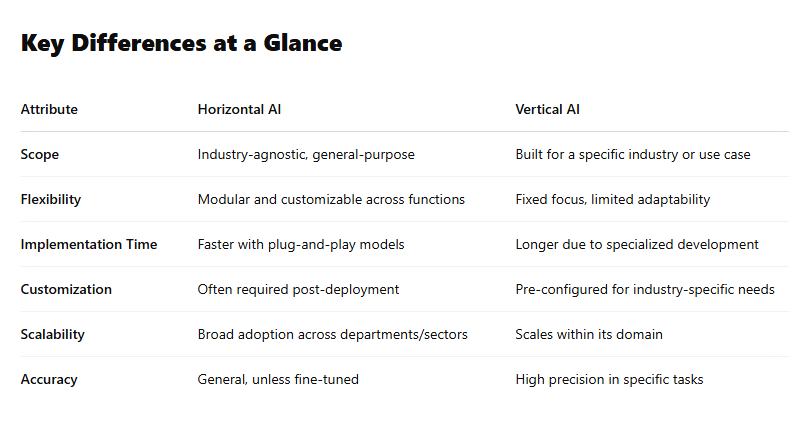
These two approaches differ not only in their design and functionality but also in how they support business objectives, adapt to workflows, and align with industry-specific requirements. Here is a detailed exploration of their distinctions, with each point offering insight into how these AI models operate in real-world applications.

image+%283%29

Scope

Horizontal AI is built to be industry-agnostic, providing a general-purpose foundation that can support a wide range of functions across multiple sectors. Think of it as a versatile toolbox containing broadly applicable capabilities such as natural language processing, image recognition, or recommendation engines. These systems are designed to fit into various organizational environments with minimal changes.

On the other hand, vertical AI is engineered with a deep focus on one particular industry or function. It leverages domain-specific data, language, and workflows to address targeted use cases, such as diagnosing diseases in healthcare, fraud detection in banking, or contract analysis in legal fields. This specificity makes vertical AI more efficient in its niche, but less useful outside it.

Flexibility

Flexibility is a key advantage of horizontal AI because it’s built to be used across industries, it offers modular architecture and customizable APIs that enable organizations to tailor it for various departments and roles, be it HR, finance, or customer service. This makes it particularly valuable for enterprises that require broad, cross-functional AI integration.

In contrast, vertical AI solutions are typically rigid in their design. Their focus is narrow, making them excellent at solving specific problems but less capable of adjusting to new use cases outside their intended scope. For companies with well-defined needs in a particular field, this trade-off may be worthwhile, but it can limit broader adaptability.

Implementation Time

Horizontal AI solutions are usually quicker to deploy since they come as plug-and-play platforms with established integrations and pre-trained models, and organizations can implement them with relatively little effort. This is especially helpful for businesses looking to adopt AI incrementally without major disruptions.

Vertical AI, by comparison, often requires more time to implement. Customizing these systems to align with proprietary processes, regulatory frameworks, and domain-specific datasets takes significant planning and development. This extended timeline is a worthwhile investment for industries where precision and compliance are critical, but it demands patience and resource allocation upfront.

Customization

While horizontal AI platforms are flexible, they typically require substantial customization to meet the nuanced demands of a particular organization. Businesses often need to train these systems with internal data, modify decision rules, or build custom modules to match their workflows.

Vertical AI, in contrast, arrives already equipped with domain-relevant features, terminology, and business logic. These systems are pre-configured to handle industry-specific needs, reducing the burden of post-deployment customization. This inherent readiness allows vertical AI to start delivering value more quickly in its specialized area, even if it lacks versatility outside that domain.

Scalability

In terms of scalability, horizontal AI offers significant advantages. Its general-purpose design and broad applicability make it suitable for deployment across diverse departments, business units, or even industries. Organizations looking to build a unified AI infrastructure across their ecosystem can benefit from this scalability.

Vertical AI, however, scales best within its own vertical. For instance, an AI model developed for radiology may be implemented across several hospitals or clinics, but it wouldn’t apply to logistics or retail. While vertical AI can expand within its domain, it lacks the horizontal spread that larger, more diversified companies may need.

Accuracy in Specialized Tasks

Horizontal AI systems, due to their wide applicability, often lack the depth of expertise needed for highly specialized tasks, unless they are further trained using domain-specific data. This can lead to generalized outputs that are sufficient but not exceptional.

Vertical AI is purpose-built to perform in-depth analysis within a narrowly defined scope. It is trained on rich, specialized datasets, incorporates expert knowledge, and is fine-tuned to deliver high accuracy in tasks that require deep understanding, such as identifying medical anomalies or interpreting legal jargon. For organizations where precision is mission-critical, vertical AI provides a significant advantage.

How DDD Can Help

At Digital Divide Data (DDD), our Generative AI solutions are designed to strengthen both horizontal and vertical AI models by providing the essential building blocks for scalable, domain-specific, and responsible AI development. For horizontal AI applications, we offer prompt engineering, dataset enrichment, and bias mitigation to support adaptable, cross-functional models that can perform reliably across various departments or industries.

For vertical AI, our solutions dive deep into domain-specific fine-tuning, RLHF (Reinforcement Learning from Human Feedback), and nuanced model training to meet the exact needs of specialized sectors like healthcare, finance, or legal. Our focus on data quality and performance ensures your models are precise, contextual, and ready for real-world deployment.

Conclusion

Choosing between horizontal and vertical AI is not a matter of which is better, it’s about which is better as per your requirements. If you need a flexible, broadly applicable solution that supports multiple departments, horizontal AI may be the right fit. If your business operates in a highly specialized or regulated industry, vertical AI could offer the depth, accuracy, and compliance you need. In some cases, a hybrid approach, leveraging horizontal AI for foundational tasks and vertical AI for domain-specific challenges, may deliver the most value.

Whether you’re building scalable horizontal solutions or specialized vertical applications, DDD’s Generative AI services are here to power your AI innovation. To learn more, talk to our experts.

Horizontal vs. Vertical AI: Which Is Right for Your Organization? Read Post »

shutterstock 1936992973

How AI-Powered Object Detection is Reshaping Defense

By Umang Dayal

9 April, 2025

Artificial Intelligence (AI) is now a central pillar of how nations protect their people, borders, and interests. Among its many applications, object detection stands out for its immediate impact on national security

By teaching machines to identify people, vehicles, weapons, and other objects in images and videos, governments and defense organizations are enhancing how they monitor threats, respond to crises, and maintain strategic advantages.

From surveillance drones patrolling borders to satellites tracking troop movements across continents, AI-driven systems are increasing speed, accuracy, and operational efficiency in unprecedented ways. This shift is not only making defense systems smarter but also reducing human workloads and error, allowing military personnel and analysts to focus on what truly matters.

In this blog, we explore how object detection is revolutionizing national security by enhancing situational awareness, accelerating decision-making, and reducing risk across every level.

The Rise of AI in National Security

AI-powered object detection systems use algorithms trained on large volumes of annotated data to recognize and classify objects in real time. Whether it’s a drone identifying enemy vehicles in rough terrain or a surveillance camera picking up suspicious behavior in a high-traffic area, the technology allows defense forces to react quickly and precisely.

A key example is Project Maven, which was launched by the U.S. Department of Defense in 2017. This initiative was developed to harness AI for analyzing vast volumes of drone footage and extracting actionable intelligence. Project Maven dramatically reduced the manual workload for military analysts by enabling AI to identify and flag people, vehicles, and other objects of interest in real time. The project improved operational timelines and the overall quality of intelligence gathered from ISR (intelligence, surveillance, and reconnaissance) assets. These enhancements allowed defense teams to accelerate mission planning and improve response times in high-risk environments.

Another example is Shield AI, a San Diego-based defense technology firm that builds AI pilots for autonomous aircraft. Their flagship platform, Hivemind, enables drones to operate in GPS-denied or communication-degraded environments without human input. These AI-powered reconnaissance tools enable real-time object detection and terrain navigation, allowing drones to scout heavily contested or dangerous areas safely. 

This advancement significantly improves ISR capabilities as it minimizes the risk of human error, reduces false positives, and increases mission success rates through autonomous situational awareness. This project represents the future of deploying smart, self-directed aerial systems that support critical operations without placing personnel in harm’s way.

Key Applications of Object Detection in National Security

Object detection is transforming nearly every aspect of defense operations by enabling systems to “see” and understand complex visual environments. Below are several of its most critical applications:

Surveillance and Reconnaissance

AI-driven surveillance tools, like drones, satellites, and fixed cameras, are redefining how military and security teams monitor territories. With the ability to detect and track people, vehicles, and movements in real time, these tools dramatically reduce the risk of human oversight and improve response times. 

AI models trained on vast datasets can distinguish between ordinary civilian activity and potentially threatening behavior, minimizing false alarms and enabling more informed situational awareness.

Border Security and Counterterrorism

AI-based object detection plays a pivotal role in identifying unauthorized border crossings, spotting concealed weapons, and flagging suspicious actions. These systems are particularly effective in remote or high-traffic areas where human monitoring is difficult. 

Integrated with facial recognition and license plate scanning, they support law enforcement and homeland security in preempting potential threats. AI also enables more efficient data fusion from multiple sources, such as ground sensors, surveillance footage, and biometric records.

Battlefield Intelligence and Tactical Advantage

On the front lines, real-time image and video analysis offers soldiers a decisive edge. AI systems ingest drone feeds and satellite imagery to identify enemy positions, detect hidden explosives, and assess terrain risks.

This information, delivered almost instantly, helps commanders make faster, smarter decisions. By reducing the fog of war, AI object detection enhances strategic planning and coordination between units.

Mine and IED Detection

Autonomous ground vehicles and drones equipped with object detection can identify improvised explosive devices (IEDs) or landmines buried underground or hidden in debris. Using visual cues and sensor data, these systems help ensure safe navigation for troops and minimize the risk of casualties. Their ability to continuously learn and adapt makes them more effective with every mission.

Cybersecurity and Decision-Making

Object detection in the digital realm helps monitor network activity for unusual patterns, potentially flagging cyber threats before they escalate. Coupled with other AI capabilities, these systems can correlate physical and digital data, such as identifying suspicious persons near a sensitive facility following a cyberattack.

Predictive Maintenance and Supply Chain Optimization

AI-powered detection systems are also used to monitor military equipment, vehicles, aircraft, and weapons systems, for signs of wear or malfunction. By spotting issues before they become critical, maintenance can be performed proactively, reducing downtime. Similarly, AI helps forecast supply needs and streamline logistics, as demonstrated in the U.S. Navy’s LAI (Logistics AI Integration) initiative.

Humanitarian and Investigative Support

AI object detection supports broader missions as well, such as law enforcement investigations into trafficking and exploitation. By analyzing video footage and online content, these systems can spot patterns of suspicious behavior or identify known criminals. In conflict zones, they help identify humanitarian needs by tracking displaced populations or damaged infrastructure.

Other Areas

AI’s impact extends far beyond traditional defense scenarios. Here are some additional areas where object detection and AI technologies are making a difference:

  • Language Translation & Communication: Real-time translation tools powered by AI help military personnel communicate across linguistic barriers in multinational operations.

  • Predictive Maintenance: AI can detect early signs of equipment failure, reducing downtime and increasing the efficiency of military assets.

  • Supply Chain Optimization: The U.S. Navy’s Logistics AI Integration (LAI) program is a prime example of how AI predicts supply needs and enhances logistics planning.

  • Human Trafficking & Exploitation Prevention: AI monitors online platforms and detects suspicious behavior patterns to assist in preventing human trafficking and exploitation.

Read more: Red Teaming For Defense Applications and How it Enhances Safety

Technical Challenges in Object Detection

Despite its promise, AI object detection faces significant hurdles that developers and defense tech must address to ensure system reliability and resilience. One major concern is vulnerability to adversarial attacks. In such cases, malicious actors intentionally introduce subtle, misleading data that can cause an AI system to misidentify or overlook objects, posing a serious threat in mission-critical environments. For example, researchers have demonstrated that adding noise to images or manipulating pixels can trick AI models into misclassifying vehicles, weapons, or people.

To combat these risks, the AI research community is exploring several techniques. One emerging approach is the use of conditional diffusion models, which are generative methods that help AI systems produce more robust and realistic predictions by modeling uncertainty in data. When trained properly, these models can resist manipulations and better generalize to new or unpredictable scenarios. Additionally, robust training techniques, such as adversarial training, ensemble methods, and data augmentation, are proving effective in hardening AI models against deceptive inputs.

Another foundational challenge lies in ensuring high-quality training data. Inaccurate or inconsistent labels can weaken model performance, especially when AI is tasked with identifying nuanced threats across diverse terrains and contexts. This is where precise data labeling and annotation become mission-critical. It’s not just about quantity but also accuracy, context, and consistency. Continuous fine-tuning and real-world testing are also necessary to adapt models to evolving conditions and threat profiles.

Finally, the importance of data governance and ethical considerations cannot be overstated. Systems that analyze sensitive environments must be developed with transparency and accountability to avoid unintended consequences, such as biased detections or privacy violations.

How Digital Divide Data (DDD) Supports National Security

We provide high-quality data services to enhance the effectiveness of national security technology. Here’s how:

Data Labeling & Annotation – Our experts ensure precise image, video, and sensor data labeling to train reliable detection AI models.

LLM Fine-Tuning & RLHF – We refine large language models and incorporate human feedback to enhance decision-making capabilities.

Red Teaming for AI Systems – Our rigorous testing identifies vulnerabilities and biases, strengthening the reliability of security technologies.

Data Engineering & Analysis – We collect, clean, and structure data to improve real-time threat detection and intelligence gathering.

Impact Sourcing Model DDD employs skilled professionals from underserved communities, delivering top-tier services while promoting social impact.

By leveraging our expertise, national security organizations can enhance precision, security, and efficiency. 

Learn more: Gen AI for Government: Benefits, Risks and Implementation Process

Object detection helps defense teams spot threats faster, make better decisions, and reduce risks. But for these systems to work perfectly, they need high-quality data and thoughtful development behind them.

At Digital Divide Data (DDD), we specialize in ML data services that make AI smarter and more reliable, from labeling images and videos to testing systems for bias and vulnerability. 

Let’s talk about how we can support your next AI project.

How AI-Powered Object Detection is Reshaping Defense Read Post »

shutterstock 2324952345

Detecting & Preventing AI Model Hallucinations in Enterprise Applications

By Umang Dayal

8 April, 2025

Generative AI is changing how businesses work. It’s helping teams move faster, make better decisions, and deliver more personalized customer experiences. But as companies race to use these AI tools, there’s a major issue that’s often overlooked: AI doesn’t always get it right.

Sometimes, it produces information that sounds convincing but is false or made up. This problem is known as an “AI hallucination.”

In this blog, we’ll break down what hallucinations are, why they happen, how to spot them, and what businesses can do to prevent them.

What Are AI Hallucinations?

AI hallucinations refer to instances where models generate content or predictions that are factually incorrect or nonsensical yet often presented with unjustified confidence. In language models like GPT or LLaMA, this might look like fabricating a statistic or quoting a non-existent research paper. In vision-language models, it might mean describing an object that isn’t present in an image.

According to a recent study published in Nature, hallucinations are not just rare anomalies; they’re systemic distortions arising from how models interpret and generate information. These hallucinations are essentially the AI’s best guess when it lacks clarity or grounding in factual data. Unlike humans, AI lacks a true understanding of truth; it generates responses based on probabilities derived from patterns in data. This leads to situations where it can present entirely fabricated content with persuasive language and tone.

There are also different types of hallucinations: intrinsic, caused by model architecture or internal reasoning issues, and extrinsic, caused by poor input quality or gaps in external data sources. Understanding these distinctions is key to addressing the problem at the root.

Why Hallucinations Are Dangerous in Enterprise Applications

In an enterprise setting, hallucinations aren’t just an academic concern. A chatbot telling a customer the wrong refund policy, an AI assistant generating a flawed market analysis, or a compliance report based on hallucinated data can have real consequences.

Consider an enterprise customer service chatbot that confidently provides incorrect warranty information. Not only does this mislead the customer, but it can lead to claims, disputes, and even potential lawsuits. In regulated industries like finance or healthcare, hallucinations could mean non-compliance with strict legal standards, putting the entire organization at risk. For example, if a medical AI tool fabricates treatment protocols or misinterprets clinical data, the outcomes could be devastating.

Businesses leveraging generative AI need to treat hallucination prevention with the same gravity as cybersecurity or data privacy. Enterprises are expected to provide accurate, auditable, and consistent information. When AI fails to meet these standards, accountability still falls on the organization. This makes it essential to not just rely on AI’s capabilities but also implement systems that monitor and validate AI outputs rigorously.

What Causes AI Hallucinations?

Several underlying issues contribute to hallucinations:

Training Data Limitations: If a model hasn’t seen a particular kind of data during training, it might “fill in the blanks” incorrectly. For instance, if financial data from emerging markets wasn’t part of the training set, the AI may improvise based on unrelated or outdated information.

Lack of Grounding: Generative models often lack direct access to external, real-time information, which makes their outputs less reliable. Without grounding, the model cannot fact-check itself, increasing the chances of invented or erroneous content.

Overgeneralization: Language models are designed to predict likely sequences of words, not necessarily truthful ones. This means they can sometimes produce content that seems right linguistically but is wrong factually.

Ambiguous Prompts: Poorly worded or open-ended queries can confuse the model, causing it to make assumptions. For example, asking “What are the legal tax loopholes in the U.S.?” without context might yield speculative or fabricated advice.

Strategies for Detecting AI Hallucinations

Hallucinations often go unnoticed unless you’re actively looking for them. Fortunately, several techniques and tools can help enterprise teams catch these issues before they cause real damage:

Confidence Scoring: Some modern AI platforms now offer confidence scores with their outputs. These scores reflect how certain the model is about a given response. For instance, Amazon Bedrock uses automated reasoning checks to assess the reliability of generated content. When confidence is low, the system can either flag the response for review or suppress it entirely. This kind of score-based filtering helps ensure that only higher-confidence outputs make it to the end user.

Tagged Prompting: This strategy involves labeling or structuring inputs with metadata that provide context to the model. For example, if an AI system is answering questions about a product catalog, tagging each prompt with the product ID, version number, or release date can help reduce ambiguity. When hallucinations do occur, the metadata makes it easier to trace the problem back to its origin. For example, was it a vague prompt, a missing tag, or a gap in the model’s training data?

Hallucination Datasets: Specialized datasets like M-HalDetect are being used to stress-test AI models under known risk scenarios. These datasets include challenging queries that have historically led to hallucinated outputs, allowing enterprises to benchmark how their models perform in those edge cases. It’s similar to how cybersecurity teams run penetration tests, this is a proactive way to expose weaknesses.

Comparative Cross-Checking: Another effective tactic is to compare outputs from multiple models or run the same query with slight variations. If different versions of the prompt yield inconsistent or contradictory responses, that’s often a red flag. Some teams use a second model to “audit” the first, identifying hallucinated content by comparing it with known facts or retrieving source material for validation.

Human-in-the-loop Validation: AI should not operate in a vacuum, especially not in critical applications. In industries like healthcare, law, or finance, having human experts validate AI-generated content is a must. This doesn’t mean slowing down every workflow, but rather inserting checkpoints where accuracy is non-negotiable. For example, a compliance report generated by AI might be routed through a legal team before being submitted externally.

Output Logging and Auditing: Tracking and logging every AI interaction can help organizations monitor patterns over time. If certain types of questions or workflows are consistently leading to hallucinated responses, that insight is invaluable for refining prompts, retraining models, or even switching platforms.

Strategies for Preventing AI Hallucinations

Prevention involves both technical and procedural strategies. Here’s how leading enterprises are minimizing hallucination risks:

Retrieval-Augmented Generation (RAG): Instead of relying on internal parameters alone, RAG methods pull in external, validated data in real time, ensuring more accurate outputs. A recent paper on Arxiv showed that RAG dramatically reduced hallucinations in structured outputs. For example, a legal AI assistant using RAG could reference up-to-date legislation databases while drafting a contract, minimizing errors. RAG is especially useful in dynamic environments like finance, where regulations or stock data change frequently. By integrating live retrieval into the model’s architecture, organizations can make sure their AI tools stay grounded in reality.

Prompt Engineering: Thoughtfully crafted prompts guide models more effectively. Adding constraints, instructions, and domain-specific context helps reduce ambiguity. Prompt templates that specify structure, such as “based on the latest annual report…” anchor the AI’s response in more grounded data. Enterprises are increasingly developing internal libraries of pre-validated prompts to standardize how AI is used across departments, ensuring consistency and reducing the chance of errors.

Model Fine-Tuning: Custom training on enterprise-specific data ensures that AI systems are attuned to domain-relevant language, context, and compliance. A customer support AI fine-tuned with actual support logs and product documentation will produce more accurate and useful responses. Fine-tuning also helps filter out generic or irrelevant data, allowing the model to prioritize enterprise-specific knowledge when generating outputs.

Safety Guardrails: Guardrails prevent AI from speculating about sensitive or high-risk topics without appropriate data. Companies are also building custom guardrails that align with internal policies, such as blocking answers on legal or medical advice unless confirmed by a human. Salesforce, for instance, has implemented layered controls that rate-limit sensitive topics and initiate fallback mechanisms when confidence is low.

Monitoring & Feedback Loops: Real-time monitoring, combined with feedback from users, helps identify and retrain against hallucination patterns over time. Logging outputs and enabling feedback lets enterprises build a continuous learning loop that enhances model accuracy with each iteration. Some businesses are integrating dashboards that track hallucination frequency by department or use case, which can then inform retraining efforts or policy updates.

Cross-functional Collaboration: Preventing hallucinations isn’t just a technical challenge; it’s a team effort. Legal, compliance, product, and engineering teams should all be involved in designing and reviewing AI deployments. This ensures that the models are not only accurate but also aligned with business objectives and regulatory requirements.

Clear User Disclaimers: Another underrated but important strategy is transparency with end-users. Clearly labeling AI-generated content and providing context (e.g., “This summary was created using AI and should be reviewed before final use”) helps manage expectations and encourages critical thinking when reviewing AI outputs.

Real-World Consequences of Generative AI Hallucinations

Hallucinations are no longer just quirky errors; they’re high-stakes liabilities. Here are highlighted incidents that expose the tangible dangers of relying on generative AI without rigorous human oversight.

NYC Chatbot Gives Illegal Business Advice

In an effort to streamline support for small businesses, New York City launched a generative AI chatbot that was intended to answer regulatory and legal questions related to employment, licensing, and health codes. However, investigations revealed that the chatbot often hallucinated responses that were not just inaccurate but outright illegal.

For instance, it incorrectly told users that employers could legally fire workers who reported sexual harassment or that food nibbled by rats could still be served to customers. These hallucinations posed serious risks to small businesses, potentially leading them into legal violations unknowingly.

Had businesses acted on this advice, it could have resulted in lawsuits, fines, or even revocation of business licenses. This case exemplifies how AI hallucinations in customer-facing tools can have immediate and severe consequences if left unchecked.

Fabricated Regulations in LLM-Generated Reports

In the financial sector, AI is increasingly used to summarize compliance updates, risk assessments, and investor reports. A study examining large language models used for these tasks found that they frequently hallucinated critical details.

For example, some models cited SEC rules that don’t exist, misstated compliance thresholds, or fabricated timelines related to regulatory deadlines. These outputs were generated confidently and looked legitimate, making them especially dangerous in high-stakes environments.

If such errors were included in official documentation or internal risk assessments, they could mislead financial officers and auditors, resulting in regulatory breaches, fines, or criminal liability. This use case highlights the need for rigorous validation mechanisms when AI is used in compliance-heavy industries.

Inaccurate Summaries Risking Patient Safety

AI is being used in hospitals and clinics to assist with summarizing complex medical records, radiology reports, and diagnostic notes. However, multiple studies and pilot implementations have revealed that generative AI often fabricates or misrepresents clinical details.

In one documented scenario, the AI added symptoms that weren’t present in the original report and incorrectly summarized the patient’s medical history. It also used invented medical terminology that did not match any recognized codes.

These hallucinations can lead doctors to make incorrect decisions regarding patient care, such as prescribing inappropriate treatments or overlooking critical symptoms. In regulated healthcare environments, this is a matter of life and death, and it could expose institutions to legal liability or loss of accreditation.

Generative AI Invents Fake Case Law

In a high-profile legal case in 2023, two lawyers in the U.S. submitted a court filing that included citations fabricated by ChatGPT. The brief contained multiple references to cases that didn’t exist, including made-up quotes and opinions from real judges.

The citations appeared authentic enough that they initially went unnoticed until the opposing counsel flagged them during review. As a result, the lawyers were sanctioned, and the court issued a public reprimand.

This incident demonstrates a critical risk in legal applications: hallucinated outputs that are syntactically and contextually correct, yet entirely fictional. If such content slips into legal arguments, it undermines the credibility of the court system and exposes firms to reputational and disciplinary consequences.

How Digital Divide Data (DDD) Helps Enterprises Minimize AI Hallucinations

DDD helps enterprises design, implement, and monitor AI systems that are reliable, responsible, and audit-ready.

Human-in-the-Loop Validation for High-Risk Outputs

In sectors like healthcare, finance, and legal services, DDD provides trained human validators to fact-check, audit, and approve AI-generated outputs before they’re delivered. For instance, in the medical report summarization use case, DDD can deploy medically literate teams to verify generated summaries against source documents, ensuring that no fabricated symptoms, misinterpreted histories, or fake terminology slip through. This layer of manual verification acts as a safeguard that significantly reduces the likelihood of errors reaching patients or professionals.

Ground Truth Data Curation to Prevent Hallucinations at the Source

AI models are only as accurate as the data they’re trained on. DDD works with clients to curate, structure, and maintain domain-specific, high-quality training datasets. In use cases like financial compliance or legal document generation, DDD helps create datasets aligned with current regulations, real case law, and accurate policy references. This ensures that models are learning from valid, trustworthy sources, minimizing the risk of hallucinated content like fake SEC rules or non-existent court cases.

Domain-Aware Prompt Engineering and Dataset Tagging

A major cause of hallucinations is vague or contextless prompting. DDD helps enterprises implement domain-aware prompt engineering by embedding structured metadata, tags, and context cues into the interaction pipeline.

For example, in enterprise customer support scenarios like the NYC chatbot case, prompts can be structured with product version IDs, location-specific regulations, or company policy references to reduce ambiguity and help models generate contextually accurate answers. DDD also assists in training staff to build libraries of “safe prompts” that consistently yield reliable responses.

Continuous Monitoring and Feedback Loops

Preventing hallucinations isn’t a one-time effort, it’s an ongoing process. DDD offers AI performance monitoring as a service, helping clients set up systems that log and analyze AI outputs across workflows.

If hallucinations occur repeatedly in certain scenarios (e.g., legal drafting or investor report summaries), DDD flags these patterns and helps retrain models or revise prompts accordingly. This continuous learning loop allows organizations to iteratively improve AI accuracy over time while maintaining transparency and compliance.

Cross-Functional Collaboration with Internal Teams

DDD works as an extension of your product, legal, and compliance teams, aligning AI system design with real-world enterprise requirements. DDD ensures every output is accurate, brand-safe, and aligned with internal policies. This is especially valuable for enterprises using generative AI at scale, where decentralization can make hallucination risk harder to track.

DDD offers Generative AI solutions that enable enterprises to build reliable and safer models by combining the best of human expertise, domain-specific data management, and proactive monitoring.

Final Thoughts

Hallucinations are not a sign of flawed technology but rather a byproduct of AI’s probabilistic design. They can and must be managed, especially in high-stakes enterprise conditions. The most successful organizations will be those that embed hallucination detection and prevention into their AI governance frameworks from the very beginning.

Enterprises should approach generative AI not as a plug-and-play solution but as a tool requiring oversight, auditability, and structured deployment. This includes setting expectations with internal users, training employees on responsible use, and continuously refining systems to respond to evolving risks.

AI is only as trustworthy as the safeguards we build around it. Now’s the time to build those safeguards before the hallucinations speak louder than the truth.

Talk to our experts to learn how we can build safer, smarter Gen AI systems together.

Detecting & Preventing AI Model Hallucinations in Enterprise Applications Read Post »

RAG

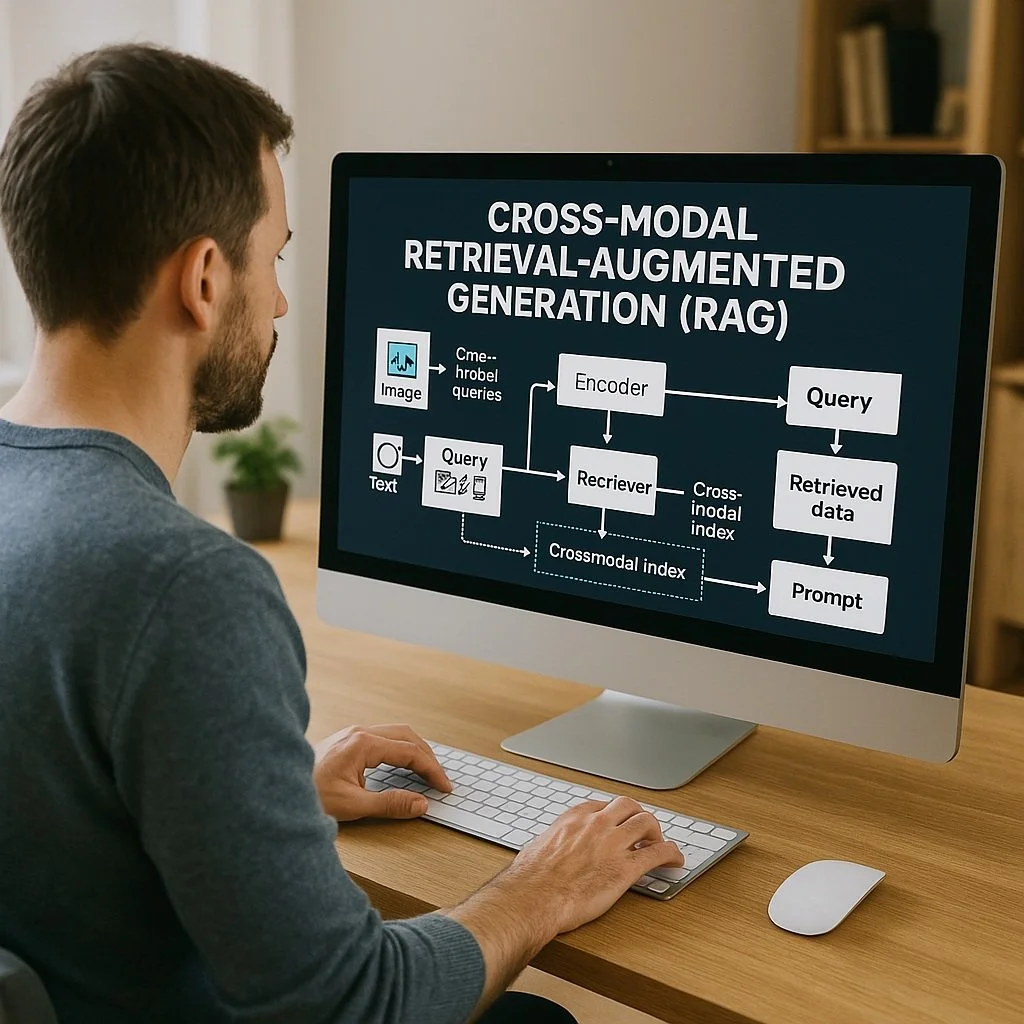
Cross-Modal Retrieval-Augmented Generation (RAG): Enhancing LLMs with Vision & Speech

By Umang Dayal

3 April, 2025

AI has come a long way in natural language processing, but traditional Large Language Models (LLMs) still face some significant challenges. They often hallucinate, struggle with limited context, and can’t process images or speech effectively.

Retrieval-Augmented Generation (RAG) has helped improve things by letting LLMs pull in external knowledge before responding. But here’s the catch: most RAG models are still text-based. That means they fall short in scenarios that require a mix of text, images, and speech to fully understand and respond to queries.

That’s where Cross-Modal Retrieval-Augmented Generation (Cross-Modal RAG) comes in. By incorporating vision, speech, and text into AI retrieval models, we can boost comprehension, reduce hallucinations, and expand AI’s capabilities across fields like visual question answering (VQA), multimodal search, and assistive AI.

In this blog, we’ll break down what Cross-Modal RAG is, how it works, its real-world applications, and the challenges that still need solving.

Understanding Cross-Modal Retrieval-Augmented Generation (RAG)

What is Cross-Modal RAG?

Cross-Modal RAG is an advanced AI technique that lets LLMs retrieve and generate responses using multiple types of data: text, images, and audio. Unlike traditional RAG models that only fetch text-based information, Cross-Modal RAG allows AI to retrieve images for a text query, analyze speech for deeper context, and combine multiple data sources to craft better, more informed responses.

Why is Cross-Modal RAG important?

  • More Accurate Responses: RAG helps by grounding their answers in real data, and with multimodal retrieval, AI gets even better at pulling fact-based, relevant information.

  • Richer Context Understanding: Many queries involve images or audio, not just text. Imagine asking about a car part, it’s much easier if the AI retrieves a labeled diagram rather than just trying to describe it.

  • More Dynamic AI Interactions: AI assistants, chatbots, and search engines get a serious upgrade when they can use text, images, and audio together. This makes conversations more intuitive and useful.

  • Smarter Decision-Making: In fields like healthcare, autonomous driving, and security, AI needs to process multimodal data to make the best decisions. Cross-Modal RAG helps make that happen.

How Cross-Modal RAG Works

Cross-Modal RAG follows a structured process to find and generate information from multiple sources. Here’s how it works:

Encoding & Retrieving Data

Multimodal Data Embeddings: Different types of content (text, images, audio) are encoded into a shared embedding space using models like CLIP (for text-image matching), Whisper (for speech-to-text conversion), and multimodal transformers like Flamingo and BLIP.

AI searches vector databases (like FAISS, Milvus, or Weaviate) to find the most relevant content. This means the model can retrieve an image for a text query or pull a transcript from audio. AI keeps track of timestamps, sources, and confidence scores to ensure retrieved information stays relevant and reliable.

Knowledge Augmentation

Once relevant multimodal data is retrieved, it’s integrated into the LLM’s prompt before generating a response. AI uses image-caption alignment and cross-attention mechanisms to make sure it understands an image’s context or an audio snippet’s meaning before responding. This allows prioritizing different data types depending on context. For example, when answering a question about music theory, it might focus more on text and audio rather than images.

Response Generation

Now, AI generates a cohesive, human-like response by pulling together all the retrieved text, images, and audio insights. For this to work well, the model must fuse multimodal data in a way that makes sense. Cross-attention mechanisms help the AI focus on the most relevant parts of retrieved images or transcripts, ensuring that responses are both accurate and insightful.

To keep responses engaging and accessible, AI also uses dynamic prompt engineering. This means AI formats answer differently depending on the type of query. If answering a medical question, it might provide a structured response with step-by-step explanations. If responding to a retail inquiry, it might generate a quick product comparison with images.

Here are a few examples of use cases:

  • A visual question-answering system retrieves and analyzes an image before responding.

  • A multimodal chatbot pulls audio snippets, images, and documents to craft insightful replies.

  • A medical AI system retrieves X-ray images and reports to assist doctors in diagnosis.

Real-World Applications of Cross-Modal RAG

Smarter Multimodal Search

Imagine searching for something without having to describe it in words. Cross-modal retrieval allows AI to fetch images, videos, and even audio clips based on text-based queries. This capability is transforming how people interact with search engines and databases, making information access more intuitive and efficient.

In retail and e-commerce, shoppers no longer need to struggle to find the right keywords to describe a product. Instead, they can simply upload a photo, and AI will match it with visually similar items, streamlining the shopping experience. This is particularly useful for fashion, furniture, and rare collectibles, where descriptions can be subjective or difficult to communicate.

Visual Question Answering (VQA)

AI is now capable of analyzing images and answering questions about them, opening up new possibilities for education, research, and everyday convenience.

In education, students can upload diagrams, maps, or complex visuals and ask AI to explain them. Whether it’s breaking down a biology chart, interpreting a historical map, or explaining a complex physics experiment, VQA makes learning more interactive and accessible. This technology also enhances academic research by enabling better analysis of scientific images and infographics.

Assistive AI for Accessibility

For people with disabilities, cross-modal AI can bridge communication gaps in powerful ways. AI-powered tools can convert text into speech, describe images, and generate captions for videos, making digital content more accessible.

Real-time speech-to-text transcription is a game-changer for individuals with hearing impairments, enabling them to follow live conversations, lectures, and broadcasts effortlessly. Similarly, visually impaired users can benefit from AI that provides spoken descriptions of images, documents, and surroundings, significantly improving their ability to navigate the digital and physical world.

Cross-Lingual Multimodal Retrieval

Language should never be a barrier to accessing information. AI-driven cross-lingual retrieval allows users to find relevant images and videos using text queries in different languages.

This is particularly impactful in journalism and media, where AI can translate and retrieve multimodal content across languages, making global news and cultural insights more accessible. Whether it’s searching for international footage, multilingual infographics, or foreign-language articles, this technology helps break down linguistic silos and connect people across borders.

Key Challenges & What’s Next?

One of the biggest hurdles in cross-modal retrieval is aligning text, images, and audio effectively. Since different data types exist in distinct formats- text as words, images as pixels, and audio as waveforms- AI needs to map them into a common vector space where they can be meaningfully compared.

Achieving this requires sophisticated deep learning models trained on vast multimodal datasets, but even then, discrepancies in meaning and context can arise. A photo of a “jaguar” might refer to the animal or the car, and without proper alignment, the AI could misinterpret the query.

Another major concern is computational cost. Multimodal retrieval demands significantly more processing power than traditional text-only searches. Every query involves analyzing and comparing high-dimensional embeddings across multiple modalities, often requiring large-scale GPUs or TPUs to process in real time. This makes deployment expensive, and for companies working with limited resources, scalability becomes a serious challenge. Optimizing these models for efficiency while maintaining accuracy is a crucial area of research.

Biases and ethical issues also pose significant risks. If the AI is trained on biased datasets- whether in images, text, or audio, it can inherit and amplify those biases. For example, if a model is trained mostly on Western-centric images, it might struggle to accurately retrieve or categorize content from other cultures. Similarly, voice-based AI systems might perform better for certain accents while failing to recognize others. Addressing these biases requires careful dataset curation, fairness-aware training techniques, and continuous monitoring of model outputs.

While multimodal AI has made impressive strides, achieving seamless, instant retrieval across text, images, and audio is still challenging. Current systems often introduce delays, especially when dealing with large-scale databases or high-resolution media files. Advances in model compression, edge computing, and distributed processing could help mitigate these issues, but for now, real-time multimodal AI remains an ambitious goal rather than a fully realized capability.

As research continues, overcoming these challenges will be key to unlocking the full potential of cross-modal retrieval. Future developments in more efficient architectures, better alignment techniques, and responsible AI practices will shape the next generation of smarter, fairer, and faster multimodal AI systems.

Read more: The Role of Human Oversight in Ensuring Safe Deployment of Large Language Models (LLMs)

Conclusion

Cross-Modal Retrieval-Augmented Generation (RAG) is changing the game by combining vision, speech, and text into retrieval-based AI models. This approach boosts accuracy, deepens contextual understanding, and unlocks new AI applications from visual search to accessibility solutions.

As AI continues to evolve, Cross-Modal RAG will become a key tool for developers, businesses, and researchers.

If you’re looking to build smarter AI applications, now’s the time to explore multimodal RAG! Talk to our experts at DDD and learn how we can help you.

Cross-Modal Retrieval-Augmented Generation (RAG): Enhancing LLMs with Vision & Speech Read Post »

AutonomyV26V

The Case for Smarter Autonomy V&V

Sahil Potnis Co-Renae E Gregoire

1 April, 2025

No One-Size-Fits-All Model

Autonomous systems, be they robotaxis, AV trucks, or UAV drones, don’t carry the luxury of a learning curve for full autonomous deployment. When handling expected (and unexpected) scenarios safely and predictably like humans, these systems must demonstrate flawless behavior every single time with no room for guesswork. Can they learn from the environment to perfect their behavior? Of course, yes, but there’s a notional difference between learning to tune up unprotected left turns versus hitting a curb. You get it.

There are often philosophical and technological debates about what constitutes an ideal playbook for validating fully autonomous behavior. The reality is, there is not one, nor should there be. While standards and guidelines help achieve a faster convergence rate and guardrail the problem, they shouldn’t dilute the innovative methods in proving a system is safe(r). Honestly, that recipe varies depending on the product technology, operational design domain (ODD), safety case claims and subclaims, and methods of CONOPS for every company.

What matters at the end are a few specifics:

  • Can you demonstrate qualitatively and quantitatively that your product meets the desired safety case claims (in whichever bounding box you want to draw)?

  • Have you built sufficient evidence from your final product validation to bridge the gap between saying “our product is safe” and “actually proving it”?

  • Have you or can you build public trust on top of the latter two via transparency?

It’s much easier said than done. I can say that first-hand.

Validating AI systems with deep learning and neural networks is a tough problem. It doesn’t follow the traditional automotive or software systems validation approach. You’re no longer working with deterministic inputs and closed-form logic. You’re working with stochastic, black-box behavior, statistical probabilities, and edge cases that rarely repeat. Yet you’re still on the hook to demonstrate functional safety, regulatory compliance, and operational reliability under every possible ODD condition.

Let’s break down the problem further.

Chain of Thought: Starting with Continuous Validation

There’s a reason why continuous validation is replacing end-of-line testing across the autonomy industry. Early-stage issues cost less to fix. They’re also easier to isolate and more informative for engineers. Wait too long, and you may have to deal with system-wide rework, safety case rewrites, or worse — a product recall that makes headlines.

The stakes are even higher when building for Level 3 or Level 4 autonomy. These systems must take complete control in real-world environments. The only way to get there confidently is to validate continually — from unit test to public test, from synthetic sim to closed course to shadow-mode deployment. It’s a regressed approach. If you’re waiting for a completely signed-off system module before you can validate it within your test corpus, it just takes too long, and there’s no guarantee that you won’t find issues to restart the process again.

At DDD, we see this shift up close every day. Teams aren’t validating autonomy as a last step. They’re baking verification and validation (V&V) into every sprint, every milestone, and every release. That’s what it takes to succeed in today’s market. Let’s break the problem down even further.

  1. Define the validation scope – component, sub-system, system, or even an autonomous behavior, per se.

  2. Highlight the constraints – Write down operating conditions to ensure the floor and ceiling of your tests are locked in. This is crucial. Just because you can test for everything doesn’t mean you need to.

  3. Create test campaigns – {insert simulation / HIL / closed course tests}; it’s important not to boil the ocean here for an early signal. If it’s not the final validation, you have a next shot.

  4. Draw the classic requirements traceability matrix (RTM) – Document your findings in the RTM and feed back into the engineering problems.

  5. Rinse and repeat…

Teams often misconstrue validation as a final step pre-release. That is true if you’re doing product validation for a commercial deployment. However, it doesn’t mean you can’t use validation principles to start the cycle early and in a smaller incremental scope. More than likely, what breaks complex distributed systems is the interface – any amount of testing that exposes interface definition problems and detects dependency failures will always benefit the system architecture and end product validation.

V&V is a process. Not a final destination. The goal is to deploy proven technology.

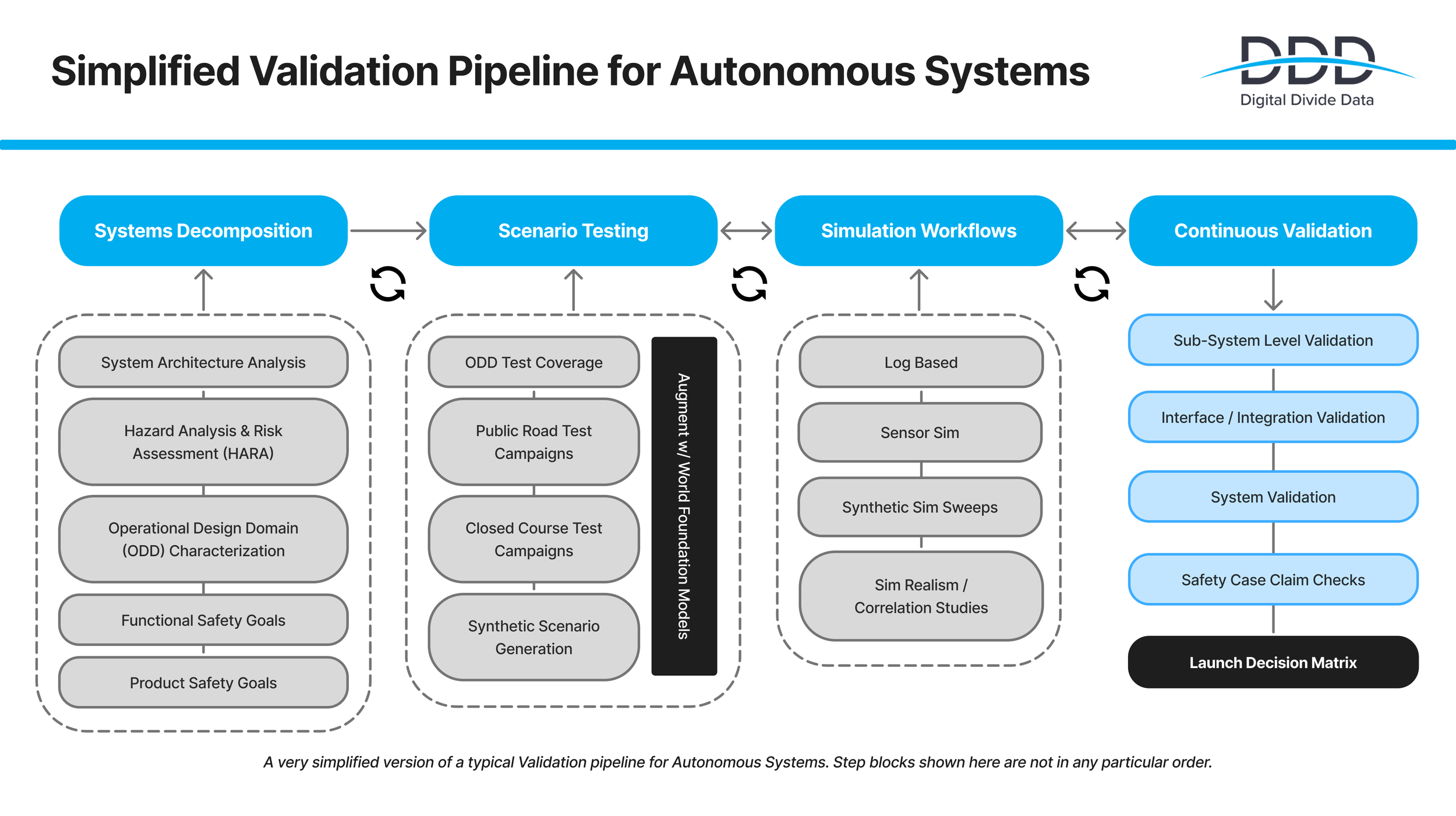
Basic Tenets of a Healthy Validation Pipeline

Autonomy+V%26V+Workflow

Figure 1. Simplified Validation Pipeline for Autonomous Systems

Synthetic Data Generation

You can’t validate what you can’t simulate.

That’s why scenario-based testing has become the gold standard for autonomy V&V. It allows developers to test real-world and edge-case interactions across varied ODDs long before a system hits the road. The amount of progress the industry has achieved in creating world foundation models is insane over the last 12 months. From what was a limiting factor to test all limiting ODD conditions five years ago to creating hyper-realistic, neurally simulated, actor-overlaid scenes is straight out of a fiction book.

What does this mean? Tools exist, but system integrators and end user applications must catch up to make the most of them. This advancement solves the software problem but, interestingly, complicates the systems engineering problem – you need to pick and choose which scenarios matter, why, and how that test builds your confidence in the system under test (SUT). You can now operate for 1,000 hours in Japan and a few hundred hours in the US to drive (nearly) perfectly, let’s say, in the UK. The additive nature of unsupervised learning using synthetic data greatly simplifies the model training problem. But, I digress…

The bottom line is that you should supplement your real-world testing with NVIDIA Cosmos-like tools to turbocharge data curation needs. Then, couple that with scenario ontology and ODD constraint definitions to create a dataset that gives you an unprecedented edge in creating V&V scenario sets.

State of the Art Simulation

Almost every autonomous systems company uses digital twin validation to increase confidence in simulation-based results by creating virtual replicas of physical systems and correlating their behavior against real-world performance. This validation layer assures that simulation outcomes are trustworthy enough to inform safety decisions at scale. There’s plenty of public domain literature on simulation realism and correlation scores. We won’t go into those details. That said:

  • Input information (II): What do you need to build in simulations and why? Is the data sourced from real-world (log-based) sensor models or the output of ODD characterization studies?

  • Input constraints (IC): Which simulation aspect gives you the most realistic behavior and, hence, which part of ODD does it leave open gaps for?

  • Desired outcomes (DO): What is the intent of simulation tests for your SUT, i.e., learning to expect or things to cross off from the known risks SOTIF quadrant?

When you plug II + IC + DO in any tool, it should spit out a spectrum of simulated tests that help you build at volume. If you can crack the simulation-in-the-loop development workflow, with the rest of the tenets in this section, you’re almost guaranteed to succeed quicker than others.

As scenario libraries grow, managing them becomes a discipline in itself. Enter simulation operations (SimOps) — a formal practice that includes scenario lifecycle management, suite health monitoring, and adversarial testing orchestration. SimOps ensures testing is systematic, repeatable, and aligned with your development goals as they evolve.

At DDD, we begin with what’s real: logs from the field, annotated sensor data, and even moments when a safety driver took over. From that foundation, we build what you need — synthetic scenarios with adjustable variables like speed, visibility, or pedestrian intent. We reconstruct real-world incidents in simulation with near pixel-perfect accuracy. We also design adversarial tests meant to push systems to the limits, on purpose, so we can see how they recover under pressure.

Data Driven Development

It’s great to have tools at your disposal that can simulate the real world, traffic behavior, agent reactions, etc., but ultimately, how you use the output data for inference and performance improvements is where things make or break.

A mental model categorizes your autonomy capabilities into standard scenario metrics – with every new software or hardware release, these metrics change against your baseline regression test suites. You can use this data to close the loop with scenario generation, simulation, and public road testing campaigns to improve the release for next time. This cuts more into your systematic verification, but the principles are the same for an overall product validation. Instead of sub-system metrics, you swap with system-level KPIs such as system latency, field assists, safety incidents, etc.

Well-Oiled Data Infrastructure

The validation pipeline can be extremely efficient or severely laggy, depending on the data infrastructure of your setup. Feeding the test systems with your inputs and executing them precisely has to happen quickly. Otherwise, the temporal costs stack on and become a perfect recipe to skip the continuous validation I mentioned earlier.

Data ingestion, cloud uploads, scenario creation or simulation execution time, and automated triage with manual QA checks are all important to optimize for streamlining the data infrastructure.

Predictive Performance Modeling

There are plenty of advancements to build predictive statistical models based on your system’s behavioral attributes, the nature of the change, and expected performance improvement. This largely helps predict the product roadmap forward and ensures that the V&V runway is sufficient to complete the testing, analysis, conclusions, and changes.

Towards More Automation

Simulation generates data. Edge cases generate questions. However, powerful insights come from understanding why something failed and where it can be traced back.

Modern V&V teams need systems that do more than detect anomalies. They need infrastructure for root-cause defect analysis — tools and workflows that isolate what went wrong, why it went wrong, and what to fix.

We’re seeing a fast pivot away from traditional human-led triage, which doesn’t scale. In its place? Automated log analysis, tagged defect taxonomies, and closed-loop workflows that route issues back to development with semantic context. DDD has helped build such taxonomies for leading autonomy customers, and we continue to refine them as systems grow more complex.

Coverage is both Metric and Deployment Decision

Coverage is a word that gets tossed around a lot. In autonomy, it means one thing: Have we tested enough to deploy with confidence? You can’t answer that question with line counts or percentage bars. You need:

  • Complete ODD analysis (day/night, urban/highway, dry/snow/low-visibility).

  • Scenario frequency distribution (not just edge cases but also the right mix of nominal vs. critical interactions).

  • Subsystem validation (perception, prediction, planning, control, fallback logic).

  • Human touchpoints (remote ops, customer support, fail-safes).

Teams preparing for geographic expansion also use region-specific scenarios to simulate local conditions, traffic patterns, and regulatory environments. This targeted approach helps adapt AV behavior to new markets quickly and safely.

The right approach combines simulation, structured closed-course testing, and targeted real-world validation — all mapped back to coverage goals. We help teams define those goals and hit them systematically.

Traceability: The Quiet Power Move in V&V

Most engineers don’t get excited about traceability. But safety auditors, regulatory bodies, and deployment leads do — and with good reason.

Traceability is a provable link from requirement to scenario to test to result. It’s the backbone of ISO 26262 and SOTIF compliance. It’s the reason regulators say yes.

And here’s the reality: The more complex your autonomy stack, the harder it is to trace. At DDD, we help clients build end-to-end traceability frameworks that embed links early and preserve them as systems evolve. That work includes:

  • Mapping requirements to acceptance criteria in simulation and real-world testing.

  • Tagging results with scenario IDs, environment variables, and sensor configurations.

  • Correlating anomalies to architectural layers (sensor, fusion, planning, actuation).

  • Making sure every test result directly reinforces a safety case element.

With traceability in place, teams can know what passed, what matters, and how to prove it to anyone who asks — regulator, insurer, or the public.

Automation isn’t the Goal; Understanding is

It’s easy to think automation is the final destination in V&V. However, the real goal is understanding. Understanding is why human-in-the-loop (HITL) validation remains essential — especially in early-stage autonomy development or when AI systems behave unexpectedly. No matter how advanced the model, there will be edge cases where human judgment is faster, sharper, and more adaptable.

At DDD, we balance automation and human review by:

  • Using AI to flag anomalies in massive data streams.

  • Routing ambiguous or high-impact cases to expert human reviewers.

  • Feeding human-labeled data back into the model for continuous improvement.

  • Creating feedback loops that combine speed with insight.

We also design performance evaluation workflows that integrate feedback from both onboard and offboard sources so that each iteration of the autonomy stack gets evaluated against business goals, technical benchmarks, and safety criteria.

This work is especially powerful for safety-critical edge cases where pedestrian intent, cyclist behavior, or sensor dropouts challenge even the most advanced AV stack. With our HITL workflows, nothing gets missed. No bad decision gets a free pass.

The Bottom Line

Looking ahead, V&V will only grow more dynamic. Engineers will regenerate entire worlds from a single log file and spin off dozens of test variants with synthetic weather, lighting, occlusion, and pedestrian behaviors. Simulations will be stress-tested by agents designed to provoke failure, not avoid it — because that’s where the system shows its true limits.

Think prompt engineering but for autonomy: crafting inputs that reveal how the model reasons under pressure, testing not just behavior but reasoning, not just capability but recoverability. It’s what makes this space exciting. And it’s why companies that invest in smarter V&V now will move faster, scale safer, and lead longer.

Verification and validation is a strategy, not a checkbox. Done right, it’s your moat, your launchpad, your competitive edge.

At DDD, we can help you validate systems, prove system readiness, improve system reliability, and shorten the road to system deployment. From automated performance analysis to HITL review, from scenario curation to traceability infrastructure — it’s the work we do every day.

And we’d love to help you do it smarter.

References

  1. Validation and Verification Processes: Keeping Up with the Driving Advances – David Ip, LinkedIn

  2. Metrics That Matter in AV Development – Applied Intuition

  3. Navigating SOTIF (ISO/PAS 21448) and Ensuring Safety in Autonomous Driving – Automotive IQ

  4. AV Compliance: Still a State-by-State Slog (for Now) – Frost Brown Todd

  5. Traceability Standards and Regulations in the Automotive Industry – SodiusWillert

  6. Continually Verify and Validate ADAS and AV Compliance and Performance – Siemens

  7. Human-in-the-Loop AI – KJR

  8. What Is Edge Case Testing? – TestScenario

  9. AV Development: 4 Triage Considerations – Applied Intuition

  10. Tech-Driven AV Performance Validation – Applied Intuition

The Case for Smarter Autonomy V&V Read Post »

LLM

The Role of Human Oversight in Ensuring Safe Deployment of Large Language Models (LLMs)

By Umang Dayal

March 24, 2025

The rise of large language models (LLMs) has transformed the way we interact with artificial intelligence, opening up new possibilities in content creation, customer service, coding assistance, and much more. These models, built on vast datasets and trained using advanced machine-learning techniques, are capable of generating human-like text with remarkable coherence and fluency. However, with great power comes great responsibility.

As LLMs continue to integrate into critical systems, from healthcare and finance to education and law, concerns about their ethical, social, and safety implications have become more pronounced. The deployment of LLMs without proper oversight can lead to severe consequences, including misinformation, biased decision-making, security vulnerabilities, and harmful content generation.

Given these risks, human oversight is not just an optional safeguard, it is a necessity. Human oversight in AI deployment involves a continuous, multi-layered approach, spanning data curation, model evaluation, real-time monitoring, and regulatory compliance. It is not enough to simply train and release an LLM; ongoing scrutiny is required to prevent unintended consequences and refine its outputs over time. By integrating human judgment into every stage of LLM development and deployment, we can mitigate risks and maximize the benefits of these powerful systems.

In this article, we will explore the essential role of human oversight in ensuring the safe deployment of LLMs, highlighting why it is crucial and where it is most needed.

Why Human Oversight is Crucial in LLM Deployment

Despite the impressive capabilities of large language models, they are far from perfect. Their outputs are influenced by the data they are trained on. While LLMs can process and generate text at incredible speeds, they lack true understanding, moral reasoning, and ethical judgment. This fundamental limitation makes human oversight a critical component in their deployment, ensuring that AI-generated content aligns with ethical standards, societal norms, and legal regulations.

One of the most pressing concerns in AI safety is the issue of bias and fairness. Since LLMs learn from historical datasets, they can inadvertently absorb and replicate harmful biases present in that data. For example, language models have been found to perpetuate racial, gender, and cultural stereotypes, sometimes reinforcing discrimination rather than eliminating it.

Without human intervention, these biases can persist and even become more pronounced, particularly if the model is used in high-stakes applications like hiring, lending, or law enforcement. Human oversight is essential to identify and mitigate these biases by carefully curating training data, refining model responses, and setting ethical guidelines for AI behavior.

LLMs do not possess intrinsic fact-checking abilities; they generate responses based on probabilities rather than verified truths. This means they can confidently produce false or misleading information, which can have serious implications if deployed in journalism, medical advice, or financial decision-making. Human oversight can play a crucial role in monitoring outputs, flagging inaccuracies, and implementing mechanisms to improve reliability, such as fact-checking integrations or reinforcement learning with human feedback (RLHF).

LLMs can be exploited for malicious purposes, including generating phishing emails, writing deceptive content, or even assisting in cyberattacks by crafting sophisticated social engineering messages. Without safeguards, these models could be weaponized by bad actors, leading to serious cybersecurity threats. Human oversight helps enforce ethical usage policies, detect potential vulnerabilities, and establish clear guidelines for responsible deployment.

Governments and industry bodies are beginning to implement AI regulations to ensure transparency, accountability, and user protection. However, laws and policies alone are not sufficient to govern the complex behaviors of LLMs. Human oversight is needed to interpret and enforce these regulations effectively, ensuring that AI applications adhere to ethical guidelines and legal requirements. By incorporating human judgment into the governance framework, organizations can create responsible AI systems that balance innovation with safety.

Key Areas Where Human Oversight Is Essential

The following key areas highlight where human oversight plays an indispensable role in maintaining the integrity, fairness, and safety of LLMs.

Training Data Curation and Bias Mitigation

Since LLMs learn by analyzing vast amounts of text from the internet, their training datasets often include problematic material such as historical biases, misinformation, and offensive language. This makes the role of human oversight critical at the data curation stage.

Human reviewers must carefully filter and annotate training datasets, ensuring that biased, misleading, or inappropriate content is either removed or balanced with diverse perspectives. Additionally, human oversight can help establish guidelines for identifying and reducing biases by implementing de-biasing techniques, such as counterfactual data augmentation and adversarial testing.

While automated tools can assist in detecting biases, they are not foolproof. Human intervention is necessary to make nuanced judgments about what constitutes fair representation versus harmful stereotyping. Without this careful curation, an LLM may reinforce and even amplify societal prejudices, leading to unintended consequences when deployed in real-world applications.

Model Evaluation and Testing

Once an LLM has been trained, rigorous evaluation is required to assess its performance, accuracy, and ethical integrity. While automated benchmarking tools can measure aspects such as fluency and coherence, they fall short in evaluating deeper issues like ethical considerations, cultural sensitivity, and factual correctness. This is where human oversight becomes crucial.

Expert reviewers conduct qualitative assessments by testing the model across various scenarios, analyzing how it responds to different prompts, and identifying cases where it produces biased, misleading, or inappropriate outputs. This process often involves adversarial testing, where human evaluators intentionally try to elicit harmful responses from the model to uncover vulnerabilities. By simulating real-world misuse cases, these evaluations help developers refine model parameters and implement safeguards before deployment.

Human oversight in evaluation also extends to domain-specific accuracy checks. For instance, if an LLM is used in the medical or legal field, professionals in these industries must validate its responses to ensure they are factually sound and comply with industry regulations.

Content Moderation and Real-Time Monitoring

Once an LLM is deployed and interacting with users, its outputs must be continuously monitored to prevent the spread of harmful content. While automated filters and moderation systems can detect certain forms of toxicity, hate speech, or inappropriate language, they often struggle with nuance, context, and evolving patterns of misuse. Human moderators are needed to oversee AI-generated content, especially in sensitive applications like social media moderation, customer service, and public-facing AI tools.

One of the biggest challenges in real-time monitoring is identifying AI hallucinations; instances where the model generates completely false or fabricated information. Because LLMs generate responses based on probabilistic patterns rather than true understanding. Human oversight helps detect and correct these hallucinations, ensuring that users are not misled by AI-generated misinformation.

Additionally, human moderators play a crucial role in flagging unintended behaviors and ensuring that AI systems comply with ethical guidelines. For example, if an LLM starts generating politically biased responses or engaging in manipulative persuasion, human intervention is required to recalibrate the model and adjust content moderation rules accordingly. Continuous feedback loops, where human reviewers analyze flagged outputs and refine AI guardrails, are essential in preventing harmful interactions and maintaining user trust.

User Interaction and Feedback Loops

The deployment of LLMs is not a one-time event but an ongoing process that requires continuous improvement based on user interactions and feedback. Human oversight is critical in establishing mechanisms that allow users to report problematic responses, suggest corrections, and contribute to the refinement of AI-generated content.

One effective approach is Reinforcement Learning with Human Feedback (RLHF), where human reviewers rate and correct AI outputs, helping the model learn preferred behaviors over time. This technique was instrumental in improving models like ChatGPT, where human evaluators guided the model away from generating harmful or biased content. By incorporating human feedback into training loops, AI developers can ensure that the model evolves in alignment with ethical and societal expectations.

Moreover, human oversight is essential in setting up transparent communication channels where users can understand the limitations of AI-generated content. Disclaimers, fact-checking features, and clear guidance on how to interpret AI responses help manage user expectations and prevent over-reliance on AI for critical decision-making.

Regulatory Compliance and Governance

As governments and regulatory bodies introduce new policies for AI deployment, human oversight is needed to ensure compliance with evolving legal and ethical standards. AI regulations, such as the European Union’s AI Act and proposed U.S. AI governance frameworks, emphasize the need for human accountability in the deployment of AI systems. Organizations developing and deploying LLMs must implement oversight mechanisms to ensure their AI models align with these regulations.

Human oversight in regulatory compliance involves conducting audits, assessing risks, and implementing transparency measures such as explainability tools that allow users to understand how AI-generated decisions are made. In industries such as finance, healthcare, and law, where AI-generated recommendations can have legal and ethical implications, human reviewers must verify that AI decisions adhere to industry standards and do not result in discrimination or unfair treatment.

Additionally, governance frameworks should include AI ethics committees, consisting of multidisciplinary experts who oversee the responsible deployment of LLMs. These committees can set ethical guidelines, establish reporting mechanisms for AI-related harm, and develop best practices for human-in-the-loop AI systems.

Case Study: OpenAI’s Reinforcement Learning from Human Feedback (RLHF) for Safer LLM Deployment

OpenAI’s early versions of GPT-3 exhibited issues such as misalignment with user intent, misinformation, bias, and the generation of harmful content. These problems made it difficult to deploy the model in sensitive applications like healthcare and finance. To address these challenges, OpenAI introduced Reinforcement Learning from Human Feedback (RLHF), a method that integrates human oversight to refine AI behavior and improve its safety and effectiveness.

Human Oversight with RLHF

OpenAI implemented a two-step process: supervised fine-tuning and reinforcement learning. First, human labelers provided ideal responses to train the model. Then, they ranked multiple AI-generated outputs, allowing a reward model to adjust the AI’s behavior based on human preferences. This iterative approach helped reduce bias, misinformation, and toxic outputs, aligning AI responses with ethical and real-world expectations.

Results and Impact

RLHF significantly improved model alignment, reducing toxicity and misinformation while making responses more relevant. Users preferred InstructGPT over GPT-3 in over 70% of cases, despite it having 100 times fewer parameters.

Read more: Advanced Fine-Tuning Techniques for Domain-Specific Language Models

How We Can Help

At Digital Divide Data, we ensure that generative AI models are deployed safely, responsibly, and effectively using our human-in-the-loop approach. Our expertise spans data enrichment, red teaming, reinforcement learning, and quality control, allowing us to streamline AI processes while mitigating risks such as bias, hallucinations, and security vulnerabilities.

Partner with us to create AI models that are not just innovative, but also trustworthy and responsible.

Read more: Advanced Fine-Tuning Techniques for Domain-Specific Language Models

Conclusion

As large language models continue to revolutionize industries, ensuring their safe and ethical deployment is more critical than ever. While these AI systems offer immense potential for automation, innovation, and efficiency, they also present risks such as misinformation, bias, security vulnerabilities, and compliance challenges. Human oversight remains essential in mitigating these risks, providing a necessary layer of accountability, refinement, and safety assurance.

By integrating expert-led interventions such as data curation, red teaming, reinforcement learning, and quality control organizations can develop AI systems that are not only powerful but also responsible and trustworthy. Human involvement in AI governance ensures that models are aligned with real-world expectations, industry regulations, and ethical considerations.

The future of AI depends on a collaborative approach between humans and machines. By prioritizing safety, accountability, and continuous improvement, we at DDD can harness the full potential of LLMs while safeguarding against unintended consequences.

Let’s build responsible AI together – Talk to our experts!

The Role of Human Oversight in Ensuring Safe Deployment of Large Language Models (LLMs) Read Post »

AdvancedFine TuningTechniquesforDomain SpecificLanguageModels

Advanced Fine-Tuning Techniques for Domain-Specific Language Models

By Umang Dayal

March 19, 2025

With the rapid advancements in Natural Language Processing (NLP), large-scale language models like GPT, BERT, and T5 have demonstrated impressive capabilities across a variety of tasks. However, these general-purpose models often struggle in highly specialized domains such as healthcare, finance, and law, where precise terminology and domain expertise are critical. Fine-tuning is the key to adapting these models to specific industries, ensuring better accuracy and relevance.

In this blog, we’ll explore advanced fine-tuning techniques that enhance the performance of domain-specific language models. We’ll cover essential strategies such as parameter-efficient fine-tuning, task-specific adaptations, and optimization techniques to make fine-tuning more efficient and effective.

Understanding Fine-Tuning for Domain-Specific Models

Fine-tuning is a crucial step in adapting large language models (LLMs) to perform optimally within a specific domain. Unlike general-purpose models that are trained on diverse datasets covering a wide range of topics, domain-specific models require specialized knowledge and vocabulary. Fine-tuning allows these models to understand industry jargon, improve accuracy on specialized tasks, and enhance performance for particular use cases.

What is Fine-Tuning?

Fine-tuning is the process of taking a pre-trained language model and further training it on a smaller, domain-specific dataset. This process adjusts the model’s weights to align with the target domain while leveraging the knowledge gained during pretraining. Fine-tuning helps bridge the gap between general NLP capabilities and the specialized requirements of industries like healthcare, law, finance, and engineering.

How Does Fine-Tuning Differ from Pretraining?

Pretraining involves training a model from scratch on massive datasets, often using unsupervised learning techniques. This stage provides a broad understanding of language but does not specialize in any one domain. Fine-tuning, on the other hand, refines a pre-trained model by exposing it to a curated dataset relevant to a specific field. This makes fine-tuning more cost-effective and efficient compared to full-scale pretraining.

Why is Fine-Tuning Important for Domain-Specific Applications?

  • Improved Accuracy: Generic models may misinterpret industry-specific terminology, whereas fine-tuned models grasp nuanced meanings and context.

  • Better Task-Specific Performance: Whether it’s medical diagnosis summarization, contract review, or legal case analysis, fine-tuned models outperform generic ones.

  • Reduction in Hallucinations: Large-scale LLMs sometimes generate misleading information, especially when dealing with complex subjects. Fine-tuning grounds the model in factual, domain-specific knowledge.

  • Enhanced Efficiency: Instead of building models from scratch, fine-tuning leverages existing architectures, reducing computational costs and training time.

Case Studies – Fine-Tuning LLMs for Domain-Specific Applications 

Fine-tuning large language models (LLMs) for domain-specific applications has become a pivotal strategy to enhance their performance in specialized fields. A notable example is Bayer’s collaboration with Microsoft to develop AI models tailored for the agriculture industry. By integrating Bayer’s proprietary data, these models assist with agronomy and crop protection inquiries, offering valuable tools to distributors, AgTech startups, and even competitors. This initiative not only helps amortize costs but also improves outcomes for Bayer’s customers.

In the manufacturing sector, researchers have fine-tuned LLMs using domain-specific materials to enhance the models’ understanding of specialized queries and improve code-generation capabilities. This approach demonstrates the potential of fine-tuning in addressing unique challenges within the manufacturing domain.

Similarly, the legal industry has embraced fine-tuned LLMs to analyze vast amounts of data and generate human-like language. Some law firms are developing in-house AI-powered tools, while others customize third-party AI with their own data to gain a competitive edge in areas such as healthcare private equity deals. This trend suggests a shift in the legal tech landscape, with traditional providers needing to adapt their business models.

These case studies underscore the effectiveness of fine-tuning LLMs to meet the specific needs of various industries, leading to more accurate and efficient applications.

Key Fine-Tuning Techniques

Fine-tuning a language model for a specific domain involves choosing the right technique based on factors such as computational resources, dataset size, and task complexity. While standard fine-tuning modifies all model parameters, more efficient methods have been developed to make the process faster, more scalable, and less prone to overfitting. This section explores key fine-tuning techniques, ranging from traditional approaches to more advanced, parameter-efficient methods.

1. Standard Fine-Tuning

Standard fine-tuning involves taking a pre-trained language model and further training it on a domain-specific dataset. This method updates all the parameters of the model, allowing it to adapt to the linguistic patterns, terminology, and structures of a particular field, such as healthcare, law, or finance. The process typically involves supervised learning, where the model is trained on labeled examples from the target domain.

While standard fine-tuning significantly improves domain adaptation, it requires a large dataset and substantial computational power. One of the major challenges is the risk of catastrophic forgetting, where the model loses knowledge from its pretraining as it overfits the new dataset. To mitigate this, techniques like gradual unfreezing; where layers are unfrozen and fine-tuned progressively can be used. Standard fine-tuning is particularly effective when a domain requires a deep level of contextual understanding and when sufficient labeled data is available.

2. Task-Specific Fine-Tuning

Instead of fine-tuning a model for general domain adaptation, task-specific fine-tuning optimizes it for a particular NLP application. This approach ensures that the model excels at specific tasks such as text classification, named entity recognition (NER), question answering, or summarization. For example, a financial NLP model might be fine-tuned to extract key insights from earnings reports, while a legal AI might be optimized for contract analysis.

Task-specific fine-tuning is usually done using supervised learning, where labeled datasets tailored to the specific task are used to train the model. This method can also be enhanced with transfer learning by first fine-tuning on a general domain dataset and then refining the model further on a task-specific dataset. One challenge with this approach is that it requires high-quality labeled data for each individual task, which may not always be readily available. However, with proper dataset curation and augmentation techniques, task-specific fine-tuning can yield highly specialized and accurate models.

3. Parameter-Efficient Fine-Tuning (PEFT)

Fine-tuning large language models can be computationally expensive and memory-intensive, making it impractical for organizations with limited resources. Parameter-efficient fine-tuning (PEFT) techniques address this issue by modifying only a small subset of parameters while keeping the majority of the model frozen. This reduces the computational burden while still allowing the model to adapt to domain-specific data.

One of the most popular PEFT methods is LoRA (Low-Rank Adaptation), which introduces trainable rank decomposition matrices into the transformer layers. By fine-tuning only these small added matrices instead of the entire model, LoRA significantly reduces memory requirements while maintaining strong performance. Another effective method is adapters, where small neural network layers are inserted into the pre-trained model and trained separately without altering the core parameters.

Additionally, prefix tuning and prompt tuning are gaining traction as efficient fine-tuning approaches. These techniques involve training a small set of additional parameters (prefixes or prompts) that condition the model’s outputs without requiring full fine-tuning. This is particularly useful for applications where multiple domain-specific adaptations are needed, as different prompts can be applied dynamically without retraining the entire model. PEFT methods are ideal for organizations looking to deploy domain-specific models with lower computational costs while still achieving high levels of performance.

4. Self-Supervised Fine-Tuning

In many specialized domains, labeled datasets are scarce, making supervised fine-tuning difficult. Self-supervised learning offers a solution by leveraging large amounts of unlabeled text data to improve the model’s domain understanding. This method allows a language model to learn meaningful representations from raw text without human annotation, making it highly scalable.

One of the most commonly used self-supervised fine-tuning techniques is masked language modeling (MLM), where random words in a sentence are masked, and the model is trained to predict them based on the surrounding context. This helps the model internalize domain-specific terminology and linguistic patterns. Another approach is contrastive learning, which trains the model to distinguish between similar and dissimilar examples, improving its ability to understand nuances within a domain.

Self-supervised fine-tuning is particularly useful for domains where obtaining labeled data is expensive or time-consuming, such as biomedical research or legal documentation. However, it requires careful dataset curation to ensure that the model learns relevant and unbiased information. By combining self-supervised learning with supervised fine-tuning, organizations can develop highly specialized models even with limited labeled data.

5. Transfer Learning and Multi-Task Learning

Rather than fine-tuning a model from scratch on a new domain, transfer learning allows knowledge to be transferred from one domain to another. This technique involves taking a model that has already been fine-tuned on a related domain and refining it further on a more specific dataset. For example, a model pre-trained on general medical literature can be fine-tuned on clinical notes to improve its understanding of patient records. Transfer learning reduces the amount of domain-specific data required for fine-tuning while improving efficiency and accuracy.

Multi-task learning is another powerful approach where a model is trained on multiple related tasks simultaneously. Instead of fine-tuning separate models for different NLP tasks, multi-task learning optimizes a single model to perform well across multiple domains or applications. For example, a legal NLP model can be trained to perform contract analysis, case law research, and regulatory compliance checks simultaneously. By sharing knowledge across tasks, multi-task learning improves generalization and reduces the need for large amounts of labeled data for each individual task.

Both transfer learning and multi-task learning help maximize the efficiency of domain adaptation by leveraging existing knowledge rather than starting from scratch. These techniques are particularly useful in domains where data availability is a challenge, allowing models to be fine-tuned with minimal resources while still achieving high performance.

Read more: Importance of Human-in-the-Loop for Generative AI: Balancing Ethics and Innovation

Optimizing Data for Fine-Tuning Domain-Specific Language Models

The effectiveness of fine-tuning a language model depends heavily on the quality, relevance, and structure of the training data. Even the most advanced models will underperform if trained on noisy, imbalanced, or insufficient domain-specific data. Optimizing data for fine-tuning involves several key steps, including careful data selection, cleaning, augmentation, and balancing. This section explores best practices to ensure that fine-tuning yields the highest possible accuracy and efficiency for domain-specific applications.

1. Selecting High-Quality Domain-Specific Data

The first step in fine-tuning is selecting a dataset that accurately represents the language, terminology, and structure of the target domain. A general-purpose model trained on web data or books may lack the specificity needed for specialized fields like healthcare, finance, or legal applications. Selecting high-quality domain-specific text ensures that the model learns the unique patterns and nuances required for accurate predictions.

Data sources should be carefully vetted to ensure relevance. For example, a legal NLP model should be fine-tuned on court rulings, contracts, and statutes rather than general news articles. Similarly, a healthcare model benefits from clinical notes, medical research papers, and doctor-patient interactions. If an organization has proprietary text data, such as customer inquiries or internal documentation, it can serve as an invaluable resource for fine-tuning. However, care must be taken to anonymize sensitive information before using it for training.

Another important factor in data selection is diversity. The dataset should encompass a wide range of subtopics within the domain to prevent overfitting on narrow subject matter. For instance, a financial NLP model should include data from various financial sectors such as banking, investments, and taxation to improve generalization.

2. Cleaning and Preprocessing the Data

Raw text data often contains inconsistencies, errors, and irrelevant information that can negatively impact fine-tuning. Proper cleaning and preprocessing are essential to ensure that the model learns from high-quality inputs.

One of the first steps in preprocessing is removing duplicates. Duplicate data can lead to overfitting, where the model memorizes specific patterns instead of generalizing across different examples. Another crucial step is handling missing or incomplete text by either discarding such data or filling gaps using interpolation techniques.

Text normalization is another key aspect of preprocessing. This includes converting text to lowercase, removing special characters, and normalizing punctuation. If the domain involves structured data, such as financial reports, standardizing numerical values and date formats can further improve consistency.

Additionally, de-identification and anonymization are necessary when working with sensitive data. For example, in healthcare applications, patient names, medical record numbers, and other personally identifiable information should be removed or replaced with placeholders to ensure privacy compliance.

Once the text is cleaned, it must be converted into a format suitable for training. Tokenization breaks text into smaller units (words, subwords, or characters) to be processed by the model. Subword tokenization techniques, such as Byte Pair Encoding (BPE) or WordPiece, are particularly effective for domain-specific models because they allow the model to recognize and learn from rare or complex terms without needing an extensive vocabulary.

3. Data Augmentation for Domain-Specific Fine-Tuning

In many specialized domains, obtaining large, labeled datasets is challenging. Data augmentation techniques can help improve model generalization by artificially expanding the dataset. By generating variations of existing text, data augmentation reduces overfitting and increases robustness.

One common method is synonym replacement, where key terms in the text are replaced with their synonyms while maintaining the original meaning. For example, in a legal NLP dataset, “plaintiff” could be replaced with “claimant” in certain instances to introduce variability.

Back translation is another effective technique where text is translated into another language and back to its original language. This process creates different phrasings of the same content while preserving meaning, making it useful for improving the diversity of training samples.

Sentence reordering can also help improve generalization. In cases where the model needs to understand logical relationships between sentences, shuffling sentence order in a controlled manner prevents it from relying too heavily on rigid structures.

Additionally, contextual word embedding substitution can be used to generate alternative versions of text. This technique utilizes pre-trained language models to replace words with contextually appropriate synonyms rather than using a simple thesaurus-based approach.

While data augmentation enhances model performance, it should be applied carefully. Excessive augmentation may introduce noise, leading to degraded model quality. A balance must be struck between increasing dataset size and maintaining the integrity of the original domain-specific information.

4. Handling Class Imbalance in Domain-Specific Datasets

Many domain-specific datasets suffer from class imbalance, where certain categories are overrepresented while others have limited examples. This is a significant issue in tasks like medical diagnosis, where common conditions such as “cold” or “flu” may dominate the dataset, while rare diseases are underrepresented. If left unaddressed, the model may learn to favor the majority class, resulting in poor performance on less frequent but equally important categories.

A common solution is oversampling, where additional examples of the minority class are added to the dataset. This can be done by duplicating existing samples or generating synthetic examples using techniques like Synthetic Minority Over-Sampling Technique (SMOTE). SMOTE creates new synthetic examples by interpolating between existing minority class instances, making the dataset more balanced.

Conversely, undersampling can be used to reduce the number of majority-class samples. While this approach balances the dataset, it risks losing valuable information. A combination of both oversampling and undersampling is often the best approach.

Another method is class weighting, where the model assigns higher importance to underrepresented classes during training. This ensures that even if the dataset remains imbalanced, the model does not disproportionately favor the majority class.

Handling class imbalance effectively ensures that the fine-tuned model performs well across all categories rather than being biased toward common cases.

5. Evaluating Data Quality Before Fine-Tuning

Before using a dataset for fine-tuning, it is essential to evaluate its quality to prevent biases and inconsistencies from affecting model performance. One way to assess data quality is by checking data completeness, ensuring that there are no missing or inconsistent entries. Lexical diversity should also be analyzed to verify that the dataset covers a broad range of vocabulary relevant to the domain.

Another important consideration is annotation accuracy, particularly for supervised fine-tuning tasks. If the dataset contains labeled examples, annotation errors can significantly degrade model performance. Conducting manual reviews, inter-annotator agreement checks and automatic anomaly detection can help maintain high labeling quality.

Bias detection is another crucial step in evaluating dataset quality. If the dataset disproportionately represents certain perspectives or terminology, the model may inherit and amplify those biases. Using multiple sources of data and applying debiasing techniques can help create a more balanced dataset.

Read more: Fine-Tuning for Large Language Models (LLMs): Techniques, Process & Use Cases

How Digital Divide Data Can Help

Fine-tuning domain-specific language models requires high-quality, curated datasets and efficient training strategies to ensure optimal performance. However, many organizations struggle with sourcing, processing, and preparing domain-specific data at scale. This is where DDD comes in, we offer expertise in data collection, annotation, and AI model training to help businesses fine-tune language models with the highest precision and develop domain-specific language models.

Conclusion

Fine-tuning language models for domain-specific tasks is essential for achieving higher accuracy, efficiency, and reliability. Advanced techniques such as PEFT, self-supervised learning, and multi-task learning offer powerful tools to optimize model adaptation. By carefully selecting data, optimizing computational resources, and addressing ethical concerns, businesses and researchers can unlock the full potential of domain-specific NLP models.

Ready to fine-tune your own model? Talk to our experts!

Advanced Fine-Tuning Techniques for Domain-Specific Language Models Read Post »

SyntheticDriving

Developing Effective Synthetic Data Pipelines for Autonomous Driving

By Umang Dayal

March 18, 2025

The development of autonomy heavily relies on vast amounts of high-quality data to train and validate machine learning models. Traditionally, real-world data collection has been the primary approach, but it comes with significant challenges, including high costs, safety concerns, and difficulties in capturing rare edge cases. To overcome these limitations, synthetic data has emerged as a game-changing solution, providing scalable, diverse, and precisely labeled datasets that enhance the performance of self-driving systems.

According to research, the global synthetic data generation market was valued at $469.8 million in 2024 and is projected to reach $3.7 billion by 2030, growing at a CAGR of 41.3% over the forecast period.

In this blog, we will explore how to develop an effective synthetic data pipeline for autonomous driving, breaking down the key components, best practices, and future trends shaping this innovative approach.

Why Synthetic Data is Essential for Autonomous Driving

Autonomous vehicles (AVs) need to be trained on diverse driving scenarios, including various weather conditions, traffic densities, road types, and unpredictable pedestrian behavior. Collecting and annotating real-world data for every possible scenario is impractical and time-consuming. Additionally, edge cases such as a pedestrian suddenly crossing the road in low visibility conditions are rare in real-world datasets, making it difficult for AV models to generalize effectively.

Synthetic data addresses these challenges by generating artificial yet highly realistic driving scenarios in simulated environments. It enables the creation of rare and complex situations that are otherwise difficult to capture in real life. Furthermore, it eliminates privacy concerns related to real-world data collection, as synthetic data does not involve actual human recordings. By combining synthetic and real-world data, companies can develop more robust AI models capable of handling the unpredictable nature of real-world driving.

Key Components of a Synthetic Data Pipeline

A well-structured synthetic data pipeline consists of multiple stages, from scenario design to model validation. Let’s break down the core elements necessary to build an effective pipeline.

1. Scenario Definition & Simulation

The first step in generating synthetic data is defining the driving scenarios that an autonomous vehicle must navigate. These scenarios include various environmental conditions, road layouts, traffic situations, and potential obstacles. Simulation tools such as CARLA, NVIDIA Drive Sim, and LGSVL allow developers to create highly customizable environments where AVs can be tested in controlled conditions.

For example, a developer might design a scenario where a cyclist suddenly crosses an intersection in heavy rain at night. By recreating such scenarios, engineers can expose AV models to complex situations and improve their ability to make safe and accurate driving decisions.

2. High-Fidelity Sensor Simulation

For synthetic data to be effective, it must accurately replicate the inputs received by real-world AV sensors, including cameras, LiDAR, radar, and ultrasonic sensors. High-fidelity simulation ensures that data captured in the virtual environment closely resembles real-world sensor readings.

To achieve this, advanced rendering techniques such as ray tracing are used to simulate how light interacts with surfaces, mimicking real-world lighting conditions. Additionally, noise models are introduced to account for sensor imperfections, ensuring that the synthetic data does not appear unrealistically perfect compared to real-world inputs.

3. Automated Data Labeling and Annotation

One of the key advantages of synthetic data is its ability to generate automatically labeled datasets. In traditional real-world data collection, human annotators spend significant time labeling objects such as pedestrians, vehicles, lane markings, and traffic signs. In contrast, synthetic data pipelines can generate perfect ground-truth annotations instantly, including depth maps, object segmentation masks, and 3D bounding boxes.

This automation drastically reduces the time and cost associated with data labeling while improving accuracy. Furthermore, synthetic annotation can be customized to match specific AV perception algorithms, ensuring seamless integration with machine learning models.

4. Domain Randomization and Variability

To enhance the generalization capabilities of AV models, synthetic data pipelines incorporate domain randomization techniques. This process involves introducing a wide range of variations in environmental conditions, vehicle placements, lighting effects, and object appearances. The goal is to prevent models from overfitting to a specific dataset and instead learn robust features that apply to real-world scenarios.

For instance, an AV model trained on synthetic data might encounter the same street intersection in various lighting conditions; morning fog, bright midday sun, and nighttime with streetlights. By exposing the model to such variations, it learns to handle diverse real-world situations more effectively.

5. Integration with Machine Learning Pipelines

Once synthetic data is generated, it must be seamlessly integrated into the machine learning pipeline. This includes data preprocessing, augmentation, and combining synthetic datasets with real-world data for model training.

Many companies adopt a hybrid approach, using synthetic data for rare edge cases while relying on real-world data for common driving scenarios. Additionally, synthetic datasets can be used to pre-train models before fine-tuning them with real-world data, reducing training time and improving generalization.

Best Practices for Building a Robust Synthetic Data Pipeline

To maximize the effectiveness of synthetic data, several best practices should be followed:

  • Ensuring Domain Realism: While synthetic data is artificial, it should closely resemble real-world driving environments. Techniques such as generative AI and physics-based rendering can help bridge the gap between synthetic and real-world data.

  • Validating Synthetic Data Effectiveness: Continuous validation is necessary to ensure that synthetic data improves model performance. This can be done by testing models trained on synthetic data against real-world benchmarks.

  • Balancing Synthetic and Real Data: A hybrid approach that blends synthetic and real-world datasets yields the best results, leveraging the advantages of both data sources.

  • Automating Pipeline Processes: Automating scenario generation, labeling, and validation helps scale synthetic data pipelines efficiently.

Challenges and Future Trends

While synthetic data has revolutionized AV development, it is not without challenges. The sim-to-real gap the difference between synthetic and real-world data remains a key concern. Despite advances in high-fidelity rendering, AV models may still struggle when transitioning from synthetic training environments to real-world conditions.

To address this, researchers are exploring generative AI models such as diffusion models and GANs (Generative Adversarial Networks) to create ultra-realistic synthetic datasets. Additionally, reinforcement learning in simulation is becoming a powerful tool for testing AV decision-making algorithms under controlled conditions.

As AV technology continues to evolve, synthetic data will play an even greater role in accelerating development cycles, improving safety, and reducing costs. The integration of self-learning simulations, where AV models dynamically interact with synthetic environments to refine their decision-making, represents an exciting future for the industry.

How Digital Divide Data (DDD) Can Help

As the demand for high-quality synthetic data continues to grow, having the right expertise in simulation and AI development is crucial. Digital Divide Data (DDD) provides cutting-edge solutions to accelerate AI and autonomous system development, making it a valuable partner for companies building synthetic data pipelines for autonomous driving.

With a deep understanding of simulation pipelines and AI-driven data solutions, DDD empowers AV companies to develop safer, more intelligent self-driving systems. By integrating synthetic simulation, log-based sim, and advanced sensor modeling, DDD ensures that autonomous technology continues to evolve with greater accuracy, efficiency, and scalability.

Conclusion

Developing effective synthetic data pipelines is essential for advancing autonomous driving technology. By leveraging simulation environments, high-fidelity sensor modeling, automated labeling, and domain randomization, companies can create scalable and diverse datasets that enhance AV performance.

As the industry moves forward, bridging the sim-to-real gap and incorporating AI-driven data generation techniques will be crucial for unlocking the full potential of autonomous vehicles. By adopting best practices and continuously improving synthetic data pipelines, AV developers can accelerate innovation and build safer, more reliable self-driving systems.

Talk to our expert today to discover how DDD can help accelerate your development with cutting-edge simulation solutions.

Developing Effective Synthetic Data Pipelines for Autonomous Driving Read Post »

Scroll to Top