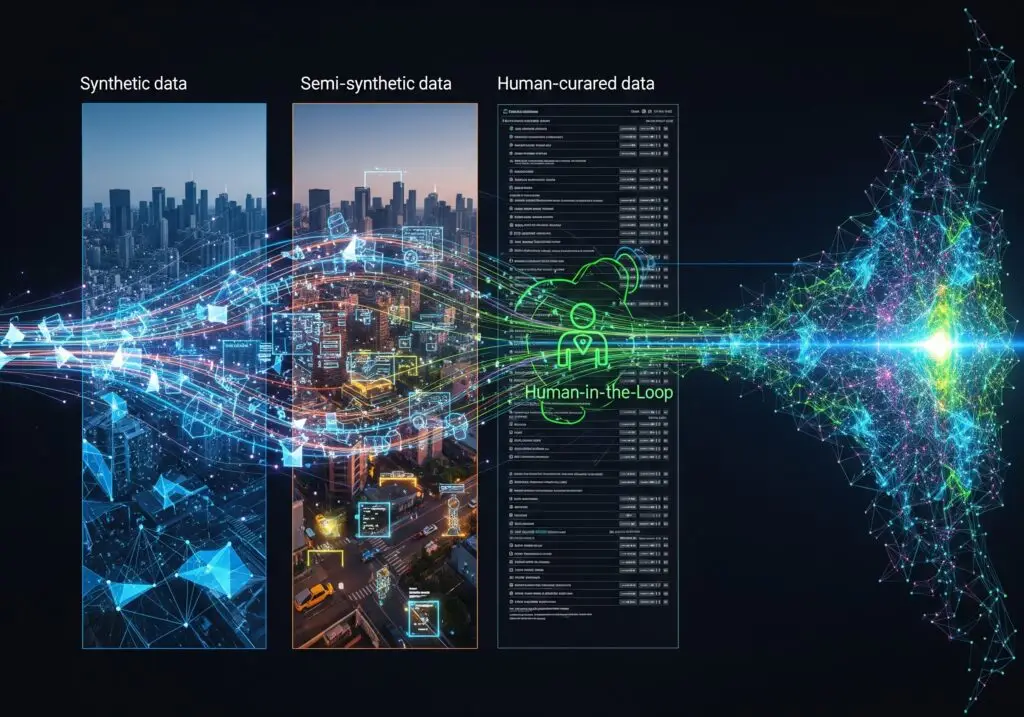
AI Dataset Creation Services: Difference between Synthetic, Semi-Synthetic, and Human-Curated Data
Synthetic data accelerates AI dataset creation and expands coverage for rare or dangerous scenarios, but it cannot replace real-world data on its own for most enterprise AI applications. Semi-synthetic approaches, combining generated content with real field samples, tend to offer a more reliable balance. Human-curated datasets remain non-negotiable in domains where annotation quality, regulatory accountability, or distribution fidelity directly affect model safety and performance.
Choosing the wrong dataset creation strategy is one of the most common reasons AI programs stall between pilot and production. End-to-end AI data collection that spans all three approaches is increasingly necessary because most real-world programs draw from more than one source. Understanding the tradeoffs between synthetic, semi-synthetic, and human-curated data is where the actual judgment begins.
Key Takeaways
- Synthetic data has a defined role by covering rare scenarios, generating privacy-safe surrogates, and bootstrapping volume. But models trained excessively on synthetic data exhibit consistent performance degradation in production due to distribution shift and the risk of model collapse.
- Semi-synthetic data, which anchors generated augmentations to real samples, tends to outperform pure synthetic pipelines because the base real data provides distributional grounding that generators cannot produce from scratch.
- Human-curated datasets are non-negotiable in safety-critical domains (ADAS, Medical NLP, and Robotics), preference optimization (RLHF/DPO), and trust-and-safety applications.
- The choice between data generation methods should be calibrated to each training stage and model objective, because the same program often needs synthetic coverage, semi-synthetic augmentation, and human-curated ground truth at different points.
What Are AI Dataset Creation Services?
AI dataset creation services refer to the end-to-end processes by which training, evaluation, and fine-tuning datasets are sourced, generated, structured, and quality-checked for use in machine learning models. There are three primary data production methods: fully synthetic generation, semi-synthetic augmentation, and human-curated collection. Each method operates under different assumptions about data fidelity, coverage, cost, and risk tolerance. AI teams increasingly need to understand not just what these methods produce, but what they reliably cannot produce, because those gaps tend to surface in production.
What Is Synthetic Data, and When Does It Work?
Synthetic data is artificially generated content, viz., text, images, video, sensor readings, or tabular records. Synthetic data is produced by generative models, simulation engines, or rule-based programs rather than captured from real-world sources. It has genuine utility in specific contexts, covering rare or hazardous scenarios that are impractical to capture (a vehicle rollover, a chemical spill, an extreme weather edge case), generating privacy-safe surrogates for regulated datasets, and bootstrapping model training when real data simply does not yet exist in sufficient volume.
Where synthetic data tends to fail
The well-documented failure mode is distribution shift. Synthetic generators can only produce distributions that reflect the assumptions baked into the generator, whether that is a physics simulator, a language model, or a Generative Adversarial Network. When the real deployment environment differs from those assumptions, the model trained on synthetic data tends to break in unpredictable ways. A 2024 arXiv study on language model collapse from synthetic training data demonstrated formally that models trained solely on synthetic data cannot avoid collapse over iterations. The statistical richness of the original human-generated distribution degrades with each generation. Mixing synthetic with real data mitigates this, but pure synthetic pipelines do not.
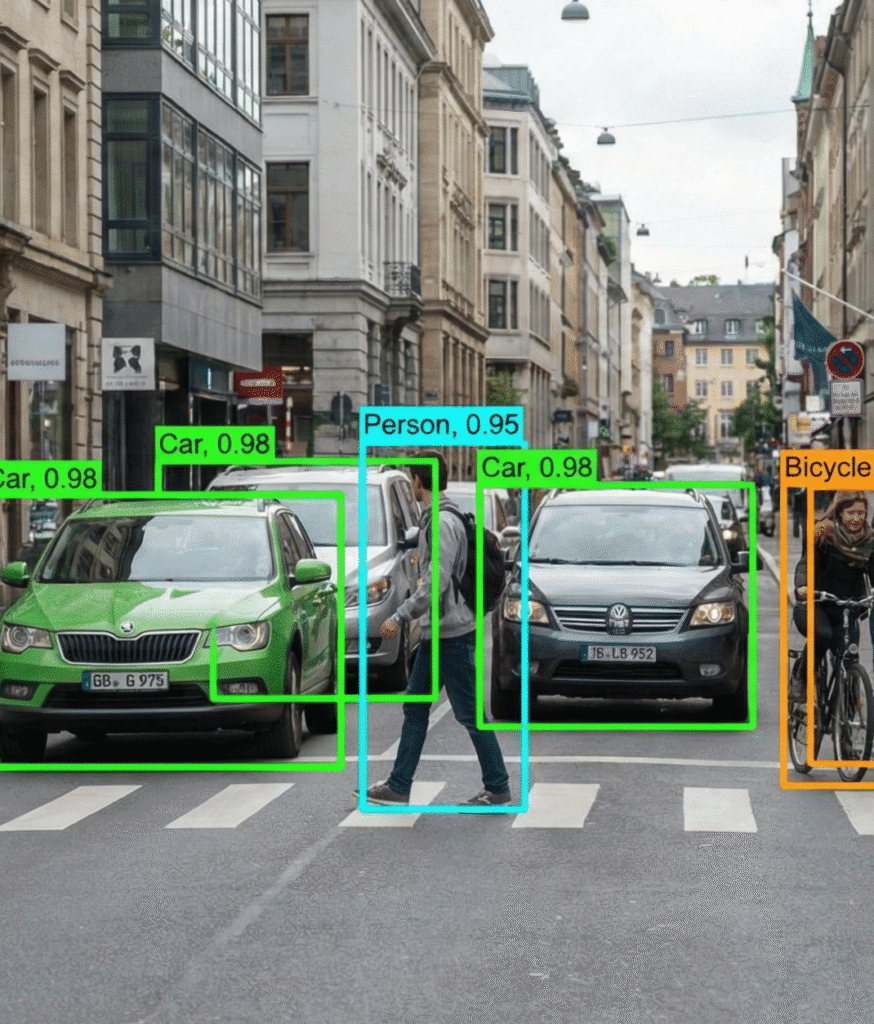
For physical AI and ADAS applications, synthetic data pipelines for autonomous driving are particularly useful for generating rare scenario coverage like construction zones, adverse weather, or pedestrian edge cases, but they consistently underperform on sensor realism unless grounded with real-world calibration data. Simulation fidelity is high enough for training initial layers of perception but rarely sufficient for safety-critical validation.
What Is Semi-Synthetic Data, and Why Do Teams Use It?
Semi-synthetic data combines real-world data samples with generated augmentations. In semi-synthetic data, the base dataset of genuine recordings or images is expanded through controlled transformations, weather overlays applied to real camera frames, paraphrase generation seeded from authentic customer conversations, and augmented LiDAR returns layered onto real point cloud captures. The real samples anchor the distribution, and generated augmentations extend coverage & volume without introducing full simulator bias.
Why semi-synthetic tends to outperform pure synthetic
Mixing any synthetic data type with real data substantially improves performance over using that synthetic type alone. The base real samples provide the distributional grounding that synthetic generators struggle to replicate from scratch. Semi-synthetic approaches, therefore, combine cost efficiency with better coverage of tail scenarios, and without asking a generator to hallucinate an entire domain from first principles. For teams running multi-layered data annotation pipelines, semi-synthetic datasets often reduce the annotation burden by generating clear, controllable examples that are faster to label than noisy real-world captures.
Where semi-synthetic data introduces risk
If the augmentation process does not preserve the statistical structure of the real samples, the hybrid dataset can mislead training. A paraphrase generator that systematically smooths out grammatical irregularities will produce cleaner training sentences than the model will ever see in production. Augmentation pipelines need explicit quality controls, including human review of a representative sample to confirm that the generated portion does not distort the base distribution.
What Is Human-Curated Data, and When Is It Non-Negotiable?
Human-curated datasets are built through deliberate collection and annotation by human contributors, viz., crowd workers, domain experts, or specialist annotators working to a defined taxonomy and quality standard. They are slower and more expensive to produce than synthetic or semi-synthetic alternatives. They are also the only reliable source of distribution fidelity in domains where the real-world signal contains nuance that no generator currently captures.
Building AI-ready datasets at scale through human curation requires far more than running annotation tasks. Building AI-ready datasets at scale involves far more than just labeling data. It requires clear taxonomy design, trained annotators, consistent quality measurement, ongoing review cycles, and structured feedback loops, areas that many internal teams tend to underestimate until the project is already underway.
Domains where human curation is non-negotiable
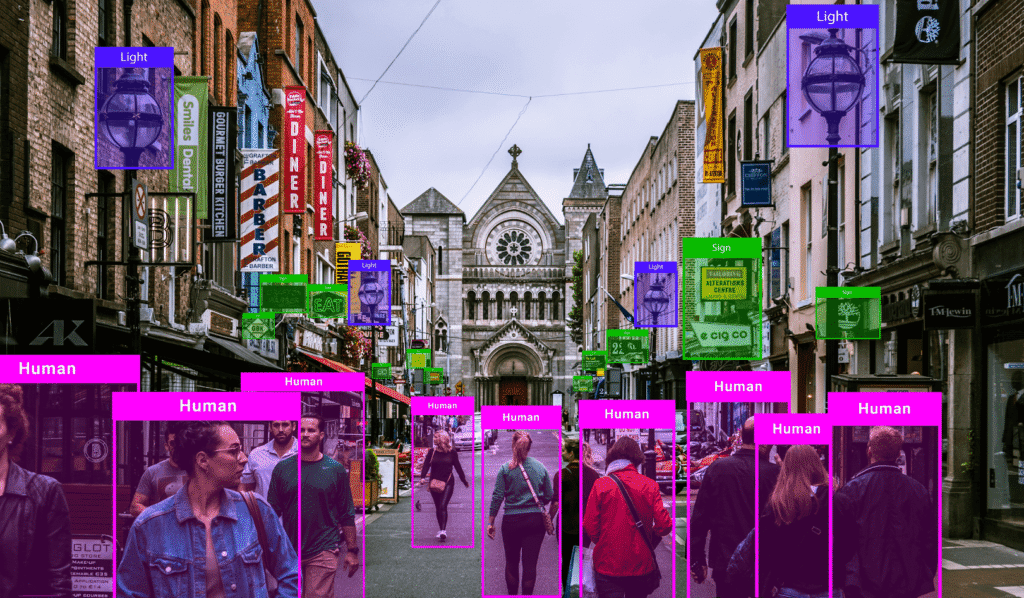
- Safety-critical perception models (ADAS, surgical robotics, aviation), where annotation errors have direct physical consequences
- Legal, medical, and financial NLP, where the model output must be traceable to verified source data for regulatory compliance
- Low-resource language models where no pre-existing generative model has sufficient coverage to produce fluent, natural synthetic text
- Preference optimization (RLHF/DPO) where the training signal is explicitly human judgment, not a distributional proxy
- Trust and safety content moderation, where the labeling taxonomy requires cultural and contextual knowledge that automated systems cannot reliably apply
The risk of treating human curation as optional in these domains shows up as bias in generative AI systems, systematic errors that are invisible in evaluation metrics but damaging in deployment. Human annotators, when properly selected and calibrated, introduce diversity of judgment that generators cannot approximate.
Is Synthetic Data Enough for Training Enterprise AI Models?
Synthetic data is a useful component of a larger data strategy, but it is not a substitute for real-world data in production-grade systems.
Enterprise models operate in deployment environments that are messier, more variable, and more adversarial than any generator’s training assumptions. A 2025 MIT analysis of synthetic data pros and cons in AI notes that using synthetic data requires careful evaluation and checks to prevent performance degradation at deployment, because statistical similarity to a training distribution does not guarantee behavioral reliability in the target environment. Benchmarks can look clean while real-world performance degrades.
The practical answer for enterprise AI teams is that quality data remains the defining factor in generative AI outcomes, and quality is determined by how well the dataset represents the deployment distribution. Synthetic data earns its place when it solves a specific problem: coverage of rare events, privacy-safe surrogates, volume bootstrapping. It does not replace real-world ground truth for model validation, for preference learning, or for domains where regulatory accountability requires traceable human judgment at every annotation step.
How Digital Divide Data Can Help
Digital Divide Data works with AI programs across the full spectrum of dataset creation approaches. For teams building synthetic or semi-synthetic pipelines, DDD provides a human-in-the-loop quality review that validates whether generated data preserves the distributional properties required for reliable training.
For programs that require human-curated ground truth, DDD’s multimodal data annotation services cover text, image, video, audio, and sensor modalities under a unified quality framework, including inter-annotator agreement tracking, calibration protocols, and escalation paths for ambiguous cases. For ADAS and Physical AI programs specifically, DDD operates annotation workflows at the sensor fusion level, handling LiDAR, camera, and radar streams together rather than treating each modality in isolation, which is where many annotation vendors introduce consistency errors.
For programs weighing when to generate versus when to collect, DDD’s data strategy teams work upstream of annotation, helping define the right mix of synthetic, semi-synthetic, and human-curated sources for a given model objective, domain, and risk profile.
Build dataset programs that match your model’s actual requirements. Talk to an Expert!
Conclusion
Synthetic, semi-synthetic, and human-curated data are not competing data sets, they are tools with different operating ranges. Synthetic data scales fast and covers rare scenarios efficiently, but it introduces distribution shift risk and degrades when used exclusively. Semi-synthetic approaches extend real data without generator bias, but require quality controls to confirm the augmentation preserves the source distribution. Human-curated datasets are irreplaceable in domains where annotation fidelity, regulatory traceability, or distributional accuracy is a hard requirement.
AI programs that treat dataset creation as a one-time procurement decision consistently underperform against those that treat it as an ongoing engineering discipline, one where the choice of generation method is calibrated to each training stage and model objective. The teams that get this right build systems that hold up in production. The teams that get it wrong tend to discover the gap in deployment when the cost of correction is highest.
References
Seddik, M. E. A., Chen, S.-W., Hayou, S., Youssef, P., Debbah, M. (2024). How bad is training on synthetic data? A statistical analysis of language model collapse. arXiv preprint. https://arxiv.org/abs/2404.05090
Guo, X., Chen, Y., (2024). Generative AI for synthetic data generation: Methods, challenges and the future. arXiv preprint 2403.04190. https://arxiv.org/abs/2403.04190
Kang, F., Ardalani, N., Kuchnik, M., Emad, Y., Elhoushi, M., Sengupta, S., Li, S.-W., Raghavendra, R., Jia, R., Wu, C. J., (2025). Demystifying synthetic data in LLM pre-training: A systematic study of scaling laws, benefits, and pitfalls. arXiv preprint 2510.01631. https://arxiv.org/html/2510.01631v1
Frequently Asked Questions
Is synthetic data enough for training enterprise AI models?
Synthetic data works well for covering rare scenarios, generating privacy-safe surrogates, and bootstrapping volume, but models trained exclusively on synthetic data consistently show performance degradation when deployed in real environments. The statistical richness of human-generated distributions degrades when synthetic data replaces real data entirely. Mixing synthetic with real data is more reliable than using either alone.
What is the difference between synthetic and semi-synthetic data for AI training?
Synthetic data is fully generated; no real-world samples are involved. Semi-synthetic data starts with real samples and extends them through controlled augmentation. The key difference is distributional grounding; semi-synthetic datasets anchor generated content to real-world distributions, which tends to produce more reliable model behavior at deployment than purely generated data.
Which domains require human-curated datasets over the synthetic data?
Domains where annotation errors have direct safety consequences, such as ADAS, surgical robotics, aviation perception, etc., require human-curated ground truth because synthetic data cannot replicate sensor realism at the level needed for safety-critical validation. Medical, legal, and financial NLP also require human curation for regulatory traceability. Low-resource languages and trust and safety content moderation are further examples where no current generator produces sufficiently accurate outputs.
How does semi-synthetic data reduce annotation costs without sacrificing model quality?
Semi-synthetic augmentation extends a smaller real dataset to a greater volume and scenario coverage without requiring the collection of every variant from scratch. Because the base samples are real, the generated augmentations inherit distributional properties that pure generators cannot produce. The important caveat is that the augmentation pipeline itself needs human quality review to confirm that the generated portion does not distort the base distribution.

Kevin Sahotsky leads strategic partnerships and go-to-market strategy at Digital Divide Data, with deep experience in AI data services and annotation for physical AI, autonomy programs, and Generative AI use cases. He works with enterprise teams navigating the operational complexity of production AI, helping them connect the right data strategy to real model performance. At DDD, Kevin focuses on bridging what organizations need from their AI data operations with the delivery capability, domain expertise, and quality infrastructure to make it happen.